Aharonov-Bohm Effect
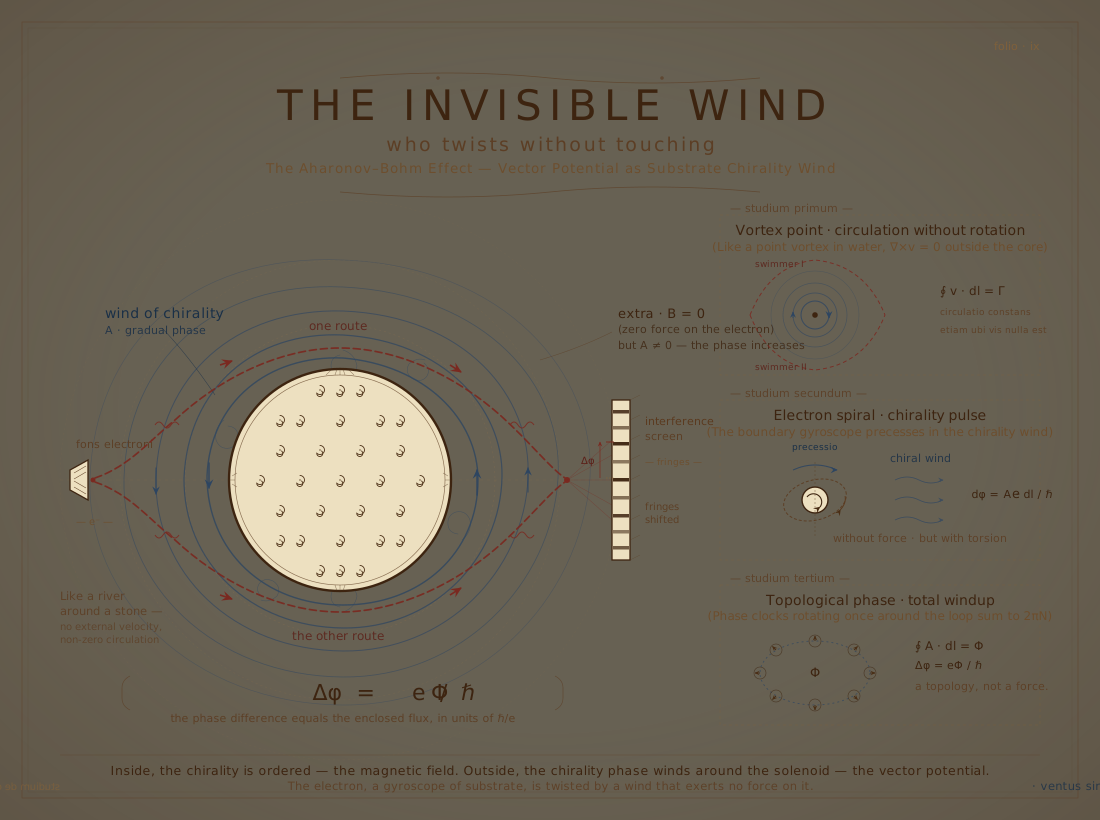
The vector potential is the substrate’s chirality wind
Interactive: open the Aharonov–Bohm simulation — see the solenoid’s chirality wind circulate with zero curl (paddle wheels ride it without turning, and every loop that encloses the solenoid reads the same \Phi whatever its shape), take the shield off to see the loophole Tonomura closed, send electrons round both sides as gyroscopes whose hands twist while their paths stay straight and the fringes move by \Phi/\Phi_0, and ride with one electron through a uniform wind to watch its hand lock to the substrate’s chirality phase — turning only for the wind along its motion.
The Standard Mystery
The Aharonov-Bohm effect is one of the most conceptually jarring results in quantum mechanics. Take a long solenoid carrying current. The magnetic field \mathbf{B} is entirely confined inside — outside the solenoid, \mathbf{B} = 0 everywhere, exactly. Shield the solenoid perfectly. Now send an electron beam around both sides of it and recombine the beams on a detector screen.
The interference pattern shifts — by an amount proportional to the enclosed magnetic flux \Phi. The electron never enters the region where \mathbf{B} is nonzero. No force acts on it. Yet something physical happens.
In standard QM, the resolution is that the vector potential \mathbf{A} — which is nonzero outside the solenoid even when \mathbf{B} = 0 — enters the Schrödinger equation directly. The phase accumulated along each path is:
\varphi = \frac{e}{\hbar} \oint \mathbf{A} \cdot d\mathbf{l}
and the phase difference between the two paths is:
\Delta\varphi = \frac{e\Phi}{\hbar}
where \Phi = \oint \mathbf{A} \cdot d\mathbf{l} is the total enclosed flux. This was experimentally confirmed by Tonomura et al. (1986) using electron holography with superconducting-shielded toroidal magnets — an exquisite measurement that eliminated every possible loophole involving stray fields.
The standard interpretation treats \mathbf{A} as “more fundamental” than \mathbf{B}, but leaves its physical content opaque. What is the vector potential, physically? Why should a mathematical gauge field — defined only up to a gradient — have observable consequences? The substrate framework gives a direct answer.
The Substrate Interpretation
From Higgs Field, the electromagnetic vector potential \mathbf{A} is the chirality phase gradient of the dc1 substrate.
Inside the solenoid, the current organizes the substrate’s chirality — it creates a region of aligned co-rotating flow, analogous to the ordered state in Higgs Field but now with a specific spatial pattern. This organized chirality is the magnetic field \mathbf{B}.
Outside the solenoid, the chirality amplitude is uniform — no local measurement of chirality strength reveals anything unusual. This is why \mathbf{B} = 0. But the chirality phase — the angular orientation of the chirality axis — winds around the solenoid. A loop encircling the solenoid picks up a total phase winding proportional to the enclosed flux. This winding is the vector potential \mathbf{A}.
Think of it hydraulically. A point vortex in a fluid has zero curl (zero rotation) everywhere except at the core. Yet the fluid circulates around the core — the velocity field is nonzero everywhere. If you send two swimmers around opposite sides and time them, they arrive with different phases. The swimmers feel no local “force,” but they are moving through a fluid that has a nontrivial circulation topology. The vector potential outside a solenoid is the same phenomenon in the chirality field: a topological wind with zero curl but nonzero circulation.
How the Electron Couples
The electron, as described in Conductors, is a vortex core of dc1 with a counter-rotating boundary layer. That boundary layer has a definite chirality — it is a gyroscopic structure with a specific phase relationship between its core spin and boundary counter-spin.
As the electron moves through the substrate’s chirality wind, its counter-rotating boundary precesses. The boundary layer is a gyroscope embedded in a slowly rotating medium. At every point along the path, the local chirality gradient applies a tiny torque to the electron’s boundary phase — not enough to deflect it (no force), but enough to rotate its internal phase.
This is the crucial distinction: the chirality wind doesn’t push the electron (no force, consistent with \mathbf{B} = 0 outside), but it twists the electron’s phase. The accumulated phase twist along a path is:
\varphi_\text{path} = \frac{e}{\hbar} \int_\text{path} \mathbf{A} \cdot d\mathbf{l}
For an electron taking path 1 (left of the solenoid), the chirality wind is co-aligned with its motion for part of the journey and counter-aligned for the rest. For path 2 (right), the alignment is reversed. The net phase difference between the two paths is:
\Delta\varphi = \frac{e}{\hbar} \oint \mathbf{A} \cdot d\mathbf{l} = \frac{e\Phi}{\hbar}
This is the exact AB phase, reproduced from the substrate’s chirality topology without invoking any force on the electron.
Why Shielding Doesn’t Help
The solenoid shielding eliminates the magnetic field outside — in substrate language, it ensures that the chirality amplitude (the strength of the local chirality preference) is uniform outside the shield. But shielding cannot eliminate the topological winding of the chirality phase, for the same reason you cannot remove the circulation around a bathtub drain by putting a lid on the drain. The winding is a topological property of the field configuration, not a local emission. It exists because the enclosed flux creates a nontrivial holonomy in the chirality field.
In the substrate picture, this is intuitive: the organized chirality inside the solenoid has wound the substrate’s phase around itself. The shield confines the amplitude disturbance but the phase winding, being a topological feature of the substrate’s global state, threads through the shield and extends to infinity. It falls off as 1/r (the familiar vector potential of a solenoid), which is exactly the behavior of a vortex circulation in a superfluid.
Connection to Berry Phase (Fine Structure Constant)
The AB phase is a Berry phase — the geometric phase accumulated when a quantum state is transported around a closed loop in parameter space. In the substrate framework, this connection is physical, not just mathematical.
The electron’s counter-rotating boundary defines a state on the Bloch sphere (Spin-Statistics). As the electron moves through the substrate’s chirality gradient, the boundary’s state vector traces a path on the Bloch sphere. The solid angle subtended by this path on the sphere is the Berry phase — and for the AB configuration, this solid angle equals e\Phi/\hbar.
The fine structure constant \alpha enters because it governs how strongly the electron’s boundary couples to the substrate’s chirality field. The coupling strength e (the electron charge) is, in substrate terms, the torque coefficient between the electron’s counter-rotating boundary and the substrate’s chirality gradient. The AB phase = e\Phi/\hbar is the product of this coupling (e) and the topological winding (\Phi), measured in units of the substrate’s fundamental action quantum (\hbar = 2mD, from the counter-rotating layer’s diffusion constant).
Quantitative Status
The qualitative picture — vector potential as chirality phase winding, electron coupling through boundary precession — reproduces the AB phase exactly because the identification \mathbf{A} = chirality gradient is the same identification that reproduces Maxwell’s equations from the substrate dynamics (The Photon as Modon). The AB effect is not an independent test; it is a consistency check on the same chirality field interpretation that gives the photon and the electromagnetic force.
What would constitute a new prediction is the substrate’s answer to the question: does the AB phase depend on the electron’s speed? In standard QM, it does not — the phase is purely geometric. In the substrate framework, the coupling between the electron’s boundary and the chirality gradient could have a velocity-dependent correction at very high speeds (where the electron’s boundary layer structure is relativistically modified). This correction would be of order v^2/c^2 relative to the standard phase and is currently far below experimental sensitivity.
Status: Qualitative interpretation complete. Quantitative derivation needed: show that the substrate chirality gradient around an infinite solenoid gives \mathbf{A} = (\Phi/2\pi r)\,\hat{\mathbf{e}}_\theta exactly, and that the boundary-chirality coupling reproduces the minimal coupling e\mathbf{A} in the Hamiltonian. The calculation should connect to the Berry phase formalism of Fine Structure Constant (fine structure constant).