Higgs Field
The Higgs Field as the Substrate’s Chirality Order Parameter
What the Standard Model Says (and What It Leaves Unexplained)
The Higgs mechanism is the part of the Standard Model that most physicists acknowledge is mathematically powerful but physically opaque. The “Mexican hat potential” is a mathematical device — nobody can tell you what physical thing has that potential. The substrate can.
The electroweak theory unifies electromagnetism and the weak force under the gauge group \text{SU}(2)_L \times \text{U}(1)_Y. At high energies, this symmetry is exact — the W and Z bosons are massless, all fermions are massless, and left-handed and right-handed particles are independent. The Higgs field is a complex scalar doublet \phi with a potential:
V(\phi) = \mu^2|\phi|^2 + \lambda|\phi|^4
with \mu^2 < 0 and \lambda > 0. This gives the Mexican hat potential — a circle of degenerate minima at |\phi| = v = \sqrt{-\mu^2/2\lambda} \approx 246 GeV. The field “rolls” to one of these minima, breaking \text{SU}(2)_L \times \text{U}(1)_Y \to \text{U}(1)_\text{EM}. Three of the four Higgs degrees of freedom become the longitudinal polarizations of W^+, W^-, and Z^0 (giving them mass). The fourth is the physical Higgs boson at 125 GeV.
What the Standard Model does not explain:
- Why the potential has \mu^2 < 0 (why the symmetric state has higher energy than the broken one)
- What the Higgs field physically is (it is postulated as a scalar field with no material content)
- Why the gauge group is \text{SU}(2)_L \times \text{U}(1)_Y and not some other group
- Why the Higgs couples to different fermions with wildly different strengths (producing the mass hierarchy from neutrinos to top quarks)
- What physical mechanism makes the W and Z massive while leaving the photon massless
The substrate framework addresses all five.
The Substrate Chirality Field
The central identification:
The Higgs field is the local chirality state of the dc1 substrate.
Figure 12.1. Substrate chirality order parameter. Left: Above the electroweak temperature, cell vortex cores have random chiralities (teal = left-handed, amber = right-handed), creating shear boundaries everywhere. The symmetric state |φ| = 0 is a local energy maximum. Right: Below TEW, same-chirality clustering wins — all orbital systems align to one handedness, co-rotating flows merge into smooth channels, and boundary energy is minimized. The equilibrium chirality amplitude is v = 246 GeV.
At every point in space, the substrate has a co-rotating/counter-rotating structure. The state of the substrate at a point is characterized by the balance between left-handed and right-handed orbital systems — which chirality dominates locally. This is a continuous variable described by a unit vector on a sphere (the orientation of the net chirality axis) plus an amplitude (how strongly the chirality dominance holds).
From the dual-spin gyroscope model (Spin-Statistics), every cell-vortex core in the substrate has a core-boundary structure with a definite phase relationship. The collection of all these phase relationships across space defines a field — the substrate chirality field. This field has the same mathematical structure as the Higgs doublet:
- Two complex components → the chirality axis can point in any direction on the Bloch sphere (the S^2 from \text{SU}(2)/\text{U}(1) identified in Spin-Statistics), parametrized by two complex numbers
- An amplitude → the strength of the chirality preference at that point (how far the substrate is from the symmetric, unpolarized state)
- A phase → the orientation of the co-rotating flow relative to a reference direction
The Higgs vacuum expectation value v = 246 GeV is the equilibrium chirality amplitude of the substrate — how strongly the substrate prefers one handedness over the other in its ground state.
Why the Symmetric State Is Unstable: The Mexican Hat from Fluid Dynamics
Consider a patch of substrate with no preferred chirality — an equal mixture of left-handed and right-handed orbital systems, randomly oriented. This is the symmetric state (the top of the Mexican hat, where |\phi| = 0).
This state is unstable, for a purely fluid-dynamical reason.
Figure 12.2. Spontaneous symmetry breaking as chirality clustering. Stage 1: Above TEW, orbital systems have random chiralities — every mismatched neighbor creates a shear boundary. Stage 2: As the universe cools, same-chirality systems cluster into domains, eliminating internal shear. Domain walls (counter-rotating boundaries between left and right domains) store the remaining boundary energy. Stage 3: One domain wins everywhere. Domain walls are pushed to the edges and dissipate. The substrate settles into its chirally ordered ground state at |φ| = v = 246 GeV.
In a superfluid filled with orbital systems of both chiralities, same-chirality orbital systems attract — they can share co-rotating flow channels, reducing boundary energy. Opposite-chirality systems repel — they create shear boundaries where their co-rotating flows collide. This is the same physics that makes Cooper pairs form: two opposite-spin electrons create a shared counter-rotating vortex that binds them (Conductors). Here it operates at the substrate level: same-chirality cell-vortex cores cluster, creating domains of net chirality.
Once a domain forms, it grows. Each new same-chirality orbital system that joins reduces the total boundary energy. The domain walls between left-handed and right-handed regions store energy (they are counter-rotating boundaries). The lowest-energy configuration minimizes total domain wall area, which means: one chirality wins everywhere.
This is spontaneous symmetry breaking, and it happens for the same reason ferromagnets spontaneously magnetize below the Curie temperature — the aligned state has lower energy than the random state, even though the random state respects the underlying symmetry.
The Mexican hat potential emerges from the substrate energetics:
The radial direction (|\phi|) is the chirality amplitude — how strongly one handedness dominates. The symmetric state |\phi| = 0 is a local maximum (unstable) because same-chirality clustering is energetically favorable.
The angular direction (the phase of \phi) is the orientation of the chirality axis — which direction in \text{SU}(2) space the chirality points. All orientations have the same energy (the substrate has no preferred internal direction), so the minimum is a circle: the brim of the hat.
\mu^2 < 0 corresponds to the chirality clustering energy (which favors |\phi| > 0) overwhelming the entropy cost of ordering (which favors |\phi| = 0). In the substrate, \mu^2 is determined by the balance between co-rotating attraction energy and the thermal/kinetic energy of the orbital systems.
\lambda > 0 is the self-interaction that stabilizes the amplitude at a finite value — the chirality cannot grow without bound because at full alignment, the boundary energy per additional alignment drops to zero. In substrate terms, \lambda is set by the saturation of the co-rotating channel capacity: once all orbital systems in a region are co-aligned, no further energy gain is available.
The equilibrium amplitude:
v = \sqrt{-\mu^2/2\lambda} = 246 \text{ GeV}
In substrate language: v is the net chirality energy density of the fully aligned ground state. It is 246 GeV because that is the energy scale where the co-rotating clustering energy (set by the orbital system dynamics) balances the saturation self-interaction.
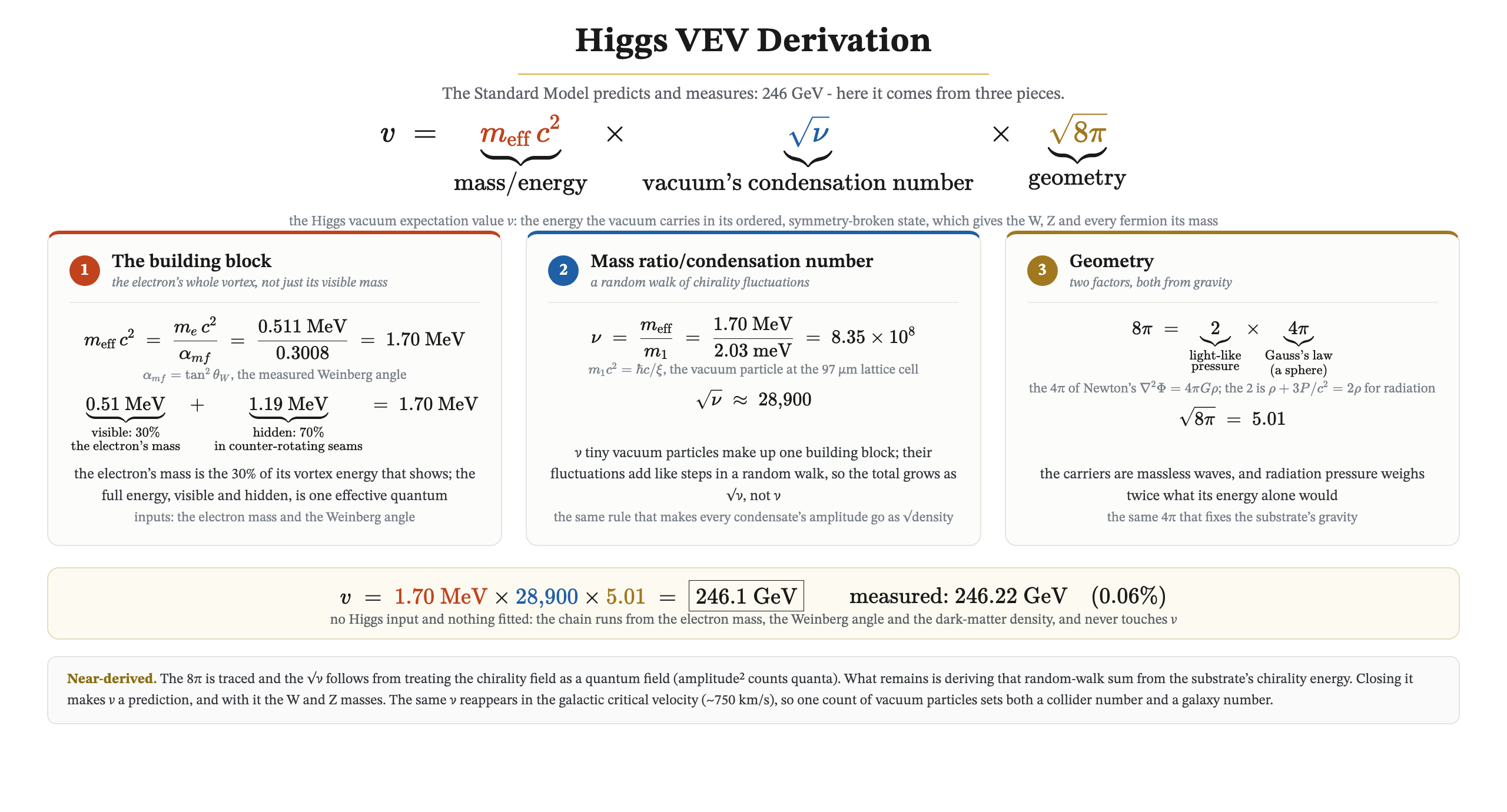
Two-scale connection. The Weinberg angle running independently identifies E_\text{core} \sim TeV as the energy scale of the vortex core structure in the counter-rotating boundary. The Higgs VEV v = 246 GeV and E_\text{core} are the same order — both reflect the chirality ordering energy of the dc1 substrate. This is consistent: v sets the equilibrium chirality amplitude, and E_\text{core} sets the energy at which probes resolve the vortex core’s internal structure. Both are determined by the same boundary physics. While v has long been treated as a measured input, the framework now has a near-derived closed form for it — v = \sqrt{8\pi\,m_\text{eff}^2 c^4\,\nu} = 246.1 GeV (within 0.06%; developed in the open-problem section below and in Open Problems § WIP-15).
From Sheets to Stacking: The Three-Dimensional Lattice
The Mexican hat mechanism drives same-chirality orbital systems to cluster into 2D sheets — triangular lattices where co-rotating systems share flow channels and counter-rotating vortices fill every interstice, channeling away elastic collision energy. Within each sheet, this is the familiar Abrikosov/Tkachenko lattice, confirmed by rotating BEC experiments. But the substrate is three-dimensional. How do these sheets stack?
The answer reveals a dynamical structure that connects the Higgs VEV to the bridge equation’s dimensional structure — and may explain why the 2D vortex lattice mathematics works so accurately for a 3D medium.
Offset stacking
Sheets cannot stack directly above each other — orbital system over orbital system — because each orbital system has polar axial streams radiating from its rotation poles. These polar jets are the same physics that produces astrophysical jets, magnetic polar regions, and the radial nodes of hydrogen wavefunctions: the pressure minimum along the rotation axis draws substrate flow inward, creating intermittent bursts of axial energy. If two orbital systems were stacked pole-to-pole, their jets would collide head-on, maximizing turbulence and energy.
Instead, the system slides to the energetically favorable offset position: each orbital system in one sheet sits above a counter-rotating vortex in the sheet below. This is analogous to HCP crystal stacking — the offset minimizes inter-layer energy by aligning sources with sinks.
Polar jet–vortex coupling
With offset stacking, each orbital system feeds its polar jet directly into the counter-vortex suction in the adjacent layer. The counter-vortex, spinning opposite to the orbital system, acts as a natural drain — pulling the jet stream inward. Meanwhile, the orbital system below the vortex feeds its own polar jet upward into the same coupling region.
This creates a dynamical spring between layers — but not a passive one. The coupling is self-correcting in a way that makes the lattice extraordinarily robust.
Consider what happens when an external perturbation — a passing modon, a density fluctuation, a collision remnant — disrupts the angle of an orbital system’s rotation plane with respect to the lattice. The orbital tilts, and its pole digs into the substrate at a steeper angle. Like a slalom skier carving hard into a turn, the steeper the dig, the greater the spray: the polar jet intensifies in proportion to the angular displacement from equilibrium.
That intensified spray does not dissipate. It feeds directly into the counter-rotating vortices in the adjacent layers — the Josephson-like vortex lines that thread the inter-sheet gaps. These vortices accelerate to absorb the extra angular momentum. Faster vortices mean stronger coupling between layers, which pulls the tilted orbital system back toward its equilibrium orientation.
This is the righting moment: the further the lattice leans, the stronger the polar jet, the more angular momentum couples into adjacent layers’ vortices, the harder the restoring force pulls it back. There is no overshoot because the same mutual friction that creates the coupling also dissipates excess energy — the reactive and dissipative channels of HVBK work together, steering the system to equilibrium rather than past it.
The result is a “springing mattress” of dynamically coupled sheets, breathing in a vibrating equilibrium set by three competing effects:
Compression — the polar jet is drawn into the counter-vortex suction, pulling sheets together. More flow means stronger coupling.
Repulsion — as sheets approach too closely, the counter-circulation between orbital systems in adjacent layers generates boundary turbulence (related to the Glaberson–Johnson–Ostermeier instability of axial superflow), pushing the sheets apart.
Equilibrium — the spacing is not a static well dug by balancing compression against repulsion (that two-term balance has only an unstable maximum). The substrate is a self-organizing superfluid, not an imposed-layer crystal: the threading vortex lines go unstable under the axial flow and ring at a single Glaberson–Johnson–Ostermeier wavelength, which carves the inter-sheet period in closed form, d_\text{GJO} = \xi\sqrt{\ln(\xi/\xi_\text{GP})/(4\pi)} \approx 0.166\,\xi \approx 16\;\mum — deep in the strongly anisotropic regime where each sheet’s in-plane physics is effectively two-dimensional. The derivation and the GJO-versus-Lawrence-Doniach choice are developed in Substrate Particles § The Vertical Scale; see Open Problems § WIP-15 for the full status.
The machine hiding in the diagram
Look at the diagram again. Not at the individual components — at the whole.
There are three sheets of co-rotating orbital systems (coral), separated by counter-spinning vortices (teal), with polar jet particles streaming between them through coupling zones. It looks like three separate mechanisms: in-plane rotation, inter-layer jet flow, and vortex suction. But it is not three mechanisms. It is one.
The same dc1 fluid that spins in the orbital plane is the fluid that streams out the poles, and the fluid that spirals into the counter-vortex in the next sheet, and the fluid whose elastic collisions set the equilibrium spacing between layers. Every degree of freedom is coupled to every other through a continuous elastic medium. Pull on any one — increase the inter-sheet spacing d, say — and watch what happens:
- Wider gaps draw out more polar jet energy from the orbital poles (the suction path is longer, the pressure gradient steeper).
- More polar jet flow speeds up the counter-vortex below (more angular momentum dumped into it).
- Faster counter-vortices increase the effective coupling between adjacent orbital systems in the same sheet (the boundary layer spins harder).
- Stronger in-plane coupling pulls orbital nodes closer together.
- Closer nodes mean more concentrated polar jets.
- More concentrated jets resist the widening — they pull the sheets back.
Every perturbation triggers a feedback cascade that restores the equilibrium. This is not a static lattice. It is a dynamical machine whose stability emerges from the continuous interplay of radial flow, axial flow, and boundary-layer angular momentum — all carried by the same substrate fluid, all governed by the same elastic collision dynamics.
The stiffness hierarchy
The lattice’s mechanical character can be quantified through three elastic moduli, borrowed from Blatter et al.’s theory of vortex lattices in layered superconductors:
c_{44} — the tilt modulus. The cost of bending vortex lines away from straight. Microscopically, it is line tension — each extra unit of bent vortex line costs energy proportional to \nu_s = (\kappa/4\pi)\ln(r_v/r_c). The logarithmic factor can be 10 to 20 in practice, making tilt the stiffest spring in the mattress.
c_{11} — the compression modulus. The cost of changing the local vortex density. In isolation, c_{11} is formally negative — a vortex array would implode if it were not stabilized by the hydrodynamic coupling to the fluid. The fluid inertia (via the Helmholtz frozen-in condition) prevents collapse: compressing the array forces the fluid to rearrange, and that kinetic cost stabilizes the system.
c_{66} — the shear modulus. The cost of sliding adjacent rows of the triangular lattice past each other — the rigidity against Tkachenko waves. This is the softest modulus, with no logarithmic enhancement: just \rho\kappa\Omega/(8\pi).
The hierarchy c_{44} \gg c_{11} \sim c_{66} is the key physical fact. The mattress is very stiff along the spring axis — bending vortex lines out of the lattice plane is expensive. But it is soft in-plane — rearranging orbital systems within a sheet is cheap. This hierarchy means that under perturbation, the lattice rearranges in-plane rather than tilting, and the polar jet coupling (which bends lines out of the plane) provides a disproportionately strong restoring force. The righting moment mechanism is not just self-correcting — it operates through the stiffest available channel.
The co-rotating cell vortices and the counter-rotating layers that fill the interstices are not separate species — they mark the interface where co-rotation meets counter-rotation at every vortex pairing, the point where the two energies balance. This balance is not fine-tuned. It is self-adjusting, because the same fluid participates in both flows simultaneously. There is no preferred direction of energy transport — radial and axial and rotational are all the same dc1 current responding to the same boundary conditions. That isotropy, imposed by the elastic fluid coupling, is what produces effective Lorentz invariance in a medium that is manifestly anisotropic at the sheet scale.
The three elastic moduli (c_{11}, c_{44}, c_{66}) cannot be computed independently — they are coupled through dc1 fluid continuity. The axial jet flow (which determines c_{44}) is sourced by the same orbital systems whose in-plane interactions determine c_{66} and c_{11}. The correct approach is a self-consistent energy functional that minimizes over (d, \xi, \omega_0) simultaneously. Progress toward this calculation is described below.
Scale invariance
The same topology — rotating disk, polar jets, counter-rotating boundary — appears at every scale where organized energy systems exist in a medium:
- Substrate lattice (\xi \sim 100\;\mum): orbital systems with polar jet coupling through counter-vortex layers.
- Stellar accretion disks (\sim 10^{11} m): rotating plasma with bipolar jets and magnetic boundary layers.
- Active galactic nuclei (\sim 10^{19} m): supermassive black hole accretion with relativistic jets and toroidal vortex structures.
- Galaxy formation (\sim 10^{21} m): disk galaxies with polar outflows and halo vortex circulation.
This is not analogy. It is the same dynamical pattern recurring because the feedback loop — in-plane rotation ↔︎ polar jet flow ↔︎ counter-rotating boundary absorption — is the lowest-energy stable configuration for organized rotational energy in an elastic medium with boundary layers. The topology is dictated by the physics: rotation creates axial pressure minima (polar jets are inevitable), axial flow meets the adjacent layer’s boundary (coupling is inevitable), and the boundary’s counter-rotation provides the restoring force (stability is inevitable). Any system with these ingredients converges to this pattern.
The substrate framework claims this pattern is not merely similar across scales — it is the same mechanism operating in the same medium at different energy densities. The orbital system at 150 fm and the galaxy at 10^{21} m are both boundary-matched rotating structures in the dc1 fluid, separated by 36 orders of magnitude in scale but governed by the same Euler equations with a vorticity source at boundaries.
The open problem — and recent progress
The diagram shows the equilibrium. Recent work (WIP-15) has largely solved the equations that determine it: why the 2D mathematics works, the inter-sheet spacing d_\text{GJO}, and — now in closed form — the Higgs VEV itself. The geometric prefactor 8\pi = 2\times 4\pi_\text{SC2} is traced (radiation-EOS weight \times exact-LI Einstein–Hilbert normalization), and the two items that gated promoting the VEV to a full derivation have narrowed to one: the equation-of-state identification close-packing \Leftrightarrow\mu=0 is closed (it is algebraically the framework’s own emergent-light relation c=\hbar/m_1\xi), leaving a single checkable inter-sheet-coupling identity, E_J=(\xi/d_\text{GJO})\,m_1c^2, for full 3D isotropy. See Open Problems § WIP-15 — two items closed.
Solved: why the 2D math works. The Blatter framework for layered superconductors provides a phase screening length \Lambda = d/\varepsilon, where \varepsilon = d/\xi is the anisotropy parameter. In the substrate, this maps to \Lambda = \xi: below the phase screening length, each layer’s physics is purely two-dimensional. Since the Feynman vortex relation and the L-R modon matching both operate at scale \sim \xi = \Lambda, they sit right at the 2D boundary — each sheet independently executing its in-plane physics. Meanwhile, the modon (whose wavelength is \sim \xi \gg d) sees the long-wavelength regime where the lattice appears fully 3D and isotropic. Same lattice, two regimes, separated by the natural crossover scale \Lambda.
This resolves a foundational concern: the bridge equation uses 2D mathematics and achieves 0.18% accuracy in a 3D medium. The Blatter mapping shows this is not a lucky coincidence — it is the expected behavior of a strongly layered system at the in-plane scale.
Solved: the inter-sheet spacing. The vertical period is fixed in closed form, with no new parameters, by the wavelength of an instability of the vortex lines that thread the stack. Flow running along a rotating vortex array goes unstable above a critical speed — the Glaberson–Johnson–Ostermeier instability — and the unstable Kelvin mode appears at a single wavelength d = 1/k_c = \sqrt{\nu_s/(2\Omega_\text{sheet})}. Substituting Feynman’s relation for the in-plane sheet rotation at one vortex per cell, \Omega_\text{sheet} = \kappa_q/(2\xi^2), and Saffman’s vortex-line-tension cut-off \nu_s = (\kappa_q/4\pi)\ln(\xi/\xi_\text{GP}), the quantum of circulation cancels and the spacing reduces to a purely geometric ratio:
d_\text{GJO} = \xi\sqrt{\frac{\ln(\xi/\xi_\text{GP})}{4\pi}} \approx 0.166\,\xi
Using the two independent estimates of the in-plane coherence length:
| Source | \xi | d_\text{GJO} |
|---|---|---|
| CP (cell occupancy) | 112 μm | 19 μm |
| SC2 (bridge equation) | 96.9 μm | 16 μm |
This is three independent classical-fluid results (the GJO instability wavelength, Feynman’s vortex density, the Saffman cut-off) combined with no fitted coefficient. An earlier reading used a Lawrence-Doniach two-term balance whose critical ratio d/\xi = e^{-(1 + 1/(2\alpha_\text{mf}))} = 0.0698 (\approx 7\;\mum) looked like the spacing — but that critical point is a maximum of the energy, not a well: an energy hilltop a structure rolls off, rescuable only with a third repulsive term that was never derived. The substrate is a self-organizing superfluid (Volovik’s strong-coupling limit, cores nearly touching at \xi_\text{GP} = \xi/\sqrt{2}), not an imposed-layer crystal, so the GJO wavelength — not the Lawrence-Doniach saddle — sets the spacing, and the 7\;\mum value is reread as an upper bound on what the two-term energy alone could support. The Lawrence-Doniach machinery is retained only for the dimensional crossover (the Blatter screening length \Lambda = \xi) that explains why the in-plane mathematics is two-dimensional. Because the stack alternates handedness, a counter-rotating boundary layer falls at every half-period d_\text{GJO}/2 \approx 8\;\mum — the scale any boundary-locked structure feels (red blood cells 6–8\;\mum, capillaries 5–10\;\mum, mitochondria 1–10\;\mum; see DNA and the Living Lattice). Full derivation in Substrate Particles § The Vertical Scale; status in Open Problems § WIP-15.
Near-derived: the Higgs VEV. With d_\text{GJO} fixed, the equilibrium chirality amplitude follows a clean zero-parameter relation in the framework’s own constants — the effective quantum m_\text{eff} = m_e/\alpha_{mf} = 1.70 MeV and the condensation number \nu = m_\text{eff}/m_1 = 8.3\times 10^8 on the electroweak (\xi_\text{SC2}) reading it selects below (the number of dc1 particles in one effective quantum):
\boxed{\;v = \sqrt{8\pi}\;m_\text{eff}c^2\,\sqrt{\nu} = \sqrt{8\pi\,m_\text{eff}^2 c^4\,\nu} = 246.1\;\text{GeV}\;}
— within 0.06% of the measured 246.22 GeV. Physically, v is the chirality-ordering energy of the fully aligned ground state, built as the RMS (in-quadrature) sum of \nu effective-quantum chirality fluctuations across the condensation — the origin of the \sqrt{\nu} amplification. The geometric prefactor factors cleanly as 8\pi = 2\times 4\pi_\text{SC2} — the Gauss/self-consistency 4\pi that fixes the bridge equation (\nabla^2\Phi = 4\pi G\rho) times the radiation-EOS gravitational weight \rho_\text{eff} = \rho + 3P/c^2 = 2\rho of the massless chirality Goldstone sector. The factor of 2 is the framework’s own pressure-gravitates mechanism in its radiation case: the chirality condensate is carried by the massless Goldstone modes (radiation EOS P = \rho c^2/3), which gravitate with weight 2\rho — just as the stiff substrate (P=\rho c^2, weight 4\rho) gives 16\pi G and dust (P\approx 0, weight \rho) gives 4\pi G. Both factors are therefore gravitational; neither is a new constant. (Corroborating that the 4\pi is the SC2 factor: the identity \rho_\text{DM}\kappa_q\omega_0 = 4\pi m_1 c^2 is just SC2 rewritten — though it carries the spurious [\text{m}^3] of the 3D-density recipe, so it confirms the 4\pi’s identity rather than deriving the prefactor.) And the 4\pi is not a separate number to compute: it is the Einstein-Hilbert normalization — the 4\pi that turns G_{\mu\nu} = 8\pi G\,T_{\mu\nu} into \nabla^2\Phi = 4\pi G\rho — which appears automatically once the substrate’s induced gravity is exactly Einstein-Hilbert, i.e. once its emergent Lorentz invariance is exact (exact covariance forces the action to be built from invariants whose leading two-derivative member is \int\sqrt{-g}\,R). So the prefactor rests on the framework’s foundational Lorentz-invariance pillar — the same condition as bridge-equation Step A, supported by GW170817’s c_\text{GW}=c to 10^{-15} — not on a heat-kernel evaluation, which would only yield a scheme-dependent Newton constant, never the Poisson 4\pi. See Open Problems § WIP-15 for the full reframe. The \sqrt{\nu} is the lattice → core scale lift: the chirality Goldstone lives at the vortex-core scale (m_\text{eff} = 1.70 MeV, E_\text{core}\sim TeV), not the lattice-cell scale (m_1 = 2 meV), and \nu = m_\text{eff}/m_1 is the ratio that bridges them. (An earlier reading attributed 8\pi to the Tkachenko shear-modulus factor c_{66} = \rho\kappa\Omega/(8\pi); the numbers exclude that — the physical shear modulus uses a different mass and rotation and misses by \sim 10^3 — see Open Problems § WIP-15 breadcrumb.) The relation uses no QCD coupling and no new mass; the chain m_\text{eff}\!\leftarrow\!\sin^2\theta_W, \xi_\text{SC2}\!\leftarrow\! bridge closure, \nu\!\leftarrow\!m_\text{eff}\xi c/\hbar never references v, and it selects the particle-physics route (\xi_\text{SC2}, giving 246 GeV) over the cosmology route (\xi_\text{CP}, giving 264 GeV) — as an electroweak quantity must.
The same \nu also fixes the galactic critical velocity. The condensation number in this VEV formula is not confined to the electroweak sector. The outer-rim onset reduces the substrate’s Landau critical velocity — the CDM-to-MOND transition scale v_L\approx750 km/s (GD1 in Galactic Dynamics) — to the clean-units law v_L=c\,(4\pi/\nu)^{1/3} carrying the same \nu=m_\text{eff}/m_1. Eliminating \nu between the two relations writes the galactic velocity in purely electroweak inputs: v_L=c\,(32\pi^2)^{1/3}\left(\frac{m_\text{eff}c^2}{v}\right)^{2/3}=740\;\text{km/s}\quad(-1.3\%). This is a two-sector consistency check: one shared \nu carried into two independent measured numbers (v=246.22 GeV and v_L=749.5 km/s). It also corroborates the leg selection above — the outer-rim law reproduces its anchor best at the electroweak \nu\approx8.3\times10^8, the same reading the VEV chain selects. (Verification: scripts/outer_vev_crosslink.py.)
What is not yet a full derivation is the quadrature law — why the \nu chirality fluctuations add in quadrature (v^2 \propto \nu) rather than coherently (\propto \nu^2) or as a single mode (\propto \nu^0). With 8\pi = 2\times 4\pi_\text{SC2} now traced to the radiation-EOS weight of the massless Goldstones and the Gauss 4\pi — the latter the Einstein-Hilbert normalization that rides on exact emergent Lorentz invariance (above), not a new open question but the framework’s pre-existing one — the prefactor is no longer the gap. Closing the quadrature law means writing the chirality energy functional
\mathcal{F}[d, \xi, \omega_0] = E_\text{in-plane}(\xi, \omega_0) + E_\text{inter-layer}(d, \xi, \omega_0) + E_\text{chirality}(\phi, d, v)
with E_\text{chirality} in Mexican-hat form V(\phi) = -\mu^2\phi^2 + \lambda\phi^4 at the vortex-core scale (E_\text{core}\sim TeV; the lattice-cell scale is too soft by \sim 10^{24}), and showing that the chirality-ordering energy of the \nu effective-quantum fluctuations forces v^2 = 8\pi\,m_\text{eff}^2 c^4\,\nu — with the Gauss 4\pi and the radiation-EOS weight 2 fixing the prefactor. With d_\text{GJO} and the chirality factor \varepsilon_\text{chirality} = \sqrt{\pi\ln 2}/K already in closed form, this is the last structural calculation in the framework. Completing it simultaneously finishes the dimensional repair of the bridge equation and promotes m_W, m_Z to zero-parameter predictions (a weaker companion breadcrumb fixes m_H: m_H/v \approx \tfrac12, i.e. \lambda \approx \tfrac18, within 3%). See Open Problems § WIP-15.
Progress on the quadrature law: the relativistic-field reading. The \nu^1 scaling is not a mysterious independence assumption — it is the standard relativistic Bose-field number–amplitude relation. For a complex scalar field the conserved charge density is n = 2\omega|\phi|^2, so the amplitude-squared |\phi|^2 = n/(2\omega) is linear in the carrier number density. With the symmetry-breaking value |\langle\phi\rangle|^2 = v^2/2 this reads v^2 = n_\chi/\omega_\chi. A field amplitude squared counts quanta linearly — only a classical additive moment (a total magnetization M = \sum_i\mu_i \propto \nu) would give \nu^2, and a single unoccupied mode would give \nu^0. So “quadrature” is forced by \phi being a genuine quantum field, the same fact that makes every BEC order parameter scale as \sqrt{\text{density}}. Deriving v then reduces to identifying the carrier: its frequency \omega_\chi = m_1 c^2/\hbar (the chirality phase is carried by the light dc1 boson, not the heavy effective quantum) and its density n_\chi = 8\pi/\lambda_C(m_\text{eff})^3 (8\pi effective quanta per effective-quantum Compton volume — the densest cores-touching packing times the 2\times 4\pi_\text{SC2} geometric). Together these give v^2 = n_\chi/\omega_\chi = 8\pi\,m_\text{eff}^2 c^4\,\nu exactly, with \nu = \lambda_C(m_1)/\lambda_C(m_\text{eff}) the ratio of the two Compton wavelengths. The telling check: fixing \omega_\chi = m_1 on physical grounds forces the density to land on exactly 8\pi per Compton volume — the natural carrier choice and the independently-derived 2\times 4\pi_\text{SC2} geometric meet. This is the He-3/Volovik two-scale structure (an emergent relativistic amplitude set by the ratio of a gap-like scale to a Fermi/Planck-like scale); what remains is to derive the carrier frequency m_1 from the chirality-wave dispersion and the 8\pi packing from the energy-functional minimization.
The closest existing mathematics remains layered superconductor theory — but with a crucial substitution: Josephson tunneling between layers is replaced by hydrodynamic polar-jet coupling mediated by HVBK mutual friction. The mathematical structure (discrete layers, in-plane lattice, inter-layer coupling energy depending on displacement and phase) transfers; the coupling mechanism is new.
Near-cancellation of rotation
Within a single sheet, the in-plane rotation is the 2D Feynman rate at one vortex per coherence cell, \Omega_\text{sheet} = \Omega_F = \kappa_q/(2\xi^2) \approx 1.2\times 10^4 rad/s. This is a distinct quantity from the macroscopic outer-scale lattice rotation \omega_0 \approx 7.8\times 10^9 rad/s — the framework’s lone dynamical rotation, fixed in the gravity sector. (It is not a Compton clock, and it does not enter the modon existence condition, which is the Volovik-speed identity c = \hbar/(m_1\xi) — see Emergent Speed of Light.) The two are different rotations — the static in-plane Feynman rotation versus the macroscopic outer rotation — related, in the older recipe-level bookkeeping below, by the projection of the 3D form onto the 2D sheets.
That projection takes the form n_1\omega_0 = (n_v^{(2D)}/d)\,\Omega_\text{sheet}\,g(d/\xi,\,\varepsilon_\text{chirality}), where the stacking factor g captures the near-cancellation of rotation between the counter-rotating intermediate layers — the same mutual-friction physics (\alpha_\text{mf}) that governs every other co/counter-rotating coupling in the model. The chirality imbalance is now closed in form, \varepsilon_\text{chirality} = \sqrt{\pi\ln 2}/K = 0.0942 (three universal constants; see Open Problems § WIP-15); with d_\text{GJO} and \Omega_\text{sheet} both fixed. In the dimensionally-honest reading developed since (see WIP-15), C1 and SC2 are inner-scale identities that carry no \omega_0, so this g is not a quantity to be derived but an artifact of writing inner-scale relations with a 3D vorticity density; what survives is the closed-form \varepsilon_\text{chirality} as a packing-fraction factor, while the genuinely open piece is the gravity-sector f_\text{cross} that fixes \omega_0.
This is why the 2D mathematics of the Feynman relation and L-R modon matching works for the 3D substrate: the physics that determines \xi operates at the in-plane scale, where the system is effectively two-dimensional (confirmed by the Blatter \Lambda = \xi crossover mapping above); \omega_0 itself is set separately, in the gravity sector. The vertical coupling through the polar jet springs is softer and more elastic — it sets d but does not modify the in-plane lattice geometry.
Connection to the Higgs VEV
The inter-sheet spacing d_\text{GJO} and the Higgs VEV v are two faces of the same chirality-ordering calculation perpendicular to the lattice plane. How same-chirality orbital systems stack into sheets separated by counter-rotating intermediate vortex layers fixes both — and both are now in closed form:
- d_\text{GJO} = \xi\sqrt{\ln(\xi/\xi_\text{GP})/(4\pi)} \approx 16\;\mum — the inter-sheet spacing, carved by the GJO instability wavelength (zero new parameters).
- v = \sqrt{8\pi\,m_\text{eff}^2 c^4\,\nu} = 246.1 GeV — the equilibrium chirality amplitude (near-derived above, 0.06%).
What remains is a single self-consistent energy functional — the dc1 chirality ordering thermodynamics at E_\text{core} \sim TeV — that derives the quadrature law (now read as the relativistic Bose-field amplitude relation v^2 = n_\chi/\omega_\chi; see above) from first principles, the same impedance calculation that the flavor mass hierarchy also requires. The geometric prefactor is already accounted for: 8\pi = 2\times 4\pi_\text{SC2} (Gauss self-consistency \times radiation-EOS weight of the massless Goldstones), with the 4\pi the Einstein-Hilbert normalization riding on exact emergent Lorentz invariance — bridge-equation Step A, not a new open question. See Open Problems WIP-15.
Nambu-Goldstone Modes: Chirality Waves
When the substrate selects a ground-state chirality, the symmetry \text{SU}(2)_L \times \text{U}(1)_Y \to \text{U}(1)_\text{EM} is broken. The broken generators correspond to directions in field space where the system can move along the brim of the hat without climbing the potential — flat directions.
In the substrate, these Nambu-Goldstone modes are chirality waves: propagating disturbances where the local chirality axis rotates without changing amplitude. A wave passes through the substrate where the chirality direction oscillates, but the strength of the chirality preference never changes.
These waves cost zero energy in the long-wavelength limit (the brim of the hat is flat), so the corresponding excitations are massless. There are three — one for each broken generator of \text{SU}(2)_L \times \text{U}(1)_Y \to \text{U}(1)_\text{EM}:
Rotation in the 1-2 plane of \text{SU}(2): The chirality axis tips north-south. This mode becomes the longitudinal component of W^+.
Rotation in the 1-3 plane: The chirality axis tips east-west. This becomes the longitudinal component of W^-.
Rotation in the 2-3 plane: A specific combination of chirality rotation and \text{U}(1) phase rotation. This becomes the longitudinal component of Z^0.
The fourth direction — radial oscillation (the chirality amplitude pulsing stronger-weaker-stronger) — costs energy because it climbs the sides of the hat. This is the Higgs boson.
The Higgs Boson: Amplitude Mode of the Substrate
When two protons collide at 13 TeV at the LHC, the collision energy is deposited into a tiny region of substrate. The co-rotating/counter-rotating structure in that region gets violently disrupted. Among the possible outcomes, the chirality amplitude in a localized region may be excited above its equilibrium value v — the substrate gets pushed partway up the side of the Mexican hat.
This is the Higgs boson: a localized, transient excitation of the substrate’s chirality amplitude. It is not a particle in the usual sense — it is a bubble where the substrate’s chirality strength temporarily exceeds its equilibrium value.
The Higgs mass of 125 GeV is the curvature of the Mexican hat potential at the minimum:
m_H = \sqrt{2\lambda}\, v = \sqrt{-2\mu^2} = 125 \text{ GeV}
In substrate terms: 125 GeV is the stiffness of the chirality amplitude — how much energy it costs to locally stretch the chirality field away from its equilibrium strength. This stiffness is determined by the substrate’s self-interaction parameter \lambda, the saturation of co-rotating channel capacity.
The Higgs boson’s lifetime is about 1.6 \times 10^{-22} seconds. The chirality amplitude excitation is unstable because the excess energy can be radiated as modons (photons), ejected as fermion-antifermion orbital system pairs, or dissipated into the substrate’s thermal background. Each decay channel corresponds to a way the excess chirality energy can reorganize into smaller, stable orbital system complexes. The Higgs is a large, excited, unstable orbital system complex — an overinflated chirality bubble — that fragments into smaller stable pieces.
How W and Z Bosons Get Mass: Eating the Goldstone Modes
In standard electroweak theory, the three Nambu-Goldstone bosons are “eaten” by the W^+, W^-, and Z^0 gauge bosons, giving them mass. In the substrate, this mechanism has a direct physical interpretation.
Figure 12.3. The Goldstone eating mechanism. Left: Before electroweak symmetry breaking, a gauge modon (counter-rotating vortex dipole) propagates at c through the disordered substrate with no mass — it does not couple to the random chirality background. Right: After symmetry breaking, the same modon propagates through chirally ordered substrate. Each chirality flip it induces costs energy, creating a wake of disturbed orbitals — the "chirality coat" (eaten Goldstone mode). This coat gives the modon inertia: the W and Z bosons are gauge modons dragging chirality disturbances through the ordered substrate.
The W and Z bosons are gauge modons — substrate excitations that mediate the weak force. Before symmetry breaking (at energies where the chirality is disordered), these modons propagate at c with zero mass. They are counter-rotating vortex dipoles that couple specifically to the chirality structure of fermions’ counter-rotating boundaries.
After symmetry breaking, the substrate has a fixed chirality. The gauge modons propagate through a chirally ordered medium, and this changes their dynamics profoundly.
A W boson carries chirality charge — it flips the chirality of whatever it interacts with. Propagating through the chirally ordered substrate, it constantly interacts with the background chirality field. Every time it flips a substrate orbital system’s chirality, it must supply the energy to push that orbital system up the side of the Mexican hat. The substrate immediately relaxes back, but the process creates a drag on the W boson’s propagation.
This drag is mass. The W boson drags the substrate’s chirality field along with it — it acquires a “coat” of chirality disturbance (the eaten Nambu-Goldstone mode) that gives it inertia:
m_W = g \cdot v/2 = 80.4 \text{ GeV}
where g is the \text{SU}(2)_L coupling constant. In substrate terms: g is the strength of the coupling between a gauge modon and the substrate’s chirality field. The product g \cdot v/2 is the energy cost per unit length of dragging a chirality disturbance through the ordered substrate at the rate set by the weak coupling.
The Z mass:
m_Z = \sqrt{g^2 + g'^2} \cdot v/2 = 91.2 \text{ GeV}
where g' is the \text{U}(1)_Y coupling. The Z is heavier because it couples to both the \text{SU}(2) chirality and the \text{U}(1) hypercharge of the substrate — it drags a bigger coat.
The photon remains massless because it corresponds to the unbroken \text{U}(1)_\text{EM} symmetry — rotations of the electromagnetic phase that leave the chirality ground state invariant. A photon modon propagating through the chirally ordered substrate does not flip any chiralities, so it acquires no coat and no mass. In substrate language: the photon modon’s internal counter-rotation is aligned with the background chirality’s \text{U}(1) symmetry axis, passing through the ordered substrate without disturbance.
Note on inputs: The m_W and m_Z values above follow from \sin^2\theta_W together with v = 246 GeV. Historically v was a second measured input, so m_W and m_Z were tree-level cross-checks rather than predictions. The near-derived closed form v = \sqrt{8\pi\,m_\text{eff}^2 c^4\,\nu} = 246.1 GeV (0.06%; see the open-problem section below) changes this: once the geometric prefactor 8\pi is derived from the chirality energy functional, v becomes a substrate prediction and m_W, m_Z join the zero-parameter chain. The framework already supplies the physical mechanism (chirality-coat drag) and the coupling structure (g = 2\sin\delta_0 from the boundary scattering chain).
The Left-Handed Asymmetry: Why the Weak Force Discriminates
This is where the substrate framework gives its most physically intuitive answer. Three observations define the weak force’s chiral structure:
- All neutrinos observed are left-handed
- W bosons interact only with left-handed particles
- Z bosons interact with both chiralities, but with different strengths
The substrate explanation builds on the chirality mechanism established in the spin-statistics section (Spin-Statistics).
The substrate ground state has a definite chirality. The co-rotating flow has a net right-handed rotation (by convention; the physics is the same either way). Every orbital system is embedded in this right-handed background.
Consider a fermion — an orbital system with an odd number of counter-rotating boundary layers — moving through the substrate. Its chirality is defined by the alignment of its spin axis with its direction of motion:
Figure 12.4. Why the weak force is left-handed. Both panels show the same fermion structure — co-rotating core (amber), counter-rotating boundary (teal), ordered substrate (gold) — but with opposite chirality. Left: Right-handed fermion. Core and substrate rotate the same way, so the boundary between them is under minimal shear. The W boson cannot couple to a relaxed boundary. Right: Left-handed fermion. Core and substrate rotate opposite ways, placing the boundary under maximum shear stress. This stored strain energy is the weak charge — the physical quantity the W boson couples to. SU(2)L acts only on left-handed particles because it is the symmetry group of strained boundary states.
Right-handed fermion: Spin axis aligned with motion. The fermion’s internal co-rotating flow and the background substrate flow are in the same sense. The outermost counter-rotating boundary is sandwiched between two same-chirality flows. This boundary is under minimum shear stress — the flow on both sides goes the same way, and the counter-rotating layer between them is relaxed.
Left-handed fermion: Spin axis anti-aligned with motion. The fermion’s internal co-rotating flow opposes the background. The outermost counter-rotating boundary is sandwiched between two opposite-chirality flows. This boundary is under maximum shear stress — the flow on each side goes opposite ways, creating intense boundary strain.
This boundary strain is the weak charge. It is a physical, mechanical property of the orbital system’s outermost boundary layer. The weak force is the interaction that couples to this strain.
The three observations follow directly:
W bosons interact only with left-handed particles because the W is a chirality-flipping modon. To flip a fermion’s chirality, it must couple to the fermion’s outermost counter-rotating boundary. A left-handed fermion has a strained boundary — there is excess energy in the boundary shear that can couple to the W modon. A right-handed fermion has a relaxed boundary — no excess energy, nothing for the W to couple to. In mechanical terms: the W boson is a vortex dipole that can only attach to a strained boundary layer. A relaxed boundary is invisible to it. \text{SU}(2)_L is left-handed only because it is the symmetry group of the strained boundary states.
Z bosons interact with both chiralities (but with different strengths) because the Z mixes the \text{SU}(2) chirality probe with the \text{U}(1) hypercharge probe. The \text{SU}(2) part couples only to strained boundaries (left-handed), but the \text{U}(1) part couples to the total boundary flow regardless of strain state. Every fermion has a boundary (both chiralities), so every fermion has hypercharge. The Z couples to both — but with different coupling strengths for left and right, because the \text{SU}(2) part contributes only for left-handed particles. The standard Z coupling to a fermion with weak isospin T_3 and electric charge Q:
g_Z = T_3 - Q\sin^2\theta_W
For right-handed fermions, T_3 = 0, so g_Z = -Q\sin^2\theta_W — coupling only through electric charge (the \text{U}(1) part). For left-handed fermions, T_3 \neq 0, adding the \text{SU}(2) contribution.
All observed neutrinos are left-handed because a neutrino has no electric charge and no color charge. In the substrate: a neutrino is a fermion whose orbital system has no net co-rotating flow asymmetry (zero charge) and no three-fold junction topology (zero color). Its only coupling to other systems is through its boundary strain state.
A left-handed neutrino has a strained boundary — it couples weakly (through W and Z) to other particles. It is detectable. A right-handed neutrino has a relaxed boundary — zero strain, zero coupling to W or Z, zero electric charge, zero color. It has no interaction with anything except gravity (the f_\text{leak} current through its boundary, which is absurdly weak for a particle this light). It is a ghost — present in the substrate but invisible to every detection method available.
This is the substrate’s seesaw mechanism: right-handed neutrinos exist but are sterile. Their boundary dynamics are not constrained by weak interactions, so their orbital system can occupy a very different energy configuration — potentially very large masses. If so, the seesaw formula naturally gives the observed tiny left-handed neutrino masses.
Quantitative prediction target: The boundary strain mechanism described above is currently qualitative — it explains why the weak force is left-handed, but does not yet compute the coupling strengths from first principles. Once the boundary stress tensor can be computed from the dc1 interaction physics (using the bulk parameters now available from Subsystems A and B: \alpha_{mf} = 0.3008, m_\text{eff} = 1.70 MeV/c^2, r_\text{eff} = 150 fm), the strain energy difference between left-handed and right-handed configurations would yield the weak coupling constant g independently of the Weinberg angle chain. Agreement would constitute a strong quantitative confirmation; disagreement would identify missing physics in the boundary model.
The Weinberg Angle as Boundary Coupling Ratio
The Weinberg angle \theta_W (\sin^2\theta_W \approx 0.231) determines the mixing between the \text{SU}(2) and \text{U}(1) components. In the Standard Model, it is a free parameter. In the substrate, it reflects the ratio of two physical properties of the same counter-rotating boundary:
- g (\text{SU}(2) coupling) ↔︎ the reactive HVBK channel: how strongly a gauge modon couples to the chirality direction of the boundary. This is a flow-pattern rotation.
- g' (\text{U}(1) coupling) ↔︎ the dissipative HVBK channel: how strongly a gauge modon couples to the total flow magnitude. This involves energy transfer across the boundary.
The result (derived in full in Weinberg Angle):
\sin^2\theta_W = \frac{\alpha_\text{mf}}{1 + \alpha_\text{mf}}
where \alpha_\text{mf} \approx 0.300 is the mutual friction parameter of the substrate’s counter-rotating boundary. The Weinberg angle is not a free parameter — it is the dissipative-to-total coupling ratio at the fermion’s boundary, computed from superfluid vortex-core scattering theory. That computation is now carried out explicitly: the staged vortex-core BdG program (Weinberg Angle § A Numerical Program for \alpha_{mf}) reduces \alpha_\text{mf} to the single product \omega_0\tau \approx 2.99 and derives \sin^2\theta_W \approx 0.23 from the close-packing geometry of the vortex lattice, confirmed by a from-scratch periodic diagonalization on the physical single-sign lattice.
The physical content: for every vortex-quasiparticle scattering event at the counter-rotating boundary, 30% of the interaction is dissipative (energy transfer, \text{U}(1) coupling) and 70% is reactive (deflection, \text{SU}(2) coupling). The value \sin^2\theta_W = 0.231 is the dissipative fraction normalized by the total.
This derivation, together with its consequences for the fine structure constant (Fine Structure Constant), constitutes the strongest quantitative result of the Higgs-as-chirality identification: the chirality field’s internal structure — specifically, the scattering physics at the boundary — determines measurable electroweak parameters.
Fermion Masses: The Yukawa Couplings from Boundary Architecture
The biggest mystery of the Higgs mechanism is the Yukawa couplings — the constants that determine how strongly each fermion couples to the Higgs field. In the Standard Model, these are 13+ free parameters. The electron’s Yukawa coupling is {\sim}2 \times 10^{-6}, the top quark’s is {\sim}1. Nobody knows why.
In the substrate framework, each fermion’s mass comes from its orbital system energy (Mass as Leaking Rotational Kinetic Energy). But the Higgs mechanism adds a new dimension: the mass is proportional to the fermion’s coupling to the substrate chirality field. A fermion that couples strongly to the background chirality gets a large chirality-induced mass. One that couples weakly gets a small mass.
The coupling strength depends on the fermion’s boundary architecture — specifically, how its outermost counter-rotating boundary interfaces with the chirally ordered substrate.
Electron (0.511 MeV, Yukawa \sim 2 \times 10^{-6}): A simple orbital system with one counter-rotating boundary layer. Its interface with the substrate chirality is minimal — one boundary, small cross-section, weak coupling. Hence a tiny mass relative to the electroweak scale.
Top quark (173 GeV, Yukawa \sim 1): A complex orbital system at a three-fold junction (Type A orientation), with multiple internal counter-rotating boundary folds (third generation = n{=}3 radial excitation). Its boundary architecture presents the maximum possible interface to the background chirality. Its Yukawa coupling is close to 1, meaning it couples with almost full strength.
The Yukawa coupling for a fermion scales as:
y_f \propto \frac{\text{effective boundary area interacting with chirality field}}{\text{maximum possible boundary area}}
This gives a structural prediction: the Yukawa couplings should correlate with the topological complexity of the fermion’s boundary architecture. More boundary folds (higher generation), more junction branches (quarks vs leptons), more internal structure — all increase the effective chirality-coupling area.
The mass hierarchy:
| Fermion | Mass | Yukawa | Substrate interpretation |
|---|---|---|---|
| \nu_e | ~0.001 eV | {\sim}10^{-11} | No charge, no color; coupling only through boundary strain |
| electron | 0.511 MeV | 2\times10^{-6} | Simple orbital, 1 boundary layer, small chirality interface |
| up quark | 2.16 MeV | 9\times10^{-6} | Junction orbital (Type A), 1st gen, modest interface |
| down quark | 4.7 MeV | 2\times10^{-5} | Junction orbital (Type B), 1st gen, slightly larger interface |
| muon | 106 MeV | 4\times10^{-4} | Simple orbital, 2nd gen (1 internal fold), larger interface |
| charm | 1,270 MeV | 5\times10^{-3} | Junction + 2nd gen, substantial interface |
| tau | 1,777 MeV | 7\times10^{-3} | Simple orbital, 3rd gen (2 internal folds), large interface |
| bottom | 4,180 MeV | 2\times10^{-2} | Junction + 3rd gen, very large interface |
| top | 173,000 MeV | {\sim}1 | Junction + 3rd gen + Type A alignment, maximal interface |
The pattern: mass increases with both junction complexity (quarks > leptons) and generation number (more internal folds). The top quark’s uniquely large mass comes from being the most topologically complex fermion — at a three-fold junction, third generation, Type A orientation, with the maximum possible boundary interface to the substrate chirality.
Open question: why three generations? The claim that the top quark has “maximum possible boundary interface” presumes the substrate supports exactly three generations of fermions. A hypothetical fourth-generation quark with an additional internal fold could in principle present even more interface. The three-generation limit is not yet derived from the substrate — it must emerge from a topological or energetic constraint on how many internal boundary folds a stable orbital system can support at a three-fold junction. Deriving this constraint (or showing that the n=4 configuration is dynamically unstable) is an open problem. Experimentally, precision electroweak data strongly disfavor a fourth generation with a conventional Higgs coupling, which is consistent with the substrate picture if the n \geq 4 fold configurations are unstable — but this remains to be shown from first principles.
Status: This is qualitative. The ordering is correct and the pattern is suggestive, but deriving the actual Yukawa values from boundary geometry requires computing the effective chirality-coupling cross-section for each fermion topology. This is a well-posed problem: Subsystems A (electroweak geometry) and B (substrate kinematics) are now solved, providing all bulk parameters — \alpha_{mf} = 0.3008, m_\text{eff} = 1.70 MeV/c^2, r_\text{eff} = 150 fm, \xi \approx 100\;\mum, m_1 \approx 2 meV/c^2 (see Constraint Summary). The Yukawa computation requires modeling the boundary architecture of each fermion topology (junction geometry, generation number, internal fold count) interacting with the chirally ordered substrate at these scales.
The Electroweak Phase Transition
At very high temperatures (T > T_\text{EW} \approx 159 GeV), the substrate’s chirality was disordered — random chirality domains, constantly forming and dissolving, no long-range order. The \text{SU}(2)_L \times \text{U}(1)_Y symmetry was unbroken. All particles were massless.
As the universe cooled through T_\text{EW}, the substrate underwent a chirality ordering transition — analogous to a ferromagnet cooling below its Curie temperature. Same-chirality orbital systems began clustering faster than thermal fluctuations could disrupt them. The chirality correlation length grew, domains merged, and eventually the entire observable universe settled into a single chirality domain.
This transition is a superfluid phase transition of the dc1 medium, directly analogous to the He-3 superfluid transition where liquid helium orders below ~2.5 mK into phases (A-phase and B-phase) with specific broken symmetries. Volovik’s work on He-3 shows that the order parameter topology of the superfluid phase determines what kinds of excitations exist — massless Goldstone modes, massive amplitude modes, topological defects. The substrate’s electroweak transition has the same structure, with the specific order parameter space \text{SU}(2)_L \times \text{U}(1)_Y / \text{U}(1)_\text{EM} \cong S^3 determining the excitation spectrum.
In the Standard Model with a 125 GeV Higgs, the electroweak transition is a smooth crossover — no sharp phase boundary. The substrate framework predicts the same: a gradual stiffening of the chirality field as the temperature dropped, not a sudden snap. This is consistent with He-3 B-phase ordering, which is second-order at low magnetic fields.
Large Rare Particles as Excited Substrate Modes
When two protons collide at the LHC at 13 TeV, the collision energy locally disrupts the chirality order, creating a hot, disordered bubble — a miniature electroweak restoration. As this bubble cools (in {\sim}10^{-23} seconds), the chirality field re-orders, and the excess energy crystallizes into particle-like excitations.
The spectrum of excitations depends on what orbital system configurations are stable (or metastable) at the transition energy:
Resonances near 125 GeV (Higgs): The chirality amplitude mode. A radial oscillation of the order parameter that decays rapidly into fermion pairs or gauge boson pairs.
Resonances near 80–91 GeV (W, Z): Gauge modons with chirality coats. Relatively stable (lifetime {\sim}10^{-25} s) because their chirality coat is a topologically protected structure — a winding of the Goldstone mode around the gauge modon core.
Resonances at higher energies (top quark at 173 GeV, hypothetical heavier particles): Larger orbital system complexes — more counter-rotating boundary folds, more junction branches, more internal structure. Unstable because the substrate’s ground-state chirality does not support such complex structures at low energy. They fragment into simpler configurations.
The key prediction: the spectrum of possible resonances is determined by the orbital system topologies that can form transiently in the disordered substrate bubble. Each topology has a specific energy (set by its boundary architecture), a specific set of quantum numbers (set by its junction topology and chirality coupling), and a specific decay pattern (set by which simpler topologies it can fragment into while conserving quantum numbers).
This connects to the central organizing principle of the Standard Model — that the particle spectrum reflects the representations of the gauge group. In the substrate, the gauge group IS the topology group of the substrate’s order parameter, and the particle representations ARE the set of stable/metastable orbital system configurations in the chirally ordered medium.
The Deep Connection: \text{SU}(2) Double Cover as Substrate Mechanics
The relationship between \text{SU}(2), \text{SO}(3), and the substrate’s counter-rotating layers is the thread that ties the Higgs mechanism to the spin-statistics theorem (Spin-Statistics) and the Weinberg angle derivation (Weinberg Angle).
\text{SO}(3) is the rotation group of ordinary 3D space — the symmetry of a classical sphere. \text{SU}(2) is its double cover — every rotation in \text{SO}(3) corresponds to two elements of \text{SU}(2). A 360° rotation in \text{SO}(3) is the identity, but in \text{SU}(2) it gives -1. Only after 720° do you return to +1.
In the substrate: \text{SO}(3) is the symmetry of the co-rotating flow alone. \text{SU}(2) is the symmetry of the co-rotating + counter-rotating system together.
A 360° rotation of the co-rotating flow returns the co-rotating layer to its original state (\text{SO}(3) identity). But the counter-rotating layer, coupled to the co-rotating flow through the mutual friction interface, has completed only a half-cycle of its phase relationship — it is at -1 in \text{SU}(2). This is the dual-spin gyroscope’s 2:1 gear reduction (Spin-Statistics), operating at the level of the substrate’s chirality field.
The Higgs field lives in \text{SU}(2) rather than \text{SO}(3) because the substrate’s chirality is a property of the co-rotating + counter-rotating system together, not just the co-rotating layer. The order parameter must track the phase relationship between core and boundary — and that phase relationship has the double-cover topology of \text{SU}(2).
This is why the Higgs field is an \text{SU}(2) doublet. A doublet is the fundamental representation of \text{SU}(2) — it transforms under the 2:1 double cover. In substrate terms: the chirality field has two components because the core-boundary phase relationship has two independent parameters (tilt angle and tilt direction of the core relative to the boundary), and these transform as a doublet under the substrate’s \text{SU}(2) symmetry.
The breaking \text{SU}(2)_L \times \text{U}(1)_Y \to \text{U}(1)_\text{EM} is the statement that the substrate’s ground state selects a specific core-boundary phase relationship. The three broken generators (which become W^+, W^-, Z^0 masses) are the three ways to rotate this phase relationship while keeping the amplitude fixed. The surviving \text{U}(1)_\text{EM} is the one rotation that leaves the selected phase relationship invariant — it corresponds to electromagnetic phase, which in the substrate is the overall phase of the co-rotating flow (not the core-boundary relationship).
The Braid Group Connection
The double-cover identification (SO(3) → SU(2) as co-rotating layer → co-rotating + counter-rotating system) has a second, independent incarnation in recent work on preon braid models. There, the braid group \mathcal{B}_3 on three ribbons maps into SL(2,\mathbb{Z}), which embeds inside SL(2,\mathbb{C}) — the double cover of the restricted Lorentz group — and the CPT-invariant elements of the braid group reproduce exactly the fermionic content of the Standard Model’s SU(3)_c \times U(1)_{em} sector.
The substrate framework provides the physical mechanism that makes this mapping automatic rather than formal. Each ribbon in a helon braid has a front and a back — equivalently, each ribbon is secretly a co-rotating / counter-rotating pair, with its internal phase relationship governed by SU(2). The braid group’s embedding in SL(2,\mathbb{C}) is therefore not a coincidence of representation theory; it is the combinatorial shadow of the substrate’s co-rotating + counter-rotating pairing at the level of discrete topology.
Where the preon model stops is exactly where the Higgs field enters. Bilson-Thompson-style braids capture SU(3)_c \times U(1)_{em} — color and electric charge — but do not capture the left-handedness of the weak interaction. The authors of recent preon work note that accounting for SU(2)_L appears to require extending the braid group beyond \mathcal{B}_3 (more strands). The substrate framework identifies the same gap from the opposite direction: the weak asymmetry is not a topological property of the particle — it is a strain on the particle’s outermost counter-rotating boundary as it moves through an already chirally ordered background. The Higgs VEV is what makes that background chirally ordered, and the strain that couples to the W and Z only exists because of it. The two frameworks identify the same missing piece and point at the same physical object.
This converts a qualitative statement (“the Higgs VEV makes the weak interaction left-handed”) into a structural one: the braid-topology representation of a fermion, projected onto the background chirality field’s alignment, yields the standard model’s P_L = \tfrac{1}{2}(1-\gamma^5) chirality projector. The pure braid topology does not know about the background; the background provides the axis against which “left” and “right” are defined; the substrate supplies both.
Predictions and Open Work
Prediction 1: The Higgs self-coupling. The substrate predicts that the Higgs self-coupling matches the Standard Model prediction exactly — because the Mexican hat potential is the exact shape of the chirality clustering energy, not an effective approximation. This contrasts with many beyond-Standard-Model theories (supersymmetry, composite Higgs) that predict significant deviations. HL-LHC aims to measure the triple self-coupling \lambda_3 = 3m_H^2/v at ~50% precision. If the measurement matches the Standard Model, that is a point for the substrate.
Prediction 2: No additional Higgs bosons. The substrate predicts exactly one Higgs boson — the amplitude mode of the single chirality order parameter. There are no additional scalar degrees of freedom because the substrate has only one chirality field.
Prediction 3: The electroweak phase transition was a smooth crossover. The substrate predicts a smooth crossover, consistent with the Standard Model prediction for m_H = 125 GeV (the SM transition is first-order only for m_H \lesssim 72 GeV). This is not a distinguishing prediction from the SM — it distinguishes the substrate from BSM models that predict a first-order transition (e.g., some supersymmetric and composite Higgs scenarios). The observable consequence — no primordial gravitational wave background from electroweak bubble nucleation — could be tested by future gravitational wave detectors (LISA, BBO), ruling out first-order-transition BSM models if confirmed.
Prediction 4: Right-handed neutrinos exist but are sterile. They are orbital systems with relaxed boundaries — zero coupling to everything except gravity. Their mass is unconstrained by the Higgs mechanism, so they could be at any energy scale.
Prediction 5: The Weinberg angle, fine structure constant, and anomalous magnetic moment are determined by a single geometric parameter. The chirality field’s internal structure determines \delta_0 = 18.48°, from which \sin^2\theta_W, \alpha = 1/137, and (g-2)/2 all follow (Weinberg Angle, Fine Structure Constant). This is the strongest quantitative consequence of the Higgs-as-chirality identification.
Prediction 6 — Combinatorial and hydrodynamic SM spectra agree. The combinatorial (preon braid) and hydrodynamic (substrate vortex complex) descriptions of stable fermions will produce the same CPT invariants. If a future version of either framework admits a stable configuration not present in the other, at least one of the frameworks is incomplete. Tested so far: the full SU(3)_c \times U(1)_{em} fermionic content; the three-fold junction stability; the \pm 2/3, \pm 1/3 electric charges; the chirality double cover. Untested: generation structure (both frameworks point to the same missing ingredient — extra strands / inter-sheet penetration).
Open work: Deriving the Yukawa hierarchy quantitatively from boundary topology cross-sections. This requires computing the effective chirality-coupling area for each fermion type — a problem that is well-posed but computationally demanding. Two additional open items: (1) completing the derivation of v = 246 GeV — now near-derived in closed form, v = \sqrt{8\pi\,m_\text{eff}^2 c^4\,\nu} = 246.1 GeV (0.06%), with the geometric prefactor accounted for (8\pi = 2\times 4\pi_\text{SC2}, Gauss self-consistency \times radiation-EOS weight of the massless Goldstones) and only the quadrature law — why v^2 \propto \nu, the statistical independence of the \nu chirality fluctuations — left to derive from the dc1 free energy landscape; closing it makes v a prediction and adds m_W, m_Z to the zero-parameter chain via SC5 extended; (2) deriving the Higgs self-coupling \lambda from the chirality saturation dynamics (this would predict m_H; a weaker breadcrumb already suggests \lambda \approx \tfrac18 from m_H/v \approx \tfrac12). Both require the substrate’s chirality ordering thermodynamics, which operates at the E_\text{core} \sim TeV scale identified by the Weinberg angle running.
Scorecard
| Observation | Standard Model | Substrate interpretation | Status |
|---|---|---|---|
| Higgs field exists | Postulated as scalar doublet | Substrate chirality order parameter | Strong — same math, physical origin |
| \mu^2 < 0 (symmetry breaking) | Put in by hand | Same-chirality clustering is energetically favorable | Strong — derives from superfluid ordering |
| v = 246 GeV | Free parameter | Equilibrium chirality amplitude: v = \sqrt{8\pi\,m_\text{eff}^2 c^4\,\nu} | Near-derived — 0.06%, framework m_\text{eff}; 8\pi = 2\times 4\pi_\text{SC2} accounted for (4\pi = EH normalization, rides on exact emergent LI = bridge Step A), quadrature law pending |
| m_H = 125 GeV | Free parameter (\lambda) | Chirality amplitude stiffness | Constrained — links to self-interaction |
| W, Z massive / \gamma massless | Goldstone theorem + gauge invariance | Chirality-coat drag vs chirality-transparent propagation | Strong — physical mechanism |
| Left-handed W coupling | \text{SU}(2)_L imposed as axiom | Boundary strain exists only for chirality-mismatched fermions | Strong — physical mechanism |
| Neutrino chirality | Imposed by field content | Right-handed boundary is relaxed → zero weak coupling → sterile | Strong — physical mechanism |
| Weinberg angle | Free parameter | Mutual friction ratio \alpha_\text{mf}/(1+\alpha_\text{mf}) at boundary | Derived — Weinberg Angle |
| Fine structure constant | Free parameter | \sin^2\delta_0 \cdot \sin^2\theta_W / \pi from boundary scattering | Derived to 1.45% — see \alpha derivation |
| Yukawa hierarchy | 13+ free parameters | Boundary architecture complexity determines coupling | Qualitative — pattern matches, needs computation |
The strongest results: the physical mechanism for why the weak force is left-handed (boundary strain from chirality mismatch), the physical picture of Goldstone modes being eaten (chirality coats dragging gauge modons), and the quantitative chain from the chirality field’s internal scattering physics to the Weinberg angle and fine structure constant (Weinberg Angle, Fine Structure Constant). These give intuitive answers to questions that the Standard Model handles mathematically but does not explain physically.
The overall picture: the substrate has one chirality order parameter that does triple duty. It gives fermions their masses (through coupling to their boundary architecture), it gives gauge bosons their masses (through the Goldstone-eating mechanism), and it explains the left-handed asymmetry of the weak force (through the boundary strain mechanism). All three are manifestations of the same physical structure — the chirally ordered dc1 superfluid. The same machinery — co-rotating flow, counter-rotating boundaries, boundary-matching quantization, modon propagation — operates here as at every other scale in the framework.