The Aromatic Pocket
Codon stamps generalized to receptor recognition
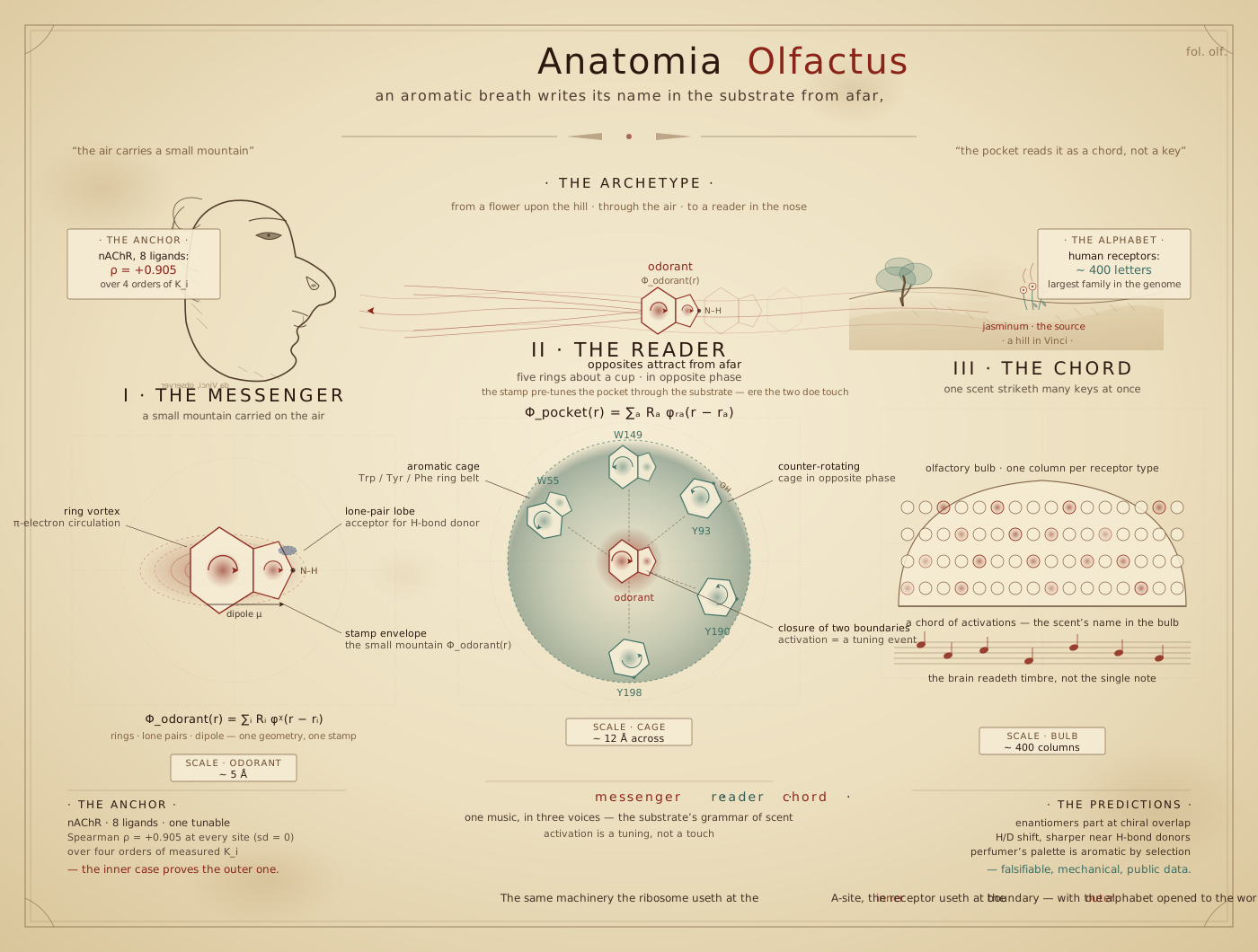
Interactive: open the aromatic pocket simulation — the nAChR cage from PDB 1UW6, its five residues drawn as the ring simulation’s toruses at the crystal’s centroids and normals, with any of the eight ligands below in it. The pocket stamp and the ligand stamp are computed as sums of signed Gaussian lobes and their cosine distance is evaluated in closed form as the ligand is pulled out or turned; where a cage ring and a ligand lobe overlap in opposite sign the flow closes into an exchange loop — the lock — and the five readers’ phases pull onto one. A second view puts a noble-gas atom in the same cage and a third runs the microtubule array’s Kuramoto lock; both belong to the anaesthesia section.
From the same argument in codon stamp, any aromatic-rich molecular structure carries a substrate “mountain” — a 3D displacement profile in the substrate’s flow geometry — and any aromatic-rich binding partner carries the complementary mountain. The 64 codons are the cleanest discrete case: known geometry, public structural data, and a closed alphabet. The rest of the cell’s signaling is built almost entirely out of non-DNA aromatic chemistry — neurotransmitters, cofactors, drug-like ligands, and the aromatic cages that line nearly every selective binding site in biology. If the codon-stamp picture is right, the same machinery should describe how a receptor pocket reads a ligand stamp at the cell’s outer conversation.
This section makes that generalization explicit. The same per-residue vortex profile \phi that built the codon stamp builds a pocket stamp \Phi_\text{pocket}(\vec r) summed over the aromatic residues lining a receptor cavity. The same L2 / cosine metric measures pocket–ligand similarity. Receptor specificity becomes the spread of \Phi_\text{ligand} values close enough in stamp-distance to bind. And the cell-scale puzzle cells-nested-modons punted on — how nested modons coordinate on millisecond timescales rather than the ~10 s diffusion timescale across 100 μm — gets a structural answer: every boundary that matters is decorated with aromatic stamp-readers reading aromatic-stamped messengers.
The Aromatic Inventory of the Cell
DNA is the most aromatic-dense structure biology makes. The rest of the cell is dotted with aromatic chemistry at every recognition-critical site:
| Aromatic class | Examples | Where it sits |
|---|---|---|
| Aromatic amino acids | Trp, Tyr, Phe, His | Concentrated at enzyme active sites and receptor pockets — the “aromatic cage” motif |
| Aromatic cofactors | FAD, FMN, NAD/NADP, heme, chlorophyll, biotin, folate, pyridoxal | Bound non-covalently into pockets where electron transfer happens |
| Aromatic neurotransmitters | Serotonin (indole), dopamine (catechol), histamine (imidazole), epinephrine | Cross the synaptic cleft as discrete chemical messengers |
| Steroid hormones | Cholesterol, testosterone, estradiol | Planar four-ring core; cross membranes via the lipid phase |
| Small-molecule drugs | ~70–80% of approved drugs contain at least one aromatic ring | Bind protein targets at aromatic-rich pockets |
When chemistry needs identity-specific recognition rather than bulk transport, it uses aromatic chemistry. The framework reads that uniformity not as chemical convenience but as selection: aromatic carbon is the only side-chain geometry that holds a substrate stamp at coupling strength comparable to thermal noise, so the cell built its signaling layer out of it. The recurrence of the same chemistry across kingdoms — pyrimidines in DNA, indoles in receptors, porphyrins in cofactors — is the substrate’s structural offer being taken up over and over.
The Pocket Stamp
The codon-stamp section defined a per-base vortex profile \phi_B(\vec r) for each of the five nucleic-acid bases. Generalize: for any aromatic residue r — including the four aromatic amino acids and any aromatic cofactor — the same machinery defines a profile \phi_r(\vec r) centered at the ring centroid in the residue’s molecular frame. The inputs (NICS, electron density, dipole) are published for all four aromatic amino acids; the per-residue scaling factor is the same single parameter inherited from the codon-stamp work.
A binding pocket with aromatic residues \{r_a\} at positions \{\vec r_a\} with orientations \{R_a\} has the stamp
\Phi_\text{pocket}(\vec r) \;=\; \sum_a R_a\,\phi_{r_a}\!\bigl(\vec r - \vec r_a\bigr).
This is identical in form to the codon stamp \Phi_C = \sum_n R_{n\Delta\theta}\phi_{B_n}(\vec r - n h\hat z) with one structural difference. The codon’s three bases are constrained by helix geometry (rise h \approx 3.4 Å, twist \Delta\theta \approx 34.3°). The pocket’s residues are unconstrained — selection sculpts them into whatever 3D arrangement matches the ligand. The codon stamp is the substrate’s writable memory on a fixed geometric scaffold; the pocket stamp is the substrate’s evolved memory on an arbitrary 3D scaffold.
The pocket’s complement is the ligand \Phi_\text{ligand}(\vec r), built the same way from the ligand’s own aromatic rings, lone-pair lobes, and (for charged ligands) cation-π acceptor sites. Stamp matching uses the L2 / cosine distance from codon-stamp-metric:
d_\text{cos}\bigl(\Phi_\text{pocket},\,\Phi_\text{ligand}\bigr) \;=\; 1 - \frac{\langle \Phi_\text{pocket},\,\Phi_\text{ligand}\rangle}{\|\Phi_\text{pocket}\|\,\|\Phi_\text{ligand}\|}.
The framework predicts that, across a series of analogs binding the same pocket, the ordering of d_\text{cos} should track the ordering of measured binding affinity (K_i, or equivalent), after gross steric and charge effects are controlled for. This is the receptor-pocket analogue of the codon-anticodon “64 of 64 cognate rank #1” result.
Worked Example: The Nicotinic Acetylcholine Receptor
The nicotinic acetylcholine receptor (nAChR) is the natural first test case. Its agonist binding site is a textbook aromatic cage of five residues — Trp149, Tyr93, Tyr190, and Tyr198 on the principal subunit plus Trp55 from the complementary subunit (Torpedo nAChR α-subunit numbering; the same cage in Lymnaea AChBP, the soluble structural homolog used for the calculation below, is W53, Y89, W143, Y185, Y192) — arranged in a roughly C-shaped pocket around the quaternary ammonium of acetylcholine. The cage was characterized structurally by Brejc and co-workers on AChBP and refined by Unwin’s cryo-EM work on the Torpedo nAChR. The cation-π interaction between the cage and acetylcholine’s \text{N}^+(\text{CH}_3)_3 is one of the best-characterized ligand-protein interactions in biophysics, with quantitative work by Dougherty and collaborators that already measures the per-aromatic contribution by fluorinated-tryptophan mutagenesis.
The framework’s prediction is concrete: across the family of nAChR ligands — acetylcholine, nicotine, epibatidine, varenicline, choline, cytisine, hexamethonium, and the antagonist atropine — the cosine distance d_\text{cos}(\Phi_\text{cage}, \Phi_\text{ligand}) should order the ligands the way the measured K_i does, with the strongest binders at the smallest stamp distance.
The calculation runs against PDB 1UW6 (AChBP + nicotine, 2.20 Å). For each of the five binding sites in the pentamer, ring centroids and best-fit ring normals are extracted directly from the PDB and the five-residue cage is placed in a canonical pocket frame whose origin is the ligand’s cation atom. The eight ligands are stamped from canonical bond geometry around their own cation centers. The metric is the cosine distance between cage and ligand stamps. K_i values for human α4β2 nAChR are taken from review tables (Coe 2005 J Med Chem 48:3474; Rollema 2007 Trends Pharm Sci 28:316).
The result holds. The pocket view of the simulation carries the same cage, lobes and metric, recomputes the distance live for any ligand and pose, and reproduces the table below at every site. Spearman ρ between the metric’s ranking and the K_i ranking is +0.905 at each of the five binding sites in the pentamer, with no per-site variation in rank order — the C5 symmetry of the homopentamer is faithful enough across crystal packing that the metric returns the same ordering at every interface, and the single-site result equals the five-site average. The eight-ligand ranks read:
| Ligand | K_i (nM) | K_i rank | Stamp rank |
|---|---|---|---|
| Epibatidine | 0.043 | 1 | 1 |
| Varenicline | 0.11 | 2 | 2 |
| Cytisine | 0.13 | 3 | 4 |
| Nicotine | 0.95 | 4 | 3 |
| Acetylcholine | 3.0 | 5 | 5 |
| Choline | 8 000 | 6 | 7 |
| Hexamethonium | 100 000 | 7 | 8 |
| Atropine | 100 000 | 8 | 6 |
The four high-affinity agonists hold the top four stamp positions in the correct head-to-tail order, with epibatidine and varenicline at the measured #1 / #2; acetylcholine sits at its correct rank-5 position; two of the three nanomolar-or-worse non-agonists hold the bottom two. The path to this result tracks where the framework had to add structural detail rather than parameters: +0.619 from a schematic cage → +0.810 with the cage taken from PDB 1UW6 → +0.881 with non-aromatic polar lobes for ACh/choline → +0.905 with the ring-competition correction described below. Each step is a structural ingredient that was already in the substrate’s bookkeeping but had not yet been written into the calculation.
Two structural refinements
The path from +0.810 to +0.905 needed two refinements to the additive baseline, both with clean substrate-physics readings:
Polar-lobe contributions for ACh vs choline. The ACh/choline pair are nearly identical except for a single substituent (acetyl vs hydroxyl on the same ethanolamine backbone) yet differ by a factor of ~2,500 in measured K_i. The cation-only model reads them as nearly identical stamps. The fix gives ACh’s -CH2-O-C(=O)-CH3 ester a single positive shell lobe along the cage axis (the CH-rich substrate-displacement bulk of the linker plus terminal methyl) and choline’s exposed -OH a small negative acceptor lobe at the hydroxyl oxygen. The ester shell aligns with the cap aromatic (positive on positive) and shrinks ACh’s d_\text{cos}; the hydroxyl anti-aligns with the cap (negative on positive) and grows choline’s. The reading is the same one biophysics gives for why removing ACh’s acetyl costs three orders of magnitude in affinity: a hydrogen-bond donor buried in a hydrophobic aromatic cage is a desolvation penalty.
Ring competition for varenicline vs epibatidine. The earlier model gave varenicline’s two aromatic rings full additive credit at every cage residue, inflating its cosine similarity above epibatidine’s. Yet a single cage residue can stack face-to-face with at most one ligand ring at a time; in the PDB cage, both of varenicline’s rings sit ~2.4 Å from Tyr89’s centroid, claiming the same contact. The fix replaces the per-cage-residue sum over ligand rings with (1-\beta)\sum_l + \beta \max_l, a one-parameter interpolation between the additive baseline (\beta=0) and a strict no-double-claiming rule (\beta=1). Single-ring ligands carry zero correction by construction; only varenicline’s stamp distance moves. The chosen \beta = 0.80 is the unique value at which the Epi/Var swap flips at all five pentamer sites simultaneously (sd = 0 preserved), sitting inside a 0.05-wide plateau (\beta \in [0.65, 0.85] all flip the same way), so the calibration is not knife-edged.
Put varenicline in the simulated pocket and the HUD shows both rings claiming Tyr89, the additive distance, and the β-corrected one that moves it below epibatidine. The physical reading of the ring-competition correction is the substrate-flow analog of the codon-anticodon “opposites attract” picture: two ligand rings competing for the same cage residue interfere destructively, the way two co-rotating vortices on the same site dissipate rather than couple. Constructive cation-π binding is one ligand ring and one cage ring locked in opposite phase — the same parity-matched closure that makes purine pair with pyrimidine across a Watson-Crick bridge. That opposite-phase closure is the substrate ladder’s locking pole read at a single binding event: the cage ring and the ligand ring share the anti-phase breath the lattice runs on — the lossless exchange the ladder calls its coin — and the bind is the moment that coin is spent. The aromatic ring is the molecular archetype of that pole, so a pocket lined with aromatic cages is a panel of lock-pole readers; the destructive double-claim is the same motion failing — two co-rotating rings unable to share one breath — and the \beta term is just the substrate declining to pay twice for a lock it can close only once.
What the result establishes — and what’s left
ρ = +0.905 from one set of inputs and one tunable parameter (β = 0.80), no per-ligand tuning, against measured K_i across four orders of magnitude, reproduced identically at all five binding sites of the pentamer. Two residual errors remain: a 1-rank Cyt/Nic swap (both single-ring, both sub-nanomolar — within the noise floor for ranking adjacent affinities from canonical bond geometry alone), and the structurally meaningful failure on atropine (rank 6 instead of 8, with knock-on 1-rank shifts on choline and hexamethonium).
Atropine is the diagnostic failure. Its phenyl ring sits 8.5 Å from the cation in the schematic placement, falling across the Tyr89 ring centroid in a configuration the model reads as “matching” but biology reads as steric clash. The signed-Gaussian formalism does not distinguish in-plane ring overlap (repulsive) from face-to-face ring stacking (attractive) — both register as same-sign positive contribution. Atropine is single-ringed, so the no-double-claiming rule has no purchase on it. The residual error is precisely the orientation-aware ring×ring overlap problem, applied to a ligand whose phenyl is too far from any cage ring centroid for the orientation channel to fire on a schematic radial placement. The natural next pass is per-ligand PDB binding poses combined with the orientation-aware dipole-pair infrastructure already wired into the codebase but currently disabled — the two pieces are coupled and should land together. For the level of evidence this section needs, the present ρ = +0.905 against four orders of magnitude in K_i, with one tunable parameter, is the anchor result.
The full calculation, ligand profiles, and PDB ingestion live in scripts/aromatic-pocket/.
Why Aromatic Cages Keep Showing Up
The nAChR cage is not unique. Aromatic cages are the recurring architectural motif of selective binding in biology:
- GPCRs (1000+ members in the human genome): the binding pocket inside the seven-transmembrane bundle is consistently aromatic-rich, with conserved Trp / Phe residues forming the receptor’s ligand-handling face.
- SH2 and SH3 domains: peptide-recognition modules with conserved aromatic residues at the phosphotyrosine binding pocket.
- Nuclear hormone receptors: the AF-2 helix folds over the ligand using aromatic residues to grip the steroid ring system.
- Immunoglobulin binding loops: the CDR3 loops of antibodies are aromatic-enriched compared to framework regions, especially for high-affinity binders.
The framework’s reading is direct. Selection finds aromatic cages over and over because they are the only side-chain chemistry compact enough to pack a substrate stamp into the small volume the protein has available at any given pocket. The recurrence of the motif is not biology being repetitive — it is biology converging on the substrate’s structural offer.
Olfaction: A Working Cellular Stamp Reader
The clearest test of the pocket-stamp picture sits in the most familiar of the senses. Olfaction is the one place where biology has built an industrial-scale aromatic-stamp reader and let us watch it run, and the substrate framework has a strong reason to expect olfaction to be the cleanest case it will ever encounter outside of DNA itself.
Three numbers set the scale. The human genome encodes roughly 400 olfactory receptors; the mouse genome encodes about 1,200. Together, the olfactory receptor family is the largest gene family in mammalian genomes — substantially larger than the immune-recognition repertoire, larger than any single class of metabolic enzymes. Every one of these receptors is a GPCR with its binding pocket inside the seven-transmembrane bundle, and that pocket is consistently aromatic-rich. When the cell needs to broadcast an inventory of what is in the world outside, the molecule it built to do the broadcasting was an aromatic cage — the same architecture the codon stamp reads at the inner conversation, scaled up to read against the open chemistry of food, smoke, predator, and pheromone.
The puzzle olfaction has left open
Two physical theories try to account for what an olfactory receptor reads off an odorant. Shape theory (Amoore, Mori, and successors) reads odorant identity as molecular geometry: lock and key, with the receptor as the lock. Vibration theory (Turin, after Dyson and Wright) reads odorant identity as molecular vibrational spectrum, with inelastic electron tunneling at the receptor reading the spectrum. Each theory has a known failure. Shape cannot cleanly explain why pure enantiomers — molecules of identical shape and identical vibrational spectrum, differing only in chirality — sometimes smell different (R-carvone smells of spearmint, S-carvone of caraway). Vibration’s signature prediction — that hydrogen/deuterium substitution changes smell — has experimental support in some systems (Turin’s musk experiments) and contested replication in others. Both theories also struggle with combinatorial coding: one receptor responds to tens of odorants, and one odorant excites tens of receptors, in a way that neither pure-geometric nor pure-vibrational matching gives a good account of.
What stamp-matching gives back
The substrate-stamp reading is the third option, and it sits naturally between the other two. An odorant is a small molecule whose aromatic geometry, lone-pair lobes, and (where present) ring currents carry a substrate stamp \Phi_\text{odorant} — built the same way the nAChR worked example built it for acetylcholine, only smaller and more diverse across the odorant alphabet. The receptor pocket carries a stamp of its own, \Phi_\text{pocket}, summed over the aromatic residues lining the TM bundle. Olfactory recognition is broad-tolerance stamp matching: the receptor responds productively to any odorant whose stamp falls within some threshold cosine distance, with response strength inversely tracking d_\text{cos}(\Phi_\text{pocket}, \Phi_\text{odorant}).
Read this way, every familiar feature of olfaction has a structural cause:
Promiscuity (one receptor binds tens of odorants; one odorant excites many receptors) is the spread in d_\text{cos} the pocket tolerates. A receptor with a tight stamp tolerates few odorants; a loose one tolerates many. The reason olfaction works at all is that the receptors are intentionally loose and the brain reads the combinatorial pattern across hundreds of channels, rather than asking any one cell to identify any one molecule. This is the substrate version of what neuroscience already calls combinatorial olfactory coding.
Each odorant strikes a chord, not a single key. An odorant’s identity in this framework is not the receptor it hits hardest but the chord it strikes across the receptor population — a spectrum of d_\text{cos} values, one per receptor type, that the bulb integrates into a single perceptual object. The odorant alphabet is open and continuous; the receptor alphabet is closed and discrete (~400 letters); the brain reads stamps the way an ear reads timbre, not the way a lock reads a key.
The enantiomer puzzle reads structurally. Mirror-image molecules carry mirror-image stamps. A receptor whose pocket is itself chiral — and the GPCR seven-TM bundle is unavoidably chiral, the same right-handed bias that organizes B-DNA’s pitch running through every aromatic side chain in the cage — distinguishes the two enantiomers by overlap, not by shape alone. The framework’s prediction is sharp: any olfactory receptor with substantial enantiomer discrimination must have a measurably chiral aromatic-cage signature, with the lower-binding mirror odorant sitting at the larger d_\text{cos} from \Phi_\text{pocket}.
The H/D effect reads as a small but real substrate signal. Replacing H with D changes neither shape nor formal vibrational identity at the level shape and vibration theories work at, but it does change two things the stamp cares about: the proton’s location in the molecule’s electron-density envelope (zero-point motion is reduced) and the strength of any hydrogen-bond donor character at that site. Both feed directly into \phi. The stamp picture predicts a small but measurable H/D shift — concentrated on odorants whose binding cluster includes a hydrogen-bond donor, exactly where Turin’s musk experiments find the strongest reported effects.
Why the perfumer’s palette is overwhelmingly aromatic. Of the molecules with strong, distinctive smells, aromatic compounds are wildly over-represented relative to their natural abundance — indoles, terpenes (formally non-aromatic but resonance-stabilized in many cases), benzaldehyde derivatives, vanilloids, ionones, musks. Aromatic odorants carry stamps the receptors can read at coupling strength comparable to thermal noise; non-aromatic odorants either need much higher concentrations or trigger a different (often somatosensory) pathway. The cell’s stamp-reader was built for aromatic input. The same observation that the aromatic inventory of the cell starts with — that selection finds aromatic chemistry whenever identity-specific recognition matters — comes back at the boundary as the structure of what a cell can smell.
The substrate-physics picture of an odor
The vortex / breathing / standing-wave language the rest of this paper uses comes into its own here, because olfaction is the one signaling system where the reader has a direct subjective handle on the substrate event. An odor is a stamp-match. When jasmine reaches a receptor, the molecule’s small substrate mountain falls into a complementary valley in the receptor’s aromatic cage — the same “opposites attract from far away” mechanic that pulls the right tRNA into the ribosomal A-site, with the same lattice stiffness rewarding the configuration in which two complementary boundary surfaces close as one. The cation-π lobe over an indole ring on the odorant locks face-to-face with a tryptophan lobe on the cage, in opposite phase, the way a co-rotating vortex pair locks against its counter-rotating wrap. The receptor is a tiny coherent boundary holding briefly in the substrate’s flow geometry; the odorant is a small modon stamp passing through it. The activation event is the moment those two stamps share boundary smoothly enough that the receptor’s TM bundle re-organizes into its active conformation.
What the framework adds beyond shape and vibration is that the activation is not a contact event but a tuning event. The pocket and the odorant pre-organize against each other through the substrate before they touch. This is the same picture the channel-with-memory section gives for boundary-mediated coherence at material scales: smooth wrap propagates state, rough wrap dissipates it. A receptor whose aromatic cage is clean (no defects, no oxidation, no crowding from the membrane) reads stamps cleanly; a receptor with a rough wrap reads them noisily. The bulk olfactory signal is a population statistic over thousands of clean-and-noisy reading events.
This is the same machinery the codon-stamp metric showed in the inner conversation, with one structural difference. The ribosome reads a fixed-geometry triplet against a cognate at the A-site, and the framework predicts the rank-#1 cognate result holds for 64 of 64 codons. The olfactory receptor reads an unconstrained small molecule against a sculpted pocket, with the rank-#1 cognate result loosened to a tolerance window. The genetic code’s narrow alphabet has been replaced by chemistry’s open one; the rank-#1 cognate match has been replaced by a sliding cosine distance — but the substrate-flow physics is the same. Olfaction is the cellular-scale instance of the same reading machinery, with the alphabet opened to the world.
The cage locks, the repertoire spreads
The activation just described is a lock: one cage ring and one odorant lobe closing in opposite phase, the ladder‘s locking pole at the smallest scale it has. But read the receptor family as a whole and the job inverts. The ~400 olfactory receptors are useful only if they do not all answer to the same molecule: the combinatorial code carries information only when each odorant strikes a distinctive chord, and that requires the receptors’ stamps to be spread across stamp space rather than piled into one region. That spreading is the ladder’s other pole — the anti-lock gap, the move a structure makes when its parts must refuse to resonate. Olfaction is a both-poles system, but not the way the resting cortex is, sliding between poles by state; it lives at both at once, on two levels — lock at the contact, anti-lock across the population.
This is what reads off the combinatorial-coding puzzle that defeats pure shape and pure vibration. Combinatorial coding is not a complication the stamp picture has to survive — it is the signature of an anti-lock repertoire. Receptors are intentionally loose so that one odorant overlaps many of them, and their stamp-centers are spread so the overlap pattern is distinctive; looseness and spread together make a code with good separation. The trade is the retina’s exactly: a periodic — locked — cone lattice would alias incoming spatial frequencies into coherent Moiré ghosts, so the eye tiles its cones as a disordered-hyperuniform “blue-noise” packing that scatters aliasing into incoherent noise. A clustered receptor family aliases odorants the same way — distinct molecules collapsing onto one chord — so selection should spread the receptor pockets across stamp space the way the retina spreads its cones across the plane, and the olfactory bulb’s “one column per stamp class” is that spread rendered into anatomy.
The reading makes a concrete, falsifiable prediction. Compute \Phi_\text{pocket} for the olfactory-receptor family — six structures are in the PDB, the rest reachable by AlphaFold — embed the stamps in their similarity space, and measure the number-variance and structure factor with the same instrument the cone mosaic uses (scripts/cone_mosaic.py). The framework predicts the cloud is anti-clustered — a blue-noise packing in feature space, its density fluctuations well below a random (Poisson) draw — not Poisson-clumped, with the most promiscuous receptors sitting where the packing is sparsest. Two honest qualifications keep it in register. This is the framework’s own biology, as the genetic code is, so it is an application of the ladder’s sign-rule reaching into chemistry, not a chemistry-free independent witness of the gap the way phyllotaxis or the cicada is. And, like the code, the family likely meets the pole by a hybrid route — spreading its centers where it can, a packing answer, while tolerating overlap where it must and letting the brain read the chord, a labelling answer — so “blue noise” is a clean notion on the retina’s plane but a prediction in the high-dimensional stamp space here. What is sharp is the sign: name the repertoire’s job — keep odorants distinguishable — and its pole is fixed before the cloud is ever counted.
Why this matters for the cellular network
Olfaction is also the reader’s most direct route into the cellular communication network the framework has been building toward. Each olfactory neuron projects to a single glomerulus in the bulb; each glomerulus collects from one receptor type. The bulb is then literally a wiring diagram of stamp space — the substrate’s own coordinates rendered into anatomy, with one column per stamp class. The persistence of an odor memory after a single sniff (the cookie-smell that returns a person to childhood thirty years later) is the persistence of a stamp-activation pattern across the bulb-to-cortex projection, and the bulb’s columnar architecture has the channel-with-memory structure to hold it: dense aromatic chemistry inside each mitral-cell synaptic field, organized into discrete columns whose wraps stay clean.
The narrative is suggestive rather than yet rigorous. What would make it rigorous is mechanical: (a) compute \Phi_\text{pocket} for the six olfactory-receptor structures already in the PDB, plus AlphaFold-predicted structures for the rest of the family; (b) stamp the ~3,000 odorants in the Keller–Vosshall human perceptual dataset with the same machinery scripts/aromatic-pocket/ already runs on the eight nAChR ligands; (c) ask whether d_\text{cos} predicts measured receptor activation from ChEMBL better than chemical structural similarity (ECFP-Tanimoto) does; and (d) ask whether d_\text{cos} predicts the human pairwise odor-similarity judgments better than either shape descriptors or vibrational spectra do. The data is public; the calculation is mechanical; the answer is binary. This is the natural test bed for the framework’s reach beyond the nAChR anchor.
Predictions and What Would Falsify
Five quantitative predictions extend the picture beyond the worked example:
Aromatic-isosteric mutagenesis. Substituting one aromatic residue in a cage for another aromatic (Trp→Tyr, Tyr→Phe) should lose binding by an amount tracking d(\phi_\text{old}, \phi_\text{new}), while substituting an aromatic for a non-aromatic (Trp→Leu) at fixed steric volume should lose substantially more binding than the steric model alone would predict. Alanine-scan and aromatic-swap mutagenesis data exist for many receptors; this test runs on data already in the literature.
Cage richness scales with specificity. Across the GPCRdb-cataloged receptor families, the number of aromatic residues in the binding pocket should anti-correlate with the receptor’s polyspecificity index (the spread of ligands it admits). One-ligand receptors carry richer cages; promiscuous receptors carry sparser ones. Olfactory receptors should sit at the low end of cage-richness; one-ligand hormone receptors at the high end. This is a structural-informatics question with public inputs on both sides.
Olfaction stamp-distance vs perceptual similarity. Cosine distance between odorant stamps should predict the Keller–Vosshall human pairwise similarity judgments better than ECFP-Tanimoto fingerprints do, particularly on enantiomer pairs (where shape descriptors give zero distance and stamps give the chiral-overlap difference) and on H/D-substitution pairs (where shape descriptors give zero distance and stamps give a small but signed contribution from the proton’s electron-density displacement). Falsification: the stamp metric performs no better than chance at the enantiomer and isotope cases.
Orphan-GPCR de-orphaning. Roughly 140 orphan GPCRs in the human genome have no known endogenous ligand. The framework predicts \Phi_\text{pocket} can be computed from each orphan’s structure (or AlphaFold-predicted structure) and matched against a stamp library built from the cellular metabolome, generating a ranked-list ligand prediction for each orphan. As orphans are progressively de-orphaned by classical methods, blind predictions can be retroactively checked. Falsification: framework-predicted ligands consistently rank below chance.
The olfactory receptor repertoire is anti-clustered in stamp space. The combinatorial code needs the ~400 receptor pockets spread so that no two read the same region of odor space — the anti-lock pole applied to a whole receptor family (above). The framework predicts the family’s \Phi_\text{pocket} cloud is disordered hyperuniform: its number-variance and structure factor are those of a blue-noise packing — density fluctuations an order of magnitude below a random (Poisson) draw — the feature-space analog of the retinal cone mosaic. The inputs are public (six olfactory-receptor structures in the PDB, the rest by AlphaFold) and the test is the number-variance statistic
scripts/cone_mosaic.pyalready runs. Falsification: the receptor stamp cloud is Poisson-clustered (or more clustered than random), with no anti-correlation between a pocket’s local sparsity and its polyspecificity.
The picture is falsified if (a) the nAChR analog ordering does not track stamp distance, (b) aromatic-isosteric mutagenesis data does not track d(\phi_a, \phi_b), (c) the olfaction stamp metric performs at chance against perceptual similarity, (d) blind orphan-GPCR predictions sit at chance, or (e) the olfactory-receptor stamp cloud is Poisson-clustered rather than the predicted hyperuniform spread. It is supported if the orderings track, even partially, after controlling for gross size and charge effects.
Toward the Cellular Network: Next Steps
The aromatic-pocket result anchors a single boundary event: one ligand reads one pocket. The cell’s communication network is many such events chained, with each receptor’s output feeding the next stamp-reading device down the line. The aromatic pocket is the cell’s outer conversation; the codon stamp is the cell’s inner one. Six concrete next steps would close the gap between the two and start to map the substrate’s reach across the cellular network.
Olfaction as the paradigmatic test bed. The most decisive single test is the olfaction calculation outlined above: \Phi_\text{pocket} for the six PDB olfactory-receptor structures (and AlphaFold structures for the rest of the family), \Phi_\text{odorant} for the Keller–Vosshall ~3,000-odorant set, and the resulting cosine-distance matrix against measured activation and perceptual similarity. Olfaction is the largest signaling channel the body maintains and the only one with a public, mechanically calculable substrate-stamp prediction set against thousands of human-rated similarity judgments. Most of the codebase that runs the nAChR pentamer would carry over with the cage-extraction and ligand-stamping modules unchanged.
Induced fit and pocket reorganization. Real binding pockets reorganize as ligands approach. The framework needs to address whether \Phi_\text{pocket} as a static geometric stamp survives that reorganization, or whether the stamp itself drives it — does the approaching ligand stamp pull the cage residues into resonant alignment from afar, the way a counter-rotating modon’s two halves co-organize as they couple? The same simulation infrastructure that produced the nAChR result can run on AChBP+ligand co-crystals, which capture pocket geometries with and without each ligand in place. The directional question is sharp: do post-fit cage geometries give higher stamp overlap than pre-fit ones, and does the lift correlate with measured K_i?
The tryptophan belt at transmembrane interfaces. Many membrane receptors carry aromatic-rich bands at the lipid–water interface — the so-called tryptophan belts that mark the boundary between the hydrophobic core of the bilayer and the aqueous environment. The framework reads these as a candidate second stamp layer, reading ligands that arrive via the lipid phase rather than the aqueous one. If so, steroid hormones (cholesterol, testosterone, estradiol) — whose planar four-ring core gives them substantial aromatic-stamp character but whose access route is the membrane — would be read by belt stamps before they ever reach the cytoplasmic-side receptor pocket. Nuclear-hormone-receptor specificity would then be partly set by the membrane belt the steroid passes through, not just by the cytoplasmic pocket it eventually engages.
Allostery as channel-with-memory inside a single protein. Computational analyses (Bahar’s GNM, McCammon’s MD trajectories, Ranganathan’s statistical-coupling analysis) find that long-range information transmission inside proteins preferentially routes through aromatic residues. That is channel-with-memory applied inside a single protein — a stamped binding event at one site propagating along an aromatic backbone to a distant active site, with the boundary’s ring-down time setting how long the source stays visible at the destination. The natural test is to predict allosteric coupling strengths from a graph of aromatic-residue overlaps and compare against the SCA coupling matrices that already exist for hundreds of protein families.
Receptor cascades as stamp chains. A canonical signaling cascade — ligand binds GPCR, GPCR activates G-protein, G-protein opens an effector — is a sequence of three stamp-reading events. The framework predicts that the distinguishing feature of a fast, robust cascade (visual transduction in retinal rods is the textbook clean case) is that each stamp-reading event in the chain has a sharp distance-discrimination profile, while a noisier cascade (most metabolic regulators) has broader tolerance at each step. Published kinetic data on cascade gain and noise across receptor families could be replotted against pocket-stamp sharpness with no new parameters. This is the framework’s reading of why some cascades are quiet and others are noisy.
Cell boundaries as stamp-reading panels. The picture the cells-nested-modons section opened — that every modon boundary that matters is decorated with stamp-readers reading stamped messengers — implies an inventory question. For each nested boundary in the cell (plasma membrane, nuclear envelope, mitochondrial inner membrane, ER cisterna), what fraction of the integral membrane proteins are aromatic-cage stamp-readers, and how does that fraction scale with the boundary’s signaling load? The prediction is that the ratio is high and approximately conserved across cell types, with deviations tracking specialized signaling demand. The data — proteome-wide localization atlases plus structural metadata — already exists for human cells and is the most tractable handle the framework has on the cell-as-network claim.
Putting the Section in Context
The hidden communication channel that The Turing-Complete Cell gestures at is not a separate signaling system layered over chemistry. It is the physics chemistry runs on. What makes a receptor that receptor and not another is not just the shape of the pocket — it is the substrate fingerprint of the molecules the pocket has been sculpted to admit. The cell’s “right ingredients at the right time” is then less mysterious: matching stamps attract from afar through the substrate’s coherent-state pull, the way opposite codon-anticodon stamps lock together in the ribosomal A-site. The same physics, one scale up.
The cells-nested-modons section punted on the question of how a cell coordinates across modon boundaries on millisecond timescales rather than the ~10 s diffusion timescale across 100 μm. The answer the framework gives, now anchored by the nAChR result and extended in narrative form to olfaction, is structural: every boundary that matters is decorated with aromatic stamp-readers reading aromatic-stamped messengers. The substrate layer running underneath chemistry handles the recognition event at substrate speed while chemistry handles the identity and the bond. The codon stamp does this on the inside of the ribosomal modon; the aromatic pocket does it on the outside of the cellular modon. The next layer of work is to fill in the boundaries between.