Neuron as Cable Modon
The cell’s polar architecture in long-cable form, with action potential as propagating boundary-coherence inversion
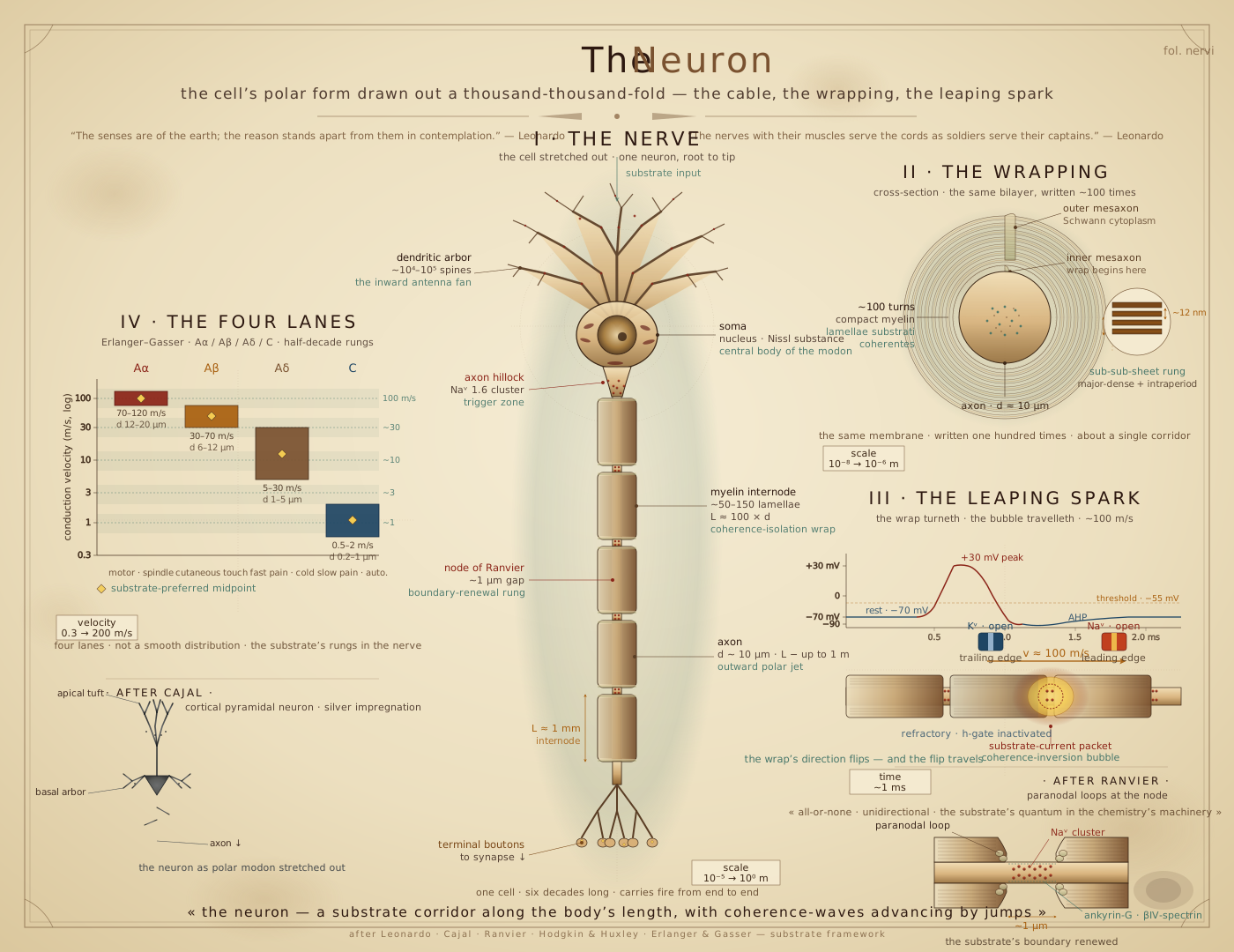
The neuron is the cell modon’s polar architecture stretched along one axis into a long substrate-coherent corridor, with the action potential as a propagating local boundary-coherence inversion, myelin as a repeated coherence-isolation wrap raising the substrate-coherence quality of long internodes, and the nodes of Ranvier as the boundary-renewal points where the substrate-current packet jumps along the cable’s substrate-preferred rung spacing. The dendritic arbor at one end is the cell modon’s inward fan — the chemistry-side surface-area amplifier for substrate-current input, structurally parallel to the rod outer segment’s disc stack and the cochlear hair cell’s stereocilia staircase, but oriented inward toward the soma rather than outward toward the world. The soma is the modon’s central body, with the nucleus and the bulk of biosynthetic machinery preserved at full cell-modon coherence. The axon is the modon’s outward polar jet — a substrate-coherent corridor that carries substrate-current packets from the integration zone at the axon hillock to one or many distal terminals. The architecture is the polar-cilium architecture of cilia-flagella.qmd, lifted to centimetres and metres, with chemistry-side machinery (myelin, nodes, voltage-gated channels) implementing the substrate-coherence demand the long-cable geometry creates.
The Neuron as Cell-Modon Polar Architecture Stretched Along One Axis
A neuron’s gross morphology presents three regions arranged along a single polar axis. The dendritic arbor receives input — from a few synapses for small interneurons to \sim 10^4–10^5 synapses for cortical pyramidal cells and cerebellar Purkinje cells. Dendrites branch with characteristic taper, carry passive electrical signals toward the soma along their length, and are densely studded with dendritic spines — small \sim 1\;\mum protrusions whose mushroom-shaped heads carry the postsynaptic apparatus and whose thin necks restrict diffusive coupling to the parent dendrite. The soma (cell body) carries the nucleus, the rough ER (visible as Nissl substance in classical stains), the Golgi apparatus, and the bulk biosynthetic machinery, and serves as the structural integration point where dendritic signals are summed at the axon hillock — a small tapering region at the soma’s base where the axon emerges. The axon is a single long projection from the hillock, typically \sim 0.5–20\;\mum in diameter and \sim 100\;\mum to \sim 1 m long, terminating in one or many presynaptic boutons at distal targets. The whole cell is conspicuously polar: input is segregated to one end, output to the other, with the soma as the central body and the axon hillock as the conversion point from analogue dendritic integration to digital axonal spiking.
The cell modon’s polar architecture is stretched along one axis, with the dendrite-soma-axon sequence playing the role at the neuronal scale that the basal-body-soma-cilium sequence plays at the cell scale. The cilia-flagella chapter developed the cilium as the cell’s outward polar projection, with the basal body anchoring it to the apical cortex and the axoneme as the substrate-coherent corridor outward. A generic cell has one such projection of \sim 5–10\;\mum at most. A neuron’s polar morphology has the projection as the cell’s defining structure: instead of one short cilium per cell, one long axon per cell, 10^4–10^6 times longer, with the dendrite arbor inheriting the apical-cortex role at the input side and the axon hillock serving as the trigger-zone analogue of the basal body’s transition zone.
The dendritic arbor is the inward antenna fan, structurally parallel to the disc stack of the rod outer segment (eye-as-antenna.qmd) and the stereocilia staircase of the cochlear hair cell (ear-as-resonator.qmd). Each is a chemistry-side surface-area amplifier expanding the cell’s substrate-current sampling capacity at one end of its polar axis — the photoreceptor expanding the membrane area available to absorb photons, the hair cell expanding the membrane area available to gate mechanosensitive channels, the neuron expanding the membrane area available to receive synaptic inputs. The dendritic arbor of a cortical pyramidal cell with \sim 10^4 synapses and a total dendritic length of \sim 10 mm presents a substrate-current sampling area of \sim 10^4\;\mum^2, raising the cell’s input-side substrate coupling by \sim 100\times over what a bare-soma cell would offer — the same surface-area-amplification factor the disc stack achieves over a bare photoreceptor cylinder.
The axon hillock is the modon’s integration-and-trigger point, where dendritic substrate-current contributions sum at the soma’s substrate-coherent interior and trigger threshold-gated axonal output when their integral crosses a substrate-coupling-mediated threshold. The hillock is densely populated with voltage-gated Na^+ channels — Na$1.2 and Na$1.6 at densities \sim 5–10\times the soma’s — making it the cell’s lowest-threshold trigger zone for axonal action potential initiation. The hillock is the substrate’s coherence-conversion interface, where the dendritic-summation analogue signal crosses the substrate-coupling threshold and is reborn as a digital substrate-current packet propagating down the axon.
The Action Potential as Propagating Boundary-Coherence Inversion
The plasma-membrane chapter developed the resting membrane potential at -60 to -90 mV as the substrate-flow gradient across the cell’s wrap, and the action potential’s depolarisation-and-repolarisation swing from -70 to +30 mV and back over \sim 1 ms as a propagating local boundary-coherence inversion — the wrap’s direction transiently flipping at the AP’s leading edge and the inversion propagating along the axon at the substrate-coupling-mediated speed of \sim 100 m/s. The Hodgkin-Huxley equations give the chemistry-side accounting in voltage-gated Na^+ and K^+ conductances; the framework reads them as biology’s chemistry-side implementation of a substrate-coherence inversion the long-cable substrate would support even in the chemistry’s absence.
The propagating-inversion reading sharpens several features of the AP that chemistry-side accounts treat as separate facts. First, the AP is all-or-none — once threshold is crossed, the depolarisation runs to completion at full amplitude regardless of the triggering input’s size. Chemistry-side reading: voltage-gated Na^+ channels open cooperatively past threshold and saturate. Framework reading: a boundary-coherence inversion is a single substrate-discrete event — the wrap’s direction either flips or it does not, with no intermediate states, in the same way a photon-modon does not arrive at half-amplitude or a stamp-class event does not occur at half-credit. The all-or-none property is the substrate’s quantisation showing through chemistry’s machinery.
Second, the AP propagates unidirectionally away from its initiation point. Chemistry-side reading: voltage-gated Na^+ channels enter a refractory state after activation, preventing back-propagation. Framework reading: once the wrap has flipped at one location, the immediate downstream substrate-coherence corridor is the only direction the inversion can propagate without colliding with itself; the refractory-state mechanism is biology’s chemistry-side implementation of the substrate’s unidirectionality requirement at the cable-modon scale. The Hodgkin-Huxley h-gate inactivation is the chemistry-side coherence-direction enforcer.
Third, the AP’s velocity scales with axon diameter as v \propto d^{1/2} in unmyelinated axons (the squid giant axon, the C-fibre population) and as v \propto d in myelinated axons (mammalian peripheral and central nervous system Aα/Aβ/Aδ fibres). The chemistry-side derivation works through cable theory — internal resistance \propto 1/d^2, membrane capacitance \propto d, characteristic length \lambda \propto d^{1/2} in the unmyelinated case. The framework reads \lambda as the substrate’s coherence length expressed through the axon’s geometry, with the velocity-versus-diameter scaling laws as the substrate’s preferred mapping from cable-modon dimension to substrate-current packet speed. The cable equation Lord Kelvin derived for transatlantic telegraph cables in 1855 and Wilfrid Rall adapted for dendritic integration in 1959 is, in this reading, the substrate’s preferred form for a one-dimensional coherence-corridor under the long-cable limit.
Myelin as Repeated Coherence-Isolation Wrap
The mammalian axon — unlike the squid giant axon Hodgkin and Huxley recorded from — is most often myelinated. In the peripheral nervous system, Schwann cells wrap individual axon segments in tight concentric spirals of \sim 50–150 bilayer turns; in the central nervous system, oligodendrocytes wrap multiple axons (typically \sim 30–60 each) with the same architecture but one cell to many axons. A myelin internode is the \sim 0.5–2 mm length of axon covered by one Schwann or oligodendrocyte wrapping; between adjacent internodes the axon membrane is exposed in a \sim 1\;\mum gap — the node of Ranvier — where voltage-gated channels concentrate. The myelin sheath itself is biology’s most lipid-dense membrane, \sim 70\% lipid by dry weight (vs. \sim 50\% for typical plasma membrane), with characteristic high cholesterol, galactocerebroside, and the structural proteins myelin basic protein (MBP) and proteolipid protein (PLP). The wrapping geometry is uniform across mammals: \sim 12 nm bilayer period in the compact myelin, with major dense lines (cytoplasmic apposition) and intraperiod lines (extracellular apposition) alternating along the spiral.
The framework reads myelin as the cell’s chemistry-side implementation of repeated coherence-isolation wraps on the axon’s long substrate-coherent corridor, structurally parallel to the nucleus’s double envelope at the nuclear modon scale but extended into a many-fold wrap rather than a double one. The nucleus needs one extra coherence-isolation rung beyond the cytoplasmic wrap to hold the genome’s substrate-coherence quality; the long axon needs many extra rungs along its internode length to hold the substrate-current packet’s coherence quality across the cable’s \sim 1 mm internode without resistive-and-capacitive degradation. Each turn of the myelin spiral is one additional coherence-isolation rung; \sim 100 turns of compact myelin on a typical Aα axon is the cell’s substrate-coherence-quality investment in keeping the AP packet undegraded between nodes.
The compact-myelin lipid composition supports this reading. The \sim 12 nm bilayer period in compact myelin sits at a substrate-preferred sub-sub-sheet rung — the same rung the cristae junctions (\sim 25 nm, one rung larger), ER contact-site gaps (\sim 10–30 nm), and rod-disc spacings (\sim 25–32 nm) cluster on. The high cholesterol fraction — the plasma-membrane chapter’s reading of cholesterol as the wrap’s stiffness modulator — is biology’s chemistry-side answer to the geometric stiffness the many-turn spiral requires to hold its sub-sub-sheet period across the internode’s length. Myelin is the cell’s chemistry-side implementation of the most coherence-quality-demanding wrap architecture biology has built outside the nuclear envelope; multiple sclerosis, in this reading, is the disease of substrate-coherence-isolation loss along the axonal corridor, with the demyelinated segment unable to hold the AP packet’s coherence between trigger nodes.
Saltatory Conduction and the Node-of-Ranvier Rung
In a myelinated axon, the action potential does not propagate continuously down the membrane. Instead, the inward current at one node depolarises the membrane at the next node through the high-impedance internode without itself crossing the myelinated stretch, and the next node’s voltage-gated Na^+ channels fire — the AP jumps from node to node. This is saltatory conduction, first proposed by Tasaki and Takeuchi in 1942 and developed by Huxley and Stämpfli in 1949, Rushton in 1951, and Frankenhaeuser and Huxley in 1964. The velocity speedup over an unmyelinated axon of the same diameter is \sim 5–50\times, depending on the species and the axon class.
The framework reads saltatory conduction as substrate-discrete jumping along the axon’s coherence-rung structure, with the node spacing setting the rung interval. The substrate’s coherence-corridor architecture supports propagating coherence-packets, but the long-cable geometry has a preferred rung-spacing — the substrate-coherent corridor is not infinitely continuous but composed of discrete coherence cells whose boundaries are the substrate’s preferred interface points. The chemistry-side machinery has placed nodes of Ranvier at these substrate-preferred boundary points; the AP packet does not propagate through the myelinated internode (which has no substrate-coherence boundary to flip) but jumps from one substrate-coherent interface to the next, with the chemistry-side voltage-gated Na^+ channel cluster at each node as the local trigger that refreshes the AP packet’s amplitude.
The internode length is the substrate’s preferred rung spacing at the axonal cable-modon scale. Across mammals, internode length scales with axon diameter as L \approx 100 \times d (with L in \mum and d in \mum) — a 10\;\mum diameter Aα axon has \sim 1 mm internodes, a 5\;\mum diameter Aβ axon has \sim 0.5 mm internodes. The framework reads this linear scaling as the substrate’s preferred coherence-rung spacing in the axon’s geometry, with the 100:1 length-to-diameter ratio as a substrate-preferred dimensionless aspect ratio analogous to the microtubule’s substrate-locked wall radius and the B-DNA helix’s substrate-locked pitch — a geometric ratio set by substrate physics rather than by chemistry-side optimisation. The chemistry-side derivation of optimal internode length from cable-equation considerations recovers \sim 100\times as the velocity-optimal value; the framework reads the recovery as the substrate’s preferred ratio showing through the chemistry-side cost function.
The node of Ranvier itself is the boundary-renewal point along the axonal corridor, structurally parallel to the cilium’s transition zone at the cellular scale and to the NPC and TOM/TIM at the smaller modon scales. Each is a chemistry-side implementation of the substrate’s coherence-boundary requirement at a regulated-jet interface: NPCs are the nuclear modon’s regulated jets; TOM/TIM the mitochondrial modon’s; the transition zone the cilium’s; the node of Ranvier the cable-modon’s. The chemistry-side machinery at each interface (FG-nucleoporins; TOM/TIM translocon channels; ciliary-necklace particles; voltage-gated Na^+ clusters with anchoring ankyrin-G and βIV-spectrin scaffolds) is the substrate-boundary-renewal apparatus at the corresponding modon scale.
Conduction-Velocity Classes as Substrate-Preferred Ratios
The Erlanger-Gasser classification of peripheral axons by conduction velocity remains the canonical framework. Four classes cover most vertebrate peripheral nerve: Aα at \sim 70–120 m/s (\sim 12–20\;\mum diameter, myelinated, motor axons to extrafusal muscle and proprioceptive afferents from spindles and tendon organs); Aβ at \sim 30–70 m/s (\sim 6–12\;\mum, myelinated, cutaneous mechanoreceptor afferents); Aδ at \sim 5–30 m/s (\sim 1–5\;\mum, thinly myelinated, fast-pain and cold afferents); and C at \sim 0.5–2 m/s (\sim 0.2–1\;\mum, unmyelinated, slow-pain, temperature, and most autonomic axons). Central-nervous-system axons span a similar range with somewhat different class boundaries, but the four-class structure recurs across mammals.
The framework reads the four classes as substrate-preferred ratios at the cable-modon conduction-velocity rung. The four velocity midpoints — \sim 95, 50, 17, 1 m/s — sit at substrate-friendly logarithmic intervals (roughly half-decade spacing on the \log v axis), structurally parallel to the four corpuscular mechanoreceptor frequency rungs at \sim 0.5, 5, 30, 200 Hz the touch chapter developed and to the three cone-opsin wavelength rungs the eye chapter developed. The touch chapter explicitly predicted that the conduction-velocity classes should cluster at substrate-preferred ratios rather than vary smoothly with myelin thickness; this chapter cashes the prediction at the architectural level and proposes the existing single-fibre-recording literature as the data series the prediction tests against. The four midpoints and their half-decade spacing place these classes in the coarse family of the substrate ladder, alongside the mechanoreceptor frequency rungs — the looser tower spaced by half-decades rather than the clean \sqrt{2} of the resonant family, but predicted to land on the same comb sampled every few rungs.
The chemistry-side derivation gives an alternative account: velocity scales linearly with diameter in myelinated axons and as the square root in unmyelinated ones, so a continuous distribution of diameters should produce a continuous distribution of velocities. The framework’s prediction is that the diameters themselves cluster at preferred values — that fibre-diameter histograms across mammalian peripheral nerves should show clustering at \sim 1, 5, 10, 15\;\mum rungs rather than a continuous distribution, and that the velocity classes are the diameter clustering’s projection through the cable-equation scaling. The classical histology literature (Boyd and Davey 1968 cat-hindlimb fibre-diameter histograms, with their famous multimodal distributions) provides existing data with this structure, awaiting reanalysis under the substrate-coherence-rung hypothesis.
Glia as the Neuron’s Coherence-Boundary Cortex
A vertebrate brain is roughly \sim 50\% neurons and \sim 50\% glial cells (a long-standing \sim 10:1 glia-to-neuron ratio claim is now retracted; cell-counting work by Suzana Herculano-Houzel published from 2009 established the near-1:1 ratio across most brain regions). Four major glial classes serve distinct substrate-coherence-related roles: oligodendrocytes (CNS) and Schwann cells (PNS) myelinate axons (developed above); astrocytes provide perineuronal substrate-coherence-boundary support including potassium buffering, glutamate uptake, blood-brain-barrier maintenance, and tripartite synapse modulation; microglia are the CNS-resident macrophage-lineage cells responsible for synaptic pruning and immune surveillance; and ependymal cells line the ventricular system and produce cerebrospinal fluid.
The framework reads astrocytes as the neuron’s coherence-boundary cortex at the cellular-neighbourhood scale, structurally parallel to the actin cortex inside the plasma membrane and the nuclear lamina inside the inner nuclear membrane at smaller modon scales. The actin cortex stabilises the cell modon’s wrap from the inside; the nuclear lamina stabilises the nuclear modon’s wrap from the inside; the astrocyte syncytium — coupled by gap junctions into a continuous network surrounding every neuron and synapse — stabilises the neural modon’s substrate-coherence environment from the outside. Astrocyte processes ensheath synapses (the tripartite synapse model of Araque et al. 1999), wrap nodes of Ranvier (perinodal astrocyte processes), and tile the brain volume in non-overlapping territories at \sim 50–100\;\mum scale. The chemistry-side functions astrocytes perform (K^+ buffering through Kir4.1 channels, glutamate clearance through EAAT1/EAAT2, water flux through AQP4) are biology’s chemistry-side implementation of the substrate-coherence-quality maintenance role the cortex plays at every modon scale.
The framework’s prediction here is that astrocyte territory size, perineuronal-net thickness, and the Kir4.1/EAAT2/AQP4 expression densities should all show clustering at substrate-preferred values rather than varying smoothly with regional metabolic demand alone. The glymphatic clearance system Maiken Nedergaard’s group developed since 2012 — bulk CSF flow through brain parenchyma along perivascular spaces during sleep — is, in this reading, the substrate-coherence-restoration mechanism at the brain-modon scale, structurally parallel to the canonical-loop substrate-current circulation at smaller modon scales but expressed in cerebrospinal-fluid bulk-flow form at the organ scale.
Predictions and What Would Falsify
Four predictions extend the architectural reading beyond the structural anchors.
Conduction-velocity classes cluster at substrate-preferred logarithmic ratios across mammals. The Aα/Aβ/Aδ/C velocity midpoints should cluster at \sim 100, 50, 15, 1 m/s rungs (or similar substrate-friendly half-decade ratios) across mammals, distinct from a smooth distribution that fibre-diameter variation alone would predict. Existing single-fibre-recording literature provides the test; the framework predicts cross-species clustering on preferred rungs and that the underlying fibre-diameter distributions cluster correspondingly.
Internode length-to-diameter ratios cluster at \sim 100:1 across vertebrates. The ratio L/d should hold near 100 across mammalian peripheral and central myelinated axons, distinct from species-by-species variation. Existing morphometric histology (Boyd-Davey, Hursh 1939, Rushton 1951) provides the data; the framework predicts the ratio’s conservation as a substrate-preferred dimensionless geometric invariant.
Myelin lamellar period clusters at the substrate-preferred sub-sub-sheet rung. Compact-myelin bilayer periods across mammals should cluster at \sim 12 nm without smooth variation by myelin-lipid composition, structurally parallel to the disc-spacing-and-crista-junction clustering at the cellular scale. Existing cryo-EM and X-ray-diffraction measurements (Schmitt, Bear, and Clark’s classic 1935-41 myelin work, recently extended by Möbius et al. and others) provide the data; the framework predicts cross-species clustering on the substrate’s preferred rung.
Astrocyte-territory size clusters at substrate-preferred rungs. Astrocyte domain volumes in cortex and other brain regions should cluster at preferred values (\sim 50, 100, 200\;\mum linear scale, \sim 10^5, 10^6\;\mum^3 volume) across mammals rather than vary smoothly with regional neuron density. Existing astrocyte-morphology data (Bushong et al. 2002, Oberheim et al. 2009) provide the test; the framework predicts substrate-preferred clustering distinct from continuous metabolic-demand scaling.
The picture is falsified if (a) conduction-velocity-class boundaries vary continuously across mammals without preferred-rung clustering, (b) the internode-to-diameter ratio drifts smoothly with axon class or species without holding near \sim 100, (c) myelin lamellar period varies continuously with lipid composition without preferred-rung structure, or (d) astrocyte territories scale smoothly with metabolic demand without preferred-volume clustering. It is supported, even partially, if any of the four ordering predictions hold against existing morphometric data.
Putting the Section in Context
The neuron is the cell modon’s polar architecture lifted along one axis into a long substrate-coherent cable, with the dendritic arbor as the inward antenna fan, the soma as the central body, the axon hillock as the trigger-and-conversion interface, and the axon as the outward substrate-coherent corridor. The action potential is biology’s chemistry-side implementation of a propagating local boundary-coherence inversion, with Hodgkin-Huxley voltage-gated Na^+ and K^+ kinetics as the chemistry-side machinery and the substrate’s coherence-length-mediated velocity as the substrate-side derivation. Myelin is the cell’s chemistry-side implementation of repeated coherence-isolation wraps along the axonal corridor, with \sim 100 bilayer turns per internode raising the substrate-coherence-quality of the long-cable stretch and a substrate-preferred \sim 12 nm lamellar period sitting on the same sub-sub-sheet rung the disc-stack and crista-junction structures cluster on. Saltatory conduction is the substrate-current packet jumping along the cable’s substrate-preferred coherence-rung spacing, with the internode length at \sim 100\times axon diameter as the substrate’s preferred dimensionless aspect ratio and the node of Ranvier as the regulated-jet boundary-renewal interface at the cable-modon scale. Conduction-velocity classes are the four substrate-preferred ratios at the cable-modon velocity rung, structurally parallel to the four corpuscular mechanoreceptor frequency rungs the touch chapter developed and to the substrate’s recurring half-decade spacing across rungs. Astrocytes are the neural modon’s coherence-boundary cortex at the cellular-neighbourhood scale, structurally parallel to the actin cortex and nuclear lamina at smaller scales, with chemistry-side K^+-and-glutamate-and-water-handling machinery as biology’s implementation of substrate-coherence-quality maintenance around the neural cable.
The Brain as Substrate Resonator walk opens here at the single cable. The synapse chapter develops the boundary-matching event where one cable’s outward jet couples to another cable’s inward fan, completing the inter-neuronal-modon coupling that the cellular-walk’s gap-junction and contact-site chapters anticipated at the cell-scale. The cortical-maps-and-rhythms chapter takes the brain-organ scale, where the substrate-coherent cable-and-synapse network of \sim 10^{11} neurons organises into the topographic maps the perception walk parked at the cortex boundary, into the gamma/theta/alpha oscillations that the substrate’s standing-wave architecture supports at the organ rung, and into the thalamocortical canonical loop that runs the brain’s substrate-current-circulation at the highest-scale modon biology has built. The walk closes with microtubule coherence revisited, where the \sim 10^{16} microtubule cylinders inside the brain’s \sim 10^{11} neurons return as the Penrose-Hameroff question reframed against the substrate-locked closed-cylindrical-modon reading the microtubule-highways chapter already developed.
What the neuron chapter adds to the substrate framework is the reading that the long cable is the substrate’s preferred shape for a coherence-corridor at body scale, with myelin and nodes-of-Ranvier as the chemistry-side machinery that lets biology build coherence-corridors a million times longer than the cilium scale where the architecture first appeared. The vertebrate brain is, in this reading, the substrate’s most extensively-coherent corridor network biology has built: \sim 10^{11} polar cable-modons interlocked through synaptic boundary-matching events into an organ-scale substrate-coherent assembly, with myelin as the long-coherence-corridor enabler, astrocytes as the perineuronal cortex, and the topographic-and-oscillatory organisation the next chapters develop as the substrate’s preferred patterns at the highest modon scale biology supports.