Deep Earth in the Substrate
Hexagonal cooling joints, the planetary canonical loop, kimberlite polar jets, and the substrate asserting itself through the lithosphere
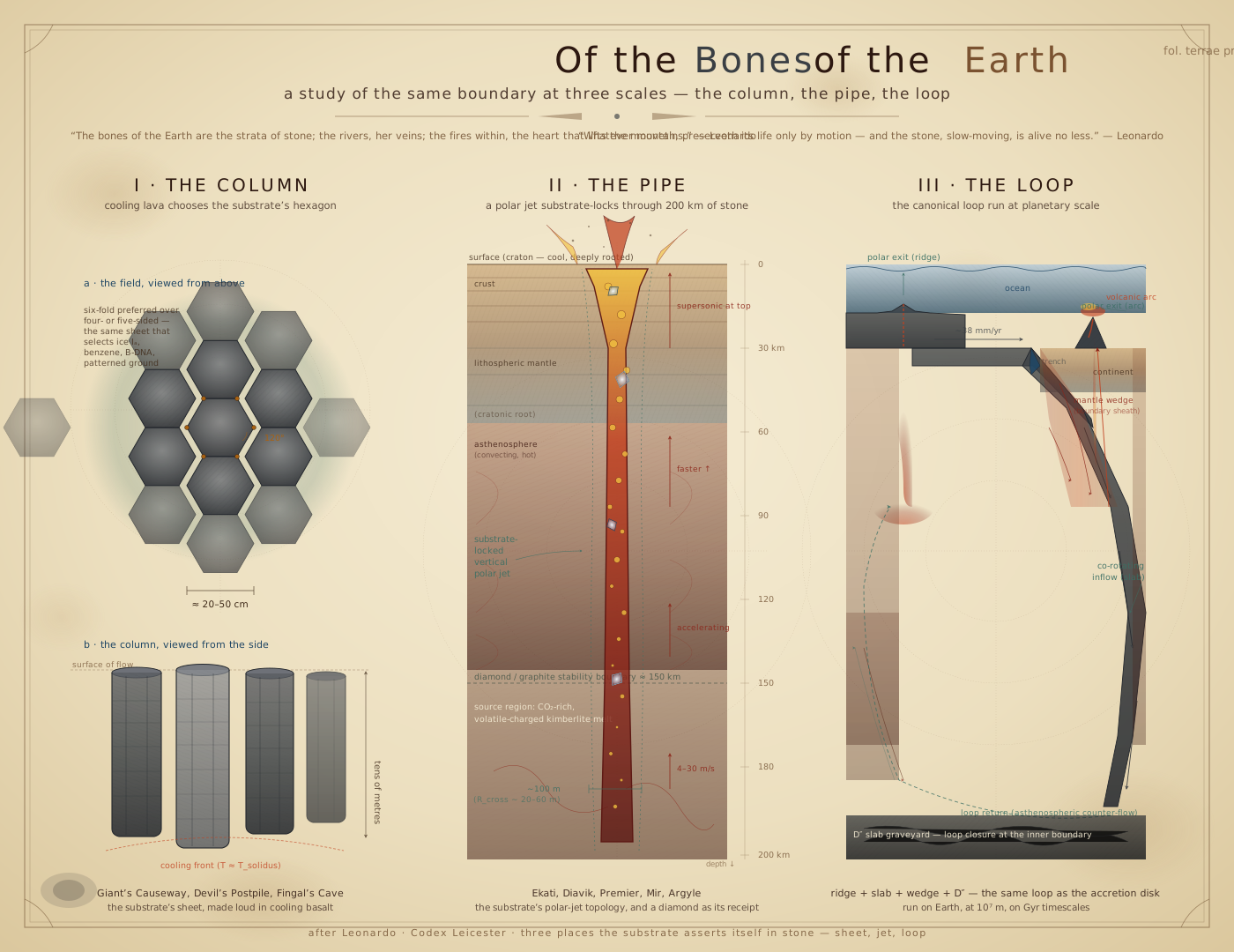
Three places the substrate asserts itself in stone. Top: hexagonal columns at the Giant’s Causeway (\sim 30 cm across), the same six-fold sheet preference that selects snowflakes, patterned ground, benzene, and B-DNA — now expressed in cooling lava. Middle: a kimberlite pipe (\sim 100 m across, \sim 200 km deep), a vertical channel through the lithosphere through which the substrate’s polar-jet topology briefly substrate-locks and ejects diamond-bearing magma at supersonic surface velocities. Bottom: a subduction zone in cross-section, where the planet’s tectonic system runs the canonical loop at planetary scale — mid-ocean ridge as polar exit, subducting slab as co-rotating inflow, volcanic arc as counter-rotating boundary, and slab graveyard at D″ closing the loop.
The Substrate Comes Up for Air
The Earth chapter found the substrate buried in dirt — at the soil-aggregate boundary near \xi, in the hyphal mesh near R_\text{cross}^\text{cyto}, in the hexagonal preference of patterned ground at decameter scale. Each of these signatures is quiet: chemistry and biology dominate the visible behavior, and the substrate’s contribution is statistical, recovered only by averaging over many examples. In the framework’s vocabulary these are large-reading-depth reads — the substrate’s number arrives at the surface only after crossing a deep stack of chemical and mechanical boundaries, each keeping a little of the coin, so the pattern survives but the sharp value does not. That is why geology gives readings rather than zero-parameter numbers, and it is not a weakness of the section but reading depth doing its bookkeeping.
This chapter is the loud version. Where the Earth chapter caught the substrate participating subtly through silicate template inheritance and biological scaffolding, deep earth — the lithosphere, the mantle, and the dynamic processes that shape continents and erupt magma to the surface — is where the substrate occasionally gets the chance to assert itself against chemistry and mechanics, at scales where its assertion is unmistakable. The hexagonal columns at the Giant’s Causeway are not subtle. A kimberlite pipe punching from 200 km depth to the surface in hours is not subtle. The Hayward Fault’s recurrence is not subtle. Each is a place where the substrate’s geometric preferences become — for a moment, in a particular regime — the cheapest way for an enormous amount of organized energy to do what it was going to do anyway.
The framework’s bridge equation chapter found two molecular cases of the substrate asserting itself in exactly this way: B-DNA’s pitch locked to 10.5 \pm 0.1 bp/turn at 0.3% agreement with the substrate cell occupancy f, and the canonical microtubule’s geometry forced to 13 protofilaments — not the chemistry-preferred 14 — at R/h_\text{mon} = 2.594. Both are cases where the substrate’s preference overrode what the local chemistry would otherwise have selected. Geology offers the same kind of cases at km scale: places where six-fold geometry, vertical polar-jet topology, or substrate-bounded propagation wins out over the mechanical alternatives. This chapter is a tour of five of them.
Hexagonal Cooling Joints: The Same Sheet, Now in Cooling Lava
Visit the Giant’s Causeway in Northern Ireland, Devil’s Postpile in California, Fingal’s Cave on Staffa, the Devils Tower laccolith in Wyoming, the Garni Gorge in Armenia, or the Columbia River Basalt outcrops, and you will see the same picture: cooled basaltic lava broken into a tightly-packed array of vertical columns, each one a polygonal prism, the population dominated by six-sided prisms with mean cross-sectional diameters of \sim 20–50 cm. The columns extend tens of meters down into the flow. The packing is honeycomb-tight. Photographs of mature columnar joint sets are indistinguishable, at first glance, from photographs of patterned ground in the high Arctic — and from photographs of beehives, snowflakes, and the basal plane of graphene. The substrate’s six-fold sheet structure has asserted itself in molten rock cooling through the basalt solidus.
The standard explanation is mechanical. As the lava cools and contracts, tensile stresses build until the rock fractures. The fracture pattern that minimizes total surface energy for a given crack density is hexagonal; this has been studied numerically (Aydin and DeGraff 1988; Goehring, Mahadevan, and Morris 2009; Lamur et al. 2018) and reproduced in laboratory experiments using starch slurries that crack as they dry. The mechanics give a column-diameter floor proportional to \sqrt{\kappa\,\tau_\text{cool}} where \kappa is thermal diffusivity and \tau_\text{cool} is the cooling timescale, and the laboratory experiments confirm the size scaling. The 6-fold preference emerges from the same energy minimization: in 2D crack tessellations, six-sided polygons minimize boundary length per unit area more efficiently than four- or five-sided alternatives.
This is correct, and the framework does not replace it. What the framework adds is the same observation it added for snowflake hexagonality and patterned-ground hexagonality: the symmetry choice — 6-fold over 4-fold, 5-fold, or 7-fold — is the substrate’s chirality-coherent sheet template made visible at meter scale. The mechanical-energy argument explains why a hexagonal pattern is energetically favored for any 2D crack tessellation; it does not explain why this particular geometry is the one the substrate has been imposing at every scale from the angstrom (benzene) to the decameter (patterned ground) and now to the meter (basalt columns). The framework reads basalt columnar jointing as the same substrate template now expressed in cooling silicate, with the cracking mechanics as the local conduit through which the template asserts itself. In the language of the substrate ladder, this six-fold preference is the lock pole wearing its spatial face — the substrate forcing matter onto a single preferred geometry, the same lock that selects benzene’s ring and ice’s lattice, here carried up to meter-wide basalt. It is a sibling of, but not the same thing as, the ladder’s \sqrt{2} scale tower: the hexagonal packing is one substrate template and the geometric ratio between scales another, and a column’s diameter lies on neither — it is mechanism-set by \kappa and \tau_\text{cool}. Only the symmetry choice is the substrate’s.
The framework does not derive column diameters from substrate physics — those follow from \kappa, \tau_\text{cool}, and the basalt’s tensile strength as standard cooling-contraction mechanics already explain. What it claims is that the 6-fold preference among mature columnar joint patterns globally is statistically stronger than a pure-mechanical isotropic-stress null model predicts, and that the excess is the same substrate sheet template that selects hexagonal Ice Ih, planar aromatic rings, B-DNA, and patterned ground.
Mature columnar basalt joint patterns should preferentially adopt 6-fold symmetry over 4-/5-/7-fold beyond what isotropic-stress mechanics predicts. Goehring’s experimental dataset on starch-slurry analog crack patterns gives the chemistry-and-mechanics baseline; the framework predicts a small but statistically significant residual excess at 6-fold across well-imaged basalt joint sites (Giant’s Causeway, Devil’s Postpile, Fingal’s Cave, Columbia River, Garni, Svartifoss, Mount Cargill, the Faroe Islands). The cleaner test is cooling-rate variation: slowly-cooled flows (centuries) should show stronger 6-fold preference than rapidly-cooled flows (days), because slow cooling gives the substrate template longer to bias the developing crack pattern.
Conjugate Joints and Triple Junctions: The 3-Fold Projection
The same six-fold sheet template projects onto a 3-fold preference whenever a system is asked to choose only one direction at each crossing. Two examples are worth cataloguing here, both well-established in field geology and both reading naturally as substrate-templated:
Conjugate joint sets in granite and sediment. When competent rock is loaded under regional stress and fractures, it typically does so in two conjugate sets at \sim 60° to each other (i.e., crossing at 120° angles when extended). The mechanics: brittle failure under triaxial stress occurs along planes oriented at 45° \pm \phi/2 to \sigma_1, where \phi is the internal friction angle (\sim 30° for typical rock), giving conjugate intersections near 60°. This is correct as far as the friction angle goes. What the framework adds is that a 60° intersection angle is also the substrate’s preferred 3-fold projection of its 6-fold sheet, and that the rock’s effective friction angle near 30° may itself reflect substrate participation in the dissipation tensor.
Triple junctions in plate tectonics. Where three lithospheric plates meet along rifting boundaries, the geometry approaches a Y with angles near 120°. The Afar triple junction in East Africa (where the Red Sea, Gulf of Aden, and East African Rift meet), the Galapagos triple junction, and the Azores triple junction all approximate this geometry — approximate being the operative word: at Afar the inter-arm angles are unequal, spanning roughly 100°–140°, and the three arms formed sequentially over \sim 20 Myr rather than in one rupture. The standard mechanics is worth stating carefully, because rigid-plate kinematics does not select 120°: McKenzie and Morgan’s classic stability analysis shows a ridge-ridge-ridge junction is stable at any angles. The selection argument is energetic — Burke and Dewey (1973) proposed that a plume-domed lithosphere ruptures in three arms at \sim 120° because that configuration requires the least work, and modern analogue and numerical experiments on Afar-type breakup recover the same result under realistic far-field stress: the triple junction forms because it minimizes the dissipative work of multi-directional breakup. The substrate reading: the same 3-fold projection of the 6-fold sheet, biasing which work-minimum the lithosphere finds. The Afar history sharpens rather than weakens the claim — a junction assembled piecemeal, under differently oriented far-field stresses at each stage, still converged on an approximate trisection — and the framework predicts that triple junctions across the planet should continue converging toward 120° as they mature, even when the local boundary stresses remain imbalanced, because the substrate biases the geometry toward its preferred angle.
Plate Tectonics as the Planetary Canonical Loop
Step back from individual joint sets and the entire plate-tectonic system reads as one expression of the feedback topology chapter’s canonical loop, run at planetary scale through the lithosphere and upper mantle. This was hinted at in the Gaia chapter but is worth drawing as a single unified loop here:
| Component | Plate tectonics | Canonical loop |
|---|---|---|
| Co-rotating disk inflow | Subducting oceanic plate, driven by slab pull | Accretion disk |
| Polar jets (mass + heat exit) | Mid-ocean ridge spreading; volcanic arc above subducting slab | Bipolar jets |
| Counter-rotating boundary | Asthenosphere flow beneath the lithosphere; mantle wedge above subducting slab | Boundary sheath |
| Radiated output | Seismic waves; heat flow through volcanic arcs and ridges; outgassing | Modons / photons |
| Loop closure at the inner boundary | Slab graveyard at D″ (\sim 200 km thick layer at the core-mantle boundary) | Disk inner edge / accretion onto compact object |
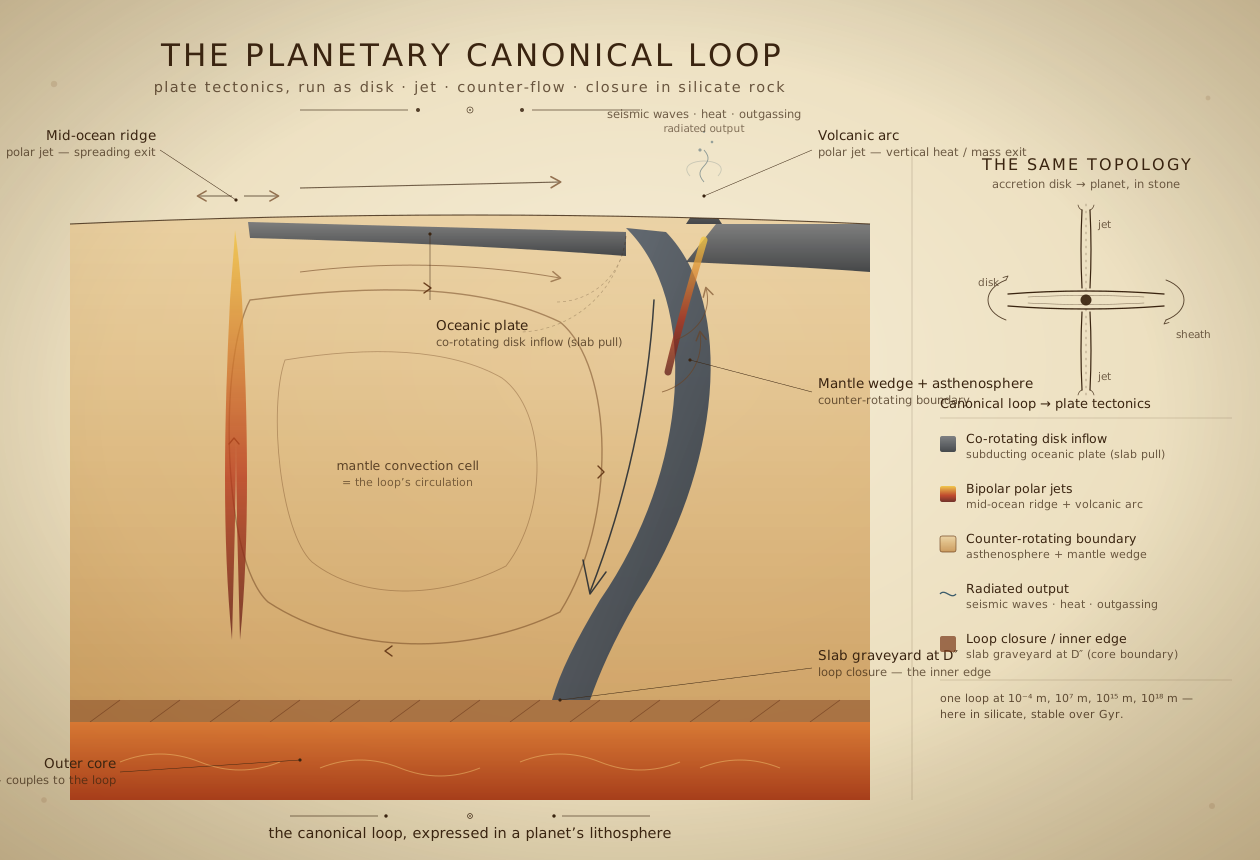
The plate-tectonic system drawn as a single canonical loop. A cross-section through the lithosphere and mantle: the mid-ocean ridge (left) is one polar-jet exit, where mantle upwelling drives plate spreading; the cooling oceanic plate is the co-rotating disk inflow, pulled toward the trench by its own dense slab; the subducting slab descends as the cold tongue, sinking through the mantle to the slab graveyard at D″ (\sim 200 km above the core-mantle boundary), which closes the loop at the inner edge; the volcanic arc is the second polar jet, venting heat and mass vertically through the overriding plate; the asthenosphere beneath the plate and the mantle wedge above the slab form the counter-rotating boundary; and seismic waves, heat flow, and outgassing are the radiated output. The whole circulation is one mantle convection cell — the same disk-jet-counterflow topology (right) that the feedback topology chapter finds at 10^{-4} m in the substrate’s vortex lattice, 10^7 m in the geodynamo, 10^{15} m in accretion disks, and 10^{18} m in AGN, here expressed in silicate rock and stable over Gyr timescales.
The framework’s contribution is structural. Standard plate-tectonic geophysics explains why slabs sink (negative buoyancy), why ridges spread (passive upwelling driven by slab pull), and why arcs erupt (slab dehydration triggers flux melting in the mantle wedge). What it does not explain is why this particular topology — with its planar coupling, its polar-jet exits, its counter-rotating boundary layers, and its return path through the mantle — is the configuration the planet settled into rather than one of the many geometrically possible alternatives. The substrate framework reads the topology as the same canonical loop that organizes accretion disks at 10^{15} m, AGN at 10^{18} m, the geodynamo at 10^7 m, and the substrate’s own vortex lattice at 10^{-4} m. Earth’s tectonic machinery is the canonical loop expressed in silicate rock at planetary scale, and the substrate’s elasticity at the dissipation scale is what makes the configuration stable over Gyr timescales. This recurrence of one topology across some twenty-two orders of magnitude is the same self-similar-motif logic the substrate ladder formalizes — a single pattern living at many sizes — with one honest qualification: these instances sit at scales each host system sets (vortex spacing, core radius, disk size), not on a \sqrt{2} comb. What recurs across them is the loop’s topology, not a fixed ratio between its rungs; the ladder’s geometric tower is a separate claim, made where a single critical medium tiles the scales between its own cutoffs.
The slab graveyards at D″ — discussed in the feedback topology and Gaia chapters — are the loop closure: subducted slabs that have descended through the entire mantle now sit piled at the core-mantle boundary, mechanically coupling the surface plate motion to the geodynamo’s outer-core convection. The seismic anisotropy in this layer (V_{SH} > V_{SV} at \sim 1%) is the loop’s boundary signature, in the same family as the cold wall of the Gulf Stream and the eyewall of a hurricane.
Stratigraphy, Folding, and the Sharpened Boundary
Stand at the rim of the Grand Canyon and look down at one and a half billion years of sedimentary history laid out as a layer cake. The boundaries between strata are sharp — sharper than diffusive mixing, bioturbation, or compaction would predict over hundreds of millions of years. The Tapeats Sandstone cuts cleanly against the Vishnu Schist below it (the Great Unconformity, recording \sim 1 Gyr of missing time); the Bright Angel Shale drapes cleanly over the Tapeats; each unit transitions to the next over thicknesses much smaller than the units themselves. The same observation applies at every scale: lake-bed varves at mm scale, marine biostratigraphic boundaries at cm scale, formation contacts at m scale, basement-cover unconformities at km scale.
The framework reads stratigraphic boundaries through the same lens the water chapter used for ocean fronts and the Earth chapter used for soil horizon transitions: counter-rotating substrate boundaries between adjacent compositional domains, sharpened by the substrate’s elastic response at the dissipation scale and persistent over the relevant geological timescales. The standard mechanism — episodic deposition with intervening pauses — is correct, but it does not explain why the boundaries stay sharp through subsequent diagenesis. The substrate’s contribution is to prevent the diffusive smoothing that would otherwise erode them.
The same argument applies to Yosemite-style exfoliation jointing. Granite domes (Half Dome, Stone Mountain, Sugarloaf, Enchanted Rock) develop curved sheet joints that peel off the dome surface in onion-like layers, each layer with thickness of \sim 1–10 m. Standard explanation: pressure release as overlying rock is eroded causes the granite to expand outward, fracturing into shells. The mechanics work, and the framework does not replace them. What the framework adds is the characteristic thickness. The sheet joint thickness in mature exfoliation is set by the depth at which residual stress balances the granite’s tensile strength — a chemistry-and-mechanics calculation. But the coherence of the sheets over hundreds of meters of dome surface, with sheet-to-sheet thickness variation much smaller than the mean, is the substrate organizing the failure pattern at a preferred scale, in the same way the soil aggregate hierarchy clusters at \xi.
Stratigraphic and joint boundaries should remain sharper than diffusive mixing predicts over geological timescales, with the boundary thickness floor scaling with mineral grain size rather than geological age. The prediction is testable through high-resolution geochemical and isotopic profiling across well-preserved sedimentary boundaries (Permian-Triassic in the Meishan section; K-Pg at Gubbio; ash-bed contacts in the Yellowstone caldera record). Standard diagenetic modeling predicts boundary widths growing as \sqrt{D\,t} with diffusion coefficient D and age t; the framework predicts a floor at the substrate’s coherence scale below which the boundary will not blur further regardless of age.
Kimberlites as Substrate-Locked Polar Jets
The most striking case in this chapter is the kimberlite pipe. Kimberlites are vertical, narrow (\sim 100 m to \sim 1 km diameter), conical magmatic intrusions that originate at depths of 150–450 km in the upper mantle, ascend through the lithosphere at speeds estimated at 4–30 m/s in the deep portion accelerating to several hundred m/s at the surface, and erupt as supersonic CO₂-rich explosive events lasting hours to days. They are the only known transport mechanism for diamond-bearing mantle xenoliths (eclogite, peridotite) to reach the surface intact, and as a consequence they are the planet’s only direct samples of mantle material from below the asthenosphere. They also show three peculiar properties that standard geology has had difficulty explaining as a single phenomenon:
- They erupt almost exclusively through ancient cratonic shields. The Slave craton (Northwest Territories), the Kaapvaal craton (southern Africa), the Siberian craton, the East European craton, and the Superior craton between them host nearly every economically viable kimberlite. Young oceanic lithosphere and active orogenic belts host essentially none.
- They cluster in time. The Cretaceous (145–66 Ma) saw a global pulse during which the majority of known kimberlites erupted; an earlier pulse occurred in the Mesoproterozoic (~1.2 Ga). The most recent eruption is dated to \sim 10{,}000 years ago in Tanzania (Igwisi Hills); the planet is essentially out of the kimberlite business now.
- They preserve diamond. A diamond at the surface is metastable (graphite is the stable form at 1 atm); it survives only because the ascent through the diamond-graphite stability boundary at \sim 150 km depth is fast enough that the carbon does not have time to re-equilibrate to graphite. The kinetics give an upper bound on the ascent timescale of \sim hours through the upper mantle.
The framework reads the kimberlite event as a vertical polar jet of the mantle’s canonical loop substrate-locking into a coherent column. In the feedback topology chapter, the polar jet is the geometric exit through which a rotating system sheds excess angular momentum and energy along its axis. In a rotating planetary mantle, polar-jet topology is always available in principle, but the substrate-locking required to maintain coherent vertical transport over 200+ km of mantle is rare. The framework’s reading explains all three peculiar properties at once: cratons provide the stable, cold, deeply-rooted boundary that allows the substrate-locked column to nucleate and persist; the Cretaceous pulse is when the planet’s mantle-convection state was most favorable to substrate-locking these columns; the diamond preservation is the receipt — physical proof that the column held coherently from 200 km depth without thermal/mechanical equilibration with the surrounding mantle.
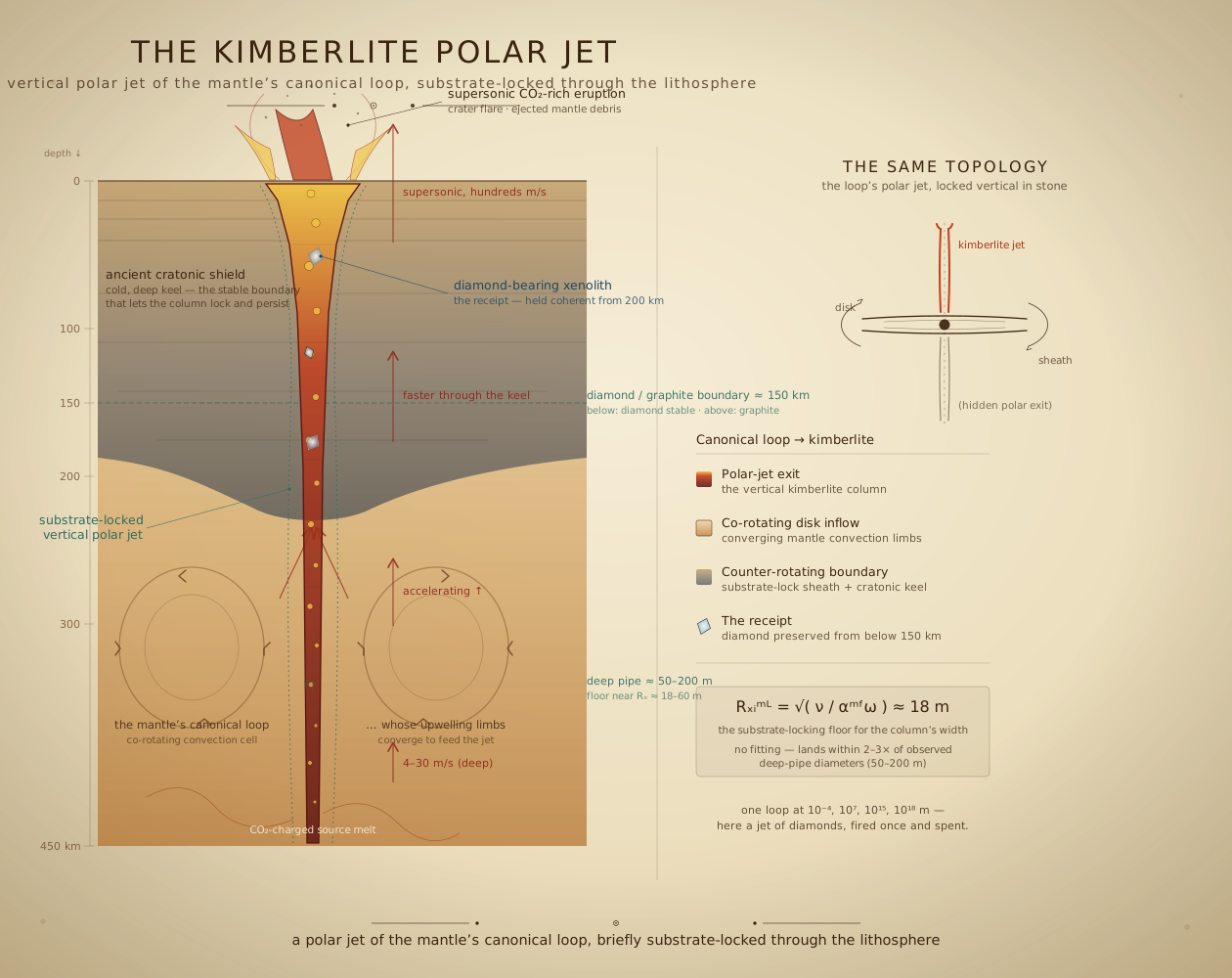
The kimberlite event drawn as one polar jet of the mantle’s canonical loop. A cross-section from the surface down to the \sim 450 km source: two flanking mantle-convection cells are the loop’s co-rotating disk inflow, and their converging upwelling limbs feed a single narrow vertical conduit — the polar-jet exit. The column substrate-locks into a coherent vortex (the dashed counter-rotating sheath) and punches straight up through the cold, deeply-rooted keel of an ancient craton, the stable boundary that lets the lock nucleate and persist. It accelerates from 4–30 m/s at depth to a supersonic CO₂-rich eruption at the surface, and crosses the diamond–graphite stability boundary at \sim 150 km fast enough that the diamond-bearing xenoliths survive — the receipt, physical proof the column held coherent from 200+ km without equilibrating with the surrounding mantle. The deep-pipe diameter (\sim 50–200 m) sits near the substrate-locking floor R_\text{cross}^\text{kimb} \approx 18 m. The same disk–jet–counterflow topology (right) the feedback topology chapter finds at 10^{-4} m in the substrate’s vortex lattice, 10^7 m in the geodynamo, 10^{15} m in accretion disks, and 10^{18} m in AGN — here fired once through the lithosphere and spent, leaving a pipe of diamonds behind.
The pipe diameter offers a back-of-envelope quantitative anchor. Apply the water chapter’s R_\text{cross} formula to kimberlite ascent:
R_\text{cross}^\text{kimb} = \sqrt{\frac{\nu_\text{kimb}}{\alpha_{mf}\,\omega_\text{erupt}}}
with \nu_\text{kimb} \sim 10^{-2} m²/s for low-viscosity CO₂-rich kimberlite magma during ascent, \omega_\text{erupt} \sim 6 \times 10^{-5} rad/s for an eruption rotation timescale of \sim 1 day, and \alpha_{mf} \approx 0.5, giving
R_\text{cross}^\text{kimb} \approx \sqrt{\frac{10^{-2}}{0.5 \cdot 6\times 10^{-5}}} \approx 18\;\text{m}
with the higher-viscosity end (\nu \sim 10^{-1} m²/s) giving \sim 60 m. This lands within a factor of 2–3 of the observed deep pipe diameters (\sim 50–200 m at depth, flaring to \sim 100–1000 m near surface from blowout). The match is not the 0.3%-level hit that B-DNA’s pitch achieves, but it is a non-trivial coincidence — a single-formula prediction with no fitting, using parameters from the kimberlite literature, landing in the right size range for the observed phenomenon.
The R_\text{cross} formula was derived in the water chapter for fluid-fluid coherence at substrate-locked boundaries (Gulf Stream rings, hyphal networks, atmospheric vortices), and its application to a magmatic intrusion ascending through the solid mantle is an extrapolation. The factor-of-2–3 agreement should be treated as suggestive rather than diagnostic. The framework’s stronger claim is the structural one — that kimberlite pipes are vertical polar jets of the canonical loop briefly substrate-locking through the lithosphere — for which the diameter calculation is supporting rather than primary evidence.
Kimberlite pipe diameter at depth should cluster near the R_\text{cross}^\text{kimb} \approx 20–60 m floor, with the upper-surface flare set by blowout dynamics rather than substrate constraint. Existing diamond-mine geology gives detailed pipe-shape data (Ekati, Diavik, Premier, Mir, Argyle); a statistical compilation of deep-portion diameters versus surface-flare diameters should show the deep portion clustering tightly while the surface diameter spreads broadly. A null result — pipe diameters distributing smoothly across many orders of magnitude — would weaken the substrate-locked-column reading.
Hotspots as the Slower Cousin
If kimberlites are the substrate-locked polar jet’s moment of glory, mantle hotspots are its slower, persistent expression. Hawaii, Yellowstone, Iceland, Réunion, and the dozens of other classical hotspot tracks each represent a long-lived (10^7–10^8 yr) vertical conduit through the mantle that erupts persistently as the overlying plate drifts past. The Hawaii-Emperor chain records 80 Myr of continuous plume activity through a narrow column of upwelling mantle. Standard mantle-plume theory: thermal buoyancy from the lower mantle (or D″) drives a coherent rising column that erupts where it intersects the lithosphere.
The framework adds the same observation it added for kimberlites: a coherent vertical column over \gtrsim 1000 km of mantle is a substrate-locked polar-jet topology, with the substrate’s elasticity providing the structural stability that keeps the plume from dispersing turbulently through the convecting mantle. The hotspot and the kimberlite are the same topology run on different timescales: the hotspot is the steady-state version (slow upwelling, persistent eruption, plate moves over it); the kimberlite is the impulsive version (rapid ascent, short eruption, single pipe). Both are the canonical loop’s polar-jet exit asserting itself through the lithosphere.
The flood basalt provinces (Siberian Traps at the Permian-Triassic boundary; Deccan Traps near the K-Pg; Columbia River Basalts in the Miocene) are the impulsive cousin at much larger diameter — what happens when a mantle plume head reaches the lithosphere and erupts an entire blob’s worth of basalt over \sim 1 Myr. Each is the canonical loop expressed at the appropriate scale: kimberlite for a single supersonic pipe, hotspot for a steady-state column, flood basalt for a plume head.
Earthquakes and Slow Slip: Substrate-Bounded Rupture
The Hayward Fault runs \sim 5 km east of me; the San Andreas \sim 20 km west. Both have characteristic earthquake recurrence intervals — the Hayward at \sim 140–170 years (last major event 1868), the San Andreas at \sim 200 years for the Peninsula segment (1906). These are not arbitrary: they are the steady-state intervals at which the Pacific-North American plate motion (\sim 38 mm/yr) accumulates enough elastic strain to overcome the fault’s static friction and rupture. The earthquake is the rapid release of that accumulated strain, propagating as a slip front along the fault plane at velocities approaching the rock’s shear wave speed v_S \approx 3.5 km/s.
The framework reads the earthquake as a propagating substrate-mediated boundary in solid rock — the elastic waves carrying the rupture energy are vibrational modes of the substrate-organized lattice in the same way photons are modon excitations of the substrate-organized vacuum. The standard seismology — P-waves at v_P \approx 6 km/s, S-waves at v_S \approx 3.5 km/s, Rayleigh and Love surface waves at v_R \approx 0.92\,v_S, rupture velocity capped at v_R in normal subshear ruptures and rarely exceeding \sqrt{2}\,v_S in supershear events — is the substrate’s elastic response made directly observable in seismograms. Where the framework adds something is at the limits of the regime:
The supershear ceiling. Earthquake ruptures normally propagate at subshear speeds (below v_R); a small population (the 1979 Imperial Valley, the 2002 Denali, the 2018 Palu) crosses into supershear. The transition requires special conditions: pre-existing damage zones, very smooth faults, or the Burridge-Andrews mechanism. The framework’s reading: supershear is the rare regime where the rupture has acquired enough coherence to substrate-lock as a propagating front in its own right, decoupling from the local rock’s friction-mediated slip and propagating as a substrate boundary. The fact that supershear events leave behind characteristic surface-rupture morphologies (shallow, narrow damage zones; less off-fault deformation) is consistent with this reading.
Slow slip events as the substrate-damped slow mode. Discovered only in the early 2000s on the Cascadia subduction zone (Dragert, Wang, James 2001) and now identified at most subduction zones globally, slow slip events are quasi-static slip episodes that propagate along subduction interfaces at \sim 5–20 km/day (six orders of magnitude below seismic rupture velocities), last weeks to months, and recur with characteristic intervals (Cascadia: \sim 14 months for ETS — episodic tremor and slip). They release seismic moment equivalent to large earthquakes but radiate almost no high-frequency energy. Their existence was a complete surprise — no one had predicted them, and there is still no consensus mechanism. The framework’s reading: slow slip is the substrate’s “soft” propagation mode for a rupture that cannot meet the substrate-locking condition for fast propagation, with the propagation velocity set by the substrate’s effective viscous coupling at the subduction interface rather than by elastic wave mechanics. Cascadia’s \sim 14-month recurrence is a tuned periodicity, in the same family as the Parkfield M~6 recurrence — substrate-mediated relaxation oscillations of a frictional system. These recurrence intervals form a ladder of their own, but a harmonic one — integer multiples T_0, 2T_0, 3T_0 of a single fundamental — and it is worth keeping it distinct from the substrate ladder’s \sqrt{2} geometric tower. The distinction is exactly that chapter’s keyboard-versus-string: a fault that stores and releases strain on one relaxation time has a clock of its own, so it rings at the overtones of that clock, the way a string with a fixed length rings at 1,2,3,\dots times its fundamental; the \sqrt{2} comb is what a critical medium with no length of its own produces instead. Slow slip should ring like a string; the Gutenberg–Richter log-periodicity is where the lengthless \sqrt{2} tower shows through the same rock.
The Gutenberg-Richter b \approx 1. Earthquake magnitudes follow a power-law size distribution \log_{10} N(M) = a - bM with b \approx 1 across orders of magnitude in seismic moment. This is one of the cleanest scale-invariant power laws in nature, and it has been read variously as evidence for self-organized criticality (Bak, Tang, Wiesenfeld), fractal fault-network geometry (Aki, Turcotte), or chaotic stick-slip dynamics. The framework’s reading: b \approx 1 is the same scale-invariant signature that Tkachenko coarsening produces in the substrate’s vortex lattice (feedback topology), now expressed in the mechanical fracture statistics of stressed lithosphere. The substrate’s coherence-cell network at every scale within the \xi-to-L_\text{domain} window provides the scale-invariant template; rock fracture statistics inherit it. The continuous power law is the scale-free backdrop; the framework predicts the discrete refinement — the log-periodic corrections Sornette finds riding on the Gutenberg-Richter line — as the macroscopic, classical face of the substrate ladder’s discrete scale invariance. This is the ladder’s comb test carried to its largest and most chemistry-free arena: fold the inter-magnitude spacings of the log-periodic corrections and they should fall on a \sqrt{2} comb, the seismic counterpart of the LOFAR branch-point fold the lightning chapter proposes at km scale. The honest caveat here is heavier than elsewhere, and worth stating plainly. The log-periodicity itself is not established: Sornette’s log-periodic corrections to Gutenberg–Richter have been challenged as statistical artifacts — log-periodic functions fit noisy, heavy-tailed catalogs disturbingly well by chance (the re-examinations of the Loma Prieta precursor; Sornette’s own significance rebuttals against exactly this objection). So this test has two open layers, not one: first whether any discrete log-periodic ladder rides the power law at all — which the seismology literature has not settled — and only then whether its period is \sqrt{2}. Pulling a discrete comb out of a scale-free spectrum is precisely the operation most prone to manufacturing peaks from finite samples (the same self-fooling risk the grain-size notch ran into with instrument channels), so the fold must clear a phase-randomized null and a significance test before any \sqrt{2} claim is admissible. This is the framework’s most speculative geological probe — offered as if the discrete scale invariance is real, here is where it must land, not as a claim that it is there.
Slow slip event characteristic recurrence intervals should cluster at substrate-set timescales rather than distributing continuously with subduction-zone parameters. The prediction is statistical: across the global slow-slip catalog (Cascadia, Nankai, Mexico, New Zealand, Costa Rica), the recurrence intervals should show preferential clustering at integer multiples of a fundamental period rather than scaling smoothly with plate convergence rate or subduction angle. The fundamental period is set by the substrate’s relaxation time at lithospheric viscosity, which the framework cannot yet calculate from first principles but which should produce coherent peaks in the recurrence-interval histogram once the catalog is large enough.
Earthquake rupture should show a low-magnitude floor below which the rupture cannot substrate-lock, observable as a deficit in events below a critical seismic moment. Most catalogs already show a completeness threshold at M \sim -1 to 0 for dense networks; the framework predicts that below the completeness threshold there is also a physical threshold corresponding to rupture lengths smaller than the substrate’s transverse coherence scale in solid rock. Distinguishing the physical floor from the network completeness would require dedicated dense-borehole seismometer arrays of the kind operating at the SAFOD (San Andreas Fault Observatory at Depth) site.
The Whole Planet Rings: The String Pole at Planetary Scale
The 1960 Chilean earthquake (M\,9.5) and the 2004 Sumatra–Andaman earthquake (M\,9.1) did something no smaller event does: they set the entire planet ringing for weeks. Earth’s free oscillations — its normal modes — are standing elastic waves of the whole body, from the gravest “football mode” _0S_2 at \sim 53.9 min and the radial “breathing mode” _0S_0 at \sim 20.5 min through a dense, discrete spectrum of overtones. And the planet does not need a great earthquake to ring: it hums continuously in the \sim 2–7 mHz band, the seismic hum, driven by the ceaseless drumming of ocean infragravity waves and the atmosphere on the solid Earth (Nawa et al. 1998; Suda et al. 1998; Rhie & Romanowicz 2004). The Earth is always sounding its own lowest notes.
This is the cleanest planetary example of the string pole of the keyboard-versus-string cut — the seismic twin of the Sun’s five-minute p-modes (solar–stellar dynamics). A finite elastic body has a length — Earth’s radius — so it rings in a discrete spectrum fixed by that size, the length-bearing complement to the substrate’s lengthless \sqrt2 keyboard. (Strictly the Earth is a bell, not an ideal string: a sphere’s overtones are inharmonic, spaced by its internal structure rather than at a clean 1, 2, 3; but the essential point stands — the modes belong to the body’s own size, not to a lattice ratio.) The reading earns its place by a disciplinary payoff for the section’s comb test: the free-oscillation spectrum is exactly the kind of length-set ladder that must be separated out before any geological dataset is folded onto the \sqrt2 comb, because it crowds the low frequencies with structure that is the planet’s size talking, not the substrate’s rung. The \sqrt2 keyboard shows through elsewhere — in the Gutenberg–Richter log-periodicity — while the free oscillations are its length-bearing foil. Like the mantle’s shear ceiling, it is a large-reading-depth descriptive read — the modes are set by Earth’s size and elastic profile, chemistry all the way down, not a substrate number — but it is the one that most vividly shows what the other pole of the ladder sounds like, at a scale a seismograph anywhere on Earth can hear.
What Deep Earth Predicts
| Prediction | Substrate origin | Test |
|---|---|---|
| Mature columnar basalt 6-fold preference excess over isotropic-stress null | Substrate’s chirality-coherent sheet template at meter scale, same as patterned ground/snowflakes/benzene/B-DNA | Statistical analysis of joint-pattern symmetry across well-imaged basalt fields; cooling-rate dependence (slow flows show stronger 6-fold excess) |
| Triple junction angles converge to 120° even under imbalanced boundary stresses | 3-fold projection of the substrate’s 6-fold sheet | Statistical compilation of triple-junction geometries globally; deviation from 120° should correlate weakly or not at all with local stress imbalance |
| Stratigraphic and joint boundaries remain sharper than diffusive mixing predicts over Gyr timescales | Counter-rotating substrate boundary at compositional/grain-size discontinuities, sharpened by elastic response at dissipation scale | High-resolution geochemical profiling of preserved sedimentary boundaries; thickness floor independent of geological age |
| Kimberlite pipe deep-diameter clusters near R_\text{cross}^\text{kimb} \approx 20–60 m | Substrate-locking floor for vertical polar-jet column in kimberlite-magma-parameter regime | Statistical analysis of pipe-shape data from diamond-mine geology (Ekati, Diavik, Premier, Mir, Argyle); deep diameter clusters tightly while surface flare spreads broadly |
| Slow slip event recurrence intervals cluster at substrate-set timescales rather than scaling continuously with subduction parameters | Substrate-mediated relaxation oscillation period at lithospheric viscosity | Statistical analysis of global slow-slip catalog; recurrence interval histogram should show coherent peaks rather than smooth distribution |
| Earthquake rupture deficit at lengths smaller than substrate transverse coherence in solid rock | Substrate-locking floor for propagating elastic rupture | Dedicated dense-borehole seismometer arrays (SAFOD-type); physical floor distinguishable from network completeness threshold |
| Hotspot tracks and kimberlite pipes are the same topology at different timescales | Both are substrate-locked vertical polar-jet exits of the mantle’s canonical loop | Geochemical and geometric comparison of hotspot-derived basalts (Hawaii, Iceland) with kimberlite xenolith suites; common vertical-column signatures |
Connections
This chapter sits at the intersection of several established framework threads:
- The feedback topology chapter supplies the canonical loop architecture (co-rotating disk + polar jets + counter-rotating boundary + radiated residual) that the plate-tectonic system, the kimberlite pipe, the hotspot column, and the earthquake rupture all express at their respective scales.
- The Earth chapter supplies the small-scale companion view: hexagonal patterned ground, soil aggregates at \xi, mycorrhizal networks at R_\text{cross}^\text{cyto}. Deep earth is what the same substrate signatures look like at km scale and above.
- The Gaia chapter supplies the Earth-as-nested-feedback-stack architecture in which the deep mantle, the lithosphere, and the surface biosphere are coupled feedback layers. This chapter develops the lithospheric layer in more mechanical detail than the Gaia narrative had room for.
- The water chapter supplies the R_\text{cross} formula and the substrate-locking number N_\text{lock}, which this chapter applies (with appropriate scope caveats) to kimberlite pipe diameters.
- The fire chapter supplies the c_T \approx 9 km/s transverse phonon speed of the substrate. Earthquake P-wave velocities in the deep mantle (\sim 13 km/s) and S-wave velocities (\sim 7 km/s) bracket this scale, suggesting the substrate’s elastic response sits in the same dynamical regime as the mantle’s seismic propagation — a connection worth developing further than space permits here.
- The ice chapter supplies the hexagonal sheet template at molecular scale that columnar basalt expresses at meter scale. The two are the same template made visible through different physical mechanisms: hydrogen-bond crystallization for ice, thermal-contraction fracture for basalt.
- The bridge equation provides the precedent for “substrate asserts itself” at sharp numerical agreement: B-DNA’s 10.5 bp/turn at 0.3%, the canonical microtubule’s 13 protofilaments at 2.0%. This chapter offers geological cases of the same phenomenon — places where the substrate’s preference wins over the local mechanics.
- The substrate ladder supplies the discrete-scale-invariance reading of the Gutenberg–Richter log-periodicity (the macroscopic, classical face of the \sqrt{2} comb), the lock-pole spatial template behind the hexagonal cooling joints, and the keyboard-versus-string distinction that separates the slow-slip recurrence’s harmonic clock from the substrate’s lengthless \sqrt{2} tower.
What Deep Earth Reveals About the Substrate
The Earth chapter closed by ranging the five elements along an axis of substrate participation: ice locks, water flows, fire tears, air permits, earth carries. Earth was the substrate’s most thoroughly buried participant — visible only by averaging over many examples of soil aggregation, hyphal mesh, fairy-ring expansion. Deep earth is the same medium given a wider canvas. In a basalt column at the Giant’s Causeway, the substrate’s hexagonal sheet has the chance to assert itself in cooling silicate at meter scale, with no biology in the way and no chemistry that prefers a different geometry. In a kimberlite pipe, the substrate’s polar-jet topology has the chance to substrate-lock vertically through 200 km of lithosphere and deliver the receipt as a diamond. In an earthquake rupture, the substrate’s elastic response is the very medium that carries the seismic energy from hypocenter to surface. In the planetary tectonic loop, the substrate’s canonical disk-jet-counterflow topology runs at the largest scale a single planet can host.
Where the surface Earth chapter found the substrate participating quietly through silicate template inheritance and biological scaffolding, deep earth is where the substrate occasionally gets the volume turned up. It is the same medium, the same template, the same canonical loop — now expressed at the scales where the planet’s own machinery puts it on display. Stand at the Giant’s Causeway, or at the rim of the Grand Canyon, or on the South Rim of Half Dome, or in the pit of an open kimberlite mine in Yakutia, or in San Francisco when the Hayward Fault next slips, and you are looking at the substrate doing what it does at every scale — but for once, doing it loudly enough that the geology cannot help but notice.