Gaia’s Layers
Earth’s evolution read as deepening enclosure — leaking fermions wrapped in nested modons, and life as the art of holding the substrate’s coin against a medium built to take it back
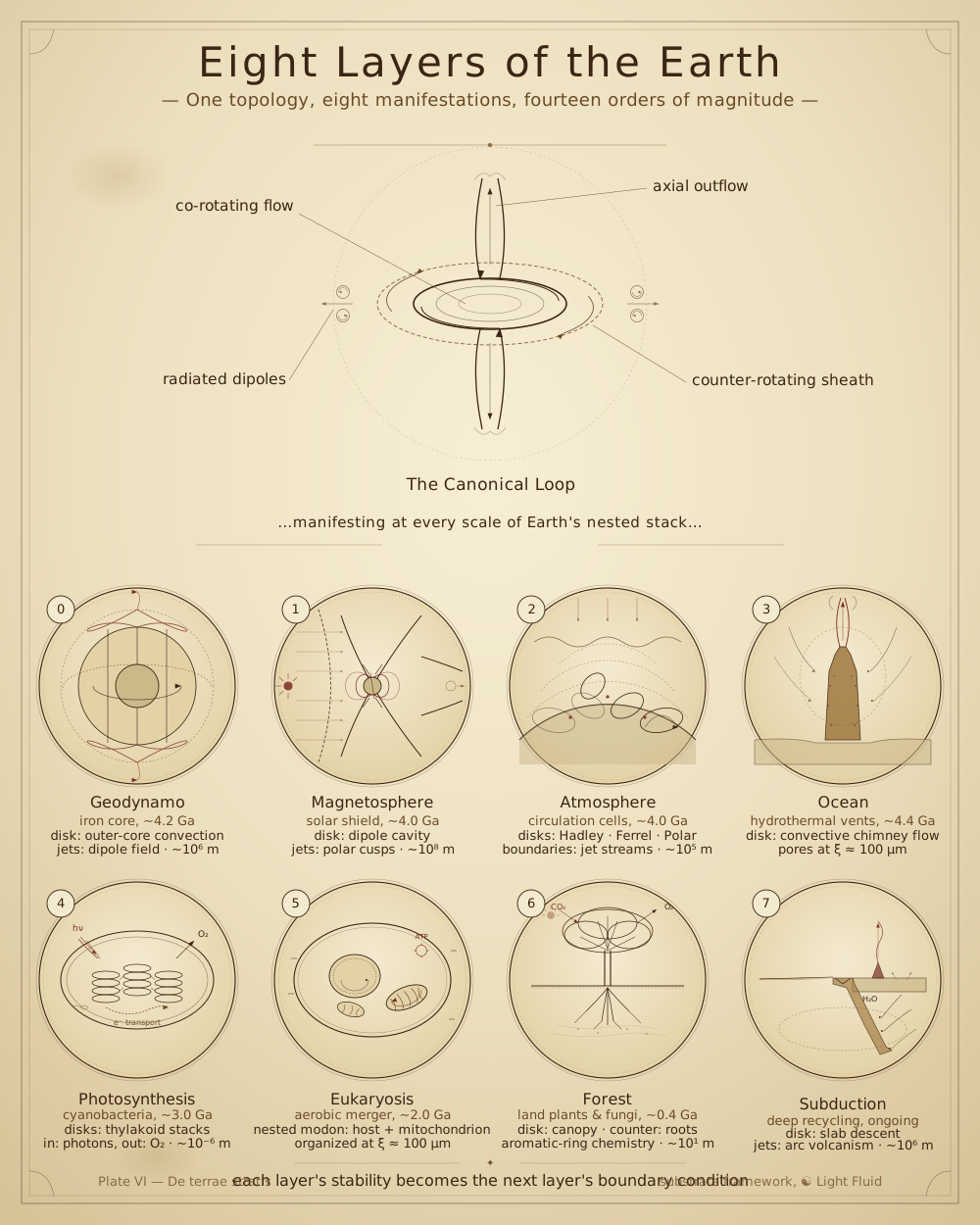
The Argument in Brief
This chapter looks at how the substrate influenced Earth and it’s development. It’s a slowly rotating mass embedded in the substrate, coupled to the Sun’s sheet through the ecliptic, shielded by its own dipole, wrapped in fluid layers each hosting its own instance of the feedback topology loop. Its geological and biological evolution formed by progressive nesting of those nodes: each major transition added a new wrap, each wrap catching the leak of the producer inside it, the whole stack stabilized at a higher level.
Interactive: open the Gaia simulation — the planet cut along the great circle through both LLSVP feet, every shell running its own copy of the canonical loop on its own clock: the geodynamo’s Taylor columns and equatorial disk, D″, Tuzo and Jason as the two feet of the mantle’s standing modon with plumes rising from each and slabs descending between them, the 660 and 410 as crisp sheets (one slab punches through, one stagnates), the plate riding on its 80–200 km shear channel, the atmosphere as its three cells and the jets at their boundaries in the thin skin over the crust, and the dipole with its auroral funnels. A layer picker lights the four ports of one shell; a show/hide menu switches each feature off and on; a log-time dial from one second per minute to one second per ten million years shows which shells move at which pace; a chemistry-only toggle blurs the sheets and lets the mantle fall into a generic multi-cell pattern. A second view puts the planet inside its magnetosphere at true scale with the geodynamo’s ledger beside it — ten terawatts of heat against a coin of a few hundred megawatts — and a dynamo slider that shrinks the standoff until the wind reaches the atmosphere and the stack above goes dark: Mars, Venus, and the young Earth under a ten-times stronger wind, still held. Because the stack’s unit hides the crust — 7 to 35 km is thinner than one tracer dot — three close views redraw the outer skin at their own scale: the lid, the outer 300 km with no vertical exaggeration, the air’s layers and the jet over 4 km of ocean, 7 and 35 km of crust with the 10–15 km hinge, the LAB at 80 km and the channel to 200 — everything this chapter calls the living skin thinner than the channel the plate rides on; the exit, where the loop’s polar exit breaks the lid, as a subduction arc with its Plinian column through the tropopause to 58 km or, on the mode switch, as a mid-ocean ridge with its melt lens and 7 km of crust; and the fault, locked and creeping on one strand with slip drawn ×1000, the locked patch storing its deficit and spending it on a ~150 yr Poisson clock — the transition along strike a step, or, chemistry only, a ramp. A fourth close view, the sky, draws the atmosphere at its own scale in two modes: the storm, 200 km across and 110 up at true scale — the tropopause, stratopause, mesopause and turbopause crisp (or, chemistry only, smeared to the widths mixing alone would give), a cumulonimbus capped by the tropopause, its field charging to the window the substrate opens and firing two strokes a minute with γ shed at the 300 keV read, sprites, halo and elves above the strong ones and blue jets from the cloud top, and chemistry-only the field stalling at a tenth of breakdown, the cloud unable to spark; and the cells, pole to pole at vertical ×100 — the six cells turning under a tropopause that steps down at the subtropical jet, the jets at the cell boundaries, the Brewer–Dobson overturn of the stratosphere, and the polar vortex over the winter pole, with the dial making the ladder’s point: at a minute a second only the jets move, at a day the cells turn, at a year the stratosphere’s overturn is a blur.
The substrate empowers life with organizational preferences — planar sheets, organized boundaries, modon energy capture, chirality selection, and a coherence length that sets the size of a storage cell — provided the scaffolding on which chemistry became biology, and that the scaffolding’s topology is visible in the structure of the result.
Everything Unbalanced Leaks
Since Our Big Bubble is unbalanced, it is an open node and catches all substrate energy that leaks. Energy in a closed modon is in a temporary equilibrium that will eventually break and leak out. It will be caught by it’s parent, and eventually leak again dissipating. An unbalanced open-node leaks in the substrate because it must spend energy on it’s radiation port. Everything downstream catches the leak, or leaks it again. The substrate hides when it can balance the leak, and is visible when it passes through.
A hydrogen atom is the cleanest small example. It is mostly balanced — the electron’s counter-rotating wrap cancels most of the proton’s rotational leak — but a fermion carrying orbital systems can never plug the gap completely. The residual is the atom still talking to the substrate: the Lamb shift, the radiative corrections, the photon it will eventually emit. You cannot close the balance perfectly with an orbital wrap; you can only get close. Perfect closure is the rare special case — the Cooper pair, the aromatic ring, the photon in transit — the handful of structures the framework calls genuine closed modons, where the anti-phase breath matches well enough that no exchange leaks out to be caught. Leaking is generic; sealing is precious.
And the seal is what makes the modon special, because the modon is the capsule. A closed node holds the coin — energy and pattern as one packet, the long vector aboard — and carries it without loss, the coherence-match doing the work a perfect container would. But the capsule is transient. A modon holds its coin only while its breath stays matched; break the match and the coin leaks straight out. A photon absorbed, a Cooper pair warmed past its gap, a coherent vortex sheared apart — each is a capsule popping and its coin escaping into the open substrate. When a living thing breaks down, this is what happens: the coin it had been holding leaks out. Death, in this grammar, is the loss of the coherence match.
So life is a strategy played against a medium built to take its energy back. To live is to fit into the feedback loop, and wrap nested closed loop modon coins to keep that body’s loop going, holding and circulating the substrate’s coin for as long as possible, using nesting: a leaking core caught by a wrap, that wrap’s own leak caught by the next, each layer buying a little more time before the coin reaches the open. A body is a giant fermion built of many modons — leaking as little as it can, lasting as long as it can, and ultimately temporary: a leaking wrap on a leaking planet, in a leaking solar system, in a leaking bubble. Nothing in the stack is permanently sealed. Some layers are merely sealed longer.
Enclosure Depth: A Map of How Wrapped You Are

The following-the-energy chapter defined a reading depth — the number of coherence-degrading boundaries between a substrate energy and an instrument trying to read it from outside. Turn that axis inward and it becomes a property of the system itself: an enclosure depth, the number of coherence boundaries that wrap an unbalanced core before its leak reaches the open substrate. The two are the same count read from opposite ends — what an observer must see through is what the core is sealed behind — and the transparency product \tau = \prod_i T_i that grades the read also grades the seal: a deeply enclosed leak arrives at the surface faint because the wraps caught most of it, which is exactly the point of the wraps.
This turns the flux graph into a map. Every system gets a place and a number — not merely how deep, but its topology nesting level: which node catches its leak, which leaks it catches, where its radiation port sits relative to the open medium. The first question the map asks of anything is binary: are you an exposed unbalanced fermion, or are you enclosed in a modon? And if enclosed, the second question is the depth — because an enclosure is not permanent. Your wrap can pop at any moment, and when it does, your enclosure depth drops by one and your coin moves one boundary closer to the open.
Run the map on ourselves and the answer is humbling. A body is not enclosed in a modon. We are exposed fermions — open producers whose outermost wrap, the organism boundary, leaks straight into the air and the biosphere, with no closed capsule sealing us off from the medium. Our internal nesting is real and deep — the mitochondrion’s coin caught by the cytoplasm, caught by the membrane, caught by the cell — but the stack terminates in the open. The final wrap pops at death; the coin leaks out. We are, at every instant, held together against a medium that is patiently reclaiming us.
But parts of Earth are enclosed in modons, and this is the asymmetry the chapter turns on. The geodynamo and the LLSVP+D″ assembly — Tuzo under Africa, Jason under the Pacific — are stationary modons: closed nodes sealed behind substrate-organized boundaries (the inner-core boundary, the core-mantle boundary, the 660) that have held their coin for billions of years. The Earth-Moon tidal pair is a modon. These are the deep, long-sealed capsules in the planetary stack, and the living world rides on the leak of the deepest of them. Whether a given piece of Earth is an exposed fermion or an enclosed modon, and at what depth, is precisely the reading the rest of this chapter performs layer by layer — and the enclosures it finds are exactly as fragile as the framework’s honesty requires. A dynamo can die; Mars and Venus are the same planetary node with its enclosure popped.
The Grammar of Life: When a Modon Can Be Stored
If life is the storage and circulation of modon coins, then the substrate sets the terms of storage, and the question “are there constraints on the grammar of life?” has a concrete answer: yes, three of them, each a property the framework already carries.
A storage cell is sized to the lattice. A coin can only be held in a coherence cell, and the substrate’s coherence cell is \xi \approx 100\;\mum. Too small a container holds too little coin to matter; too large a one cannot be carried as a single coherent domain at all. This is the cell-size coincidence read as a storage constraint — ordinary working cells cluster at one to a few \xi not by accident but because that is the size at which the substrate will let a single coherent capsule exist. The mitosis result makes the coupling exact: a cell grows until its interior can no longer be carried as one coherence cell, strains against the \xi ceiling into a chimeric two-domain state, and resolves the strain by dividing — and the substrate’s oppositional energy is not only the obstacle but part of the drive, the two-domain configuration relaxing into a fresh counter-rotating boundary laid down at the cleavage plane. The cell’s size, shape, and the timing of its division are dictated by the substrate’s storage conditions; the biochemical sizer is biology’s implementation of a ceiling the medium sets.
Storage requires running cold — far below the speed limits. The coin circulates losslessly only below the substrate’s critical rims. Drive a flow up to the inner rim (v_\text{rot,inner} = 0.776\,c) and the coin is shed in the open as a gamma modon; drive it to the outer rim (v_\text{rot,outer} = 0.0025\,c) and it saturates and spends as a velocity ceiling. At the rim, the coin is being spent, not stored — which is why the cleanest reads of the substrate live there (following the energy) and why life cannot. Life runs many orders of magnitude below both rims, precisely so the breath stays matched and the coin stays sealed. The same statement explains why you cannot build nested life out of fire: when something is burning, chemistry is driving the lattice hard, spending coins as fast as it makes them, and a flame is a producer leaking everything it has — a structure that cannot hold a coin long enough to nest one inside another. Cold chemistry stores; hot chemistry burns. Life is necessarily a low-temperature art.
Chemistry must tune to the substrate. A coin is held by a structure that lands on the substrate’s rungs — the modon-shaped molecule, the planar aromatic sheet, the counter-wound duplex, the single chirality. Chemistry that does not match the substrate’s geometry leaks the coin it tries to hold; the framework’s reading of homochirality, aromatic stacking, and the DNA duplex as a modon is that life’s molecules are the chemistries that found the addresses of the substrate’s lossless channel. This is the middle band of the depth ordering — chemistry supplies one boundary condition, the substrate supplies the scaling — and it is why the grammar of life reads cleanly at the level of shape even where the numbers arrive deep and faint.
These three are the ground rules. A modon can be stored where the container is near \xi, the flows sit well below the rims, and the chemistry lands on the rungs — and only there. Everywhere those conditions fail, the coin leaks back to the medium, which is the substrate doing exactly what it was built to do. The rest of this chapter is Earth meeting those conditions, layer by layer, and learning to keep the coin a little longer at each turn.
Layer Zero: The Magnetic Field
What standard physics says
Earth’s magnetic field is generated by convective flow in the liquid iron outer core — the geodynamo. Organized columnar flows (Taylor columns) aligned with the spin axis drive electrical currents that sustain a dipole field. The field reverses polarity on timescales of 10^5–10^6 years, with excursions on shorter timescales. The energy source is a combination of secular cooling, latent heat from inner-core crystallization, and compositional buoyancy as light elements are rejected at the inner-core boundary.
What the substrate adds
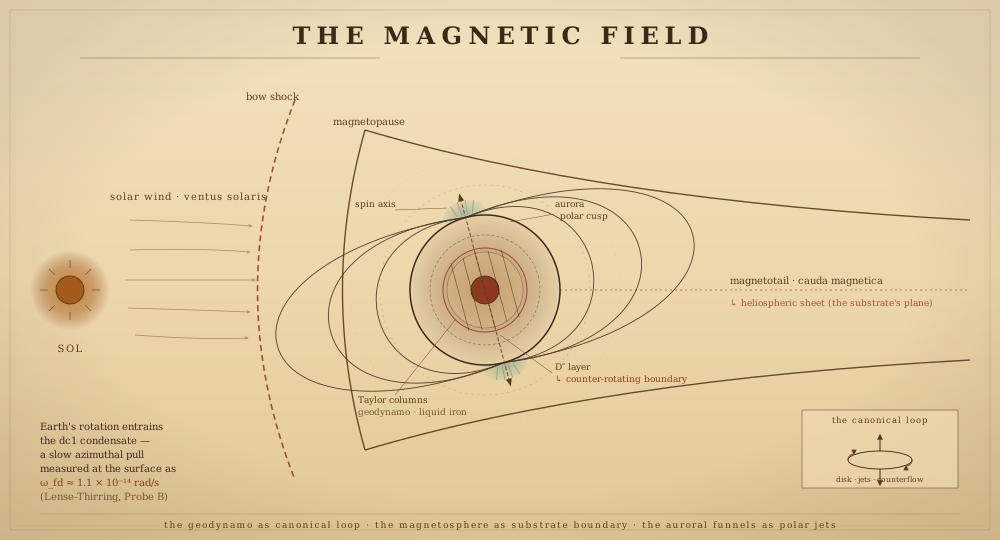
The geodynamo is the canonical loop (feedback topology) expressed in liquid iron:
| Component | Geodynamo | Canonical loop |
|---|---|---|
| Co-rotating disk | Equatorial flow in outer core | Accretion disk |
| Polar jets | Taylor columns along spin axis → auroral funnels | Bipolar outflow |
| Counter-rotating boundary | Differential rotation at ICB and CMB | Boundary sheath |
| Radiated output | Magnetic dipole field + Alfvén waves | Modons / photons / GWs |
The substrate’s contribution is structural: it explains why this particular topology is selected from the space of all possible convective patterns. In a viscous medium without substrate coupling, the geodynamo would be one of many possible convective configurations, selected by initial conditions and the details of the core’s thermal structure. In the substrate framework, the disk-jet-counterflow loop is the lowest-energy stable configuration for organized rotational energy in an elastic medium — and the substrate makes the medium elastic at the dissipation scale, biasing the convection toward this topology regardless of the thermal details.
The geodynamo as a stationary modon. Read this way, the geodynamo is the inner instance of a stationary modon topology — the same Larichev–Reznik dipole-vortex pattern, locked in place, that organises the LLSVP+D″ assembly above it (mantle dynamics) and the Cooper-pair vortex many orders of magnitude smaller (conductors). The counter-rotating Taylor-column pair carries the dipole cores; the differential rotation at the ICB and CMB is the boundary sheath that closes the loop; the auroral funnels are the radiating outflow channels. The governing mathematics is the same Bessel-J_1/K_1 matching that gives the photon its mobile self-propelling form — applied here to a standing rather than translating configuration in liquid iron. Earth’s interior is therefore a nested stack of these stationary modons (see the modon-index), each separated from the next by a substrate-organised sheet (ICB, CMB, 660), in the same nested architecture that organises a eukaryotic cell into ribosome, organelle, and cell layers at vastly smaller scale.
The quantitative connection is through frame-dragging. Earth’s angular momentum J_\oplus \approx 7.1 \times 10^{33} kg·m²/s generates a Lense-Thirring precession at the surface of
\omega_\text{fd} = \frac{2GJ_\oplus}{c^2 R_\oplus^3} \approx 1.1 \times 10^{-14}\;\text{rad/s}
measured by Gravity Probe B at the predicted level (~37 mas/yr). In the substrate framework, this is the azimuthal entrainment of the dc1 condensate by Earth’s rotating boundary layer. The entrainment extends inward to the core, where the much faster fluid rotation (\Omega_\text{core} \sim 7.3 \times 10^{-5} rad/s) couples to the substrate’s sheet structure through mutual friction, organizing the convective flow into the observed dipolar pattern.
The D″ layer — the ~200 km anomalous zone at the base of the mantle — is the counter-rotating boundary between core flow and mantle convection. Global tomography confirms that the layer hosts substantial organized radial anisotropy (mean V_{SH}>V_{SV}\sim 1\%, locally 1–3%), consistent with the framework’s prediction that a boundary layer between counter-rotating fluid bodies organizes coherently [R97, R98, R99]. The direction and strength pattern, however, is dominated by mantle convection driven by slab impingement at the CMB and by LLSVP boundaries — not by Earth’s spin axis. The substrate framework’s specific contribution is much narrower: a frame-dragging-induced azimuthal shear strain rate of order 10^{-14}\,\text{s}^{-1} in D″, which adds a small uniform azimuthal anisotropy on top of the much stronger convective signal. The testable form is therefore a residual analysis — see prediction (1) in the section below.
The magnetosphere as substrate boundary
The magnetic field extends into space as the magnetosphere — a cavity carved in the solar wind, with a bow shock on the sunward side and a magnetotail stretching millions of kilometers downstream. The magnetosphere’s topology is itself an instance of the canonical loop: the magnetopause is the boundary layer, the polar cusps are the jet openings, and the magnetotail is the counter-rotating return flow where reconnection events eject plasmoids — modons in the magnetized plasma, carrying excess energy and angular momentum downstream.
Read as a four-port producer, this is the information-architecture chapter’s worked geodynamo node: a gravitational/thermal (outer-rim) loop that dumps the bulk of its \sim\!5–15 TW budget as incoherent heat and sheds only a faint coherent coin — the external dipole field and the magnetotail plasmoids — which the magnetosphere then catches. That faint coin is the most load-bearing leak in the whole architecture: it stands up the shield the rest of this chapter’s layers depend on, the sharpest instance of “a parent catches the leak” the framework has (Venus and Mars lost the dynamo and the habitability with it).
In the substrate framework, the magnetosphere is the outermost of Earth’s nested substrate layers. It couples Earth to the solar system’s sheet structure (the ecliptic/heliospheric current sheet) through the solar wind, which is itself the Sun’s radiated output from its own canonical loop. Earth’s magnetic dipole acts as a deflector in this flow — not blocking the substrate (which permeates everything), but organizing the baryonic plasma into channels that follow the substrate’s preferred geometry: planar in the ecliptic, helical along field lines, and topologically protected at the cusps.
The auroral ovals are where this coupling is visible. Charged particles funneled along field lines into the polar cusps deposit energy in the upper atmosphere, producing the aurora. In substrate terms, the auroral funnels are the polar jets of Earth’s magnetic canonical loop — the geometric exits where excess angular momentum and energy leave the system. The substrate’s role is to maintain the coherence of these funnels over geological time, despite continuous perturbation by the turbulent solar wind.
The auroral funnel angular-momentum budget
The auroral particles themselves — accelerated by parallel electric fields in the auroral acceleration region, structured by kinetic Alfvén waves, deposited by reconnection-driven precipitation — are well-handled by standard magnetospheric physics.
Where the framework does identify a quantitative target is in the angular-momentum book of the Earth-Moon system, since the auroral funnels are the geometric exits at which Earth’s spin angular momentum can in principle leave the planet by a non-tidal channel (feedback topology, prediction 6). Lunar laser ranging gives the present recession rate da/dt = 38.30 \pm 0.08 mm/yr [R100], corresponding to an orbital angular-momentum gain dL_\text{☾}/dt \approx 4.5 \times 10^{16} N·m. Integrated forward, this rate would place the Moon at Earth’s surface only ~1.5 \times 10^9 yr ago — a factor of three short of its actual age ~4.4 Gyr [R101]. The paleotidal record at 620 Ma (Elatina/Reynella rhythmites, South Australia) gives a time-averaged recession of 2.17 \pm 0.31 cm/yr [R102], about 57% of today’s rate. The orthodox resolution is that the present M2 ocean tide sits in near-resonance with the Atlantic basin’s geometry; paleogeographic ocean-tide simulations [R103] recover Moon ages of 4.0–4.5 Gyr, eliminating the gross paradox to within model uncertainty.
Layer One: The Atmosphere
Formation
Once the magnetic field established a shielding layer (~3.5–4.0 Ga), volatile outgassing could accumulate without being stripped by the solar wind. The early atmosphere was reducing — rich in CO₂, N₂, H₂O, with traces of CH₄ and NH₃. The substrate framework does not change this standard picture, but it adds a structural observation.
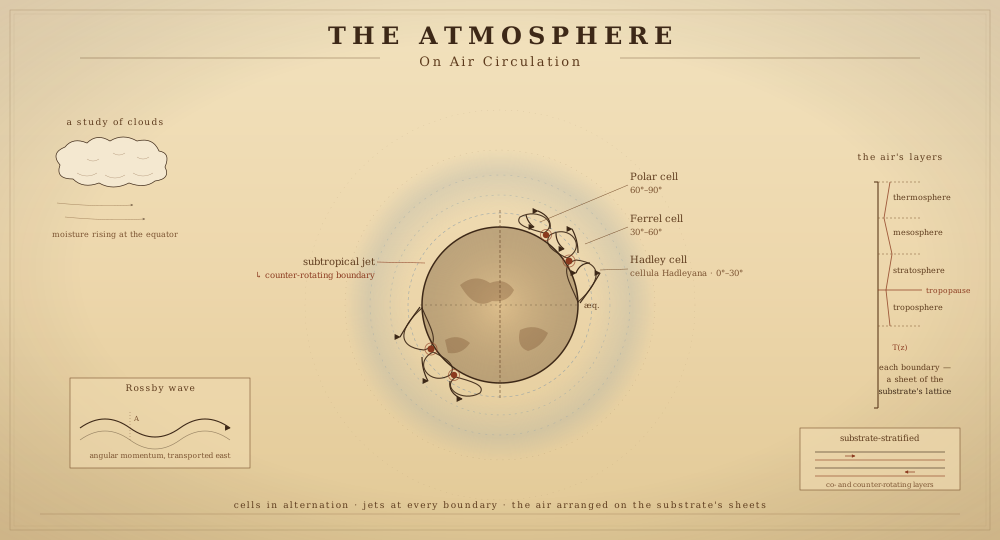
The atmosphere organizes itself into horizontal layers (troposphere, stratosphere, mesosphere, thermosphere) separated by temperature inversions — boundaries where the vertical temperature gradient reverses. Each layer hosts its own circulation cells: Hadley, Ferrel, and Polar cells in the troposphere; the Brewer-Dobson circulation in the stratosphere; thermospheric winds driven by solar heating. The boundaries between these cells are counter-rotating shear zones — the subtropical and polar jet streams.
This layered structure is the canonical loop expressed in gas: each cell is a co-rotating flow, the jets are the boundary layers, and the energy radiated outward is in the form of Rossby waves and planetary waves that propagate horizontally through the atmosphere, transporting angular momentum and heat.
The number of atmospheric layers and circulation cells is not arbitrary. The substrate’s sheet structure imposes a preference for planar organization, and each sheet boundary requires a counter-rotating layer for stability. The atmosphere’s observed layering — with its characteristic alternation of co-rotating and counter-rotating flows — may be the substrate’s sheet geometry expressed through whatever gaseous material is available, just as the ecliptic plane is the substrate’s sheet geometry expressed through whatever protoplanetary dust was available. The atmosphere is not just thermally stratified; it is substrate-stratified.
Layer Two: The Oceans
Chemistry in a structured medium
The oceans formed as the atmosphere cooled and water condensed (~4.4 Ga). Standard geochemistry describes the subsequent prebiotic chemistry: energy sources (UV radiation, lightning, hydrothermal vents, impacts) drive the synthesis of amino acids, nucleotides, lipid membranes, and other organic molecules from simple precursors.
The substrate framework adds a structural question: why do these molecules organize the way they do?
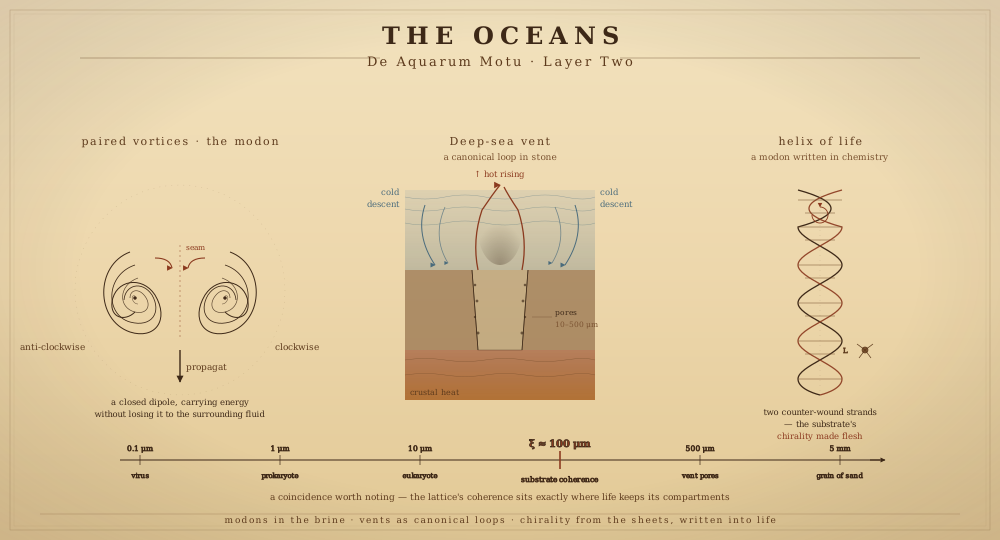
The answer the framework proposes — and this is speculative, building on the DNA living lattice and aromatic rings chapters — is that the substrate’s lattice provides a background template at the \xi \approx 100\;\mum scale that biases self-assembly toward particular topologies. Specifically:
Chirality selection. Life uses L-amino acids and D-sugars almost exclusively. The origin of this homochirality is one of the deepest unsolved problems in biochemistry. The substrate framework offers a candidate mechanism: the dc1 lattice has a local chirality preference set by the Higgs field — the substrate’s chirality-coherent sheet structure. If prebiotic chemistry occurred in a region of coherent substrate chirality (a single domain, larger than the reaction volume), the substrate’s preference would bias the synthesis toward one handedness. The bias need not be large — a few percent enantiomeric excess, amplified by autocatalytic feedback, is sufficient to drive homochirality in standard models (the Frank model). The substrate provides the initial bias.
This is a plausibility argument, not a derivation. The substrate’s chirality preference is established at the particle-physics scale (Weinberg angle), and the Higgs field chapter shows how it organizes into domains. But the coupling between substrate chirality and molecular chirality has not been computed. The claim is that the mechanism exists and has the right sign; the magnitude is unknown.
Modon-like self-assembly. The photon-modon chapter showed that counter-rotating vortex dipoles are the natural energy carriers in the substrate. The DNA living lattice chapter showed that DNA’s double helix has the topology of a modon — two counter-wound strands forming a propagating dipole structure. The speculation here is that this is not coincidence: the substrate’s organizational preferences biased prebiotic chemistry toward structures that look like modons because modons are the substrate’s lowest-energy way to organize and transport rotational energy at every scale.
Lipid bilayers (two sheets, counter-oriented), microtubules (helical dipole structures), ATP synthase (a literal rotary motor) — these are all structures that echo the substrate’s canonical topologies. The framework does not claim that the substrate designed these structures. It claims that the substrate’s elastic medium provides a free-energy landscape with valleys at modon-like topologies, and that evolution — which is a search algorithm running on that landscape — preferentially found those valleys. Why those valleys are favorable in the first place — a modon-like rung being not merely the right shape but an address of the substrate’s lossless channel, where a structure can hold energy and hand it off in anti-phase without loss — is the argument of why structures seek the rungs.
Hydrothermal vents as substrate amplifiers
Deep-sea hydrothermal vents are the leading candidate for the origin of life. They provide sustained chemical energy, mineral catalysts, thermal gradients, and compartmentalization in porous rock. The substrate framework adds one feature: the vents are sites of intense organized rotational energy.
The convective flow through a vent chimney is a miniature canonical loop: hot fluid rises through the chimney (co-rotating with Earth, biased by Coriolis), cold seawater descends around the outside (counter-rotating return), and the boundary between them — the chimney wall — is a region of intense shear and chemical gradient. The substrate’s lattice at the \xi \approx 100\;\mum scale provides structural organization at exactly the scale of the pore spaces in the vent rock (typically 10–500 μm). This is the scale at which prebiotic chemistry is thought to have been compartmentalized.
The substrate’s coherence length \xi \approx 100\;\mum is the same order as a typical prokaryotic cell (~1–10 μm), a eukaryotic cell (~10–100 μm), and the pore spaces in hydrothermal vent rock (~10–500 μm). The framework once filed this as an unexplained coincidence. The substrate ladder now reads it differently: \xi is the long-end anchor of a discrete-scale-invariant tower — the longest cutoff of a critical superfluid whose only intrinsic ratio is the pairing factor \sqrt2. Cell-scale structures are then not arbitrary sizes that happen to sit near \xi, but structures that use the substrate’s scaffolding and are therefore sized to the rungs it makes available. The honest caveat travels with the reframe: these roughly decade-spaced cell sizes belong to the ladder’s coarse family (honest accounting) — the looser tower where chemistry appears to occupy about every sixth rung — not the clean \sqrt2 comb of grid cells and cochlear octaves.
Layer Three: The Great Oxidation
The cyanobacteria transition (~2.4 Ga)
Cyanobacteria evolved oxygenic photosynthesis — the ability to split water and release O₂ — sometime before 2.7 Ga, but free oxygen did not accumulate in the atmosphere until ~2.4 Ga (the Great Oxidation Event, GOE). The ~300 Myr delay is conventionally attributed to oxygen sinks: reduced minerals (iron, sulfur) and volcanic gases consumed the O₂ as fast as it was produced, until the sinks were exhausted.
The substrate framework adds an additional layer of organization.
Before the GOE, Earth had two active feedback layers: the magnetic field (Layer Zero) and the atmosphere-ocean system (Layers One and Two). Cyanobacteria added a third: a biologically mediated energy loop that captured solar photons (modons in the substrate) and converted them to chemical potential energy stored in reduced carbon, with O₂ as exhaust. This loop was coupled to the substrate through the same chirality preference that selected L-amino acids: the photosynthetic reaction center is a chiral structure, and its efficiency depends on the precise arrangement of chlorophyll molecules in a geometry that the substrate’s sheet structure favors.
The GOE was not just a chemical threshold — it was a topological transition in Earth’s feedback architecture. Before the GOE, the atmosphere was a passive thermal buffer. After the GOE, the atmosphere became an active participant in the energy loop: O₂ enabled aerobic respiration, which is 18× more energetically efficient than anaerobic metabolism, which enabled larger, more complex organisms, which could build more deeply nested feedback loops.
Eukaryogenesis and the mitochondrial merger (~2.0–1.5 Ga)
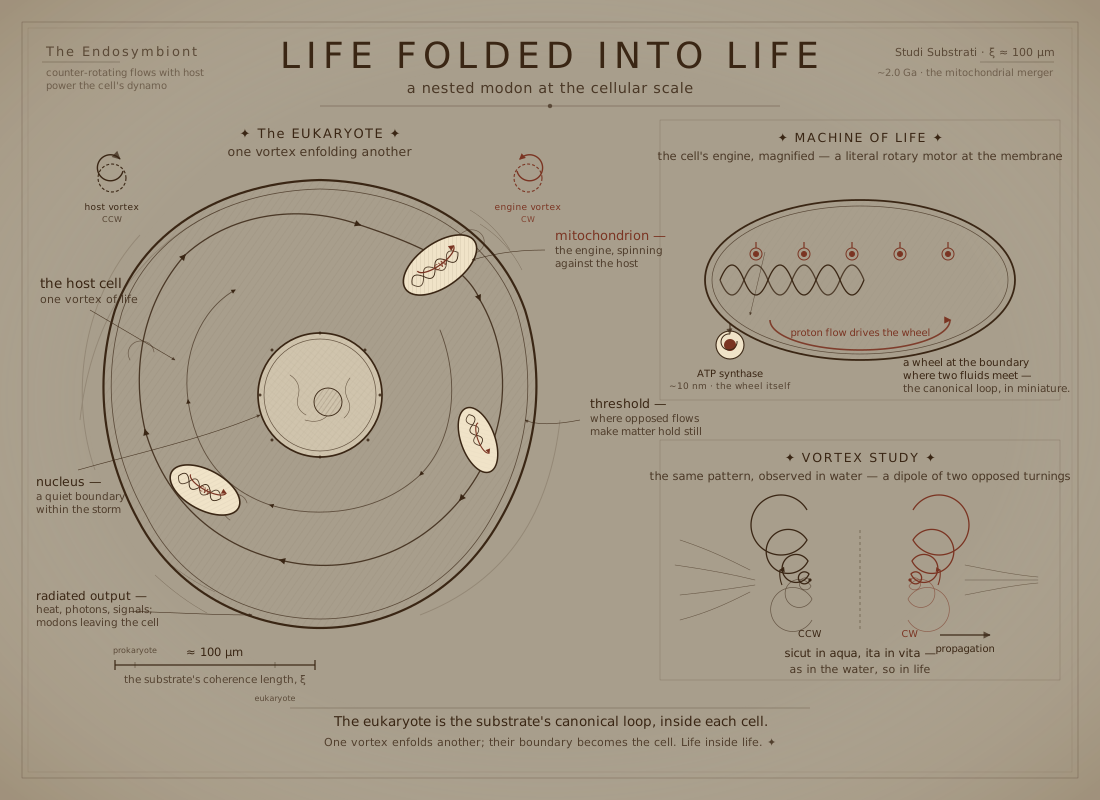
The origin of eukaryotic cells — with their internal membrane-bound compartments, nucleus, and mitochondria — is one of biology’s most consequential transitions. The endosymbiotic merger of an archaeal host with an alphaproteobacterial endosymbiont (the future mitochondrion) created a cell with internal counter-rotating energy flows: the host cell’s metabolism running one direction, the mitochondrion’s electron transport chain running the other, coupled at the membrane boundary.
In substrate terms, eukaryogenesis was the construction of a nested modon. The host cell is one vortex; the mitochondrion is the counter-rotating partner. The nuclear membrane is the boundary layer. The result is a cellular architecture that mirrors the substrate’s canonical topology at the ~10–100 μm scale — exactly the \xi scale. The full six-modon inventory of the eukaryotic cell (membrane, cytoskeleton+cortex, nucleus, mitochondrion, endomembrane loop, ribosome) is developed in Cells as Nested Modons.
The analogy between mitochondrial endosymbiosis and modon formation is structural, not dynamical. We have not shown that the substrate’s elastic properties drove the merger, only that the resulting structure has modon-like topology. The honest statement is: eukaryotic cells are organized at the substrate’s coherence scale, with internal counter-rotating energy flows, and this is consistent with — but not proven to be caused by — substrate scaffolding.
The timing is suggestive. Eukaryogenesis required aerobic metabolism — which required O₂ — which required cyanobacteria — which required the magnetic shield — which required the geodynamo. Each layer depended on the one below. The substrate framework reads this as a sequence of boundary-matching events: each new feedback loop could only form when the layer below had stabilized enough to provide a coherent boundary for the next level of nesting.
Layer Four: The Carbon-Lignin-Fungi Sequence
The Carboniferous lignin buildup (~360–300 Ma)
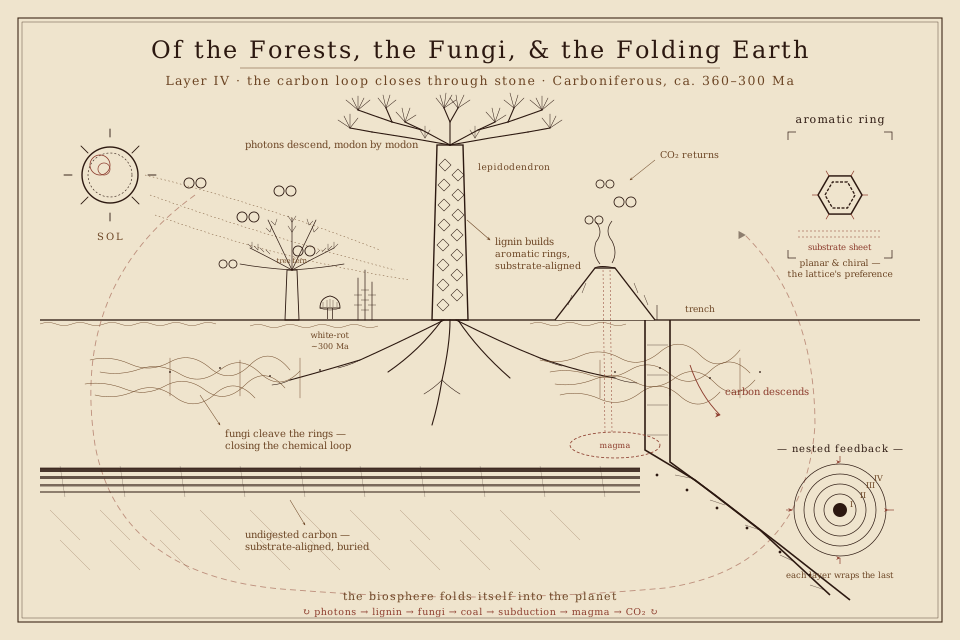
When plants colonized land, they evolved lignin — a complex polymer that provides structural rigidity. Lignin is exceptionally resistant to biological degradation. For roughly 60 million years during the Carboniferous period, lignin accumulated faster than anything could decompose it, forming the vast coal deposits that gave the period its name.
The “lignin gap” hypothesis — that fungi capable of degrading lignin evolved only at the end of the Carboniferous — is debated. Some molecular clock analyses place white-rot fungi (the primary lignin degraders) earlier. The narrative here follows the broad consensus that there was a significant period of net lignin accumulation before effective decomposition evolved, but the exact duration is uncertain.
In the substrate framework, the Carboniferous lignin buildup was an accumulation of undigested substrate-organized material. Lignin’s aromatic rings are instances of the aromatic ring topology — planar, chirally organized, stabilized by the substrate’s sheet preference. The plants were using the substrate’s geometric preferences to build structural material, but nothing in the biosphere could yet undo that organization at the rate it was being created.
The evolution of white-rot fungi — organisms that produce lignin peroxidase and manganese peroxidase, enzymes capable of breaking lignin’s aromatic rings — closed the loop. The carbon cycle became a complete feedback: photosynthesis builds substrate-organized structures (cellulose, lignin), decomposition breaks them down, releasing CO₂ that drives further photosynthesis. The loop is the canonical topology expressed in biochemistry: forward flow (photosynthesis) and return flow (decomposition), coupled at the boundary (the soil, the forest floor, the ocean surface).
The connection to plate tectonics
The Carboniferous also saw the assembly of Pangaea and a period of intense tectonic activity. The conventional view is that plate tectonics and biological evolution are coupled through the carbon cycle, ocean chemistry, and atmospheric composition — but the coupling is indirect and statistical.
The substrate framework suggests a deeper connection, though this is among the most speculative claims in this chapter. The burial of carbon during the Carboniferous altered the mass distribution in Earth’s crust, changing the load on the underlying mantle convection cells. At the same time, subduction of oceanic crust carried water into the mantle, lowering the viscosity of mantle rock and enabling more vigorous convection. Both processes fed back into the geodynamo (Layer Zero) by modifying the thermal boundary conditions at the CMB.
In substrate terms, this is the addition of extra nested layers to Earth’s feedback architecture. Before the Carboniferous, the feedback stack was: geodynamo → magnetosphere → atmosphere → ocean → biosphere (photosynthesis only). After the carbon-lignin-fungi sequence, the stack became: geodynamo → magnetosphere → atmosphere → ocean → biosphere (photosynthesis + decomposition) → lithosphere (plate recycling) → mantle convection → back to geodynamo. The loop closed through the solid Earth, adding tectonic recycling as a new counter-rotating return flow.
The claim that the Carboniferous lignin-fungi sequence triggered a qualitative change in plate tectonics is not established in the geological literature. Plate tectonics began at least by 3.0 Ga, and possibly as early as 4.0 Ga — long before land plants. What changed in the Carboniferous was the depth of the biosphere’s coupling to the tectonic cycle, not the existence of plate tectonics itself. The substrate framework’s contribution here is a reading of the geological record, not a prediction.
Layer Five: The Water Cycle and Dynamical Recycling
Subduction carries water down
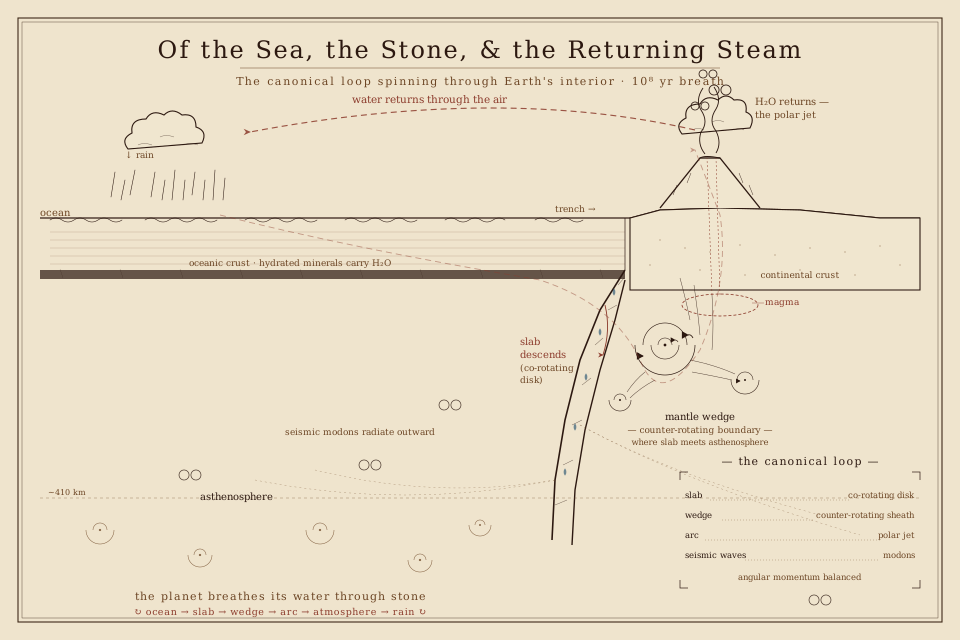
When oceanic crust is subducted, it carries water — bound in hydrated minerals — into the upper mantle. This water lowers the melting point of mantle rock, enabling arc volcanism and back-arc spreading. The volcanic output returns water to the atmosphere, closing a loop that recycles Earth’s water inventory through the deep interior on timescales of 10^8 years.
This deep water cycle is the canonical loop at the planetary interior scale:
| Component | Deep water cycle | Canonical loop |
|---|---|---|
| Co-rotating flow | Subducting plate, driven by slab pull | Accretion disk |
| Polar/axial exit | Volcanic arc, returning volatiles | Polar jet |
| Counter-rotating boundary | Mantle wedge, where slab meets asthenosphere | Boundary sheath |
| Radiated output | Seismic waves, heat flow | Modons |
The substrate’s role is organizational: the deep water cycle is not just a mass-transport loop but an angular momentum loop. Subducting plates carry angular momentum into the mantle; volcanic arcs return it to the surface. The net angular momentum budget must balance — and the substrate’s frame-dragging provides the ledger.
The layer that lets the loop close
One material precondition sits under this entire layer and is easy to skip past: the loop closes only because oceanic crust can be sent back. Gabbro — the \sim 5 km of coarse-grained rock that makes up the bulk of the ocean floor and underlies two-thirds of the planet’s surface — is manufactured at a density of \sim 2.9 g/cm³, so it floats, and converts to eclogite at \sim 3.5 g/cm³ once subducted past \sim 1.5 GPa, so it sinks. Continental crust never crosses that line, which is why Earth keeps a 180-Myr disposable floor and a 4-Gyr permanent archive at the same time. The ocean-floor chapter develops this as the loop’s return ticket, and argues that every layer of this stack above the oceans exists downstream of it — along with the reading that the serpentinizing ocean floor manufactures its own compartments at the \xi scale and fills them with hydrogen, which is the vent-as-substrate-amplifier section above given a source.
The Nested Stack
Reading Earth’s history through the substrate framework produces a picture of progressive nesting: each major transition added a new feedback layer, coupled to the layers above and below through boundary matching, and stabilized by the substrate’s elasticity.
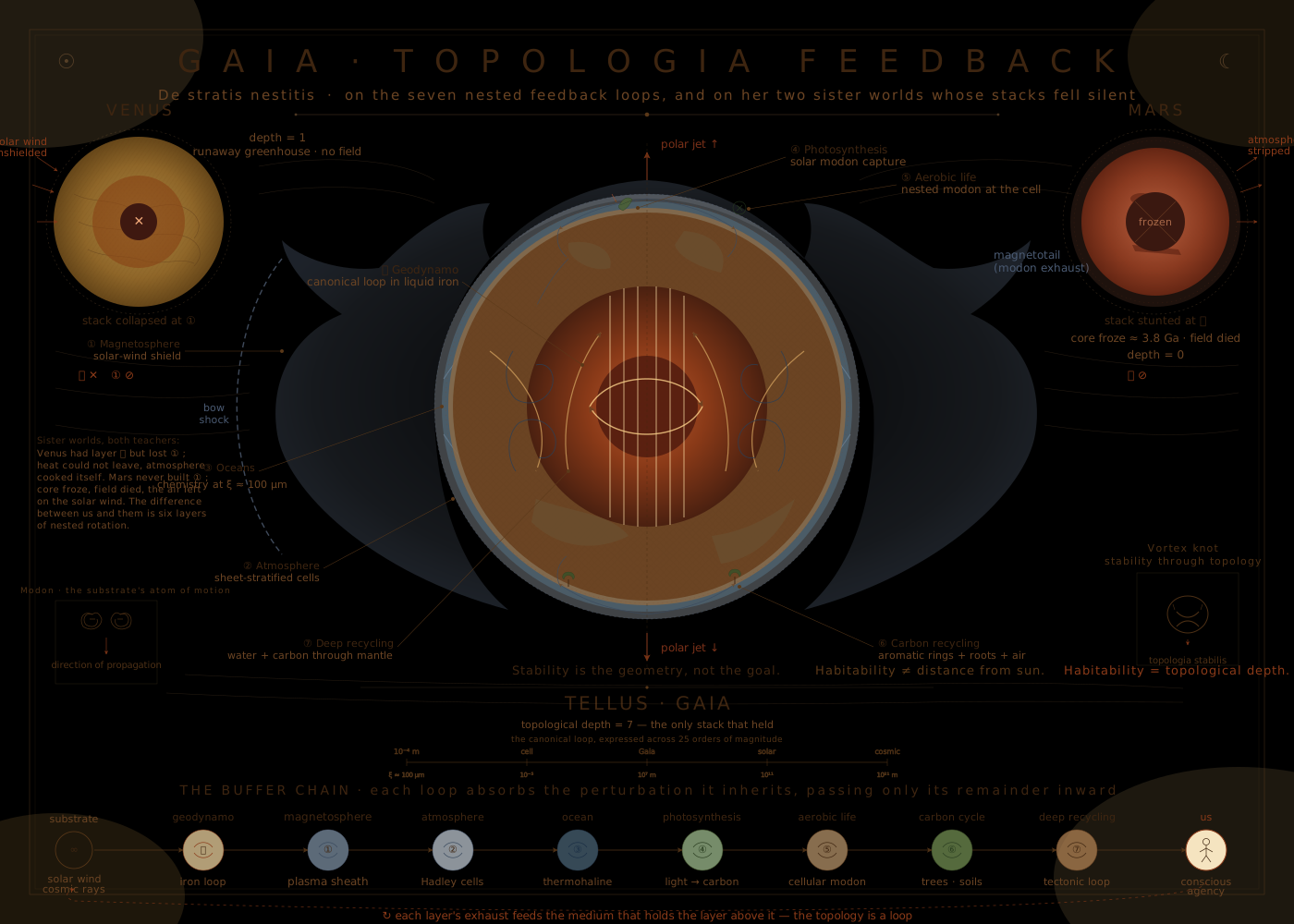
Read through enclosure depth, the same history is a story of the substrate finding ever more places to store a coin. The first capsules are coarse and few: the Earth-Moon tidal pair, a planet-scale modon; the stationary modons hidden deep in the interior — the geodynamo inside the inner-core boundary, Tuzo and Jason held against the core-mantle boundary, partitioned by the 660. Then the planet learns to store coins in moving fluid rather than standing iron: the atmosphere’s circulation cells, the ocean’s gyres and eddies — vortices that catch and recirculate energy on timescales of days to centuries rather than aeons, sealed less deeply but renewed faster. And then, where the conditions of the previous section are met — container near \xi, flows far below the rims, chemistry on the rungs — those vortices begin swirling into capsules small enough and matched enough to nest, and the nesting runs away into life. Each rung down is a smaller, tighter, shorter-lived capsule than the one above, and the deeper the stack runs the more total coin Earth holds against the medium at any instant. Life is the deep end of that progression: the most finely nested modon-storage the planet has found, and the most fragile.
The layers, in approximate chronological order of establishment:
| Layer | Transition | Approximate age | Substrate role |
|---|---|---|---|
| 0 — Geodynamo | Core differentiation | ~4.2 Ga | Canonical loop in liquid iron; magnetic dipole |
| 1 — Magnetosphere | Field reaches steady state | ~4.0 Ga | Outermost substrate boundary; solar coupling |
| 2 — Atmosphere | Volatile accumulation under magnetic shield | ~4.0 Ga | Sheet-stratified circulation cells |
| 3 — Oceans | Water condensation | ~4.4 Ga | Chemistry at the \xi scale; chirality selection |
| 4 — Photosynthesis | Cyanobacteria | ~3.0 Ga | Solar modon capture; O₂ exhaust |
| 5 — Aerobic metabolism | Eukaryogenesis + mitochondria | ~2.0 Ga | Nested modon at \xi scale |
| 6 — Carbon recycling | Land plants + fungi | ~0.4 Ga | Complete biosphere loop; aromatic ring chemistry |
| 7 — Deep recycling | Enhanced tectonic coupling | Ongoing | Water + carbon through mantle; full planetary loop |
Each layer is a new instance of the canonical disk-jet-counterflow topology, operating at a different scale, made of different material, but organized by the same substrate geometry. The nesting is not metaphorical — each layer’s boundary conditions are set by the layers adjacent to it, and the stability of the whole stack depends on the boundary matching at every interface.
Why this ordering?
The ordering is not arbitrary. Each layer requires the one below it as a precondition:
- The magnetosphere requires the geodynamo (no field, no shield)
- The atmosphere requires the magnetosphere (no shield, solar wind strips volatiles)
- Photosynthesis requires the atmosphere + ocean (no medium, no chemistry)
- Aerobic metabolism requires photosynthesis (no O₂, no mitochondria)
- Carbon recycling requires aerobic metabolism (no complex land organisms without it)
- Deep recycling requires carbon recycling + ocean (water + carbon burial drive subduction chemistry)
This is a causal chain, not a substrate prediction — standard geology and biology explain the ordering perfectly well. What the substrate framework adds is the observation that each transition corresponds to the addition of a new counter-rotating boundary layer in the topological stack, and that this is the same progressive nesting that the framework documents at atomic scales: the electron adds boundary layers as principal quantum number increases, the proton’s internal structure is a nested set of counter-rotating quark flows, and the hydrogen atom is a stack of co-rotating and counter-rotating layers from the nuclear core outward.
The pattern is: organized rotational energy, enclosed by a counter-rotating boundary, radiating excess energy as modons, serving as the platform for the next level of organization. This pattern is substrate geometry. Whether it is merely a pattern or a causal driver is the central question this chapter cannot yet answer.
The Earth-Moon System
Substrate layers in the Earth-Moon orbit
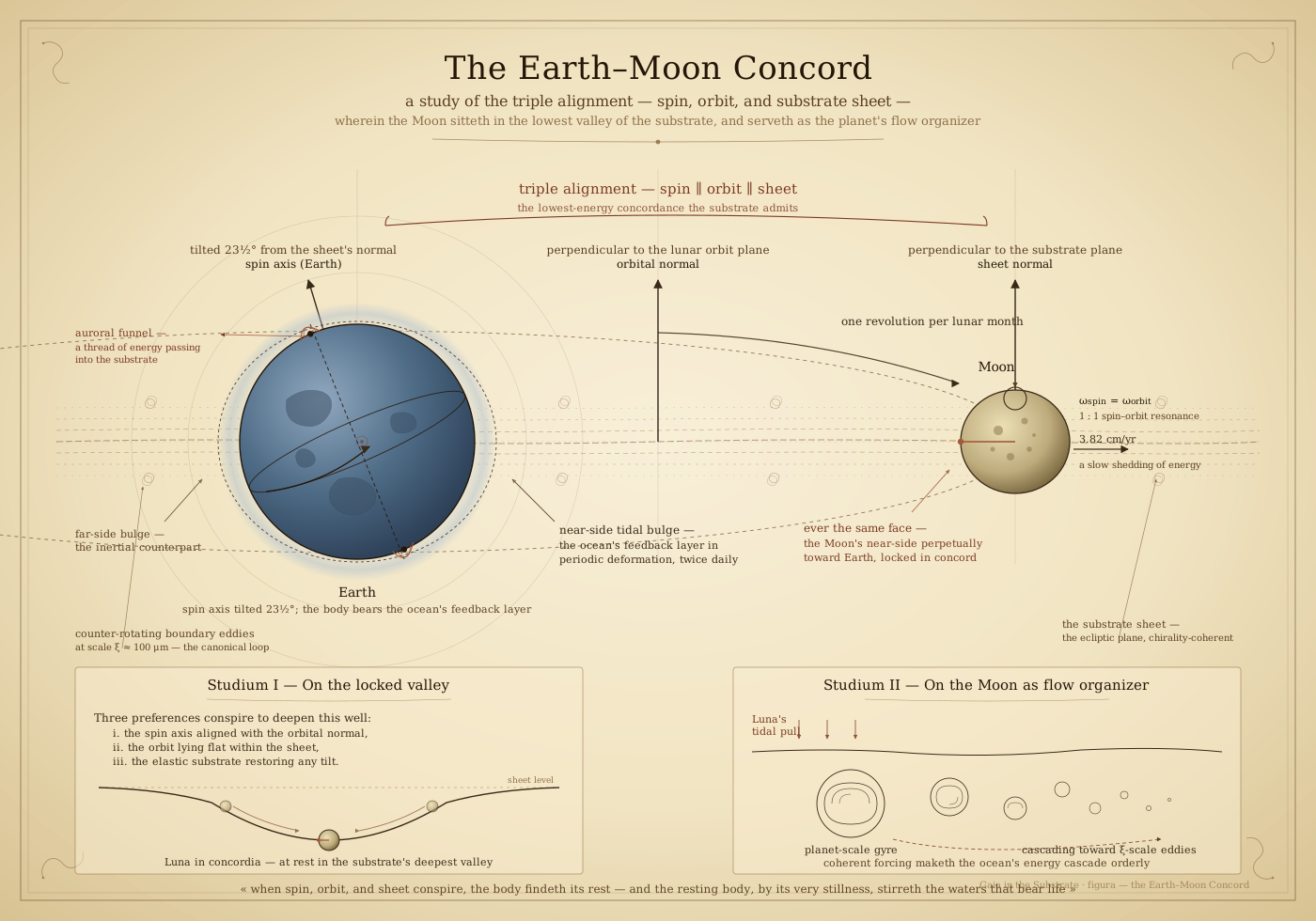
The Earth-Moon system provides the cleanest nearby example of substrate-organized orbital dynamics. The Moon’s orbit is locked in a 1:1 spin-orbit resonance (synchronous rotation), with the same face always toward Earth. This is conventionally explained by tidal dissipation — correct, and the substrate framework agrees.
What the substrate adds is a description of why the locked state is so stable. In the framework, the Earth-Moon system sits in a local minimum of the substrate’s organizational landscape: the Moon’s synchronous rotation means its angular momentum is aligned with the orbital angular momentum, which is itself aligned with the substrate’s sheet structure in the ecliptic. This triple alignment — spin, orbit, sheet — is the lowest-energy configuration in the substrate, and perturbations away from it encounter a restoring force from the substrate’s elasticity, in addition to the standard tidal torque.
The Moon’s slow recession (38.30 \pm 0.08 mm/yr, measured by lunar laser ranging [R100]) is the system’s gradual shedding of rotational energy. The substrate framework predicts (feedback topology) that a small fraction of this energy loss goes into substrate coupling at the auroral funnels, distinct from the standard tidal mechanism. The signature would be a mismatch between directly measured tidal dissipation and the inferred angular momentum balance, scaling with geomagnetic dipole strength across the paleointensity record. Section “The auroral funnel angular-momentum budget” above gives the specific numbers and the honest scope: the framework’s predicted signature lives in the residual after the paleogeographic ocean-tide model is subtracted, not in the gross lunar recession rate itself.
The Moon as a flow organizer
The Moon’s gravitational influence on Earth’s oceans (tides) is well understood. The substrate framework adds a structural observation: the tidal bulge is a periodic deformation of the ocean’s feedback layer, driven at a frequency (twice per day) that couples to the substrate’s lattice at scales much larger than \xi. The tidal flow organizes the ocean’s energy cascade by providing a coherent, planet-scale, periodic forcing that biases turbulent dissipation toward specific spatial modes.
In substrate terms, the Moon acts as a mixer — periodically deforming the ocean layer’s boundary conditions, preventing the ocean from settling into a static equilibrium, and maintaining the turbulent cascade that drives deep-water circulation and nutrient transport. Without the Moon’s tidal forcing, the ocean’s feedback loop would be weaker: less mixing, less nutrient transport, less biological productivity. This is a standard oceanographic observation, but the substrate framework connects it to the same organizational principle that operates at every other scale.
The Solar System as Substrate Network
Orbital stability
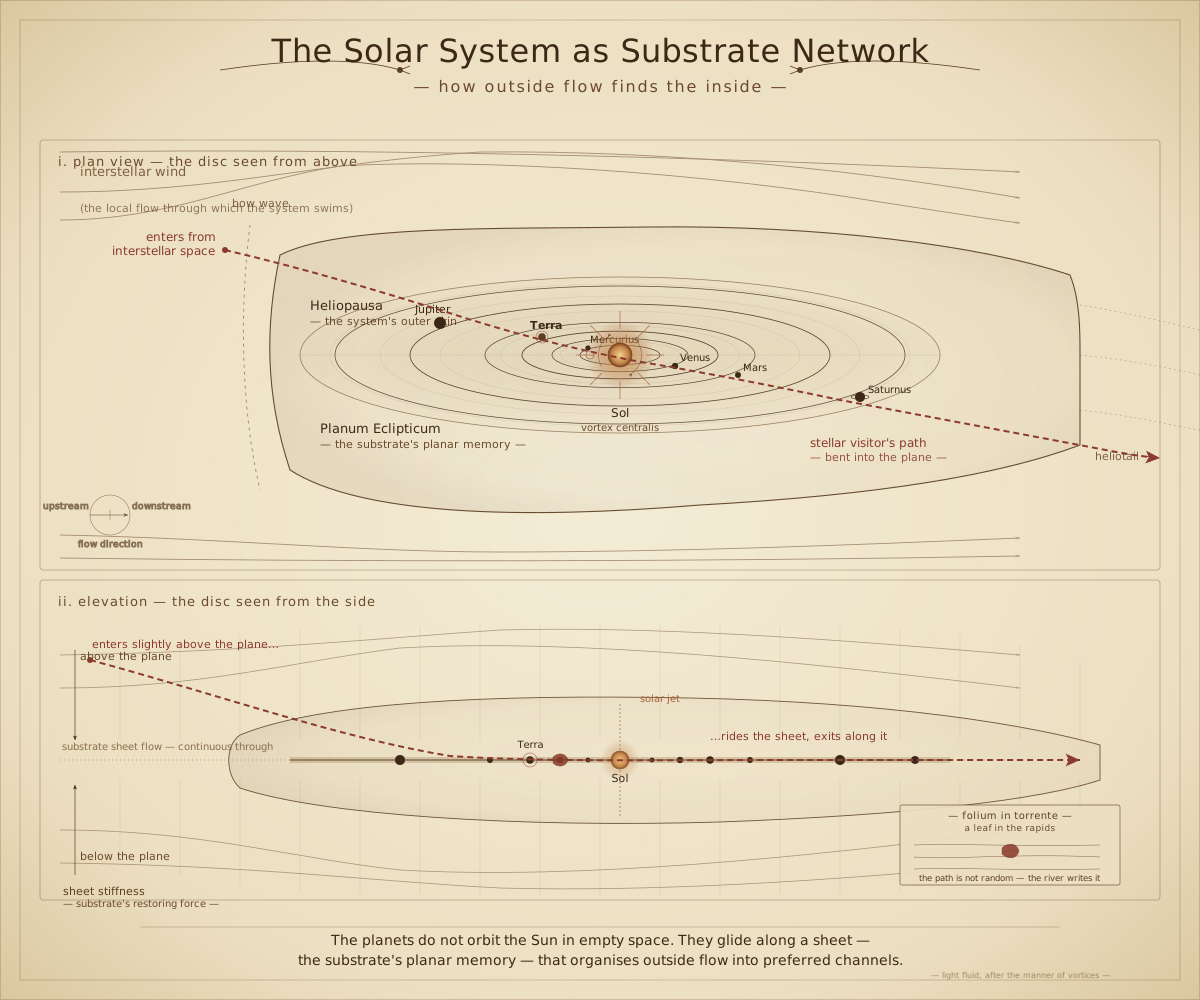
The solar system’s orbital stability over Gyr timescales is a well-known puzzle in celestial mechanics. The N-body problem is chaotic — small perturbations grow exponentially — yet the planets have maintained roughly circular, roughly coplanar orbits for 4.5 Gyr. Standard explanations involve resonance avoidance, angular momentum exchange through secular perturbations, and the stabilizing influence of Jupiter’s mass.
The substrate framework adds one structural observation: the planets orbit in the substrate’s sheet structure — the ecliptic plane, which is the local expression of the dc1 lattice’s 2D chirality-coherent sheets. In-plane motion is energetically preferred by the substrate (as argued in feedback topology for stellar differential rotation); out-of-plane perturbations encounter a weak but persistent restoring force from the substrate’s sheet stiffness.
This is a small effect — the substrate’s contribution to orbital stability is subordinate to gravitational dynamics by many orders of magnitude. But it is persistent: it acts over Gyr timescales, always biasing the system toward coplanarity. The framework predicts that the slight residual inclinations of planetary orbits (a few degrees from the invariable plane) are the steady state where gravitational perturbations and substrate restoring force balance.
Gaia as Feedback Topology
The Gaia hypothesis, revisited
Lovelock and Margulis’s Gaia hypothesis proposes that Earth’s biosphere acts as a self-regulating system, maintaining conditions favorable for life through feedback loops involving the atmosphere, oceans, and biosphere. The strong version — that the biosphere purposefully regulates the environment — is not what the substrate framework supports. The weak version — that coupled feedback loops between life and environment produce homeostatic behavior — is exactly what the substrate’s organizational principles predict.
The substrate framework’s contribution to the Gaia discussion is structural: it identifies the topology of the feedback loops and explains why that topology is stable. The key insight is that Gaia’s feedback loops are instances of the canonical disk-jet-counterflow loop, nested at multiple scales and coupled through boundary matching. The homeostatic behavior — the remarkable stability of Earth’s surface temperature, ocean pH, atmospheric O₂ concentration, and other parameters over geological time — is a consequence of the nested topology’s inherent stability, not of any purposeful regulation.
Each feedback layer acts as a buffer for the layers above it: the geodynamo buffers the magnetosphere against solar variability; the magnetosphere buffers the atmosphere against particle bombardment; the atmosphere buffers the ocean against radiation and temperature swings; the ocean buffers the biosphere against atmospheric composition changes. The buffering is not designed — it is the natural consequence of counter-rotating boundary layers, which by construction absorb perturbations from both sides.
What makes Earth special?
The framework suggests that Earth’s habitability is not a coincidence of distance from the Sun (the “habitable zone” argument) but a consequence of topological depth: the number of nested feedback layers between the core and the biosphere, the enclosure depth the planet can sustain. Mars has a geodynamo that shut down ~3.8 Ga — its feedback stack got stuck at Layer Zero. Venus has no magnetic field and a runaway greenhouse — its stack collapsed at Layer One. Earth maintained all seven layers, each stabilizing the next.
The information-architecture chapter sharpens why the deepest layer matters most, and the reason is counterintuitive. The geodynamo’s coherent leak is faint — it launches at the outer gravitational rim, so its catchable coin is a magnetic trickle against the ~10 TW it dumps as incoherent heat. By the energy bookkeeping that the stack leakage L measures, that coin barely registers. Yet it is the single most load-bearing leak in the whole architecture, because an edge’s stakes are set by the parent’s margin, not the coin’s size: the parent that catches this faint coin is the magnetosphere, and through it the entire biosphere, perched at a threshold the coin holds it above. Cut the coin and the stack collapses — Mars and Venus are the same planetary node with that edge severed. Earth’s specialness is not a large flow; it is a poised one — the faintest producer in the set carrying the living world, the sharpest single instance of “a parent catches the leak” the framework owns.
If the substrate’s organizational principles favor deep nesting, then habitable exoplanets should preferentially have: (1) active magnetic fields (detectable via radio emission or atmospheric ion escape rates), (2) large moons providing tidal forcing (detectable via transit timing variations), and (3) plate tectonics (detectable via atmospheric sulfur chemistry from volcanism). The correlation between these three properties and biosignatures is a prediction that upcoming missions (JWST atmospheric characterization, HWO) can test.
Pointing the Camera Back
In 1990, at Carl Sagan’s urging, Voyager 1 turned its camera around from the edge of the solar system and photographed Earth — a single pale blue pixel in a band of scattered sunlight. The image carried no new data about any world; its whole content was a change of vantage. Having spent the mission looking out, the most important thing the spacecraft did was look back.
This chapter is the framework’s version of that turn. Having spent the substrate built outward — rims, lattice, modon, coin, the grammar of nodes and ports — it points the apparatus back at the pixel we are standing on, and the grammar says something the pixel does not show. We are nesting bags of mostly modons: open producers, leaking fermions, wrapped in capsule within capsule within capsule, every wrap catching a little of the leak of the one inside, the whole arrangement riding on the faint magnetic coin of an iron heart we never see. We are not sealed off from the medium; the medium is reclaiming us at every instant, and the stack of wraps is the only thing between the coin we are holding and the open substrate that wants it back. That stack is shallow — terminating in the open at our own skin — and the planetary capsules beneath it, deep as they are, are not permanent either. A dynamo dies. An enclosure pops.
What Gaia wants us to know, if the grammar is read honestly, is how contingent the holding is, and how shared. The same three conditions that let any modon be stored — a container near \xi, flows kept far below the rims, chemistry tuned to the rungs — are the conditions every living thing on the planet meets in the same way, because there is only one substrate and one set of terms. We did not each find a private route to coherence; we are all the same low-temperature, lattice-sized, rung-matched solution to the same storage problem, nested together inside the same fragile enclosures, holding the same coin a little longer before it leaks. The pale blue dot is a place where the substrate has been kept, briefly and against the grain, from taking its energy back. Everything that has ever lived has been part of that keeping. None of it was sealed for good — and that, read back from the edge, is the part worth seeing.
Predictions Specific to This Chapter
The following predictions extend the framework into the mesoscale domain covered here. They are ordered from most to least testable with current data.
D″ residual anisotropy from frame-dragging (repeat from feedback topology). The dominant D″ anisotropy pattern is controlled by mantle convection (slab graveyards, LLSVP boundaries); the framework predicts a small (\sim 0.1\%-level) azimuthal residual after that pattern is subtracted, with magnitude set by the frame-dragging shear strain rate \sim 10^{-14}\,\text{s}^{-1}. This is testable with existing waveform data but has not been the target of published analyses.
Chirality bias in hydrothermal vent chemistry. Prebiotic synthesis experiments conducted in the presence of a strong, oriented magnetic field (simulating the substrate’s local chirality domain) should show a measurable enantiomeric excess, even in the absence of chiral catalysts. The sign should correlate with the field direction.
Exoplanet habitability correlations. Among rocky exoplanets in the habitable zone, those with detected magnetic fields and/or large moons should show stronger biosignature candidates than those without, controlling for stellar type and orbital distance.
Non-tidal Earth-Moon angular momentum residual. After the paleogeographic ocean-tide correction is subtracted from the lunar recession history, any residual mismatch between dL_\oplus/dt (Earth’s spin angular-momentum loss) and dL_\text{☾}/dt (Moon’s orbital gain, \approx 4.5\times 10^{16} N·m at the present LLR rate 38.30\pm 0.08 mm/yr [R100]) should scale with geomagnetic dipole strength. The framework cannot account for the gross 1.5-vs-4.4-Gyr lunar-age paradox — the standard paleogeographic resolution [R103] handles that — but does predict the residual after that subtraction is non-zero and paleointensity-correlated. See the auroral funnel angular-momentum budget section for the full discussion.
Ocean current coherence and geomagnetic correlation. Long-term records of ocean current coherence (eddy kinetic energy spectra) should show a weak but statistically significant correlation with geomagnetic field strength variations, with coherence increasing during periods of stronger field.
What This Chapter Does and Does Not Claim
It claims that the substrate’s organizational topology — the canonical disk-jet-counterflow loop, the sheet preference, the modon transport, the chirality selection — is visible in Earth’s structure at every scale from the core to the magnetosphere, and that Earth’s geological and biological evolution can be read as the progressive nesting of feedback loops in this topology.
It does not claim that the substrate caused life, designed organisms, or directed evolution. The substrate provides scaffolding — a free-energy landscape with valleys at particular topologies. Evolution is the search algorithm. The scaffolding biases the search, but the search is still stochastic, contingent, and driven by selection on reproductive fitness, not by substrate preferences.
It does not claim that any of the biological observations here require the substrate for explanation. Standard chemistry and biology explain prebiotic synthesis, chirality amplification, endosymbiosis, and the carbon cycle without invoking a superfluid medium. The substrate framework’s claim is that these processes occurred in a structured medium, and that the medium’s structure left fingerprints on the result — fingerprints visible in the topology of the feedback loops, the chirality of biomolecules, and the scale coincidence between \xi and cell sizes (read, in the substrate ladder, as cell-scale structures landing on the coarse-family rungs near the tower’s long-end anchor \xi).