The Substrate — A Visual Introduction
This chapter is a narrative walkthrough of the framework’s key ideas, light on equations and heavy on physical intuition. If you prefer to start with the mathematics, skip to the Bridge Equation — the single chain of relations that connects electroweak symmetry breaking to galaxy rotation curves with zero adjustable parameters. If you already know which topic interests you, every section in the sidebar stands on its own.
Two Particles and a Bang
The universe begins not as a singularity expanding into itself, but as a bubble popping in a medium that boils. Not the only bubble — one of many, nucleating wherever the pressure builds high enough, the way steam bubbles pop in a pot of water on the stove. Our bubble — \mathcal{B}^{0} — is the one we live inside. Everything we have ever observed is the interior of this bubble and the wall it carved when it formed.
Inside the bubble: enormous energy, and two kinds of dark material particles flung into an elastic environment. One is tiny — call it dc1, “dark carbon.” The other is much larger — call it dag, “dark silver.” They differ in mass by at least a factor of a thousand. That asymmetry is the seed of everything.
Here is what has to happen next. It does what fluids do.
The smaller particles, lighter and vastly more numerous, form a quantum condensate — a Bose-Einstein condensate, the same phase of matter that physicists create in laboratories at temperatures near absolute zero. But unlike those laboratory condensates, which are fragile and microscopic, this one fills the universe. At the energy densities inside the bubble, dc1’s quantum wavelength stretches far beyond the spacing between particles. They overlap, merge, lose their individuality, and become a single coherent quantum fluid — a superfluid with no viscosity and extraordinary stiffness.
And superfluids spin. They have to. The creation event carries angular momentum, and a superfluid cannot rotate like a solid body — it is forbidden by quantum mechanics. Instead, the rotation punches through the fluid as an array of quantized vortex lines, each carrying exactly one quantum of circulation. The fluid crystallizes its own spin into a lattice of tiny tornadoes, regularly spaced, phase-locked, topologically protected. This is the Feynman-Onsager result, confirmed in every superfluid ever studied, from helium-4 to ultracold rubidium.
The larger particles — dag — do something different. Too heavy to delocalize, too sparse to condense, they sit as anchor points in the sea of dc1 vortices. They pin the lattice. They are the tent poles that keep the fabric taut across cosmological distances and timescales. Without dag, the vortex lattice would drift and eventually tangle into chaos. With it, the lattice holds its shape for the age of the universe.
The substrate architecture. Sparse dag anchor points (coral diamonds) pin the dc1 vortex lattice at ~100 μm spacing. Particles — electrons, photons, protons — are not objects embedded in the lattice. They are the lattice’s own excitations: vortex storms, dipole solitons, topological knots in the flow.
The result is a substrate — an active, structured, elastic medium that fills all of space. Not the old Victorian aether, which was rigid and passive and was rightly killed by Michelson-Morley. This substrate is a quantum superfluid: it flows without friction, it carries energy in quantized packets, it responds to organized rotation by building counter-rotating boundary layers, and it is invisible to the electromagnetic probes we use to look for it — because electromagnetism is it. Photons are not things moving through the substrate. They are things the substrate does.
The lattice has a characteristic scale: each cell spans roughly 100 micrometers — about the width of a human hair. This number is not assumed. It falls out of three measured quantities: the speed of light, Planck’s constant, and the observed density of dark matter. From those, the framework derives the lattice spacing, the dc1 mass (~2 millielectronvolts), and the number density (~660 billion particles per cubic meter). The substrate is the dark matter. The “missing mass” that astronomers have spent decades hunting is not missing. It is the medium.
How Fluids Build Structure
Let’s look at what fluids do when they carry energy and spin.

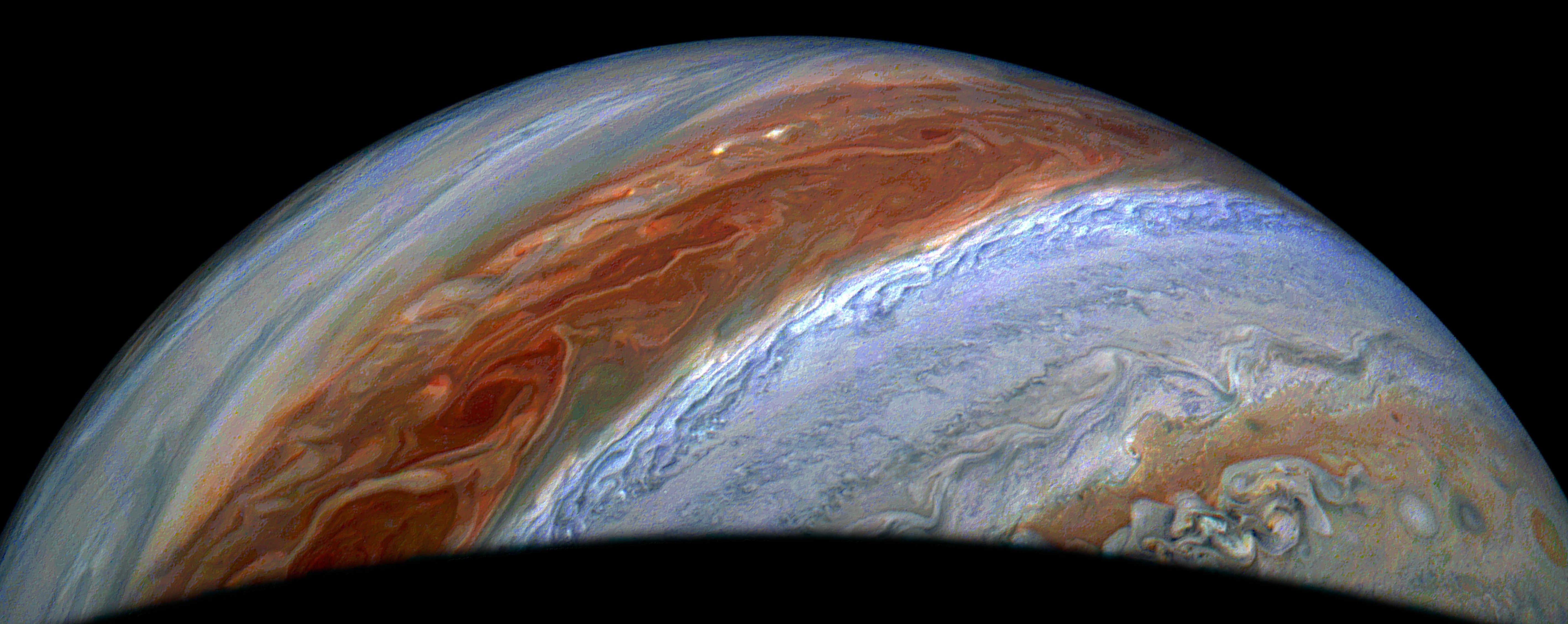
Jupiter’s atmosphere organizes into alternating bands — eastward jets next to westward jets, separated by turbulent shear zones. Each band is a co-rotating flow; each boundary is a counter-rotating layer where the two flows grind against each other. The Great Red Spot is a vortex storm locked into one of these boundaries, stable for centuries, fed by the shear energy of the flows on either side.

Kelvin-Helmholtz instabilities along the wind-collision interface that produce vortical rolls
(By Empetrisor - Own work, CC BY-SA 4.0, https://commons.wikimedia.org/w/index.php?curid=105303125)
Kelvin-Helmholtz waves — the curling, breaking wave patterns that form when wind blows over water, or when two cloud layers move at different speeds — are the visible signature of a velocity shear becoming unstable. They roll up into vortices. Those vortices, if the medium is elastic enough, organize into streets: alternating rows of same-sign and opposite-sign rotation, regularly spaced, self-sustaining. Von Kármán vortex streets behind islands in the ocean persist for hundreds of kilometers. They are not forced. They are what the fluid does on its own when something disrupts a uniform flow.

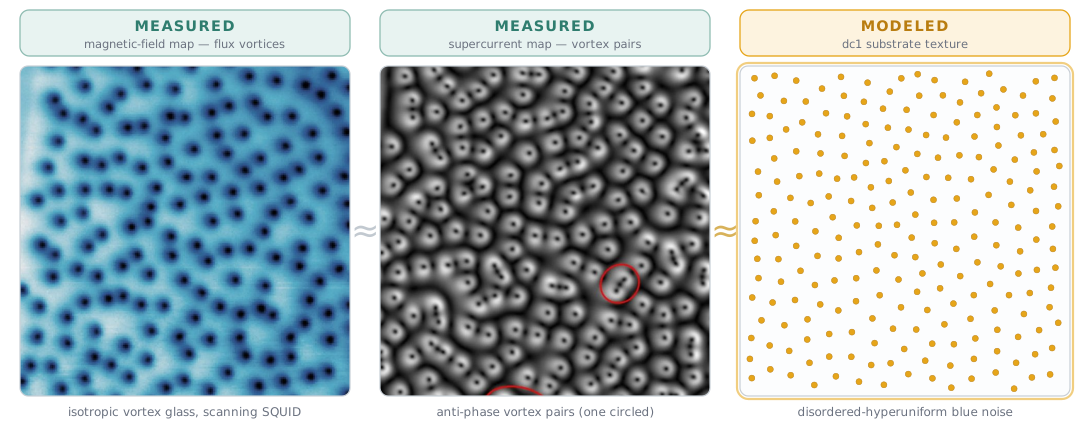
By Frederick S. Wells, Alexey V. Pan, X. Renshaw Wang, Sergey A. Fedoseev & Hans Hilgenkamp - https://www.nature.com/articles/srep08677, CC BY 4.0, https://commons.wikimedia.org/w/index.php?curid=57135410
And in superfluid helium — the closest laboratory analog to the dc1 substrate — rotation produces not continuous vorticity but a lattice of quantized vortex lines, hexagonally packed, each carrying exactly h/m of circulation. The lattice is so regular it diffracts light. It forms spontaneously. It is stable indefinitely. And between any two regions of different rotation, counter-rotating layers appear at the boundary, mediating the angular momentum transfer through a mechanism called mutual friction.
The pattern is universal. Every boundary between co-rotating regions spontaneously generates a counter-rotating layer. The Euler equations model how angular momentum is conserved across a velocity discontinuity. The counter-rotating layer is the cheapest way for the fluid to match boundary conditions — cheaper than turbulent mixing, cheaper than rigid walls, cheaper than any other topology.
Boundary parity. Same-spin regions (blue) separated by counter-spinning boundary layers (red). The number of boundary layers — odd or even — determines whether the system behaves as a fermion or a boson. This single rule explains spin statistics, the Pauli exclusion principle, and why matter and radiation are fundamentally different.
Now take this universal pattern and apply it to the substrate. The dc1 superfluid is organized into chirality-coherent sheets — same-spin lattice sites forming triangular arrays within each plane, with counter-rotating dc1 layers between the planes. The lattice is not isotropic. It is layered, like a deck of cards, each card a 2D vortex crystal, the cards separated by thin films of opposite-spinning fluid.
This is the stage. What performs on it?
Vortex storms, knots, and solitons
Lock a superfluid into a lattice and give it enormous rotational energy. The excitations it supports are not gentle ripples. They are topological defects — features of the flow that cannot be smoothed away without cutting the fluid.
The simplest is a vortex line — a one-dimensional core where the fluid’s phase winds by 2π. Superfluid helium is full of them. They are indestructible: a vortex line in helium-4 persists indefinitely because the circulation around it is quantized, locked to an integer, and integers cannot change continuously. The only way to remove one is to bring in a vortex of opposite sign so the two annihilate. This is topological protection — the same mathematics that makes Möbius strips one-sided and knots impossible to untie without cutting.
Three tiers of one fluid. Top: the vortex lattice at ~100 μm — the perturbation envelope, set by measured constants. Middle: zoom ×10⁹ to the effective quantum at 150 fm — the vortex core where ~10⁹ dc1 particles orbit collectively at 0.776c, carrying exactly ℏ of angular momentum. Bottom: zoom ×10⁵ further to the nuclear scale at ~1 fm — three interlocking vortex channels forming the proton’s Borromean topology, with 99% of its mass stored in the counter-rotating boundary energy between them.
In the substrate, these defects are the particles of physics:
The electron is a half-integer vortex — a phase singularity where the condensate’s wavefunction is undefined, like the eye of a hurricane. Roughly a billion dc1 particles orbit collectively around this singularity at three-quarters the speed of light, carrying exactly one quantum of angular momentum. The half-integer winding is why the electron requires 720° of rotation to return to its original state — not a mysterious quantum property, but the geometry of a half-turn vortex in a condensate. And the half-integer winding is why the electron is indestructible: you cannot continuously deform a half-twist into no twist. You can only annihilate it with a half-twist of opposite sign — a positron.
The proton is a Borromean knot — three interlocking vortex channels that cannot be separated without cutting, like three rings linked so that removing any one frees the other two. This is quark confinement: pull two channels apart and you stretch the counter-rotating boundary between them until enough energy accumulates to create a new channel pair. You get a meson, never a free quark. The knot topology is the confinement mechanism.
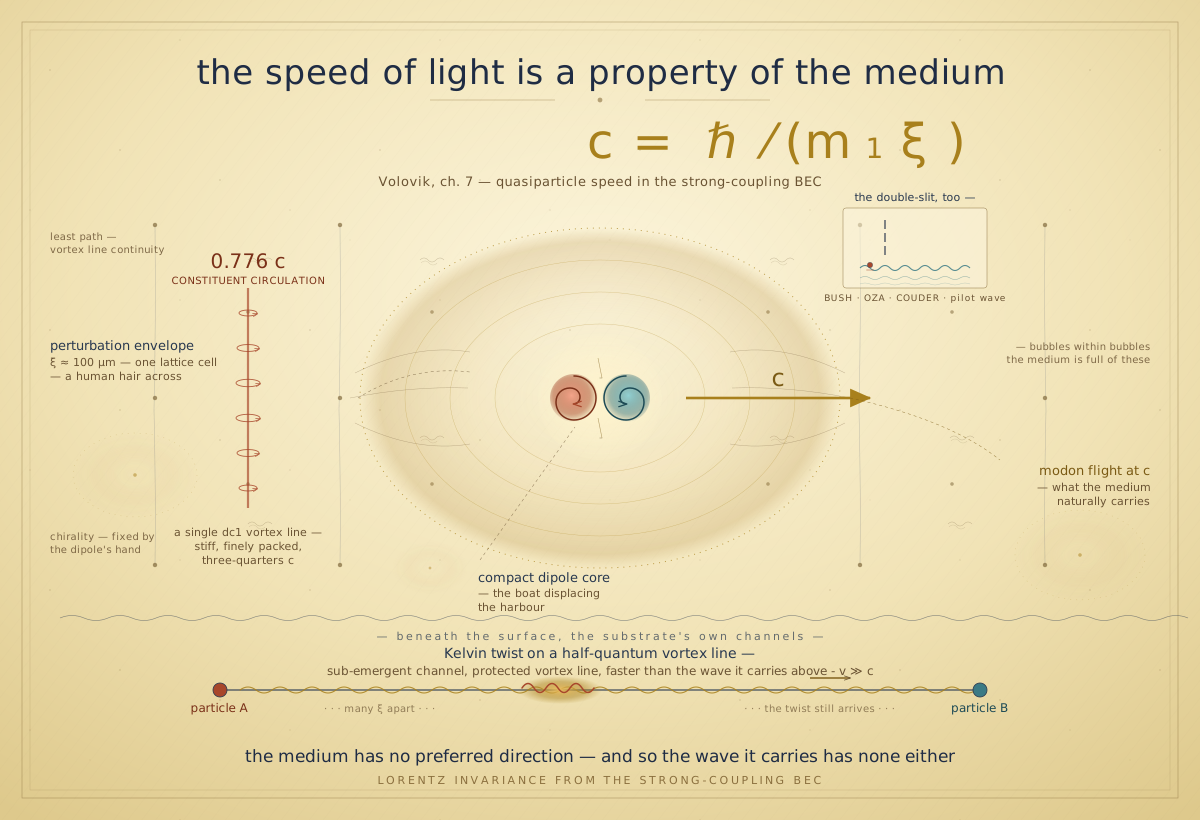
The photon is a modon — a counter-rotating vortex dipole, two opposite-spinning cores pulling each other through the fluid, like a smoke ring through still air. It carries zero net winding, which is why it can be created and destroyed freely: zero-topology configurations form and dissolve without topological obstruction. The modon pulls itself forward by mutual advection — each vortex drags the other — and the substrate’s stiffness confines it to the lattice cell scale, quantizing its energy and setting its speed at exactly c.
The canonical loop: co-rotating disk, polar jets, counter-rotating boundary, radiated waves. This topology appears at every scale — from the electron’s breathing oscillation, to Earth’s geodynamo, to accretion disks, to galaxy formation. It is the lowest-energy stable configuration for organized rotational energy in an elastic medium.
One topology, every scale
Drop a spinning mass into an elastic medium and the medium organizes itself the same way every time. A co-rotating disk forms in the equatorial plane. Polar jets emerge along the spin axis, ejecting excess angular momentum. A counter-rotating boundary layer wraps the whole structure, absorbing the shear. Energy circulates through the loop — in through the disk, out through the jets, dissipated at the boundary — and a fraction escapes as propagating waves.
This loop appears in the substrate’s own vortex lattice at 100 micrometers. It appears in accretion disks around black holes. It appears in the jets of active galactic nuclei. It appears in the geodynamo that generates Earth’s magnetic field — co-rotating iron flow near the equator, Taylor columns along the spin axis, counter-rotating layers at the core-mantle boundary, auroral funnels at the poles playing the role of the jets.
It appears in the hydrogen atom.
The electron’s vortex storm breathes — it oscillates between a contracted phase (maximum rotation at 150 femtometers) and an expanded phase (maximum ripple in the substrate at 100 micrometers) at the Compton frequency. The orbital shells of hydrogen are standing-wave patterns in this breathing, stabilized by the counter-rotating layers between them. Quantization is not imposed by fiat. It emerges because only discrete patterns survive the boundary matching between the co-rotating interior and the decaying exterior — the same mathematics that produces discrete notes on a violin string, except the “string” is a counter-rotating boundary layer in a superfluid.
Mass itself is rotational energy — the kinetic energy of organized substrate flow. The electron’s 0.511 MeV is entirely accounted for by one effective quantum (~10⁹ condensed dc1 particles) orbiting at 0.776c. The proton’s 938 MeV is 99% boundary energy from the counter-rotating sheets between its three interlocking vortex channels. There is no other source of mass. No Higgs field bolted on from outside — the Higgs mechanism is the local chirality ordering of the substrate itself, spontaneous symmetry breaking arising from same-chirality clustering in the dc1/dag lattice.
And the speed of light is a substrate property: c = \hbar/(m_1 \cdot \xi) — the ratio of Planck’s constant to the dc1 mass times the coherence length. It is the maximum speed at which organized disturbances propagate through the superfluid. Not a law imposed on the universe. A material property of the medium, the way the speed of sound is a material property of air. All excitations — photons, gravitational waves, anything that propagates — share this speed, because they are all quasiparticle excitations of the same condensate. The LIGO observation GW170817 confirmed that gravitational waves travel at the speed of light to fifteen decimal places. The substrate predicts exact equality — they are the same medium vibrating in different modes.
The Atom as a Fluid Machine
Now look inside.
The electron breathes
In standard physics, the electron is a point — dimensionless, structureless, with mass and spin and charge and a magnetic moment all packed into a mathematical dot. It is the most precisely measured object in nature, and we have almost nothing to say about what it is.
In the substrate, the electron is a storm.
De Sympathia Electronum — the electron as a dc1 vortex storm. At its core, roughly a billion dc1 particles orbit a phase singularity at three-quarters the speed of light, carrying exactly one quantum of angular momentum. The storm breathes — expanding to fill a 100 μm coherence envelope, contracting to a 150 fm vortex core — at 1.24 × 10²⁰ cycles per second.
Roughly a billion dc1 particles, condensed into a single collective structure called the effective quantum, orbit a phase singularity at 0.776c. The core is about 150 femtometers across — a hundred times the proton’s charge radius, a hundred thousand times smaller than a hydrogen atom. The phase singularity at the center is exactly like the eye of a hurricane: the surrounding fluid spins, but the center is a point where the flow is undefined. This is the electron’s spin — not an abstract “intrinsic” property but angular momentum of organized substrate flow.
And the storm breathes. De Broglie proposed in 1924 that every particle vibrates at a frequency set by its rest energy: \omega_c = m_e c^2/\hbar. For the electron, that is 1.24 \times 10^{20} Hz — a vibration completing once every eight zeptoseconds, a hundred thousand times faster than visible light. He spent the rest of his career being told this was naive. Bush’s walking droplets suggest he was right all along.
In the substrate, the vibration is literal. The effective quantum’s orbit expands and contracts at the Compton frequency. At peak contraction, the energy is concentrated in intense rotation at 150 fm — the kinetic energy of the effective quantum equals the electron’s entire rest mass. At peak expansion, the energy has flowed outward into the substrate, sending a pressure ripple across the full 100 μm coherence envelope. Then the substrate springs back, the orbit contracts, and the cycle repeats.
Each cycle pumps a ripple into the dc1 medium — exactly as a bouncing droplet pumps a wave into the silicone oil bath in Bush and Oza’s experiments. The ripples propagate outward at c, spaced one Compton wavelength apart: \lambda_c = 2.43 picometers, about one-twentieth of a hydrogen atom’s radius. The electron is a tiny engine, vibrating its entire rest mass in and out of the substrate a hundred billion billion times per second, leaving a trail of concentric ripples in its wake.
From heartbeat to pilot wave
When the electron moves, something remarkable happens.
The ripples are no longer symmetric. Ahead, each new ripple is emitted slightly closer to the previous one — the electron has moved forward between pulses, compressing the spacing. Behind, each ripple is farther back, stretching the spacing. This is the Doppler effect, and it creates a directional wave envelope: constructive interference ahead, destructive behind. A wave that builds up in front of the electron and guides it forward.
This is the pilot wave. Its wavelength — the spacing of the constructive-interference peaks — is the de Broglie wavelength: \lambda_B = h/(m_e v). At the hydrogen ground state, where the electron orbits at c/137, the de Broglie wavelength is 137 Compton wavelengths — the constructive interference of 137 consecutive heartbeats creates one cycle of the guiding wave. The fine structure constant \alpha \approx 1/137 is, in this picture, the number of heartbeats per pilot-wave cycle at the ground state. Not a mysterious dimensionless number. A ripple count.
The pilot wave pushes back. Its gradient — strongest just ahead of the electron — means the substrate is slightly denser in front, slightly thinner behind. The electron’s vortex storm, embedded in this density gradient, gets nudged forward. The electron creates the wave, the wave guides the electron, and Dagan and Bush showed mathematically that this feedback loop stabilizes at exactly the speed where p = \hbar k. The electron locks onto its own wave. Self-propulsion through self-generated guidance, in a medium with memory.
Hydrogen: when the pilot wave meets itself
Atomus Hydrogenii — the hydrogen atom as a layered orbital system. The proton core sits at the center, wrapped in counter-rotating boundary layers. The electron’s standing wave pattern carves a co-rotating flow channel (the “raceway”) at the Bohr radius, stabilized by the quantum potential at its edges.
Now wrap the pilot wave around a proton.
The electron orbits, pumping ripples into the substrate with every Compton cycle. The ripples propagate outward, wrap around the orbit, and — if the circumference is an exact multiple of the de Broglie wavelength — interfere constructively with themselves. A standing wave forms. The substrate locks into a self-reinforcing pattern: co-rotating flow in the orbital channel, counter-rotating eddies at the channel edges, the electron surfing the groove it carved in the medium.
Only discrete orbits work. The circumference of the ground-state Bohr orbit is 2\pi a_0 = 332 picometers — exactly one de Broglie wavelength at the ground-state speed. One pilot-wave cycle per orbit. That is n = 1. For n = 2, the orbit is four times larger, the electron half as fast, the de Broglie wavelength twice as long, and the circumference fits exactly two wavelengths. The two configurations at n = 2 — 2s (spherical symmetry) and 2p (dumbbell lobes) — are different standing-wave patterns of the same pilot-wave mechanism. Orbital shapes are interference patterns, not probability clouds.
This is quantization without quantum axioms. No Born rule, no wavefunction collapse, no measurement postulate. Just a vibrating object in a wave-supporting medium with memory, orbiting a Coulomb center. The boundary matching — oscillatory Bessel functions inside, exponential decay outside, joined at a turning point — is the same mathematics that structures the modon. The same mathematics that produces discrete notes on a violin string. The same mathematics, in fact, that the framework uses at every scale. Quantization is geometry.
At the edges of the electron’s co-rotating flow channel, the velocity gradient between “moving with the electron” and “stationary background” creates counter-rotating eddies. Their reaction force on the co-rotating layer is the quantum potential — the term in the Schrödinger equation that makes quantum mechanics quantum. Near the nucleus, it pushes outward, preventing collapse. At nodes, it enforces the zeros. At the classical turning point, it confines. And beyond the turning point, the counter-rotating boundary fluctuates — the eddies occasionally create momentary gaps — which is tunneling. Not mysterious. Not nonlocal. Fluid dynamics at a turbulent boundary.
The photon: when the atom exhales
When the electron drops from one orbit to a lower one, the standing wave pattern reorganizes. The old groove dissolves. A new one forms at a smaller radius. The energy difference has to go somewhere.
It goes into a modon.
Anatomy of a photon. Two counter-rotating vortex cores — one spinning clockwise, one counterclockwise — pulling each other through the substrate by mutual advection. The dipole carries zero net angular momentum (massless), propagates at exactly c (set by the medium), and crosses between chirality sheets by flipping its spin orientation at each boundary — the lowest-energy transit path through the lattice.
The boundary layer between orbital levels becomes unstable. One co-rotating and one counter-rotating orbital system are ejected as a pair — a counter-rotating vortex dipole, a modon, that propagates through the substrate at c. Its energy equals the energy difference between the two levels: E = h\nu. Its frequency is set by the transition. Its internal structure — two opposite-spinning vortex cores pulling each other forward by mutual advection, like a smoke ring through still air — is set by the Larichev-Reznik boundary matching at the coherence scale \xi.
The modon is massless because its two halves carry equal and opposite angular momentum — the net is zero. It is self-propelled because each vortex sits in the velocity field of the other. And it crosses between the substrate’s chirality sheets without losing energy by flipping its spin orientation at each boundary — the flip-flop mechanism. What changes at each layer is the handedness. What is preserved is the topology, the energy, and the speed. This is why light travels through apparently empty space without slowing down or dispersing: the substrate is not empty, but it is elastic, and the modon’s topology is perfectly matched to transit through it.
Boundary crossing. The modon reverses its spin orientation at each chirality sheet boundary, maintaining its topology and energy. The flip costs nothing — the two vortex cores simply exchange roles. This is the lowest-energy path through the layered substrate, and it is why photons travel indefinitely without losing energy.
Absorption is the reverse: an incoming modon disrupts an existing standing wave pattern and the electron’s pilot wave reorganizes around a new stable orbit at higher n. The modon must have exactly the right energy — the frequency matching the level spacing — because only that frequency produces a new standing wave that satisfies the boundary matching. This is why spectral lines are sharp. The quantization of absorption mirrors the quantization of the orbits, because both are the same boundary-matching condition operating in the same medium.
The electron breathes. The breathing creates a pilot wave. The pilot wave wraps around a nucleus and quantizes the orbits. When an orbit changes, the boundary exhales a modon — a photon — that carries the energy difference through the substrate at the speed set by the medium. From the electron’s heartbeat to the light that reaches our eyes, it is one continuous chain of fluid dynamics. Nothing is imposed. Nothing is mysterious. Nothing requires interpretation.
From Atoms to the Cosmos
Now zoom out. Way out.
Gravity: the boundary leaks
The counter-rotating boundary layers that wrap every particle do three things. They push back against internal flow — the quantum potential. They eject counter-rotating vortex dipoles — photons. And they leak.
Gravity as boundary-layer ebbing. The dc1 current leaks through counter-rotating boundaries — a trickle, not a flood. The leak applies force to the enclosed mass of each boundary it crosses, falls as 1/r² by geometric dilution, and reproduces the exact Schwarzschild solution of general relativity when the steady-state inflow is substituted into the acoustic metric.
A tiny fraction of the dc1 particles — roughly one in a quadrillion per interaction time — transits each counter-rotating boundary, carrying momentum from one massive system toward another. This trickle is gravity. It is the same boundary, the same counter-rotating physics, the same substrate — just a different mode of interaction. Where the quantum potential pushes back and the photon ejects, gravity leaks through.
And gravity’s extraordinary weakness — the fact that it is 10^{39} times weaker than electromagnetism — is no longer a mystery. It is a direct consequence of how good those counter-rotating barriers are. The leak fraction f_\text{cross} \sim 10^{-15} means the boundaries are nearly perfect. They have to be, or atoms would not be stable. The same quality that makes matter possible makes gravity weak.
The leak current accelerates between boundaries — a laminar waterfall of dc1 particles streaming through the co-rotating substrate — and the steady-state inflow velocity at distance r from a mass M is v_\text{ebb} = \sqrt{2GM/r}. Substitute this into the Unruh-Visser acoustic metric and you recover the exact Schwarzschild solution of general relativity. Not an approximation. Not linearized. The full solution, including gravitational redshift, light deflection, perihelion precession, and GPS corrections. Einstein’s equations are the self-consistency condition for the substrate’s response to organized energy.
The cosmological constant — the worst prediction in all of physics, off by 120 orders of magnitude in quantum field theory — resolves naturally. In a superfluid at equilibrium, the vacuum energy is exactly zero. The Gibbs-Duhem relation enforces it: the superfluid self-tunes. The tiny observed dark energy is not a fundamental constant. It is the residual from the universe not being in perfect equilibrium — cosmic expansion prevents full relaxation, and the leftover disequilibrium is \delta T/T_c \sim 10^{-61.5}. The monstrous 10^{-122} fine-tuning becomes 10^{-61.5} squared — the natural scale for a system that has had 13.8 billion years to relax but is not quite done.
Galaxy rotation: boundary parity strikes again
Here is where the framework makes its sharpest quantitative predictions — and where the connection between atoms and galaxies becomes undeniable.
Galactic dynamics from boundary parity. The counter-rotating boundary’s symmetry forces a quadratic current-phase relation — no linear term. This single mathematical fact produces flat galaxy rotation curves, the baryonic Tully-Fisher relation, and the MOND acceleration scale. Zero new parameters.
The counter-rotating boundary has a symmetry: flow encountering it with phase +\delta\phi is physically equivalent to flow with phase -\delta\phi, because the boundary contains both rotation directions equally. It cannot prefer a sign. This forces the current through the boundary to depend on \delta\phi^2, not \delta\phi — a quadratic response instead of a linear one.
This single mathematical fact — boundary parity forces a quadratic current-phase relation — produces the MOND field equation in the deep low-acceleration regime. Take the quadratic response, impose mass continuity across a chain of boundaries stretching from a galaxy’s center to its outskirts, and out falls: \nabla \cdot [|\nabla\Phi|\,\nabla\Phi] \propto \rho_b. That is the Bekenstein-Milgrom equation — the modified gravity law that explains flat galaxy rotation curves, derived here not from a modified Lagrangian but from the symmetry of the substrate’s boundaries.
From this equation: rotation curves are flat (v = \text{constant} at large radii), the baryonic Tully-Fisher relation holds (M_b \propto v^4), and the acceleration scale where gravity transitions from Newtonian to MONDian behavior is:
a_0 = c\sqrt{G\,\rho_\text{DM}} = 1.16 \times 10^{-10}\;\text{m/s}^2
The measured value, from 2,693 data points across 153 galaxies: (1.20 \pm 0.24) \times 10^{-10} m/s². Match: ~3%, well within systematics, with zero free parameters. Every factor in that formula is a substrate parameter: c from the Volovik quasiparticle speed, G from the boundary leak fraction, \rho_\text{DM} from the substrate density itself.
The “cosmic coincidence” — the long-standing puzzle that a_0 \approx cH_0/6 — is explained: a_0/(cH_0) = \sqrt{3\Omega_\text{DM}/(8\pi)} = 0.178. Measured: 0.179. The mysterious factor of ~1/6 is just geometry and the dark matter fraction.
And the reason MOND works in galaxies but fails in galaxy clusters? The substrate’s outer-scale rotation velocity (v_\text{rot,outer} \approx 750 km/s) acts as a Landau critical velocity — the threshold where the superfluid response breaks down. Galaxies, with dispersion velocities of 30–200 km/s, are deep in the superfluid regime. Clusters, at 800–1500 km/s, have crossed the threshold into normal (collisionless) behavior. Same substance, different phase — velocity-dependent, not spatial.
The universe’s fingerprint
Vestigium Universi — the universe’s fingerprint. When our bubble hit the moraine crust from the previous cycle at supersonic speed, it carved a dispersive shock wave into the dark energy density — a chirped undular bore whose carrier wave steps from soliton edge to harmonic edge, amplified by the growing dark energy fraction at low redshift. This is not noise. It is the signature of our bubble’s birth.
If the universe is a bubble in a substrate that boils, then our bubble did not expand into nothing. It expanded into the remnants of previous bubbles — moraine features, organized crusts of substrate material left behind by earlier cycles. And when our expanding bubble wall hit one of those crusts at around redshift z \approx 2.2, it was traveling at Mach 1.3 — supercritical, faster than the local sound speed in the substrate.
What happens when a flow decelerates through the sound barrier in a dispersive medium is one of the best-studied problems in nonlinear wave theory. It produces a transcritical undular bore — a structured pattern of ridges and voids, with a leading soliton upstream, a recovery-zone node at the critical crossing, and a chirped wave train downstream.
That is exactly what the data shows.
The DESI satellite measures the dark energy density at different epochs. Combined with Jia et al.’s binned reconstruction of the Hubble constant as a function of redshift, the picture that emerges is not the smooth, constant dark energy that ΛCDM predicts. It is oscillatory. It has structure. A leading soliton at z \approx 2.3, a deep wake behind it, a recovery-zone node at z = 1.60 — within \Delta z = 0.012 of the zero-parameter prediction z_\text{crit} = 1.588 where the Mach number crosses unity — and five to six oscillation cycles downstream, with wavelengths compressing toward low redshift exactly as a KdV dispersive shock wave demands.
The most striking single result: divide out the dark energy amplification factor from the observed crest amplitudes, and what remains is a monotonically decreasing carrier wave — the rank ordering that the Whitham modulation equations require for any undular bore. The dark energy is not random noise. It is a cosmologically amplified fingerprint of our bubble hitting a wall.
→ See the full bore diagnostic — the 15-knot spline fit to DESI BAO + Jia H₀(z) data, showing the three-region Grimshaw-Smyth anatomy, the amplitude demodulation, and the chirped wavelength structure that achieves χ² = 9.68 versus ΛCDM’s 29.0.
The fit achieves \chi^2 = 9.68 against the data — versus 29.0 for \LambdaCDM on the same observables — with a local Hubble constant of H_0 = 71.8 km/s/Mpc, consistent with SH0ES distance-ladder measurements. The Hubble tension — the disagreement between early-universe and late-universe measurements of the expansion rate — is resolved: the low-redshift dark energy enhancement from the bore’s downstream crests inflates the local expansion rate above the cosmological baseline.
And the S_8 tension — the disagreement between how clumpy the universe should be (from the CMB) and how clumpy it actually is (from weak lensing) — is resolved by the same encounter. The moraine crust disrupted the counter-rotating boundaries’ gravitational response, suppressing structure growth by exactly the amount predicted by the Weinberg angle: \eta_\text{crust} = 2\alpha_{mf}^2 = 0.181. The same coupling constant that governs the MOND boundary physics sets the crust’s disruption efficiency. One parameter, two tensions resolved.
Seven domains, one chain
\sin^2\theta_W \;\xrightarrow{\text{scattering}}\; \alpha_{mf} \;\xrightarrow{\text{bridge}}\; \rho_\text{DM} \;\xrightarrow{a_0}\; \text{galactic dynamics} \;\xrightarrow{f(z)}\; \text{dark energy} \;\xrightarrow{S_8}\; \text{structure formation}
One measured input — the Weinberg angle, \sin^2\theta_W = 0.2312, measured at particle colliders — threads through electroweak symmetry breaking, quantum mechanics, general relativity, galactic dynamics, dark energy evolution, and structure formation. The bridge equation connects the electroweak sector to the dark matter density with zero adjustable parameters. From there, the chain is unbroken: the same \rho_\text{DM} that sets the lattice spacing also sets the MOND acceleration scale, the dark energy profile, and the growth suppression factor.
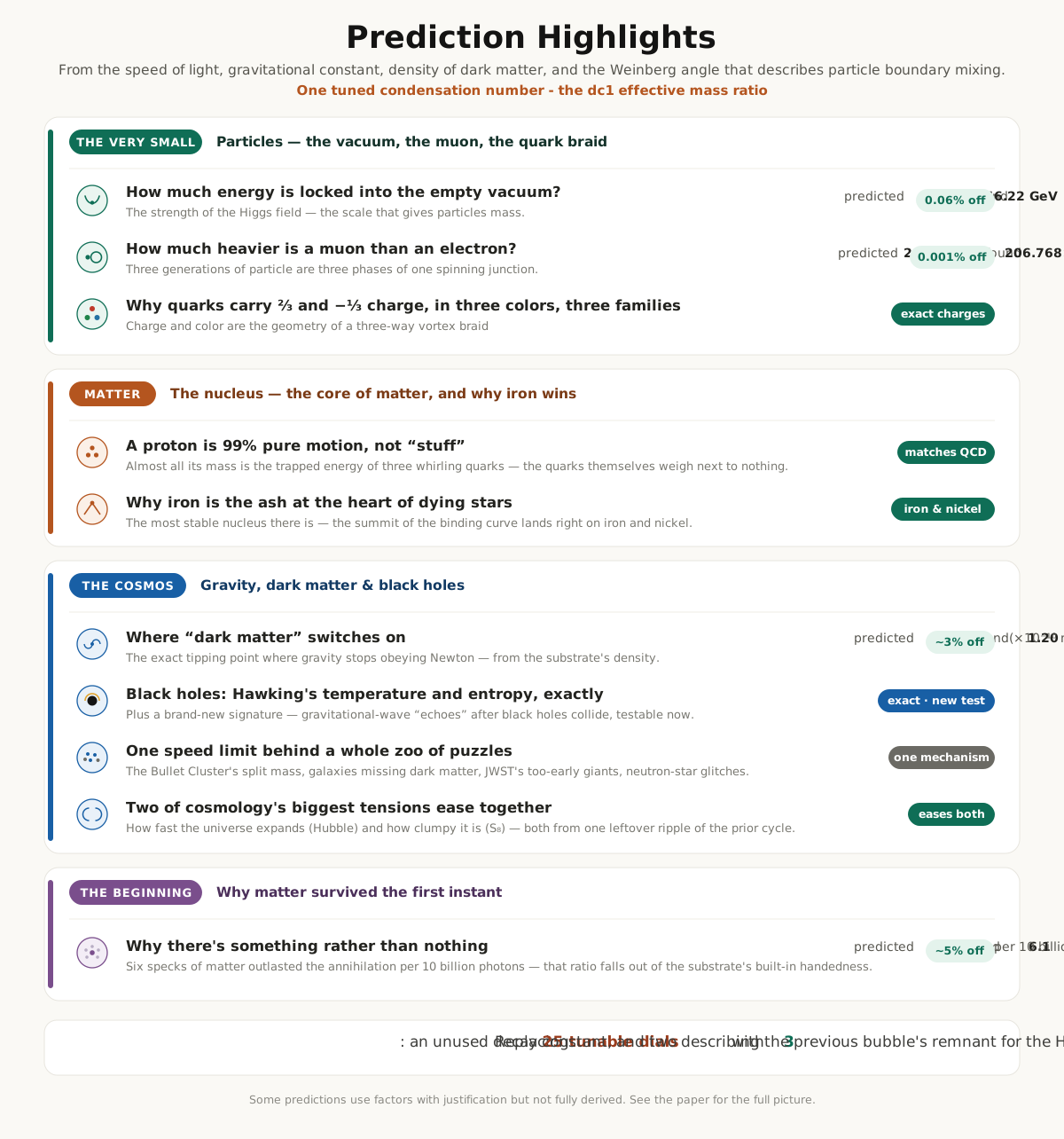
The math is in the bridge equation. What matters here is what the chain means: there is one substance, organized by one set of boundary-layer equations, producing everything from electron spin to the expansion rate of the universe. Not two incompatible frameworks stitched together. Not 25 free parameters. One fluid. One geometry. One chain.
Life in the Fluid
The substrate does not just explain physics. It explains why physics permits biology.
Nested loops, all the way down
Earth’s nested feedback stack. Each layer — geodynamo, magnetosphere, atmosphere, ocean, biosphere — is an instance of the canonical disk-jet-counterflow loop, made of different material but organized by the same substrate geometry. Each layer buffers the one above it, and the whole stack’s stability depends on the boundary matching at every interface.
Drop a spinning mass into an elastic medium and the medium organizes itself the same way every time — we saw this in Movement 2. Now look at Earth through that lens.
The liquid iron outer core is a canonical loop: co-rotating equatorial flow, Taylor columns along the spin axis (the polar jets), counter-rotating shear at the core-mantle boundary and the inner-core boundary, and a magnetic dipole as the radiated output. The magnetosphere is the next loop outward: the magnetopause is the boundary layer, the polar cusps are the jet openings, the magnetotail is the counter-rotating return flow. The atmosphere layers its own circulation cells — Hadley, Ferrel, Polar — separated by the jet streams, which are counter-rotating shear zones. The oceans have the Gulf Stream and deep-water return as their co-rotating and counter-rotating flows.
Each layer exists because the one below it stabilized first. The magnetosphere requires the geodynamo. The atmosphere requires the magnetosphere — without it, the solar wind strips volatiles. Photosynthesis requires the atmosphere and oceans. Aerobic metabolism requires photosynthesis. Complex carbon recycling requires aerobic organisms. Each transition added a new counter-rotating boundary layer to the stack — the same progressive nesting that produces higher principal quantum numbers in the hydrogen atom, just written in iron and water and chlorophyll instead of dc1 vortices.
Mars had a geodynamo that shut down 3.8 billion years ago. Its feedback stack got stuck at layer zero. Venus has no magnetic field and a runaway greenhouse — its stack collapsed at layer one. Earth maintained all seven layers, each stabilizing the next. The framework suggests that what makes a planet habitable is not just its distance from a star but its topological depth — how many nested feedback loops it can sustain.
The Moon as resonance lock
The Earth-Moon system as a substrate-coupled pair. The Moon’s synchronous rotation aligns spin, orbit, and the substrate’s sheet structure in the ecliptic — a triple alignment that is the lowest-energy configuration. The tidal forcing acts as a periodic mixer, maintaining the turbulent cascade that drives deep-water circulation, nutrient transport, and biological productivity.
The Moon’s tidal lock is not incidental. In the substrate framework, the Earth-Moon system sits in a local energy minimum: spin aligned with orbit aligned with the substrate’s sheet structure in the ecliptic. Perturbations encounter a restoring force from the substrate’s elasticity, in addition to the standard tidal torque. The Moon acts as a mixer — periodically deforming the ocean’s boundary conditions, preventing the system from settling into static equilibrium, and maintaining the turbulent cascade that drives nutrient transport. Without the Moon’s tidal forcing, the ocean feedback loop would be weaker: less mixing, less biological productivity.
The Sun as canonical loop
Sol Æternus — the Sun as canonical feedback topology. Differential rotation (equator laps the poles by 30%), the tachocline boundary layer, polar coronal holes with fast solar wind, and the 22-year magnetic polarity cycle — all instances of the same disk-jet-counterflow architecture that organizes the electron’s vortex storm.
The Sun’s tachocline — a thin shear layer where the radiative core’s rigid rotation meets the convective envelope’s differential rotation — plays the same structural role as Earth’s D″ layer. Both are counter-rotating boundaries between a rigid inner region and a differentially rotating outer region. Both are where the magnetic dynamo lives. The substrate predicts this correspondence: the canonical loop’s boundary sheath, expressed in whatever material is available — liquid iron for Earth, ionized plasma for the Sun — always becomes the dynamo’s seat.
The 22-year solar magnetic cycle is a boundary-layer oscillation. The counter-rotating tachocline does not intrinsically prefer one magnetic polarity, so the system oscillates between them — driven and self-limiting, with the substrate’s elasticity stabilizing the period against turbulent fluctuations. Solar flares and coronal mass ejections are localized boundary failures — vortex reconnection events, the stellar equivalent of the superfluid helium reconnections that have been studied in laboratories for decades.
DNA: the living modon
Vita in Reticulo — life on the lattice. The DNA double helix as a bound, stationary modon: two antiparallel sugar-phosphate backbones (counter-rotating channels) joined by stacked aromatic base pairs (the toroidal vortex column). The cell at ~100 μm matches the substrate’s coherence length ξ. Mitochondria at ~1–10 μm match the lattice spacing. ATP synthase — a literal rotary motor — converts substrate-current flow into stored chemical energy.
The double helix of DNA has the topology of a modon — the same counter-rotating vortex dipole that constitutes a photon. Two antiparallel sugar-phosphate backbones wind around a central axis, their chemical polarities running in opposite directions. The base pairs bridging the interior — aromatic rings stacked at 3.4 Å spacing — form a continuous one-dimensional substrate channel running along the helix axis, the same kind of co-rotating raceway that carries the electron’s pilot wave around the hydrogen atom.
A photon is a modon that travels. DNA is a modon that stays — bound in place, stationary, its counter-rotating topology stabilized by hydrogen bonds and stacking interactions rather than by mutual advection. The framework does not claim the substrate designed DNA. It claims that the substrate’s free-energy landscape has valleys at modon-like topologies, and that evolution — which is a search algorithm running on that landscape — preferentially found those valleys.
The scale coincidences are striking. The typical eukaryotic cell (~10–100 μm) matches the substrate’s coherence length \xi \approx 100\;\mum. Mitochondria (~1–10 μm) match the lattice spacing. Red blood cells (~7–8 μm) match it almost exactly. ATP synthase — a literal rotary motor that converts proton-gradient flow into stored phosphate-bond energy — operates at ~10 nm, deep inside a single lattice cell. Whether these are coincidences or constraints is an open question. But if the substrate provides organizational scaffolding at the \xi scale, then structures that use that scaffolding would naturally be sized to fit within it.
The chirality of life — L-amino acids, D-sugars, right-handed B-DNA — may trace to the substrate’s own chirality preference, set by the Higgs field (the local chirality ordering of the dc1/dag lattice). The bias need not be large. A few percent enantiomeric excess, amplified by autocatalytic feedback, is sufficient to drive homochirality. The substrate provides the initial nudge; chemistry does the rest.
Magnetism: Seeing It Again for the First Time
Thomson and Maxwell almost had it.
The vortex atom, resurrected
In 1867, Thomson proposed that atoms are stable knots of circulation in an all-pervading fluid. Maxwell, six years earlier, had built his entire theory of electromagnetism on a mental model of “molecular vortices” — spinning cells of fluid separated by idle wheels that transmitted angular momentum between neighbors. The idle wheels were his electrons. The spinning cells were his magnetic field. He derived every one of his equations from this picture, then discarded the model as scaffolding.
They were closer than anyone would be for 160 years. But they could not get past two problems: how does the fluid sustain stable vortices without dissipating? And if the electron is a vortex, why doesn’t it radiate itself away? They had no superfluid. They had no topological protection. The vortex atom programme died, and physics took the algebraic path — fields without a medium, particles without internal structure, forces without a mechanism.
Vigor per Gyrum — force through rotation. A bar magnet in cross-section showing organized co-rotating vortex flows leaking through aligned atomic boundary layers, curving from north to south pole in sweeping arcs of dc1 substrate current. The “field lines” that iron filings trace are not abstract mathematics. They are the streamlines of organized co-rotating flow, leaked through trillions of aligned boundaries.
Now you have seen the superfluid. You have seen topological protection. And you can see what Thomson and Maxwell were reaching for.
What field lines actually are
A magnetic field is not a mysterious force field. It is organized dc1 substrate flow leaking through aligned atomic boundaries.
In iron, four unpaired 3d electrons per atom push their co-rotating flow in the same direction through the atom’s outer boundary. When neighboring atoms align — parallel spins, co-rotating flows — the boundary between them partially dissolves. This is the exchange interaction: the energy saved by merging co-rotating flows rather than maintaining separate boundaries. It is the same boundary dissolution that creates conduction channels in metals, the same mechanism that stabilizes covalent bonds. Co-rotating flows merge. Counter-rotating flows create new boundaries. The energy difference is the exchange energy.
The result, across billions of aligned atoms, is a coherent stream of co-rotating dc1 flow leaking out through the poles of the magnet, curving through the substrate, and returning through the other pole. Those curving streamlines are what iron filings trace. Not abstractions. Not mathematical conveniences. Physical flow in a physical medium.
Why magnets snap together
Bring two magnets together, north pole to south pole. The leaked flows in the gap are co-rotating — both moving in the same direction through the same region of substrate. Co-rotating flows merge. The boundary dissolves. Energy is released. The magnets pull together.
Flip one magnet around. Now the flows in the gap are counter-rotating — both pushing outward, colliding. A new boundary forms. Energy is spent. The magnets push apart.
Magnetic attraction and repulsion are boundary dissolution and boundary creation — the same physics that drives the exchange interaction between neighboring atoms, organized coherently across macroscopic distances. The force between two magnets is the summed co-rotating flow coupling of \sim 10^{23} aligned atomic leaks, projected through the substrate between the poles.
The Curie point: watching order drown
Heat a permanent magnet and its pull weakens. At 770°C for iron, the magnetization drops to zero. This is the Curie point, and the substrate makes it tangible in a way that abstract statistical mechanics cannot.
Temperature is disordered kinetic energy — chaotic dc1 eddies superimposed on the organized flows. As temperature rises, the chaos disrupts the boundaries between neighboring atoms, blurring the distinction between co-rotating and counter-rotating. Each atom’s co-rotating leak gets buffeted by random torques that try to randomize its orientation. Below the Curie point, the exchange coupling wins — organized flow stays aligned despite the buffeting. Above it, the thermal chaos wins. Each atom’s leak points in a random direction. The coherent macroscopic current disappears. The iron filings fall away.
You are watching organized rotational energy — a coherent dc1 current leaking through trillions of aligned boundary layers — drown in thermal noise. Every refrigerator magnet is a window into the substrate. The alignment you feel when two magnets snap together is the same chirality ordering that breaks electroweak symmetry. The familiar and the fundamental are the same thing.
Where to Go from Here
You have now seen the substrate from the inside out — from the two particles that constitute it, through the atoms and galaxies it organizes, to the life it scaffolds and the magnets it makes tangible. The story is one continuous chain of fluid dynamics, and every section in the sidebar is a deeper dive into one link of that chain.
If you want the math, start with the Bridge Equation — the zero-parameter chain connecting the Weinberg angle to galaxy rotation curves, with derivations, numerical checks, and honest error bars.
If you want the evidence, start with Experiments — Michelson-Morley, the double slit, Bell’s theorem, the Aharonov-Bohm effect, and the Lamb shift, each reexamined through the substrate.
If something specific caught your eye — how crystals work, what the Higgs field really is, why the universe’s dark energy has structure, how DNA exploits the lattice — dive in. Every section stands alone, but they all connect back through the same substrate.
If you want to help, see Open Problems. The framework has five genuinely free parameters, several open derivations, and a list of testable predictions waiting for data. This is an open-source project, and the lattice has room for more hands.
Vestigium Locorum — a map of the framework. Every section in this paper connects through the substrate’s boundary-layer equations, the bridge equation’s zero-parameter chain, and the canonical feedback topology that repeats at every scale. One fluid. One geometry. One chain.