Aromatic Rings as Toroidal Vortices
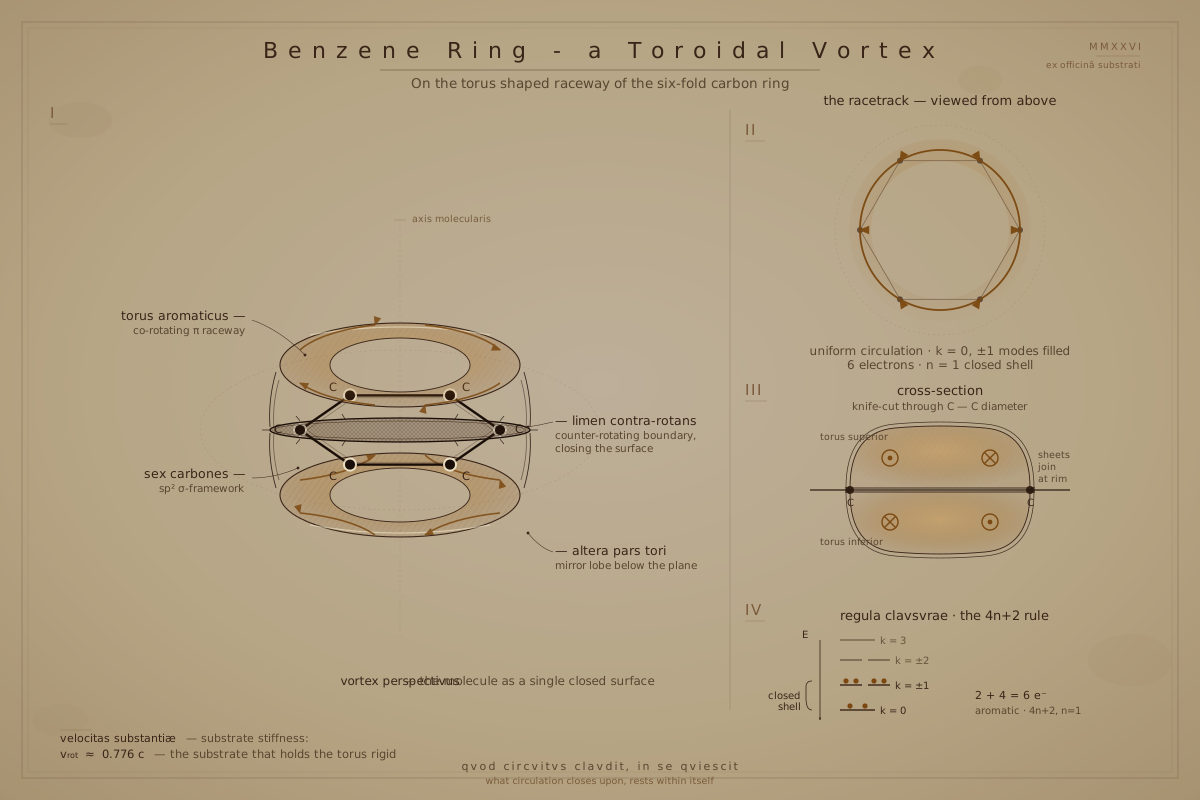
Interactive: open the aromatic ring simulation — watch benzene’s three Kekulé π bonds, each a co-rotating loop in its own counter-rotating skin, slide onto the ring axis and become one closed channel above the plane and one below, each wrapped in one continuous sheet with no ends anywhere; switch on a field along the axis and see one donut speed up and the other slow, the net circulation diamagnetic, its induced field threading the ring against \mathbf B and returning past the ring protons with it — shielded inside, deshielded outside, read at the NICS probes. A second view puts N atoms and n_e electrons on the ring: the Hückel ladder fills, the standing wave \cos k\phi sits on the torus with its nodes, the phase needles round the outside close only when k is an integer (drag it off one and watch the seam open), and 4n rings distort until their parity is even. A third stacks rings at DNA’s 3.4 Å and watches the facing donuts share one sheet until the column is one tube.
The Aromaticity Puzzle
Benzene shouldn’t be as stable as it is. Treat it as a Kekulé structure — three single bonds, three double bonds — and standard bond-energy bookkeeping predicts a heat of hydrogenation near 86 kcal/mol, three times the value for cyclohexene’s single double bond. Measure the actual heat: 49 kcal/mol. The molecule is roughly 36 kcal/mol more stable than the localized-bond picture allows. That extra binding energy is the aromatic stabilization, and a century of chemistry has organized itself around the rule that decides when a ring gets to keep it: Hückel’s 4n+2.
The rule is sharp. A planar, fully conjugated cyclic π system is aromatic — exceptionally stable, with delocalized electrons, supporting a measurable ring current — if its π cloud contains 4n+2 electrons. Benzene with 6, the tropylium cation with 6, naphthalene’s perimeter with 10, [18]annulene with 18, the porphyrin inner ring with 18: all aromatic. A ring with 4n electrons is antiaromatic — actively destabilized relative to a comparable open-chain. Cyclobutadiene (4 π electrons) is so unstable that for decades it could only be observed in argon matrices below 35 K, and even there it distorts to a rectangle to avoid the fully-symmetric square configuration.
Standard molecular orbital theory captures the rule by counting bonding and antibonding levels around a ring of N p-orbitals. The eigenvalues of the cyclic Hückel matrix are E_k = \alpha + 2\beta\cos(2\pi k/N), k = 0, 1, \dots, N-1. The k = 0 mode is non-degenerate; every other \pm k pair is doubly degenerate. A closed shell — every spatial MO either fully occupied or fully empty — requires 4n+2 electrons. Anything else leaves a degenerate pair half-filled and the ring distorts.
That counting argument is correct as far as it goes, but it leaves the origin of the stabilization in algebra. Why does the substrate care about closed shells? Why are unfilled degenerate pairs unstable in a way that has no analog in the open-chain limit? In the substrate framework, the answer is the same one that runs through every other quantization story in this paper: a closed-loop boundary must match itself smoothly. Aromaticity is what happens when the substrate finds a way to do that with a single shared boundary instead of N separate ones — and Hückel’s rule is the parity condition that decides when the loop will close.
From Localized Bonds to a Ring of Flow
A standard covalent bond, in the substrate picture, is a merger of two co-rotating raceways enclosed by one shared counter-rotating boundary, replacing the two separate boundaries each isolated atom would carry. The energy gain is geometric: one shared boundary surface has less total area, and therefore less stored boundary energy, than the two it replaces. This is the picture developed for H₂ at the end of The Hydrogen Flywheel — chemistry as boundary merger.
In a chain of conjugated p-orbitals — say 1,3-butadiene — each successive pair can do this merging trick. Adjacent p-orbital lobes overlap above and below the molecular plane, sharing a counter-rotating sheet that runs along the carbon backbone. The shared sheet is what spectroscopists call the π system, and the energy gain over isolated double bonds is the delocalization energy. The substrate is consolidating boundaries: instead of two separate π bonds (four counter-rotating surfaces), the molecule supports one ribbon-shaped π envelope (two surfaces, top and bottom). For an open chain the consolidation runs into geometry at the ends — the ribbon has to terminate, and termination costs boundary energy at each end.
Now close the chain into a ring. If the ring is the right size — six atoms in benzene, with carbon-carbon distance ~1.4 Å and the right sp^2 geometry — the p-orbital lobes on adjacent carbons overlap continuously all the way around. The ribbon’s two ends meet. The substrate now has the option of supporting a single closed-loop co-rotating channel above the ring and another below, each one bounded by a continuous counter-rotating sheet. The ribbon becomes a torus. Topologically, the π system has gone from a finite-length boundary surface with two ends to a closed surface with no ends at all.
The ring view of the simulation starts from the three localized bonds; press Merge into the torus to watch the boundaries between the lobes dissolve.
This is the energetic punchline. Closed surfaces have no termination energy. The boundary that confines the π electrons has been minimized in the strongest geometric sense available — a torus is the lowest-energy way to enclose a closed-loop co-rotating flow in three dimensions, just as a sphere is the lowest-energy way to enclose an isotropic one. The 36 kcal/mol of aromatic stabilization is what the substrate gets back for finding this configuration.
The proton drags substrate inward through co-rotating Coulomb flow (the Coulomb region in the Hydrogen Flywheel makes this explicit). Each carbon nucleus in the ring is leaking that oppositional pull into the surrounding substrate, and the π electrons exist precisely to counter-balance it. In a Kekulé picture, each electron pair counter-balances locally, atom by atom, with three separate localized boundaries. In the toroidal picture, the entire ring counter-balances the entire ring of nuclei with one continuous surface. The new flow pattern is the lower-energy way to close the books on the leaking attraction.
Boundary Matching on a Ring
Whenever the substrate confines a co-rotating flow, the same mathematics applies. Inside the confined region, the wavefunction is oscillatory; outside, it decays exponentially; at the boundary, the two solutions must match smoothly in both amplitude and derivative. For a single hydrogen atom this matching produces the principal quantum number n. For the modon — Larichev and Reznik’s two-dimensional vortex dipole — it produces the structure constant K = j_{11}^2 + 1 \approx 15.67 that determines the photon’s internal architecture. The architecture is the same; only the geometry of the cavity changes.
For an aromatic ring, the cavity is a torus and the relevant geometric coordinate is the angle \phi around the ring. The substrate flow on the torus has to come back to itself after one full circuit — this is the fundamental closed-loop boundary condition. A standing wave whose phase advances by \delta\phi in going once around must satisfy \delta\phi = 2\pi k for some integer k, otherwise the flow on the second pass arrives out of phase with the first and the configuration tears itself apart in a finite number of cycles. The substrate quantizes the allowed circulation modes, exactly as it quantizes radial standing waves in the hydrogen atom. These modes are the ordinary harmonic series — integer multiples of a fundamental, evenly spaced in frequency — and that template is the right one here precisely because the ring has a length, its circumference, to set the fundamental. That is the deliberate complement of the case the substrate ladder treats, where the medium between its cutoffs has no length of its own and so can organize only by ratio — the \sqrt{2} tower — never by overtone. A closed ring is a bounded cavity and the substrate at large is not; the two pictures sit side by side without conflict.
The allowed modes around a ring of N atoms are labeled by the integer k, with k running from -(N-1)/2 to +(N-1)/2 (or, equivalently, 0 to N-1 with periodic identification). The k = 0 mode is uniform circulation: every atom contributes the same amplitude and phase to the toroidal flow. The |k| = 1 modes have one full standing-wave wavelength around the ring; |k| = 2 has two; and so on, up to the maximum that the discrete atomic positions can resolve.
Each |k| > 0 mode comes in two flavors — clockwise (+k) and counterclockwise (-k). They are degenerate by symmetry: in the absence of an external field, the substrate cannot distinguish circulation direction. This degeneracy is the topological consequence of the ring’s invariance under reflection; you can convince yourself by holding a benzene molecule up to a mirror and noting that nothing distinguishes the left-handed flow from the right-handed one. The k = 0 mode has no such partner. A uniform circulation has no chirality — reversing direction produces the same flow.
So the level structure on the ring is: one non-degenerate mode at k = 0, then a sequence of doubly-degenerate pairs at |k| = 1, 2, 3, \dots. Filling the modes with electrons (two per spatial mode, by Pauli), the closed-shell occupations are:
| |k| filled up to | Modes filled | Electrons (2 per mode) |
|---|---|---|
| 0 | 1 | 2 |
| 1 | 3 | 6 |
| 2 | 5 | 10 |
| 3 | 7 | 14 |
| 4 | 9 | 18 |
The pattern: 1 + 2n modes giving 4n + 2 electrons. This is Hückel’s rule, derived not from the algebra of a tight-binding Hamiltonian but from the topology of standing waves on a closed loop. The modes view of the simulation draws the ladder and the standing waves for any N and n_e, and lets k be dragged off an integer to see why the loop then fails to close. The rule is identical to the one that gives noble-gas stability in atoms — closed shells are stable, half-filled degenerate shells are not — applied to the cyclic geometry of the ring instead of the spherical geometry of the atom.
The 4n+2 Rule as Boundary Parity
A theme runs through the framework: when a counter-rotating boundary has to close on itself, the number of layers must be even. An even number of counter-rotating layers between an interior and the external substrate makes a boson — closed boundary, integer spin, no Pauli exclusion. An odd number makes a fermion — half-integer spin, antisymmetric exchange, the topology that protects Bell correlations. The same parity rule structures the spin-statistics theorem, distinguishes polarized fermion vortices from balanced boson pairs, and decides which orbital systems are stable in the substrate at all.
Aromaticity is the molecular-scale instance of this rule. The toroidal raceway is a closed surface, and the angular momentum modes filling it must collectively close on themselves. With 4n+2 electrons, the contributions cancel cleanly: the k = 0 mode contributes zero net angular momentum (uniform flow has no preferred direction), and each filled \pm |k| pair contributes +|k|\hbar from its clockwise occupant and -|k|\hbar from its counterclockwise occupant, summing exactly to zero. The total angular momentum around the ring is zero, the boundary surface closes smoothly, and the configuration is stable. Even parity.
Seen from the substrate ladder, this cancellation is the pairing-two wearing its molecular face. Each \pm|k| pair is a circulation and its counter-rotating partner — the same anti-phase pairing that binds Cooper electrons and runs the lattice’s own breath — so a closed shell is simply the configuration in which every chiral circulation is balanced by its anti-phase twin, save the lone unpaired k = 0 mode that supplies the “+2.” An aromatic ring is in this sense the molecular archetype of the ladder’s locking pole: a structure whose entire purpose is to bind, nest, and ring as one coherent current, and which earns its 36 kcal/mol precisely by doing so.
With 4n electrons, there is no way to do this. After filling k = 0 (2 electrons) and the lowest n - 1 degenerate pairs (4n - 4 electrons), there are 2 electrons left over with the next degenerate pair as their lowest available home. By Hund’s rule those two electrons go into the two members of the degenerate pair with parallel spins — one clockwise, one counterclockwise, with parallel spins giving a triplet ground state. The clockwise and counterclockwise contributions to angular momentum still cancel (the spatial pieces sum to zero), but the spin angular momentum doesn’t, and the configuration carries a permanent magnetic moment. More importantly, the spatial part of the wavefunction now has a half-filled degenerate shell, which means the boundary surface has a place where the standing-wave amplitude is undetermined. The substrate cannot match the boundary smoothly there. Odd parity. Unstable.
The substrate’s response to odd parity is the same response it has elsewhere in the framework: distort until the parity becomes even. Cyclobutadiene with 4 π electrons would, if it could maintain D_{4h} symmetry, sit at exactly this odd-parity point. What it actually does is pucker into a rectangular D_{2h} structure, breaking the four-fold symmetry, lifting the degeneracy of the half-filled pair, and shoving one of its members below the other so both electrons can pair up in the lower one. The Jahn-Teller distortion that the textbooks describe as “removal of degeneracy” is, in the substrate picture, the molecule choosing localized double bonds over a torus that won’t close. The energy penalty for being antiaromatic is the energy the substrate has to pay to maintain a parity-mismatched boundary, and the molecule pays that penalty by giving up the toroidal raceway entirely and falling back to a Kekulé-like alternation. It is worth keeping this distinct from the ladder’s other pole. An antiaromatic ring is not a structure that seeks a gap between the rungs the way phyllotaxis or the resting cortex do; it is a structure that wants to lock and cannot, its pairing left incomplete by the parity mismatch. The distortion is a lock restored by force, not a never-lock chosen by design — aromatic and antiaromatic are both locking-pole states, one achieved and one frustrated.
The cyclobutadiene preset runs this distortion: the half-filled pair splits, the bonds alternate, and the torus falls back to two localized loops.
The contrast with benzene is total. With 6 electrons (the n = 1 closed shell), the toroidal vortex is the lower-energy state. The molecule is a regular hexagon — all six C–C bonds equal length, halfway between a single and a double bond, because the bond order is determined not by alternating localized π bonds but by the uniform delocalized ring current. With 4 electrons (cyclobutadiene), the toroidal vortex doesn’t close; the molecule rejects the symmetric configuration and reverts to alternating bonds. The aromatic/antiaromatic distinction is not a difference in degree — it is the substrate flipping between two qualitatively different boundary topologies.
The Ring Current as a Direct Substrate Observable
The 4n+2 rule and the toroidal-vortex picture together predict something that turned out to be testable long before anyone had a substrate framework to motivate it. If benzene’s π electrons really do circulate as a closed-loop ring current, then placing the molecule in an external magnetic field perpendicular to the molecular plane should induce a measurable diamagnetic response: the ring current responds to the changing flux exactly like a single-loop superconducting coil. Below the molecular plane, the induced field reinforces the external field; above, it opposes; protons attached to the ring’s perimeter sit in a region where the induced field aids the external field, so they are deshielded; protons hanging above the ring center sit in a region where the induced field opposes, so they are shielded.
This shows up in NMR as a strikingly large chemical shift difference. Aromatic protons on benzene’s perimeter resonate at \delta \approx 7.3 ppm — significantly downfield (deshielded) compared to ordinary alkene protons at 5–6 ppm. The bridging protons in [18]annulene that sit inside the ring resonate at \delta \approx -3 ppm, a shielding so strong that it pushes the protons above the field of tetramethylsilane. The 10 ppm spread between the inner and outer protons is direct evidence of a closed-loop current circulating in the toroidal region.
The ring view with the field on traces the induced field of the two loops and reads it at the ring centre, 1 Å above it, and at a ring proton.
In the substrate framework, this isn’t a “ring-current model” — it’s the literal description of what the toroidal vortex is. The π electrons are a co-rotating substrate flow circulating through a torus; an external magnetic field couples to that circulation; the response is a real, mechanical adjustment of the substrate flow direction; and the local field at any point near the molecule is the superposition of the external field with the substrate’s response. The Nucleus-Independent Chemical Shift (NICS) — the calculated shielding at a probe point above the ring center — is, in this framework, a direct measurement of the strength of the toroidal raceway. Aromatic systems show NICS values of -8 to -12 ppm at the ring center. Antiaromatic systems show positive NICS, indicating a paratropic ring current that points opposite to the diamagnetic direction — the substrate trying to support a current in a topology that doesn’t admit one, and getting the sign wrong.
Larger Rings and Where the Framework Predicts Something New
Hückel’s rule is exact for monocyclic, planar, fully-conjugated systems. The substrate framework reproduces it as the closed-shell condition for standing waves on a torus. So far, no new physics — the framework recovers a textbook result, which is the minimum requirement for taking it seriously. The interesting question is whether the framework predicts anything that standard π-electron theory doesn’t.
It does, in two places.
First, the framework predicts that the toroidal vortex has internal structure beyond what Hückel theory captures. The torus has a coherence-length thickness — the substrate envelope that sets the radial extent of the co-rotating flow above and below the molecular plane. For benzene this thickness is set by the same physics that sets the size of an isolated p-orbital; the p-orbital lobes contribute their tail densities to the toroidal flow up to distances on the order of the carbon van der Waals radius. For larger fused-ring systems — naphthalene, anthracene, pyrene, eventually graphene — the toroidal raceways from adjacent rings begin to overlap and merge. In graphene, the entire \pi system is a single planar raceway extending across the whole sheet, with sp^2 carbon centers acting as the vortex pinning sites and the \pi electrons forming a delocalized two-dimensional flow.
The substrate framework therefore predicts that the electronic properties of graphene should be derivable from a continuum two-dimensional version of the same boundary-matching mathematics. The Dirac cone at the K and K' points of graphene’s Brillouin zone — the famous linear dispersion that gives graphene its anomalous transport — should map onto the substrate’s modon dispersion, modified for the discrete hexagonal lattice. The ratio of the Fermi velocity in graphene (v_F \approx c/300) to the substrate’s intrinsic rotational velocity (v_\text{rot,inner} = 0.776c) should be derivable from the lattice geometry alone, with no fitted parameters. This is a quantitative cross-check against an existing measurement, and currently an open problem.
Second, the framework predicts that very large aromatic systems should show measurable deviations from standard density functional theory. DFT computes molecular properties under the assumption that exchange-correlation effects are local in the electron density. The substrate framework says they are not — they include the long-range coherence of the toroidal raceway, which extends out to the substrate coherence length \xi \approx 110\;\mum and provides correlations across distances enormously larger than the molecule. For small molecules (benzene, naphthalene) the coherence-length effect is negligible because the molecule is so much smaller than \xi that the long-range piece of the substrate response is essentially uniform. For large aromatic systems — porphyrins (~1.5 nm across the macrocycle), nanographene flakes (10–100 nm), single-walled carbon nanotubes, conjugated polymers running tens of monomers in length — the coherence-length tail begins to develop spatial structure across the molecule, and the substrate predicts a small but systematic correction to DFT-computed properties.
The most testable consequence is in NICS values. Standard DFT predicts NICS for porphyrin and large polycyclic aromatic hydrocarbons (PAHs) within roughly 1–2 ppm of experiment for most cases, with some systematic underestimates of about 2–3 ppm in the largest molecules. The substrate framework predicts that this discrepancy should grow with molecular size and should correlate specifically with the number of effective ring currents the molecule supports. For a molecule with N_\text{rings} fused aromatic rings and a characteristic dimension L, the substrate correction should scale as roughly N_\text{rings} \times (L/\xi)^{1/2} — small for benzene, larger for hexabenzocoronene, larger still for graphene quantum dots. This is an underspecified prediction at the moment — the open problem is to derive the prefactor from the framework itself rather than fitting to data — but the sign and scaling of the correction are determined.
A different test bears directly on the toroidal-vortex picture. Aromatic ring currents are sensitive to the substrate flow direction in a way that localized bonds are not. If the substrate has a preferred chirality on cosmological scales (as the Higgs field chapter argues, and as the weak interaction’s parity violation demands), then aromatic compounds with enantiomeric ring currents — flowing clockwise versus counterclockwise as seen along a fixed external axis — should have a tiny energy splitting. This is the molecular analog of the parity-violating energy difference predicted (and barely measurable) in chiral amino acids. For aromatic systems it should appear as a parity-violating contribution to the NMR ring-current shift, with magnitude controlled by the same \alpha_{mf}^2 factor that controls the S_8 tension and the anomalous magnetic moment. At the ring-current scale, this is in the parts-per-trillion range — not currently measurable, but in principle observable in a sufficiently sensitive precession experiment on a molecular ensemble.
Putting the Section in Context
Aromaticity has long been one of chemistry’s most explanatorily-stretched concepts. The Hückel rule is empirically airtight; the molecular orbital derivation is mathematically clean; but the physical reason a ring with 4n+2 electrons should be more stable than a ring with 4n has tended to come down to “because the math works out that way.” The substrate framework says the math works out that way because the substrate cares about closed surfaces, and a torus is the lowest-energy closed surface for a co-rotating flow that has to come back to itself.
The same boundary-matching mathematics that gives the hydrogen atom its principal quantum number gives benzene its 6-electron stable configuration. The same parity rule that distinguishes fermions from bosons distinguishes aromatic from antiaromatic rings. The same Larichev-Reznik matching that determines the photon’s internal structure determines the standing-wave modes around an aromatic loop. There is nothing special about aromatic chemistry from the substrate’s point of view — it is one more place where the medium has organized itself into a closed-loop standing-wave configuration, and the rule for which configurations close cleanly is the rule the framework has been using all along. And benzene’s diamagnetic ring current — a coherent circulation that closes on itself and never terminates — is the framework’s lossless channel at its smallest closed instance: the same low-loss circulation the substrate ladder says a structure tuned to a rung is plugged into, which DNA stacks into a one-dimensional wire (the aromatic stack) and conductors extend across an entire sample.
The next chapter examines conductors — extended systems where the toroidal vortex picture generalizes to delocalized current loops on macroscopic length scales, and where superconductivity emerges as the substrate’s ability to support a coherent flow over the entire sample without termination at the boundary.