The Solar System as Substrate Architecture
Boundary layers from the solar core to the heliopause — the canonical loop at every interface
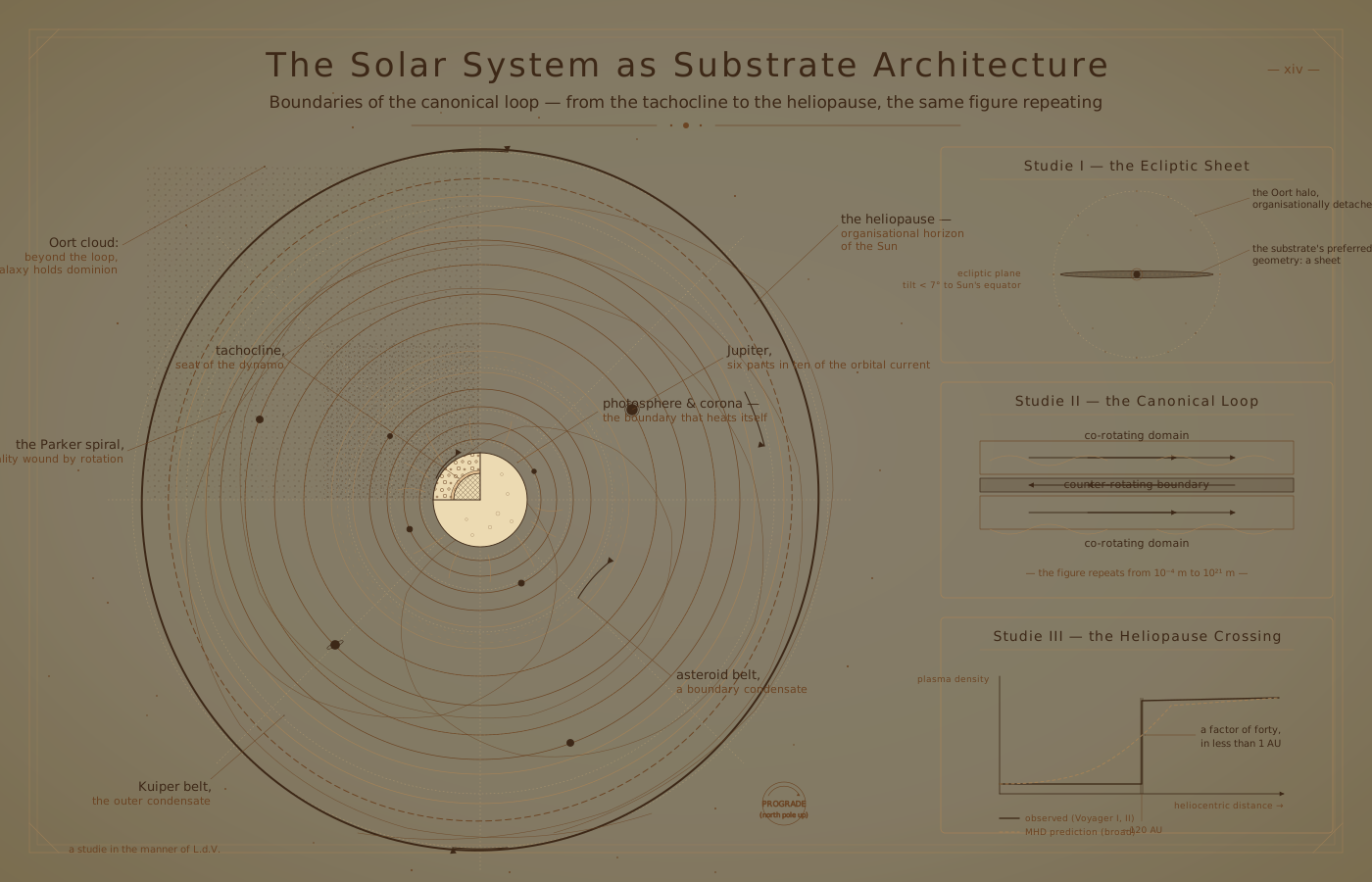
The Solar System in the Substrate
The solar system itself is a nested stack of substrate boundaries stretching from the Sun’s tachocline to the heliopause and threaded through every planet, ring system, and debris field along the way.
The solar system is a collection of gravitationally bound objects orbiting in a superfluid medium — the dc1 lattice — whose organizational preferences are imprinted on every structure we observe. The ecliptic plane, the asteroid belt, the Kuiper belt, the heliospheric current sheet, Saturn’s rings, Jupiter’s magnetosphere, the Oort cloud — each of these is a boundary or a boundary product in the substrate’s organizational hierarchy. Each one maps to a place in the canonical loop improving on the gravitational model.
The Boundary Stack
The solar system, read from the inside out, is a sequence of counter-rotating boundaries separated by co-rotating domains. Each boundary is where the substrate’s organizational energy changes character — where one regime of organized rotation meets another, and the shear between them produces the structures we observe.
| Boundary | Inner domain | Outer domain | Substrate role | Observable |
|---|---|---|---|---|
| Tachocline | Radiative core (rigid rotation) | Convective envelope (differential rotation) | Counter-rotating shear layer; dynamo seat | Helioseismic shear profile |
| Photosphere–corona transition | Cool photosphere (~5,800 K) | Hot corona (~10^6 K) | Energy deposition from boundary excess | Coronal temperature anomaly |
| Heliospheric current sheet | North magnetic hemisphere | South magnetic hemisphere | Outermost solar boundary; chirality separator | Parker spiral polarity reversal |
| Planetary magnetopauses | Planetary magnetic cavity | Solar wind flow | Local substrate deflection boundaries | Bow shock, magnetotail |
| Asteroid belt | Inner rocky planets | Outer gas giants | Boundary condensate at Jupiter resonance | Debris concentration at 2.1–3.3 AU |
| Kuiper belt | Giant planet domain | Interstellar medium transition | Outer boundary condensate | Debris concentration at 30–55 AU |
| Heliopause | Solar wind (heliosphere) | Interstellar medium | Terminal solar boundary | Voyager plasma density transition |
Each row in this table is an instance of the canonical loop’s boundary sheath — the counter-rotating layer that separates two domains of organized rotation. The substrate’s contribution is to explain why boundaries at such wildly different scales (the tachocline is \sim 0.04\,R_\odot \approx 2.8 \times 10^7 m; the heliopause is \sim 120 AU \approx 1.8 \times 10^{13} m) share the same topology: the dc1 lattice is elastic at every scale, so the lowest-energy boundary configuration is always the same counter-rotating shear layer, expressed in whatever local material — plasma, magnetic field, dust, neutral gas — is available.
Read through the substrate ladder, this stack is the canonical loop’s boundary sheath as a self-similar motif — one counter-rotating-boundary configuration replicated up a tower of scales, the same way the ladder reads the lattice breath replicated from the vortex core to the cell. But the stack is the ladder’s coarse family, not a \sqrt2 comb: its rungs are mechanism-set — the tachocline by stratified shear, the magnetopauses by ram-pressure balance, the belts by resonance, the heliopause by the interstellar medium — so the scales recur but their ratios carry no single substrate period, exactly as the solar interior’s layers and superconductivity’s five scales do (honest accounting). The firm claim is the repeated topology; the spacing is coarse and domain-set.
The Ecliptic: A Substrate Sheet Made Visible
The most conspicuous feature of the solar system is that it is flat. The eight planets orbit within a few degrees of a common plane, the asteroid belt lies in that plane, the Kuiper belt lies roughly in that plane, and the Sun’s equator is tilted only \sim 7° from it. Standard explanations trace this to angular momentum conservation during the collapse of the proto-solar nebula — correct, and the substrate framework agrees entirely with the mechanism.
What the framework adds is a reason why angular momentum conservation produces a disk rather than some other geometry. The answer, from feedback topology: the dc1 lattice is organized into chirality-coherent 2D sheets, and planar is what the substrate prefers. A collapsing molecular cloud that carries angular momentum will form a disk because the substrate’s sheet geometry provides an elastic restoring force that channels rotational energy into the plane of maximum moment. Other geometries — spherical, cylindrical, toroidal — are accessible but cost more boundary energy per unit angular momentum stored.
The ecliptic is the solar system’s expression of the same sheet preference that produces aromatic ring planarity at the molecular scale, galactic disk flatness at the cosmic scale, and the 2D triangular lattice arrangement of cell vortices at the \xi scale. There is one geometry, repeating across 25 orders of magnitude in size, because there is one medium whose elastic properties favor it.
This planar preference is the substrate ladder’s locking pole wearing its spatial face. The ladder has two preferred templates that should not be conflated: a preferred geometry — the chirality-coherent 2D sheet, the same template ice freezes onto as a hexagon and an aromatic ring adopts as a flat torus — and a preferred scale-ratio, the \sqrt2 tower. The ecliptic is the first: a system locking onto the substrate’s preferred plane, the spatial sibling of the \sqrt2 ladder rather than a rung on it. That is why the same disk geometry recurs across 25 orders of magnitude while carrying no \sqrt2 spacing of its own.
The invariable plane of the solar system — the plane perpendicular to its total angular momentum vector — is tilted \sim 1.6° from the ecliptic, but only \sim 0.3° from Jupiter’s orbital plane: Jupiter carries \sim 60\% of the system’s orbital angular momentum, so the invariable plane nearly coincides with Jupiter’s orbit. The residual \sim 1.6° tilt to the ecliptic is set by the combined contribution of the other planets. The substrate framework predicts that long-term secular evolution should drive planetary inclinations toward the invariable plane, with the timescale set by the gravitational torques (dominant) plus a small substrate restoring contribution (subdominant but persistent). Over Gyr timescales, the substrate’s sheet stiffness contributes a weak but cumulative coplanarizing force.
The Sun’s Boundaries, Expanded
Here we trace the Sun’s boundaries outward, past the corona, into the heliosphere — the volume of space that the Sun’s influence dominates.
The heliospheric current sheet as chirality boundary
The heliospheric current sheet (HCS) is a thin, warped surface extending from the Sun’s magnetic equator to the outer heliosphere. Above it, the interplanetary magnetic field points one way; below it, the other. During solar minimum the HCS is nearly flat; during solar maximum it becomes deeply corrugated, following the Sun’s tilted and multipolar magnetic equator.
In the substrate framework, the HCS is a chirality domain wall — it separates two regions of the dc1 lattice with opposite chirality alignment, the same structure that appears at the electroweak scale in the Higgs field chapter and at the galactic scale in the galactic dynamics chapter. The HCS is the Sun’s outermost counter-rotating boundary, extended into the heliosphere by the solar wind. Its corrugation during solar maximum reflects the underlying oscillation of the tachocline boundary (the 22-year Hale cycle), propagated outward at the solar wind speed.
The Parker spiral — the characteristic Archimedean spiral pattern of the interplanetary magnetic field — is the frozen-in imprint of the Sun’s rotation on the outflowing solar wind. In substrate terms, it is the azimuthal component of the dc1 entrainment by the Sun’s rotation, wound into a spiral by the radial outflow. The spiral’s winding angle at Earth’s orbit (\sim 45°) is set entirely by the ratio of solar wind speed to solar surface rotation speed — a standard calculation that the substrate framework reproduces without modification. What the framework adds is the observation that the Parker spiral is the heliospheric expression of the same frame-dragging that the feedback topology chapter documents at planetary and stellar scales: the Sun’s rotation drags the local substrate into co-rotation, and the solar wind carries that angular momentum outward.
The termination shock and heliopause
Voyager 1 crossed the termination shock at \sim 94 AU (2004) and the heliopause at \sim 121.5 AU on 25 August 2012 [R104]. Voyager 2 crossed the termination shock at \sim 84 AU (2007) and the heliopause at \sim 119 AU on 5 November 2018 [R105, R106]. The asymmetry — the termination shock is not spherical — reflects the interstellar medium’s ram pressure, which compresses the heliosphere on the upstream (nose) side.
In the substrate framework, the termination shock is where the solar wind’s radial outflow speed drops below the local substrate’s wave speed — an acoustic transition, exactly analogous to the ergosphere being where azimuthal flow exceeds the quasiparticle speed, but in the radial direction. The solar wind goes from supersonic to subsonic, and the shocked plasma piles up in the heliosheath (between the termination shock and the heliopause).
The heliopause itself is the Sun’s terminal boundary — the surface where the Sun’s organized rotation finally meets the interstellar medium’s independent flow. In canonical loop terms, the heliopause is the outermost extent of the Sun’s counter-rotating boundary, beyond which the substrate is organized by the galaxy’s large-scale flow rather than by the Sun. Both Voyager crossings revealed remarkably sharp transitions: the plasma density jumped by a factor of \sim 40 (V1 [R104, R107]) and \sim 20 (V2 [R106, R107]) in less than a day of spacecraft motion — at the Voyagers’ \sim 15–17 km/s drift speeds, \lesssim 0.01 AU \approx 1.5 Gm of boundary thickness. In substrate terms, this sharp interface is expected: boundary layers in an elastic medium are thin, because the substrate’s stiffness resists gradual transitions and favors sharp jumps.
Ideal MHD heliosphere models predict a broad transition at the heliopause and a “drastic pile-up” of the heliospheric magnetic field as it approaches the boundary. Neither is observed: both Voyagers traversed the actual density jump in < 1 day (\lesssim 0.01 AU), and the Voyager 1 magnetic field showed no pile-up at all. Recent work [R108] reproduces the Voyager profiles only by inserting an ad-hoc magnetic-dissipation term (\tau \approx 6 yr) into the induction equation. The substrate framework expects this: counter-rotating boundaries in an elastic medium are always thinner than viscous models predict, because the substrate’s stiffness provides a restoring force that resists broadening. The tachocline’s thinness inside the Sun and the heliopause’s sharpness outside it are the same phenomenon — substrate-stiffened boundaries — expressed at scales nine orders of magnitude apart. The asymmetry between the two crossings is informative: V2 was preceded by a \sim 1.5 AU plasma boundary region [R106] and a \sim 0.7 AU magnetic barrier with \sim 3\times field enhancement [R105]; V1 saw a thick inner-heliosheath boundary layer and no magnetic barrier. Both spacecraft, however, traversed the heliopause itself in less than a day. The variability lives in the precursor accommodation layers; the boundary scale itself does not.
Planetary Boundaries: A Comparative Atlas
Each planet in the solar system hosts its own set of substrate boundaries — or fails to, with observable consequences. The substrate framework predicts that the depth of a planet’s boundary stack (the number of nested canonical loops it sustains) correlates with its dynamical complexity and, for rocky planets, with its potential for habitability.
The gas giants: deep boundary stacks
Jupiter has the solar system’s most vigorous planetary canonical loop. Its rapid rotation (\sim 10 hr period), enormous angular momentum (spin \sim 6.9 \times 10^{38} kg·m²/s; orbital \sim 1.9 \times 10^{43} kg·m²/s, \sim 60\% of the system’s orbital total), and powerful magnetic field (\sim 4.2 G at the equator, \sim 20\times Earth’s) make it a miniature version of the Sun’s boundary architecture. The Great Red Spot — a persistent anticyclonic storm — is a long-lived coherent vortex in Jupiter’s atmosphere, maintained for centuries against turbulent dissipation. In substrate terms, it is a macroscopic modon: a co-rotating structure stabilized by the substrate’s elastic response at the dissipation scale, exactly as the feedback topology chapter argues for the Gulf Stream’s persistence on Earth. Jupiter’s banded cloud structure — alternating prograde and retrograde zonal jets — is the atmospheric expression of the substrate’s sheet geometry: each band is a co-rotating zone, each boundary between bands is a counter-rotating shear layer, and the pattern repeats because the substrate prefers layered, planar organization of rotational energy.
Jupiter’s magnetosphere is enormous (the magnetopause is at \sim 60–100\,R_J on the sunward side) and its magnetotail stretches beyond Saturn’s orbit. The Io plasma torus — a ring of ionized material from Io’s volcanic eruptions, orbiting Jupiter in the magnetic equatorial plane — is a boundary condensate: material trapped at the interface between Jupiter’s co-rotating magnetosphere and the counter-rotating solar wind, organized into a toroidal ring by the substrate’s sheet preference.
Saturn tells the same structural story with an added feature: the ring system. Saturn’s rings are a visible, tangible boundary condensate — particulate matter organized into a thin disk in the equatorial plane, with sharp edges, gaps at resonance locations, and an overall flatness (\sim 10 m thick over \sim 280,000 km diameter) that is among the most extreme aspect ratios in nature.
Saturn’s rings are \sim 10 m thick but \sim 280,000 km in diameter — an aspect ratio of \sim 10^{-8}. Standard celestial mechanics explains this through collisional damping: particles in inclined orbits collide, lose energy, and settle into the plane of minimum energy, which is the equatorial plane. The substrate framework agrees with this mechanism but adds a structural reason for the extreme thinness: the substrate’s sheet geometry provides an additional restoring force toward the equatorial plane, making the equilibrium thinner than collisional damping alone would produce. The prediction is subtle — the difference between the observed ring thickness and the collisional-only prediction should be attributable to substrate sheet stiffness — and may not be distinguishable with current data.
The rocky planets: boundary depth and habitability
The four rocky planets illustrate the substrate framework’s claim that habitability correlates with topological depth — the number of nested feedback layers a planet sustains.
Mercury has the shallowest boundary stack. Its magnetic field is real but weak (\sim 1\% of Earth’s), generated by a dynamo in a partially molten iron core. It has no atmosphere to speak of, no ocean, no active surface recycling. In substrate terms, Mercury’s canonical loop stalled at Layer Zero: the dynamo exists but is too weak to shield an atmosphere, so no further layers could accumulate. The feedback stack has one entry.
Venus presents the most instructive failure. It is nearly Earth’s twin in mass and composition, sits in the inner habitable zone, and has a thick atmosphere. But it has no detectable magnetic field, no plate tectonics, and a surface temperature of \sim 735 K under a runaway greenhouse. The substrate framework reads Venus as a system whose canonical loop collapsed. Without an active dynamo (Layer Zero), the magnetosphere vanished, the solar wind stripped hydrogen from the upper atmosphere, water was lost, and the carbon cycle had no ocean sink — CO₂ accumulated without bound, and the surface became uninhabitable. Venus is what happens when the first boundary in the stack fails: every subsequent layer loses its foundation.
Why did Venus lose its dynamo? The standard answer is uncertain — possibly insufficient core cooling, possibly a different interior composition, possibly the lack of plate tectonics to remove heat from the mantle efficiently. The substrate framework adds a structural hypothesis: Venus’s slow retrograde rotation (243-day period, backward relative to its orbit) means its spin angular momentum is misaligned with the ecliptic sheet. A dynamo requires organized columnar flow along the spin axis (Taylor columns), and the substrate’s sheet preference favors flows in the ecliptic plane. A planet rotating slowly and backward fights the substrate’s geometry at every scale. The canonical loop is harder to establish and harder to maintain.
Venus rotates backward relative to every other planet except Uranus, with a period longer than its year. The cause is debated — a giant impact, atmospheric tidal locking, or some combination. Whatever the cause, the consequence in the substrate framework is clear: Venus’s spin is working against the substrate’s sheet organization. The prediction is that any rocky planet with sufficiently slow or retrograde rotation, in the habitable zone or not, will struggle to maintain a deep boundary stack. This is testable as exoplanet rotation measurements become possible.
Earth maintains the deepest boundary stack in the solar system, as documented in the Gaia chapter: geodynamo, magnetosphere, atmosphere, oceans, photosynthesis, aerobic metabolism, carbon recycling, deep water cycling — seven nested layers, each stabilizing the next. The substrate framework attributes this depth not to Earth’s distance from the Sun alone (Venus is nearly as close and failed) but to the combination of prograde rotation, active core dynamo, large stabilizing moon, and plate tectonics — all of which align with or reinforce the substrate’s organizational preferences.
Mars lost its global magnetic field \sim 3.8 Ga ago. Without the magnetic shield, the solar wind stripped its atmosphere, the oceans evaporated or froze, and the surface became uninhabitable. In substrate terms, Mars’s canonical loop failed at Layer Zero — the dynamo shut down, and the boundary stack collapsed from the bottom. The remnant crustal magnetic fields (strong, patchy, concentrated in the southern highlands) are fossil boundaries — frozen imprints of the ancient dynamo’s organization, preserved in magnetized rock after the active loop ceased.
Mars’s crustal fields are among the strongest in the solar system relative to its size — up to \sim 1500 nT at \sim 200 km altitude, compared to Earth’s \sim 30,000–60,000 nT at the surface. Their spatial pattern (strong in the ancient southern highlands, weak or absent in the younger northern lowlands and near large impact basins) is consistent with a dynamo that operated vigorously during Mars’s first \sim 500 Myr and then stopped. In the substrate framework, this is a frozen boundary layer — the same phenomenon as a white dwarf’s degenerate interior, but at planetary scale: the canonical loop’s counter-rotating boundary was quenched by the loss of driving energy, and its last configuration was preserved in the rock.
Debris Fields as Boundary Condensates
The solar system’s debris concentrations — the asteroid belt, the Kuiper belt, the scattered disk, and the Oort cloud — are not random accumulations. Each sits at a location that the substrate framework identifies as a boundary in the Sun’s organizational hierarchy.
The asteroid belt: the inner-outer transition
The main asteroid belt occupies the region between \sim 2.1 and \sim 3.3 AU — the gap between Mars’s orbit (1.5 AU) and Jupiter’s (5.2 AU). Standard celestial mechanics explains the belt’s existence through Jupiter’s gravitational influence: resonances with Jupiter (particularly the 3:1 and 2:1 mean-motion resonances) cleared gaps in the belt and prevented a planet from forming. The Kirkwood gaps — sharp depletions at specific orbital periods — are the direct signature of these resonances.
The substrate framework reads the asteroid belt as a boundary condensate — debris that accumulated at the interface between two organizational domains. The inner solar system (Mercury through Mars) is the domain of rocky, compact planets with relatively low angular momentum. The outer solar system (Jupiter through Neptune) is the domain of gas and ice giants with enormous angular momentum — Jupiter alone carries more orbital angular momentum than the rest of the system combined. The boundary between these two domains — the region where the substrate’s organizational mode transitions from compact-body to giant-planet — is where debris collects, because material at the boundary is subject to competing organizational forces from both sides and cannot settle into either regime.
The Kirkwood gaps are, in this picture, not merely gravitational resonances but nodes in the boundary’s internal structure. A counter-rotating boundary in an elastic medium is not featureless — it has internal oscillation modes, with nodes and antinodes set by the boundary’s geometry and the medium’s stiffness. The Kirkwood gaps are the nodes; the concentrations between them are the antinodes. The resonances provide the mechanism (gravitational clearing), but the substrate’s boundary structure provides the reason why debris concentrates between them rather than dispersing uniformly.
The Kirkwood gaps are fully explained by gravitational resonance with Jupiter. The substrate framework’s claim that the belt itself is a boundary condensate adds a structural layer to this explanation but does not predict anything that resonance theory does not. The value is in the pattern: the same boundary-condensation phenomenon that produces the asteroid belt also produces Saturn’s ring gaps (at satellite resonances), the Kuiper belt (at the edge of Neptune’s influence), and the heliospheric current sheet (at the Sun’s magnetic boundary). The substrate framework connects these phenomena; gravitational dynamics explains each one separately.
The Kuiper belt: the outer boundary
The Kuiper belt (\sim 30–55 AU) is the outer solar system’s boundary condensate, sitting at the edge of Neptune’s gravitational dominance. Its structure — a classical belt, a scattered disk, and resonant populations (especially the 3:2 plutinos) — mirrors the asteroid belt’s internal organization at a larger scale.
The most intriguing Kuiper belt feature, from the substrate perspective, is the cold classical belt: a population of objects with low inclinations (< 5°), low eccentricities, and a high fraction of wide binaries. These objects have orbits so undisturbed that they are believed to have formed in situ, never significantly perturbed since the solar system’s formation. They are the solar system’s most pristine record of the proto-solar disk’s original state.
In the substrate framework, the cold classical belt’s remarkable dynamical coldness — its thinness, its circularity, its binary preservation — is evidence of the substrate’s sheet stiffness operating over Gyr timescales. These objects formed in the ecliptic sheet and were never kicked out of it, not only because gravitational perturbations were weak at that distance, but because the substrate’s sheet restoring force provided an additional coplanarizing influence. The cold classical belt is the nearest thing to a direct photograph of the substrate’s sheet preference, frozen in ice and rock at 44 AU.
The Oort cloud: the spherical limit
The Oort cloud (\sim 2,000–100,000 AU) is roughly spherical — the one major solar system structure that is not organized into the ecliptic plane. In the substrate framework, this is expected and informative. The Oort cloud sits at distances where the Sun’s organizational influence — its frame-dragging, its solar wind, its magnetic field — has become negligible. The objects there were originally ejected from the planetary region by giant planet encounters, scattering them into random orientations. At Oort cloud distances, the substrate’s local organization is set by the galaxy, not the Sun: the Milky Way’s tidal field, passing stars, and the galactic substrate sheet (the disk midplane) slowly reshape the cloud’s outer boundary.
The Oort cloud’s sphericity is, in substrate terms, the natural shape of a debris population that has lost contact with its parent boundary stack. The Sun’s canonical loop cannot maintain sheet organization at 10^5 AU — the boundary energy has been radiated away long before reaching that distance. What remains is a population of objects organized only by the weakest forces: galactic tides and stellar perturbations. The Oort cloud marks the Sun’s organizational horizon — the distance beyond which the solar system’s substrate architecture gives way to the galaxy’s.
The boundary stack has a natural extent: the outermost boundary (the heliopause) is at \sim 120 AU, and beyond that the Sun’s substrate organization fades. The Oort cloud’s inner edge (\sim 2,000 AU) and the heliopause (\sim 120 AU) are separated by a factor of \sim 17 — an interstitial zone where the Sun’s organization is too weak to maintain coherent boundaries but still strong enough to gravitationally bind objects. This is the solar system’s “suburbs” — gravitationally attached but organizationally detached. The Kuiper belt (\sim 30–55 AU) is still inside the heliosphere and retains sheet structure; the Oort cloud is outside it and does not. The heliopause is not just a plasma boundary — it is the organizational boundary of the Sun’s canonical loop.
Orbital Resonances as Substrate Mode Structure
The solar system is riddled with orbital resonances — integer ratios of orbital periods between pairs of bodies. Jupiter and Saturn are near a 5:2 resonance. Neptune and Pluto are locked in a 3:2 resonance. The Galilean moons of Jupiter maintain a precise 1:2:4 Laplace resonance (Io:Europa:Ganymede). Saturn’s rings are sculpted by resonances with its moons.
Standard celestial mechanics explains resonances through gravitational torques: bodies in resonance exchange angular momentum at regular intervals, which can either stabilize the resonance (trapping) or destabilize it (clearing). Both effects are observed — the Laplace resonance is stable; the Kirkwood gaps are cleared.
The substrate framework adds a structural observation. Resonances are mode-locking events — situations where two oscillators (orbiting bodies) synchronize their frequencies at integer ratios. Mode-locking is ubiquitous in driven oscillator systems, and its prevalence in the solar system is conventionally explained by the dissipative torques that drive systems toward resonance. What the substrate adds is a reason why integer ratios are preferred: the substrate’s lattice structure introduces a weak but persistent discreteness into the angular momentum landscape. Orbits whose periods are integer multiples of each other produce standing-wave-like patterns in the substrate’s local response — constructive interference that lowers the system’s total boundary energy. Non-integer ratios produce running waves that dissipate boundary energy continuously. The integers are favored because they are the quiet modes of the substrate’s response to periodic gravitational perturbation.
That favoring is only half the story, and the missing half is the substrate ladder‘s two-pole sign rule. Standard celestial mechanics already notes that resonances can either trap or clear, and the ladder names why: an integer ratio is a tooth, and whether a body seeks it or flees it is fixed by what the resonance does to it. Where mode-locking is stabilizing — the Galilean moons’ 1:2:4 Laplace chain (an octave stacked twice, the cleanest tooth there is), Neptune and Pluto’s protected 3:2 — bodies lock onto the tooth and librate there for the age of the system: the locking pole, gravitational edition. Where mode-locking is destabilizing — the Kirkwood resonances, where Jupiter pumps an asteroid’s eccentricity until it is ejected — the surviving population flees the integer ratio, and the belt is swept clean at exactly the commensurabilities, debris piling up between them. That clearing is the anti-lock pole: a population sculpted by removal-at-resonance, the gravitational cousin of the avoid-resonance selection the ladder reads in the prime-numbered cicada (where prime cycles emerge as the attractor of a generic avoid-resonance dynamic). It is the same sign rule the ladder states for biology — name the job and the pole is fixed — now in a purely gravitational, non-living system: share angular momentum stably and you take the tooth; dodge a destabilizing pump and you take the gap. The honest caveat is that the asteroids dodge only the dominant (Jupiter) resonances rather than seeking the maximal-incommensurability extremum that \varphi and the primes mark, so the belt shows the anti-lock sign, not the gap’s extremal value.
This is a small effect — gravitational torques dominate resonance dynamics by many orders of magnitude. But it is the same discreteness that produces quantized circulation in the dc1 condensate (\kappa_q = h/m), quantized angular momentum in hydrogen orbitals (L = n\hbar), and the cell occupancy’s integer-like structure (f = 4\pi/(K\sqrt{2})). The substrate’s lattice imposes discrete mode structure at every scale; orbital resonances are this discreteness expressed through gravitational coupling at the planetary scale.
What the Substrate Tells Us About Our Solar System
Reading the solar system through the substrate framework produces several structural insights that gravitational dynamics alone does not provide.
Why the solar system is flat. The ecliptic is not just a consequence of angular momentum conservation — it is the substrate’s sheet preference, expressed through the material that was available during the solar system’s formation. The same preference produces galactic disks, accretion disks, aromatic rings, and the cell-vortex lattice’s 2D sheet structure. The solar system is flat because it formed in a medium that prefers flat.
Why boundary layers are sharp. The tachocline (\sim 0.04\,R_\odot thick across a 0.7\,R_\odot radius), the heliopause (transition over < 1 AU at \sim 120 AU), Saturn’s ring edges, the magnetopause — all are thinner than viscous or collisional models predict. The substrate’s elastic stiffness resists boundary broadening, producing sharper interfaces than a purely dissipative medium would allow. This is the same physics at every scale: the substrate is elastic, so boundaries are sharp.
Why debris collects at boundaries. The asteroid belt, the Kuiper belt, Saturn’s rings, Jupiter’s Trojan asteroids, the zodiacal dust cloud — all are concentrations of material at locations where two organizational domains meet. Boundary condensation is a generic consequence of counter-rotating boundaries in an elastic medium: material at the boundary is trapped between competing flows and cannot join either side, so it accumulates.
Why magnetic fields and habitability correlate. Earth’s deep boundary stack — seven nested feedback layers — depends on its active dynamo (Layer Zero). Venus and Mars, which lost their dynamos, lost their boundary stacks and their habitability. Mercury, with its weak dynamo, never built a stack beyond Layer Zero. The substrate framework predicts that this correlation is not accidental: the dynamo is the foundation of the canonical loop at planetary scale, and without it the loop cannot propagate to higher layers. This is a testable prediction for exoplanets: rocky planets with active magnetic fields (detectable via radio emission) should preferentially show biosignatures.
Why the giant planets have weather. Jupiter’s Great Red Spot, Saturn’s hexagonal polar vortex, Neptune’s Great Dark Spot — these are long-lived coherent structures in turbulent atmospheres. Their persistence over decades to centuries is remarkable from a turbulent-dissipation standpoint. The substrate framework attributes their stability to the same mechanism that stabilizes the Gulf Stream and atmospheric jet streams: the substrate’s elastic response at the dissipation scale interrupts the turbulent cascade, providing a floor below which energy cannot cascade further. Coherent structures larger than this floor are stabilized; structures smaller than it are dissipated. The floor is set by \xi \approx 100\;\mum — the same scale everywhere — but the structures that sit above it are scaled by the planet’s size, rotation, and atmospheric depth.
Why interstellar visitors come from a preferred direction. As documented in feedback topology, the framework predicts that interstellar objects drifting through the substrate over Myr timescales should arrive with inclinations clustered around the galactic disk plane (\sim 60° from the ecliptic), not randomly distributed. The two confirmed interstellar visitors — 1I/’Oumuamua (\sim 57°) and 2I/Borisov (\sim 44°) — are consistent with this prediction but the sample is too small to be conclusive. LSST will provide the decisive dataset within a decade. The inclination is only one axis: the framework also reads ʻOumuamua’s ablated condition as the mark of a moraine erratic — a shard of the previous cycle sorted to high velocity by the transcritical wash — which gives a second, orthogonal test on the same object through its composition (Erratics: Catching a Piece of the Previous Cycle).
Predictions Specific to This Chapter
The following predictions extend the framework into solar system science. They are ordered from most to least testable with current or near-future data.
Heliopause sharpness vs. MHD predictions. Both Voyager spacecraft traversed the actual plasma density jump in < 1 day — at their \sim 15–17 km/s drift speeds, \lesssim 0.01 AU \approx 1.5 Gm of boundary thickness — with density jumps of \sim 40\times (V1, 2012, 121.5 AU [R104, R107]) and \sim 20\times (V2, 2018, 119 AU [R106, R107]). Ideal MHD models predict a “drastic pile-up” of magnetic field at the heliopause and a much broader transition; neither is observed, and reconciling MHD with the Voyager profiles requires inserting an ad-hoc magnetic-dissipation term (\tau \approx 6 yr) into the induction equation [R108]. The substrate framework reads the observed \lesssim 0.01 AU scale as a substrate-stiffness floor on counter-rotating boundaries in an elastic medium. The Interstellar Probe mission concept would sample the boundary at a different solar-cycle phase and heliographic latitude than either Voyager; the framework’s sharp prediction is that the density-jump scale should again be \lesssim a day’s transit, while the precursor structure (the 1.5 AU plasma boundary region and 0.7 AU magnetic barrier upstream of V2 [R105], absent at V1) is expected to vary with local conditions. The distinctive claim is that variability lives in the accommodation layers, not in the heliopause boundary itself.
Cold classical Kuiper belt thickness. The cold classical belt’s vertical dispersion should be smaller than gravitational scattering models predict, with the residual attributable to the substrate’s sheet restoring force. This is testable with improved orbital elements from the Vera Rubin Observatory’s LSST survey.
Ring system aspect ratios. Across all solar system ring systems (Saturn, Jupiter, Uranus, Neptune), the ring thickness-to-diameter ratio should be smaller than collisional models predict, with the discrepancy scaling with the central body’s angular momentum — a proxy for the strength of the local substrate organization.
Exoplanet magnetic field and biosignature correlation. Among rocky exoplanets in habitable zones, those with detected magnetic fields (via auroral radio emission, once detectable by SKA or ngVLA) should preferentially show atmospheric biosignatures, controlling for stellar type and orbital distance. This tests the boundary-stack-depth hypothesis directly.
Interstellar object inclination distribution. With LSST’s expected detection rate of \sim 1 interstellar object per year, the inclination distribution should cluster around the ecliptic-galactic angle (\sim 60°) by the early 2030s, distinguishing the substrate sheet prediction from a uniform distribution.