Crystal Optics
How photons navigate crystalline matter
From Highways to Side Streets
The conductors chapter showed what happens when atoms pack closely enough for their outermost counter-rotating boundaries to dissolve: the sealed outer shell of an isolated atom merges with its neighbors’ sealed shells, and the result is a continuous co-rotating channel — a highway for electrons. Copper is the cleanest highway because its sealed 3d¹⁰ shell presents an exceptionally smooth inner boundary; niobium’s ragged 4d⁴ shell creates the roughness that lets phonon-mediated counter-rotating seams bind Cooper pairs. That chapter asked one question about a crystal: can the electrons move?
This chapter asks the complementary question: can the photons move, and at what speed?
A photon in free substrate is a modon — a counter-rotating vortex dipole that propels itself through the dc1 sea at c, the quasiparticle speed set by c = \hbar/(m_1\xi). The modon’s wake fills one lattice cell of the substrate (\xi \approx 100\;\mum). In vacuum, it encounters only the substrate itself: a uniform, stiff, triangular vortex lattice with no boundaries except the ones the modon carries along. The modon moves at c because the substrate’s co-rotating and counter-rotating layers offer no net impedance to a balanced dipole with even boundary parity.
A crystal changes this. A crystal is a periodic arrangement of atoms, each one an orbital system complex — a set of co-rotating electron channels wrapped in counter-rotating boundary shells, anchored to a nuclear vortex core. Every atom in the crystal is a permanent localized perturbation of the substrate’s vortex lattice. And a crystal arranges these perturbations in a periodic pattern, with lattice constants of a few ångströms — about six orders of magnitude smaller than the substrate’s own \xi. The modon that was gliding through uniform substrate now encounters a dense, regular forest of boundary structures.
The question is what happens to the modon’s propagation when it enters this forest.
The Refractive Index Is a Boundary Impedance
Standard optics says: the refractive index n = c/v_\text{phase} tells you how much a material slows light. Maxwell’s equations give n = \sqrt{\varepsilon_r \mu_r}, with permittivity \varepsilon_r encoding how easily the material’s charges respond to the electric field and permeability \mu_r encoding the magnetic response. This is correct and quantitatively precise. What it does not explain is why light slows down at the microscopic level — what physical process makes a photon take longer to cross a centimeter of glass than a centimeter of vacuum.
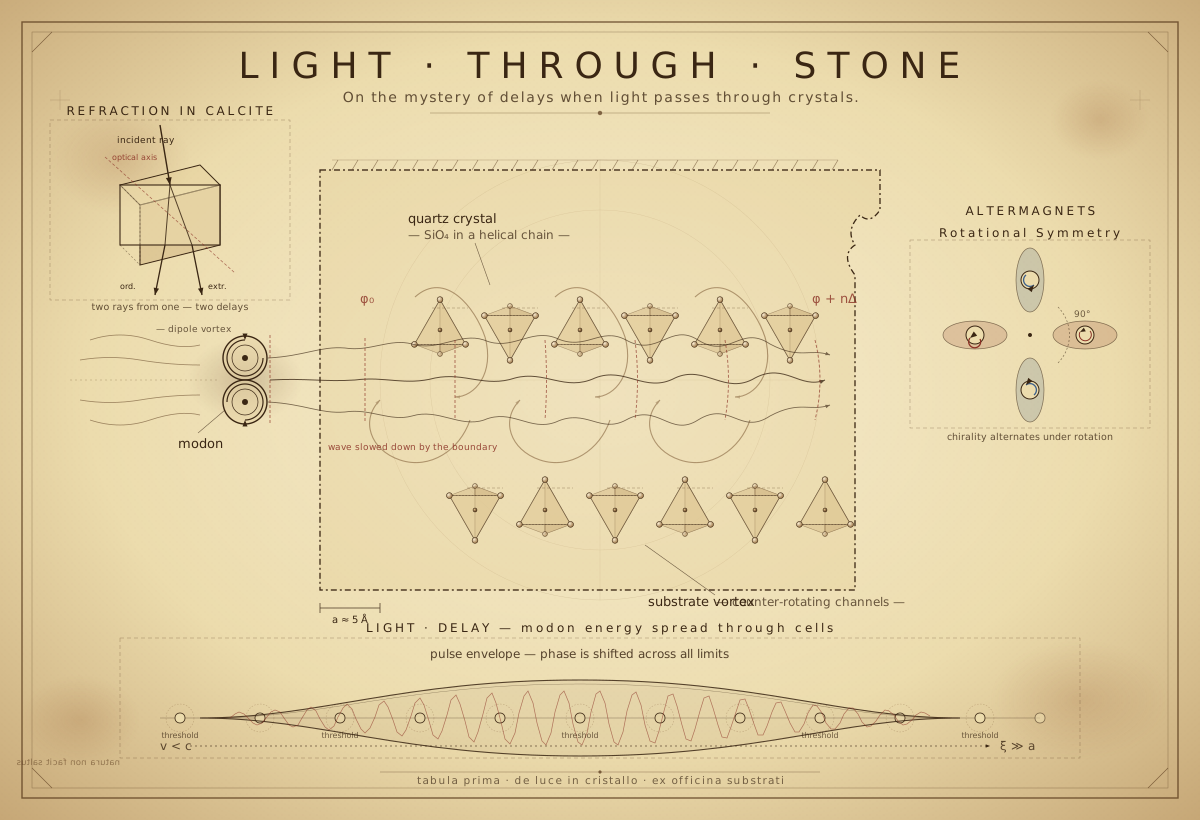
The substrate framework provides the mechanism. When a modon enters a crystal, its counter-rotating vortex dipole encounters the periodic boundary structures of the atomic orbital systems. Each atomic boundary is a localized counter-rotating shell — the same kind of boundary that wraps an isolated electron, but now fixed in place by the crystal lattice. The modon’s two circulations couple to each atomic boundary they pass, transferring a small amount of rotational energy into the boundary, then receiving it back as they decouple. The process is elastic — no net energy is lost to the crystal (in a transparent material) — but it takes time. Each coupling–decoupling event introduces a phase delay proportional to the coupling strength between the modon’s circulation and the atomic boundary.
The accumulated delay over many unit cells is the refractive index.

This picture maps directly onto the standard Lorentz oscillator model of dispersion, but with physical content behind the oscillator. In the Lorentz model, each atom is a damped harmonic oscillator driven by the incoming field; the phase lag of the oscillator response produces the reduced phase velocity. In the substrate picture, each atom’s outer boundary shell is the oscillator — its counter-rotating vortex responds to the modon’s co-rotating drive with a restoring force set by the binding energy of the boundary, a resonant frequency set by the boundary’s natural oscillation mode, and a damping set by the coupling of the boundary to the crystal’s collective modes (phonons, in standard language). What the Lorentz model describes abstractly, the substrate makes concrete: the photon slows down because it is handing energy back and forth to boundary layers at every atomic site.
Three immediate consequences follow.
Higher density means higher refractive index. More atoms per unit volume means more boundary encounters per unit path length. Diamond (n = 2.42) has 1.76 \times 10^{23} carbon atoms per cm³, each with tightly bound, compact 2s²2p² shells. Glass (n \approx 1.5) has a lower effective atomic density diluted by the open SiO₄ network. Water (n = 1.33) is sparser still. The correlation between atomic density and refractive index — obvious empirically, derivable from the Clausius-Mossotti relation — is the substrate saying: more boundaries, more delay.
Resonances produce anomalous dispersion. Near an electronic transition, the modon’s frequency matches the natural frequency of a boundary shell’s oscillation. The coupling becomes strong, the phase delay swings through \pi, and the group velocity can exceed c or go negative (anomalous dispersion). This is not superluminal energy transport — the modon’s signal velocity stays at c, because the leading edge of the pulse is not accelerated by resonance. The substrate picture makes the distinction intuitive: at resonance, the boundary shells are doing the most work, exchanging the most rotational energy per encounter, and the modon’s effective phase advance per unit cell can become negative while its wavefront still propagates causally through the lattice.
Transparent materials are boundary-smooth. A crystal is transparent when none of its boundary shells have natural frequencies matching the modon’s frequency. The modon couples weakly to every boundary it passes — enough to accumulate a phase delay (the refractive index) but not enough to lose energy (no absorption). A colored crystal has one or more boundary resonances in the visible range. An opaque crystal has boundaries that absorb or scatter across the entire visible band. The substrate vocabulary for transparency is: smooth passage through off-resonant boundaries.
The extreme case of boundary-smooth is the ionic crystal, where no boundary is shared at all — each ion keeps its own closed counter-rotating shell and the binding is pure flux between them. The alkali halides are therefore the widest optical windows in the solid state, and lithium fluoride — the tightest cation against the tightest anion — is the widest of all: transparent from 0.11 to 7\;\mum, with the largest band gap of any solid and a refractive index of 1.392, barely above water’s. The chapter there reads both edges of that window as one boundary-stiffness number seen twice, which forces them to slide together down an isostructural series.
This is the same vocabulary the conductors chapter used for electrical resistance. Copper’s low resistivity comes from smooth boundaries; diamond’s transparency comes from off-resonant boundaries. The two properties — electrical conductivity and optical transparency — are decoupled because they probe different boundary structures: conductivity probes the outermost dissolved boundaries that carry free electrons, while transparency probes the inner bound boundaries that the modon couples to on its way through. A material can have dissolved outer boundaries (metal) with strong visible-frequency inner boundaries (opaque metal like iron), or intact outer boundaries (insulator) with off-resonant inner boundaries (transparent insulator like quartz). The substrate sees no paradox: different boundaries, different physics.
Birefringence: When the Crystal Breaks Substrate Isotropy
In an amorphous material or a cubic crystal, the modon encounters the same average boundary structure regardless of its propagation direction. The refractive index is a scalar. In a crystal with lower symmetry — hexagonal, tetragonal, orthorhombic, monoclinic, triclinic — the boundary structures the modon encounters depend on which direction it travels through the lattice.
Calcite (CaCO₃, trigonal) is the textbook example. Its carbonate groups lie in planes, with Ca²⁺ ions between them. A modon traveling along the c-axis encounters a uniform sequence of carbonate boundary planes at regular spacing. A modon traveling perpendicular to the c-axis encounters carbonate groups edge-on, with a different boundary cross-section and a different coupling strength. The two directions give two different phase delays per unit cell — two different refractive indices. The crystal is birefringent: n_o = 1.658, n_e = 1.486, a difference of 10%.
The substrate adds a layer to this picture. The substrate’s own vortex lattice is organized into chirality-coherent 2D sheets (Higgs Field), with same-chirality sites in triangular arrays within each plane and counter-rotating dc1 layers between them. When a crystal’s atomic lattice has a preferred plane — as calcite does — that plane can either align with or cut across the substrate’s sheet structure. The modon’s coupling to the crystal boundaries will differ depending on whether it is propagating within a substrate sheet or across sheets, independently of the crystal’s own anisotropy.
In most circumstances this substrate anisotropy is negligible compared to the crystal’s own boundary anisotropy — the substrate’s inter-sheet period is at the \sim 16\;\mum scale (with counter-rotating boundaries every \sim 8\;\mum), while the crystal’s unit cell is at the ångström scale, so the crystal’s periodic boundaries dominate. But the substrate’s sheet structure should produce a small additional birefringence, independent of the crystal’s own symmetry, observable in principle in cubic crystals that should otherwise be perfectly isotropic.
Those two spacings are not arbitrary. The 8\;\mum counter-rotating boundary and the 16\;\mum like-handed sheet are the half-octave and the octave of the substrate’s own vertical structure — the d_\text{GJO}/2 \to d_\text{GJO} pairing that anchors the substrate ladder. A residual birefringence keyed to this scale would be crystal optics probing the substrate’s own octave directly: the one rung of the ladder that need not be inferred from biology, read off the polarization of light instead.
This is a prediction. A perfect cubic crystal — silicon, diamond, NaCl — measured with sufficient precision should show a residual birefringence at the \Delta n \sim 10^{-8} to 10^{-10} level, with the slow axis aligned to the local substrate sheet normal rather than to any crystal axis. The effect would rotate with the sample’s orientation relative to the local substrate (which is fixed to the local galactic frame, not the lab frame) and would be indistinguishable from an external stress birefringence unless one tracked the angular dependence carefully. We do not expect this to be detectable with current polarimetry, but it is worth flagging as a signature of substrate structure at the mesoscale.

Anomalous Delays: The Quartz Puzzle
In 2024, a team using multi-frame ultrafast imaging discovered an anomalous time delay in quartz crystals. When coaxial 800 nm and 400 nm femtosecond pulses entered a quartz crystal simultaneously, the time delay between the two output pulses was up to five times the value predicted by standard dispersion theory. Critically, this delay was independent of laser intensity, ruling out nonlinear optical effects as the source.
The standard picture — chromatic dispersion, the Sellmeier equation, group velocity mismatch — predicts the 400 nm pulse should lag the 800 nm pulse by a specific amount determined by the frequency-dependent refractive index. The measured delay was five times larger, and no intensity dependence was observed. The authors concluded that the physical mechanism “still needs further exploration.”
The substrate framework offers a candidate mechanism. In the standard picture, each pulse propagates independently through the crystal, each at its own group velocity, with no interaction between them. In the substrate picture, a modon is not a point particle — it is a counter-rotating vortex dipole whose wake fills a region set by its wavelength and the substrate’s response. Two modons propagating coaxially through the same crystal are two dipole vortices threading through the same periodic boundary forest, and their wakes overlap.
When the 800 nm modon enters first, it disturbs the boundary structures of the atomic sites along its path. Each boundary shell is displaced from equilibrium by the coupling to the first modon’s circulation, and the displacement takes time to relax — set by the boundary’s damping rate, which is the inverse of the linewidth of the relevant electronic transition. The 400 nm modon arrives while the boundaries are still ringing from the 800 nm encounter. The 400 nm modon, being closer to the electronic resonance of quartz’s Si–O bonds (the UV absorption edge sits near 160 nm, with a resonance tail extending into the blue), couples more strongly to the pre-excited boundaries than it would to boundaries at equilibrium.
The result is an enhanced phase delay for the 400 nm pulse — not from a change in refractive index (which would be intensity-dependent) but from a timing-dependent enhancement of the modon-boundary coupling. The 800 nm modon pre-conditions the boundary shells; the 400 nm modon encounters pre-conditioned boundaries and delays further. The effect is independent of intensity because the conditioning depends on the presence of the first pulse, not its amplitude — the boundary shells are either ringing or they are not, and the ring-down time is set by the crystal, not the pulse energy.
The framework predicts that the anomalous delay should depend on the time separation between the two pulses, vanishing when the separation exceeds the boundary relaxation time and maximizing when the second pulse arrives during the peak of the first pulse’s boundary excitation. It should also depend on the crystal orientation relative to the propagation direction (because the boundary coupling is anisotropic in non-cubic crystals like quartz), and it should scale with the second pulse’s proximity to an electronic resonance. These are testable predictions that distinguish the substrate mechanism from any nonlinear-optical explanation.

The crystal’s ring-down time is the optical instance of a more general substrate quantity: the time a channel’s wrap holds state after an excitation passes — in the substrate ladder’s small economy, how long the channel can hold the coin before the wrap roughens and the stored state leaks away. The same notion appears as Drude \tau in metals and as the codon-stamp conjecture in DNA. See Channel with Memory for the cross-domain picture.
Phonon-Polaritons: When the Crystal Breathes with the Modon
At infrared frequencies, something qualitatively different happens. The modon’s frequency drops low enough to match the natural oscillation frequencies of the crystal lattice itself — the phonon modes. Now the modon is not just coupling weakly to individual boundary shells as it passes; it is resonantly driving the collective motion of entire planes of atoms. The result is a phonon-polariton: a hybrid excitation in which the modon and the crystal’s vibrational mode become inseparable.
In the substrate picture, a phonon-polariton is a modon that has partially dissolved into the crystal’s boundary structure. The modon’s counter-rotating circulation is shared between the dc1 substrate and the crystal’s ionic displacement pattern. Near the transverse optical phonon frequency \omega_\text{TO}, the sharing becomes total — the modon cannot propagate at all, and the crystal is opaque (the Reststrahlen band). Between \omega_\text{TO} and the longitudinal optical phonon frequency \omega_\text{LO}, the dielectric function is negative and no propagating mode exists. Above \omega_\text{LO}, the modon re-emerges as a propagating excitation, now carrying a remnant of the phonon interaction as a modified dispersion. (This partial dissolution has a strong-coupling limit — the exchange run faster than every loss, the modon and one boundary becoming two new particles outright — and what becomes of light there, up to and including condensing and crystallizing, is Dressed Light’s subject.)
The substrate adds a physical picture to an already well-characterized phenomenon. What makes it worth developing here is the connection to the speed of propagation. Near the edges of the Reststrahlen band, the polariton’s group velocity drops dramatically — slow light in the infrared, arising from the same modon-boundary coupling that produces the refractive index at visible frequencies, but now at resonance rather than off-resonance. The group velocity can drop to 10^{-3}c or lower, and the modon’s wake — normally spanning one substrate cell (\sim 100\;\mum) — compresses spatially. The modon, in effect, is spending most of its time being a phonon and only a fraction of its time being a photon.
This compression is relevant to the anomalous delay observations. Any crystal with strong phonon-polariton coupling (quartz is an excellent example: its Si–O stretching modes produce Reststrahlen bands near 8–10 μm) should show enhanced modon-boundary pre-conditioning effects at frequencies where the polariton character is strong. The framework predicts that the 5× anomalous delay observed in quartz should be strongest when the 800 nm pump pulse has its second harmonic (400 nm) or a subharmonic close to a phonon-polariton resonance tail — not at the resonance itself, but in the extended dispersion region where the polariton character is declining but the boundary ringing time is still long.
Photonic Band Gaps: Forbidden Modon Frequencies
Photonic crystals — artificially structured materials with periodic dielectric variations at the wavelength scale — produce photonic band gaps: frequency ranges in which no propagating electromagnetic mode exists. The phenomenon is the optical analog of electronic band gaps in semiconductors, and it is well described by Maxwell’s equations in periodic media.
The substrate picture of photonic band gaps is a direct extension of the modon-boundary coupling. In a photonic crystal, the boundary structures are not at the ångström scale (individual atoms) but at the wavelength scale (hundreds of nanometers to micrometers). A modon propagating through a photonic crystal encounters periodic boundary perturbations at a spacing comparable to its own wavelength. When the Bragg condition is satisfied — the round-trip phase through one period equals a multiple of 2\pi — the forward-propagating modon couples resonantly to a backward-propagating modon. The two counter-propagating modons form a standing wave, and no net energy transport occurs. This is the band gap.
This is the substrate ladder’s locking pole in optical form — the modon binds to the lattice rather than gliding past it — and it locks through the ordinary harmonic condition, a round-trip phase equal to an integer multiple of 2\pi, precisely because a photonic crystal, unlike the free substrate, has a length (its period) to set the resonance. That is the deliberate complement of the case the ladder treats, where the medium between its cutoffs has no length of its own and so can organize only by the \sqrt{2} ratio tower, never by overtone — the same distinction that separates a bounded aromatic ring from the substrate at large.
What the substrate framework contributes is the observation that photonic band gaps at the \sim 100\;\mum scale — the substrate’s own lattice cell size — should be qualitatively different from photonic band gaps at other scales. A photonic crystal with periodicity near \xi is resonant with the substrate’s own internal structure. The boundary perturbations of the photonic crystal are at the same scale as the modon’s wake, and the Bragg reflection is no longer just a coupling between forward and backward modons — it is a coupling between the modon and the substrate lattice itself.
The framework predicts that photonic crystals engineered at the \xi scale (periodicity \sim 100\;\mum, corresponding to frequencies \sim 3 THz) should show anomalously sharp band edges and enhanced nonlinear response compared to photonic crystals at other scales, because the modon is interacting with a resonant substrate rather than merely reflecting off a passive dielectric pattern. This is an experimentally accessible prediction: THz photonic crystals exist and are actively studied, and a comparison of band-edge sharpness at \sim 100\;\mum periodicity versus, say, \sim 10\;\mum or \sim 1 mm periodicity would test whether the substrate scale is special.
It is worth being precise about what this does and does not claim in ladder terms. Here \xi is the substrate’s long-end cutoff — the boundary that, with \xi_\text{GP} at the short end, brackets the whole \sqrt{2} tower — not itself one of the tower’s rungs (it is the \xi/d_\text{GJO} \approx 6.9 scale the ladder’s honest accounting flags as set by different physics than the half-octave). The THz prediction is therefore a resonance between an engineered period and a substrate cutoff, not a structure pinning to a half-octave rung: the locking is against the substrate’s own boundary rather than against a passive dielectric pattern, which is exactly why it should be anomalous.
Altermagnetism: Rotational Boundary Symmetry
Altermagnetism — confirmed experimentally in 2024–2025 as a third class of magnetic order — presents one of the cleanest opportunities for the substrate framework to contribute something the standard picture cannot easily provide.
In a ferromagnet, atomic magnetic moments align parallel, producing a net field. In an antiferromagnet, moments alternate via simple translation — up-down-up-down along a lattice direction — and cancel to zero net field. In an altermagnet, moments alternate in direction but are related not by translations but by rotations or mirror reflections within the crystal structure. The net magnetization is zero (like an antiferromagnet), but the electronic band structure is spin-split (like a ferromagnet). The result is spin-polarized currents without a net magnetic field — a combination that neither ferromagnetism nor antiferromagnetism can produce.
The substrate framework sees magnetic moments as organized rotational flows in the dc1 substrate (spin). A ferromagnet has its atomic orbital systems’ co-rotating flows all aligned — same chirality, same axis. An antiferromagnet has alternating chiralities related by translation: one atom’s co-rotating flow is clockwise, its translational neighbor’s is counterclockwise, and the pattern cancels by simple periodicity.
An altermagnet does something more subtle. The alternating chiralities are related by the crystal’s rotational symmetry rather than its translational symmetry. In a d-wave altermagnet like MnTe or RuO₂, the spin pattern has the symmetry of a d_{x^2-y^2} orbital: the chirality flips sign under 90° rotation but preserves sign under 180° rotation. In the substrate picture, this means the co-rotating flows at alternating sites are rotated versions of each other — the same vortex pattern, seen from a rotated vantage point — rather than simple reversals.
The distinction matters for the substrate because rotational operations preserve the topology of the co-rotating flow while translational operations can disrupt it. In an antiferromagnet, the translational alternation creates a dense network of counter-rotating boundaries between every pair of nearest neighbors — the same kind of boundary that wraps an isolated atom, replicated at every bond. In an altermagnet, the rotational relationship means the co-rotating flows of adjacent atoms can partially merge along certain crystallographic directions while remaining separate along others. The boundary structure is direction-dependent in a way that translational antiferromagnetism cannot produce.
This direction-dependent boundary merging is why altermagnets have spin-split electronic bands. Along directions where the co-rotating flows partially merge, electrons of one spin orientation travel through smoother channels — the boundaries are partially dissolved, as in a metal — while electrons of the opposite spin encounter intact boundaries. Along other directions, the roles reverse. The spin splitting is a consequence of the crystal’s point-group symmetry acting on the substrate’s boundary architecture, and its d-wave (or g-wave, or i-wave) character reflects the angular symmetry of the boundary dissolution pattern.

The framework makes two predictions for altermagnets.
Altermagnetic order should couple to the substrate’s sheet structure. The rotational symmetry that defines an altermagnet acts within the crystal’s atomic planes. The substrate’s chirality-coherent 2D sheets provide a natural template for this in-plane rotational ordering. The framework predicts that altermagnetic ordering temperatures should correlate with the degree of alignment between the crystal’s magnetic planes and the substrate’s sheet structure — and that thin-film altermagnets grown with controlled crystal orientation should show different ordering characteristics depending on the film’s orientation relative to the substrate’s sheet normal (which is fixed in the galactic frame, as discussed in feedback topology). This is a subtle effect, likely at the sub-kelvin level for ordering temperature variations, but it is directional and therefore distinguishable from random sample-to-sample variation.
Altermagnetic spin currents should show anomalous coherence. Because the spin-split channels in an altermagnet arise from direction-dependent boundary dissolution — not from spin-orbit coupling — the spin currents they carry should be less susceptible to spin-flip scattering than spin currents in conventional spin-orbit materials. The substrate picture is explicit: the spin-polarized channel is a co-rotating flow channel whose boundaries have been partially dissolved in a direction that matches the crystal’s rotational symmetry. Spin-flip scattering requires a boundary disruption that reverses the flow chirality, and the altermagnetic channel geometry — smooth in one direction, rough in the perpendicular — makes such disruptions geometrically unfavorable. The framework predicts that spin diffusion lengths in altermagnets should exceed those in heavy-metal spin-orbit systems by a factor related to the channel anisotropy, and that this enhancement should scale with the d-wave (or higher) symmetry character of the spin splitting.
Piezoelectricity and Pyroelectricity: Boundary Asymmetry Under Stress
Quartz is piezoelectric — mechanical stress produces an electric polarization — because its crystal structure lacks an inversion center. Standard crystallography explains this through the displacement of charge centers under strain. The substrate framework adds a complementary picture: stress changes the spacing between the crystal’s periodic boundary structures, and in a non-centrosymmetric crystal this spacing change is asymmetric — the boundaries on one side of each atom are compressed while those on the other side are stretched.
The asymmetric boundary displacement creates a net co-rotating flow bias across the crystal. Co-rotating flow in the substrate is charge current (this is the mapping established in conductors — charge coupling is co-rotating substrate flow coupling). An asymmetric boundary compression produces an asymmetric flow, which is a macroscopic polarization. The magnitude of the piezoelectric coefficient — how much polarization per unit stress — depends on how strongly the boundary structures couple to lattice strain, which in turn depends on the rigidity and geometry of the outer electron shells.
Pyroelectricity (polarization changing with temperature) follows the same logic with thermal expansion replacing mechanical strain. Ferroelectricity (spontaneous polarization that can be reversed by an external field) occurs when the crystal structure has a stable asymmetric boundary configuration and a metastable reversed configuration separated by an energy barrier. The substrate picture of ferroelectric switching is: the co-rotating flows in the crystal’s boundaries collectively reverse direction, passing through a high-energy symmetric configuration at the barrier top. The switching dynamics should show signatures of the cooperative vortex reversal — domain wall velocities, nucleation barriers, and critical fields that reflect the vortex topology of the boundary layers rather than just the ionic displacements.
This reframing does not add quantitative predictions beyond standard crystallography for simple piezoelectrics. Its value is in the conceptual unification: the same boundary-flow language that describes conductivity, superconductivity, optical transparency, and magnetic order also describes the electromechanical response. The crystal is not a collection of balls and springs with charges attached; it is a collection of orbital system complexes whose co-rotating and counter-rotating boundaries respond to every kind of perturbation — electrical, mechanical, thermal, optical, magnetic — through the same coupling mechanism.
The Substrate as an Optical Medium: What Changes
Standard crystal optics is extraordinarily well-developed. The Sellmeier equation fits refractive index data to parts per million. The nonlinear susceptibility tensors are tabulated for hundreds of crystals. Photonic band gap engineering produces devices with precisely designed spectral responses. This chapter does not propose to replace any of this.
What the substrate framework changes is the reason behind the numbers.
The refractive index is not just a material property — it is the accumulated phase delay from modon-boundary coupling at every atomic site. Birefringence is not just crystal anisotropy — it is the direction-dependent boundary cross-section the modon encounters. Absorption is not just electronic transition — it is resonant modon-boundary energy transfer that does not return. Nonlinearity is not just large-field response — it is multiple modons sharing boundary structures. And altermagnetism is not just a new magnetic phase — it is the crystal’s rotational symmetry acting on the substrate’s boundary architecture to create direction-dependent channel dissolution.
The framework’s most distinctive contributions in this domain are:
The anomalous delay mechanism — modon-preconditioned boundary coupling — which provides a substrate-level explanation for the 5× delay in quartz that standard dispersion theory cannot account for.
The altermagnetic boundary picture — direction-dependent boundary dissolution governed by the crystal’s point-group symmetry — which predicts enhanced spin coherence lengths and coupling to the substrate’s sheet structure.
The THz photonic crystal resonance — the prediction that photonic band gaps near the substrate’s own \xi \approx 100\;\mum scale should show qualitatively different behavior from those at other scales.
Residual birefringence in cubic crystals — a predicted \Delta n \sim 10^{-8} to 10^{-10} effect from the substrate’s sheet structure, independent of crystal symmetry.
Predictions
Anomalous delay scaling. The quartz femtosecond delay should depend on interpulse separation, vanishing beyond the boundary relaxation time and maximizing during peak boundary excitation. The delay enhancement factor should correlate with the second pulse’s spectral proximity to the crystal’s nearest electronic resonance and with crystal orientation. Similar anomalous delays should appear in other polar crystals (LiNbO₃, BBO, KDP) with enhancement factors scaling with the crystal’s phonon-polariton coupling strength.
THz photonic crystal anomaly. Photonic crystals with periodicity near \xi \approx 100\;\mum (\sim 3 THz) should show anomalously sharp band edges and enhanced nonlinear response compared to photonic crystals at other periodicities. The enhancement should be measurable as a narrower spectral transition from transmission to reflection at the band edge, and as a lower threshold for nonlinear effects (self-phase modulation, parametric gain) near the edge.
Altermagnetic spin diffusion enhancement. Spin diffusion lengths in d-wave altermagnets (MnTe, RuO₂, CrSb) should exceed those in heavy-metal spin-orbit systems by a factor that scales with the symmetry character of the spin splitting. The framework predicts this factor arises from the geometric suppression of spin-flip scattering in direction-dependent dissolved boundary channels.
Altermagnetic sheet coupling. Thin-film altermagnets grown with controlled crystal orientation should show sub-kelvin variations in ordering temperature as a function of the film’s orientation relative to the substrate’s galactic-frame sheet normal. This is a directional effect distinguishable from random variation by its correlation with the film plane’s tilt relative to the galactic disk.
Cubic crystal residual birefringence. High-precision polarimetry on perfect cubic single crystals (Si, diamond, GaAs) should reveal a residual birefringence at the \Delta n \sim 10^{-8}–10^{-10} level with a slow axis that rotates with the sample’s orientation relative to the galactic frame, not with any crystal axis.
Nonlinear-delay correlation. Materials with strong anomalous interpulse delays should show enhanced second-harmonic generation coefficients, and vice versa. Both effects probe the same quantity: the strength and relaxation time of modon-boundary coupling at atomic sites.
Context
The conductors chapter showed the substrate’s boundary physics at the extremes: metals where boundaries dissolve, superconductors where counter-rotating vortex seams bind Cooper pairs. This chapter fills in the space between those extremes — transparent insulators, birefringent crystals, altermagnets, photonic crystals — where the boundaries neither fully dissolve nor fully bind, but impede the modon in structured, symmetry-governed ways.
The picture that emerges is consistent: the modon (photon) is a probe of the crystal’s boundary architecture. The refractive index measures the average boundary impedance. Birefringence measures its anisotropy. Dispersion measures its frequency dependence. Nonlinearity measures the cross-coupling between concurrent modons at the same boundary. Anomalous delays measure the boundary’s temporal response. Photonic band gaps measure the resonance between the modon’s wavelength and the boundary periodicity. And altermagnetism measures the rotational symmetry of boundary dissolution in a compensated magnetic crystal.
The same modon that propagates at c in free substrate, that carries quantum information through topologically protected channels (entanglement), that splits into spatially separated deposits in chloroplasts (DNA and the Living Lattice), and that drives the energy transport in photosynthetic reaction centers — this same modon, entering a crystal, encounters the organized boundary architecture of condensed matter and responds with every optical phenomenon we have ever measured. The framework does not replace crystal optics. It grounds it in the same fluid dynamics that grounds everything else.
The next chapter examines the Michelson-Morley experiment — the classic null result that was taken to rule out a medium, and the substrate framework’s account of why a superfluid substrate produces exactly the null that Michelson and Morley observed.