Lightning: The Substrate Made Visible
Why thunderclouds spark below threshold, glow with gamma rays, and follow paths the electric field doesn’t pick
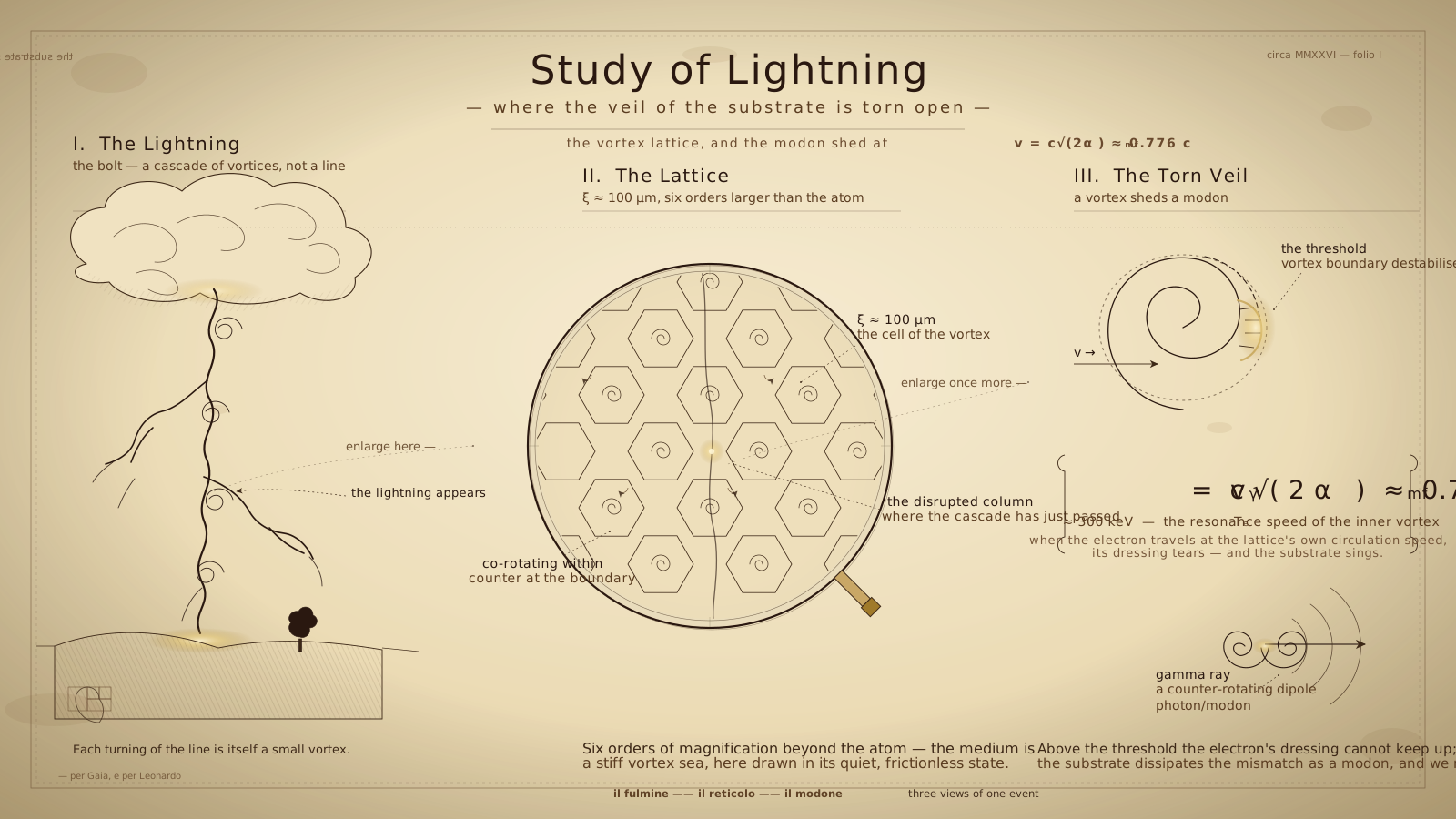
The Claim
Lightning is one of the few everyday phenomena where the dc1 substrate stops being invisible. The mystery is well known: thunderclouds carry electric fields one-third to one-tenth of what’s needed for conventional breakdown, yet there are 2,000 thunderstorms going off across Earth at any moment. The field is asking how nature bridges the gap. The substrate framework asks a different question — what if the threshold itself is wrong because we left out a medium?
The substrate predicts that when an electron reaches the inner-scale circulation speed of its own vortex,
\boxed{v_\gamma^\text{onset} = c\sqrt{2\alpha_{mf}} \approx 0.776\,c \quad \Leftrightarrow \quad T_e \approx 300\;\text{keV}}
it stops gliding through the substrate frictionlessly and starts shedding modons. Those modons are gamma rays. The same speed that sets the electron’s mass sets the threshold at which the electron’s vortex structure becomes unstable in the lab frame — and at which the substrate’s enormous stored rotational energy first becomes detectable as a tap on a tuning fork. Lightning is the regime where that tap rings out as gamma flashes, flickering glows, and a discharge channel that doesn’t quite point where the electric field says it should.
Interactive: the storm mode of the Gaia simulation’s sky view draws the puzzle as a meter: the cloud’s field charges toward the 3 MV/m breakdown line and fires at a tenth of it, in the window the substrate opens, each stroke shedding γ at the 300 keV read and the cloud glowing faintly with gamma rays between strokes (the ALOFT flicker). Chemistry only, the field climbs to the cloud’s ceiling and stalls there — by the air-only calculation, the cloud cannot spark.
This section is predictive rather than retrospective. Unlike Bridge Equation or Galactic Dynamics, where the substrate framework reproduces measured numbers from zero-parameter chains, the lightning predictions here are claims about what the next round of measurements should find — a sharper-than-bremsstrahlung gamma onset near 0.776\,c, a coherent line in the flicker spectrum, an angular offset that grows with cosmic-ray delay, and statistical clustering of lightning branch points at substrate domain boundaries. Some of the supporting derivations (Tkachenko mode coupling, substrate channel relaxation time, modon-emission angular distribution from a destabilizing vortex) are not yet first-principles calculations. They are stated here at the level of the framework’s logic so they can be tested. Several can be tested with existing data.
The Threshold Puzzle, Restated
The conventional argument is a textbook calculation. An electron in air gains energy from the field at rate eE and loses it to ionization collisions at rate roughly eE_c, where E_c \approx 3 \times 10^6 V/m is the dielectric breakdown threshold. When E > E_c, electrons avalanche; below it, they thermalize. This calculation assumes air is the only medium present.
In the substrate framework that assumption is wrong by construction. The cloud is not just nitrogen and oxygen and ice crystals — it’s nitrogen and oxygen and ice crystals immersed in a dc1 BEC with one wavefunction per ξ³ cell (\xi \approx 100\;\mum, the width of a human hair) and inner-scale vortex rotation at 0.776\,c (see Bridge Equation and Substrate Particles). The breakdown calculation treats the dc1 as if it were the vacuum of QFT — a passive backdrop. It isn’t. It’s a participating medium with its own coupling channels through \alpha_{mf}.
Three things follow that conventional breakdown leaves out.
The substrate is pre-stressed. Cloud charging concentrates electric field, which polarizes the dc1 boundary structure as it does any dielectric — but the substrate’s polarization is not just dipolar displacement of charge. It’s a strain on the counter-rotating layer that organizes electron and ion vortices in the cell. A pre-stressed substrate has a lower effective threshold for vortex-defect proliferation. The standard calculation ignores this term entirely.
The runaway electrons drag through the lattice. Wilson’s relativistic electron — Dwyer’s “bullet ripping through snowflakes” — is, in the substrate picture, a topological defect dragging through a vortex sea at a speed that is no longer small compared to the sea’s own circulation speed. At v_e = 0.776\,c, the electron’s translational velocity equals the rotational velocity at its own vortex boundary. In the lab frame, the leading edge of the electron’s coherence dress is trying to move at v_e + 0.776\,c > c, which the substrate refuses. The boundary destabilizes and the electron sheds a modon — a photon — to bring itself back into causal compliance. At gamma-ray energies, those modons are gamma rays.
The cascade is a substrate event, not just an air event. Once a few relativistic electrons start shedding modons, the modons themselves perturb the dc1 lattice in their wakes. Each ξ-scale wake is a region of the substrate transiently moved off equilibrium. Air molecules sitting in that region encounter a substrate that is no longer cooperating frictionlessly with whatever EM perturbation reaches them — they are easier to ionize. The cascade pre-conditions the medium ahead of itself, and the pre-conditioning is in the dc1, not in the air.
The 30-year-old factor-of-3-to-10 gap between the standard threshold and what nature actually does is the size of the term we left out.
It is tempting to read a thunderstorm as gravity’s rare boundary-crossing turned up loud — substrate energy accumulating behind the wrapping layers and finally breaking through. The accumulation half of that picture is right (the field pre-stresses the counter-rotating layer, and the discharge path is chosen in the dc1, not by the field alone), but the exit is a different one. Gravity is the seep: the reactive spectral-flow trickle through an intact boundary, about one dc1 particle in 10^{15}, running continuously and everywhere. Lightning is the spend: a boundary driven past the threshold at v_\text{rot,inner} = 0.776\,c, where the wrap can no longer stay coherent and throws a piece of itself away as a modon. Below that speed the shedding rate is zero, not small. They are two of the three exits one layer has (The HVBK Bridge § Three Modes, One Layer) — opposite ends of the same Kopnin resonance curve, not the same leak at two intensities.
Gamma Rays Are Modons Shed by Relativistic Electron Vortices
This is the central mechanism, and it makes the gamma rays a consequence of the runaway, not a separate process bolted on for energy bookkeeping.
In the standard picture, gamma rays come from bremsstrahlung — the relativistic electron deflects off an air nucleus and emits a photon. This is real and accounts for some of the observed flux. But TGFs and gamma-ray glows produce >10^{17} relativistic electrons’ worth of emission, far more than easily comes from bremsstrahlung alone, and the spectrum extends to surprising energies. The relativistic feedback model (Dwyer 2003, 2012) closes the bookkeeping by having gamma rays pair-produce positrons that backstream and seed new avalanches — a process that works numerically but is baroque, requiring the medium to do exactly what’s needed at each step.
The substrate makes the emission native. Every electron is already a vortex in the dc1 (see Electron). When that vortex moves at 0.776\,c, its boundary cannot remain coherent in the lab frame, and a counter-rotating dipole — a modon — is the only stable way for the substrate to dissipate the boundary mismatch. Modon emission is simply how the substrate handles a vortex defect being driven through it at its own circulation speed.
Read through the substrate ladder, the emission is even more native than “a way to dissipate.” The shed modon is one quantum of the lattice’s own paired breath — the same counter-rotating dipole, now set propagating (see Photon as Modon) — so the gamma ray is not a new object the electron manufactures at the threshold but the breath it was already riding, released the instant it can no longer hold it losslessly.
This predicts:
- The gamma-ray spectrum should show a substrate-driven enhancement as electrons cross T_e \approx 300\;\text{keV} (v \approx 0.776\,c) — a shoulder on top of the bremsstrahlung continuum, centered at the electron break. The right baseline to compare against is the full bremsstrahlung calculation including the dipole-forbidden electron–electron channel, which itself rises near the electron rest-mass scale; the substrate signature is the excess and the shape on top of that baseline, not a contrast with the minimum-ionization energy. The mechanism, the shoulder width, and the discriminators are developed in The Inner Rim Spectrum.
- The gamma flux at fixed electron energy should exceed pure-bremsstrahlung calculations, because there is a second emission channel (modon shedding) that the bremsstrahlung calculation does not include.
- The angular distribution should be different. Bremsstrahlung peaks forward in the electron’s direction of motion; modon shedding from a destabilizing vortex boundary should be more isotropic in the electron’s rest frame — observable as a fatter angular distribution at the lab-frame source.
These are testable with no new instrumentation — but the platform matters. A satellite-detected TGF reads the few-hundred-keV band only through atmospheric and spacecraft Compton scattering, which smears a 300 keV source shoulder (what the archives show); ALOFT, flying near the source, is the clean platform for this channel, and the controlled tokamak runaway spectrum is cleaner still.
Three Specific Substrate Signatures in Recent Lightning Data
The article catalogs three sets of recent observations the field is still digesting. Each has a clean substrate reading.
1 — The flicker. ALOFT discovered that thunderclouds glow with gamma rays even when no lightning is visible, and the glow flickers. Dwyer’s relativistic feedback simulations reproduce the flicker pattern from particle physics alone — avalanches piling up in cascade trains. The substrate framework says: that’s right, but there should be a second frequency component superimposed on the cascade pattern, set by the lattice’s own oscillatory modes.
The substrate’s vortex lattice supports Tkachenko modes — soft transverse oscillations of the lattice itself — at frequencies set by the lattice rotation \omega_0 \approx 7.8 \times 10^9 rad/s (Emergent Speed of Light), the cell size \xi, and the inter-cell coupling. The exact frequency of the relevant excited mode depends on which lattice degrees of freedom the cascade couples to most strongly — a calculation we have not yet done from first principles. What the substrate framework predicts robustly is that some coherent line should sit on top of the broadband cascade noise, because the lattice has its own natural oscillation timescales and the cascade is driving it. A spectral analysis of ALOFT flicker data looking for a coherent line on top of the broadband cascade pattern would test this directly. If Dwyer’s simulation already matches the data within errors using only particle physics, the substrate prediction is that higher-resolution spectroscopy will reveal residual structure that the particle-only physics doesn’t explain.
2 — The cosmic-ray angular mismatch. Shao’s 2025 reconstruction of initial lightning current from radio waves showed the bolt’s onset direction tilted slightly off the local electric field axis, and aligned more closely with what could be a cosmic-ray shower trajectory. The standard-physics reading is that a cosmic ray ionized a column of air, providing seed electrons in that column. The substrate reading is more direct: a cosmic ray is itself a high-energy vortex defect (or jet of them) plowing through the dc1 lattice, leaving a substrate channel — a trail of perturbed vortices — along its trajectory. That channel has a lower effective breakdown threshold than the surrounding undisturbed substrate. The lightning takes the channel because it is the path of least resistance in the dc1, even though the electric field would prefer a slightly different direction.
The cosmic-ray channel and the field axis usually agree closely, but not exactly. The angular mismatch Shao measures should correlate with the substrate relaxation timescale — channels age, and lightning that fires shortly after a cosmic-ray shower should track the cosmic-ray axis more tightly than lightning that fires later. The substrate predicts: angular offset should grow with delay between cosmic-ray arrival (independently measured by ground-based cosmic-ray detectors) and bolt onset, with a relaxation timescale set by lattice viscosity. A coordinated cosmic-ray-detector / lightning-radio array would extract this curve.
3 — The needles. The LOFAR array in the Netherlands resolves lightning into branching structures with stretches of fast propagation, slow propagation, and short branches called “needles.” In the substrate picture, the propagating discharge is a cascade of boundary reorganizations moving through the dc1 lattice, and the lattice is not isotropic at every scale — it has chirality-coherent domains (see Pillar 5 of the Bridge Equation’s \eta = 1 argument). Crossing a domain boundary changes the local coupling between cascade and lattice. Speed changes. Branching points sit on domain edges.
The substrate prediction operates at domain scale, not single-cell scale. Individual lattice cells at \xi \approx 100\;\mum are below LOFAR resolution, but the domain organization of the lattice — coherent regions where chirality, lattice orientation, or vortex alignment stay constant — extends to much larger scales set by the cell-to-cell coupling. Lightning morphology should therefore show preferential branching at domain boundaries, with branch geometry and propagation-speed transitions clustering at characteristic length scales rather than scattered randomly. A statistical analysis of LOFAR-resolved bolts, looking for non-random clustering of branching points and speed transitions, would extract the domain structure. Those characteristic length scales are candidate rungs of the substrate ladder: the same comb test the paper runs on grid-cell modules and vesicle radii applies here, asking whether LOFAR branch-point spacings pile up at preferred ratios rather than smear continuously. The honest expectation is that lightning’s domains belong to the ladder’s coarse family — their scale is set by cell-to-cell coupling, not by the \sqrt{2} pairing rung (honest accounting) — so the firm prediction is the clustering, with the ratio left open. The substrate framework predicts this clustering exists; air-only physics does not.
Why the Substrate is Normally Invisible — and Why Lightning is the Exception
The substrate stores enormous rotational energy, but it gets out of the way so cleanly that we mistake “out of the way” for “not there.”
Three things hide the substrate in normal conditions.
Counter-rotating boundaries are nearly perfect. The cell-vortex lattice has co-rotating interior and counter-rotating exterior layers, and the cancellation is exact in equilibrium. An electron moving slowly through this medium displaces the substrate symmetrically in front and behind — net momentum transfer to the medium is zero (see Two Fluids and the Quantum Potential). This is why the substrate is Lorentz invariant for sub-relativistic motion: there is no preferred frame because there is no friction.
The lattice cell is large compared to most things we probe with. Atoms are at a_0 \sim 53 pm; the lattice cell is at \xi \sim 100\;\mum, six orders of magnitude larger. Atomic-scale physics resolves a single homogeneous patch of substrate, not the lattice structure. The lattice is invisible because we usually look through too small a window to see it (see the Bridge Equation’s “boat in the harbor” argument).
Below 0.776\,c, electron vortices ride along. A slow electron’s coherence dress can co-rotate with the surrounding lattice without straining its boundary. The vortex moves through the lattice the way a small whirlpool moves down a river — the river accommodates. Above 0.776\,c that accommodation fails. The leading edge tries to outrun causality, the boundary destabilizes, and the substrate dumps its excess as modon emission. That is when the substrate becomes visible.
This riding-along, and the perfect counter-rotation that hides the substrate alongside it, are one thing seen twice: they are the lossless channel the substrate ladder calls the substrate’s coin — the paired anti-phase breath of a vortex and its counter-rotating partner, a handoff that is complete and lossless precisely because it is paired (the breath is the ladder). Below 0.776\,c the electron is plugged into that breath and pays nothing to move; at the threshold its own breath can no longer complete the handoff inside the light cone, the exchange goes lossy, and the coin is spent as a shed modon. The three masking mechanisms are three faces of the coin circulating perfectly; lightning is the substrate being driven hard enough to spend it in the open.
Lightning is the regime where all three masking mechanisms break down at once: the field stretches and stresses boundaries, the cascade extends over kilometers (many lattice cells), and the runaway electrons cross the 0.776\,c threshold. The substrate’s normally-cooperative behavior fails on every axis, and we see it — as gamma rays, as flicker, as direction mismatch, as branching morphology that doesn’t quite add up under air-only physics.
This is also why most electromagnetism doesn’t need the substrate to be explained. Maxwell’s equations are a remarkably accurate effective theory because the substrate is, in nearly all conditions, frictionless and averaged-over. Lightning is the place where we accidentally drove the medium hard enough to feel the bottom.
Connection to Aromatic Rings — Same Physics, Different Scale
The mechanism that emits a gamma ray from a relativistic electron in a thundercloud is the same mechanism that builds a toroidal raceway in benzene (see Aromatic Rings). Both are the substrate’s response to a vortex topology being driven across a boundary regime — the electron’s vortex structure at relativistic speed in lightning, the π-electron toroidal flow at the carbon ring’s resonance condition in benzene. In each case the substrate reorganizes its boundary layer, and that reorganization carries a signature: a gamma ray ejected, or a ring current that diamagnetically shields the molecule. Same physics, different scale. The substrate is the shared medium.
The connection to Conductors is also direct. A current in a wire is electrons surfing the substrate’s response to the applied field; a lightning strike is the same process driven into a regime where the substrate can no longer cooperate quietly. Conduction is the smooth-running version of what lightning is when the lid blows off.
What This Section Predicts (Summary Table)
| Prediction | Substrate origin | Test |
|---|---|---|
| Gamma onset at T_e \approx 300\;\text{keV} | v_\gamma = c\sqrt{2\alpha_{mf}} from electron-vortex / lattice resonance | Compare TGF and ALOFT spectra to substrate threshold vs. bremsstrahlung minimum |
| Excess gamma flux over pure bremsstrahlung | Modon shedding adds to bremsstrahlung | Quantitative spectrum vs. air-only Monte Carlo |
| Coherent line in flicker spectrum | Tkachenko-mode lattice oscillation on top of cascade noise | High-resolution ALOFT power spectrum |
| Cosmic-ray angular offset grows with delay | Substrate channel relaxation timescale | Coordinated cosmic-ray + radio-array timing |
| Branching clusters at substrate domain edges | Chirality-coherent lattice domains channel the cascade | Statistical analysis of LOFAR-resolved branching points |
Each prediction is testable with existing or near-term instruments. None requires new fundamental physics — only a willingness to read the data through a framework where the medium isn’t empty.
What Lightning Tells Us About Everything Else
The deeper point is that lightning is evidence for stored substrate energy on Earth, today, in measurable quantities. The same sea of cell vortices that holds a JWST-impossibly-early galaxy together (see Early Structure Formation) and provides the missing 4% in S_8 (DESI Dark Energy Crust) is overhead during every thunderstorm, getting briefly visible to gamma-ray detectors when the conditions stress it past its quiet regime.
Astrophysics built much of its case for the substrate over many decades and many telescopes. Lightning may be the place where the same medium becomes a tabletop laboratory — visible from a NASA aircraft or a Dutch radio array, on any humid summer afternoon, anywhere in the tropics. The framework predicts exactly what to look for. The data is already coming in. The next decade of TGF, ALOFT-successor, and LOFAR observations will tell us how much of the substrate signature is already in hand and how much needs new analysis to bring out.
If the substrate predictions hold up — the threshold, the flicker line, the cosmic-ray angular offset, the needle scale — then lightning is the substrate’s most accessible demonstration.