The Bullet Cluster
MOND’s challenge resolved
The Puzzle
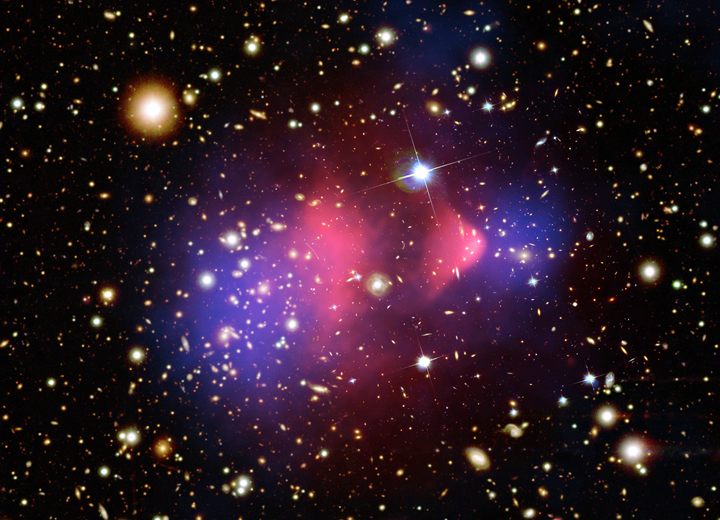
Credit: X-ray: NASA/CXC/CfA/M.Markevitch et al.; Optical: NASA/STScI; Magellan/U.Arizona/D.Clowe et al.; Lensing Map: NASA/STScI; ESO WFI; Magellan/U.Arizona/D.Clowe et al.
The “bullet cluster” formed after the collision of two large clusters of galaxies, the most energetic event known in the universe since the Big Bang.
The Bullet Cluster (1E 0657-56) is widely regarded as the strongest single piece of evidence for particle dark matter — and the most damaging observation for any modified-gravity explanation of the missing mass problem.1 The system consists of two massive galaxy clusters that collided roughly 150 Myr ago, with a relative velocity of approximately 4,500 km/s, nearly in the plane of the sky.2
The collision separates three components that normally overlap:
| Component | Tracer | Behavior during collision |
|---|---|---|
| Galaxies (stars) | Optical/IR light | Effectively collisionless — passed through each other |
| Hot gas (ICM) | X-ray emission | Collisional — interacted, slowed, heated, lagged behind |
| “Dark matter” | Gravitational lensing | Collisionless — passed through, tracked the galaxies |
The key observation: the gravitational lensing mass peaks — where most of the mass actually is — are centered on the galaxy distributions, not on the X-ray gas, even though the hot intracluster medium contains the large majority (~85-90%) of the baryonic mass.3 The spatial offset between the X-ray gas and the lensing mass is approximately 150–270 kpc in the subcluster.4
The standard interpretation is straightforward: both clusters contained large halos of collisionless dark matter particles. During the collision, the dark matter halos passed through each other (just like the galaxies), while the gas got stuck. The lensing mass tracks the dark matter halos, which track the galaxies. The spatial separation of mass from gas is taken as direct proof that most of the matter is in a collisionless, non-baryonic form — particle dark matter.
For standard MOND, this observation poses a genuine challenge.5 In pure modified gravity, the gravitational potential should trace the baryonic mass distribution. Since ~90% of the baryonic mass is in the gas, the lensing signal should peak on the gas, not the galaxies. Angus et al. (2006) showed that MOND can reproduce the qualitative offset — because the galaxies sit in lower-acceleration regions where the MOND enhancement is stronger — but a residual mass discrepancy of approximately a factor of 2 remains. This is the same “cluster problem” that has plagued MOND since the 1980s: even with the MOND enhancement, clusters still appear to need roughly twice as much mass as their observed baryons provide.6
The situation creates a three-way tension:
| Framework | Explanation of Bullet Cluster | Residual problem |
|---|---|---|
| ΛCDM | Collisionless DM particle halos passed through each other | Collision velocity may be uncomfortably high for ΛCDM (\sim 4500 km/s) |
| Standard MOND | MOND enhancement offset toward galaxies | Factor ~2 residual mass; no collisionless component to separate from gas |
| MOND + hot dark baryons | Undetected baryonic matter (neutrinos, cold gas) provides missing mass | Ad hoc; not confirmed; conflicts with BBN if too much baryonic mass required |
The substrate framework resolves all of this — and does so by using the same velocity-dependent phase transition that governs galactic dynamics.
The Substrate Resolution
The Landau critical velocity: two regimes of the same substance
The substrate framework identifies one parameter that controls whether the dc1 medium produces MOND-like behavior or CDM-like behavior: the Landau critical velocity v_L = v_\text{rot,outer} = \omega_0\xi \approx 750 km/s (GD1 in Galactic Dynamics).
This is the outer-scale rotation velocity of the substrate lattice — the threshold above which bulk flow through the counter-rotating boundary layers excites vortices and disrupts superfluid coherence. Below v_L, the substrate is in its superfluid (coherent) phase, and the parity-symmetric quadratic CPR produces MOND phenomenology. Above v_L, the substrate is in its normal (incoherent) phase, and the boundary layers no longer maintain coherent quantum transmission — the substrate behaves as a classical, collisionless gas.
The velocity dispersions of galaxy clusters sit firmly above this threshold:
| System | v_\text{disp} (km/s) | v_\text{disp}/v_L | Phase | Gravitational behavior |
|---|---|---|---|---|
| Dwarf galaxies | 30–80 | 0.04–0.11 | Deep superfluid | Pure MOND |
| Milky Way | 150–200 | 0.20–0.27 | Superfluid | MOND + Newtonian |
| Galaxy groups | 300–500 | 0.40–0.67 | Superfluid (marginal) | Transitional |
| Bullet Cluster (main) | ~1000 | ~1.3 | Normal | CDM-like |
| Bullet Cluster (sub) | ~800 | ~1.1 | Normal | CDM-like |
| Bullet Cluster (collision) | ~4500 | ~6.0 | Deeply normal | Fully CDM-like |
Both components of the Bullet Cluster were already in the normal phase before they collided. The collision velocity itself (\sim 4500 km/s \approx 6\,v_L) is far above the transition. During and after the merger, every aspect of the substrate’s behavior is that of a collisionless, dissipationless gas — precisely what ΛCDM calls “cold dark matter.”
Interactive: the Bullet Cluster view of the galaxy simulation runs the collision. Two clusters pass through each other at 4500 km/s = 6\,v_L, each carrying galaxies, hot gas and substrate; the gas shocks and stalls between them while the galaxies and the tangled, collisionless substrate sail through, and the two maps in the corner — the X-ray sky and the lensing sky — separate on screen the way Clowe’s did, with the lensing–gas offset read off live (\sim 220 kpc at +150 Myr, against the observed 150–270). Drag the collision speed below v_L and the breath switches back on: the coupled substrate half-follows the gas and the offset shrinks, Prediction 1 as one knob. The table above is also a slider in the galaxy view: put a Milky-Way disk in a cluster core’s flow and its boundary pairs — drawn breathing at 181 km/s — tear into a tangle of vortex lines as the flow crosses v_L; the rotation curve drops to Newton-from-baryons and the halo that ΛCDM would infer fades to a uniform fog. The Bullet passage preset sets that flow to 6\,v_L.
The phase transition is the breath switched off
Read through the substrate ladder, the two phases are two states of one object — the lattice’s anti-phase breath. The counter-rotating boundary that carries gravity is a circulation and its partner trading energy across a shared seam, a handoff that is complete and lossless because it is paired; a flat rotation curve is what it looks like when every boundary out to the MOND radius spends that paired breath — the substrate’s lossless coin — coherently (the boundary is the breath). The Landau critical velocity v_L is the speed past which a bulk flow can no longer complete that handoff: above it the flow excites vortices, the pairing decoheres, and the breath switches off. What is left is the substrate’s bare gravitating mass with no coherent phonon force — exactly CDM. Superfluid and normal are not two substances but one breath: paid out below v_L, unspendable above it.
This is the same threshold-crossing the framework reads in lightning. There an electron driven past its own circulation speed (v_\gamma = c\sqrt{2\alpha_{mf}} \approx 0.776\,c) can no longer hand off its breath inside the light cone, so it spends the coin in the open — as a shed gamma-ray modon. The Bullet Cluster is the cluster-scale instance of identical physics: a vortex medium driven past its critical circulation velocity loses the lossless handoff. The two outcomes differ only by density. A lightning electron is a single bound modon that must shed what it can no longer hold, so the spent coin rings out as radiation; the cluster substrate is dilute and near-perfectly collisionless (f_\text{cross} \approx 4\times10^{-31} per cell tick, BC2 below), so it does not radiate — it simply goes inert, decohering into the collisionless gravitating mass the lensing reveals. Same critical velocity, same loss of the coin; the medium’s density decides whether the breath is shed as light or merely silenced into dark mass.
One honest boundary must be drawn — the same one galactic dynamics draws. This is a coherence threshold, the ladder’s lock pole engaged versus disengaged, not the anti-lock \varphi gap. A cluster above v_L is not a structure fleeing a rung the way phyllotaxis or a resting cortex flees resonance; it is the paired breath simply switched off, the lock failing to engage because the flow outruns it. Clusters sit at the disengaged end of the lock-pole axis, not in the gap — reading them as the anti-lock pole would be a category error the ladder is explicit about.
The substrate IS the dark matter — in both phases
The identification n_1 m_1 = \rho_\text{DM} (C10) holds regardless of the phase. The substrate has the correct mass density to be the dark matter at all scales and in all phases. What changes between phases is not the mass — it is the force law.
In the superfluid phase (galaxies): the quadratic CPR produces an additional MOND-like phonon force that enhances gravity beyond the Newtonian prediction. This is why galaxy rotation curves are flat.
In the normal phase (clusters): the coherent phonon force is absent. Gravity is purely Newtonian. But the substrate mass is still there — \rho_\text{DM} \approx 5\rho_\text{baryon} — and it gravitates normally. The “missing mass” in clusters is the substrate itself, contributing its mass through ordinary Newtonian gravity without any MOND enhancement.
This is the key insight: the substrate provides the missing mass in clusters without requiring MOND to work at cluster scales. The phase transition eliminates the MOND phonon force precisely where MOND fails, while preserving the substrate’s gravitational mass. There is no need for ad hoc “hot dark baryons” or neutrino halos.
Why the lensing mass tracks the galaxies
With this framework, the Bullet Cluster morphology follows naturally:
Before the collision, each cluster consisted of three components embedded in the substrate:
- Galaxies — collisionless (huge separations between stars)
- Hot intracluster gas — collisional (electromagnetic interactions, ram pressure)
- Substrate — collisionless (counter-rotating boundary layers are nearly perfect barriers; f_\text{cross} \approx 4\times10^{-31} per cell tick means essentially no self-interaction)
The substrate fills the cluster volume and is gravitationally bound to the overall potential. Its density follows the hydrostatic profile \rho(r) = \rho_0\exp(-\Phi/c^2) (SC3 — the v = 0 branch of the Bernoulli integral, which is the right branch for a bound, relaxed distribution carrying no net throughput, unlike the free-falling ebb around an isolated mass), creating a concentration of substrate mass roughly tracking the total gravitational potential — which, since the substrate dominates the mass, means the substrate is self-consistently concentrated where the cluster is deepest.
During the collision, the three components separate according to their interaction physics:
Gas → Electromagnetic interactions create enormous drag. The intracluster medium of the two clusters collides, shocks, heats to \sim 10^8 K, and slows dramatically. It piles up between the two cluster centers. The characteristic bow shock (the “bullet” shape) forms at the leading edge of the subcluster’s gas.
Galaxies → Effectively collisionless. The physical separations between galaxies are so vast (~Mpc) compared to their sizes (~kpc) that gravitational deflections are small and direct collisions negligible. The galaxies of each cluster pass through the other cluster largely unimpeded.
Substrate → In the normal phase, the dc1 medium has negligible self-interaction. The counter-rotating boundary layers that confine orbital systems are nearly perfect barriers (f_\text{cross} \approx 4\times10^{-31} per cell tick), and in the incoherent phase there is no long-range phonon coupling. The substrate from each cluster passes through the other with minimal dissipation — exactly as ΛCDM’s collisionless dark matter particles would.
After the collision, the mass distribution has separated:
- Lensing mass (substrate + galaxies) → offset to either side, centered on the galaxy distributions
- X-ray gas → concentrated in the center, between the lensing peaks
This is precisely what is observed. The substrate framework predicts the Bullet Cluster morphology — it is not an anomaly to be explained away, but a direct consequence of the velocity-dependent phase transition.
Quantitative Analysis
BC1 — Mass budget
The Bullet Cluster’s total mass within 250 kpc of each component is approximately 2–3 \times 10^{14}\,M_\odot, with the hot gas accounting for roughly 12–17% (the cosmic baryon fraction) and galaxies contributing only 1–2% of the total.
The substrate predicts: total mass \approx \rho_\text{DM}/\rho_b \approx 5–6 \times the baryonic mass. Since the baryon fraction in clusters should match the cosmic value \Omega_b/\Omega_m \approx 0.16, the substrate mass fraction is \approx 0.84 — precisely the ratio required to explain the lensing signal. No free parameters are needed: the substrate-to-baryon ratio is the cosmological ratio \rho_\text{DM}/\rho_b, set by C10.
\frac{M_\text{lens}}{M_\text{baryon}} = \frac{\rho_\text{DM} + \rho_b}{\rho_b} = 1 + \frac{\Omega_\text{DM}}{\Omega_b} \approx 1 + \frac{0.265}{0.049} \approx 6.4
This is consistent with the observed mass-to-baryon ratios in the Bullet Cluster.
BC2 — Self-interaction cross section
The Bullet Cluster places an upper limit on the dark matter self-interaction cross section. The fact that the lensing mass passed through without significant dissipation constrains:
\frac{\sigma}{m} \lesssim 1\;\text{cm}^2/\text{g}
The substrate’s self-interaction in the normal phase is governed by the boundary crossing fraction f_\text{cross} \approx 4\times10^{-31} per cell tick. Converting to a cross section per unit mass:
The dc1 particles have mass m_1 \approx 2 meV/c^2 \approx 3.6 \times 10^{-39} kg. With f_\text{cross} \approx 4\times10^{-31} per cell tick, the effective scattering cross section is many orders of magnitude below the Bullet Cluster bound. The substrate in its normal phase is far more collisionless than the constraint requires.
This is physically natural: the counter-rotating boundary layers that confine orbital systems are nearly perfect barriers. Gravity’s weakness (G \sim 10^{-11}) is a consequence of this near-perfection (G2 in Gravity). A substance whose boundaries are efficient enough to produce stable matter is automatically collisionless enough to satisfy the Bullet Cluster constraint.
BC3 — Lensing peak locations
The gravitational lensing signal arises from the total mass distribution bending light from background galaxies. In the substrate framework, the effective refractive index is (from S1 in Spacetime Dynamics):
n(r) = 1 + \frac{2G\,M_\text{enclosed}(r)}{r\,c^2}
Since the substrate mass (\sim 84\% of total) passes through the collision collisionlessly, it remains associated with the galaxy distributions on either side. The X-ray gas (~85–90% of baryonic mass, or ~14% of total mass) contributes a secondary lensing signal at the center — but it is overwhelmed by the substrate mass at the sides.
The lensing peak offset from the gas is therefore set by the collision geometry: the substrate and galaxies have traveled \sim 150–270 kpc beyond the gas stalling point. The substrate predicts that the lensing peaks are coincident with the galaxy centroids — not displaced from them — because both are collisionless. Recent JWST observations confirm this alignment in unprecedented detail, with intracluster light (also collisionless) tracing the lensing mass distribution closely.7
BC4 — The collision velocity
The subcluster’s velocity of \sim 4500 km/s is sometimes cited as a challenge for ΛCDM — some simulations find it difficult to produce such high relative velocities between massive clusters.8 Subsequent work has debated this claim, with some simulations accommodating the velocity and others finding tension.
In the substrate framework, the collision velocity is natural and unsurprising. The substrate’s normal phase has no phonon drag or superfluid viscosity to resist bulk flows. The two clusters fall toward each other under Newtonian gravity (enhanced by their large substrate mass), reaching a relative velocity set by:
v_\text{infall} \sim \sqrt{\frac{2G(M_1 + M_2)}{d_\text{initial}}}
For M_\text{total} \sim 10^{15}\,M_\odot and reasonable initial separations, infall velocities of several thousand km/s are entirely expected. The substrate does not introduce any additional tension with the observed velocity — if anything, MOND would predict higher infall velocities than Newtonian dynamics for systems that begin the infall in the transitional regime.9
What the Substrate Adds Beyond ΛCDM
The Bullet Cluster is often framed as a decisive victory for ΛCDM. But the standard interpretation raises an unresolved question: what is the dark matter particle? After decades of direct detection experiments (LUX, XENON, PandaX, LZ), no dark matter particle has been found. The Bullet Cluster tells us that the missing mass is collisionless — but it does not identify what it is made of.
Why direct detection comes up empty. The identification also explains the decades of null results, and commits the framework to more of them. A dc1 particle weighs m_1\approx2 meV/c^2; at halo speeds the most it can hand a xenon nucleus is \sim5\times10^{-22} eV, and even a whole effective quantum (1.70 MeV) manages only \sim3\times10^{-4} eV — nowhere near the keV thresholds of LZ or XENONnT. The framework therefore predicts that these detectors will never accumulate a population of halo-induced recoils at any energy. LZ’s 2026 extended-energy search reports one event at 248 keV nuclear-recoil-equivalent (global 2.6\sigma) [R216]; a single event cannot confirm or refute this, but a growing population with a spectrum and rate matching the local dark-matter density would falsify the dc1 dark sector (see Predictions § 2b).
The substrate framework provides this identification: the missing mass is the dc1 superfluid itself, in its normal (incoherent) phase. The same substance that produces MOND phenomenology in galaxies produces CDM phenomenology in clusters — through a velocity-dependent phase transition, not through different particles or ad hoc mechanisms.
This unification adds explanatory power that neither ΛCDM nor MOND alone possesses:
| Feature | ΛCDM | Standard MOND | Substrate |
|---|---|---|---|
| Bullet Cluster lensing-gas offset | ✓ (by construction) | Partial (direction yes, mass budget no) | ✓ (normal phase = collisionless DM) |
| Galaxy rotation curves | Requires tuned halos | ✓ (by construction) | ✓ (superfluid phase = MOND) |
| Same substance explains both | — | — | ✓ (velocity-dependent phase transition) |
| Identifies “dark matter” | Unknown particle | Not applicable | dc1 substrate |
| Cluster mass budget | ✓ (DM halos) | ✗ (factor ~2 deficit) | ✓ (n_1 m_1 = \rho_\text{DM}) |
| Self-interaction constraint | ✓ (collisionless by assumption) | Not applicable | ✓ (f_\text{cross} \approx 4\times10^{-31}/tick, automatic) |
| Collision velocity | Possibly tense | Naturally high | Naturally high |
Predictions
Prediction 1: Transition-dependent merger morphology
The substrate framework predicts that the post-merger mass distribution depends on whether the constituent systems are above or below v_L during the collision. This leads to a distinctive prediction: group-scale mergers with velocity dispersions near v_L \approx 750 km/s should show intermediate behavior — partially collisionless, partially dissipative dark matter.
For a merger between two galaxy groups with v_\text{disp} \sim 400–600 km/s and a moderate collision velocity, portions of the substrate may remain in the superfluid phase while others are driven into the normal phase by the collision dynamics. This would produce:
- A lensing-gas offset that is smaller than in the Bullet Cluster
- An asymmetric mass distribution reflecting the partial phase transition
- Enhanced MOND-like effects in the post-merger remnant as the system virializes and cools below v_L
No such velocity-dependent behavior is predicted by particle dark matter models, where the DM is always collisionless regardless of the system’s velocity dispersion.
The substrate ladder sharpens this into a scaling collapse with a single knob. Because the lock pole is universal — one paired-breath boundary, occupied identically in every system (the boundary is the breath) — the superfluid→normal crossover must be governed by one velocity and nothing else: plot the normalized lensing–gas offset of every merging system against v/v_L and they should fall on a single universal curve, rising from the coupled (superfluid) regime through the intermediate groups to the fully collisionless Bullet Cluster — with v_L \approx 750 km/s the same number that sets the MOND-to-Newtonian transition in galaxies (GD1). Mass, gas fraction, formation history, and morphology may move a system along that curve only through their effect on v; they may not move the curve itself. This is the cluster analog of the galactic one-knob RAR falsifier: any residual offset dependence on a variable other than v/v_L, after velocity is accounted for, would show the threshold is not the single substrate-fixed v_L and would falsify the breath reading. ΛCDM predicts no velocity dependence at all; SIDM predicts one, but governed by a free cross-section rather than pinned to v_L. Only the substrate predicts the crossover to land at the same velocity that flattens rotation curves.
Prediction 2: Substrate self-interaction is negligibly small
The substrate predicts an effective self-interaction cross section many orders of magnitude below \sigma/m \sim 1 cm²/g, far below current observational constraints. This distinguishes the substrate from self-interacting dark matter (SIDM) models that predict \sigma/m \sim 0.1–10 cm²/g to solve small-scale problems.
If future observations of merging clusters or cluster cores establish a non-zero self-interaction cross section in the range \sigma/m \sim 0.1–1 cm²/g, this would be in tension with the substrate framework. Conversely, ever-tighter upper bounds on \sigma/m are consistent with the substrate’s prediction of essentially zero self-interaction in the normal phase.
Prediction 3: No MOND enhancement in cluster cores
In the substrate framework, the hot gas in the Bullet Cluster’s center — where the velocity dispersion is highest — should show purely Newtonian dynamics with no MOND enhancement whatsoever. The gas-rich central region is the most deeply incoherent part of the system.
This is testable: detailed mass modeling of the central collision region should find g_\text{obs} = g_\text{bar} + g_\text{substrate(Newtonian)} with zero residual acceleration beyond what Newtonian gravity from the substrate mass predicts. Any MOND-like residual in the high-velocity-dispersion center would falsify the substrate’s phase-transition mechanism.
Prediction 4: Post-merger MOND recovery
As the merged system virializes and potentially cools over Gyr timescales, the substrate predicts a recovery of MOND-like effects in the outer regions where the velocity dispersion drops below v_L. This is a unique prediction: in ΛCDM, the dark matter behavior is independent of the merger history; in the substrate, the gravitational phenomenology evolves as the system relaxes. In the ladder’s language this is the breath switching back on: as the flow falls below v_L the lock pole re-engages and the boundaries resume their paired, lossless response — the same coherence threshold recrossed downward, the time-reverse of the lightning electron shedding its coin as it crosses upward.
For a system like the Bullet Cluster, full relaxation would take many Gyr, but the outer fringes — where galaxies have been flung to large radii with low velocities — may already show enhanced gravitational effects relative to the Newtonian prediction from the local substrate mass alone.
Prediction 5: Universal cluster mass-to-baryon ratio
The substrate predicts that the total-to-baryonic mass ratio in clusters should converge to the cosmological value (\Omega_\text{DM} + \Omega_b)/\Omega_b \approx 6.4, with no dependence on cluster mass, merger history, or morphology. This is because the substrate mass density is universal (n_1 m_1 = \rho_\text{DM}), and in the normal phase, no phonon force adds or removes effective gravitational mass.
In ΛCDM, the same prediction holds (by a different mechanism), so this test does not distinguish the frameworks. However, the substrate makes a stronger prediction: the scatter in the mass-to-baryon ratio should be very small — set only by variations in the baryon fraction (gas stripping, feedback), not by variations in the dark matter profile. Any cluster showing a significantly anomalous total-to-baryon ratio would need to be explained by baryonic processes, not by dark matter physics.
The Khoury Connection
The substrate framework’s resolution of the Bullet Cluster builds directly on Khoury’s superfluid dark matter program.10 Khoury proposed that dark matter is superfluid within galactic cores but not on cluster scales, with the superfluid phonons mediating a MOND-like force. The substrate extends this in three ways:
First, the transition threshold is identified with a specific physical parameter: v_L = \omega_0\xi \approx 750 km/s, the Landau critical velocity of the dc1 lattice. In Khoury’s framework, the extent of the superfluid region is set by degeneracy and thermalization conditions — the interplay of DM density, velocity, particle mass (m \lesssim \mueV in the 2025 review [R116], revised from \sim eV in the original papers), and self-coupling. In the substrate, v_L is determined by the already-constrained outer-scale parameters (\omega_0, \xi) with no additional freedom. The 2025 review also relocates the Bullet Cluster constraint itself: the merging-cluster bound on \sigma/m applies to the degenerate collisionless outskirts (with Bose-enhanced scattering), not to the superfluid cores — in the substrate’s language, the collision probes the incoherent phase, which is the same conclusion reached from the v_L threshold.
Second, the MOND acceleration scale a_0 is derived, not imposed. Khoury’s Lagrangian is chosen (P(X) \propto X\sqrt{|X|}, finite-temperature stabilized in the 2025 review) to reproduce MOND, with a_0 = \alpha^3\Lambda^2/M_\text{Pl} set by hand; the substrate derives the MOND field equation from the parity symmetry of the counter-rotating boundary (GD2–GD4).
Third, the substrate provides a unified substance across all scales. In Khoury’s framework, the DM particle must be identified (axion-like, sub-\mueV mass, with repulsive self-interactions). In the substrate, the dark matter is the medium itself — the dc1 sea that also generates spacetime geometry, quantum mechanics, and particle physics. The Bullet Cluster is explained by the same substance that produces the electron’s mass, the photon’s speed, and the Milky Way’s rotation curve.
Connection to Other Cluster Observations
The Bullet Cluster is the most famous, but not the only, merging cluster system. Several other colliding clusters show similar lensing-gas offsets:
- MACS J0025.4-1222 — another binary cluster merger with clear lensing-gas separation
- Abell 520 — the “train wreck cluster,” initially controversial because it appeared to show a dark matter peak coincident with the gas (potentially challenging both CDM and substrate); subsequent analyses revised the mass map
- El Gordo (ACT-CL J0102-4915) — a massive high-redshift (z = 0.87) merger with lensing-gas offsets
All of these systems have velocity dispersions above v_L, placing them in the substrate’s normal phase. The substrate predicts the same behavior in every case: lensing mass tracks galaxies (both collisionless), gas lags behind (collisional). This is the same prediction as ΛCDM — because in the normal phase, the substrate is CDM.
The distinguishing power comes at the boundary: galaxy groups with v_\text{disp} \sim 500–800 km/s undergoing mergers would be the critical test. If the substrate is correct, merging groups near v_L should show a measurably different mass distribution than what pure CDM predicts — a partially dissipative dark matter component with reduced lensing-gas offset.
Open Calculations
Required to sharpen predictions
Quantitative phase-transition profile. Model the substrate’s superfluid-to-normal transition as a function of local velocity dispersion and temperature. The transition at v_L is not a sharp step function — it is a crossover region governed by the Landau criterion applied to the dc1 BEC. Computing the width of this transition sets the velocity range where intermediate behavior is predicted. Priority: high.
Cluster mass profile from substrate hydrostatics. Derive the substrate density profile in a relaxed cluster from the hydrostatic condition \rho(r) = \rho_0\exp(-\Phi/c^2) coupled to the Poisson equation with substrate + baryonic sources. Compare to observed NFW-like profiles and to the isothermal \beta-model. Priority: high — this is the cluster equivalent of the galactic rotation curve.
Group-scale merger simulations. Simulate mergers between systems with v_\text{disp} \sim 500–800 km/s, incorporating the velocity-dependent phase transition. Compute the predicted lensing-gas offset as a function of collision velocity and mass ratio. Compare to ΛCDM predictions and identify observable differences. Priority: medium (requires numerical infrastructure from the galactic dynamics open calculations).
Self-interaction cross section from substrate parameters. Derive \sigma/m from the boundary physics (f_\text{cross}, \alpha_{mf}, \xi) in the normal phase. This should give a prediction many orders of magnitude below current observational bounds. Priority: low (qualitative argument is already strong).
Post-merger relaxation and MOND recovery timescale. Estimate the timescale for a merged cluster to virialize, cool below v_L in its outer regions, and begin showing MOND-like effects. Compare to the age of known post-merger systems. Priority: medium.
Summary
The Bullet Cluster is a confirmation of the substrate framework’s ability to explain observations. The standard argument — “the mass passed through the gas, therefore dark matter is a collisionless particle” — is correct in its conclusion but incomplete in its identification. The substrate agrees that the mass is collisionless; it identifies that mass as the dc1 substrate in its normal (incoherent) phase.
The resolution rests on a single physical parameter: the Landau critical velocity v_L \approx 750 km/s.
- Below v_L (galaxies): Substrate is superfluid → parity-symmetric CPR → MOND phenomenology → flat rotation curves, Tully-Fisher, RAR
- Above v_L (clusters): Substrate is incoherent → no phonon force → Newtonian gravity + collisionless substrate mass → CDM phenomenology → Bullet Cluster morphology
The same substance, the same density (n_1 m_1 = \rho_\text{DM}), the same framework. The phase transition is not invoked to rescue the model — it was identified from galactic dynamics (GD1) before being applied to clusters. The Bullet Cluster is a prediction, not a patch.
The substrate framework now addresses the two observations most commonly cited as decisive for their respective sides:
| Observation | “Proves” | Substrate explanation |
|---|---|---|
| Galaxy rotation curves | MOND / modified gravity | Superfluid phase → quadratic CPR → MOND field equation |
| Bullet Cluster | Particle dark matter | Normal phase → collisionless substrate → CDM behavior |
Both arise from the same underlying physics. Neither is fundamental — both are emergent phenomena of a velocity-dependent phase transition in a single medium.
The predictions are:
- Quantitative: correct mass budget, negligible self-interaction, lensing-gas offset geometry — all from substrate parameters already constrained by other observations
- Zero free parameters: all masses and cross sections follow from C10 (\rho_\text{DM}), C3 (G, hence f_\text{cross}), and GD1 (v_L)
- Falsifiable: group-scale mergers near v_L should show transition behavior unlike pure CDM; MOND effects should be absent in high-v_\text{disp} cluster cores; post-merger relaxation should show MOND recovery
- Distinguishing: standard MOND has no collisionless component and fails at the factor-of-2 level; ΛCDM has no explanation for MOND phenomenology in galaxies; the substrate explains both with one phase transition
- Timely: JWST is providing high-resolution mass reconstructions of merging clusters; next-generation surveys (Euclid, Rubin/LSST) will map the lensing-gas offset in dozens of systems spanning a range of velocity dispersions
The Bullet Cluster shows that the missing mass is collisionless. The substrate identifies what that collisionless mass is: the same superfluid medium that, at lower velocities, produces the phenomena we call “modified gravity.”
References specific to this section
- Clowe, Bradač, Gonzalez et al. (2006): Direct Empirical Proof of Dark Matter, ApJ 648, L109
- Markevitch, Gonzalez, Clowe et al. (2004): Direct constraints on DM self-interaction, ApJ 606, 819
- Bradač et al. (2006): Combined strong+weak lensing of 1E 0657-558, ApJ 652, 937
- Mastropietro & Burkert (2008): Simulating the Bullet Cluster, MNRAS 389, 967
- Angus, Famaey & Zhao (2006): Can MOND take a bullet?, MNRAS 371, 138
- Angus & McGaugh (2008): Collision velocity in conventional and modified dynamics, MNRAS 383, 417
- Sanders (2003): Clusters of galaxies with MOND, MNRAS 342, 901
- Lee & Komatsu (2010): Bullet Cluster challenge to ΛCDM, ApJ 718, 60
- Cha et al. (2025): JWST lensing analysis of the Bullet Cluster, ApJ Letters
- Berezhiani & Khoury (2015): Theory of Dark Matter Superfluidity, Phys. Rev. D 92, 103510
- Berezhiani, Cintia, De Luca & Khoury (2025): Superfluid Dark Matter, Physics Reports, arXiv:2505.23900
- Cross-references: Galactic Dynamics (GD1, GD2–GD4, GD9), Gravity (G2, C3), Spacetime Dynamics (S1, SC3), Tidal Dwarf Galaxies
Footnotes
Clowe, D. et al., “A Direct Empirical Proof of the Existence of Dark Matter,” ApJ 648, L109, 2006. Weak lensing mass reconstruction shows an 8σ spatial offset between the lensing mass peaks and the X-ray gas peaks. [R80]↩︎
Markevitch, M. et al., “Direct Constraints on the Dark Matter Self-Interaction Cross Section from the Merging Galaxy Cluster 1E 0657-56,” ApJ 606, 819, 2004. Chandra observations reveal the bow shock and constrain the collision geometry. [R81]↩︎
Bradač, M. et al., “Strong and Weak Lensing United. III. Measuring the Mass Distribution of the Merging Galaxy Cluster 1ES 0657-558,” ApJ 652, 937, 2006. Combined strong+weak lensing reconstruction confirms M_{>250\text{kpc}} \sim 2–3 \times 10^{14}\,M_\odot for each component. [R82]↩︎
Mastropietro, C. & Burkert, A., “Simulating the Bullet Cluster,” MNRAS 389, 967, 2008. Hydrodynamic simulations constraining the offset geometry and collision parameters. [R83]↩︎
Angus, G.W., Famaey, B. & Zhao, H.S., “Can MOND take a bullet? Analytical comparisons of three versions of MOND beyond spherical symmetry,” MNRAS 371, 138, 2006. MOND can reproduce the direction of the lensing-gas offset but not the full mass budget; residual mass discrepancy of order 2× persists. [R84]↩︎
Sanders, R.H., “Clusters of galaxies with modified Newtonian dynamics,” MNRAS 342, 901, 2003. The MOND cluster mass discrepancy is systematic: clusters need ~2× more mass than MOND + observed baryons predict. [R85]↩︎
Cha, S. et al., “A High-Caliber View of the Bullet Cluster Through JWST Strong and Weak Lensing Analyses,” ApJ Letters, 2025. JWST data show close correspondence between intracluster light and lensing mass, with a modified Hausdorff distance of 19.80 \pm 12.46 kpc. [R86]↩︎
Lee, J. & Komatsu, E., “Bullet Cluster: A Challenge to the ΛCDM Cosmology,” ApJ 718, 60, 2010. Claimed the observed velocity is incompatible with ΛCDM predictions at >3\sigma. [R87]↩︎
Angus, G.W. & McGaugh, S.S., “The collision velocity of the bullet cluster in conventional and modified dynamics,” MNRAS 383, 417, 2008. MOND predicts higher collision velocities due to enhanced gravitational attraction at large separations. [R88]↩︎
Berezhiani, L. & Khoury, J., “Theory of Dark Matter Superfluidity,” Phys. Rev. D 92, 103510, 2015 [R4]; consolidated and revised in Berezhiani, Cintia, De Luca & Khoury, “Superfluid Dark Matter,” Physics Reports, 2025, arXiv:2505.23900 [R116]. Superfluid phase within galaxies, normal behavior in clusters; phonon-mediated MOND force.↩︎