The Ear as Resonator
The cochlea as substrate standing-wave ladder and the hair cell as ångström-scale mechanical antenna
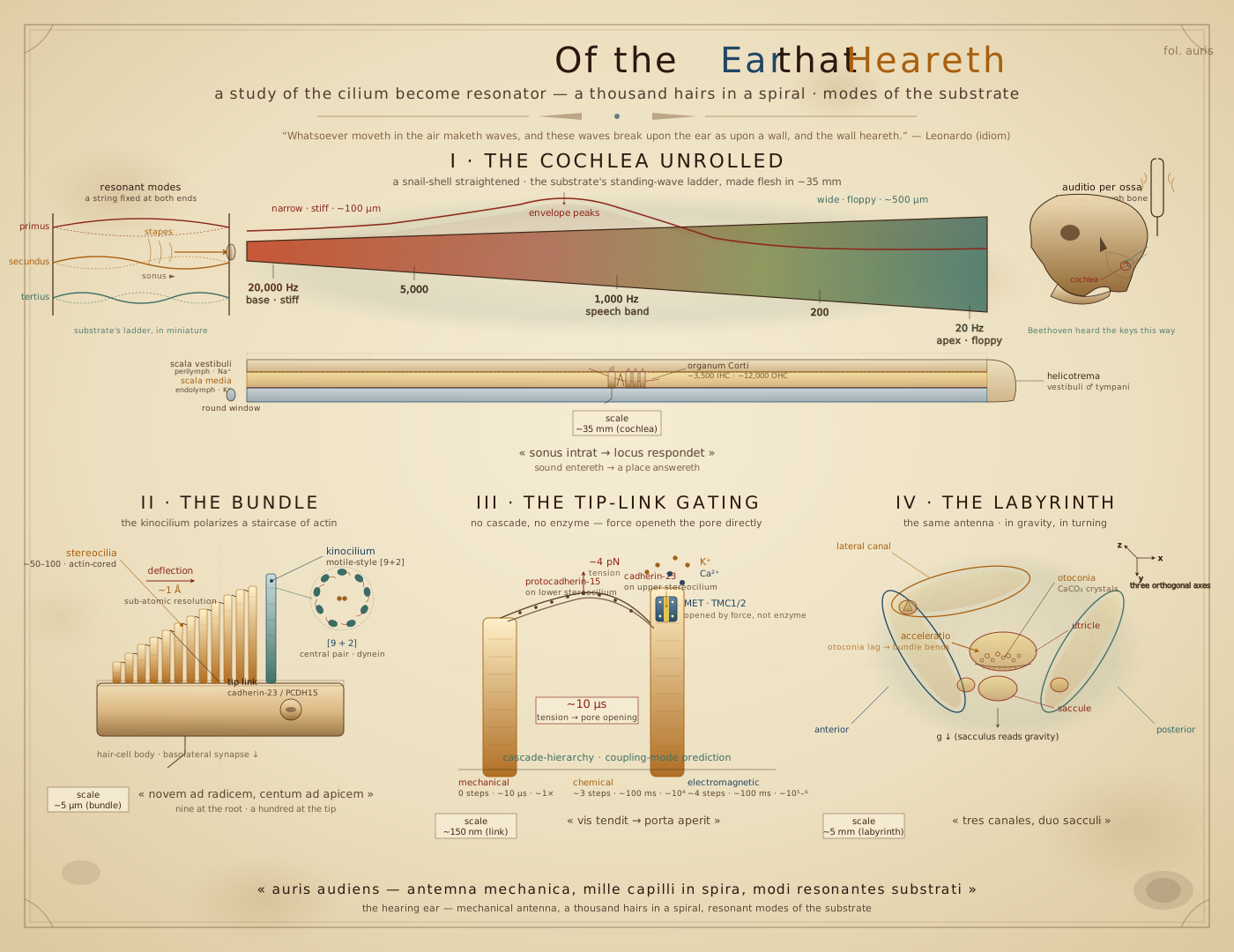
The substrate when applied to the architecture of the ear shows up in these seven ways: * The hair cell apical bundle is like the cilium, a substrate antenna but specialised for the mechanical channel. * The cochlea around use chemistry and the substrate ladder as a discriminator. * The kinocilium that polarises each hair-cell bundle is a modified [9+2] motile-style primary cilium. * The staircase of stereocilia beside it is the chemistry-side surface-area amplifier for mechanical deflection, parallel to the rod outer segment’s disc stack for photons. * The tip-link-and-MET-channel architecture is the substrate’s mechanical-coherence channel coupled directly into the substrate-current the cell reads, with no intervening amplification cascade because mechanical-to-ionic coupling does not need one. * The basilar-membrane stiffness gradient is the chemistry-side gradient that maps the substrate’s standing-wave spectrum onto \sim 35 mm of biology. * The outer hair cells’ prestin-driven electromotility is the substrate-coherent feedback amplifier that sharpens the standing wave at each place. * The vestibular hair cells in the labyrinth’s otolith organs and semicircular canals run the same antenna in static-tilt and rotational-acceleration configurations rather than oscillatory ones. * The bone conduction is direct substrate-mechanical evidence that the cochlea reads the substrate regardless of the engineered air-coupling path.
The Hair Cell Bundle as Modified-Cilium Mechanical Sensor
A vertebrate hair cell is a polarised epithelial cell with its receptive apparatus crowded onto its apical face. From this face projects a bundle of \sim 50–100 stereocilia in cochlear hair cells (more in vestibular hair cells, \sim 50 in inner cochlear hair cells, \sim 150 in mammalian outer cochlear hair cells) along with, in development and in many vestibular cells throughout life, a single kinocilium. The stereocilia are actin-cored cellular projections \sim 100 nm wide and ranging in length from \sim 1 to \sim 10\;\mum within a single bundle, arranged in a staircase in which adjacent stereocilia rise in length by \sim 0.5–1.0\;\mum steps, with the longest stereocilium adjacent to the kinocilium and the shortest at the opposite edge. The kinocilium itself is a true [9+2] axoneme with a central pair and dynein arms — the canonical motile-cilium architecture inherited from the cell’s general ciliary toolkit — but in mammalian cochlear hair cells it is resorbed during the first postnatal week, leaving the stereocilia staircase with its polarity intact. In vestibular hair cells the kinocilium persists.
The kinocilium’s role is geometric. Its position at one edge of the bundle defines the bundle’s axis of mechanical sensitivity: deflection of the bundle toward the kinocilium opens mechanotransduction channels at the stereocilia tips; deflection in the perpendicular plane has no effect; deflection away from the kinocilium closes channels that were partly open at rest. The kinocilium is therefore the bundle’s polarisation element, organising the staircase into a directional mechanical antenna in the same way a Yagi-Uda antenna’s reflector and director elements polarise its electromagnetic response. The framework reads this directly: the kinocilium is the modified [9+2] primary cilium serving as the substrate-aware antenna’s directional axis, with the actin-cored stereocilia staircase beside it as the chemistry-side sensitivity-amplification array specialised for the mechanical-channel signal the cilium is polarising on. Across the three vertebrate sensory cilia the cilia-flagella chapter pointed at, the photoreceptor uses a [9+0] connecting cilium and stacks \sim 1{,}000 discs of opsin-loaded membrane to amplify EM-absorbing surface area, the hair cell uses a [9+2] kinocilium and a \sim 100-element staircase of actin protrusions to amplify mechanically-deflectable surface area, and the olfactory neuron uses a \sim 10–30-cilium tuft to amplify chemical-receptor surface area. One architecture, three chemistry-side specialisations, three substrate channels.
The mechanical sensitivity that this architecture delivers is striking. Single-stereocilium displacements of \sim 1 Å — the same order as a hydrogen-bond length, far below the thermal-noise floor for an isolated cell, comparable to the substrate’s preferred lattice rung at the angstrom scale — produce measurable receptor currents in patch-clamp recordings from individual mammalian and turtle hair cells. The auditory threshold of \sim 20\;\muPa at \sim 3 kHz corresponds to eardrum motions of \sim 0.1 Å — sub-atomic-scale mechanical detection at the ear’s input. Hair-cell mechanotransduction is therefore the substrate’s mechanical-coherence channel sampled at substrate-ladder spatial resolution, with the stereocilia staircase as the chemistry-side amplifier that exposes the substrate-mechanical signal to the cell’s ionic readout machinery.
The Basilar Membrane as Substrate Standing-Wave Ladder
The cochlea’s frequency-to-place mapping — the tonotopy Helmholtz proposed and Békésy demonstrated — is enforced by a systematic gradient in basilar-membrane mechanical properties along its length. At the basal end nearest the oval window, the basilar membrane is \sim 100\;\mum wide, \sim 7\;\mum thick, and stiff enough to resonate at \sim 20 kHz; at the apical end at the helicotrema it is \sim 500\;\mum wide, \sim 2\;\mum thick, and floppy enough to resonate at \sim 20 Hz. The stiffness varies by a factor of \sim 100 from base to apex, mass-loading varies by a factor of \sim 10, and the resonant frequency at each place — the local mechanical impedance match — scales approximately logarithmically along the length: \sim 3.6 octaves per millimetre at the basal end falling to \sim 1 octave per millimetre at the apex. The combination produces a place-code in which each \sim 100\;\mum of basilar membrane corresponds to a substantial fraction of an octave at the high-frequency end and a smaller one at the low end, with \sim 3{,}500 inner hair cells distributed along the membrane each reading the local oscillation amplitude.
The basilar membrane is the a chemistry-side implementation of a substrate-standing-wave ladder. The substrate, in the feedback-topology chapter and the photon-modon chapter, supports standing waves at every length scale at which rotational or oscillatory energy organises itself; the spectrum of allowed substrate modes between any two boundary-matched points spans an essentially continuous frequency range, with chemistry-side machinery at the sampling end determining which modes are read. The cochlea provides the chemistry-side machinery: a graded-stiffness elastic membrane embedded in two fluid-filled chambers that admits external pressure oscillations through the oval window and reads them along its length. Each place on the membrane is a local mechanical oscillator with its own resonance frequency, set by the local stiffness-and-mass combination; the place-frequency map is the substrate’s standing-wave spectrum projected onto \sim 35 mm of biology.
That the map is laid out by the octave — and that the half-octave (\sqrt{2} in frequency, the tritone) is the interval the ear and the twelve-tone scale both treat as the axis of symmetry — is the cochlea reading the substrate’s rung ratio directly. The octave is the lattice’s pairing-two and the half-octave its \sqrt{2}, the fundamental step of the substrate ladder; the continuous stiffness gradient is the chemistry-side device that fills in between the rungs, but the rungs themselves — the privileged intervals the auditory system organises around — are the substrate’s.
The travelling-wave structure Békésy observed — peak amplitude moving from base to apex as a pure tone is delivered, peaking at the place tuned to the tone’s frequency, falling off rapidly past the peak — is the cochlea’s active response to the standing-wave mode at the matched place. A pure tone delivered at the oval window propagates as a pressure wave through scala vestibuli, deflects the basilar membrane along its length, and excites the local oscillator most strongly at the place where the local resonance frequency matches the tone’s frequency. Past the peak the wave damps out within \sim 1 mm; before the peak the membrane oscillates at low amplitude as the wave builds toward resonance. The envelope of the travelling wave is therefore a spatially-resolved frequency selectivity function, with a peak whose location reads the frequency and whose width reads the frequency selectivity of the cochlea at that place.
The substrate reading sharpens the place-coding picture. The cochlea is not a passive frequency-discriminating membrane; it is the substrate’s standing-wave architecture made physically explicit by chemistry-side engineering. The basilar membrane’s \sim 100\times stiffness gradient and the corresponding \sim 1000\times resonant-frequency range are biology’s way of admitting and reading the substrate’s wide-bandwidth mechanical-mode spectrum within a single organ. The chemistry-side cost is the elaborate cellular architecture of the organ of Corti (tectorial membrane, inner and outer hair cells, supporting cells, the spiral ganglion innervation) plus the bony cochlear capsule that anchors the whole assembly; the architectural payoff is a spatial Fourier transform of incoming acoustic signal, performed continuously, with no need for the time-domain-to-frequency-domain conversion the brain would otherwise have to do. The cochlea hands the brain a frequency-decomposed signal at the auditory nerve.
Tip-Link Gating as Direct Mechanical-to-Substrate-Current Coupling
The cellular mechanism by which a hair cell converts stereocilia deflection into an ionic current is the tip link. A tip link is a fine extracellular filament \sim 150 nm long, composed of a cadherin-23 / protocadherin-15 heterodimer (the genes underlying multiple congenital deafness syndromes), running from the top of each shorter stereocilium to the side of the next taller stereocilium in the staircase. Deflection of the bundle toward the kinocilium puts the tip links under tension; the tension is mechanically transferred to a mechanoelectrical-transduction (MET) channel at the stereocilium tip — most likely a TMC1/TMC2 channel in mammalian cochlear hair cells, with TMHS/LHFPL5 and TMIE as obligate accessory subunits — pulling the channel open at \sim 4 pN. K^+ ions (abundant in the endolymph filling scala media) and Ca^{2+} flow into the stereocilium through the opened channel, depolarising the hair cell; the depolarisation propagates to the cell’s basolateral synapse and releases glutamate onto the afferent auditory nerve fibre.
The kinetic property that distinguishes mechanotransduction from phototransduction is the speed of MET channel opening: \sim 10\;\mus from tip-link tensioning to channel opening in mammalian cochlear hair cells, against \sim 100 ms for the photoreceptor cascade from photon absorption to membrane hyperpolarisation. The phototransduction cascade has four sequential enzymatic steps (opsin → transducin → PDE6 → cGMP hydrolysis → CNG channel closing) and provides \sim 10^5–10^6-fold amplification of a single quantum event. Mechanotransduction has zero enzymatic steps — the tip link’s mechanical tension opens the channel directly — and provides essentially no amplification of the input signal. The hair cell does not need amplification because the substrate’s mechanical channel is already directly coupled to the chemistry-side ionic machinery: an ångström-scale mechanical deflection produces a \sim 1 pA receptor current without any intermediate cascade.
The framework reads this contrast directly. The substrate’s mechanical channel shares its physical mode with the chemistry-side ion-permeability machinery — both are stress-and-strain dynamics in a charged membrane — and so couples to it without an intermediate transduction cascade. The substrate’s electromagnetic channel does not share a physical mode with ion-permeability and so needs a chemistry-side cascade to do the conversion. This is a substrate-physics prediction about which sensory modalities should and should not be cascaded, and the auditory-versus-visual contrast confirms it. Olfaction, taste, and thermal/nociceptive sensation — all chemistry-channel inputs — should fall in between, with shorter cascades than vision but not the cascade-free direct coupling of hearing. The literature broadly supports this: olfactory transduction has a three-step GPCR-cAMP-CNG cascade with \sim 100 ms onset; gustatory bitter/sweet transduction has a similar GPCR-PLC\beta cascade with similar timescale; thermal TRP-channel activation is direct (channel opens at threshold temperature) and fast (\sim 1 ms onset). The substrate’s preferred coupling-mode hierarchy — direct for mechanical and thermal, cascaded for chemical and electromagnetic — is biology’s chemistry-side speed hierarchy.
The tip-link architecture itself sits at the framework’s preferred sub-sheet rung. The cadherin-23/PCDH15 filament is \sim 150 nm long, a length the vesicle-traffic chapter and the microtubule-highways chapter placed at the substrate-coherent sub-sheet rung where IFT trains, COPII coats, and microtubule-stabilising MAP arrays cluster. The MET-channel gating force of \sim 4 pN matches the single-motor stall force of cytoplasmic dynein and kinesin and the single-myosin force in the cellular force ladder. Hair-cell biology has populated a framework-preferred rung with a chemistry-side filament-and-channel pair that delivers direct mechanical-to-ionic coupling at the substrate’s preferred force and length scales.
Outer Hair Cells as Active Substrate-Feedback Amplifiers
The cochlea has two classes of hair cell. Inner hair cells (IHCs, \sim 3{,}500 in humans, arranged in a single row along the cochlear length) are the cochlea’s afferent sensors: \sim 95\% of the auditory-nerve axons synapse onto them. Outer hair cells (OHCs, \sim 12{,}000 in humans, in three rows) are the cochlea’s amplifiers: only \sim 5\% of auditory axons synapse onto them, but \sim 1{,}800 efferent fibres from the brainstem’s medial olivary complex synapse onto them, descending the auditory pathway to control cochlear gain. The OHC’s distinctive cellular property is electromotility: when the OHC’s membrane is depolarised, the cell shortens; when hyperpolarised, it lengthens. The length change is \sim 4\% of cell length per \sim 100 mV across the membrane and follows the membrane voltage at frequencies up to \sim 70 kHz — the highest-frequency motor protein known in biology. The molecular substrate is prestin (SLC26A5), a transmembrane protein of the SLC26 anion-exchanger family that has been specialised in the OHC lineage to function as a voltage-to-displacement transducer, packing the OHC lateral membrane at \sim 10^4 molecules per \mum^2.
The functional consequence is cochlear amplification. The OHCs sit between the basilar membrane and the tectorial membrane, mechanically coupled to both. When a passing travelling wave deflects the basilar membrane, the local OHCs depolarise (their stereocilia bundles shear against the tectorial membrane), prestin contracts the OHCs, and the OHC contraction pulls the basilar membrane back toward its rest position — but in a way that adds energy in phase with the local oscillation rather than damping it. The OHC’s electromotile feedback raises the basilar-membrane oscillation amplitude at the local frequency by \sim 40–60 dB (a factor of \sim 100–1000) and sharpens the frequency-selectivity peak by a factor of \sim 10, lifting the cochlea’s effective Q factor from \sim 3–5 (passive cochlear mechanics) to \sim 30–100 (active OHC-amplified mechanics). Otoacoustic emissions — faint sounds the ear emits in response to or in the absence of input, first measured by Kemp in 1978 and now a clinical screening tool — are the audible signature of this active process, with the OHCs’ feedback occasionally going slightly unstable and emitting acoustic energy back through the middle ear.
The framework reads OHCs as the canonical loop’s active-amplifier arm at the substrate’s mechanical-channel rung. The OHC takes a substrate-mechanical input (basilar-membrane deflection sensed via stereocilia), converts it through the chemistry-side ionic transduction machinery into a membrane-voltage signal, runs that signal through prestin’s voltage-to-displacement transducer, and feeds the resulting mechanical output back into the substrate’s standing-wave structure at the same tonotopic place. This is the canonical loop’s substrate-current-to-mechanical-work conversion (the same conversion that ATP synthase performs at the mitochondrial proton circuit and that dynein performs along the cilium’s axoneme) but expressed in positive-feedback amplifier configuration rather than directional-work configuration. The substrate’s standing-wave mode at each tonotopic place is the resonator; the OHCs are the active feedback element that pumps energy into the resonator at the matched phase, sharpening the Q factor by an order of magnitude.
The cochlear amplifier is therefore biology’s chemistry-side implementation of a regenerative resonator — a passive resonator with active feedback narrowing the bandwidth, the same architecture as the regenerative receivers Edwin Armstrong patented in 1914 for narrow-band radio reception, the same architecture as the laser cavity’s gain medium pumped to compensate for cavity losses. The framework’s reading is that biology has discovered a regenerative-resonator architecture independently in the cochlea, and the OHC’s prestin-based electromotility is the chemistry-side ingredient that makes the regeneration possible at audio frequencies. The architecture is the substrate’s; the molecular implementation is biology’s.
The Vestibular System as Substrate Gravity and Acceleration Sensor
The cochlea is one of two sensory structures in the membranous labyrinth of the inner ear. The other is the vestibular apparatus: three semicircular canals (anterior, posterior, lateral) oriented along three orthogonal axes, joined to two otolith organs (the utricle and saccule) that sit in the labyrinth’s central chamber. The vestibular apparatus shares the cochlea’s general cellular toolkit — hair cells with stereocilia bundles, tip links and MET channels, afferent innervation by spiral-ganglion-equivalent (Scarpa’s-ganglion) afferents — but specialises each end-organ for a different mechanical signal.
The semicircular canals sense angular acceleration. Each canal is a fluid-filled torus oriented in one plane; angular rotation of the head in that plane lags the fluid through inertia, and the relative motion between the canal walls and the endolymph deflects a gelatinous cupula at one end of the canal, which deflects the embedded hair-cell bundles. Three canals oriented along three orthogonal axes deliver three components of the angular-acceleration vector; the brainstem reads the three components and computes head rotation in three-dimensional space. The otolith organs sense linear acceleration including gravity. Each contains a hair-cell-lined macula covered by an otolithic membrane — a gelatinous matrix with calcium-carbonate crystals (the otoconia, \sim 5–50\;\mum diameter) embedded in its outer surface — sitting on the stereocilia bundles below. Linear acceleration of the head causes the dense otoconia to lag the head’s motion through inertia; the membrane drags, the stereocilia deflect, and the hair cells signal acceleration along the macula’s plane.
The vestibular system is the substrate’s gravity-and-acceleration sensor at the organism-modon scale. The substrate’s gravitational signature, developed in the gravity chapter, is the dc1 ebb-flow gradient that biases massive objects toward the curl of the local substrate-flow geometry; in a sitting human at rest the gravitational signal is steady, downward, \sim g \approx 9.8 m/s^2, and the utricle’s macula reads it through the slight downward sag of the otoconia. The semicircular canals read time-varying components of the same substrate-mechanical signal — head rotations propagate through the substrate as transient flows whose acceleration the canals’ inertial cupula-deflection sense. The whole vestibular apparatus is therefore the cell’s mechanical antenna lifted to the organism scale, with the labyrinth’s bony capsule as the organism-scale equivalent of the cochlea’s bony capsule, the otoconia as the static-mass-loading element that lets the static substrate gradient (gravity) be sensed, and the cupula-and-endolymph as the dynamic mass-loading element that lets the rotational substrate signal (head turning) be sensed.
The shared cellular toolkit between cochlea and vestibular apparatus has a single explanation under the substrate reading: both organs sense the substrate’s mechanical channel, one in its oscillatory (acoustic) configuration and the other in its quasi-static and rotational (gravitational/inertial) configurations. The same hair-cell antenna, the same tip-link gating, the same MET-channel chemistry serve both. The differences are entirely in the coupling element that mediates between the external substrate signal and the bundle: tectorial membrane and travelling wave for the cochlea, otolithic membrane and inertial lag for the otolith organs, cupula and endolymphatic flow for the canals. One cellular antenna, three coupling-element specialisations, three slices of the substrate’s mechanical-channel signal accessible to the same downstream chemistry.
Bone Conduction as Substrate-Mechanical Evidence
A tuning fork pressed against the skull is audible, and the audibility persists when the ear canals are blocked. Beethoven, deaf in his last decade, reportedly heard the piano through a wooden rod held in his teeth touching the soundboard. The mechanism — bone conduction — has been studied for over a century: sound waves coupled into the cranial bones propagate through the petrous temporal bone (the densest bone in the human body, housing the bony labyrinth) and reach the cochlea directly, bypassing the entire engineered air-coupling chain of pinna, ear canal, tympanic membrane, malleus-incus-stapes ossicular chain, and oval-window stapes footplate. Three component mechanisms are conventionally distinguished: compressional (the bone capsule deforms slightly under acoustic pressure, mechanically compressing the cochlear fluids), inertial (the ossicles lag behind the skull’s motion through their own inertia, producing relative motion at the oval window), and osseotympanic (sound radiated from the bone wall of the ear canal back into the canal). The relative contributions vary with frequency: compressional dominates at low frequencies, inertial at mid frequencies, osseotympanic at higher frequencies.
The framework’s reading is that bone conduction is substrate-mechanical evidence. The cochlea’s basilar membrane reads the substrate’s mechanical signal regardless of the path that brought the signal to the cochlea — through air-coupled ossicular chain, through bone-conducted compression, through tooth-and-mandible vibration, through the skull’s own resonances. What the engineered middle-ear chain provides is impedance matching between the air’s \sim 410 Pa·s/m specific acoustic impedance and the cochlear fluid’s \sim 1.5 MPa·s/m, a factor-of-\sim 4{,}000 mismatch the ossicles bridge through their \sim 17\times area ratio (eardrum versus stapes footplate) and \sim 1.3\times lever ratio. The chain raises air-conduction sensitivity by \sim 30 dB relative to the substrate-only path. But when that engineered chain is unavailable — Beethoven’s middle-ear sclerosis, a modern hearing aid’s bone-anchored vibrator, a tuning fork on the mastoid — the substrate-mechanical signal still reaches the cochlea, just with the lower sensitivity the bypass implies.
This sharpens a substrate-physics distinction the eye-as-antenna chapter could not make. The eye has no equivalent of bone conduction: there is no bypass path for light to enter the photoreceptor outer segments other than through the cornea-lens-vitreous chain. The cochlea has a bypass path — bone conduction — because the substrate’s mechanical channel propagates through dense matter in a way the substrate’s electromagnetic channel propagates only through transparent matter. The bone capsule of the cochlea is opaque to light and conducts substrate-mechanical signal; the cornea of the eye is transparent to light and conducts essentially no substrate-mechanical signal at audio frequencies. The asymmetry between the two senses is a substrate-channel-coupling-mode asymmetry, not an evolutionary accident of organ design.
The framework’s testable claim here is that the frequency response of bone conduction should not match the air-conduction response in the band \sim 250 Hz to \sim 4 kHz, with the bone-conducted response biased toward substrate-preferred frequencies the air-coupled chain’s resonances do not emphasise. Cochlear inputs at \sim 1–2 kHz dominate bone-conducted sensitivity in clinical audiograms; the framework predicts that the dominance is not just middle-ear-bypass arithmetic but reflects substrate-preferred mechanical-mode coupling at the cochlear apex of the speech-frequency range.
Predictions and What Would Falsify
Four predictions extend the architectural reading beyond the structural anchors.
Basilar-membrane place-frequency map clusters at substrate-preferred logarithmic intervals. The frequency-to-place mapping along the basilar membrane should cluster at substrate-preferred logarithmic rungs — likely octave-and-half-octave intervals — rather than vary as a smooth continuous function of position. Existing cochlear cryo-tomography and laser-vibrometry data across mammals provide the test; the framework predicts cross-species clustering on preferred ratios rather than smooth distribution. Psychoacoustic critical-band data (Bark and ERB scales) provide an independent test: the just-noticeable-difference in frequency should show non-smooth structure at the substrate-preferred ratios, beyond the chemistry-side gradient explanations.
Stereocilia staircase displacement quanta cluster at substrate-ladder rungs. The step heights between adjacent stereocilia in mature cochlear and vestibular hair-cell bundles should cluster at substrate-preferred sub-sub-sheet rungs (likely \sim 0.5, \sim 1.0, \sim 1.5\;\mum), and the bundle’s mechanical operating point (the displacement at which \sim 50\% of MET channels are open) should sit at substrate-preferred angstrom-scale rungs. Cryo-electron tomography of stereocilia bundles across hair-cell types provides the test; the framework predicts preferred-rung clustering distinct from chemistry-side actin-bundle-length expectations.
OHC active-amplification Q factor clips at substrate-preferred values. The active-amplification Q factor of cochlear filters across mammals — set by OHC electromotile feedback — should clip at substrate-preferred integer or simple-rational values (Q \sim 10, 20, 30, 60, 100) rather than at the chemistry-side prestin-saturation values continuously dependent on prestin density and OHC length. Cross-species comparative cochlear physiology and prestin-knockdown experiments provide the test; the framework predicts clipping on substrate-preferred values that prestin-saturation models alone do not deliver.
Bone-conduction sensitivity peaks at substrate-preferred frequencies the air-conduction path under-emphasises. Bone-conducted audiograms, after subtracting the air-conduction sensitivity curve, should show residual peaks at substrate-preferred mechanical-mode frequencies (likely at \sim 1, \sim 2, \sim 4 kHz with substructure visible at finer resolution) beyond what mass-spring-damper models of the petrous-temporal-bone-to-cochlea coupling alone would predict. Clinical bone-conduction audiometry with high-resolution frequency sampling provides the existing assay; the framework predicts substrate-preferred-mode residuals in the bone-conduction-minus-air-conduction difference spectrum.
The picture is falsified if (a) the basilar-membrane place-frequency map is smoothly logarithmic without preferred-rung structure, (b) stereocilia staircase step heights vary continuously with actin-bundle expression without preferred clustering, (c) cochlear Q factors continuously track prestin density without clipping at substrate-preferred integers, or (d) bone-conduction frequency response is fully predicted by petrous-bone mechanical models alone with no substrate-mode residual. It is supported, even partially, if any of the four ordering predictions hold against existing data.
Putting the Section in Context
The vertebrate ear is the substrate’s mechanical-channel sensor, built by specialising one of the cell’s standard architectures — the modified [9+2] motile-style primary cilium serving as a polarisation element — for mechanical deflection at the substrate’s preferred angstrom-scale ladder rung. The hair-cell apical bundle is the cilium with \sim 50–100 actin-cored stereocilia in a staircase beside it, amplifying mechanically-deflectable surface area in the same architectural sense the rod outer segment’s disc stack amplifies EM-absorbing surface area. The tip-link-and-MET-channel architecture is the substrate’s mechanical-coherence channel coupled directly into the substrate-current the cell reads, with no intermediate cascade because mechanical-to-ionic coupling does not need one — the substrate’s mechanical channel and the chemistry-side ion-permeability machinery share their physical mode. The basilar-membrane stiffness gradient maps the substrate’s standing-wave mechanical-mode spectrum onto \sim 35 mm of chemistry-side membrane, with \sim 3{,}500 inner hair cells distributed along its length each reading the local oscillation amplitude and so delivering a spatial Fourier transform of incoming acoustic signal to the auditory nerve. Outer hair cells provide the canonical loop’s active-amplifier arm at the mechanical-channel rung, with prestin-driven electromotility feeding substrate-coherent positive feedback back into the cochlear standing wave and raising the cochlea’s Q factor by an order of magnitude over the passive value. The vestibular labyrinth runs the same antenna in static-tilt and rotational-acceleration configurations through otolithic and cupula coupling elements, lifting the hair-cell antenna to the organism scale. And bone conduction is direct substrate-mechanical evidence that the cochlea reads the substrate regardless of the engineered air-coupling path — a bypass channel the eye does not have because substrate-mechanical signal propagates through dense matter where substrate-electromagnetic signal does not.
The Perception walk now has two of its four chapters. The eye took the electromagnetic channel; this chapter took the mechanical channel. The next chapter takes the chemical channel — the olfactory epithelium as a \sim 400-channel substrate-chemical discrimination array, with one olfactory receptor (OR) per neuron, \sim 400 OR family members in humans (the largest single gene family in the genome), and a glomerular convergence architecture in the olfactory bulb that averages many neurons onto each receptor-class output. The chapter after that takes the substrate’s mechanical channel at the body-internal layer, with Pacinian corpuscles, muscle spindles, and proprioception as the body’s substrate-mechanical self-model — the same channel this chapter took at the cochlear-acoustic and labyrinthine-inertial layers, but expressed through different chemistry-side coupling elements at the body-internal scale.
What the ear does that the eye does not is to convert standing-wave substrate signal directly into a place-coded substrate-coherent neural signal, with no need for a chemical amplification cascade between sensor and signal. The eye’s \sim 10^5-fold cGMP amplification chain is the chemistry-side workaround for the substrate-electromagnetic channel’s not-quite-matching coupling mode to ionic machinery; the ear’s tip-link-MET-channel architecture is the substrate-mechanical channel’s directly-matching coupling mode at work, expressed at the substrate’s preferred angstrom-and-piconewton ladder rung. The cochlea is the substrate’s standing-wave architecture made physically explicit by chemistry-side engineering; the basilar-membrane stiffness gradient and the OHC’s regenerative-resonator feedback are biology’s chemistry-side cost paid to deliver the spatial Fourier transform that hearing is. Helmholtz proposed the resonator picture in 1863; Békésy showed it was a travelling wave in 1928; Kemp measured the cochlear amplifier in 1978; the substrate-physics reading places the whole assembly as the cell’s outward mechanical antenna lifted to organism-scale at the substrate’s preferred ladder rung. The ear is the substrate listening to itself through chemistry-side machinery the body has fitted to the substrate’s standing-wave geometry; the next two chapters take the remaining two substrate channels in turn.