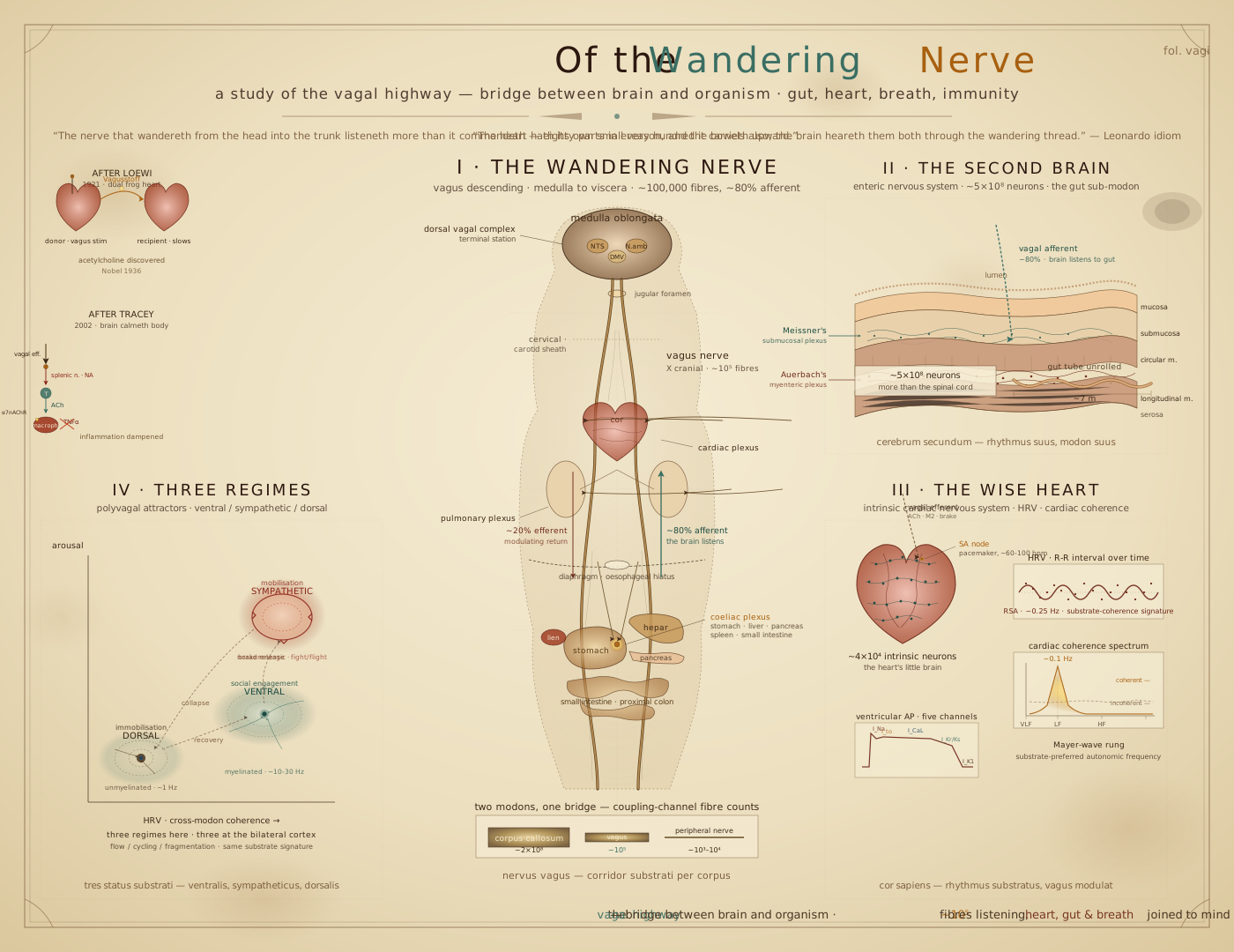
The Vagal Highway
The vagus nerve as inter-modon coupling channel between brain modon and organism modon, the enteric nervous system as a quasi-autonomous gut sub-modon, heart-brain coherence as cross-modon co-coherence at autonomic rungs, and polyvagal regimes as substrate-coherence states
Galen of Pergamon described in the 2nd century CE the nervi vagi — the wandering nerves — as the longest of the cranial nerves, descending from the brain through the neck into the thorax and abdomen to innervate viscera at distances unprecedented in the cranial-nerve series. Andreas Vesalius’s 1543 De humani corporis fabrica plate VI rendered the vagal anatomy with the dissection-derived precision that opened modern anatomy, showing the nerve’s descent from the jugular foramen past the carotid sheath into the cardiac, pulmonary, and abdominal plexuses. Otto Loewi published in 1921 his dual-frog-heart experiment — stimulating the vagus of a donor heart, transferring the perfusate to a recipient heart, and observing the recipient slow — the first demonstration that nerves transmit through a chemical messenger, the Vagusstoff he and Henry Dale later identified as acetylcholine (shared Nobel 1936). John Newport Langley between 1898 and 1921 systematised the autonomic nervous system terminology — sympathetic, parasympathetic, enteric — with the vagus identified as the parasympathetic backbone carrying the bulk of cranio-sacral autonomic outflow. Walter Cannon’s 1932 The Wisdom of the Body synthesised the autonomic-and-endocrine homeostatic-regulation picture, with the vagus and sympathetic chain as the body’s antagonistic regulatory pair. Michael Gershon in 1998 published The Second Brain on the enteric nervous system — the \sim 5 \times 10^8-neuron intrinsic neural network of the gut wall, capable of generating coordinated peristalsis and secretion in complete vagal denervation, and structurally distinct from the central and autonomic divisions Langley had named. J. Andrew Armour from 1991 onward characterised the intrinsic cardiac nervous system — the \sim 40{,}000-neuron network of cardiac ganglia within the epicardial and intramural cardiac tissue — and named it the little brain of the heart. Stephen Porges introduced polyvagal theory in 1994 and developed it across the next three decades into the framework’s reading of autonomic state as a three-regime substrate (ventral-vagal social-engagement, sympathetic mobilisation, dorsal-vagal immobilisation) with the myelinated ventral vagus as the phylogenetically newer mammalian addition supporting social-coherence regulation. Kevin Tracey from 2000 onward identified the cholinergic anti-inflammatory pathway — the vagal-efferent regulation of splenic-macrophage cytokine release through α7-nicotinic acetylcholine receptors — establishing brain-immune coupling through the substrate-coherent vagal signal. The HeartMath group (Doc Childre, Rollin McCraty, and collaborators) from the 1990s onward documented cardiac coherence — the phase-locking of heart-rate-variability, respiratory, and blood-pressure rhythms at \sim 0.1 Hz that correlates with measurable improvements in cognitive performance, emotional regulation, and immune function. The hippocampal-modon chapter described memory as substrate-coherence archival within the brain modon; this chapter takes the next step outward and asks how the brain modon is embedded in the larger organism modon — through what substrate-coupling channel, with what other sub-modons, and what the substrate-coherent state of the integrated organism looks like.
The framework’s claim is direct. The vagus nerve is the substrate’s primary inter-modon coupling channel between the brain modon and the organism modon, with \sim 10^5 fibres (\sim 80\% afferent) carrying continuously-updated visceral substrate-coherent signal upward from gut, heart, lungs, and abdominal viscera to the dorsal vagal complex and downward through the cholinergic efferent system; with the enteric nervous system as a quasi-autonomous gut sub-modon of \sim 5 \times 10^8 neurons capable of substrate-coherent local rhythm generation in complete vagal denervation; with the intrinsic cardiac nervous system as a \sim 4 \times 10^4-neuron heart sub-modon supporting cardiac-rhythm substrate-coherence independent of central drive; with heart-rate variability as the cleanest substrate-coherence-quality biomarker at the body-modon scale, with respiratory-sinus arrhythmia, baroreflex, and Mayer-wave rhythms phase-locking at substrate-preferred autonomic rungs; with polyvagal regimes (ventral-vagal, sympathetic, dorsal-vagal) as three substrate-coherent autonomic states distinguished by which vagal-efferent system carries the dominant brain-to-organism coupling; with the cholinergic anti-inflammatory pathway as substrate-coherent brain-immune regulation through the same vagal substrate; and with the integrated brain-plus-organism modon as a nested-modon system whose substrate-coherent state is read at every rung from heart-beat-to-heart-beat (\sim 1 Hz) through respiratory (\sim 0.25 Hz) through Mayer-wave (\sim 0.1 Hz) through circadian (\sim 10^{-5} Hz) rhythms. The vagal corridor joins the LINC complex, MAM contact sites, gap junctions, synapses, plasmodesmata, mycorrhizal hyphae, and the corpus callosum on the framework’s inter-modon-coupling-channel list — now at the largest scale yet, joining two organ-modons of the same organism into the integrated body modon.
The chapter’s contribution is the architectural reading of the brain-body coupling that the touch-and-proprioception chapter opened from the periphery side. That chapter established interoception as the substrate-coherent body-internal signal carrying vagal, vascular, and visceral state upward to the insular cortex; this chapter develops the coupling architecture itself — the vagal corridor as substrate-coupling boundary between two organ-modons, the sub-modons it joins, and the autonomic-state regimes the coupled system supports. The chapter proceeds in six passes: the vagus as inter-modon coupling channel at the dorsal vagal complex; the enteric nervous system as a gut sub-modon with intrinsic substrate-coherent dynamics; the heart as a sub-modon with its own little brain and its own substrate-coherent rhythm; heart-rate variability as substrate-coherence biomarker at the body-modon scale; polyvagal regimes as three substrate-coherent autonomic states; and the cholinergic anti-inflammatory pathway as substrate-coherent brain-immune regulation through the vagal substrate.
The Vagus as Inter-Modon Coupling Channel at the Dorsal Vagal Complex
The human vagus nerve carries \sim 100{,}000 axons between the dorsal vagal complex of the medulla and the visceral targets it innervates: the cardiac plexus on the heart, the pulmonary plexus at the bronchial tree, the oesophageal-gastric branches at the upper digestive tract, the coeliac plexus serving stomach-liver-pancreas-spleen-small-intestine-proximal-colon, and the hepatic and splenic branches with their dedicated efferent populations. Roughly 80\% of these fibres are afferent — sensory axons carrying visceral state upward to the nucleus tractus solitarius (NTS) — and roughly 20\% are efferent — motor axons carrying central commands downward through the dorsal motor nucleus (unmyelinated, slower) and the nucleus ambiguus (myelinated, faster). The afferent dominance is the framework’s first structural anchor: the vagus is more a listening channel than a commanding one. The brain is continuously sampling the organism through the vagal corridor; the efferent fraction is the modulating return, structurally parallel to the corticothalamic feedback architecture the cortical-maps-and-rhythms chapter developed at the brain-modon scale.
The dorsal vagal complex in the medulla — NTS as primary afferent terminus, dorsal motor nucleus of vagus as the unmyelinated-efferent origin, nucleus ambiguus as the myelinated-efferent origin, and area postrema as the chemoreceptor trigger zone outside the blood-brain barrier — is the framework’s brain-side terminus of the inter-modon coupling channel. The NTS receives the full visceral afferent stream and distributes it to the parabrachial nucleus, the central amygdala, the bed nucleus of the stria terminalis, the hypothalamic paraventricular nucleus, and through them to the insular cortex (Bud Craig’s lamina-I-to-thalamus-to-posterior-insula pathway), the anterior cingulate, the orbitofrontal cortex, and the prefrontal cortex. The architecture is the substrate’s bottom-up visceral-state propagation into the higher cortical canonical loops the brain-as-prediction-engine chapter developed — body-internal state enters the prediction-engine hierarchy at the medullary first synapse and is integrated upward into the canonical-loop predictive architecture, with insular cortex as the body-internal-state representation at the cortical rung and anterior cingulate as the body-internal-state-prediction-error rung.
The framework reads the vagal-corridor fibre count of \sim 10^5 as substrate-coupling bandwidth scaled to the modons it joins. The bilateral-coupling chapter’s inter-modon-coupling-bandwidth list scales the coupling-fibre count to the modon scale: \sim 10^1–10^2 for nucleus-cytoskeleton at the cell rung (LINC SUN-KASH bridges), \sim 10^3–10^4 for ER-mitochondrion at the organelle rung (MAM contact sites), \sim 10^2–10^4 for adjacent-cell gap junctions, \sim 10^3–10^4 for plasmodesmata between plant cells, \sim 10^{14}–10^{15} for the brain-wide synapse population across all cable-modon pairs, \sim 10^7–10^8 for inter-tree mycorrhizal hyphae per forest stand, \sim 2 \times 10^8 for the corpus callosum across the two brain hemispheres. The vagus at \sim 10^5 sits on this scaling at the brain-modon-to-organism-modon rung. The framework’s bandwidth-scaling prediction is that inter-modon-coupling-channel fibre counts cluster at substrate-preferred values logarithmically distributed across the modon-rung hierarchy, with the vagal-corridor count near 10^5 fitting the brain-to-organism rung between corpus callosum (intra-brain) and mycorrhizal hyphae (inter-organism), distinct from arbitrary anatomical-evolutionary scaling.
The vagal-corridor transit time sits on the substrate-preferred temporal-rung structure the cortical-resonator-ODE chapter developed for the brain-modon dynamics. Myelinated ventral-vagal fibres conduct at \sim 15–30 m/s; unmyelinated dorsal-vagal fibres conduct at \sim 1–2 m/s; the round-trip transit from medulla to abdominal viscera (path length \sim 0.5 m) is \sim 30–50 ms for myelinated fibres and \sim 0.5–1 s for unmyelinated fibres. The two conduction-velocity classes generate two substrate-preferred temporal coupling rungs at the brain-organism boundary: a fast rung at \sim 10–30 Hz supporting moment-to-moment vagal-brake modulation of heart rate and respiration, and a slow rung at \sim 1 Hz supporting tonic visceral-state regulation. The substrate-coherence architecture of the integrated brain-organism modon naturally inherits two distinct rungs from the vagal-corridor conduction-velocity bimodality, structurally parallel to the Pacinian-Meissner-Merkel-Ruffini four-rung mechanical-channel decomposition at the cutaneous antenna.
The Enteric Nervous System as a Gut Sub-Modon
Michael Gershon’s 1998 The Second Brain synthesised a century of enteric-nervous-system anatomy and physiology into the framework’s reading of the gut as a quasi-autonomous neural sub-modon. The enteric nervous system (ENS) consists of \sim 5 \times 10^8 neurons distributed across two principal plexuses — the myenteric plexus (Auerbach’s plexus, between the longitudinal and circular smooth-muscle layers, primarily motor) and the submucosal plexus (Meissner’s plexus, within the submucosa, primarily secretory and absorptive) — that together innervate every segment of the digestive tract from the oesophagus to the rectum. The cell count exceeds the spinal cord’s; the network maintains coordinated peristalsis, secretion, immune-cell-trafficking regulation, and nutrient-sensing function under complete vagal denervation, demonstrating intrinsic substrate-coherent dynamics independent of central drive.
The framework reads the ENS as a quasi-autonomous gut sub-modon embedded within the organism modon, with its own substrate-coherent rhythms (peristaltic, segmentation, migrating-motor-complex) at its own substrate-preferred temporal rungs. The migrating motor complex (MMC) is the cleanest example: a slow (\sim 90–120 minute period) peristaltic wave that sweeps the small intestine during fasting, generated and propagated by intrinsic ENS circuitry through the network of interstitial cells of Cajal (gut pacemaker cells) coupled to enteric inhibitory and excitatory motor neurons. The MMC’s \sim 100-minute period sits on the substrate’s preferred ultradian rhythm rung — the same \sim 90-minute cycle that organises the basic rest-activity cycle (BRAC) during sleep with its REM-NREM alternation, the ultradian oscillation in cortisol and other endocrine outputs, and the gastrointestinal MMC itself. The framework reads the cross-system \sim 90-minute convergence as a substrate-preferred ultradian rung shared by multiple organism-scale loops, distinct from independent chemistry-side biochemical periodicities.
The interstitial cells of Cajal (ICCs) — discovered by Santiago Ramón y Cajal himself in 1893 and named in his honour — are the gut’s pacemaker cells: a network of mesenchymal-derived cells embedded between the smooth-muscle layers and the enteric plexuses, connected to each other and to the smooth muscle through gap junctions, that generate the slow-wave rhythm (\sim 3 Hz in the stomach, \sim 12 Hz in the duodenum, declining toward the colon) which sets the maximum frequency of smooth-muscle contraction at each gut segment. The framework reads the ICC network as the gut sub-modon’s substrate-coherence-rhythm-generation layer, structurally parallel to the cardiac sinoatrial node at the heart sub-modon and to the thalamocortical pacemaker structures at the brain modon. The cross-organ convergence is the substrate’s signature: every organ-modon-with-a-rhythm has a dedicated pacemaker-cell network of mesenchymal or specialised-myocyte origin generating substrate-coherent rhythm at substrate-preferred frequencies, with chemistry-side details (the HCN channel for sinoatrial pacing, the IP3-receptor-and-CACC for ICC slow waves, the T-type calcium channel for thalamic burst-firing) varying across organs but the architectural pattern — pacemaker-network coupled by gap junctions, generating substrate-coherent rhythm, distributed to effector tissue through coherence-cell architecture — recurring everywhere.
The gut-brain axis is the framework’s name for the bidirectional substrate-coupling between the gut sub-modon and the brain modon. Vagal afferents from the gut wall (chemoreceptors for nutrient content, mechanoreceptors for distension, immune-and-cytokine sensors, microbiota-metabolite sensors) carry gut-internal state upward to the NTS; vagal efferents carry brain-side regulation downward to the ENS plexuses; humoral signalling (gut hormones, microbial metabolites, immune cytokines, vagal-innervated enteroendocrine cells) carries additional substrate-coherent information through the bloodstream and lymphatic pathways. The microbiota literature from the 2010s onward (Cryan, Mayer, Knight, and collaborators) established that gut microbial composition shapes mood, cognition, and behaviour through this substrate-coupling network — that the gut sub-modon’s substrate-coherent state, including its microbial-symbiont layer, propagates upward to the brain modon’s substrate-coherent state through the vagal corridor and humoral pathways. The framework’s reading is that the integrated organism modon’s substrate-coherent state is set jointly by the brain modon and the gut sub-modon (along with the heart sub-modon of the next section) through the substrate-coupling pathways the vagus implements.
The Heart as a Sub-Modon with Its Own Little Brain
J. Andrew Armour and Jeffrey Ardell’s 1991 Neurocardiology opened the modern characterisation of the intrinsic cardiac nervous system — a \sim 40{,}000-neuron network of cardiac ganglia distributed across the epicardial fat pads and within the atrial-and-ventricular walls of the human heart. The intrinsic network includes afferent neurons (sensing intracardiac pressure, stretch, oxygenation, and chemistry), local-circuit interneurons (integrating afferent input and shaping the network’s intrinsic dynamics), and efferent motor neurons (controlling sinoatrial-node firing, atrioventricular conduction, contractile force, and coronary vasomotor tone). The network operates with substantial autonomy from central control: in cardiac transplant patients, the denervated heart maintains coordinated rate and contractility under intrinsic control, with the intrinsic cardiac nervous system providing the local integration that the brainstem normally supplies through vagal-and-sympathetic efferent input.
The framework reads the intrinsic cardiac nervous system as a heart sub-modon’s local neural network — a “little brain of the heart” in Armour’s phrasing — with its own substrate-coherent dynamics at the cardiac rung, structurally parallel to the ENS at the gut rung but operating at higher temporal frequency and lower neuron count. The neuron count ratio (gut-ENS at \sim 10^4 \times the heart’s intrinsic network) reflects the gut sub-modon’s broader substrate-coupling-channel demand: the gut has more states to maintain (segmentation, peristalsis, secretion, absorption, immune-trafficking, microbiota regulation) and a longer anatomical extent (\sim 7 m versus the heart’s \sim 15 cm), so its local neural sub-modon scales accordingly. The cross-organ count comparison is the substrate’s modon-scale-to-local-neural-count scaling: organs that maintain more independent substrate-coherent states have more local neurons; the ratio across organs is set by the substrate-coherent-state-space dimension each organ supports, not by tissue mass.
The sinoatrial node — the heart’s pacemaker, \sim 10^4 specialised cardiomyocytes in the right atrium near the superior vena cava entry — generates the substrate-coherent cardiac rhythm at \sim 60–100 beats per minute through the funny current (I_f), an HCN-channel-mediated inward depolarising current that drives the diastolic depolarisation toward action-potential threshold. The framework reads the sinoatrial node as the heart sub-modon’s substrate-coherence-rhythm-generation layer, identical in architectural role to the interstitial cells of Cajal in the gut sub-modon and to the thalamocortical pacemaker structures in the brain modon, with chemistry-side details differing (HCN channel here, IP3R-and-CACC there, T-type Ca channel at the thalamus) but architectural pattern identical.
The cardiac rhythm is modulated by vagal and sympathetic input from the brainstem at every beat. Vagal efferents to the sinoatrial node release acetylcholine onto muscarinic-M2 receptors, which couple to G-protein-mediated activation of GIRK potassium channels and inhibition of I_f, slowing the pacemaker rate; sympathetic efferents release noradrenaline onto β1-adrenergic receptors, which couple to G-protein-mediated activation of I_f and L-type calcium channels, accelerating the rate. The two efferent systems operate on the sinoatrial node simultaneously, with the net pacemaker rate set by the balance of vagal and sympathetic drive — this is the autonomic balance clinicians and physiologists track through heart-rate variability. The framework reads the dual-efferent modulation as the substrate-coupling between the brain modon and the heart sub-modon, with the cardiac rhythm as the substrate-coherent state of the heart sub-modon and the vagal-and-sympathetic input as the substrate-coupling signal modulating that state.
The cardiac action potential itself runs on the substrate’s preferred small-integer-channel-set architecture the neuron-as-cable-modon chapter developed. The ventricular cardiomyocyte action potential is generated by five principal ionic currents — fast sodium I_{Na} (rapid depolarisation), transient outward potassium I_{to} (early repolarisation notch), L-type calcium I_{Ca,L} (plateau phase), delayed rectifier potassium I_{Kr} and I_{Ks} (repolarisation), and inward rectifier potassium I_{K1} (resting potential maintenance). The five-channel architecture is the substrate’s preferred set at the cardiac-rhythm rung, parallel to the four-channel set in the squid axon (Hodgkin-Huxley) and the larger sets in cortical pyramidal cells. The gap junctions (connexin-43 in ventricular myocardium, connexin-40 in atrial and conduction-system tissue) couple adjacent cardiomyocytes into a single substrate-coherent dynamical sheet — the substrate-coupling architecture the cells-nested-modons chapter developed for inter-cell substrate-coherence, now operating across the heart sub-modon’s \sim 10^{10} cardiomyocytes as a single coherent dynamical organ.
Heart Rate Variability as Substrate-Coherence Biomarker at the Body-Modon Scale
The interval between successive heartbeats — the R-R interval on the electrocardiogram — is not constant. Over any minute of recording, the R-R interval varies by tens of milliseconds, with the variability decomposing into spectral components at distinct frequencies. The high-frequency (HF) band (\sim 0.15–0.4 Hz) carries the respiratory sinus arrhythmia (RSA) — the cardiac rate accelerating during inspiration and decelerating during expiration through cyclic vagal-brake release and re-engagement at the respiratory rate. The low-frequency (LF) band (\sim 0.04–0.15 Hz) carries the Mayer waves — slower oscillations near \sim 0.1 Hz reflecting baroreflex feedback, sympathetic-vagal balance, and vasomotor tone. The very-low-frequency (VLF) and ultra-low-frequency (ULF) bands carry circadian, thermoregulatory, and humoral rhythms at the slowest rungs. Heart rate variability (HRV) is the integrated signature of the autonomic substrate-coupling between brain and heart, with the spectral composition reflecting the quality of the substrate-coherent coupling at each rung.
The clinical literature has documented HRV as one of the cleanest physiological biomarkers known. Reduced HRV (low total power, especially in the HF vagal-mediated band) predicts cardiovascular mortality, sudden cardiac death, post-myocardial-infarction recovery, depression severity, anxiety-disorder severity, post-traumatic-stress-disorder severity, chronic-inflammation severity, and immune-function compromise across thousands of studies and decades of replication. Increased HRV (high total power, well-organised spectral structure, strong RSA) tracks cardiovascular health, emotional regulation capacity, social-engagement capacity, sleep quality, and longevity. The single-biomarker-multiple-outcome breadth is unusual in physiology; the framework reads it as the substrate-physics signature of HRV as a substrate-coherence-quality biomarker at the body-modon scale.
The framework reads HRV as the cleanest substrate-coherence-quality biomarker at the integrated brain-organism modon scale. The substrate-coherent coupling between brain modon and organism modon should produce phase-locked rhythms across the visceral organs, with respiratory, cardiac, vasomotor, and barometric oscillations sharing substrate-preferred frequency rungs and substrate-coherent phase relationships. A well-coupled brain-organism modon produces high HRV with organised spectral structure: a clear HF respiratory peak, a clear LF Mayer-wave peak, a clear VLF circadian-and-thermoregulatory peak, all at substrate-preferred frequency rungs. A poorly-coupled brain-organism modon — chronic stress, depression, post-traumatic-stress-disorder, severe inflammation — produces low HRV with disorganised spectral structure, the rhythms either flattened (autonomic withdrawal) or dominated by a single band (sympathetic overdrive, parasympathetic withdrawal). The substrate-coherence-quality reading is structurally parallel to the EEG-coherence reading the bilateral-coupling chapter developed for the bilateral brain — now lifted to the brain-organism modon scale, with HRV-coherence playing the role EEG-coherence plays at the brain rung.
The HeartMath group’s cardiac coherence protocol — slow paced breathing at \sim 0.1 Hz with focused-attention on a positive emotional state — drives the HRV spectrum into a sharp Lorentzian peak near 0.1 Hz with phase-locking between cardiac, respiratory, and blood-pressure rhythms. Doc Childre, Rollin McCraty, and collaborators have documented the cardiac-coherence state’s effects on cognitive performance, emotional regulation, immune function, and inter-subject heart-rate-and-brainwave coherence (when two subjects in physical contact or even in proximity enter cardiac-coherence states, their HRV and EEG signatures become inter-subject-correlated above chance). The framework reads cardiac coherence as the trained-attention version of the substrate-coherent integrated-organism state, structurally parallel to the trained-interoceptive access the touch-and-proprioception chapter discussed for body-energy practices. The contemplative traditions’ phenomenological reports of coherent heart, open heart, heart-mind unity, and the somatic-practice traditions’ explicit cardiac-respiratory protocols (pranayama, qigong-zhan-zhuang, taiji’s deep-breathing forms, vagal-nerve-stimulation breathing) all converge on the same substrate-coherence-state the HRV biomarker measures.
The substrate-physics prediction is that the cardiac-coherence frequency at \sim 0.1 Hz is a substrate-preferred Mayer-wave rung — the resonance frequency of the baroreflex feedback loop set by the substrate’s preferred autonomic-rung structure rather than by arbitrary chemistry-side time constants. The Mayer-wave frequency is remarkably conserved across mammals despite enormous variation in body size, heart rate, and respiratory rate; the framework predicts cross-species clustering at substrate-preferred values near 0.1 Hz, with adjacent rungs at substrate-preferred ratios distinct from continuous variation with body mass or vascular-tree dimension.
Polyvagal Regimes as Three Substrate-Coherent Autonomic States
Stephen Porges introduced polyvagal theory in his 1994 Society for Psychophysiological Research presidential address and developed it across the next three decades into the framework’s standard reading of mammalian autonomic state. The theory’s key anatomical claim is that the vagus is not a single uniform system but a phylogenetically stratified one: the unmyelinated dorsal vagal complex (dorsal motor nucleus of vagus origin, projecting through unmyelinated efferents to subdiaphragmatic viscera, evolutionarily ancient, shared across vertebrates including reptiles) generates the immobilisation response — bradycardia, decreased cardiac output, decreased respiration, and the freeze/shutdown survival response under overwhelming threat. The myelinated ventral vagal complex (nucleus ambiguus origin, projecting through myelinated efferents to supradiaphragmatic structures including heart, lungs, larynx, pharynx, and face, evolutionarily newer, found only in mammals) generates the social engagement response — moderate cardiac slowing, controlled respiration, vocalisation-and-facial-expression coordination, and the affiliative-bonding-and-co-regulation state mammals require for live birth, parental care, and group living. The sympathetic nervous system (thoracolumbar origin, noradrenergic, shared across vertebrates) generates the mobilisation response — tachycardia, increased cardiac output, increased respiration, vasoconstriction, and the fight-or-flight survival response.
The theory’s central claim is hierarchical: under increasing threat, the autonomic system transitions through the three regimes in a phylogenetically reverse order — first ventral-vagal withdrawal (loss of social engagement), then sympathetic activation (fight-or-flight), then dorsal-vagal activation (freeze/shutdown if the sympathetic response is insufficient to escape). Recovery proceeds in the forward order: dorsal-vagal release allows sympathetic activation, sympathetic discharge allows ventral-vagal re-engagement and return to social-engagement state. The three regimes are not points on a single autonomic-arousal axis (the old sympathetic-parasympathetic continuum); they are three distinct substrate-coherent autonomic states with different vagal-efferent systems carrying the dominant brain-to-organism coupling.
The framework reads polyvagal theory as the substrate-physics architecture of three distinct substrate-coherent autonomic regimes at the brain-organism modon scale, each implementing a different brain-modon-to-organism-modon coupling pattern through a different vagal-efferent population at a different substrate-preferred temporal rung. The ventral-vagal regime uses the myelinated fast vagal corridor at the \sim 10–30 Hz substrate-coupling rung the previous section developed — supporting the moment-to-moment cardiac-and-respiratory modulation that the brain-to-heart fast canonical loop requires for social-engagement co-regulation. The sympathetic regime uses the noradrenergic mobilisation pathway — a coarser, slower, less specifically modulated brain-to-organism coupling at the bulk-tissue-perfusion rung, with the substrate-coherent state shifted away from the fine-grained vagal-brake modulation toward broad mobilisation. The dorsal-vagal regime uses the unmyelinated slow vagal corridor at the \sim 1 Hz substrate-coupling rung — supporting the slowest, lowest-arousal autonomic state in which the brain-organism modon system shuts down to a baseline substrate-coherent state for emergency-survival purposes.
The three regimes are substrate-coherent attractor states, not points on a continuum. The framework reads the regime transitions as substrate-coherent-state bifurcations in the autonomic dynamical system the brain-organism modon supports, structurally parallel to the bilateral-coupling chapter’s reading of dominant-submissive cycling between brain hemispheres as substrate-coherent-leader-exchange bifurcations. The bilateral cortex supports three regimes (flow / cycling / fragmentation) in the Kuramoto-pair coupled-oscillator architecture; the brain-organism modon supports three regimes (ventral-vagal / sympathetic / dorsal-vagal) in the autonomic substrate-coupling architecture; in both cases the substrate’s preferred regime-structure is three substrate-coherent attractors with bifurcation transitions between them. The cross-rung recurrence of three substrate-coherent regimes is the substrate’s signature — the same architectural pattern recurring at the bilateral-cortex scale and at the brain-organism scale, with chemistry-side details differing but the regime-count and bifurcation-structure conserved.
The clinical and developmental implications follow. Chronic dorsal-vagal dominance (chronic immobilisation, dissociation, shutdown) is the substrate-coherent signature of post-traumatic-stress-disorder freeze responses, severe depression’s psychomotor retardation, and complex-trauma developmental adaptation. Chronic sympathetic dominance (chronic hyperarousal) is the substrate-coherent signature of anxiety disorders, panic disorder, and hypertensive disease. Restricted access to the ventral-vagal regime (impaired social engagement) is the substrate-coherent signature of autism-spectrum social-engagement differences (Porges’s Social Engagement System model), reactive attachment disorder, and the social-regulatory disruptions of chronic stress. The framework reads each of these clinical presentations as a substrate-coherence-imbalance signature at the brain-organism modon scale, with the chemistry-side machinery (noradrenergic, cholinergic, HPA-axis, and immune-cytokine systems) implementing the regime that the substrate-coupling-imbalance has settled into. Vagal-tone training (slow-paced breathing, cold-water immersion, vagal-nerve stimulation, meditation, social-engagement practices) shifts the substrate-coherent regime back toward ventral-vagal access, with measurable HRV improvements as the substrate-coherence-quality biomarker tracking the shift.
The Cholinergic Anti-Inflammatory Pathway: Brain-Immune Coupling Through the Vagal Substrate
Kevin Tracey and collaborators at the Feinstein Institute published in 2000 the discovery that vagal-efferent stimulation suppresses systemic inflammation through a specific pathway: vagal-efferent fibres synapse on splenic-nerve neurons, which release noradrenaline onto splenic memory T-cells expressing β2-adrenergic receptors; these T-cells release acetylcholine, which binds α7-nicotinic acetylcholine receptors on splenic macrophages and dramatically suppresses their tumour-necrosis-factor-α and other pro-inflammatory cytokine release. The cholinergic anti-inflammatory pathway (CAP) thus implements a vagal-efferent regulatory loop on the immune system’s principal cytokine-release engine, with the brain capable of dampening systemic inflammation through vagal output to the spleen.
Vagal-afferent input to the CAP is the closing-of-the-loop component. The vagus’s afferent fibres include immune-and-cytokine-sensing axons (Kreutzberg’s microglia and Watkins-and-Maier’s neuroimmune-pathway literature established the central representation of peripheral immune state through vagal-afferent and humoral pathways). Peripheral inflammation (elevated peripheral cytokines, tissue injury, infection) drives vagal-afferent firing upward to the NTS, propagates through the parabrachial-nucleus-and-insula pathway to drive sickness behaviour (lethargy, anorexia, social withdrawal, fever, hyperalgesia, depressed mood — the integrated response to systemic infection that increases survival by reducing energetic expenditure and increasing immune metabolic priority), and triggers compensatory CAP vagal-efferent output to dampen the inflammation once the immune response has been mounted.
The framework reads the cholinergic anti-inflammatory pathway as substrate-coherent brain-immune coupling through the same vagal substrate the cardiac and gut couplings use. The integrated brain-organism modon includes the immune system as an additional sub-modon — distributed across lymphoid organs (spleen, thymus, lymph nodes, bone marrow), with \sim 10^{12} lymphocytes circulating between tissue and blood, with cytokines as the soluble substrate-coupling signals — and the vagus couples this immune sub-modon to the brain modon through the substrate-coupling architecture the chapter has developed. The cytokine-and-acetylcholine-and-noradrenaline molecular substrate of the CAP is the chemistry-side machinery; the substrate-physics reading is that the immune sub-modon’s substrate-coherent state (inflammation level, lymphocyte trafficking, cytokine balance) is coupled to the brain modon’s substrate-coherent state through the same vagal corridor that couples gut and heart sub-modons, with the architectural pattern recurring across all three sub-modon couplings.
The clinical applications extend across the framework’s predictions. Vagal-nerve stimulation has been approved for treatment-resistant depression, treatment-resistant epilepsy, and (in clinical trials) inflammatory bowel disease and rheumatoid arthritis — all conditions in which the substrate-coherence-imbalance the chapter has read in HRV-and-polyvagal terms manifests through different sub-modon disturbances (mood, cortical excitability, gut inflammation, joint inflammation) with the same substrate-coupling channel (the vagus) accessible to therapeutic modulation. The chemistry-side mechanism differs across conditions (noradrenergic-and-serotonergic for depression, cortical-excitability-balance for epilepsy, cholinergic-anti-inflammatory for the inflammatory conditions); the substrate-physics reading is that vagal-nerve stimulation shifts the integrated brain-organism modon’s substrate-coherent state through the inter-modon coupling channel, with the chemistry-side mechanism being the specific local implementation at the targeted sub-modon.
The framework’s prediction is that vagal-nerve-stimulation response heterogeneity (some patients respond strongly, others not at all) tracks substrate-coherence-quality biomarkers (baseline HRV, polyvagal-regime distribution, insular-cortex interoceptive-accuracy) rather than the specific disease diagnosis, with substrate-coherence-imbalance severity predicting response magnitude across diagnostic categories. Existing clinical-trial datasets in the depression and inflammatory-disease populations provide the test; the framework predicts cross-diagnosis response-prediction by substrate-coherence-quality biomarkers distinct from diagnosis-specific chemistry-side predictors.
Predictions and What Would Falsify
Five predictions extend the vagal-corridor reading beyond the structural anchors.
Inter-modon-coupling-channel fibre counts cluster at substrate-preferred values across the modon-rung hierarchy. The vagal-corridor \sim 10^5, the corpus-callosum \sim 2 \times 10^8, the mycorrhizal-hyphae \sim 10^7–10^8, the synapse \sim 10^{14}–10^{15}, the gap-junction \sim 10^2–10^4, and the LINC-SUN-KASH \sim 10^1–10^2 counts should cluster at substrate-preferred logarithmic-rung values across the modon-scale hierarchy rather than vary continuously with modon size, with adjacent rungs at substrate-preferred ratios. Comparative anatomy across vertebrates, plants, and fungi provides the test; the framework predicts logarithmic-rung clustering distinct from arbitrary anatomical-evolutionary scaling.
Mayer-wave frequency clusters at substrate-preferred values across mammals. The Mayer-wave peak in the LF HRV band should cluster at substrate-preferred frequency rungs near \sim 0.1 Hz across mammalian species, with weak dependence on body mass, heart rate, or vascular-tree dimension beyond a logarithmic floor. Existing cross-species HRV literature (Berntson, Cacioppo, Quigley, and collaborators) provides the test; the framework predicts cross-species clustering at substrate-preferred values distinct from continuous variation with body-mass scaling.
Vagal-nerve-stimulation response correlates with substrate-coherence-quality biomarkers across diagnostic categories. Vagal-nerve-stimulation response in depression, epilepsy, inflammatory bowel disease, rheumatoid arthritis, and post-traumatic-stress-disorder cohorts should correlate with baseline HRV, polyvagal-regime distribution, and insular interoceptive-accuracy measures across all diagnostic categories rather than being mediated by diagnosis-specific predictors. Existing VNS clinical-trial datasets provide partial assays; the framework predicts substrate-coherence-quality residual contribution distinct from diagnosis-specific chemistry-side predictors.
Inter-subject heart-and-brain coherence under physical proximity exceeds chance. When two subjects share physical proximity (or contact) and engage in synchronised attention-and-breathing protocols, their HRV and EEG signatures should show inter-subject coherence above chance, scaling with proximity, attentional engagement, and trained-practitioner status. Existing HeartMath inter-subject-coherence datasets (McCraty, Atkinson, Tomasino) provide partial assays; the framework predicts cross-subject substrate-coherent coupling distinct from chance correlation.
The migrating-motor-complex ultradian period clusters with other organism-scale ultradian rhythms at the \sim 90-minute substrate-rung. The MMC (\sim 90–120 min), the basic rest-activity cycle (\sim 90 min REM-NREM), the ultradian cortisol cycle (\sim 90 min), and other organism-scale slow rhythms should cluster at substrate-preferred ultradian-rung values rather than vary continuously with chemistry-side time constants. Existing cross-system ultradian-rhythm literature (Kleitman, Lavie, Czeisler, Brandenberger) provides the test; the framework predicts cross-system convergence at substrate-preferred ultradian values distinct from independent biochemical periodicities.
The picture is falsified if (a) inter-modon-coupling-channel fibre counts vary continuously without preferred-rung clustering, (b) Mayer-wave frequencies vary continuously with body-mass scaling without preferred-rung clustering, (c) VNS response is fully explained by diagnosis-specific chemistry-side predictors with no substrate-coherence-quality residual, (d) inter-subject HRV-and-EEG coherence is at chance under controlled conditions, or (e) ultradian organism-scale rhythms vary continuously without converging at a substrate-preferred rung. It is supported, even partially, if any of the five ordering predictions hold against existing data.
Putting the Section in Context
The vagus nerve is the substrate’s primary inter-modon coupling channel between the brain modon and the organism modon, with \sim 10^5 fibres (\sim 80\% afferent) descending from the dorsal vagal complex of the medulla through the neck and thorax into the abdomen and innervating heart, lungs, gut, liver, pancreas, and spleen. The fibre count fits the framework’s inter-modon-coupling-bandwidth scaling list — joining LINC at \sim 10^1–10^2, MAM at \sim 10^3–10^4, gap junctions and plasmodesmata at \sim 10^2–10^4, mycorrhizal hyphae at \sim 10^7–10^8, and the corpus callosum at \sim 2 \times 10^8 — at the brain-modon-to-organism-modon rung. The afferent dominance reads the vagus as more a listening channel than a commanding one, with the brain continuously sampling the organism through the vagal corridor and the efferent fraction as modulating return. The dorsal vagal complex’s distribution to NTS, parabrachial nucleus, central amygdala, hypothalamic paraventricular nucleus, insula, anterior cingulate, and prefrontal cortex propagates visceral state upward into the brain-modon’s canonical-loop predictive architecture. The vagal-corridor conduction-velocity bimodality (myelinated \sim 15–30 m/s versus unmyelinated \sim 1–2 m/s) generates two substrate-preferred temporal coupling rungs at the brain-organism boundary.
The enteric nervous system is a quasi-autonomous gut sub-modon of \sim 5 \times 10^8 neurons (more than the spinal cord) distributed across the myenteric and submucosal plexuses, with intrinsic substrate-coherent dynamics including the \sim 90-minute migrating motor complex (sharing the substrate-preferred ultradian rung with REM-NREM and the cortisol cycle), the \sim 3–12 Hz slow-wave rhythm generated by interstitial cells of Cajal, and the bidirectional gut-brain axis with microbiota-metabolite-and-cytokine signalling alongside the vagal corridor. The intrinsic cardiac nervous system is a \sim 4 \times 10^4-neuron heart sub-modon with its own little brain, generating intrinsic cardiac rhythm at the sinoatrial node (architecturally parallel to gut interstitial-cells-of-Cajal and brain thalamocortical pacemakers) and modulated by vagal-and-sympathetic input at every beat. Heart-rate variability is the cleanest substrate-coherence-quality biomarker at the body-modon scale, with respiratory sinus arrhythmia at the HF band, Mayer-waves at the LF \sim 0.1 Hz band, and circadian-and-thermoregulatory rhythms at the slowest rungs all phase-locking when the brain-organism modon coupling is substrate-coherent. The HeartMath cardiac-coherence protocol drives the HRV spectrum into a sharp Lorentzian peak at the Mayer-wave rung, with measurable effects on cognitive performance, emotional regulation, immune function, and inter-subject coherence under physical proximity.
The polyvagal regimes — ventral-vagal social engagement, sympathetic mobilisation, dorsal-vagal immobilisation — are three substrate-coherent autonomic attractor states at the brain-organism modon scale, with three distinct vagal-efferent populations (myelinated ventral, sympathetic noradrenergic, unmyelinated dorsal) implementing the substrate-coupling at three substrate-preferred temporal rungs and at three distinct substrate-coherent regimes. The three-regime architecture is structurally parallel to the bilateral-coupling chapter’s three-regime architecture (flow / cycling / fragmentation) at the brain-modon scale, with the cross-rung recurrence of three substrate-coherent regimes as the substrate’s signature at this architectural level. The cholinergic anti-inflammatory pathway adds the immune sub-modon to the integrated brain-organism modon, with vagal-efferent modulation of splenic-macrophage cytokine release through the same vagal substrate that couples gut and heart sub-modons.
The brain-as-prediction-engine chapter developed the brain modon’s instantaneous computational architecture; the bilateral-coupling chapter developed its organ-scale bilateral organisation; the cortical-resonator-ODE chapter wrote down the explicit multi-rung dynamical equations; the hippocampal-modon chapter added the memory dimension through a specialised sub-modon within the brain modon; this chapter has added the body dimension — the brain modon’s embedding in the organism modon through the vagal corridor and the constellation of sub-modons (enteric, cardiac, immune) the corridor joins. The mind in the substrate is not the brain alone; it is the brain modon plus the organism modon coupled through the vagal substrate, with the integrated substrate-coherent state of the coupled system as the substrate of conscious experience and homeostatic regulation. The contemplative-and-somatic traditions’ phenomenological reports of embodied mind, body-mind unity, heart-mind, gut feeling, and the trained access to substrate-coherent integrated-organism states (cardiac coherence, vagal-brake training, somatic interoceptive fluency) all converge on the architectural reading this chapter has developed — the substrate-coherent state of consciousness is the integrated brain-organism modon’s coherent state, with the vagal corridor as the substrate-coupling channel that makes the integration possible.
What this chapter adds to the framework is the reading that the brain modon is not a closed system but an open one, with \sim 10^5 vagal fibres carrying continuously-updated visceral substrate-coherent signal into the brain’s canonical-loop predictive architecture, and with the integrated brain-organism modon as the substrate of conscious experience rather than the brain alone. The Galen-Vesalian anatomical foundation, the Loewi-Dale neurochemical foundation, the Langley-Cannon autonomic-physiology foundation, the Gershon enteric-nervous-system foundation, the Armour intrinsic-cardiac-nervous-system foundation, the Porges polyvagal-theory foundation, the Tracey cholinergic-anti-inflammatory-pathway foundation, the Craig insular-interoception foundation, and the HeartMath cardiac-coherence foundation have collectively built the empirical and theoretical scaffold the framework now reads through substrate physics. The integrated brain-organism modon — coupled through the vagal corridor, supported by sub-modons at the gut, heart, and immune rungs, with HRV as the substrate-coherence-quality biomarker, and with the three polyvagal regimes as substrate-coherent autonomic attractor states — is in the framework’s reading the substrate’s preferred organism-scale conscious-self architecture, with chemistry-side machinery implementing the substrate-coherent coupling that the substrate framework predicts is the physical foundation of embodied mind.