Cortical Maps and Rhythms
Topographic maps as substrate-coherence-cell readout at organ scale, with gamma/theta/alpha as standing-waves and the thalamocortical loop as canonical loop at the brain rung
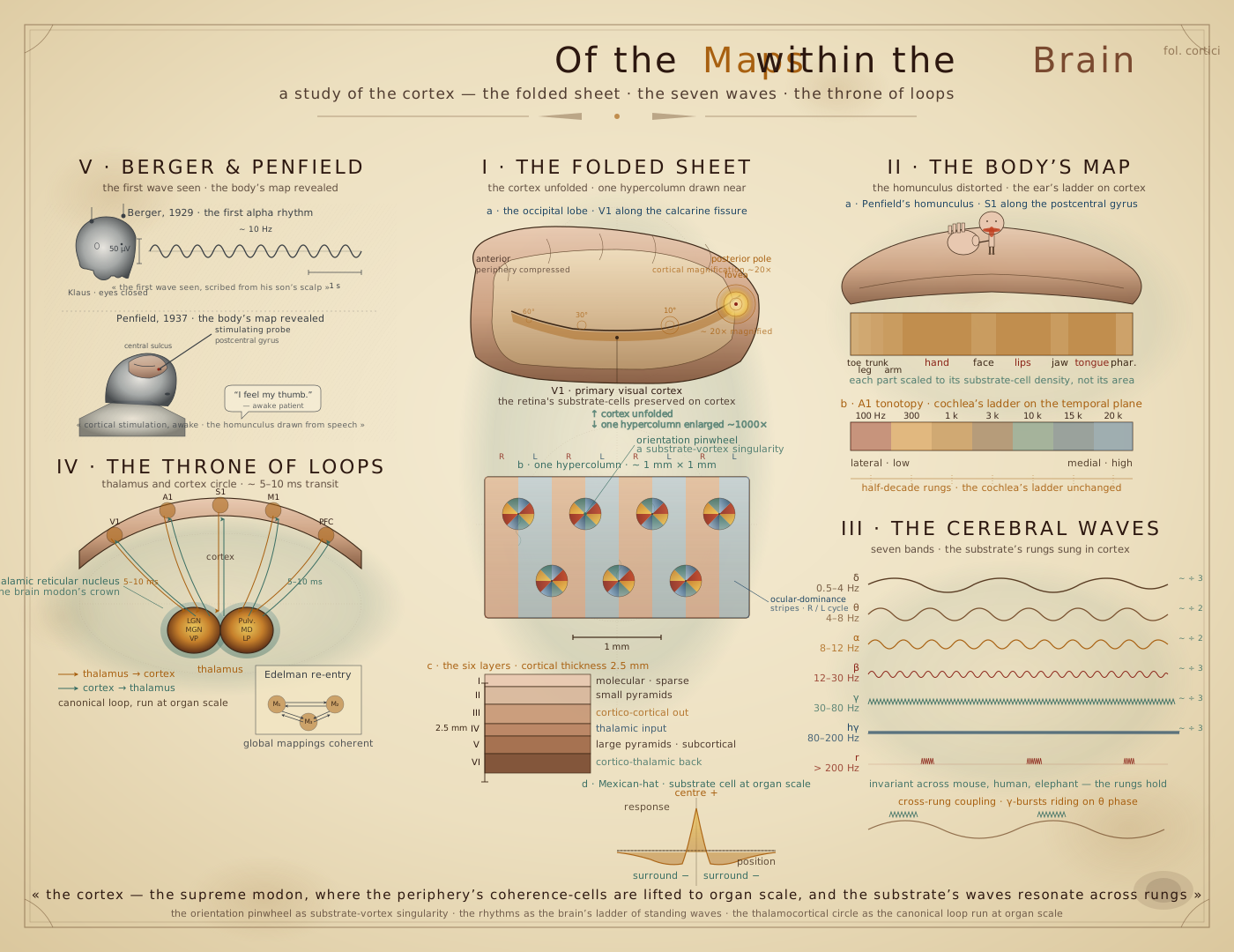
The cerebral cortex is the substrate’s coherence-cell architecture lifted to organ scale, with topographic maps (retinotopy V1, tonotopy A1, somatotopy S1) as the periphery’s substrate-coherence-cells preserved by reciprocal projection into the cortical sheet, cortical columns and hypercolumns as the substrate-coherence-cell tiling at the organ-scale rung, gamma/theta/alpha rhythms as substrate standing-waves at preferred logarithmic frequency rungs, the thalamocortical loop as the canonical loop run at organ scale, the default-mode network as the brain modon’s integrating central body, sleep as the brain modon’s substrate-coherence-quality restoration cycle, and the insular cortex as the brain’s substrate-coherence-readout for the body’s internal coherence state. Each element is structurally parallel to architecture already developed at smaller modon scales — the center-surround coherence-cell at the retina lifted to a Mexican-hat receptive field at V1; the cochlear stiffness-gradient frequency-rung mapped to a tonotopic gradient at A1; the touch chapter’s body-scale antenna network mapped to the somatotopic homunculus; the canonical loop developed across the cellular walk lifted to the thalamocortical circuit at organ scale; the actin cortex and astrocyte syncytium lifted to the DMN at the organ-modon scale; the Q-cycle and glymphatic-flow architecture lifted to slow-wave sleep at the brain’s coherence-restoration rung. Edelman’s re-entrant signalling, in this reading, is biology’s chemistry-side accounting of canonical-loop substrate-current circulation at the inter-cortical-map scale; his global mappings are substrate-coherence-cell assemblies at organ scale; his “remembered present” is the substrate-current integration over the thalamocortical transit time.
Topographic Maps as Substrate-Coherence-Cell Readout at Organ Scale
The cerebral cortex’s defining organisational feature is the topographic map: a region of cortex in which the spatial layout of neurons preserves the spatial layout of the sensory surface that projects to it. The cortex carries at least one such map for each primary sensory modality with a spatially structured periphery.
Primary visual cortex (V1) carries the retinotopic map: each location on the retina projects, through the lateral geniculate nucleus of the thalamus, to a corresponding location on the calcarine cortex of the occipital lobe, with the fovea overrepresented by a cortical magnification factor of \sim 20–40\times relative to the peripheral retina. A 1^\circ of foveal visual field occupies \sim 6 mm of cortex; a 1^\circ at 30^\circ peripheral eccentricity occupies \sim 0.2 mm. The framework reads this as the eye chapter’s substrate-coherence-cell density lifted into cortex: the retina’s centre-surround coherence cells at the fovea have \sim 100\times smaller spatial extent than at the periphery (foveal cones at \sim 2–3\;\mum pitch vs. peripheral cones at \sim 15–30\;\mum), and the cortical magnification factor is the chemistry-side preservation of the number of substrate-coherence cells per unit cortex rather than the number per unit visual angle. The retina’s substrate-coherence-cell readout — Mexican-hat receptive fields, centre-surround — is preserved through retinal-ganglion-cell projection to LGN and through LGN-to-V1 projection, with each V1 hypercolumn implementing the same substrate-coherence-cell architecture the retinal ganglion-cell-receptive-field implements at the periphery, but now equipped with the cortical machinery (orientation columns, ocular-dominance columns, layer-specific connectivity) the next section develops.
Primary auditory cortex (A1) carries the tonotopic map: each cochlear place projects, through the cochlear nucleus, superior olive, lateral lemniscus, inferior colliculus, and medial geniculate nucleus, to a corresponding location on the superior temporal plane of A1, with low frequencies represented laterally and high frequencies medially across \sim 1–2 cm of cortex. The framework reads this as the ear chapter’s basilar-membrane stiffness gradient lifted into cortex: the cochlea’s substrate-preferred logarithmic frequency-rung ladder, mapped onto \sim 35 mm of basilar membrane by the chemistry-side stiffness gradient, is preserved by the auditory pathway’s repeated tonotopic relays and re-expressed as the A1 cortical-frequency gradient at the organ scale. The framework’s prediction here mirrors the ear chapter’s: A1 cortical-frequency-rung clustering on substrate-preferred logarithmic intervals (octave or half-octave rungs) across mammals, distinct from a smooth chemistry-side mapping of cochlear place to cortical location.
Primary somatosensory cortex (S1) carries the somatotopic map: each location on the body surface projects, through dorsal-column nuclei, ventral posterior thalamus, to a corresponding location on the postcentral gyrus, with body parts scaled to their peripheral substrate-coherence-cell density (their two-point-discrimination resolution from touch chapter) rather than their anatomical surface area. The hand, the lips, and the tongue dominate the Penfield homunculus; the trunk and the leg are compressed. The framework reads this as the touch chapter’s mechanoreceptor-density-and-substrate-coherence-cell-tiling structure preserved through the dorsal-column pathway into cortex, with the homunculus’s distortion as the chemistry-side observable of the substrate-coherence-cell-density’s projection through the sensory pathway. The framework predicts a quantitative scaling: S1 cortical area allotted to each body region should be proportional to that region’s substrate-coherence-cell count (its two-point-discrimination spatial-frequency density integrated over its area), distinct from chemistry-side scaling models based on peripheral nerve density alone.
Primary olfactory (piriform) cortex breaks the topographic pattern. The olfactory bulb’s glomerular array — \sim 1800 glomeruli in human, \sim 1800 in mouse — is topotopic in the sense that all OSNs expressing a single odorant receptor project to two glomeruli at stereotyped medial-and-lateral positions in the bulb (the nose chapter developed this). But piriform cortex receives a combinatorial, non-topographic projection from the bulb: each piriform pyramidal neuron receives input from a distributed set of glomeruli, and odorant identity is represented by the combination of co-active piriform cells rather than by a spatially organised map. The olfactory channel is the chemistry-side answer to the cortex’s substrate-coherence-cell-architecture in the absence of a continuous low-dimensional sensory manifold: V1’s retinotopy reflects retinal photoreceptors’ continuous 2D spatial manifold; A1’s tonotopy reflects the cochlea’s continuous 1D frequency manifold; S1’s somatotopy reflects the body surface’s continuous 2D spatial manifold; piriform’s combinatorial coding reflects the discrete OR-family-based decomposition of chemical space at \sim 400 molecular-recognition substrate-coherence cells with no underlying continuous manifold to preserve. Topographic maps are the substrate’s preferred cortical readout when the sensory manifold is continuous; combinatorial codes are the substrate’s preferred cortical readout when the sensory manifold is discrete. The substrate-coherence-cell architecture is preserved across both cases. The chemistry-side cortical implementation chooses between topographic and combinatorial layouts based on the sensory manifold’s geometry.
In Edelman’s re-entrant signalling picture, each cortical map is one global mapping in a network of maps connected by reciprocal projections; perception arises from the integrated re-entrant activity across these maps, not from any single map alone. The framework reads each global mapping as a substrate-coherence-cell assembly at organ scale, and the re-entrant signalling architecture as the chemistry-side implementation of canonical-loop substrate-current circulation across the inter-map interfaces.
Cortical Columns, Hypercolumns, and Mexican-Hat Receptive Fields
Mountcastle’s 1957 columnar finding has held up across half a century of cortical microcircuitry research: cortical neurons sharing functional properties — preferred stimulus orientation, ocular dominance, preferred whisker, tonotopic frequency — are arranged in vertical columns perpendicular to the cortical sheet, with column diameter \sim 100–500\;\mum and the full \sim 2.5 mm cortical thickness organised into six layers (I–VI) with characteristic input-output connectivity. Hubel and Wiesel’s elaboration in V1 added the hypercolumn — the \sim 1 mm \times 1 mm cortical patch containing one full cycle of orientation preferences (0° to 180°) and one full cycle of ocular dominance (right eye, left eye) for one retinotopic position. Barrel cortex (Woolsey and Van der Loos 1970) shows the cleanest one-to-one mapping: in rodent S1, each of the \sim 30 mystacial whiskers projects to a single discrete cortical “barrel” \sim 300\;\mum across, with one-to-one preservation of the whisker array’s topography in the cortical-column architecture.
Cortical columns and hypercolumns are the substrate-coherence-cell tiling architecture at the cortical-organ rung, structurally parallel to the retinal ganglion-cell tiling at the eye, the cochlear hair-cell tiling at the ear, the glomerular array tiling at the bulb, and the mechanoreceptor tiling at the skin. Each is the substrate’s preferred coherence-cell layout at the corresponding modon scale, with the cortical hypercolumn at \sim 1 mm sitting at a substrate-preferred organ-scale rung distinct from the \sim 100–200\;\mum cell-scale rung the retinal ganglion-cell receptive fields sit on. The six-layer laminar architecture is a substrate-preferred small-integer count, parallel to the microtubule’s 13 protofilaments, the axoneme’s 9+2 arrangement, and the three-fold-iterated rungs that recur across the substrate’s preferred geometric structures.
The Hubel-Wiesel simple-cell and complex-cell receptive fields in V1 are the substrate’s Mexican-hat readout lifted from the retina to the cortex. A V1 simple cell’s receptive field has the classical Gabor-function structure — an orientation-tuned excitatory centre flanked by inhibitory side regions — which is the centre-surround Mexican-hat extended into one further dimension (orientation) at the cortical rung. The framework’s reading is that the cortex is not doing fundamentally new substrate computation that the retina did not do; the cortex is doing the same Mexican-hat substrate-coherence-cell readout the retina does, but at a coarser spatial scale, with one extra orientation dimension, and with the substrate-coherence-cell-tiling-density set at the organ-scale hypercolumn rung rather than at the retinal-ganglion-cell scale. The cortex’s value-add is re-entrant integration across multiple such maps — Edelman’s global-mapping architecture — not a different kind of substrate-coherence-cell readout.
The framework predicts that cortical-column dimensions cluster at substrate-preferred values across mammals — hypercolumn diameter near \sim 1 mm, minicolumn diameter near \sim 50–100\;\mum, cortical thickness near \sim 2.5 mm — distinct from a smooth scaling with brain size that an allometric chemistry-side account would predict. Suzana Herculano-Houzel’s cortical-thickness measurements across mammals show striking conservation of cortical thickness within an order of magnitude across \sim 10^4\times variation in total brain mass; the framework reads this conservation as the substrate’s preferred organ-scale-coherence-cell-thickness rung at \sim 2.5 mm.
Gamma, Theta, Alpha as Substrate Standing-Waves at the Brain Rung
The Berger rhythm at \sim 8–12 Hz is the first-recognised member of a now-well-established hierarchy of cortical oscillation bands. György Buzsáki’s Rhythms of the Brain (2006) and the broader oscillation-physiology literature have established at least seven canonical bands: infraslow (<0.5 Hz), delta (0.5–4 Hz), theta (4–8 Hz), alpha (8–12 Hz), beta (12–30 Hz), gamma (30–80 Hz), and high-gamma plus ripples (80–200+ Hz). Each band is associated with characteristic behavioural states (delta with slow-wave sleep, theta with hippocampal exploratory and REM activity, alpha with relaxed wakefulness, beta with motor planning, gamma with active perception and attention, ripples with hippocampal memory consolidation) and with characteristic chemistry-side mechanisms (delta with cortico-thalamic synchronisation, theta with septohippocampal medial-septum input, alpha with thalamocortical reciprocal loops, gamma with fast-spiking PV-positive interneuron networks).
The band structure comes from substrate standing-waves at the brain modon’s organ-scale resonance rungs, with the boundaries between bands at substrate-preferred logarithmic intervals — roughly half-decade ratios, parallel to the conduction-velocity-class structure developed at the cable-modon scale and to the mechanoreceptor frequency-rung structure developed at the body-scale modon. The seven canonical bands span \sim 3 decades from \sim 0.5 to \sim 500 Hz, with band-to-band ratios of \sim 2–3\times, the substrate’s preferred logarithmic rung-spacing across every scale the framework has developed. The brain’s chemistry-side machinery (PV-interneuron networks for gamma, septohippocampal for theta, thalamocortical for alpha) is the substrate’s chemistry-side implementation of standing-wave generation at the corresponding organ-scale rungs. Those \sim 2–3\times band ratios are one to one-and-a-half octaves — two to three rungs of the lattice’s \sqrt{2} half-octave, the substrate ladder — and the column occupies that octave sub-lattice for a reason the next section develops. The prediction sharpens accordingly: resolved cortical spectral peaks should cluster at \sqrt{2} and its powers rather than at arbitrary ratios.
The framework predicts that EEG-band boundaries cluster across mammals at substrate-preferred ratios rather than varying continuously with brain mass, body size, or metabolic rate. A mouse cortex and an elephant cortex run gamma at the same \sim 30–80 Hz, theta at the same \sim 4–8 Hz, and so on — despite \sim 10^5\times variation in cortical surface area, the band structure is approximately species-invariant. The bands are the substrate’s preferred standing-wave rungs at the brain-organ scale, and the chemistry-side machinery is constrained to operate at these rungs by the substrate-physics rather than being free to scale with anatomical size.
Cross-frequency coupling — most prominently theta-gamma nesting in hippocampus, where fast gamma bursts ride on the phase of slow theta cycles — is the framework’s nested-rung architecture expressed in the temporal domain. The framework reads cross-frequency coupling as the substrate’s hierarchical-rung architecture’s chemistry-side observable in cortical activity, structurally parallel to the nested-shell architecture across smaller modon scales (sub-sheet within sheet within wrap). The chemistry-side machinery (PV-interneuron-mediated gamma riding on cholinergic-or-GABAergic theta) implements the nesting; the substrate-physics reading is that the multi-rung organisation is the substrate’s preferred temporal-organisation across scales, with chemistry filling in the specific implementation at the brain rung.
How the Column Chains the Bands
The band hierarchy above is the substrate ladder read in time, and the substrate-ladder chapter leaves a tension the cortical column is the natural place to resolve. Folded against the lattice’s \sqrt{2} comb, the named EEG band edges only half-oblige — the low edges (0.5, 4, 8 Hz) land on comb teeth, the higher ones scatter. The resolution is that the cortex does not read the comb passively: the cortical column is the structure that selects and chains the rungs, and band edges — human round numbers, dynamically re-set by cortical state — were never the substrate’s prediction in the first place. The substrate predicts where resonant peaks fall and what their ratios are. Two facts about how the column chains them turn the half-obliging edges into the expected signature rather than a failed prediction.
First, the column lays the rungs out in physical space. The laminar-oscillation literature (Buffalo, Fries, Landman, Buschman, and Desimone 2011; Bastos and collaborators 2015 onward; Mejías and collaborators 2016) finds a frequency gradient through cortical depth: gamma is generated in the superficial layers (II/III) and carries feedforward signals, while alpha and beta are generated in the deep layers (V/VI) and carry feedback. Fast on top, slow on the bottom. This is Buzsáki’s general principle — slower oscillations engage larger networks — read at the scale of a single column: the superficial layers run small, local recurrent loops (fast); the deep layers run the long-range cortico-thalamic and cortico-cortical loops (slow). Loop spatial extent and frequency are inverse, so a column whose loop sizes are \sqrt{2}-spaced substrate rungs is a \sqrt{2}-spaced frequency comb, stacked through the \sim 2.5 mm of cortical depth. The column does not host the bands side by side; its laminar architecture is the ladder, one rung per loop scale — the substrate-coherence-cell tiling of the previous section now read in the frequency domain.
Second, the column occupies a sub-lattice of the comb, and which sub-lattice depends on what it is doing. A nesting hierarchy — one band’s cycle containing a whole number of the next band’s cycles — requires integer ratios, and the cleanest integer ratio that is also a power of \sqrt{2} is the octave, \sqrt{2}^{\,2} = 2. So when the cortex binds, it locks adjacent rungs at octaves: Lisman and Idiart’s (1995) theta-gamma code rides a whole number of gamma cycles on each theta cycle, sharpened by Belluscio and collaborators (2012) to literal integer 1{:}5 and 1{:}9 phase-phase ratios between theta and the gamma sub-bands. When the cortex rests, the opposite design goal takes over: Pletzer, Kerschbaum, and Klimesch (2010) find adjacent band centers at the golden ratio \varphi \approx 1.618 — the most irrational number, chosen precisely so the bands cannot lock and can coexist without interference. These are the two faces of the ladder the substrate chapter already names: the octave that nests and the half-octave \sqrt{2} — the tritone, the comb’s own axis of symmetry — that refuses to. The EEG bands sit roughly an octave apart not because the substrate comb is coarse but because the column, chaining the rungs by cross-frequency coupling, occupies the locking sub-lattice — every second rung — and slides toward the non-locking interval at rest. The \sim 2–3\times band ratios are one to one-and-a-half of those octaves.
This is where the framework’s prediction meets an independent literature, and the convergence is the part worth flagging. Penttonen and Buzsáki (2003) showed that the center frequencies of the oscillation classes form a geometric progression — a straight line on a natural-logarithmic axis — conserved across mammals, exactly the log-spaced ladder the substrate predicts. The debate within that literature is only over the ratio: Buzsáki’s group reads it as \approx e \approx 2.7 between named bands; Klimesch’s group reads the fine structure as the golden ratio \varphi \approx 1.62 between sub-bands; and van Albada and collaborators (2013) reconciled the two by noting that \varphi^2 \approx 2.62 \approx e — the named band is two fine steps. That is structurally identical to the substrate ladder’s own claim that the octave is two half-octaves: a two-tier geometric architecture, a fine rung and a band that is two of them. The neurophysiology, built from the data, and the substrate, built from the pairing factor, arrive at the same shape.
What the two do not yet share is the fine rung’s value. The substrate’s half-octave is \sqrt{2} = 1.414; the resting-EEG fine ratio is \varphi = 1.618. Both are small irrational ratios near the half-octave, both are non-locking intervals — \sqrt{2} the tritone, \varphi the most irrational number — and they differ by \sim 14\%, with the entire substrate-versus-data discrepancy reducing to this one number (the band-ratio gap, 2 versus 2.6, is just its square). That is the sharp, honest test the column hands the ladder: not whether convention-set band edges fall on \sqrt{2} teeth, but whether the peak ratios in high-resolution cortical spectra cluster at \sqrt{2} and its octave — or at \varphi. If \sqrt{2}, the bands are the substrate’s pairing factor read in time; if \varphi, the brain has chosen the most irrational number over the substrate’s geometry, and the resting ladder is the column’s own optimization rather than the substrate’s. Either way, the geometric ladder itself — once merely “the bands should cluster” — is now an independently established fact.
A first measurement. The test no longer hangs entirely in the future. A first pass has been run on resolved spectral peaks: 109 subjects of eyes-closed resting EEG from the PhysioNet archive, each spectrum parameterized into oscillatory peaks (FOOOF; Donoghue and collaborators 2020), one representative peak per band per subject, and the inter-band ratios folded against all three combs (scripts/comb_test.py). The result is clarifying, and it does not simply confirm the substrate. The octave structure is robust — the bands step by factors near two, the nesting sub-lattice — and because the octave is the \sqrt{2} comb’s second tooth (2 = \sqrt{2}^{\,2}), the full set of ratios appears at first to favour \sqrt{2}. But that apparent win is the octave in disguise: re-folding only the sub-octave fine structure, where \sqrt{2} and \varphi actually diverge, the fine ratio lands on \varphi, not \sqrt{2} (p < 10^{-4}, with \sqrt{2} rejected). To the precision this dataset allows, the resting cortex has chosen the most irrational number. That is the \varphi branch of the test above, and it is the reading the framework holds without strain: the octave — the nesting rung — is the substrate’s, shared with the cochlea and the grid; the fine desync interval is the column’s own, tuned to the number that refuses to lock rather than to the substrate’s pairing factor. The substrate sets the rungs a structure may occupy; at rest the cortex spaces its rhythms to keep them apart, and the spacing it chooses is \varphi. The caveats keep this a lean, not a verdict — the per-band representatives are shaped by the conventional band edges, the recording is alpha-dominated occipital EEG, and the decisive version wants a band-free peak assignment on a larger cohort (the 228-subject LEMON archive; WIP-26) — but the direction is now data, not conjecture: where \sqrt{2} and \varphi part ways, the first measurement goes to \varphi.
The chaining has a name in the substrate’s own terms. Cross-frequency coupling — the slow phase holding while the fast amplitude is handed off cycle by cycle — is the anti-phase breath at the brain rung, the coin the ladder’s small economy spends: the column is a stack of structures pinned to \sqrt{2}-spaced rungs, trading the lossless exchange up and down the ladder. Theta-gamma nesting is that trade made visible — the canonical loop of the next section, run not once but as a chained hierarchy across the column’s frequency rungs.
The Thalamocortical Loop as Canonical Loop at Organ Scale
Every primary cortical area has reciprocal projections to a corresponding first-order thalamic relay nucleus — V1 with the lateral geniculate nucleus (LGN), A1 with the medial geniculate nucleus (MGN), S1 with the ventral posterior nuclei (VPL/VPM), motor cortex with the ventral lateral nucleus (VL). Each first-order nucleus relays the periphery’s input to its corresponding cortical area through layer-IV-targeting axons, and each cortical area sends a massively reciprocal layer-VI projection back to its thalamic nucleus, creating a cortico-thalamo-cortical loop with transit times of \sim 5–10 ms per round trip. The thalamic reticular nucleus, a thin GABAergic shell wrapping the thalamus, gates these loops through inhibitory projections onto thalamic relay neurons. Higher-order thalamic nuclei (the pulvinar in vision, the mediodorsal nucleus in prefrontal areas, the lateral posterior nucleus in associative areas) carry cortico-thalamo-cortical loops between cortical areas, with cortical area A projecting to the higher-order nucleus and the nucleus projecting back to cortical area B, implementing inter-cortical communication through a thalamic relay rather than through direct cortico-cortical projections alone. Edward Jones, S. Murray Sherman, and others have developed this architecture systematically since the 1990s; it is now recognised as the canonical thalamocortical-loop motif across mammalian cortex.
The framework reads the thalamocortical loop as the canonical loop run at organ scale. The cellular walk developed the canonical loop as the substrate-current-circulation architecture recurring across cellular machinery — the microtubule highways at cytoskeletal scale, the Q-cycle at respiratory scale, the vesicle traffic cycle at membrane-traffic scale, the Golgi cycle at protein-processing scale. Each is a substrate-current loop with a defining transit time, a substrate-coherent intermediate state at the loop’s midpoint, and chemistry-side machinery implementing the cycling. The thalamocortical loop is biology’s chemistry-side implementation of the canonical loop at the brain-organ scale — substrate-current packets cycle between cortex and thalamus on the \sim 5–10 ms transit time, the thalamus serving as the substrate-coherent intermediate state (the “subcortical hub” that integrates re-entrant signals across cortical maps), and the GABAergic thalamic-reticular-nucleus serving as the chemistry-side coherence-gate at the loop’s midpoint.
Edelman’s re-entrant signalling is, in this reading, the inter-cortical-map application of the canonical loop. Edelman framed re-entry as the architecture by which multiple cortical maps maintain coherence with each other — V1 with the dorsal-stream “where” map, V1 with the ventral-stream “what” map, S1 with M1, S1 with parietal multimodal areas — through massively reciprocal projections that allow each map’s state to be continuously updated by the others. The framework reads each re-entrant pathway as a canonical loop instance at the inter-map scale, with the higher-order thalamic nuclei (pulvinar, mediodorsal, lateral posterior) as the substrate-coherent intermediate states and the cortico-thalamo-cortical transit times as the loop-cycle timescales. The brain’s organisation is, in this reading, a hierarchy of canonical loops at multiple temporal rungs: \sim 1 ms at the single-synapse rung, \sim 10 ms at the local cortico-cortical rung, \sim 50–100 ms at the thalamocortical and global-mapping rungs, \sim 1–10 s at the working-memory rung, \sim 100 s at the contextual rung. Each rung is the canonical loop’s substrate-coherent intermediate state at the corresponding spatial scale.
The “remembered present” — Edelman’s name for the integrated perceptual state that the brain produces in real time — is the substrate-current integration over these nested canonical-loop transit times. The present is remembered because the brain reads its sensory state through canonical-loop cycles whose transit times extend into the past by the loop-cycle duration; the longest loops integrate sensory state across \sim 100 ms or more. The framework’s substrate-physics reading is that consciousness is the substrate-coherent state these nested canonical loops maintain at the brain-organ scale — not a separate module the brain has somewhere, but the substrate-coherent integration of all the canonical-loop activity the brain runs simultaneously.
The Default-Mode Network as Integrating Modon
Marcus Raichle and colleagues in 2001 identified the default-mode network (DMN): a set of cortical regions whose activity is highest at rest and decreases during externally-directed cognitive tasks. The DMN’s anatomical components are now well-established: the posterior cingulate cortex / precuneus, the medial prefrontal cortex, the angular gyrus / inferior parietal lobule (bilaterally), and the lateral temporal cortex. The DMN is anatomically and functionally distinct from the task-positive network (dorsolateral prefrontal, intraparietal, and frontal eye-field areas) which engages during externally-directed attention. The DMN’s components are recruited by internally-directed cognition: spontaneous thought, autobiographical memory retrieval, self-referential processing, theory-of-mind reasoning, future projection. The DMN’s intrinsic activity is detectable at \sim 0.01–0.1 Hz fluctuations in fMRI BOLD signal — the resting-state functional connectivity organising principle that has restructured systems neuroscience since the mid-2000s.
The framework reads the DMN as the brain modon’s integrating central body — the cortex region where the organ-scale substrate-coherence state is maintained as the brain’s default coherent representation of itself. The DMN is structurally parallel to the nucleus of the cell modon, the matrix of the mitochondrial modon, the lumen of the ER modon — the substrate-coherent interior volume of the modon at the corresponding scale, where the modon’s central coherent state is preserved against external perturbation. The cortex’s task-positive network engages during externally-driven cognition; the DMN engages during the brain’s self-coherent default operation. The DMN’s \sim 0.01–0.1 Hz fluctuation timescale is the brain modon’s substrate-coherent breathing frequency at the organ scale — one rung below all the cortical-rhythm bands above, sitting on the substrate’s preferred logarithmic-rung ladder at the slowest brain-organ-scale rhythm.
Edelman’s dynamic core (developed with Giulio Tononi in A Universe of Consciousness, 2000) is the framework’s natural language for the DMN’s role. The dynamic core is the rapidly-shifting set of cortical regions whose substrate-coherent activity defines the moment-to-moment integrated state of consciousness; the DMN is the anatomical scaffold on which the dynamic core’s substrate-coherent state is preserved across the brain modon’s organ-scale rest activity. The framework’s substrate-physics reading is that the DMN is the brain’s chemistry-side implementation of a substrate-coherent integrating volume at organ scale, with the chemistry-side machinery (the long-range cortico-cortical and cortico-thalamic projections connecting the DMN’s components into a functionally-coupled assembly) as the substrate-coupling architecture that maintains the integration.
Sleep as Substrate-Coherence-Quality Restoration at Organ Scale
The brain cycles between waking, non-REM (slow-wave) sleep, and REM sleep on a \sim 90 min ultradian cycle, with \sim 4–5 such cycles per night. Slow-wave sleep (Stages N3) shows the highest-amplitude lowest-frequency cortical EEG, with dominant delta (0.5–4 Hz) and the slow oscillation (<1 Hz) across the cortex, indicating global synchronisation of cortical activity into a single low-frequency standing wave. REM sleep shows desynchronised cortical activity resembling waking, but with characteristic PGO waves (pontine-geniculate-occipital), rapid eye movements, and skeletal muscle atonia. The neuron chapter teased the glymphatic clearance system — bulk cerebrospinal-fluid flow through brain parenchyma along perivascular spaces, identified by Nedergaard’s group in 2012-13 — as a substrate-coherence-restoration mechanism at the brain-modon scale, with glymphatic flow increasing \sim 60\% during sleep and clearing metabolic waste (including amyloid-β at \sim 2\times the daytime rate).
The framework reads sleep as the brain modon’s substrate-coherence-quality restoration cycle at organ scale, with slow-wave sleep as the substrate-coherence-renormalisation phase (global synchronisation re-establishes the brain modon’s substrate-coherent baseline state) and REM sleep as the substrate-coherence-reintegration phase (re-entrant cortical activity re-runs the day’s global mappings to consolidate substrate-coupling-strength changes from waking experience). The glymphatic system is the chemistry-side implementation of the substrate-coherence-quality renewal mechanism at the brain-modon’s coherence-boundary cortex — the astrocyte syncytium developed in the neuron chapter — running its substrate-coherent fluid-flow circulation while the brain modon’s cortical activity is globally synchronised into the slow-wave state. The framework reads slow-wave sleep’s <1 Hz global oscillation as the brain modon’s coherence-restoration breathing frequency, structurally parallel to (and one rung slower than) the DMN’s \sim 0.01–0.1 Hz resting-state fluctuation.
The framework’s prediction here is that the slow-wave-sleep global-oscillation frequency clusters at a substrate-preferred sub-Hz rung across mammals, and that glymphatic clearance rate shows discrete state transitions on substrate-preferred temporal rungs rather than smooth state-dependent variation. The Walker-laboratory and Stickgold-laboratory memory-consolidation literature (showing discrete sleep-stage-dependent enhancements of declarative and procedural memory) provides the data series the framework predicts shows substrate-rung discreteness.
The Insular Cortex and the Body-Energy Lift
The touch-and-proprioception chapter closed with a teaser: body energy — the substantive phenomenology of interoception developed across contemplative and somatic traditions (qi, prana, ki, mana; acupuncture meridians; somatic-experiencing body-awareness practices) — read as trained extended attention accessing substrate-coherent body-internal signal already physically present in the substrate. The chapter explicitly parked this lift at the brain arc. It lifts here.
Bud Craig’s series of papers from 2002 onward established the insular cortex — the cortex region buried in the lateral sulcus, distinct from the somatosensory cortex on the postcentral gyrus — as the brain’s interoceptive cortex. The insular receives ascending input from spinal lamina I (the dorsal-horn interoceptive afferent stream), from the nucleus of the solitary tract (visceral afferents from cranial nerves IX and X), and from the parabrachial nucleus (mid-brainstem interoceptive relay), all routed through specific thalamic nuclei (ventral posterior parvocellular, mediodorsal, ventral medial). The posterior insular receives the primary afferent stream; the anterior insular integrates this interoceptive map with limbic and prefrontal areas; the anterior insular is the most consistently activated cortical region in feeling states reported across emotional, autonomic, and bodily-awareness tasks. Antonio Damasio’s somatic-marker hypothesis and Stephen Porges’s polyvagal theory both rest on the insular’s role in mapping body-internal state to subjective experience.
The framework reads the insular cortex as the brain modon’s substrate-coherence-readout for the body’s internal coherence state, structurally parallel to S1’s reading of the body’s external surface state but operating on a different ascending sensory pathway. Penfield’s homunculus is the exteroceptive map; the insular has the interoceptive map — a topographically organised representation of the body’s internal-organ, cardiovascular, respiratory, muscular, and visceral state preserved across the posterior-to-anterior insular gradient. The framework’s reading is that interoception is not a vague awareness of internal sensations; it is the brain’s substrate-coherence-readout of a body-scale substrate-coherent signal already physically present in the substrate, channelled through specific ascending pathways and represented in a specific cortical territory.
The contemplative-tradition body-energy frameworks (qi in Chinese medicine, prana in Vedic traditions, ki in Japanese aikido / kotodama traditions, mana in Polynesian traditions) read here as trained extended attention to the insular cortex’s substrate-coherent interoceptive signal. Acupuncture meridians, the framework predicts, map onto fascial planes and neurovascular bundles where the body’s substrate-coherent internal signal is most accessible to peripheral sensors — the chemistry-side physical channels that the insular cortex reads. The substrate-physics reading does not invalidate the chemistry-side neuroanatomy (every body-energy practice operates through known ascending pathways into the insular and through the descending autonomic regulation those pathways enable); the framework reads body-energy as the substantive substrate-coherent component of the signal these pathways carry, distinct from but not separable from the chemistry-side neural transmission. The trained attention shifts what the brain’s resource allocation reads as figure versus ground in the insular’s interoceptive map; the body-energy phenomenology is the substrate’s substantive presence in the interoceptive signal made conscious through trained attention.
This is the same architectural move the touch chapter made for the peripheral mechanoreceptor array — interoception is not a sense in the standard exteroceptive list (vision, audition, touch, taste, smell) because it is the body modon’s self-sensing, not the body’s sensing of an external environment. The brain’s substrate-coherent representation of the body’s substrate-coherent internal state is the substrate’s most coherent self-sensing organisation biology has built; the contemplative-tradition body-energy practices are biology’s chemistry-side training-protocol for accessing this representation consciously.
Predictions and What Would Falsify
Four predictions extend the organ-scale substrate reading beyond the structural anchors.
Cortical-rhythm spectral peaks cluster on a \sqrt{2} comb, octave-spaced where they nest. The prediction is about resolved spectral peaks and their ratios, not convention-set band edges: across mammalian species spanning \sim 10^5\times variation in cortical surface area, the dominant rhythms should sit on the octave sub-lattice of the \sqrt{2} comb (factors of \sim 2, sharpened to integer ratios where cross-frequency coupling nests them), distinct from a smooth scaling with brain mass or metabolic rate. The decisive sub-test is the fine ratio — whether resting-state adjacent-rung spacing is the substrate’s \sqrt{2} = 1.414 or the most-irrational \varphi = 1.618 that the resting-EEG literature reports (Pletzer, Kerschbaum, and Klimesch 2010), a \sim 14\% difference a high-resolution spectral measurement can resolve (a first pass on 109 subjects of resting human EEG already leans \varphi for the fine ratio, with the octave structure on the comb — see How the Column Chains the Bands). Penttonen and Buzsáki’s (2003) geometric-progression analysis and cross-species comparative-EEG data (primate, rodent, cetacean, carnivore) provide the test; the framework predicts clustering on the \sqrt{2} comb.
Cortical-column and hypercolumn dimensions cluster at substrate-preferred organ-scale rungs across mammals. Hypercolumn diameter (\sim 1 mm), minicolumn diameter (\sim 50–100\;\mum), cortical thickness (\sim 2.5 mm), and layer counts (6) should hold near these values across mammalian cortices spanning \sim 10^4\times variation in total cortical surface area, distinct from a smooth allometric scaling with brain size that a metabolic-cost chemistry-side argument would predict. Existing comparative cytoarchitectonic data (Brodmann, Vogt, Mountcastle, Herculano-Houzel) provides the test; the framework predicts substrate-preferred clustering distinct from continuous allometric scaling.
Thalamocortical-loop transit times cluster at substrate-preferred temporal rungs. First-order cortico-thalamo-cortical transit times (\sim 5–10 ms) and higher-order inter-areal transit times (\sim 30–100 ms) should cluster at preferred values across mammals rather than vary smoothly with axon length or myelination — a substrate-preferred temporal-rung structure parallel to the conduction-velocity-class structure at the single-cable scale, but at the inter-modon-loop scale. Existing thalamocortical-recording literature (the Sherman-Guillery survey, Llinás-and-collaborators recordings) provides the test; the framework predicts cross-species clustering on preferred ms rungs.
Interoceptive-accuracy correlates with substrate-coherence-quality biomarkers beyond attention-control models. Trained meditators, somatic-experiencing practitioners, and contemplative-tradition adepts should show measurable enhancements in heart-rate variability (HRV), EEG cross-frequency coupling indices, default-mode-network coherence in resting-state fMRI, and other proposed substrate-coherence-quality biomarkers, beyond what attention-control-and-emotion-regulation models predict, with effect sizes scaling with self-reported and behavioural interoceptive-sensitivity measures. The Khalsa-and-colleagues interoception literature, the Davidson-laboratory contemplative-neuroscience work, and the Porges polyvagal literature provide existing data series; the framework predicts substrate-coherence-biomarker-correlated training effects distinct from chemistry-side attention-and-regulation training alone.
The picture is falsified if (a) cortical-rhythm spectral peaks vary smoothly with brain mass or species without \sqrt{2}-comb clustering, (b) cortical-column dimensions scale allometrically with brain size without preferred-rung structure, (c) thalamocortical transit times vary continuously without preferred-temporal-rung clustering, or (d) interoceptive-training effects reduce entirely to attention-control and emotion-regulation effects without substrate-coherence-biomarker enhancement. It is supported, even partially, if any of the four ordering predictions hold against existing comparative-neuroanatomy, electrophysiology, or contemplative-neuroscience data.
Putting the Section in Context
The cerebral cortex is the substrate’s coherence-cell architecture lifted to organ scale. Topographic maps (retinotopy V1, tonotopy A1, somatotopy S1) preserve the periphery’s substrate-coherence-cell tiling through reciprocal thalamocortical projections, with cortical magnification factors reflecting the peripheral substrate-coherence-cell-density rather than peripheral spatial area, with combinatorial coding in piriform cortex as the substrate’s chemistry-side answer when the sensory manifold is discrete rather than continuous. Cortical columns and hypercolumns at \sim 100\;\mum and \sim 1 mm are substrate-preferred organ-scale coherence-cell tilings, with the six-layer laminar architecture as a substrate-preferred small-integer count parallel to other geometric invariants across the framework. Mexican-hat receptive fields in V1 are the substrate’s coherence-cell readout architecture lifted from retina to cortex unchanged in kind, with the cortex’s value-add as re-entrant integration across multiple maps rather than as a different substrate-readout mechanism. Gamma, theta, alpha, and the broader band hierarchy are substrate standing-waves at the brain modon’s organ-scale resonance rungs, with band boundaries at substrate-preferred logarithmic intervals (half-decade rungs) approximately invariant across mammals despite \sim 10^5\times cortical-size variation. The thalamocortical loop is the canonical loop run at organ scale, with \sim 5–10 ms transit times at the first-order rung and \sim 30–100 ms at the higher-order inter-cortical-map rung, and with Edelman’s re-entrant signalling and global mappings as biology’s chemistry-side accounting of canonical-loop substrate-current circulation at organ scale. The default-mode network is the brain modon’s integrating central body — substrate-coherent interior volume at organ scale, parallel to nucleus, matrix, and lumen at smaller scales — with the Edelman-Tononi dynamic core as the substrate-coherent state preserved across the DMN’s anatomical scaffold. Sleep is the brain modon’s substrate-coherence-quality-restoration cycle, with slow-wave global synchronisation as the substrate-coherence-renormalisation phase, REM as the substrate-coherence-reintegration phase, and the glymphatic system as the chemistry-side coherence-quality renewal mechanism at the brain modon’s astrocyte-cortex. The insular cortex is the brain’s substrate-coherence-readout for the body’s internal coherence state, with the contemplative-tradition body-energy practices as trained extended attention to the substrate-coherent interoceptive signal physically present in the substrate.
The Brain as Substrate Resonator walk now has the brain’s organ-scale substrate reading at the cable, the synapse, and the cortex. What the cortical-maps-and-rhythms chapter adds is the reading that the brain’s distinctive architectural feature — the topographic-map-and-rhythm-and-loop organisation across \sim 10^{11} cable modons interconnected by \sim 10^{15} boundary-matching couplings — is the substrate’s preferred organ-scale instantiation of all the substrate-physics tools the framework has developed across the cellular and perception walks: coherence-cell tiling, canonical loops, standing-wave resonance, regulated-jet interfaces, coherence-boundary cortex, and substrate-coherence-quality restoration cycles, all running together at the highest modon scale biology has built. Edelman’s reading — the brain as a re-entrant integrating network of selected neural-group maps — is the substrate framework’s natural chemistry-side language for what the brain does at organ scale; the substrate-physics layer adds the reading that the maps are substrate-coherence-cell assemblies, the re-entry is canonical-loop substrate-current circulation, and the “remembered present” is the substrate-current integration over the brain modon’s nested-loop transit times.
The walk closes at microtubule coherence revisited, where the \sim 10^{16} microtubule cylinders inside the brain’s \sim 10^{11} neurons return as the Penrose-Hameroff question reframed against the substrate-locked closed-cylindrical-modon reading. The cortical-maps-and-rhythms chapter has developed the substrate’s organ-scale architecture; the microtubule chapter takes the substrate’s smallest coherent-cylindrical-modon scale inside the brain’s neurons and asks what role, if any, this rung plays in the brain’s substrate-coherent integration. The brain arc closes there with the framework’s most explicit speculation flag, parallel to the aromatic pocket chapter’s and lifetime of the stamp chapter’s style.