Emergent Speed of Light
The Claim
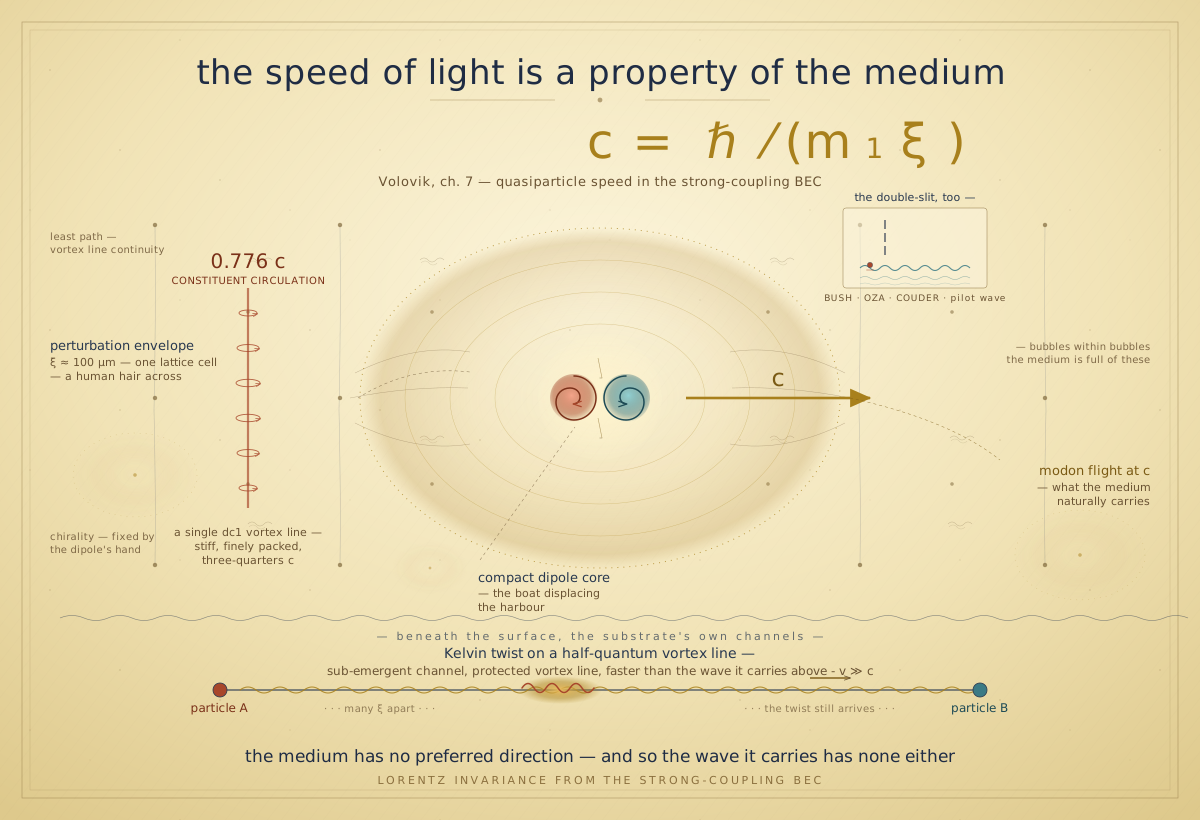
The speed of light emerges as the maximum propagation speed of quasiparticle excitations in the dc1 condensate, determined by the dc1 mass and the coherence length:
\boxed{c = \frac{\hbar}{m_1 \cdot \xi}}
This comes from the dc1 rotational velocity of \approx 0.776c, and the modon’s self-advecting stream.
The Volovik Route
With Volvik’s analysis of quasi particle spectra in BCS-BEC superfluids, the strong-coupling limit, where the gap energy \Delta_0 exceeds the Fermi energy E_F — the quasiparticle spectrum is automatically Dirac-like:
E^2 = \mu^2 + c^2 p^2
with a single isotropic speed c = \hbar/(m_1 \xi). The speed is set by the interaction energy of the condensate, not by any constituent particle velocity.
The inner-scale circulation velocity v_\text{rot,inner} = 0.776\,c and the outer-scale lattice rotation v_\text{rot,outer} = 0.0025\,c are both well below c — just as the speed of sound in a superfluid can far exceed the velocity of individual atoms.
Combined with the dark matter density relation n_1 m_1 = \rho_{DM} and close-packing (n_1 \xi^3 \approx 1), the Volovik formula determines both the coherence length and the dc1 mass from measured constants:
\xi = \left(\frac{\hbar}{\rho_{DM} \cdot c}\right)^{1/4} \approx 110\;\mu\text{m}, \qquad m_1 = \left(\frac{\hbar^3 \rho_{DM}^3}{c^3}\right)^{1/4} \approx 2\;\text{meV}/c^2
These are the values quoted in Substrate Particles — they follow from this route.
On the scale these values imply. A cell at \xi \approx 100\;\mum means the substrate’s effective “Planck length” — the scale where its emergent spacetime dissolves into microstructure — is macroscopic, and that will strike any reader raised on quantum gravity as the framework’s most radical number. Two results from the same sources say it is the expected kind of number, not an exotic one. Volovik’s methodological principle is that vacuum thermodynamics “operates in the infrared limit and is independent of the ultraviolet cutoff” — the macroscopic laws do not know where the UV lives — and when he computes the acoustic Planck constants of superfluid ^4He explicitly, the acoustic Planck length comes out at the interatomic distance ([R156]): in his own laboratory analog, the effective Planck scale is a property of the medium, discovered empirically, and enormously larger than any “fundamental” scale of the phonon theory. Zloshchastiev states the same conclusion from the equation-of-state side ([R151]): the vacuum superfluid’s mass, density, and coupling are open parameters that need not be Planckian, locatable only by measurement. The substrate’s answer to “where does the cutoff sit?” is the three measurements that agree: \rho_\text{DM}, the Higgs VEV, and the solar-wind ceiling. The medium told us; \xi \approx 100\;\mum is what it said. (The full superfluid–spacetime correspondence this chapter’s acoustic metric belongs to is stated canonically in Zloshchastiev’s emergent-metric derivation [R149].)
Why the BEC regime is guaranteed. The dc1 thermal de Broglie wavelength (\sim 1.3 mm at CMB temperature) exceeds the interparticle spacing (\sim 115\;\mum) by an order of magnitude, placing the substrate deep in the quantum-degenerate regime. The BEC condition \Delta_0 \gg E_F is automatically satisfied. No fine-tuning is required.
Lorentz invariance from the BEC regime. In the strong-coupling limit, the quasiparticle spectrum is automatically isotropic: c_\parallel = c_\perp = c. There is no anisotropy to tune away. This is the substrate’s physical origin of Lorentz invariance — the BEC regime produces a single light cone with no preferred direction. Compare He-3-A (weak coupling), where c_\perp/c_\parallel \sim 10^{-5}. The substrate must be in the opposite regime, and it is.
All low-energy excitations share this speed. Scalar modes (phonons), vector modes (modons/photons), and tensor modes (gravitational wave metric perturbations) all inherit the same isotropic c from the BEC medium. GW170817 confirmed |c_\text{GW}/c - 1| < 6 \times 10^{-15}; the substrate predicts exact equality.

Figure: All modes, one speed. The three excitation types of the dc1 condensate — scalar (a phonon: a radial compression wave), vector (a modon/photon: a self-advecting counter-rotating dipole), and tensor (a gravitational wave: the + and \times metric polarizations) — all ride the single isotropic speed fixed by the stiff equation of state P = \rho c^2. GW170817 measured |c_\text{GW}/c - 1| < 6 \times 10^{-15}; the substrate predicts exact equality.
Lorentz Invariance in Three Dimensions

Figure: Lorentz invariance as a least-energy hand-off. The modon and the medium are the same dc1 superfluid, breathing at frequency f_0. The vortex pair slips cell-to-cell between breaths, in anti-phase, advancing one cell per cycle so that v = f_0\,\xi = c. The hand-off works the same whether the modon moves through a chirality-coherent sheet (in-plane) or across the stack (perpendicular) — equal speeds in both directions mean a single spherical light cone. This is the intuitive companion to the three rigorous arguments below: the isotropic BEC spectrum, the \xi-scale envelope, and the single-speed equation of state all say the same thing.
The substrate’s vortex lattice is organized into chirality-coherent 2D sheets — same-chirality lattice sites forming triangular arrays within each plane, with counter-rotating vortex layers between them (see Higgs Field). This layered structure is manifestly anisotropic: there is an in-plane direction and a stacking direction. Yet the modon propagates at c in all directions, not just within a single sheet. Three independent arguments guarantee this.
1. The BEC spectrum is isotropic. The Volovik quasiparticle dispersion E^2 = \mu^2 + c^2 |\mathbf{p}|^2 depends on |\mathbf{p}|, not on the direction of \mathbf{p}. This is a property of the BEC ground state itself — in the strong-coupling limit, the condensate has no preferred axis, and the speed c = \hbar/(m_1\xi) is the same in every direction. The layered structure is a feature of the vortex lattice sitting in the BEC, not of the BEC’s own dispersion relation. Compare: sound in a crystal propagates isotropically at long wavelengths even though the crystal lattice is discrete. The BEC condensate is the “long-wavelength medium” of which the vortex lattice is a microstructure.

Figure: One light cone, or many? The quasiparticle velocity surface in momentum space. In the strong-coupling BEC the spectrum depends only on |\mathbf{p}|, so the surface is a circle — one speed in every direction, a single spherical light cone. Weak-coupling He-3-A, by contrast, has a strongly anisotropic gap with point nodes (c_\perp/c_\parallel \sim 10^{-5}) and no single light cone. The substrate’s de Broglie wavelength (\sim 1.3 mm) far exceeds its interparticle spacing (\sim 115\;\mum), so \Delta_0 \gg E_F holds automatically: it sits in the left-panel regime.
2. The modon envelope is larger than the lattice layers. The modon’s perturbation envelope — the region where the L-R solution transitions from interior Bessel oscillation to exterior exponential decay — has radius \xi \sim 100\;\mum. This is the matching boundary, not the energy concentration: the modon’s energy is concentrated in a compact dipole core (the two counter-rotating vortex centers), much smaller than ξ. Think of a boat in a harbor: the boat is compact, but its wake displaces the entire basin. The ξ-scale envelope is the wake. The inter-sheet spacing h is much smaller than ξ — the near-cancellation between counter-rotating layers requires \omega_0/\Omega_\text{sheet} \sim (h/\xi) \cdot \epsilon_\text{chirality} \sim 10^{-3}, placing h well below \xi. At the modon envelope’s scale, the layered structure averages out: the modon does not resolve individual sheets, just as an ocean wave does not resolve individual water molecules. This is the same dimensional crossover identified by Blatter et al. (1994) for vortex lattices in layered superconductors: the tilt modulus c_{44} exhibits a crossover from 2D behavior at short wavelengths (k \gg 1/h) to 3D isotropic behavior at long wavelengths (k \ll 1/h). The modon’s envelope lives entirely in the isotropic regime.

Figure: The “boat in the harbor” effect. Reading left to right as a zoom-out: at the core scale the modon’s energy is a compact vortex dipole and the chirality-coherent 2D sheets are fully resolved; through the crossover at the inter-sheet spacing h the layers blur and the perturbation envelope forms; at the envelope scale \xi \approx 100\;\mum the layering has averaged into a smooth, isotropic medium. Because the \xi-wide wake is far larger than the inter-sheet spacing (h \ll \xi), the modon never resolves the lattice and propagates at c in every direction. The fourth panel is what the envelope does not hold: the modon’s phase leaks out as a coherent tail that carries no energy and has no observed cutoff — past the outer reach \ell_L \approx 3.9 cm, across both openings of a double slit, and, organized as a half-quantum channel, across the kilometre baselines of Bell tests. The ruler beneath places every scale on one logarithmic axis.
3. The equation of state has one characteristic speed. The stiff EOS P = \rho c^2 admits a single propagation speed for all perturbations — compressive and vortical alike. The energy-momentum relation for any steadily propagating disturbance gives U = \partial E / \partial P = c (see the 3D vorticity derivation). This is a scalar relationship with no directional dependence. Any localized excitation that propagates steadily in this medium travels at c, regardless of its orientation relative to the lattice.
Why the matching condition works in any plane. The L-R modon matching — interior Bessel functions joined to exterior exponential decay at a separatrix — operates in the 2D plane defined by the modon’s propagation direction and its dipole axis. This plane is not tied to the lattice plane. For a modon moving in the x-direction, the matching occurs in the (x,y) plane; for a modon moving in the z-direction (perpendicular to the sheets), it occurs in the (z,y) plane. Because the medium is isotropic at scale \xi, the matching equation has the same solution in every such plane — the same K = j_{11}^2 + 1 = 15.67, the same Bessel structure, the same confinement.
The modon carries its own energy. A modon is a nonlinear solitary wave — its stability comes from the balance between the vortex dipole’s mutual advection and the exponentially decaying exterior confinement. The energy is entirely internal: the counter-rotating vortex pair carries its own momentum. The substrate provides the confinement length scale (L_R = c/f_0) but does not inject or extract energy. Unlike a sound wave, which is a collective oscillation of the medium, the modon displaces the medium as it passes, the medium springs back, and the net energy transfer is zero. The only thing that can destroy a modon is encountering the opposite topology — an anti-modon whose vorticity destructively interferes with its own.
Compact emission, ξ-scale envelope. When an atomic boundary collapses, the modon is ejected as a compact dipole — its energy concentrated in two counter-rotating vortex cores far smaller than ξ. It does not need to “balloon up” to the lattice cell scale. The ξ-scale envelope is the perturbation field — the region of dc1 BEC that the compact dipole displaces as it propagates. The matching condition at ξ gives the modon its quantization and speed c, but the energy packet itself is dense and small. This explains why a photon can be emitted from an atom (a_0 \sim 53 pm) yet carry a perturbation envelope of \sim 100\;\mum: the atom doesn’t produce a ξ-sized object — it launches a compact vortex dipole into a ξ-sized sea. The connection to the Compton oscillation is direct: the electron vortex’s heartbeat breathes between r_\text{eff} \sim 150 fm and the reduced Compton wavelength \bar\lambda_C \approx 386 fm (the per-cycle breath is causally bounded there; see Open Problems § WIP-12), dressed by a perturbation envelope that reaches \xi \sim 100\;\mum. In a tightly bound atom, the atomic potential constrains that envelope, shrinking the electron’s effective zone of influence. Free, the full ξ-scale dress is available. The modon at emission inherits the scale of whatever transition produced it.
This is the substrate’s complete account of Lorentz invariance: the BEC spectrum gives c in all directions, the scale separation makes the lattice invisible to quasiparticle excitations, the EOS enforces a single speed, the boundary matching is plane-independent, and the modon’s self-propulsion ensures frictionless transit. None of these arguments require the layered structure to be absent — they require only that it operate at a scale below the modon’s resolution.
The Modon Existence Condition
The Volovik route determines c. A second condition — the Larichev-Reznik modon dispersion relation — must hold for dipole-vortex excitations (photons) to exist and propagate at c. Written honestly it proves not to be independent: it collapses back onto the Volovik speed, and it does not fix the outer-scale rotation \omega_0. (Earlier drafts read it as determining \omega_0; that reading is retired — see WIP-15.)
The physical picture: the self-pinned vortex lattice — held in place by dc1’s own logarithmic equation of state, whose cell scale is a coupling constant rather than a density (see Substrate Particles) — creates a background vorticity field throughout the substrate, analogous to a planetary atmosphere where the Coriolis effect gives rise to Rossby waves. Modons (counter-rotating vortex dipoles) propagate against this background vorticity gradient, just as oceanic modons propagate against the planetary vorticity gradient on a beta-plane. (What holds the lattice in place does not enter the dispersion: the background gradient \beta is set by the lattice rotation \omega_0, fixed in the gravity sector, so swapping the old “dag pinning” for self-pinning leaves the modon speed and the constant K = j_{11}^2 + 1 untouched.)
The Larichev-Reznik modon exists in a medium with a background vorticity gradient \beta. Its propagation speed is:
U_{LR} = \frac{-\beta}{p^2 + \kappa_\text{ext}^2}
where \beta is the vorticity gradient (the rate at which the substrate’s orbital angular momentum density changes with position), p is the interior wavenumber satisfying J_1(p \cdot a) = 0 at the modon boundary, and \kappa_\text{ext} is the exterior decay rate set by K_1 matching conditions.
The matching condition at the modon boundary (r = a) couples interior and exterior:
p \cdot \frac{J_0(p \cdot a)}{J_1(p \cdot a)} = -\kappa_\text{ext} \cdot \frac{K_0(\kappa_\text{ext} \cdot a)}{K_1(\kappa_\text{ext} \cdot a)}
This transcendental equation has discrete solutions — the modon speed is quantized by boundary matching. The lowest-energy solution gives the propagation speed.
What the Dispersion Fixes: the Volovik Speed, Not \omega_0
The dispersion U_{LR} = -\beta/(p^2 + \kappa_\text{ext}^2) is already dimensionally clean ([m/s] = [m⁻¹s⁻¹]/[m⁻²]); all of the bookkeeping subtlety lives in how the background vorticity gradient \beta is identified. With the ground-state wavenumber p = j_{11}/\xi (j_{11} \approx 3.83, the first zero of J_1) and exterior decay \kappa_\text{ext} = 1/\xi (the modon’s influence decays over one coherence length), the denominator is p^2 + \kappa_\text{ext}^2 = (j_{11}^2 + 1)/\xi^2 = K/\xi^2, with K = j_{11}^2 + 1 = 15.67. Requiring U_{LR} = c then fixes
\beta_{2D} = \frac{cK}{\xi^2} = \frac{K\hbar}{m_1\,\xi^3} \qquad [\text{m}^{-1}\text{s}^{-1}],
dimensionally honest, with the dc1 mass m_1 explicit. The modon rides the dc1-circulation gradient \kappa_1 = 2\pi\hbar/m_1 = \nu\,\kappa_q, not the effective-quantum circulation \kappa_q = 2\pi\hbar/m_\text{eff}: the naive on-sheet Feynman gradient built from \kappa_q gives only U = \Omega_F\xi/K \approx 0.07 m/s, short by the factor K\nu/\pi whose physical content is the inner/outer mass ratio \nu = m_\text{eff}/m_1. Substituting the dc1 gradient, the whole condition collapses to
c = \frac{\beta_{2D}\,\xi^2}{K} = \frac{\kappa_1}{2\pi\xi} = \frac{\hbar}{m_1\xi},
the Volovik quasiparticle speed. The modon existence condition is therefore an identity, not a second independent constraint — it re-expresses why a counter-rotating dipole riding the inner-scale vorticity gradient propagates at exactly c (which is why photons travel at c) — and, written this way, it contains no \omega_0 at all.
The Outer Rotation \omega_0 Is Anchored by Measurement
The outer-scale lattice rotation \omega_0 is the framework’s single genuinely-dynamical rotation. It is not fixed by the modon condition above. It is anchored by measurement, through the fast solar wind and the galaxy/cluster velocity split:
v_\text{rot,outer} = \omega_0\,\xi \approx 0.0025\,c \approx 7.5 \times 10^5\;\text{m/s},
which gives \omega_0 \approx 7.8 \times 10^9 rad/s. Its best theoretical handle is the clean-units law v_\text{rot,outer} = c\,(4\pi/\nu)^{1/3}\approx740 km/s, which uses only c and the condensation number \nu; deriving that law is the one remaining piece (The Outer Rim Onset, WIP-15 item 2b). An earlier draft fixed \omega_0 in the gravity sector through G = f_\text{cross}\,v_\text{rot,outer}/4\pi. That relation was a coincidence of SI units and is retired: \omega_0 is G-free (Gravity § Mathematical Form). This same velocity sets the Landau critical velocity for the CDM-to-MOND transition: below v_\text{rot,outer} the substrate responds as a superfluid; above it, as collisionless dark matter — matching Khoury’s dark matter superfluidity prediction (v_L \sim 10^{-3}c).
Earlier drafts inserted the outer rotation into the dispersion via \beta \approx n_1\omega_0\xi, giving c = n_1\omega_0\xi^3/K and solving for \omega_0 = Kc/(f\xi). That 3D form was dimensionally broken — LHS [m/s], RHS [s⁻¹], off by [m] — because n_1 is a 3D number density [m⁻³] where the L-R matching needs a 2D vorticity gradient [m⁻¹s⁻¹]; and solved for \omega_0 it returned values \sim 10^4 from the gravity-sector number (the long-standing “projection factor”). The resolution is that \omega_0 was never in this equation — it was an artifact of writing an inner-scale identity with a 3D density. The genuine 3D→2D projection (chirality-coherent sheets, inter-sheet spacing d_\text{GJO}) is developed in WIP-15.
Two Speeds, One Substrate
The substrate now has two well-separated rotational velocities, both derived rather than assumed:

Figure: Two speeds, one substrate. The two derived rotational velocities on a logarithmic axis, both below the ceiling c. The outer-scale lattice rotation v_\text{rot,outer} = \omega_0\xi \approx 0.0025\,c comes from the gravity sector and sets gravity and the CDM–MOND (Landau) transition; the inner-scale particle-vortex circulation v_\text{rot,inner} = c\sqrt{2\alpha_{mf}} \approx 0.776\,c comes from the electroweak sector and sets particle mass and spin. Both circulate slower than the wave the medium carries — just as sound in a superfluid can outrun its own atoms.
| Scale | Velocity | Origin | Role |
|---|---|---|---|
| Outer (\xi) | v_\text{rot,outer} = \omega_0 \xi \approx 0.0025\,c | Measured (fast wind); clean-units law c\,(4\pi/\nu)^{1/3} | Dissipation onset, CDM-MOND transition |
| Inner (r_\text{eff}) | v_\text{rot,inner} = c\sqrt{2\alpha_{mf}} \approx 0.776\,c | Electroweak sector (Subsystem A) | Particle mass, spin |
A third velocity, and this one is measurable on a bench. Both speeds above are internal to the substrate and are inferred rather than observed. There is a third ratio against the same ceiling that lives in ordinary matter and can be checked with a chemistry set: an electron in the innermost shell of an atom of nuclear charge Z circulates at approximately Z\alpha\,c. For hydrogen that is 0.7\% and nothing whatever happens, which is why the first four rows of the periodic table can be done by counting electrons. For gold it is 0.58\,c, for lead 0.60, for uranium 0.67 — and at those speeds the consequences are a colour, the one metal that is liquid at room temperature, and most of the working voltage of a car battery (Gold in the Substrate).
That matters here rather than only there. If c is a property of the medium rather than an external constant, the claim needs somewhere cheap to bite, and almost everything this paper offers in support is remote or expensive — cosmology, accelerators, interferometry, the CMB frame. The bottom right of the periodic table is the exception: it is ordinary matter, at rest on a table, containing something moving fast enough against the substrate to notice what it is moving through.
The inner velocity determines how much energy is stored in each particle vortex — and therefore the mass of every particle. That connection is the subject of the next chapter.