Touch and Proprioception
How the body’s antenna pattern lifts from a single cell to the whole organism — and why the traditions that train ‘body energy’ were feeling something real
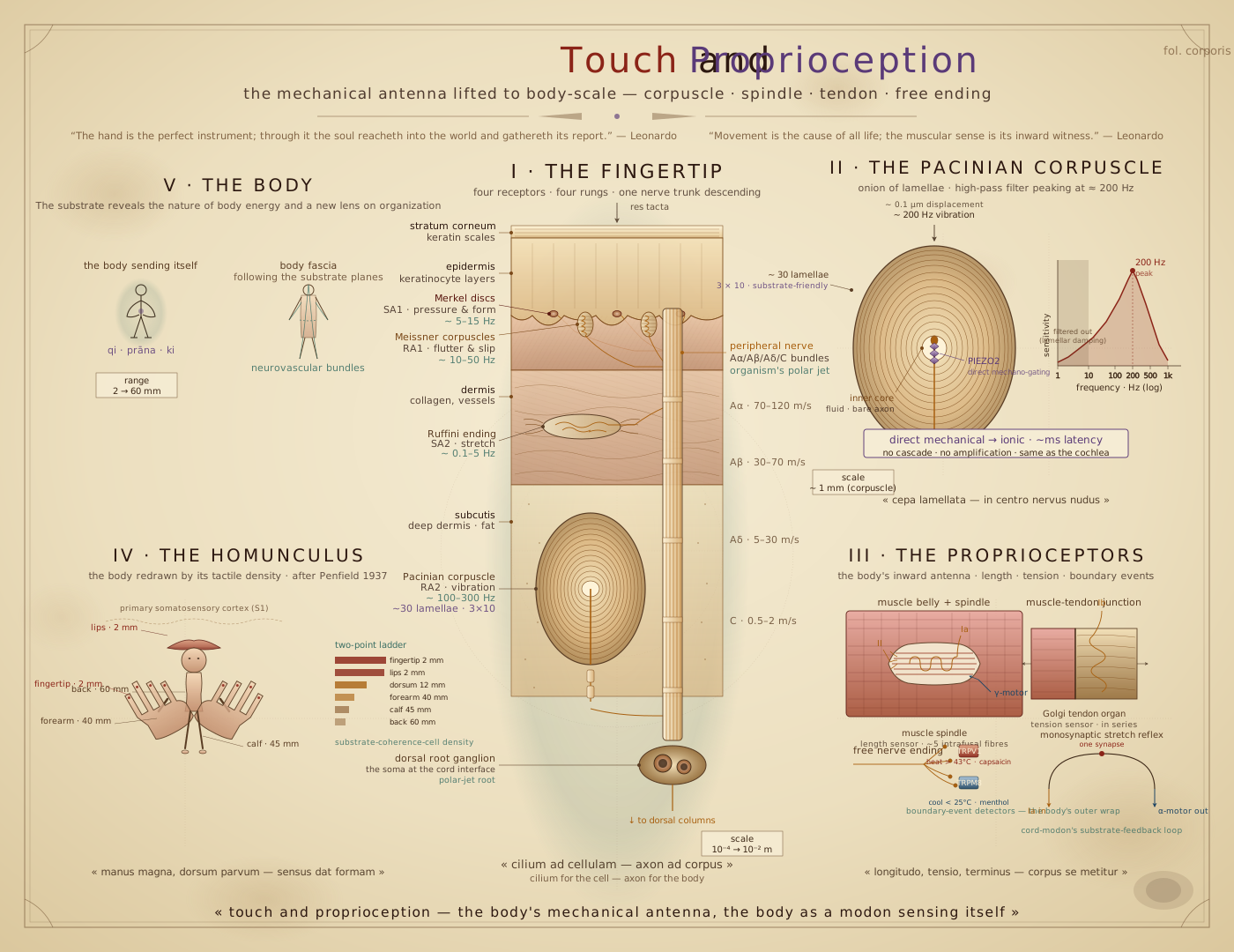
The first three chapters of this walk each watched a cell grow a single specialised antenna and point it at the world. The eye grew a cilium and packed it with light-catching discs; the ear grew a bundle of stiff hairs tuned to vibration; the nose grew a tuft of cilia studded with smell receptors. In every case the same underlying object — the cilium, the cell’s outward antenna onto the substrate — was respecialised for a different channel.
Touch breaks the pattern in an interesting way, and the break is the whole point of this chapter. A photon arrives from one direction; sound is focused to one place on a membrane; an odorant binds in one pocket. Each of those is a localised signal, and a single well-aimed antenna on a single cell is the right tool. But mechanical contact happens everywhere on the body at once, and it happens inside the body too — in every muscle, every tendon, every joint. You cannot solve that with one antenna pointed in one direction. You need a net.
So the body does something the framework reads as the same architecture lifted one level up. Instead of one antenna per cell, it builds millions of antennae per body, and tiles them across the entire surface and through every muscle. This chapter follows that net: how it is built, how it sorts touch into a handful of distinct sensations, how it lets the body feel not only the world but its own posture and motion — and, at the end, why the body-sensing traditions of nearly every human culture have been training attention on a signal the framework says is physically there all along.
This chapter takes only the periphery — the receptors in the skin and muscle and the nerves carrying their signal up to the brainstem. What the brain does with that signal is held for the brain arc, alongside the visual, auditory, and olfactory cortices.
One antenna per cell becomes millions per body
Start with a single touch neuron. Its cell body sits in a small cluster just outside the spinal cord (the dorsal-root ganglion). From it, a single fibre splits in two and runs in opposite directions: one branch dives into the cord and climbs toward the brainstem; the other runs outward, sometimes a full metre — from the spinal cord all the way to a fingertip or a toe — and ends in a specialised sensing terminal. One neuron, two long arms, reaching from the body’s edge to its core.
The framework reads this neuron as the body-scale version of the cilium. Recall the recurring shape from the cellular chapters: a coherence boundary (the cell’s edge), a long substrate-coherent corridor running outward from it (the cilium’s shaft), and sensing machinery at the far tip, with signal flowing back down the corridor. The touch neuron has exactly that shape, just enormously larger. The spinal cord is the coherence boundary; the long peripheral fibre is the corridor; the receptor terminal is the tip; and the signal flowing back is the nerve impulse.
What changes at body scale is only the number. A cell builds one cilium because it needs to sample one localised signal. A body builds millions of these neuron-antennae because it needs to feel mechanical contact across its whole interface with the world — and so it weaves a distributed net rather than aiming a single dish. The molecular gadget at each tip is swapped to suit the job, exactly as it was for the eye, ear, and nose: where those tips carried disc stacks or hair bundles or receptor tufts, the touch tips carry the layered capsules, muscle-fibre wraps, and bare endings we are about to meet. Same pattern, new scale, new tip hardware.
The Pacinian corpuscle: an onion that listens for vibration
The clearest single object in the whole chapter is the Pacinian corpuscle, and it is worth looking at closely because it makes the architecture visible to the naked eye. It is a translucent ovoid about the size of a grain of rice, buried in the deep skin of the fingers and the soles, in joints, and around internal organs. Slice one open and it looks like a tiny onion: twenty to sixty concentric layers of flattened cells, each separated from the next by a thin film of fluid, wrapped around a single bare nerve ending at the core.
That onion is not packaging — it is a filter. Press on the corpuscle slowly and the layers simply slump and the fluid between them slides aside, so a steady push never reaches the nerve at the centre. But a fast vibration sails straight through the layers and shakes the core. The corpuscle is therefore deaf to constant pressure and exquisitely alive to buzzing: it peaks sharply around 200 cycles per second and can feel a vibration that moves the skin by a tenth of a micrometre — about the width of a few molecules. This is the receptor that lets you feel the texture of a surface through a tool, the faint hum of a phone on a table, the grain of paper under a pencil.
The framework reads the Pacinian corpuscle as the body’s antenna tuned to one note of the substrate’s mechanical channel — and the onion of layers as exactly the kind of mechanical filter the cochlea used, wrapped around a sensing tip. The cochlea spreads a thousandfold range of frequencies along a 35 mm membrane to resolve pitch finely in one organ; the corpuscle does the opposite trade, using its thirty-odd layers to lock onto one preferred band so it can be mass-produced and scattered all over the body. Two ends of the same design choice: the ear trades compactness for fine frequency resolution; the skin trades resolution for the ability to deploy the same small sensor everywhere.
Even the layer count carries the framework’s signature. The typical ~30 layers reads naturally as three-tens — the substrate’s three-fold preference showing up once more, the same small-integer thumbprint that appears in the cilium’s nine-fold ring and the cell’s three-way membrane junctions. The framework’s bet is concrete: count Pacinian layers across many mammals and they should cluster near small multiples of three rather than smear continuously with corpuscle size.
Four notes, played everywhere
The Pacinian corpuscle is one of four touch receptors that tile the fingertip, and together they are the heart of this chapter’s reading. Each is tuned to a different rung of the same mechanical channel — think of them as four notes the skin can hear, played at every point on the body at once:
- Merkel cells sit at the base of the epidermis and report sustained shape and pressure — the lowest band, a few cycles per second, with the finest spatial grain. These are what read the form of an object resting in your hand and the fine texture you explore slowly with a fingertip.
- Meissner corpuscles sit just under the skin’s surface in the ridges of the fingerprints and report flutter and slip — the band that tells you a held object is beginning to slide, so you can tighten your grip before you drop it.
- Ruffini endings lie deeper, woven into the collagen, and report stretch — skin being pulled sideways, which tracks the configuration of your hand and the angle of your joints.
- Pacinian corpuscles, as above, report the high buzz — vibration carried through objects, felt over the widest area.
Lay those four out and they ladder upward in frequency in rough half-decade steps — very roughly 0.5, 5, 30, and 200 cycles per second. The framework reads this as the substrate’s mechanical channel decomposed into four discrete rungs and sampled at every spot on the body. The cochlea handled the same physical channel by smearing it continuously into thousands of place-coded pitches along one membrane — because it only had to do it once, in one organ. The skin cannot afford a private cochlea at every square millimetre, so it picks four representative notes and repeats that small kit across the whole surface. Same channel, two strategies: continuous tuning when you sense in one place, four fixed rungs when you must sense everywhere.
PIEZO2: a push becomes a signal, with nothing in between
How does a mechanical push actually become a nerve impulse at these tips? The answer turned out to be beautifully direct, and it confirms a prediction the earlier chapters set up.
In the eye, catching a photon takes a long molecular relay — a cascade of half a dozen steps that amplifies one quantum of light into a cellular signal a hundred thousand times over. Smell takes a shorter relay. But touch, it turns out, takes essentially no relay at all. The protein PIEZO2 is an ion channel shaped like a three-bladed propeller embedded in the membrane; when the membrane is stretched, the blades flatten and the channel pops open, letting current flow. Push the skin and the channel opens in about a millisecond — no enzymes, no second messengers, no amplifier chain. The mechanical force is the signal. (PIEZO2’s discovery earned a share of the 2021 Nobel Prize.)
The framework had already predicted this ordering from the ear chapter, and the reason is clean. A mechanical push and an opening ion channel are the same kind of physical event — both are motion, force, deformation — so they couple directly, with no translation needed. Light is a different kind of event entirely, an electromagnetic one, so converting it to an ionic signal needs the long cascade to bridge the gap. Smell sits in between. Three senses, three cascade lengths, and they line up exactly with how closely each channel matches the machinery of an ion channel: mechanics direct and instant, light slow and deeply amplified, smell in the middle. Touch is the cleanest case of the direct end.
Why the fingertips feel more than the back
Press two pencil points on a fingertip a couple of millimetres apart and you feel two points. Do the same on your back and the two points have to be four or five centimetres apart before you can tell them apart at all — a thirty-fold difference across one body. The reason is simply how densely the net is woven: fingertips pack roughly a hundred times more touch receptors per square centimetre than the back does.
This density map is what the famous cortical homunculus draws. When Penfield mapped the touch cortex in the 1930s, he found a distorted little figure with grotesquely swollen hands and lips and a shrunken trunk — the body redrawn in proportion to how finely each part is sampled, not how big it is. The framework reads this as the body allocating its sensing resolution where it matters: dense sampling on the hands that manipulate objects and the lips and face that speak and emote, sparse sampling on the broad surfaces that mostly just need to know something touched them. It is the same trick the retina plays in laying its cones densely in the fovea and thinly in the periphery — resolution spent where the task demands it. The framework’s testable edge here is that those discrimination thresholds across the body should cluster on a few preferred rungs rather than slide smoothly with receptor density alone.
The body feels itself
Everything so far has the antennae pointing outward, at the world. But the body runs a second, inward-facing copy of the whole apparatus — and this is where touch becomes something deeper than a sense of the outside.
Buried in every skeletal muscle are muscle spindles: small stretch detectors wrapped around special muscle fibres, reporting how long the muscle is and how fast its length is changing. At the muscle’s ends, Golgi tendon organs woven into the tendon report how hard the muscle is pulling. In the joints, more endings report angle and end-of-range strain. Together they answer, continuously and without your asking, a question the outward senses cannot: where is my body right now? — every joint angle, every muscle length, every tension. This is proprioception, and the nerves carrying it are the thickest and fastest in the entire body, delivering a full body-position update to the cortex in about a fiftieth of a second — fast enough that you correct your balance before you know you were tipping.
The framework reads this inward layer as the body’s mechanical model of itself. The skin’s antennae sample the substrate’s mechanical channel at the body’s outer edge; the spindles and tendon organs sample it at the body’s internal configuration. Integrate that signal across the whole body and you get a continuously refreshed map of your own posture and motion in space — the organism sensing not just the world, but itself, through the very same antenna pattern aimed inward instead of out.
One detail makes the self-model unforgettable. When a limb is amputated, the map of it often persists — the vivid phantom limb, sometimes painful, that an amputee still feels. The framework reads this exactly as it sounds: the body’s internal self-model living on in the brain after the physical limb that once filled it is gone. The map outlasts the territory, which tells you the map was a real and somewhat independent thing all along.
The alarm at the edge
Not every ending is a tuned antenna. The skin and most internal tissues are also threaded with free nerve endings — bare fibres with no capsule, no onion, no wrap, just exposed membrane. These carry pain, temperature, and itch, and their molecular hardware is the TRP family of channels, each tuned to a kind of threat: one opens to burning heat and to the bite of chilli (the channel that is the sensation of spice), another to cold and to menthol, others to harsh chemicals and to the acid of injured tissue. Like PIEZO2, these couple their trigger straight to a nerve signal — heat or cold or irritant directly to impulse, no relay.
The framework reads free nerve endings as boundary-event detectors at the body’s outermost edge — the organism-scale cousins of the gatekeeping barriers that guard the borders of the cell’s organelles (the nuclear pore, the mitochondrial import gates, the cilium’s transition zone). Wherever the framework finds a coherence boundary, it finds machinery watching for things that threaten it. The skin is the body’s outermost boundary, and the TRP-studded bare endings are its threat sensors — tuned not to texture or pitch but to damage, fired off as the fast pain that makes you snatch your hand back before you have consciously decided to.
Body energy: what the traditions were feeling
There is a quieter cousin to proprioception that the modern literature calls interoception — the sense of the body’s internal state. Stretch sensors in the gut and bladder, pressure sensors in the great arteries, chemical sensors watching oxygen and acidity, and an enormous nerve (the vagus, four-fifths of whose fibres run upward, reporting) carry a constant stream from the heart, lungs, and gut to the brainstem and beyond. Almost none of it reaches consciousness. Your blood pressure is corrected beat by beat, your posture adjusted continuously, your mood tugged by visceral signals — all below the threshold of attention, running silently underneath your day.
The framework reads this whole inward stream as the organism’s own coherent self-signal: physically present, continuously generated, mostly subliminal — but available to attention that is trained to reach it.
And that last clause is where something remarkable comes into view. Across thousands of years and almost every human culture, practitioners have reported — and systematically trained — a felt sense of “body energy”: qi in Chinese internal arts and medicine, prāṇa in the yogic traditions, ki in Japanese martial arts, and the body-felt sense cultivated in modern somatic therapies and by every serious dancer and athlete. The convergence is striking: traditions with no contact between them arrived at remarkably similar descriptions of a patterned, attendable, body-internal signal — often mapped along lines (acupuncture’s meridians) that Western anatomy can recognise as fascial planes following the body’s nerve-and-vessel bundles.
The framework’s reading here is deliberately careful, because honesty matters more than a tidy story. It does not posit a new energy field. It says something simpler and, if anything, more interesting: the body-internal signal those traditions describe is the proprioceptive and interoceptive stream that is already there — already running through every nerve, already shaping posture and balance and autonomic state beneath awareness. What sustained practice trains is access: raising a normally unconscious but entirely physical signal into reportable experience, and with it the practical control (balance, calm, fine motor refinement, self-regulation) the traditions claim. On this reading the meridians are not separate channels of some occult substance; they are a hard-won map of the body’s real internal pathways, laid down by the same nerve-and-fascia geometry the rest of anatomy follows, and discovered by people who spent lifetimes paying attention to it.
This is a place where the framework and the traditions need not compete. The traditions contribute the trained access; the framework contributes the architecture that says the signal is genuinely present to be accessed. Neither displaces the other — and the framework even hands the claim a way to be tested, below.
How to test this
The reading above is not just a retelling; it makes predictions that existing data can check. Four stand out.
- Pacinian layer counts cluster on small multiples of three. Counted across many mammals, the onion-layer number should pile up near ~15, 30, 45 rather than vary smoothly with corpuscle size or age.
- Two-point discrimination clusters on preferred rungs. Across body regions and species, the spacing at which two touches separate should fall on a few preferred steps (roughly 2, 5, 10, 25, 60 mm) rather than track receptor density alone.
- The four receptors’ tuning frequencies are conserved on preferred rungs. The roughly 0.5 / 5 / 30 / 200 Hz ladder should hold across mammals at half-decade spacing, largely independent of body size — not drift continuously with it.
- Trained interoceptive skill tracks coherence biomarkers. Skilled practitioners’ accuracy at sensing heartbeat, breath, and gut state should correlate with measurable body-coherence signatures (heart-rate-variability structure, EEG coherence, fascial mechanics) beyond what ordinary attention-control can explain.
The picture is falsified if Pacinian layers, two-point thresholds, and receptor frequencies all vary smoothly with no preferred-rung structure, and if trained body-awareness is fully explained by attention alone with no coherence residual. It is supported if any of these orderings hold up against the records already in the literature.
Putting the section in context
The body is the substrate’s mechanical antenna built at organism scale, by taking the cell’s single cilium-antenna and lifting it one level up: the sensory neuron becomes the body’s outward-reaching antenna, with a specialised tip at its far end, millions of them woven into a net across the whole body. Four receptors sort touch into four rungs of the mechanical channel and sample them everywhere; PIEZO2 turns a push directly into a signal, confirming that mechanical sensing is the direct-coupling end of the spectrum the eye and nose anchor. The map of where the body samples densely is the homunculus. And the same antenna pattern aimed inward — through muscle spindles, tendon organs, and the visceral senses — gives the body a continuously updated model of itself, the physical substrate of what the world’s body-energy traditions have spent millennia learning to feel.
With this, the perception walk closes on the body sensing itself. The eye took the substrate’s light channel; the ear took its mechanical channel as pitch and balance; the nose took its chemical channel; and this chapter took the mechanical channel again, but spread across the whole body and turned inward on itself. Four senses, one architecture — the cell’s outward antenna, respecialised for each channel the substrate offers and, here, lifted to the scale of the entire organism.
What this chapter adds to the framework is its boldest single image: the body as a nested set of antennae sensing itself at every scale — each cell with its cilium, each organ with its own loops, and the whole organism with its body-wide net of sensory neurons and its inward self-model. The substrate samples itself through biology’s machinery at every level; and at the top of that stack, trained human attention can turn around and report the very signal the framework says was there all along. The brain arc that follows will lift all of this into central representation — but the foundation it rests on is the body, already quietly feeling itself, before a single thought is formed.