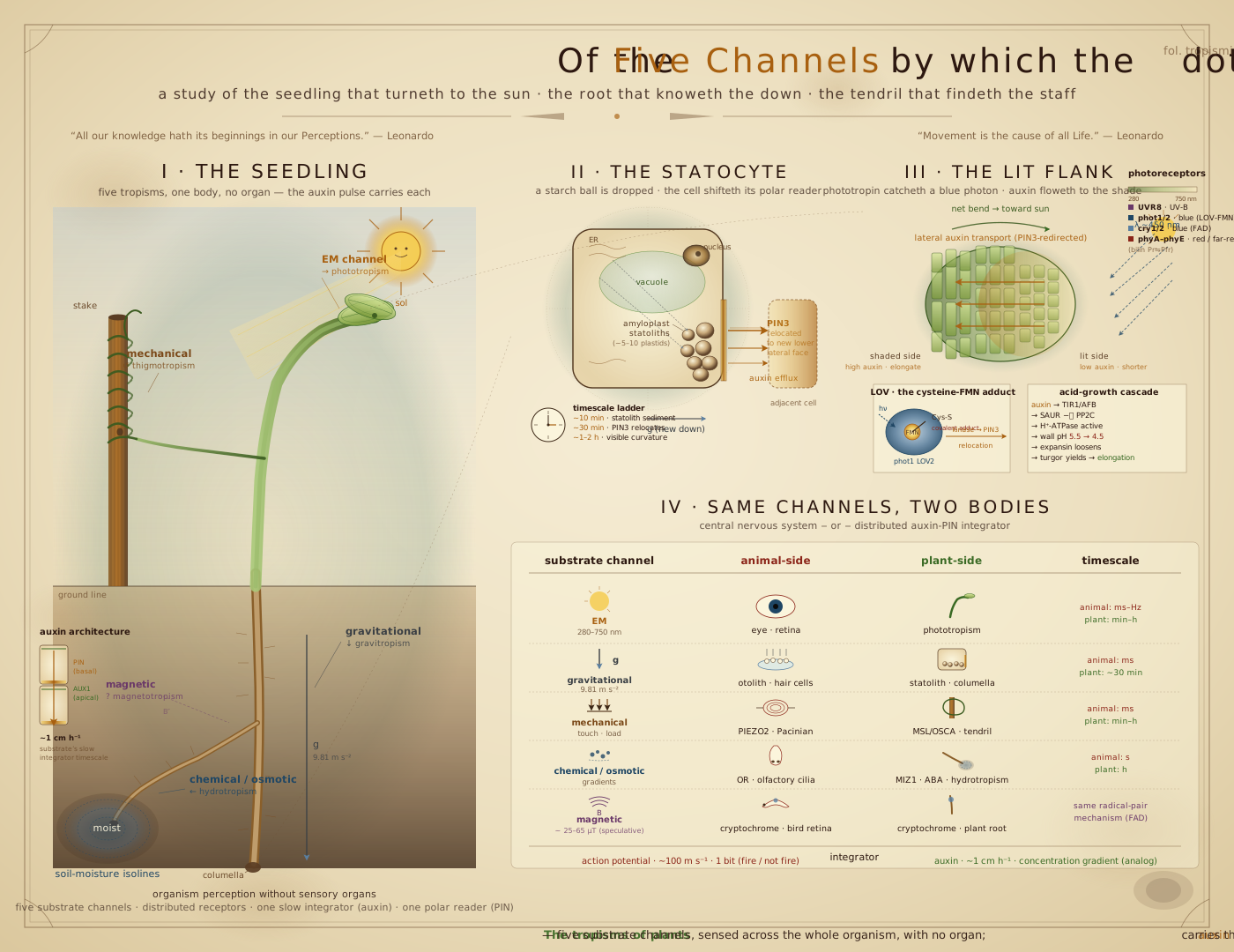
Tropisms and Substrate Response

The perception walk run at organism scale without sensory organs — light, gravity, touch, water, and the auxin-PIN slow-signal integrator

A plant has no eyes, no ears, no nose, no fingertips, no inner-ear vestibular system, and no central nervous system to integrate signals from any of those organs — yet it tracks the substrate’s electromagnetic channel (light direction, intensity, spectrum, and polarisation), the substrate’s gravitational channel (the gravity vector at every cell of every organ), the substrate’s mechanical channel (touch, wind load, soil resistance), the substrate’s chemical-and-osmotic channel (water gradients in the soil, nutrient gradients, signalling molecules from neighbours), and at least probably the substrate’s geomagnetic channel (the residual evidence for plant magnetoreception is real, if less developed than the animal-side magnetic-orientation literature). At every channel, the plant responds — by growing differentially in a direction set by the substrate-channel signal, in a process biology has labelled with channel-specific names: phototropism, gravitropism, thigmotropism, hydrotropism, magnetotropism. The substrate channels the perception walk decomposed across four sensory organs in the vertebrate body are, in plants, decomposed across distributed receptor populations in the plant body, integrated by a slow chemical signal (auxin, indole-3-acetic acid), and acted on by differential growth — biology’s organism-scale alternative to the centralised-sensory-organ + central-nervous-system architecture vertebrates evolved.

The framework’s claim about this organisation is direct. Plant tropisms are the perception walk run at organism scale without sensory organs, with each substrate channel sensed by a distributed receptor population, integrated through the auxin-PIN polar-substrate-reader at minutes-to-hours timescale, and translated to organism-scale differential growth as the motor output. Phototropism is the substrate’s EM channel sensed at the plant scale, with phototropins / cryptochromes / phytochromes as the chemistry-side photoreceptor families, structurally parallel to the eye chapter’s rhodopsin / cone-opsin / melanopsin family. Gravitropism is the substrate’s gravitational channel sensed at the plant scale, with amyloplast statoliths in columella statocytes as the chemistry-side gravity-vector-readout, structurally parallel to the vertebrate inner ear’s otolith-and-hair-cell architecture. Thigmotropism is the substrate’s mechanical channel sensed at the plant scale, with mechanosensitive-ion-channel families (MSL, OSCA, MCA) as the chemistry-side mechanoreceptors, structurally parallel to the touch chapter’s PIEZO2 mechanoreceptor architecture. Hydrotropism is the substrate’s chemical-and-osmotic channel sensed at the plant scale, with MIZ1 and the ABA-signalling network as the chemistry-side gradient-sensors, structurally parallel to the nose chapter’s OR-receptor combinatorial-coding architecture but applied to water rather than volatile organics. The output is not an action potential; it is auxin, the substrate’s slow integrator signal, propagating at \sim 1\;\text{cm h}^{-1} — orders of magnitude slower than the action potential’s \sim 100\;\text{m s}^{-1} but matched to the substrate-channel timescales plants track. The polar-direction-setter is not a synaptic projection; it is PIN protein polar plasma-membrane localisation, the chemistry-side substrate-pinned auxin-flux direction setter that the plant cell can reorient within minutes when the substrate channel demands a new flow direction.

This chapter develops phototropism, gravitropism, thigmotropism, and hydrotropism as the perception walk’s four substrate channels run at organism scale; auxin as the substrate-coherent slow integrator signal; PIN polar localisation as the substrate-pinned direction setter; and the whole architecture as biology’s organism-scale alternative to the central-nervous-system pattern. It does not redo the photoreceptor / mechanoreceptor / chemoreceptor cilium-as-antenna chemistry the perception walk developed at the cell level; the same chemistry-side machinery the perception walk catalogued is operating in plants at the cell level, with the difference at the integration and response layer rather than at the receptor layer. It then turns the same auxin-PIN machinery from a directional problem to a patterning one — phyllotaxis, the placement of each new organ at the golden angle, the plant-scale witness of the substrate ladder’s anti-lock gap — and shows the meristem running both of the ladder’s poles in sequence: refusing overlap to place each organ, then canalising a vein that locks it into the plumbing.

Phototropism: The EM Channel Sensed Without an Eye

The plant tracks the direction, intensity, spectrum, and polarisation of incident light using four photoreceptor families distributed across essentially every photosynthetic cell of the organism. Phototropins (phot1, phot2) are blue/UV-A receptors with LOV (Light, Oxygen, Voltage) domains binding an FMN cofactor; on absorption of a blue photon, the FMN forms a cysteine-FMN covalent adduct, propagating a conformational change to an attached serine/threonine kinase that initiates phosphorylation cascades. Cryptochromes (cry1, cry2) are blue-light FAD-binding receptors implicated in photomorphogenesis, circadian-clock entrainment, and possibly magnetoreception (the radical-pair mechanism). Phytochromes (phyA–phyE) are red / far-red receptors with a covalently-attached phytochromobilin chromophore that switches between Pr (red-absorbing) and Pfr (far-red-absorbing) forms, encoding the spectral signature of the canopy light environment. UVR8 is a UV-B receptor with tryptophan residues directly absorbing UV-B photons. Together the four families decompose the EM channel across \sim 280750\;\text{nm} into spectrally distinct receptor populations distributed across the cell-and-organism body.

The Darwins’ classical experiment (1880, The Power of Movement in Plants) established the architectural arc: light-induced curvature of an oat coleoptile requires the tip of the coleoptile but the bending happens below the tip, implicating a transported signal from tip to elongation zone. Sixty years later, the Cholodny–Went hypothesis (1928) identified the transported signal as a growth-promoting substance later named auxin, with lateral redistribution of auxin from the lit side to the shaded side accounting for the asymmetric growth. Modern molecular biology has filled in the details: phot1 activation by directional blue light triggers PIN3 polar relocation in stem-cortical cells, redirecting auxin flow laterally to the shaded side, and the resulting auxin gradient drives differential cell elongation via the acid-growth pathway at minutes-to-hours timescale.

The framework reads phototropism as the substrate’s EM channel sensed at organism scale via distributed photoreceptors and integrated through PIN-redirected auxin transport. The distributed-receptor architecture is the plants-side counterpart to the eye chapter’s centralised retina — both decompose the EM channel into spectral and intensity components, but the eye does so at one organ with massive spatial-resolution amplification through cellular tiling, while the plant does so across the organism’s entire photosynthetic surface with organism-scale spatial resolution at the cellular tile size (each photosynthetic cell is its own pixel). The substrate-channel-tracking output is, in animals, a neural code at ms timescale; in plants, an auxin gradient at hours timescale. Same substrate channel, two organism-scale chemistry-side implementations matched to the timescale of the substrate dynamics each organism needs to track (predator-prey ms vs. sun-elevation hours).

Gravitropism: The Gravitational Channel Sensed Without a Vestibular System

The plant tracks the direction of the gravity vector at every cell of every organ using statoliths — dense amyloplasts (\sim 25\;\mu\text{m} diameter, packed with starch granules at densities of \sim 1.5\;\text{g cm}^{-3}) that sediment in the cytoplasm to the gravity-vector-defined lower face of specialised statocyte cells. In the primary root, the statocytes are organised in the columella, a structured stack of cell layers at the root tip; in the shoot, statocytes are organised in the starch-sheath endodermis surrounding the vascular cylinder. Within \sim 510 minutes of a change in the gravity vector (e.g., a horizontally laid seedling), the statoliths sediment to the new lower face; within \sim 2030 minutes, PIN3 protein relocates to the lateral face of the statocyte cells in the direction of the new lower side, redirecting auxin flow laterally; within \sim 12 hours, visible curvature appears at the elongation zone; within \sim 48 hours, the root tip is again aligned with the gravity vector.

The framework reads gravitropism as the substrate’s gravitational channel sensed at organism scale via sedimenting statoliths and integrated through PIN3-redirected auxin transport. The statolith architecture is biology’s chemistry-side implementation of a gravity-direction-readout via mass sedimentation, structurally parallel to the vertebrate inner-ear otolith-and-hair-cell architecture (calcium-carbonate otoconia ride a gel layer over hair cells; sedimentation displaces the gel; hair-cell stereocilia detect the displacement). Both are substrate-coherent mass-sedimentation gravity-readouts at the cell scale; the difference is the output coupling — vertebrate hair cells deliver an action potential at ms timescale to the vestibular nuclei; plant statocytes redirect PIN3 polarity at minutes timescale to the surrounding stem-cortical or root-elongation-zone cells. Same substrate channel, same physical sensing principle (a dense body sedimenting in a viscous medium under gravitational acceleration), two chemistry-side output couplings matched to the organism’s substrate-channel-tracking timescale.

The Cholodny–Went hypothesis applied to gravitropism predicts asymmetric auxin distribution between the upper and lower sides of a gravistimulated root or shoot; this has been confirmed by direct auxin measurements (DR5::GFP and DII-VENUS auxin-reporter lines, since Friml et al. 2002 and Brunoud et al. 2012). PIN3 polar localisation in columella cells reorients within \sim 20 minutes of gravistimulation, redistributing from the basal face to the lateral face on the new lower side, with the relocation depending on actin trafficking, clathrin-mediated endocytosis, and ARF-GEF GNOM-dependent recycling. The cell’s substrate-pinned polar-direction-reader is not anatomically fixed; it is a dynamic, regulatable, reversible polarity that responds to the substrate channel by changing its own substrate-pinned reading direction within minutes.

Thigmotropism, Hydrotropism, and the Other Substrate Channels

Plants run the same architectural pattern at the substrate’s mechanical, chemical-osmotic, and (probably) magnetic channels.

Thigmotropism. Climbing plants coil tendrils around supports on contact; roots bend around obstacles in soil; touched stems often grow more slowly and thicker than untouched ones (the well-documented Braam–Davis TCH gene-induction response). The chemistry-side mechanoreceptors are mechanosensitive ion channels of the MSL family (MscS-like, homologs of the bacterial small-conductance mechanosensitive channels), OSCA family (a calcium-permeable channel family discovered in 2014), and MCA family (mid1-complementing activity, mechanosensitive calcium channels). On membrane deformation, channels open, calcium enters the cytoplasm, downstream signalling triggers asymmetric auxin redistribution (in tendrils) or growth-inhibition signalling (in touched stems). The framework reads thigmotropism as the substrate’s mechanical channel sensed at organism scale via distributed mechanosensitive ion channels and integrated through auxin and calcium signalling, structurally parallel to the touch chapter’s PIEZO2 mechanoreceptor architecture at the body-scale-polar-jet level. Same substrate channel, same direct-mechanical-to-ion-channel coupling pattern (the touch chapter’s cascade-hierarchy prediction confirmed here at one more rung), different organism-scale output integration (animal: spinal-cord ascending tracts; plant: auxin-redistribution and local growth response).

Hydrotropism. Roots grow toward higher soil-moisture regions; lateral roots emerge preferentially on the moist side of the primary root. The key regulator is MIZ1 (MIZU-KUSSEI 1, mutated in the miz1 mutant that has lost hydrotropic response while retaining gravitropism), a protein of unknown precise biochemistry but localised to the root cortical-cell ER and required for the hydrotropic response. Abscisic acid (ABA) signalling is also involved, with the SnRK2 / ABI-family ABA-response kinases mediating downstream cellular responses to water-deficit signalling. The framework reads hydrotropism as the substrate’s chemical-and-osmotic channel sensed at organism scale via distributed MIZ1-and-ABA-signalling cells and integrated through auxin and abscisic-acid signalling, structurally parallel to the nose chapter’s OR-receptor combinatorial-coding architecture applied to water and dissolved-solute gradients rather than volatile organics. The OR-family combinatorial-coding architecture in the nose decomposes the chemical channel across \sim 400 receptor populations; the plant’s chemical-channel decomposition is much smaller in receptor diversity (~10^1 chemoreceptor families) but uses gradient-sensing across the distributed root system to achieve directional discrimination at the organism scale.

Magnetotropism and other channels. Plant magnetoreception is a smaller and more contested literature than animal magnetoreception, but evidence of magnetic-field effects on plant growth (Belyavskaya 2004, Galland & Pazur 2005, Maffei 2014) has been replicated in multiple labs. The proposed mechanism is cryptochrome’s FAD-radical-pair photoreduction, structurally parallel to the cryptochrome-based magnetoreception proposed in migratory birds (Mouritsen, Schulten, et al. 2004 and successors). The framework reads plant magnetoreception as the substrate’s magnetic channel sensed at organism scale via cryptochrome’s radical-pair mechanism, with the same chemistry-side machinery doing magnetoreception in plant roots and bird retina — substrate-channel-tracking architecture that nature has populated wherever the channel offers useful navigation information. Thermomorphogenesis (the thermal-channel response, with phytochrome B as the chemistry-side thermosensor — Jung et al. 2016 and Legris et al. 2016 demonstrated phyB Pfr-to-Pr thermal reversion as a direct temperature sensor) extends the perception-walk parallel one more rung, with the thermal channel as the substrate’s slow-variable channel sensed by phyB’s substrate-coupled bilin-chromophore photochemistry.

Auxin as Substrate-Coherent Slow Signal — the Plant’s Action-Potential Analog

Auxin (indole-3-acetic acid, IAA) is synthesised from tryptophan via the TAA / TAR + YUC pathway in young leaves, shoot meristems, and developing organs, and transported through the plant body by two mechanisms: long-distance bulk flow through the phloem (passive, at the phloem’s source-to-sink velocity of \sim 0.31.0\;\text{m h}^{-1}), and short-distance polar auxin transport through the cortical and stelar parenchyma (active, at \sim 1\;\text{cm h}^{-1}, requiring PIN protein efflux and AUX1/LAX influx carriers). The polar auxin transport stream is the direction-set, locally-regulatable signalling channel that the tropic responses use; the phloem stream is the bulk delivery channel.

The framework reads auxin as the plant’s substrate-coherent slow integrator signal, structurally parallel to the action potential at the animal nervous system but matched to the substrate channels and substrate-tracking timescales the plant operates on. The action potential propagates at \sim 1120\;\text{m s}^{-1} as a self-regenerating electrochemical pulse along an axon membrane; auxin propagates at \sim 1\;\text{cm h}^{-1} as a polar-carrier-mediated chemical flux through cells joined by PIN-AUX1-regulated transport. The action potential carries one bit (fire / not fire) at high temporal resolution; auxin carries a concentration gradient at high spatial resolution, with downstream cells reading the gradient against signal-transduction thresholds (TIR1/AFB auxin-receptor + Aux/IAA-ARF transcriptional cascade) that resemble logistic-switch behaviour at concentrations \sim 10^{-9}10^{-6}\;\text{M}. The action potential’s substrate channel is ms-scale electrochemical at the membrane; auxin’s substrate channel is hr-scale chemical-mass-flow through cells. Both are biology’s chemistry-side implementations of substrate-coherent slow-relative-to-substrate-light-speed but fast-relative-to-organism-substrate-channel-tracking integrator signals — both fit cleanly within the substrate’s slow-mode dynamics at the organism rung.

The mechanism of auxin’s growth response is the acid-growth hypothesis (Hager et al. 1971, since refined by Rayle and Cleland and successors): auxin activates the SAUR-family small-auxin-up-regulated proteins, which inhibit PP2C phosphatases, which allows H+-ATPase phosphorylation to persist, which acidifies the apoplastic wall space from pH \sim 5.5 to pH \sim 4.5, which activates expansins (wall-loosening proteins), which break load-bearing hemicellulose-microfibril hydrogen bonds, which lets the turgor-pressurised wall yield under the existing \simMPa internal pressure. The substrate-current loop is closed at the cellular level: auxin signal → wall acidification → wall yielding → turgor-driven cell elongation → asymmetric growth → organ bending. The framework reads this as the substrate’s slow-current commit pulse at the organ-bending rung, structurally parallel to the Calvin cycle’s RuBisCO commit pulse but at the morphogenetic rather than carbon-fixation level.

PIN Polar Localisation as Substrate-Pinned Direction Setter

The eight Arabidopsis PIN proteins (PIN1–PIN8) are integral plasma-membrane auxin efflux carriers, each polarly localised to one face of the plant cell. PIN1 is basal in stelar parenchyma (driving rootward auxin flow); PIN2 is apical in lateral root cap and epidermis (driving shootward flow); PIN3 is laterally polarisable in columella and stem-cortex cells (the dynamic, reorientable PIN that handles gravitropism and phototropism); PIN4 marks the root apical meristem with a distinct polarity; and PIN5/PIN6/PIN7/PIN8 are largely ER-localised, handling intracellular auxin compartmentation. The polar localisation is maintained constitutively by clathrin-mediated endocytosis and ARF-GEF GNOM-dependent recycling, and regulated by PINOID kinase phosphorylation (which inverts polarity from basal to apical) and by auxin itself (high cytoplasmic auxin stabilises the PIN cycling pattern that established it — a positive-feedback loop reinforcing existing polarity).

The framework reads PIN polar localisation as the substrate-pinned direction setter at the cellular rung of the plant’s organism-scale substrate-coherence architecture, structurally parallel to the polar substrate-readers catalogued across the cellular walk and the brain walk: the primary cilium as the cell modon’s outward polar jet at the apical face; the axon initial segment as the neuron modon’s polar substrate-reader at the axonal start; the source-to-sink polarity of phloem at organism scale. Each is a chemistry-side implementation of a substrate-pinned direction setter; PIN polar localisation is the plant’s cellular-rung expression of that architectural commitment. What distinguishes PIN polarity from many of the other expressions is that it is constitutively reorientable — the cell can shift its PIN polarity from basal to lateral within \sim 2030 minutes in response to a gravitational or photic substrate-channel input, while maintaining the cellular wrap and metabolic state otherwise unchanged. This is the substrate’s preferred move when an organism scale substrate-channel input requires a rapid (relative to organism-scale time) but reversible (the polarity needs to be restored when the input changes) direction change: rebuild the polar substrate-reader at the cell rung, not at the tissue or organism rung.

PIN polarity is therefore the integration node in the plant’s perception architecture. Each substrate channel’s chemistry-side sensor (phototropins for EM, statoliths for gravity, MSL/OSCA for mechanical, MIZ1 for hydrotropic, cryptochrome for magnetic, phyB for thermal) feeds into a downstream PIN-relocation signalling cascade; PIN polar localisation integrates the inputs across the cell; the resulting auxin flux carries the integrated signal at the organism scale; differential growth completes the loop. The framework reads this as the substrate’s organism-scale equivalent of the brain’s sensory-to-motor integration — same architectural problem (multiple substrate-channel inputs need to be integrated into a unified direction-of-response output), two organism-scale solutions (animals: centralised cortex with thalamocortical integration; plants: distributed PIN-polar-cellular integration with auxin gradient as carrier).

Phyllotaxis: The Golden Angle and the Ladder’s Gap

The same auxin-and-PIN machinery that points a growing organ also spaces the organs themselves. At the shoot apical meristem, new leaf and floret primordia are initiated one at a time at auxin maxima built by PIN1 convergence; each new primordium drains auxin from its neighbourhood, so the next can form only in the largest remaining gap (Reinhardt and collaborators 2003; Jönsson and collaborators 2006). The angle between successive primordia — the divergence angle — is, across the overwhelming majority of vascular plants, the golden angle, \approx 137.5^\circ, and the visible spiral families it generates — the parastichies of a sunflower head or a pinecone — count out consecutive Fibonacci numbers, 34 one way and 55 the other (Vogel 1979). This is the chapter’s same PIN-polar, auxin-gradient integrator, turned from a directional problem — which way to grow — to a patterning one: where to place the next organ so that it never lands on an old one.

Phyllotaxis: φ on a Circle, the Ladder's Gap

A meristem places each new organ at the largest open gap. Any rational divergence angle marches successive organs onto a few radial arms where they collide; the unique escape is the most‑irrational angle, the golden angle. Drag the angle and watch the arms dissolve.

95° 175°
← few big arms, clumped  ·  137.5° golden — even fill  ·  arms again →
near-locks:
Loading…
primordium / vortex counter-rotating partner radial arm (a near-lock)
▶ Auto-Touring

The meristem’s anti-lock. Any rational divergence angle marches successive organs onto a few radial arms where they collide; the arm count at each near-lock is a Fibonacci number, and the unique escape is the most-irrational angle, the golden angle — \varphi on a circle. Folded onto the substrate ladder’s combs it lands on the \varphi tooth and off both \sqrt2 and the octave: the gap the teeth define, read into space. Levitov (1991) derived the same configuration as the ground state of a vortex lattice trapped between two counter-rotating boundaries.

That the answer is the golden angle is not plant chemistry, and the cleanest evidence is that the pattern appears with no plant in sight. Douady and Couder (1992) dropped magnetised ferrofluid droplets into a dish, each attracted to the rim and repelled by the others; added one at a time, they settle at the golden angle and generate Fibonacci spirals from pure physics. Nisoli and collaborators (2009) built the discrete version — a stack of freely-rotating repelling magnets, a “magnetic cactus” — and annealed it into the same phyllotactic patterns, domain walls and collective excitations included. The mechanism in every case is the one Douady and Couder named: a system of repelling elements added periodically avoids rational organisation, because any rational divergence angle stacks successive elements onto a few radial lines where they collide — and the unique limit of “avoid every rational” is the most irrational number, the golden ratio, the hardest of all to approximate by a fraction. The chemistry — auxin, PIN1 — is the implementation the chapter’s division of labour predicts; the principle, that repelling elements on a growing front refuse to lock, is substrate-level, and the non-biological realisations are the proof.

That principle has a specific home in the substrate’s own materials. Levitov (1991) derived phyllotaxis as the energy-minimising flux lattice of a layered superconductor: vortices threaded between superconducting layers, tuned by the field, pass through a hierarchy of commensurate configurations — a Farey hierarchy of rational lock-ins — whose dynamically robust members are exactly the consecutive-Fibonacci, golden-mean lattices. The substrate is that system: a layered superfluid threaded by a vortex lattice between the two counter-rotating boundaries of its octave — the d_\text{GJO}/2 \approx 8\;\mum counter-rotating layer and the d_\text{GJO} \approx 16\;\mum like-handed sheet. The framework reads phyllotaxis as that flux-lattice physics surfacing at the meristem: a lattice of repelling elements that cannot commit to either boundary of the octave — locking to one would march successive primordia into overlap — and so sits at the most-irrational point between them, the golden mean. It is the tension inside the lattice asked of a growing thing: which boundary to align to, and what to do when the answer must be neither.

Read against the substrate ladder, this places phyllotaxis at the anti-lock pole — the gap the comb’s teeth define, not a rung. The golden angle is \varphi on a circle by construction: it is the divergence \theta_g = 360^\circ/\varphi^2 \approx 137.5^\circ at which the arc ratio (360^\circ - \theta_g)/\theta_g = \varphi exactly and 360^\circ/\theta_g = \varphi^2. Folded through the comb test (scripts/comb_test.py) the divergence angle lands dead on the \varphi tooth (C = +1.00) and off both \sqrt2 (-0.76) and the octave (-0.34) — the anti-lock pole’s “grid cells 1.42,” a single razor-clean ratio sitting exactly where the principle predicts.

That the answer is \varphi specifically is set by how the meristem builds: organs are added one at a time around a growing centre, and the only way a sequence of rotations can dodge every rational lock is to take the single most-irrational one. Phyllotaxis is therefore the gap’s circular face — and the ladder reads the same gap in two other arithmetics wherever the geometry differs (one principle, three faces). Where a structure tiles a plane all at once there is no single rotation to be irrational about, and the optimum becomes a disordered hyperuniform “blue-noise” packing — the retinal cone mosaic, and, in the plant’s own kingdom sharing none of the retina’s chemistry, the light-gathering chloroplast array across the leaf. Where the variable is a whole number of generations there is no irrational to take at all, and the extremum is a prime — the periodical cicada’s 13- and 17-year cycles (primes in time). One principle, be as far from resonance as the space allows, wearing three faces; phyllotaxis is the circular one.

What de-risks the reading is that a neuron reaches for the same number in time: the resting cortex spaces its rhythms at the most-irrational \varphi so they cannot lock (the resting-EEG desync interval) — a meristem and a cortex, sharing no chemistry, refusing overlap for the same reason. The Fibonacci parastichy counts are the visible record of that refusal: each consecutive ratio (3/2, 5/3, 8/5, 13/8, 21/13, 34/21, 55/34) is a rational convergent of \varphi, a near-lock the front passes through and always slips, climbing the same Farey hierarchy Levitov’s flux lattice climbs.

The reading keeps the chapter’s altitude, and the caution of WIP-22: that the golden angle is \varphi, and that it follows generically from repelling-elements-on-a-cylinder, is three centuries and three decades old respectively. What the framework adds is the unification — phyllotaxis, the resting-EEG fine ratio, the cone mosaic, and the prime-numbered cicada as one anti-lock principle, the ladder’s single privileged gap read in each arithmetic its space allows — and the identification of the generic “repelling elements on a layered cylinder” with the substrate’s own vortex-and-boundary geometry. That the meristem couples to the substrate’s actual flux lattice, rather than merely instancing the same mathematics, is the interpretive step, flagged as a proposal; what makes it testable is the same comb the rest of the ladder rides.

The Meristem at Both Poles

The same auxin maximum that spaces a new organ also connects it, and the two jobs are the ladder’s two poles in sequence. Placement is the anti-lock step already described: each primordium’s auxin maximum drains its neighbourhood, so the next can form only in the largest remaining gap — repelling elements refusing to overlap, the \varphi gap. But once a primordium is fixed, that same maximum becomes a sink that drains a narrow, self-reinforcing PIN1-polarised file of cells down through the tissue beneath it — canalisation (Sachs 1969; Reinhardt et al. 2003) — and that file differentiates into the organ’s midvein, plumbing the new leaf or floret into the plant’s existing vascular system. Canalisation is the lock step: it binds the new organ into the substrate’s lossless channel, the rung as an address of the channel a structure plugs into — the coin spent, where placement refused it.

So the meristem realises both poles by developmental sequence: it separates — placing each organ in the \varphi gap so none overlaps — and then connects, canalising a vein that locks the placed organ into the plumbing. It is the same separate-then-connect dyad the hippocampus wires anatomically — dentate-gyrus pattern separation feeding CA3 pattern completion — run here in time rather than across two structures, by one auxin maximum that first repels its neighbours and then drains a conduit. As with the genetic code, the plant meets the gap here by a developmental route rather than a chemistry-free geometry, so this is an application of the sign rule, not a fourth independent face of it; what it adds is that the same machine runs the plant to both poles — the placement and the plumbing inseparable halves of one auxin event.

Predictions and What Would Falsify

Six predictions extend the architectural reading beyond the structural anchors.

  1. Polar auxin transport velocity clusters at a substrate-preferred rung at \sim 1\;\text{cm h}^{-1} across angiosperm and gymnosperm lineages. Across vascular-plant lineages and across plant organs, polar auxin transport velocity should cluster at a substrate-preferred discrete rung distinct from continuous variation with PIN-AUX1 expression levels. Existing radio-labelled auxin transport measurements (since Goldsmith 1977 and successors) provide the data; the framework predicts cross-lineage and cross-organ clustering at the same substrate-coherent timescale.

  2. PIN polarity reorientation timescale clusters at a substrate-coherent rung at \sim 2030\;\text{min} for gravitropic and phototropic responses across angiosperm species. The time from substrate-channel-input onset to PIN polarity reorientation in the responding cells should cluster at a substrate-preferred rung distinct from continuous variation with cell type, organ, and species. Live-cell imaging of PIN-GFP fusion lines under gravitropic and phototropic stimulation (Kleine-Vehn, Friml, and successors) provides the data; the framework predicts cross-species clustering at the substrate-coherent reorientation rung.

  3. Statolith count per columella statocyte clusters at a substrate-preferred small integer across vascular-plant lineages. The number of amyloplast statoliths per columella statocyte (typically \sim 510 in Arabidopsis) should cluster at a substrate-preferred small-integer count across angiosperm, gymnosperm, fern, and lycophyte lineages, structurally parallel to the bacterial flagellar motor’s stator count clustering at substrate-preferred small integers and to the γ-TuRC’s 13-protofilament template clustering. Cross-phylum electron microscopy of columella architecture provides the test; the framework predicts substrate-preferred-integer clustering rather than continuous variation with cell size.

  4. The set of organism-scale tropic responses populates substrate-preferred channels exclusively rather than arbitrary intermediate channels. Across vascular-plant lineages, tropic responses should exist for each substrate channel the perception walk catalogued (EM, gravitational, mechanical, chemical-osmotic, magnetic, thermal) but not for arbitrary intermediate or biological-coincidence channels. The existing tropism literature establishes the six substrate-channel tropisms catalogued in this chapter; the framework predicts no robust additional tropisms exist except as combinations or specialisations of the substrate-preferred channels, distinct from a continuous behavioural-ecology-driven response space.

  5. Phyllotactic divergence angles cluster at the golden angle — the ladder’s anti-lock gap — not at \sqrt2 or any rational/octave commensuration, across vascular-plant lineages. Folded through the comb test, the distribution of measured divergence angles should land on the \varphi comb and off the \sqrt2 and octave combs; transient, juvenile, and aberrant phyllotaxis should pass through the Fibonacci-convergent commensurations — the Farey near-locks — rather than scatter across arbitrary angles. This is the one prediction in the chapter that places a structure deliberately between the substrate’s rungs rather than on one, marking phyllotaxis as the anti-lock counterpart to the structural-rung predictions above. The extensive phyllotaxis literature — divergence angles across thousands of species, sunflower-parastichy censuses — provides the test, and the non-biological realisations (superconducting flux lattices, the magnetic cactus) provide the substrate-side control.

  6. The meristem runs both poles in sequence — anti-lock placement, then lock canalisation — and the two are separable computations of one auxin maximum. Each primordium is placed at the golden-angle gap by lateral auxin depletion (the anti-lock step of prediction 5) and then connected by canalisation of a midvein that locks it into the vascular ladder (the lock step). The framework predicts these are sequential, dissociable operations rather than one coupled output: there should exist conditions and mutants in which organs are still placed near \varphi but fail to canalise a proper vein (anti-lock intact, lock fails), and others in which venation proceeds while the placement geometry degrades (lock intact, anti-lock fails) — distinct from a model in which spacing and venation are an inseparable single output. Live auxin-reporter imaging with vein tracing under graded polar-auxin-transport perturbation (NPA dose series, weak pin1 alleles; Sachs 1969; Reinhardt et al. 2003) provides the test.

The picture is falsified if (a) polar auxin transport velocity varies continuously without substrate-preferred-rung clustering, (b) PIN polarity reorientation timescales vary continuously without substrate-coherent clustering, (c) statolith counts vary continuously without substrate-preferred-integer clustering, (d) tropic responses populate a continuous arbitrary-channel space rather than clustering at the perception-walk’s substrate-preferred channels, (e) phyllotactic divergence angles scatter across arbitrary values, or cluster at \sqrt2 or a rational/octave commensuration, rather than on the golden-angle gap, or (f) placement and canalisation prove to be a single inseparable output with no condition dissociating the anti-lock spacing step from the lock venation step. It is supported, even partially, if any of the six ordering predictions hold against existing data.

Putting the Section in Context

Plant tropisms are the perception walk run at organism scale without sensory organs. The substrate’s electromagnetic channel is sensed via distributed phototropins / cryptochromes / phytochromes / UVR8 (phototropism); the gravitational channel via sedimenting amyloplast statoliths in columella statocytes (gravitropism); the mechanical channel via MSL / OSCA / MCA mechanosensitive ion channels (thigmotropism); the chemical-and-osmotic channel via MIZ1 and ABA-signalling (hydrotropism); the magnetic channel via cryptochrome’s FAD-radical-pair mechanism (magnetotropism, with the same architecture proposed for bird retinal magnetoreception); the thermal channel via phyB’s Pfr-to-Pr thermal reversion (thermomorphogenesis). Each chemistry-side sensor feeds into PIN protein polar localisation at the cellular rung, which redirects auxin flux at \sim 1\;\text{cm h}^{-1} across the organism, which drives differential growth via the acid-growth pathway at the elongation zone, which translates the substrate-channel input into organism-scale organ bending. Auxin is the plant’s substrate-coherent slow integrator signal, structurally parallel to the action potential at the animal nervous system but operating at hours rather than milliseconds; PIN polar localisation is the substrate-pinned direction setter at the cellular rung, constitutively reorientable within minutes to track new substrate-channel inputs; the whole architecture is biology’s organism-scale alternative to the centralised-sensory-organ + central-nervous-system pattern animals built, populated wherever a substrate-coherent slow-substrate-channel-tracking strategy is the right answer to an organism’s substrate-channel-environment.

And the same auxin–PIN integrator that points an organ also spaces and plumbs the organs themselves: phyllotaxis places each new organ at the golden angle — the ladder’s anti-lock gap read into space, the circular face of one gap whose planar face is the chloroplast array and whose prime/temporal face is the cicada’s buried clock — and canalisation then locks each placed organ into the vascular plumbing, the meristem running both of the substrate’s poles, separate-then-connect, from a single auxin maximum.