Brain as Differential Prediction-and-Control Engine
Variable-length columns as a substrate-eigenmode basis, polar-jet axons as coherence-match discriminators, and canonical loops as the substrate’s prediction-and-error cycle
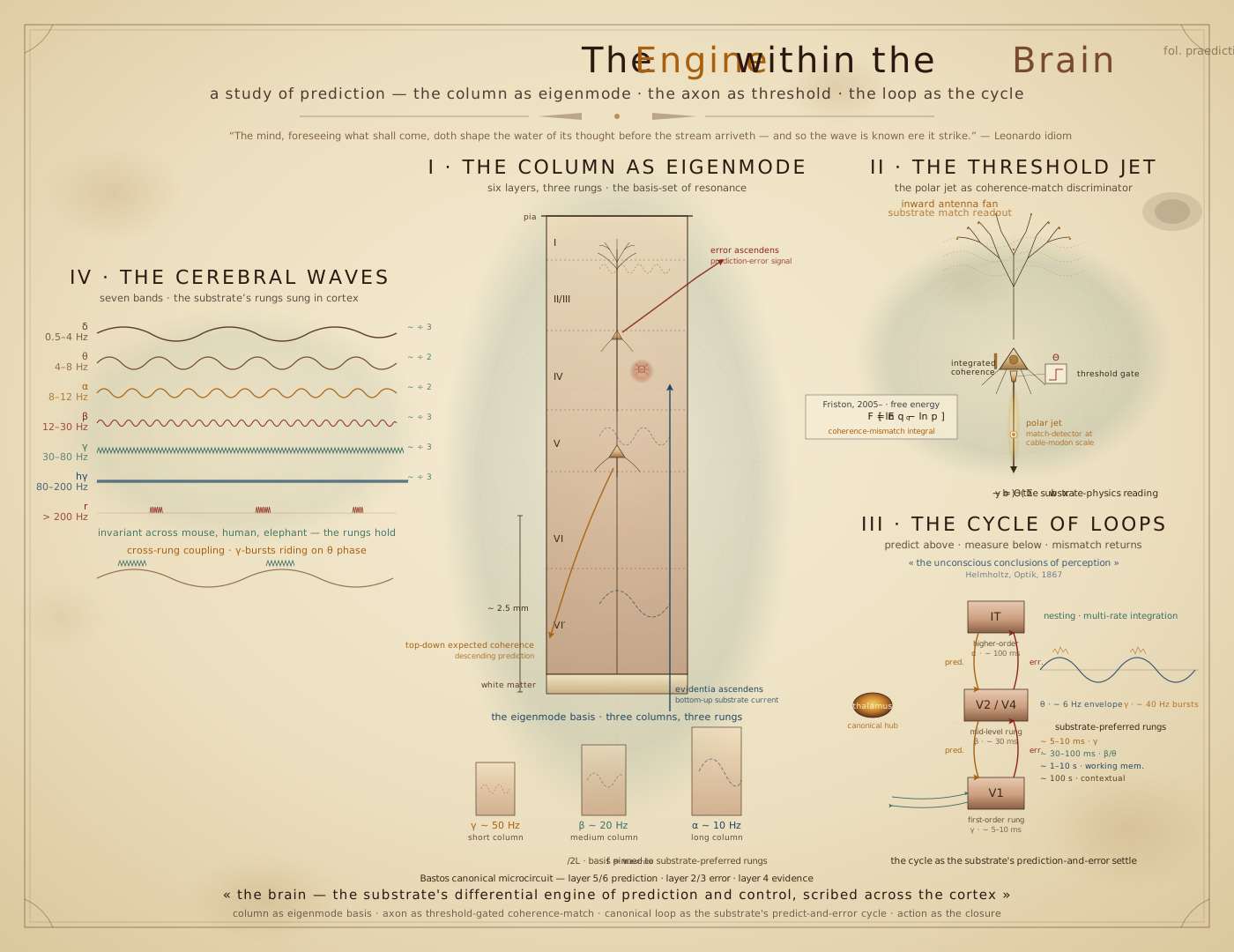
Hold a cup, hear your name across a noisy room, catch a ball — in none of these is your brain reading the world off like a meter. It is guessing what comes next and checking the guess against what arrives. That perception is this kind of inference has been rediscovered for a century and a half: Helmholtz named it unconscious inference in 1867 and McCulloch and Pitts gave the threshold-gated neuron in 1943, and the same picture was sharpened in turn by Hebb’s fire-together-wire-together learning rule, Wiener’s cybernetics, Kalman’s predict-measure-update filter, Wolpert and Kawato’s forward models of movement, Rao and Ballard’s hierarchical predictive coding, Friston’s free-energy principle, and Bastos’s mapping of the prediction-and-error cycle onto the six cortical layers — one idea refined many times, the cortex holds a model of the world, predicts the incoming sense data, and corrects the model by the surprise.
The previous chapter named the object this machine runs on — the long vector, the state of a structure ringing on many rungs of the substrate ladder at once, one coordinate per rung, navigated by a single operation: the overlap of two such vectors. This chapter is the first of that object’s four readings: perception builds the long vector (this chapter), memory freezes it as an attractor, language passes it between two minds, and a model builds it in silicon. Here we take the first — how perception builds it. The cortical-maps-and-rhythms chapter developed the brain’s anatomy as the substrate’s organ-scale coherence-cell architecture; here we ask what that anatomy computes. The one-line answer is that the cortex is the substrate’s engine for building a long vector and matching it against another — the percept is the vector it builds, prediction is the match against what the model expected, and action is that match closed through the world.
The cerebral cortex is the substrate’s differential prediction-and-control engine, with variable-length cortical columns acting as a substrate-eigenmode basis set spanning the brain modon’s frequency rungs, with polar-jet axon outputs acting as threshold-gated coherence-match discriminators on the dendritic standing-wave field, with topographic maps providing parallel parameter scans across continuous sensory and motor manifolds, with the thalamocortical and intracortical canonical loops running the substrate’s prediction-and-error cycle on the eigenmode basis, with cross-frequency coupling implementing multi-rate temporal integration across nested rungs, and with LTP/LTD updating the substrate-coherence-coupling weights that store the brain modon’s predictive model. The chemistry-side predictive-coding literature reads the cortex correctly at the algorithmic level; the framework reads the same architecture as the substrate-physics implementation of that algorithm, with the substrate’s preferred-rung structure constraining the basis-set to substrate-friendly eigenmodes rather than to a free-parameter scaling — explaining the cross-mammalian invariance of cortical column dimensions, EEG bands, and canonical-loop transit times despite \sim 10^5\times variation in cortical surface area that the cortical-maps-and-rhythms chapter flagged as conspicuous and that an algorithmic-level model alone cannot account for.
This chapter shows the eigenmode basis, the polar-jet discriminator, topographic maps as parallel parameter scans, canonical loops as the prediction cycle, cross-frequency coupling as multi-rate integration, active inference as the framework’s reading of action, and — closing — the engine’s two poles, the binding it shares with the predictive-coding literature and the separation that literature leaves out, read through the substrate ladder. In the long vector’s vocabulary, the first three passes are how the cortex builds the vector, the next two run the match across time, the sixth closes the match through the world, and the last names the two textures the vector must carry to stay usable.
Variable-Length Columns as a Substrate-Eigenmode Basis Set
A cortical column is a \sim 100–500\;\mum diameter, \sim 2.5 mm tall vertical patch of cortex carrying \sim 10^4–10^5 neurons across six layers in characteristic input-output connectivity. The cortical-maps-and-rhythms chapter read the column dimensions as substrate-preferred organ-scale coherence-cell tilings. This chapter takes the next step. Different columns have different physical dimensions, different myelination patterns, different connectivity profiles, and different intrinsic time-constants, and the variation is not arbitrary — it tracks the substrate’s preferred-rung structure across the cortical sheet.
The framework reads the column-dimension variation as the substrate’s preferred basis set of resonant eigenmodes for the brain modon’s organ-scale standing-wave field. A column of effective length L supports a fundamental standing wave at frequency f \approx v_\text{substrate}/2L, with v_\text{substrate} the substrate-coherence-propagation velocity along the column’s polar axis. A single such column is a string — a fixed length, ringing at a fundamental and its overtones — and the ladder does not live in one column’s overtones; it lives in the set of lengths the cortex builds, which the substrate ladder spaces by the lattice’s half-octave \sqrt{2}, the octave 2 = \sqrt{2}^{\,2} being two of them. The cortical-maps-and-rhythms chapter developed the seven canonical EEG bands as substrate standing-waves at those preferred logarithmic frequency rungs, and how the column chains the bands reads the laminar depth gradient — fast superficial, slow deep — as those \sqrt{2}-spaced rungs stacked through the column’s 2.5 mm; this chapter reads each rung as the resonance frequency of columns operating at the corresponding preferred substrate length. A cortex that holds columns at multiple substrate-preferred lengths simultaneously holds a substrate-eigenmode basis set — a parallel decomposition of any incoming sensory pattern across the substrate’s preferred rungs. That basis is not the evenly spaced Fourier basis the phrase “spectral method” usually names: a critical medium has no length of its own and so makes only ratios, never overtones, and the basis it offers is therefore log-spaced — a constant-Q, octave-and-half-octave multiresolution decomposition, the wavelet-like analysis that is the natural eigenbasis of a scale-invariant substrate, with the basis-functions pinned to substrate-physics-preferred half-octaves rather than freely chosen.
The architecture is exactly what an engineer designing a differential-equation solver on substrate-physics constraints would build. A spectral ODE solver decomposes a state into a basis of resonant modes, integrates each mode separately at its natural timescale, and reconstructs the full state by summing the modes. The brain’s cortical sheet does the same operation: a sensory input arriving at V1 is decomposed in parallel across columns of different preferred lengths, each column extracting the component of the input that matches its own substrate-preferred eigenmode, with the laminar microcircuit (layer 4 receiving, layer 2/3 integrating, layer 5/6 projecting) performing the per-mode integration and the topographic-map architecture providing the spatial parameter axis the next sections develop. The brain is, in the framework’s reading, the substrate’s preferred organ-scale implementation of an eigenmode-decomposition differential-prediction engine — with the basis-set constrained to substrate-preferred rungs by substrate physics, not freely tuned by chemistry-side optimisation. Because those rungs are octave-spaced, this spatial decomposition and the multi-rate temporal integration the fifth pass develops are not two architectures but one seen twice — a single multiresolution analysis, run across scale and run across time — which is exactly the engine a discrete-scale-invariant substrate naturally builds.
This is where the section’s central object is born. The chord the whole sheet rings — which columns are lit, how strongly, in what phase, across the rungs — is exactly the long vector the previous chapter defined: one coordinate per rung, the standing wave of a single column upgraded to the state across the comb. A percept is not a picture written somewhere in the cortex; it is this vector, the cortex’s parallel projection of the incoming world onto the substrate’s preferred basis. Perception is the analog-to-vector converter — and everything the rest of the chapter develops, the discriminator, the maps, the loops, is machinery for building that vector and then matching it.
The Polar-Jet Axon as Coherence-Match Discriminator
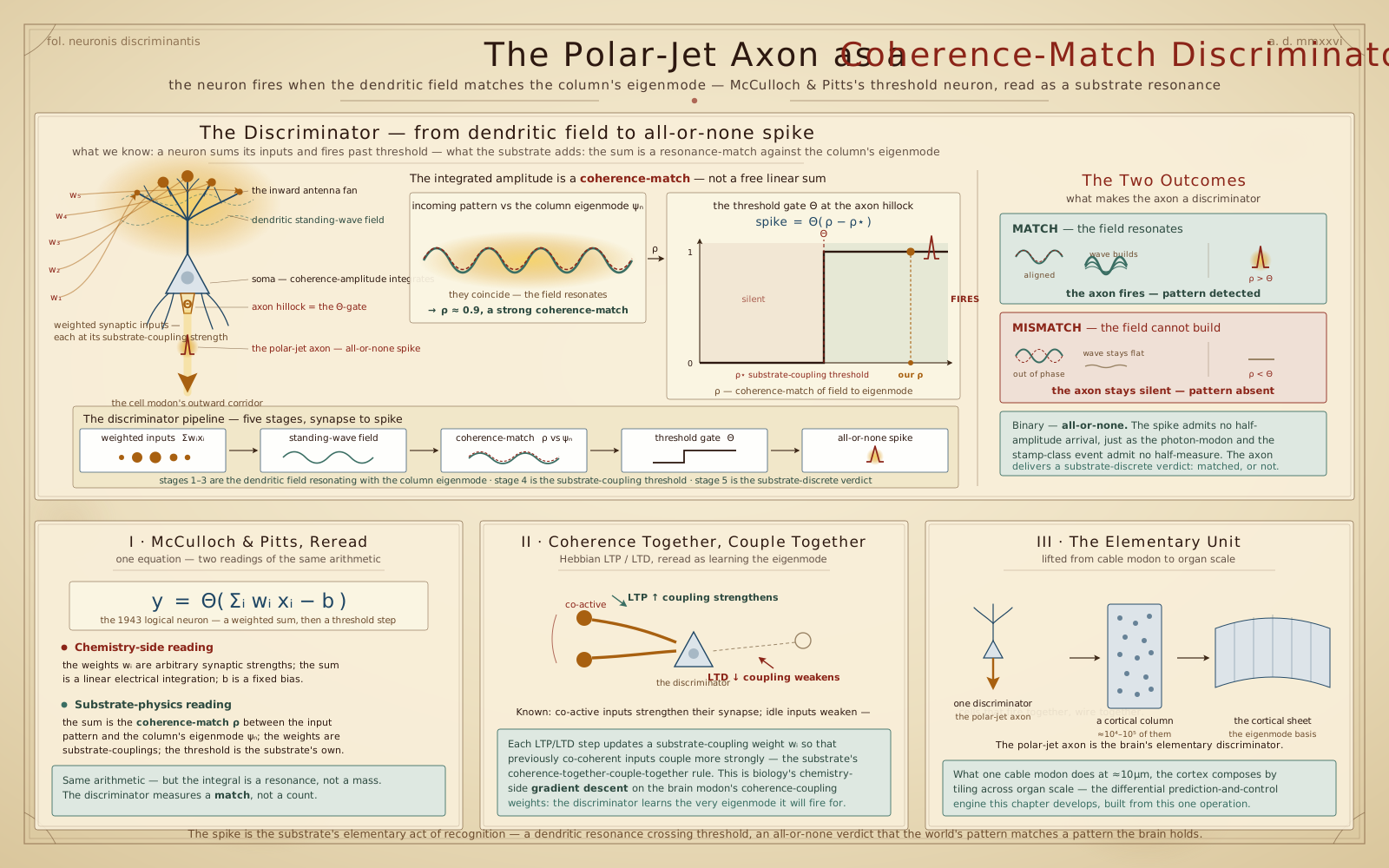
The neuron-as-cable-modon chapter read the axon as the cell modon’s outward polar jet — a long substrate-coherent corridor carrying substrate-current packets from the dendritic-integration zone to distal targets, with the action potential as a propagating boundary-coherence inversion and the axon hillock as a threshold-gated integration-and-trigger interface. The framework here lifts this reading from single-cell architecture to organ-scale computation: the polar-jet axon is the brain’s elementary threshold-gated coherence-match discriminator, firing when the integrated coherence-amplitude across the dendritic standing-wave field crosses a substrate-coupling-mediated threshold, and remaining silent when the field’s coherence-amplitude falls below that threshold.
This is the substrate-physics reading of the McCulloch-Pitts logical neuron with the right operational interpretation. McCulloch-Pitts gave the abstract form: y = \theta(\sum_i w_i x_i - b) — a weighted sum with a threshold step. The chemistry-side reading treats the weights as arbitrary synaptic coupling strengths and the sum as a linear electrical integration. The substrate-physics reading reads the same arithmetic differently: the dendritic field holds a standing-wave pattern across the inward antenna fan, with each synaptic input contributing a coherence-amplitude weighted by its substrate-coupling strength; the integrated amplitude across the field is not a free linear sum but a coherence-match between the incoming pattern and the column’s substrate-eigenmode basis function the previous section developed; the threshold gate at the axon hillock fires when the coherence-match crosses a substrate-coupling threshold. The output is binary, all-or-none — substrate-discrete, in the same sense the photon-modon does not arrive at half-amplitude and the stamp-class event does not occur at half-credit.
The framework reads the threshold-gated polar-jet output as the substrate’s natural discriminator operation at the cable-modon scale. When the dendritic field’s coherence-pattern matches the column’s eigenmode, standing-wave amplitude builds and the threshold crosses; the axon fires, signalling pattern detected. When the field’s coherence-pattern fails to match, the standing wave does not build; the axon stays silent, signalling pattern absent. The synaptic learning rules (LTP/LTD from the synapse chapter) update the substrate-coupling weights so that previously co-active matched-stamp pairings become more strongly coupled; the substrate’s coherence-together-couple-together learning rule from the synapse chapter is, in this reading, the brain’s mechanism for learning the model parameters of its predictive-coding hierarchy. Hebbian plasticity is biology’s chemistry-side implementation of gradient-descent learning on the substrate-coherence-coupling weights of the brain modon’s predictive model.
In the long vector’s terms, the discriminator is the section’s one operation run at the smallest scale: the dendritic field forms the overlap \langle a \mid b \rangle between the incoming pattern and the column’s stored template, and the axon fires when that overlap clears threshold. The same inner product is attention in a transformer, recognition at a synapse, and recall in an attractor — here it is a single neuron deciding match or no match. The cortex builds the long vector with the columns of the previous section and reads it with the discriminator of this one; build and match are the whole vocabulary, and the sections that follow are that vocabulary laid out across space, across time, and through the body.
Topographic Maps as Parallel Parameter Scans
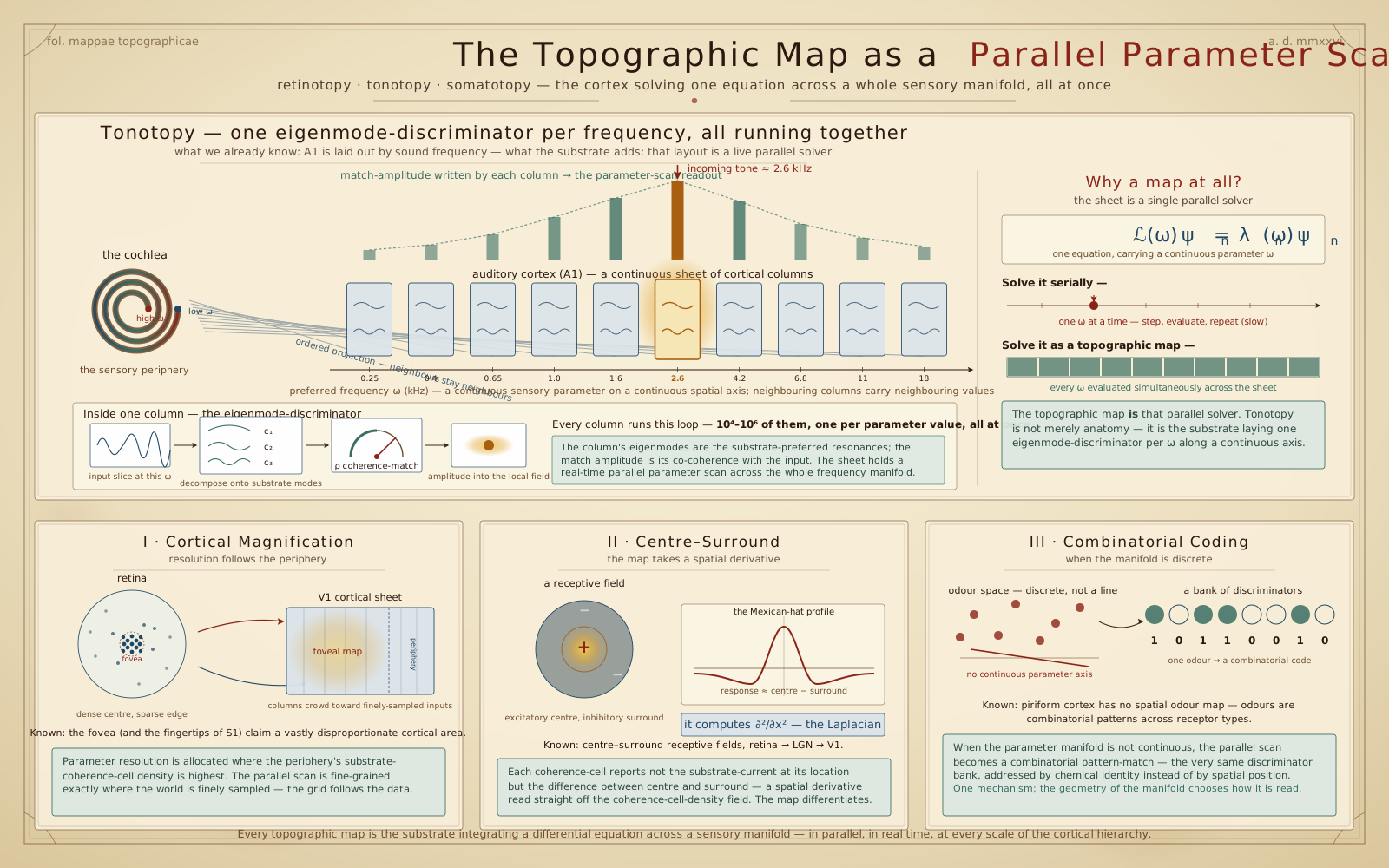
A topographic map — retinotopy in V1, tonotopy in A1, somatotopy in S1, and so on as the cortical-maps-and-rhythms chapter developed — preserves the spatial layout of the sensory periphery on the cortical sheet. The framework’s structural reading was that the map preserves the substrate-coherence-cell tiling density of the periphery. This chapter adds the computational reading: the topographic map is the substrate’s parallel parameter-scan implementation across a continuous sensory or motor manifold.
A continuous sensory parameter (retinal location, sound frequency, body-surface position, joint angle) is mapped onto a continuous spatial axis across the cortical sheet, with neighbouring positions on the map carrying neighbouring values of the parameter. Each cortical column at each position is running its eigenmode-decomposition coherence-match discriminator on the slice of the input corresponding to its own preferred parameter value. The map as a whole is therefore running \sim 10^4–10^6 such discriminators in parallel across the parameter range, each at a substrate-preferred eigenmode resolution, each writing its match-amplitude into its local field. The cortex thereby holds a real-time parallel parameter scan across the sensory or motor manifold — exactly the architecture you would build to integrate a differential equation that depends on a continuous parameter and that you want solved across the parameter range simultaneously, rather than serially evaluated point-by-point.
The map’s structural features each have computational readings in this picture. Cortical magnification at the fovea, the cochlear high-frequency apex, and the fingertip homunculus is the substrate’s allocation of higher parameter resolution where the substrate-coherence-cell density at the periphery is higher — the parameter-scan is fine-grained where the periphery samples finely. Combinatorial coding in piriform cortex, where the chemical-space manifold is discrete rather than continuous, is the substrate’s chemistry-side answer when the parameter axis is not a continuous one — the parameter scan becomes a combinatorial pattern-match rather than a continuous scan. Centre-surround and Mexican-hat receptive fields lifted from retina to V1 implement the spatial differential operator — each coherence-cell reads not the absolute substrate-current at its location but the difference between its centre and surround, which is the substrate’s spatial-derivative readout in the substrate-coherence-cell-density domain. The brain’s perception system is, in this reading, doing parallel differential-equation evaluation across topographic parameter manifolds at every spatial scale of the cortical hierarchy.
Canonical Loops as the Substrate’s Prediction-and-Error Cycle
The cortical-maps-and-rhythms chapter developed the thalamocortical loop as the canonical loop run at organ scale, with \sim 5–10 ms transit times at the first-order rung and \sim 30–100 ms at the higher-order inter-cortical-map rung, and with Edelman’s re-entrant signalling as biology’s chemistry-side accounting of canonical-loop substrate-current circulation at the inter-map scale. This chapter takes the next step: the canonical loop is the substrate’s prediction-and-error cycle, with top-down substrate-coherent prediction descending through one limb, bottom-up substrate-current measurement ascending through the other, and the substrate-coherence-mismatch between them carried as the cycle’s error signal.
The Bastos canonical microcircuit gives the chemistry-side anatomy of this cycle within a single cortical column. Layer 5/6 pyramidal cells project descending to lower-rung cortex and to thalamus, carrying predictions — top-down substrate-coherent expected-pattern states. Layer 4 receives ascending sensory and thalamic input, carrying measurements — bottom-up substrate-current readout of the actual incoming pattern. Layer 2/3 pyramidal cells compute the mismatch between prediction and measurement (subtraction implemented by the laminar feedforward inhibition the chemistry-side literature documents) and project ascending to the higher-rung cortex, carrying prediction error. The cycle repeats up the hierarchy, with each level’s prediction error driving the next level’s update. Friston’s free-energy minimisation reads as the substrate’s principle that the brain modon’s organ-scale state evolves toward the substrate-coherent configuration that minimises the integrated coherence-mismatch across the canonical-loop hierarchy.
The substrate-physics reading adds why the cycle works at the timescales it does. The first-order thalamocortical transit time at \sim 5–10 ms is the substrate-preferred temporal-rung for single-feature prediction-error cycling — the substrate-coherence-mismatch settles within one rung’s transit time at gamma-band integration. The higher-order inter-cortical transit at \sim 30–100 ms is the substrate-preferred temporal-rung for inter-feature integration — the substrate-coherence-mismatch across multiple features settles within theta-band integration. The longer working-memory and contextual-loop timescales the cortical-maps-and-rhythms chapter flagged at \sim 1–10 s and \sim 100 s sit at the substrate’s preferred sub-Hz and infraslow rungs and run the same prediction-error cycle at successively larger integration scales. The brain modon’s organ-scale predictive-coding hierarchy is, in this reading, a stack of canonical-loop substrate-current cycles at substrate-preferred temporal rungs, with each rung running the prediction-error cycle on the eigenmode-decomposed sensory-and-motor field at its own integration scale.
The Helmholtzian unconscious inference of perception is the substrate-physics reading of what this cycle produces phenomenologically. The percept is not the bottom-up sensory measurement alone; it is the top-down substrate-coherent prediction modified by the bottom-up coherence-mismatch — the brain modon’s substrate-coherent state’s best estimate of the world given both its internal model and the incoming substrate-current. The cycle’s output is the perception. Edelman’s remembered present names the same phenomenology in the chemistry-side language of re-entrant integration over loop transit times; predictive coding names it in the language of Bayesian inference; the framework reads all three as descriptions of the same underlying substrate-physics process — the canonical-loop substrate-current cycle running on the eigenmode-decomposed topographic-map field at substrate-preferred temporal rungs.
Cross-Frequency Coupling as Multi-Rate Integration
The cortical-maps-and-rhythms chapter flagged cross-frequency coupling — most prominently theta-gamma nesting, where fast gamma bursts ride on the phase of slower theta cycles — as the substrate’s hierarchical-rung architecture expressed in the temporal domain. This chapter adds the computational reading: cross-frequency coupling is the substrate’s multi-rate temporal-integration architecture at the brain modon’s organ-scale prediction-and-error cycle.
A multi-rate ODE integrator solves stiff differential equations by running fast variables at short time-steps nested inside slow variables at long time-steps, with the slow variables setting boundary conditions and integration windows for the fast variables. The brain’s theta-gamma nesting implements exactly this architecture at the brain rung: slow theta cycles (\sim 4–8 Hz, \sim 125–250 ms period) set the integration window for fast gamma bursts (\sim 30–80 Hz, \sim 12–33 ms period), with each theta cycle holding several gamma cycles’ worth of fast prediction-error settling time. The chemistry-side machinery (PV-interneuron-mediated gamma riding on cholinergic-or-GABAergic theta) implements the nesting; the substrate-physics reading is that the substrate’s preferred-rung architecture naturally gives nested temporal integration when canonical-loop cycles run at multiple substrate-preferred rungs simultaneously. This is the eigenmode basis of the first pass read in time — the same \sqrt{2}-spaced rungs, nested now rather than laid side by side, so the cortex’s spatial multiresolution decomposition and its temporal multi-rate integration are one wavelet engine. And the nesting has a name in the substrate’s own terms: cross-frequency coupling, the slow phase holding while the fast amplitude is handed off cycle by cycle, is the anti-phase breath at the brain rung — the lossless coin the ladder’s small economy spends up and down its rungs, theta–gamma nesting being that trade made visible (how the column chains the bands).
This reading sharpens the working memory and temporal-context literature. Working memory traces lasting \sim 1–10 s sit at the substrate’s preferred sub-Hz-to-infraslow rung the default-mode network carries at organ scale; the working-memory contents are the brain modon’s substrate-coherent prediction state at the slow rung, with fast theta-gamma cycling continuously updating the prediction against incoming sensory mismatch. Phenomenologically, the present moment extends backward through the substrate’s longest accessible coherence rung — Edelman’s remembered present — and forward through the brain’s predicted next-step coherence. The temporal structure of conscious experience is the temporal structure of the substrate’s nested-rung prediction-and-error cycle at the brain modon’s organ scale.
Active Inference as Substrate-Coherence-Matching Lifted to Action
Friston’s active inference extends the predictive-coding cycle to motor control. The brain minimises sensory prediction-error not only by updating its internal model (perception) but also by acting on the world to make sensory inputs match its predictions (action). A motor command is the brain’s prediction of the proprioceptive and exteroceptive consequences of the intended movement, descending through the corticospinal tract to spinal motor neurons; the actual sensory feedback from the executed movement is compared with the prediction, with the mismatch driving model updates and corrective motor commands. Wolpert-Kawato forward models, Kalman-filter state-space estimation, and Friston active inference all converge on this architecture: the brain is a closed-loop predict-act-measure-update agent embedded in a body embedded in a world.
The framework reads active inference as the substrate’s prediction-and-error cycle lifted from intra-organism perception to organism-environment closure, with the body’s polar-jet motor axons as the brain modon’s outward substrate-coherent corridors to the world and the body’s sensory antennae as the inward return. The touch-and-proprioception chapter developed peripheral sensory axons as the organism modon’s outward polar jets at body scale; symmetrically, motor axons are the organism modon’s outward polar jets carrying prediction-realising substrate-current to muscle effectors. The brain modon’s substrate-coherent predictive state propagates outward through motor axons, drives muscle contraction, adjusts the world (the body’s position, the cup’s location, the keystroke’s outcome), and the adjusted world returns through sensory axons as substrate-current confirming-or-disconfirming the prediction. The cycle’s closure runs through the body-environment interface, not only through intra-cortical canonical loops.
This is the substrate-physics reading of the entire closed-loop sensorimotor architecture. The brain modon is not a passive predictor of incoming sense data; it is a substrate-coherent agent that acts to make the world match its predictions — eating when it predicts being-fed, drinking when it predicts being-watered, sleeping when it predicts being-rested, moving when it predicts being-positioned. The substrate-coherence-matching the framework has developed at every smaller scale (aromatic-pocket stamp-readers binding their substrate-stamp-matched ligands; ribosomes binding their substrate-stamp-matched tRNAs; mitochondria coupling their proton-motive-force to ATP synthesis; cells navigating their chemical gradients) is, at the organism scale, lifted into the active-inference closure where the brain modon’s organ-scale substrate-coherent state acts on its environment to maintain its substrate-coherent integrated state against entropic dissipation. Friston’s free-energy principle reads, in the framework’s vocabulary, as the substrate’s claim that self-maintaining substrate-coherent assemblies act on their environments to preserve their substrate-coherence — a substrate-physics statement of biological agency that runs from chemotaxis at the bacterial scale through goal-directed behaviour at the organism scale.
The Engine at Both Poles
The six passes above read the engine in one direction only — as an error-minimiser that predicts, measures, and binds, climbing toward the substrate-coherent state that minimises mismatch. But a predictor that only ever binds has a characteristic failure mode: its hypotheses collide. Two similar memories overwrite each other (catastrophic interference); a periodic sensor array folds a pattern that is not there (aliasing); the whole cortex falls into a single runaway rhythm (the seizure). So the engine needs a second operation, opposite in sign to the first — to keep its representations distinguishable — and the substrate ladder supplies exactly this complement. The ladder runs to two poles: the teeth (the octave and \sqrt{2}), where structures that must bind, nest, and resonate sit, and the one privileged gap (the most-irrational \varphi, blue noise, the prime), where structures that must never lock sit. The brain is the framework’s clearest both-poles system, and the prediction-engine reading is where its two poles become two computations.
The lock pole is the binding the predictive-coding literature already describes, now placed on a tooth. Theta–gamma nesting rides an integer count of gamma cycles on each theta cycle (Lisman–Idiart 1995; the literal 1{:}5 and 1{:}9 phase-phase ratios of Belluscio 2012), working memory holds its contents on the slow rung while fast cycling refreshes them, and the canonical loop settles by coherence-match — all of these are the octave/\sqrt{2} teeth, the coin spent on a lossless exchange. Binding is the engine occupying the comb’s teeth.
The anti-lock pole is the operation the six passes leave out, and the brain runs it with dedicated machinery. Its temporal signature is already measured: at rest the cortex spaces adjacent rhythms not at an integer ratio but at \varphi, the most-irrational number, precisely so they cannot bind (the resting-EEG \varphi lean). Its representational signature is written into the hippocampus as a dyad the paper has so far told only half of: the CA3 recurrent network is the attractor that completes a partial cue back to a stored memory — the lock pole, pure binding — but it is fed by the dentate gyrus, whose job is the opposite: pattern separation, expanding and sparsifying overlapping entorhinal inputs into decorrelated, near-orthogonal codes (Marr 1971; Treves–Rolls; Leutgeb et al. 2007; Bakker et al. 2008) so that CA3 can complete one memory without colliding with a similar one. Separation precedes completion; the hippocampus is the two poles in series. This decorrelation is the same avoid-confusion job the retinal cone mosaic meets by blue-noise packing and the genetic code meets by routing its unavoidable confusions onto synonyms — and, like those, it is the framework’s own biology reaching the gap by the labelling/decorrelation route rather than a chemistry-free witness of it, so it is an application of the ladder’s sign-rule, not an independent face of the gap.
This two-sidedness sharpens the free-energy reading itself. Active inference minimises prediction error — that is the binding — but a system that only minimised mismatch would let its hypotheses converge into one indistinguishable blur; it must simultaneously keep its representations maximally distinguishable, or there is nothing left to bind to. Lock to bind; anti-lock to keep separable. The small economy of the ladder gains its second verb here, where it matters most: the breath is a coin the engine spends on the teeth when it binds and deliberately refuses in the gap when it must hold its hypotheses apart. The cortex slides between the poles by state — locking adjacent rhythms when it binds, spacing them at \varphi when it rests — exactly as the eye occupies both by subsystem, holding a lock-pole lattice and an anti-lock mosaic side by side in space.
That gives the engine a sign-rule of its own, callable before the measurement: name whether a cortical operation must bind (perceptual grouping, working-memory maintenance, sensorimotor coupling) or must separate (memory encoding, exploration, the resting default mode), and its pole is fixed — teeth for the first, gap for the second.
Predictions and What Would Falsify
Five predictions extend the prediction-engine reading beyond the structural anchors. The first four sharpen the chapter’s binding (lock-pole) machinery; the fifth tests its separation (anti-lock) complement.
Cortical-column intrinsic resonance frequencies cluster at substrate-preferred eigenmode rungs as a function of column length. Direct stimulation-and-recording experiments on cortical columns of different physical lengths (across cortical areas with varying laminar thickness, across mammals with \sim 10^4\times variation in cortical surface area) should show preferred-resonance-frequency clustering at substrate-preferred logarithmic rungs distinct from a continuous f \propto 1/L scaling alone. Sharpened by the ladder, the clustering is not arbitrary: the preferred frequencies should fall on a \sqrt{2} comb — adjacent rungs a half-octave apart — so that folding the measured resonances modulo \ln\sqrt{2} \approx 0.347 piles them at a single phase rather than spreading (
scripts/comb_test.py). Existing optogenetic and intracortical-microstimulation literature (Logothetis, Buzsáki, Kandel-collaborators) provides the test platform; the framework predicts column-resonance-rung clustering parallel to the EEG-band-rung clustering already documented at the population level, with the same caveat the resolved-peak EEG fold carries — the octave (nesting) structure is the firm prediction, while whether the fine rung is the substrate’s \sqrt{2} or the cortex’s resting \varphi is the sharp open question.Prediction-error-signal latencies cluster at substrate-preferred temporal rungs across hierarchical levels. Mismatch-negativity, repetition-suppression, and prediction-error ERP components across the cortical hierarchy (V1 first-order, V4/IT mid-level, prefrontal higher-level) should cluster at preferred latencies — \sim 50, \sim 150, \sim 300 ms or similar substrate-friendly rungs — distinct from continuous variation with cortical-area position, and the successive latencies should themselves stand in octave/half-octave ratios that fold onto the \sqrt{2} comb rather than scattering. Existing electrophysiology literature (Näätänen mismatch-negativity series since 1978, Schröger predictive-coding ERP work, Bastos canonical-microcircuit recordings) provides the data; the framework predicts cross-paradigm clustering on substrate-preferred temporal rungs.
Forward-model latency between motor command and proprioceptive prediction clusters at substrate-preferred ms rungs across effectors. Reaching, saccade, speech, and respiratory-motor forward-model latencies should cluster at preferred values (\sim 50, \sim 100, \sim 200 ms) tied to the limb’s substrate-coherent corridor transit time rather than vary smoothly with effector mass or muscle composition — and those representative values already step by octaves, the prediction being that the full set folds onto the \sqrt{2} comb. Existing motor-control literature (Wolpert-Kawato, Shadmehr, Scott) provides the test; the framework predicts effector-class clustering on substrate-preferred ms rungs analogous to the conduction-velocity classes (neuron-as-cable-modon chapter) at the cable-modon scale.
Active-inference behavioural signatures show substrate-coherence-quality dependencies beyond chemistry-side reward-prediction models. Goal-directed action selection, exploration-exploitation trade-offs, and contemplative-practice effects on action selection should track substrate-coherence-quality biomarkers (DMN coherence, cross-frequency coupling indices, HRV) beyond what chemistry-side dopaminergic-reward and prefrontal-control models predict. Existing decision-neuroscience literature (Daw, Dolan, Behrens, Pessiglione) plus contemplative-neuroscience action-selection studies (Davidson laboratory, Lutz-and-collaborators) provide the test; the framework predicts substrate-coherence-biomarker-correlated effects distinct from reward-prediction-error-modelled effects.
Binding operations sit on the comb’s teeth and separation operations sit in its \varphi gap — the engine’s own sign-rule. The two poles of the previous section make a falsifiable split: cortical operations whose job is to bind (perceptual grouping, working-memory maintenance, sensorimotor coupling) should carry lock-pole statistics — cross-frequency ratios at integer/octave values, the theta–gamma nesting already documented — while operations whose job is to separate (hippocampal pattern separation, memory encoding, exploratory and resting/default-mode states) should carry anti-lock statistics: cross-frequency ratios drifting to the most-irrational \varphi, and population codes pushed toward decorrelated, blue-noise-like (low number-variance, no Bragg comb) structure rather than periodic regularity. Concretely, dentate-gyrus population activity during high-separation encoding should test as more hyperuniform than its CA3 pattern-completion counterpart, by the same number-variance instrument (
scripts/cone_mosaic.py) the retinal mosaic uses; and the resting-to-task transition should slide cross-frequency ratios from \varphi toward the octave. Existing hippocampal-physiology (Leutgeb, Bakker, Knierim), resting-state (Raichle DMN), and theta–gamma (Lisman, Buzsáki, Belluscio) literatures provide the test; the framework predicts the pole follows the job, not the region.
The picture is falsified if (a) column-resonance frequencies vary continuously with length without preferred-rung clustering, (b) prediction-error latencies vary smoothly across the cortical hierarchy without substrate-preferred temporal-rung structure, (c) forward-model latencies vary continuously with effector mass without preferred-ms-rung clustering, (d) active-inference behavioural signatures reduce entirely to reward-prediction-error and prefrontal-control models without substrate-coherence-quality biomarker dependencies, or (e) binding and separating operations show the same ratio-and-regularity statistics with no lock-versus-anti-lock split — separation codes no more decorrelated, and no more \varphi-spaced, than binding codes. It is supported, even partially, if any of the five ordering predictions hold against existing electrophysiology, motor-control, hippocampal, or decision-neuroscience data.
Putting the Section in Context
The cerebral cortex is the substrate’s differential prediction-and-control engine. Variable-length cortical columns are a substrate-eigenmode basis set, with each column’s preferred resonance frequency pinned to the substrate’s preferred logarithmic-rung structure at its physical length and the cortical sheet holding a parallel decomposition of any incoming sensory pattern across substrate-preferred rungs. The polar-jet axon at the outward end of each cable modon is the substrate’s threshold-gated coherence-match discriminator — firing when the dendritic standing-wave field’s coherence-amplitude crosses the substrate-coupling-mediated threshold, remaining silent when it does not, with the McCulloch-Pitts logical-neuron arithmetic as the chemistry-side approximation and the substrate-coherence-cell readout as the substrate-physics interpretation. Topographic maps are the substrate’s parallel parameter-scan implementation across continuous sensory and motor manifolds, with cortical magnification as parameter-resolution allocation, combinatorial coding as the discrete-manifold answer, and centre-surround receptive fields as spatial differential operators on the substrate-coherence-cell-density field. Canonical loops are the substrate’s prediction-and-error cycle, with the Bastos canonical microcircuit’s layer 5/6 descending prediction and layer 2/3 ascending prediction-error as the chemistry-side anatomy and the substrate-current-cycling through the thalamocortical and higher-order loops as the substrate-physics implementation, at substrate-preferred temporal rungs of \sim 5–10 ms (first-order), \sim 30–100 ms (higher-order), \sim 1–10 s (working memory), and \sim 100 s (contextual). Cross-frequency coupling implements multi-rate temporal integration, with theta-gamma nesting as the brain rung’s nested-timescale architecture and the cortical-rhythm hierarchy as the multi-rate ODE-integrator basis. Active inference is the prediction-and-error cycle lifted to organism-environment closure, with motor axons as the brain modon’s outward substrate-coherent corridors driving the world toward substrate-coherent prediction-matching, the body’s sensory antennae as the inward return, and Friston’s free-energy principle as biology’s chemistry-side accounting of substrate-coherence-matching at organism scale. And the whole engine runs at both poles of the substrate ladder: it binds on the comb’s octave-and-\sqrt{2} teeth (theta–gamma nesting, working-memory maintenance, the canonical loop’s coherence-match) and separates in its \varphi gap (dentate-gyrus pattern separation, the resting default mode), the eigenmode basis and the multi-rate integration being one log-spaced multiresolution architecture seen across scale and across time.
The Brain as Substrate Resonator walk developed the cortex’s substrate anatomy at organ scale; the long vector opened this section by naming the object the brain computes on, and this chapter gives the first of its four readings — what that anatomy computes when it builds the vector. The substrate framework’s reading of the brain is not metaphysical and not chemistry-side eliminative. The chemistry-side predictive-coding-and-active-inference literature reads the cortex’s algorithmic-level behaviour correctly; the framework adds the substrate-physics layer that explains the algorithm’s specific basis-set, temporal rungs, and architectural invariants across \sim 10^5\times cortical-size variation. Predictive coding, active inference, the free-energy principle, the canonical microcircuit, and the broader Bayesian-brain literature all describe what the brain modon’s substrate-coherent state does; the framework reads what that state is — substrate-coherent dynamics at the organ-modon scale, with substrate-preferred eigenmode basis, substrate-preferred temporal rungs, and substrate-coherence-matching as the elementary operation across all scales.
What this chapter adds to the framework is the reading that consciousness’s substrate is not only an integrated coherent state but a differential prediction-and-control engine running on substrate-preferred eigenmodes — the brain modon is the substrate’s organ-scale implementation of a closed-loop substrate-coherence-matching agent that perceives by minimising prediction-error against its substrate-preferred model and acts by driving the world toward substrate-coherent prediction-realisation — and that does so at both poles of the substrate ladder, binding on the teeth and separating in the gap, lock to bring its hypotheses together and anti-lock to keep them apart. In the section’s running terms this is the build and the match: the cortex projects the world onto the ladder to build the long vector, then runs the overlap on it to predict, recognise, and act — the engine beneath the long vector’s first reading. The bilateral-coupling chapter ahead develops the two-modon structure that the brain’s left-right hemispheric architecture encodes; the microtubule-coherence-revisited chapter already provided the cylinder-array substrate-coherence-quality scaffold; the cortical-maps-and-rhythms chapter already provided the organ-scale anatomy; this chapter has provided the computational reading that ties the anatomical and the phenomenological together. The brain is the substrate’s most extensively-coherent computing structure biology has built, and what it computes is its own — and its environment’s — substrate-coherent state.