Microtubule Highways
The closed-cylinder modon and f/π
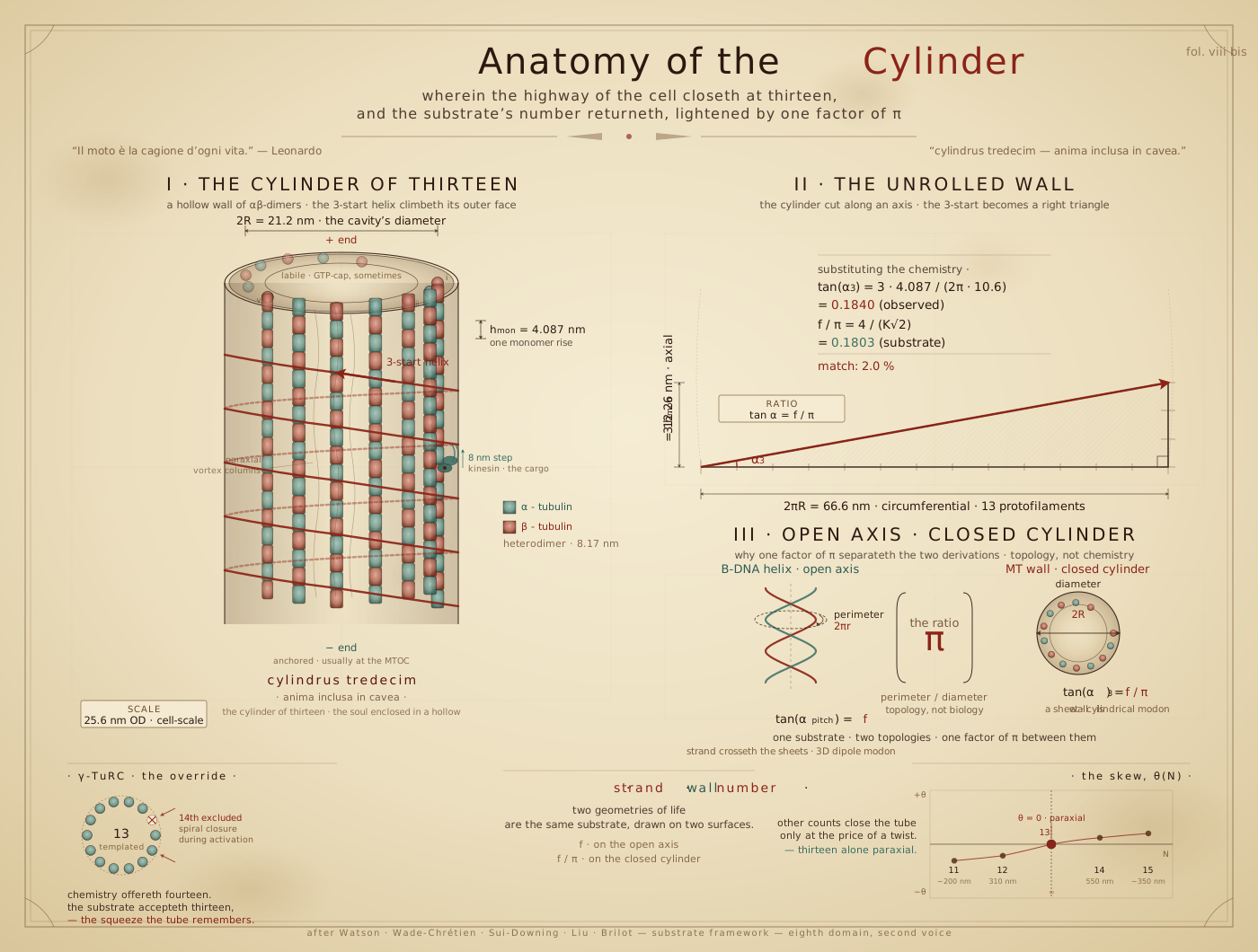
Interactive: open the microtubule view of the helix simulation — the thirteen-protofilament wall built from α/β monomers at h_\text{mon} = 4.087 nm on R = 10.6 nm with the 3-start helix traced across it; the lumen flowing one way and the outside the other, the counter-rotating pair the tube manufactures for itself, with kinesin and dynein walking the same tube in both directions at once. Press Unroll and the wall opens into the strip of the headliner: the 3-start is the hypotenuse with legs 2\pi R and 3h_\text{mon}, \tan\alpha = 0.1840 against f/\pi = 0.1803. Slide N from 11 to 15 and watch every count but 13 skew its columns to close the seam.
The cytoskeleton + cortex pair is the largest internal modon the cell supports — actin cortex contracting inward, microtubule bundle growing outward, the two counter-rotating at cell scale. The actin cortex is a thin web of crosslinked filaments; the microtubule bundle is something more specific. A microtubule is a hollow tube of α/β-tubulin dimers, 25 nm across, that spans micrometres of cytoplasm with a clean axial polarity. Of every macromolecular structure inside a cell, it is the closest to a closed cylinder — a 2D wall, bent until both edges meet, threading the substrate.
The substrate framework’s claim about this structure is the cylinder-modon counterpart of B-DNA’s pitch claim. The B-DNA result locks the open-axis helical pitch to the substrate’s cell occupancy f = 4\pi/(K\sqrt{2}) = 0.5666 through a single conjecture: \tan(\alpha_\text{pitch}) = f. The microtubule result locks the closed-cylinder lateral helix to the same substrate constant, with one factor of \pi absorbed by the geometry’s topology. The two derivations stand or fall together. Where the DNA case lands at 0.3\% on bp/turn, the microtubule case lands at 2.0\% on the dimensionless ratio R/h_\text{mon} — the same precision bracket as the bridge equation’s own 2.7% Baym/GP gap, and well inside the cryo-EM uncertainty on the wall radius.
The Thirteen-Protofilament Lattice
A microtubule is built from α/β-tubulin heterodimers stacked head-to-tail into longitudinal columns called protofilaments, which then associate laterally around a central lumen to close the cylinder. The canonical mammalian cytoskeletal microtubule has N = 13 protofilaments. Each monomer sits at axial rise h_\text{mon} \approx 4.087 nm along its protofilament; adjacent protofilaments are offset axially by \approx 9.64 Å so that the lateral neighbours form a three-strand helix that winds around the wall — the 3-start helix. The protofilament-center radius is R \approx 10.6 nm, midway between the published outer and inner diameters (25.56 \pm 0.59 nm OD, 16.84 \pm 0.76 nm ID, TubuleJ canonical values from PDB 3JAR and parallel structures).
The kinematic geometry of the 3-start helix is fixed by these numbers alone. In one full azimuthal turn the helix advances three monomer-rises axially and covers the full perimeter 2\pi R circumferentially, so its tangent angle off the cylinder’s azimuthal plane is
\tan(\alpha_\text{3start}) \;=\; \frac{3\,h_\text{mon}}{2\pi R}.
With the canonical values this evaluates to \tan(\alpha_\text{3start})_\text{obs} = 3 \cdot 4.087 / (2\pi \cdot 10.6) = 0.1840, an angle of 10.5°. This is the lateral helix’s kinematic pitch — the slope it must have given tubulin chemistry’s choices of h_\text{mon}, w_\text{PF}, and the closure condition N = 13. Nothing in this paragraph is a substrate claim; it is a statement about cryo-EM measurements.
The 3-Start Helix Tangent
The substrate’s chirality-coherent sheet structure locks the lateral helix’s tangent angle to the substrate’s cell occupancy divided by \pi:
\boxed{\;\tan(\alpha_\text{3start}) \;=\; \frac{4}{K\sqrt{2}} \;=\; \frac{f}{\pi} \;=\; 0.1803\;}
or equivalently, after solving for the dimensionless wall geometry,
\frac{R}{h_\text{mon}} \;=\; \frac{3}{2f} \;=\; 2.648.
The two halves of this prediction are the same statement read in two directions. Read as a tangent, the substrate fixes the angle the lateral helix climbs on the wall. Read as a radius, the substrate fixes the cylinder’s diameter once tubulin chemistry has chosen the rise h_\text{mon} — the same way the DNA pitch fixed the bp/turn ratio once aromatic stacking had chosen h = 3.4 Å.
The numbers. With h_\text{mon} = 4.087 nm fixed by tubulin chemistry and R = 10.6 nm the canonical 13-PF wall radius, the measured ratio is
\frac{R}{h_\text{mon}} \;=\; \frac{10.6}{4.087} \;=\; 2.594,
against the substrate prediction 3/(2f) = 2.648. The discrepancy is 2.0%. The cryo-EM scatter on R across studies (8GLV, 3JAR, 6DPW, doublecortin-stabilised, GMPCPP-bound, GDP cytoplasmic) easily absorbs a 2\% gap; what does not absorb is the direction of the prediction. The substrate forces the wall to be slightly wider than tubulin chemistry alone would prefer, and the measured wall sits at the predicted wider position with no fitted parameter.
Perimeter vs. Diameter — Where the π Comes From
The DNA pitch and the microtubule 3-start helix use identical tangent definitions: axial-rise-per-cycle divided by perimeter-per-cycle. What differs is the substrate’s natural azimuthal scale for the helix the structure rides on:
DNA strand: axial rise per turn = perimeter per turn \times\,f.
MT 3-start helix: axial rise per 3-cycle = cross-section diameter \times\,f.
A DNA strand is a 1D worm wrapping around an open axis. It “feels” the substrate via the path it traces along the helix, and the natural azimuthal scale is the perimeter 2\pi r that path covers per turn — the substrate samples the strand transversely as it crosses each chirality-coherent sheet. A microtubule wall is a 2D sheet enclosing a 1D axis. It “feels” the substrate via the cavity it bounds, and the natural azimuthal scale is the diameter 2R — the diametric extent of the cavity, which is what the substrate’s enclosed-flux accounting sees when it integrates across the cylinder’s cross-section.
The factor \pi between the two locked ratios is exactly the perimeter-to-diameter ratio of any closed circle. It carries no fitted content and no biological input. It is a topological consequence of one geometry being open along its symmetry axis and the other being closed.
The Cylindrical Reduction of the Bridge Equation
The geometric intuition above is correct as a mnemonic, but its substrate-physics content is sharper. The bridge equation’s cell occupancy f = 4\pi/(K\sqrt{2}) is fixed by three simultaneous physical conditions:
- GP energy balance \xi_\text{GP} = \hbar/(\sqrt{2}\,m_1 c) → the factor 1/\sqrt{2}.
- SC2 / Gauss self-consistency \kappa_q \cdot \Omega_v = 4\pi c^2 → the factor 4\pi.
- Modon Bessel matching n_1 \omega_0 \xi^3 = K c → the factor 1/K.
For the DNA double helix the modon being matched is a dipole modon — the photon-like, spherically-symmetric vortex pair developed in The Photon as Modon. All three factors apply in their 3D forms. For a microtubule the modon being matched is a hollow cylindrical modon — a chirality-coherent sheet wrapped into a closed tube, with paraxial vortex columns on the wall (the protofilaments). The three conditions become:
- GP energy balance survives intact. The wall thickness equals \xi_\text{GP} = \xi/\sqrt{2}; this is a local statement about how the substrate’s two fluids balance pressure against rotation, and it does not care whether the modon is spherical or cylindrical.
- The Gauss factor reduces 4\pi \to 4. The 4\pi in the bridge equation is the 3D solid angle \oint d\Omega = 4\pi over which gravitational flux escapes a spherical modon. On a closed cylinder the analogous flux integral runs over a disk cross-section (\pi R^2) plus an azimuthal Stokes circulation (2\pi R per unit length). One factor of \pi — the “spherical \pi” — is absorbed by the missing axial direction; what remains is the 2D line-factor 4, the cylindrical analog of the 3D solid-angle factor. This is the same accounting that distinguishes Baym’s 8\pi (2D lattice elastic) from the bridge equation’s 4\pi (3D Gauss) — a Gauss factor specific to the symmetry of the modon being matched.
- Bessel matching survives via the cross-sectional dipole structure. The empirical claim is that K = j_{11}^2 + 1 is unchanged on the cylindrical background, because the chirality coherence of the wall is set not by the lateral 3-start helix itself but by the cross-sectional counter-rotating wall pair (inner and outer surface of the tube). That cross-section is itself a J_1/K_1 dipole — the same matching gives the same K.
Putting these together,
\underbrace{f}_{\text{3D dipole modon}} \;=\; \frac{4\pi}{K\sqrt{2}} \;\xrightarrow{\text{cylindrical reduction}}\; \frac{4}{K\sqrt{2}} \;=\; \underbrace{f/\pi}_{\text{cylindrical modon}}.
The mnemonic “perimeter vs. diameter” of the previous subsection is the substrate-Lagrangian content of this calculation, viewed from the cylinder’s outside. Inside the calculation, the \pi shift is one factor of the 3D Gauss solid angle absorbed by the cylindrical (rather than spherical) symmetry of the modon being matched.
Both microtubules and DNA sit deeply inside the 2D Blatter regime — wall radii of order 10 nm against a substrate phase-screening length \Lambda = \xi \approx 100\;\mum, four orders of magnitude inside the regime where each chirality-coherent layer’s physics is purely 2D. The DNA derivation rides this 2D regime in its full 3D dipole form because the helix path is a 1D filament threading the layers transversely. The microtubule derivation rides this 2D regime in its cylindrically-reduced form because the wall is one of the substrate’s chirality-coherent sheets, just curved into a closed cross-section.
Why N = 13, and What Other Lattices Tell Us
The 3-start helix tangent prediction \tan(\alpha_\text{3start}) = f/\pi corresponds to a paraxial lattice — one whose protofilaments run parallel to the cylinder axis with zero skew. Cryo-EM measurements (Chrétien & Wade 1991; Sui & Downing 2010; Chrétien et al. 1996, 1998) find that paraxial closure is achieved by a unique integer protofilament count: N = 13. Other counts (N \in \{11, 12, 14, 15\}) close the wall into a cylinder only at the cost of a small supertwist — a measurable rotation of the protofilament bundle around the cylinder axis, with a moiré period set by the residual skew:
| N | Skew angle | Supertwist period |
|---|---|---|
| 11 | \approx -2.3° | \sim 200 nm |
| 12 | -1.6° | 310 nm |
| 13 | 0° | \infty (paraxial) |
| 14 | +0.9° | 550 nm |
| 15 | +1.5° | \sim 350 nm |
The framework reads the N=13 selection the same way it reads the B-form preference in DNA. The substrate locks the lateral-helix tangent at f/\pi, and the chemistry of h_\text{mon} and w_\text{PF} pick out which integer protofilament count realises that tangent with zero residual skew. Other counts realise the cylinder closure at the cost of an energy penalty that grows as \theta_\text{skew}^2, the cylindrical-modon analog of the chiral/boundary projection cost that disfavours A-form and Z-form DNA outside their narrow chemistry windows.
Because the wall is closed, it has a circumference — a length — so the count it settles on is a whole number, fixed by a harmonic closure condition rather than drawn from a continuum. That makes N=13 the bounded-cavity complement of the substrate ladder’s lengthless \sqrt2 tower: a critical medium with no length of its own can offer only ratios — octaves, never overtones — while a wall with a definite perimeter rings at integers. The microtubule selects 13 the way a pinned string selects its overtones; it is a harmonic count, not a rung of the \sqrt2 comb — the same keyboard-versus-string distinction that separates the aromatic ring and the photonic crystal from the ladder proper.
The cleanest “chemistry says X, substrate forces Y” override in this picture is the \gamma-tubulin ring complex (\gamma-TuRC), the nucleator that templates microtubule formation in vivo. \gamma-TuRC has 14-fold native symmetry — fourteen \gamma-tubulins arranged in a ring (Liu et al., Nature 2020; Brilot et al., NSMB 2024). Chemistry alone would have growing microtubules inherit this 14-fold count. They do not: the fourteenth \gamma-tubulin is structurally excluded during activation and the lattice closes at N = 13. The substrate’s paraxial preference is what overrides chemistry’s 14-fold offer, and the geometric mismatch the override has to accommodate is published in the activation literature as the “spiral closure” magnitude. This is the cell-biology counterpart of the bridge equation forcing f = 0.5666 against the arbitrary preferences of any of its constituent sectors.
The cases where other protofilament counts do appear are diagnostic in the same way A-form RNA and Z-DNA are diagnostic in the DNA case. Wade and Chrétien’s 1990 in-vitro reconstitution finds a population peak at N = 14 when nucleation is left to tubulin chemistry without \gamma-TuRC. C. elegans touch-receptor neurons run N = 15 microtubules built from a paralog tubulin (MEC-7/MEC-12) whose lateral chemistry has shifted enough to pay the substrate-energy cost in exchange for a stiffer, mechanically tuned organelle. Centriole and axoneme structures combine N = 13 A-tubules with N = 10 B-tubules in fixed geometries. In every case the deviation from the substrate-locked N = 13 tracks a specific chemistry-imposed bias that the cell is willing to pay for; the default, when chemistry has nothing to say, is the substrate-locked count.
The numerical agreement (2.0\% on R/h_\text{mon}) is strong, and the substrate-Lagrangian backing — the cylindrical reduction of the bridge equation’s 4\pi Gauss factor — is sharper here than in the DNA case, where the chiral/boundary projection argument is purely heuristic. What is currently a conjecture rather than a derivation is the same residual the DNA pitch carries: a full variational derivation on the substrate’s cylindrical-modon background, including the Seeley-DeWitt confirmation that the cylindrical reduction 4\pi \to 4 falls out of the one-loop induced-gravity action. The Bessel-matching identification — that K = j_{11}^2 + 1 survives because the cross-sectional dipole, not the lateral 3-start helix, sets the chirality coherence — is also empirically motivated rather than formally proved. Both residuals sit in the same status bracket the DNA pitch’s open derivation does: open work the paper acknowledges, not blocking work.
Two Lattices on One Wall: Fibonacci and the Seam
N = 13 fixes how many protofilaments close the wall and the 3-start helix fixes how they stagger. Neither fixes how the α and β monomers are arranged across protofilaments, and tubulin has two answers. In the B-lattice each α sits laterally beside another α and each β beside a β, with a lateral stagger of one 3-start step, 0.92 nm = 3h_\text{mon}/13. In the A-lattice α sits beside β, and the stagger is 0.92 + 4.0 = 4.92 nm — eight thirteenths of a dimer, so that thirteen steps around the wall climb exactly eight dimers. Amos and Klug proposed the A-lattice from the first diffraction work;1 the microtubules cells actually build turned out to be B-lattice, with a consequence: the 3-start helix, having climbed 13 \times 0.92 = 12 nm in one turn, arrives a dimer and a half up and cannot close on its own kind. A B-lattice microtubule therefore carries a seam, one line of A-type contacts where the helix is forced shut, and cryo-electron microscopy sees it both in vitro and in vivo.2
The two lattices are two packings of the same wall, and the difference between them is one the ladder already has a name for. Erickson pointed out in 1973 that any tubular packing of subunits — actin, flagellin, virus coats, microtubules — is described by the same parastichy numbers botanists use for phyllotaxis, the helical families k(m, n, m{+}n) that a leaf spiral is counted in.3 Count the A-lattice that way and its helical families are 3, 5, 8, and 13 — consecutive Fibonacci numbers, which is why Koruga could call the microtubule’s screw symmetry “a latent bioinformation code”4 and why Hameroff draws the tubulin lattice with Fibonacci windings. The arithmetic is short. On the A-lattice a helical family that steps a protofilaments across and b dimers along has |8a + 13b| starts: (1, 0) is the 8-start, (1, -1) the 5-start, (2, -1) the 3-start, and (5, -3) a 1-start — a single generative helix that visits every dimer on the wall by stepping five protofilaments at a time. Five thirteenths of a turn is 138.5°. The golden angle is 137.5°. The A-lattice is a plant meristem’s phyllotaxis rolled onto a 25 nm cylinder: its divergence sits on the Fibonacci convergent 5/13 of 1/\varphi^2, one degree from the most irrational angle there is. The B-lattice is not. Counted in monomers its families are 3, 10, and 13, its generative helix steps four protofilaments (110.8°, nothing golden about it), and it closes only with the seam.
That is the two poles of the ladder sitting on one wall. The closure — thirteen, the 3-start at f/\pi, the integer count of a bounded cavity — is the lock: what makes the tube a conduit that transmits. The Fibonacci packing is the anti-lock: the golden spacing a structure adopts when its elements must never land on one another, the packing phyllotaxis and the cone mosaic use so that neighbours cannot alias. The sign rule says which pole a structure takes is fixed by its job, and that makes the lattice choice a prediction rather than a curiosity. A wall whose job is to carry — cargo, one direction per motor — is a highway, and a highway can afford one seam. A wall whose job is to hold distinguishable state — each dimer a coordinate that a neighbouring reader must not confuse with the next, the register the brain chapter needs — wants the golden packing. The cell does make both. EB1-family proteins drive tubulin into A-lattice-rich thirteen-protofilament tubes in vitro,5 and extra A-lattice seams in an otherwise B-lattice tube raise its shrinkage rate more than twenty-fold,6 which is the trade a register makes against a highway: separability bought with stability.
Lattice type should track the job, not the tubulin. The anti-lock reading predicts A-lattice content enriched where a microtubule serves as a register — the short, MAP2-cross-linked, mixed-polarity arrays of dendrites and soma — and depleted where it serves as a highway, the long uniform-polarity tau-bound bundle of the axon. In-vivo cryo-tomography of the two compartments is the test. Falsified if lattice type is indifferent to compartment and function, or runs the other way.
The Highway and Its Median
Everything to here has fixed the wall — its tangent, its radius, its protofilament count — and none of it has yet said why the chapter is called highways. The microtubule’s defining role in the cell is its traffic: it is the track along which kinesins haul cargo toward the plus end (anterograde, toward the periphery) while dyneins haul it toward the minus end (retrograde, toward the centre), both running on the same tube at once. A microtubule is the cell’s two-way road, and the substrate ladder has something specific to say about how one tube carries both directions.
The mycorrhizal network met this question one family-rung up and answered it with a median. A fungal hypha is \sim 2–10\;\mum wide — the scale of the substrate’s counter-rotating boundary layer at d_\text{GJO}/2 \approx 8\;\mum — so it straddles that layer the way a road straddles its painted centre line, inheriting two oppositely-directed lanes from the vacuum beneath it (the lattice breathes in pairs). A microtubule cannot: at 25 nm it is four orders of magnitude too small to straddle an 8\;\mum median. So it does the only other thing a conduit can do with a median — it builds its own, by closing a chirality-coherent sheet into a tube.
That is precisely the cross-sectional structure the bridge-equation reduction already required, where the wall’s chirality coherence was carried “not by the lateral 3-start helix itself but by the cross-sectional counter-rotating wall pair (inner and outer surface of the tube)” — a J_1/K_1 dipole. A counter-rotating pair is a median: the same anti-phase boundary the hypha borrows from the substrate, here manufactured by the cylinder’s own closure. The road lays its median flat; the plasma membrane closes it into a wall and transports across it; the microtubule closes it into a tube and transports along it. The closed cylinder is a median rolled into a highway.
The substrate’s claim here is modest and structural. A conduit whose wall is a single handedness would have a grain — it would ratchet one way; a conduit whose wall is a counter-rotating pair has no such grain, and carries flux in both axial senses on equal footing, the way the hypha streams loaded and spent vesicles past each other in one tube. The tube’s polarity — the plus-end/minus-end label that kinesin and dynein read to choose a direction — is chemistry’s, set by the α/β dimer’s head-to-tail stacking; the tube’s two-way capacity — that both directions can run at all, at once, on one track — is the substrate’s, supplied by the paired wall and supplied identically at every scale from the 25 nm tube to the 8\;\mum hypha. This is the paper’s usual division of labor: the substrate makes the road two-lane, the chemistry paints the signs.
It recurs across the whole closed-cylindrical-conduit family — desmotubule (\sim 15 nm) → microtubule (\sim 25 nm) → axoneme (\sim 200 nm) → hypha (\sim 2–10\;\mum) → vascular conduit (\sim 10–500\;\mum) — every member a paired wall closed into a tube, every member natively two-way: intraflagellar transport runs anterograde and retrograde on the axoneme, xylem and phloem counterflow on the vascular conduit, secretory and endocytic vesicles on the cytoplasmic microtubule. This is one of the ladder’s families, and an honest one: its rungs step by $$6–12 rather than \sqrt2, the coarse family set by what each conduit must enclose rather than by the pairing factor — the firm claim being that the family clusters and runs two ways, the exact ratio left open. And the reason a structure seeks any of these rungs is the ladder’s: a conduit is an address of the substrate’s lossless channel, so the microtubule is sought not only as a road but as a connected one — the same low-decoherence channel the brain chapter reads as the coherence scaffold of the \sim 10^{16}-cylinder array. The two-way highway and the coherence scaffold are one object doing two jobs.
Native bidirectional transport on a single tube should be the default across the closed-cylindrical-conduit family, not a per-taxon or per-organelle specialisation. A microtubule (or axoneme, or hypha) that carried only one direction of traffic, or a family that achieved two-way transport by dedicating separate one-way tubes to each direction rather than running both on one paired wall, would falsify the median reading. It is the same prediction the mycorrhizal chapter makes for hyphae, read down the conduit family to its smallest cytoplasmic rung.
Putting the Section in Context
The microtubule sits in the same eighth-domain status bracket as B-DNA’s pitch: a sharp numerical match with a heuristic-but-tight functional form, conjectured to lock to f through the substrate’s universal constrained-equilibrium logic. What the microtubule case adds is topology. The DNA derivation lives on an open helical axis and uses f in its native 3D dipole form. The microtubule derivation lives on a closed cylindrical wall and uses f/\pi — the same cell occupancy with one Gauss factor reduced for the cylinder’s symmetry. The substrate locks the geometry the same way in both cases; it picks the geometric prefactor up from the modon’s topology.
This gives the cytoskeleton + cortex pair of the nested-modon inventory a quantitative anchor it did not have before. The microtubule is the cell’s clearest realisation of a closed cylindrical modon, and its wall radius is fixed by the same substrate constant that fixes B-DNA’s pitch and the dark-matter density. The cell’s polar architecture — actin cortex contracting inward, microtubule bundle growing outward — is then not only a counter-rotating pair at cell scale but a substrate-locked one: the bundle’s individual tubes have their dimensionless geometry pinned to the bridge equation, the cortex’s dimensionless geometry presumably to the same constant by a different topological projection (a candidate open derivation in its own right).
The reading that opened DNA and the Living Lattice — that the geometry of life is constrained by the medium it operates in — gains its second worked example here. Where biology had two long-standing puzzles in helix-and-tube geometry that no first-principles derivation existed for — why 10.5 bp/turn?, why 13 protofilaments? — the substrate gives one answer for both: because f is the substrate’s universal locking ratio, with one factor of \pi varying with the modon’s topology. Two structures, one constant, two topologies, two derivations that stand or fall together.
Footnotes
Amos, L.A. & Klug, A., “Arrangement of subunits in flagellar microtubules,” Journal of Cell Science 14, 523–549, 1974.↩︎
Mandelkow, E.-M., Schultheiss, R., Rapp, R., Müller, M. & Mandelkow, E., “On the surface lattice of microtubules: helix starts, protofilament number, seam, and handedness,” Journal of Cell Biology 102, 1067–1073, 1986; Kikkawa, M., Ishikawa, T., Nakata, T., Wakabayashi, T. & Hirokawa, N., “Direct visualization of the microtubule lattice seam both in vitro and in vivo,” Journal of Cell Biology 127, 1965–1971, 1994.↩︎
Erickson, R.O., “Tubular packing of spheres in biological fine structure,” Science 181, 705–716, 1973.↩︎
Koruga, D.L., “Microtubular screw symmetry: packing of spheres as a latent bioinformation code,” Annals of the New York Academy of Sciences 466, 225–235, 1986.↩︎
des Georges, A., Katsuki, M., Drummond, D.R., Osei, M., Cross, R.A. & Amos, L.A., “Mal3, the Schizosaccharomyces pombe homolog of EB1, changes the microtubule lattice,” Nature Structural & Molecular Biology 15, 1102–1108, 2008.↩︎
Katsuki, M., Drummond, D.R. & Cross, R.A., “Ectopic A-lattice seams destabilize microtubules,” Nature Communications 5, 3094, 2014.↩︎