The Ribosome as a Fluid-Flow Stamper
Three counter-flowing channels, GTP-driven inflation, and an exit tunnel that imprints chirality
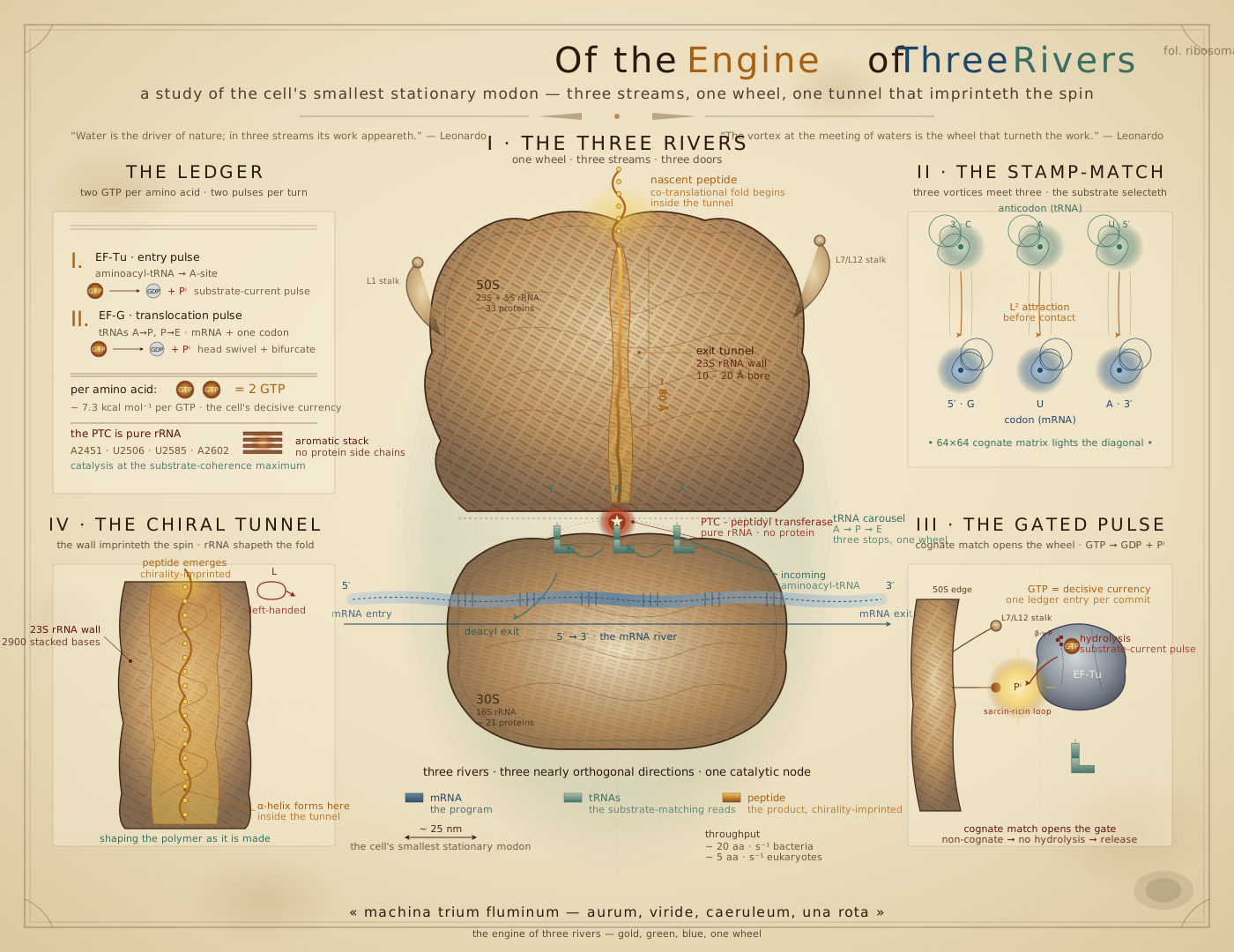
The ribosome sits at the bottom of the nested-modon stack — the smallest stationary modon biology has built, at \sim 25 nm, with three counter-flowing channels running through one structure. The codon-stamp chapter takes the ribosome’s entry pocket as a worked example: the 64×64 cognate-recognition matrix lights up its diagonal because three stacked codon vortices meet three stacked anticodon vortices and the substrate’s matched-stamp attraction selects the cognate tRNA at structural strength. That chapter is about recognition at contact — what happens in the picosecond the right tRNA arrives at the A-site.
This chapter takes the ribosome on its own terms — not as a recognition site but as a machine. The framework’s claim is direct and structural. The ribosome is the cell’s three-channel fluid-flow stamper: mRNA threading in, tRNAs cycling through, peptide emerging out, with GTP-hydrolysis events as substrate-current pulses that drive each step and an exit tunnel that imprints chirality on the product before it leaves. Every claim in that sentence is supported by anchored ribosomal biochemistry. The framework’s addition is a structural identification of why the architecture looks the way it does and what role the substrate is playing at each step.
The chapter stays inside the defensible reading. The conjecture that the codon stamp persists long enough for synonymous codons to write different substrate fingerprints into the nascent peptide is parked under Speculations and depends on the open lifetime question; this chapter does not load any of its claims on that conjecture. A teaser at the very end points the reader to where that more ambitious reading lives.
Three Counter-Flowing Channels
The ribosome’s geometry is the canonical loop expressed as a stationary three-channel pattern.
The mRNA channel. A linear groove that runs across the small subunit (30S in bacteria, 40S in eukaryotes), passing the A-, P-, and E-sites in sequence. mRNA enters at one face, threads through the codon-reading geometry at the subunit interface, and exits at the opposite face. Direction: 5' \to 3' along the groove, set by the chirality of the small-subunit head and platform.
The tRNA channel. A carousel rather than a linear groove. Aminoacyl-tRNAs arrive at the A-site bound to EF-Tu·GTP from the cytoplasmic pool; they translocate to the P-site after peptide-bond formation; they exit through the E-site as deacylated tRNA. The carousel runs at three stops per cycle, with each tRNA visiting A → P → E and the previous tRNA having moved one stop ahead at each step. Direction: orthogonal to the mRNA channel, set by the geometry of the subunit interface.
The peptide exit tunnel. A \sim 80 Å tube through the large subunit (50S in bacteria, 60S in eukaryotes), lined almost entirely by 23S/28S rRNA, with a diameter of \sim 10–20 Å. The nascent peptide emerges from the peptidyl transferase center (PTC), threads up through the tunnel, and exits on the opposite face of the large subunit, ready to engage cytoplasmic chaperones or co-translationally translocate into the ER lumen. Direction: away from the subunit interface, set by the tunnel’s helical organisation.
The three channels meet at the PTC and depart on three structurally distinct axes. The cleanest anchor for their near-orthogonality is the tRNA L-shape itself: solution-phase transient electric birefringence (Friederich, Vacano, Hagerman 1995) measures the interstem angle of the tRNA L at 89 \pm 4° — essentially identical to the crystal value — and this \sim 90° joint is the physical link between the codon-anticodon contact in the mRNA channel and the CCA-3’ end at the PTC, with the peptide tunnel continuing through the 50S body to the opposite face. The substrate’s three-fold offer — already counted at the F_1 catalytic head, the microtubule 3-start helix, and the ER three-way junction — recurs here at the recognition gate: three stacked codon vortices meeting three stacked anticodon vortices (codon-stamp-metric.qmd), three tRNA binding sites A/P/E coordinated through one carousel, the codon as biology’s irreducibly three-letter word. At the bond-forming carbon itself the substrate takes a different offer — a two-fold pseudo-symmetry developed below. The framework reads the architecture as the substrate’s two complementary cyclic offerings expressed on one stationary modon: three at the gate, two at the bond, both substrate-preferred for their respective jobs.
Codon-Anticodon Attraction as the Entry Gate
The entry of an aminoacyl-tRNA into the A-site is the ribosome’s most discriminating step. The error rate is \sim 10^{-4} to 10^{-3} per codon — better than the chemistry alone supports. Two mechanisms in current literature account for this: (i) initial-selection geometry at codon-anticodon recognition (Ogle and Ramakrishnan), and (ii) proofreading after GTP hydrolysis, where non-cognate tRNAs dissociate before peptide-bond formation.
The framework’s codon-stamp chapter develops the substrate-physics version of mechanism (i). Three stacked codon vortices in the mRNA channel meet three stacked anticodon vortices on the incoming tRNA; cognate stamps match by L2-metric attraction; near-cognate stamps mismatch and dissociate. The diagonal of the 64×64 cognate-recognition matrix lights up at structural strength because matching stamps attract through the substrate before they touch, and the substrate’s preference biases the geometry-of-contact stage in a way that conventional kinetic-fit models do not predict.
What this chapter adds is the machine reading. The codon-anticodon attraction is not the ribosome doing the selection — it is the substrate doing the selection, and the ribosome’s role is to hold the channels in position so the substrate can make the call. The ribosome’s two large structural elements that touch the codon-anticodon mini-duplex (the decoding center A1492-A1493-A1913 nucleotides, plus the small-subunit shoulder) are biology’s geometric scaffold for presenting the codon to incoming tRNAs at the right orientation; they do not themselves select which tRNA wins. The selection happens at the substrate level via stamp matching, and the ribosome’s structural role is to enforce the boundary conditions under which the substrate-level selection can happen reproducibly.
This reading is consistent with the experimental fact that ribosomal-protein perturbations of the decoding region affect accuracy much less than rRNA-base perturbations. The literature on antibiotic resistance mutations (streptomycin, paromomycin, aminoglycosides) maps the accuracy-critical sites to 16S rRNA bases, not to ribosomal proteins. The framework reads this as the substrate’s selection happening through the rRNA’s substrate-coherent stack, with the proteins as a peripheral gearbox that biases but does not arbitrate.
The entry gate is where the ribosome runs both of the substrate ladder’s poles at once. Reading a single codon is a lock: the cognate mini-duplex must bind, and the 64-of-64 cognate diagonal is that lock ringing at structural strength. But the 64 codons as a set have the opposite job — they must stay anti-locked, never aliasing one meaning into another, the same refuse-to-resonate task the retinal cone mosaic solves in space. The ribosome is the machine that has to enforce both at the same gate: lock the right tRNA in, and keep every wrong one distinguishable. The two predictions that close this chapter are the two poles read as data — substrate-gated commitment is the lock; the transition-biased error residual below is where the anti-lock job runs out of alphabet.
There is one place the substrate’s selection cannot help the ribosome, and the framework predicts exactly where the residual errors land. The anti-lock analysis of the code shows the substrate’s alphabet is not fully separable: a within-class transition swap (A↔︎G or C↔︎U — two-vortex against two, or one against one) costs only about a third the stamp distance of a cross-class transversion (one vortex against two), so roughly half the single-letter near-cognates the ribosome must reject are nearly invisible to the substrate. The misreading errors that survive proofreading should therefore be transition-biased — the substrate cannot lend its discrimination where it has none to lend — and the closest meaning-changing pairs the analysis names (Thr↔︎Ile, Thr↔︎Met, Ala↔︎Val, Lys↔︎Arg, Lys↔︎Glu) are exactly the transition-prone misreading pairs the ribosome-fidelity literature already tracks. The framework reads the ribosome’s residual error spectrum not as machine sloppiness but as the unavoidable shadow of an alphabet whose within-class swaps the substrate renders near-identical. This is still a recognition-at-contact claim — it does not invoke stamp persistence — and so it sits inside this chapter’s defensible reading.
GTP Hydrolysis as Substrate-Current Pulses
Two GTP molecules are hydrolysed per amino-acid addition cycle: one by EF-Tu (during aminoacyl-tRNA delivery), one by EF-G (during translocation). The ribosome itself has no catalytic site for nucleotide hydrolysis; the GTPase activity sits on the factors, which dock at the GTPase-Associated Center (GAC) on the large subunit (centred on the L7/L12 stalk and the sarcin-ricin loop).
Conventional biochemistry reads each hydrolysis as the energy source that drives the conformational change of the relevant step. The framework’s reading is structurally sharper.
Each GTP molecule is a small modon ledger entry. GTP carries \sim 7.3 kcal/mol of high-energy phosphate bond — the same chemical-capacitor structure ATP carries, in the same \beta-\gamma phosphoanhydride geometry. The modon-to-ATP chapter reads ATP as the cell’s small mobile chemical capacitor — a substrate-current packet stored in a diffusible chemistry. GTP is the same architecture, used by the ribosome and by signal-transduction GTPases (Ras, heterotrimeric G proteins) where the cell needs a committable energy packet that can fire once and then dissociate. ATP is the cell’s universal currency; GTP is the cell’s decisive currency. In the substrate ladder’s economy the real coin is the lattice’s lossless paired-breath exchange — what a structure spends to stay plugged into the lossless channel — and these hydrolysis packets are the chemistry’s meter on it: the ribosome draws down two quanta of substrate current per residue, one to commit the read at the gate and one to drive translocation, each released as a discrete committable pulse rather than a continuous draw.
Each hydrolysis is a gated-bifurcation event. The framework reads the Q-cycle (modon-to-ATP.qmd) as a gated-bifurcation node where one quasi-particle in becomes two anti-correlated halves out. EF-Tu’s GTP hydrolysis is the same structural motif: one cognate-recognition event in becomes two anti-correlated outputs out (committed peptide bond formation + released GDP·P_i). The hydrolysis is structurally gated — non-cognate tRNAs do not trigger it, cognate tRNAs do — because the substrate’s matched-stamp attraction at the codon-anticodon interface provides the coherence threshold that the GAC’s geometry requires to activate. The substrate decides; the chemistry executes.
Translocation as substrate-current-driven inflation. EF-G’s GTP hydrolysis powers the translocation step: the small subunit head swivels, the tRNAs move A → P and P → E, and the mRNA shifts one codon. Single-molecule FRET work has resolved this into multiple sub-steps, but at the framework level it is one substrate-current pulse driving the structure through one coherence-boundary reconfiguration. The substrate-current released by the hydrolysis transiently inflates the ribosome’s mobile elements (the small-subunit head, the tRNA-bound regions of the large subunit) and the structure settles into the post-translocation state when the current dissipates.
The picture this gives is the ribosome as a stationary modon being pulsed by a sequence of small modon entries. The mRNA channel carries the program; the tRNA channel carries the substrate-matching reads; the GTP factors carry the substrate-current pulses that drive each commit step; the peptide tunnel carries the product. Two GTP per amino acid sets the energy budget; the rate of the cycle (\sim 20 aa/s in bacteria, \sim 5 aa/s in eukaryotes) sets the throughput.
The PTC: Pure RNA, Where Coherence Is Highest
The peptidyl transferase center sits at the bottom of the exit tunnel, at the subunit interface, between the A-site and P-site tRNAs. It catalyses the peptide-bond-forming reaction between the A-site aminoacyl group and the P-site peptidyl group. The catalytic site is pure rRNA: 23S nucleotides A2451, U2506, U2585, A2602, and others in the bacterial numbering, with no protein side chains positioned for catalysis. Ribosomal proteins are present near the PTC but do not provide the active-site chemistry.
The framework’s reading falls out of the aromatic-pocket chapter reading of aromatic stacking as the substrate’s most-coherent matter configuration. Catalysis happens where substrate coherence is highest, and rRNA’s aromatic stacking is the most uninterrupted aromatic network in the cell. 23S rRNA contains \sim 2{,}900 stacked aromatic bases in one contiguous structure — orders of magnitude larger than the four-base aromatic stacks of B-DNA’s regulatory regions or the small-molecule aromatic cofactors of cytochromes. The PTC is the point of maximum coherence in this stack, and the substrate’s reading of “catalysis = boundary-matching at the coherence maximum” picks out this point as the natural catalytic site.
The ribosomal proteins are then, in the framework’s language, a second skin — a gearbox sitting outside the substrate-coherent core, transmitting forces and stabilising the structure but not arbitrating the chemistry. The fact that the PTC is RNA, not protein, is therefore not a phylogenetic curiosity (“the ribosome is older than coded protein synthesis”) but the framework’s prediction: catalysis at the cell’s lowest-frustration modon happens at the substrate-coherence maximum, which is the rRNA stack.
The PTC’s Two-Fold Symmetry: The Substrate’s Gated-Bifurcation Offer at the Bond
The PTC’s most surprising structural feature — given the three-fold patterns the framework reads almost everywhere else in the cell — is that its catalytic core is not three-fold. It is two-fold. Bashan et al. (Mol. Cell 2003) and Agmon et al. (Biol. Chem. 2005, with a series of follow-ups from the Yonath group through Agmon 2017) identified a \sim 180-nucleotide region of 23S rRNA surrounding the PTC, called the Symmetrical Region (SymR), that divides into an A-region and a P-region related by a clear two-fold pseudo-symmetry axis. The two halves match in RNA backbone fold and base orientation (though not in sequence), and the symmetry is conserved across every published large-subunit structure and across the entire archaeal/bacterial phylogenetic split. The proto-ribosome hypothesis the same group developed reads SymR as the trace of an ancestral dimerization event: the modern PTC arose when two modest-sized RNA hairpins ligated into one structure, with the bond-forming chemistry sitting at the dimerization interface.
The framework’s reading falls out without forcing. The PTC is the substrate’s two-fold offering at the catalytic carbon, complementing the three-fold offering at the recognition gate. Where three is the substrate’s lowest-frustration cyclic configuration (the offering picked up by the codon, the F_1 rotor head, the microtubule 3-start helix, the ER three-way junction), two is the substrate’s lowest-frustration paired-vortex configuration — the gated-bifurcation node the Q-cycle subsection names at Complex III, and the substrate’s natural geometry for one in becomes two anti-correlated halves out. The Q-cycle is the bifurcation expressed electronically (one two-electron reducing equivalent in, two single-electron halves out, gated); the PTC SymR is the bifurcation expressed geometrically (two tRNA holding sites mirror-paired across the axis, one bond formed at the centre, one peptide chain emitted along the orthogonal exit).
At the PTC the bifurcation runs forward through the bond-forming chemistry’s own angle ladder. The A-site \alpha-amino attacks the P-site peptidyl ester carbon, which begins planar sp^2 with 120° bond angles, passes through a tetrahedral sp^3 transition state at 109.5°, and resolves to a new planar sp^2 amide carbon at 120° on the other side. The substrate’s three-fold angle preference shows up here in the chemistry’s own resting geometry — the trigonal planar carbonyl is where the carbon spends most of its time — while the holding apparatus around it runs on the two-fold offer. The A-region and P-region nucleotides present their tRNAs in equivalent mirror geometry against the bond-forming carbon, the substrate’s coherence-maximum at the centre of the SymR is exactly where the catalytic event happens, and the peptide product then leaves on the orthogonal axis — the exit tunnel runs roughly perpendicular to the SymR’s mirror plane — playing the radiation role the electron-half plays after the Q-cycle’s bifurcation. Two tRNAs in across the mirror axis; one bond formed at the centre; one peptide emitted along the perpendicular. The substrate’s full bifurcation motif, expressed structurally at biology’s smallest stationary modon.
Two predictions extend the reading. First, the SymR’s two-fold geometry should be conserved across phylogeny more tightly than the three-fold features (codon length, A/P/E count) because it is the substrate’s preferred geometry for the catalytic carbon itself rather than for the surrounding regulatory machinery — a prediction the Yonath group’s phylogenetic comparisons already largely support, and which sharpens further at the archaeal/eukaryotic divergence. Second, mutations that disrupt the two-fold relationship between A-region and P-region nucleotides should disrupt catalysis more severely than equivalent mutations outside the SymR, even when neither set touches the active-site catalytic bases directly. The existing 23S structure-function literature (Polacek and Mankin’s omit-mutant studies; SymR-targeted work in the Yonath group) provides a partial test set.
The Exit Tunnel as a Chirality-Imprinting Fluid Shaper
The exit tunnel is the framework’s clearest example of fluid-flow shaping in the cell. A peptide emerging from the PTC threads up through a \sim 80 Å tube lined almost entirely by 23S rRNA, with a diameter of \sim 10–20 Å. Co-translational folding starts inside the tunnel — α-helices and partial tertiary structure form before the peptide exits. The tunnel is not an inert chimney; recent ribosome-profiling work (Wilson and colleagues, multiple labs) has documented that translation rate, codon usage, and even folding outcomes depend on the tunnel’s interaction with the nascent chain.
The framework’s reading is that the exit tunnel is a boundary-shape device — the substrate-coherent rRNA wall imposes a directed flow on the emerging peptide, and the peptide’s L-amino-acid handedness is reinforced (or established, depending on how one reads the substrate’s chirality bias) by the rRNA’s substrate field as it passes. The tunnel’s helical organisation, its varied luminal width, and its specific contact points with the nascent chain are all the substrate’s tools for imprinting spin — chirality, fold orientation, and partial structure — on the peptide before it leaves.
This is the angle the turing-complete-cell speculation parks one rung further out. The defensible reading available now is the structural one: the tunnel is biology’s only known structural device for shaping a polymer as it is produced, the tunnel’s wall is the cell’s most chirality-coherent rRNA surface, and L-amino-acid handedness has resisted every attempt to invert it because the entire tunnel-and-PTC assembly would have to mirror-flip together to produce D-amino-acid proteins natively. The Hilvert mirror-ribosome experiments are too early to be evidence either way, but they are consistent with the prediction that running mirror chemistry requires running the whole substrate-coupled scaffold mirror, not just the amino acids.
Predictions and What Would Falsify
Four predictions extend the fluid-flow reading beyond the structural anchors.
GTPase activation is substrate-gated, not just geometry-gated. EF-Tu GTP hydrolysis on cognate codon-anticodon should track the substrate-stamp match strength (the cognate-recognition diagonal of the codon-stamp matrix) more strongly than ribosomal-protein geometry alone predicts. Near-cognate tRNAs that show low substrate-match should fail to trigger hydrolysis even when their geometric fit is acceptable; near-cognate tRNAs with high substrate-match should trigger hydrolysis even when their geometric fit is impaired. The literature on aminoglycoside-induced misreading and on engineered tRNA suppressors provides the existing data series. The anti-lock reading sharpens the direction of the residual: the misreading errors that survive should be transition-biased, because transitions are precisely the swaps the substrate cannot separate — a prediction the existing misreading spectra already let one check.
Translation accuracy is rRNA-perturbation-sensitive, not protein-perturbation-sensitive. Mutations in 16S/23S rRNA decoding-region bases should shift accuracy substantially; mutations in adjacent ribosomal proteins should not. The antibiotic-resistance literature already separates these classes; the framework’s prediction is that the rRNA / protein impact ratio on accuracy is much larger than mass-action chemistry would predict from active-site geometry alone.
Exit-tunnel chirality is rRNA-coherence-dependent. Modifications that disrupt rRNA aromatic stacking in the exit tunnel (specific nucleotide methylations, intercalating drugs that target tunnel positions) should disrupt co-translational folding outcomes more strongly than chemistry-of-contact arguments would predict. Existing data on chloramphenicol and macrolide effects on nascent-chain folding are the test set; the framework predicts a stacking-coherence dependence that mass-action models do not.
Two-GTP-per-amino-acid is substrate-set, not energy-set. The energetics of peptide-bond formation could in principle be supplied by one GTP per cycle; biology spends two. The framework reads the second as the commit-and-translocate substrate-current pulse, distinct from the entry-gate pulse of the first, and predicts that engineered ribosome-factor systems that try to reduce the cycle to one GTP should fail at the translocation step specifically. This is a synthetic-biology prediction the framework parks for the long horizon.
The fluid-flow picture is falsified if (a) GTPase activation correlates with geometric fit alone with no residual substrate-match dependence, (b) rRNA and protein perturbations contribute equally to accuracy effects, (c) exit-tunnel stacking-coherence is uncorrelated with co-translational folding outcomes, or (d) one-GTP engineered cycles run translocation cleanly. It is supported, even partially, if any of the four ordering predictions hold against existing data.
Putting the Section in Context
The ribosome is the cell’s smallest stationary modon and the substrate’s most explicit fluid-flow stamper. Three counter-flowing channels, three nearly-orthogonal directions, one catalytic node at the substrate-coherence maximum, two GTP per cycle as substrate-current pulses, and an exit tunnel that imprints chirality on the product before it leaves. Every structural element has a substrate reading; none of those readings depend on stamp persistence; all of them are anchored against published ribosomal biochemistry.
The two prior chapters of this cellular walk laid the wrap-and-membrane vocabulary the ribosome chapter does not re-derive. The plasma membrane chapter gave the bilayer-as-counter-oriented-pair architecture; the endoplasmic reticulum chapter gave the reticulum-as-substrate-landscape-tracker reading and noted that the ER’s rough surface is where translocon-coupled ribosomes thread their nascent peptides into the cell’s most chirality-coherent compartment. This chapter closes the loop on that handoff: the peptide that emerges from the rough-ER ribosome’s exit tunnel has already been chirality-imprinted by the tunnel’s rRNA wall, and the ER lumen’s substrate-coherent environment continues the fold the tunnel started. Two substrate-coherent compartments in series, one chemistry-side reading of co-translational folding, one substrate-side reading of why it works.
The reading above takes the ribosome as a machine and stops there. There is a more ambitious reading the substrate framework points toward, parked under Speculations: that the codon stamp the codon-stamp chapter develops persists in the substrate long enough that synonymous codons leave different fingerprints on the nascent peptide despite coding the same amino acid. If that lifetime conjecture holds, the ribosome stops being only a machine and becomes a memory device: each codon-anticodon read writes a substrate stamp into the nascent chain, the next bond inherits the previous stamp’s residue, and the entire fold trajectory is shaped by the codon-sequence history rather than the amino-acid sequence alone.
This is the rigorous version of “silent mutations are not silent” — a single substitution that changes a codon without changing the amino acid would shift the fold trajectory by the codon-stamp distance d(C_{\text{syn1}}, C_{\text{syn2}}) developed in the codon-stamp chapter. And the anti-lock analysis sharpens that distance into a discriminating prediction: not every silent swap is equal — a silent transversion carries {\sim}3.6\times the stamp distance of a silent transition — so among functionally-damaging silent variants the framework expects transversions to bite hardest, a residual orthogonal to codon-usage frequency that the conventional translation-speed account is blind to. The literature already documents synonymous-SNP phenotypes that mass-action models struggle to explain (Sauna and Kimchi-Sarfaty review the disease cases; Plotkin and Kudla review the regulatory ones); the framework turns that catalogue of anomalies into a sharp, signed ratio. The conjecture’s status depends on the stamp lifetime question: if the stamp lives long enough for one residue to feel the previous one’s substrate field through the rRNA’s coherent stack, the picture becomes a worked example; if not, the codon-anticodon contact event of codon-stamp-metric.qmd is the whole story and the codon-bias literature is solved by mass action.
The defensible reading of this chapter does not depend on which way that question lands. What has changed is that the nearest test no longer waits on new instrumentation. The population-genetic shortcut (Route 3) reads the transversion-bites-hardest prediction straight off data the field has already collected — ClinVar pathogenic-synonymous variants against gnomAD common-benign, stratified by swap type and controlled for codon-usage frequency — and a clean positive would place the framework’s first concrete lower bound on the stamp lifetime, since a stamp can only shape the fold if it survives to it. The two direct routes (femtosecond pump-probe on stalled ribosomes at single-codon resolution; synonymous-codon folding-kinetics correlation against codon-stamp distance) sit further out on the technical horizon the field is closing on. The nearest one is runnable now, and the lifetime chapter is where all three live.