Phloem and Xylem as Polar Transport

The counterflow circuit at organism scale — tension-pulled water column, pressure-driven sugar stream, and the plant’s polar-jet axis

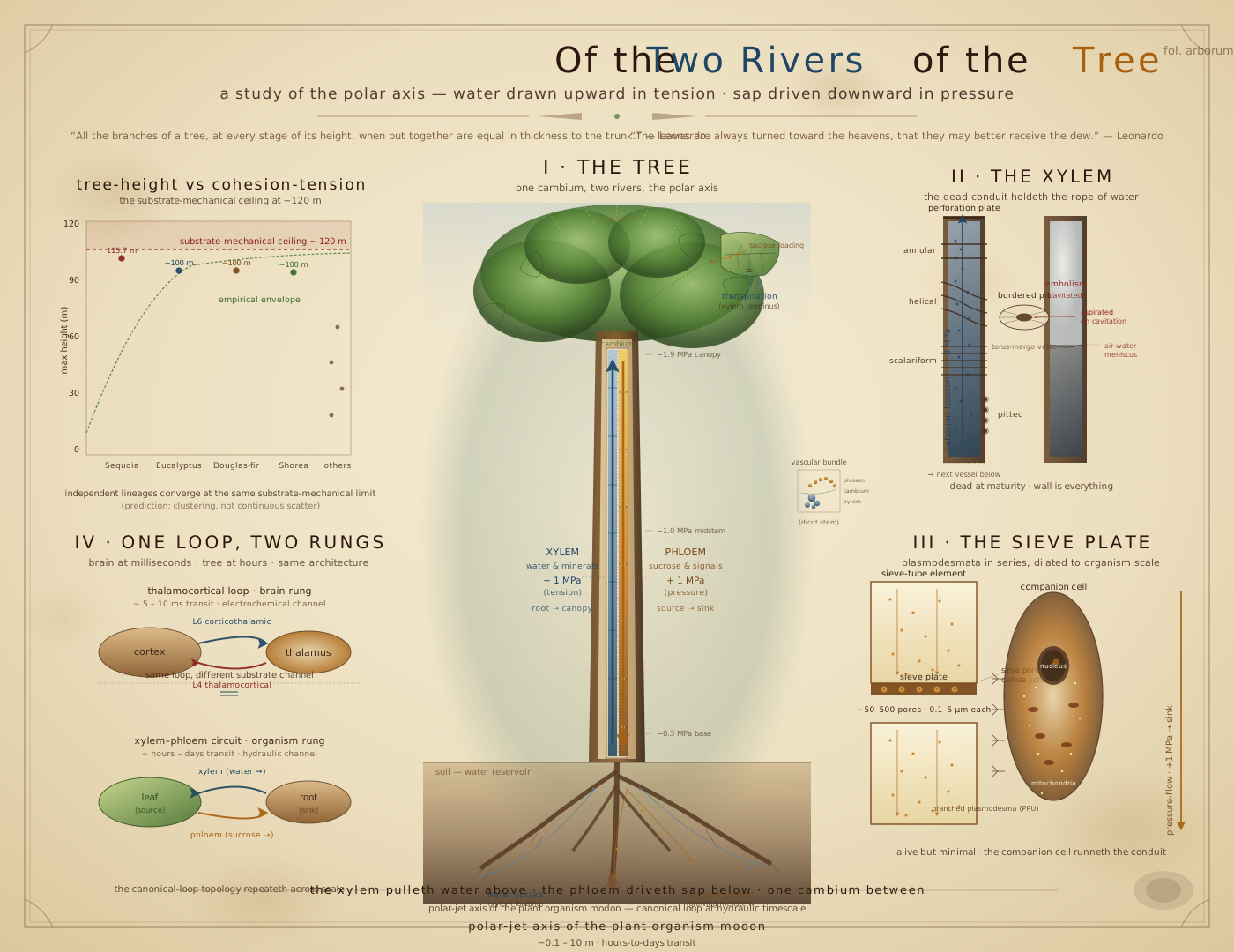
A vascular plant moves two things over the long-distance organism-scale axis between root and shoot: water (from soil to atmosphere, against gravity, through the xylem, pulled by transpiration) and photosynthate (from leaves to growing tissues and storage organs, in either direction along the axis, through the phloem, pushed by an osmotically generated pressure gradient). The two streams run in paired but topologically separate conduits along the same vascular bundle; their substrate-mechanical signatures are opposite-signed (xylem at \sim -1\;\text{MPa} tension, phloem at \sim +1\;\text{MPa} pressure); their cellular implementations are qualitatively different (xylem cells die at maturity and become pure paracrystalline-walled conduits, phloem cells live and run cytoplasmic flow through callose-regulated sieve plates); and together they constitute the plant’s long-distance counterflow circuit at organism scale — the architectural commitment that lifts the symplast from tissue scale (10100\;\mu\text{m}) to organism scale (10^{-1}10^1\;\text{m}), and that anchors the plant’s claim to being a single substrate-coherent organism from root tip to canopy.

The framework’s claim about this organisation is direct. The xylem-phloem vascular pair is the plant organism modon’s polar-jet axis, structurally parallel to the thalamocortical loop at the brain rung and to the peripheral sensory axon network at the body rung — biology’s chemistry-side implementation of the canonical loop at organism scale, with the xylem as one polar-coherent corridor and the phloem as its opposite-signed counterflow partner. The xylem runs the substrate-mechanical tension-pull arm of the loop, with a \simMPa-tension water column held by hydrogen-bonded cohesion against gravity; the phloem runs the substrate-mechanical pressure-push arm of the loop, with a \simMPa-pressure sucrose stream driven from osmotically loaded sources to sinks. The two arms are substrate-mechanically coupled (water in the phloem stream came up the xylem; sucrose loading at the leaf transfers water across the bundle-sheath / phloem interface; embolism in the xylem disrupts the phloem-source water supply); their counterflow is the substrate’s chemistry-side answer to the long-distance organism-scale-coherence problem in a plant body that has no muscles to pump, no heart to circulate, and no nerves to coordinate timing.

That counterflow is the macroscopic echo of a finer one. The substrate’s chirality-coherent sheets are separated by counter-rotating intermediate layers (Substrate Particles § The Vertical Scale), and such a layer is not an empty gap but one of the lattice’s own anti-phase breathing partners — the other half of a breath, the substrate’s flow running one way on its upper face and the opposite way on its lower. A conduit that straddles such a layer therefore inherits two oppositely-directed lanes built into the vacuum it occupies — the reading the mycorrhizal hypha is given, where carbon streams down while water and minerals stream up through one tube, the counter-rotating boundary its painted centre line. The xylem-phloem pair is the same anti-phase median asserted at organism scale, with one difference of implementation: where the hypha runs both lanes inside a single tube, the plant body splits them into two topologically separate conduits — the ascending tension arm at \sim -1\;\text{MPa} and the descending pressure arm at \sim +1\;\text{MPa}, an opposite-signed pair that is the substrate’s own anti-phase breath drawn at the scale of a tree. The substrate ladder reads that paired breath as the motif the whole tower replicates, and a structure tuned to it as one plugged into the lossless channel; the vascular cylinder is that channel laid along the plant’s polar axis, the phloem spending the plant’s chemical energy down one lane while the xylem returns water up the other. The plant did not invent its counterflow circuit; it pinned a pair of conduits to a median that was already double.

This chapter develops the xylem as the substrate-coherent tension-pulled water column, the phloem as the substrate-coherent pressure-driven sucrose stream, the sieve plate as the plasmodesma architecture lifted to organism scale, the source-to-sink polarity as wrap-direction signature at organism scale, the xylem-phloem pair as a counterflow circuit structurally parallel to the thalamocortical loop and as a both-poles structure split by organ position, and tree height as the substrate-mechanical ceiling on the architecture. It does not redo the callose-and-symplastic-domain chemistry that the plasmodesmata chapter developed, does not redo the chloroplast and Calvin-cycle machinery upstream of phloem loading, and does not redo the canonical-loop architecture developed across the cellular walk. The reading the framework adds is the architectural one: this is the polar-jet axis, lifted.

Xylem as Tension-Pulled Substrate-Coherent Rope

Xylem is the long-distance water conduit. Two cell types do the work — tracheids (single elongated cells with tapered overlapping ends and lateral bordered pits, the ancestral architecture preserved in conifers and ferns) and vessel elements (shorter cells with open perforation plates at their end walls, stacked end-to-end into continuous vessels that can run many centimetres to many metres, the derived architecture of angiosperms). Both share three structural commitments. First, the cell dies at maturity, leaving only a lignified secondary cell wall and an empty lumen — the conduit is acellular, with no living protoplast to maintain. Second, the lumen is continuous with neighbouring xylem cells through pits and perforation plates, so the entire xylem system of a stem is one connected hydraulic network. Third, the water column inside the lumen is held under negative pressure (tension) of typically -0.5 to -2\;\text{MPa} under transpiring conditions, with tall trees on hot dry days reaching -3 to -5\;\text{MPa} at the canopy.

The Dixon–Joly cohesion-tension theory (1894) explains the physics: water lost by transpiration at leaf-surface stomata pulls the water column upward; the column does not break because hydrogen-bonded cohesion between water molecules is strong enough to sustain tension up to roughly -30\;\text{MPa} in idealised conditions (and -3 to -5\;\text{MPa} reliably in living xylem); adhesion of water to the lignified cell-wall surface holds the column against gravity at the conduit boundary; and the resulting tension propagates downward through the continuous water column from leaf to root, pulling water through the root cortex and across the soil-root boundary. The driving force is evaporation at the leaf; the work is done by the hydrogen-bonded water column itself.

The framework reads xylem as a substrate-coherent linear conduit under tension, structurally parallel to the microtubule cylinder at the cytoskeletal scale and to the axoneme at the outward-cell-jet scale — successive rungs of the substrate’s closed-cylindrical-conduit family that the mycorrhizal chapter lays out across five scales (desmotubule \sim 15\;\text{nm} → microtubule \sim 25\;\text{nm} → axoneme \sim 200\;\text{nm} → fungal hypha \sim 210\;\mu\text{m} → vascular conduit \sim 10500\;\mu\text{m}), with the xylem at the largest rung (10^{-5}10^{-4}\;\text{m} lumen diameter, 10^{-1}10^1\;\text{m} length). Those five rungs span four decades of diameter, each set by what its conduit must carry rather than by a single resonance — the ladder’s coarse family, where the clustering at preferred sizes is the firm claim and the inter-rung ratio is left open, distinct from the resonant family whose rungs sit cleanly on the \sqrt2 comb. The water column inside the xylem is a substrate-coherent linear element under negative pressure, held by hydrogen-bonded cohesion as biology’s chemistry-side implementation of substrate-coupled linear coherence. The death of the xylem cell at maturity is the substrate’s preferred move when a conduit must sustain \simMPa-scale tension without internal cytoplasmic pressure to balance it — no living cell can survive at -3\;\text{MPa} (the wrap-tension signature is wrong), so biology drops the cytoplasm and leaves only the lignified wall. The substrate-mechanical commitment is to the wall, not to the cell.

Vessel-and-tracheid diameter is substrate-mechanically constrained. Narrower conduits are more cavitation-resistant (the meniscus radius at the air-water interface in a bordered pit scales with pore diameter, and the cavitation threshold scales as 1/r), but they offer higher hydraulic resistance per unit length (Hagen–Poiseuille flow scales as r^4). Plants populate the trade-off curve at lineage-specific rungs: tracheids in conifers at \sim 1030\;\mu\text{m} diameter (cavitation-safe, high-resistance, supports tall-tree habit through redundancy), vessels in temperate angiosperms at \sim 30100\;\mu\text{m} (intermediate), vessels in ring-porous temperate trees at \sim 100500\;\mu\text{m} in springwood (low-resistance, high-throughput, cavitation-prone — and cavitated each winter, with new earlywood produced annually). The framework predicts the diameter distribution clusters at substrate-preferred discrete rungs across plant lineages rather than varying continuously with biomechanical demand alone.

Phloem as Pressure-Driven Source-to-Sink Loop

Phloem is the long-distance photosynthate conduit. The work cells are sieve-tube elements (in angiosperms; sieve cells in gymnosperms), stacked end-to-end with sieve plates at the cross-walls, each sieve plate perforated by \sim 50500 sieve pores each \sim 0.15\;\mu\text{m} in diameter and lined with callose. Unlike xylem, sieve elements remain alive at maturity — but with most cellular machinery degraded: the nucleus is lost, the vacuole is degraded, the ribosomes are gone, and metabolic support is provided by the adjacent companion cell, which retains a full complement of cellular machinery and is connected to the sieve element by branched plasmodesmata (the “pore-plasmodesmal-unit”, PPU, of unique architecture). The sieve element + companion cell pair is therefore one functional unit with the cytoplasm-thinned conduit and the metabolically-active partner running it.

The driving physics is Münch’s pressure-flow hypothesis (1930). At the source (a mature, photosynthesising leaf, or a starch-mobilising storage organ), sucrose is loaded into the sieve-element/companion-cell complex by either symplastic (plasmodesmal) or apoplastic (transfer-cell, with SUC2-family sucrose-H^+ symporters) routes, raising sieve-element osmolarity to \sim 1030\% sucrose by weight. Water follows osmotically from the adjacent xylem, raising hydrostatic pressure inside the sieve element to \sim 12\;\text{MPa}. At the sink (a growing meristem, developing fruit, root tip, or storage organ accumulating starch), sucrose is unloaded from the sieve element into surrounding tissues, water follows osmotically out, and the pressure drops to \sim 0.10.5\;\text{MPa}. The pressure gradient along the sieve tube — high at source, low at sink — drives bulk flow of the sucrose-laden cytoplasmic stream from source to sink at rates of \sim 0.31.0\;\text{m h}^{-1}.

The framework reads phloem as a substrate-coherent linear conduit under pressure, the opposite-signed partner to xylem’s tension-pulled column. The wrap-tension signature is \sim +1\;\text{MPa} (positive pressure, compression of the sieve-element protoplast against the wall, structurally parallel to turgor but operating at an order of magnitude higher pressure than typical mesophyll turgor and in a flow rather than a static mode). The sieve element’s retained-but-degraded cellular machinery is the substrate’s preferred move when a conduit must sustain \simMPa-scale pressure and run continuous cytoplasmic-stream flow — a fully-functional cell would have too much resistance (organelles obstructing the stream), but a fully-dead cell would lose the regulatory machinery (callose response to injury, P-protein plugging on damage). Biology has populated the substrate-mechanical middle: living but minimal, with the companion cell supplying the active regulation.

Sieve Plates as Regulated-Jet Architecture, Lifted from Plasmodesmata

The sieve pore is the defining structural feature of the phloem and the key architectural link back to the plasmodesmata chapter. Developmentally, sieve pores derive from the plasmodesmata that existed at the cell-cell interface in the meristematic precursor — the same callose-regulated cylindrical channels through the wall that the plasmodesmata chapter developed. During phloem differentiation, the plasmodesmata at the prospective sieve-plate face are dilated dramatically (from the \sim 3050\;\text{nm} outer diameter of a basal plasmodesma to the \sim 0.15\;\mu\text{m} outer diameter of a sieve pore), the desmotubule is lost (the ER discontinuity at the sieve plate distinguishes it from a basal plasmodesma), and the callose collar is retained as the regulated-closure machinery. The sieve plate is therefore biology’s chemistry-side implementation of plasmodesmata-in-series stretched to organism scale: the chapter 2 architecture, dilated and stripped of the desmotubule, stacked at \sim 100500\;\mu\text{m} intervals along the phloem column, each one a callose-regulated regulated jet at the interface between successive sieve-tube elements.

The framework reads this as the symplast architecture lifted from tissue scale to organism scale through the same callose-regulated regulated-jet machinery. The chapter 2 architecture was: PM-continuous, ER-continuous, cytoplasmic-sleeve-flow, callose-regulated, default-open / gated-closed. The phloem sieve-plate architecture is: PM-continuous, ER-discontinuous (the desmotubule is lost), cytoplasmic-stream-flow at \simMPa pressure rather than diffusion-flow, callose-regulated, default-open / gated-closed on injury or developmental signal. The phloem is the symplast running at 10^4 times the spatial scale and at \sim 100 times the substrate-current throughput, with the same regulated-jet motif at every cross-wall. Callose closure of sieve plates on injury (within seconds, via Ca^{2+}-activated callose synthase) is the substrate’s chemistry-side circuit-breaker at the organism-scale jet — preventing catastrophic loss of phloem contents on wounding, structurally parallel to the rapid callose closure of plasmodesmata on viral attack at the tissue scale.

The framework predicts the sieve-pore diameter clusters at substrate-preferred discrete rungs distinct from continuous variation with phloem-flux demand, structurally parallel to the plasmodesmal cytoplasmic-sleeve clustering at the sub-sub-sheet rung but at a different rung set matched to \sim\mu\text{m}-scale rather than \sim\text{nm}-scale flow. The callose-regulation machinery (synthase / glucanase pair) is conserved across both expressions.

Source-to-Sink Polarity as Wrap-Direction Signature at Organism Scale

The phloem’s source-to-sink flow direction is not fixed by anatomy — the same sieve tube can carry flow upward to a growing apical meristem in spring (source: storage roots; sink: shoot apex) and downward to a growing root system later in the season (source: mature canopy leaves; sink: root meristem and storage tissues), with the direction set by the pressure gradient that the loading and unloading events establish at the two ends. The polarity is therefore dynamic, bidirectional, and substrate-current-driven — biology’s chemistry-side implementation of a substrate-coherent flow whose direction is set by where the loading and unloading work happens, not by the conduit itself.

The framework reads source-to-sink polarity as a wrap-direction signature at organism scale, structurally parallel to the membrane potential at the plasma membrane (set by ion-pump activity, not by the lipid bilayer’s intrinsic asymmetry), to the H^+ gradient at the mitochondrion and chloroplast (set by electron-transport-chain pumping, not by inner-membrane intrinsic asymmetry), and to the RanGTP gradient at the nucleus (set by Ran-GEF/Ran-GAP localisation). At each scale, the wrap-direction signature is chemistry-side activity at the boundaries establishing a substrate-coherent gradient across an otherwise-symmetric wrap. Source-to-sink polarity in the phloem is the same architecture at organism scale: chemistry-side sucrose-loading at one terminal and sucrose-unloading at the other establish the substrate-coherent pressure gradient that drives the bulk flow through the sieve tube. The phloem itself is direction-agnostic; the loading and unloading machinery at the two ends sets the polarity.

The xylem’s tension-pull is unidirectional (always root-to-shoot, driven by transpiration at the leaf — the gravitational and atmospheric-evaporation channels do not reverse on biological timescales). The xylem’s wrap-direction signature is therefore fixed-polarity, set by the substrate’s atmospheric-evaporation channel coupled through the leaf’s stomatal architecture. The xylem-phloem pair is therefore the plant’s chemistry-side implementation of a fixed-polarity ascending arm + a dynamic-polarity descending-or-ascending arm, with the counterflow circuit’s directionality set by the substrate channels each arm tracks (xylem: atmospheric-evaporation; phloem: source/sink osmotic loading).

Xylem-Phloem Pair as Counterflow Circuit at Organ Scale

The xylem and the phloem are not independent conduits running in parallel — they are substrate-mechanically coupled in three explicit ways. First, the water that the phloem carries as part of the sucrose stream came up the xylem — phloem loading at the leaf moves water from the leaf xylem across the bundle-sheath/phloem interface into the sieve element by osmosis, then carries that water down the phloem to the sink, where unloading releases the water to the local apoplast. Second, the cohesion-tension in the xylem is coupled to the transpiration rate at the leaf, which is regulated by stomatal aperture, which is itself regulated by hydraulic and signalling inputs that include the phloem-delivered signals (sucrose, hormones, RNAs) from sources. Third, embolism in a xylem vessel disrupts the local water supply to phloem loading at upstream leaves, propagating a hydraulic and signalling perturbation through both arms of the circuit.

The framework reads the xylem-phloem pair as the canonical loop at organism scale, structurally parallel to the thalamocortical loop at the brain rung. The thalamocortical loop runs as: cortical area → first-order thalamic relay → cortical area, with reciprocal layer-IV / layer-VI projections forming a \sim 510\;\text{ms} transit-time substrate-current loop at organ scale. The xylem-phloem circuit runs as: leaf source → phloem → root sink (and leaf source ← xylem ← root water uptake), with the ascending xylem arm and the descending phloem arm forming a \simhour-scale transit-time substrate-current loop at organ scale. The two are the same canonical-loop architecture at vastly different substrate-channel timescales — the brain tracks predator-prey and motor-coordination signals at the ms-scale electrochemical channel; the plant tracks atmospheric-evaporation and photosynthate-supply signals at the s-min-hr-scale hydraulic channel. Same architecture, different substrate channels, different chemistry-side implementations matched to the channels.

This is the organism-modon polar-jet lift that the touch chapter cashed for animals at the peripheral-sensory-axon network. In animals, the cell-scale cilium-as-antenna lifts to the body-scale peripheral sensory axon, with one polar jet per cell at the cellular scale becoming millions of polar jets per body at the organism scale. In plants, the cell-scale chloroplast-positioning and plasmodesmal-corridor architecture lifts to the organism-scale xylem-phloem axis, with the symplast at 10100\;\mu\text{m} tissue scale becoming the vascular cylinder at 10^{-1}10^1\;\text{m} organism scale. The body axis (animal: head-tail and dorsal-ventral; plant: shoot-root) is the polar axis of the organism modon; the substrate-coherent linear conduits along that axis (animal: spinal cord and peripheral axons; plant: xylem and phloem) are the polar-jet expression of the organism modon at the substrate-coherent linear-conduit scale. Different chemistry-side machinery, different substrate channels, same architectural commitment.

Tree Height and the Cohesion-Tension Limit

The cohesion-tension architecture has a substrate-mechanical ceiling. Hydrostatic pressure decreases with height at \sim -0.01\;\text{MPa m}^{-1} (gravity alone), and the actual xylem tension at the canopy must additionally overcome hydraulic resistance through the conduit, leaf-water-status osmotic adjustment, and the safety margin against cavitation. Empirical measurement of \Psi_\text{leaf} in tall conifers (Koch et al. 2004, on Sequoia sempervirens up to 112\;\text{m}; subsequent work on Eucalyptus regnans up to \sim 100\;\text{m}) finds canopy leaf water potentials at \sim -1.9 to -2.5\;\text{MPa}, near the cavitation threshold of the xylem itself (\sim -3\;\text{MPa}). At heights approaching \sim 120\;\text{m}, the canopy water status approaches the cavitation threshold so closely that leaf turgor cannot be maintained, photosynthesis declines, and the trees stop growing taller — the substrate-mechanical ceiling.

The framework reads this as the substrate-mechanical ceiling on the cohesion-tension architecture, structurally parallel to the photorespiration ceiling on RuBisCO’s k_\text{cat}/\Omega trade-off — both are substrate-mechanical limits that biology has populated up to but cannot engineer around without changing the underlying architecture. The cohesion-tension architecture cannot support arbitrarily tall trees because hydrogen-bonded cohesion cannot hold against arbitrary tension; the chemistry-side machinery has populated the architecture up to the substrate-mechanical limit and stopped. The framework predicts the maximum tree height across vascular-plant lineages clusters at the substrate-mechanical cohesion-tension ceiling rather than at a chemistry-side biomechanical limit, with embolism-resistance and conduit-redundancy strategies populating the architecture at the ceiling but never breaking through it.

The cavitation failure mode itself is informative. When a xylem conduit cavitates (a bubble of water vapour nucleates under the tension load), the embolism is contained by bordered pits at the cell wall — substrate-coherent isolation valves whose torus-margo architecture (in conifers) or pit-membrane porosity (in angiosperms) admits liquid water at low tension but prevents air-water meniscus passage at high tension. The bordered pit is biology’s chemistry-side implementation of a substrate-coherent valve at the conduit-conduit boundary, structurally parallel to the callose-regulated sieve plate at the phloem rung and to the callose-regulated plasmodesma at the symplast rung. Three rungs of regulated-jet machinery at three different scales, with bordered pits as the xylem-specific expression matched to the negative-pressure substrate channel.

The Vascular System at Both Poles

The counterflow circuit is only half of what the substrate ladder reads into the vascular cylinder. A circuit that binds — that locks root to canopy into one coherent column so tension propagates unbroken and the sieve stream runs source to sink — sits at the ladder’s lock pole: the cohesion-tension rope is a single hydrogen-bonded element held in phase along its whole length, and the xylem-phloem coupling is the canonical loop closed. But a perfectly locked water column is also perfectly fragile. If every conduit shared one cavitation threshold, a single tension excursion on a hot dry afternoon would empty the entire system at once. The substrate’s other pole is the escape, and plant hydraulics already has a name for it.

Hydraulic vulnerability segmentation is the deliberate spread of cavitation thresholds across a plant’s conduits and organs (Zimmermann 1983; Tyree & Ewers 1991; Choat et al. 2012). Distal, metabolically cheap organs — leaves, petioles, minor branches — are built to cavitate at lower tensions than the trunk, so that under drought they embolise and are shed first, dropping the transpiring load and protecting the expensive, irreplaceable stem. That graded spread is the anti-lock pole doing the same job it does everywhere else in the paper: refusing a dangerous synchrony. A field of conduits tuned to one threshold is the hydraulic version of a metronomic heart or a market whose correlations have all gone to one — efficient until the single shared trigger fires, then catastrophic. Spreading the thresholds is how the column keeps its binding from becoming a single point of failure.

So the vascular system realises both poles by organ position along the polar axis: the load-bearing trunk column at the lock pole, where coherence buys transport efficiency, and the distal sacrificial organs at the anti-lock pole, where a graded vulnerability buys failure-tolerance. This is a new member of the both-poles set, distinct from the cortex (which slides by state), the eye and chloroplast (by subsystem), the hippocampus (by circuit stage), and the symplast (by callose gating) — the vascular cylinder splits the two poles along the body’s own length. And like the heart’s broadband variability and the genetic code’s degeneracy, it reaches the anti-lock pole by the labelling route — grading a continuous property (the cavitation threshold) rather than packing elements into a geometric blue-noise spread — so it is an application of the sign-rule, not a chemistry-free witness of the gap. The textbook fact is the segmentation; what the framework adds is the reading of it as the anti-lock pole, the unification with heart-rate variability and the market (bind for function, spread for resilience), and the sign-rule that calls which organs sit where before the measurement: name what an organ is for — to bear the column, or to be shed for it — and its pole is fixed.

Predictions and What Would Falsify

Five predictions extend the architectural reading beyond the structural anchors.

  1. Xylem conduit diameter clusters at substrate-preferred discrete rungs across vascular-plant lineages. Vessel and tracheid diameters across angiosperms, gymnosperms, ferns, and lycophytes should cluster at substrate-preferred discrete diameter rungs distinct from a continuous distribution set by Hagen–Poiseuille efficiency and cavitation-safety alone. This is a coarse-family prediction: the clustering is the firm claim, but — because conduit diameter is set by the cavitation-versus-resistance trade-off across four decades rather than by a single pairing resonance — the inter-rung ratio is left open, and a clean \sqrt2 comb is not expected here (the vascular conduit is the largest rung of the five-scale conduit family, not a tooth of the resonant comb). Cross-lineage wood-anatomy surveys (the InsideWood database and successors) provide the existing data; the framework predicts clustering at a small set of substrate-preferred rungs rather than a continuous distribution.

  2. Sieve-pore diameter clusters at a substrate-preferred rung distinct from the plasmodesmal cytoplasmic-sleeve rung. The \sim 0.15\;\mu\text{m} sieve-pore diameter should sit at one substrate-preferred discrete value (or a small set) across angiosperm phloem, distinct from continuous variation with phloem-flux demand and distinct from the plasmodesmal \sim 35\;\text{nm} cytoplasmic-sleeve rung — the same closed-cylinder conduit walked \sim 5 octaves up the coarse-family ladder by developmental dilation, not a separate kind of object. Cryo-electron tomography of intact sieve plates across lineages provides the test; the framework predicts cross-phylum clustering at the organism-scale-jet rung.

  3. Maximum tree height across vascular-plant lineages clusters at the cohesion-tension substrate-mechanical ceiling at \sim 100120\;\text{m} rather than at a continuous biomechanical limit. Across angiosperm and gymnosperm tall-tree lineages, the maximum-height envelope should saturate at the cohesion-tension ceiling with embolism-resistance and conduit-redundancy strategies populating up to but not exceeding the ceiling, regardless of mechanical-support, light-competition, or growth-rate variation. Existing maximum-height records (Sequoia sempervirens at 115.7\;\text{m}, Eucalyptus regnans at \sim 100\;\text{m}, Pseudotsuga menziesii at \sim 100\;\text{m}, Shorea faguetiana at \sim 100\;\text{m}) provide the existing data; the framework predicts independent-lineage tall-tree maxima converge at the substrate-mechanical ceiling rather than scatter across a continuous biomechanical envelope. (This is a ceiling, not a ladder rung: it marks the end of the cohesion channel — the tension at which water’s hydrogen-bonded column fails — not a \sqrt2-spaced tooth, so it is not a comb-test target, the same boundary-not-rung distinction the ladder draws for the coherence cutoff \xi in crystal optics and thermal dynamics.)

  4. Phloem source-to-sink pressure-differential clusters at a substrate-coherent ratio across angiosperms. The pressure differential between source and sink ends of a phloem column (\sim 0.51.5\;\text{MPa}) should cluster at a substrate-preferred ratio relative to the sieve-element wrap-tension signature, not vary continuously with phloem-flux demand. Pressure-probe and aphid-stylet measurements across plant species under controlled source/sink conditions provide the test; the framework predicts a substrate-coherent pressure-ratio signature distinct from continuous chemistry-side variation.

  5. Cavitation thresholds are graded across a plant’s organs rather than uniform — the anti-lock pole expressed by organ position. Within a single plant, the tension at which conduits cavitate (the P_{50} of a vulnerability curve) should be spread along the polar axis — lowest in distal, cheap, shed-able organs (leaves, petioles, minor twigs) and highest in the trunk — rather than clustered at one whole-plant value, and the spread should track the cost gradient of the organs rather than their height alone. Organ-by-organ vulnerability-curve measurements within individuals (the existing hydraulic-segmentation literature already supplies the method) test it directly; the framework predicts a graded, desynchronised threshold distribution — the anti-lock signature — and reads health as the capacity to shed distal-first, the failure mode being a plant whose organs all cavitate together. This is the vascular system’s anti-lock pole, and like the heart’s broadband variability it is a sign-rule application (grading a continuous property), not a chemistry-free witness of the gap.

The picture is falsified if (a) xylem conduit diameters vary continuously without substrate-preferred-rung clustering across lineages, (b) sieve-pore diameters vary continuously without substrate-preferred-rung clustering, (c) tall-tree maximum heights vary continuously across lineages with no ceiling at the cohesion-tension limit, (d) phloem source-to-sink pressure differentials are fully predicted by continuous chemistry-side flux models without a substrate-coherent pressure-ratio signature, or (e) cavitation thresholds are uniform across a plant’s organs, with distal and trunk conduits failing at the same tension rather than in the graded, distal-first order the anti-lock reading predicts. It is supported, even partially, if any of the five ordering predictions hold against existing data.

Putting the Section in Context

The xylem-phloem vascular pair is the plant organism modon’s polar-jet axis. Xylem runs the tension-pulled substrate-coherent rope from root to shoot at \sim -1\;\text{MPa} negative pressure, with the water column held by hydrogen-bonded cohesion and pulled by transpiration at the leaf, the conduit cells dying at maturity because no living cell can survive at \simMPa-scale tension, and the maximum tree height saturating at the cohesion-tension substrate-mechanical ceiling near \sim 120\;\text{m}. Phloem runs the pressure-driven substrate-coherent sucrose stream from source to sink at \sim +1\;\text{MPa} positive pressure, with the sieve elements alive but cytoplasmically minimal, with metabolic support delivered by branched-plasmodesma-coupled companion cells, and with callose-regulated sieve plates as the plasmodesmal architecture stretched from the \sim 35\;\text{nm} tissue-scale rung to the \sim 0.15\;\mu\text{m} organism-scale rung. Source-to-sink polarity is the wrap-direction signature at organism scale, set by chemistry-side loading and unloading machinery at the two ends rather than by the conduit itself, structurally parallel to wrap-direction signatures at every smaller modon rung. The xylem-phloem pair as a counterflow circuit is biology’s chemistry-side implementation of the canonical loop at organism scale, structurally parallel to the thalamocortical loop at the brain organ rung but operating at hydraulic timescales (s-min-hr) rather than electrochemical timescales (ms). That circuit runs at both of the ladder’s poles at once — binding root to canopy through the cohesion-tension column and source-to-sink loop, and spreading its risk of catastrophic embolism through the graded cavitation thresholds of vulnerability segmentation — the plant’s both-poles realisation, split by organ position along the polar axis. Bordered pits in xylem and callose collars in phloem sieve plates are the regulated-jet machinery at the organism-scale-conduit rung — three rungs of regulated jets at three different scales, with the substrate-coherent valve architecture invariant across them.

This is the fourth rung of the five-scale stack the chloroplast, plant-cell, and Calvin-cycle chapters set up. Chloroplast positioning within the cell sets the substrate-channel-tracking organisation at \mu\text{m} scale (chapter 1); plasmodesmal symplast continuity lifts that organisation to 10100\;\mu\text{m} tissue scale (chapter 2); the Calvin loop commits the inorganic-to-organic carbon transition within each substrate-coherent chloroplast (chapter 3); the xylem-phloem polar-transport pair lifts the symplastic and carbon-fixation organisation to 10^{-1}10^1\;\text{m} organism scale through the tension-pull / pressure-push counterflow circuit (chapter 4, this one). The remaining rung lifts further: the mycorrhizal network extends the organisation to 10^110^4\;\text{m} forest scale through inter-organism substrate-current bridges (chapter 5). Each rung is a chemistry-side implementation of the same substrate principle the chloroplast does at the inside of its first wrap.

The reading the plants section is building is that the plant body is a single substrate-coherent modon from root tip to canopy, with its symplast as the tissue-scale modon-interior, its chloroplast population as the substrate-current-input source, its Calvin loop as the substrate-current commit pulse at the carbon rung, and its xylem-phloem vascular cylinder as the polar-jet axis along which the substrate-current flows over the long-distance organism-scale extent. The brain walk closed on \sim 10^{16} microtubules per brain as substrate-coherence-scaffold; the plants section is showing that biology has built an entirely parallel organism-scale substrate-coherent architecture without a brain, using gated continuity instead of gated discontinuity and using hydraulic counterflow instead of electrochemical re-entry. Two strategies, same substrate principle. The plant is the framework’s existence proof that organism-scale substrate coherence does not require a brain.