The Long Vector
The substrate ladder turns a single standing wave into a high-dimensional state — one coordinate per rung — and a percept, a memory, an utterance, and a transformer’s residual stream turn out to be the same object: a long vector, navigated by coherence-match. This chapter defines the term the rest of the section, and the bridge paper, already use.
Perception, cognition, and memory all need a long, high-dimensional vector, with the ability to send and receive, compare, and store. The substrate framework shows that the substrate ladder is the energetic medium that supports all four.
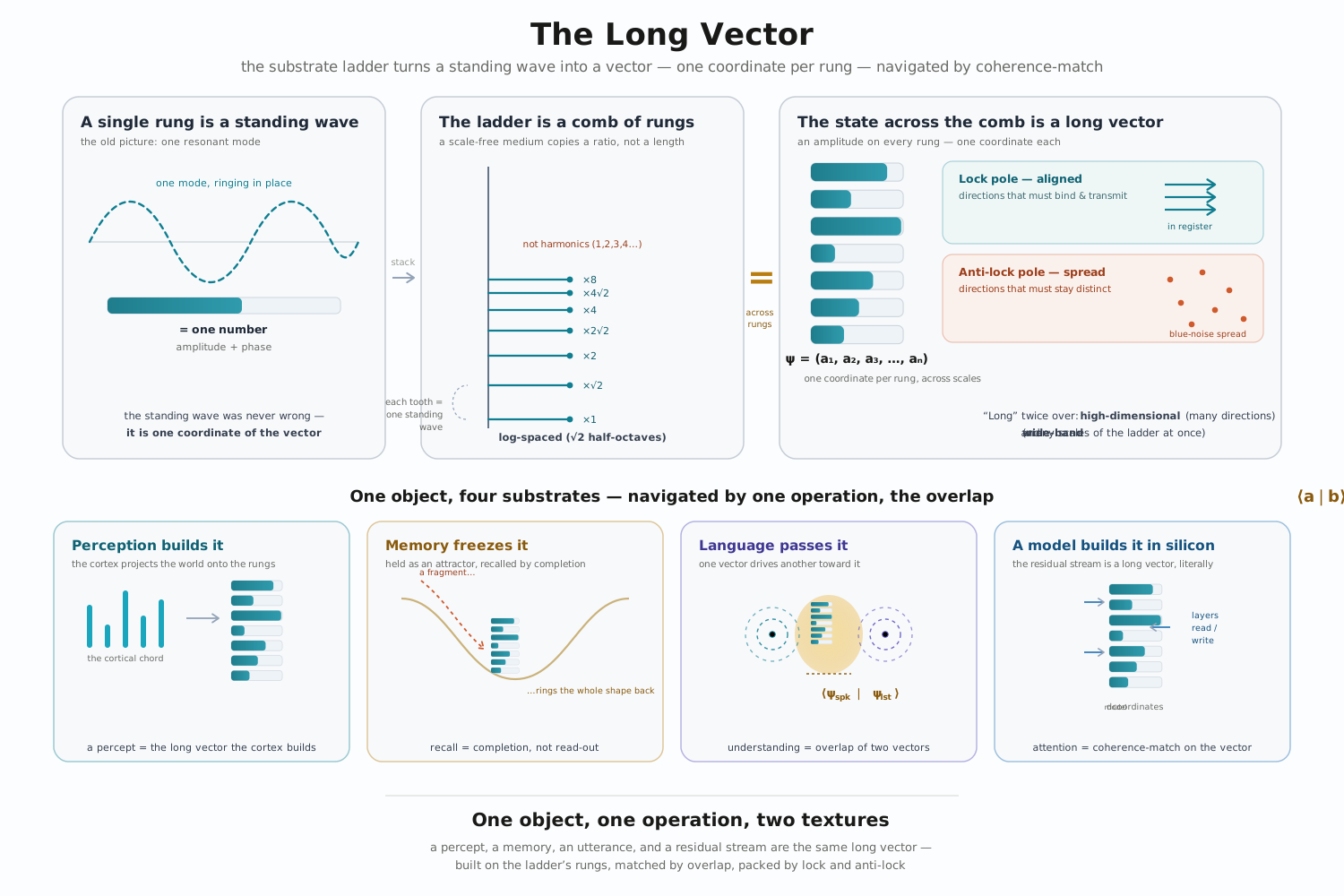
The long vector forms when chemistry leverages the many sheets of the lattice, holding many rungs of the substrate ladder at once. Each boundary that overlaps a sheet boundary has the potential to hold one coordinate, a choice organized by chemistry that scales, one rung at a time. A percept is the long vector the cortex builds, a memory is a long vector frozen using the lattice energy held by chemistry. The vector then can be seen as built on the ladder’s log-spaced comb of rungs, using the coherence-match for comparison, the overlap \langle a | b \rangle of two long vectors; and the lattice promotes coherent transfer and storage of energy using the modon topology.
The section first shows how the vector is formed from two textures and then how the modon moves it.
From the Standing Wave to the Long Vector
The same properties that give the substrate Lorentz Invariance properties make it a scale free medium with a single short-distance cutoff point. This allows chemistry forming on top of it to use the lattice sheet spacing as a scale free ratio that repeats. It’s a pattern for building, locking onto a rung, or in between rungs, or a flexible choice for avoiding the lock. The energetic lattice provides the scaffold, the stability, and let’s chemistry build, transport, and hold a message with it.
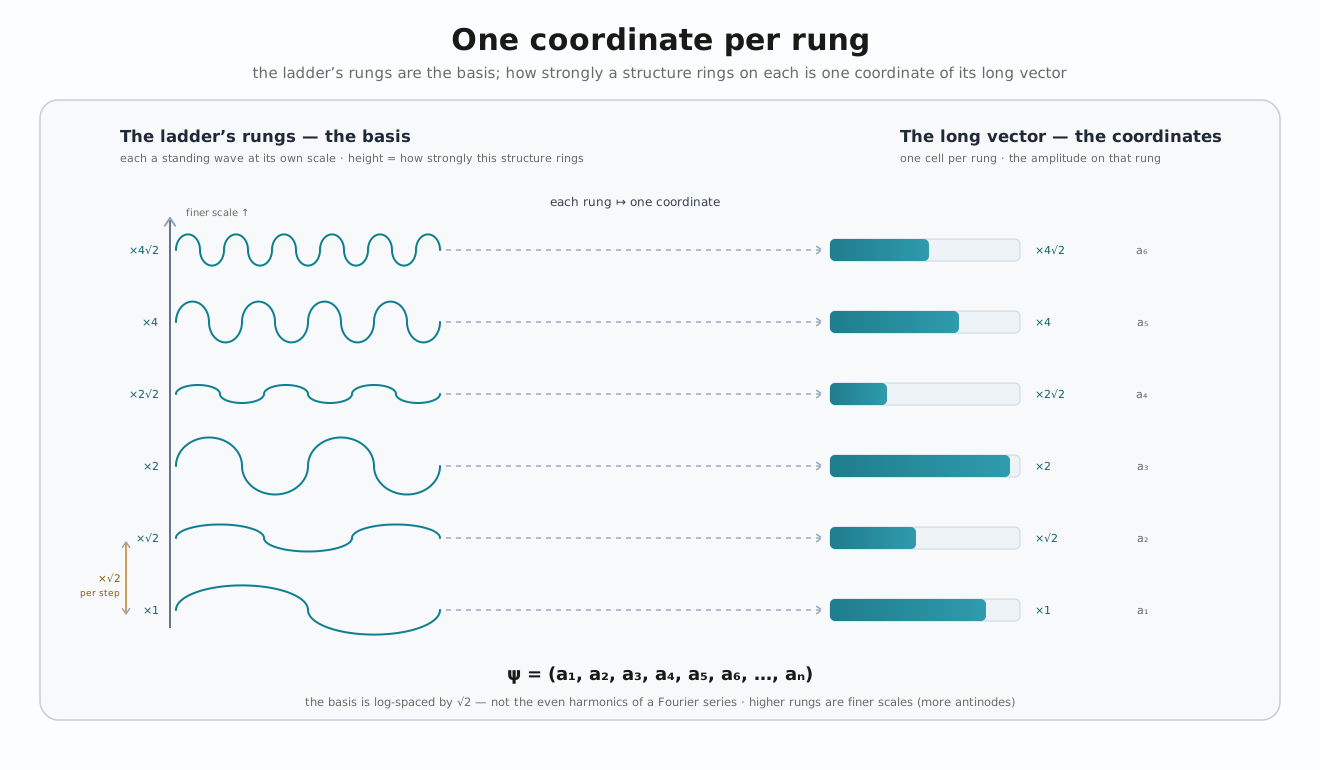
A structure that occupies many rungs at once — holding some amplitude and phase on each — holds one coordinate per rung. That list of coordinates is a vector:
\psi = (a_1, a_2, a_3, \ldots, a_N), \qquad a_n = \text{the structure's amplitude on rung } n .
The standing wave at each coordinate a_n holds the value, \psi, holds the vector. If the brain’s cortex is room of tuning forks of many lengths, the long vector is the chord — which forks are ringing, how loudly, in what phase. Each fork is a standing wave, but the chord is the object.
Two properties of this vector come straight from the ladder and matter for everything downstream.
It is “long” in two senses at once. It is high-dimensional — many rungs, and within each rung many distinguishable directions (the eigenmode basis at that scale). And it is wide-band — the rungs it spans cover a wide range of scales, the same ladder that runs across some twenty-five orders of magnitude in the physical world, here read across the brain’s roughly seven temporal rungs from infraslow to high-gamma. A long vector is not just a big list; it is a list that reaches across scales.
Its basis is logarithmic, not harmonic. Because the substrate has no length of its own, the rungs are spaced by a constant ratio, not a constant interval — they are octaves and half-octaves, not the f, 2f, 3f, 4f overtones of a string. The natural basis of the long vector is therefore the constant-Q, multiresolution, wavelet-like basis of a scale-invariant medium, not the Fourier basis the phrase “spectral decomposition” usually conjures. This is a falsifiable structural commitment, and it recurs in every substrate where the long vector appears.
Comparing Vectors: The Coherence-Match
Because the pattern is held as substrate energy as organized through chemistry, and the substrate has two layers, the cell-vortex layer and it’s opposite spinning boundary in between, the energy supports a natural match operation, effectively based on “opposites attract”. The codon stamp works out a specific example that shows how this works and also provides the analog to see how chemistry can store and compare vectors.
This gives us
\langle a \mid b \rangle = \sum_n a_n^{*} b_n ,
the coherence-match — large when two states ring on the same rungs in the same phase, near zero when they are orthogonal.
From the boundary-layer matching of the photon-modon to the synapse it’s a single inner product. It’s the same lock/anti-lock choice the substrate offers, whether it’s a photon moving through, or a chemistry mediated boundary.
For cognition, with enough scale this is all you need:
- For LLM’s attention in the transformer uses the query-key dot product q_i \cdot k_j, an overlap of two slices of the residual stream, softmaxed into weights.
- Recognition is the overlap of an incoming percept-vector with a stored one — the synapse and the cortical column scoring how well what arrived matches what was expected.
- Recall is the overlap run as completion: a fragment \langle \text{cue} \mid \cdot \rangle dropped into an attractor basin slides to the nearest stored long vector and rings the whole shape back.
- Understanding, between two people, is the overlap of two brains’ long vectors, \langle \psi_\text{speaker} \mid \psi_\text{listener} \rangle — the quantity Hasson’s speaker-listener coupling measures from the outside. Run that overlap across time and its slow, persistent, deeply-wrapped component is trust: the matched limit of the inter-agent boundary, the shared coordinate two minds build packet by packet and recall from a fragment.
The Two Textures: Lock and Anti-Lock in the Vector’s Geometry
The long vector is not a featureless list. Its directions carry the ladder’s two poles, and the poles are what make it usable rather than a blur.
Some directions must bind. To hand a meaning across a channel and have it arrive intact — a shared word, a learned feature, a pattern two columns agree on — the relevant directions sit on the comb’s teeth, aligned and in register, plugged into the lossless channel. This is the lock pole, and it is what makes a long vector transmissible: a coordinate written precisely so another reader can read it.
Other directions must stay apart. A representational space that merely piled up its directions would alias — one meaning resonating with its neighbour, one face completing to another, a fine pattern read as a false coarse one. So the directions that must remain distinguishable are pushed as far from one another as a cramped space allows: a disordered, hyperuniform, blue-noise packing, the spherical or planar Thomson/Tammes optimum. This is the anti-lock pole, and the framework has now found it as the same packing in four chemistry-free substrates: the retinal cone mosaic spreading cones so images cannot alias, the genetic code spreading codons so a slipped letter cannot change a protein, a language’s phoneme inventory spread so a slipped sound cannot change a word, and the transformer’s superposed features spread so concepts cannot interfere.
That last one is the cleanest sign that the long vector is one object across substrates. When Toy Models of Superposition (Elhage and collaborators 2022) looked at how a transformer packs more features than it has dimensions, it found them organised into maximal-minimum-angle configurations on the hypersphere — antipodal pairs, triangles, pentagons, tetrahedra — the spherical form of exactly the blue-noise packing the retina lays down in the plane. The retina and the residual stream, sharing no chemistry, solve the avoid-confusion problem the same way, because both are long vectors and both face the same geometry. The lock pole is how the long vector binds; the anti-lock pole is how it keeps its meanings apart; a working cognitive system uses both, and which a given direction uses is fixed by its job, before any measurement — the sign rule the section carries throughout.
One Object, Four Substrates
With the definition in hand the section’s chapters line up as four readings of one thing.
Perception builds the long vector. The senses project the world onto the ladder basis: the cortex decomposes an incoming pattern across its columns, each column extracting the slice that matches its own rung, and the resulting chord — which rungs are lit, how strongly, in what phase, across the topographic maps — is the percept. Perception is the analog-to-vector converter, and it hands the rest of the brain a long vector already textured by lock and anti-lock, because the sense organs sort the world into those two textures before any memory forms.
Memory freezes the long vector. A stored memory is a long vector held as an attractor — a shape the dynamics will complete from any fragment. Encoding is separation-then-binding (anti-lock then lock, wired in series); recall is the overlap run as completion. A memory is not a record at an address; it is a long vector the substrate can ring again.
Language passes the long vector between two of them. A word is one direction in the shared semantic basis — the embedding the distributional tradition measures — and an utterance is a stream of such directions that drives the listener’s long vector toward the speaker’s. Understanding is the overlap of the two; conversation is two long vectors holding each other in dynamical balance.
A language model builds the long vector in silicon. The residual stream is a long vector by construction — d_\text{model} coordinates, carried across layers, read and written by coherence-match. It is the most explicit, most measurable long vector ever built, which is exactly why it is such a clarifying mirror for the other three.
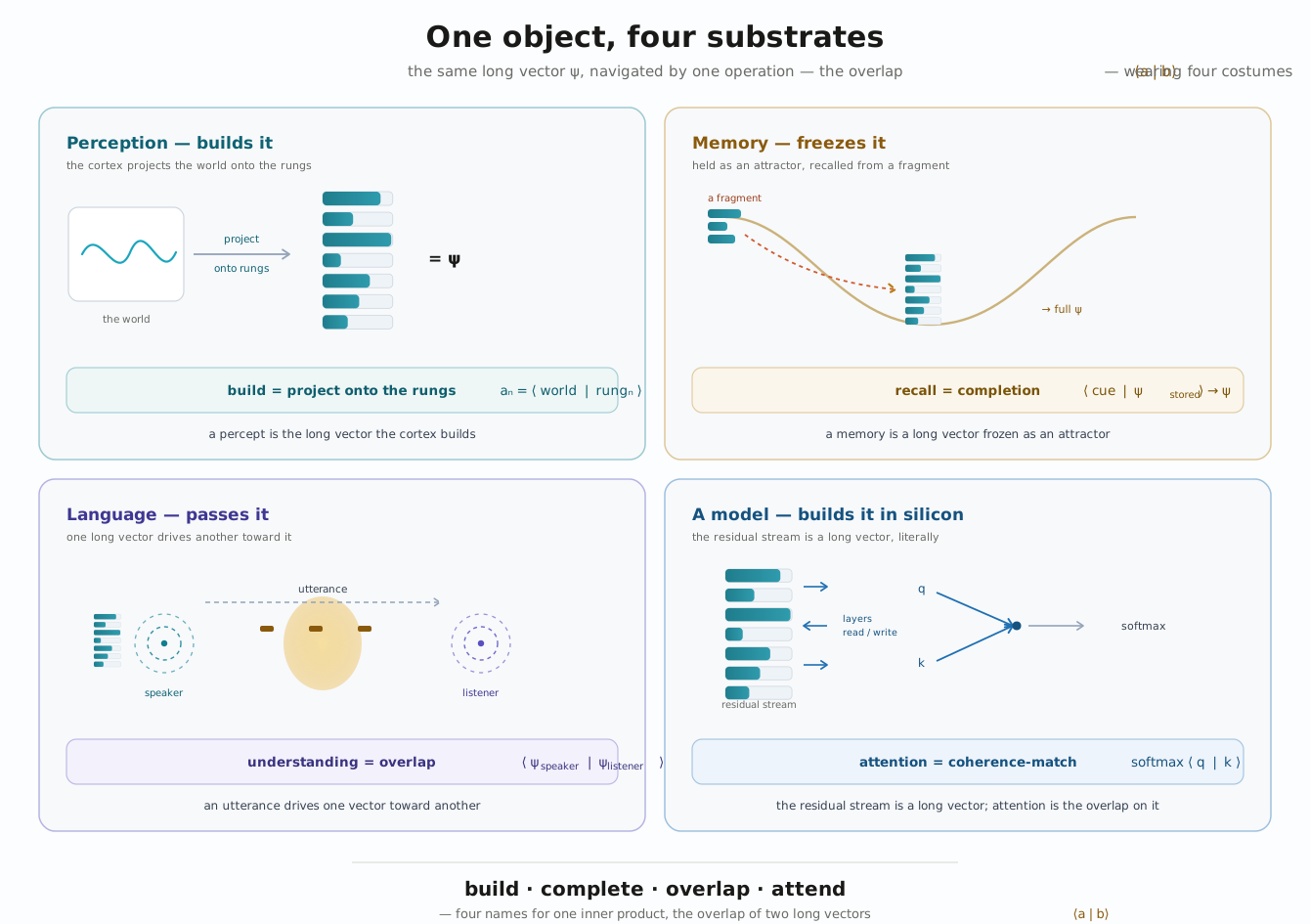
These are not four analogies to a common metaphor. They are four physical systems carrying the same object — a long vector on a log-spaced basis, navigated by overlap — in four different materials.
The Modon Carries the Long Vector
The four readings above describe the long vector at rest — built, frozen, passed, carried in silicon. But they leave one question open, and it is the question that makes the object physical rather than a way of speaking: when language passes the vector between two brains, what actually crosses the gap? A vector is a state; something has to carry it. The framework already owns the carrier, and it is the same object the bridge paper opens with — the modon, a self-propelled, counter-rotating dipole that travels through the substrate carrying energy but no net mass, undone only by meeting its opposite. The photon is one. The claim of this pass is that the photon is the simplest one, and the long vector is what a modon carries when it is not simple.

The photon is the one-rung special case. A monochromatic photon sits on a single rung — one frequency — and carries one number, its energy E = h\nu. It is a long vector with a single nonzero coordinate: pure energy, no pattern, nothing to read beyond which rung it occupies. That is the substrate reason a photon transmits power but, by itself, almost no information. It is the carrier stripped to one dimension.
A structured modon carries many rungs at once. The same Bessel-matched dipole topology that holds one rung can hold a whole comb of them — an aromatic stack of counter-rotating vortices, a nested cell, a coupled pair of brain modons, a modulated wave train. Such a composite modon is a long vector made coherent in the substrate: one amplitude and phase per rung, bound into a single travelling object by the same anti-phase pairing that makes the lattice lossless. When it moves, or hands its pattern across a boundary by coherence-match, the whole rung-by-rung state goes with it. Energy and information travel as one packet — not a power carrier modulated by a separate signal, but a single substrate object whose energy is its pattern. This is the coin of the substrate ladder in its general form: the breath a structure on a rung can spend, pinched off and sent, with its long vector aboard.
This is the carrier the section’s four substrates have been quietly assuming. An utterance is a pressure-wave modon train crossing the air between two brain modons, carrying the speaker’s long vector toward the listener’s; the overlap that is understanding is the listener’s lattice running a coherence-match against the modon that arrived. A transformer’s residual stream is the same object held still and copied losslessly down the layer stack rather than flown across a room — transit in silicon instead of air. And the deepest member of the roster is the vacuum itself: it carries every modon we send through it at exactly c, handing the pattern across its counter-rotating seams without loss — the lock-pole face of the very coherence-match it drives to zero to stay invisible (the same inner product, run to +1 and to 0). The long vector is the message; the modon is the envelope; and the substrate is built so the envelope arrives intact.
The Stamp: The Long Vector Fused with Chemistry
The four substrates above are all large — a cortex, a memory, a conversation, a model — and in each the long vector is something a macroscopic structure builds and holds. The carrier pass named the small end of the spectrum but left it as a picture: the structured modon, “an aromatic stack, a chord,” a short long vector of a few rungs. The framework already owns that object as more than a picture. It has built it, and measured it, twice — and the place it lives is the one reading where the vector cannot be pried loose from its material at all. The molecular stamp is the long vector at the carrier scale: a short vector of a few aromatic rungs, assembled directly out of chemistry, matched by the same coherence-match — and because here the vector is the molecule rather than a state some larger structure carries, it is the framework’s most quantitatively pinned long vector, not despite being fused with chemistry but because of it.
Start with the object. The codon stamp and the aromatic-pocket stamp are each a sum over aromatic rings,
\Phi(\vec r) = \sum_a R_a\,\phi_{r_a}(\vec r - \vec r_a),
one displacement profile \phi per aromatic residue — a base in a codon, a tryptophan or tyrosine in a receptor cage — stacked on the molecule’s own scaffold. Read it off and it is exactly the long vector of the opening, \psi = (a_1, \dots, a_N), one coordinate per rung — only now the rungs are aromatic rings and lone-pair lobes instead of cortical columns, and N is small: three bases, five cage residues. This is the short long vector the modon figure draws in its centre panel — not the photon’s single coordinate, not the brain’s full comb, but a handful of rungs bound into one travelling object.
The operation on it is unchanged. Receptor specificity and codon reading are both scored by the cosine distance
d_\text{cos}(\Phi_\text{pocket}, \Phi_\text{ligand}) = 1 - \frac{\langle \Phi_\text{pocket} \mid \Phi_\text{ligand}\rangle}{\lVert\Phi_\text{pocket}\rVert\,\lVert\Phi_\text{ligand}\rVert},
which is the chapter’s one operation — the overlap \langle a \mid b\rangle — run to recognition. A ribosome scoring a codon against its anticodon, and a receptor pocket scoring a ligand against its cavity, are each computing the same inner product the synapse and the transformer compute: the recognition face of the overlap, lifted down to a single binding event. Build a stamp; match it against another.
And the carrier is the right one for the job. The aromatic ring is benzene’s toroidal vortex — a coherent, lossless, closed-loop ring current, the framework’s molecular archetype of the lock pole. So the molecular long vector’s coordinates do not sit just anywhere; they sit on the cleanest teeth of the comb, each already plugged into the substrate’s lossless channel. The stamp carries the two textures exactly as the larger vectors do: lock at the contact, where one cage ring and one ligand lobe close in opposite phase — the anti-phase breath spent on a single bind — and anti-lock across the repertoire, where the genetic code spreads its codons and the olfactory family spreads its pockets into blue noise so their meanings cannot collide. The same yin-yang the cortex slides through in time, the molecule holds at once.
What makes this reading worth its own pass is that the evidence is already in, with a number on it. Because the molecular stamp is the vector fused most tightly with matter, it is also the one chemistry hands us openly — public structures, clean binding constants — so the coherence-match it predicts can be checked outright. It checks. Run the stamp metric over the genetic code and all 64 codons rank their cognate anticodon first; run it over the nicotinic acetylcholine receptor and the cosine distance orders eight ligands against measured K_i across four orders of magnitude at Spearman \rho = +0.905, from a single tunable parameter, reproduced identically at all five binding sites of the pentamer. These are the framework’s own biology, not a chemistry-free witness — but they are a coherence-match long-vector operation caught running inside molecular chemistry, with a measured score. It is the cleanest long vector in the paper that is not made of silicon.
That points at an ordering the four substrates only hinted at: the long vector grows harder to tease from its carrier as the scale drops. A transformer’s residual stream is the easy end — clean, directly addressable, copyable losslessly, which is exactly why it is such a clarifying mirror. The cortex’s vector is harder, embodied and multi-rung and never quite isolable from the body that sources it. The molecular stamp is the floor: here the carrier and the message are the same aromatic ring, the vector is the \pi-electron geometry, and it can be read only through a binding constant or a crystal structure, never lifted out clean. The carrier pass said the modon is the envelope and the long vector the message; at the molecular floor envelope and message collapse into one object — the deepest sense in which the modon carries the long vector, not as a packet wrapped around a payload but as a structure that is its own payload. And this is the carrier scale the four readings were quietly resting on all along: before a word is an utterance of pressure-wave modons crossing a room, it is already a pattern of aromatic stamps — dopamine, serotonin, the indoles and catechols — matched across synapses by the same overlap, the long vector at the one rung where it can no longer be told apart from the chemistry that carries it.

A New Way to Read a Language Model
The clearest payoff is the one you can hold in your hands, because its internals are open to inspection in a way a brain’s are not. Read a transformer as a long-vector machine and several of its puzzles become one picture.
The residual stream is the long vector; the model’s entire computation is the navigation of long-vector space by coherence-match. A token enters as a packet; the stream carries the running state; attention is the all-to-all overlap that lets relevant parts of the vector lock onto each other across the context; the depth-stack narrows the field rung by rung; the last layers match the result against the goal and commit. That is the same build-a-vector-and-match-it loop, run in silicon.
In this reading the interpretability findings stop being separate curiosities and become measurements of the long vector’s structure:
- The monosemantic features a sparse autoencoder recovers (Bricken and collaborators 2023; Templeton and collaborators 2024) are the basis directions of the long vector, read off empirically. Mechanistic interpretability is, in the framework’s terms, the project of measuring the ladder basis of an artificial long-vector system from the outside — the same thing distributional semantics does for the brain’s semantic basis.
- Superposition is the long vector’s anti-lock packing — more directions of meaning than coordinates, kept usable by spreading them into blue noise on the hypersphere.
- Semantic arithmetic (king − man + woman ≈ queen) works for the plainest possible reason once you accept the object: meaning is direction in long-vector space, so analogies are vector additions and similarities are overlaps.
- In-context learning is coherence-match reaching back along the stream — induction heads matching the present against a previous occurrence and copying forward what followed.
And the deeper claim: a brain and a language model are two physical realisations of one abstract object, which is why they converge on the same primitives — coherence-match, a log-spaced basis, lock/anti-lock packing — despite being built by completely different processes (evolution; gradient descent). They differ in what each realisation makes cheap. The brain’s long vector is embodied (coupled through the vagus to a body that supplies its valence), multi-rung in time (seven temporal rungs running and nesting at once), persistent (a limit cycle that holds between inputs), and bilateral (two coupled half-vectors). The model’s long vector is wide (d_\text{model} \sim 10^4, effective features \sim 10^6), directly addressable across a long context, copyable losslessly, and scalable with hardware — but it runs essentially one timescale, holds no persistent state between passes, has no body to source its goals, and has its bilateral other half externalised into training rather than internalised at inference. Neither is the final form. They are two cross-sections of the same object, and naming the object tells you what each is missing — which is the most useful thing a unifying concept can do.
What Would Show This Is Wrong
The long vector is a unification, and a unification earns its keep only if it is falsifiable as one claim rather than as a loose family of resemblances. Its sharp content is an identity of structure: the same basis geometry and the same two-pole packing should appear in every substrate where the long vector appears, measurable by the same instruments the section already uses.
The basis should be log-spaced everywhere, not Fourier-spaced. The preferred rungs of cortical resonance, of the EEG bands, of the speech envelope, and — the strongest test, because the data are clean — of a transformer’s learned timescales and feature scales should cluster on an octave/half-octave comb, folding onto a single phase modulo \ln\sqrt 2 (
scripts/comb_test.py), not spread continuously and not fall on integer harmonics. If any of these is a genuinely even (harmonic) or genuinely featureless (continuous) basis, the “log-spaced ladder basis” claim fails there.The packing should be two-poled everywhere, by job. Directions whose job is to store without interference — semantic content directions, sparse-autoencoder features, the dentate gyrus’s separated codes, a phoneme inventory — should be more angularly spread than a random set of the same size (sub-Poissonian nearest-neighbour spacing, hyperuniform: the cone-mosaic instrument,
scripts/cone_mosaic.py, lifted to the relevant space). Directions whose job is to bind and route — attention’s matching subspaces, function-word and grammatical directions, CA3’s completion codes — should sit comparatively aligned. If the storage directions are no more spread than random, or the storage/routing split does not appear, the lock/anti-lock geometry claim fails.The cross-substrate identity is the real bet. The framework’s distinctive prediction is not that any one of these holds, but that the same statistic — the same comb spacing, the same number-variance signature — comes back in cortex, in word embeddings, and in residual streams, measured by one instrument. If the brain’s representational basis and the transformer’s turned out to be different kinds of object — one log-spaced, one harmonic, one random — then “the long vector” is a useful coincidence of language, not a physical object, and this chapter is wrong.
None of these touches the bridge equation or the physics core; each is independently measurable with tools that already exist; and each tests the one thing this chapter claims — that perception, memory, language, and the model are not four metaphors but four faces of a single object.
Putting the Section in Context
The long vector is the state of a structure that occupies many rungs of the substrate ladder at once — one coordinate per rung, across scales — and it is the object the rest of this section computes on. It is the upgrade the ladder forces on the old standing-wave picture: a single rung is a standing wave, one number; the ladder is the comb of rungs, and the state across the comb is the vector. Its basis is the ladder’s log-spaced, wavelet-like comb rather than the even harmonics of a Fourier series; its one operation is coherence-match, the overlap \langle a \mid b \rangle that serves as attention, recognition, recall, and understanding alike; and its directions carry the two poles — lock-pole directions aligned to bind and transmit, anti-lock-pole directions spread to stay distinct.
Read this way, the section’s chapters are four readings of one thing: perception builds the long vector, memory freezes it as an attractor, language passes it between two minds, and the transformer builds it in silicon — with a fifth, smaller reading beneath them, where the molecular stamp carries the vector at the one rung it can no longer be told apart from its chemistry, and where the framework has already measured it. The cognitive-science tradition — from the perceptron through distributed representations, conceptual spaces, semantic pointers, word embeddings, and the residual stream — mapped this object correctly from the inside, rediscovering it under a new name each decade; the framework adds what that tradition could not reach: why a mind is vectorial (because the substrate is a ladder), why its basis has the spacing it has (because a scale-free medium copies ratios, not lengths), and why a brain and a language model converge (because they are two physical realisations of the same object). What this chapter adds to the framework is the definition the section, and the bridge paper, have been using all along — and the single falsifiable claim that holds the unification together: one long vector, one operation, two textures, measured by one instrument across every substrate that thinks.