Black Holes as Sonic Horizons
The event horizon is the surface where substrate inflow reaches c — recovering Hawking’s temperature exactly, reading Bekenstein’s entropy as the boundary-crossing leak of the arrow of time, and replacing the singularity with a maximally-packed core that seeds the next bubble
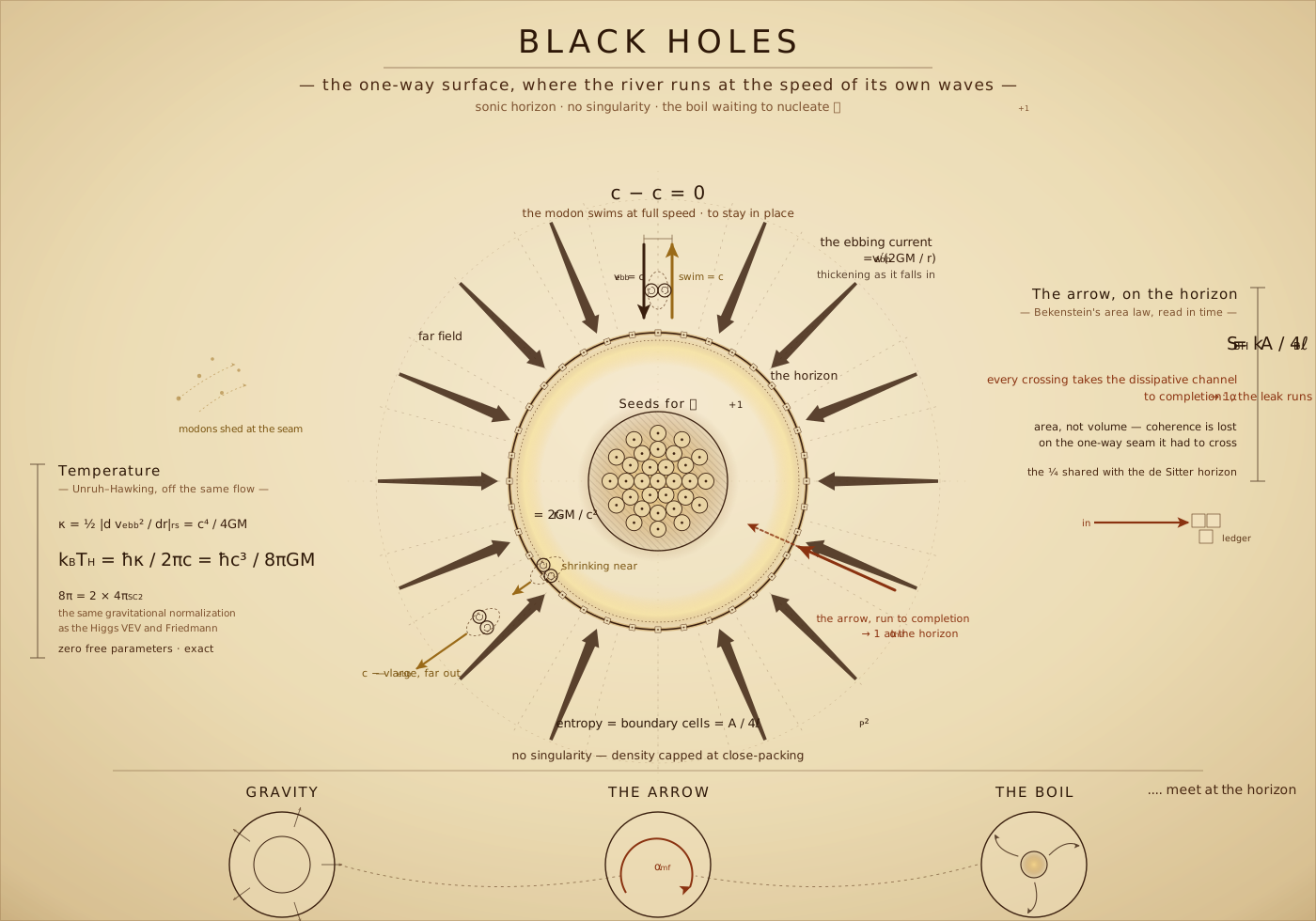
The place the framework’s gravity stopped
The gravity chapter builds the whole of general relativity out of one flow. A mass M draws a steady inward current of substrate — the ebbing current that we feel as weight — and the self-consistent inflow speed is v_\text{ebb}(r) = \sqrt{\frac{2GM}{r}}, which fed into the acoustic metric returns the exact Painlevé–Gullstrand form of the Schwarzschild solution, not a linearization. Every static test of GR — redshift, light-bending, Shapiro delay, perihelion precession — falls out of that one inflow.
But the chapter halts where the inflow gets interesting. Read v_\text{ebb}(r) down to small r and it crosses the signal speed. The radius where it does, v_\text{ebb}(r_s) = c \quad\Longrightarrow\quad r_s = \frac{2GM}{c^2}, is exactly the Schwarzschild radius — and in the substrate it is not an abstract coordinate surface but a physical place: the surface where the river of dc1 runs inward at the speed of its own waves. The framework already named the rotating version of this in passing — where the azimuthal entrainment v_\phi goes supersonic it called the result an acoustic ergosphere, “the rotating analog of Unruh’s dumb hole” — but it never turned around and said the plain thing: a black hole is a sonic horizon in the substrate, and everything black holes are famous for is what a sonic horizon does. This chapter says it, and finds that the two newest cosmology chapters — the arrow of time and why matter won — are exactly the tools the horizon needs.
Why nothing climbs out — the modon held still
The framework’s account of why a horizon traps is more concrete than the textbook “escape velocity exceeds c,” because here the medium is real and so is the swimmer. Light is a modon — a counter-rotating dipole that self-advects through the substrate at the signal speed c relative to the local fluid. Its speed over the ground is therefore c plus whatever the fluid itself is doing. For a modon trying to climb radially outward against the ebbing inflow, the ground speed is v_\text{out}(r) = c - v_\text{ebb}(r). Far away v_\text{ebb}\ll c and light climbs freely. At the horizon v_\text{ebb}=c exactly, so v_\text{out}=c-c=0: the outgoing modon swims at full speed and stays in place, a salmon holding station in a current as fast as it is. Inside, v_\text{ebb}>c and v_\text{out}<0 — even a maximally outbound modon is carried inward. The horizon is not a wall; it is the surface where the substrate’s own flow first matches the speed of the only thing that could carry information back out. This is the analog-gravity trapped surface made mechanical, and it is why the Painlevé–Gullstrand metric — which the framework reproduces exactly — has the horizon it has.
A second, framework-specific thing fails at the same surface, and it matters for the interior. Everything stable in this universe is held together by counter-rotating boundary layers — the thin skins of reversed vorticity that close a shear zone in a low-dissipation superfluid, the same skins that supply the quantum potential, give particles their mass, and meter the gravitational leak. A boundary skin can only close a velocity jump if it can itself keep pace with the bulk — it has to track the flow it wraps. Once the bulk inflow exceeds c, no skin can track it: the roller that would close the seam would have to move faster than its own waves. So at the horizon the containment mechanism of matter itself begins to fail — which is precisely the “boundary systems that hold orbital structure together weaken” that the boil chapter invokes for its compactors, now located at a definite radius. Inside the horizon, matter cannot stay matter.
Hawking’s temperature, recovered from the inflow gradient
A sonic horizon is not perfectly black. The horizon sits at a gradient of the flow, and a gradient in the medium that carries a quantum field makes that field radiate — this is Unruh’s 1981 result, and because the framework reproduces the Painlevé–Gullstrand metric exactly, it inherits the result exactly rather than by analogy. The surface gravity is the half-gradient of the squared inflow at the horizon, \kappa = \tfrac12\left|\frac{\mathrm d\,v_\text{ebb}^2}{\mathrm dr}\right|_{r_s} = \tfrac12\,\frac{2GM}{r_s^2} = \frac{c^4}{4GM}, and the temperature of the radiated modons is the Unruh–Hawking relation \boxed{\;k_B T_H = \frac{\hbar\,\kappa}{2\pi c} = \frac{\hbar c^3}{8\pi G M}\;} — the Hawking temperature, with no free parameter, read straight off the framework’s own ebbing current. For a solar-mass hole T_H\approx 6\times10^{-8} K; the radiation is real but, for any astrophysical hole, fantastically faint.
Two things in this are worth pausing on. First, the radiated quanta are modons — the substrate’s photons — so Hawking radiation in this picture is not a formal pair-production bookkeeping but the horizon’s boundary shear shedding modons, the same pinch-off process by which an atom emits a photon, now driven by the flow gradient instead of an orbital transition. And because it is driven by the gradient rather than an orbital ladder, the light comes out blank — a line-free continuum that carries no fingerprint of what fell in. This is the substrate’s reading of the no-hair theorem: any modon that could imprint a line is manufactured downstream of the horizon, where v_\text{ebb}>c, and can never climb the river to be seen; the only light that escapes is shed by the boundary shear at the seam itself, and a boundary sheds by its kinematics, not by any spectrum of the matter behind it. Hawking radiation is featureless for the same reason sonoluminescence is and a lightning gamma is — it is light shed by a driven boundary, not sung by an orbital ladder, the interior’s own spectra having lost their fight with the gravity river the moment they crossed. Second, the prefactor is 8\pi = 2\times 4\pi_\text{SC2} — the same doubled Gauss’s-law solid angle that the framework already traces through the Higgs VEV’s geometric prefactor and through the Friedmann equation H_0^2=(8\pi G/3)\rho. The 4\pi is gravity’s normalization wherever it appears; the extra 2 is the same radiation-EOS weight that shows up in the pressure-as-source factor. The horizon temperature wears the framework’s gravitational fingerprint.
Bekenstein’s entropy is the arrow of time, read on the horizon
The deepest fact about black holes is that they carry entropy — and not just any entropy, but an amount proportional to the horizon area, not the volume it encloses: S_\text{BH} = \frac{k_B\,A\,c^3}{4 G\hbar} = \frac{k_B\,A}{4\,\ell_\text{Pl}^2}, \qquad \ell_\text{Pl}^2 = \frac{\hbar G}{c^3}. This “area, not volume” is the seed of the holographic principle and is, in most frameworks, a clue without a mechanism. The substrate supplies the mechanism directly, and it is one the paper has already built — in the arrow-of-time chapter. There, entropy is not an abstract microstate count bolted on from outside; it is lost pairing coherence, measured in boundary crossings — the running tally of breath that has taken the dissipative channel across a counter-rotating seam and cannot be re-gathered. The single irreversible primitive is the dissipative fraction \alpha_{mf} of each crossing.
A horizon is the ultimate boundary. Everything that crosses it takes the dissipative channel to completion: by the modon-held-still argument, nothing that crosses can be re-collected from outside, so the catch-fraction that the arrow chapter writes as 1-\alpha_{mf} goes to zero and the leak fraction goes to one — at the horizon the arrow runs all the way over. The entropy a black hole holds is therefore the count of independent boundary cells tiling its horizon, because that — and only that — is the surface across which coherence is irreversibly lost. Entropy scales with area for the same reason the arrow is carried by boundary crossings: the information that has fallen in is registered not in the volume it now occupies but on the one-way seam it had to cross to get there. The holographic area law is the arrow of time, read on the horizon.
The coefficient is not a new guess either — the framework is already committed to the 1/4. The gravity chapter’s resolution of the cosmological constant uses the de Sitter horizon entropy S_\text{dS} = 1/(\delta T/T_c)^2 \approx 2\times10^{122} — and that number is precisely A_\text{dS}/(4\ell_\text{Pl}^2) for the Hubble-scale horizon (R_H=c/H_0, A_\text{dS}=4\pi R_H^2). The cosmological horizon and the black-hole horizon are the same kind of surface seen from its two sides, so the 1/4 that the paper already spends on \Lambda is the same 1/4 here. What this chapter adds is not the coefficient but the reason there is an area law at all: the cell on the horizon is a gravitational-Planck cell \ell_\text{Pl}^2, related to the substrate’s own \sim100\,\mum cell by the framework’s standing hierarchy (\ell_\text{Pl}/\xi)^2 = (m_1/M_\text{Pl})^2 = f_\text{cross}\,\omega_0\hbar/(4\pi c^3\xi) — the same tiny boundary-transit probability f_\text{cross}\approx10^{-15} that makes gravity weak. The horizon is fine-grained at \ell_\text{Pl} and coarse at \xi for the identical reason gravity is 10^{40} times weaker than electromagnetism: only one dc1 in a quadrillion ever transits a boundary. A solar-mass horizon then holds S_\text{BH}\approx 10^{77}\,k_B — the largest entropy the framework assigns to anything its size, and the cleanest statement that a black hole is where the substrate’s arrow has run furthest.
No singularity — the core is a boil waiting to happen
Run the inflow past the horizon and standard GR predicts a singularity: density without bound, the theory devouring itself. The substrate forbids it, and forbids it for a reason the framework already owns. The dc1 condensate has a maximum density. Its self-interaction is logarithmic — a Zloshchastiev superfluid-vacuum equation of state — and a logarithmic self-binding condensate packs to a finite maximum and no further (the Avdeenkov–Zloshchastiev maximum-density result the framework uses to retire the second dark-matter species). Inflow can pile substrate up toward close-packing, but the equation of state stiffens without limit as it approaches the ceiling; the density saturates rather than diverging. There is no singularity because there is a densest the superfluid can be.
So the interior is not a point but a filled core of maximally-packed substrate — which is, recognizably, the pre-boil state. The boil chapter already reads black holes as “compactors”: bulk dc1 flows in, the central region accumulates “at densities far above the ambient,” the containment built from the same substrate “weakens,” and “eventually the configuration is no longer stable against the substrate’s other phase, and a bubble nucleates.” This chapter supplies the missing middle of that story — the horizon at r_s, the boundary-failure that begins there, and the saturated core the inflow drives toward — and hands it back at the point where the boil chapter takes over: the core, pressed to its ceiling, sits one fluctuation away from nucleating a child bubble \mathcal B^{+1}. Our own bubble, the boil chapter argues, “probably nucleated” inside a black-hole interior of \mathcal B^{-1}. The horizon is the entrance to the next universe’s furnace, and the same maximally-coherent re-pairing that the arrow chapter needs to reset entropy for a fresh epoch is what the saturated core delivers.
One recent result looks, at first pass, like an attack on this claim, and should be read carefully because it is actually support. Volovik (2026) argues that a gravastar — a static regular black hole with no singularity — is thermodynamically unstable toward the singular Schwarzschild configuration ([R158]): a static regular core is not an equilibrium endpoint. The substrate’s core is not static. It is metastable and finite-lived — a compactor banking compression toward the nucleation barrier — and its decay channel is not collapse to a point but macroscopic quantum tunneling to the new phase, computed by exactly the vortex-instanton machinery (w \propto e^{-2\pi N}) Volovik himself uses for black-to-white-hole transitions ([R154]). His instability is the thermodynamic pressure behind the pop, not an argument against the regular core; and his own resolution of the singularity in the laboratory analog — the \delta-function vorticity of a ^3He vortex resolved at the coherence length — is this framework’s mechanism, with the resolution scale at the substrate’s \xi rather than sub-Planckian. The honest sentence: the framework agrees the regular core is not eternal; it disagrees about the endpoint — tunneling to the next cycle, not a singular point.
A floor on the horizon — the smallest black hole there can be
The no-singularity argument caps the density from above. There is a second, sharper limit at the other end, and it comes from the one thing that makes this chapter’s horizon a physical surface rather than a coordinate one: the substrate has a grain.
Everything in the identification above is hydrodynamics. v_\text{ebb} is a bulk flow of dc1, c is the speed of that fluid’s own sound mode, and the horizon is the place where the first overtakes the second. All three are coarse-grained quantities — they are defined by averaging over many cells of a medium whose cell size is the framework’s \xi \approx 100\,\mum (lattice cell size). A horizon smaller than a cell is not a small horizon; it is no horizon at all, because there is no interior volume across which a flow speed could be defined, and nothing for a boundary skin to fail to track. Demanding that the trapped region be at least one cell across, r_s \ge \xi, puts a floor on black-hole mass:
\boxed{\;M_\text{min} = \frac{\xi c^2}{2G} \approx 6.7\times10^{22}\,\text{kg} \approx 3.4\times10^{-8}\,M_\odot\;}
— nine-tenths of the mass of the Moon. (With \xi = 96.9\,\mum from the SC2 leg, 6.5\times10^{22} kg.) Below a lunar mass, the substrate has no black holes. Whatever a sub-lunar concentration of mass is in this framework, it is not a horizon-bearing object; it is a dense knot in a medium whose cells it cannot individually resolve.
The coefficient here is soft and should be read as such. Whether a hydrodynamic horizon needs one cell or a few tens of cells to be a well-defined surface is not something this chapter computes, and the honest floor is therefore M_\text{min} \sim 10^{23} kg to within an order of magnitude or two. What the argument does fix robustly is the scale: the framework’s smallest black hole is a planetary-satellite mass, not a Planck mass and not an asteroid mass.
Every black hole the framework permits is currently growing, not evaporating. At the floor, the Hawking temperature derived above is T_H(M_\text{min}) = 1.82 K — below the CMB’s 2.725 K — so even the lightest permitted hole absorbs more than it sheds in the present epoch. This also sharpens prediction 2 below: the framework’s evaporation endpoint is not a Planck-scale remnant but the cell scale, r_s \to \xi, reached only in a far future where the background has cooled past the floor’s own temperature.1
What this rules out: primordial black holes
The floor lands squarely on a live observational program. Primordial black holes — hypothetical relics of the early universe, and the leading remaining candidate for particle-free dark matter — are searched for hardest in the “asteroid-mass window” 4\times10^{-17} < M/M_\odot < 4\times10^{-12}, the one band not yet closed by lensing, evaporation, and dynamical constraints. That window is where a recent and striking proposal lives: a PBH transiting a white dwarf deposits enough tidal heating to ignite carbon and trigger a Type Ia supernova, a channel whose yields Leung, Nomoto and Kusenko find can reproduce features of real remnants (Tycho, Kepler, 3C 397) and may be required, at non-zero fraction, to explain the Mn/Ni abundance trend across Milky Way stars.2
The substrate forbids the objects, and forbids them twice over, independently.
They cannot have horizons. The Schwarzschild radii across that entire window run from 0.12 pm to 12 nm — from nuclear to molecular scale. The top of the window is 10^4 times smaller than one lattice cell; the bottom is 10^9 times smaller. The framework’s floor sits a factor of \sim\!8500 above the window’s upper edge, so no plausible softening of the r_s \ge \xi criterion rescues any part of it.
They cannot have formed. The framework’s replacement for inflation is multi-site bubble nucleation, and its signature statistical consequence is that the primordial fluctuations are Gaussian to an extreme degree: f_\text{NL} \sim 1/\sqrt{N_\text{bubble}} \sim 10^{-13} by the central limit theorem over \sim e^{60} sites (spacetime dynamics). PBH formation needs one of exactly two things — a \sim\!10^7-fold enhancement of small-scale power, or fat non-Gaussian tails — and the boil supplies neither. There is no inflaton potential to engineer a feature into, and the same averaging that resolves the DBI non-Gaussianity tension flattens the rare tail that PBH collapse requires. The boil makes no black holes; it makes a smooth, Gaussian plasma, and the first black holes in \mathcal{B}^0 are the ones stars make.
That is a genuine cost as well as a result, and it should be booked as one. The Mn/Ni observation is real and the trigger mechanism is sound Newtonian tidal physics; what the framework denies is only the identity of the transiting object, since the ignition channel never uses the horizon — it needs a compact mass, nothing more. The framework’s own candidate supplier of transiting compact masses is a population it already carries for other reasons, from a completely different origin: the moraine debris of \mathcal{B}^{-1}. That substitution, and the sharply different predictions it makes on the same data, is worked out in Erratics § The supernova channel.
The hourglass — what fills a compactor, and how fast
The floor section left every permitted black hole growing. The boil chapter reads the population as compactors — the standing crop of nucleation sites for \mathcal B^{+1} — and its breadcrumb 2 asks what sets the trigger. Between the two sits a question neither chapter has posed: what actually fills a compactor, and at what rate? That rate is the clock of the whole cycle — the hourglass whose last grain is the next bubble — and it is worth being precise about which sand runs through it, because the intuitive answer turns out to be wrong by twenty-one orders of magnitude.
The intuitive sand is the CMB, and the one-way street is real. Follow the logic that suggests it. The background light cannot be banked by matter: it sits four decades below the Rydberg, so chemistry is deaf to it — it scatters off free electrons, passes through everything else, and never stops. The only trap that works on light is the speed limit itself. And the trade at a horizon runs strictly one way: by the floor result, even the smallest permitted hole sits at T_H = 1.82 K, below the CMB’s 2.725 K, so every black hole the framework permits is a net absorber of background light in the present epoch — a solar-mass hole absorbs \sim10^{31} times more CMB power than it Hawking-radiates — and by the modon-held-still argument nothing captured ever climbs back out. (That the CMB is sub-floor delocalized winding rather than compact modons changes nothing here: a stretched winding rides the lattice at c relative to the local fluid, and at the horizon the local fluid itself falls at c, so the salmon argument traps it identically.) One wrinkle at the bottom of the range is worth recording: a floor-mass hole has r_s \approx 100\,\mum while the CMB spectral peak is at \lambda \approx 1.1 mm — the smallest permitted black hole is ten times smaller than the wavelength of the light it would swallow, so its capture is further wave-suppressed. The horizon floor and the modon floor meet at the bottom of the hourglass, and the neck narrows to nothing.
But the arithmetic retires the CMB as the clock. The photon capture cross-section of a hole is \sigma = 27\pi\,(GM/c^2)^2, and against today’s CMB energy density (4.2\times10^{-14} J/m³) the trickle is:
| Hole | \dot M_\text{CMB} | Fraction of own mass per Hubble time |
|---|---|---|
| M_\text{min} (0.9 lunar) | 9\times10^{-22} kg/yr | 2\times10^{-34} |
| 10\,M_\odot stellar | 8\times10^{-5} kg/yr | 6\times10^{-26} |
| Sgr A* (4\times10^6\,M_\odot) | 1.3\times10^{7} kg/yr | 2\times10^{-20} |
| Phoenix A (10^{11}\,M_\odot) | 8\times10^{15} kg/yr | 6\times10^{-16} |
Summed over a generous census of every black hole in the universe, the optical depth of the sky to horizon capture is \sim10^{-21} per Hubble time: at today’s rate the holes would need \sim10^{21} Hubble times to drink the CMB. Meanwhile expansion drains order-unity of the CMB’s energy per Hubble time through redshift — the background light is not spiralling into whirlpools; it is free-streaming and stretching, and the expansion channel beats the capture channel by a factor of \sim10^{21}. The framework in fact requires this transparency: the quiet-majority chapter’s prediction 3 holds n_1/n_\gamma = 1509 comoving-conserved since the boil, a claim the \Omega_\text{DM}/\Omega_b identity leans on. A universe whose holes drank its CMB would break the framework’s own bookkeeping. At 10^{-21} per Hubble time, the books are safe by twenty orders.
Three fuels, one drain. What does fill a compactor, then? The candidates, side by side at cosmic mean density:
| Fuel | Mean density | How it arrives | What limits it |
|---|---|---|---|
| Baryons | 4\times10^{-28} kg/m³ | falls, forms disks, radiates | the Eddington valve — its own light pushes back; a finite reservoir |
| CMB | 4.6\times10^{-31} kg/m³ | free-streams at c, almost always misses | transparency — \sigma = 27\pi(GM/c^2)^2 against an expanding sky |
| dc1 | 2.3\times10^{-27} kg/m³ | flows — the ebbing current | nothing analogous — see below |
Baryons are the fast clock, and it is measured: the quasar era is SMBHs gorging on gas at the Eddington limit (Quasars reads that era as the hole’s childhood), and it is how Phoenix A got to 10^{11}\,M_\odot in the first place. But baryonic accretion is self-limiting twice over — the infalling matter radiates its binding energy back out, and the radiation pushes on the rest of the infall — and its reservoir is 6\times10^{-10} of the boil’s output, locally exhaustible. This is the star–hole asymmetry read as plumbing: a star is a boundary system in equilibrium with its inflow — a valve, returning what it takes in as light and wind — while a horizon is the place boundaries fail: a pure drain. The dc1 is the slow clock. It outweighs the CMB five-thousandfold, its reservoir is the ambient substrate and effectively unlimited, and — decisively — the Eddington valve does not work on it: the stealth vacuum does not scatter light, so no radiation pressure ever pushes the ebbing current back. Nothing turns it off.
And the slow clock runs away. Capture from a medium at rest is Bondi’s problem, and its rate goes as the square of the mass: \dot M \;=\; \frac{4\pi\,G^2 M^2\,\rho_\text{dc1}}{v_\text{reg}^3}, with v_\text{reg} the regulating speed of the inflow. Solve it: \boxed{\;M(t) = \frac{M_0}{1 - t/t_*},\qquad t_* = \frac{v_\text{reg}^3}{4\pi G^2 \rho_\text{dc1}\,M_0}\;} — not exponential growth but a finite-time runaway: the mass formally diverges at t_*, and t_* \propto 1/M_0. This is the spiralling-whirlpool intuition made exact, and it does three things at once. It answers half of the boil chapter’s breadcrumb 2: no critical mass is needed for a guaranteed pop, because every hole is already on a finite-time trajectory — the nucleation barrier decides where on the curve the pop happens, not whether the curve arrives. It orders the queue: t_*\propto1/M_0\rho means the biggest, best-fed holes blow up first, by orders of magnitude — Phoenix A is the canary not by hand-waving but by formula. And it feeds the cascade: the first pop loads neighboring compactors that are themselves already far down their own runaway curves, which is what makes the cluster cascade a chain reaction rather than a coincidence.
The absolute timescale is honestly open, because the coefficient is not computed. If v_\text{reg} is the Landau critical speed v_L = 751 km/s — the substrate’s natural ceiling on bulk flow — then at cosmic mean density Phoenix A’s t_* is \sim4\times10^{4} Hubble times; if the regulator is c (a bare horizon-flux reading), \sim6\times10^{11}; Sgr A* is 2.5\times10^4 times longer in either reading, and local halo densities well above the cosmic mean shorten all of these. That (c/v_L)^3-wide uncertainty — seven decades of rate — is logged as WIP-34. What survives the slack is the robust content: the M^2 law, the finite-time form, the 1/M_0 ordering, and the scale — no pop is imminent; the deep clock runs in units of \gtrsim10^4 Hubble times, exactly the “simmering, not popping” the boil chapter asserts. The hourglass is real, but its sand is the substrate itself: the CMB was made by the last pop and mostly stretches away untouched; the dc1 ebbing current, valveless and inexhaustible, is what fills the next one. What that filling buys across cycles — why each bubble mints its light fresh instead of inheriting it, and why the cycles do not decay — is assembled in A Universe That Boils § What survives a cycle.
The information question, in substrate terms
The paradox — does a black hole destroy the information that falls in? — has a natural, modest reading here, and it is again the arrow chapter’s, which already identifies measurement-collapse as “the dissipative channel overrunning the reactive one.” Infalling coherence is dispersed into the horizon’s boundary-cell ledger: holographically, onto the area, exactly the S_\text{BH} cells above. That dispersal is irreversible in the same in-practice sense as any thermalization — the reactive channel conserves the ledger, but the leaked fraction “cannot be un-leaked” by anything outside. The framework therefore sits, without strain, on unitary-in-principle, thermal-in-practice: nothing is destroyed (the substrate’s microdynamics are reversible), but nothing is recoverable from outside either (the arrow has run over). And the bounce gives the information somewhere to go that a one-way evaporation does not — through the saturating core into \mathcal B^{+1} — so the framework’s version of the paradox is not “where did it go?” but “it went where the next bubble comes from.” This is a re-description, not a derivation of the page curve; it is flagged as such below.
Predictions and falsification
- Gravitational-wave echoes from a physical near-horizon shell. The substrate horizon is not a mathematically perfect one-way membrane but the surface where the inflow first reaches c and the boundary skin begins to fail — a thin, stiff, physical transition region, not an idealized discontinuity. A perturbed merger remnant should therefore leak a train of post-ringdown echoes, delayed repetitions spaced by roughly the wave-crossing time of the near-horizon cavity, \Delta t \sim (r_s/c)\,\ln(\,\cdot\,) — the generic signature of any horizon with structure. This is a live search in LIGO/Virgo/KAGRA data and a target for Einstein Telescope and LISA. Clean, high-SNR ringdowns with no echoes down to the instrument floor falsify the stiffened-shell picture and push the substrate horizon back toward an ideal one.
- No singularity, a maximum-compactness core, no complete evaporation. Because density saturates at close-packing, black holes have a hard, finite-density core and a maximum compactness; Hawking evaporation cannot proceed to a point but must terminate at a core-scale remnant or a nucleation event (the boil’s \mathcal B^{+1}). The horizon floor makes the endpoint concrete: evaporation stops at r_s \to \xi, a lunar-mass remnant, not a Planck-scale one. Any observation requiring a literal singularity — or a clean, remnant-free final evaporation puff — would break this.
- No black hole below \sim\!10^{23} kg, and therefore no primordial black holes. M_\text{min} = \xi c^2/2G \approx 0.9\,M_\text{Moon} follows from the horizon being a hydrodynamic surface in a medium with a 100\,\mum cell, and it excludes the entire asteroid-mass PBH window (4\times10^{-17}–4\times10^{-12}\,M_\odot) by four to nine orders of magnitude, with the boil’s Gaussianity (f_\text{NL}\sim10^{-13}) independently forbidding their formation. This is the chapter’s cleanest falsifier and it is instrument-ready: a confirmed PBH detection anywhere in the asteroid window — by microlensing (Subaru HSC, Roman), by a \gamma-ray evaporation signature, or by a directly witnessed white-dwarf transit — kills the r_s \ge \xi floor, and with it the reading of \xi \approx 100\,\mum as a genuine hydrodynamic grain rather than a bookkeeping length. Nothing else in the paper puts the lattice cell at risk from an astronomical observation.
- Hawking temperature is exact, not approximate. T_H=\hbar c^3/8\pi G M follows with zero parameters from the framework’s own v_\text{ebb} gradient, with the prefactor 8\pi=2\times4\pi_\text{SC2} the same gravitational normalization as the Higgs VEV and Friedmann. A measured deviation from the exact Hawking value (e.g. in an analog-gravity bench experiment matched to these flow profiles) at the relevant order would falsify the identification.
- The horizon entropy is the cosmological horizon’s law, shared. S_\text{BH} = A/4\ell_\text{Pl}^2 is not independently posited — it is the same horizon-entropy relation the framework already uses for the de Sitter horizon to set \Lambda (S_\text{dS}\approx2\times10^{122}). The two are locked: any consistent substrate computation that produced a black-hole coefficient other than the de Sitter 1/4 would break the shared law, so confirming the area law’s coefficient from the cell-counting side is the same calculation as deriving \Lambda’s.
Honest assessment
What is solid is the central identification and it is genuinely strong: a black hole is a sonic horizon in the substrate, the surface where the ebbing current v_\text{ebb}=\sqrt{2GM/r} first reaches c at exactly r_s=2GM/c^2. This is not a new assumption — it is the framework’s already-exact Painlevé–Gullstrand inflow read one radius further than the gravity chapter chose to, plus the standard analog-gravity trapped-surface argument. The modon-held-still mechanism (v_\text{out}=c-v_\text{ebb}) makes “nothing escapes” mechanical rather than definitional.
What is new here and cheap is the horizon floor. M_\text{min}=\xi c^2/2G costs the framework nothing it had not already bought — the horizon’s status as a coarse-grained hydrodynamic surface is the chapter’s own central claim, and \xi is fixed elsewhere — yet it yields a hard minimum black-hole mass, an evaporation endpoint, and an exclusion of primordial black holes that the framework then has to pay for honestly elsewhere. Its weakness is the coefficient: the criterion r_s \ge \xi is stated, not derived, and how many cells a horizon actually needs is uncomputed. The scale survives that slack; the factor does not.
The hourglass section divides the same way. Its negative half is solid and cheap: retiring the CMB as the compactor fuel uses only the standard photon capture cross-section and the measured background density — no substrate input anywhere — and the resulting 10^{-21}-per-Hubble-time trickle simultaneously checks the quiet-majority chapter’s comoving conservation of n_1/n_\gamma rather than assuming it. The \dot M \propto M^2 finite-time form is generic Bondi capture and robust. What is not solid is the coefficient: the regulating speed spans v_L to c — seven decades of rate — and the local dc1 density near a real hole is uncomputed (WIP-34). The section therefore claims an ordering (biggest holes pop first) and a floor on the timescale (nothing imminent), and deliberately claims no near-term observable.
What is re-derived (Tier-2a in spirit) is the surface gravity \kappa=c^4/4GM and the Hawking temperature T_H=\hbar c^3/8\pi GM, exact because the metric is exact. The area law S\propto A is, in this framework, a genuine consequence rather than a postulate: it is the holographic face of the arrow chapter’s “entropy = boundary crossings,” with the horizon as the one-way seam. That is the chapter’s strongest original contribution.
What is not solid: the entropy coefficient 1/4 is inherited from the same horizon-entropy law the paper already spends on \Lambda — consistent and economical, but not independently derived here from substrate cell-counting (doing so is the same open calculation as deriving \Lambda’s value, WIP-17). The interior and the bounce inherit every caveat of the boil chapter and are the most speculative leg — the Painlevé–Gullstrand metric is stationary, and the time-dependent collapse-to-nucleation flow is not yet solved (whether there is a critical mass that must pop, or a Poisson-distributed thermal trigger, is open). And the information story is a faithful re-description of decoherence in substrate terms — unitary in principle, thermal in practice — not a derivation of the page curve. The strongest near-term test is prediction 1: GW echoes are a real, contested, instrument-ready search, and the framework takes a definite side (a physical near-horizon shell, hence echoes) that clean ringdowns can falsify.
Putting the section in context
The paper built a superfluid theory of gravity and then stopped at the horizon, and built a cyclic cosmology of boiling bubbles and started after the pop — leaving the black hole itself, the most extreme gravity there is, as a gap between two finished chapters. This chapter fills it, and finds it needs nothing new: the horizon is the ebbing current reaching c, the temperature is that current’s gradient, the entropy is the arrow of time run to completion on the one-way seam, the absent singularity is the substrate’s maximum density, and the core is the boil’s furnace waiting to light. It is the keystone of the cosmology triptych: where gravity is the leak, the arrow is the leak read in time, and why matter won is what the leak’s reset leaves behind, the black hole is the one place where all three meet — the surface where the river runs at the speed of light, the arrow runs all the way over, and the next universe is one fluctuation away from catching. The next chapter reads the hourglass’s ranking of fuels as a black hole’s biography — the bright, brief quasar childhood on baryons, the long jet-mode adulthood on banked spin, the old age on the ebbing current.
Footnotes
The mass at which T_H crosses the present T_\text{CMB} is 4.5\times10^{22} kg — within a factor of 1.5 of M_\text{min}. The framework has no derivation of that proximity and should not pretend to one: T_\text{CMB} is epoch-dependent and \xi is not, so the two scales coincide now and will not later. Noted as an unexplained numerical adjacency, not a result.↩︎
Leung, S.-C., Nomoto, K., Kusenko, A., et al., “Primordial Black Hole Triggered Type Ia Supernovae I: Impact on Explosion Dynamics and Light Curves,” ApJ, 2025, arXiv:2507.21041; “II: Comparison with Supernova Remnants and Galactic Chemical Evolution,” ApJ, 2026, arXiv:2606.07505. [R144, R145]↩︎