Why Matter Won
Baryogenesis from substrate chirality — the matter–antimatter asymmetry as the vacuum’s built-in handedness, with η_B ≈ ε_chirality⁹ as the prediction target
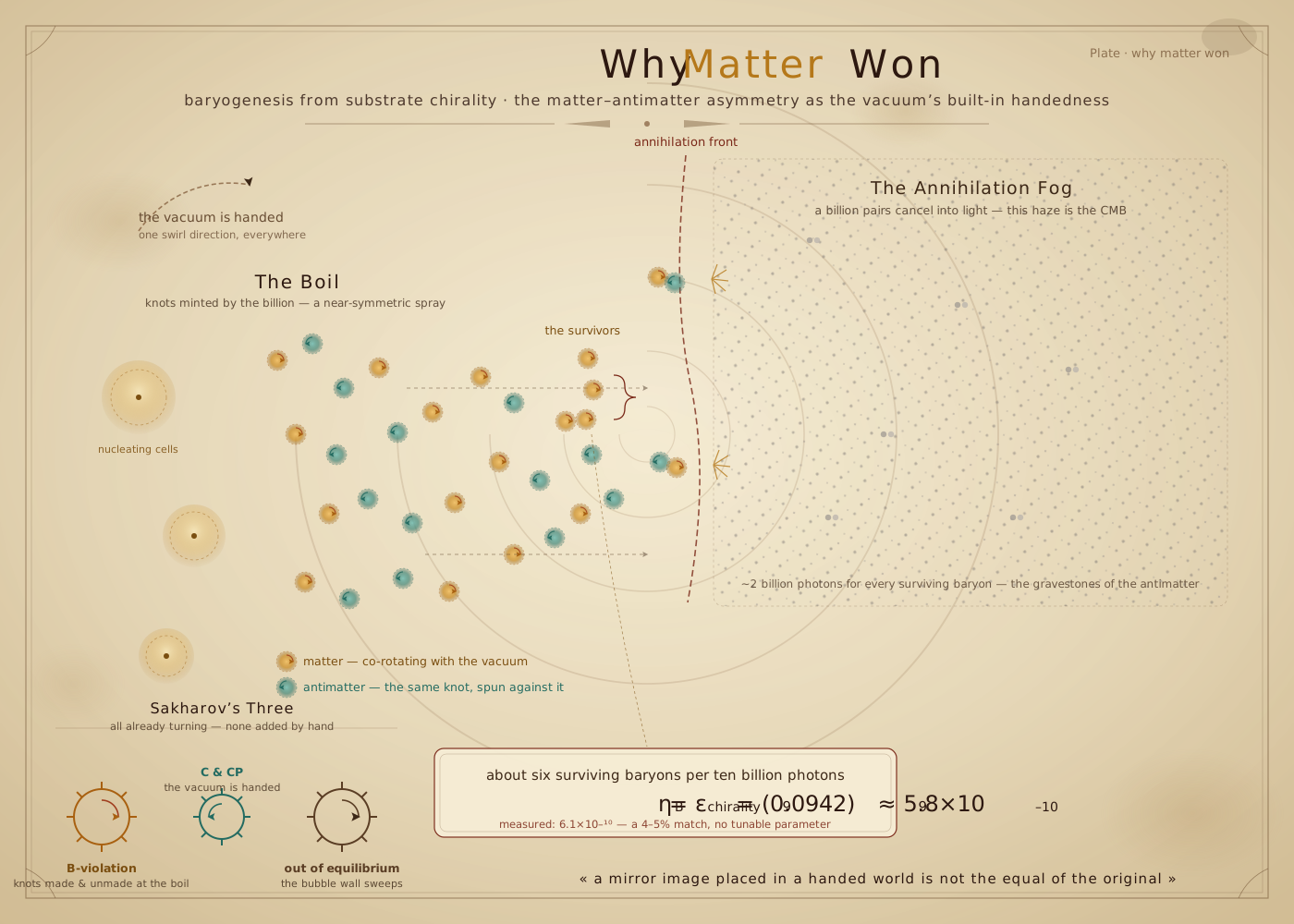
Interactive: open the boil simulation — a nucleation inside \mathcal{B}^{-1}: the wall sweeps out through the parent phase, the latent heat behind it is minted into clockwise and counter-clockwise knots (and, for every knot, some fifteen hundred quanta that never wind up), and the two signs race to attrition — each pair that meets spirals in and re-pairs as a modon, so the fog that fills the bubble is drawn in both colours. Set B⁻¹’s swirl to see the tie broken by inheritance: with the parent’s residual swirl one way the amber knots survive, the other way the teal ones (an antimatter universe only relative to ours), and with no swirl the sign is a coin flip. The tilt is drawn a hundred million times too large so a survivor can be seen at all; the HUD carries the true \varepsilon_\text{chirality}^{\,9}.
The puzzle, in plain terms
Look around. Everything you can see — the page, your hands, the stars — is made of matter. Antimatter, matter’s mirror twin, is almost nowhere: we make a few atoms of it in laboratories and watch a trickle of it arrive in cosmic rays, and that is all. Yet every way we know to make matter makes antimatter in the same breath. Collide enough energy and you get a particle and its antiparticle, always as a pair, always in exactly equal numbers. Run that logic backward to the hot early universe — a furnace busy converting energy into particles — and it should have produced precisely as much antimatter as matter. They should have found each other, annihilated completely, and left a universe of nothing but light. We are standing inside the evidence that they did not.
The accounting is sharp. For every roughly billion antimatter particles in the early universe there were about a billion and one matter particles. The billion pairs annihilated into light — that light is still here, the cosmic microwave background — and the lonely leftover, one part in a billion, is everything. The measured size of that excess is a single number, the baryon-to-photon ratio:
\eta_B \;=\; \frac{n_\text{baryons}}{n_\text{photons}} \;\approx\; 6 \times 10^{-10}.
About six surviving matter particles for every ten billion photons. Where did the one-in-a-billion bias come from? Standard cosmology calls the problem baryogenesis and answers it by adding new physics — heavy particles, new symmetry-breaking, a CP-violating phase tuned to fit.
The substrate has a built-in handedness — it is chiral to the core — and a chiral vacuum is exactly what a universe needs to prefer matter over antimatter.
What antimatter is in the substrate
Start with what the mirror twin actually is, mechanically. In this framework a particle is a knot of substrate flow — a little vortex with a spinning core wrapped in counter-rotating boundary shells (Spin-Statistics). Its antiparticle is the same knot with every rotation reversed: where matter’s core co-rotates with the background, antimatter’s core counter-rotates against it. Charge, spin sense, and chirality all flip together, because they are all readings of the same circulation. Matter and antimatter are a clockwise knot and a counter-clockwise knot of the very same string.
From the Higgs chapter: the substrate vacuum is not even-handed. Its ground state condensed into a single chirality — a net rotation sense the whole observable universe shares, the same way a ferromagnet cooling through its Curie point picks one direction for all its spins. This is not a new assumption invented for baryogenesis. It is the already-paid-for fact that makes the weak force left-handed, that makes all observed neutrinos left-handed, and that makes a right-handed neutrino a sterile ghost (standard model). The vacuum has a handedness, and the entire Standard-Model chiral structure is the receipt.
A clockwise knot and a counter-clockwise knot are mirror images — but they are sitting in a vacuum that is itself swirling one way. A mirror image placed in a handed world is not the equal of the original. Matter and antimatter knots are not on equal footing in this substrate, and the difference is set by how strongly the vacuum is handed. That is the whole idea. The rest is making it precise.
Sakharov’s three conditions
1. Baryon number must not be perfectly conserved. “Baryon number” is just a count of matter knots minus antimatter knots. For the count to change from zero, the universe needs a moment when knots can be created and destroyed wholesale. The substrate has exactly one such moment: the boil — the first-order phase transition where normal substrate converts to the ordered superfluid and, in the framework’s own words, “creates protons, electrons, baryonic matter all formed as vortices.” Knots are minted there by the billion. Crucially, after the boil they are topologically locked — “unbreakable three-way knots” — which is why the proton does not decay and why the asymmetry, once frozen in, stays frozen. Baryon number is violated only at the boil and conserved ever after. That is the ideal arrangement: a brief window to set the number, then a vault to keep it. (The minting moment has an independent telling inside superfluid vacuum theory: Zloshchastiev’s genesis paper derives mass generation from the logarithmic Mexican-hat potential — spontaneous symmetry breaking or tunneling — switched on at a primordial measurement event [R151]. The boil is that mechanism with the measuring apparatus and the numbers supplied; see the genesis mapping.)
2. The mirror symmetries (C and CP) must be broken. This is the condition that usually requires bolting on new physics, and it is the one the substrate gives away for nothing. C (charge conjugation) is the operation that swaps every knot for its reversed-rotation twin — matter for antimatter. P (parity) is the mirror flip of space, which reverses handedness. In an even-handed vacuum, swapping matter for antimatter would change nothing measurable. But the substrate vacuum is handed, so swapping a co-rotating knot for a counter-rotating one does change its relation to the background swirl. C is broken — maximally, in fact, which is the same statement as “the weak force only ever touches left-handed particles.” P is broken for the identical reason. The residual under the combined operation CP is not zero either, because the vacuum’s handedness has a definite amount, not just a definite sign. The framework already measures that amount: it is the chirality factor \varepsilon_\text{chirality} = 0.0942 that sets the substrate’s cell occupancy and carries the \tfrac12\ln 2 entropy of the single fillable Majorana state each paired vortex holds. C and CP violation are not inputs here. They are the vacuum’s handedness, which the paper had already weighed.
3. It must happen out of equilibrium. If everything stays in perfect thermal balance, any asymmetry that builds up is immediately undone — every forward reaction is matched by its reverse. You need a shove that outruns the back-reaction. The boil provides it natively: it is a first-order transition that proceeds by bubble nucleation, and a bubble wall sweeping outward through the substrate is the very definition of a system racing away from equilibrium. The same wall that the cosmology chapters already use to seed structure is the non-equilibrium engine baryogenesis needs.
The framework holds all three — and the middle one, the expensive one, is the chiral vacuum it built the Standard Model from. The universe made matter and antimatter in a near-tie, in a vacuum that was very slightly tilted in matter’s favor, during a one-time event violent enough to lock the tilt in. The tilt is the substrate’s handedness. The lock is the unbreakable knot. What follows puts a number on “very slightly.”
The one number: η_B as a power of the chirality factor
Here the chapter stops describing and places a bet, in the spirit of the arrow-of-time chapter’s single computed ladder. The framework owns exactly one dimensionless measure of “how handed is the vacuum” — the chirality factor
\varepsilon_\text{chirality} \;=\; \frac{\sqrt{\pi \ln 2}}{K} \;=\; 0.0942,
already fixed, with no freedom left, by occupancy self-consistency in the bridge equation. It is the per-event bias the handed vacuum imposes whenever it must select a chirality. The question is how many such selections stand between the symmetric furnace and a surviving baryon.
A baryon is not one knot but a bound three-quark knot (proton core), and each quark sits at a three-armed junction — three flux-tube arms meeting at a Y. Freezing a net handedness into the whole object is therefore not one chirality choice but a choice repeated across its 3 \times 3 = 9 chirality-bearing interfaces. If each interface inherits one factor of the vacuum bias \varepsilon_\text{chirality}, the surviving asymmetry of the assembled baryon is that bias to the ninth power:
\boxed{\;\eta_B \;\approx\; \varepsilon_\text{chirality}^{\,9} \;=\; (0.0942)^9 \;=\; 5.8 \times 10^{-10}\;}
against the measured \eta_B = (6.1 \pm 0.04)\times 10^{-10} — a 4–5% match, with no tunable parameter. The input \varepsilon_\text{chirality} was set years earlier by an unrelated constraint (the cell occupancy), and the exponent is a small integer read off the baryon’s topology. That a quantity fixed by lattice geometry, raised to the count of a baryon’s junction interfaces, lands within a nudge of the cosmic matter-to-photon ratio is the kind of unforced coincidence that the framework’s Tier-1 results are made of — a dimensionless ratio read nearly raw.
Read in logarithms the structure is even plainer. Each interface costs \ln(1/\varepsilon_\text{chirality}) \approx 2.36 nats of suppression, and the observed asymmetry sits at \ln(1/\eta_B) \approx 21.2 — which is 9.0 interfaces’ worth, almost exactly. The universe suppressed the antimatter by nine factors of the vacuum’s handedness, one per junction interface of the knot that had to survive.
Where the antimatter went
The same number explains not “why is there an asymmetry” but “where did all the antimatter go?” The substrate answer is concrete and a little stark: it is still here, all around you, as light.
Out of the boil came nearly equal billions of matter and antimatter knots. Almost every one found a partner of opposite rotation and the two cancelled — a clockwise knot meeting a counter-clockwise knot is two opposite circulations summing to none, releasing their stored energy as a burst of modons, the massless flow-quanta we call photons. That annihilation fog is the cosmic microwave background. The photons of the CMB are the gravestones of the antimatter; there are about two billion of them for every surviving baryon precisely because each baryon’s lost antimatter partner — and its partner’s partner — ended as light. The matter/photon ratio \eta_B is small because annihilation was nearly complete; it is non-zero only by the \varepsilon_\text{chirality}^9 tilt that left a few knots with no one to cancel against. We, and everything we have ever seen, are that remainder: the knots that drew the long straw of the vacuum’s handedness.
That annihilation, though, destroyed nothing it did not also conserve. Circulation is topological — a knot meeting its counter-rotating twin does not cancel into nothing but re-pairs, the two opposite spins unbinding from their cores to ride away locked together as the modon’s two counter-rotating lobes: a photon is one matter-lobe and one antimatter-lobe, balanced and set travelling. The antimatter is not erased, then — its very handedness survives as the counter-rotating half of the light; and the counter-rotating layers that bind your own atoms are that same motif’s structural cousin, shells turning against their cores rather than against the background, one geometry read a single frame apart.
Those photons are still streaming, and a vast sleet of them passes through your body every second — each a knot’s worth of energy that set out at the boil and has been travelling, unabsorbed, ever since. It is tempting to read that endless seep as a reservoir quietly topping the universe back up, a background hum offsetting the slow dissipative drain the substrate never fully escapes. It is the reverse. These are the gravestones, not the wellspring — the annihilation fog is where the boil’s coherence went, the warm high-entropy bath the lattice relaxes toward, not a store it draws from. They pass through matter precisely because matter has no way to catch them: the same transparency that lets us see the CMB at all is the proof that nothing is quietly feeding on it. The reservoir that genuinely offsets the drain lies upstream of all of it — the parent cycle’s un-drained coherence, spent in one stroke at renucleation, not seeping back a photon at a time.
This also closes a loop with the arrow of time. That chapter identifies the substrate’s single irreversible primitive — the dissipative fraction \alpha_{mf} — and reads the universe’s low-entropy start as a freshly re-paired, maximally coherent lattice. Baryogenesis is what that fresh lattice does on its way out of coherence: the boil’s one-way bubble wall (the arrow) freezes the chiral vacuum’s bias (the handedness) into a knot count that the topological lock then preserves down the whole subsequent history. Matter excess, the arrow of time, and the CMB are three faces of the same boil.
Which way, not just how much: inheriting the handedness
There is a question the section above quietly stepped over. It fixed how much the vacuum tilts — \varepsilon_\text{chirality}, raised to the nine junctions — but not which way. The chapter’s own image was a ferromagnet cooling through its Curie point: it “picks one direction for all its spins.” Picks — by an internal coin-flip, sign left to chance. And that is exactly the loose thread. Out of the boil came, to a part in a billion, an even spray of co-rotating and counter-rotating knots; the tilt that decides between them has a definite magnitude, but the story as told gives it no definite sign. Something has to break the tie in a particular direction. What?
The ferromagnet metaphor was hiding the answer, because it silently assumed there was no field in the room. A ferromagnet cooling in an ambient field does not pick at random — it aligns to the field. And the framework has already put an ambient field in the room. The boil chapter says the substrate \mathcal{B}^0 nucleated into was not pristine but the draining remnant of the previous cycle \mathcal{B}^{-1}, whose vortices carry a “fossil rotation rate from the previous cycle’s equilibrium”; the arrow-of-time chapter reads that same remnant as \mathcal{B}^{-1}’s un-drained coherence. A residual circulation with a definite sense is precisely an external field for a chirality that is about to condense. So the sign is not spontaneous after all:
The vacuum does not choose its handedness by an internal coin-flip. It aligns to the residual swirl the parent left in the substrate it nucleated out of. The tie is broken by inheritance — \mathcal{B}^0 takes its matter direction from \mathcal{B}^{-1}.
One objection has to be met head-on, because a companion chapter seems to forbid this. Erratics insists the bulk of \mathcal{B}^0 “was melted down to raw forming energy and recast” and has “no memory of before,” and the moraine we sit inside is met late — from z\approx2.2, some eight billion years after nucleation — far too late to have seeded the boil. Both are true, and neither bites, because the seed is not the moraine’s boulders and not any remembered structure. It is the ambient swirl of the region \mathcal{B}^0 condensed within, and the one thing an aligning transition inherits from an ambient field is a sign, not a structure. The recast melts every erratic and every fossil galaxy back to forming energy; what it cannot scramble is the overall sense of circulation it condenses into, any more than a ferromagnet forgets which way the ambient field pointed while its old domains melt. The handedness is the single bit of \mathcal{B}^{-1} that survives being recast — carried not as memory but as alignment.
This sharpens what “the same matter direction” can even mean, and the honest answer is narrower than it first sounds. For two causally disconnected bubbles, “matter versus antimatter” is a pure labelling convention: an observer in an opposite-handed bubble calls their survivors matter, and two CP-mirror worlds are internally identical, so there is no absolute matter direction painted on the substrate to compare against. The claim has physical content only relative to a shared parent — and there it is sharp. The sibling bubbles \mathcal{B}^0_j of our own cluster cascade all nucleated out of the same draining remnant, so they inherit the same handedness: their matter is our matter, and were the two ever brought together they would not annihilate. Opposite handedness becomes possible only across a boundary to a different lineage. And the obvious regress — what seeded the first cycle? — never starts, because the boiling substrate has no first cycle and no single origin; handedness is passed hand to hand down each lineage, and the substrate as a whole need carry none. Matter direction, like the isotropy the boil chapter argues for, is a within-lineage inheritance, not a global fact.
What is solid here is that it costs nothing and closes a real gap: the sign the ferromagnet picture left to chance is supplied by a field the framework had already placed — the parent’s residual coherence — turning spontaneous symmetry breaking into biased symmetry breaking with no new ingredient. What is a bet is the strength of the inheritance: the chapter has not shown that \mathcal{B}^{-1}’s un-drained swirl, diluted across the interval before nucleation, is still strong enough to bias \mathcal{B}^0’s condensing chirality rather than merely nudge it. A weak or scrambled remnant would leave the sign effectively random again, and only the magnitude would survive. Quantifying that residual bias — the same free-energy calculation at the bubble wall that the honest assessment below already flags — is what would move this from a satisfying closure of the metaphor to a claim with a number.
From the surviving baryons to the elements
“Where the antimatter went” settled what was left: a billion-to-one residue of matter knots, adrift in the annihilation fog of their vanished twins. But a residue of bare proton and neutron knots is not yet a periodic table — and the same \eta_B that counts the survivors turns out to be the master dial of everything that came next, because it fixes not merely how many baryons exist but how many photons they must share the universe with, and that ratio decides which nuclei the young universe could build.
This is the part the CMB was quietly holding. \eta_B is not a private entry in the baryogenesis ledger; it is a number the sky measures twice, by unrelated physics — the odd/even heights of the CMB acoustic peaks weigh the baryon inertia, and the primordial helium and deuterium abundances count how far fusion ran before the plasma thinned — and the two agree on \sim 6\times10^{-10}. The substrate adds a third value, the only one that claims to explain rather than measure it: \eta_B \approx \varepsilon_\text{chirality}^9. If that identification holds, the helium in every star and the height of the third acoustic peak are the same fact — the vacuum’s handedness, read once at the boil and propagated untouched through the first chemistry.
The full story of what the survivors became — the first three minutes that turned \eta_B into hydrogen and helium, the sharp stop at the mass-5 and mass-8 gaps, and the stellar and explosive forges that built everything heavier — is its own chapter, The Forge of the Elements. It runs, from the primordial deuteron to a bar of gold, on nothing but the \eta_B derived here and the boundary-seam binding the framework already owns.
Predictions and falsification
- The asymmetry is a fixed power of an already-measured constant. \eta_B \approx \varepsilon_\text{chirality}^{\,9} = 5.8\times10^{-10}, with \varepsilon_\text{chirality} = 0.0942 carried in from the cell occupancy and the exponent fixed at the baryon’s 3\times3 junction-interface count. This is a zero-parameter retrodiction of \eta_B. If a future, fully-derived \varepsilon_\text{chirality} (or a corrected interface count) pushed the product away from the measured 6.1\times10^{-10} by more than the few-percent level, the identification fails. The narrow target is the test.
- No primordial antimatter domains. Because the bias is a property of the whole chiral vacuum — one handedness across the entire bubble — the framework forbids large regions of leftover antimatter. There should be no antimatter galaxies or clusters and no annihilation gamma-ray signature at domain boundaries anywhere in our bubble. This now extends between bubbles of our own lineage: because our cluster’s siblings \mathcal{B}^0_j nucleated out of the same parent remnant, they inherit the same handedness, so a matter/antimatter split is possible only across a boundary to a different lineage, never at a sibling wall. (See prediction 6.)
- The CP-violation budget is the chirality factor, not a free phase. The framework predicts that the total CP violation responsible for the asymmetry traces back to \varepsilon_\text{chirality} — the same number that sets the cell occupancy and feeds the Weinberg-angle/\alpha_{mf} chain — rather than to an independent, tunable CKM-style phase. If measured CP violation in the quark sector turns out to be sufficient on its own to produce 6\times10^{-10} through standard channels (it currently falls many orders of magnitude short, which is why baryogenesis is an open problem), the substrate’s distinct mechanism would be redundant; if it remains insufficient, the chiral vacuum is doing the work the Standard Model cannot.
- The asymmetry is set once, at the boil, and never edited. The topological lock on the three-way knot predicts proton stability and forbids any later baryon-number drift. A confirmed proton decay, or any mechanism that altered \eta_B after the transition, would break the “set-once-then-vault” structure the prediction rests on.
- The derived \eta_B must also satisfy the light-element abundances. Because \eta_B is the single input Big Bang nucleosynthesis takes, the substrate’s \varepsilon_\text{chirality}^9 is tested a second, independent time: fed into the standard BBN network it must reproduce the observed \sim 25\% primordial helium and \text{D}/\text{H}\sim 2.5\times10^{-5} deuterium. It does — because 5.8\times10^{-10} falls inside the concordance window the CMB acoustic peaks and the primordial abundances jointly define. This is a consistency requirement on a substrate-supplied number, not a substrate rewrite of BBN (the framework leaves the baryon–photon and nuclear-reaction physics standard); but it is a real one — a future \varepsilon_\text{chirality} or interface count that pushed \eta_B outside that window would fail here even while still looking close to the raw photon ratio, a sharper knife than the photon count alone.
- Sibling bubbles share our matter direction — no annihilation at a sibling wall. If the vacuum’s handedness is inherited from the parent remnant rather than picked spontaneously, then every sibling \mathcal{B}^0_j of our cluster cascade, having nucleated out of the same draining coherence, carries the same sign. The candidate sibling-wall imprints the boil chapter already flags — the CMB Cold Spot and hemispherical asymmetry — should therefore show no annihilation gamma-ray edge. A confirmed annihilation signature at a sibling-wall contact would falsify the shared-parent seeding (and return the handedness sign to chance, leaving only its magnitude explained). This prediction is softer than the others — it rests on the seeding being strong enough to survive dilution before nucleation, the open bet named in the section above — but it is specific, and it is testable against templates the framework is already pointing at that data.
Honest assessment
What is solid is the qualitative result, and it is genuinely strong: the substrate satisfies all three Sakharov conditions without a single new ingredient, and it supplies the hardest one — C and CP violation — as the very chiral vacuum it already used to make the weak force left-handed and neutrinos one-handed. A theory whose vacuum has built-in handedness should prefer matter to antimatter, and this one does, for reasons it was already committed to. Closing the visible gap at inflation chapter §reheating — replacing “no separate mechanism needed” with a mechanism the framework actually owns — is the secure part of this chapter.
What is a bet is the number. The match \eta_B \approx \varepsilon_\text{chirality}^9 to 4–5% is striking, and the inputs are honest — the constant was fixed elsewhere and the exponent is a small topological integer — but the chapter has not derived that the per-interface bias is exactly one factor of \varepsilon_\text{chirality}, nor proven that the right interface count is 9 rather than, say, 8 (which would give 6.2\times10^{-9}, ten times too large) or some non-integer effective value. The clean reading — nine junction interfaces, one bias factor each — is a physically motivated conjecture about how the vacuum tilt propagates through the three-quark knot, not a calculation from the boundary stress tensor. The exponent’s sharp sensitivity (each unit changes \eta_B by a factor of ten) cuts both ways: it makes the agreement at n=9 impressive and means a wrong count would be obvious, which is exactly what makes it falsifiable rather than fitted. A real derivation would compute the asymmetry generated per bubble-wall crossing from the chiral free-energy difference between co- and counter-rotating knots — the same boundary-stress-tensor calculation the Higgs chapter flags as the route to the weak coupling g. Until that is done, item 1 above is a prediction target, in the framework’s own honest sense, not a banked Tier-1 result.
The single most valuable next step is that boundary-stress calculation. It would either produce the per-knot suppression from first principles — promoting \eta_B \approx \varepsilon_\text{chirality}^9 from a haunting coincidence to a derivation, and with it a Tier-1-class result — or it would produce a different power and tell us the coincidence was just that. Both outcomes are worth far more than the borrowed silence the chapter replaces.
Putting the section in context
The paper built a chiral vacuum and then, on the one page where that chirality could have paid its largest dividend, looked away and borrowed standard baryogenesis. This chapter cashes the dividend. The matter–antimatter asymmetry is not a separate mystery requiring new particles; it is the handed vacuum of the weak force, read at the boil, frozen by the one-way bubble wall into the unbreakable knots we are made of. The qualitative story is complete and costs nothing the framework had not already spent. The quantitative claim — that the one-in-a-billion excess is the vacuum’s handedness raised to the count of a baryon’s junctions, \eta_B \approx \varepsilon_\text{chirality}^9 — is the framework’s highest-risk, highest-reward bet in cosmology: a single small integer away from a parameter-free explanation of why there is something rather than light.
This chapter balanced only the first of the boil’s two books. It decided what survives — matter over antimatter, by the vacuum’s handedness. It says nothing about why the matter that won is electrically neutral, one electron for every proton, to better than a part in 10^{20}. That is a second, orthogonal balance, governed by a different conserved quantity — net circulation rather than chirality — and it is kept exactly where this one is merely tilted. Its companion is The Two Ledgers of the Boil.