Iron in the Substrate
The folded shell — why the middle of the table is the only place a boundary can be held halfway; the register that does not ring down, the palindrome at ten instead of eight, the volcano that is the same V as sodium’s, and why the element at the crest of the binding curve is the one life could not do without
A shell that cannot be filled
The last three chapters ran one ledger to its end. A valence shell of eight is four counter-rotating pairs; a participant is a half-boundary one partner short, a spectator is a surface already closed with nothing left to merge, a vacancy is a slot with nothing in it at all. Carbon is four participants and no spectators and no vacancies — the row’s double zero. Rightward, spectators accumulate and the elements acquire a voice. Leftward, vacancies accumulate and the elements run out of anything to say with.
Row two is closed. What the ledger has not yet been asked is what happens when the shell is not eight.
Drop a row and a new shell opens with five lobes instead of four slots, and the arithmetic runs again — but the resolution cannot. The second row’s participants pair off: every open half-boundary finds a partner, the merger completes, and the atom is done. A d-shell’s five lobes cannot do this, for a reason that is geometric rather than energetic. They point in five directions at once, they sit inside the atom’s outermost surface where an approaching partner cannot reach them, and there is no arrangement of neighbours in three-dimensional space that presents five partners to five buried lobes. The shell is offered more mergers than it can complete and fewer than it can refuse.
The framework has already named three ways a shell can resolve. Covalent: participants meet and merge, one shared counter-rotating surface replacing two (the hydrogen flywheel). Ionic: nothing merges at all, and what holds is flux between two intact closed shells (lithium). Metallic: the outer boundaries dissolve entirely into a shared raceway spanning the crystal (conductors).
A shell that cannot pair off discretely has only the third exit, and it takes it every single time. Every one of the forty elements in the d-block is a metal. Not most, not nearly all — every one, across three rows, from scandium to mercury, including the ones that would rather not be. There is no d-block semiconductor element, no d-block insulator element, no d-block gas. Row two produces metals, metalloids, non-metals and gases within seven steps; the d-block produces one thing forty times in a row. On the ledger that is not a coincidence but a definition: a shell with more open lobes than the geometry can pair off must delocalize, and delocalizing is what a metal is.
But delocalizing the shell does not empty it. The 4s electrons leave; the 3d lobes stay, and they stay behind the interface. That is the whole of this chapter.
The palindrome at ten
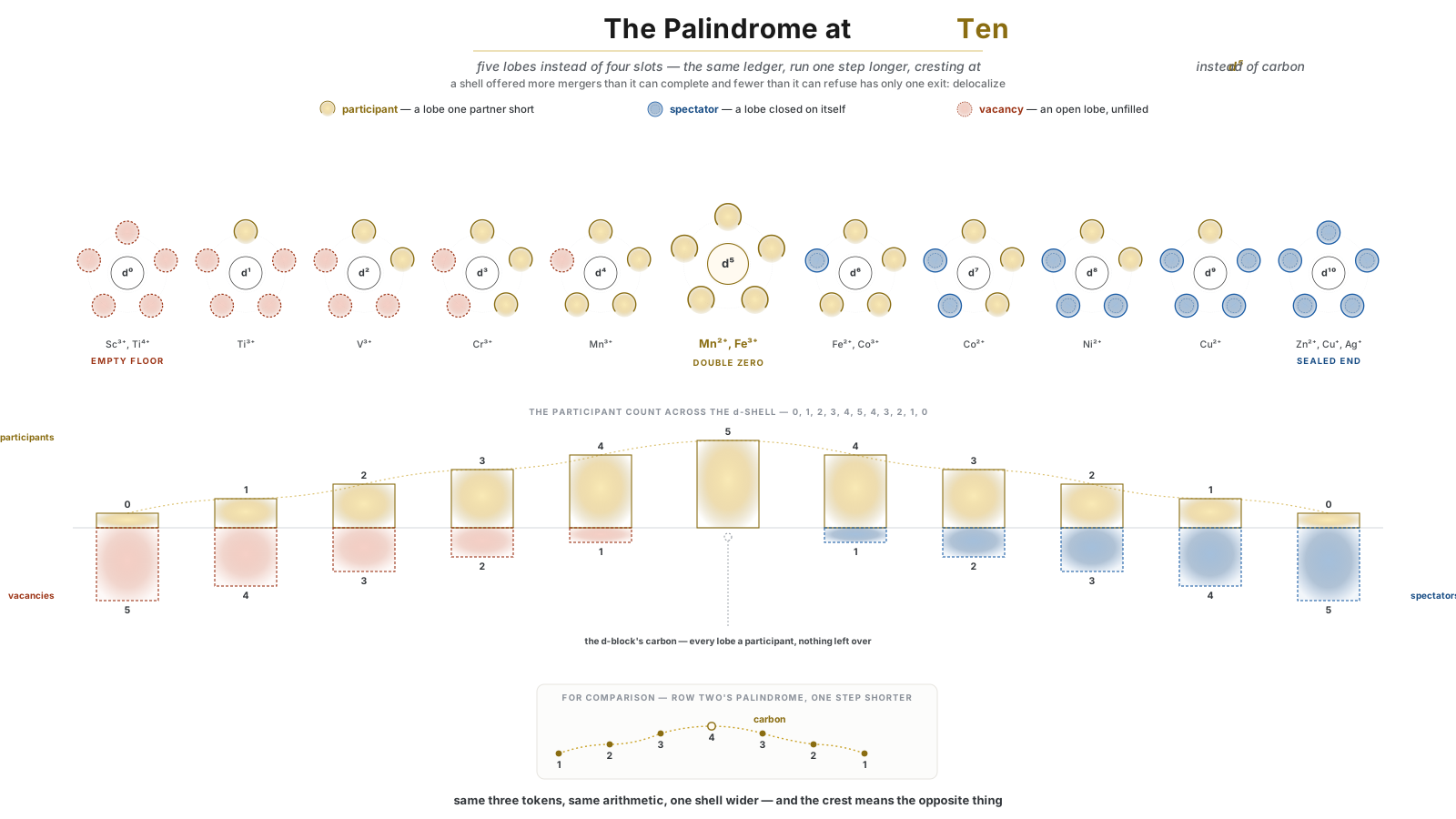
Run the ledger’s three tokens across the five lobes and the second row’s shape reappears, one step longer.
| d^n | Participants | Spectators | Vacancies | Where it lives | |
|---|---|---|---|---|---|
| d^0 | 0 | 0 | 5 | Sc³⁺, Ti⁴⁺ | |
| d^1 | 1 | 0 | 4 | Ti³⁺ | |
| d^2 | 2 | 0 | 3 | V³⁺ | |
| d^3 | 3 | 0 | 2 | Cr³⁺ | |
| d^4 | 4 | 0 | 1 | Mn³⁺ | |
| crest | d^5 | 5 | 0 | 0 | Mn²⁺, Fe³⁺ |
| d^6 | 4 | 1 | 0 | Fe²⁺, Co³⁺ | |
| d^7 | 3 | 2 | 0 | Co²⁺ | |
| d^8 | 2 | 3 | 0 | Ni²⁺ | |
| d^9 | 1 | 4 | 0 | Cu²⁺ | |
| d^{10} | 0 | 5 | 0 | Zn²⁺, Cu⁺, Ag⁺ |
The participant column reads 0,1,2,3,4,5,4,3,2,1,0 — the same palindrome as row two’s 1,2,3,4,3,2,1, cresting one step higher because the shell is one pair wider. And it has the same double zero: d^5 is the d-block’s carbon, the single configuration with no spectators and no vacancies, every lobe a participant and nothing left over. It is occupied by Mn²⁺ and Fe³⁺.
The two crests behave in opposite ways, and the difference is the whole reason the d-block exists as a separate kind of chemistry. Carbon’s crest is maximum building capacity: four exposed participants, each of which will find a partner, which is why carbon builds everything. The d^5 crest is maximum stability without building: five buried participants, none of which can find a partner, which is why Mn²⁺ and Fe³⁺ are the least reactive and most persistent states of their elements rather than the most productive. Same arithmetic, opposite expression, and the variable is exposure. A participant that can be reached is a bond waiting to happen. A participant that cannot be reached is a setting.
The crest shows up where a crest should. Mn²⁺ is famously pale — its salts are the faintest pink, with molar absorptivities two to three orders of magnitude below an ordinary transition-metal ion’s, because from a shell where every lobe already holds one electron there is no electronic transition available that does not also cost a spin flip. Manganese(II) is nearly colourless for structurally the same reason carbon has nothing to say: every slot is a participant, and there is no cheap move. Fe³⁺ is the same configuration and the same story — the rusted, finished, thermodynamically terminal state of the most-used metal on the planet.
The chemistry is Hund’s rule and half-filled-shell stability, and both are a century old; nothing here overturns them or improves on them numerically. What the framework contributes is that the second row and the d-block are one ledger at two shell widths, so the same three consequences follow at both: the crest is anomalously stable, the sealed end is inert, and the working elements are the ones just off the crest. The load-bearing observation is the sign flip between the two crests — row two’s crest builds and the d-block’s crest refuses — and that the framework has a one-word account of why (exposure), which is the same word it used to explain why silicon has no benzene and why arsenate cannot hold a bridge.
The fold is the register
Why can a d-lobe hold a setting when a p-lobe cannot?
The framework already answered this in a paragraph it has not yet cashed. The hydrogen flywheel reads the angular quantum number as a count of boundary folds: l is the number of nodal surfaces where the co-rotating flow reverses, and orbital shapes are the lowest-energy way to fold a counter-rotating boundary l times. An s-shell has no folds and is a sphere. A p-shell has one fold and is a dumbbell. A d-shell has two folds — and where two folds cross, the chapter notes, they leave a one-dimensional defect running along the angular-momentum axis that is topologically protected: you cannot smooth it away.
That is the difference, and it is a difference in kind rather than degree. A boundary with no protected defect can relax continuously — it can ring down, leak, and return to its ground configuration through a smooth path. A boundary carrying a protected junction line cannot. Its configuration can only change by a discrete event that adds or removes a whole lobe’s occupancy. A shell that cannot relax continuously is a shell that holds its setting until something comes and changes it, which is the definition of a register.
Everything the d-block is known for follows from putting that register behind an unchanged interface.
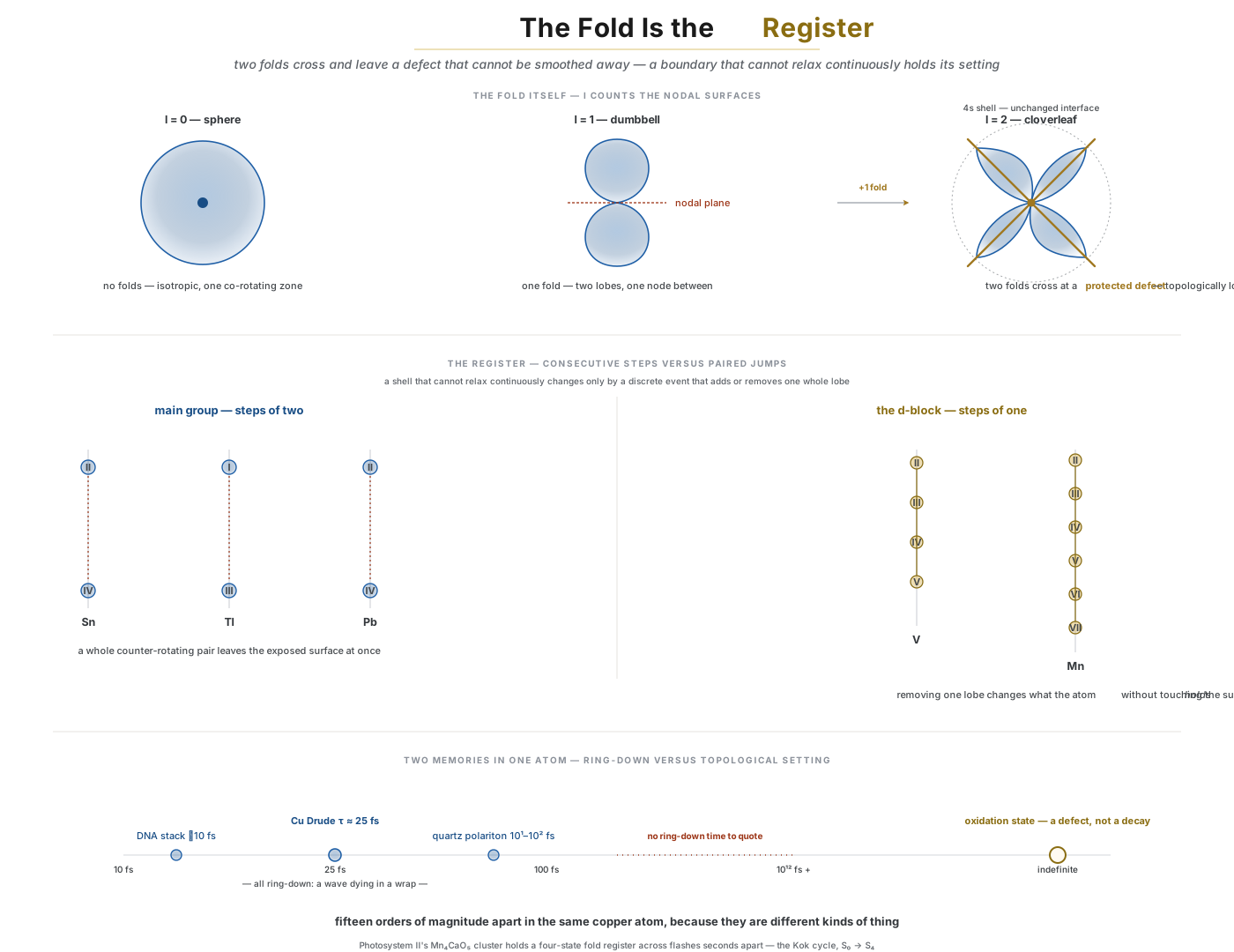
Variable oxidation state is the register being read and written. The 3d lobes sit inside the 4s shell, so removing one changes what the atom holds without changing the surface the world touches. Compare the main group, where an element with two accessible states has them two apart — Sn(II)/Sn(IV), Tl(I)/Tl(III), Pb(II)/Pb(IV) — because what is being removed is a whole counter-rotating pair from the exposed surface. The d-block walks consecutively: vanadium runs II, III, IV, V, all four stable in water and each a different colour in the same beaker; manganese runs II through VII. Consecutive single steps are only possible if the thing being stepped is a set of individually removable lobes that are not part of the interface.
And the register does not ring down. This is where the fold reading earns something the paper needs. Channel with memory builds a ladder of boundary memories — copper’s Drude \tau \approx 25 fs, quartz’s polariton at 10^1–10^2 fs, DNA’s aromatic stack at \gtrsim 10 fs — all of them ring-down times, all of them the decay of an excited boundary back toward smooth. An oxidation state is not on that ladder at all, and the fold argument says why: it is not a decaying oscillation but a topological setting, so it has no ring-down time to quote. The same copper atom whose conduction boundary forgets in 25 femtoseconds holds its oxidation state indefinitely. Fifteen orders of magnitude separate the two memories in one atom, and the framework’s reading is that they are different kinds of thing — one a wave dying in a wrap, the other a defect that cannot be smoothed. The register changes only when a partner arrives to take a lobe.
Biology exploits exactly that. The oxygen-evolving complex of Photosystem II is a Mn₄CaO₅ cluster that must absorb four separate photons and hold the accumulated oxidation state between them before it releases O₂ — the Kok cycle’s S₀ through S₄, established with flashes spaced seconds apart precisely because the register holds that long. No femtosecond boundary memory can do that. A four-state fold register held in manganese can, and does, in every leaf.
The register’s depth is measurable
If the claim is that a fold register works because it sits behind the interface, then how far behind should be measurable — and it is, in the most direct way available: as the width of a spectral line.
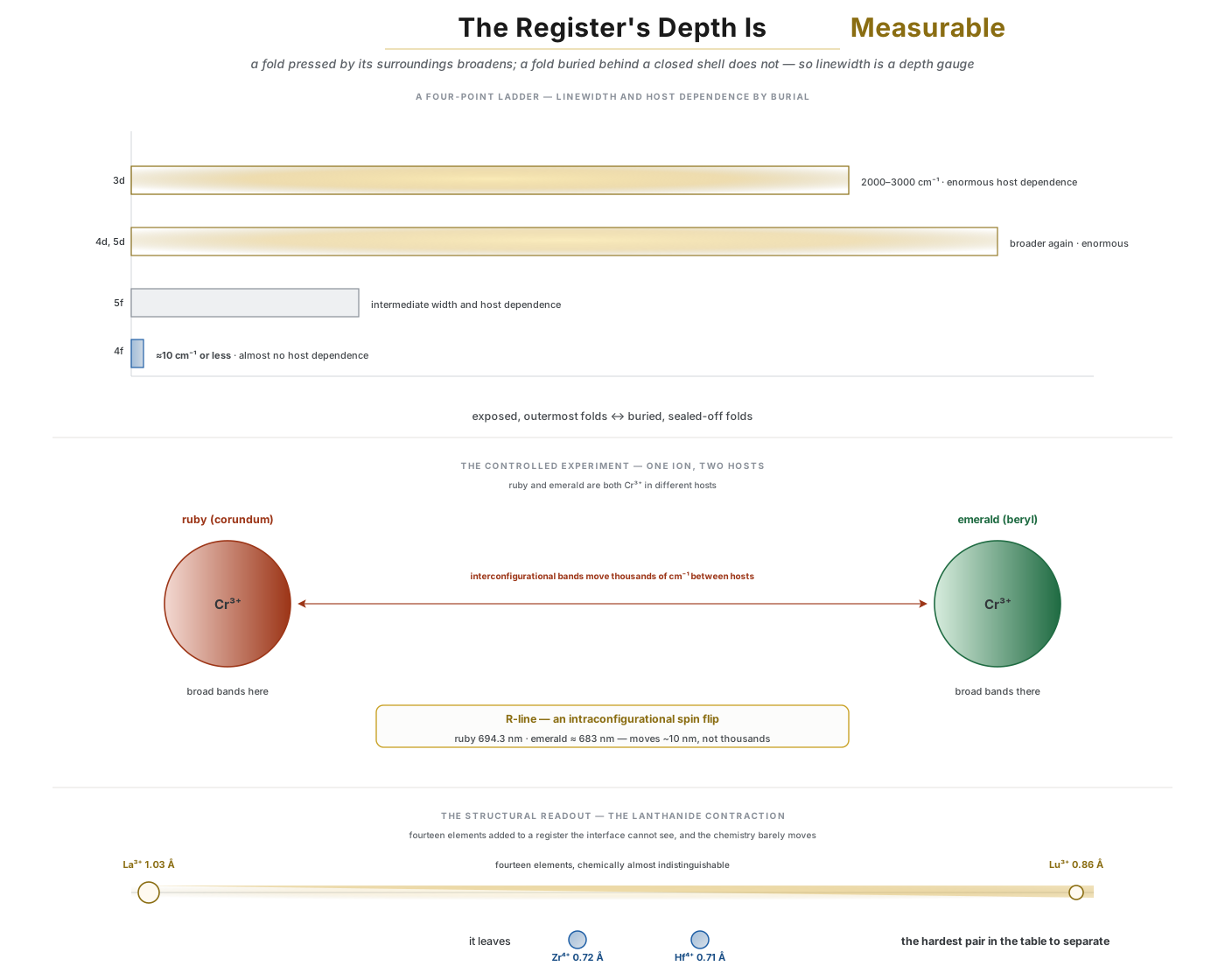
A transition that changes which lobes are occupied moves the folds, so anything pressing on those folds from outside broadens and shifts it. A transition happening deeper inside, where the surroundings cannot reach, does not broaden. So the framework’s commitment is that linewidth is a depth gauge, and the periodic table supplies a clean four-point ladder.
| Shell | Where it sits | Typical width | Host dependence |
|---|---|---|---|
| 3d | outermost folded shell, directly pressed by ligands | \sim 2000–3000 cm⁻¹ | enormous |
| 4d, 5d | more extended still, pressed harder | broader again | enormous |
| 4f | buried under filled 5s and 5p | \sim 10 cm⁻¹ or less | almost none |
| 5f | buried, but less completely than 4f | intermediate | intermediate |
The d-block’s bands are hundreds of nanometres wide and change colour completely with their surroundings — which is why the mineral world is coloured at all, and why transition-metal chemistry is taught through colour. The lanthanides do the opposite: Eu³⁺’s red emission near 612 nm is a hairline, and it is the same red in every host, which is precisely why europium is in every phosphor and neodymium’s 1064 nm line is in every solid-state laser. A buried register makes a bad dye and a superb reference.
The controlled experiment is better than either, because it exists inside a single ion. Ruby and emerald are both Cr³⁺. Ruby is chromium in corundum and emerald is chromium in beryl, the ion is identical, and the colours are red and green — because the broad interconfigurational bands, which move the folds, sit in different surroundings and shift by thousands of wavenumbers. Yet the same crystals emit ruby’s R-line at 694.3 nm and emerald’s at roughly 683 nm — an intraconfigurational transition that only flips a spin without rearranging which lobes are occupied, and which therefore barely moves at all. One ion, two transitions, and the one that touches the folds is host-dependent by hundreds of nanometres while the one that does not is host-independent to about ten. That R-line’s sharpness is why ruby was the first laser.
The actinides close the ladder in the right direction. 5f sits less deeply buried than 4f, and actinide spectra are correspondingly broader and more ligand-sensitive than lanthanide spectra — a fact usually filed as an inconvenience of actinide chemistry and read here as the depth gauge working.
And the same burial has a structural readout. The lanthanide contraction — La³⁺ at 1.03 Å shrinking to Lu³⁺ at 0.86 Å across fourteen elements that are chemically almost indistinguishable — is what a register buried so deep the interface cannot see it looks like from outside: you can add fourteen electrons to it and barely change the chemistry. It leaves Zr⁴⁺ and Hf⁴⁺ at 0.72 and 0.71 Å, the hardest pair in the periodic table to separate, for the same reason.
Pressing on the folds
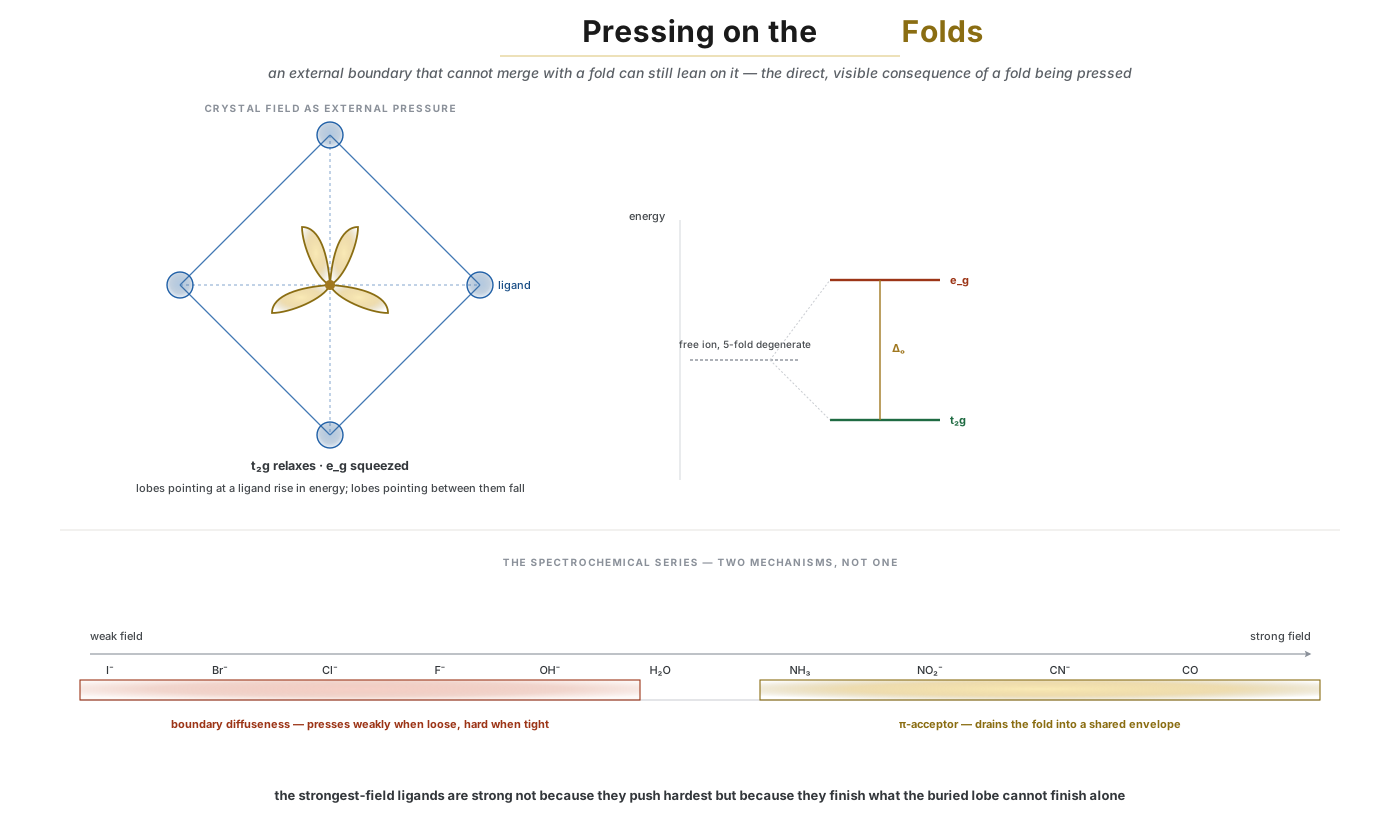
The d-shell’s exposure is what makes it useful, and the mechanism is the one the hydrogen flywheel already sketched: when a metal sits inside a cage of ligands, those external counter-rotating surfaces press on the cloverleaf’s lobes. Lobes pointing at a ligand are squeezed and rise in energy; lobes pointing between them relax. That is crystal-field splitting, t_{2g} against e_g, and it is the direct visible consequence of a fold being pressed by a boundary that cannot merge with it.
Which raises the question of why some ligands press harder, and here the ledger says something the electrostatic reading cannot. The spectrochemical series runs
\text{I}^- < \text{Br}^- < \text{Cl}^- < \text{F}^- < \text{OH}^- < \text{H}_2\text{O} < \text{NH}_3 < \text{NO}_2^- < \text{CN}^- \approx \text{CO}
and it has always been awkward that its two ends are governed by different physics. The bottom end is pure boundary diffuseness — iodide to fluoride is exactly the gradient the carbon chapter walked for oxygen, sulfur and selenium, a loose boundary pressing weakly and a tight one pressing hard. The top end is not about pressing at all: CN⁻ and CO are the ligands that can take the metal’s flow into their own \pi sheet. That is the neighbors chapter’s routing bit read from the other side — where nitrogen chose whether to donate its spectator into a sheet, a \pi-acceptor ligand chooses to receive a metal’s participant into one.
So the series is two mechanisms, and the ledger names them as the same two moves it has been using all along: at the bottom, a boundary that only excludes, pressing with a force set by its diffuseness; at the top, a boundary that completes a merger, draining the fold into a shared envelope. The strongest-field ligands are strong not because they push hardest but because they are the only ones that partly finish what the buried lobe cannot finish alone.
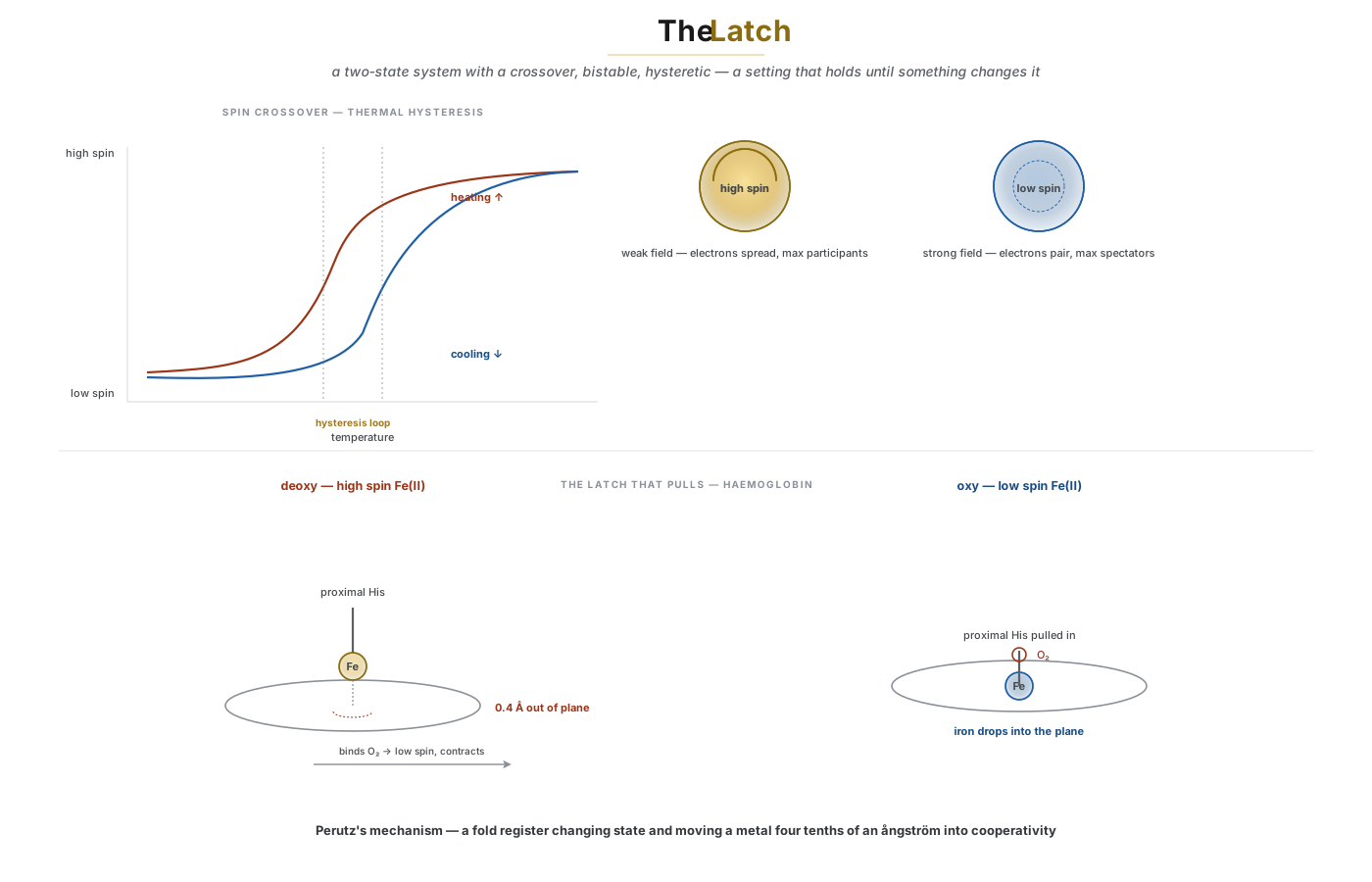
The latch
Press the folds hard enough and the shell has a choice, because two costs are now in competition: the cost of putting an electron into a raised lobe, and the cost of pairing two electrons into a lowered one. Weak field, and the electrons spread out — high spin, maximum participants. Strong field, and they pair up — low spin, maximum spectators.
That is a two-state system with a crossover, and it is bistable in exactly the way the framework’s other latches are. Spin-crossover compounds — the iron(II) family built on phenanthroline and thiocyanate is the canonical one — sit near the crossing and flip between the states with thermal hysteresis, meaning the transition temperature going up differs from the one coming down. A hysteretic two-state boundary that holds its setting is the definition epigenetics uses for a latch, arrived at here in a single atom rather than a chromatin domain.
And biology put that latch to mechanical work in the most important place it had. Deoxyhaemoglobin’s iron is high-spin Fe(II), too large for the porphyrin hole, and it sits about 0.4 Å out of the ring plane. Bind oxygen and the iron goes low-spin, contracts, and drops into the plane — dragging the proximal histidine and the helix behind it, which is Perutz’s mechanism and the origin of cooperativity. The sigmoid oxygen-binding curve that makes haemoglobin a transporter rather than a sponge, the Bohr effect, the whole quantitative behaviour of the blood, is downstream of a fold register changing state and moving a metal by four tenths of an ångström.
The latch does not just hold a setting. It holds a setting and pulls.
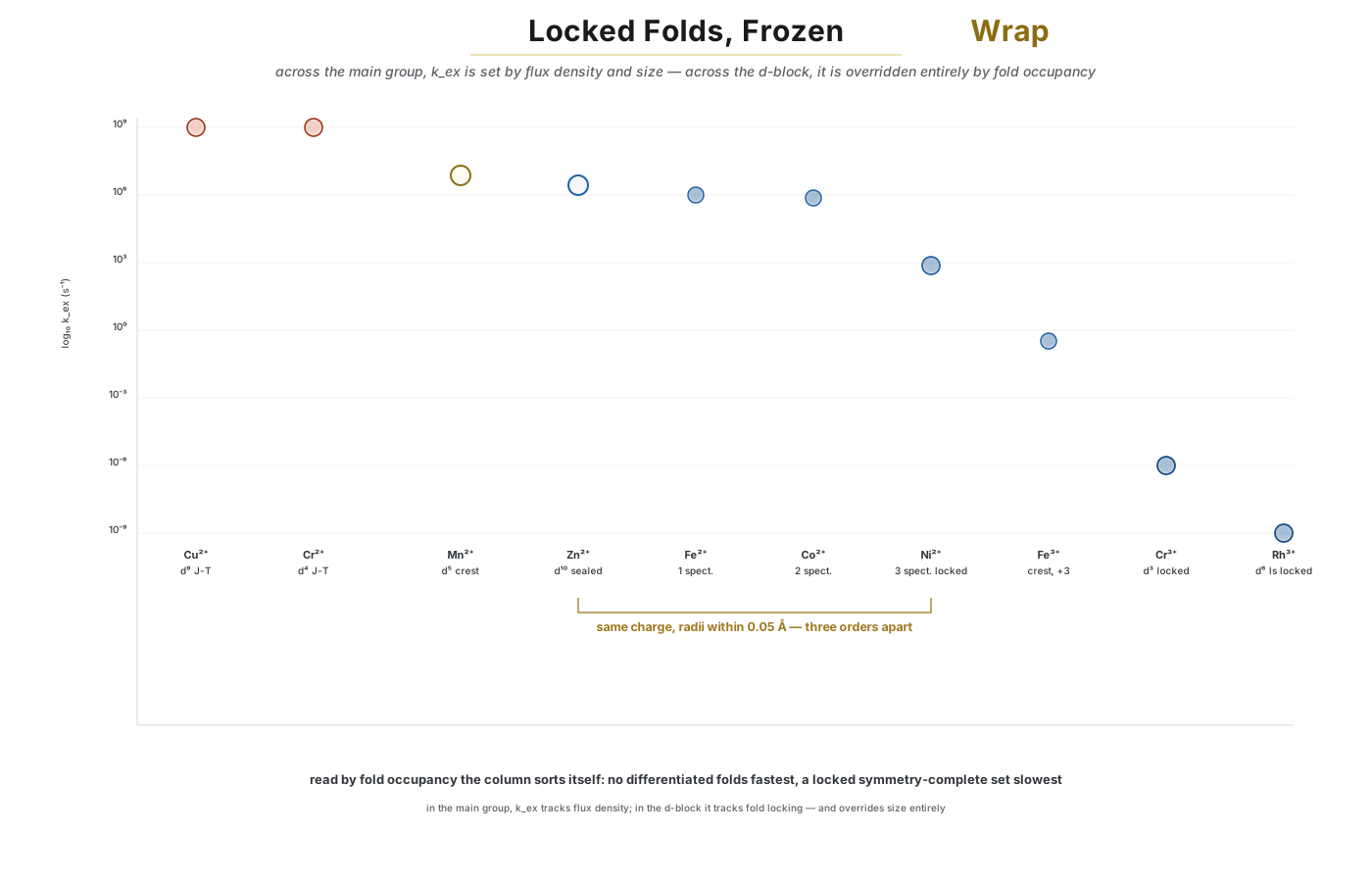
Locked folds, frozen wrap
The lithium chapter made the water-exchange rate k_\text{ex} — how many times a second an ion’s recruited wrap turns over — into a load-bearing quantity, and read it off the surface flux density e/4\pi r^2: a hungrier boundary grips its wrap harder and lets go more slowly. Across the main group that works, and the chapter used it to sort the entire post-lithium battery field.
Across the d-block it fails completely, and the way it fails is the point.
| Ion | d^n | r (Å) | k_\text{ex} (s⁻¹) | Folds |
|---|---|---|---|---|
| Cu²⁺ | d^9 | 0.73 | \sim 10^{9} | one lobe short, Jahn–Teller unstable |
| Cr²⁺ | d^4 | 0.80 | \sim 10^{9} | one lobe over, Jahn–Teller unstable |
| Mn²⁺ | d^5 | 0.83 | 2\times10^{7} | crest — every lobe singly filled |
| Zn²⁺ | d^{10} | 0.74 | \sim 10^{7} | sealed — no folds available |
| Fe²⁺ | d^6 | 0.78 | 4\times10^{6} | one spectator |
| Co²⁺ | d^7 | 0.75 | 3\times10^{6} | two spectators |
| Ni²⁺ | d^8 | 0.69 | 3\times10^{4} | three spectators, locked set |
| Fe³⁺ | d^5 | 0.65 | 1.6\times10^{2} | crest, higher charge |
| Cr³⁺ | d^3 | 0.62 | \sim 10^{-6} | half-filled lower set — locked |
| Rh³⁺ | d^6 ls | 0.67 | \sim 10^{-9} | filled lower set — locked |
Nickel and zinc are the controlled comparison. Same charge, radii within 0.05 Å, same row, adjacent in the table — and three orders of magnitude apart in how fast their wrap turns over. No flux-density argument can produce that, because there is no flux difference to produce it with. The only thing that differs is what the buried folds are doing.
Read the column by fold occupancy and it sorts itself. The two fastest ions in the table are the two whose fold sets are one lobe away from an even distribution and are therefore already unstable — the Jahn–Teller cases, d^4 and d^9, a boundary that is distorting anyway and lets go of anything. The two next-fastest are the two with no fold structure to lock: the crest, where every lobe is identically occupied, and the sealed end, where every lobe is closed. Both behave like main-group ions of their size, which is exactly what the ledger requires — a shell with no differentiated folds cannot use folds to grip. Then everything with a partially locked set falls, by more than fifteen orders of magnitude, bottoming at the configurations that fill a symmetry-complete subset exactly: d^3 and low-spin d^6.
So k_\text{ex} has two independent determinants, and each row of the table uses one. In the main group it is flux density, set by charge and size. In the d-block it is fold locking, set by occupancy, and it overrides size entirely. That is a genuine extension of the lithium chapter rather than a restatement of it, and it comes with a sharp test: zero-CFSE ions — d^0, high-spin d^5, d^{10} — should fall on the main-group flux curve, and everything else should fall below it by an amount that tracks fold occupancy and not radius.
It also explains a drug. Cisplatin is square-planar Pt(II), low-spin d^8, and its therapeutic window exists because its ligand substitution is slow enough that the intact complex survives the bloodstream and fast enough that it aquates once inside a cell. A locked fold set is what buys that hour.
The volcano is the same V
Now the d-block’s largest industrial fact, which the paper has so far said nothing about: essentially every heterogeneous catalyst in the world is a d-block metal. Iron for ammonia, platinum and rhodium and palladium in every catalytic converter, nickel for hydrogenation, cobalt for Fischer–Tropsch, ruthenium, iridium, silver for ethylene oxide. Not a main-group element in sight.
The ledger’s account is one sentence. A catalyst must hold a boundary halfway — accept a merger deep enough to break the reactant’s own bond, and shallow enough to give the product back. Carbon cannot do this: its mergers are exact and permanent, which is exactly why C–C runs 346 kJ/mol and is kinetically inert at body temperature. An ionic solid cannot do it either: nothing merges at all. Only a shell whose lobes are buried, partially occupied, and topologically prevented from relaxing smoothly can enter a merger and then be talked back out of it. Chemisorption is a merger held at a fold, and the fold is why it can be undone.
And then the shape of the resulting rate is one the paper has met before. Two ledgers run monotonically across the d series in opposite usefulness: adsorption strength rises leftward across the row (more open lobes, deeper binding), and the ability to release the product rises rightward (more spectators, shallower binding). A rate that needs both must be non-monotonic, with a maximum in the interior — which is Sabatier’s principle from 1911, drawn as Balandin’s volcano, and given a computable descriptor by Nørskov’s d-band-centre work. The maximum for ammonia synthesis sits at iron and ruthenium; for hydrogen evolution at platinum; for most of the rest somewhere in groups 8 through 10. The world’s catalysts are clustered in three columns of the periodic table because those columns are the interior of a V.
This is structurally identical to the lithium chapter’s central argument. There, tear cost and wrap payment both fell monotonically down the alkali column, their difference had to have an interior extremum, and it landed on sodium in two unrelated measurements. Here, binding strength and release ability both run monotonically across the d row, their product has to have an interior extremum, and it lands on group 8–10 in every catalytic reaction anyone has measured. Same argument, different shell, and in both cases a non-monotonic retrodiction that no size-ordered story recovers by accident.
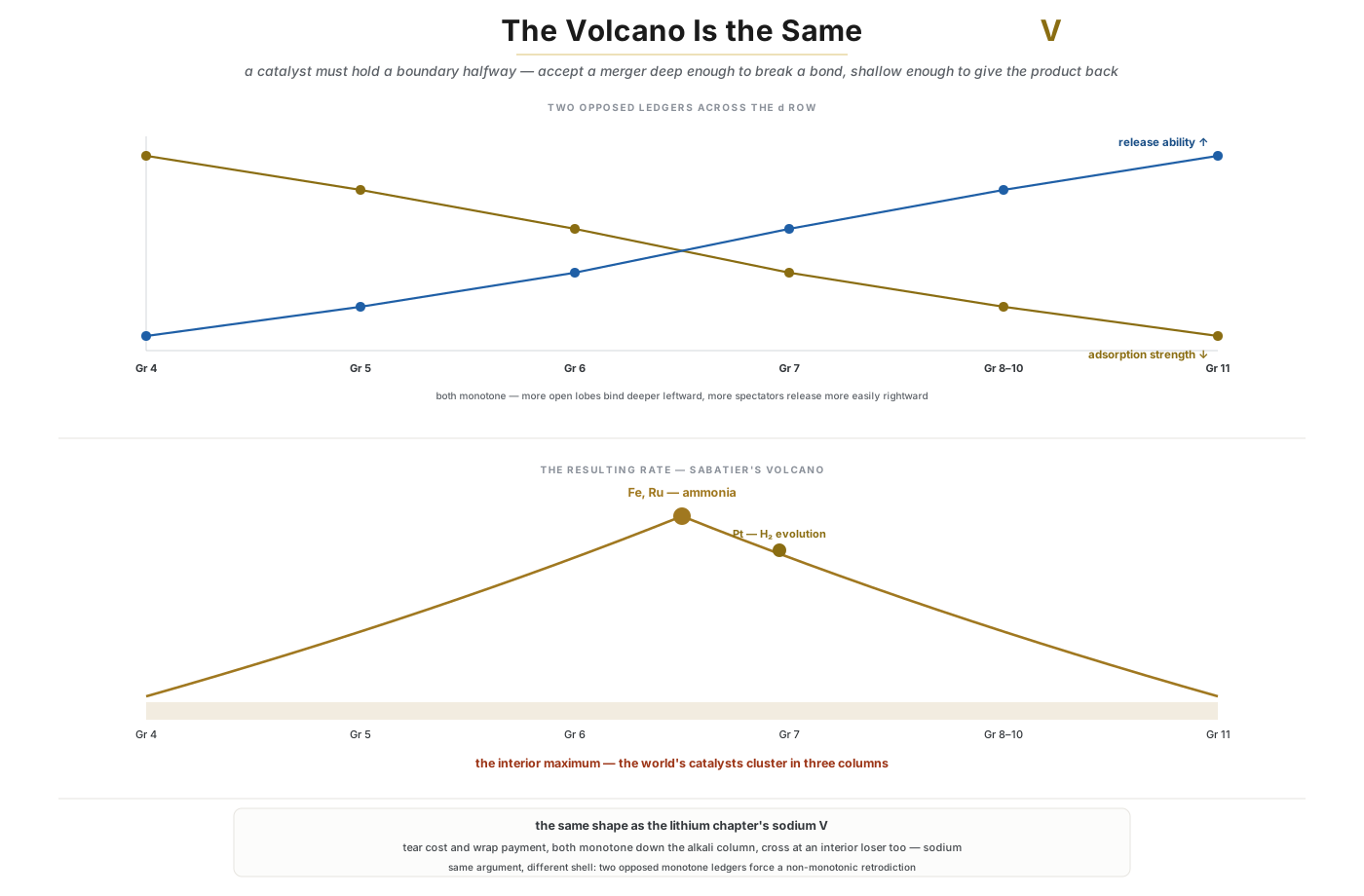
Sabatier’s principle, the volcano plot, ligand-field theory and the d-band-centre model are all standard, quantitative and predictive, and the framework improves on none of them numerically. It cannot currently compute a single binding energy. The claim is about shape and unification: that the volcano is the same two-monotone-ledger structure the lithium chapter used, that its interior maximum is forced rather than empirical, and that the reason it is a d-block phenomenon at all is the fold — the only boundary structure in the table that can be entered partway and left again. The falsifier is real and stated in the predictions: a catalytic rate whose two ledgers genuinely oppose and which nevertheless comes out monotone across the row.
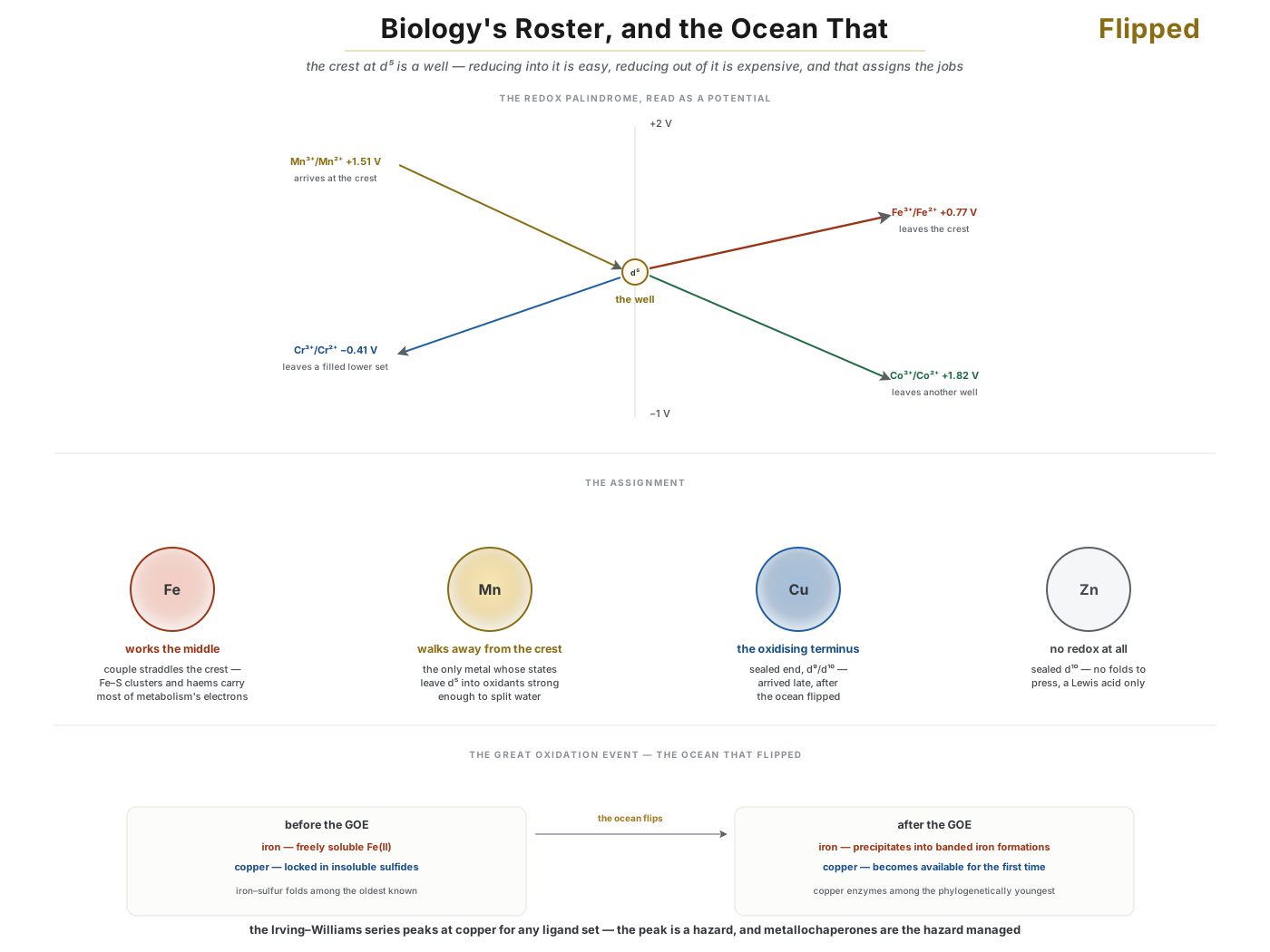
Biology’s roster, and the ocean that flipped
Put the palindrome on a voltage axis and biology’s choice of metals stops looking like a list.
The crest at d^5 is a well. Reducing into it is easy and reducing out of it is expensive, and the first-row aqueous couples say so plainly: Mn³⁺/Mn²⁺ sits at +1.51 V because that reduction arrives at the crest, while Fe³⁺/Fe²⁺ sits at +0.77 V because it leaves it. Cr³⁺/Cr²⁺ is -0.41 V, leaving a filled lower set. Co³⁺/Co²⁺ is +1.82 V, leaving another. The first row’s redox ladder is the palindrome read as a potential, with wells at the configurations that complete a symmetry set.
Which assigns the jobs.
Iron works the middle because its couple straddles the crest. Fe(II)/Fe(III) is d^6 against d^5 — one state in the well and one immediately beside it — so the couple sits near the centre of the biological range and is tunable across more than a volt by ligand choice alone. Iron–sulfur clusters run the reducing end, haems run the middle, and between them they carry nearly every electron in metabolism. It is the cheapest two-state register in the periodic table, and it is the one biology built its energy economy on.
Manganese does the one job that requires leaving the crest. Oxidising water is the hardest oxidation in biology, and manganese is the only first-row metal whose accessible states walk away from d^5 into genuinely powerful oxidants. So it is in exactly one place — the oxygen-evolving complex — doing exactly the job its position on the ladder makes it expensive enough for, and holding the four-state register described earlier while it does.
Copper works the oxidising terminus, and it arrived late. Its couple sits at the sealed end of the palindrome, d^9 against d^{10}, which puts it high — good for the last step before oxygen. And the geological record matches the ledger: before the Great Oxidation Event, copper was locked in insoluble sulfides and iron was freely soluble as Fe(II); afterwards the ocean flipped, iron precipitated into the banded iron formations, and copper became available for the first time. Phylogenomic surveys of protein structure find precisely that ordering — iron–sulfur chemistry among the oldest folds, copper enzymes among the youngest. Cytochrome c oxidase, sitting at the oxygen end of the respiratory chain with its copper centres, is the newest metal in the chain occupying the newest position on the voltage ladder.
Zinc does no redox at all, because a sealed shell has no folds to work with. d^{10} is the d-block’s neon: nothing to press, nothing to split, no colour, no magnetism, no accessible second state. What is left is a bare, fast-exchanging, strongly polarising cation — a Lewis acid with no capacity to generate a radical. That combination is why zinc is in roughly a tenth of the human proteome, why carbonic anhydrase can turn over a million times a second on it, why zinc fingers are structural, and why the cytosol can maintain free zinc at femtomolar concentrations without the metal doing any damage while it waits. Iron is dangerous in the cytosol precisely because it has folds; zinc is safe precisely because it has none.
And one more interior extremum, which biology has to fight rather than exploit. The Irving–Williams series — the stability of divalent first-row complexes rising Mn < Fe < Co < Ni < Cu and then falling to Zn — peaks at copper, universally, for essentially any ligand set. That means a cell containing free copper would find copper displacing every other metal from every other site. The response is exactly what the constraint demands: copper is never free, it is handed atom-to-atom by dedicated metallochaperones, and its cytosolic free concentration is buffered below one ion per cell. The palindrome’s peak in binding strength is a hazard, and the machinery built around copper is the hazard being managed.
Why iron
Which leaves the question the carbon chapter posed and did not answer. It observed that the framework has a real derivation for where the elements stop — the iron peak from the surface-versus-Coulomb balance, A_\text{peak} \approx 2a_S/a_C \approx 59–63 (the iron peak) — and only a structural account for where they build. It said: iron is where the substrate says stop; carbon is where it says build. This chapter can now add the second half of what iron is.
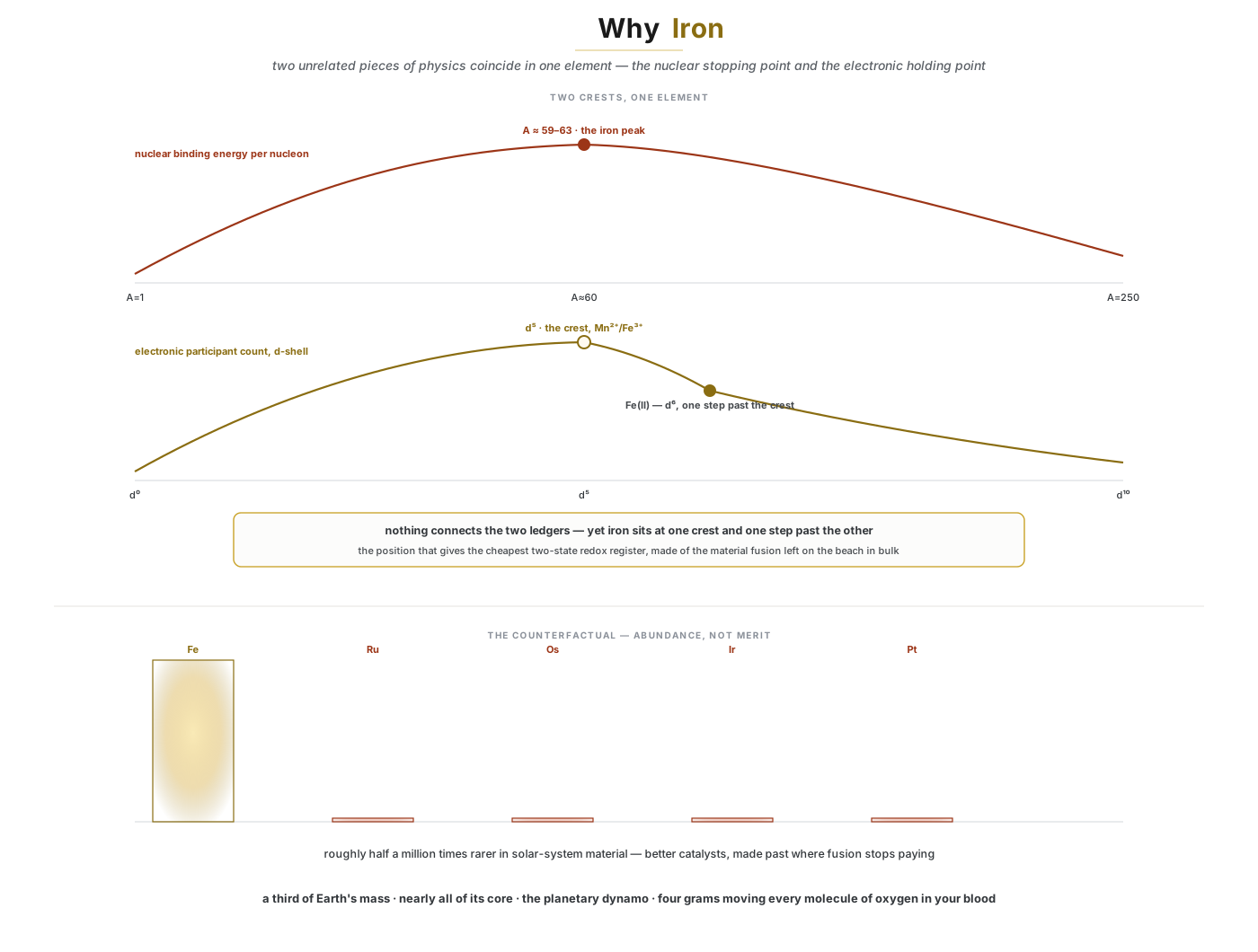
Iron is the one element where the nuclear ledger’s stopping point and the electronic ledger’s holding point coincide.
Those are two unrelated pieces of physics. The nuclear crest comes from a droplet’s surface tension losing to its Coulomb repulsion at A \approx 60, and the framework derives it with zero free parameters from close-packing geometry. The electronic crest comes from five lobes filling singly before they pair, and sits at d^5. Nothing connects them. Yet element 26 sits one step past the electronic crest — which is the position that gives the cheapest possible two-state register, a couple straddling the well — while sitting at the nuclear crest, which is the position that makes it, by an enormous margin, the most abundant transition metal in the universe.
The counterfactual is the argument. Ruthenium is a better catalyst than iron for ammonia synthesis and sits at the same place in the palindrome one row down. Osmium and iridium and platinum are better at nearly everything. All of them are roughly half a million times rarer than iron in solar-system material, because they sit past the crest where fusion stops paying and can only be made in the slow and violent captures that follow. Life did not select iron over ruthenium on the merits. Iron is what the nuclear ledger left on the beach in bulk, and it happens to sit one step off the electronic crest.
That coincidence propagates all the way up. Iron is about a third of the Earth by mass and nearly all of its core; the core’s convection is the planet’s dynamo, which is the magnetism chapter’s exchange interaction made planetary and the shield the biosphere sits under; iron oxide is the crust’s colour and the banded iron formations are the fossil of the ocean flipping; four grams of it move every molecule of oxygen in your blood. The most abundant thing the stars could make that still has a fold is iron, and the substrate’s answer to what to do with a fold is: keep state in it.
Predictions
Linewidth is a depth gauge. Transition width and host-sensitivity should scale monotonically with how exposed the folded shell is: 5d and 4d broader than 3d, 3d far broader than 5f, 5f broader than 4f. Within a single ion, transitions that rearrange lobe occupancy should be broad and strongly host-dependent while intraconfigurational transitions in the same ion should be sharp and nearly host-independent. Retrodicted by ruby versus emerald — the broad bands moving thousands of wavenumbers between hosts while the R-line moves about ten — and by the host-independence of Eu³⁺ and Nd³⁺ emission. Falsified by a sharp, host-independent interconfigurational d–d band, or by a broad, strongly host-dependent f–f line in a well-ordered crystal.
Zero-CFSE ions fall on the main-group curve. Extending lithium prediction 6: plot k_\text{ex} against surface flux e/4\pi r^2 for aqua ions. Main-group ions and the d-block’s zero-CFSE configurations (d^0, high-spin d^5, d^{10}) should lie on one curve; every other d^n should lie below it by an amount tracking fold occupancy rather than radius, with the deepest departures at d^3 and low-spin d^6 and the shallowest at the Jahn–Teller configurations d^4 and d^9. Retrodicted by the Ni²⁺/Zn²⁺ pair — matched in charge and size to 0.05 Å, separated by 10^3 in exchange rate. Falsified by a partially-locked fold set exchanging as fast as its zero-CFSE size-match, or by the departures ordering with radius instead of occupancy.
The volcano’s interior maximum is forced. Any catalytic rate built on a genuinely opposed adsorb-then-release trade must be non-monotonic across the d series with its maximum in the interior, and the maximum must move with the binding descriptor rather than with the identity of the metal — so a ligand, alloy, or strain treatment that shifts a metal’s binding energy must shift its position on the volcano correspondingly. Retrodicted across ammonia synthesis, hydrogen evolution, and CO oxidation. Falsified by a two-ledger catalytic rate that comes out monotone across the row, or by a metal whose rate fails to move when its binding energy is tuned.
The redox palindrome. First-row M³⁺/M²⁺ potentials should be high where the reduction arrives at a symmetry-complete fold set and low where it leaves one. Retrodicted: Mn³⁺/Mn²⁺ +1.51 V arriving at d^5; Co³⁺/Co²⁺ +1.82 V leaving low-spin d^6; Fe³⁺/Fe²⁺ +0.77 V leaving d^5; Cr³⁺/Cr²⁺ -0.41 V leaving d^3. Falsified by a first-row couple whose potential departs from this in the opposite sense to its fold arithmetic with no ligand-field explanation.
Biological metal assignment follows position on the palindrome. Metals whose useful couple straddles the crest should carry the middle of the redox range (iron); metals that must walk away from the crest should be reserved for the extreme end (manganese at water oxidation); metals at the sealed end should work the oxidising terminus and should be phylogenetically late (copper, post-oxygenation); and the sealed shell itself should do no redox chemistry at all (zinc). Falsified by a genuine zinc redox enzyme, by a manganese enzyme operating at the reducing end of a chain where iron would serve, or by copper-dependent folds turning out to be as ancient as iron–sulfur ones.
The d-block is exceptionlessly metallic. A partially filled fold set presents more open lobes than any three-dimensional arrangement of discrete partners can pair off, so it must delocalize. All forty d-block elements are metals at ambient conditions. Falsified by a d-block element that is a semiconductor or insulator in its stable ambient phase.
Two memories in one atom. The fold register is a topological setting rather than a decaying oscillation, so it should not appear anywhere on channel-with-memory’s ring-down ladder and should not scale with the quantities that set ring-down times. Concretely, the ratio of oxidation-state lifetime to boundary ring-down time in the same material should exceed 10^{12} wherever the state lives in a fold register — retrodicted by copper’s 25 fs Drude \tau against an indefinitely persistent oxidation state in the same metal — and the register’s decay should be governed by the availability of a transfer partner rather than by lattice damping. This is the weakest prediction here, because “an oxidation state is stable” is not usually treated as a memory claim and the comparison is not a controlled one; it is stated because the framework’s memory ladder should either absorb the fold register or explain why it is a different object, and the framework’s answer is that it is a different object.
Conclusion
Carbon is where the substrate is visible because chemistry abstains. Lithium is visible because chemistry collapses. Iron is visible for a third reason, and it is the one that took the longest to see: chemistry neither abstains nor collapses — it stalls, halfway, and stays there.
The second row’s shells resolve. Every participant finds a partner or does not, and once the question is settled the atom is finished. The d-shell cannot settle. Five lobes point five ways from inside a surface no partner can reach through; the shell is offered more mergers than it can complete and fewer than it can refuse, so it delocalizes what it can and keeps the rest. What it keeps is a boundary with two folds crossing at a defect that cannot be smoothed away — and a defect that cannot be smoothed away is a setting that cannot decay.
Everything the middle of the table does is that setting seen from a different side. Seen from the light, it is a fold pressed by its surroundings, which is why minerals are coloured and why ruby and emerald are the same ion. Seen from the solvent, it is a fold locked or unlocked, which is why nickel and zinc are the same size and three orders of magnitude apart. Seen from a reaction, it is a merger held halfway and then released, which is why every catalyst in the world sits in three columns. Seen from a protein, it is a latch that holds a state and pulls, which is why your blood is cooperative. And seen from a leaf, it is four photons’ worth of oxidation held in manganese across four separate flashes — a memory with no ring-down time, because there is nothing in it that is ringing.
This chapter’s hardest claim is that a shell which cannot pair off has no choice but to dissolve, and the d-block’s exceptionless metallicity is the evidence. The silicon chapter asks the complementary question and finds a second road to the same exit: what happens to a shell that can pair off exactly — four participants, four slots, nothing left over — when you stretch its mergers until they no longer hold. Group 14 walks from insulator to metal in five steps with the arithmetic never changing, and what a semiconductor keeps is the part of the delocalization that never finished.
Iron is also where the ledger’s two crests happen to meet, and that coincidence is the last thing this chapter can offer without walking off the top. The uranium chapter does the walking. Above iron both ledgers turn — the nuclear one because a drop that keeps growing accumulates repulsion faster than surface, so the ratio that sets the crest also sets the cliff; the electronic one because a fold buried behind two closed shells stops being readable at all, and fourteen elements in a row become one element with fourteen masses. The fold that holds a setting here is, a few rows up, a seam that can no longer span its own drop.
The paper has been reading the periodic table for four chapters as an accounting problem: how many boundaries an atom has, how many it can use, and what it does with the ones left over. Row two spends its leftovers on voice. The d-block spends them on state. Carbon shows the substrate’s sheet, and iron shows the substrate’s fold — and of the two, the fold is the one that remembers.