Our Normal Universe
How a hidden superfluid adds yin to science’s yang, replacing strange reality with balance

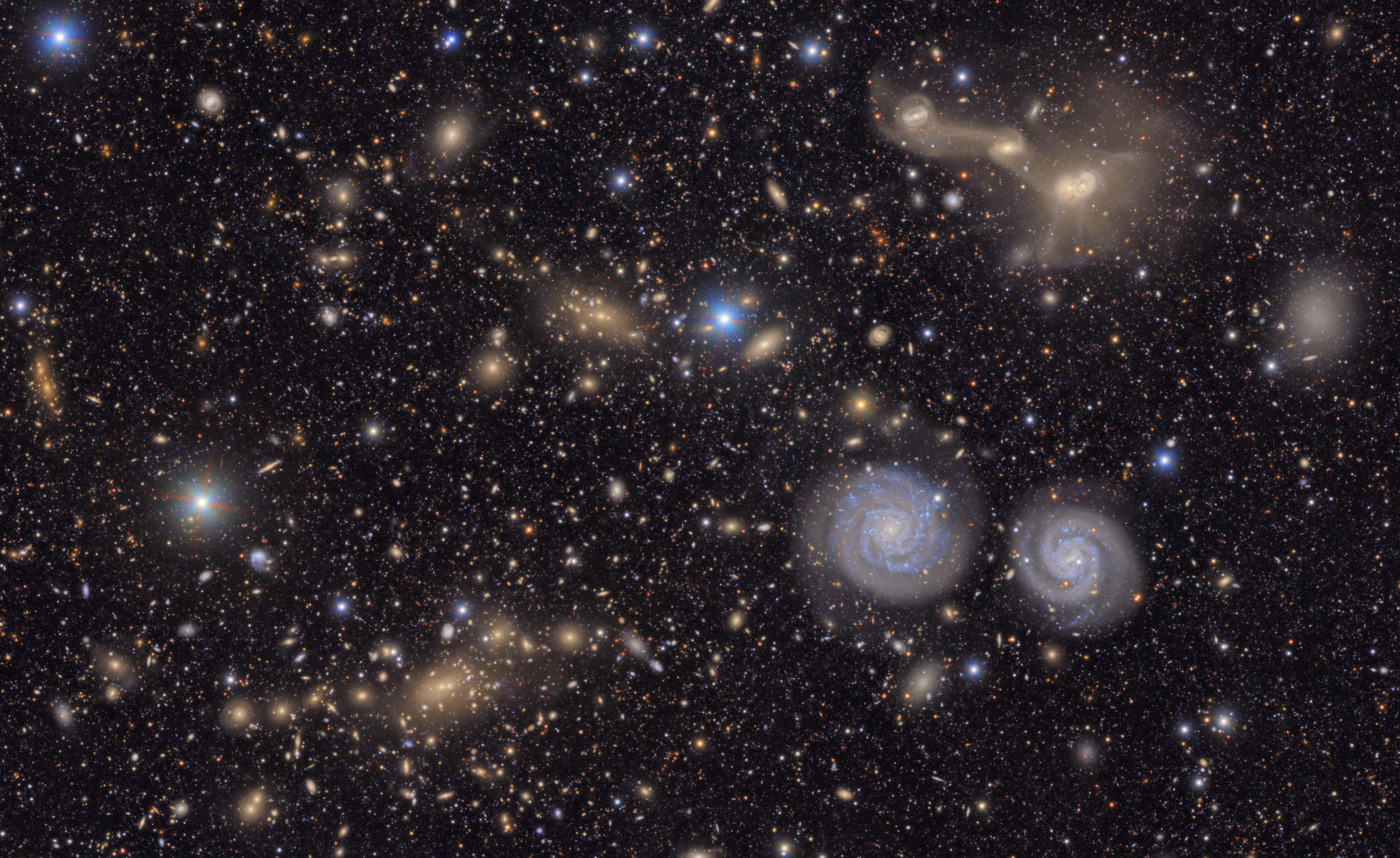
https://rubinobservatory.org/gallery
Letting go of strange physics
This is one of those discoveries that will likely be hard to believe, especially given my use of Claude. That said, here we are. This is my best attempt to tell the story of what I am certain is a big discovery. The paper has the details of the math.
I had an insight and spent a year tracking it down. The results are comforting and simplifying across the board, so I hope I can do them justice.
The quantum mystery dissolves once you picture the particle as a vortex in a supercharged superfluid, spinning at close to the speed of light and moving inside a bubble that generates a wave. At any moment the particle sits in one unpredictable state inside that large bubble, which is hypersensitive to observation. The electron’s vortex orbits the proton’s knot of three vortices, wrapped in orbital shells formed by shear layers in the substrate. Each shell is lined by counter-rotating layers with a strong reaction force — the quantum potential.
When an electron’s orbital drops, a photon is emitted, a modon, a dipole vortex that rolls up from the collapsing counter-rotating layers of the orbital boundary.
These assumptions redundantly determine the superfluid’s lattice cell size, ~97 μm, the same length found from both particle physics and cosmology.
Mass leaks through these boundaries — only a tiny fraction, but each leak carries a lot of energy. Mass fully expressed is that rotational energy, and the familiar E = mc^2 is the bookkeeping: a vortex spinning at the speed of light carries energy equal to its mass times that speed squared.
Gravity feels the ebbing leak — the visible fraction of mass — falling between boundaries and accelerating.
Speed limits in the substrate explain dark matter, gravitational lensing, and how the universe began.
The same equations simplify everything. The night sky shows objects moving away from us — not empty space expanding, growing everywhere at once. Time is time, and space is space, without adjustments. Gravity and speed in the vacuum create pressure in a substrate that both bends light and slows atomic clocks.
Particles come from different vortex topologies — plain vortices, or knots of three — each carrying twists, and the knots carrying braids as well, where the crossings cause turbulence and leak more mass. The proton is a knot of three quark vortices; the muon is an electron with a fold. This vortex picture matches the Standard Model, adding clarity and accurate predictions.
Cellular dynamics builds on the energy of this same superfluid. The shared electrons of a benzene ring form a toroidal vortex with balancing shear layers above and below. And the Gulf Stream’s remarkable coherence sheds light on the subtle but powerful nature of boundary layers, which grow sharper and stiffer when chemistry locks them onto paired vortex binding energy.
By decoding the nature of the vacuum and these boundary-layer dynamics, discoveries ripple through science. First I’ll give the story behind the equations, then show some highlights of these ripples.
The backbone equations
The math comes from a set of equations I call the big onion, the backbone equations using only the speed of light c, the gravitational constant G, light’s packet size \hbar, one measured angle describing how particles interact (the weak mixing angle), and the best observed dark-matter density. There is a single tuned parameter — the effective mass ratio of the vacuum’s own particle, the background energy vortex I nicknamed dc1 (“dark carbon”), which floats nearly massless in the spaces in between.

The backbone reveals the nature of the vacuum’s energy — the hidden potential behind boundary layers — and from there it gets clearer how the universe began, how life formed, how information is captured, how it moves, and what holds it all in place.
All of it rests on two small adjustments to existing research.

Two adjustments
Here they are, up front. The quantum potential is the reaction force of a counter-rotating skin wrapped around a vortex. And the photon is a modon — the self-propelled pair of counter-rotating vortices that oceanographers already know from Gulf Stream rings. Everything below is what those two turn into once you take them literally.
Physics already has the rest of the pieces. The Standard Model’s Higgs field shows that the vacuum is not empty; the vacuum is routinely described as having the properties of a superfluid, and a handful of physicists have worked out math that models key properties of the universe using superfluid helium as the analog. At low temperatures the rare, unbalanced He-3 tunes into the underlying medium, exhibiting the properties of a superfluid-filled vacuum that can hide energy.
My search started from one of the first images released by the Vera C. Rubin Observatory, where I saw the pattern of the boundary layers: the arcs created by the gravitational lensing of the cosmic web that shapes the expanding universe. After a big bang, I reasoned, there must be a substrate that forms a superfluid of vortices, spinning with rotational energy proportional to the speed of light, that underlies it all.
This came from a long life filled with curiosity about every aspect of science, even though I’m not an expert in any one domain. I could see in my mind’s eye how the energy organized itself across the universe — the empty spaces filled with balanced, hidden energy from vortices that managed to self-cancel their rotational energy. I saw that energy threaded through boundary layers at every scale: not just in space, but here on Earth, in the atom, and in cellular dynamics.
The linchpin for the backbone combines papers from five domains: the geophysics of ocean waves, pilot-wave hydrodynamics, superfluids, quantum mechanics, and cosmology. Take those equations, raise the vortex rotation speed to the substrate’s own, and add the mechanism that explains how light moves through the superfluid, and what emerges is the fluid mechanism that ties quantum mechanics and general relativity together.
Ultimately, what I saw in that Rubin image were the boundary layers of a superfluid under stress.
Superfluid shear zones
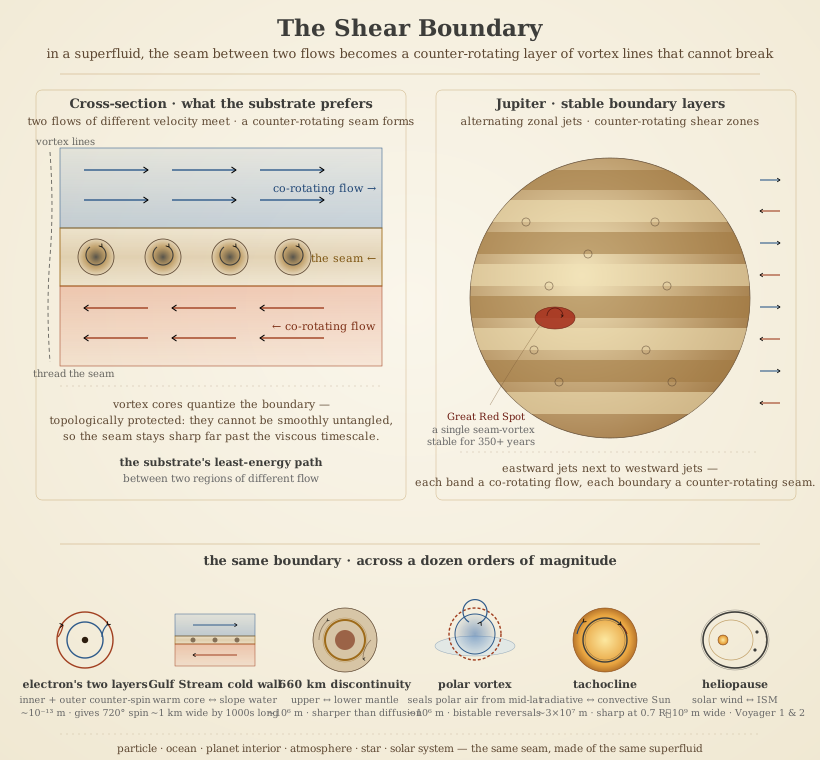
Turbulence creates shear zones in any fluid, but in a superfluid those zones form thin, wrapping, counter-rotating boundary layers that redirect the rotational velocity and head off a calamity — two particle streams moving close to the speed of light hitting head on. Instead of colliding, they nest into vortex eddies. With viscosity low enough, the fluid essentially cancels that turbulent layer, enclosing it so both sides of the boundary persist without the diffusion you would expect.
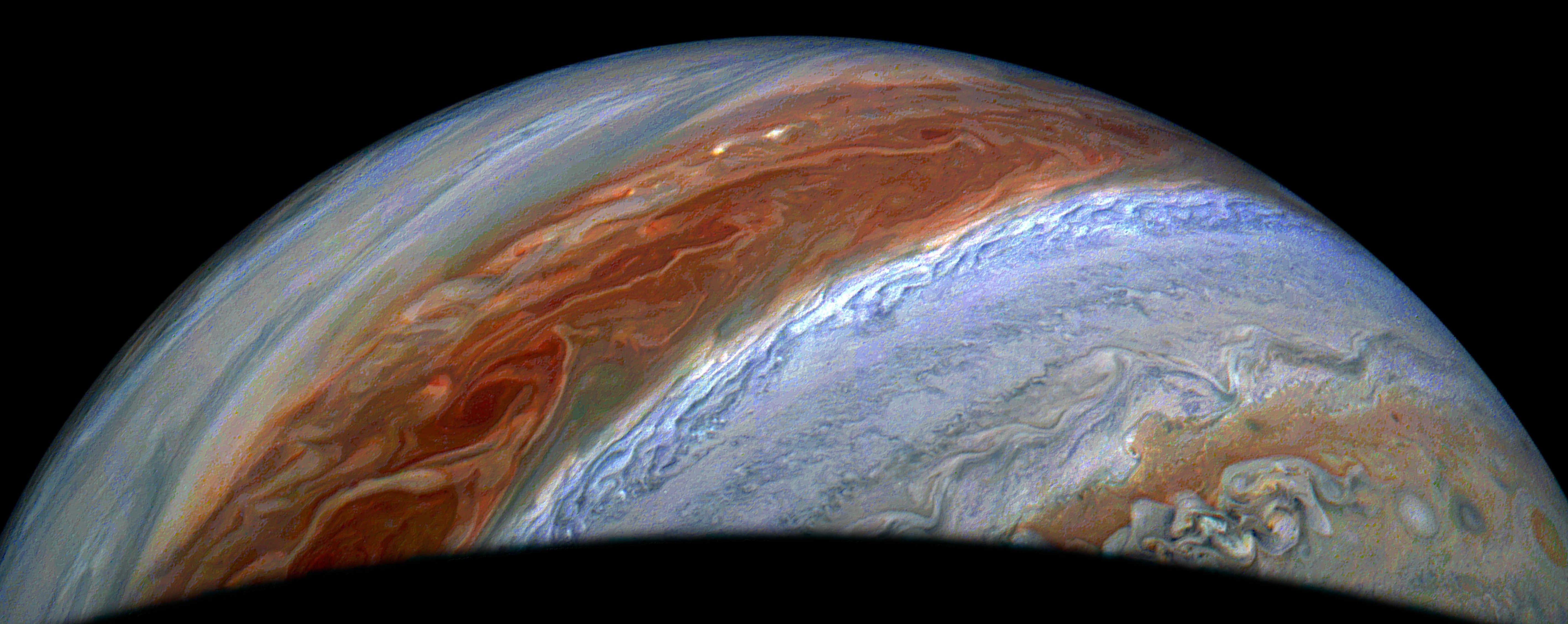
science.nasa.gov - Juno sees Jupiter’s turbulence
Look closely at images of Jupiter and you’ll see it in action, only at a much slower speed. How does the Great Red Spot stay coherent for so long? It’s surrounded by narrow but highly energetic wrapping, counter-rotating layers that keep diffusion and energy loss at bay. Now imagine that fluid flowing much faster, until the vortices tighten into a persistent knot.
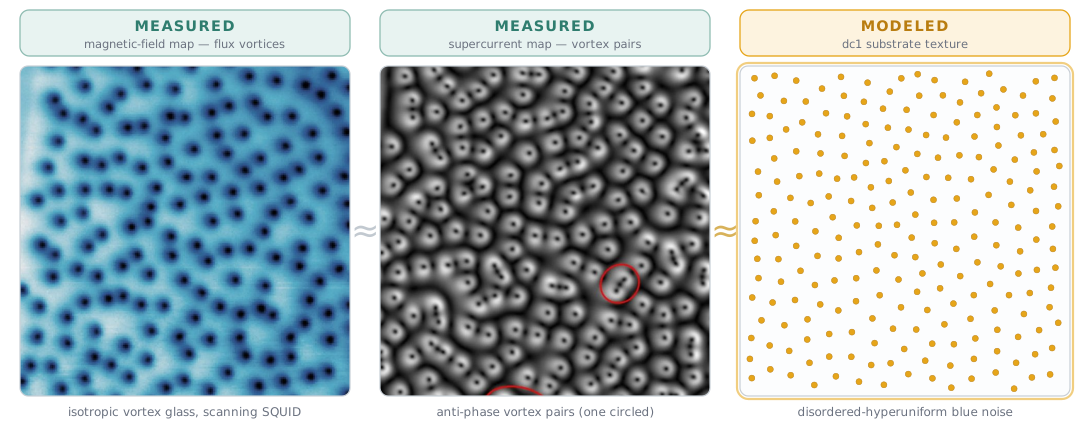
The vortex glass, measured and then modeled — a visual analog to the texture of the dc1 lattice, vortex shear zones near the speed of light. Left & center (measured): the isotropic vortex glass in a YBCO superconductor imaged by scanning SQUID microscopy — individual quanta of magnetic flux breaking through the electron superfluid and locking into a glassy texture; the field map (left) resolves into the supercurrent map (center), where the flux lines are closely-spaced anti-phase pairs and groups, one circled. Right (modeled): the disordered-hyperuniform “blue-noise” texture the dc1 substrate lattice holds from the backbone equations. Measured images by Frederick S. Wells, Alexey V. Pan, X. Renshaw Wang, Sergey A. Fedoseev & Hans Hilgenkamp - https://www.nature.com/articles/srep08677, CC BY 4.0, https://commons.wikimedia.org/w/index.php?curid=57135410
It forms a closely packed space of vortices with a domain-glass texture. And this texture explains how light moves through the vacuum, staying coherent without scattering, through an elastic avoidance dance. A hole opens for the photon to pass through in one piece.
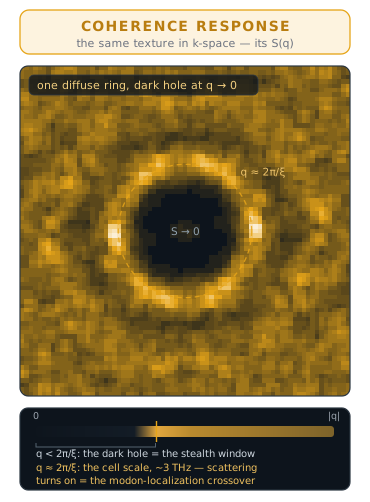
The same texture shows why a modon stays coherent. Below the cell scale (q < 2\pi/\xi) the substrate has nothing to scatter off: S(q)\to0, the stealth window. Light with a wavelength longer than a cell sees no grain at all, so a modon glides through the substrate without losing coherence. Only at the ring (q \approx 2\pi/\xi, the ~97 μm cell, ~3 THz) does scattering switch on and the modon localize to a single cell. The texture’s silence is the modon’s coherence — the same anti-lock that makes the vacuum transparent is what lets the photon ride it.
If you could zoom in on a superfluid, you would see many evenly spaced vortices, each made of a large number of vortex lines — collectively moving chains of particles orbiting a vortex core. A line may stay connected close to the core, or bounce against it, disconnecting and rebounding outward some distance while still orbiting. Vortex lines bounce with a frequency, rebounding off an enclosing envelope — a bubble — that forms at a quantized radius. That envelope builds up from the leaking substrate accumulating inside it. This leads to an interesting property: heavier vortices, with more leaking energy, have a smaller envelope, because the counter-rotating layer forms closer to the core.
With two nearby vortices spinning the same way, a turbulence zone forms between them. They balance that energy by oscillating in opposite phases, held apart at some quantized distance, where the vortex lines in between rotate the opposite way, weaving together to contain the turbulence. The remaining leaking energy from the pair creates the envelope of counter-rotating vortices — a skin that forms at a larger quantized distance, the lattice size.
If the leak between anti-phase pairs is nearly fully encapsulated, this energetic bubble moves freely without energy loss, like the superconducting fluids measured near absolute zero. The overall energy between balanced pairs stays constant — no collisions, no energy loss, except the tiniest fraction that ends up as leaking mass energy and never gets recycled, just like a vacuum.

What a particle looks like from inside the substrate. (1) A vortex line is a moving chain of substrate particles (dc1), too fine and fast to pick out one by one, so it reads as one smooth line of angular momentum. (2) A core is wound from countless such lines — some stay connected and hug it, others bounce off and rebound as disconnected lines still orbiting; a counter-rotating skin of eddies wraps the outside of the envelope, cancelling the turbulence. (3) The envelope tracks the leak: a light core loses little energy and its envelope forms far out (a long Compton wavelength), while a heavy, crowded core leaks hard and its envelope clamps down close. (4) The anti-phase breath — two like-spinning cores oscillate in opposite time like a seesaw, one contracting as the other swells, tied at a fixed distance by a woven web of counter-rotating lines that hides the leak.
This understanding of superfluids helped me see the pattern — how the vacuum energy and the boundary layers both hide. Counter-rotation makes a boundary stiffer and narrower wherever the layer is most turbulent. This means the atom, and the empty spaces in between, are not empty vacuums. They are regions where the energy signature has been canceled by the time we are able to observe it.
If electrons, protons, and other heavy matter are all vortices in a superfluid, they form a self-binding, coherent, elastic, springing gluey substrate. The large, visibly massive vortices we know well as particles paint the big picture; the tiny cell vortices of the dc1 sea, and the wrapping substrate layers, add the balance. Zloshchastiev found the math for this in superfluid vacuum theory — the logarithmic equation of state.
Mass, in this picture, becomes leaking energy from unbalanced systems of vortices, where the self-organizing wrapping layers can’t fully cancel the leaking vortex lines from the core. The two types of particles in the Standard Model now have a clear explanation: bosons are balanced, fermions are not, and the distinction falls out of fluid dynamics.

From these insights — Volovik’s research into superfluid helium, plus Simeonov’s paper combined with the HVBK mutual-friction formula from superfluids — the Schrödinger equation falls out, with the quantum potential as the reaction force of the counter-rotating boundary layer.
This dovetailed right into the second realization, which started with a question: how does radiation move in the substrate? How do the two counter-rotating boundary layers that line each orbital of each atom, balanced in opposition, both expand into a higher-energy orbital and collapse into a lower one? What form of vortices would be absorbed and emitted when two oppositely rotating collections of vortex lines expand or contract?
The photon is a modon
Both transitions require wrapping and unwrapping a balanced vortex dipole, a modon.
The strong counter-rotating boundary-layer channels that hold the electron in orbit release units of self-advecting counter-rotational energy. As the two balanced orbital channels unwind, they release a pair of vortex cores rotating in opposite directions, each driven by the other’s velocity field, wrapped in a thin bubble that cancels almost all the remaining leaking mass. And the speed that pair travels at is the speed of light: c = \hbar/(m_1 \xi), with m_1 the resting dc1 mass and \xi the size of the modon’s perturbation envelope.

Self-advecting vortex cores with inner velocity of \approx0.776c travel at c on their own energy, stabilized by the energy of the substrate. When a photon is absorbed by another atom, those two layers are caught, unwrapped, and folded into the receiving atom’s counter-rotating orbital layers, lifting it to a higher orbital.

This answers the big questions about the atom. The electron is held in its orbit by the reactive force of the counter-rotating layer — the quantum potential. Light is quantized by the modon equation, and the speed of light shows up directly as a property of the substrate’s rotational velocity.
The photon is massless because its two opposite momentum fields cancel each other. Modons can hold vortex cores of varying energy inside the same envelope, as long as the cores match. Each photon has a single boundary but pushes a smooth bow wave through the substrate — the properties of both a particle and a wave. A modon is annihilated by its mirror image, and caught by the two counter-rotating layers of another atom. All the properties a photon must have.
Starting from this reframe — an intuitive lens on the atom — the math fell out cleanly. Modons are built on balanced, oppositional energy, and their essential building block is the Bessel function, which sets how the energy inside and outside must match smoothly at the boundary. The equations need three inputs:
- the smallest packet size of a photon (Planck’s constant) plus the speed of light
- the observed oscillation wavelength of particles (the Compton wavelength formula)
- the measured dark-matter density of the universe
Those three fix the lattice size — the photon’s perturbation envelope — from cosmology alone. Particle physics then reaches the same size independently, with only the dc1 effective mass ratio tuned, and hands back the vacuum energy and the speed limits in space. Where the two routes meet, geometry confirms them: the cell occupancy — the vortex density this envelope has to have — factors cleanly into four pieces, Gauss’s solid angle 4\pi, Bessel modon matching 1/K, the Gross–Pitaevskii healing length 1/\sqrt2, and parallel vortex filaments \eta=1. Each is independently justified for an extremely coupled BCS-form condensate like dc1, and none of them is adjustable.
Two routes that share almost no physics agree on the lattice size, ~97 μm, the width of a human hair, the size of a cell in the human body. And its energy comes from a single particle, dc1, with a rest mass of ~2 meV.
The large size of the lattice comes from the relatively light mass of dc1 compared to the electron, and from how the substrate settles into its resting state in between atoms. Pairs of anti-phase oscillating vortex cores, breathing against one another in a quantized substrate, are balanced by a wrapping coherence envelope that matches the leaking mass inside. The size of that envelope comes from the Compton wavelength — Planck’s constant, the speed of light, and the mass of the particle — and the equation shows that lighter particles have longer wavelengths. With much less leaking mass, the dc1 envelope has to grow much larger before enough leaking mass can sustain a counter-rotating envelope. This creates a large, blurry window — essentially impossible to find, and yet a stiff, energetic, perfectly pliant superfluid.

If you’re familiar with the double-slit experiment, the dimensions here show why observation disrupts the coherent bow wave, and the interference pattern it would otherwise paint on the screen.
From the size of the lattice, the backbone equations fill in gaps in the Standard Model both numerically and intuitively, and support a broad base of predictions across domains.
One of those domains is cosmology, which means turning toward a heavy subject.
Gravity

From the same backbone equations, space becomes a lot less mysterious. The gravitational lensing that gives rise to the idea of warped space turns into a property of the substrate. The stiff boundary layers prevent mass from leaking to an amazing degree, but once in a while mass leaks through and falls to the next boundary. That’s the gravity we feel — the acceleration from one boundary to the next that creates the lensing effect. The backbone shows that pressure in the substrate, through stiffer boundary layers in the atom, slows the decay rate that drives atomic clocks — cleanly unwarping space and undilating time.
A black hole’s mass forms a pressure bubble strong enough that light from inside hits a river of gravity moving faster than the speed of light itself. The information is not lost or destroyed, just squished inside the bubble under too much pressure to show through. The clean-spectrum radiation it emits comes from pure modon streams shed by the boundary-layer turbulence, not from orbitals changing — so there are no spectral lines. It’s just like lightning and sonoluminescence, where photons are produced by the substrate shedding energy after it’s pushed too far.
The substrate in space appears as dark matter when it moves faster than its outer-rim onset speed, v_L — the fastest speed at which the lattice can carry photons coherently, and thus invisibly. Above it, the vortices act like a collisionless gas enclosed by a boundary layer. This same speed finds the MOND acceleration scale, the limit where gravity changes behavior. Below the scale, the lattice moves photons coherently as a superfluid; above it, the lattice shreds into incoherent vorticity, changing its nature and its lensing effects. The cosmic web formed from channels of substrate that moved past the speed limit during expansion, helping to channel matter.
A universe that boils
As an energetic superfluid, the substrate holds up under enormous pressure, but it has breaking points. The springing vortex mattress compresses and holds mass by wrapping into more and more counter-rotating layers of vortices. The energy doesn’t go away — it folds, again and again, holding back more and more hidden layers of energy along with the extra leaking mass. In a large black hole that pressure hits a tipping point: a cascading reaction releases the compressed energy, and the bubble pops. Now picture a time when the previous big bubble has wound down and many nearby black holes have accumulated a lot of mass. One pops, triggering those nearby, and the resulting cascade consumes everything in its path, forming the next big bubble.
So Our Big Bubble started as a new phase of something old, growing and expanding by fluid dynamics. First the cascade created a large, expanding, thermalized soup that consumed everything, moving faster than the substrate’s critical velocity and erasing any notion of a past or an origin. All we see is a hot beginning — an even afterglow of scattered photons, too small to be absorbed, bouncing in every direction — with structure forming once the bubble cooled off enough to allow it.
There’s no center or edge, because every direction looks the same from inside a bubble that stretched enormously and is still expanding.
Formation of matter

As the bubble grew the vortices organized. Moving so fast and so densely packed, the vortex lines find lower energy organizations. At first, the eddies hold vortices spinning in both directions — matter and anti-matter.
Almost all of these merge into tiny photons, each a modon wrapping one matter and one anti-matter vortex. It’s a war of attrition, but the deck is stacked in B^{-1}’s favor — the previous bubble’s dominant handedness ensures the next one matches. Only six matter particles form for every ten billion photons, and those photons still radiate as the cosmic microwave background, scattering around the universe — the leftover ones too small to be absorbed by the atoms they bounce off.
Matter forms from locked triads of quark vortices — protons and neutrons — simple at first, then rolling up later into heavier nuclei as well. Over a longer period, they pull in and stabilize balancing electron vortices.
With the photons having trapped the anti-matter, the rest are left spinning the same way — the lightweight dc1 particles that fill the spaces in between.
Once the speeds slow below the critical velocity, this leftover dc1 forms a triangular lattice of cell vortices — paired toroidal vortices, separated and held by anti-phase breathing energy, wrapped in an envelope with a counter-spinning boundary layer. This is the hidden lattice’s relaxed, stable energy state, the one it can occupy in all but the most extreme conditions once the soup condenses. This is where the substrate hides, forming pristine boundary layers, perfectly canceling each one, finding the least-energy path like a vacuum.
The moraine crust of B^{-1}
During the formation of matter, something inevitable happened. Well before the lattice forms, the bubble stops nucleating everything and starts integrating with the previous bubble’s remnants instead of absorbing them completely.
Picture Our Big Bubble hitting the moraine crust of the previous one, like a tsunami washing over a sandbar. Adding two parameters to the backbone to model the last bubble’s remnants gives a varying dark-energy density and less clumpiness. Then using a spline to find the best density fit turned up the shockwave signature that envelope should have produced — a chirping undular bore, a specific rippling pattern created when the bubble slowed past its critical threshold, right where the backbone predicted. That one model reduced both major cosmic tensions, giving more accurate estimates of the expansion rate and the clumpiness.

And from the same backbone, the whole sky falls out, forward and backward in time: from the smooth afterglow we sit inside, to the early stretch that set it up, to the web of dark matter we live in — and even a gentle lean to our own corner of it.
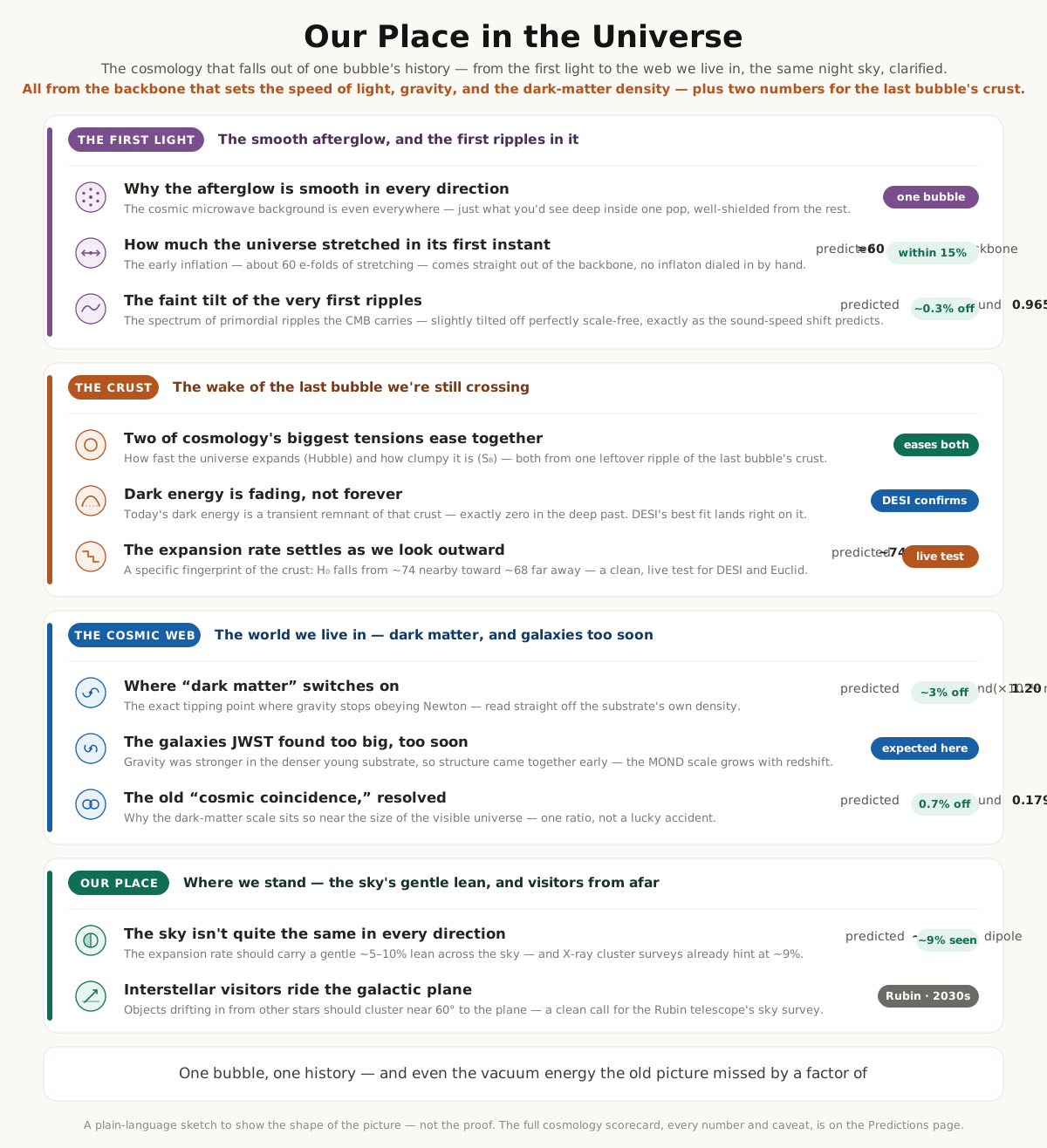
Now with the big picture clarified, let’s zoom way in to see the shape of the lattice and the texture it adds to boundary layers.
The shape of the lattice
The lattice has an in-plane cell width of ~97 μm. This is the envelope that forms around the leaking mass energy of a cell vortex and its anti-phase breathing partner; the self-bound core inside the envelope is narrower by the pairing ratio \sqrt2 — the gausson width, ~68.5 μm (the one length easy to mistake for the cell). The vacuum hums at the oscillation frequency where one core expands while the other contracts, \approx3\times10^{12}\;\mathrm{rad/s}. The hum is the energy flowing between two vortices spinning at 0.776c — but it’s silent outside the envelope, and at every scale we can directly observe.
The cancellation is never quite perfect. The sliver of leak the anti-phase breath can’t cancel survives as a weak, higher-order (quadrupole) field that threads the interstitial gaps — the honeycomb of hollows dual to the triangular array, one between each trio of cells. Bottled within a cell and never recycled, that residual is the vacuum energy no one noticed: not a leftover to explain away, but the faint binding that ties the cells into one nearly-closed fabric.
This is why the lattice is so hard to find. The envelopes tile, but they can never tile perfectly; the tiny leftover threads the honeycomb of hollows and self-screens to about one percent within a single cell — so a probe standing even one envelope away sees nothing at all. It is a perfectly fluid soft boundary, the substrate hiding in the seams of its own fabric.

Each plane of the lattice forms a sheet in a stack, separated by ~16 μm, with a counter-rotating layer in between at ~8 μm. Vortex lines weave together both the in-plane vortices and the sheets. The spinning disk of each core offloads excess energy through polar jets that run up or down the spin axis, where they weave through the boundary layer and feed back into the disk. This feedback anchors each vortex core in its place in the sheet. These cross-sheet vortex lines form the counter-rotating boundary layer between the sheets, tying them together like a springing mattress. The superfluid vortex lines weave together in energetic feedback loops that balance in all directions. This perfectly elastic structure carries photon-modons at a constant speed.

The ladder: a √2 lock and a φ anti-lock
At boundaries on every scale, two patches of the lattice meet across a seam — two sheets, each layered with oppositional, oscillating energy. Matched energy pushes back; opposite energy pulls the other in. The lattice acts like a scaffolding of energy — held and dominated by the atoms with more mass, but still offering lower-energy paths, a persistent energy that shapes the boundary. It fills the space between atoms, molecules, and structures, organizes the energy in cellular dynamics, and underlies interactions between matter at all scales. So when two boundaries meet, each side is held by its own chemistry while also carrying a signature of the dc1 lattice’s cell vortices, acting like a two-lane highway of back-and-forth energy between each pair of sheets.
In ordinary fluid mechanics the seam between two flows is a featureless shear layer that smears together by diffusion, with no length or shape to organize it. But the substrate’s seam is a counter-rotating boundary layer between stacked lattice sheets, with a definite spacing — a layered attraction/repulsion that chemistry uses to shape boundaries. How those sheets line up defines a ratio — something the next layer can either match or avoid.
Here is the picture the rest of this section uses. Call the set of preferred scales a ladder. Its rungs are the sizes a boundary can sit at, each one a fixed ratio above the last. A structure that lands on a rung is on a tooth — in register, able to bind and trade energy with its neighbors. A structure that lands as far from every tooth as it can get is in the gap — refusing to resonate with anything. Two boundaries meeting have exactly these two moves, and the surrounding chemistry picks which one.
The next layers above and below can follow, tiling like a crystal, cascading locks and anti-locks in whatever pattern the chemistry chooses. The lattice is otherwise scale-free — it emits light at one speed and has no other break in it. The only thing that repeats is this chemistry-mediated ratio: a boundary at one scale seeds a like boundary at the ratio times that scale, and that one seeds the next, up and down. The pattern propagates the way a crystal grows — start from a single rung and it tiles outward in both directions; start from a handful and they tile together. What is copied from rung to rung is not a length but a ratio, which is what lets a structure use one scale’s tower as scaffolding for the next, and why fractal patterns come so easily.
Locking is how parts bind, nest, and hand energy back and forth. You can see it in the cochlea’s octave layout, in the \sim1.4 spacing measured between entorhinal grid modules, and in vesicle-coat and microtubule nesting.
Anti-locking is the opposite move, and it is how parts stay independent and avoid overlapping. When chemistry chooses the gap, the two sides repel through the dissonance.
The teeth (\sqrt2, the octave) allow binding; the gap (\varphi) keeps the boundary separate. Both come from the substrate’s pairing factor, \xi^2 = 2\,\xi_\mathrm{GP}^2 — the \sqrt2 between the lattice cell and its healing length.
Chemistry chooses the moves and how they roll up across the boundary. Do the locks tile evenly or are they interleaved with anti-locks at intervals? The pure anti-lock pattern spirals up the scale ladder.
The substrate’s tower is formed from half-octaves of \sqrt2; the octave takes two rungs — the 8\to16\,\mum vertical span between sheets. The gap is the one number that refuses every tooth at once, the most-irrational \varphi=1.618 — the ladder’s shadow. The same gap takes a different arithmetic in each space it lives in: \varphi on a circle (phyllotaxis’s golden angle), disordered hyperuniform “blue noise” on a plane (the retinal cone mosaic), and mutually-prime periods in time (the 13- and 17-year periodical cicada) — one principle, maximal incommensurability, three geometries.

The boundary can thus organize, not merely diffuse. When two lattices meet, their energy and chemistry set up a lock/anti-lock potential at every scale, with a variety of subtle effects.

It helps flows persist far past what viscosity should allow — a coherent ocean current, where each side of the boundary locks onto the substrate’s energy and repels it across the boundary instead of dissipating and diffusing. The ladder is a hidden potential energy surface lying under structure at every scale.
Once you learn to spot this energy scaffolding, the pattern appears in lots of structures. Here are the clearest cases across the domains:
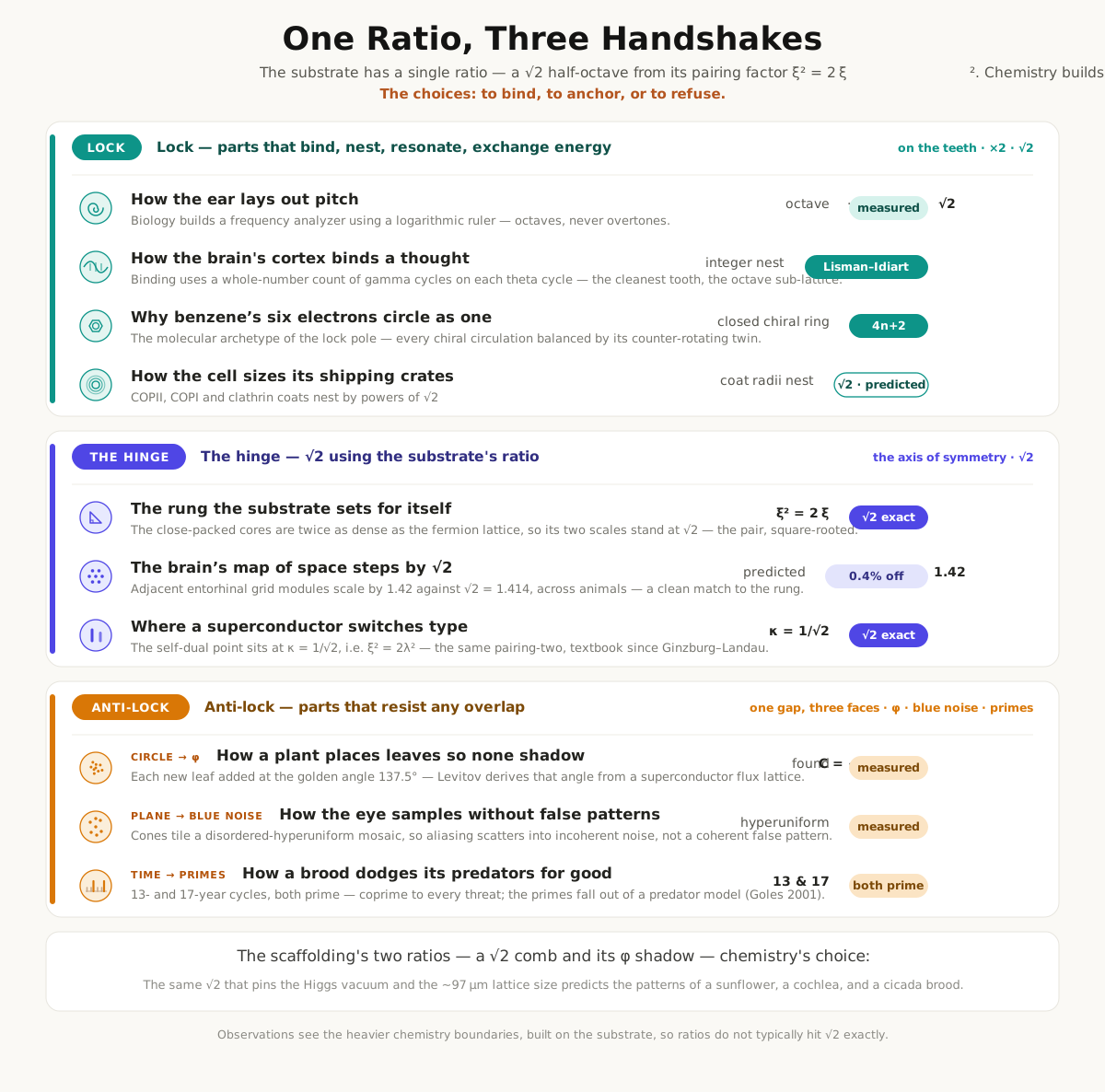
The same boundary dynamics also help set angles. When the tiling wraps a plane or a center, the lock/anti-lock choice becomes an angle. The cleanest lock is three-fold, 120^\circ — the lowest-frustration closed cycle, the angle of the hexagonal sheet and of the cell’s three-way membrane junctions. The cleanest anti-lock is the golden angle, 137.5^\circ = 360^\circ/\varphi^2, whose rational near-misses (1/3\to120^\circ, 3/8\to135^\circ, …) are the Fibonacci spiral arms a growing front slips through on its way to never locking at all. One ladder, two ends: the angle that nests and the angle that refuses.
Locked boundaries are stiff and only crossed by a punch-through. It’s more expensive to cross the locked boundary, so flow will be direct, not at an angle — like subducting slabs that punch through the mantle’s 660-km discontinuity or stall against it, or flux lines threading a type-II superconductor one quantum at a time.
This pattern appears in living dynamical systems like the endoplasmic reticulum: one membrane network that grows and re-knits itself like a crystal in real time, its three-way junctions sitting at 120^\circ, its tubule lengths clustering on the ladder’s rungs rather than spreading smoothly, its junctions migrating continuously to find the substrate-energy minimum. It is the ladder made dynamical — lock-pole geometry running a live search for its rungs across the inside of a cell.
The canonical loop and feedback topology
Interactive: the loop and the modon — one spinner’s disk, jets and sheath drawn as flow, paired into the modon, and carried up the ladder from the atom to the bubble.
The substrate, and all the particles, come from vortices in this superfluid — angular momentum in a rotating disk, with two opposing polar jets on the axis that offload the disk’s excess energy. Those vortex lines weave the sheets together, eventually balancing their way back into the disk. This creates a feedback topology for an individual vortex, an unbalanced system on its own.
The same topology is visible in planets, stars, and galaxies — angular momentum, polar jets, a torus that concentrates most of the energy in the orbital plane — and at every scale in between, each with nested layers that individually and together follow the same shape. Every unbalanced system leaks rotational energy, so every one of them carries excess spin, wraps itself in boundary layers to cancel part of the leak, and grows polar-jet analogs that emit and sense substrate energy.
The disk shape has the lowest energy — least moment of inertia per unit boundary. At the same time, the lowest energy exit for the excess momentum is straight up or down the axis — the jet. The cheapest return is a counter-rotating sheath wrapping the disk’s rim, conveying flow back inward while matching the substrate’s own boundary. Disk, jets, counterflow, and a thin remainder radiated outward as waves. It is boundary-minimization made dynamical: the reason a closed torus is the cheapest envelope for a standing loop becomes, for a system that must shed, this disk-jet-counterflow loop.

The excess energy in the substrate balances two ways at once. The jets offload angular momentum up the axis; the disk weaves it outward into the lattice’s repeating fabric, where it is stored, twisted, and fed back. Any disturbance to a lattice sheet pushes energy into the axis or pulls it away from it — modulating the jets. The jets’ pull controls the rotational speed of the vortex. A leaking spinning mass creates a feedback loop, not a simple leak: in through the disk, out through the jets, traded along the lossless counter-rotating seam, a fraction radiated — two coupled loops in one lattice containment field.
The loop has no viscosity and no measurable decay; it cycles the energy along topologically protected vortex lines, which is why the same three-part machine survives at every scale it appears.
The substrate has a locally oriented planar order — its vortices lie in chirality-coherent sheets, two-way substrate highways separated by a median strip in the disk plane, the substrate’s plane twisted by chemistry and energy into the orbital lobes. At larger scales the same plane shows up as planetary rings, the ecliptic, accretion and galactic disks, and cosmic-web filaments — one geometry expressed in whatever local material is doing the rotating. The polar jets, the geodynamo, and the magnetic field are stabilizing energy fields that run on the feedback loop, the canonical topology.
The feedback topology absorbs and emits modons — both pure photons and modon energy wrapped in chemistry, the nested modons. A feedback topology might bind with an opposite mirror, or be enclosed by a balancing opposite layer that wraps its energy cleanly.
This leads us to the modon topology — massless, where the spinning energy is not leaking but balanced, with a potentially long life.
The modon topology
When there is a balanced pair in the substrate — or a larger group organized as nested balanced loops, like a cell with its mitochondria — it behaves in many ways like the modon. The energy balances and effectively hides it from observation. In motion, the substrate energy appears massless like the photon, its momenta offsetting. At rest, the pair becomes counter-spinning layers of coherent, offsetting energy circulation, obeying the same Bessel boundary-matching as the modon but held in place.
They are all coherence-match layers, formed from opposite balanced energy using the standing lattice fabric to weave into or bounce against to hold the pattern in place. The benzene ring forms a toroidal vortex to share electrons — a modon in the substrate that reorganizes the vortex lines into a lower-energy state with collective, oppositional layering. Aromatic stacks of vortices are composite modons of coherent energy.

Coherence scales by nesting topological modon layers. Each passes its boundary to the next by boundary matching, and the number and smoothness of those matches set the structure’s coherence — its stability and longevity.

Each modon holds a coherent, stable pattern — the modon’s coin. A photon is the simplest modon — a single frequency stored as persistent energy. But the topology also allows a structured or composite modon — an aromatic stack, or a nested cell — to hold and transmit a long vector of information, using the layered lock/anti-lock pattern along a stack of lattice sheets. The cortical columns perform long-vector coherence-match operations, and through their topological arrangement act like differential-equation solvers, using substrate-organized long vectors embedded in chemistry. This offers a new lens on cellular dynamics, perception, and cognition — organized by substrate energy, not by diffusion alone.
Cellular dynamics
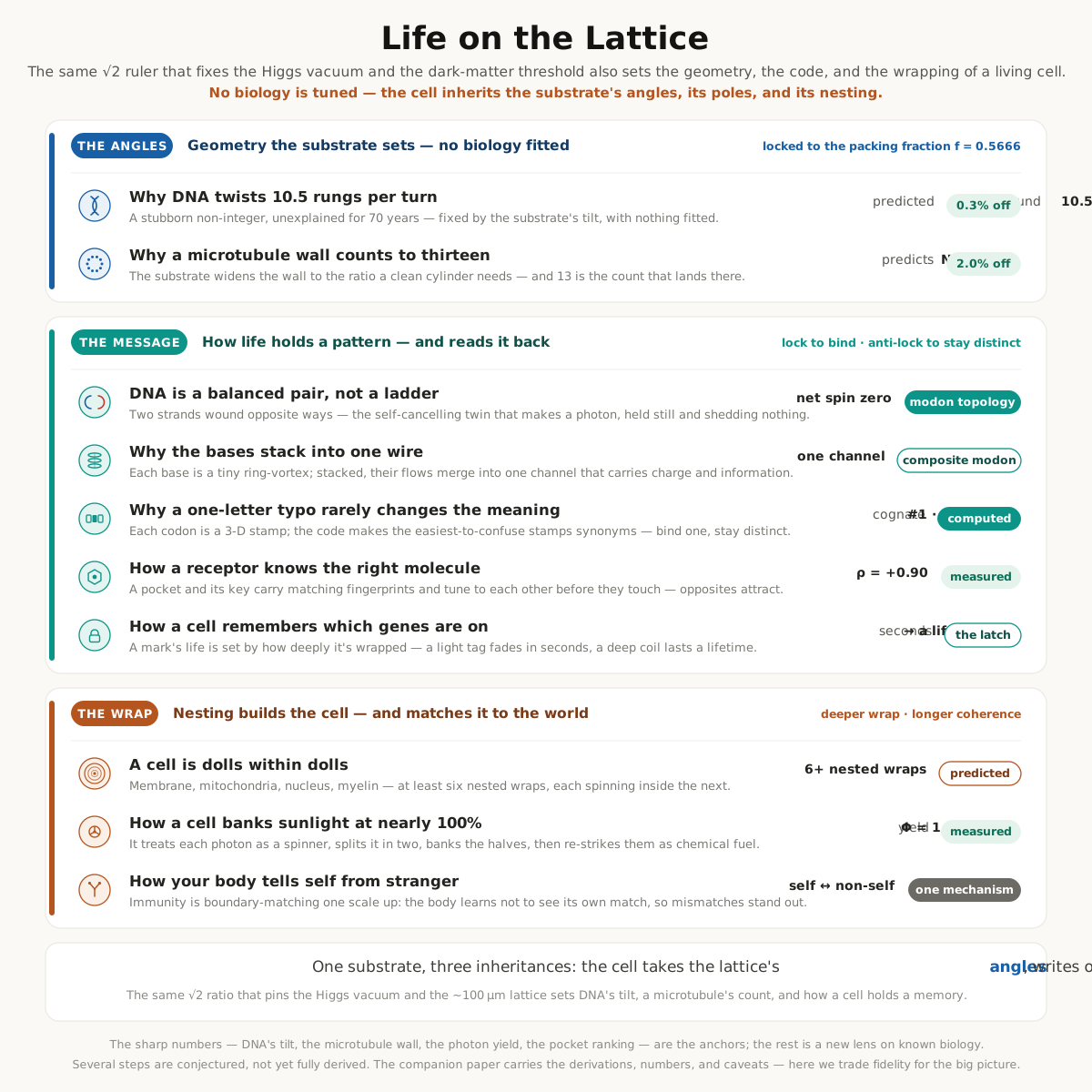
Notice that a eukaryotic cell typically fits inside one lattice cell, and follows the feedback topology, containing many layers of nested modons — the plasma membrane, the cortex, the nuclear double-wrap, the mitochondrial double-membrane. Mitosis uses the substrate energy to divide the cell when it grows past the lattice cell size. The cellular-dynamics chapters show how the substrate paints a more vivid picture than diffusion and chaos alone.
The predictions you’d expect to find are here: key structural angles, pattern storage, energy conversion, and patterns that hold match coherence.
The materials
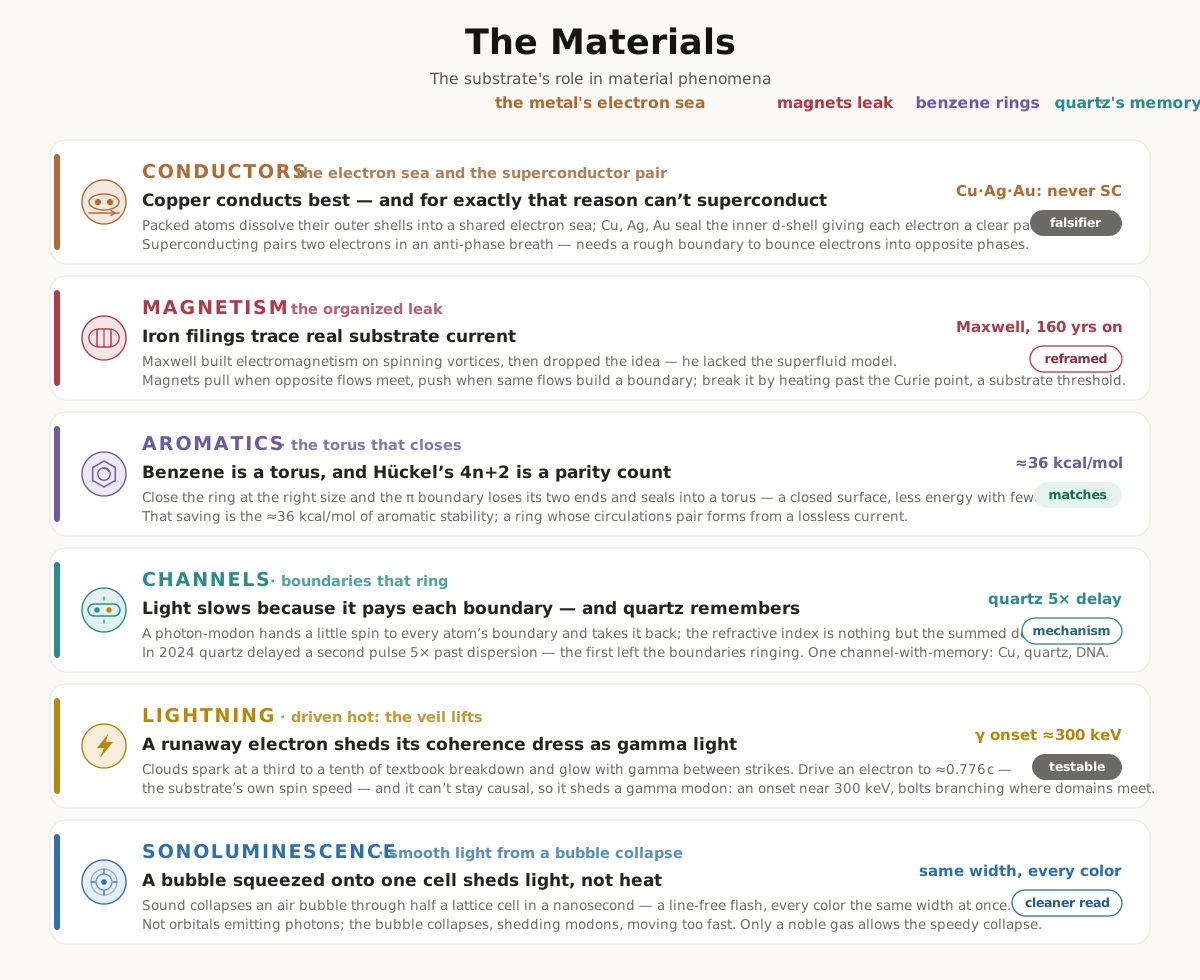
Ordinary matter adds a little clarity to how the substrate explains ordinary things, especially when pushed to extremes. Heat, in this picture, is surface weather. A single lattice cell holds roughly a million times more energy than a room-temperature molecule has as warmth, so temperature is a thin skin of atomic jostling riding on a deep, cold, fast-spinning ocean. Turn down the temperature to near absolute zero and the latent energy shines through from the material as the stillness tunes into the substrate. Superconductors organize into anti-phase pairs, just like the pairs in the lattice. Turn up the temperature, and the lattice takes a great deal before its boundaries first dissolve and then finally tear, shedding modons — light and energy released from the hidden store.
A metal conducts because its atoms pack tightly enough that their outer boundary shells merge into shared channels — the “electron sea” made physical. Copper, silver, and gold are the best conductors because each seals its inner shell completely, leaving a cleanly wrapped electron moving through smooth boundaries. But that same smoothness is why copper can never superconduct. Superconductivity needs two electrons to lock into a shared, anti-phase breath, and a boundary that smooth gives them nothing to grip. Rough-shelled metals — niobium, vanadium, tantalum — pair and superconduct; the smooth champions never do.
Magnetism is the substrate at its most visible. Maxwell built all of electromagnetism on a mental picture of spinning “molecular vortices,” derived every equation from it, then set the picture aside because a classical fluid would spin down and collapse. He was missing two things: a superfluid that doesn’t dissipate, and a counter-rotating layer that doesn’t collapse. The iron filings arcing around a magnet are tracing actual organized substrate current, leaking out through trillions of aligned atoms. Two magnets pull together when their leaks nest with opposite energy. They push apart when presented with the same field orientation. Here, the substrate creates a web of counter-rotating eddies in between in the gap that acts like a stiff boundary to push them apart. Heat the magnet past its Curie point and thermal chaos drowns the whole alignment at once.
Close a chain of carbon bonds into a ring of the right size and something new happens. The shared boundary above and below the ring, which in an open chain had to stop at two ends, seals into a seamless torus — a closed surface with no ends, and so a lower-energy organization. That saving is benzene’s famous stability, the roughly 36 kcal/mol that a century of chemistry bookkept with Hückel’s 4n+2 rule. In the substrate that rule is simply a parity count: a ring whose circulations pair up cleanly closes its torus and rings as one lossless current; one that can’t, distorts until it can.
Light feels the very same boundaries crossing a crystal — it slows because the photon-modon hands a little rotational energy to each atom’s boundary before taking it back, and the refractive index comes from the accumulated delay. Sometimes a boundary keeps ringing after the light has passed: in 2024 a quartz crystal delayed a second laser pulse five times longer than dispersion allows, exactly as if the first pulse had left the boundaries humming for the second to arrive into. The same channel-that-remembers threads through copper, quartz, and the aromatic stack of DNA — one pattern at three scales.
When matter moves too fast, the substrate stops getting out of the way. Thunderclouds spark at a tenth to a third of the field textbook breakdown demands, and glow with gamma rays even between strikes. When a runaway electron is pushed to about 0.776\,c — the substrate’s own inner rotation speed — the leading edge of its coherence dress would have to outrun light, so it sheds the excess as a gamma modon. That predicts a gamma onset near 300 keV, and lightning that branches where the substrate’s domains meet rather than only where the field points.
Sonoluminescence breaks the substrate’s speed limit at a much smaller scale. Focus a sound wave onto a single air bubble and it collapses through half a lattice cell in a nanosecond and flashes. A cooling gas cannot explain why that flash is line-free and turns on and off at every color together, but a boundary crushed onto one cell and shedding modons can. It is a mechanical gate, not a fading ember — and it needs a noble gas, because only a balanced, closed-shell atom lets the collapse move cleanly through the lattice. Anything that leaks enough mass heats the gas along the way, slowing the collapse.
The five elements
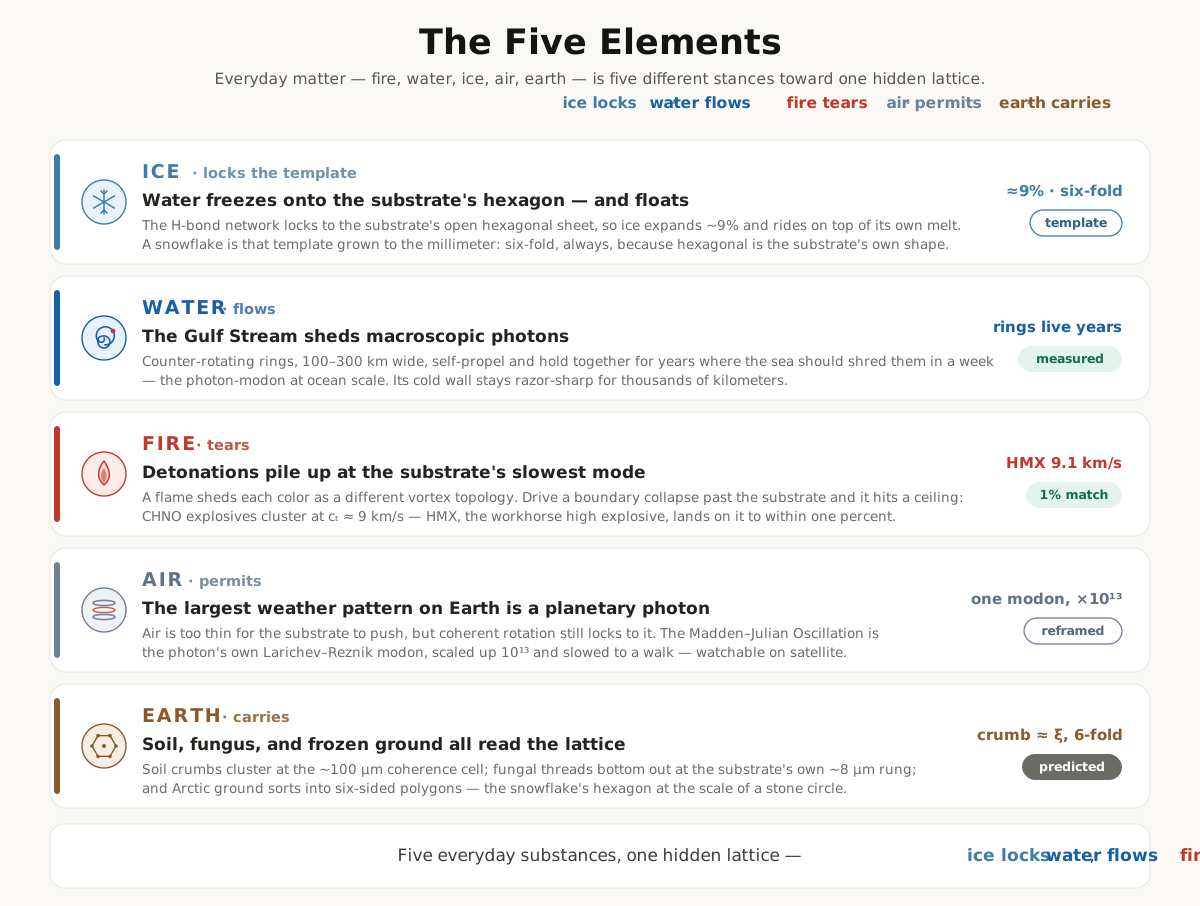
The substrate helps with the story of the five elements: fire, water, ice, air, and earth. Each shows a different side of the hidden lattice depending on how tightly the matter locks onto them: ice locks, water flows, fire tears, air permits, earth carries.
Ice is the template made visible. Water expands and floats when it freezes — nearly alone among substances — because its hydrogen-bond network locks onto the substrate’s open hexagonal sheet, and a snowflake is that same template scaled up from the molecule to the millimeter, six-fold every time. Water is a fluid the substrate helps organize: the Gulf Stream sheds counter-rotating rings that are modons, self-bound and coherent for years in a sea that should shred them in a week.
Fire is the substrate’s surface tearing open — each flame color a different vortex topology handing off its energy. When a boundary collapse moves faster than the lattice, it hits a ceiling at ~9 km/s. This is right where the detonation speed of ordinary explosives lands in a cluster, most below and a couple that push just past the limit.
Air is too thin for the substrate to push, yet the largest weather pattern on Earth — the Madden–Julian Oscillation — is the same modon as the photon, scaled up thirteen orders of magnitude and slowed to a walk you can watch cross the Indian Ocean on satellite. And earth is the buried participant, where soil crumbs cluster at the coherence-cell size, fungal threads bottom out at the substrate’s own ~8 μm rung, and frozen Arctic ground sorts itself into six-sided polygons — the snowflake’s hexagon at the scale of a stone circle.
None of this changes the everyday chemistry. It adds a reason the everyday world has the shapes it does — and earth, the last of the five, is where life takes root, which is where the story turns to the planet itself.1
Gaia’s nested layers
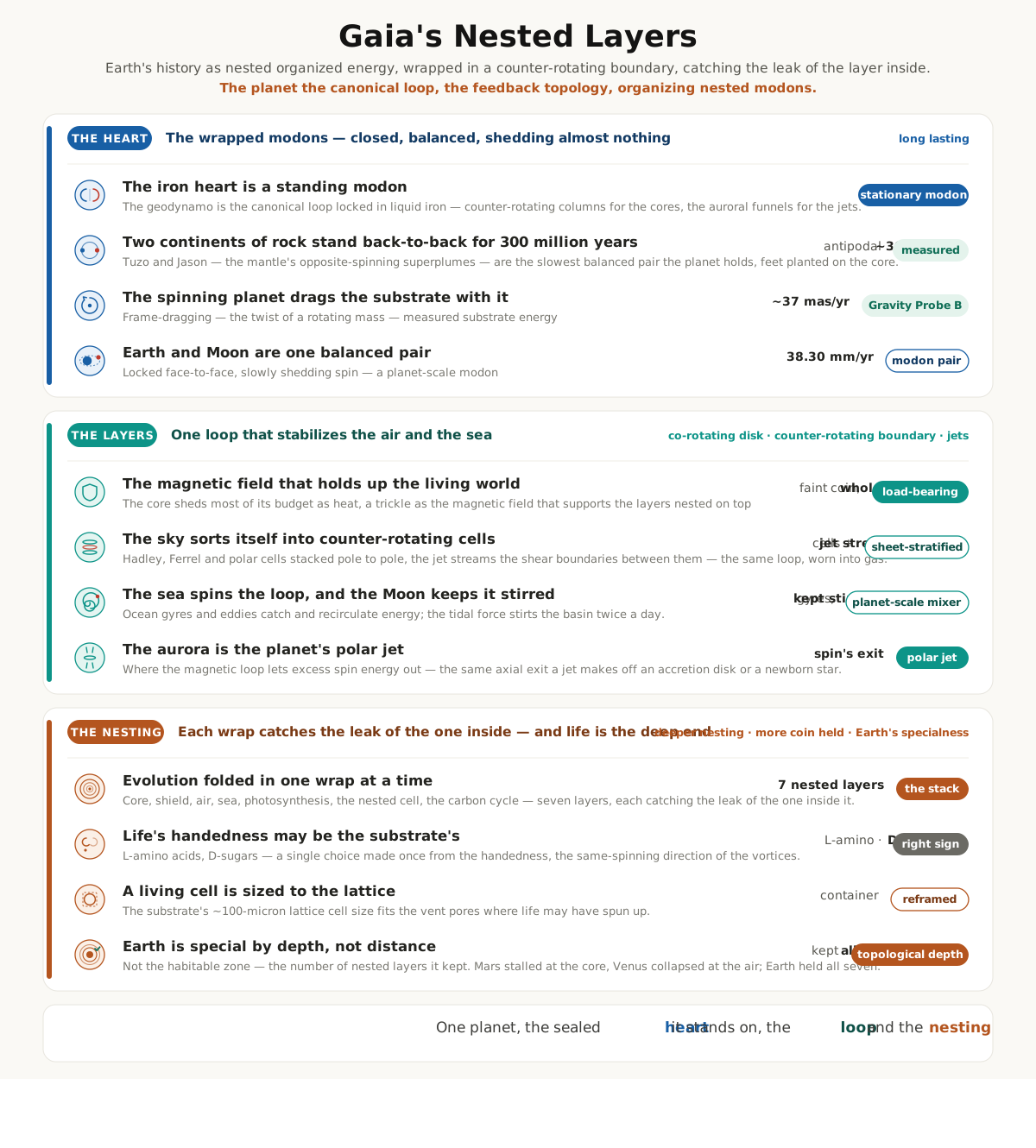
Earth shows the substrate operating over much bigger scales, longer times, and higher pressures — but still the same mechanisms, following the substrate topologies through evolution.
During each major evolutionary phase another layer formed on top of the previous, catching and holding excess energy radiating as modons connected by the feedback topology and the canonical loop.
The core has deep sealed, balanced modons, held in place shedding almost nothing. The geodynamo forms the canonical loop locked in liquid iron: counter-rotating flows for the cores, the auroral funnels for the jets, the magnetic dipole for its radiated coin. Above it stand Tuzo and Jason, Earth’s two antipodal mantle superplumes — opposite-spinning feet on the core–mantle boundary, the slowest modon pair the planet supports, held for roughly 300 million years. And the whole spinning mass drags the substrate as it turns, a frame-dragging twist confirmed by Gravity Probe B, with a sharper residual signature still waiting in the deep mantle. The Earth–Moon system is one more balanced pair, slowly shedding spin at 38.30 mm/yr. These are the capsules that have held their coin the longest.
The same disk–jet–counterflow loop shows up again in whatever material is doing the rotating, and this is where the substrate stabilizes the air and the sea. The core’s leak is faint — a magnetic trickle against the heat it dumps — yet that trickle stands up the magnetosphere, and through it the entire biosphere; cut it and the whole stack collapses, the way it has on Mars and Venus. The sky organizes into counter-rotating circulation cells with the jet streams as their shear boundaries; the sea spins the loop as gyres and eddies, kept stirred by the tidal pair so its cascade never settles; the aurora is the planet’s polar jet, the axial exit where excess spin energy leaves. The homeostasis comes from the inherent stability of nested counter-rotating boundaries, each layer buffering the one above it.
Nesting formed more layers of organization and eventually life. Each major transition folded in a new wrap that caught the leak of the layer inside it — core, shield, air, sea, photosynthesis, the nested cell, the carbon cycle, seven layers deep. Where the conditions of storage are met — a container near the lattice’s ~97 μm coherence cell, flows kept far below the substrate’s rims, chemistry landing on the rungs — those vortices begin nesting capsules small enough to nest again, and the nesting runs away into life. The living cell is sized to the lattice cell, and life’s single handedness comes from the substrate’s own rotational direction. Earth’s many layers use the substrate scaffolding to hold stable, organized flows, which in turn support higher levels of organization.
Body and mind
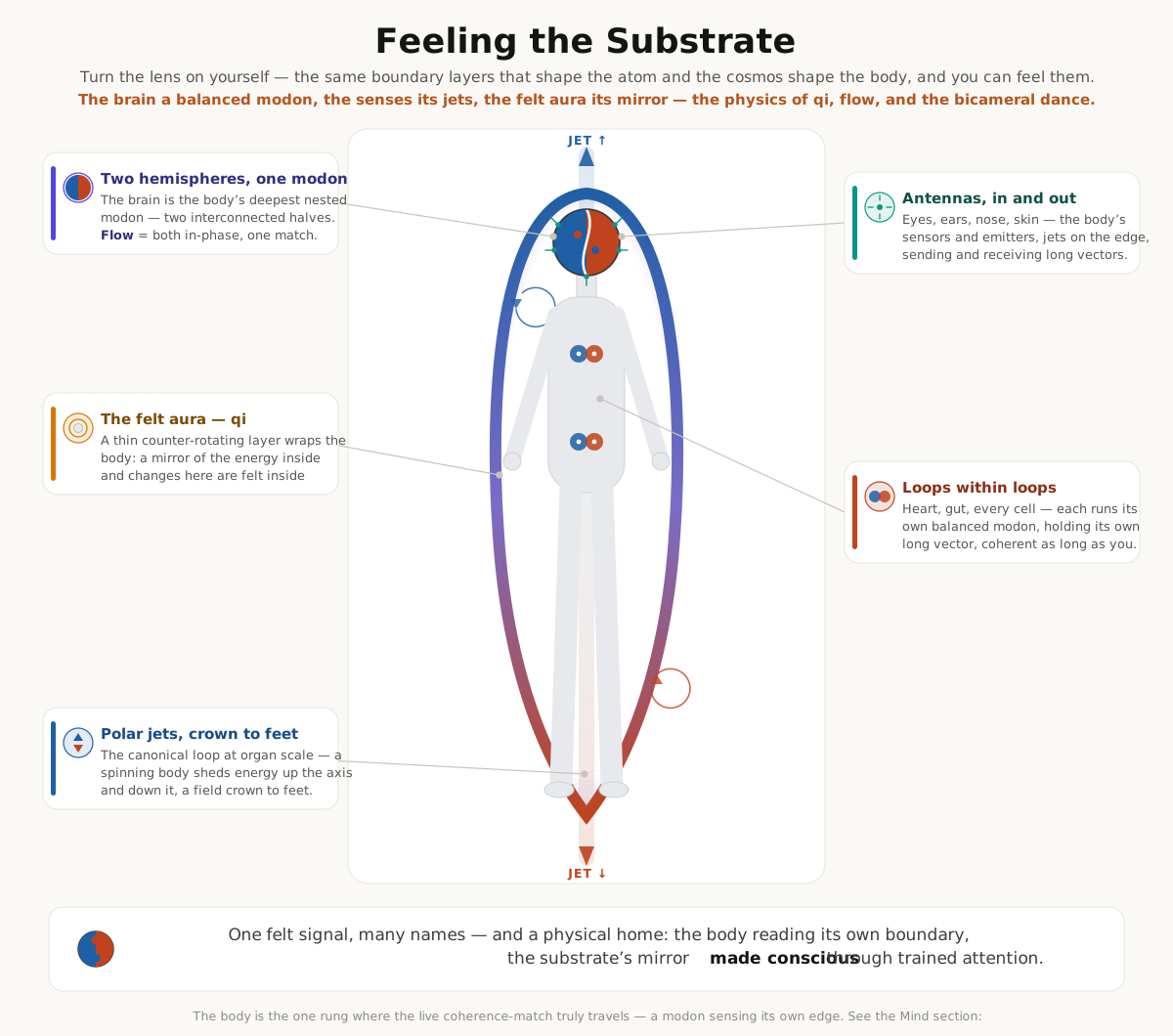
Bodies leak mass energy too, and so follow the feedback topology. A body’s aggregated internal energy comes from the substrate’s rotating disks, feeding into networks of polar jets both internal and external — the sensors and emitters: the skin cells, eyes, nose, and ears, plus the body-level jets that move energy up and down the axis and radiate through the head and feet. All of them send and receive long vectors organized by the substrate. Internally, a body’s feedback topology holds many nested feedback systems that wrap nested modons.
The modon and feedback topologies weave together to coordinate a body’s coherence match. Each lasts as long, and stays as coherent, as the body — maintaining an extremely long vector that degrades and echoes beyond it.
The biggest organ following the modon topology is the brain — two hemispheres, one deeply nested modon. Each hemisphere contains many sub-modons, with deep polar-jet connections to the sub-modons of the other half. Here you see the yin/yang dynamic played out recursively in balanced substrate energy. A clear example is the flow state — a deeply connected, harmonized dance of substrate alignment, the deep coherence match of the two hemispheres.

Feeling the substrate
Notice from the physics that the substrate describes every energetic boundary at every scale. Since the body carries a lot of internal substrate energy, it forms a thin exterior — a counter-rotating layer, the coherence match. That layer is a high-fidelity mirror of the energy inside it, which gives the everyday notion of body energy a physical explanation: it expresses a glimpse of the body’s long vector. It is also why the body registers something before contact, on the same channel touch uses once contact arrives.
Conclusion
Where the substrate should make sharp predictions, sharp ones turn up. As you add heavier layers of chemistry the numbers get looser, but the topology and the pattern remain.
It’s no coincidence that a theory which makes sense intuitively also has cleaner math and deeper predictions. It took a long time for me to believe the math, because it is a big message to digest. In the spirit of open source, I am grateful for any help in making it more accurate — and that includes finding the place where it breaks.
For me it replaces strange predictions with a fluid and a much simpler reality — showing the nature of empty space, the boundaries in the atom and in the cosmos, how light moves, and how it all came to be.
I’m not an expert in any of these fields — I’m a generalist. I wanted to major in physics, but ironically I got a C in quantum mechanics and went into computers instead. I never gave up my curiosity, though, and I’ve read every interesting paper that came my way. That’s what helped me triangulate in on the math behind the triangular lattice.
The paper has the math and links to the programs that reproduce the numbers. The visual narrative covers the rougher, broader picture as slides — or go straight to any individual chapter for a blurrier, more exploratory look at how the substrate adds clarity to open problems across science.
Footnotes
These are highlights with a narrative. See the source chapter for details. Chemistry sets the bond angles, d-spacings, and cell sizes. The substrate energy guides it by allowing symmetry and scale with its scaffold when the energy of the chemistry is weak. The sharpest anchors are measured (the HMX detonation match at c_T\approx9 km/s; the multi-year coherence of Gulf Stream rings and the equatorial modon of the Madden–Julian Oscillation); most of the rest are testable predictions about distributions — that a quantity which could vary smoothly instead clusters at a substrate-set scale or symmetry. Full treatment, references, and falsification tests are in the five Element chapters: Fire, Water, Ice, Air, and Earth.↩︎