The Cosmic Web
Voids, walls, filaments, and nodes as a substrate flow network sorted by the Landau critical velocity — the dark canyon walls read as the bones of the universe
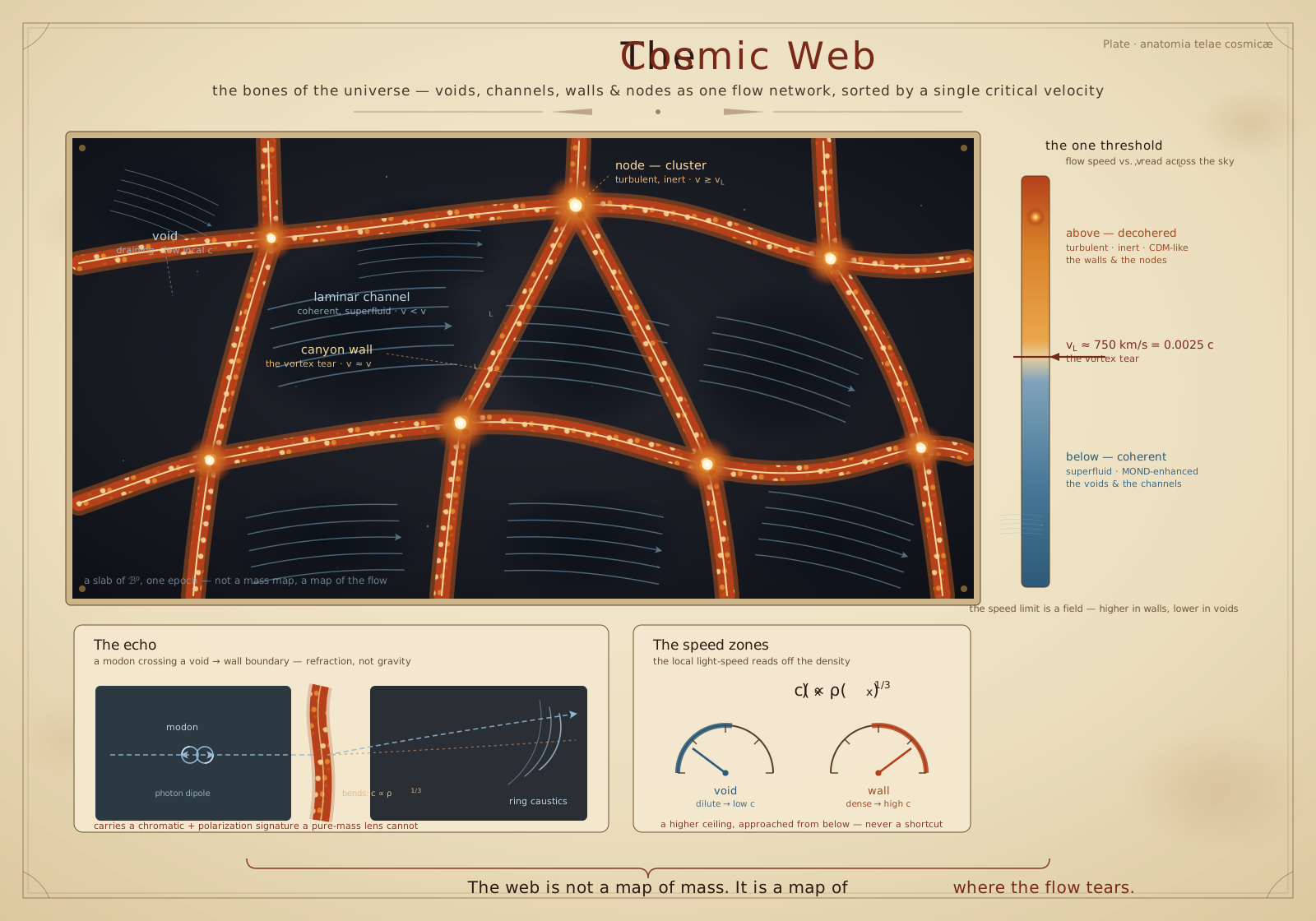
The first thing you might see in some deep sky images with lots of stars are faint filaments and rings of light strung across the dark, too orderly to be an accident and too diffuse to be any single object. Standard cosmology has a name for the large-scale version of it — the cosmic web, the filaments and sheets and voids that the galaxy distribution traces — and a story for how it grew: gravity amplifying primordial density ripples until matter drained out of the emptying voids and piled up along the walls and filaments between them. That story is not wrong, and the substrate does not overturn it. But it leaves the web as scenery — the place the galaxies happen to sit — rather than as a thing with its own dynamics.
The substrate framework shows the cosmic web as a flow network, sorted everywhere by a single velocity threshold the framework already uses for one job and can now use for the whole map. It shows the web’s four elements — voids, channels, walls, and nodes as the four faces of the substrate’s one critical velocity, read across the sky. The dark canyon walls between the laminar channels are the bones of the universe, from the same backbone equations.
One threshold, read across the sky
The framework sorts the cosmos by the vortex-tear velocity v_L = \omega_0\xi \approx 749.5\;\text{km/s} = 0.0025\,c — the Glaberson–Johnson–Ostermeier / Donnelly–Glaberson coherence threshold of the rotating lattice, not the phonon–roton Landau velocity (that, for the substrate’s marginal monotonic branch, is c itself; see What Sets the Critical Velocity). It uses this threshold once, to separate galaxies from clusters:
Below v_L, organized flow stays coherent and the medium mediates a MOND-like response; above it, the breath decoheres, vortices proliferate, and the medium goes turbulent and inert. (Turbulence in the Substrate)
That is a velocity sorting, not a spatial one — “name a system’s velocity relative to v_L and its phase is fixed before you measure it” (galactic dynamics). The cosmic web is what that sorting looks like when you stop asking about one galaxy at a time and map the whole drainage flow of the substrate. Matter drains out of voids, converges into sheets, funnels along filaments, and collects at nodes — and the flow speeds up as it converges. Somewhere along that convergence the drift crosses v_L, and the medium changes phase. The web is the map of where it crosses.
| Web element | Substrate flow state | Speed vs. v_L | Phase / behaviour |
|---|---|---|---|
| Void | dilute, quiescent, draining outward — a source | \ll v_L | deep superfluid; low local c (see below) |
| Filament interior / sheet | coherent laminar convergent flow — the channel | < v_L | superfluid, MOND-enhanced — where galaxies condense |
| Canyon wall | sharp shear surface where convergence tears the flow | \approx v_L | vortex tangle — a counter-rotating boundary layer |
| Node / cluster | filament intersection, virialized — a sink | \gtrsim v_L | turbulent, inert, CDM-like (Bullet Cluster) |
The nodes are the part the framework already had: galaxy clusters sit above v_L and behave as ordinary collisionless dark matter. What this chapter adds is the connective tissue — the channels and the walls between them — and the reading of the walls as the structure that organizes the whole network.
The canyon walls as counter-rotating boundary layers
The framework’s deepest recurring object is the counter-rotating boundary layer: wherever a coherent co-rotating flow meets another, a thin counter-rotating shear layer forms between them, carrying the dissipation and holding the two flows apart. It is the Gulf Stream’s cold wall, the galactic boundary whose quadratic current-phase relation is MOND, the atomic boundary that quantizes the electron. The framework’s thesis is that this is one geometry running through every scale (feedback topology).
The cosmic web’s walls are that object at the top of the ladder. Where two voids drain toward the same sheet, their convergent flows meet, and the substrate does what it does at every scale: it lays down a counter-rotating shear layer between them. At the wall, the drift has steepened past v_L, so that boundary layer is not a quiet interface but a vortex tangle — the flow tears, exactly the Donnelly–Glaberson instability the helium chapter watches on a lab bench (two critical velocities). This gives the walls four properties at once, and they are precisely the properties your intuition assigned to the “dark canyon walls”:
- They are fast. The wall is where the flow has crossed v_L — the faster-flowing region, by construction.
- They separate the laminar channels. A boundary layer is the thing that organizes a flow into channels; that is what boundary layers are for. The voids and filament interiors stay laminar because the walls hold them apart.
- They are dark. Above v_L the substrate is in its inert, decohered phase — it does not mediate the coherent MOND response, and it emits no light. The walls are substrate structure with no luminous tracer of their own; the galaxies we see hang on the channel side of them, draped over the bones rather than embedded in them.
- They are load-bearing. A rigid, dark, connected scaffolding of counter-rotating boundary layers is exactly a skeleton: the web’s shape is set by where the walls run, and the luminous matter fills in around them.
So “the bones of the universe” is not a metaphor the framework has to reach for — it is the literal reading. The bones are the substrate’s counter-rotating boundary layers, torn past v_L by the convergent drainage flow, forming the connected dark scaffolding that channels the laminar flow and gives the web its shape. The framework already says the substrate prefers this geometry — “planar is what the substrate prefers… galactic disks, the cosmic web’s filamentary sheets. There is one geometry running through all of these” (feedback topology) — but it stated the preference kinematically, as a shape the substrate falls into. The v_L reading says why the walls are sharp and dark: they are boundary layers on the far side of the vortex tear.
This is the substrate ladder’s sign rule written across the sky. v_L is a coherence threshold — the lock pole engaged versus disengaged — not the anti-lock \varphi gap. Below v_L the boundary breathes coherently (lock engaged: superfluid, MOND channels). Above v_L the pairing decoheres (lock disengaged: turbulent, inert walls and nodes). Name a region’s flow speed relative to v_L and its place in the web is fixed before you measure it — the same predict-the-state-from-the-flow logic the framework uses for the galaxy/cluster split, now naming voids, channels, walls, and nodes in one stroke.
Why we see them: modon refraction at the walls
A wall is dark, but it is not invisible, because light has to cross it. A photon is a modon — a counter-rotating vortex dipole that pulls itself through the substrate at the local signal speed set by the medium’s equation of state (photon as modon). When a modon crosses a canyon wall it crosses two things in quick succession, and both bend it:
- A density step. The wall separates a dilute channel from a denser convergence, and c \propto \rho^{1/3} (see The speed zones below). A change in the local signal speed across an interface is refraction — the modon’s path bends toward the slow (dilute) side, exactly as light bends entering glass.
- A vortex tangle. The wall is a turbulent boundary layer, and a tangle of quantized vorticity scatters and depolarizes a modon in a way a smooth mass distribution does not.
The framework already flagged this exact geometry as its cleanest observational handle, before this chapter named the walls:
Voids in the cosmic web are the obvious laboratory: photon arrival times, dispersion, and polarization rotation across void–wall transitions should carry the signature. (universe that boils)
The consequence is that a canyon wall acts as a refractive lens, and a curved wall focuses. Light from a source behind a wall can be gathered into ring-like caustics — the faint arcs and rings that drew the eye in the first place. This is not the same as gravitational lensing by a mass: a mass lens is achromatic and preserves polarization, while a substrate wall is a refractive-plus-scattering boundary and so imprints a chromatic dispersion (an arrival-time and wavelength dependence) and a polarization rotation that a pure-mass lens cannot. That difference is the falsifiable content — a wall caustic and a dark-matter arc should look the same to a mass-only analysis but differ in their spectral and polarization fine structure.
The framework offers a mechanism — modon refraction at a torn boundary layer — for ring- and arc-like features associated with the web. It does not claim that every faint ring in a deep image is a wall caustic; shell galaxies, tidal streams, and ordinary Einstein rings are real and common, and must be excluded first. The specific, testable claim is narrower: features produced by void–wall refraction carry a dispersion and polarization signature that mass-lensing does not, and they should correlate with void–wall boundaries mapped independently (e.g. by the galaxy field). That correlation, and that spectral fine structure, are the tests — the rings alone are a motivation, not evidence.
The speed zones
The framework carries a hard, and easily misread, prediction: the speed of light is not a global constant but a field set by the local substrate density, c(\mathbf{x}) \propto \rho(\mathbf{x})^{1/3}, the bulk relation the boiling-universe chapter uses for the dilute frontier (“c \propto \rho^{1/3} … the dilute regions carry signals slowly,” universe that boils). Across the web this means the local speed limit is genuinely different from place to place: higher in the dense filaments and walls, lower in the voids. These are the literal “speed zones” — regions of the universe where the maximum signal speed differs by a small but real amount.
This is a spatial effect — void versus wall at one epoch — and must not be confused with a drift of c over cosmic time. The framework fixes c against cosmic-time drift precisely because the substrate does not dilute smoothly: above its marginal density it clumps, each self-bound structure holding its local density near close-packing while the cosmic mean falls as the structures separate (the deeper engine). The cell scale \xi and hence the reference c are pinned by a coupling energy, not a density, so they do not drift. What varies is the local density contrast between a void and a wall at the same time — and that contrast is exactly what the cosmic web makes large and mappable.
What would it be like to fly a spacecraft into one of these zones? Crossing a void→wall boundary is crossing a superfluid critical-velocity surface — the cosmic analog of dragging a wire through helium until the flow tears. On the void side the substrate is calm and laminar: coherent flow, MOND-flavoured gravity, clean optics, and a lower local speed limit. As you approach the wall the substrate ahead of you tears into vortex turbulence, the local c ticks up as the density rises, light arriving from behind you fans into rings and picks up dispersion, and gravity’s character flips from the coherent MOND regime of the channel to the inert CDM-like regime of the wall. Push through and the far channel is calm again. It is a boundary you could in principle detect — by the arrival-time, dispersion, and polarization changes across it — long before you could feel it.
But — and this is the disciplined part — none of it is a way to go faster than light. You never beat the local c; the wall’s higher c is a higher ceiling you approach from below, not a loophole. The bulk substrate flow itself tops out at v_L = 0.0025\,c — a stiff cosmic wind, not a warp. The web has speed zones in the honest sense that the speed limit is a field rather than a constant, and that is a real, testable departure from both special relativity’s global c and \LambdaCDM’s featureless space. It is not a departure from causality.
Feeding the web back into S_8
The framework’s quantitative structure-growth prediction, S_8 \approx 0.80–0.816, comes from reading the moraine crust of the previous cycle \mathcal{B}^{-1} as a smooth density profile f(z) that suppresses growth through a Weinberg-anchored boundary-disruption efficiency \eta_\text{crust} = 2\alpha_{mf}^2 = 0.181 (the crust suppresses structure growth). That calculation treats the medium as spatially uniform — the same G_\text{eff} and the same MOND response everywhere at a given redshift. The flow-network picture breaks that uniformity, and it is worth being careful about the signs, because the naive expectation — that sorting space into fast channels and inert walls must lower the clustering amplitude — is backwards. Channeled growth actually runs the amplitude up; the v_L threshold caps that rise and protects the current floor; the only topological push toward the lensing band is a nonlinear projection effect on the observable; and the previous cycle’s relics imprint a shape, not a shift. None of these is folded into the current number, and — read with the signs straight — together they leave the headline where it is rather than carrying it into the lensing band.
Channeled growth runs the amplitude up
The web sorts space into sub-v_L channels (MOND-boosted, fast-growing) and super-v_L walls and nodes (inert, Newtonian). It is tempting to read that as a net suppression — growth “runs fast in the channels and is switched off in the walls” — but the sign is the other way, and the DESI chapter’s own MOND accounting is what settles it. At 8\,h^{-1}Mpc the modes sit deep in the MOND regime, where the boost \nu = G_\text{eff}/G enhances growth (WIP-20, fifth pass). Gating that boost by v_L does not flip its sign; it only restricts the enhancement to the channels while the walls and nodes grow at the ordinary Newtonian (\LambdaCDM) rate. A flow-topology-weighted average of “faster than \LambdaCDM in the channels, \LambdaCDM in the walls” is still above \LambdaCDM. So channeled growth is a less-up than a spatially-uniform MOND boost would give — not a new suppression on top of the smooth-crust number. Reading it as an owed lowering would double-count a sign the framework has already fixed.
What channeled growth does buy is a sharp, orthogonal environment dependence of clustering: the effective growth amplitude in filament interiors should exceed that measured across walls or in voids, in the specific sense that the MOND enhancement is present in the channels and absent in the walls. This plugs directly into the falsifier the galactic-dynamics chapter already names — a residual radial-acceleration-relation dependence on void-versus-wall membership that survives after the external-field effect is regressed out (galactic dynamics). If clustering is genuinely environment-independent at fixed mass, the channeled-growth reading is wrong. That is a real prediction; it is just not a lever on the S_8 headline.
The v_L threshold caps the MOND runaway
The channeled-growth sign raises an obvious worry: if MOND enhances growth at 8\,h^{-1}Mpc, why does the enhancement not run away? Taken literally, it nearly does. The static-boost MOND-modified linear growth diverges — \sigma_8 \sim 230 — the known pathology that a relativistic completion (TeVeS/AeST) has to tame, and which the substrate paper “does not carry” (WIP-20, fifth pass). WIP-20 handled it by capping the boost at an ad-hoc \nu_\text{max}; the cosmic-web reading says the cap is not ad-hoc at all. It is v_L.
The mechanism is this. The MOND enhancement is largest where the boost is largest — the deep-MOND, low-acceleration regions — but it only becomes observationally dangerous once those modes go nonlinear and pile mass into the high-density peaks that dominate the weak-lensing S_8. And that is exactly where the convergent flow crosses v_L: the collapsing walls and nodes tear past the vortex threshold, the medium goes inert, and the MOND boost switches off in precisely the regions that would otherwise carry the runaway. The substrate’s own coherence threshold is the physical regulator that the relativistic completion supplies elsewhere — a cutoff on the MOND enhancement tied to density through the collapse velocity, rather than imposed by hand.
The consequence for S_8 is a floor, not a further suppression. The v_L cutoff pulls the runaway back down toward the no-MOND value — the S_8 = 0.816 that WIP-20 quotes as the operative linear result. This is the chapter’s one load-bearing contribution to the growth number, and it is a positive result: the cosmic web’s threshold protects “0.816 stands” from the linear-MOND pathology, using physics the framework already owns rather than a borrowed completion.
The only topological effect that points down — toward the lensing band rather than the floor — is not a growth effect at all but a projection effect on the observable. Weak lensing weights the nonlinear projected mass, and v_L-gating funnels mass into thin, Newtonian filaments and walls rather than fat, MOND-concentrated isotropic halos. Less-concentrated halos project less power at lensing scales — the same lever the astrophysical-feedback literature uses to relax S_8 without touching linear growth. This one is genuinely sign-plausibly-down and genuinely hard to range: it needs an N-body realization with v_L-classified cells fed through a lensing forward-model, and until that is run it stays a directional expectation, not a number.
The web skeleton is inherited from \mathcal{B}^{-1}
The sharper new idea is about where the channels come from. The moraine crust is not only a smooth curve — it is “studded with erratics… the collapsed cores and compact remnants and shaved husks of the previous cycle,” and the transcritical wash sorts them, leaving “the densest cores… cold and intact, the seeds, the bowling-pins for the structure that grows inside \mathcal{B}^0” (universe that boils). The framework already grants these seeds a kinetic role (they perturb the dispersion; erratics). The flow-network reading promotes them to a topological one: the surviving relics of \mathcal{B}^{-1} are the template the drainage network organizes around. Where a dense relic sits, the substrate’s convergent flow finds a ready-made center to drain toward — so the previous cycle’s crust does not merely suppress growth, it lays out the skeleton of our cycle’s web.
-This is a heredity claim: the cosmic web of \mathcal{B}^0 inherits its large-scale wiring from the moraine of \mathcal{B}^{-1}. It predicts that the filament network should carry a preferred correlation scale or orientation imprinted from the prior crust — a feature over and above the scale-free hierarchy that pure gravitational instability produces on its own. It is the same discrete-matter channel that WIP-31 bounds against the eBOSS Lyman-\alpha forest at |\Delta S_8| \lesssim 0.005–0.01 — but read for its geometry (does the crust texture organize the web?) rather than only its amplitude (does it move the growth number?). The amplitude is bounded small; whether the geometry is imprinted is open, and it is a cleaner test, because a preferred scale in the filament network is a shape, not a shift, and shapes are harder for astrophysical confounds to fake.
None of these corrections is folded into the S_8 \approx 0.80–0.816 result, and — read with the signs straight — they leave it where it is. The smooth-crust budget is spent and survives its nonlinear corrections (WIP-20); the discrete-matter amplitude is bounded small (WIP-31). Channeled growth runs the amplitude up, and the v_L threshold caps that rise back to the 0.816 floor — so the growth route protects the headline rather than lowering it. The genuine down-movement is owned entirely by the two channels already counted (the spline fit-shape, \to 0.807, and the erratic free-streaming, -0.005 to -0.01), which sit the number just above the lensing band. What is genuinely open — and what this chapter flags as owed — is not an anisotropic-growth suppression (that runs the wrong way) but two other things: the nonlinear lensing-projection calculation (does v_L-gated funneling of mass into thin filaments lower the weak-lensing observable?), which is the one topological lever that could reach the band, and the geometric imprint calculation (does the \mathcal{B}^{-1} relic distribution set a preferred web scale?), which is a shape test, not a shift. Both are stated as predictions rather than results.
No wormholes, no shortcut, an honest warp
The web’s speed zones invite the obvious question — if the substrate is a real, structured, flowing medium with a position-dependent light speed, does it open any door to faster-than-light travel through these regions? The framework’s answer is a clean no, and it is worth stating as sharply as the framework states its positive results, because the negative results are load-bearing too.
- Wormholes are not a thing. There is no spacetime geometry to fold: spacetime is the acoustic geometry of a flowing medium, not a manifold you can pinch into a shortcut. The usual route to a traversable wormhole runs through ER=EPR — entanglement as a geometric bridge — and the framework severs it. Entanglement is a physical topologically protected vortex line, a half-quantum vortex channel, not a geometric throat: “Wormholes are not a thing as entanglement has been un-entangled by long distance topologically protected vortex lines” (Bell’s theorem). Cutting one end snaps the far end faster than c — the piano-wire mechanism — but it carries no signal, so it is a shortcut for correlation, never for matter or messages.
- Riding the flow does not help. The fastest bulk substrate flow anywhere in the web is the wall flow at v_L = 0.0025\,c — 750 km/s. Fast for a spacecraft, nothing next to light. And the two genuinely superluminal channels the framework does contain — the core-bound twist mode of the entanglement channel, above 5\times10^6\,c by measurement, and the phase velocity c^2/v — carry no usable energy or signal (reach law; Bell’s theorem). The speed limit is firm: nothing crosses the substrate faster than its hull speed, and the hull speed is the local c.
- The one honest opening is warp, and it is deep speculation. Because the substrate is a real medium rather than an abstract geometry, an Alcubierre-like effect does not require exotic negative-energy matter to fold space — in principle it requires only engineering the substrate’s density and flow around a craft, which the position-dependent c shows is a physical field and not a fixed backdrop (“space is not warped… but who knows, maybe warp drive is on the table,” visual narrative). This is conceptually less forbidden than in general relativity, and that is the whole of the honest claim. The energy scales are absurd, no mechanism is on offer, and it belongs firmly in the speculative register. The framework kills the wormhole cleanly and leaves the warp flagged as a maybe — not because it can build one, but because it removes the specific impossibility (exotic geometry-folding matter) that forbids one in GR, and replaces it with mere, and enormous, engineering difficulty.
Predictions and falsification
The web sorts on v_L, and clustering is environment-dependent. Structure grows with MOND enhancement in the sub-v_L channels and without it in the super-v_L walls and nodes. The radial acceleration relation should show a residual dependence on void-versus-wall membership after the external-field effect is regressed out. Environment-independent clustering at fixed mass falsifies the channeled-growth reading.
Void↔︎wall optical signatures. A modon crossing a void–wall boundary shifts speed (c \propto \rho^{1/3}), disperses, and rotates in polarization. Photon arrival times, spectral dispersion, and polarization rotation should correlate with void–wall transitions mapped independently from the galaxy field. Probes: Rubin/LSST time-domain and weak-lensing, DESI, and fast-radio-burst dispersion measures across void walls.
Wall caustics are refractive, not achromatic. Ring- and arc-like features produced by wall refraction carry a chromatic dispersion and polarization signature absent from pure-mass gravitational lensing, and should sit on independently-mapped void–wall boundaries. A feature that is achromatic and polarization-preserving is a mass lens, not a wall.
The web skeleton carries a \mathcal{B}^{-1} imprint. The filament network should show a preferred correlation scale or orientation over and above the scale-free gravitational hierarchy — the geometric fingerprint of the previous cycle’s relic distribution. Bounded in amplitude by the eBOSS Lyman-\alpha forest (|\Delta S_8| \lesssim 0.005–0.01, WIP-31); the geometric test is open.
No faster-than-light travel in the speed zones. The local c is a ceiling approached from below, never beaten; bulk flow tops out at v_L = 0.0025\,c; the superluminal channels carry no signal. A confirmed superluminal signal — usable communication or transport faster than the local light speed — would falsify the framework’s causal structure.
Honest assessment
What is solid is that the framework already contains every piece: the vortex-tear threshold v_L that sorts coherent from turbulent flow, the counter-rotating boundary layer that recurs at every scale, the density-dependent light speed, the moraine seeds of the previous cycle, and the modon whose propagation ties them to what we see. This chapter’s contribution is the assembly — reading the cosmic web as the one v_L sorting mapped across the sky, and the dark canyon walls as the substrate’s counter-rotating boundary layers torn past the vortex tear. That reading is internally forced: given the framework’s galaxy/cluster split, the web’s channels and walls are the same physics at the same threshold, not a new postulate.
What is a bet is the quantitative half. The environment-dependent growth and the inherited-skeleton imprint are corrections the current S_8 \approx 0.80–0.816 does not yet carry — but, read with the signs straight, they do not move the headline: channeled growth runs up, the v_L threshold caps it at the floor, and the only topological lever that points toward the lensing band is a nonlinear lensing-projection effect that has not been computed. The owed calculations are that projection effect (the one that could reach the band) and the crust-geometry imprint (a shape test), not an anisotropic-growth suppression, which runs the wrong way. And the wall-caustic reading, the piece that started the whole project, is a mechanism with a distinguishing signature but no confirmed case: every faint ring has a conservative explanation that must be excluded first. The framework does not claim the web is solved. It claims something more disciplined and more testable — that the web is a flow network, that its bones are the substrate’s torn boundary layers, that the speed limit is a field and not a constant across it, and that none of this opens a door to faster-than-light travel that the framework’s own causal structure does not already close.