Erratics: Catching a Piece of the Previous Cycle
The moraine’s boulders, read one at a time — composition, not kinematics, as the discriminator for a survivor of 𝓑⁻¹
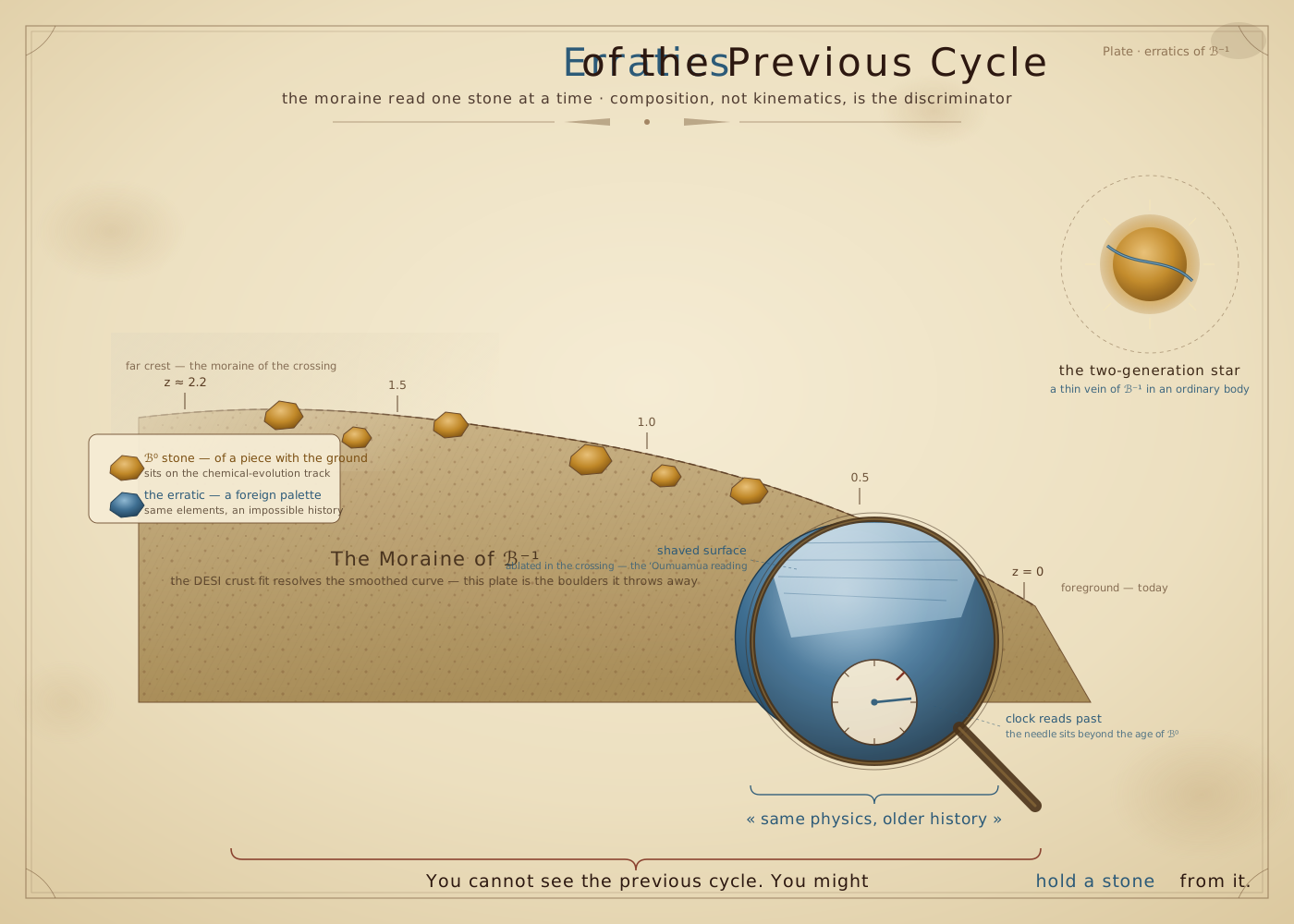
The stone that does not fit
Walk a glacial valley in the Alps or New England and you will find, sitting on the granite, a boulder of a rock that has no business being there — a lump of gneiss resting on limestone, a stone whose nearest outcrop is two hundred kilometres north. Geologists call it an erratic. The ice carried it from somewhere else and dropped it when the ice melted. The boulder is the single most eloquent object in the whole moraine, because it is the one piece that does not match its surroundings, and the mismatch is the evidence: it records a journey the smoothed-out till cannot.
The boiling-universe picture says our cosmos sits inside exactly such a moraine. Our bubble \mathcal{B}^0 expanded outward through the remnant boundary of the previous cycle \mathcal{B}^{-1}, and what it met there was not a featureless density curve but a glacial deposit — and a glacial deposit is never only a profile. It is studded with erratics: the collapsed cores, compact remnants, and shaved husks of the previous cycle’s own structure, too dense to be swallowed whole by the expanding wall, left behind as a discrete population caught up near the outer reaches of \mathcal{B}^0’s interior. The DESI crust fit resolves only the relaxed density curve f(z) — the substrate smoothed. This chapter is about the boulders the smoothing throws away.
The framework has already asked one question about them and answered it: do the erratics, as a population, move the growth of structure? That is the statistical, kinetic question — free-streaming, velocity dispersion, seeding — and WIP-31 chased it into the Lyman-\alpha forest and pinned it small (|\Delta S_8|\lesssim0.005–0.01). This chapter asks the other question, the one WIP-31 does not touch: could we catch a single erratic and prove what it is? One weighs the crowd. The other reads a stone. They are complementary, and the second is the one with a smoking gun. A third instrument — reading the crowd not by its gravity but by the chemistry it left in the sky — turned up while this chapter was being written, from work with no interest in previous cycles, and is taken up near the end.
What survives, and what it remembers
The first thing to get right is what an erratic is made of, because that is the whole game. The bulk of \mathcal{B}^0 — every atom in your body, every star you can see — was minted at the boil, where normal substrate converted to the ordered superfluid and, in the framework’s own words, “creates protons, electrons, baryonic matter all formed as vortices.” That material has no memory of before: it was melted down to raw forming energy and recast.
The erratics are the exception, and they are the exception precisely because they were not melted. They are encountered late — at the moraine, from z\approx2.2 down to the present — long after inflation, by a wall whose absorption is no longer total. The densest cores “survive cold and intact” (universe-that-boils). A body that survives cold and intact keeps its nuclei. And its nuclei were forged in \mathcal{B}^{-1}’s stars, in \mathcal{B}^{-1}’s supernovae, over \mathcal{B}^{-1}’s entire nucleosynthetic history — a history that ran to completion and then relaxed, before our boil ever lit. An erratic is a fossil of the previous cycle’s chemistry, carried across the bubble wall the way the ice carries the gneiss across the valley.
Same physics, different history — the honest constraint
Here is the discipline the idea has to accept, and it is a strength, not a weakness. A tempting version of this chapter would have erratics made of alien matter — exotic isotopes, unknown elements, a periodic table that does not close. The framework forbids that. \mathcal{B}^{-1} was the same substrate we are: same lattice, same cell occupancy, and therefore the same fine-structure constant, the same Weinberg angle, the same nuclear binding curve. Its stars ran the same nucleosynthesis on the same nuclei. An erratic is not made of strange elements. It is made of ordinary carbon and iron and europium — synthesised in a different cycle.
So the discriminator cannot be “what elements are these.” It has to be “could this history have happened here?” — a chronometric and statistical mismatch against \mathcal{B}^0’s own chemical evolution, not an exotic-matter signature. That is a sharper and more falsifiable claim than a bestiary of impossible atoms would be, because \mathcal{B}^0’s chemical evolution is measured. Four readings follow the same logic — same physics, older history — from the cleanest to the most caveated. A fifth, of a different kind — population chemistry rather than a single object — is developed further below in the supernova channel.
1. A clock that reads past the age of the sky
The sharpest is radioactive dating. Long-lived nuclei — ^{232}Th (t_{1/2}=14 Gyr), ^{238}U (4.5 Gyr), the U/Pb and Th/Pb chains — are the tools astronomers already use to age the oldest stars (nucleocosmochronometry). They give an age by comparing how much of the radioactive clock is left against how much was made. An erratic’s clock has been running since \mathcal{B}^{-1} made it — which can be older than \mathcal{B}^0 itself. The framework’s cleanest prediction is therefore the most startling one to state: a genuine erratic can date older than the universe it sits in. A rock, or a star, whose radiometric age robustly exceeds the age of \mathcal{B}^0 (\sim13.8 Gyr from within our cycle) is doing something no single-cycle object can do.
This is not an idle target. The subgiant HD 140283 — the “Methuselah star” — was measured in 2013 at 14.5\pm0.8 Gyr, formally older than the universe; tightened parallaxes and revised physics have since pulled it back to \sim12–13.5 Gyr, inside the bound. Standard cosmology must resolve every such case as measurement error, because a genuine one would break the timeline. The framework makes a different, testable prediction: there should be a residual floor of older-than-\mathcal{B}^0 ages that does not vanish as the error bars shrink — the erratics — while the majority do resolve as ordinary uncertainty. A population survey of nucleochronometric ages that collapses cleanly under Gaia/JWST-grade precision falsifies the individual-erratic picture; a stubborn tail that does not is the signal.
2. Abundances off the galactic-chemical-evolution track
Short of a clock, there is the pattern. Our galaxy’s chemistry is not random: metallicity rises with time, \alpha-elements track iron along a known curve, r- and s-process ratios follow the enrichment history. The cleanest empirical avatars of that history are the ultra metal-poor stars whose heavy elements are pure r-process with no s-process contribution — the r-rich flagship CS 22892-052 (Sneden’s star) and the r-poor benchmark HD 122563 — chemistry laid down so early that no prior generation had yet run the slow neutron capture that s-process elements require. They are the type-specimens of “the frontier where the r-process has fired but the s-process has not had time,” which is precisely the kind of history an erratic would carry frozen. An object built in \mathcal{B}^{-1} inherited that cycle’s history, which need not lie on our track. The signature is an abundance pattern that is internally self-consistent (same physics made it) but sits off the galactic-chemical-evolution locus for its measured age and kinematics — most tellingly a decoupling of the actinide clock from the stable r-process anchors. The real class of actinide-boost stars (CS 31082-001 and kin), whose Th/Eu ratios yield stellar ages so short they sometimes come out negative under standard production ratios, is exactly the kind of unexplained chronometric anomaly this reading predicts a reservoir of — flagged here as a candidate class, not a claim, because standard r-process yield scatter remains the conservative explanation and must be excluded first.
3. The ablation signature — ʻOumuamua as the flagship
The individual erratic we may already have seen is an interstellar visitor. The framework reads 1I/ʻOumuamua as an ablated erratic: it arrived “shaved down as if it had been through a bath of energy that millions of miles of empty space could never supply” (solar-system-boundaries) — the transcritical wash that sorted the moraine heated a hot component to high dispersion, and these are the shards still circulating between the galaxies. ʻOumuamua’s genuinely anomalous properties — no cometary coma, an extreme axis ratio, non-gravitational acceleration with no visible outgassing — are what the framework expects of a core that was processed by the crossing, not condensed quietly in a nearby disk. This reading is already load-bearing elsewhere in the framework, and it is the one candidate the sky hands us today. It is also where the inclination prediction meets a second, orthogonal test: an ISO that clusters near the galactic-plane angle (\sim60°) and carries a chronometric or abundance anomaly is an erratic on two independent axes at once.
4. The two-generation object
Most erratics will not arrive whole. They will be ground up, and their material folded into clouds that later formed stars — so the natural place to look is not a pure erratic but a composite: an object whose bulk composition is ordinary \mathcal{B}^0 chemistry with a minority ancient component threaded through it, a thin vein of previous-cycle material in an otherwise normal body. This is the “more than one generation in one composition” signature — a star that is chemically two things at once, a majority partner on our GCE track and a minority partner that reads older or off-track. Actinide-boost again fits the shape: a normal metal-poor star carrying an actinide component its own history cannot account for.
One honest constraint sharpens rather than softens this. The moraine encounter began at z\approx2.2 (\sim10.8 Gyr ago), so erratics were delivered to \mathcal{B}^0’s interior late — which means the cleanest hunting grounds are contemporary wanderers (ISOs) and late-accreted debris, not the oldest in-situ halo stars, which formed before the erratics could have arrived. So HD 140283 and the actinide-boost stars are type-specimens of the anomaly, illustrative of what to look for; the framework’s own timing points its sharpest bet at ISOs and accreted substructure, where the delivery is not in tension with the object’s age. Naming that constraint is part of the prediction.
What erratics did not do: seed the first galaxies
The delivery timing settles a larger question than where to hunt, and it is worth settling in the open, because the boiling-universe picture invites the conjecture almost irresistibly. If the densest cores of \mathcal{B}^{-1} survive the boil — and the biggest black holes of the previous cycle are surely the hardest things to melt — should they not be the seeds of our structure? JWST finds galaxies and billion-solar-mass quasars earlier than \LambdaCDM can comfortably build them; a population of ready-made supermassive anchors inherited from \mathcal{B}^{-1} would explain that in one stroke. The framework refuses the stroke, on its own arithmetic. Maisie’s Galaxy sits at z = 11.4, 390 million years after the boil. The first possible delivery of previous-cycle material is the moraine contact at z \approx 2.2 — ten billion years later. Nothing carried by the moraine can seed what formed before the moraine arrived, any more than a glacial erratic can be found upstream of the glacier. And the interior offers no earlier route: the observable universe inflated by \sim e^{60} from a critical bubble tens of microns across, so no object of \mathcal{B}^{-1} was ever inside — the single exception, the black hole \mathcal{B}^0 nucleated within, was consumed as the boil’s latent heat. The full three-part refusal — the mint, the geometry, the statistics — and the substrate’s own account of the early seeds (generically super-critical inflow in the coherent regime, on the over-densities the tachyonic engine sheds) are given in Early Structure Formation § The First Black Holes.
What erratics can seed is structure assembled after they arrive — z \lesssim 2.2 — and even there the honest arithmetic keeps them humble: WIP-31‘s estimator finds the cold cores’ Poisson seeding negligible at the S_8 scale unless \mathcal{B}^{-1} bequeathed cluster-mass monsters. The erratics’ real scientific value is not as architecture but as evidence — the individual smoking gun and the supernova channel — which is precisely why this chapter reads them one stone at a time.
The timing cuts both ways, and that is its virtue. It denies the framework a convenient explanation for the JWST galaxies, forcing that load onto the a_0(z) evolution and the tachyonic engine, where it is independently testable. And it exposes the erratic picture itself to a clean kill: a confirmed previous-cycle signature in material enriched before z \approx 2.2 — an over-age anomaly locked into chemistry older than the moraine contact — would break the delivery timing, and with it both this chapter’s hunting map and the no-inherited-seeds commitment. The prediction list below carries this as its own entry.
Binaries and mergers: the confound named honestly
A recurring temptation is to read weird binary and merged systems — a star with two chemically distinct populations, an over-massive contact binary, an asteroid or moon that looks like two bodies of different provenance welded together — as two cycles’ material joined. The framework’s honest position is that this is mostly a confound, not a signal. Same-cycle merging produces two-population objects all the time: galactic mergers, captured companions, and rubble-pile asteroids are all “two things welded together” from our cycle. The merging of two fermion topologies at the planetary, lunar, or asteroidal scale is a real process, but it carries no cycle-of-origin label by itself.
The discriminator does not change: it is composition, not the fact of the pairing. A merged or binary system points to \mathcal{B}^{-1} only when one component fails the chronometric or GCE test that the other passes — when the two halves cannot share a single cosmic history. Absent that, a strange binary is a strange binary. This is where the individual-erratic program is most likely to fool itself, and the chapter flags it as the first place to be sceptical, not the first place to claim a hit.
The archetypal version of this confound is the globular cluster, and it is worth naming because it is so tempting. Globular clusters sit in exactly the right neighbourhood — the outer halo, many of them demonstrably accreted from now-destroyed satellites (NGC 1261, tied to the Gaia–Enceladus merger, is a clean example) — and nearly all of them harbour multiple stellar populations, chemically distinct groups that read at first glance like “more than one history in one object.” But the multiplicity is the wrong kind. The sub-populations are very nearly coeval — self-enrichment and a brief second burst, separated by tens of millions of years, not the age of a cosmos — and both sit on \mathcal{B}^0’s own chemical-evolution track. That is a same-cycle process wearing the costume of a two-generation object. A globular cluster earns erratic candidacy only at the narrow intersection the discriminator demands: an accreted cluster that is also robustly dated older than \mathcal{B}^0 and carries a minority population off the GCE locus. The right instinct (look in the accreted outer halo) and the wrong signal (coeval multiplicity) live in the same object, which is exactly why it is the confound to state first.
The supernova channel — a population-level chemical test
The four readings above all require catching an object. There is a reading of a different kind — one that requires catching only a statistic — and the framework did not find it. It arrived from outside, in work with no interest in previous cycles, carrying data already collected for another purpose entirely.
The observation is this. Leung, Nomoto and Kusenko have shown that a sufficiently compact body transiting a white dwarf deposits enough tidal heating along its track to push the local carbon burning past neutrino cooling at \sim0.5 GK, seeding a thermonuclear runaway and detonating the star as a Type Ia supernova. Their modelling finds this channel produces SNe Ia that closely resemble standard models, matches features of real remnants (Tycho, Kepler, 3C 397) and nearby events (SN 2011fe, SN 2012cg), and — the result that matters here — that a non-zero fraction of such explosions appears to be needed to reproduce the Mn and Ni abundance trend observed across Milky Way stars.1 Their transiting body is a primordial black hole in the asteroid-mass window, proposed as dark matter.
The substrate cannot accept that identification, and says so twice. Dark matter here is the un-wound dc1 substrate itself, with the budget fully spent (quiet majority) and no second species anywhere in the framework; and, independently, the horizon floor forbids any black hole below \sim\!10^{23} kg while the boil’s Gaussianity forbids the formation of primordial ones at all. Every mass in the window they use has a Schwarzschild radius between 0.12 pm and 12 nm — four to nine orders of magnitude inside a single lattice cell.
But the mechanism never uses the horizon. Tidal ignition is Newtonian: it needs a mass, concentrated tightly enough to pass through a white dwarf’s core without being disrupted, and nothing else. So the framework is not obliged to reject the observation along with the object — it is obliged to name a different supplier. And it already carries a population of compact bodies delivered into \mathcal{B}^0 from outside its own history: the erratics.
The honest cost: a mass class the framework does not yet own
This substitution is not free, and the gap should be stated before the payoff. The erratic inventory as this chapter has built it runs to stellar-mass cold cores at one end — collapsed remnants of \mathcal{B}^{-1}, \sim10^{30} kg — and ʻOumuamua-scale shards at the other, \lesssim10^{9} kg and no denser than rock. Neither works. A stellar-mass core meeting a white dwarf is a merger, not a transit. And a rubble body carrying the right mass would be 5 to 200 km across at ordinary densities — far too diffuse to concentrate tidal heating into an ignition kernel, and shredded by ram pressure long before it reached the core. Compactness, not mass, is the binding requirement, which is exactly why the original proposal reached for black holes.
What the channel needs is 10^{14}–10^{19} kg held in a body small enough to punch through — a compactness the framework’s catalogue does not currently contain. The one candidate it can construct from parts it already owns is a sub-horizon lump of maximally-packed dc1: the same saturated state the black-holes chapter puts at a black hole’s core, but below M_\text{min}, so it has no horizon and is not a black hole. Whether such a lump is stable, and at what density, turns on a number the framework has never computed — \rho_\text{max} for the dc1 condensate — and that gap is now tracked as WIP-33. Until it closes, the supernova channel is an extension of the erratic population by assumption, not a consequence of it. It is flagged here as the newest and least-supported claim in the chapter.
The payoff: the two pictures predict opposite trends
What makes the substitution worth making despite that cost is that it is not a re-description. Swapping a primordial population for a delivered one changes when and where the channel operates, and the two readings come apart on the very observable Leung et al. already work in:
| PBH dark matter | Substrate erratics | |
|---|---|---|
| Origin | inflationary fluctuations, present since t\!\sim\!0 | moraine debris of \mathcal{B}^{-1}, delivered from z\approx2.2 |
| Spatial | traces \rho_\text{DM} — rises toward the galactic centre, fills the far halo | traces late-accreted debris — hot halo, thick disk, retrograde substructure; not the DM profile |
| Trend with [Fe/H] | channel fraction highest at low metallicity — the transit rate needs only a white dwarf, while the binary channels need time to mature | channel fraction zero at low metallicity, switching on across the halo→disk transition and rising toward the present |
| Falsifier | a channel fraction that vanishes in the metal-poor population | a channel fraction that is non-zero and flat-or-rising toward the most metal-poor stars |
The third row is the sharp one, and the signs are opposite. A primordial population is there from the beginning, and because tidal ignition requires no binary companion it should be relatively most important early, when the double- and single-degenerate channels have not yet had time to deliver. A delivered population cannot act before it arrives: erratics reached \mathcal{B}^0’s interior only from z\approx2.2 (\sim10.8 Gyr ago), so the channel is strictly absent from the chemistry laid down before then and appears only in stars enriched afterwards. The framework predicts a chronological onset where the standard reading predicts a floor — and the same GCE machinery that produced the original result can test it, by asking whether the required channel fraction goes to zero below the metallicity the Milky Way had when the moraine encounter began.
This is also, for the erratics program specifically, the instrument it was missing. The accreted-halo test below returns a null with no statistical power, because nucleochronometry on single stars is a \pm5–10 Gyr tool. The supernova channel does not need any single object identified: it reads the population through the chemistry it left behind, which is measured to far better precision than any stellar age. And its spatial prediction points at the same corner of the sky the chronometric probe already pointed at — accreted, kinematically hot, retrograde-leaning debris — which makes the two tests correlated in a checkable way rather than merely compatible.
A risk to name, in the framework’s own accounts
One consequence cuts against the paper rather than for it, and belongs on the record. The galactic dynamics chapter predicts a redshift-dependent mass step in SN Ia residuals, oscillating at the bore’s carrier frequency, and looks for it in Pantheon+. If a distinct SN Ia channel switches on at z\approx2.2 and grows toward the present, it injects a redshift-dependent systematic across exactly the window the DSW crust fit occupies — a second, non-standard population entering the standardization at low z and absent at high z. That is a confound for the bore search, and potentially a co-signature: the two effects have different shapes (an oscillating carrier versus a monotonic ramp), so they are separable in principle, but the framework should not claim the residuals without having separated them. Named here as a debt, not resolved.
The debt has since acquired an outside creditor. Direct host-age measurements now report a 5.5\sigma correlation between standardized SN Ia magnitude and progenitor age, -0.030 \pm 0.004 mag/Gyr — large enough to mimic cosmic acceleration if uncorrected [R175] — and the correction is contested [R176]. A channel that needs only a white dwarf, fires preferentially in old populations, and grows toward the present is the right shape for such a correlation; it is not yet the right size or sign, because the framework has not computed the standardized brightness of a transit-triggered explosion relative to the binary channels. The gravitational side of the question is closed in the crust chapter — the candle is untouched by a_0(z) or by G_\text{eff}, so any real age effect is astrophysical and lands here (§ Type Ia supernovae as a test of G_\text{eff}).
One channel, three instruments
The relation to WIP-31 is worth stating plainly, because these are the same population read with different instruments, and none double-counts the others:
| WIP-31 (statistical) | This chapter (individual) | Supernova channel (population chemistry) | |
|---|---|---|---|
| Question | Does the erratic population shift structure growth? | Can we identify a single erratic? | Did erratics detonate white dwarfs, and when? |
| Observable | S_8, Lyman-\alpha P_\text{1D} suppression | radiometric age, abundance pattern, ablation | Mn, Ni, ^{57}Ni vs. [Fe/H]; SN Ia remnant yields |
| Method | free-streaming + seeding on 8\,h^{-1}Mpc | nucleochronometry, GCE offset, ISO spectroscopy | GCE fit for the required non-standard channel fraction |
| Verdict | bounded small, |\Delta S_8|\lesssim0.005–0.01 | a smoking gun if one object dates older than \mathcal{B}^0 | untested; the framework predicts an onset, PBH-DM predicts a floor |
| Failure mode | absorbed into neutrino/WDM bounds | absorbed into measurement error / GCE scatter | absorbed into SN Ia progenitor-model systematics |
The statistical channel is nearly spent — the crowd barely moves the needle. The individual channel is wide open, because a single robustly-dated over-age object would be worth more than any shift in a growth parameter: it would be a held sample of the previous cycle, the direct evidence the moraine’s smoothed curve can only imply. The supernova channel sits between them: it cannot hand us a sample, but it is the only one of the three whose decisive data has already been taken.
A first look at the data: the accreted-halo test
The two readings above can be combined into one test that existing data can already attempt. The framework says erratics were delivered late, so a chronometrically over-age star should be found preferentially among accreted halo debris rather than among in-situ stars — and the sharpest form uses the boost-insensitive Th/U clock, asking whether an over-age residual survives inside the accreted population after the ordinary dwarf-galaxy enrichment story is subtracted. We ran that test as a feasibility probe: nucleochronometric ages for metal-poor stars (Th/Eu and Th/U from the JINAbase compilation) cross-matched to Gaia DR3, with each star tagged in-situ or accreted by its galactocentric orbit (L_z, energy).
The honest result is a null with no statistical power, and both halves of that phrase matter. The pipeline passes its sanity check — the raw fraction of accreted stars climbs with r-process enhancement (0.44 \to 0.71 from normal to r-II stars), reproducing the known correlation, though at fixed metallicity it flattens, so most of that trend is a metallicity effect rather than an r-process one. But the age test itself finds nothing: the accreted and in-situ age distributions are statistically indistinguishable (Th/Eu medians 7.9 vs 7.5 Gyr; Mann–Whitney p\approx0.25), and there is no over-age tail preferentially in the accreted class.
Figure 1 shows why no power is the operative half. About a quarter of the computed ages come out negative — physically impossible — which is the fingerprint of a \pm5–10 Gyr systematic (dominated by the theoretical production ratios) swamping the signal. The single most “over-age” star in the sample, at a nominal 37 Gyr, is an in-situ disk star with an obviously spurious clock, not a survivor of \mathcal{B}^{-1}. The robust Th/U chronometer exists for only \sim15 stars, and the parallax-quality cut biases the surviving sample toward nearby, in-situ stars. At this precision and sample size a null is expected whether or not the prediction is true — the experiment cannot yet distinguish the two.
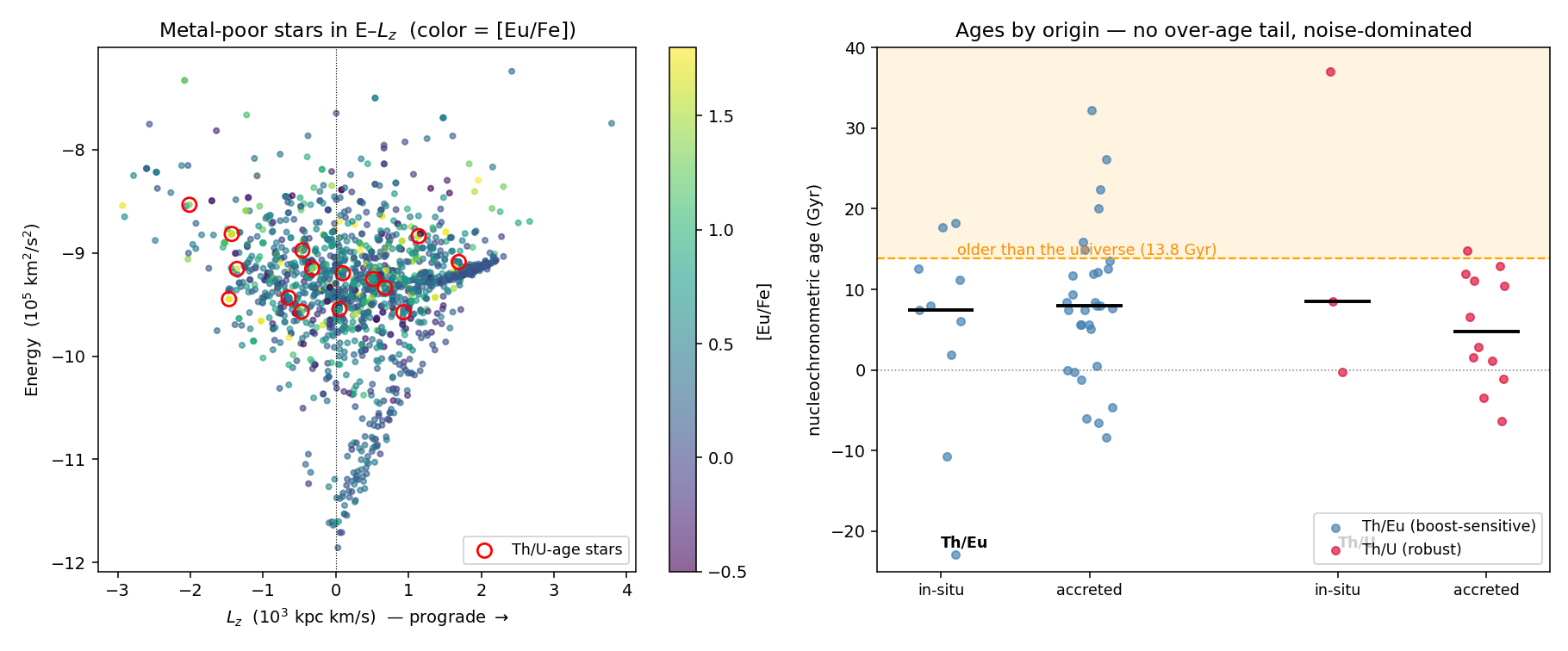
One thread is worth flagging for whoever comes back to this — as a pointer, explicitly not a result. The only two Th/U stars whose over-age readings are physically plausible rather than noise — CS 31082-001 (\sim13.7 Gyr, the actinide-boost prototype) and HE 1523-0901 (\sim12.0 Gyr) — both sit on retrograde, accreted (Sequoia-like) orbits, in the same corner of the halo as a real population of \sim45 retrograde r-II stars. That is the direction the framework points. It is also, at N=2, exactly what small-number coincidence looks like, and the retrograde halo’s r-enrichment already has a conventional account. The value of the probe is not this hint but its map: it says the decisive measurement is U detections in many accreted stars at few-Gyr precision — the ELT / high-resolution-spectroscopy regime — and it leaves a reproducible pipeline (data/erratics/ in the source tree) pointed at that target.
Predictions and falsification
A residual floor of over-age objects. A population survey of nucleochronometric ages should retain a small tail of robustly older-than-\mathcal{B}^0 ages that does not collapse as precision improves. If every such case resolves to within-error under Gaia/JWST-grade data (as HD 140283 largely has), the individual-erratic picture is falsified at stellar scale.
ISOs are the cleanest hunting ground. Because erratics were delivered late, the framework’s sharpest bet is on interstellar objects and late-accreted debris, not old halo stars. An ISO that is both inclination-clustered near \sim60° (feedback-topology) and carries an anomalous composition/ablation signature is an erratic on two independent axes. Sample return or high-resolution in-situ spectroscopy of an ISO (a Comet-Interceptor-class or dedicated ISO-rendezvous mission) is the decisive experiment.
The anomaly is chronometric/statistical, never exotic-matter. Erratics carry ordinary elements with an impossible history, not impossible elements. A confirmed exotic isotope or non-standard nuclear physics in a candidate would falsify this reading (and most of the rest of the framework with it) — the prediction is specifically an off-track history under standard physics.
Composition, not pairing, is the label. A merged or binary system implicates \mathcal{B}^{-1} only through a per-component history mismatch. No morphological feature of a binary — mass ratio, contact, two-population spectra — counts on its own.
The transit-triggered SN Ia channel switches on, it does not float. If the Mn/Ni trend really requires a non-standard Type Ia channel, the framework predicts its required fraction goes to zero below the metallicity the Milky Way carried at z\approx2.2, and rises thereafter — because a delivered population cannot act before it arrives. A primordial-black-hole population predicts the opposite sign, being relatively strongest in the metal-poor regime where the binary channels have not yet matured. Falsified if the required channel fraction is non-zero, and flat or rising, toward the most metal-poor stars. The same reading predicts the channel traces accreted, kinematically hot substructure rather than the dark-matter profile, so it should be weak toward the inner Galaxy and absent from the far smooth halo — the opposite of a \rho_\text{DM}-tracing population.
No black hole is doing this. Whatever transits the white dwarf, the framework says it has no horizon: M_\text{min}=\xi c^2/2G\approx10^{23} kg puts every mass in the proposed window four to nine orders of magnitude below the smallest possible black hole (black holes § the horizon floor). A confirmed asteroid-mass primordial black hole falsifies that floor directly, and takes the erratic reading of this channel with it.
Nothing from \mathcal{B}^{-1} predates the moraine contact. Erratics seed nothing before z \approx 2.2 — in particular, not the JWST galaxies or the early quasars, which the framework must and does explain internally (early-structure-formation). Falsified if a confirmed previous-cycle signature appears in material whose enrichment demonstrably predates the moraine contact — an over-age anomaly locked into chemistry older than z \approx 2.2. Note the direction of the knife: an over-age object found among late-accreted debris is the prediction (item 1); an over-age component woven into pre-contact chemistry is the falsifier.
Honest assessment
What is solid is the logic: if the moraine picture is right at all, it carries erratics, those erratics keep the previous cycle’s nuclei, and the only honest discriminator is a history that cannot have happened in \mathcal{B}^0. That chain is tight, and it turns a piece of the framework’s most speculative cosmology into a program with a concrete smoking gun — an object that dates older than the sky.
What is newest and least settled is the supernova channel. It is the chapter’s only population-level instrument and the only one whose decisive data already exists, which makes it the most valuable addition here — but it is bought on credit. It requires the erratic population to extend down into a compact sub-planetary mass class the framework does not yet own, whose only available construction is a sub-horizon lump of saturated dc1 that nobody has shown to be stable, at a density the framework has never computed (WIP-33). Two things are worth separating. The negative half — that no primordial black hole is doing this, by two independent arguments — is solid and follows from machinery the paper already owns. The positive half — that erratics are doing it instead — is an assumption laid on top of the erratic picture, not a consequence of it, and if WIP-33 closes against a stable lump then the framework is left denying the identification with nothing to put in its place. That is a real possible cost and it is booked here rather than hidden: on this one point the framework’s negative claim is much stronger than its positive one.
What is a bet, and a long one, is that any real object clears the confounds. Every candidate this chapter names — Methuselah’s revised age, the actinide-boost stars, ʻOumuamua’s oddities — has a conservative single-cycle explanation that must be excluded first, and measurement error and GCE scatter are patient adversaries. The accreted-halo test above is the framework being honest about exactly that: run today, the sharpest version of the prediction returns a null, and the chronometry is too coarse for the null to mean anything yet. That is the state of the evidence — a clear target and an instrument not yet sharp enough to hit it. The framework does not claim any of them is an erratic. It claims something more modest and more testable: that the previous cycle, if the crust is its moraine, must have left boulders; that those boulders are individually identifiable in principle by a clock that reads too old; and that the residual tail which survives every tightening of the error bars — if it survives — is the closest thing to a held sample of \mathcal{B}^{-1} we will ever have. The stone that does not fit is the one worth picking up.
Footnotes
Leung, S.-C., Nomoto, K., Kusenko, A., et al., “Primordial Black Hole Triggered Type Ia Supernovae I: Impact on Explosion Dynamics and Light Curves,” ApJ, 2025, arXiv:2507.21041; “II: Comparison with Supernova Remnants and Galactic Chemical Evolution,” ApJ, 2026, arXiv:2606.07505. [R144, R145]↩︎