Gold in the Substrate
A token the arithmetic cannot make — why one metal’s colour is a measurement of the substrate’s own speed limit; the spectator you can buy back, and what it costs in volts; why mercury bonds like a noble gas and caesium auride is a salt; four ways to be the wrong ion in the right hole; and why the one element that cannot be spent chemically became money
The token that is not counted
Five chapters of this section have run on arithmetic. Count the half-boundaries an atom has, count the closed surfaces in its way, count the empty slots it cannot fill, and everything else follows: carbon’s double zero, nitrogen’s single routable bit, lithium’s three vacancies, iron’s five buried lobes, group 14’s four-and-four repeated five times down a column. Three tokens — participant, spectator, vacancy — and every one of them made the same way, by counting electrons into shells.
The silicon chapter reached the bottom of its column and found a token that is not made that way, and could do nothing with it but name it. Lead has four participants by every count the section knows how to run, and behaves as though it has two. Its stable oxidation state is +2; PbO₂ is a violent oxidant; the same flip runs across thallium and bismuth on either side. Nothing in the arithmetic moved. What moved is a speed.
This chapter is that token, worked properly.
It is also the one chapter in this section where the periodic table reaches back into the paper’s own foundations, and that is the reason to write it rather than leave the breadcrumb. Everywhere else, the section has been doing standard chemistry in borrowed vocabulary — surfaces instead of orbitals, mergers instead of bonds — and the substrate has been a way of speaking rather than a thing being measured. Here the governing parameter is
Z\alpha \;=\; \frac{\text{circulation speed of the innermost boundary}}{\text{the substrate's own signal speed}}
and the paper has a chapter on each half of that ratio. The denominator is not a postulate here: c is emergent, a property of the substrate’s dispersion, the speed at which the medium can pass a disturbance along. The numerator is what an electron in a heavy atom actually does. And the constant that converts between them, \alpha, is the one number this framework claims to derive from boundary geometry.
So the heavy end of the periodic table is the one place in ordinary matter where the substrate’s speed limit is not a background assumption but a term in the chemistry. Gold is yellow because an electron is going fast enough to notice what it is going fast through.
That claim is not the framework’s invention — relativistic quantum chemistry has been quantitative about it since the 1970s, and the uranium chapter already names the four anomalies everyone knows. What this chapter adds is what those anomalies are made of on the ledger: a fourth way to make a token, a controlled experiment that isolates it, and one property that distinguishes it sharply from the three the counting produces.
One ratio, and which shells feel it
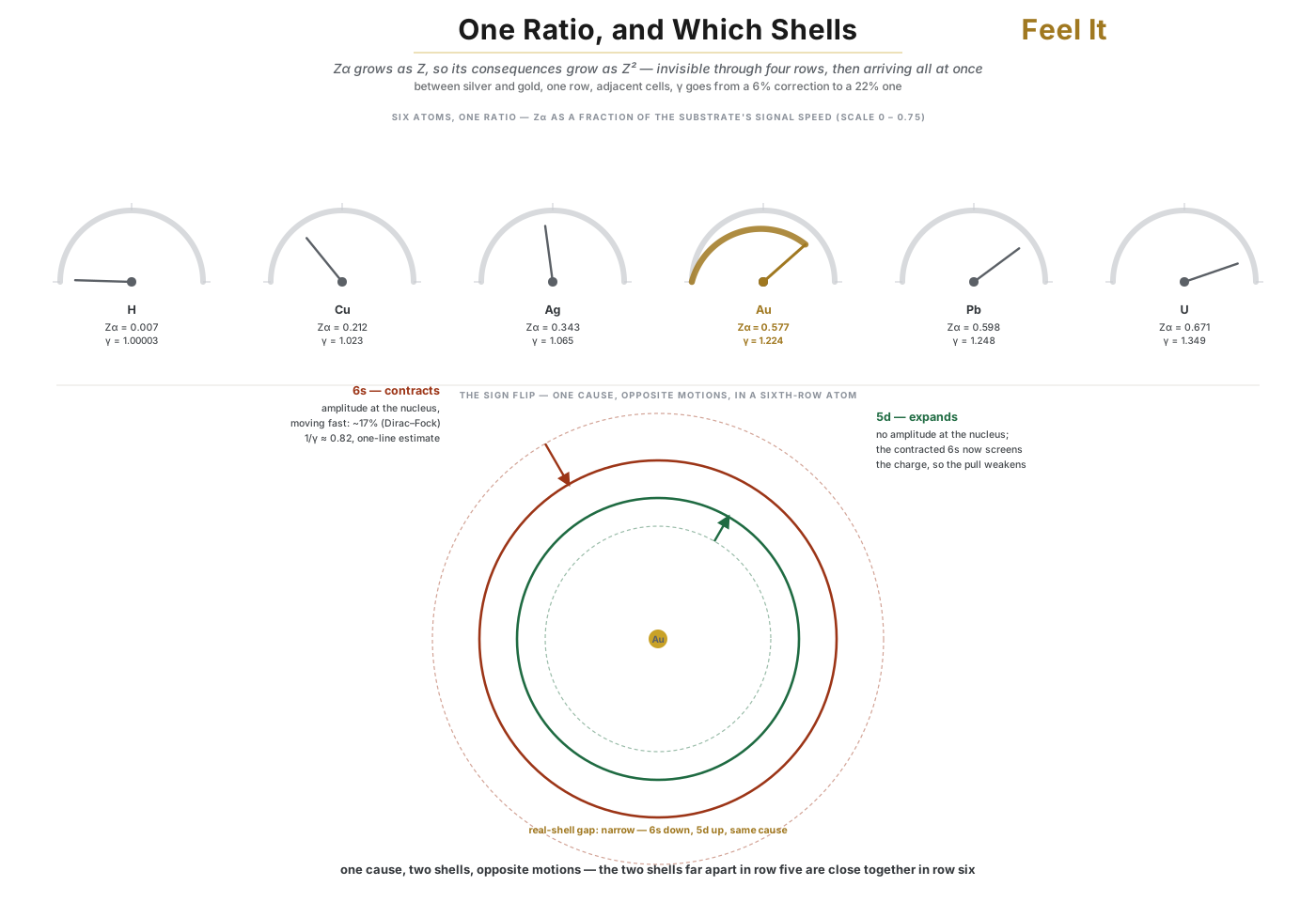
The estimate is a single line and it is old. An electron in the innermost shell of an atom of nuclear charge Z circulates at approximately Z\alpha\,c. For hydrogen that is 0.7\% of the substrate’s signal speed and nothing whatever happens, which is why the first four rows of the table can be done entirely by counting.
| Z | Z\alpha | \gamma = (1-(Z\alpha)^2)^{-1/2} | |
|---|---|---|---|
| H | 1 | 0.007 | 1.00003 |
| Cu | 29 | 0.212 | 1.023 |
| Ag | 47 | 0.343 | 1.065 |
| Au | 79 | \mathbf{0.577} | \mathbf{1.224} |
| Hg | 80 | 0.584 | 1.232 |
| Tl | 81 | 0.591 | 1.240 |
| Pb | 82 | 0.598 | 1.248 |
| Bi | 83 | 0.606 | 1.257 |
| U | 92 | 0.671 | 1.349 |
The quantity grows as Z, so its consequences grow as Z^2, which is why the effect is invisible through four rows and then arrives all at once. Between silver and gold — one row, adjacent cells in the same column — \gamma goes from a 6\% correction to a 22\% one.
The framework’s reading of what a \gamma of 1.22 does to a boundary is already on the page, in the uranium chapter, and it uses two results the paper owns. The speed limit chapter says anything with a standing core builds a bow wave against the medium and gains inertia from it. The reach law says an excitation’s coherent wake extends one Compton length, \hbar/mc — heavier is shorter. An innermost shell is a boundary whose radius is its reach. So a boundary that has become 22\% heavier by moving fast is a boundary 22\% smaller, and the crude one-line estimate is 1/\gamma = 0.82. Full Dirac–Fock calculations put gold’s 6s contraction at roughly 17\%. The one-line version is not exact and gets the size right.
Then comes the part that does all the work, and it is a sign flip:
A boundary with amplitude at the nucleus — the s shells, and the p_{1/2} shells — contracts, because it is the one that is moving fast. A boundary with no amplitude at the nucleus — d and f — expands, because the contracted inner shells now screen the nucleus better and the outer folds feel a weaker pull.
One cause, opposite effects on the two kinds of shell. Every anomaly in this chapter is the gap between those two opening. That is worth stating flatly, because it is what makes the effect chemically visible rather than merely large: if everything contracted together, an atom would just be smaller and nothing about its chemistry would change. What changes chemistry is that the 6s came down while the 5d went up, and the two shells that were far apart in the fifth row are close together in the sixth.
Which sets up a test the section knows how to run.
The controlled experiment is a column
The iron chapter has one argument I think is the strongest in the section, and its strength is entirely in its design: ruby and emerald are the same ion. Cr³⁺ in corundum and Cr³⁺ in beryl, same element, same oxidation state, red and green — so whatever explains the difference cannot be a property of chromium. One variable, isolated.
Group 11 offers the same design one row up, and the isolated variable is Z itself.
| Cu | Ag | Au | |
|---|---|---|---|
| Z\alpha | 0.212 | 0.343 | \mathbf{0.577} |
| Valence configuration | d^{10}s^1 | d^{10}s^1 | d^{10}s^1 |
| Metallic radius (pm) | 128 | 144 | \mathbf{144} |
| First ionization energy (eV) | 7.73 | 7.58 | \mathbf{9.23} |
| Electron affinity (eV) | 1.24 | 1.30 | \mathbf{2.31} |
| E^\circ(\mathrm{M^+/M}) (V) | +0.52 | +0.80 | \mathbf{+1.69} |
| Interband onset (eV) | 2.1 | 3.9 | \mathbf{2.4} |
| Colour | red | white | yellow |
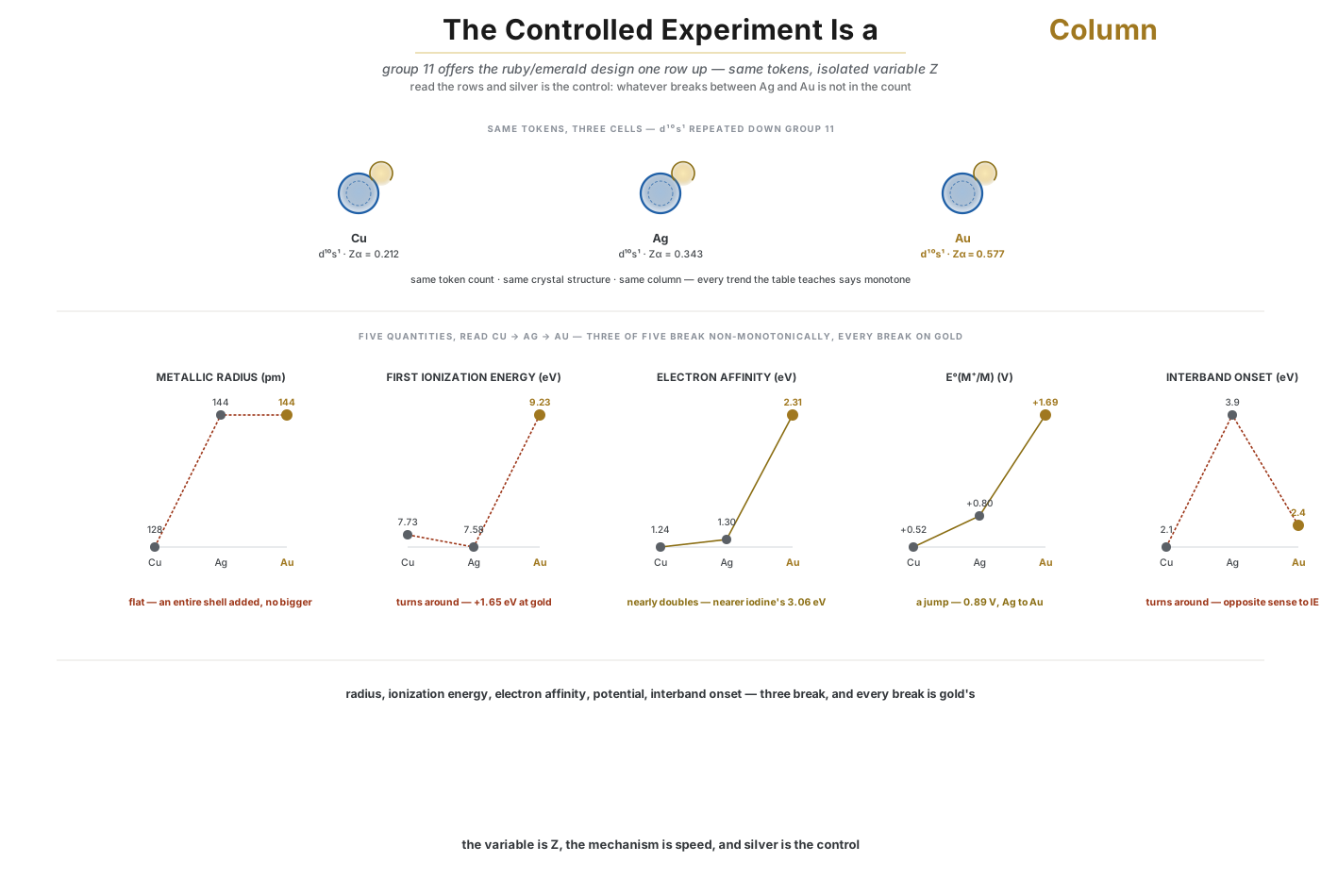
Same token count in all three cells. Same crystal structure. Same column, so every trend the periodic table teaches says these should be a monotone series. Read the rows.
The radius does not grow. Silver sits one row below copper and is 16 pm larger, which is what a row is worth. Gold sits one row below silver and is the same size. An entire principal shell has been added and the atom did not get bigger — the row’s growth and the contraction cancelled, to the precision of the measurement.
The ionization energy turns around. It falls from copper to silver, as every column in the table does, and then jumps by 1.65 eV at gold. Gold is harder to ionize than copper, which sits two rows above it.
The electron affinity nearly doubles. Copper and silver differ by 0.06 eV. Gold exceeds silver by a full electronvolt, and lands closer to iodine’s 3.06 eV than to any other metal’s.
And the interband onset turns around in the opposite sense to the ionization energy, which is the detail that matters most and I will come back to it.
Five quantities. Three of them are non-monotone down a column that has no arithmetic reason to be anything but monotone, and every one of the breaks lands on the same cell. The variable is Z, the mechanism is speed, and silver is the control.
None of this is new and none of it is the framework’s. Relativistic effects in heavy-element chemistry were established by Pyykkö, Desclaux, Schwerdtfeger and others from the late 1970s onward; the calculations are Dirac–Fock or four-component coupled-cluster, they are quantitative, and they reproduce every number in the table above. The framework computes none of them, and the 1/\gamma estimate above is a plausibility check, not a derivation.
What the framework contributes is placement. The section has spent five chapters insisting that the periodic table’s behaviour is set by a small number of counted tokens; this is the region where that is false, and rather than being an embarrassment it turns out to be the section’s tightest connection to the rest of the paper. The claim being made is that Z\alpha belongs in the ledger’s vocabulary as a fourth way to make a token, that the token it makes has a property none of the counted ones have, and that the region it governs is exactly the region where the counting fails. Whether that is insight or bookkeeping is a fair question; the next four sections are the case for insight.
One caveat on the table above, because it is the kind of thing this section is supposed to concede. Copper’s colour is not relativistic. Copper is red because its 3d shell sits close to its 4s for ordinary shell-structure reasons, with Z\alpha=0.21 and \gamma = 1.02 doing essentially nothing. So the colours down group 11 are red–white–yellow, and the two coloured members are coloured for different causes. That is a genuine muddying of a clean-looking row, and it is not an argument against the reading — the counterfactual calculations put non-relativistic gold at silver’s onset, not copper’s — but it does mean the column cannot be read as a single trend in colour, and the honest statement is narrower: silver and gold differ by one variable, and gold’s break is in the direction and of the size the speed predicts.
Why gold is yellow, and why it takes two signs
A metal’s colour is set by where its interband absorption begins. Below that threshold the conduction sea returns everything and the metal is a mirror; above it, photons are spent lifting flow out of the filled d shell and onto the raceway, and those colours go missing.
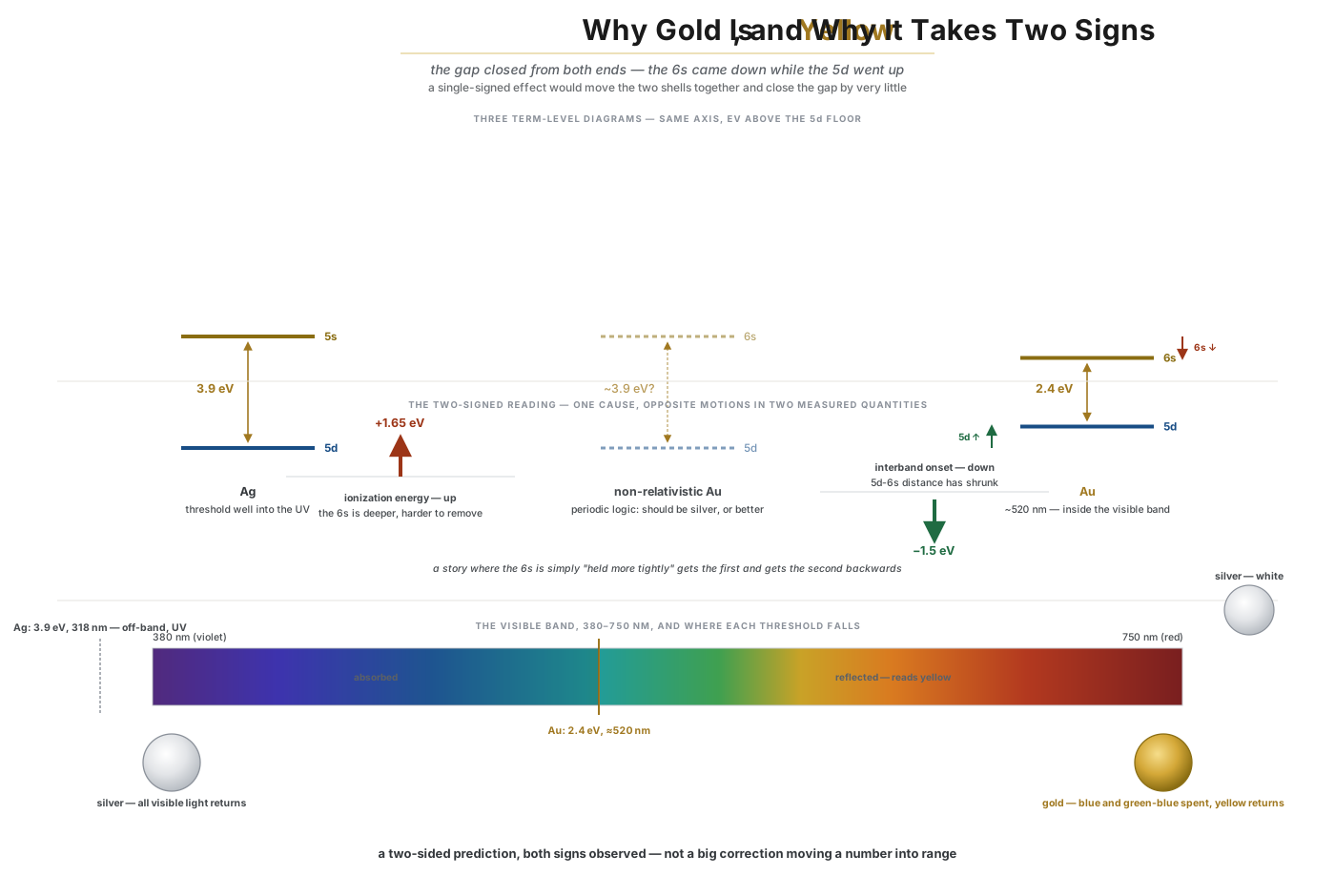
Silver’s 4d \to 5s threshold sits at about 3.9 eV, well into the ultraviolet. The whole visible band lies below it, all of it comes back, and silver is white — the best mirror in the table, which is why it is the coating on every telescope that can afford it.
Gold’s 5d \to 6s threshold should sit in the same place. Periodic logic says the sixth row’s shells are further apart than the fifth’s, if anything, so gold should be a slightly better silver. It sits at about 2.4 eV instead — around 520 nm, inside the visible band. Gold absorbs blue and green-blue and returns the rest, and the rest is yellow.
Now the detail I flagged, because it is the sharp part of this section and it is easy to skate past.
The gap closed from both ends. The 6s came down because it contracts; the 5d went up because it expands. Those are opposite motions from one cause, and the visible-range coincidence needs both of them. A single-signed effect — everything contracting, or everything expanding — moves the two shells together and closes the gap by very little. It is the sign flip that does the work, and the sign flip is not an extra assumption: it follows directly from which shells have amplitude where the speed is.
That gives the chapter’s colour argument a shape the section values. It is not “a big correction moved a number into the right range,” which almost any large effect could do. It is a two-sided prediction: the same cause must push the ionization energy up (the 6s is deeper, harder to remove) and the interband onset down (the 6s is deeper but the 5d is shallower, so the distance between them shrank). Those are opposite motions in two measured quantities, and gold does both — +1.65 eV on the ionization energy and -1.5 eV on the interband onset, relative to silver.
A story in which gold’s 6s is simply “held more tightly” gets the first and gets the second backwards. Only the two-shell version gets both.
The gold maximum
The section’s most evidentially valuable move is pattern five: when a real outcome depends on two requirements that vary monotonically in opposite senses, the outcome cannot be monotone, and a framework that says where it turns around has said something a size-ordered story cannot recover by accident.
Relativistic chemistry has one of these and it is called, in the literature, the gold maximum.
The direct effect rises monotonically with Z: more charge, faster inner boundary, more contraction, all the way to the end of the table. But what makes contraction chemically visible is not the contraction itself — it is how exposed the contracted shell is to the outside world. And exposure falls as the sixth row fills: once the 6p shell starts, the 6s pair is buried behind it and stops being the thing chemistry touches.
Two monotone trends, opposite in sign, so the chemical consequence must peak somewhere in the interior. It peaks at Z = 79.
Read what has to be true at the maximum and the periodic table has exactly one cell that satisfies it:
- The 5d shell must be complete, so that its expansion is fully developed and there are no open folds to complicate the picture.
- The 6s shell must hold one electron, not two — a second 6s electron screens the first and softens everything.
- The 6p shell must be empty, so nothing lies outside the contracted boundary.
- And Z must be as large as those three conditions permit.
5d^{10}\,6s^1\,6p^0. That is gold, and it is only gold. Copper and silver have the configuration and not the speed. Mercury has the speed and a second 6s electron. Thallium has begun the 6p. One row, one configuration, one occupant — which is the section’s window-of-one shape arriving in a region where nobody was looking for it.
It also comes with a forward leg, which windows usually do not. Roentgenium, element 111, is gold’s congener one row further down, at Z\alpha = 0.81 and \gamma = 1.71. Every argument here says it should be more extreme than gold on every axis. Nobody has made enough of it to check, and the calculations say it should be, which is a retrodiction of a computation rather than of a measurement and is worth exactly what that is worth.
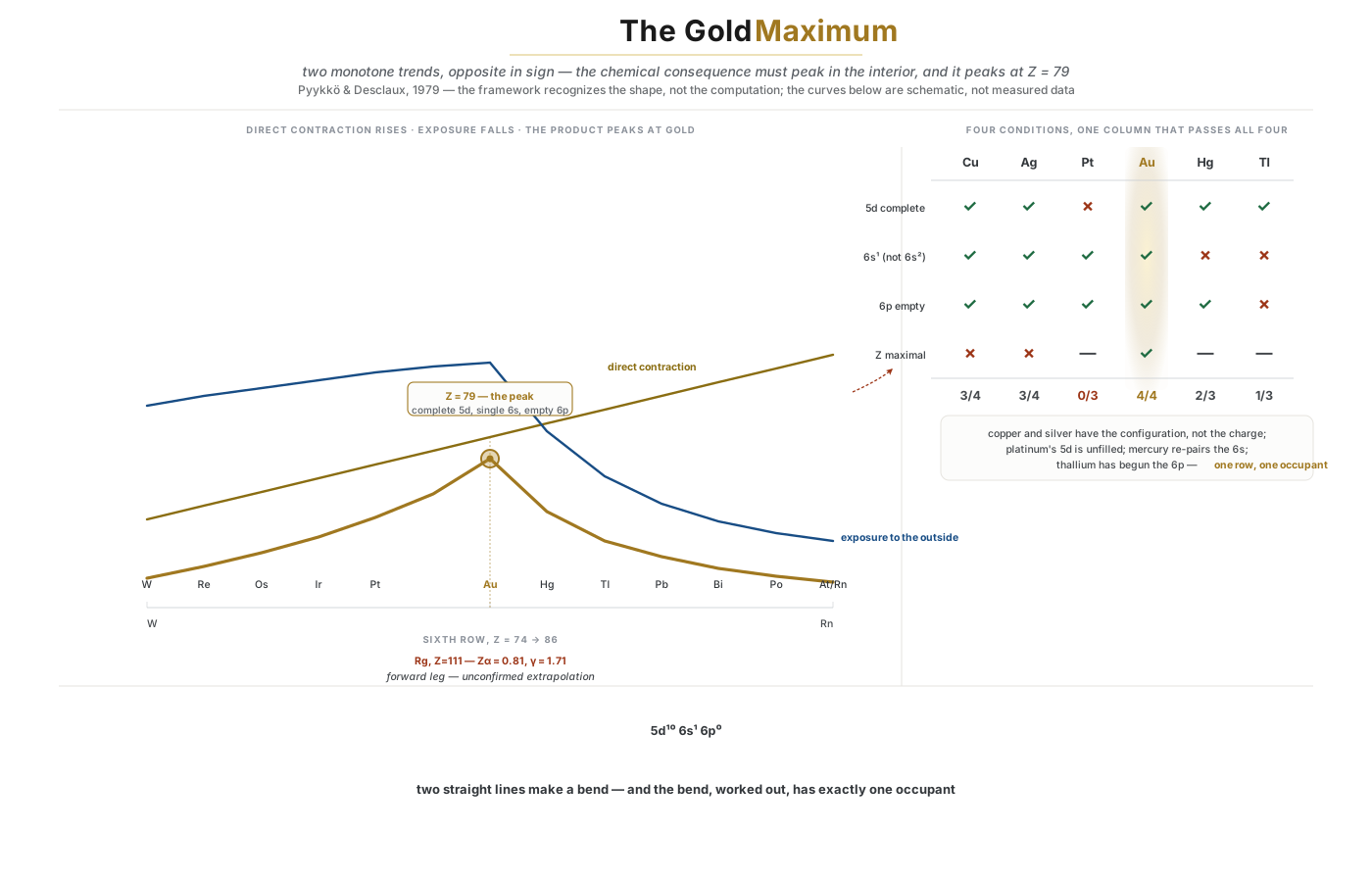
The gold maximum is a result of Dirac–Fock calculations, published by Pyykkö and Desclaux in 1979, and the framework does not compute it. What the framework does is recognize the shape — that it is the same two-opposed-monotone-trends argument the lithium chapter used to put a minimum at sodium and the iron chapter used to put a maximum in groups 8–10, appearing for a third time on an axis neither of them touched.
That is a weaker claim than the sodium one, for an honest reason: the sodium V was retrodicted in two experimentally unrelated measurements, and the gold maximum is one phenomenon read through several of its consequences. It should be counted as the section’s third instance of a forced interior extremum, not as an independent confirmation of anything.
The spectator you can buy back
Here is the chapter’s actual contribution to the ledger, and it is one distinction.
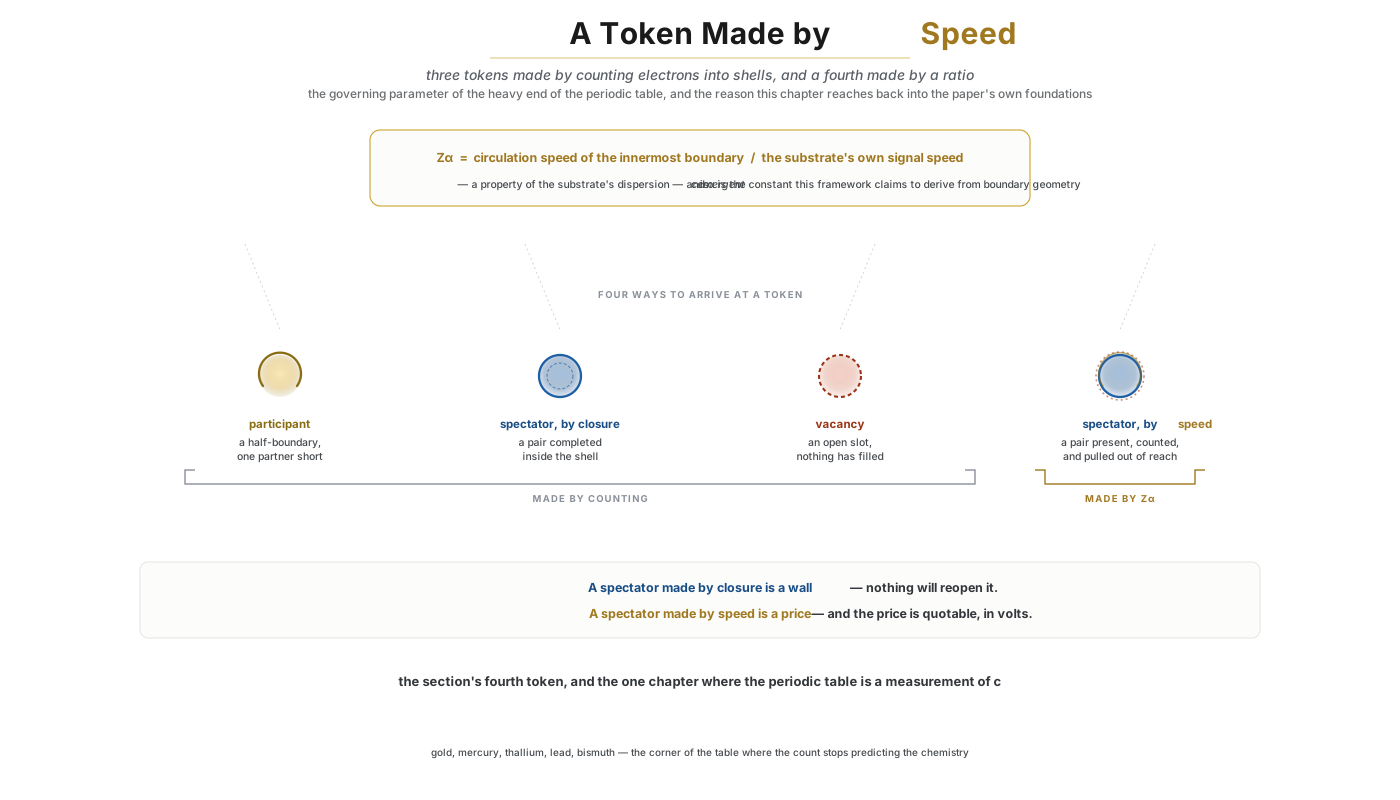
The section’s vocabulary has three tokens. It now has four ways to arrive at one:
| Way | What is physically there | Made by |
|---|---|---|
| Participant | a half-boundary, one partner short | counting |
| Spectator, by closure | a pair completed inside the shell | counting |
| Vacancy | nothing | counting |
| Spectator, by speed | a pair present, counted, and pulled out of reach | Z\alpha |
The fourth looks like the second from the outside. Lead behaves as though its 6s pair were a lone pair; thallium and bismuth do the same one column on either side. That is the inert pair effect, and read only through the chemistry it is indistinguishable from an ordinary closed shell.
It is not the same thing, and the difference is sharp:
A spectator made by closure is a wall. A spectator made by speed is a price.
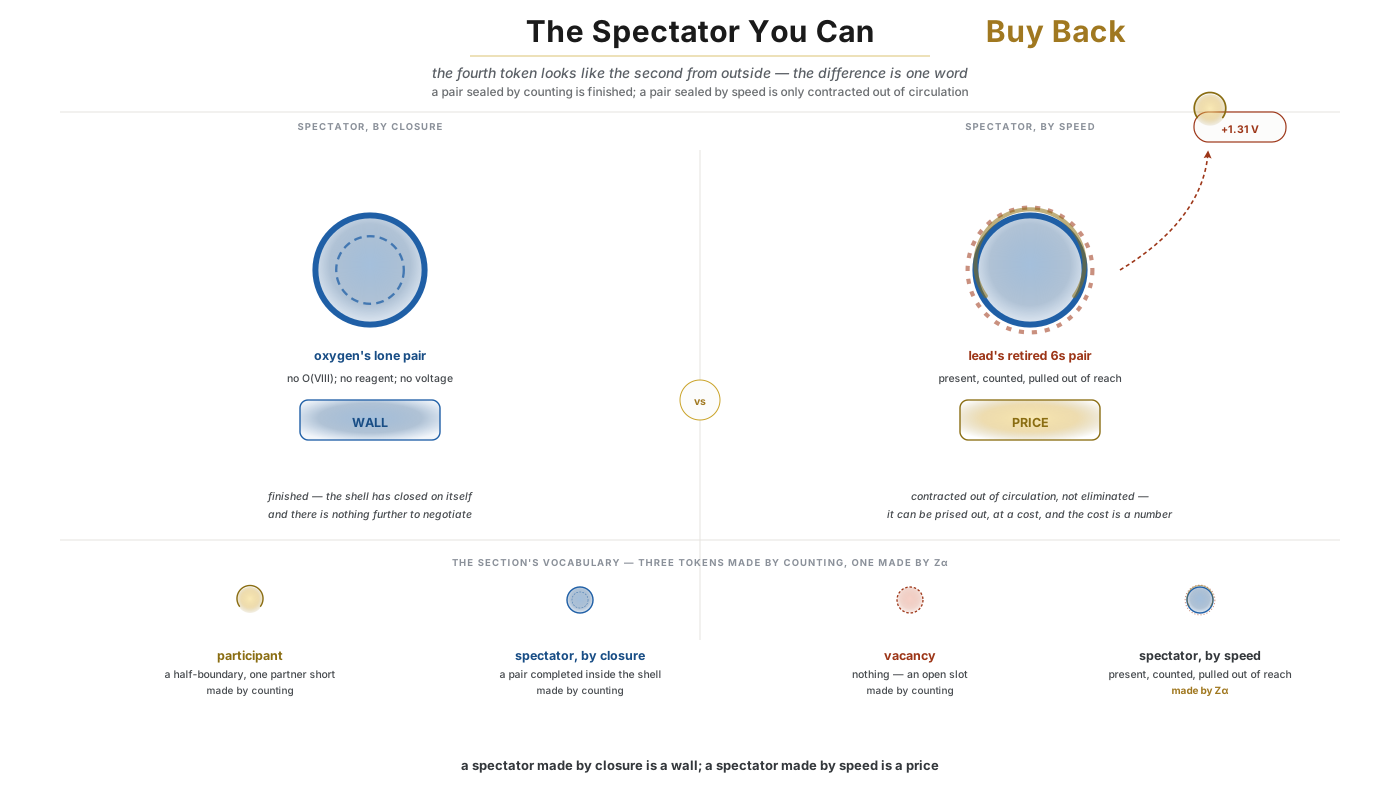
Oxygen’s lone pairs cannot be removed at any price a chemist can pay; there is no O(VIII), no reagent that would produce one, no voltage that would drive it. The pair is not merely expensive, it is finished — the shell has closed on itself and there is nothing further to negotiate. Lead’s 6s pair is a participant that is still there and still counted. It has been contracted out of circulation, not eliminated. So it can be prised out, at a cost, and the cost is a number.
That number is measurable, and the section’s own methods say where to look: compare a sixth-row element to its fifth-row congener, holding the arithmetic fixed. The fifth-row element has the same tokens by count and almost none of the speed, so the difference between the two couples is the price of the pair.
| Couple | Fifth row | Sixth row | Difference |
|---|---|---|---|
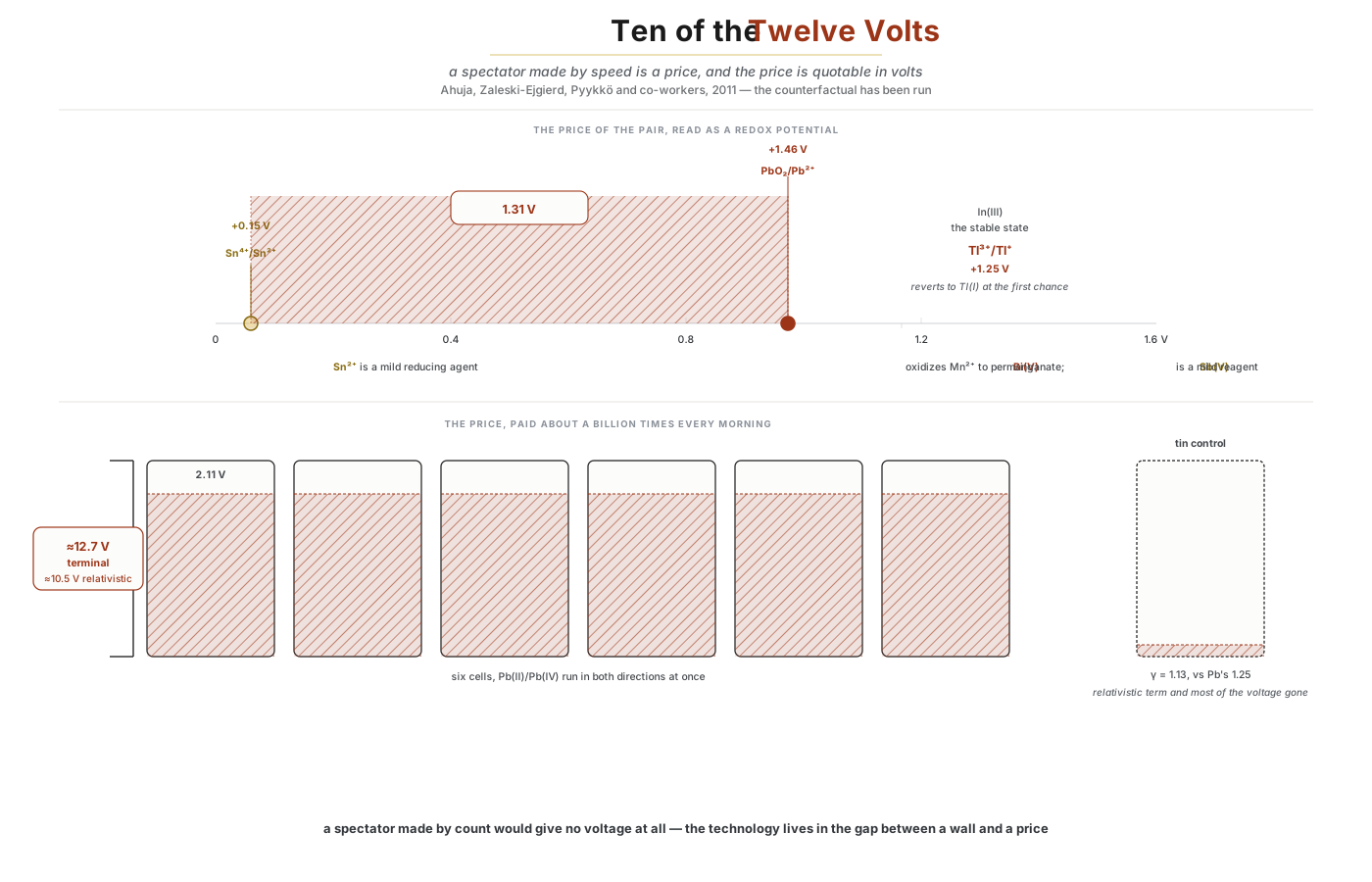
| M(IV)/M(II) | Sn⁴⁺/Sn²⁺, +0.15 V | PbO₂/Pb²⁺, +1.46 V | 1.31 V |
| M(III)/M(I) | In(III) is simply the stable state | Tl³⁺/Tl⁺, +1.25 V | — |
| M(V)/M(III) | Sb(V), a mild oxidant | Bi(V), oxidizes Mn²⁺ to permanganate | — |
Tin’s +4 state is its ordinary one and Sn²⁺ is a mild reducing agent. Lead’s +4 state is a ferocious oxidant. Two adjacent cells in one column, identical counts, opposite preferences, and the gap between the couples is about 1.3 V. Indium(III) is unremarkable; thallium(III) is a strong oxidant that reverts to Tl(I) at the first opportunity. Antimony(V) is a reagent; bismuth(V) will tear an electron out of manganese.
Every one of those numbers is the retirement bonus on a pair that speed took out of service.
Ten of the twelve volts
And then the price gets paid, about a billion times every morning.
The lead–acid cell — Planté, 1859, and still the thing that turns a starter motor — runs the Pb(II)/Pb(IV) couple in both directions at once: lead metal oxidizing to PbSO₄ at one plate, PbO₂ reducing to PbSO₄ at the other. It delivers about 2.11 V per cell, six cells to a car battery, twelve-ish volts on the terminal.
In 2011 Ahuja, Zaleski-Ejgierd, Pyykkö and co-workers did the obvious and previously undone thing: they computed the cell’s thermodynamics with the relativistic terms in, then with them out. The answer is that 1.7 to 1.8 of the 2.11 volts is relativistic in origin. Roughly ten of the twelve volts in a car battery are there because lead’s 6s pair is expensive to remove, and it is expensive to remove because an electron deep inside a lead atom is moving at a substantial fraction of the speed the substrate can pass a signal.
The control is in the same calculation and it is the one the ledger would ask for. Build the identical cell out of tin, directly above lead, same arithmetic, \gamma = 1.13 instead of 1.25: the relativistic contribution largely disappears, and so does most of the voltage.
This is the section’s favourite kind of result, so it is worth saying exactly why. It is not that relativity contributes to the lead–acid battery, which would be unremarkable — relativity contributes a little to everything. It is that a single named token, introduced to explain a colour, turns out to be most of the working voltage of the oldest rechargeable technology in industrial use, and that the counterfactual has been run and comes out where the ledger says. A spectator made by count would have given no voltage at all, because there would have been nothing to buy back. The entire technology exists in the gap between a wall and a price.
There is also a symmetry with the lithium chapter that I did not expect and cannot resist. The two great rechargeable chemistries of the industrial era sit at opposite ends of one ledger: lithium runs on the smallest naked boundary in the table, and lead runs on the fastest. One is chosen for having almost nothing inside the wrap; the other for having so much inside it that the innermost shell is relativistic. Nothing connects them except that both are boundary accounting, and both were found by engineers who were not doing any.
Mercury, which bonds like a noble gas
Move one cell right from gold and the same contraction does something else, because now the 6s shell is full.
Mercury’s 6s^2 pair is contracted so far that it stops behaving like a valence pair at all. What it behaves like is a closed shell — and the numbers say so in the bluntest available way:
| Zn | Cd | Hg | |
|---|---|---|---|
| Melting point (°C) | 420 | 321 | \mathbf{-38.8} |
| Boiling point (°C) | 907 | 767 | \mathbf{357} |
| Cohesive energy (eV/atom) | 1.35 | 1.16 | \mathbf{0.67} |
| First ionization energy (eV) | 9.39 | 8.99 | \mathbf{10.44} |
Zinc to cadmium is an ordinary column step: everything softens a little. Cadmium to mercury is not a step, it is a fall off a shelf — 360 degrees of melting point, and cohesion cut nearly in half from a metal whose atoms are heavier and ought to hold each other better.
And the ionization energy turns around again, exactly as gold’s did, and lands somewhere that should stop a reader. Mercury’s first ionization energy is 10.44 eV. Radon’s is 10.75 eV. A metal and a noble gas, within three percent of each other.
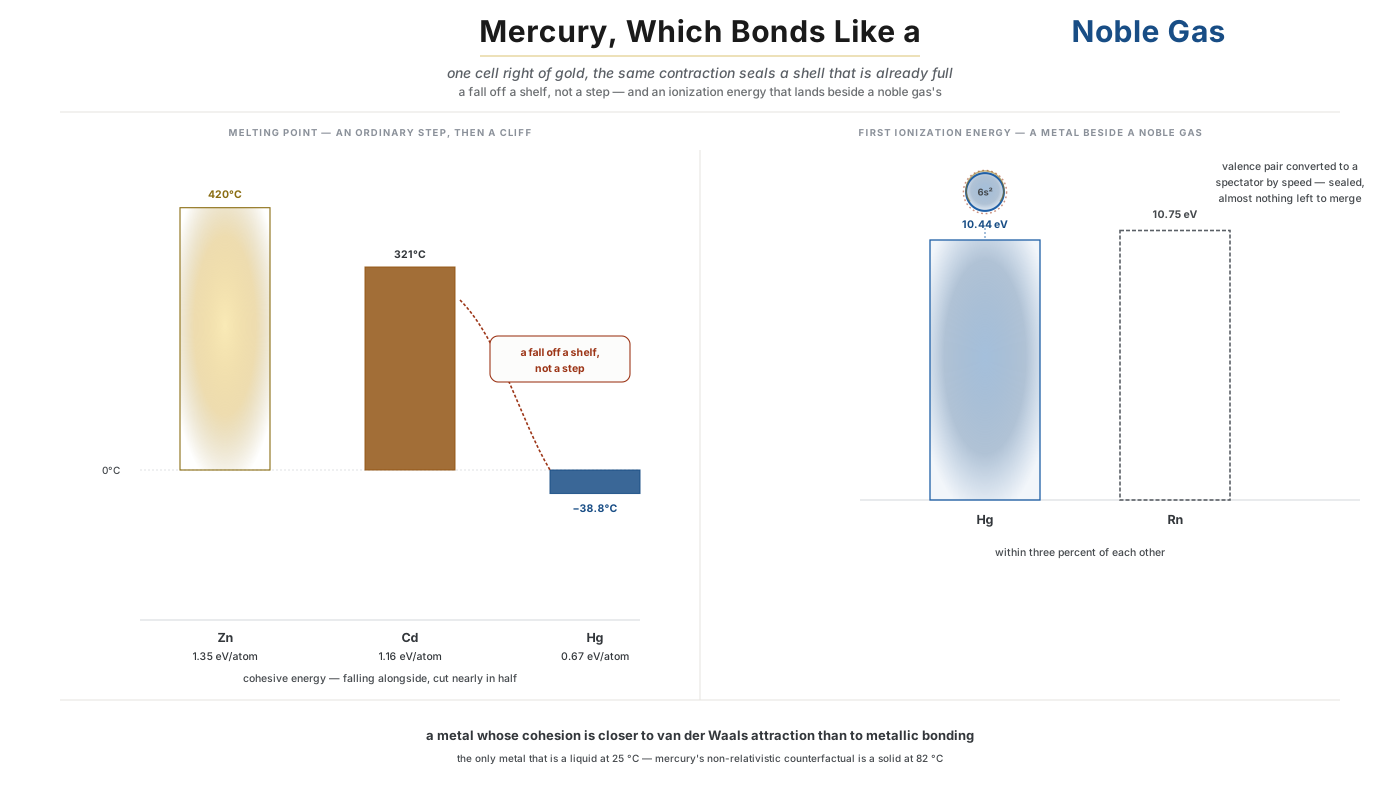
The ledger’s reading is one sentence: mercury’s valence pair has been converted into a spectator by speed, so mercury has almost nothing to contribute to a merger and almost nothing to dissolve into a raceway. It is a metal whose cohesion is closer to a noble gas’s van der Waals attraction than to metallic bonding — which is not a metaphor, it is what the cohesive energy is saying. Helium’s chapter is at the far end of the same idea (superfluid helium): a sealed shell has nothing to offer its neighbours, and a substance made of sealed shells barely holds together.
The counterfactual has been run here too. Calvo, Pahl, Wormit and Schwerdtfeger computed mercury’s melting point by relativistic molecular dynamics in 2013 and got 241 K against the measured 234 K; switch the relativistic terms off and the same calculation gives 355 K. Non-relativistic mercury would be a solid at 82 °C — a perfectly ordinary metal sitting in the column where the trend puts it. The 120 K it is missing is the speed.
So: mercury is the only metal that is a liquid at 25 °C. Caesium melts at 28.5 °C and gallium at 29.8, so the window is narrow and the claim needs its temperature stated, but at room temperature the table has exactly one, and it has one for a reason the section can name.
Two more things fall out of the same closure, both of them familiar:
Mercury forms the only common homonuclear diatomic metal cation. Hg₂²⁺ — the mercurous ion, the Hg–Hg bond in calomel — exists because a pair of mercury atoms that cannot bond usefully to anything else can at least commit their retired pairs to each other. No other metal in the table does this at ambient conditions.
And mercury’s vapour is monatomic and its liquid does not wet most things, which is why it made a barometer and a thermometer, which is why it was in every school laboratory and every dental surgery for a century, which is most of how it got into people. The instrument and the poison are the same property.
Four ways to be the wrong ion in the right hole
Which brings the chapter to the part that is not chemistry, and to an argument the section has now made three times without noticing it was making a series.
The lithium chapter found that Li⁺ and Mg²⁺ match in radius to within 6\%, so a magnesium-dependent enzyme accepts lithium geometrically — and lithium then delivers less than half the surface flux. It fits the socket and under-drives it, which is a decent structural description of a drug that damps excursions rather than switching anything.
The silicon chapter found the inverse: Pb²⁺ carries a stereochemically active spectator — the retired 6s pair still occupies space and still points — so lead enters a site and presents an asymmetric, hemidirectional coordination the site was never built for. It fits and points.
Add the two this chapter is responsible for and there are four distinct ways to be the wrong ion in the right hole, and the relativistic corner supplies three of them.
Thallium fits and is not pumped back out. Tl⁺ has an ionic radius of 150 pm against K⁺’s 138 — a 9\% mismatch, closer than lithium’s to magnesium. It is monovalent, it is soft, and Na,K-ATPase does not merely tolerate it: the pump binds Tl⁺ with roughly ten times the affinity it has for potassium. So thallium rides into every cell in the body on the machinery that maintains the potassium gradient, distributes itself the way potassium does, and then does not leave, because nothing in the cell is built to recognize it as foreign. Thallium sulfate is odourless, tasteless and was sold as rat poison and depilatory into the twentieth century; it was the poisoner’s poison for exactly this reason, and the antidote — Prussian blue — works by presenting a lattice with a better-sized cage than potassium’s own.
Mercury does not fit anything, and grips. Hg²⁺ has no socket in biology and does not need one. Its route in is a thiol: the Hg–S formation constants are enormous, and once mercury is on a cysteine it does not come off on any timescale a cell can use. Methylmercury goes further and does something the ledger should find interesting — conjugated to cysteine it is a close enough structural mimic of methionine that the LAT1 amino-acid transporter carries it across the blood–brain barrier. Not a metal-site substitution at all; a molecular mimicry at the transporter, which is why Minamata was a neurological disease and why the exposure route was fish.
Lay them out and the series is clean:
| Ion | Site | The failure mode |
|---|---|---|
| Li⁺ | Mg²⁺ | fits, and under-drives — half the flux, geometry intact |
| Pb²⁺ | Ca²⁺ | fits, and points — a spectator that occupies space asymmetrically |
| Pb²⁺ | Zn(Cys)ₙ | does not fit, and outcompetes — thiophilicity, not radius |
| Tl⁺ | K⁺ | fits, is actively imported, and is never exported |
| Hg²⁺ | no site | no socket at all — grips a thiol and does not release |
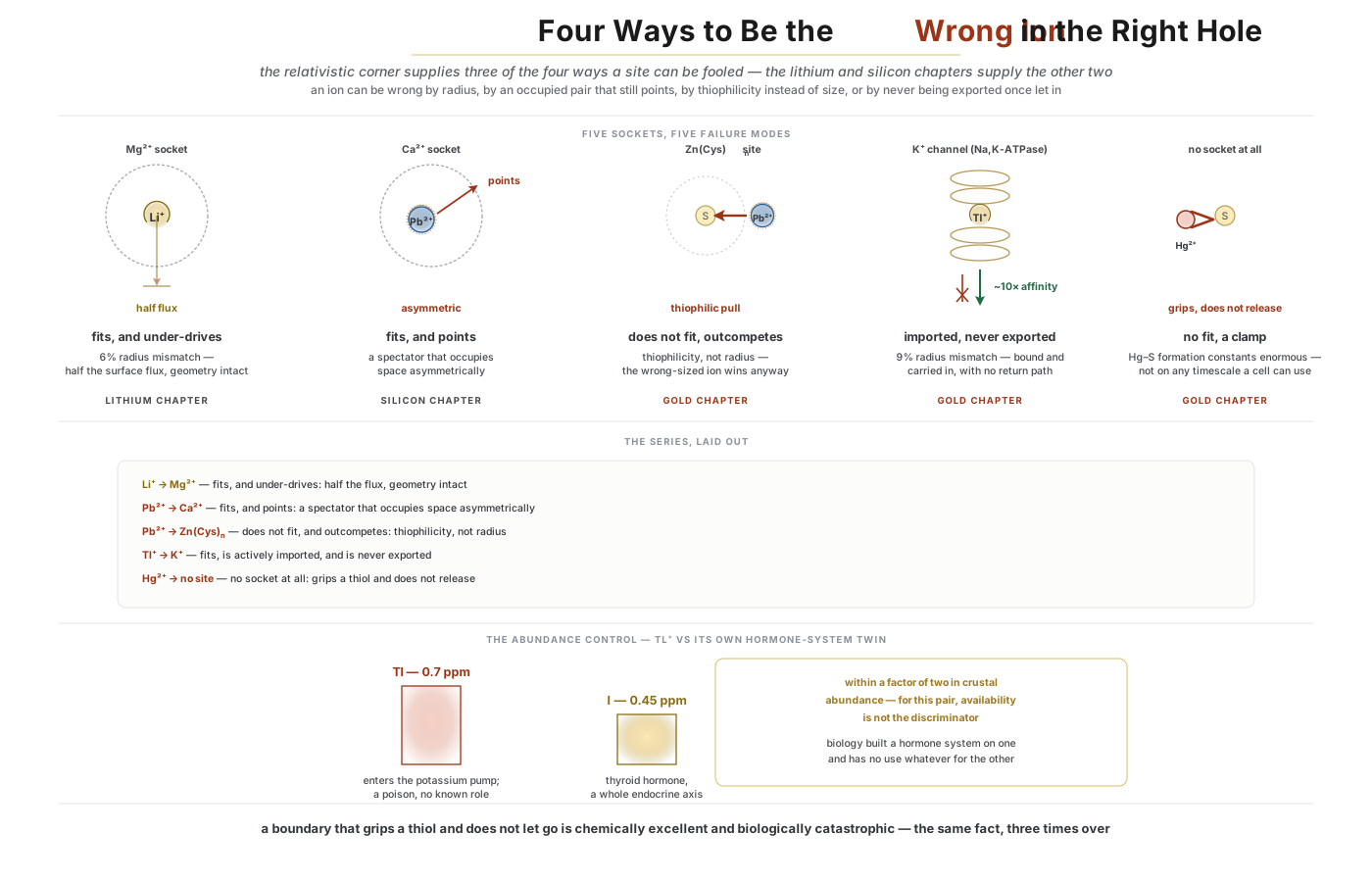
The last three are the relativistic corner, and the ledger has one sentence covering all of them. A boundary softened and enlarged by relativistic expansion of its outer d shell is a soft, polarizable, thiophilic boundary — it reaches further, deforms more readily, and binds sulfur far more strongly than oxygen. Biology’s metal economy, as the lithium chapter argued and the aluminium breadcrumb sharpened, is entirely a matter of handing: metals are passed from chaperone to site to chaperone, and a metal that cannot be handed on is not a nutrient, it is a lesion. A boundary that grips a thiol and does not let go is chemically excellent and biologically catastrophic, and those are the same fact.
Every mechanism in this section is established toxicology and none of it needs a substrate. Tl⁺/K⁺ mimicry, Pb²⁺ hemidirectionality in ALAD and calmodulin, methylmercury’s LAT1 transport — all measured, all published, all with quantitative accounts.
The framework’s claim is that the five rows of that table are one table rather than five case studies, and that the axis sorting them is the boundary property this section has been tracking throughout: how large, how soft, how readily a wrap turns over, and — new here — whether the token doing the damage was made by counting or by speed. The specific new content is the last row’s reading: that thiophilicity is relativistic d-shell expansion seen from a protein, and that it is therefore the same parameter as gold’s colour. That is a unification claim and it produces no number. It does produce a falsifier, stated in the predictions, and the falsifier is about abundance rather than chemistry.
The metal that became a halogen
Now the strangest thing in the chapter, and it is a near-miss run in reverse.
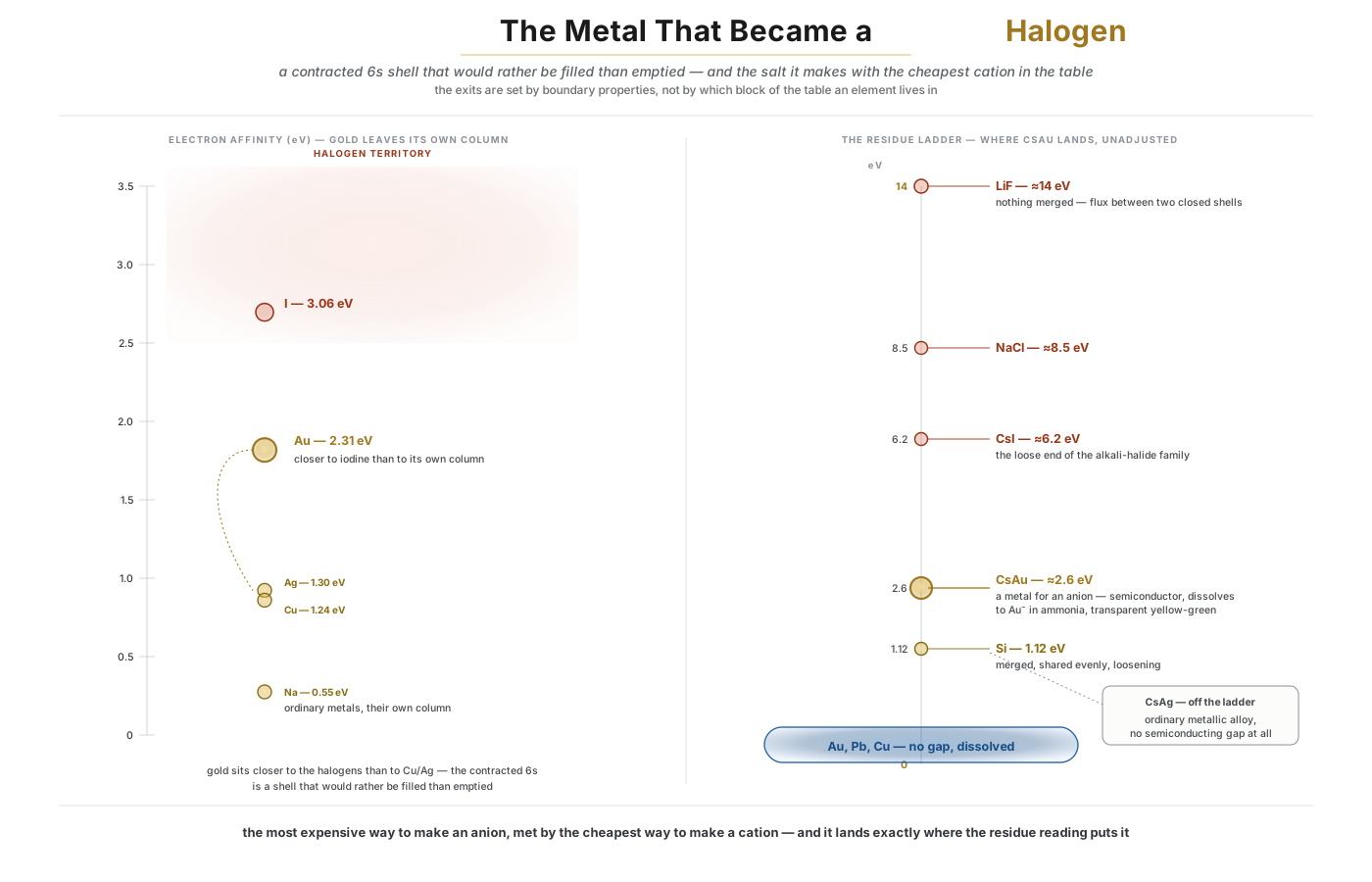
Gold’s electron affinity is 2.31 eV. That is not a metallic number. Silver’s is 1.30, copper’s 1.24, sodium’s 0.55; iodine’s is 3.06. Gold sits closer to the halogens than to its own column, and the reason is the contracted 6s: a shell pulled deep enough is a shell that would rather be filled than emptied.
So gold should be able to take the abandon exit as the anion. It does.
Caesium auride, CsAu, is a real compound and it is not an alloy. It adopts the CsCl structure. It dissolves in liquid ammonia to give solvated Au⁻. And — the detail that settles it — it is a semiconductor, with a gap of about 2.6 eV, transparent yellow-green, not a metal. CsAg, made from the element directly above, is an ordinary metallic alloy with no such behaviour. Rubidium auride does the same thing; caesium platinide, Cs₂Pt, contains Pt²⁻ and is likewise a semiconductor.
Two things about this are worth extracting.
The first is that it is the ledger’s cleanest possible demonstration that the exits are set by boundary properties and not by which block of the table an element lives in. The section has been describing “abandon” as what happens when one partner has vacancies and the other has spectators, and has drawn all its examples from group 1 against group 17. Here the anion is a 5d transition metal, and it works because velocity gave it a halogen-shaped hole. The cation has to be caesium — the cheapest tear in the table, which is the lithium chapter’s own ledger read at its far end. The most expensive way to make an anion, met by the cheapest way to make a cation.
The second is that CsAu lands on the silicon chapter’s residue ladder exactly where the ledger puts it, without being fitted there. That ladder orders solids by how much boundary is still committed to a named partner, and it runs abandon-at-the-top, dissolve-at-the-bottom:
| Solid | What the boundaries did | Gap (eV) |
|---|---|---|
| LiF | nothing merged — flux between two closed shells | \approx 14 |
| NaCl | ” | \approx 8.5 |
| CsI | ” , at the loose end of the family | \approx 6.2 |
| CsAu | ” , with a metal as the anion | \mathbf{\approx 2.6} |
| Si | merged, shared evenly, loosening | 1.12 |
| Au, Pb, Cu | dissolved | — |
CsAu is the weakest member of the abandon family, sitting one rung above the semiconductors — which is where a compound whose anion is a reluctant halogen with an affinity of 2.31 eV rather than 3.06 ought to sit. The abandon exit, taken by a metal, produces the smallest possible residue and lands in the gap between the salts and the semiconductors. Nothing about the residue reading was constructed with aurides in mind, and it accommodates them without adjustment.
The volcano, moved
The iron chapter argued that essentially every industrial catalyst is a d-block metal because a catalyst must hold a boundary halfway — deep enough to break the reactant apart, shallow enough to give the product back — and that the rate must therefore peak in the interior of the row, which is Sabatier’s principle drawn as a volcano.
Gold is the element that broke that story for eighty years, and then repaired it.
Bulk gold is catalytically dead. It adsorbs almost nothing, which is the whole reason it is inert, and on the volcano it sits far down the right-hand slope — released too easily, never held. That is exactly what relativity predicts: a contracted 6s that will not share is a surface that will not bind.
Then in 1987 Haruta found that gold particles below about 5 nm oxidize carbon monoxide below room temperature, outperforming platinum, and an entire field of gold catalysis followed. Nothing about gold’s speed changed. What changed is that a small particle is mostly corners and edges, and a corner atom has fewer neighbours than a bulk atom — so its boundary is less committed to the crystal and more available to a visitor.
On the ledger that is a knob the section already owns. The silicon chapter established coordination number as the structural gauge of how much boundary is committed: four is the merger number, twelve is complete dissolution, and everything in between is a partially committed surface. A bulk fcc gold atom has twelve neighbours. A corner atom on a nanoparticle has six or fewer. Lower coordination, less committed, more available.
So the volcano’s binding-strength axis is moved by two things this section has now named, and they are independent:
- Speed moves an element along it — relativity pushed gold off the right edge.
- Coordination moves a site along it — under-coordination walks it back on.
That gives the nanogold result a shape rather than an anomaly: gold is the element whose bulk sits just far enough past the peak that a modest reduction in coordination brings it back into the active window, and its congeners are not. Silver, which never left the window, does not gain nearly as much from being made small; platinum, which sits nearer the peak already, is degraded rather than improved by extreme under-coordination on many reactions. The element that gains most from being made small is the one relativity pushed furthest off the peak.
This also part-pays a debt the iron chapter posted and did not settle. That chapter asserted that the 4d and 5d metals are better catalysts than their 3d partners and that life took iron only because the nuclear ledger left it lying about in bulk. Half the reason those rows press harder is now on the page: relativistic expansion of the 5d shell makes a sixth-row fold reach further and bind deeper than its third-row counterpart at the same position in the palindrome. That is the right direction, it is checkable against the catalysis literature row by row, and the section has still not done it. The breadcrumb stays.
Nobility, and why gold is money
The section’s sixth pattern is about what a boundary remembers, and it has three clocks: a ring-down that decays in femtoseconds, a fold register that holds a setting until a partner arrives, and a barrier crossing that nothing in the universe can hurry.
Gold adds a fourth kind of persistence, and the interesting thing about it is that it is not a clock at all.
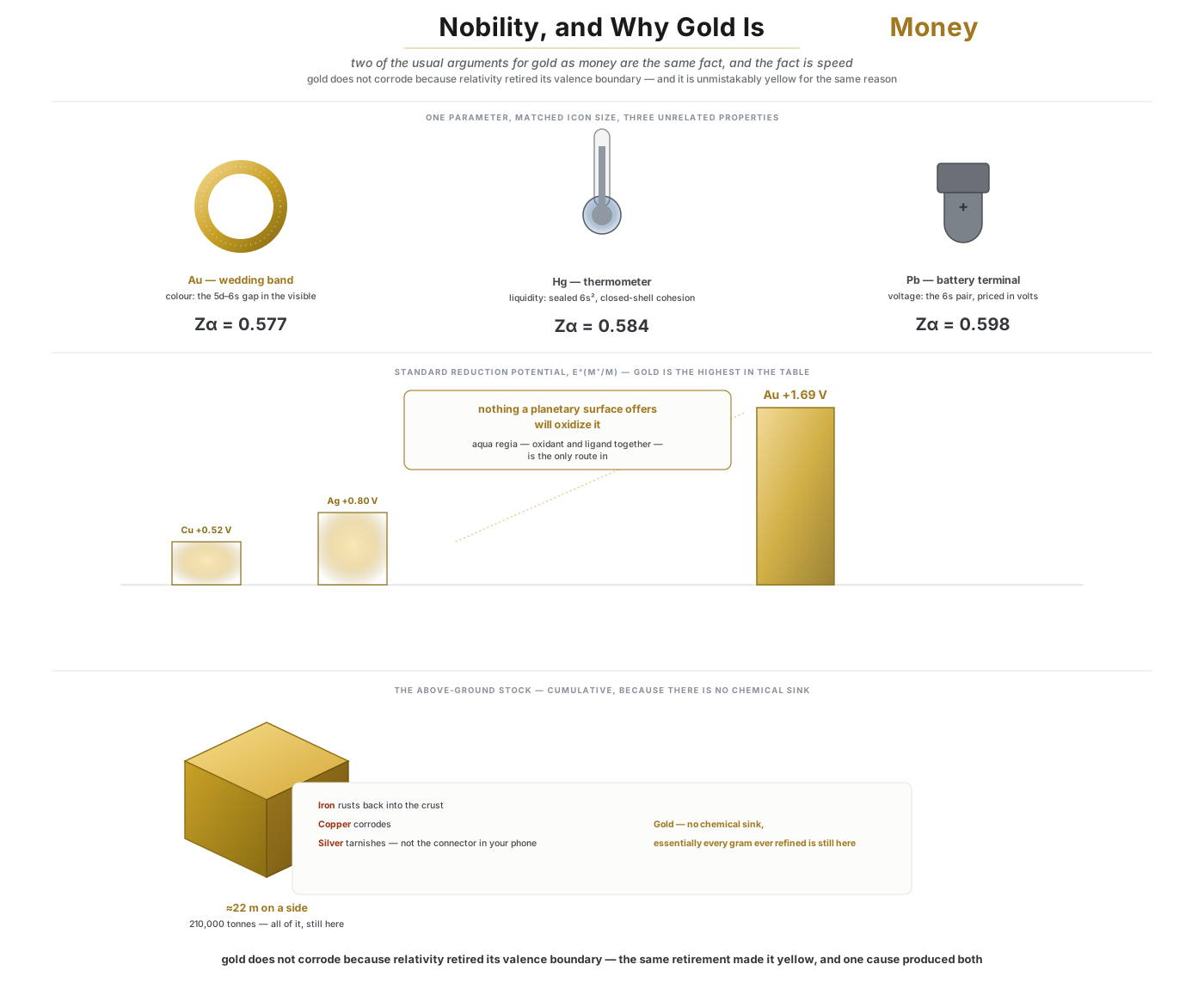
Gold’s standard reduction potential, E^\circ(\mathrm{Au^+/Au}) = +1.69 V, is the highest of any metal in the table. Nothing a planetary surface can offer will oxidize it — not oxygen, not water, not acid, not sulfur, not time. Dissolving gold requires aqua regia, which works by supplying an oxidant and a ligand simultaneously, and the fact that this recipe has a name and a mediaeval reputation is itself the datum.
Gold’s permanence is not a slow rate. It is an absent reaction. A ring-down can be lengthened by cooling. A fold register can be flipped by presenting a ligand. A barrier clock runs at a rate that no environment can touch but it does run. Gold’s state persists because the ledger offers it nothing to change into: the 6s is too deep to give up and the shell is too closed to take anything on. That is a fourth entry on the memory table and it belongs in a different column from the other three.
And that is most of why gold is money.
The argument usually offered for gold as a monetary metal is a list — rare but not too rare, dense, malleable, doesn’t corrode, easy to recognize. On the ledger it is not a list. Two of those properties are the same fact, and the fact is speed. Gold does not corrode because relativity retired its valence boundary. Gold is unmistakably yellow because the same retirement dropped its interband threshold into the visible. The metal that cannot be spent chemically is also the metal you can identify across a room, and one cause produced both.
The consequence is that essentially every gram of gold ever refined is still here. The above-ground stock is something like 210{,}000 tonnes — a cube about 22 m on a side — and it is cumulative in a way no other commodity is, because there is no chemical sink. Iron rusts back into the crust. Copper corrodes. Silver tarnishes, which is precisely why silver, the better conductor and the whiter metal, is not the connector in your phone: every contact surface in modern electronics that has to still work in ten years is gold-plated, and it is gold-plated because silver’s boundary is available to sulfur and gold’s is not.
The section can be honest about the width of this window. Gold is not the only noble metal — platinum, iridium and their neighbours are comparably unreactive for closely related relativistic reasons, and a purely chemical argument does not single gold out. What singles it out is the conjunction: findable as the native metal, soft enough to work without smelting, dense enough to assay by weight in water, and coloured. Add “recognizable by eye” to the specification and the table’s occupancy drops to one. That is a weaker window than phosphorus’s and it should be labelled as one, because two of its four criteria are about human hands and eyes rather than about the ledger. But the two that are about the ledger are the two that matter, and they are one parameter read twice.
One coda, because it is the same Z doing it. Photoelectric absorption of gamma rays scales as something between Z^4 and Z^5, so the elements at the bottom of the table are also the ones that stop radiation — which is why the apron is lead. The same nuclear charge that runs the innermost boundary at 0.6\,c is the charge that gives the atom its cross-section to a photon. Two unrelated uses of the heavy end, one number underneath.
The corner biology will not use
There is a conspicuous absence at this end of the table and the section is obliged to notice it.
The heaviest element with an established essential role in most organisms is iodine, at Z = 53. Beyond it there is exactly one exception in the whole periodic table — tungsten, at Z = 74, in the enzymes of some hyperthermophilic archaea. Nothing else. No essential gold, no essential mercury, no essential thallium, lead, bismuth or platinum, in any organism ever examined. The entire relativistic corner is biologically excluded, and its members appear in biology only as poisons.
The obvious explanation is abundance, and abundance is certainly part of it. But abundance can be partly controlled for, and the control is available in the same corner. Thallium’s crustal abundance is roughly 0.7 ppm; iodine’s is roughly 0.45 ppm. They are within a factor of two of each other, and biology built a hormone system on one and has no use whatever for the other — while the unused one is toxic precisely because it enters the machinery biology built for potassium. For that pair, availability is not the discriminator.
The ledger’s reading is the lithium chapter’s, extended by one term. Biology’s metal economy is handing: a nutrient metal must be picked up, carried, delivered, and released, and the aluminium breadcrumb already argues that an ion whose wrap turns over once a second cannot participate. A relativistically softened boundary fails the same test at the other end — it binds sulfur so tightly that nothing hands it on. And there is a second term specific to this corner: a token made by speed cannot be tuned. The whole utility of the d-block, as the iron chapter argued, is that a fold register can be pushed around by a ligand — the same iron sits anywhere across a volt depending on what is coordinated to it. A pair retired by velocity is set by Z, which a protein cannot change. It is not a register; it is a constant. Biology has no use for a constant it cannot address.
I want to be clear that this is the weakest extended argument in the chapter. Abundance, solubility in the ancient ocean, and simple evolutionary contingency all bear on it, none of them are disentangled here, and one abundance-matched pair is an anecdote rather than a control. It is offered as a prediction with a stated falsifier and nothing more.
The last stable element, twice
The chapter ends where the section’s two ledgers do, and they end in the same cell without knowing about each other.
For most of the twentieth century, bismuth was taught as the heaviest stable element. In 2003 de Marcillac and colleagues measured ²⁰⁹Bi decaying by alpha emission with a half-life of about 1.9 \times 10^{19} years — a billion times the age of the universe, and unambiguously not stable. Which leaves lead as the heaviest element with a genuinely stable nuclide, and lead is where the uranium chapter’s argument said everything must drain: ²⁰⁸Pb is the heaviest doubly-sealed nuclear shell there is, and every decay chain in nature terminates on a lead isotope.
So element 82 is:
- the last element the nuclear ledger can hold — the doubly-magic drain of every alpha chain, past which a drop can no longer span its own seam;
- and the element where the boundary ledger’s counting breaks down completely, four participants behaving as two, its 6s pair retired by a speed that has nothing whatever to do with nuclear surface tension.
Two ledgers, two entirely unrelated mechanisms — one about a drop’s surface against its own charge, one about an electron’s velocity against the substrate’s signal speed — and they run out at the same atomic number. I do not think that is meaningful and I am not going to argue that it is. It is worth writing down because the section keeps finding coincidences of this shape (iron is the other one, where the nuclear crest and the electronic register meet), and the honest position is to record them and let the count accumulate or not.
What is not a coincidence is what humans then did with element 82, and it is the section’s tidiest piece of history.
In 1953 Clair Patterson measured the lead isotope ratios in the Canyon Diablo meteorite and got 4.55 billion years for the age of the Earth — the first correct number, still the number, and it works because the barrier clock inside a uranium nucleus is the one clock in nature that no environment can hurry, and lead is what it counts into. To get the measurement he had to build the first ultra-clean laboratory, because his blanks kept coming back contaminated. Following that contamination to its source occupied the rest of his life: he demonstrated that industrial lead — tetraethyl lead in petrol, principally — had raised background concentrations by orders of magnitude, and he spent twenty years being attacked by the lead industry until the regulations went through.
The element that told us the age of the Earth is the element that poisoned the twentieth century, and one person discovered both facts, in that order, using the same instrument. The first is the nuclear ledger’s clock; the second is the boundary ledger’s retired pair fitting into a calcium socket and pointing. Same element, two ledgers, and Patterson had to be exact about the one in order to be alarmed by the other.
Predictions
Every effect in this chapter scales as (Z\alpha)^2 and must vanish in the light congener at matched arithmetic. Silver is the control for gold, cadmium for mercury, indium/tin/antimony for thallium/lead/bismuth. Retrodicted across the group 11 table above (radius non-growth, the +1.65 eV ionization break, the doubled electron affinity, the +0.89 V potential rise) and the group 12 table (the 360 °C melting-point fall, cohesion halved, ionization energy reaching radon’s). The sharp leg is two-signed: because s contracts while d expands, the same cause must raise gold’s ionization energy and lower its interband onset relative to silver — opposite motions in two measured quantities, both observed. Falsified by a relativistically-attributed anomaly of comparable size in a 4d/5s congener at matched configuration; or by a heavy-element anomaly requiring only one sign of shell displacement to explain both quantities.
A spectator made by speed is a price, not a wall, and the price is quotable in volts. Unlike a shell closed by counting, a relativistically retired pair remains present and removable, so every 6s^2 element must have an accessible high oxidation state displaced from its 5s^2 congener’s by an amount tracking (Z\alpha)^2. Retrodicted: Sn⁴⁺/Sn²⁺ +0.15 V against PbO₂/Pb²⁺ +1.46 V; In(III) unremarkable against Tl³⁺/Tl⁺ +1.25 V; Sb(V) a mild reagent against Bi(V) oxidizing Mn²⁺ to permanganate. The quantitative leg is the lead–acid cell: 1.7–1.8 V of 2.11 V computed relativistic, with the tin analogue as the computed control. Falsified by a 6s^2 main-group element whose high oxidation state is more accessible than its 5s^2 congener’s, or by a recomputation of the lead–acid cell that removes the relativistic contribution without removing the voltage.
The gold maximum is a window with one occupant. The chemical consequence of relativistic contraction requires simultaneously a completed 5d, a singly-occupied 6s, an empty 6p, and maximal Z — four conditions with exactly one solution in the sixth row. Retrodicted by gold holding the extremum on radius anomaly, ionization break, electron affinity and interband shift against both its column and its row neighbours. Forward leg: roentgenium (Z\alpha = 0.81) must exceed gold on every axis. Falsified by a sixth-row element with a larger relativistic chemical anomaly than gold’s at matched measure, or by mercury or thallium proving to hold the maximum on a majority of the four axes.
Gold takes the abandon exit as the anion, and the product lands where the residue ladder puts it. A 6s contracted enough to give gold a 2.31 eV electron affinity must permit a genuine ionic auride against the cheapest available cation, and — since the gap is the residue of unfinished delocalization — that auride must be a semiconductor whose gap sits below the alkali halides and above the group 14 semiconductors, because gold is a reluctant halogen. Retrodicted: CsAu is CsCl-structured, \approx 2.6 eV, transparent, dissolving in ammonia to Au⁻, while CsAg is an ordinary metallic alloy; Cs₂Pt contains Pt²⁻ and behaves likewise. Falsified by a genuinely metallic alkali auride, or by an auride gap out of order with its ionicity on the ladder.
The volcano’s binding axis has two independent knobs, and one of them is coordination. Relativity moves an element along the volcano; under-coordination moves a site. So catalytic activity in gold nanoparticles must track the fraction of under-coordinated corner and edge atoms rather than total surface area, and the gain from miniaturization must be largest for the element relativity pushed furthest past the peak. Retrodicted by bulk gold’s inertness against sub-5 nm gold oxidizing CO below room temperature, and by silver’s and platinum’s much smaller size-dependent gains. Falsified by a size-activity relation that tracks specific surface area rather than corner/edge fraction, or by a bulk-terminated Au(111) facet matching corner-site activity at equal exposed area.
Mercury’s cohesion is closed-shell cohesion, and the trend continues into the superheavies. A relativistically sealed 6s^2 pair should give cohesive properties that relativistic calculations reproduce and non-relativistic ones miss by a large factor, and the sealing must deepen with Z. Retrodicted: melting point computed at 241 K relativistic against 234 K measured and 355 K non-relativistic; ionization energy 10.44 eV against radon’s 10.75; Hg₂²⁺ as the only common homonuclear diatomic metal cation. Forward leg, partly measured: adsorption on a gold surface must weaken monotonically down the column, and gas-phase chromatography of copernicium (Z=112) and flerovium (Z=114) already places both far weaker than mercury. Falsified by a superheavy group-12 or group-14 element found to be less volatile than its lighter congener.
The relativistic corner is biologically excluded, and abundance is not the reason. A token set by Z cannot be tuned by a ligand, so it cannot serve as a register; and a relativistically softened, thiophilic boundary binds sulfur too tightly to be handed on, which is the operation biology’s entire metal economy consists of. So no element beyond iodine (Z=53) should be essential except where an unusual metabolic niche forces it — one exception exists, tungsten in hyperthermophilic archaea. The abundance control is the Tl/I pair, comparable in crustal abundance to within a factor of two, one of which carries a hormone system and the other of which is a poison that enters via the potassium pump. Falsified by an essential thallium-, lead-, mercury-, gold- or bismuth-dependent enzyme in any organism; weakened considerably if the tungsten exception turns out to have relatives.
Conclusion
Carbon is where the substrate is visible because chemistry abstains. Lithium is visible because chemistry collapses. Iron is visible because chemistry stalls halfway and stays there. Silicon is visible because chemistry finishes but only just. Gold is visible for a fifth reason, and it is the one that reaches back furthest into the rest of this paper: chemistry stops being arithmetic, because something inside the atom is moving fast enough to matter.
Five chapters counted. Half-boundaries, closed surfaces, empty slots — participant, spectator, vacancy, and every one of them produced by counting electrons into shells. The bottom right of the table has a token that arithmetic cannot make. Lead’s 6s pair is present, counted, and unreachable; mercury’s is present, counted, and sealed; gold’s is present, counted, and so deep that the element would rather be an anion. Nothing about the count changed in any of the three. What changed is a ratio, Z\alpha, and it is the speed of the innermost boundary measured against the speed the substrate itself can pass a signal.
The distinction that earns this token its place in the vocabulary is one sentence. A spectator made by closure is a wall; a spectator made by speed is a price — and unlike the wall, the price is quotable, and it has been quoted. Tin’s +4 state against lead’s costs 1.3 V. Ten of the twelve volts on a car battery terminal are that price being paid and recovered, twice a day, in about a billion vehicles. There is no analogue of that anywhere among the counted tokens, because a shell that has closed on itself offers nothing to buy back.
Everything else in the chapter is the same ratio read through a different instrument. Read through light, it is a colour: the 6s falling and the 5d rising until the gap between them lands inside the visible band, which is why gold is yellow and silver — one row up, one variable different — is white. Read through a thermometer, it is a liquid, mercury having sealed its valence pair so thoroughly that its cohesion is a noble gas’s and its ionization energy is radon’s. Read through a crystal, it is a salt with a metal for an anion, CsAu sitting one rung below the caesium halides on a residue ladder built for something else entirely. Read through a catalyst, it is an element pushed off the right edge of the volcano and walked back on by making its particles small enough to be mostly corners. Read through a protein, it is a boundary too soft and too thiophilic to be handed on, which is why the whole corner is poison. And read through three thousand years of human history, it is money — because the one element the ledger offers nothing to react with is also, by the same cause, the one you can pick out of gravel by eye.
Then both ledgers run out at 82. Lead is the last element with a stable nucleus, the drain every alpha chain empties into, and the element whose electron count stopped meaning what it says. Those two facts have nothing to do with each other, and Clair Patterson used the first to date the planet and then spent his life on the second, which had got into everyone’s blood.
If carbon shows the substrate’s sheet, lithium its coin, iron its fold, and silicon its gap, then gold shows its speed.
And that is the reason this chapter belongs in a physics paper rather than a chemistry one. The paper’s standing claim is that c is not an external constant but a property of the medium — how fast the substrate can hand a disturbance along — and almost everything offered in support of that has been remote or expensive: cosmology, accelerators, interferometers, the CMB frame. Here is an atom in which the innermost boundary circulates at something like 58\% of that speed, and the consequence is sitting on somebody’s finger, being yellow. Relativity is normally the physics of the very fast and the very far. In one corner of the periodic table it is the physics of a wedding ring, a thermometer, and a car battery.
The corner ends at bismuth, which is not quite stable, and past it the boundary ledger has nothing left to count at all. The uranium chapter takes over with the other one.