The Neighbors of Carbon
Spectator boundaries as biology’s dial — zero says nothing, one can choose, two always speaks, three only terminates; why the second row holds shape and the third row moves energy; and the four-line arithmetic that says phosphorus had to be the backbone
The family carbon needed
The carbon chapter ended on a triad. Carbon is the frame: zero spectator boundaries, no dipole, nothing to say, and therefore the element that holds shape without editorializing. Oxygen is the gradient: two spectator boundaries pointed outward, supplying the asymmetry carbon lacks. Sulfur is the gate: oxygen’s diffuse congener, a merger strong enough to hold and loose enough to switch.
Three elements, and something conspicuous missing. Biology’s four core functions are structure, recognition, energy, and switching. The triad covers three of them and hands energy to nobody. Yet the cell’s energy currency is not a carbon compound, an oxygen compound, or a sulfur compound. It is a phosphorus compound, and so is the genetic backbone, the outer leaf of every membrane, and the switch on essentially every regulated protein in the eukaryotic proteome. Phosphorus is the element the triad forgot, and it is the one doing the most work.
This chapter reads the whole neighborhood on the spectator ledger the carbon chapter opened, and the ledger turns out to be more than a lens. Two results come out of it that the framework did not have before. The first is that nitrogen is the one element in the neighborhood whose spectator boundary can be routed: one lone pair, and a genuine choice about whether it joins the shared sheet or stands outside it. Biology built the peptide bond, the nucleobase, and its universal acid–base catalyst out of that one bit. The second is a piece of arithmetic four lines long. It counts how many chain positions an element’s aqueous oxyanion can offer, returns 4 for silicon, 2 for phosphorus, 1 for sulfur, and 0 for chlorine, and so predicts which element builds a planet, which builds a chain, which hangs a tag, and which stays a free ion. That arithmetic is a derivation of Westheimer’s old question, why did nature choose phosphates?, from boundary counting, and its answer is that exactly one element qualifies.
The dial: zero, one, two, three
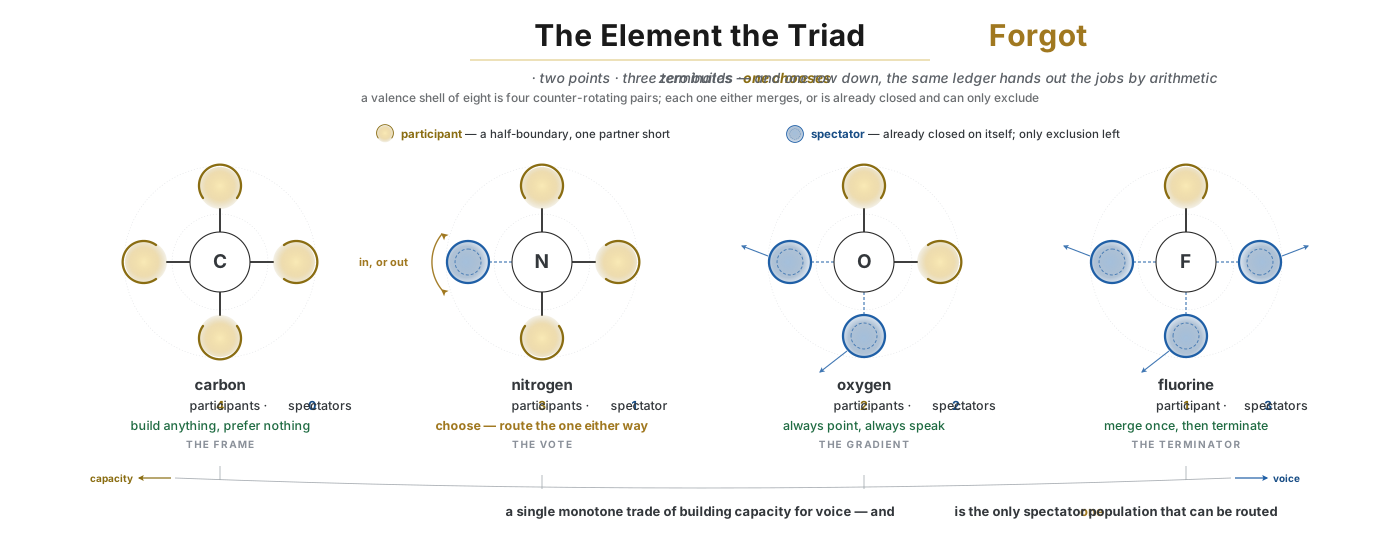
Lay the second row out on the carbon chapter’s own axis. A valence shell of eight is four counter-rotating pairs. A participant is a half-boundary one partner short, available to merge. A spectator is a surface already closed on itself, with nothing left to merge and nothing to do but exclude.
| Participants | Spectators | What the count permits | |
|---|---|---|---|
| Carbon | 4 | 0 | build anything, prefer nothing |
| Nitrogen | 3 | 1 | choose — route the one spectator in or out |
| Oxygen | 2 | 2 | always point, always speak |
| Fluorine | 1 | 3 | merge once, then terminate |
Read as a dial rather than a list, the row is a single monotone trade of building capacity for voice, and each setting has a distinct fate. Carbon at zero is the universal builder. Fluorine at three is the universal terminator: one merger, maximally deep, and then a surface that offers the world nothing at all. Oxygen at two is the workhorse of polarity precisely because it can never stop pointing.
Nitrogen at one is the interesting setting, for a reason that is almost arithmetical. Zero spectators leaves nothing to decide. Two or three leaves at least one spectator committed to spectating no matter what else happens. One is the unique count at which the entire spectator population of an atom can be routed either way, into the shared sheet as a participant or out of the plane as an exclusion. The elements below nitrogen in its group carry the same single lone pair, but they have no sheet to route it into, for the reason the next section is about. Within the row where the sheet exists, nitrogen is the only element whose whole voice is a single bit, and the whole bit is switchable.
Nitrogen: the element with a vote
The switch is a real, well-characterized piece of chemistry that organic textbooks teach in two unconnected places. A nitrogen can hold its lone pair in an in-plane orbital, where it points outward and behaves as a basic, hydrogen-bond-accepting spectator: the pyridine-type routing. Or it can donate the lone pair into the \pi sheet above and below the plane, joining the delocalized current and ceasing to be basic at all: the pyrrole-type routing. In the framework’s vocabulary, this is one spectator boundary choosing whether to participate in the shared counter-rotating envelope or to stand outside it and exclude.
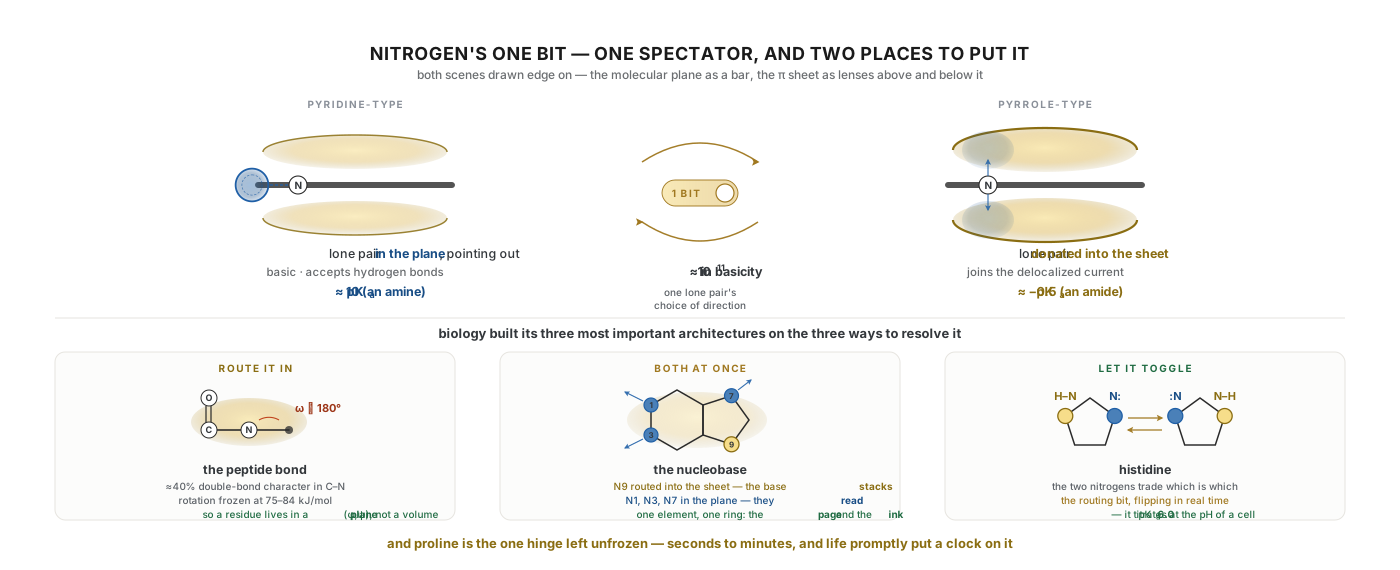
The energetic consequence of that one bit is enormous. An amine, spectator out, has a conjugate-acid pK_a near 10; an amide, spectator routed into the carbonyl’s \pi system, has one near -0.5. Ten to eleven orders of magnitude of basicity, from one lone pair’s choice of direction. Ammonia’s own pyramid inverts across that choice some 10^{10} times a second over a barrier of only 24 kJ/mol, which shows how flat the decision is when nothing is holding it.
Biology has built its three most important molecular architectures on the three ways to resolve it.
Route it in, and you get the peptide bond. The amide nitrogen donates into the carbonyl, the linkage acquires roughly 40\% double-bond character, and rotation about it costs \sim 75–84 kJ/mol, frozen at body temperature. That freeze is why the backbone torsion \omega is pinned near 180° and why the conformational space of a residue is the two-dimensional Ramachandran plane (\phi,\psi) rather than a three-dimensional one. The helix, the sheet, and the very idea of a fold exist because nitrogen put its one spectator into the sheet and took a degree of freedom off the table. The substrate reading is the one the aromatic-rings chapter already uses: a continuous counter-rotating envelope across the O=C–N unit is a consolidated boundary with less area than two separate ones, and planarity is the geometry that consolidation demands. The entire protein-folding problem is shaped by a single lone pair’s decision to join a sheet.
Route both ways at once, and you get the nucleobase. A purine does something no other biological ring does: it runs both routings simultaneously in one aromatic system. Adenine’s N9 is pyrrole-type. Its lone pair is in the \pi sheet, which is why it is not basic and why the base stacks, contributing to the aromatic column running down the axis of DNA. Adenine’s N1, N3, and N7 are pyridine-type, lone pairs in-plane and pointing outward, which is why they are the hydrogen-bond acceptors that read the sequence. The stacking current and the reading contacts are the same element in the same ring, distinguished only by which way one spectator faces. Nitrogen is simultaneously the page and the ink.
Let the routing toggle, and you get histidine. Imidazole is the minimal ring carrying one nitrogen of each type, and its two tautomers exchange which nitrogen is which: the pyrrole-type N–H and the pyridine-type acceptor trade places. That is the routing bit flipping in real time, and its price is a pK_a of \approx 6.0, the only amino-acid side chain titrating near physiological pH. Histidine is consequently biology’s universal acid–base catalyst, its metal ligand of choice, and the proton shuttle in carbonic anhydrase, the serine proteases, and the respiratory chain. Biology’s general-purpose proton handler is nitrogen’s one bit, unlatched.
A fourth case is worth a line because it is the exception that shows the rule was load-bearing. Proline ties its nitrogen into the backbone ring, removing the amide hydrogen and locking \phi. It is the one residue where the frozen \omega partially thaws, with a few to tens of percent cis population at equilibrium and an interconversion slow enough, seconds to minutes, to be a genuine molecular clock. Biology promptly built an enzyme family around it: the peptidyl-prolyl isomerases (cyclophilin, FKBP, Pin1) accelerate the flip by some five orders of magnitude and use it as a timing and switching element in folding, signaling, and the cell cycle. Nitrogen froze the backbone everywhere, left exactly one hinge, and life put a clock on it.
Every piece of chemistry above is textbook: amide resonance, pyridine-versus-pyrrole nitrogen, imidazole tautomerism, proline cis–trans. None of it is new and the framework does not overturn any of it. What the framework contributes is the unification: these are normally taught as four unrelated facts in four different chapters, and on the spectator ledger they are one fact, the routing of a single spectator boundary, read four times. The load-bearing observation is the count itself, which is arithmetic rather than chemical convention: one is the only spectator population that can be routed entirely either way, and in the row that still has a sheet, nitrogen is the only element that has it. That carbon can build and fluorine can only terminate is unsurprising. That the element with a switchable voice is the one holding the peptide bond, the nucleobase’s dual role, and the pH-7 catalyst is the pattern worth recording.
The row boundary is the reach law
Now step down a row, and the carbon chapter’s silicon argument generalizes into something checkable.
The reason there is no silicon benzene is that a \pi bond requires a lateral merger: the lobes above the plane must fuse into one continuous counter-rotating sheet, and likewise below. At C–C’s 1.54 Å they reach; at Si–Si’s 2.35 Å they reach past each other without merging, and the ribbon never forms. That is the reach law read on chemistry. A tight boundary localizes and holds, a diffuse one reaches and reorganizes, and there is a distance past which lateral consolidation simply fails.
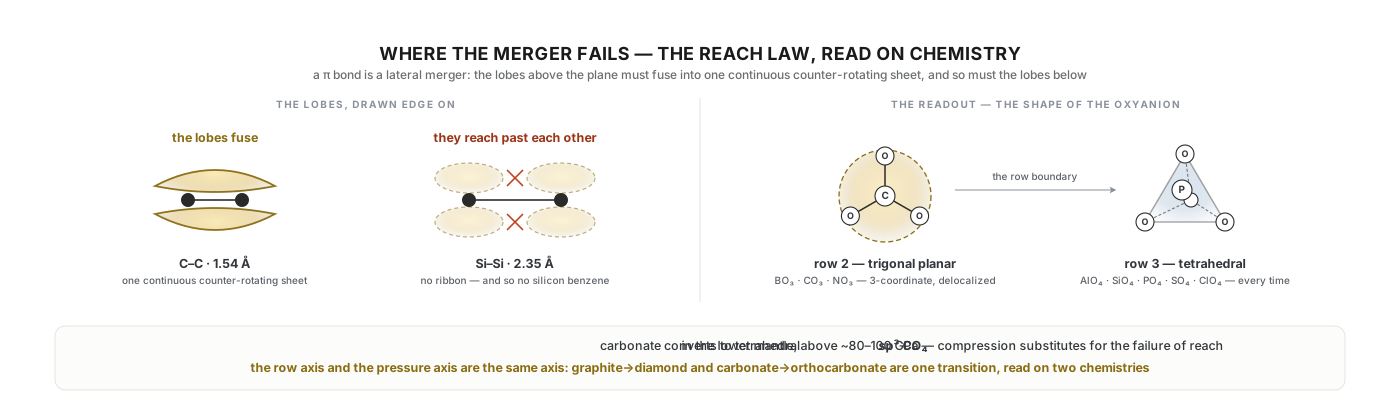
If that is right, it should show up somewhere far from graphite, and it does, in the most ordinary structural fact about oxyanions. Ask each element in the neighborhood what shape its oxyanion takes:
| Row | Oxyanion | Geometry | Coordination |
|---|---|---|---|
| 2 | BO₃³⁻, CO₃²⁻, NO₃⁻ | trigonal planar, delocalized | 3 |
| 3 | AlO₄⁵⁻, SiO₄⁴⁻, PO₄³⁻, SO₄²⁻, ClO₄⁻ | tetrahedral | 4 |
The second row makes flat, \pi-delocalized, three-coordinate anions. The third row makes tetrahedral, four-coordinate ones, every time. The row boundary is exactly where the lateral merger fails, and the shape of the anion is the direct readout. An element that can build a delocalized sheet across three oxygens does so and stops at three. An element that cannot takes a fourth oxygen and goes tetrahedral instead. Carbonate is a fragment of the substrate’s own sheet. Silicate is what you get when the sheet is unavailable and the atom falls back to mechanical packing.
One second-row case needs a word, because it looks like an exception and is not. Boron does form a tetrahedral anion in water, B(OH)₄⁻, but it gets there by a different route. Boron carries a vacancy, not a spectator, and the fourth hydroxide fills that vacancy as a Lewis base, with no \pi sheet involved at all. The planar-versus-tetrahedral rule is a statement about centres whose slots are all filled, and the lithium chapter is where the vacancy side of the ledger gets read.
The framework’s own prediction about that pair of poles, open substrate-templated geometry at low pressure and close-packed at high, makes a sharp further claim here. If tetrahedral coordination is the packing answer and planar delocalization is the template answer, then squeezing a second-row oxyanion hard enough should convert it. It does. Carbonate’s planar CO₃ units convert to tetrahedral sp^3 CO₄ in the lower mantle above roughly 80–100 GPa, and orthocarbonate and orthonitrate salts, four-coordinate carbon and nitrogen, exist only as products of extreme synthesis, metastable at best. Compression substitutes for the failure of lateral reach. The row axis and the pressure axis are the same axis, and graphite\todiamond and carbonate\toorthocarbonate are the same transition read on two different chemistries.
Four lines of arithmetic, and why the crust is rock
Here is where the ledger stops being a lens and produces a number.
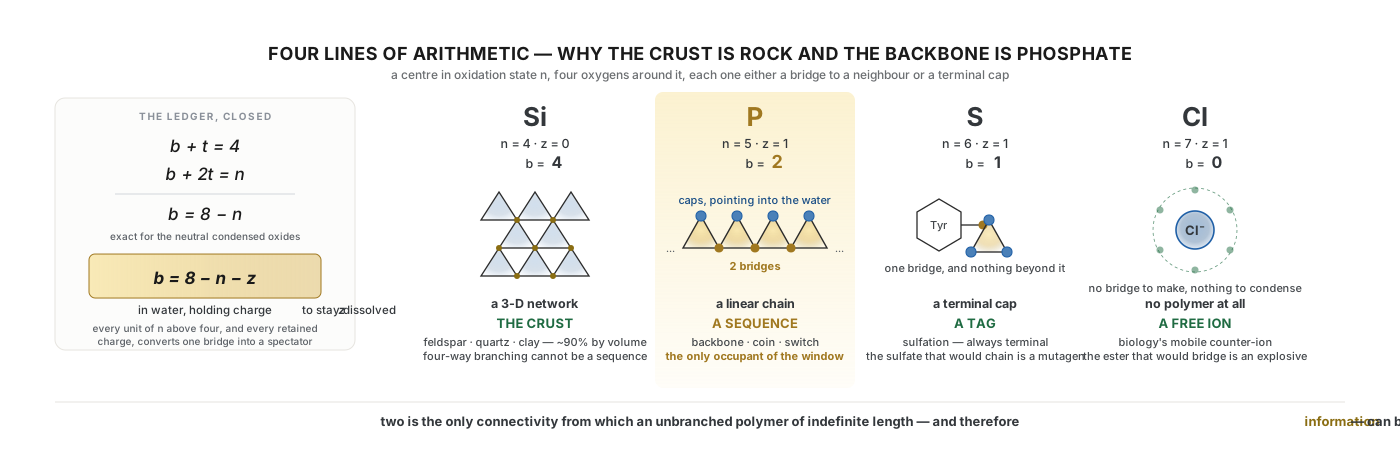
Take a central atom X in oxidation state n, tetrahedrally surrounded by four oxygens, and condense it into a polymer. Each oxygen is either bridging, shared with a neighboring center and contributing formally one to X’s account, or terminal, a double bond or a charged cap, contributing two. With b bridging and t terminal:
b + t = 4, \qquad b + 2t = n \quad \Longrightarrow \quad \boxed{\,b = 8 - n\,}
That is the whole derivation, and it is exact for the neutral condensed oxides. Silicon at n=4 gets b=4, and quartz shares all four corners. Phosphorus at n=5 gets b=3, and P₄O₁₀ has three bridges plus one terminal P=O. Sulfur at n=6 gets b=2, and polymeric SO₃ has two bridges plus two S=O. Chlorine at n=7 gets b=1, and Cl₂O₇ is a single bridge between two ClO₃ caps. Every unit of oxidation state above four converts one bridging boundary into a spectator.
Now put it in water, where biology lives. To stay dissolved and stay inside a cell, the anion must retain charge, and each retained negative charge is one more oxygen pulled out of service as a spectator cap. So the aqueous connectivity is b = 8 - n - z for retained charge z, and the neighborhood sorts itself:
| Center | n | Neutral b | Aqueous b, z=1 | Polymer topology | What it builds |
|---|---|---|---|---|---|
| Si | 4 | 4 | — (needs no charge) | 3-D network | the crust — feldspar, quartz, clay |
| P | 5 | 3 | 2 | linear chain | backbone, coin, switch |
| S | 6 | 2 | 1 | terminal cap | a tag — sulfation |
| Cl | 7 | 1 | 0 | none | a free ion — chloride |
Read the last column against what biology and geology actually do, and the arithmetic has predicted the roles.
Silicon has no reason to hold charge, so it condenses fully and precipitates. Four bridges is a three-dimensional network, and a three-dimensional network is a rock. Silicates are \sim 90\% of the crust by volume, and the earth chapter reads their sheet-and-framework menu as the substrate’s template selected over the whole history of the planet. Where biology does use silicon, in diatom frustules, sponge spicules, and plant phytoliths, it is always a shell or skeleton and never a chain, because four-way branching cannot be a sequence.
Sulfur gets one bridge, so it can only cap. That is exactly how biology spends it: tyrosine-O-sulfate, heparan and chondroitin sulfate, sulfolipids, PAPS as the universal donor. Sulfation is always terminal, never a backbone. The dialkyl sulfate that would be required to chain does exist, dimethyl sulfate, and it is a laboratory alkylating agent and mutagen, too reactive to be a metabolite. (Sulfur’s other biological career, as the gate, runs through its reduced -2 state, not its oxyanion.)
Chlorine gets zero, so it stays a free ion. Chloride is biology’s mobile counter-ion and its inhibitory current. Perchlorate esters, the compounds that would follow from a bridge, are explosives.
And phosphorus gets exactly two. Two is the connectivity of a chain, of a sequence. One is a dead end. Three or four is a solid. Two is the unique number of connection points from which an unbranched linear polymer of indefinite length can be assembled, which is to say the unique number from which information can be built.
So the question “why is the genetic backbone phosphate?” has a one-line answer: phosphorus is the only element whose aqueous oxyanion offers exactly two bridging positions while still carrying the charge that keeps it soluble and confined. Silicon has the wrong connectivity and no charge. Sulfur and chlorine have the wrong connectivity in the other direction. The window is n=5, and n=5 has exactly one occupant in the row where lateral reach has already failed.
Two slots, three functions
The result gets better once you notice that the arithmetic does not say what occupies the two bridges, and that biology’s answer to that question is its whole molecular economy.
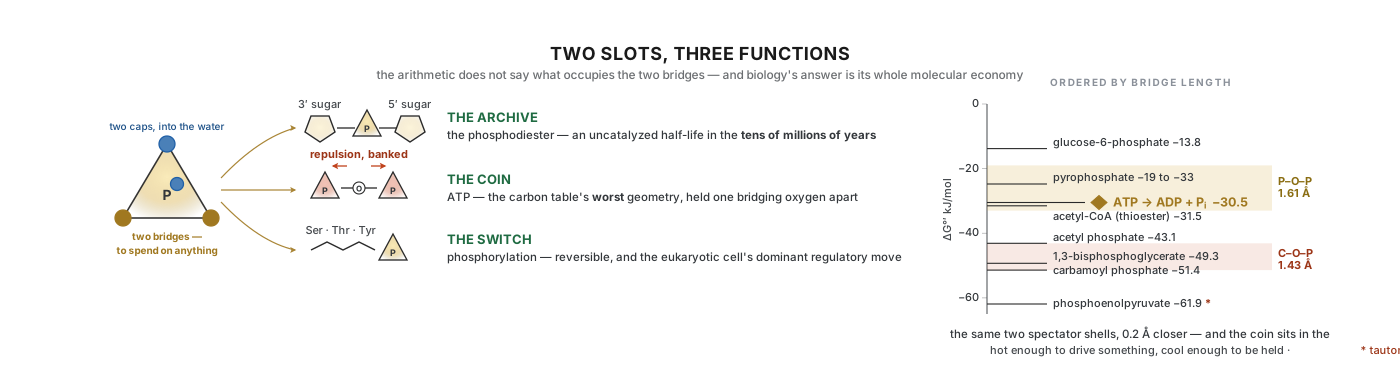
Fill both bridges with sugar, and you get memory. The phosphodiester keeps one P=O and one P–O⁻ and spends its two bridges on the 3′ and 5′ carbons of adjacent riboses. The two spectator caps point outward into water, which is why DNA is soluble, why its counter-ion cloud sets its persistence length, and why the reading happens on the outside. The linkage is kinetically extraordinary: an uncatalyzed phosphodiester half-life estimated in the tens of millions of years, which is what an archive needs.
Fill one bridge with another phosphate, and you get a battery. This is the sharp connection back to the carbon chapter. The carbon chapter’s table shows spectator boundaries as a penalty: O–O runs 142 kJ/mol against C–C’s 346 because two spectator shells forced adjacent have no merger to gain and only mutual exclusion to pay. The penalty relaxes with bond length, which is why P–P beats N–N and S–S beats O–O. Hydrogen peroxide falls apart because of that penalty.
ATP is that penalty engineered into a spring. A phosphoanhydride is precisely the geometry the carbon table calls worst: two heavily spectator-loaded centers pressed into adjacency. Biology does not avoid the failure mode. It stores energy in it, and holds it in check kinetically with the charge shell and the Mg²⁺ clamp. The same physics that makes hydrogen peroxide a propellant makes ATP a currency. The difference is that the anhydride puts one bridging oxygen between the two spectator shells, which is enough separation to be stable for months in neutral water and not enough to relieve the repulsion. The anhydride is the tuned distance between “falls apart” and “won’t release.”
That makes a checkable ordering, because the carbon chapter’s rule was penalty relaxes with distance. Rank biology’s high-energy phosphates by the length of the bridge across which the two spectator shells face each other:
| Linkage cleaved | Bridge | \Delta G^{\circ\prime} (kJ/mol) | Reading |
|---|---|---|---|
| Glucose-6-phosphate | C–O–P monoester | -13.8 | one shell, nothing adjacent |
| Pyrophosphate \to 2 P_\text{i} | P–O–P | -19 to -33 | two shells, long bridge (P–O \approx1.61 Å) |
| ATP \to ADP + P_\text{i} | P–O–P | \mathbf{-30.5} | two shells, long bridge |
| Acetyl-CoA (thioester) | C–S | -31.5 | third-row bridge, diffuse |
| Acetyl phosphate | C–O–P | -43.1 | two shells, short bridge (C–O \approx1.43 Å) |
| 1,3-bisphosphoglycerate | C–O–P | -49.3 | ” |
| Carbamoyl phosphate | C–O–P | -51.4 | ” |
| Phosphoenolpyruvate | C–O–P enol | -61.9 | tautomerization, not distance |
The phosphorus-bridged anhydrides cluster near -30. The carbon-bridged ones, where the same two spectator shells sit some 0.2 Å closer, cluster near -45. Creatine phosphate (-43) and PEP (-62) are driven by resonance stabilization in the products rather than repulsion in the reactant. The ledger handles that too, since delocalizing a charge over four equivalent oxygens is spectator load shared across more surfaces and therefore cheaper, but PEP’s enol\toketo tautomerization is a genuinely separate effect and should be named as one rather than folded in.
The retrodiction worth stating is where ATP sits. It is in the middle of that ladder, not at the top, and the reason is that -30 kJ/mol is simply what a phosphoanhydride is worth at the P–O–P distance. Biology’s universal coin is not the hottest compound available. It is the value the only doubly-connective, kinetically stable, third-row oxyanion happens to carry. If ATP were as hot as PEP it could not be held; as cool as glucose-6-phosphate it could not drive anything.
Fill one bridge with a protein hydroxyl, and you get a switch. Phosphorylation is the eukaryotic cell’s dominant regulatory move: a bulky, doubly-charged spectator shell installed on a serine, threonine, or tyrosine, reversibly, by the same element and the same linkage.
So: one element, two slots, and three of biology’s four core functions. Sugar-and-sugar is the archive. Phosphate-and-phosphate is the coin. Protein-and-nothing is the switch. And modon-to-atp can now say what its rotor is actually re-striking: the coin the F₀F₁ head mints is spectator repulsion, stored across one bridging oxygen at the one distance in chemistry where it can be both banked and spent.
The near-miss that proves the reach constraint
Two constraints were doing work above, connectivity-two and kinetic stability, and it matters that they are independent, because there is an element that satisfies the first and fails the second.
Arsenic sits directly below phosphorus. Arsenate, AsO₄³⁻, is isostructural with phosphate, carries the same charge, and offers the same two bridges. It is a perfect connectivity match, and it is lethal for exactly that reason: it substitutes into phosphate’s slots and then does not hold. Measured arsenodiester hydrolysis runs on the order of a tenth of a second at neutral pH, against a phosphodiester’s tens of millions of years, roughly sixteen orders of magnitude. That is the reach law at the boundary. Row four is diffuse enough that nothing stays merged. The 2010 claim of an arsenate-backboned bacterium was retracted by the field within two years, and the framework’s reading is that it could not have been otherwise.

Phosphorus is the intersection of two constraints, and the intersection has exactly one member. Row two cannot take four oxygens at ambient pressure. Row four cannot hold a bridge. Row three, at n=5, is the single cell in the table where connectivity-two, retained charge, and kinetic stability all coincide.
Fluorine: carbon’s mirror
The dial’s far end deserves its own beat, because it is carbon’s exact inversion and its fate is inverted too. Carbon is four participants and zero spectators, the universal builder. Fluorine is one participant and three spectators, and the consequence is a strange pair of superlatives.
The single merger fluorine makes is the deepest one carbon has available: C–F at 485 kJ/mol, the strongest single bond to carbon, driven by the largest electronegativity gap in the table. And the surface that results offers the world nothing. PTFE has the lowest surface energy of any common solid, \sim 18–20 mN/m against polyethylene’s 31 and water’s 72, and sits at the extreme negative end of the triboelectric series. Maximum bond strength, minimum interaction, which on the spectator ledger is one statement rather than two. The \sigma merger is perfect; the three closed shells wrapped around it present only exclusion.
That is also, read plainly, the mechanism of the forever-chemical problem. Degrading a perfluorinated chain requires starting a merger at a surface that offers no half-boundary to start one with. There is no first step, which is why the methods that actually work on PFAS are the ones that bypass the surface entirely, solvated-electron reduction, supercritical water oxidation, plasma, incineration above 1000 °C, rather than any enzyme, radical, or catalyst that would have to get a grip first.
And biology essentially abstains. Against thousands of known natural organohalogens built on chlorine and bromine, natural organofluorines number roughly five, and the whole biosphere appears to contain one enzyme family, fluorinase from Streptomyces cattleya, that forms a C–F bond at all, slowly. Biology uses fluoride ionically, in fluorapatite, and covalently almost never.
Availability is a real competing explanation and must be stated. Fluorine is more abundant than chlorine in the crust (\sim 585 vs \sim 145 ppm) but vastly less available in solution: seawater carries \sim 1.3 mg/L fluoride against \sim 19{,}400 mg/L chloride, because fluoride precipitates into insoluble calcium minerals. A biosphere that evolved in seawater had little fluoride to work with regardless of what its boundaries look like, so “biology skipped fluorine” is not clean evidence for the spectator reading on its own. The narrower claim the ledger does support is the one that survives the confound: where fluorine is available, it is used ionically and not covalently, and the physical superlatives, strongest bond to carbon, lowest surface energy of any solid, no available first step for degradation, are one fact about three spectators and one participant rather than three separate facts.
The payoff: why nitrogen is fixed and phosphorus is mined
The lateral-reach failure this chapter has been tracking through orbital lobes and oxyanion shapes has one more consequence, and it is planetary.
Ask why the atmosphere is 78\% nitrogen. Nitrogen’s two-atom molecule can close a triple bond, which needs two lateral \pi mergers on top of the \sigma, and at N–N distances the lobes reach. N≡N comes out at 945 kJ/mol, the strongest bond in ordinary chemistry, and it beats three single N–N bonds (\sim 3 \times 160) by a wide margin. So elemental nitrogen is a small, inert, volatile molecule, and the planet holds some 4 \times 10^{18} kg of it overhead.
Phosphorus cannot do this. The \pi merger fails at P–P distances, so the triple bond in P₂ (\approx 490 kJ/mol) loses to three singles (\approx 3 \times 200 = 600), and elemental phosphorus takes the P₄ tetrahedron instead, a waxy solid that ignites in air. Phosphorus has no volatile elemental form, and therefore no atmospheric reservoir. It is the only major biogenic element whose biogeochemical cycle has no meaningful gas phase: rock, weathering, water, organism, sediment, rock.
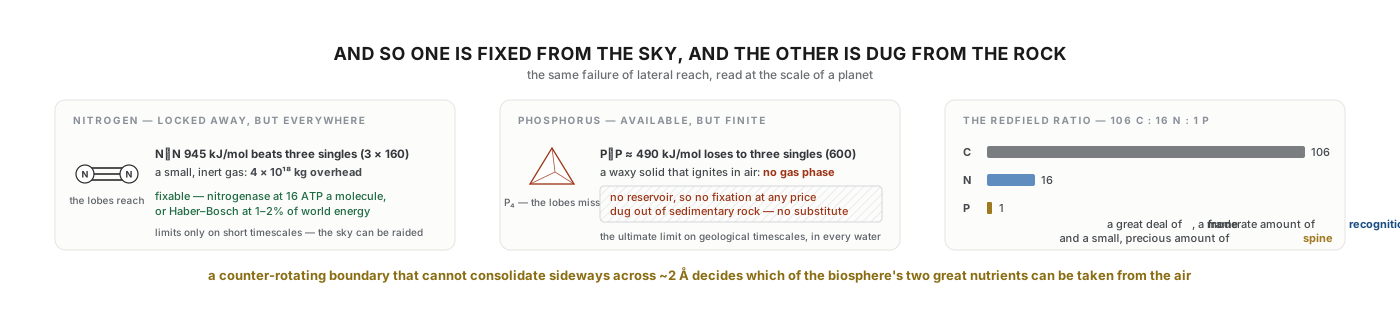
Every downstream consequence follows from that one geometric failure.
- Nitrogen is locked away but everywhere, so life evolved a way to break in. Nitrogenase spends 16 ATP per N₂ and a MoFe₇S₉C cofactor to do it, third-row sulfur doing the switching to crack a second-row triple bond. Industrially, Haber–Bosch consumes on the order of one to two percent of global energy and feeds roughly half the world’s population.
- Phosphorus is available but finite, with no fixation route at any energy price, because there is no reservoir to fix from. It is dug out of sedimentary rock, and there is no substitute.
- The two limitations sort by timescale exactly as the reservoir structure predicts. Freshwater systems are phosphorus-limited (Schindler’s whole-lake experiments). The open ocean is nitrogen-limited on short timescales, since N₂ fixation is expensive but possible, and phosphorus-limited on geological ones, because over long enough spans biology can always fix nitrogen from the sky and can never fix phosphorus from anywhere.
- And the Redfield ratio, 106 C : 16 N : 1 P, is the stoichiometry of the division of labor this chapter has been describing: a great deal of frame, a moderate amount of recognition, and a small precious amount of spine.
That is the arc, and it is one continuous argument. A counter-rotating envelope fails to consolidate across a bond longer than about 2 Å. Therefore the third row cannot ring, cage, or tube; therefore its oxyanions are tetrahedral rather than planar; therefore phosphorus is the unique doubly-connective aqueous oxyanion and became the backbone, the coin, and the switch; and therefore phosphorus never had a gas phase, and must be mined while nitrogen is pulled from the air. The shape of the global phosphorus cycle is a consequence of how far a boundary can reach sideways at the ångström scale.
Predictions
Oxyanion geometry as the row-boundary readout. For second-row centres with no vacancy (carbon, nitrogen), every oxyanion at ambient conditions should be planar and \pi-delocalized (CO₃, NO₃); every third-row oxyanion should be tetrahedral (AlO₄, SiO₄, PO₄, SO₄, ClO₄); and second-row four-coordinate orthoanions should require extreme pressure or extreme synthesis and be metastable at best. Boron is excluded by construction, since B(OH)₄⁻ fills a vacancy rather than failing a sheet. Retrodicted by the tetrahedral sp^3 CO₄ transition in lower-mantle carbonates above \sim 80–100 GPa and by the exotic status of orthocarbonate and orthonitrate salts. Falsified by a stable, ambient, planar three-coordinate third-row oxyanion, or by a stable ambient four-coordinate carbonate or nitrate. This is the same claim as carbon prediction 3, open-template below and close-packed above, read on anions instead of polymorphs, and the two must agree in sign.
Connectivity valence predicts biological role. The bridging count b = 8 - n - z should sort the oxyanion-forming elements into network-formers (b\ge3: skeletal or mineral roles only), chain-formers (b=2: sequence and energy roles), cap-formers (b=1: terminal tagging only), and free ions (b=0). Retrodicted across Si / P / S / Cl. Falsified by a biological linear polymer with a sulfate or silicate backbone, or by a terminal-only role for phosphate in an organism that has no phosphodiester chemistry.
The high-energy-phosphate ladder orders by bridge length. Among true anhydrides, and excluding cases where product tautomerization or resonance dominates, |\Delta G^{\circ\prime}| of hydrolysis should increase as the bridge across which the two spectator shells face each other gets shorter: P–O–P (\sim-30) < C–O–P (-43 to -51). Retrodicted by the table above. Falsified by a carbon-bridged acyl phosphate systematically less exergonic than a phosphoanhydride at matched charge state and Mg²⁺ loading, with no tautomeric explanation. A clean test exists in matched model compounds where the bridge length is varied and the charge state held fixed.
The nitrogen routing bit as a one-parameter axis. Across nitrogen-containing rings and linkages, basicity, planarity, and \pi-current participation should be anticorrelated through a single parameter, the fraction of the lone pair routed into the sheet, rather than varying independently. Concretely: measured NICS or magnetically induced current density at a nitrogen-bearing ring should track that nitrogen’s conjugate-acid pK_a negatively and monotonically across a homologous series (pyrrole → imidazole → pyrazole → pyridine → pyrimidine), with histidine’s tautomer pair falling at the crossing point. This is a real, cheap, computable test, and the framework does not currently have the curve. Falsified by a nitrogen heterocycle that is simultaneously strongly basic and strongly ring-current-participating at that nitrogen.
Arsenate as the reach-law boundary. The connectivity-versus-stability split predicts that any element matching phosphate’s connectivity and charge but sitting in row four or below should fail kinetically rather than structurally: good geometry, no hold. Retrodicted by arsenodiester hydrolysis (\sim 10^{-1} s vs. phosphodiester’s \sim 10^{7} yr) and by the retraction of the arsenate-DNA claim. Vanadate’s utility as a phosphate transition-state analog is the same fact used constructively. Falsified by a stable arsenodiester polymer under aqueous physiological conditions.
No gas-phase phosphorus, and the timescale split it forces. Because the \pi merger fails at third-row distances, phosphorus has no volatile elemental or hydride reservoir of any consequence, and therefore no biological fixation route. The prediction is structural rather than numerical and already carries its own tests: the ultimate limit on primary production should be phosphorus on geological timescales in every aquatic system, with nitrogen limitation appearing only on timescales short compared to fixation. Falsified by the discovery of a biological or geochemical phosphorus-fixation pathway drawing on an atmospheric reservoir, which the framework says cannot exist because there is nothing up there to draw on.
Conclusion
Carbon’s chapter argued that carbon is where the substrate is most visible because carbon has nothing of its own to say. The neighborhood makes the complementary point: the elements around carbon are useful precisely to the degree that they say something, and what they say is set by one integer.
Zero spectators is a builder. One is a decision, and biology spent it on planarity, on the base that stacks and reads at once, and on the catalyst that titrates at the pH of a cell. Two is a gradient. Three only terminates, and gets used for non-stick surfaces and nothing alive. Then step down a row, watch the lateral merger fail, and the same ledger hands out the third row’s jobs by arithmetic: four bridges is a planet, two is a sequence, one is a label, zero is an ion in solution.
The result the framework did not have before this chapter is that the two-bridge window has exactly one occupant. Westheimer asked why nature chose phosphates and answered with a list of properties, charge, solubility, kinetic stability, tetrahedral geometry, each individually reasonable and none of them forced. On the spectator ledger they are not a list. They are one condition, b = 8 - n - z = 2 with the merger still tight enough to hold, and the periodic table admits a single solution. Nature did not choose phosphate. It was the only thing on the shelf.
The ledger has a left half as well, and the lithium chapter reads it. Walk back from carbon and the participant count falls again, but the shortfall is made of vacancies rather than spectators, and a vacancy invites where a spectator excludes. That makes carbon the row’s double zero and lithium the element with three slots it can never fill, whose only resolution is to abandon its shell entirely.
And the last turn is the one that keeps surprising me about this framework. The reason we mine phosphate rock rather than pulling phosphorus out of the sky is not agronomy, and not geology. It is that a counter-rotating boundary cannot consolidate sideways across 2.2 Å, the same failure that leaves silicon with no benzene, the same reach that the carbon chapter used to explain why there is only one element able to build life’s frame. One geometric limit, read at the scale of an orbital lobe, and it sets which of the biosphere’s two great nutrients can be taken from the air.