The Mycorrhizal Network
How fungi wire roots into a shared network — and what the ‘Wood Wide Web’ does and doesn’t justify
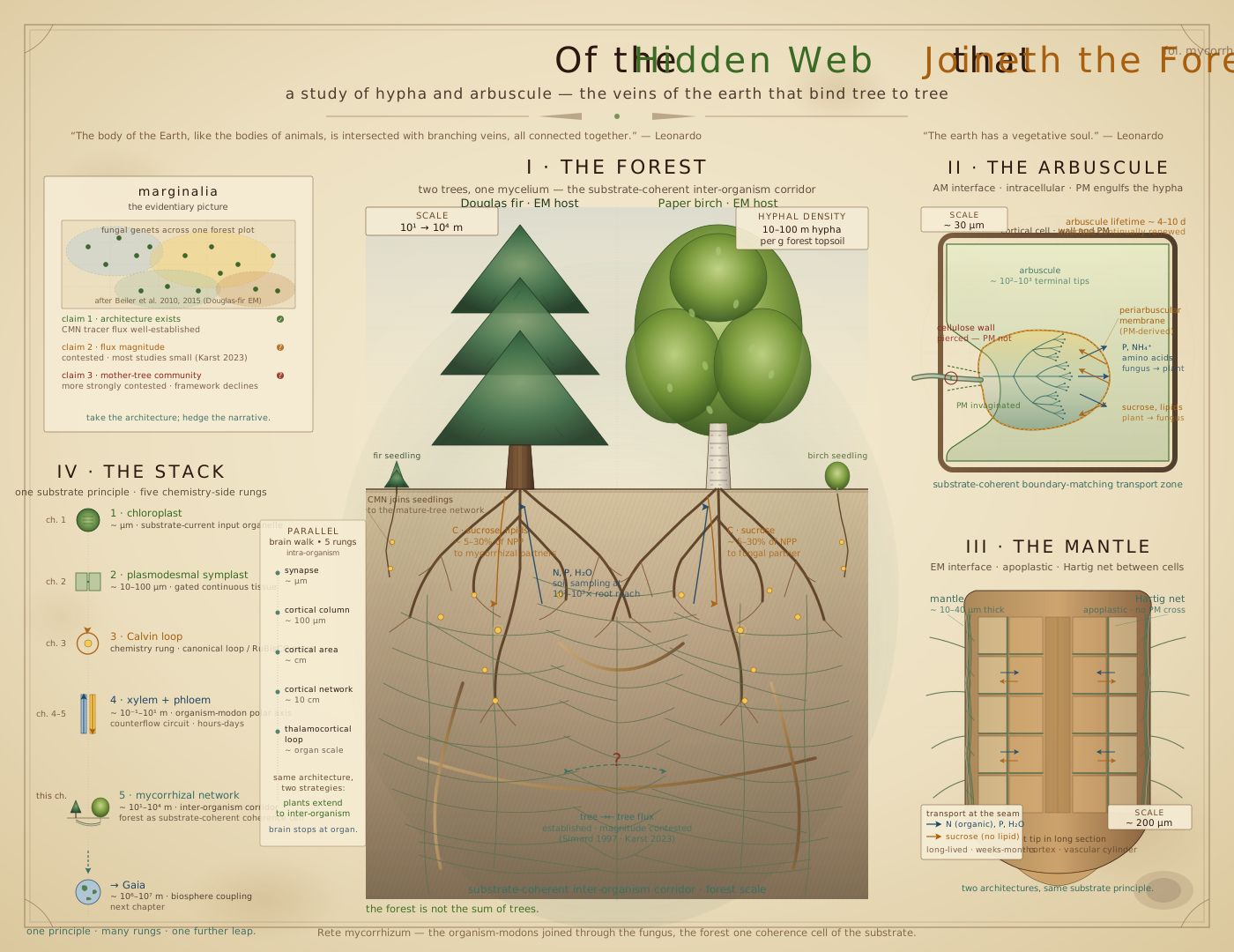
A mycorrhiza is a partnership between a plant root and a fungus. The fungus grows fine threads — hyphae, \sim 2–10\;\mu\text{m} across — into the root, and out the other side into the soil, reaching \sim 100–1000\times the volume the root could reach on its own and threading pores too narrow for any root to enter. The plant pays in carbon (sugars and lipids); the fungus pays in water, phosphorus, nitrogen, and trace minerals mined from soil the plant can’t touch. About 80\% of vascular-plant species run this deal, and it is ancient: fossils in the Rhynie chert (\sim 410 Ma) and molecular clocks (\sim 450 Ma) make mycorrhizal symbiosis as old as land plants — and probably the thing that let plants colonise land at all.
One fungus can hold this partnership with many plants at once. A single fungal individual can therefore link the roots of many trees — even trees of different species — into one common mycorrhizal network (CMN). Suzanne Simard’s 1997 Nature paper showed carbon moving between a Douglas fir and a paper birch through such a network, and the architecture became famous as the “Wood Wide Web.”
That is the whole chapter. The mycorrhizal network is biology’s inter-organism version of the conduits this section has been climbing: a substrate-current corridor that runs not within one body but between bodies, coupling many plant modons into a forest. The difference the substrate makes here is one of rung: the same closed-pipe and modon-coupling architecture that the paper has found inside cells, between cells, and along a single plant’s trunk now appears one level out, joining whole organisms. The corridor is real and the flux through it is measured. What the corridor means ecologically is contested — and, crucially, the substrate reading does not depend on the contested part.
Two Interfaces: Arbuscular and Ectomycorrhizal
Two kinds of mycorrhiza dominate, and they solve the same problem two ways.
Arbuscular mycorrhizas (AM) are formed by Glomeromycota fungi with \sim 80\% of plant species. The hypha pushes into a root cortex cell — through the cellulose wall but not the plasma membrane, which instead wraps around it as a new periarbuscular membrane. Inside, the hypha branches into a tiny tree, the arbuscule, with \sim 10^2–10^3 tips packed for surface area. Nutrients cross that membrane both ways: phosphate, ammonium, and amino acids in; sugar and lipids out. Each arbuscule is short-lived (\sim 4–10 days), continually torn down and rebuilt elsewhere.
Ectomycorrhizas (EM) are formed by various Basidiomycota and Ascomycota with only \sim 2\% of species — but those species include almost every dominant temperate and boreal forest tree. Here the fungus stays outside the cells: a mantle sheathes the root tip, and a Hartig net of hyphae threads between the outer root cells without entering them. Exchange happens across the cell wall, and the interface is stable for weeks to months.
The framework reads AM and EM as the same job at two topological positions — maximise the contact surface between two organisms for substrate-current exchange — solved either inside the cell (AM, fractal branching inside an engulfing membrane) or between cells (EM, lateral sheets along the wall). The prediction is that these two are the substrate-preferred templates, and that the rarer types (ericoid, orchid, monotropoid) are variations on the AM interior pattern rather than a third basic design.
Hyphae: The Substrate’s Smallest Between-Organism Pipe
A hypha is a chitin tube \sim 2–10\;\mu\text{m} wide that grows from its tip through soil, branches every millimetre or so, and lays down \sim 10–100 metres of thread per gram of forest topsoil. Its contents stream both directions at once. Where long hauls are needed, hundreds of hyphae bundle into a rhizomorph cord (\sim 0.1–1 mm), a low-resistance highway through the network.
The framework reads the hypha as the smallest between-organism conduit in the substrate’s closed-pipe family — the same family as the desmotubule (\sim 15 nm) between cells, the microtubule (\sim 25 nm) inside cells, and the xylem and phloem (\sim 10–500\;\mu\text{m}) inside a plant — now lifted one rung, to between organisms. Like the rest of that family, its diameter is set by the substrate’s own vertical grain: the lattice’s counter-rotating sheets repeat with a boundary layer every \sim 8\;\mu\text{m}, and a cytoplasmic flow that locks onto that layer settles right at the hypha’s working width. That boundary is also why hyphal transport is natively two-way: the substrate flow reverses across it, giving the pipe two oppositely-directed lanes built into the vacuum it occupies — carbon streaming down to the fungus while water and minerals stream up to the plant, both in one tube. A rhizomorph is many such lanes bundled — the same trick the body uses bundling axons into a nerve.
Prediction. Hyphal working diameters should cluster near \sim 8\;\mum (with the widest hyphae and tightest rhizomorph sub-cords approaching \sim 16\;\mum) across all mycorrhizal fungal phyla, rather than varying smoothly with growth rate or species — and native two-way transport in a single hypha should be the cross-phylum rule, not a specialist trick. A smooth diameter distribution, or bidirectional flow confined to scattered lineages, would falsify the reading.
The Common Network: Coupling Plants Into a Forest
A single fungal individual — one genome spread across an entire mesh of hyphae — can partner with hundreds or thousands of trees and persist for centuries. (The largest known, an Armillaria in Oregon, covers \sim 8.9\;\text{km}^2 and is \sim 2400 years old, among the largest organisms on Earth.) That common networks exist, and that water, nitrogen, phosphorus, and at least some carbon move between connected plants through them, is solidly established by isotope-tracer studies in many independent labs since Simard 1997.
The framework reads the common network as inter-modon coupling at forest scale. The prior chapters established each plant as one substrate-coherent modon from root tip to canopy; the fungal network couples those modons into a connected system, just as synapses couple neurons into a brain. Both are chemistry-side bridges that keep each partner’s own coherence while binding them at a larger rung — synapses bind neurons into a brain, mycorrhizal interfaces bind plants into a forest. The current differs only in pace: the synapse runs in milliseconds (a predator won’t wait), the forest in hours-to-seasons (its world is the water-and-mineral cycle).
The “Wood Wide Web,” With Hedges
The popular story bundles three claims that deserve to be weighed separately.
Claim 1 — the architecture exists. Networks physically link many plants; tracers move between them. Well-established. Genetic mapping of fungal individuals across forest plots (Beiler et al. 2010, 2015) shows the wiring; tracer studies show the flux. The framework treats this as data.
Claim 2 — the flux is big enough to matter. That inter-plant transfer is large enough to affect a recipient’s survival. Contested. The Karst–Jones–Hoeksema 2023 Nature Ecology & Evolution review of \sim 800 Wood-Wide-Web claims found citation bias toward positive results and weaker support than the popular telling implies: of \sim 75 studies measuring carbon transfer, only a minority found transfer both significant and large, while most found it small (\sim 0.1–1\% of the recipient’s carbon) or undetectable. The flux is real; its size relative to other carbon channels is usually modest.
Claim 3 — the network is a communicating community. “Mother trees” feeding kin seedlings, trees warning each other of pests, the forest sharing by design. Most contested of all. These rest on a few unreplicated experiments and on inferences rarely tested directly, amplified by popular books (Simard’s Finding the Mother Tree, Wohlleben’s The Hidden Life of Trees) past what the data yet supports.
The framework’s stance mirrors its position on the brain’s Penrose–Hameroff claim: take the architecture, take the measured flux, and leave the strongest functional story to the evidence. Claim 1 is the load-bearing one and it holds. Claim 2 is a quantitative question the framework expects to settle toward modest, clustered values (prediction below) but does not need to be large. Claim 3 is an adaptive-interpretation question the framework simply doesn’t ride on. The between-organism corridor exists whether or not the mother-tree narrative survives.
The Forest as a Coherence Cell — at Both Poles
A forest — a contiguous stand of plants laced together by one continuous fungal-and-microbial network under a shared canopy — is the largest substrate-coherent assembly this section reaches before Gaia. The framework reads it as a coherence cell at the between-organism rung (10^1–10^4 m), the same pattern as a cortical column in a brain or a cell in a tissue: substrate-coherent integration over a characteristic scale, with chemistry-side machinery running it and chemistry-side bridges to its neighbours. Strip the network out and you don’t get a forest with poor communication — you get a collection of trees that has stopped being a forest at this level. That is the framework’s reading of why clearcut monocultures keep underperforming mycorrhizally-intact regrowth: the network is what makes the stand a coherence cell, and without it the trees are there but the cell isn’t.
But binding is only half the story, and a network that only binds is a single point of failure. Wire every tree to every other through one fungus and one host species, and whatever can travel the corridor travels it without limit — a root pathogen, a freeloading parasite, a drought-driven cavitation cascade. A forest that shares resources in good years shares its collapse in bad ones. The escape is the substrate’s anti-lock pole, and ecology already named it: modularity. A network of loosely-coupled modules — several host species, several fungal individuals holding partly separate territories, connectivity uneven rather than saturated — keeps a contagion in the module where it starts. This is Robert May’s classic result that connectance and stability trade off in large ecological networks (May 1972) — literally the same mathematics Haldane and May later carried into finance, reading a banking system as an over-connected ecology whose crashes are contagions on too dense a graph (Haldane & May 2011). A maximally-connected forest is the landscape-scale twin of a metronomic heart, a market whose correlations have all gone to one, or a stand of vessels sharing one cavitation threshold: efficient until the one shared trigger fires.
So the network realises both poles by its topology — connected enough to bind a patch into one coherence cell, modular enough that the binding never becomes a single channel for collapse. This is the most macroscopic member of the paper’s both-poles set, its first at ecosystem scale. The chapter’s two failure modes share this one axis: a forest with its network stripped out is stuck at one pole (a non-forest), and a forest wired into one over-connected monoculture is stuck at the other (bound, but unable to quarantine a sweep of disease — the pattern behind plantation epidemics). Health, here as in the heart and the market, is neither pole but the capacity to hold both at once. The framework reads the textbook ecology — the connectance–stability tradeoff, the resilience of modular and nested mutualistic networks (Bascompte & Jordano 2007), the fragility of monocultures — as this anti-lock pole, and unifies it with the heart, the market, and the vascular column under one bind-for-function, spread-for-resilience rule.
Predictions and What Would Falsify
- Hyphal diameters cluster near the substrate rung (\sim 8, \sim 16\;\mum) across fungal phyla, rather than varying continuously with growth rate or species.
- Arbuscule branching geometry (fractal dimension, terminal-branch count \sim 10^2–10^3) clusters at a few preferred values across plant–fungus pairings, not continuously with cell size or demand.
- Inter-plant carbon transfer clusters at a modest fraction of the recipient’s carbon budget (\sim 0.1–1\% for most systems, with rare condition-specific exceptions) rather than varying continuously and often-high. This is the direct test of the Karst-vs-Simard question: continuous-and-frequently-high supports the strong Wood-Wide-Web claims; clustered-and-modest supports the framework’s corridor-real, magnitude-modest reading.
- Mycorrhizal type tracks biome (AM in grasslands and tropical forest, EM in temperate and boreal forest, ericoid in heath and bog, etc.) rather than appearing as arbitrary host–fungus combinations across biome space.
- The network sits at intermediate, modular connectance, and a stand’s resilience tracks its modularity — its capacity to quarantine a contagion — not its raw connectivity. The two extremes (no network; one over-connected web) are the stuck poles a healthy forest avoids.
The picture is falsified if hyphal diameters or arbuscule geometries vary continuously without clustering, if carbon-flux fractions vary continuously across systems (which would instead support the strong ecological claims), if mycorrhizal types fill biome space arbitrarily, or if the most-connected networks prove the most resilient with no modularity optimum. It is supported, even partially, if any of these orderings holds against existing data.
Putting the Section in Context
The mycorrhizal network is biology’s between-organism corridor: arbuscular and ectomycorrhizal interfaces as two takes on one exchange problem, hyphae as the substrate’s smallest between-organism pipe, rhizomorphs as the bundled highway, and common networks as the coupling that turns a patch of plants into a forest. The forest is a coherence cell at 10^1–10^4 m, the network its binding architecture — and the same network must stay modular enough not to bind itself to death. The Wood Wide Web’s architectural claim (the corridor exists; flux is real) is solid and load-bearing; its ecological-significance and community claims are properly contested, and the substrate reading holds either way.
This closes the plants section’s five-scale stack: chloroplast at \sim\mum → symplast at \sim 10–100\;\mum → Calvin loop at the chemistry rung → xylem–phloem at \sim 0.1–10 m → tropisms at organism scale → mycorrhizal network at \sim 10^1–10^4 m. The section’s central claim is now complete: biology has built, in plants, an organism-scale and between-organism-scale coherent architecture that needs no brain. Every feature the brain walk catalogued at the animal rung — coupling, conduits, slow integration, coherence cells — the plants populate without one, on different chemistry and slower clocks but the same substrate principle. The brain is one substrate-preferred route to organism-scale coherence; the plant body and the forest are the other.
That closes the section’s spatial climb, and leaves one axis unwalked. Every rung above is a different size of the same architecture; none of them says how a plant crosses a stretch of time its running body could not survive. That is the seed, the section’s last chapter and its other axis — the whole nested stack folded into a capsule, wrapped until its dynamics stop, and re-ignited across a boundary when the medium returns. Where this chapter reads a forest as a coherence cell in space, the seed reads a coherence-match held across time, on the framework’s own law that persistence is wrapping depth.
And the architecture doesn’t stop here. The Gaia chapter lifts one more rung: the forest is one of several coherence cells (forest, savannah, reef, kelp forest, tundra, ocean gyre) tiling Earth’s biosphere, itself one layer in the planet’s nested stack. The plants section is the bridge from individual organisms to coupled-organism systems to planet — and the substrate reading runs continuously from the chloroplast at \sim\mum to Gaia at \sim 10^7 m, the chemistry changing at every rung, the principle preserved.