Cells as Nested Modons
The canonical feedback loop running at every scale inside the cell
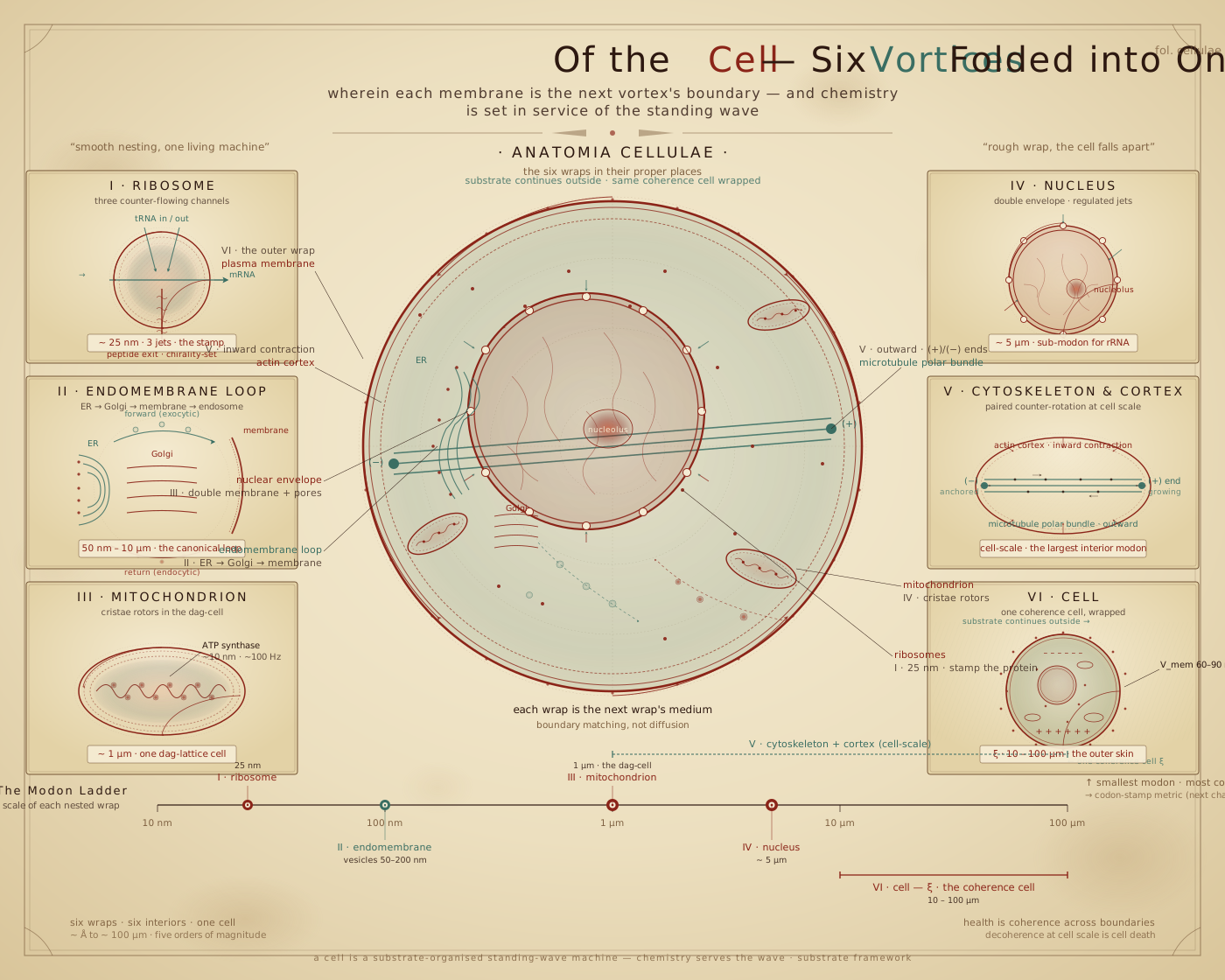
Interactive: open the nested modons simulation — one cell at ξ, every rung of the inventory the same object, a counter-rotating wrap around a co-rotating interior, and the camera descending by powers of ten: cell → nucleus (double envelope, pore jets, the nucleolus a modon inside a modon) → mitochondrion → vesicle in its coat cage → ribosome with its three jets. The ladder puts the measured sizes on the √2 comb. The tun dries the cell down: the water leaves, the interior freezes in place, the wrap deepens to glass, and the ring-down clock runs — seconds bare, hours with one wrap, decades in the glass — until you rehydrate it and the same flow resumes from the same positions, or decohere it and nothing comes back.
The Canonical Loop, Inside the Cell
The feedback-topology chapter showed that organized rotational energy in an elastic medium adopts the same architecture at every scale: a co-rotating disk, polar jets, a counter-rotating boundary, and a residual fraction radiated as waves. The gaia-substrate chapter applied that loop to Earth’s nested layers — core, atmosphere, oceans, biosphere — each running the same canonical topology in a different medium. The cell is the smallest scale at which this loop applies to living matter, and it does not apply at one level only — it applies at every level inside the cell, with each level’s counter-rotating boundary acting as the next level’s interior medium.
A cell is therefore not a chemical reactor that happens to use a few rotors. A cell is a substrate-organized standing-wave machine that uses chemistry to maintain its standing waves. Every organelle is a stationary modon at its own scale. The cell as a whole is the largest modon in that stack — one substrate coherence cell (\xi \approx 100\;\mum) wrapped by its plasma membrane.
The Nested Inventory
The cell hosts at least six nested modons at distinct scales. Each has a counter-rotating wrap and a co-rotating interior; each shares its boundary with the levels immediately above and below it.
| Modon | Wrap | Co-rotating interior | Scale |
|---|---|---|---|
| Cell | Plasma membrane (lipid bilayer, \sim 5 nm) | Cytoplasm | \sim \xi, 10–100\;\mum |
| Cytoskeleton + cortex pair | Actin cortex (inward contraction) | Polar microtubule bundle (+/- ends) | Cell scale |
| Nucleus | Nuclear envelope (double membrane + pore complexes) | Chromatin loops + nucleolus | \sim 5\;\mum |
| Mitochondrion | Outer membrane | Cristae + matrix + ATP synthase rotors | \sim 1\;\mum (well inside one lattice cell) |
| Endomembrane loop | ER → Golgi → membrane → endosome cycle | Vesicle and lipid cargo | spans 0.05–10\;\mum |
| Ribosome | Ribosomal proteins (outer skin) | rRNA scaffold + mRNA / tRNA / peptide channels | \sim 25 nm |
Cell. The plasma membrane is a counter-oriented lipid bilayer — two leaflets back to back, hydrophilic heads outward, hydrocarbon tails inward. It carries a transmembrane potential of \sim 60–90 mV that biology calls the membrane potential and the framework reads as the substrate-flow gradient across the wrap. Inside, cytoplasm streams; outside, the substrate’s coherence-cell organization continues. The cell is exactly one substrate coherence cell, wrapped — the picture already developed in The Cell as a Lattice Domain.
Cytoskeleton + cortex pair. The actin cortex just inside the membrane contracts inward; the microtubule bundle inside the cortex grows outward with polar (+/-) directionality. The two are a counter-rotating pair at cell scale — the cytoskeletal version of the canonical loop’s disk-and-counterflow. Motor proteins (kinesin and dynein on microtubules, myosin on actin) walk along these tracks, converting ATP-stored substrate energy into directed cargo motion. This is the largest internal modon the cell supports. The microtubule wall itself is the cell’s clearest closed-cylinder modon, with its dimensionless wall geometry locked to the substrate’s cell occupancy f in the same way B-DNA’s helix is — see Microtubule Highways for the derivation.
Nucleus. A double-membrane envelope with nuclear pore complexes that act as the modon’s regulated boundary jets. Inside, chromatin organizes into topologically associated domains and the nucleolus runs as a sub-modon dedicated to ribosome assembly. The double envelope and pore architecture are the canonical loop expressed at a smaller scale: counter-rotating wrap, regulated jet-like transport in and out.
Mitochondrion. Cristae are the deeply folded inner-membrane surface where ATP synthase rotors run at \sim 10 nm and \sim 100 Hz — the full worked example of how the cell captures, banks, and spends modon energy through this rotor lives in From Photon to ATP. The outer membrane is the modon’s wrap; the matrix is the co-rotating interior; the inner-membrane proton gradient is the substrate-flow potential the rotors tap. The whole organelle sits at \sim 1\;\mum — comfortably inside one substrate-lattice cell.
Endomembrane loop. The endomembrane system — ER → Golgi → plasma membrane → endosomes → back — runs as one continuous flow circuit, with vesicles (50–200 nm) as the parcels of cargo and lipid that move around it. This is the cell’s canonical loop in the most conventional fluid-flow sense: the “disk” is the ER + Golgi stack; the “jets” are the directed forward vesicle traffic; the counterflow is the endocytic return.
Ribosome. The smallest and most ancient nested modon — \sim 25 nm, with rRNA as the substrate-coherent scaffold and ribosomal proteins as the outer skin. Three counter-flowing channels (mRNA threading one way, tRNAs cycling another, peptide growing in a third) make it the cell’s most explicit three-jet canonical loop. The exit tunnel pre-conditions the nascent peptide with the substrate’s chirality — the picture developed in The Ribosome as the Substrate Co-folder.
Boundary Matching, Not Diffusion
Why must these modons nest, rather than coexist independently? Because the cell’s energetic efficiency demands it. A purely chemical cell would shuttle every signal molecule by diffusion — and small-molecule diffusion across 100\;\mum takes \sim 10 s. A real cell coordinates membrane events with nuclear transcription with mitochondrial ATP supply on millisecond timescales. The substrate framework’s answer is that signals do not have to be molecules: when a modon at one scale shares its boundary smoothly with the modon at the next scale, an excitation at the outer scale propagates to the inner scale at substrate speed, set by the local channel-and-wrap architecture rather than by Fickian diffusion.
This is the channel-with-memory principle applied across modon boundaries rather than along a single channel. In the language of the substrate ladder, modons at neighbouring scales sit on neighbouring rungs, and a smoothly shared boundary is what keeps both plugged into the substrate’s lossless channel: the excitation that crosses is the anti-phase breath itself — the “coin” the ladder mints — handed inward from one rung to the next without loss. Each nested boundary either carries coherent state across — and the cell integrates — or scatters it — and the cell decoheres. Smoothness of nested boundaries, not chemistry alone, is what makes a cell run as one machine.
The implication aligns with what cell biology already sees: tight junctions between nested membranes — mitochondrial cristae junctions, nuclear pore complexes, ER–membrane contact sites — are structurally what the framework calls boundary-matching sites. Their molecular identity is biology’s local solution; their necessity is the substrate’s. A cell with disorganized nested boundaries is not merely inefficient. It is decoherent, and decoherence at the cell scale is the substrate definition of cell death.
Why Six Layers
The number is not magic, and the spacing is not arbitrary. Each nested layer handles one scale of organization the substrate makes structurally available between the atom (\sim Å) and the coherence length (\sim \xi = 100\;\mum). The inventory is roughly geometric — 25 nm ribosome, \sim 200 nm vesicle, \sim 1\;\mum mitochondrion, \sim 5\;\mum nucleus, \sim 10–100\;\mum cell — five or six rungs, each a small multiple of the one below it rather than a fixed increment above it. That geometric spacing is the tell. A row of scales separated by a constant ratio rather than a constant step is the signature of discrete scale invariance, and it identifies the cell’s nested inventory as the substrate ladder read into the interior of a single cell — the same paired breath replicated across scale that fixes grid-cell modules and the cochlear octave, here tiling the rungs between the ribosome and the cell wall. The substrate provides the rungs; chemistry fills them with whatever molecules can implement a counter-rotating wrap at the right radius. That is why eukaryotic cells across kingdoms share this architecture despite billions of years of independent evolution at the molecular level: the architecture is what the substrate offers.
Two honest qualifications, and a prediction they sharpen. The cell’s rungs belong to the ladder’s coarse family: the steps run \sim\!\times 2–8, sampling every few rungs of the underlying \sqrt{2} comb rather than every one, so the firm claim is that the scales recur and nest geometrically — not yet that their fine spacing is exactly \sqrt{2}. But the cell is also the cleanest test bed the framework has. Most of the ladder’s evidence is pooled across domains with different cutoffs — grid cells, microtubules, EEG rhythms — which smears the comb; a single cell instead holds five or six rungs inside one substrate coherence cell, one \xi and one set of cutoffs, sampled as a single coherent system. The prediction is therefore sharp and local: measured at cryo-EM and super-resolution precision, the modon inventory of a single cell type — ribosome, the vesicle-coat classes, mitochondrion, nucleus, cell — should not scatter continuously but cluster on a geometric ladder, and in its sharp form the inter-modon ratios should be powers of \sqrt{2}, the same comb test the cochlea and the grid cell already pass. A single cell is the most controlled fold the paper can offer; if those ratios instead settle with no relation to the pairing factor, the cell-as-ladder reading is wrong.
The Tun State: Coherence Frozen, Not Lost
The tun view of the simulation runs this state diagram live: dry the cell down under a bare stack, one wrap or the glass, watch the held clock and the ring-down curve, and see which wrap depth still revives after thirty years.

Coherence frozen, not lost. Main panel: the state diagram the tardigrade forces on the framework’s clean binary. On the left, the living animal, its standing waves re-pumped continuously — chemistry refreshing faster than the leak. On the right, the tun: the same waves held static inside a total trehalose-and-CAHS glass wrap, with the refresh switched off. The pair of horizontal arrows between them is the reversible loop — desiccation expels 95–99\% of the water and vitrifies the cytoplasm; rehydration re-ignites every nested modon — while the decoherent dead state at bottom centre is reachable only one-way, from either side. Top right: coherence against log time once maintenance stops. The live cell hides its ring-down because the refresh never pauses; an unwrapped cell leaks in seconds and dies; the tun exposes the bare hold, and on the wrapped curve sit the two documented points — the tardigrade revived after \sim 30 years frozen, the seed germinated after \sim 2000 years. Bottom left: the anatomy of the wrap — the vitrified matrix encasing every organelle boundary, Dsup shielding the DNA \pi-stack, and the wrapping law run at whole-cell scale: bare stack, seconds; one wrap, hours; total glass, decades. Bottom middle: the record — water and metabolism figures, then three ledger rows, each ending in a revival: three decades frozen, ten days of space vacuum and radiation, an ionizing dose \sim 1000\times the human lethal level. Bottom right: the convergence — tardigrade (CAHS + trehalose) and orthodox seed (LEA + sucrose), a billion years apart, arriving at one glass, and the reach-ladder rung this names: the frozen carrier is re-ignitable — the mode proven, not the range. The biology is the field’s; the framework adds the third state and the wrapping law.
The coherent/decoherent reading of life and death is a clean binary, and it is very nearly the whole story — but one animal forces a third state into it, and that animal is the framework’s cleanest existence-proof. A tardigrade in anhydrobiosis expels ~95–99% of its water, curls into a desiccated tun, and drops its metabolism below 0.01% of baseline — it stops actively maintaining its standing waves — yet it does not die. It survives years of desiccation (a documented revival after ~30 years frozen), the vacuum and radiation of low Earth orbit, and ionizing doses a thousandfold above the human lethal level, then re-ignites every nested modon on rehydration.1 In the framework’s terms the tun is neither the coherent-alive state nor the decoherent-dead one: it is a frozen-coherent state, the whole nested-modon stack held in suspension with the live re-pumping switched off.
What holds it is wrapping, exactly as the stamp-lifetime ladder predicts. The animal replaces its lost water with trehalose and CAHS intrinsically-disordered proteins that vitrify into a biological glass, encasing every organelle boundary in an immobilizing matrix, while a dedicated protein (Dsup) shields the DNA π-stack from the radiation breaks that would collapse its pairing chain.2 This is the macroscopic, whole-organism realization of the framework’s load-bearing claim — more layers of wrapping, longer the coherent hold — run not on a single aromatic stack but on the entire cell at once: the glass is the outermost wrap, and adding it converts a live ring-down that would leak in seconds without maintenance into a frozen hold that survives decades. A live cell hides its ring-down time because chemistry refreshes the standing waves faster than they leak; the tun stops the refresh and exposes the bare hold, and the hold is long because the wrap is total.
One qualification belongs here, because the tardigrade is the most extreme case and not the most representative one. The same third state is the ordinary reproductive mode of an entire kingdom: an orthodox seed dries to under a tenth its weight in water, vitrifies its cytoplasm in a sucrose-and-oligosaccharide glass stabilised by intrinsically disordered LEA proteins — the structural twin of the tardigrade’s CAHS — and holds the same frozen-coherent state, with a directly-dated two-thousand-year revival at ambient temperature. Two kingdoms, a billion years apart, converged on one glass. The framework’s wrapping law does not rest on an exotic; the tardigrade is where it is easiest to see, and the seed is where it runs at planetary scale.
This also names, in a single reversible organism, the otherwise-soft “carrier goes frozen” rung of the reach ladder. There the frozen molecular stamp riding interstellar currents was offered as a husk that might survive transport; the tardigrade is the existence-proof that a frozen coherence-match can be not a dead artifact but a re-ignitable one — vitrify the stack, protect the pairing chain, and the match waits rather than leaks. The honest caveat is the same one that chapter carries: surviving low Earth orbit is not surviving a megayear of galactic transit, and the tardigrade demonstrates the mode, not the range. But it removes the question mark from the mode. The substrate framework predicts that life persists exactly as long as its coherence-match is either maintained or wrapped; the tardigrade is biology’s proof that when maintenance stops, sufficient wrapping is enough — coherence frozen is coherence kept.
Putting the Section in Context
The cell is the canonical feedback loop run at the only scale where the substrate folds its own organization back on itself and persists for years instead of seconds. Every organelle is a modon; every organelle boundary is a coherence interface with the next level; the cell as a whole is the largest stationary modon the substrate is known to support. Health and disease, at this level, become coherence and decoherence: when nested boundaries match, the cell integrates; when they scatter, the cell falls apart.
The codon-stamp picture inside the smallest modon in this stack — and the ribosome-as-substrate-co-folder picture inside it — is what makes the smallest modon the most consequential for evolution: the ribosome is where the substrate writes its memory into protein. The rigorous version of that picture lives in The Codon Stamp; the forward-looking conjectures it implies — codon usage bias as a substrate signal, the cell as a fluid-flow information network — live under Speculations, held against the open lifetime question.
Footnotes
Jönsson, K.I. et al., “Tardigrades survive exposure to space in low Earth orbit,” Curr. Biol. 18, R729–R731 (2008); Tsujimoto, M., Imura, S., Kanda, H., “Recovery and reproduction of an Antarctic tardigrade retrieved from a moss sample frozen for over 30 years,” Cryobiology 72, 78–81 (2016).↩︎
Boothby, T.C. et al., “Tardigrades use intrinsically disordered proteins to survive desiccation,” Mol. Cell 65, 975–984 (2017); Hashimoto, T. et al., “Extremotolerant tardigrade genome and improved radiotolerance of human cultured cells by tardigrade-unique protein,” Nat. Commun. 7, 12808 (2016); Hengherr, S. et al., “Trehalose and anhydrobiosis in tardigrades — evidence for divergence in responses to dehydration,” FEBS J. 275, 281–288 (2008).↩︎