The Endoplasmic Reticulum
The cell’s living boundary-layer reticulum
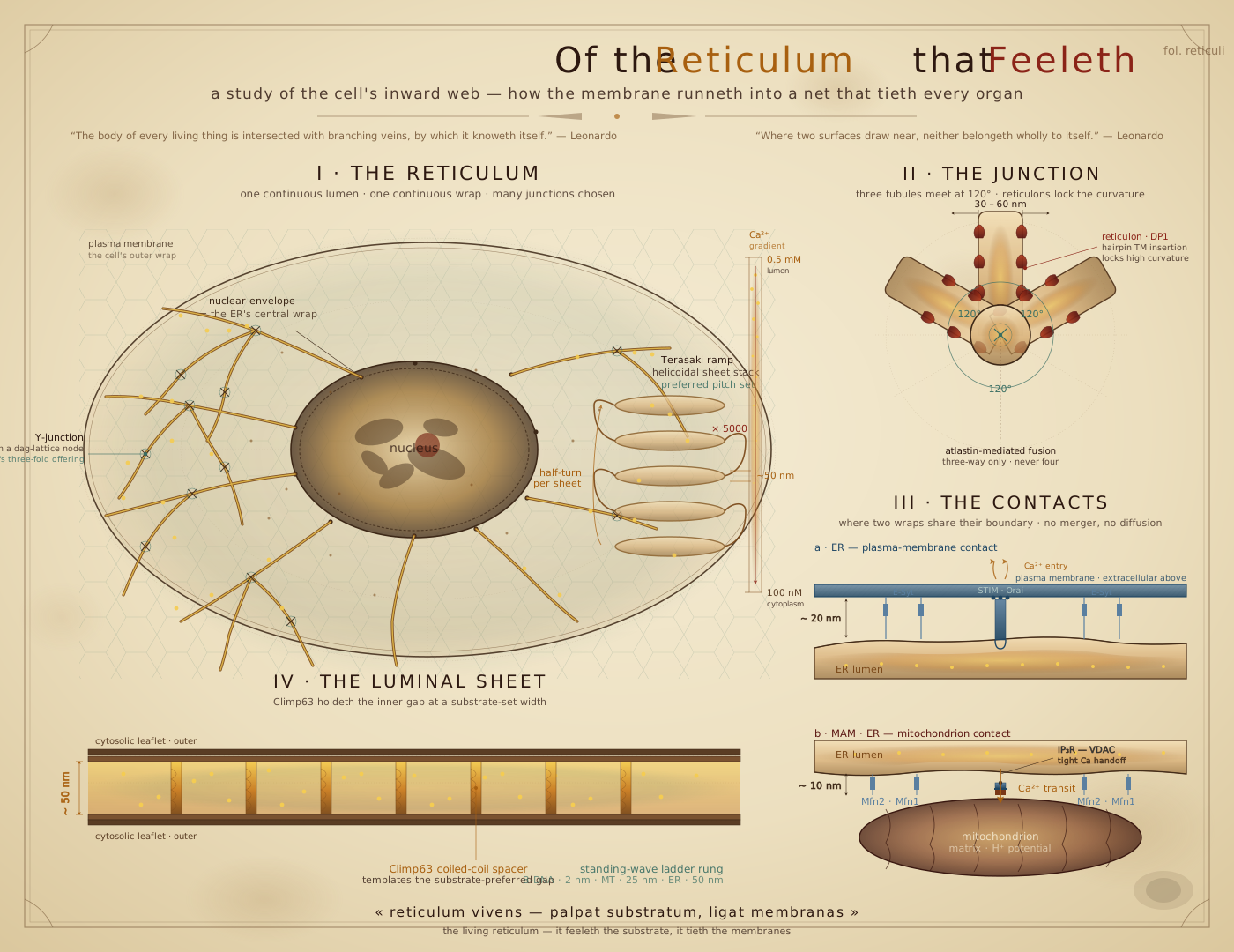
The endoplasmic reticulum is the largest single membrane structure inside a eukaryotic cell. Its surface area in a typical mammalian cell is ten to thirty times the area of the plasma membrane; in secretory cell types (hepatocytes, plasma cells, exocrine pancreatic acini) it can occupy half of all cytoplasmic membrane. Topologically it is one continuous bilayer-wrapped tube enclosing one continuous luminal compartment that runs from the inner face of the nuclear envelope to within a few tens of nanometers of the plasma membrane, with sheet domains (Terasaki ramps, stacked cisternae) and tubule domains (a polygonal three-way-junction network) connected as one organelle. It is also one of the most dynamic structures inside the cell — junctions migrate on the second timescale, tubules slide along microtubules, sheets and tubules interconvert under cell-state changes, and contact sites with every other organelle form and dissolve continuously.
The framework’s claim about the ER is the natural extension of the plasma membrane chapter inward. The ER is the cell’s internal boundary layer, expressed as a continuous reticulum whose three-way-junction topology is the substrate’s two-dimensional sheet structure made navigable. The plasma membrane is a single closed wrap at the cell scale; the ER is the same bilayer architecture run into a space-filling network that lives one sub-domain scale below the cell and acts as the cell’s primary internal tracker of the substrate’s lattice landscape. Where DNA’s polar axis runs the cell’s longest substrate-coherent wire and reads it through [4Fe-4S]-cluster terminals (dna-living-lattice.qmd), the ER’s polar membrane surface runs the cell’s largest substrate-coherent sheet and reads it through positional commitments — where to place a three-way junction, where to dock with another organelle, where to release calcium.
The Reticulum’s Topology
A cryo-EM-resolved ER is two morphologies running into each other along one continuous lumen.
Tubules. Hollow cylindrical membranes of \sim 30–60 nm diameter, joined at three-way Y-junctions, organized into a polygonal network that fills the cytoplasm. The junctions sit at angles measurably close to 120°, and the network looks topologically like a 2D honeycomb embedded in 3D (with frequent reconnections, mergers, and crossings). In a typical cell the network contains \sim 10^3–10^4 three-way junctions, mostly in the cell periphery.
Sheets. Flat-faced lamellar cisternae of \sim 50 nm luminal width, often stacked. In secretory and highly synthetic cell types the sheets are stacked into helicoidal terraces — Terasaki ramps (Terasaki et al. 2013) — in which each successive sheet connects to the next by a half-turn of helicoidal membrane, like a parking-garage ramp. The Terasaki geometry is mathematically a finite set of allowed helical pitches, only some of which are observed in cells, and which the framework reads in the same register as the microtubule’s 13-protofilament closure: a substrate-preferred discrete geometry overriding chemistry’s natural continuum.
Curvature stabilisers. Reticulons (RTN1–4) and DP1/Yop1 insert hairpin transmembrane domains that wedge into the outer leaflet and lock in the tubule’s high curvature; Climp63 acts as a luminal spacer that maintains the \sim 50 nm sheet thickness; atlastin GTPases mediate homotypic tubule fusion at junctions. The framework reads these proteins as biology’s curvature-locking implementation for the substrate’s preferred radii at this sub-domain scale — the same role cholesterol plays at the plasma membrane, with the difference that the ER’s preferred radii are tighter and the locking proteins are specific rather than diffuse.
The numbers are the framework’s first set of anchors. A 30–60 nm tubule diameter sits inside the standing-wave ladder rung at \sim 50 nm — between B-DNA (\sim 2 nm) and the microtubule wall (\sim 25 nm) on the way up, and between lipid rafts and lattice spacing on the way down. A 50 nm sheet luminal width sits at the same rung. A 120° three-way junction is the angle the substrate’s three-fold symmetry already produces at F_1’s catalytic head and at the microtubule wall’s 3-start helix — three is the substrate’s lowest-frustration cyclic offering, and a Y-junction in a 2D-embedded network is the substrate’s three-fold offering expressed as a network node.
The Network as Substrate-Landscape Tracker
The reading the user’s overview of the cell already gestured toward sharpens here. The ER’s three-way-junction network is the cell’s continuously-running readout of its own substrate-lattice landscape. Each junction sits at a position; the position is held against thermal noise by curvature-stabiliser chemistry; the position migrates when the local substrate landscape changes. The network as a whole is therefore not a static skeleton — it is a polar-transport system whose nodes carry positional information about the cell’s lattice domain in the same sense that DNA’s polar channel carries sequential information about the genome.
Three mechanistic features support this reading.
Junction migration is fast and continuous. Live-cell ER imaging since Lee and Chen 1988 has documented that three-way junctions slide along the network on the 1–10 s timescale, with new junctions forming by atlastin-mediated tubule fusion and old junctions dissolving by retraction. The migration is not random walk — junctions preferentially track along microtubules, dock at specific cortical sites, and cluster near regions of active calcium release. The framework reads the migration kinetics as the network seeking its substrate-energy minimum: each junction has a substrate-energy cost set by how well it matches the local lattice configuration, and the migration is the network relaxing toward that configuration in real time.
Tubule lengths cluster, not smooth. Quantitative reconstructions of ER tubule networks (Nixon-Abell et al. 2016, Schroeder et al. 2019) report that the lengths between adjacent junctions are not exponentially distributed (which a pure random-network model would predict) but cluster at preferred values — peaks reported in the literature at \sim 0.5, \sim 1, \sim 2\;\mum, with falloff at longer lengths. The framework reads the clustering as the substrate’s standing-wave ladder showing up in the network’s edge-length distribution: tubules connect at intervals favoured by the substrate’s sub-sheet structure, not at random.
The network reorganises with cell state. In cells transitioning between states (mitotic onset, ER stress, secretory upregulation) the entire network’s topology reorganises on a minutes timescale, with sheet/tubule ratio shifting toward sheets in highly secretory states and toward tubules in mobile or signaling-active states. The framework reads the reorganisation as the network re-tuning its substrate-coherence configuration to the cell’s current functional regime — the same way Mediator condensates (dna-living-lattice.qmd) re-tune the genome’s coherence boundaries to the cell’s transcriptional state. The ER does at the membrane what Mediator does at the chromatin: it is the cell’s structural rearranger, run continuously rather than at signaling events.
The intuition the DNA chapter’s polar-channel section makes explicit at the genome lifts directly here. The DNA polar channel reads a 1D substrate landscape by sequence-dependent spectra projected through hydrogen-bond tie-points to wrap lobes. The ER’s reticulum reads a 3D substrate landscape by junction-position-dependent contact-site choices projected through curvature-stabiliser chemistry to docking commitments. One channel, one reader; one network, many readers. The same architecture, rotated from a linear filament to a space-filling mesh.
Three-Way Junctions and the Substrate’s Three-fold Offer
The 120° angle at every three-way ER junction is the cleanest place where the network’s substrate reading shows itself. A 2D-embedded network of identical tubules has two natural junction topologies: three-way (Y) at 120°, and four-way (X) at 90°. Cells almost exclusively choose three-way. Curvature-elasticity arguments give a small preference for three-way (Y junctions distribute bending across three meeting tubes rather than the four of an X), but the elasticity-only preference is mild and would predict a measurable fraction of 90° junctions in any cell type that hosted them. Cells run essentially zero.
The framework reads the exclusivity as the substrate’s three-fold symmetry preference expressed at the network-node level — the same three-fold offering that picks out the F_1 catalytic head’s \alpha\beta\alpha\beta\alpha\beta arrangement (modon-to-atp.qmd), the microtubule’s 3-start helix (microtubule-highways.qmd), and the photon-modon’s pair-of-vortices-plus-radiation triple (photon-modon.qmd). Three is the lowest closed cyclic configuration the substrate supports without frustration; biology takes the offer at every scale where a junction has to choose between branching topologies. A 90° four-way ER junction would be a substrate-frustrated configuration that the network avoids the same way bacterial reaction centers avoid the B-branch (modon-to-atp.qmd) — the substrate’s preference amplifies a small structural bias into a near-binary directional commitment.
The prediction is sharp. In cells where the curvature-stabiliser machinery is disrupted (reticulon knockdowns, atlastin mutations), the framework predicts the three-way fraction should remain near unity rather than redistributing across topologies, because the substrate preference does not depend on the elastic locking machinery; only the migration rate of the junctions should be affected. Conventional curvature-elasticity reading predicts that disrupting the locking should allow a broader topology distribution. The data series exists in the atlastin-knockout literature.
The Luminal Ca²⁺ Capacitor
The ER lumen stores calcium at \sim 0.5 mM concentration against a cytoplasmic concentration of \sim 100 nM — a \sim 5000\times gradient, maintained by SERCA pumps and released through IP_3 receptors and ryanodine receptors during signaling. Conventionally this is the cell’s primary internal calcium buffer and the source of calcium signals that drive everything from muscle contraction to exocytosis.
The framework’s reading parallels the plasma membrane potential as substrate-flow gradient. The plasma membrane carries a \sim 70 mV voltage potential as its wrap-direction signature; the ER carries a \sim 5000\times chemical-potential gradient as its wrap-direction signature. Both are substrate-flow signatures maintained by ATP-driven chemistry against thermal decay. The plasma membrane uses ion gradients (Na^+, K^+) primarily expressed as a voltage because the ions can flow on millisecond timescales; the ER uses a calcium gradient because calcium release events couple cleanly to the slower (10s of ms to seconds) signaling timescales the cell needs for second-messenger cascades.
The framework’s specific addition is that calcium release events should propagate as substrate-coherence wavefronts, not as pure ionic diffusion. Calcium wave propagation in the cytoplasm at \sim 10–100\;\mum/s is well-documented (Allbritton et al. 1992 and many since); pure diffusion of Ca^{2+} in cytoplasm is \sim 65\;\mum^2/s, which gives wave speeds inconsistent with the observed in the simplest pure-diffusion model. Biological accounts add CICR (calcium-induced calcium release) amplification through ryanodine receptors as a regenerative wave mechanism. The framework’s prediction is that the wave’s coherent edge is the ER tubule network’s coherence-boundary propagating through the reticulum, with CICR as the chemistry-side amplifier. A direct test is whether calcium wavefront geometry tracks the underlying ER network topology more strongly than the conventional reaction-diffusion model predicts; live-cell super-resolution calcium imaging with simultaneous ER network reconstruction is the existing measurement series.
Boundary-Matching at Contact Sites
The most-studied recent ER property is its contact sites with other organelles. The ER touches every other organelle in the cell at specific tethered interfaces:
- ER–PM contact sites (\sim 10–30 nm gap, tethered by STIM-Orai, E-Syts) mediate store-operated calcium entry and lipid transfer.
- MAMs (mitochondria-associated membranes, \sim 10–30 nm gap, tethered by Mfn2-Mfn1, IP_3R-VDAC) mediate calcium transfer to mitochondria and lipid exchange for membrane biogenesis.
- ER–Golgi contacts mediate vesicle budding and cargo transfer.
- ER–lipid droplet, ER–lysosome, ER–peroxisome contacts mediate cholesterol and fatty-acid trafficking.
In each case, two modon-wrapped organelles approach each other to within tens of nanometers, hold the gap with specific tethering proteins, and exchange specific cargo across the gap without merging. The framework reads each contact site as a boundary-matching event in the Cells as Nested Modons sense — two coherent wraps sharing their boundary at a substrate-coherent interface, with the gap distance set by the substrate’s preferred boundary-matching scale rather than by tether-protein geometry alone.
The 10–30 nm contact-site gap clusters at the substrate’s sub-sub-sheet rung — below the 50 nm tubule diameter and above the \sim 5 nm bilayer thickness. The framework predicts that the gap distribution across contact-site types should cluster at preferred values within this band, not vary continuously with tether protein. Super-resolution measurements across multiple contact-site types are an existing data series; the prediction is a clustering analysis with this specific motivation. The ER is the cell’s contact-site organising organelle because it is the cell’s largest membrane and the one positioned to share its boundary with every other modon-wrapped structure. The reading the framework offers is that this is what the ER fundamentally is — not a synthesis factory that happens to make contacts, but a contact-organiser whose contacts the rest of the cell’s machinery uses.
Protein Folding as Substrate-Coherent Imprint
The ER lumen is the cell’s most chirality-coherent compartment. It hosts the rough-ER ribosomes that translate secreted and membrane proteins, the chaperone machinery (BiP, calnexin, calreticulin) that catalyses their folding, and the disulfide-bond machinery (PDI) that locks the folded structure. Proteins enter the lumen unfolded through the Sec61 translocon, fold to their native state inside the lumen, are quality-checked, and are exported in vesicles to the Golgi. Misfolded proteins are retrograded to the cytoplasm for degradation through ERAD; chronic accumulation of misfolded proteins triggers the unfolded protein response.
The framework’s reading is that the ER lumen is the cell’s chirality imprinting chamber. The plasma membrane chapter’s argument that “lipid asymmetry gives the wrap a defined direction” is most acute inside the ER, where the wrap surrounds a compartment that is topologically continuous with the outside of the cell (vesicles that bud from the ER and ultimately reach the plasma membrane carry the same wrap direction throughout). Nascent secreted and membrane proteins fold inside this compartment, and the framework predicts that their fold is biased by the substrate’s chirality preference more strongly than the cytoplasmic-folded protein population, because the ER lumen’s wrap direction is single-valued across the entire organelle in a way the cytoplasm’s is not. The prediction is testable in principle as a measurable enantiomeric bias in mis-folding rates or chaperone-dependence between ER-folded and cytoplasm-folded mirror-image protein constructs; this is technically demanding and the framework parks it as a long-horizon test.
The more accessible prediction is that the UPR is a substrate-decoherence signal, not just a misfolded-protein-accumulation signal. When the ER’s wrap loses coherence — through aggregation, chronic stress, age-related dysfunction — the substrate’s chirality imprint on nascent proteins becomes noisier, mis-folding rates rise, and the UPR fires. The conventional reading attributes UPR firing to mass-action accumulation of unfolded substrate; the framework adds that the coherence quality of the wrap matters independently, and predicts UPR firing in cells with disrupted ER topology even at unchanged unfolded-protein loads. The reticulon-knockdown literature again provides an accessible test.
Predictions and What Would Falsify
Four sharper predictions extend the picture beyond the qualitative anchors.
Three-way junction exclusivity is substrate-preference, not elasticity. In curvature-stabiliser-disrupted ER (reticulon RTN1-4 multiple-knockdown, atlastin GTP-locked mutant), the framework predicts the Y/X junction ratio should remain near unity even as junction migration kinetics slow. Conventional elasticity-only models predict a measurable redistribution toward four-way and higher-order junctions. The atlastin literature gives the assay; the prediction is the ratio not moving.
Tubule lengths cluster on the standing-wave ladder. The peaks in the inter-junction tubule length distribution should sit at substrate-preferred values (\sim 0.5, \sim 1, \sim 2\;\mum and their multiples) rather than at chemistry-set values. The Nixon-Abell / Schroeder data are reanalysable; the framework’s prediction is the cluster positions, not their existence.
Calcium-wave geometry tracks the ER network. Calcium wavefronts propagating through cytoplasm should align with the ER tubule network’s topology more strongly than the conventional reaction-diffusion CICR model predicts — wave edges following tubule corridors, wave amplitudes peaking at junction densities. Live-cell GCaMP imaging with simultaneous ER reconstruction is the existing measurement series; the framework predicts a specific spatial correlation that conventional models do not.
UPR firing tracks ER coherence quality independent of unfolded-protein load. Cells with intact unfolded-protein loads but disrupted ER topology (reticulon-knockdown, atlastin-mutant) should show elevated UPR signaling at unchanged misfolded-protein burden. The UPR-activation panel (BiP/IRE1/ATF6) is standard; the framework’s prediction is a coherence-quality contribution to UPR firing distinct from mass-action accumulation.
The picture is falsified if (a) curvature-stabiliser disruption redistributes the junction topology toward four-way and higher-order junctions, (b) inter-junction tubule lengths are smoothly distributed without preferred-node clustering, (c) calcium wavefronts ignore ER tubule corridors, or (d) UPR firing is fully explained by unfolded-protein mass action without a coherence-quality contribution. It is supported, even partially, if any of the four ordering predictions hold against existing data.
Putting the Section in Context
The ER is the cell’s living boundary-layer reticulum — the same bilayer architecture the plasma membrane chapter developed at the cell’s outer wrap, rebuilt inside the cell as a continuously-reorganizing network whose topology is the substrate’s two-dimensional sheet structure made navigable. Its three-way junctions sit at substrate-favoured lattice positions; its tubule lengths cluster on the substrate’s standing-wave ladder; its 120° junction angle is the substrate’s three-fold offering recurring at the network-node scale; its 50 nm sheet width and 30–60 nm tubule diameter sit at the same sub-sheet rung; its \sim 5000\times luminal Ca^{2+} gradient is the wrap’s chemical-potential signature; its contact sites with every other organelle are explicit boundary-matching events; its lumen is the cell’s most chirality-coherent compartment for protein folding.
Where DNA’s polar channel runs the cell’s longest substrate-coherent wire and the Polar Channel as Regulatory Engine reads it through cluster-and-condensate terminals, the ER’s polar membrane surface runs the cell’s largest substrate-coherent sheet and reads it through positional commitments at three-way junctions and contact sites. The two are the cell’s two primary substrate-readers — one linear, one space-filling — and together they cover the geometric range the substrate makes available between the nucleotide scale and the organelle scale. Each has a chemistry-side implementation that biochemistry has worked out in detail; each has a substrate-side reading that the framework adds.
The next chapter — the ribosome as a fluid-flow stamper — picks up where the ER’s rough surface delivers its output: the nascent peptide chain emerging from a translocon-coupled ribosome, threading into the ER lumen for the chirality-coherent fold described in the last subsection above. The ER does not just contain ribosomes; it is the substrate-coherent environment that makes their output mean what it does after they finish translating. The chapter after that — the Golgi apparatus — picks up where the ER’s export delivers its output: vesicles carrying folded proteins to the cis-Golgi cisterna, beginning the polar transport across stacked cisternae that the framework reads as another instance of the same sheet-structure preference at one scale up.