Mantle Dynamics in the Substrate
Degree-2 antipodal cells, the 660 km substrate boundary, hotspot fixity, and the Wilson cycle as a planetary-scale relaxation oscillation
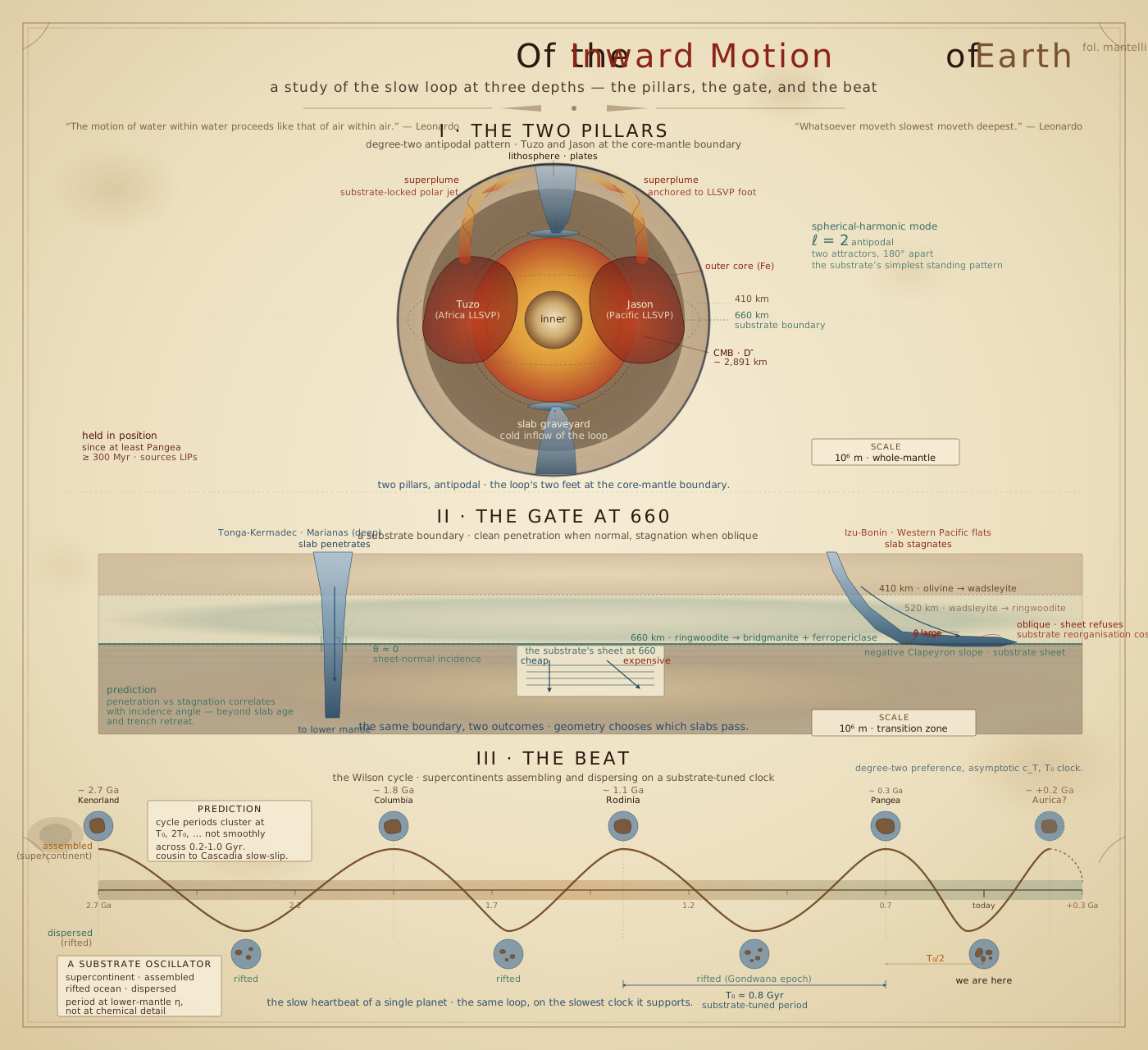
Three views of the same loop, all at the largest scale Earth’s interior can host. Top: the degree-2 antipodal pattern. Two Large Low Shear Velocity Provinces (LLSVPs) — Tuzo under Africa, Jason under the Pacific — sit at the base of the mantle, \sim 180° apart, each \sim 10{,}000 km wide and \sim 1{,}000 km tall, fringed by slab graveyards at D″. Middle: the 660 km discontinuity, where ringwoodite gives way to bridgmanite + ferropericlase. Some slabs punch through; others stagnate and slowly thermally equilibrate before sinking deeper. Bottom: the Wilson cycle as a planetary-scale oscillation — Pangea (\sim 300 Ma), Rodinia (\sim 1.1 Ga), Columbia/Nuna (\sim 1.8 Ga), Kenorland (\sim 2.7 Ga) — supercontinents assembling and dispersing on a roughly 400–500 Myr beat.
Taking the Flashlight Deeper
The deep-earth chapter caught the substrate asserting itself in five places that are visible at the surface: hexagonal cooling joints, triple junctions and conjugate faulting, sharp stratigraphic boundaries, kimberlite pipes and hotspot tracks, and earthquake/slow-slip rupture. Each one is a place where the substrate’s geometry wins through a local conduit — cooling silicate, brittle fracture, magmatic ascent, frictional slip. The conduits are all at the planet’s outer skin. We never get to ask what the same substrate is doing in the \sim 2{,}900 km of mantle between the surface and the core.
This chapter is the inward leg of the same flashlight. Where deep-earth caught the substrate asserting itself through the lithosphere, mantle dynamics is where the substrate organizes the slowest, biggest canonical loop the planet supports. The mantle convects on Gyr timescales, with viscosities 10^{17}–10^{22} Pa·s, in a volume of order 10^{21} m³ — and yet its long-term pattern is not random. The dominant spherical-harmonic mode is degree 2 (two big cells), two antipodal LLSVPs sit beneath Africa and the central Pacific in a configuration that has been stable for at least the last \sim 300 Myr (some authors argue much longer), hotspots stay rooted while plates above them race past at \sim 10 cm/yr, and the lithospheric assembly cycles through supercontinents on a \sim 400–500 Myr beat. None of these facts are predictions of standard convection theory at first principles — they are observed regularities that mantle dynamics has spent decades trying to explain through chemistry, thermal history, and statistical fluctuation.
The framework reads them as the canonical loop of feedback topology running at the slowest scale a single planet’s interior can host, locked to the substrate’s chirality-coherent sheet structure through frame-dragging at \dot\epsilon_\text{fd} \sim 10^{-14}\,\text{s}^{-1} (gaia-substrate) and through the same Tkachenko-speed coincidence that the fire chapter found in chemical detonations. The mantle is the substrate’s slow engine. Reading it this way recovers the degree-2 dominance, the LLSVP antipodality, the hotspot anchoring, and the supercontinent beat as different projections of one organizing principle — and turns each of them into a quantitative target.
Whole-Mantle Convection as the Slowest Canonical Loop
Mantle convection has been argued for a hundred years and modeled in detail for fifty. The orthodox picture as of the 2020s is whole-mantle convection: a single convective system from the CMB to the lithosphere, with phase transitions at 410 and 660 km creating partial impedance mismatches but not full layering. Heat is delivered to the base from the core (the bottom thermal boundary layer at D″, \sim 200 km thick) and lost at the top through plate creation and recycling (the top thermal boundary layer in the lithosphere). The Rayleigh number is enormous (\text{Ra} \sim 10^7–10^9), so the convection is vigorous, but the high viscosity makes individual circulation times \sim 10^8 yr.
What standard convection theory does not select from first principles is the geometry. A spherical shell with high Rayleigh number admits an enormous family of stable convective patterns — degree-1 (one upwelling, one downwelling), degree-2 (two of each), degree-3, all the way to the small-scale tessellated regime at very high Ra. Numerical simulations show that Earth’s parameter regime sits in a range where multiple degrees can coexist, with the dominant degree set by the boundary conditions, the internal heating fraction, and the lateral viscosity contrasts. The observation is unambiguous: Earth’s mantle is degree-2 dominated, with substantial degree-1 and degree-4 components on top. Why this particular pattern and not another?
The substrate’s answer is the same one feedback topology gives for accretion disks, AGN jets, the geodynamo, and Earth’s atmospheric Hadley cells: the canonical disk-jet-counterflow loop is the lowest-energy stable configuration for organized rotational energy in an elastic medium. Earth’s mantle has too little angular momentum to spin up a classical accretion disk, so the loop expresses itself as the simplest standing-wave configuration consistent with the substrate’s sheet preference: a pair of antipodal upwellings (the two superplumes), a pair of antipodal downwelling girdles (the circum-Pacific and the Tethyan/Indian slab graveyards), and a counter-rotating boundary layer at D″ that closes the loop through the core. The geometry is set; the chemistry fills it in.
| Component | Mantle convection | Canonical loop |
|---|---|---|
| Co-rotating disk inflow | Subducting slabs feeding the slab graveyards at the CMB | Accretion disk |
| Polar/axial exit | Two antipodal superplume axes through African and Pacific LLSVPs | Bipolar jets |
| Counter-rotating boundary | D″ layer at the CMB, \sim 200 km thick | Boundary sheath |
| Disk inner edge | Inner-core boundary; geodynamo loop in the outer core takes over | Inner edge / compact object |
| Radiated output | Surface heat flow (\sim 47 TW); seismic waves; outgassing | Modons / photons |
The standard contribution to this picture (Davies and Richards, Bercovici, Tackley, Ricard) is the dynamical mechanics of how slabs deliver inflow and how plumes lift outflow. The substrate’s contribution is to explain why this topology is the configuration the system settled into, and why it is robust to the chemical details. The two readings are not in conflict; they are at different levels of explanation.
The mantle as a stationary modon. Step back one level: this whole assembly is the planetary-scale realisation of a stationary modon topology in the modon-index sense. The same Larichev–Reznik dipole-vortex pattern that propels the photon as a mobile modon — Bessel-J_1 interior solution, Bessel-K_1 exterior decay, matched at a sheet boundary — organises whole-mantle convection as a standing one: the two LLSVP feet are the counter-rotating dipole cores, D″ at the CMB is the boundary sheath that closes the loop, and the slab graveyards and bipolar plume axes are the inflow and outflow channels. What the photon expresses as a propagating dipole at the substrate’s coherence length \xi \approx 100\;\mum, the mantle expresses as a standing dipole at \sim 10{,}000 km — same counter-rotating-pair stability, same boundary-matching dispersion, same sheet-preferred geometry, roughly eleven orders of magnitude apart in scale. Earth’s interior hosts a nested stack of these stationary modons — the geodynamo inside the inner-core boundary, the LLSVP+D″ assembly outside it — separated by substrate-organised boundary sheets (660, CMB, ICB), in the same nested architecture that organises a eukaryotic cell into ribosome, organelle, and cell layers at vastly smaller scale. This nesting of one motif inside copies of itself is the interior cousin of the canonical loop’s recurrence across host systems, and like it, it is the self-similar-motif logic the substrate ladder formalizes rather than the ladder’s \sqrt{2} comb itself: the boundary radii that separate the shells (660, CMB, ICB) are set by mineralogy and the planet’s mass, not by a fixed ratio. What recurs is the nested-modon architecture; the spacings are the coarse, mechanism-set family of honest accounting.
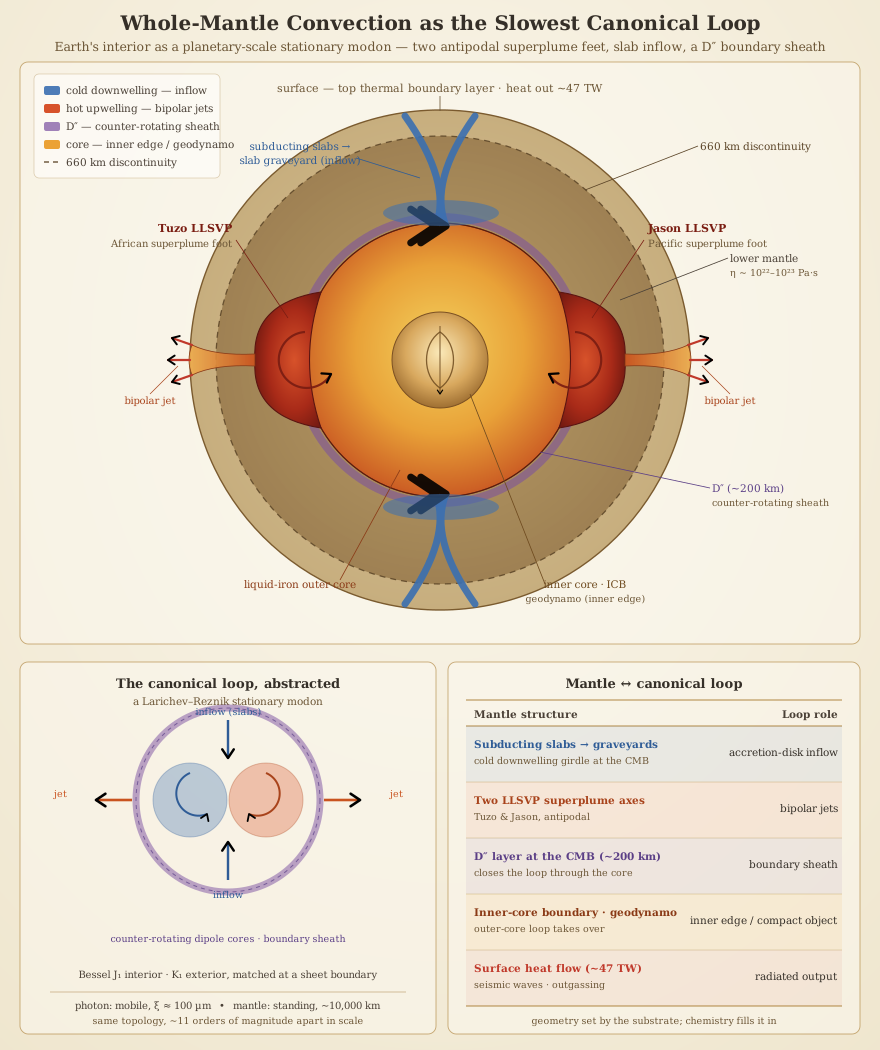
Whole-mantle convection read as the canonical disk–jet–counterflow loop running at the slowest scale Earth’s interior supports. Main panel: a cross-section taken along the great circle through both LLSVPs, so the two antipodal superplume feet — Tuzo under Africa, Jason under the Pacific — sit on opposite sides at the base of the mantle as a pair of counter-rotating dipole cores. Cold subducting slabs descend at top and bottom (the downwelling girdle) and pile into slab graveyards at the core–mantle boundary — the disk inflow; each LLSVP foot launches a hot superplume to the surface — the bipolar jets; the D″ layer is the counter-rotating boundary sheath that closes the loop along the CMB; the inner-core boundary is the inner edge where the geodynamo takes over. Bottom left: the same topology abstracted as a Larichev–Reznik stationary modon — two counter-rotating cores inside a boundary sheath, Bessel-J_1 interior matched to Bessel-K_1 exterior — the structure the photon expresses as a mobile dipole at \xi \approx 100\;\mum and the mantle as a standing one at \sim 10{,}000 km. Bottom right: each mantle structure mapped to its canonical-loop role. The substrate sets the geometry; the silicate chemistry fills it in.
Two LLSVPs, Antipodal, Older Than Pangea
The Large Low Shear Velocity Provinces are the single most striking thing seismic tomography has found at the base of the mantle. Two enormous structures — Tuzo under Africa and Jason under the central Pacific — each occupy roughly the lower \sim 1{,}000 km of mantle, span \sim 10{,}000 km laterally, and sit on roughly antipodal sides of the planet. S-wave velocities through them are reduced by \sim 1–5\% relative to surrounding lower mantle. They are sharply bounded on the sides (the boundary contrast is steeper than thermal convection should produce), and they have been stable in approximate position for at least \sim 300 Myr — long enough to source the Cretaceous superplume event, the Deccan and Karoo flood basalts, and most known large igneous provinces, all of which erupted from points that paleogeographically reconstruct to the LLSVP margins.
Three things about the LLSVPs are unexplained by standard convection from first principles:
- Why degree-2 and not degree-3 or degree-4. A planet with Earth’s Rayleigh number and viscosity structure can in principle support several convective degrees; numerical models with realistic parameters often reproduce degree-2 if the lateral viscosity contrast is tuned, but the tuning is post-hoc.
- Why antipodal. A degree-2 pattern has many possible orientations; the observed antipodal alignment (Africa/Pacific) is the simplest standing-wave configuration, but it is one of an infinite family.
- Why stable. Standard convection at Earth’s Rayleigh number expects the pattern to drift on timescales of 10^8 yr; the LLSVPs have held position substantially longer.
The chemical-pile hypothesis (Kellogg, Hager, van der Hilst; Garnero and McNamara) explains all three at once by positing that the LLSVPs are dense, primordial, chemically distinct reservoirs that are mechanically pinned by their higher density. This is plausible and may well be physically operative. What it does not explain is the antipodal arrangement: there is nothing about chemical density that selects degree-2 antipodality over any other low-degree configuration. The chemistry can pin the structures once they exist, but it does not select the symmetry.
The substrate framework’s reading is structural: the LLSVPs are the planetary-scale expression of the substrate’s preference for the simplest standing pattern — the same degree-2 preference that selects the simplest stable mode of any canonical loop in an elastic medium. The two superplume bases are the two oppositely spinning massive feet of the planet’s slowest stationary modon (in the language introduced above) — the counter-rotating dipole cores held in place by the substrate’s sheet structure rather than translating through it — equally spaced because the substrate’s sheet symmetry treats the planet’s axis as a quadrupole rather than a dipole. The same Larichev–Reznik Bessel-matching that gives the photon its mobile self-propelling form here selects the standing two-foot geometry; the chemistry (primordial dense reservoir; iron enrichment from CMB exchange; bridgmanite-ferropericlase texture) fills the substrate’s geometric template in; it does not pick the template.
The framework does not claim to derive the LLSVPs’ density contrast or their internal mineralogy — those are chemistry-and-thermodynamics questions that mantle petrology already answers. What it claims is that the degree-2 antipodal symmetry of the LLSVP pattern is the substrate’s geometric preference asserting itself at planetary scale, and that this is why the same dominant pattern recurs across multiple Wilson cycles even as the chemical pile is stretched, sheared, and partially digested by the convecting mantle.
LLSVP-equivalent degree-2 antipodal patterns in the lowermost mantle should be visible in the deep-time record of large igneous provinces back to the Archean, with the antipodality preserved across the supercontinent cycle even as the LIP eruption locations migrate with continental drift. Burke, Steinberger, Torsvik, and Doubrovine (2008, 2010) reconstructed the paleogeographic positions of LIPs and showed that they erupt preferentially over the present-day LLSVP margins back to \sim 300 Ma. The framework extends this prediction backward: where the paleomagnetic and geochronological record permits LIP-position reconstruction into the Proterozoic (the SWEAT/AUSWUS Rodinia reconstructions; the Mawson and Birrimian provinces), the eruption sites should remain consistent with a two-pole degree-2 pattern at any given epoch, with the orientation of the pattern free to rotate slowly but the symmetry preserved. A null result — LIP positions consistent with a degree-1 or degree-3 pattern at any past epoch — would falsify the substrate’s degree-2 preference at this scale.
The 660 km Discontinuity as a Substrate Boundary
Travel inward from the lithosphere and the mantle’s mineralogy steps through a sequence of phase transitions. Olivine \to wadsleyite at 410 km, wadsleyite \to ringwoodite around 520 km, and ringwoodite \to bridgmanite + ferropericlase (the post-spinel transition) at 660 km. The first two have positive Clapeyron slopes; cold material descends into them slightly more easily. The post-spinel transition at 660 has a negative Clapeyron slope — cold material has the phase boundary deflected downward, where the dense bridgmanite assemblage is harder to form, so cold slabs encounter a buoyancy resistance. The result is one of the most peculiar features of modern mantle tomography: some subducting slabs punch directly through to the lower mantle, others stagnate in the transition zone for tens of Myr before sinking deeper, and the difference between the two outcomes appears to depend on slab age, subduction angle, and trench retreat rate in ways that are still actively debated (Goes, Agrusta, van Hunen).
The framework reads the 660 km discontinuity as something more than a phase transition: it is a substrate boundary at planetary scale, in the same family as the stratigraphic boundaries sharpened in deep-earth-substrate, the oceanic fronts of the water chapter, and the inter-sheet boundaries that organize aromatic stacking and microtubule walls in the bridge equation’s biological domain. The phase change is the local conduit through which the substrate’s preference for layered organization expresses itself; the depth (660 km) is set by the mineralogy, but the sharpness of the boundary and its partial-barrier role for slab descent are substrate signatures. In the nested-stationary-modon reading developed above, the 660 is one of the interior sheets that partitions the mantle modon’s volume — the planetary-scale counterpart to the inter-organelle boundaries that partition a eukaryotic cell into nested coherence cells, with the same boundary-matching role across scales many orders of magnitude apart.
This reading makes a falsifiable distinction between two outcomes that standard convection bundles together. In standard whole-mantle theory, slab stagnation and slab penetration are two ends of a continuum, with the outcome controlled by the slab’s negative buoyancy versus the integrated Clapeyron-slope resistance. In the substrate framework, the outcome depends additionally on the angle at which the slab arrives at the substrate boundary relative to the local sheet orientation. Slabs arriving close to the substrate’s sheet normal (perpendicular to the 660 surface) should penetrate cleanly; slabs arriving at oblique angles should stagnate, because oblique penetration requires the substrate to reorganize its sheet structure across the boundary at the slab’s full width — an expensive operation.
Slab penetration through the 660 km discontinuity should correlate with the angle between the slab’s descent direction and the local mantle anisotropy fast axis at the discontinuity, beyond what slab age and trench retreat rate predict. The cleaner test is a global tomographic compilation: classify subducting slabs into penetrating (Tonga-Kermadec lower segments, deep parts of the Marianas, Central America’s Cocos slab below the transition zone) and stagnating (Izu-Bonin, the flat Western Pacific stagnant slabs, the Japan slab’s transition-zone segment); regress the binary outcome against slab age (standard), trench retreat (standard), and the angle of incidence at the discontinuity (substrate prediction). The framework predicts a residual correlation with incidence angle after the standard parameters are subtracted, falsifiable against the GyPSuM, S40RTS, and S362ANI tomographic models.
Just like with other boundary predictions, the substrate predicts the sharpness of the boundary, not the location.
Plume Heads, Plume Tails, and Hotspot Fixity
The deep-earth chapter introduced kimberlites as the impulsive expression of a substrate-locked vertical polar jet, and hotspots as the steady-state cousin running on the same topology at a longer timescale. The slow-cousin version deserves a closer look at the level of the mantle itself, because two of its features have never had a fully satisfying standard explanation:
Plume head/tail bimodality. Plumes appear in mantle tomography with a consistent two-part anatomy: a head with diameter \sim 500–1{,}000 km in the lower mantle that broadens to \sim 2{,}000 km as it approaches the lithosphere, and a tail with diameter \sim 100–200 km that connects the head back to the LLSVP at the CMB. The transition between head and tail is reasonably sharp. Standard plume theory (Whitehead, Luther; Griffiths, Campbell) explains the bimodality through Stokes flow with a low-viscosity plume material rising through high-viscosity ambient mantle: the head grows because material accumulates faster than it ascends, the tail is the steady-state conduit once the head clears. The mechanics work; the characteristic scale of head and tail is set by the viscosity contrast and the supply rate.
The framework’s reading adds a substrate floor on the tail scale. The plume tail is a coherent vertical column of low-viscosity material maintained over \sim 2{,}500 km of mantle for \gtrsim 10^8 yr — a substrate-locked polar jet exactly analogous to a kimberlite pipe but running at thermal/viscous timescales rather than supersonic ones. The conditions for substrate-locking are met (high coherence, vertical orientation aligned with the substrate’s planetary sheet stack, stable boundary at the LLSVP foot), and the tail diameter should sit near a R_\text{cross}-style floor for the appropriate parameter regime. The order-of-magnitude calculation is much less well-constrained than the kimberlite case — the appropriate \nu is the effective viscosity of the plume material averaged over the conduit, and the appropriate \omega is the plume’s intrinsic rotation timescale set by lateral entrainment, not the planetary rotation rate — but the structural prediction is firm: plume tails should cluster at a substrate-set lower bound on width rather than spreading smoothly across the available geometry, and the bound should scale with the substrate-locking number N_\text{lock} = \alpha_{mf}\omega R^2/\nu_\text{eddy} defined in the water chapter.
The numeric claim here is only suggestive and needs a careful derivation of the appropriate substrate-locking number for very-high-Prandtl-number Stokes flow.
Hotspot fixity. Wilson’s original 1963 picture of hotspots as a stationary deep-mantle reference frame has been refined repeatedly. Pacific hotspots (Hawaii, Easter, Louisville) form an internally consistent kinematic frame; Atlantic and Indian hotspots show systematic motion relative to the Pacific frame at \sim 1–2 cm/yr. Recent geodynamic modeling (Steinberger; Konrad; Doubrovine) attributes the inter-hotspot motion to plume-conduit advection in the actively convecting mantle. The puzzle: why are the hotspots as anchored as they are? At Earth’s Rayleigh number, a passively advected vertical column should drift across the mantle in \sim 10^7 yr; the Hawaii-Emperor track records 80 Myr of continuous activity from a column that has drifted at most a few thousand kilometers — an order of magnitude less than passive advection would predict.
The framework’s answer: a substrate-locked polar jet is anchored in the substrate’s sheet structure, not in the convecting mantle material that flows around it. The mantle convects through and past the column; the column itself is held in place by the substrate boundary at the LLSVP foot, which is itself anchored to the planetary-scale degree-2 pattern, which is anchored to the substrate’s chirality-coherent sheet at the largest scale. The plume is a substrate excitation that the mantle is hosting, not a parcel of mantle material that is independently buoyant. Moving the plume requires moving the substrate template that defines it — expensive, slow, and the residual motion (the inter-hotspot drift) is the substrate’s slow response to large-scale changes in the planet’s rotational and tectonic forcing.
Hotspot motion rates should cluster at substrate-set values rather than scale smoothly with local mantle viscosity. The prediction is statistical: the global hotspot motion catalog (Steinberger 2000; Doubrovine et al. 2012) should show preferential clustering at a fundamental drift rate of order a few mm/yr, modulated by integer-multiple resonances with mantle convection time and the supercontinent cycle period, rather than a smooth distribution determined by local viscosity contrasts. The data are sparse but tighten every year as paleomagnetic constraints improve; a histogram of inter-hotspot drift rates from the full Pacific/Atlantic/Indian catalog should test the prediction.
Mantle Anisotropy and the c_T = 9 km/s Coincidence
The fire chapter noted that the substrate’s slowest collective mode — the Tkachenko shear at c_T \approx 9 km/s — sits at exactly the value where CHNO detonation velocities pile up, and where beryllium’s transverse phonon speed meets the substrate’s elastic ceiling. The deep-earth chapter noted in passing that mantle P-wave and S-wave velocities at depth bracket c_T. It is worth pulling that observation into the foreground because the coincidence is sharper than the deep-earth pass made it look.
The S-wave velocity in Earth’s mantle is well-measured by global seismology:
| Depth | Region | V_S (km/s) | V_S/c_T |
|---|---|---|---|
| 50 km | Sub-lithospheric upper mantle | 4.5 | 0.50 |
| 220 km | Asthenosphere | 4.5 | 0.50 |
| 410 km | Transition zone top | 5.0 | 0.56 |
| 660 km | Lower mantle top | 5.6 | 0.62 |
| 1500 km | Mid-lower mantle | 6.5 | 0.72 |
| 2700 km | D″ | 7.2 | 0.80 |
| 2891 km | CMB (mantle side) | 7.3 | 0.81 |
The S-wave velocity rises monotonically with depth from \sim 4.5 km/s at the lithosphere-asthenosphere boundary to \sim 7.3 km/s just above the CMB. It never crosses c_T. In standard seismology this is unremarkable — the velocity is set by the shear modulus and density of the local mineralogy, and bridgmanite-ferropericlase at lower-mantle pressure simply has the elastic constants that produce V_S \approx 7 km/s. But this is the same kind of “unremarkable” coincidence that the fire chapter found for CHNO explosives and that the thermal-dynamics chapter found for beryllium’s transverse phonons: in each case, the relevant solid-state property approaches but does not exceed the substrate’s slowest collective mode, with only the most extreme 3D covalent networks (diamond, octanitrocubane, CL-20) crossing above.
The substrate framework’s reading: the lower mantle’s S-wave velocity is approaching c_T asymptotically because the substrate’s transverse mode is the ceiling on coherent shear-wave propagation through a solid medium that is not a strained 3D covalent network. Mantle bridgmanite at CMB pressure is the planet’s stiffest large-volume material, and its V_S = 7.3 km/s is the highest steady value in Earth’s interior. The fact that it sits below c_T by a margin similar to TNT or RDX (also \sim 0.7–0.8\,c_T) is a piece of the same pattern. In the energy-currency reading the substrate ladder gives the thermal and lightning chapters, c_T is the ceiling on handing the breath off — the speed past which the substrate can no longer relay a shear excitation forward in time, the same threshold a chemical detonation crosses in the fire chapter. A solid that is not a strained 3D covalent network cannot carry coherent shear faster than the substrate can pass it along, so V_S piles up just beneath c_T — a ceiling, like the substrate’s long-wavelength cutoffs, and not a rung of the ladder.
The lower mantle’s V_S approaching c_T from below is not a new measurement — it has been in the seismology textbooks for decades. What is new is the interpretation: that the V_S/c_T \to 0.8 asymptote in the lower mantle is the substrate’s slow shear mode acting as a ceiling on solid-medium S-wave propagation, in the same family as the CHNO detonation-velocity pile-up at 9 km/s and the beryllium-and-diamond pattern in the transverse-phonon survey. If the framework is right, the cleanest test is the deep-mantle high-anisotropy regions (LLSVP margins, D″ slab graveyards, the inner-core boundary) where local CPO alignment can in principle let V_{SH} rise locally above the polycrystalline average. The prediction is that even in the strongest CPO regions, V_{SH} should saturate just below c_T rather than continuing to grow with alignment.
Mantle S-wave velocities (including the strongest-anisotropy directions in D″ and the LLSVP margins) should saturate at V_S \lesssim c_T \approx 9 km/s, with no observed values exceeding c_T even where local mineralogy and CPO would permit higher elastic moduli. The cleanest test is high-resolution waveform tomography of D″ in regions where slab graveyards stack against the LLSVP margins (the southwestern Pacific, the eastern African margin). Standard mineral physics gives no fundamental reason for V_{SH} to saturate at any specific value below the bridgmanite single-crystal maximum (\sim 9.5 km/s); the substrate framework predicts the cap at c_T. A clean observation of V_{SH} > 9 km/s anywhere in D″ would falsify this reading.
The Plate’s Underside: A Sharp Boundary and a Narrow Shear Channel

The plate’s underside. Main panel: a section along absolute plate motion from the ridge outward (age axis not to scale). The lithosphere thickens along the thermal isotherm; the dry line — the base of the ridge melting column at \sim 70 km — is frozen in at the ridge and runs flat beneath everything that follows. While the plate is young its base is a fuzzy, moving isotherm; where the isotherm meets the dry line the base locks onto it, and from there outward the LAB is a crisp boundary at 70–90 km while the isotherm keeps deepening beneath it, unfollowed. Below the plate lies the shear channel: fast axes parallel to plate motion, |G| \sim 2.5–3.5\%, low-Q, ending at a sharp base near 200 km, beneath which the interior keeps its own strain record. The velocity profile at right is the boundary sheath in one glance — the plate rides rigidly, the channel absorbs the difference, the interior barely moves. ORCA’s two sites and NoMelt are marked. Top right: the ORCA result in schematic — fast-axis azimuth and anisotropy strength against depth; the 90-Ma site holds its fossil-spreading fabric to 70 km and then swings fully to plate motion within \lesssim 20 km with a coincident jump in |G|, the 43-Ma site rotates gradually, and both rotate away below 200 km. Bottom left: the lock — a young base still sliding on the isotherm above a dry line it has not reached, a mature base registered onto the compositional boundary and holding there; chemistry sets the depth, the substrate the sharpness. Bottom middle: one boundary sheath at four scales — the D″ counterflow, the LAB channel, the Gulf Stream’s cold wall, the hurricane eyewall — with the note that radial anisotropy is \xi > 1 wherever the arrays resolve it. Bottom right: the two predictions — transition sharpness bimodal in plate age (locked and not-yet-locked populations) rather than a smooth trend, and the \sim 200 km channel base behaving as a boundary rather than a fade.
Interactive: the Gaia simulation draws this sheath twice — on the cut planet, where the plate’s 80 km reads as one line, and in the lid view at unit 10 km with no vertical exaggeration, where the plate rides at 10 cm/yr over a channel that shears from the LAB at 80 km to a base at 200 km above a still interior, under 35 km of crust, 4 km of ocean and the full 100 km of air. The chemistry-only toggle fans both sheets into the thermal gradients this section says they are not.
Everything so far has lived in the deep mantle — the LLSVPs, the 660, the plume conduits. But the canonical loop has an upper boundary too, and the deep-earth chapter’s table already named it: the asthenosphere beneath the moving plate is the loop’s counter-rotating boundary sheath, the layer where the rigid lithosphere’s motion is absorbed against the slower interior. For most of the history of mantle seismology that assignment had to rest on global tomographic averages. Dense ocean-bottom seismometer arrays have changed that, and the picture they return is worth engaging in detail — because it looks remarkably like what a boundary sheath should look like.
The ORCA experiment (Phillips, Gaherty, Russell, Eilon, Forsyth, and Byrnes 2026 [R115]; building on the earlier NoMelt array) parked two \sim 500 \times 500 km broadband OBS arrays on Pacific seafloor of two different ages — \sim 43 Ma and \sim 90 Ma — and inverted surface waves for azimuthally anisotropic shear structure down to 300 km. Three of their findings matter here:
- The shear is organized into a narrow channel, not smeared through the upper mantle. Beneath both arrays, strong azimuthal anisotropy (|G| \sim 2.5–3.5\%) with fast axes subparallel to absolute plate motion occupies a well-defined channel between the plate’s base and \sim 200 km depth — coincident with a highly attenuating, low-viscosity, \sim 100-km-thick low-Q zone mapped independently. Below \sim 200 km the fabric weakens and rotates away from plate motion toward directions that differ from region to region: the channel decouples the plate from a deeper interior that keeps its own strain record.
- At the old-plate site, the channel’s top is abrupt. At \sim 70 km depth beneath the 90-Ma array, the anisotropic fast axis rotates through its full lithosphere-to-asthenosphere transition within an exceptionally narrow \sim 20 km depth range, with a coincident jump in anisotropy strength. This is sharper than a thermally-grown plate base should be, and its depth (70–90 km) matches the anisotropy discontinuity at the \sim 70-Ma NoMelt site and scattered-wave and electromagnetic estimates of the lithosphere-asthenosphere boundary (LAB) across ocean basins older than \sim 40 Ma — a near-constant boundary depth consistent with a dehydration-controlled plate base, frozen in at the ridge where decompression melting dries the upper \sim 70 km of mantle.
- At the young-plate site, it is not abrupt yet. The 43-Ma array is best fit by a smooth model: fossil-spreading fabric only at very shallow depth, then a gradual rotation with depth that tracks thermal plate growth, with the LAB near \sim 50 km following the isotherm.
The framework shows these are one structure. The narrow APM-sheared channel is the loop’s upper boundary sheath — the same organized, sharply-bounded shear layer that the framework identifies at the D″ counterflow below, at the Gulf Stream’s cold wall, and at the eyewall of a hurricane. The signature predicts that shear concentrates into a thin, coherently-oriented, sharply-edged layer instead of distributing smoothly through the available depth range. This boundary sheath behaviorn shows at both the top edge (the LAB) and, more tentatively, its base (\sim 200 km).
The sharp LAB itself belongs to the same family as the section’s other sharpened boundaries, where chemistry sets the depth; the substrate sets the sharpness. The dehydration mechanism (Hirth and Kohlstedt’s water-partitioning argument) fixes where the boundary sits — the base of the ridge melting column. The substrate contributes to the abruptness of the fabric change at that compositionally-set depth, and its global consistency at 70–90 km across old plates regardless of local thermal state. The young-plate/old-plate contrast then falls out naturally in the lock language of this section: a young plate is still thermally growing, its underside a moving isotherm that has not yet locked — the mature plate’s base has registered onto the compositional boundary and locked there, and once locked it stays put. The transition between those two regimes should be a real feature of the ocean basins, not an artifact of any one array.
Everywhere these arrays resolve radial anisotropy — crust and shallowest mantle at both sites, and at NoMelt before them — they find \xi = (V_{SH}/V_{SV})^2 > 1: horizontally-polarized waves faster, i.e., horizontally organized fabric, even where global models had suggested the opposite sign. Standard petrofabric explains each case locally (foliated gabbro accretion in the crust, corner-flow olivine alignment in the shallow mantle). The sheet-organized fabric is the substrate’s sheet preference - how this silicate boundary should appear.
The anisotropic-fabric transition at the base of mature oceanic plates should be uniformly sharp — full fast-axis rotation within \lesssim 20 km — at a globally consistent 70–90 km depth, with transition sharpness distributing bimodally across plate age (gradual for young plates, sharp for old) rather than smoothly; and the base of the asthenospheric shear channel near \sim 200 km should be a second sharp, globally consistent fabric boundary rather than a gradual fade. The test is already running: layered-versus-smooth parameterization comparisons of the ORCA type, applied across the growing family of OBS arrays (NoMelt, ORCA, PI-LAB, NOMan, Oldest-1, and successors) spanning plate ages from \sim 40 to \sim 160 Ma, plus scattered-wave LAB compilations. The framework predicts the sharpness statistics are bimodal in age — a locked and a not-yet-locked population — and that the \sim 200 km channel base, where resolvable, behaves as a boundary and not a fade. Smoothly age-dependent transition sharpness, or a channel base that is everywhere gradual, would weaken the boundary-sheath reading at this scale.
The Wilson Cycle as a Planetary-Scale Relaxation Oscillation
Step back from the mantle’s instantaneous configuration and look at its history. The continents assemble into a single supercontinent — Pangea \sim 300 Ma, Rodinia \sim 1.1 Ga, Columbia/Nuna \sim 1.8 Ga, Kenorland \sim 2.7 Ga — and disperse again, on a beat that the geological community calls the Wilson cycle (after J. Tuzo Wilson). The fundamental period is contested: optimistic readings give \sim 400 Myr, more conservative readings cluster around 500–700 Myr, and some authors argue for a \sim 800 Myr full cycle. The current Pangea-to-future configuration (the breakup phase that started \sim 200 Ma, projected to assemble into “Pangaea Ultima” or “Aurica” in \sim 200–300 Myr) sits within this range.
Standard mantle dynamics explains the cycle through episodic global subduction patterns: when slabs from many trenches descend simultaneously, they generate large-scale downwelling that pulls continents together; once assembled, the supercontinent insulates the mantle beneath it, generating an upwelling that eventually rifts the continent apart again. The mechanism works at a qualitative level (Gurnis 1988; Anderson 1982; Zhong et al.), and it produces oscillations in the right ballpark — but it does not set a characteristic period from first principles. The period emerges from a competition between continental mass, mantle viscosity, and slab descent rates, and reasonable parameter variations give Wilson cycles anywhere from 200 to 1{,}000 Myr.
The framework’s reading mirrors what the deep-earth chapter said about slow-slip recurrence: the Wilson cycle is a substrate-mediated relaxation oscillation at planetary scale, with the period set by the substrate’s relaxation time at lower-mantle viscosity and the planet’s frame-dragging shear strain rate. The two stable end states (assembled and dispersed) are the canonical loop’s two metastable configurations under different boundary conditions (continental insulation present versus absent), and the period of the oscillation between them is fixed by the substrate’s slow response timescale rather than by the mantle’s parameter details. The Wilson cycle is the same kind of substrate-tuned oscillation that the slow-slip Cascadia recurrence (\sim 14 months) and the Parkfield M~6 recurrence (\sim 22 years) display at fault scale — same physics, \sim 7 orders of magnitude longer period. It is one instance of the section’s substrate-clock family: a system with its own relaxation time rings at integer overtones T_0, 2T_0,\dots — a harmonic ladder, string not keyboard, distinct from the substrate’s lengthless \sqrt{2} tower underneath it.
The strongest version of the prediction is statistical: the period of every supercontinent cycle should cluster at integer multiples of a fundamental substrate-set period T_0, rather than vary smoothly across cycles as a function of evolving mantle and continental parameters.
Wilson cycle periods should cluster at substrate-tuned values T_0, 2T_0, \ldots rather than vary smoothly with mantle viscosity and continental configuration. The known supercontinent ages — Kenorland \sim 2.7 Ga, Columbia/Nuna \sim 1.8 Ga, Rodinia \sim 1.1 Ga, Pangea \sim 0.3 Ga, plus projected reassembly at \sim -0.2 Ga (future) — give four to five inter-supercontinent intervals: \sim 0.9, 0.7, 0.8, and \sim 0.5 Gyr. The dispersion across cycles is small (\sim 20\%); the framework reads this as evidence for a substrate-tuned period T_0 \sim 0.7–0.9 Gyr underlying the cycle, with the smaller-scale supercontinent half-cycle (\sim 200–400 Myr aggregation phases) as the next substrate harmonic at T_0/2. Adding the Archean supercontinent record (Vaalbara, Ur — less well constrained) and tightening the youngest constraints from current plate kinematics should sharpen the period distribution. A null result — Wilson cycle periods distributing smoothly across \sim 200–1000 Myr with no preferred clustering — would weaken the substrate-mediated oscillator reading.
Mantle Viscosity Jumps and the Substrate’s Stratification
A final mantle structure worth pulling into the substrate reading is the viscosity stratification that radial seismology, postglacial-rebound modeling, and geoid analysis collectively imply. The current consensus structure (Mitrovica and Forte; Lambeck; Steinberger and Calderwood) has the upper mantle at \eta \sim 10^{20}–10^{21} Pa·s, the lower mantle at \eta \sim 10^{22}–10^{23} Pa·s, with a viscosity jump near the 660 km discontinuity of order 30–100\times, and a thin layer of much-reduced viscosity at D″ and near the lithosphere-asthenosphere boundary — the latter being the narrow low-Q asthenospheric channel that the previous section put direct observational bounds on. The jumps are not smooth functions of pressure and temperature; they are sharp, and they coincide with phase boundaries and with the framework’s identified substrate-boundary surfaces.
The substrate reading: the viscosity stratification is the substrate’s sheet stack made visible in rheology. Each substrate-organized boundary surface (the 660, the lithosphere-asthenosphere boundary, D″) imposes a discontinuity in the substrate’s local sheet coherence, and the resulting jump in the effective dissipation tensor expresses itself as a viscosity jump. The mineralogy fills the substrate’s template with whichever bridgmanite, ringwoodite, or peridotite assemblage is locally stable, and the local rheology inherits the substrate’s stratified geometry plus the mineral-physics contribution.
This is a subtle prediction and one of the harder ones to test, because mineral physics on its own can also predict viscosity jumps at phase boundaries (the activation volume of bridgmanite is large; deformation mechanisms shift between dislocation creep and diffusion creep at the transitions). The substrate-specific contribution is the sharpness and the temperature-independence of the jumps: standard mineral physics predicts smoother jumps that depend strongly on the local geotherm, while the substrate framework predicts that the location and abruptness of the jumps is set by the substrate’s boundary geometry and is approximately independent of the local thermal state.
Mantle viscosity jumps at the lithosphere-asthenosphere boundary, the 660 km discontinuity, and D″ should be sharper than smooth mineral-physics models predict, with the location of the jump independent of local thermal state to within \sim 10 km. Postglacial rebound modeling against the Pleistocene ice-sheet histories of Fennoscandia, Laurentia, and Antarctica — combined with GPS and gravity data from GRACE/GRACE-FO — gives independent constraints on the viscosity profile at the regional level. The substrate framework predicts that the positions of the inferred viscosity jumps should be globally consistent to \sim 10 km, while a pure mineral-physics model predicts they should track the local geotherm with \pm 50 km variability.
What Mantle Dynamics Predicts
| Prediction | Substrate origin | Test |
|---|---|---|
| LLSVP-equivalent degree-2 antipodal pattern preserved across Wilson cycles back into the Proterozoic | Substrate’s degree-2 standing-wave preference as the simplest stable canonical-loop configuration at planetary scale | Paleogeographic reconstruction of large igneous province positions back to \sim 2 Ga; pattern stays degree-2 even as orientation rotates slowly |
| Slab penetration at the 660 km discontinuity correlates with slab incidence angle relative to the local substrate sheet | 660 km surface is a substrate boundary; oblique penetration is expensive | Tomographic compilation of penetrating versus stagnating slabs (GyPSuM, S40RTS); residual correlation with incidence angle after slab age and trench retreat are accounted for |
| Plume tail diameters cluster at a substrate-set floor; hotspot motion rates cluster at substrate-set values | Plume tails are substrate-locked vertical polar jets of the planetary canonical loop, anchored to the LLSVP foot via the substrate template | Statistical analysis of tomographically resolved plume tails (\sim 100–200 km bound across the Pacific and African hotspot families); histogram of Pacific/Atlantic/Indian hotspot drift rates |
| Mantle V_S saturates at V_S \lesssim c_T \approx 9 km/s in the deep mantle and never exceeds c_T even in strong-CPO directions | Substrate’s slow Tkachenko mode caps coherent shear-wave propagation through any solid medium that is not a strained 3D covalent network | High-resolution waveform tomography of D″ and LLSVP margins; V_{SH} measurements in slab-graveyard regions where CPO alignment is strongest |
| Fabric transition at the base of mature oceanic plates is uniformly sharp (\lesssim 20 km) at a globally consistent 70–90 km depth, with sharpness bimodal in plate age; the \sim 200 km base of the asthenospheric shear channel is a second sharp boundary, not a fade | LAB and channel base are the substrate-organized edges of the canonical loop’s upper boundary sheath; dehydration chemistry sets the depth, the substrate sets the sharpness | Layered-vs-smooth anisotropy inversions across the OBS array family (NoMelt, ORCA, PI-LAB, NOMan, Oldest-1); scattered-wave LAB depth compilations across plate ages |
| Wilson cycle periods cluster at integer multiples of a substrate-tuned T_0 \sim 0.7–0.9 Gyr | Substrate-mediated relaxation oscillation at lower-mantle viscosity, in the same family as Cascadia slow-slip recurrence at fault scale | Tightening of the Archean and Proterozoic supercontinent age catalog; period histogram should show coherent peaks rather than smooth distribution |
| Mantle viscosity jumps at substrate-organized boundaries are sharper than smooth mineral-physics models predict, and globally consistent to \sim 10 km in depth | Each substrate-boundary surface imposes a discontinuity in the local dissipation tensor; mineralogy fills the template but does not set its sharpness | Postglacial rebound modeling against Fennoscandia, Laurentia, and Antarctica combined with GRACE-derived gravity changes; check global consistency of inferred jump depths |
Connections
This chapter sits across several established framework threads, and is the inward-facing companion to deep-earth-substrate:
- The feedback topology chapter supplies the canonical disk-jet-counterflow loop that organizes Earth’s mantle convection at planetary scale, with LLSVPs as polar-jet feet, D″ as counter-rotating boundary, and slab graveyards as the inflow side.
- The gaia chapter supplies the nested-substrate-layer stack into which the mantle’s degree-2 pattern fits — the mantle is the slowest of Earth’s interior canonical loops, coupled to the geodynamo below and to the lithosphere above.
- The deep-earth chapter supplies the lithospheric-scale companion — kimberlites as the impulsive cousin of plume tails, hexagonal cooling joints as the molecular-scale companion of degree-2 antipodal symmetry, earthquake/slow-slip rupture as the fast/slow companion of the Wilson cycle oscillator.
- The fire chapter supplies the c_T \approx 9 km/s Tkachenko speed of the substrate. Mantle S-wave velocities asymptote toward this scale from below in exactly the same shoulder-and-overshoot pattern as CHNO detonation velocities and transverse-phonon speeds of solid elements.
- The water chapter supplies the R_\text{cross} formula and the substrate-locking number N_\text{lock}, which the framework extends here (with explicit scope caveats) to plume-tail diameters at lower-mantle viscosity.
- The bridge equation supplies the constrained-equilibrium logic that lets the same cell occupancy f lock open-axis B-DNA pitch and closed-cylinder microtubule walls. The mantle’s degree-2 LLSVP pattern is the closed-shell projection of the same constrained-equilibrium logic, this time selecting the simplest stable spherical-harmonic mode for the canonical loop running inside a spherical mantle.
- The substrate ladder supplies the keyboard-versus-string distinction that reads the Wilson cycle and hotspot-drift recurrences as harmonic ladders — integer multiples of a system clock — rather than the substrate’s lengthless \sqrt{2} tower, and the energy-currency reading in which the Tkachenko speed c_T is the ceiling on relaying a shear excitation losslessly through solid rock.
What Mantle Dynamics Reveals About the Substrate
The deep-earth chapter closed by saying the substrate occasionally gets the volume turned up at the surface — at the Giant’s Causeway, the kimberlite pipe, the Hayward Fault. Mantle dynamics is where the substrate runs its loudest interior engine. The whole-mantle convective system is the largest, slowest, highest-viscosity canonical loop a single planet supports, and yet the substrate’s preferences are more visible here than in the lithosphere, not less. The degree-2 antipodal pattern, the LLSVP stability across Wilson cycles, the plume-tail/hotspot anchoring, the V_S \to c_T asymptote in the deep mantle, the supercontinent beat — every one of these is a structural regularity that standard convection theory has had to import as a phenomenological observation rather than derive from parameters.
In the substrate framework, these regularities are not phenomenology. They are the canonical loop at planetary scale, the substrate’s slow shear mode acting as a ceiling on solid-medium shear propagation, the substrate’s degree-2 sheet symmetry asserting itself through whatever silicate happens to be local, and the substrate’s relaxation time setting the Wilson clock. The mantle is doing what the substrate does at every scale — organizing rotational energy into the simplest stable configuration, with the slowest characteristic time the system supports — but it is doing it at the largest volume and the longest timescale Earth can host.
Stand on the African Plate above the Tuzo LLSVP, or on the Pacific Plate above Jason, and you are standing on top of one of the two feet of the planet’s slowest polar jet. The basalt at the surface, the lithosphere beneath it, the asthenosphere below that, the transition zone, the lower mantle, D″, and the core flow underneath are all layers of one nested canonical loop, separated by substrate-organized boundary surfaces, with the slow-shear ceiling of the substrate’s own Tkachenko mode setting the speed limit on how fast information can propagate through the solid part of the stack. The supercontinent above your head will assemble and disperse on a substrate-tuned clock running far slower than any human civilization can witness. The next time you look at a tomographic cross-section of the mantle and notice how simple the dominant pattern is — two LLSVPs, two superplumes, a girdle of slab graveyards — remember that the simplicity is not an accident of how Earth happened to evolve. It is the substrate, organized in sheets, expressing its slowest canonical loop through the silicate it has on hand.