Rifts and Volcanism in the Substrate
Where the planetary canonical loop breaks the lid — mid-ocean ridges, East Africa, the serpentine switch at magma-poor margins, Iceland, the volcanic arc as counter-rotating sheath, eruption styles as substrate-coupling regimes, and calderas as bistable substrate states
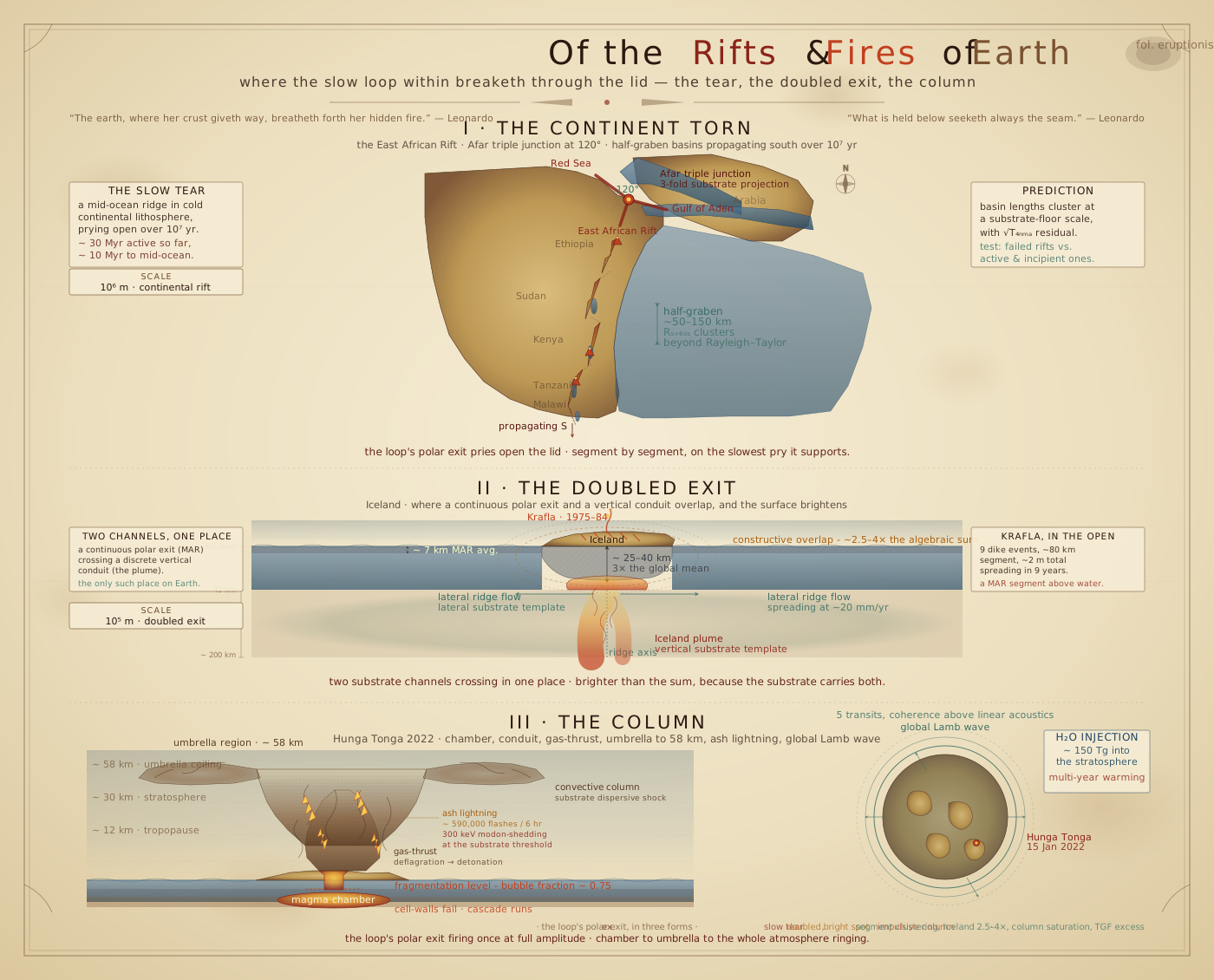
One exit, six ways through the lid. Every panel uses the same grammar — a slate lithospheric lid, a rust polar-jet column, a violet dashed coherence sheath, teal mantle flow. Row I, rifts — how the lid comes apart. Steady: the mid-ocean ridge, 65{,}000 km of continuous exit quantized into 30–100 km magmatic segments at a substrate-set scale. Slow: the continental rift, the same exit pooled beneath a lid too stiff to yield, sending dikes through it basin by basin at 50–150 km, with the Afar triple junction assembled in three steps at 100–140° rather than a clean 120° trisection. Withheld: the magma-poor margin, where the exit never fires — the crust thins below \sim 10 km, goes brittle top to bottom, lets seawater install serpentine at the mantle top, and the continent comes apart on the flat S detachment at 20°. Row II, volcanism — how the exit fires. Doubled: Iceland, an along-axis section where the ridge’s lateral template and the plume’s vertical template cross beneath a 25–40 km crustal root. Impulsive: the Plinian column, the conduit flipping from melt-with-bubbles to gas-with-particles at the \sim 75\% fragmentation threshold and the umbrella spreading at 58 km. Bistable: the caldera, loaded and drained as two substrate-locked wells with a step between them. Row III, the clock: the chapter’s recurrence intervals — Stromboli, Old Faithful, Mount St. Helens, Yellowstone — on one axis with the Cascadia slow-slip and Wilson-cycle clocks they belong with, across fourteen decades; and the one prediction every section shares, a comb at T_0, 2T_0, 3T_0 rather than a smooth hump.
The Substrate Breaks the Lid
The deep-earth chapter caught the substrate asserting itself in the lithosphere skin — at columnar joints, triple junctions, kimberlite pipes, hotspot tracks, and earthquake rupture. The mantle-dynamics chapter followed the same flashlight inward, finding the substrate organizing the slowest canonical loop the planet supports — degree-2 antipodal LLSVPs, plume tails anchored to their feet, the V_S \to c_T asymptote in the lower mantle, the Wilson cycle as a substrate-tuned relaxation oscillation. Between those two pictures sits a question both chapters dance around but neither resolves: what does the canonical loop look like at the moment it breaks the lid?
This chapter is that moment. Where deep-earth caught discrete cases of the substrate punching through (a kimberlite, a basalt column, an earthquake) and mantle dynamics caught the slow interior engine, rifts and volcanism are where the planetary canonical loop’s exit — the polar-jet side of the feedback topology — actually ruptures the planetary skin and lets organized mantle energy pass through to the atmosphere. In the energy reading the substrate ladder gives the thermal and lightning chapters, this is the planet spending the coin through the lid: the canonical loop holds the mantle’s organized energy in a low-loss circulation for as long as it can, and where the lid finally gives way that energy is released into the atmosphere — the same lossless-handoff-failed move that sheds a gamma ray from a lightning leader, here at the scale of a continent and a stratospheric column. The mid-ocean ridge system is the steady-state version, 65{,}000 km of continuous polar-jet exit threading the ocean basins. Continental rifts (East Africa, Baikal, Rio Grande, Rhine Graben) are the slow version, where the lid is being pried open over 10^7 yr. Magma-poor margins (Iberia–Newfoundland, Galicia) are the withheld version, where the exit never fires during breakup and the lid is instead taken apart mechanically, on a serpentine detachment. Iceland is the doubled version, where a ridge and a plume meet and the loop’s exit is brighter than either alone. Plinian eruption columns are the impulsive version, where a single conduit ruptures violently enough that the substrate’s preferred geometry takes over the column’s dynamics for hours. And calderas — Yellowstone, Toba, Long Valley, Krakatoa — are the bistable version, the substrate-locked magma-chamber state that flips, abruptly and completely, to the substrate-locked drained state.
The unifying observation is the one the deep-earth chapter pinned down at the surface and the mantle-dynamics chapter pinned down at depth: the canonical loop’s geometry is set by the substrate, and the local chemistry fills it in. Volcanism is where the chemistry is at its most spectacular — molten silicate, supersonic gas-particle mixtures, atmospheric Lamb waves, lightning in ash plumes — and the substrate’s structural preferences are still visible underneath, controlling segment lengths, arc geometries, eruption recurrence, and the abrupt thresholds at which one eruption regime gives way to another.
Mid-Ocean Ridges as Continuous Polar Exits
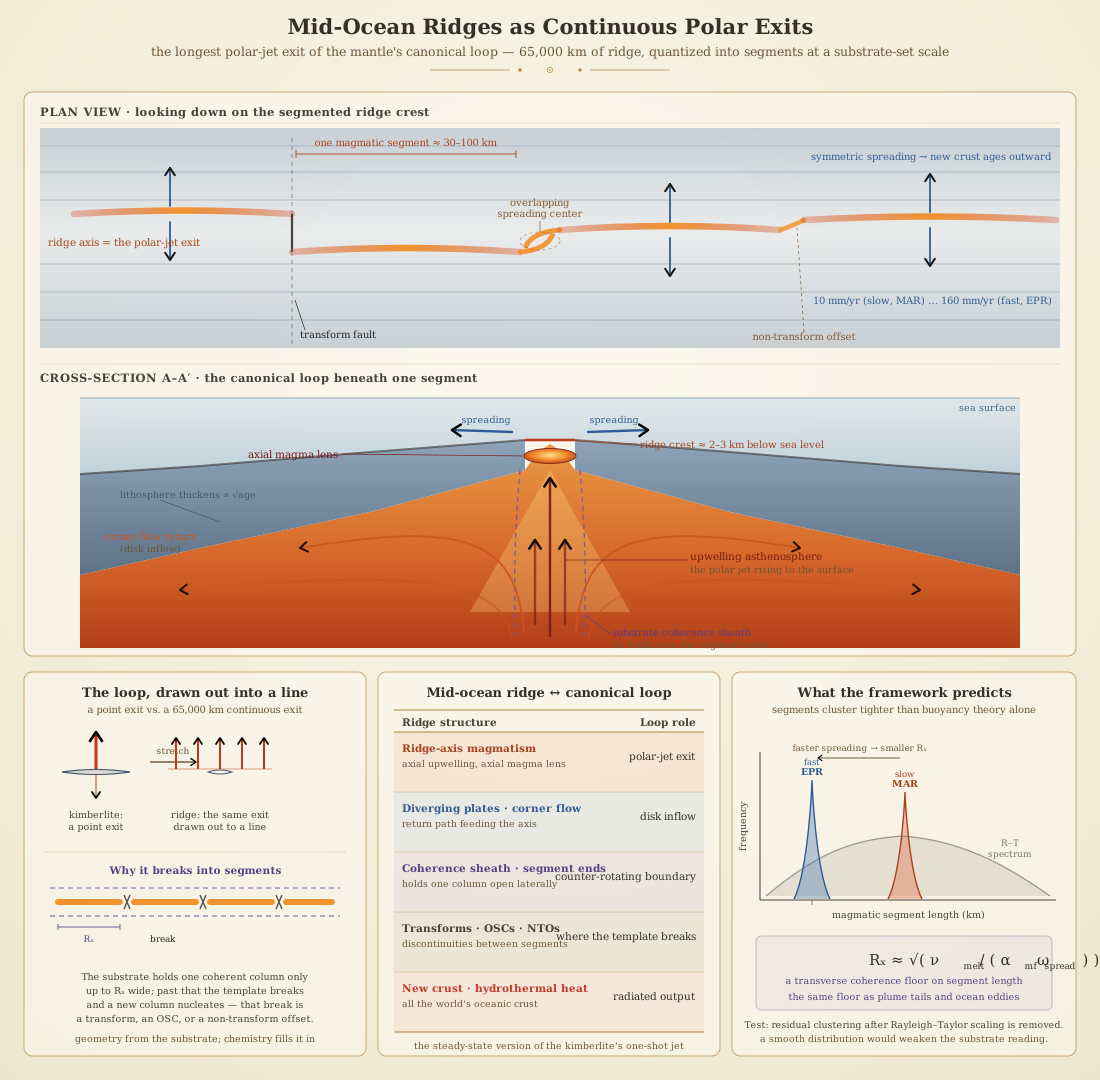
The mid-ocean ridge system read as the longest continuous polar-jet exit of the mantle’s canonical loop. Top of main panel — plan view: the ridge crest is a string of magmatic segments, each broad and shallow at its centre and tapering at its ends, offset from its neighbours by a transform fault, an overlapping spreading centre (OSC), and a non-transform offset (NTO); seafloor spreads symmetrically away on both flanks, building new crust that ages outward, at rates from \sim 10 mm/yr (slow, Mid-Atlantic Ridge) to \sim 160 mm/yr (fast, East Pacific Rise). Bottom of main panel — cross-section: beneath one segment, two cool plates thicken away from a crest \sim 2–3 km below sea level; an axial magma lens caps a column of upwelling asthenosphere — the polar jet — bounded by a substrate coherence sheath whose width sets the segment scale, while corner-flow streamlines rise at the axis and peel outward beneath each plate as the disk-inflow return. Bottom left: the kimberlite’s single point exit is the same loop jet drawn out into a 65{,}000 km line, then quantized into coherent columns of width R_\text{cross} — the breaks are the transforms, OSCs, and NTOs. Bottom middle: each ridge structure mapped to its canonical-loop role. Bottom right: the testable prediction — segment lengths should cluster more tightly than the broad Rayleigh–Taylor buoyancy spectrum predicts, with the preferred scale shifting to smaller values for faster spreading, set by R_\text{cross} \sim \sqrt{\nu_\text{melt}/(\alpha_{mf}\,\omega_\text{spread})}.
The mid-ocean ridge system is the longest continuous topographic feature on Earth. It runs \sim 65{,}000 km through every ocean basin, sits \sim 2–3 km below sea level along its crest, and produces all the world’s oceanic crust through symmetric seafloor spreading at rates ranging from 10 mm/yr (the Mid-Atlantic Ridge near Iceland) to 160 mm/yr (the East Pacific Rise at the equator). The ridge’s role in the planetary canonical loop was named in the deep-earth chapter — mid-ocean ridge spreading; volcanic arc above subducting slab in the polar-jets row of the table. What that one-line entry skates over is the segmentation: the ridge is not a continuous line but a string of magmatic segments, each \sim 30–100 km long, separated by transform faults, overlapping spreading centers, and small non-transform offsets. The segments have characteristic axial morphology (broader and shallower at their centers; narrower and deeper at their ends) and characteristic geochemical evolution along their length.
Standard ridge-segmentation theory (Macdonald, Sempéré; Crane 1985) attributes segment length to the spacing of mantle upwelling instabilities beneath the ridge axis, set by Rayleigh-Taylor dynamics in the asthenosphere with characteristic length \sim depth-of-melting \times a numerical factor of order unity. The mechanics work — and they predict the right order of magnitude. What they do not predict is the clustering: segment lengths along well-mapped ridge sections (the East Pacific Rise between 9°N and 13°N, the Mid-Atlantic Ridge near 35°N, the Reykjanes Ridge south of Iceland) cluster more tightly than the Rayleigh-Taylor instability spectrum predicts, suggesting an additional length-selection mechanism beyond the buoyancy dynamics.
Interactive: the exit view of the Gaia simulation draws this cross-section at true scale, unit 1 km: the plates parting at 5 cm/yr each way over the upwelling column, melting from the dry solidus at \sim 60 km inside its coherence sheath, the melt focused to a lens 1–2 km under a crest 2.5 km down, 7 km of crust in its three layers, the lithosphere thickening as \sqrt{\text{age}} and the floor subsiding with it, black smokers on the axis — with the log-time dial showing which of these moves at which pace. The mode switch trades it for the impulsive exit, the arc of the section below.
This chapter treats the ridge as a process — the geometry of the exit, and what sets the spacing of its segments. What the exit actually manufactures is the subject of the ocean-floor chapter: \sim 7 km of basalt-over-gabbro, laid down to a specification that barely moves across a sixteenfold range of spreading rate, and carrying — in its texture, its magnetite, its chemistry and its density — four separate signals the planet goes on to depend on. The two chapters split the rock cleanly: this one owns the ridge’s length scale and the R_\text{cross} prediction below, that one owns the product’s clock, its memory, and its disposal.
The framework reads ridge segmentation through the same lens applied to plume tails in mantle dynamics: a continuous polar-jet exit, like a discrete one, has a substrate-set transverse coherence floor. The segments are the lateral extent over which the substrate can hold a single coherent magmatic column open against the surrounding lithosphere; the discontinuities (transforms, OSCs, NTOs) are where the substrate template breaks and a new column nucleates. The same R_\text{cross}-style reasoning that the water chapter applied to oceanic eddies and the deep-earth chapter applied (with scope caveats) to kimberlite pipes should set a floor on segment length scaling as \sqrt{\nu_\text{melt}/(\alpha_{mf}\,\omega_\text{spread})}, with \nu_\text{melt} the effective viscosity of the partial-melt zone and \omega_\text{spread} a rotation frequency set by the spreading rate and the column geometry.
The framework does not derive segment lengths from substrate physics — those follow from Rayleigh-Taylor instability in a partial-melt zone as standard ridge mechanics already explain. What it claims is that the clustering of segment lengths around a preferred scale, beyond what the instability spectrum predicts, is a substrate-locking signature, in the same family as the plume-tail diameter prediction in mantle dynamics and the eddy-size floor in the water chapter.
Mid-ocean ridge magmatic segment lengths should cluster more tightly than buoyancy-instability theory alone predicts, with the preferred scale shifting between fast-spreading and slow-spreading regimes in a way consistent with R_\text{cross} \sim \sqrt{\nu_\text{melt}/(\alpha_{mf}\,\omega_\text{spread})}. The cleaner test is a comparative compilation: segment-length statistics for the East Pacific Rise (fast, \nu_\text{melt} low because the partial-melt zone is hotter and broader), the Mid-Atlantic Ridge (slow, \nu_\text{melt} higher), and the ultraslow Gakkel and Southwest Indian Ridges (where the standard theory predicts very long segments but the data show a more complex pattern). The framework predicts a residual clustering after Rayleigh-Taylor scaling is removed; a smooth distribution would weaken the substrate-floor reading.
The East African Rift as the Open-System Worked Example

Two branches, one architecture. Map: the polar exit runs south from Afar in two branches with opposite personalities — the magma-rich eastern branch (rust, with its volcanoes) carrying strain in dikes through the Main Ethiopian Rift and the Kenya rift, the magma-poor western branch (slate, with its fault ticks) carrying it on border faults over 100 km long beneath Lakes Albert, Tanganyika and Malawi — and both are segmented into half-graben basins 50–150 km long. The faint rust blob under Afar is the single asymmetric upwelling that feeds all three arms; the inset draws the Y at its real unequal angles, assembled in three steps over \sim 20 Myr. Top row, each branch caught acting as a unit: at Dabbahu the September 2005 dike ran the full \sim 60 km of one magmatic segment in two weeks, and thirteen more re-intruded the same outline through 2010; at Karonga the northern Malawi basin released its moment as a 27-day sequence of M_w 5.8–6.0 events on a family of immature faults at \sim 5 km spacing, with no melt anywhere — and still the strain partitioned instead of going diffuse. Middle row: the Watts et al. 2025 striping — pulses from one upwelling leaving long, low chemical stripes along the fast-opening Red Sea arm and short, high ones along the slow Ethiopian arm, so that extension rate and plate thickness, the two knobs in R_\text{cross}, are the field’s own control parameters; and the chapter’s one genuinely discriminating plot, standard flexure’s L \propto T_e^{3/4} against the framework’s L = a\sqrt{T} + L_0, which cross where both are anchored on East Africa and part at both ends — the thin, young rifts show the floor and the thick, old ones show the slopes. Bottom strip: the architecture the two branches share, drawn once — half-grabens whose border fault switches sides at every accommodation zone, still discrete after \sim 30 Myr of extension. The mechanics are the field’s; the framework claims the three-fold attractor, the segment as the unit in both regimes, the persistence, and the different curve.
A continental rift is a mid-ocean ridge in slow motion: the same canonical-loop polar exit, but propagating through cold continental lithosphere that resists rather than yields. The East African Rift is the planet’s best-instrumented active example. It begins at the Afar triple junction in the north, where the Red Sea, Gulf of Aden, and East African arms meet in the Y-geometry the deep-earth chapter sees as the substrate’s 3-fold projection. Like with most substrate energy measurements, the junction is not a clean 120° trisection: the Red Sea arm trends NW–SE, the Aden arm ENE, the Ethiopian arm NE–SW, and the angles between them are unequal — spanning roughly 100°–140° rather than 120° three ways. The junction of these arms has formed sequentially: rifting began in the Gulf of Aden \sim 35 Ma, in the Red Sea \sim 25–29 Ma, and the Ethiopian arm is the youngest, propagating in to complete the junction only \sim 11–18 Ma — Wolfenden’s 2004 study of the northern Ethiopian rift is titled “birth of a triple junction.” The substrate energy shows the dynamics of the convergence: a junction assembled piecemeal over \sim 20 Myr, under far-field stresses of different orientations and magnitudes at each stage, still arrived at an approximate three-fold geometry. The classical explanation (Burke and Dewey 1973) is that three-armed rupture of a plume-domed lithosphere minimizes mechanical work, and modern analogue and numerical experiments recover the same result under realistic bi-directional far-field stress: the triple junction forms because it minimizes the dissipative work of multi-directional breakup. That is the standard mechanics, and the framework reads it one level down — the substrate’s 3-fold projection biasing which minimum the lithosphere finds. Every angle is mediated by chemistry, inherited structure, and stress history, so no individual angle is expected to be precise; the substrate claim is about the attractor, not the snapshot.
From Afar the rift propagates southward through Ethiopia, Kenya, Tanzania, Malawi, and Mozambique, segmented into individual half-graben basins each \sim 50–150 km long, with characteristic accommodation-zone structures between segments where the polarity of the bounding faults reverses. The segments link up along strike on \sim 10–30 Myr timescales. And the rift runs south in two branches with opposite personalities, which makes it a natural controlled experiment. The Eastern branch (Ethiopia, Kenya) is magma-rich: within the Main Ethiopian Rift, extension has localized since \sim 3 Ma into \sim 50–100 km magmatic segments — oblique to the older Miocene border faults but orthogonal to the current extension direction — whose axial volcanic morphology mimics slow-spreading mid-ocean-ridge segments (Ebinger and Casey 2001). The Western branch (Albertine, Tanganyika, Malawi) is magma-poor: extension there is carried almost entirely by border faults over 100 km long, bounding deep lake-filled basins with kilometers of synrift sediment, in cold strong lithosphere whose seismicity extends to 30+ km depth. Two branches, two different strain-accommodation mechanisms — dikes in the east, faults in the west — and the same segmented architecture in both.
Each branch has now delivered a clean real-time observation of its segmentation acting as a unit. The east’s is the Dabbahu rifting episode of 2005–2010, the continental twin of the Krafla episode treated in the Iceland section below: in September 2005 a \sim 60 km dike intruded the full length of the Dabbahu magmatic segment in Afar in about two weeks — \sim 2.5 km³ of magma, up to 8 m of opening, the largest magmatic rifting event on land since Laki in 1783 and the first captured by satellite geodesy — followed by thirteen more dikes re-intruding the same segment through 2010. The Nature paper announcing it (Wright et al. 2006) is titled “Magma-maintained rift segmentation at continental rupture”: the entire segment, not a single fault and not the plate boundary as a whole, acted as the unit of failure, and the repeated dikes respected its boundaries. That is the segment-as-coherent-column picture, stated in the mainstream literature’s own words.
The west’s is the 2009–2010 Karonga earthquake sequence at the northern end of Lake Malawi (Gaherty et al. 2019). Instead of one mainshock trailing aftershocks, the basin released its moment as a series of M_w 5.8–6.0 events over 27 days, on multiple interacting, immature faults in the border fault’s hanging wall — with aftershock lineations resolving synthetic faults at \sim 5 km spacing, an anomalously low b-value (\sim 0.8) indicating high differential stress in strong intact crust, and InSAR confirming no magmatic involvement anywhere in the sequence, including at the Rungwe volcanic province 50 km north. This is the stiff, cold, amagmatic end-member the framework’s reading invokes, caught in the act: even with no melt available to organize the strain, the deformation does not go diffuse — it partitions into discrete, interacting, characteristic-scale structures, hierarchically nested from the \sim 100 km basin down through intrabasinal fault families spaced at \sim 5 km. This partitioned stage is the amagmatic story’s opening chapter, not its ending: carry the same regime through enough thinning and the distributed families eventually collapse onto a single weak master surface, once water reaches the mantle and installs the slip plane — the localization climax the serpentine-switch section below reads off the Galicia margin.
Three complications keep the substrate reading honest. First, the segmentation demonstrably exploits inherited structure: Malawi Rift faults track Precambrian shear-zone fabric (Laó-Dávila et al. 2015; Kolawole et al. 2018), so segment boundaries are partly set by billion-year-old scars, and any substrate-floor test must regress out the inherited-fabric control first. Second, the mainstream already has a thickness scaling — border-fault and basin lengths correlate with effective elastic thickness across the rift system (Ebinger et al. 1999), and standard flexure predicts length \propto T_e^{3/4}. The framework’s \sqrt{T_\text{lith}}-plus-residual is a different curve, which is what makes the prediction testable rather than redundant. Third, the Afar junction’s angles are unequal and its arms formed sequentially — the substrate claim survives as a bias toward the three-fold attractor, not as a measured 120° trisection.
The newest data from Afar bear directly on the framework’s control parameters. Geochemistry from more than 130 young volcanoes across all three rift arms (Watts et al. 2025) shows that the junction is underlain by a single, asymmetric mantle upwelling feeding all three arms — not three plumes, and not a symmetric dome — delivering melt in pulses that are channeled along each arm’s thinned-lithosphere plumbing. The chemical striping the pulses leave behind has a shorter wavelength and higher amplitude along the slow-extending Ethiopian arm than along the fast-opening Red Sea arm, and the authors’ own conclusion is that the length scale of mantle heterogeneity in magma-assisted rifting is controlled by extension rate and plate thickness. Those are precisely the two control knobs in the R_\text{cross} \sim \sqrt{\nu_\text{melt}/(\alpha_{mf}\,\omega_\text{spread})} scaling this chapter assigns to ridge and rift segmentation — the field’s own analysis is measuring the same dependencies the substrate reading predicts, and the pulsing itself belongs to the substrate-clock family the volcanic-metronome section develops below. This is consonance, not confirmation: the mainstream mechanism (channelized flow under a rifted lid) is complete on its own terms. But it means the comparative test the framework wants — heterogeneity wavelength against spreading rate across the three arms of a single junction — is already being assembled by the field for its own reasons.
The framework reads continental-rift segmentation as the same substrate-locked polar-exit geometry that organizes mid-ocean ridge segments, but operating on a thicker, colder, less yielding lithosphere — so the substrate-imposed segment scale is more visible because the local mechanics is too stiff to wash it out. Standard continental-rifting theory (McKenzie 1978; Buck 1991; Brun and Beslier) predicts approximately the right scale from lithospheric thickness and strain rate; what is harder to explain is the rift’s persistence in segmented form — over the \sim 30 Myr the East African system has been active, the basins have remained discrete entities with characteristic widths and lengths, rather than coalescing into a continuous trough, and the Dabbahu and Karonga episodes show the segments acting as units in both the magma-rich and magma-poor regimes. The East African Rift basins should cluster at scales set by the lithospheric R_\text{cross}, with the segmentation persisting until the rift completes its propagation to a true mid-ocean ridge (which the Afar segment is approaching now, and which the southern segments — if they do not stall as failed rifts — will not reach for tens of Myr) and the lithosphere is thin enough for the segments to merge into a continuous spreading center. That, it should be said plainly, is the magma-rich route to breakup — the one Afar is visibly taking. It is not the only one: at magma-poor margins the melt never organizes the strain, the exit never fires during breakup, and the lid is taken apart mechanically instead, on a serpentine detachment — the route the next section follows to its end at the Galicia margin. The same prediction applies to the Baikal Rift, the Rio Grande Rift, the Rhine Graben, and the failed Midcontinent Rift in North America: segment lengths should cluster, and failed rifts (the Midcontinent, the Newark basins) are the cases where the substrate-locking condition was not met for long enough to overcome the lithosphere’s resistance, and the rift died.
Continental rift basin lengths should cluster more tightly than lithospheric-thickness scaling alone predicts, with the preferred scale increasing systematically with lithospheric thickness as \sqrt{T_\text{lith}} but with a substrate-floor residual independent of thickness. The cleanest test is a comparative compilation across active continental rifts (East Africa, Baikal, Rio Grande, West Antarctic, Salton Trough), failed rifts (Midcontinent, Newark, Anza-Borrego), and very-young oceanic rifts (Red Sea, Gulf of Aden, Gulf of California) — after regressing out the two known controls: inherited basement fabric (which sets some segment boundaries outright) and the standard flexural scaling (length \propto T_e^{3/4}, per Ebinger et al. 1999). The framework predicts a substrate-floor residual at the few-tens-of-km scale that should persist across all categories, and a \sqrt{T_\text{lith}} rather than T_e^{3/4} trend in the thickness dependence. A null result — segment lengths distributing smoothly with lithospheric thickness once inheritance is removed — would weaken the substrate-locking reading.
Breaking a Continent Without the Exit: The Serpentine Switch

Breaking a continent without the exit. Main panel: the Galicia margin in cross-section, Iberia on the left, exhumed mantle on the right. Where the crust is thicker than \sim 10 km a ductile lower layer seals the mantle from the sea and conjugate margins stay symmetric; at the dashed line the ductile layer runs out, and oceanward of it the crust is a train of tilted fault blocks — faults dipping oceanward and locked at \sim 40°, synrift wedges recording the rotation, seawater running down the faults — resting on S, the bright, nearly flat, corrugated serpentine detachment that slips at 20–25° and becomes the seafloor where the crust reaches zero. A steep new fault (55–60°) propagates up from the root zone and cuts across the older roots, which flatten into S. Top right: the rolling hinge as four frames — born steep, rotates, locks, abandoned — and below it the active-fault dip plotted against time as a sawtooth, each tooth resetting from 40° back to 60° when a new fault nucleates: a mechanical relaxation oscillator whose stride is the block width. Bottom left: the switch itself — two crustal columns either side of the \sim 10 km threshold (Pérez-Gussinyé and Reston 2001), and the five-step cascade from full embrittlement, through seawater and serpentine, to strain collapsing onto S and asymmetric hyper-extension. Bottom middle: the register — the S surface’s corrugations, cut parallel to flow, matching the fault above it ridge for ridge and rotating in azimuth oceanward as the extension direction swung; and the three fault sets of the 3-D volume (Lymer et al. 2019) active concurrently, their heaves summing to a constant along strike. Bottom right: the two predictions — fault-block widths clustering at the oscillator’s stride after flexure and crustal thickness are regressed out, and the global rifted-margin population bimodal between magma-poor and volcanic rather than a continuum.
Everything above assumes the exit eventually fires. The East African section followed the polar exit prying open a continent, and its endpoint was magmatic: segments link, melt organizes the strain, and the rift matures into a spreading center. But a large fraction of the world’s rifted margins record a different ending. At magma-poor margins — the Iberia–Newfoundland conjugate pair is the type example — the continental crust thinned to zero and the continents came apart with almost no magma at all: no thick wedges of rift-related volcanics, mantle rock exhumed directly onto the seafloor and serpentinized in place, organized seafloor spreading arriving only after separation was already accomplished. The polar exit never fired during breakup. Something else did the work, and the best image ever made of that something is the Galicia margin, west of Spain.
Beneath the Galicia margin’s tilted fault blocks runs a bright, nearly flat reflection called S — long suspected to be a detachment fault, and finally mapped in full by a bespoke 3D seismic volume (Lymer et al. 2019). The 3D surface settled a decades-old argument in one figure. S is corrugated, ridge-and-trough grooves running parallel to the extension direction — and the corrugations on S match, ridge for ridge, the corrugations preserved on the block-bounding faults above it, proving the two slipped as a single surface. S is not one fault: it is a composite surface, assembled from the juxtaposed, rotated roots of successive block-bounding faults in a rolling-hinge cycle (Buck 1988). Each fault is born steep at \sim 55–60°, rotates as the crust beneath it is pulled out, locks at \sim 40°, and is abandoned as a new fault propagates up from the root zone and cuts across it — the abandoned root flattening into the growing detachment. And the angular bookkeeping, read from the synrift wedges in the 3D volume, shows that slip on S itself continued down to 20–25°.
That last number is the tell. Ordinary rock friction forbids slip at 20°; it requires exceptionally weak fault rocks — serpentine or talc — at the top of the mantle, and the Galicia mantle is demonstrably serpentinized: hydrated-mantle velocities beneath S (Bayrakci et al. 2016), serpentinite drilled further west along the margin (Whitmarsh et al. 1998). But serpentine needs seawater, and seawater can only reach the mantle once the crust has no ductile layer left to seal it — which happens when the crust thins to \sim 10 km and becomes brittle top to bottom (Pérez-Gussinyé and Reston 2001). So the detachment, the hyper-extension it enables, and the asymmetry of the resulting conjugate margins all switch on late in the rifting, and abruptly, when a single material threshold is crossed. The observations agree: conjugate magma-poor margin pairs are symmetric where the crust is thicker than \sim 10 km and asymmetric below it (Reston and Pérez-Gussinyé 2007; Reston 2010), and the still-active root of the Galicia system now dips beneath the conjugate Flemish Cap margin (Hopper et al. 2004).
The framework explains each link of the cascade. Full crustal embrittlement is the crustal-lattice hinge running out of ductile — the depth-swept Deborah number collapsing to \mathrm{De} \gg 1 through the whole column, so the crust can no longer re-register anywhere and can only crack. The cracking lets seawater in, and the water installs the sheet rung — the 2-D silicate the ocean-floor chapter shows is locked out of dry manufacture and added by hydration afterwards. That chapter treats the sheet rung chemically: the serpentinization reactor, the self-made pores, the free hydrogen. Galicia supplies its mechanical face: the sheet rung is also the weak rung — a layered structure shears where framework and chain will not — and the moment water installs it at the crust-mantle boundary, the entire margin’s strain budget abandons the distributed fault families and collapses onto a two-dimensional silicate a few hundred metres thick. Energy localizes onto the cheapest boundary available, and the substrate’s own preferred geometry, once installed, is the cheapest boundary by an order of magnitude. The result is the same mode flip the section has now met twice — magmatic versus tectonic accretion at slow ridges (ocean floor), loaded versus drained magma chambers (calderas, below): two substrate-locked states with a sharp switch between them, not a continuum. Volcanic and magma-poor margins are the continental-breakup expression of that same bistable pair — a rift that reaches breakup either because the melt organized the strain, or because the serpentine did.
The rolling hinge itself belongs to the section’s clock family. Nucleate steep, rotate, lock, abandon, repeat: a mechanical relaxation oscillation, with the reset threshold written in fault mechanics rather than magma supply, and the 3D volume shows every block in the system went through the same angular cycle — the same birth angle, the same lock-up, the same final slip window — block after block, oceanward. The stride of that oscillator is written permanently into the margin as fault-block width, the way the mush’s oscillator is written into cumulate layers and the ridge’s tape head writes its stripes. To be precise about the division of labour: the angles themselves (60° birth, 40° lock-up, 20° on serpentine) are friction chemistry — Anderson, Byerlee, and Moore’s serpentine gouge — and the framework claims none of them. What it reads as substrate is the repetition: a system that cycles through the same thresholds with the same stride, block after block, is a relaxation oscillator ringing on its own fundamental, and the framework expects the stride to cluster.
The 3D volume also delivered a correction to the field’s own 2D models that the section should adopt everywhere it describes migrating fault systems. In the 2D rolling-hinge and sequential-faulting pictures, one fault slips at a time: each must lock before its successor initiates. The 3D data show otherwise: the faults are of limited lateral extent, they link and merge along strike, and they operate in sets — three of them in the Galicia volume — whose members were active concurrently, with complementary heaves whose sum stays nearly constant along strike as displacement transfers from a dying fault to its neighbours (Lymer et al. 2019). Migration happens set by set, each new set cutting across the roots of the last. The unit of the oscillator is the set, not the fault — which is precisely the reading this chapter gave Dabbahu, where the dike respected the segment, and Karonga, where the moment release partitioned across an interacting family. In all three cases the coherent unit is larger than any single structure in it, and the bookkeeping (constant summed heave, conserved segment boundaries) is the unit acting as a unit.
And the corrugations are a register. Grooves cut parallel to flow, frozen into the surface, readable a hundred million years later: the S surface is a strain tape the way the seafloor is a magnetic tape, and it even records a change of signal — the corrugation azimuth rotates oceanward across the volume, preserving the swing of the extension direction during rifting the way the stripes preserve reversals. The corrugated oceanic core complexes of the slow ridges are this same surface’s younger siblings; Galicia’s S is the buried continental original, and the ridge-for-ridge match between S and the faults above it is the section’s sharpened-boundary claim in mechanical form — a surface stitched together from generations of fault roots that nonetheless slipped as one coherent boundary.
The mechanics here are complete on their own terms, and none of them are the framework’s. The rolling hinge is Buck (1988); the low-angle slip on weak serpentine is Moore et al. (1996) and Reston et al. (2007); the embrittlement-serpentinization threshold is Pérez-Gussinyé and Reston (2001) with the hydration mapped by Bayrakci et al. (2016); the concurrent fault sets and the composite, corrugated S surface are Lymer et al. (2019). The framework adds no angle, no depth, and no strength. What it adds is the joining: that full embrittlement is the crustal-lattice hinge running out of ductile, that the serpentine detachment is the sheet rung’s mechanical face, that the volcanic/magma-poor margin split is the section’s recurring bistable pair, that the rolling hinge is a member of the substrate-clock family with its stride written in block widths, and that the corrugated composite surface is a register in the same family as the magnetic tape and the sharpened contact. Each of those joinings carries a testable statistical signature; the mechanics would be equally happy without them, which is what makes the predictions below discriminating rather than decorative.
Fault-block widths at magma-poor rifted margins should cluster at a preferred scale beyond what flexural and crustal-thickness scaling predict, and the global rifted-margin population should be bimodal — volcanic versus magma-poor — rather than continuously distributed. The first half is the rolling-hinge oscillator’s stride: measure block widths (fault spacings in the displacement direction) across the Galicia 3D volume, the Iberia–Newfoundland conjugate profiles, Flemish Cap–Goban Spur, and the South Atlantic magma-poor segments, regress out the known controls (crustal thickness at faulting, flexural wavelength), and test the residual for clustering against a smooth null. The second half is the bistable-pair signature, same shape as the magmatic/tectonic accretion-mode prediction in the ocean-floor chapter: score margins worldwide on a magmatic-budget axis (volume of rift-related volcanics, width of the exhumed-mantle domain) and test for bimodality against a unimodal continuum. Smoothly distributed block widths, or a continuum of margin types, would weaken the respective readings — and the bistability prediction either holds across calderas, ridge accretion modes, and margin types together, or the family claim fails.
Iceland: Where Two Substrate Channels Overlap
Iceland is the only landmass where a mid-ocean ridge surfaces. It is also the surface expression of one of the planet’s most persistent and well-resolved mantle plumes, with a tomographically imaged conduit extending from the lower mantle (mantle dynamics) to the lithosphere beneath the central Highlands. Standard mantle geodynamics has had decades of debate about whether Iceland is fundamentally a plume that happens to coincide with the Mid-Atlantic Ridge or a ridge that happens to be locally buoyant — Foulger versus Anderson is the textbook controversy.
The framework reads Iceland as neither/both: it is the unique terrestrial location where a continuous polar-jet exit (the Mid-Atlantic Ridge) and a discrete substrate-locked vertical conduit (the Iceland plume) coincide, and the resulting surface expression is the constructive overlap of the two substrate channels. The amplification is structural, not chemical: the ridge supplies the lateral substrate template; the plume supplies the vertical substrate template; their intersection has access to both polar-exit geometries simultaneously. This is why Iceland sits \sim 3 km above the mean Mid-Atlantic Ridge depth, has anomalously thick crust (\sim 25–40 km versus the \sim 7 km global ridge average), and erupts frequently along en-echelon fissure systems whose orientations track the local stress field with unusual fidelity.
The Krafla rifting episode of 1975–1984 — during which a \sim 80 km segment of the Northern Volcanic Zone underwent nine separate dike-emplacement events, each propagating laterally for tens of km in hours to days, with \sim 2 m of total spreading — is the cleanest single observation of a substrate-locked mid-ocean ridge segment doing in real time what most ridges do unobserved beneath 3 km of seawater. The dike velocities (\sim 0.5–1 m/s lateral), the propagation directions (consistently along the substrate-organized rift axis rather than along the local stress field), and the systematic recurrence of events along the segment are direct observational data on the substrate’s lateral coherence in a magmatic conduit.
Iceland’s volcanic productivity per unit ridge length should exceed both the typical mid-ocean-ridge rate and the typical hotspot rate, consistent with the constructive overlap of two substrate channels rather than the geometric sum of two independent contributions. Standard plume-ridge interaction models (Ito, Lin) predict a \sim 2\times enhancement over the algebraic sum. The framework predicts a larger residual (\sim 2.5–4\times), with the excess attributable to the constructive overlap of the two substrate-locked geometries. The cleaner test is the along-axis variation of crustal thickness (constrained by seismic refraction) across the Reykjanes Peninsula, central Iceland, and the Kolbeinsey Ridge to the north: the substrate prediction is a sharper Iceland-centered peak than the geodynamic models give.
The Volcanic Arc as the Counter-Rotating Sheath, Made Magma
The deep-earth chapter’s canonical-loop table gave one cell to the volcanic arc: counter-rotating boundary. The arc above a subducting slab is the boundary layer between the descending plate (co-rotating disk inflow) and the overlying mantle wedge — and unlike the abstract counter-rotating sheaths around accretion disks, the volcanic arc is visible, erupting, and segmented in characteristic ways. Three of its features sharpen the substrate reading:
Inter-volcano spacing. Along most volcanic arcs, the major edifices are spaced at characteristic intervals of \sim 50–100 km. Tatsumi (1986) and many subsequent studies attribute this spacing to Rayleigh-Taylor instabilities in the slab dehydration plumes that rise from the subducting plate at \sim 100–150 km depth, with the instability wavelength set by the buoyant-plume diameter and the spacing between adjacent plumes. The mechanics work for the order of magnitude. The framework reads the clustering — arc volcanoes spaced more uniformly than Rayleigh-Taylor noise predicts — as the substrate’s lateral coherence imposing a preferred length scale at the arc.
Arc curvature. Frank (1968) noted that volcanic arcs trace small circles on a sphere defined by the subducting slab’s dip angle: a slab dipping at \delta degrees produces an arc whose curvature radius is R_\oplus\,\sin\delta. The geometry is purely spherical and was a clean prediction; it explains the curvature of the Aleutians, the Lesser Antilles, and the Banda Arc. What it does not explain is the segmentation of arcs into shorter trends separated by gaps, kinks, or transverse fault systems (the Aleutian arc’s central-and-eastern bend; the Tonga-Kermadec system’s southern transition). The substrate reading: arc segments are bounded by the same kinds of substrate-template discontinuities that bound mid-ocean ridge segments, with the segment scale set by the arc’s R_cross-equivalent and the discontinuities at integer-multiple positions where the lateral coherence breaks.
Arc-trench parallelism and back-arc spreading. Behind many active arcs (the Mariana Trough, the Lau Basin, the Sea of Japan, the Tyrrhenian Sea) lie back-arc basins where the upper plate is itself extending, often forming a small ocean basin with its own spreading center. The standard explanation: trench rollback creates extension in the upper plate. The substrate reading: the back-arc spreading center is a secondary polar exit, opening behind the arc because the canonical-loop topology requires a return path for the angular momentum the subducting slab is delivering to the wedge. The arc-and-back-arc system is the canonical loop’s complete boundary structure expressed at the scale of a subduction zone, with the arc as the primary counter-rotating sheath and the back-arc as the secondary polar exit.
Arc-segment length statistics across global subduction zones should show clustering at substrate-set scales beyond what Rayleigh-Taylor instability spacing predicts, and the cluster scale should track \sqrt{T_\text{slab-distance}} across arcs of different slab depths. A statistical compilation across the Aleutian, Cascadia, Central American, Andean, Tonga-Kermadec, Izu-Bonin-Marianas, Japan-Kuril-Kamchatka, Sunda-Banda, and New Hebrides arcs should show the predicted clustering. The framework’s clean signature is that the clustering should be sharper than the slab-parameter spread within each arc would otherwise predict.
Eruption Styles as Substrate-Coupling Regimes

The regime ladder. Row I: VEI 0–8 laid out as the fire chapter’s detonation ladder run in silicate — effusive (laminar), Strombolian and Vulcanian (subcritical cascade), Plinian (deflagration-to-detonation), ignimbrite and pyroclastic density current (sustained dispersive shock), caldera-forming (bistable transition) — each rung carrying its twin in fire, the top rung its twin in air. Under all five runs one axis, how fast the cascade runs against how fast the substrate can pass the coin forward, and the two dashed thresholds are the only steps that change the topology. A: the step between rungs 2 and 3 as a foam — melt continuous at \varphi \approx 0.3, cells crowding and walls thinning at 0.6, and past \sim 0.75 the inversion to gas continuous with melt in particles; beneath it, cell-wall thickness against bubble fraction crossing the substrate coherence floor inside the observed 0.70–0.80 band (Sparks 1978), with sphere close-packing at 0.74 ticked. B: the discriminating plot, column-rise velocity against mass eruption rate: the standard column model keeps rising, the framework saturates at a substrate ceiling, and the shaded residual is what a re-analysis of St Helens 1980, Pinatubo 1991 and Hunga Tonga 2022 should find — a schematic of the prediction, the three eruptions placed by eruption rate only; the inset is the same ceiling in fire, CHNO detonation piling up below c_T. C: the top rung as a time series — chamber volume dropping by >90\% in one episode, refilling over 10^4–10^5 yr to the same locked level, and dropping again, against the long tail a smooth drain would give: the two wells of the headliner’s caldera panel, read in time.
A volcano’s eruption style spans an enormous range. At one extreme: the gentle effusive lava lakes of Kīlauea or Erta Ale, where basaltic magma with <1\% dissolved volatiles flows out at temperatures of \sim 1{,}200°C and walks-pace velocities. At the other: the Plinian columns of Pinatubo 1991, Mount St. Helens 1980, and Hunga Tonga 2022, where gas-rich silicic magma fragments cataclysmically in the conduit and erupts as a supersonic mixture of ash and gas at column-rise velocities of 100–600 m/s, with the column’s umbrella punching into the stratosphere. The Volcanic Explosivity Index (VEI) catalogues this range from 0 (effusive) to 8 (super-eruption, Toba-class).
The substrate framework reads the VEI scale through the same lens the fire chapter used for chemical detonation regimes:
Effusive (VEI 0–1) is the laminar regime. The cascade — bubble nucleation, melt fragmentation, gas-particle separation — proceeds slowly enough that the substrate reorganizes ahead of it. The conduit dynamics are set by chemistry and viscosity; the substrate is the medium in which they happen but is barely participating in the dynamics.
Strombolian and Vulcanian (VEI 1–3) are subcritical cascade. Discrete bubble bursts at the magma-air interface (Strombolian) or short pressurized expulsions of viscous magma (Vulcanian) are local cascade events that complete and self-extinguish. The substrate participates — the periodic intervals between bursts are themselves a substrate-tuned signature, addressed below — but the cascade does not run away.
Plinian (VEI 4–6) is the deflagration-to-detonation transition. When the magma’s bubble fraction crosses the fragmentation threshold (\sim 75\% by volume), the conduit transitions from a melt-with-bubbles to a gas-with-particles flow. The cascade now runs supersonically through the conduit, the surrounding magma column accelerates, and the eruption column above the vent assumes the substrate’s preferred dispersive-shock structure with a leading discontinuity (the gas-thrust region) and a trailing convective column. This is the magmatic analog of the deflagration-to-detonation transition in a chemical explosive. It is also the magmatic instance of the coin-handoff ceiling the fire chapter reads in chemical detonation: once the flow outruns the speed at which the substrate can relay its breath forward, the energy can no longer be handed off losslessly and piles into the leading shock. The substrate-set column-rise ceiling the prediction below invokes is that same threshold — a ceiling on how fast the coin can be passed, not a rung of the ladder.
Ignimbrite/pyroclastic-density-current eruptions (VEI 5–7) are sustained substrate-mediated dispersive shock. The 1980 Mount St. Helens lateral blast, the Pelée 1902 nuée ardente, and the Pinatubo 1991 ignimbrite were all sustained pyroclastic density currents — supersonic gas-particle mixtures propagating across topography at 50–300 m/s for tens of km, capable of destroying everything in their path. The framework reads PDCs as the magmatic equivalent of an undular bore (the same structure the DESI chapter treats at cosmological scale), with the substrate’s elastic response setting the leading-edge sharpness.
Caldera-forming (VEI 7–8) is the bistable substrate transition. Treated in its own section below.
The cleanest quantitative anchor is the fragmentation threshold. Across silicic magmas, the volume fraction at which the foam fragments into a gas-plus-particle flow clusters tightly at \sim 0.7–0.8 (Sparks 1978; Wilson). This is not a chemical constant — it is a topological condition: the cell-cell wall thickness drops below a critical value at which the substrate cannot hold the foam structure coherent, and the cascade runaway begins. The framework predicts that the fragmentation threshold should be set by the substrate’s coherence scale at the magma’s local conditions, scaling weakly with composition and pressure but converging on \sim 75\% across the silicic-magma range. This is consistent with the data and is a structural rather than numerical claim.
Plinian eruption column ascent velocities should saturate at a substrate-tuned ceiling, falling well below the simple gas-thrust prediction at high mass-eruption rates. Conventional column models (Sparks; Woods) give column rise velocities scaling with the mass eruption rate and the entrainment coefficient. The framework predicts that for the largest eruptions (Pinatubo, Hunga Tonga, Toba), the column-rise velocity should saturate as the local Mach number approaches an order-unity fraction of the substrate-set ceiling for two-phase magmatic flows. A clean test would be a re-analysis of column-velocity data across the major instrumented Plinian eruptions of the satellite era, looking for a saturation residual relative to the standard models.
Calderas as Bistable Substrate-Locked States
A caldera is the surface expression of a magma chamber that has emptied catastrophically — typically losing 10–1{,}000 km³ of material to a single eruptive episode and collapsing as the overlying rock loses its support. The result is a roughly circular depression, ranging from \sim 2 km (Krakatoa) to \sim 100 km (Toba) across, often nested with younger, smaller calderas inside older, larger ones (Yellowstone’s three nested calderas; the Long Valley-Mono complex). Caldera formation is one of the most catastrophic geological phenomena on Earth — Toba’s \sim 74 ka eruption is hypothesized to have caused a global volcanic winter and a near-extinction event for early modern humans.
Standard caldera mechanics (Druitt and Sparks; Roche and Druitt) treat the collapse as a piston-style failure of the chamber roof when the chamber pressure drops below lithostatic, with the caldera diameter set by the chamber’s lateral extent and the roof’s mechanical strength. The mechanics work, and the framework does not replace them. What the framework adds is the same observation it added for the polar vortex’s sudden stratospheric warmings: the chamber sits in a bistable substrate-locked state, with two stable configurations (loaded and drained) and a sudden, sharp transition between them rather than a smooth depressurization.
The bistability reading explains three otherwise puzzling caldera features at once:
The completeness of evacuation. Caldera-forming eruptions empty their chambers nearly completely in a single episode — typical residual fractions are <10\%. A smooth depressurization would predict gradual emptying with a long tail; the observed pattern is closer to a step function.
The narrow range of caldera diameters per volcanic system. A given volcanic system that has produced multiple caldera-forming eruptions over its lifetime (Yellowstone, 0.64 Ma + 1.3 Ma + 2.1 Ma; Long Valley + Mono; the Toba sequence) tends to produce calderas of similar diameter at each event, even though the chamber size has presumably evolved. The substrate reading: each chamber sits at a substrate-locked size set by the lithostatic and substrate-coherence balance, and resurges to the same scale after each evacuation.
Resurgent dome formation. After collapse, many calderas develop a central resurgent dome over \sim 10^4–10^5 yr as new magma accumulates beneath the floor. The substrate reading: the system relaxes back toward the loaded substrate-locked state, with the resurgent dome marking the renewed substrate-template that will host the next chamber filling.
Caldera diameters within a single volcanic system should cluster at a system-specific substrate-set scale, with the cluster width substantially smaller than the global VEI-7 caldera-diameter distribution would predict if each caldera were independently sized. The cleanest test is the well-dated polycaldera systems: Yellowstone’s three nested calderas at \sim 70 \times 50 km (Huckleberry Ridge), \sim 16 \times 11 km (Mesa Falls), \sim 70 \times 50 km (Lava Creek); Long Valley’s main caldera at 32 \times 17 km plus Mono Lake’s dome chain; the Taupō volcanic zone’s overlapping calderas across the past 1.6 Myr. The framework predicts statistical clustering within each system that exceeds what global compilations show. A null result — caldera sizes within a system distributing across the global VEI-7 range — would weaken the substrate-bistability reading.
The Volcanic Metronome
Many volcanoes erupt with characteristic recurrence intervals — periodic enough that the volcanological community treats them as substantive features of the system, not accidents. The most famous case is Stromboli: the eponymous Strombolian eruption style is named after this volcano because its mild, periodic explosive bursts occur every \sim 5–15 minutes, continuously, for at least the past \sim 2{,}000 years, with the interval well-characterized in the seismic and acoustic record. Old Faithful in Yellowstone erupts every \sim 60–110 minutes (the interval has lengthened over the past century, attributed to shifts in the local hydrothermal plumbing). Mount St. Helens during its 1980–1986 dome-growth phase produced eruptive pulses on a \sim 6-month recurrence interval. Yellowstone’s three caldera-forming eruptions are spaced at \sim 660 kyr intervals (with substantial scatter). Across volcanic systems globally, eruption recurrence intervals span 14 orders of magnitude — from the Strombolian few-minutes scale to the supereruption few-hundred-thousand-years scale.
The framework reads these recurrence intervals as the third instance of the section’s substrate-clock family, alongside slow-slip events and the Wilson cycle: each is a substrate-mediated relaxation oscillation whose fundamental period T_0 is set by the substrate’s response time at the local viscosity and length scale. The Strombolian few-minutes interval, the Cascadia 14-month slow slip, and the \sim 0.7–0.9 Gyr Wilson cycle are the same physics spread across \sim 6 orders of magnitude — each a system with its own clock ringing at integer overtones T_0, 2T_0, 3T_0 (string, not keyboard), the harmonic ladder that rides atop the substrate’s lengthless \sqrt{2} tower rather than being it.
The strongest version of the prediction is statistical: across the volcanological record, recurrence intervals for systems in the same class (basaltic Strombolian, basaltic effusive, andesitic Vulcanian, dacitic Plinian, rhyolitic caldera-forming) should cluster at integer-multiple resonances of a class-specific fundamental period, rather than distributing smoothly with chamber volume and supply rate.
Eruption recurrence intervals within a volcano class should cluster at substrate-tuned values rather than scale smoothly with chamber and conduit parameters. The cleanest test is the high-frequency end of the spectrum where the data is most abundant: catalog the inter-eruption intervals for the world’s persistently active Strombolian volcanoes (Stromboli, Yasur, Erebus, Sangay, Pacaya), and check whether the intervals across this set cluster at an integer-multiple structure rather than spreading smoothly with each volcano’s chamber characteristics. The framework’s specific prediction is a fundamental period T_0^\text{Strombolian} of order 5–10 minutes shared across the class, with T_0, 2T_0, 3T_0 peaks visible in the global histogram. A null result — smooth distribution scaling with magma viscosity and chamber size — would weaken the substrate-oscillator reading at this scale.
Volcanic Lightning and the 300 keV Signature
The umbrella column of an explosive eruption is one of the planet’s most efficient lightning factories. The 2022 Hunga Tonga eruption produced an estimated 590{,}000 lightning flashes in the first six hours — the highest sustained flash rate ever recorded for any natural phenomenon, exceeding the global average atmospheric flash rate of \sim 100 flashes/s by orders of magnitude during the peak. Mount Augustine, Eyjafjallajökull, Sakurajima, Mount St. Helens, and Pinatubo all produced spectacularly imaged volcanic lightning during their eruptive paroxysms. The lightning is correlated with the silicic-ash content of the column (electrically conductive ash particles facilitate triboelectric charging) and with the ice nucleation in the upper column.
The lightning chapter treats the substrate physics of cloud-to-ground discharges through the 300 keV modon-shedding threshold (thermal dynamics). The prediction at the heart of that chapter is that lightning produces a small but reliable population of high-energy modons at the 0.776\,c threshold, observable as terrestrial gamma-ray flashes (TGFs) and hard-X-ray bursts associated with leader-step propagation. The framework predicts the same signature in volcanic lightning, with the additional constraint that the eruption column’s higher charge density and longer-lived discharge structure should produce a higher flux of high-energy modon emissions per flash than ordinary thunderstorm lightning.
Volcanic lightning should produce hard-X-ray and gamma-ray emissions at the 300 keV substrate-shedding threshold at a per-flash flux exceeding ordinary thunderstorm lightning by a factor consistent with the column’s higher charge density and longer leader paths. The 2022 Hunga Tonga eruption is the cleanest single dataset; ASIM (the ISS-mounted Atmosphere-Space Interactions Monitor) was operating during the event and should have recorded any TGF correlations, though no published analysis has yet appeared. The framework’s specific prediction is a TGF-to-flash ratio for volcanic lightning that exceeds the global thunderstorm value by \sim 1–2 orders of magnitude. A null result — volcanic lightning matching the thunderstorm TGF rate — would still be consistent with the framework, but would constrain the column’s modon-emission efficiency more tightly than current models permit.
Outgassing as the Loop’s Radiated Channel
Every eruption returns volatiles to the atmosphere — water vapor, CO₂, SO₂, HCl, HF, and trace species — that were carried into the mantle by subducting plates and that now complete the Gaia chapter’s deep water cycle. Hunga Tonga injected an unprecedented \sim 150 Tg of water vapor into the stratosphere in 2022, enough to measurably warm the planet for several years through enhanced stratospheric IR opacity. The Mount Pinatubo eruption injected \sim 20 Tg of SO₂ into the stratosphere in 1991, producing the most-studied volcanic-cooling event in the satellite era (\sim 0.5°C global cooling for \sim 2 years).
In the canonical-loop picture the deep-earth and mantle-dynamics chapters develop, volcanic outgassing is the radiated output row of the table — the equivalent of modons and photons in the accretion-disk loop, the equivalent of the auroral particle precipitation in Earth’s magnetic loop. The radiated channel carries energy and matter out of the system in a form that is not reabsorbed: subducted volatiles released through arc volcanism are returned to the surface inventory and do not re-enter the mantle on the same cycle. The framework reads volcanic outgassing as the canonical loop’s surface receipt — the visible mass-and-heat balance that closes the planetary feedback stack.
The structural prediction: outgassing fluxes should be organized at the substrate’s preferred scales, not just by the local chemistry of the erupting magma. Specifically, the ratio of outgassed species (H₂O / CO₂ / SO₂) across major arc systems should cluster at substrate-set values reflecting the substrate-organized geometry of the arc-back-arc loop, rather than vary smoothly with the slab’s age and dehydration state.
Hunga Tonga: Closing the Surface Circuit
The air chapter reads the 2022 Hunga Tonga eruption as the atmosphere being struck like a drum and ringing in its lowest-order normal mode — a global Lamb wave that circled the planet several times with internal coherence higher than linear acoustic theory predicts. From the rifts-and-volcanism side, the same event is the planetary canonical loop’s polar exit firing once at maximum amplitude. The eruption sent a Plinian column to \sim 58 km, injected \sim 150 Tg of water vapor into the stratosphere, generated nearly 600{,}000 lightning flashes in six hours, and delivered the cleanest single-event observation of the substrate’s preferred dispersive-shock geometry from the magma chamber to the stratosphere in modern instrumental history.
Interactive: the arc mode of the exit view draws the whole circuit in one frame at unit 1 km — an 80 km slab down a 45° dip, water leaving it at 100–150 km, melt rising through the wedge’s corner flow to the chamber, and a Plinian column at 200 m/s through the tropopause to a 32 km umbrella with overshoots to 58 km, lightning glittering in its lower reaches and the jet bending the umbrella downwind. The dial makes the point of the section’s clock ladder: at one second per minute the column moves and the slab is frozen; at one second per century the slab and the melt move and the column is a blur.
Hunga Tonga is, in the framework’s reading, the surface circuit closing in real time: the canonical loop’s polar-jet exit (the eruption column) coupling through the loop’s radiated channel (the Lamb wave, the lightning, the stratospheric water injection) to the loop’s outermost layer (the global atmosphere ringing in its fundamental mode). Three substrate signatures show up in one event: the dispersive-shock structure of the column (substrate-mediated cascade), the Lamb-wave coherence across multiple global transits (substrate-stiffened atmospheric mode), and the lightning flash rate (substrate-coupled charge separation in the column). Each is testable against existing data; together they make Hunga Tonga the single best modern target for the framework’s volcanism predictions.
What Rifts and Volcanism Predict
| Prediction | Substrate origin | Test |
|---|---|---|
| Mid-ocean ridge magmatic segment lengths cluster at R_\text{cross}-set scales beyond Rayleigh-Taylor predictions | Substrate-locked transverse coherence floor for continuous polar-jet exits in partial-melt zones | Comparative segment-length statistics for fast-spreading (EPR), slow-spreading (MAR), and ultraslow (Gakkel, SWIR) ridges; clustering should exceed buoyancy-instability spread |
| Continental rift basin lengths cluster at substrate-set scales with \sqrt{T_\text{lith}} scaling plus a thickness-independent residual | Substrate template imposed on a thicker, colder lithosphere where the local mechanics is too stiff to wash out the substrate scale | Comparative compilation across active rifts (East Africa, Baikal, Rio Grande), failed rifts (Midcontinent, Newark), and incipient oceanic rifts (Red Sea, Gulf of California), after regressing out inherited basement fabric and the flexural T_e^{3/4} baseline |
| Magma-poor margin fault-block widths cluster at a preferred scale beyond flexural and thickness scaling, and the global rifted-margin population is bimodal (volcanic vs. magma-poor) rather than continuous | Rolling-hinge relaxation oscillator with a substrate-clocked stride, riding the serpentine-switch bistable pair | Block-width statistics from the Galicia 3D volume and conjugate-margin profiles after regressing out flexural and crustal-thickness controls; margin-type bimodality test across global passive-margin compilations |
| Iceland’s volcanic productivity per ridge length exceeds the algebraic sum of MAR + plume contributions by 2.5–4\times | Constructive overlap of two substrate channels (lateral ridge + vertical plume), not their simple geometric sum | Along-axis crustal-thickness profile across Reykjanes Peninsula, central Iceland, Kolbeinsey; sharper Iceland-centered peak than geodynamic models give |
| Arc segment lengths cluster at substrate-set scales beyond Rayleigh-Taylor instability spacing, with the cluster scale tracking \sqrt{T_\text{slab-distance}} | Lateral substrate coherence in the mantle wedge above a subducting slab | Statistical compilation across global subduction-zone arcs; clustering should be sharper than slab-parameter spread within each arc |
| Plinian eruption column ascent velocities saturate at a substrate-tuned ceiling at the highest mass-eruption rates | Substrate-mediated dispersive-shock structure caps two-phase magmatic-flow velocities | Re-analysis of column-velocity data across instrumented-era Plinian eruptions (Pinatubo, Mount St. Helens, Hunga Tonga); residual relative to standard column models |
| Caldera diameters within a single volcanic system cluster at a system-specific substrate-set scale | Bistable substrate-locked chamber state with substrate-coherence-set lateral scale | Multi-eruption polycaldera systems (Yellowstone, Long Valley, Taupō); within-system clustering exceeds global VEI-7 distribution |
| Eruption recurrence intervals within a volcano class cluster at substrate-tuned values T_0, 2T_0, 3T_0 | Substrate-mediated relaxation oscillation, same family as Cascadia slow-slip and the Wilson cycle | Inter-eruption interval histogram for persistently active Strombolian volcanoes; class-fundamental T_0 visible across the catalog |
| Volcanic lightning produces hard-X-ray and gamma-ray emissions at 300 keV at 1–2 orders-of-magnitude higher per-flash flux than ordinary thunderstorm lightning | Same substrate-shedding threshold as ordinary lightning, with the column’s higher charge density amplifying the effect | ASIM observations during Hunga Tonga and comparable eruptions; TGF-to-flash ratio comparison |
| Outgassed species ratios (H₂O/CO₂/SO₂) across arc systems cluster at substrate-set values rather than vary smoothly with slab parameters | Substrate-organized geometry of the arc-back-arc loop sets preferred outgassing-channel ratios | Comparative arc volatile flux compilation (Aleutian, Cascadia, Andean, Tonga-Kermadec); cluster pattern after slab-age regression |
Connections
This chapter is the surface-exit companion to deep-earth-substrate and mantle-dynamics, and it draws on most of the framework’s lateral threads:
- The feedback topology chapter supplies the canonical disk-jet-counterflow loop architecture. Mid-ocean ridges are the loop’s continuous polar-jet exit; the volcanic arc is its counter-rotating sheath; the back-arc basin is the secondary polar exit; outgassing is the radiated channel. Every section of this chapter draws on the loop’s geometry.
- The deep-earth chapter supplies the structural reading of plate tectonics as the canonical loop, the kimberlite as the impulsive polar-jet exit, the hotspot track as the steady-state version, and the triple-junction 3-fold preference that biases the Afar geometry at the head of the East African Rift toward its approximate — sequentially assembled, not precisely 120° — trisection.
- The mantle-dynamics chapter supplies the LLSVP-anchored plume tails that drive the long-lived hotspots (Iceland, Hawaii, Réunion) and the substrate-mediated relaxation-oscillation framework that this chapter extends to volcanic recurrence intervals at much shorter periods.
- The ocean-floor chapter supplies the silicate ladder’s locked-out sheet rung and the magmatic-versus-tectonic bistable accretion pair, both of which the serpentine-switch section extends back from the ridges to the moment of continental breakup itself — the sheet rung’s mechanical face (serpentine as the weak slip plane) completing the chemical face (the reactor, the pores, the hydrogen) that chapter owns.
- The crustal-lattice chapter supplies the brittle–ductile hinge whose disappearance — the whole crust gone brittle at \sim 10 km — is the threshold that lets seawater reach the mantle and throws the serpentine switch.
- The water chapter supplies the R_\text{cross} formula and the substrate-locking number N_\text{lock}, which this chapter applies (with explicit scope caveats) to mid-ocean ridge segmentation and continental rift basin lengths.
- The fire chapter supplies the deflagration-to-detonation framework that organizes the eruption-style hierarchy from effusive through Plinian to caldera-forming, and the substrate-mediated cascade reading that explains the silicic-magma fragmentation threshold at \sim 75\% bubble fraction.
- The air chapter supplies the Hunga Tonga Lamb-wave reading that completes the surface circuit from eruption column to global atmosphere. Volcanic lightning extends the lightning chapter treatment of the 300 keV threshold to the eruption-column regime.
- The Gaia chapter supplies the deep-water-cycle context for outgassing as the canonical loop’s radiated channel, closing the surface budget that the loop architecture sets up.
- The bridge equation supplies the substrate constants (\xi, c_T, \alpha_{mf}, f) that every quantitative claim in this chapter reduces to. The chapter introduces no new parameters.
- The substrate ladder supplies the keyboard-versus-string distinction that reads the volcanic-metronome recurrence intervals as a harmonic ladder (integer multiples of a system clock) rather than the substrate’s lengthless \sqrt{2} tower, and the energy-currency reading in which an eruption is the planet spending the substrate’s coin through the lid — the Plinian transition the point past which the breath can no longer be handed off losslessly and piles into the column’s leading shock.
What Rifts and Volcanism Reveal About the Substrate
The deep-earth chapter said the substrate occasionally gets the volume turned up at the surface, and the mantle-dynamics chapter said it runs its loudest interior engine through the planet’s slowest convective loop. Rifts and volcanism are where those two pictures meet. Every active rift and every erupting volcano is a place where the canonical loop’s polar exit, organized by the substrate at planetary scale, is breaking through the crustal lid in real time. The mid-ocean ridge system is the steady-state version, 65{,}000 km of substrate-organized polar exit threading the ocean basins continuously. The East African Rift is the slow version, the substrate prying open a continent over 10^7 yr. The Galicia margin is the withheld version, where the exit never fired and the substrate’s weakest sheet — serpentine, installed by seawater the moment the crust went entirely brittle — took the continent apart instead. Iceland is the doubled version. The volcanic arc is the loop’s counter-rotating sheath made magma. A Plinian column is the loop’s polar exit firing impulsively, with the eruption’s dispersive-shock structure the substrate’s preferred geometry asserting itself in two-phase flow at supersonic velocities. A caldera is the substrate’s bistable state flipping. Stromboli’s metronomic burst rhythm is the same kind of substrate-tuned oscillator that runs the Wilson cycle, eight orders of magnitude slower. Volcanic lightning is the substrate’s 300 keV signature visible in the eruption plume.
Each of these is the substrate doing what it does at every scale — organizing rotational energy into the simplest stable configuration, with the slowest characteristic time the system supports — but doing it through molten silicate, supersonic gas-particle mixtures, and atmospheric Lamb waves. Stand on the rim of Yellowstone’s caldera, or on the floor of the Afar Depression, or on the deck of a ship crossing the Mid-Atlantic Ridge above Iceland, and you are standing where the planet’s slow interior engine breaks through to the surface. The basalt under your feet, the rift propagating along strike, the ash plume rising from the next vent over, the atmospheric pressure pulse from the last big eruption that just circled the planet five times and reached you again — they are all the substrate’s same canonical loop, expressed at the place where the lid finally gives way and the loop’s exit becomes briefly, spectacularly, audible.