The Nucleus and Its Envelope
Double wrap, regulated jets, and the cell’s most coherent sub-modon
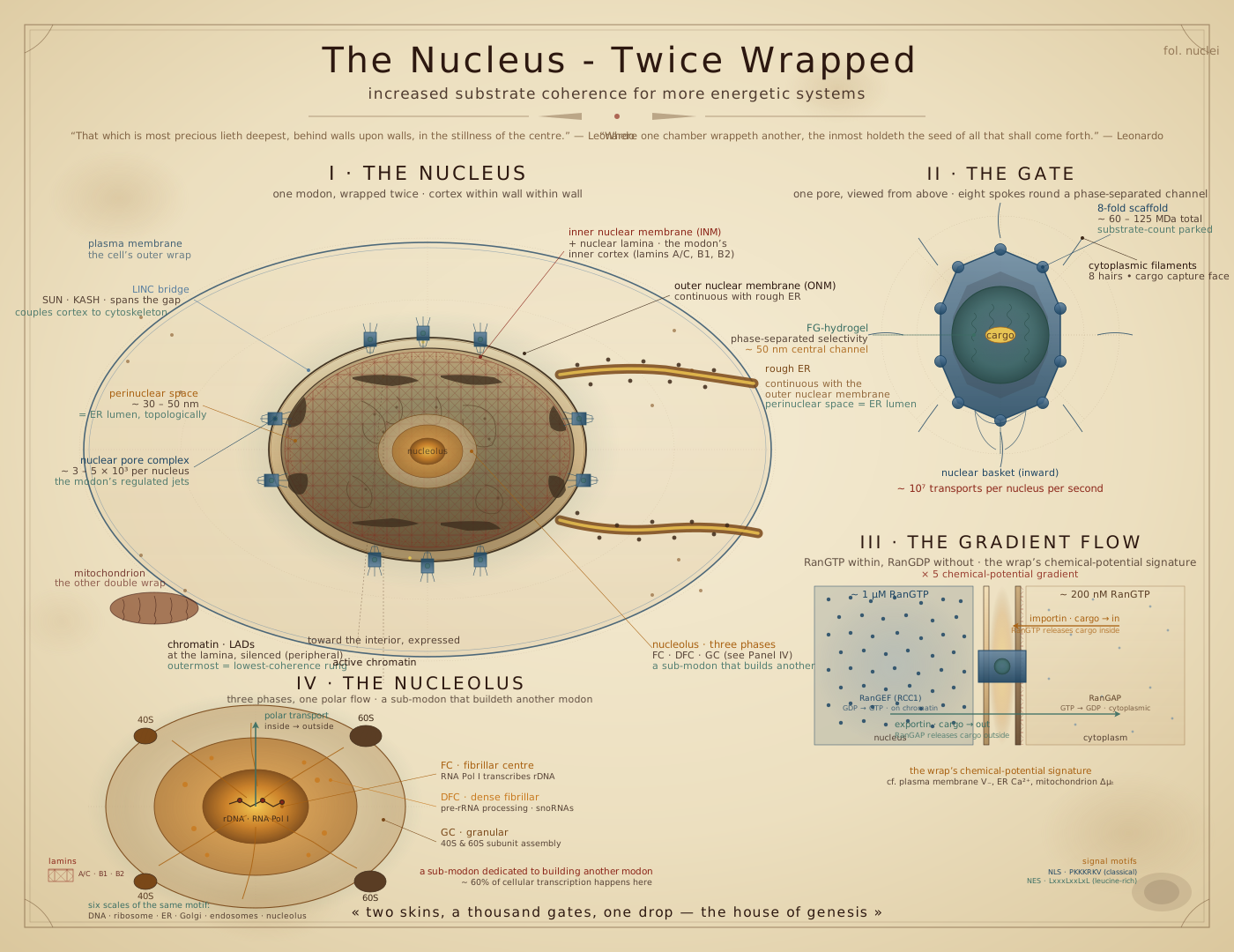
The nucleus is the largest stationary internal modon in a eukaryotic cell, at \sim 5–10\;\mum diameter, wrapped by a double bilayer and pierced by \sim 3{,}000–5{,}000 nuclear pore complexes whose regulated transport defines what the nucleus exchanges with the cytoplasm. It contains the cell’s entire genome — \sim 2 m of DNA in a human cell, organized as \sim 23 chromosomes (in interphase, \sim 46 in dividing cells) folded across topologically associated domains, A and B compartments, lamina-associated domains, and active and silenced chromatin states. It hosts the cell’s largest membrane-less organelle, the nucleolus, where ribosomal RNA is transcribed and ribosomes are assembled. It maintains a chemical-potential gradient across its wrap — the RanGTP/RanGDP gradient — that powers all directional transport across its boundary. And it does all of this while occupying \sim 10% of the cell volume in most cell types.
The nucleus is the cell’s most substrate-coherent internal modon, wrapped twice because its cargo — the genome — is the cell’s most substrate-coherent wire, and reading or writing that cargo requires the substrate’s deepest coherence-boundary anywhere inside the cell. The double bilayer is biology’s chemistry-side implementation of an extra coherence-isolation rung. The nuclear pore complexes are the modon’s regulated jets. The nuclear lamina is the modon’s inner cortex, structurally analogous to the actin cortex at the plasma membrane and serving the same coherence-boundary-stabilising role. The RanGTP gradient is the wrap’s chemical-potential signature, structurally analogous to the membrane potential at the plasma membrane and the calcium gradient at the ER. The nucleolus is a substrate-coherent phase-separated sub-modon dedicated to ribosome assembly — the cell’s only sub-modon that builds another modon as its primary function.
Why the Wrap Is Double
A typical animal cell hosts \sim 30 membrane-bounded organelles. All of them — plasma membrane, ER, Golgi cisternae, endosomes, lysosomes, peroxisomes, secretory granules, transport vesicles — are wrapped by a single bilayer. Only two are wrapped by a double bilayer: the nucleus and the mitochondrion. The mitochondrion’s double membrane has a separate substrate reading anchored in the modon-to-ATP chapter — the inner membrane carries the proton-motive force across an electrochemical wall the outer membrane shields from the cytoplasm. The nuclear envelope’s double membrane needs its own substrate reading.
The framework reads the double wrap as biology’s chemistry-side implementation of an extra coherence-isolation rung for the modon whose cargo demands the cell’s highest substrate-coherence. DNA is the cell’s longest substrate-coherent wire (dna-living-lattice.qmd), with sub-helix to chromosome-scale polar transport, [4Fe-4S]-cluster terminals reading sequence-dependent spectra locally and Mediator condensates reading the lattice at regulatory ends (Polar Channel as Regulatory Engine). The cytoplasm is a substrate-decoherent environment by comparison — packed with translating ribosomes, signaling cascades, vesicle traffic, cytoskeletal reconfigurations, and the ER’s continuous network rearrangement. A single bilayer wrap, as the framework reads it at the plasma membrane, gives one coherence-boundary inversion. A double bilayer wrap gives two. The genome sits behind two such inversions, and the substrate-coherence inside the wrap is consequently stiffer than anywhere else in the cell. Read against the substrate ladder, the double wrap adds a nesting count — one boundary, then two — which is the lock pole’s preferred-integer geometry, the same quantity-class as the Golgi cisternal stack and the microtubule’s N=13, and explicitly not a step on the \sqrt2 length ladder. The ladder’s \sqrt2 quantities at this organelle are instead the gaps it sets — the \sim 30–50 nm perinuclear space, the \sim 10–20 nm lamina — lengths that can fall on the half-octave comb where a count cannot.
Three structural facts support this reading.
The perinuclear space is topologically continuous with the ER lumen. The space between the inner nuclear membrane (INM) and the outer nuclear membrane (ONM) is \sim 30–50 nm wide and connects directly to the lumen of the rough ER. The framework’s reading is that the nucleus is embedded in the endomembrane system rather than separate from it — the inner wrap is the modon-coherent boundary, the outer wrap is shared with the rest of the endomembrane system, and the genome therefore sits inside two nested coherence boundaries with the inner one specifically substrate-pinned to the nuclear modon.
The INM has its own protein composition. While the ONM looks like rough ER (ribosomes attached, ER-resident proteins present), the INM has a distinct set of integral membrane proteins (LBR, emerin, LAP1, LAP2, MAN1, SUN-domain proteins) that anchor the lamina and tether specific chromatin regions. The framework reads this protein-specificity as the inner wrap being a genuinely separate coherence boundary — biology has placed distinct chemistry-side machinery on the INM precisely because it is a different modon-wrap than the ONM, even though the two are physically a few tens of nanometers apart.
LINC complexes bridge the two membranes. SUN-domain proteins on the INM span the perinuclear space and bind KASH-domain proteins on the ONM, forming the LINC (Linker of Nucleoskeleton and Cytoskeleton) complex. The LINC complex couples the nuclear lamina (on the INM’s nuclear face) to the cytoskeleton (on the ONM’s cytoplasmic face) so the nucleus’s position and orientation track the cell’s mechanical state. The framework reads LINC complexes as boundary-matching couplers in the cells-nested-modons.qmd sense — they hold the two adjacent modon boundaries (the nuclear wrap inside, the cell’s cytoskeletal cortex outside) coherent across the perinuclear gap, the same way contact-site tethers hold ER-PM and MAM coherence at smaller gaps.
The whole architecture is the cell’s chemistry-side implementation of a single substrate principle: when the cargo is the most coherence-demanding object in the cell, the wrap is built as a nested double-coherence boundary with explicit mechanical coupling between the inner and outer levels. Every other internal modon — mitochondrion aside, on its own energetic grounds — runs with one wrap because one is what its cargo needs. The nucleus runs with two.
Nuclear Pore Complexes as Regulated Jets
Nuclear pore complexes are the largest protein assemblies in the cell — \sim 60–125 MDa each, \sim 120 nm outer diameter, \sim 50 nm central channel, \sim 80 nm transverse height through the double membrane. A typical mammalian cell hosts \sim 3{,}000–5{,}000 NPCs in its envelope, with each pore handling \sim 1{,}000 transport events per second under normal conditions — ten million transport events per nucleus per second across the cell’s most regulated boundary. The architecture is 8-fold rotationally symmetric (cytoplasmic ring + spoke complex + nuclear ring), with eight spokes of nucleoporins (Nups) flanking the central transport channel.
The framework reads each NPC as a regulated polar jet of the nuclear modon in the feedback-topology canonical loop sense. The canonical loop’s jets are the modon’s transport corridors to and from its surroundings, regulated to maintain the modon’s coherence against bulk exchange with the environment. The plasma membrane has ion channels as its regulated jets at the molecular scale; the ER has contact sites as its regulated jets at the sub-organelle scale; the nucleus has NPCs as its regulated jets at the molecular-machine scale, large enough that single-particle cargo crosses the boundary one at a time and selectively.
The selectivity mechanism is one of cell biology’s cleanest known cases of phase-separated functional condensates. The NPC’s central channel is filled with phenylalanine-glycine (FG) repeat domains from \sim 11 FG-Nups, forming a hydrogel-like permeability barrier that selectively passes cargo bound to importin/exportin chaperones. Cargo without a chaperone (or above a \sim 40 kDa diffusion cutoff) cannot traverse the FG-meshwork; cargo with the right chaperone can. The chaperones interact directly with FG-repeat hydrophobic patches and pull the cargo through.
The framework reads the FG-channel as a phase-separated selectivity boundary, structurally identical to the Mediator condensates the Polar Channel chapter developed for the genome’s regulatory ends. Both are phase-separated functional condensates running at the substrate-coherence interface between two coherence regimes. Both implement selective transport by chemistry-side recognition (FG-interaction motifs in importin/exportin; transcription-factor recognition in Mediator) of substrate-stamp-matched cargo. The framework’s prediction is that the FG-channel’s selectivity should track substrate-stamp coupling at the chaperone-FG interface in the same way the SNARE-fusion and TGN-sorting predictions track matched-stamp coupling — engineered chaperones with equal FG-affinity but different substrate properties should show different cargo-throughput rates.
That selectivity is the lock half of the picture; the substrate ladder supplies the other half. A single importin binding its cargo is a lock — one stamp matched to one cage — but the family of nuclear-transport signals must do the opposite job. The cell runs \sim 20 karyopherins reading distinct NLS and NES classes, and those import-and-export addresses must stay mutually distinguishable, so that a cargo bound for the nucleus is never read as one bound for export or for the wrong pathway. That is the ladder’s anti-lock pole reached by the labelling route — the same move the genetic code, the vesicle SNARE/Rab addresses, and the olfactory receptor repertoire make: the machinery locks to commit a transport event, while the address code spreads so destinations cannot be confused. The framework’s prediction is that the signal-plus-karyopherin stamp set is anti-clustered — spread in stamp space rather than packed — and that mis-import, when it happens, falls on the least-distinguishable address pairs.
The directional asymmetry of NPC transport is set by the RanGTP gradient across the nuclear envelope. RanGTP is high inside the nucleus (\sim 1\;\muM) and RanGDP is high in the cytoplasm (\sim 200 nM RanGTP) — a \sim 5\times chemical-potential gradient maintained by RanGEF (nuclear, drives Ran→GTP) and RanGAP (cytoplasmic, drives Ran→GDP). Importin-cargo complexes assemble in the cytoplasm; pass through the NPC; bind RanGTP inside the nucleus, releasing the cargo; the importin-RanGTP complex returns to the cytoplasm and the RanGAP-GTPase event ejects the importin for reuse. Exportin runs the opposite direction with RanGTP-binding driving cargo capture in the nucleus and RanGAP-driven release in the cytoplasm.
The framework’s reading of the RanGTP gradient parallels the plasma membrane potential as substrate-flow gradient and the ER’s calcium capacitor. The plasma membrane carries an electrochemical gradient as its wrap-direction signature; the ER carries a chemical-potential gradient as its wrap-direction signature; the nuclear envelope carries the RanGTP/RanGDP gradient as the nuclear modon’s wrap-direction signature. Each modon’s wrap has a chemistry-side gradient that biology maintains by ATP- or GTP-driven chemistry; the framework reads each as biology’s chemistry-side implementation of the substrate-flow direction that the modon’s wrap requires by construction.
What the framework does not claim is a strong reading of the NPC’s 8-fold rotational symmetry. The substrate’s symmetry preferences developed so far in this work cluster at 3-fold (F_1 catalytic head, microtubule 3-start helix, ER three-way junctions, clathrin triskelion, photon-modon’s vortex triple) and 6-fold (hexagonal lattice expressions). 8-fold is not in this set. Either the substrate offers a less-emphasised 8-fold rung at the toroidal-channel scale that the framework has not yet derived, or the 8-fold count is set by chemistry-side packing of the Nup proteins around the channel without a substrate-physics preference — both readings are consistent with the rest of the framework, and the framework parks the question rather than forcing an unsupported answer. The ladder does sharpen what kind of quantity this is, even while leaving the value parked: an eight-spoke count is an azimuthal integer-closure of a bounded ring — the same quantity-class as the microtubule’s N=13 protofilaments, set because a closed wall has a circumference and rings at whole-number modes — and so it is a lock-pole closure count, not a \sqrt2 scale-ratio. The open question is therefore not “is 8 a comb tooth?” (it is the wrong kind of quantity for the comb) but whether the substrate offers a geometric closure count at the toroidal-channel scale the way the locked tangent gives N=13 for the tubule — a question for the modon-closure geometry, not the scale ladder. The architectural reading lifts regardless: the NPCs are the modon’s regulated jets, the channel-filling FG-condensate is the selectivity mechanism, the RanGTP gradient is the wrap’s chemical-potential signature, the eight-spoke count is a chemistry-side packing detail that future work may or may not relate to the substrate’s offered geometry at this scale.
The Nuclear Lamina as Inner Cortex
The nuclear lamina is a meshwork of intermediate filaments — lamins A, C (alternative splice forms of LMNA), B1 (LMNB1), and B2 (LMNB2) — lining the inner face of the inner nuclear membrane. The meshwork is \sim 10–20 nm thick, organized as overlapping head-to-tail filaments cross-linked by lateral associations, and covers most of the INM’s nuclear face. Specific chromatin regions (lamina-associated domains, LADs) interact directly with the lamina and are transcriptionally silent; non-LAD chromatin is gathered toward the nuclear interior and is more transcriptionally active.
The framework reads the lamina as the nucleus’s inner cortex, structurally analogous to the actin cortex at the plasma membrane. The plasma membrane has actin cortex (mainly cortical F-actin, \sim 100 nm thick) running just inside the bilayer, providing mechanical stiffness and shape control to the cell modon. The nuclear envelope has lamin meshwork (\sim 10–20 nm thick) running just inside the INM, providing mechanical stiffness and shape control to the nuclear modon. The two are the same architecture at different scales: a contractile-and-cross-linking intermediate-filament-or-actin meshwork sitting one rung inside the bilayer wrap and locking the modon’s coherence-boundary geometry against thermal noise and mechanical stress.
The cells-nested-modons.qmd already named this pair as the cell-scale modon’s wrap-plus-cortex configuration. The nucleus runs the same configuration at a smaller scale, with the lamins as biology’s chemistry-side implementation of the cortex layer for the smaller modon. The two cortices (cell-scale actin cortex + nucleus-scale lamin cortex) are explicitly coupled by the LINC complex, which means the cell’s mechanical state propagates directly to the nucleus’s coherence-boundary geometry. Cells migrating through tight constrictions, cells under high cortical tension, cells with disrupted actin organisation — all show direct, measurable nuclear-shape responses through LINC.
The framework’s prediction is that lamin disruption should produce coherence-quality effects on the genome that are distinct from the mechanical-defect effects mainstream cell biology has documented. Hutchinson-Gilford progeria syndrome and other laminopathies show nuclear-shape abnormalities, premature senescence, and gene-expression changes; conventional readings attribute the gene-expression changes to lost LAD-tethering and consequent chromatin reorganisation. The framework adds that the lamin meshwork is the substrate-coherence-boundary of the nuclear modon, and disrupting it should cause substrate-coherence loss across the genome — the Polar Channel’s regulatory reading should show degraded sequence-dependent spectra coupling at the chromatin level, not just lost contact-tethering. The prediction is that progeria-cell chromatin should show degraded TAD-boundary clarity and lost Mediator-condensate organisation at substrate-coherence-mediated strength, distinct from and additive to the mechanical-defect effects.
The lamina-associated-domain (LAD) reading sharpens this further. LADs are the chromatin regions whose substrate-coherence-boundary placement is outermost in the nucleus — they sit at the modon’s wrap, against the lamin cortex, and are transcriptionally silenced. Non-LAD chromatin sits toward the modon’s interior, where substrate coherence is highest, and is transcriptionally active. The framework reads this organisation as the genome stamping its accessibility on the substrate-coherence ladder: the genes biology wants to silence sit at the modon’s wrap (lowest coherence-quality position for transcription); the genes biology wants to express sit toward the interior (highest coherence-quality position). The chromatin-state-as-position-in-modon reading is a direct extension of the DNA polar channel framework one rung up from the helix to the chromosome organisation level.
The Nucleolus as Phase-Separated Sub-Modon
The nucleolus is the cell’s largest membrane-less organelle — \sim 1–3\;\mum across in most cells, with one to several per nucleus depending on cell type. It is a phase-separated functional condensate, not bounded by a bilayer but maintained by liquid-liquid phase separation of nucleolar proteins and RNAs. Its function is exclusive: \sim 60% of all cellular transcription happens here (rRNA), all four rRNA species (5.8S, 18S, 28S in eukaryotes; plus 5S, which is transcribed elsewhere) are processed here, and the small (40S) and large (60S) ribosomal subunits are assembled here before export to the cytoplasm.
The framework reads the nucleolus as a substrate-coherent phase-separated sub-modon dedicated to assembling the cell’s smallest stationary modon. The ribosome is the cell’s smallest stationary modon (cells-nested-modons.qmd, ribosome-fluid-flow.qmd) and the only one whose internal architecture is built from \sim 3{,}000 stacked aromatic bases. Building such an object requires the substrate-coherence the framework reads as biology’s lowest-frustration cellular environment — and the cell builds that environment as the nucleolus.
The nucleolus’s internal organisation makes the reading sharper. Cryo-EM and live-cell super-resolution work have resolved the nucleolus into three nested phase-separated compartments:
- FC (fibrillar centre). Innermost. Where RNA Polymerase I is concentrated and pre-rRNA is transcribed from rDNA repeats.
- DFC (dense fibrillar component). Middle. Where pre-rRNA is processed — early cleavage, snoRNA-guided modifications, removal of internal transcribed spacers.
- GC (granular component). Outermost. Where rRNA is packaged with ribosomal proteins and the small and large subunits assemble.
Cargo moves outward through the three phases: transcribed in FC, processed in DFC, assembled in GC, exported through NPCs to the cytoplasm. This is the same polar transport architecture the Golgi chapter developed for cis → medial → trans cisternae and the vesicle-traffic chapter developed for early → late → lysosome endosomes. Three nested phase-boundaries, three sequential stations, one polar gradient running from inside out.
The cellular walk has now found this same architecture four times — DNA’s polar channel, the ER’s three-way-junction network, the Golgi’s stacked cisternae, the endosomal pH gradient — and the nucleolus is the fifth. Each implements a substrate-reader (or substrate-writer) at its own scale: DNA at the ångström scale; ER at the micrometer scale; Golgi at the organelle scale; endosomes at the sub-organelle scale; the nucleolus at the condensate scale. The framework’s reading is that polar transport across a substrate-coherent corridor is the cell’s general-purpose information-processing motif at every scale where the substrate offers a coherent corridor — and the nucleolus is biology’s chemistry-side implementation of the architecture at the phase-separated-condensate rung.
The reading sharpens further when one observes that the nucleolus is the cell’s only sub-modon whose primary function is to build another modon. The mitochondrion’s primary function is to bank energy; the Golgi’s is to stamp cargo; the ER’s is to fold and synthesise; the nucleus’s is to read and replicate the genome; the nucleolus’s primary function is to build ribosomes. The cell’s most ancient stationary modon — the ribosome — requires the cell’s most coherent assembly environment, and biology has placed that environment inside the most coherent compartment available (the nucleus) inside the cell’s most coherent phase-separated condensate (the nucleolus). The architecture of “modon assembled inside a coherent sub-modon inside a coherent modon inside a coherent cell” reads as the substrate’s coherence-stack made fully visible.
Mitotic Envelope Breakdown and Open vs Closed Mitosis
Animal cells run open mitosis: the nuclear envelope completely disassembles during prometaphase, the chromosomes condense and align in a cytoplasm-exposed configuration, and the envelope reassembles around the two daughter sets at telophase. Yeast and many fungi run closed mitosis: the nuclear envelope remains intact throughout, and the chromosomes segregate inside a still-membrane-bounded nucleus. Plant cells run a partially-open arrangement intermediate between the two.
The framework reads open mitosis through the same coherence-cell-splitting argument the Golgi chapter developed for the Golgi ribbon. A single coherence-cell domain cannot host a single nuclear modon while preparing to divide into two coherence-cell domains. In animal cells, where the cell-scale coherence domain is large and the nucleus-scale coherence-boundary is tightly coupled to the lamina (and through LINC to the cytoplasmic cytoskeleton), the simplest substrate-mechanically-coherent path is to disassemble the envelope completely, run chromosome segregation in the cytoplasmic environment, and reassemble two envelopes after cytokinesis. In yeast, where the cell is much smaller and the coherence-domain geometry is correspondingly different, the substrate-mechanically-coherent path is to maintain the envelope and split the nuclear interior at the spindle-pole-body axis. The framework’s reading is that the two strategies are different chemistry-side implementations of the same coherence-domain-splitting requirement, and that the conventional cell-biology distinction (“open mitosis” vs “closed mitosis”) is biology’s name for what the substrate makes available at different cell sizes.
The framework’s prediction here, like the Golgi’s, is that nuclear envelope breakdown should track coherence-cell-splitting signatures and not solely protein-phosphorylation chemistry. Mitotic NEBD chemistry (CDK1-mediated phosphorylation of lamins, Nup98, Nup153, and other envelope proteins) is well-documented; the framework’s additional prediction is that envelope breakdown should show coherence-quality signatures (loss of substrate-coherence boundary indicators, propagation patterns consistent with a coherence-front rather than a chemical wavefront) that conventional models do not predict. Phosphorylation-resistant lamin mutations should produce partial NEBD failures, not complete prevention, because the underlying coherence-splitting requirement is independent of the phosphorylation chemistry.
Predictions and What Would Falsify
Four predictions extend the architectural reading beyond the structural anchors.
FG-channel selectivity tracks substrate-stamp coupling, not just chaperone-FG affinity. Engineered importin/exportin chaperones with equal FG-affinity but different substrate-coupling properties (perturbations to chaperone hydrophobic surface, FG-interaction geometry, or local charge distribution) should show different cargo-throughput rates through reconstituted NPCs. The reconstituted-NPC literature (Frey, Görlich) is the existing assay; the framework’s prediction parallels the SNARE and codon-stamp predictions for matched-stamp transport selectivity. Its anti-lock complement is equally testable: the NLS/NES-plus-karyopherin stamp repertoire should be spread (anti-clustered) in stamp space — the labelling route to the gap — with mis-import concentrating on the least-distinguishable address pairs, exactly as predicted for the vesicle and glycan routing codes.
Nucleolar phase boundaries fall on the substrate’s \sqrt2 comb. The FC/DFC/GC interface positions and the nucleolar size distribution across cell types should cluster at substrate-preferred values rather than vary continuously with rRNA-load, and — this is the sharpened form the ladder gives the older standing-wave framing — the successive lengths should be spaced by powers of \sqrt2 (fold mod \ln\sqrt2 \approx 0.347). Super-resolution imaging of nucleolar phases across cell types provides the data; the framework predicts the same \sqrt2 comb the raft-size, ER-tubule-diameter, and vesicle-radius distributions fall on. (The nucleolar phase count — three — is a lock-pole integer like the Golgi cisternal count, a separate prediction from the comb, not a point on it.)
Lamina disruption produces coherence-quality genome effects distinct from mechanical defects. Progeria-derived cells (LMNA mutations) should show degraded TAD-boundary clarity in Hi-C data and lost Mediator-condensate organisation in ChIA-PET data at strengths beyond what the mechanical-shape-defect model predicts. Existing Hi-C and ChIA-PET datasets on progeria cells provide the test; the framework’s prediction is a coherence-quality genome-organisation signature additive to the mechanical-shape contribution.
NEBD coherence-front geometry independent of CDK1-phosphorylation. Phosphorylation-resistant lamin/Nup mutants should show partial NEBD with coherence-front geometry consistent with the coherence-domain-splitting requirement, not full NEBD prevention. Live-cell imaging of phosphorylation-mutant NEBD progression is the test; the framework predicts a substrate-coherence-mediated residual disassembly that the chemistry-only model does not.
The picture is falsified if (a) FG-channel selectivity is fully predicted by chaperone-FG geometric/affinity matching, (b) nucleolar phase-boundary positions are continuously distributed without preferred-node clustering, (c) progeria genome-organisation effects are fully explained by lamin’s mechanical role, or (d) phosphorylation-resistant mutants fully prevent NEBD. It is supported, even partially, if any of the four ordering predictions hold against existing data.
A word on what is not predicted. The framework does not derive the NPC’s 8-fold symmetry from substrate physics — this could be a chemistry-side packing feature without a substrate-mechanical reason, and the framework declines to force a substrate-preference reading on the count without an offered geometric rung at the toroidal-channel scale. The framework’s architectural reading lifts regardless: NPCs are the modon’s regulated jets, the FG-channel is a phase-separated selectivity boundary, the RanGTP gradient is the wrap’s chemical-potential signature, the lamina is the modon’s inner cortex, the nucleolus is a substrate-coherent assembly sub-modon, and the double envelope is biology’s chemistry-side implementation of nested coherence-isolation for the cell’s most coherence-demanding cargo. None of these claims depend on the specific value of any symmetry count.
Putting the Section in Context
The nucleus is the cell’s most coherence-demanding internal modon, wrapped twice because its cargo is the cell’s most substrate-coherent wire. The inner bilayer is the coherence boundary the genome’s polar channel needs; the outer bilayer is shared with the rest of the endomembrane system; the perinuclear space between them is continuous with the ER lumen, holding the nucleus inside the endomembrane wrap rather than separate from it. NPCs are the modon’s regulated jets, with FG-channel phase-separated condensates as the selectivity boundary and the RanGTP gradient as the wrap’s chemical-potential signature. The lamina is the modon’s inner cortex, structurally analogous to the actin cortex at the plasma membrane, mechanically and coherence-quality coupled to the cytoskeleton through LINC complexes. The nucleolus is a phase-separated sub-modon dedicated to assembling the cell’s smallest stationary modon — three nested phases running polar transport across the cell’s most coherent compartment, building ribosomes inside the most coherent place the cell offers.
The cellular walk has now found the same polar-transport architecture at six scales: the ribosome’s three counter-flowing channels at the nanometer scale, the DNA polar channel at the ångström scale, the ER’s three-way-junction network at the micrometer scale, the Golgi’s stacked cisternae at the organelle scale, the endosomal pH gradient at the sub-organelle scale, and the nucleolus’s three-phase condensate at the condensate scale. Each runs the same motif — sequential stations along a substrate-coherent corridor — at its own scale; each has chemistry-side machinery biochemistry has worked out in detail; each adds one substrate-side reading. The cell’s information processing is one principle expressed six times, and the nucleolus is the principle’s expression at the most coherence-demanding internal compartment. That a single motif recurs, self-similar, across six scales is itself the substrate ladder’s central thesis — one pattern tiled up a geometric tower — though here across the ladder’s coarse family: the six scales nest by factors of \sim 6–12, mechanism-set, not the clean \sqrt2 of the resonant rungs (honest accounting).
The next chapter — mitochondrial anatomy beyond the rotor — completes the cell’s other double-wrapped organelle. The modon-to-ATP chapter developed the rotor itself; the anatomy chapter takes the rest of the mitochondrion — cristae geometry, outer-inner membrane separation, matrix dynamics, mitochondrial DNA, fission/fusion — as the energy organelle’s whole architecture. Where the nucleus is the cell’s coherence-demanding modon (the genome lives behind a double wrap because the substrate coherence at the inner boundary needs to be the cell’s highest), the mitochondrion is the cell’s energy-flux-demanding modon (the proton-motive force lives behind a double wrap because the substrate-current density at the inner boundary needs to be the cell’s highest). Two double-wrapped organelles, two different demands, the same architectural answer. Those two demands are the two faces of the ladder’s coin — the paired, lossless breath a structure on a rung can hold and hand off. Coherence-quality and current-density are how losslessly a modon holds that coin versus how much of it the modon passes per unit area: the nucleus is the cell’s vault, built to hold the genome’s breath at the lowest decoherence anywhere inside the cell; the mitochondrion is the cell’s mint, built to pass the breath at the highest flux. The cell’s two double-wrapped organelles sit at the two poles of one energy economy.