Channel with Memory
The metals/crystals/DNA overlap — one substrate phenomenon at three scales
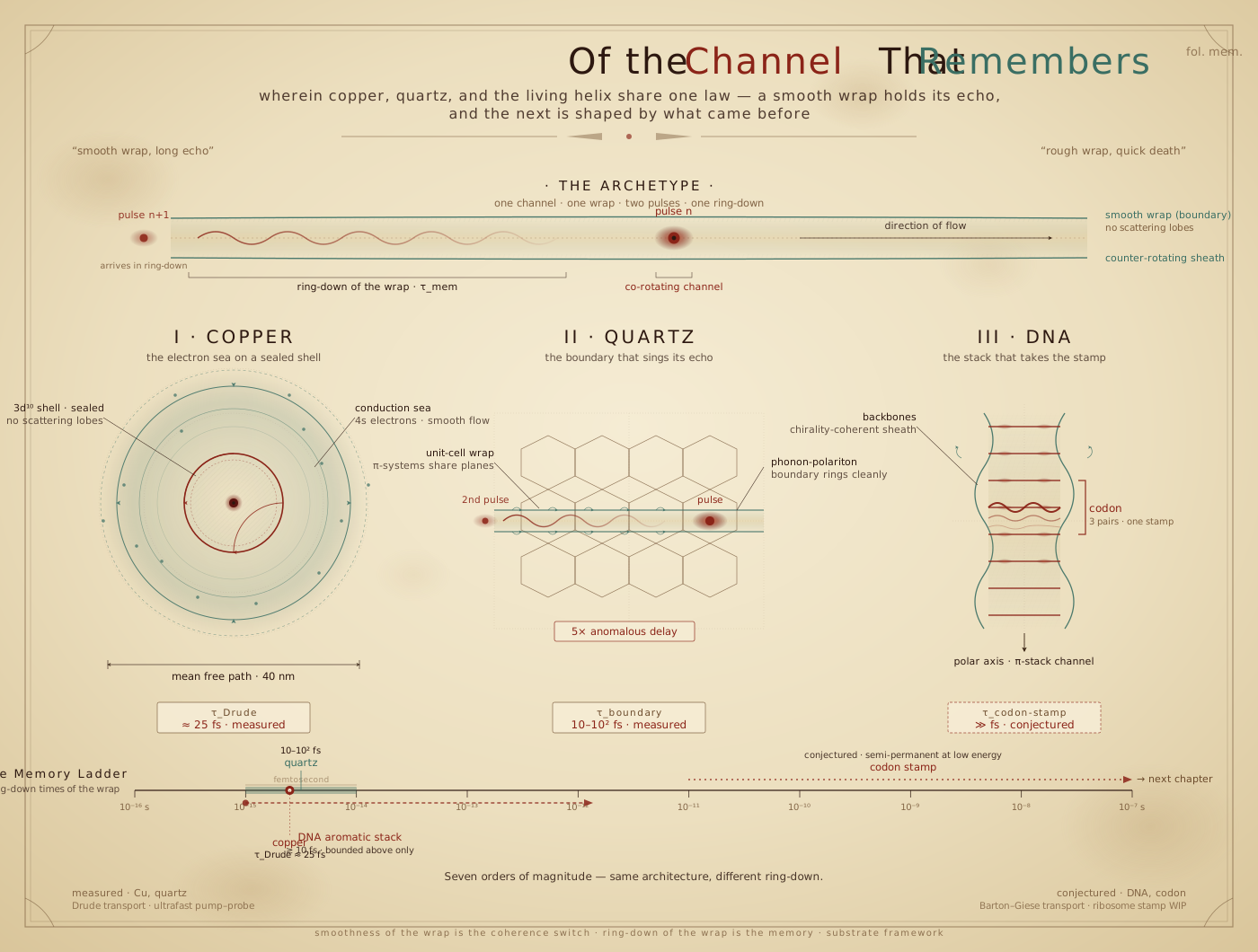
Three Materials, One Pattern
Three sections of this paper describe materials from very different angles: conductors (copper’s electron sea), crystal optics (quartz’s anomalous femtosecond delay), and DNA (the stacked aromatic column of B-DNA). Read together, the same five-part architecture is present in all three.
| Feature | Metals (Cu) | Crystals (quartz) | DNA |
|---|---|---|---|
| Boundary dissolution | Outer 4s shell merges into a shared sea | Adjacent π systems share boundary planes | Stacked bases merge into one column |
| Co-rotating channel | Conduction-electron raceway | π-band / phonon-polariton | Polar helical axis (stacked-base channel) |
| Counter-rotating wrap | Sealed inner 3d¹⁰ shell | Counter-rotating boundary on the optical mode | H-bond core + water/counterion sheath |
| Mesoscale memory | Drude \tau \approx 25 fs | Boundary ring-down → 5× anomalous pulse delay | Codon stamp on the aromatic stack (conjectured) |
| Chirality coupling | Spin polarization (altermagnets) | Birefringence from sheet structure | L-amino-acid / D-sugar selection |
These are not three coincidences. They are three scales of one substrate phenomenon: a coherent flow channel whose boundary holds state for a finite ring-down time, allowing one excitation to influence the next. The substrate’s most general organizing principle for transmitting coherent state through matter is channel-with-memory.
Boundary Smoothness as the Coherence Switch
In every case the substrate carries coherent state along the channel only as long as the channel’s wrap remains smooth. Copper conducts because its inner 3d¹⁰ shell is sealed — the boundary has no partially-filled lobes for the conduction channel to scatter off (Copper: From Nuclear Core to Conduction Sea). Quartz transmits a femtosecond pulse with a measurable phase delay because its phonon-polariton boundary rings cleanly; a second pulse arriving inside the ring-down window encounters a pre-conditioned boundary and accumulates extra delay — the 5× anomaly that standard dispersion theory cannot account for (Anomalous Delays). DNA conducts charge through hundreds of ångströms along its stacked aromatic core, and the conductance collapses exponentially the moment a single base-pair mismatch disrupts the wrapping sheath (Charge Transport Along the Polar Axis).
The substrate reads these as the same statement: smooth wrap → coherence propagates; rough wrap → coherence dies within a few coupling sites. Whatever the system is, the channel is only as good as its boundary.
In the substrate ladder’s terms this is the locking pole at work: a smooth wrap is what plugs the channel into the substrate’s lossless circulation, letting one excitation hand its state to the next, while a rough patch is a spot of anti-lock dropped where the structure needs to lock, and the coherence drains out there — the same reading DNA charge transport gives a single base-pair mismatch.
The Memory Ladder
The ring-down time of the boundary — how long the channel’s wrap stays preconditioned after an excitation passes — sets how strongly one excitation can influence the next, and runs across many orders of magnitude:
| System | Memory timescale | Length scale | Set by |
|---|---|---|---|
| Cu conduction | \tau_\text{Drude} \approx 25 fs at 300 K | \sim 40 nm mean free path | Phonon disruption of inner-shell sealing |
| Quartz boundary | \sim 10^{1}–10^{2} fs | one unit cell | Phonon-polariton relaxation |
| DNA aromatic stack | \gtrsim 10 fs (bounded by coherent hole transport) | \gtrsim 200 Å observed | π-stacking integrity, sheath continuity |
| Codon stamp (conjectured) | likely much longer — semi-permanent at low energy | \sim 10 Å per codon, \sim 80 Å along tRNA | Substrate lattice stiffness vs. thermal noise |
| Oceanic gabbro magnetite | \tau_\text{Néel} \ggg 10^{17} s — read back at 180 Myr | 0.05–15 μm grain | Grain volume vs. thermal energy (Néel), i.e. cooling rate |
The first two rows are measured. The third is bounded above by Barton–Giese coherent-hole-transfer experiments but the boundary’s own ring-down time has not been directly probed. The fourth is the codon-stamp conjecture worked out in The Codon Stamp, with the lifetime question itself held open as the framework’s load-bearing biological unknown. The fifth is measured too, and it is the reason the fourth is phrased the way it is: the magnetic domain the codon-stamp argument reaches for as its analogy is not a hypothetical but the ocean floor, where the geomagnetic field of 180 million years ago is still legible in magnetite that froze slowly enough to grow past the superparamagnetic threshold. Twenty-two orders of magnitude separate the first row from the last, and the last one’s ring-down time was set by the same knob that set its host rock’s grain size — one Deborah number running from texture through to memory. The framework’s reason for expecting it to be long is structural: the aromatic stack is stiffer than copper’s lattice and better-wrapped than quartz’s polariton boundary. A waveform amplified along a tRNA’s L-shape into the peptidyl-transferase center, then frozen into the next residue’s local field, sits in the lowest-energy configuration available against background lattice stiffness. Like a magnetic domain, it should require an active disturbance to relax.
This is the substrate’s ladder read in the time domain rather than in length or frequency. The four ring-down times here are mechanism-set — phonon disruption, polariton relaxation, \pi-stacking integrity, lattice stiffness — so this particular table is a catalog of rungs rather than a single \sqrt{2} comb. But it is the same discrete-rung phenomenon the substrate ladder systematizes across every domain: the rung positions are tuned by each material’s chemistry, while the framework’s open bet is that the spacing between them, gathered across enough systems, resolves onto the lattice’s comb. Read through the ladder’s small economy, a ring-down time is just how long a channel can hold the coin — the lossless anti-phase exchange the substrate trades in — before the wrap roughens and it leaks away; a longer memory is a channel that stays plugged into the substrate’s circulation for more coupling sites downstream.
DNA as the Tunnel, Codons as the Signals
The cellular reading of channel-with-memory is the entry point for the rest of the work that follows.
DNA’s double helix is a signal well: a smooth, doubly-wrapped, chirality-coherent vacuum tube carrying coherent π-stack state along its axis. Each base pair is a pair of complementary aromatic toroidal vortices held face-to-face — A:T by two hydrogen bonds, G:C by three — and the pair is reinforcing. Each base’s vortex stabilizes its partner against the opposing energy of the substrate’s chirality-coherent sheets, the way two opposed magnets lock each other in place rather than fighting each other. A codon — three stacked base pairs — is a 3D convolution of six aromatic toroids reading as a single stamp on the polar channel.
This is the architecture of nested modons. The base pair is a small modon — two counter-rotating vortices held together by mutual propulsion. A codon is three such modons chained along a shared boundary, behaving as one larger modon at the helical scale. The polar axis of B-DNA is a long line of codons behaving as a still larger modon at the gene scale. The cell as a whole — bounded by the substrate’s coherence length \xi \approx 100\;\mum — is the largest modon in the stack, wrapping all of the inner structure inside the substrate’s own organization. Modons chained into a big modon, wrapped into the substrate’s modon. Each nesting level shares boundary with the level above; the channel at each scale carries memory at the timescale appropriate to that scale.
The reason this scaffold matters for what comes next is that a finite mesoscale boundary memory makes a 64-symbol code physically distinguishable rather than just chemically distinguishable. Each of the 64 codons is a unique 3D convolution profile — a unique “mountain” of substrate displacement. If the aromatic stack holds that mountain coherently long enough to bias the next peptide bond’s local field, the genetic code carries information beyond identity. Synonymous codons are no longer identical; they are different stamps with the same amino acid label. That distinguishability is the substrate ladder’s anti-lock pole doing its work one level up from the channel: the tunnel itself locks — a clean coherent wire — while the message riding it must refuse to lock, staying as far from confusable as the codon alphabet allows, exactly the division DNA’s three substrate jobs sorts the whole molecule into. The lattice locks to make the tunnel; the codons anti-lock so they can be read off it. This is the conjecture The Codon Stamp builds out into a per-base metric, and channel-with-memory is the physics that has to hold for that conjecture to have any teeth.
Putting the Section in Context
The metals/crystals/DNA overlap is the cleanest cross-domain confirmation the framework has at material scales: the same boundary-and-channel architecture, the same dependence on wrap smoothness, the same mesoscale-memory pattern, at length scales spanning seven orders of magnitude. What the framework adds beyond “this is a pattern” is that the same substrate is responsible for all three, and that the ring-down time of any channel’s boundary is the right number to ask about whenever the question becomes whether one excitation can influence another at that scale.
Copper and quartz are the inanimate evidence. DNA is the architecture biology builds on top of it. The cellular machine — examined in the DNA chapter ahead — runs on this principle at every scale at once.