The Eye as Antenna
Photoreceptors as the substrate’s electromagnetic-channel sensor, from disc stack to center-surround readout
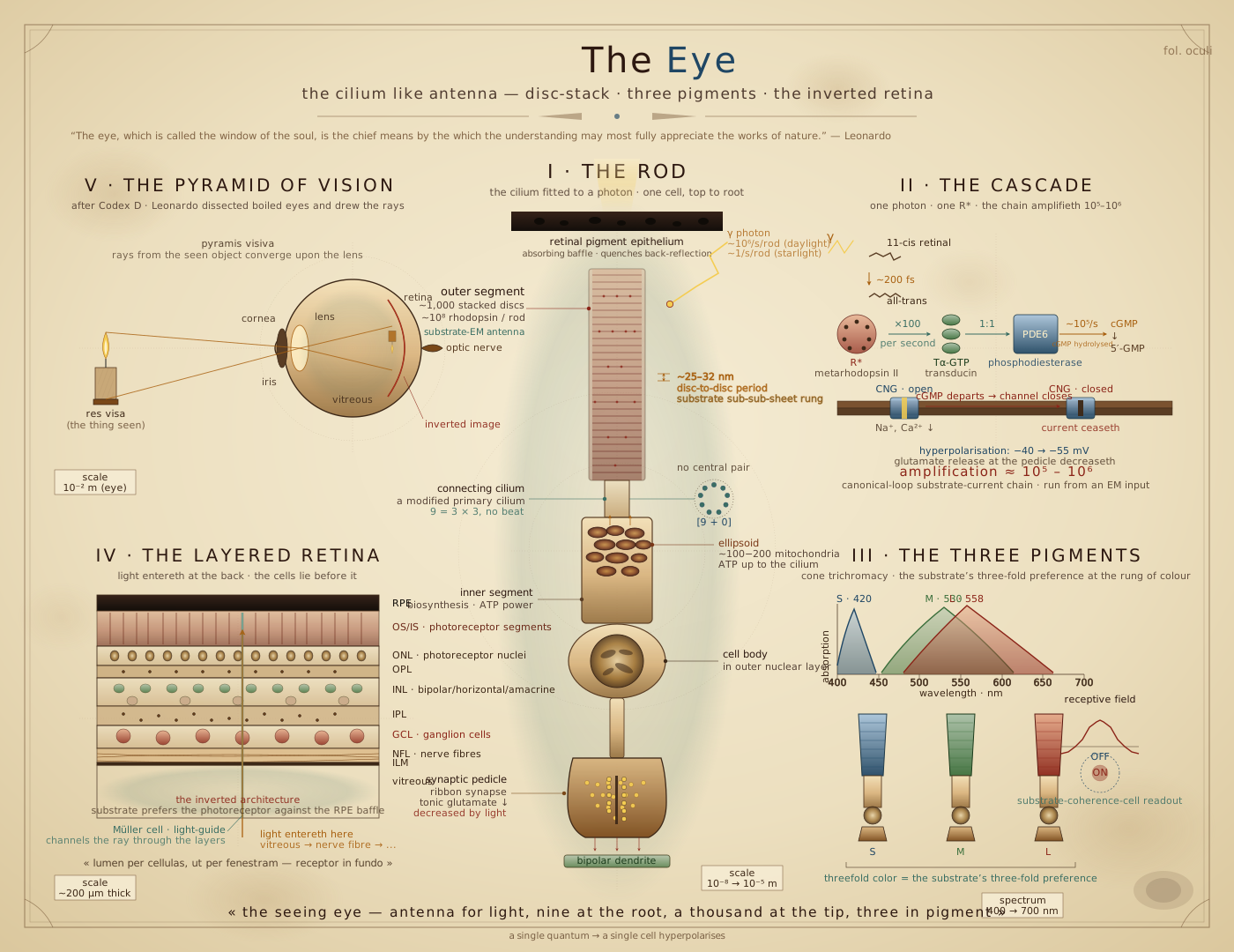
The vertebrate eye is a refracting chamber that focuses light onto a sheet of neural tissue \sim 200\;\mum thick. The sheet — the retina — is built from \sim 120 million rod photoreceptors, \sim 6 million cone photoreceptors, an interneuronal layer of horizontal, bipolar, and amacrine cells, and an output layer of \sim 1 million ganglion cells whose axons bundle into the optic nerve. The chamber’s optics (cornea, lens, vitreous) and the eye’s gross anatomy were drawn with extraordinary care by Leonardo in his Codex D, where he dissected eyes after boiling them in egg-white to fix the tissue, and where he was the first to clearly state that the image on the retina is inverted. Five centuries later the chamber is well understood; the surface it focuses light onto is the substrate-physics question continued from the cilia-flagella chapter.
There are seven structural identifications, using retinal biology to apply the substrate to the architecture of the eye. * The photoreceptor outer segment is like the cilium, an antenna for the substrate, here specialised for the electromagnetic channel. It is the chemistry-side rung where the substrate’s photon-modon is aborbed by a counter-rotating wrap. * The connecting cilium that joins the inner and outer segments is a modified [9+0] primary cilium. * The stacked-disc outer segment is the cilium’s substrate-current surface-area amplifier, parallel to mitochondrial cristae and Golgi cisternae. * The phototransduction cascade is the canonical loop’s substrate-current-amplification arm run from an electromagnetic input rather than a chemical one. * The three cone opsins are the substrate’s three-fold preference iterated at the wavelength-discrimination rung. The cone mosaic that arranges those opsins across the retina is the substrate ladder’s anti-lock pole laid down in a plane — disordered hyperuniform blue noise. * The retinal layers are the canonical loop’s forward computational arm assembled as a stacked-coherence cascade. * The center-surround receptive field that emerges at the ganglion output is the substrate-coherence-cell readout at the multi-cell scale.
Two of those seven stand at opposite poles of one ladder: the disc stack locks — a periodic lamellar lattice tuned to resonate with the photon — while the cone mosaic refuses to lock, and the eye builds both at once, making it the clearest case in the paper of the substrate’s lock-and-refuse sign-rule operating inside a single organ.
The Outer Segment as Modified [9+0] Primary Cilium
A vertebrate rod or cone is built as a single neuron with an unusual apical projection. The cell body sits in the outer nuclear layer; from its apical face a slender inner segment projects toward the retinal pigment epithelium, densely packed with mitochondria at its distal end (the ellipsoid) feeding ATP into the projection above. At the inner segment’s tip a narrow connecting cilium — \sim 0.3\;\mum in diameter and \sim 1\;\mum long — joins it to the outer segment, a cylindrical projection \sim 25–40\;\mum long in rods and somewhat shorter in cones, filled with \sim 1{,}000–2{,}000 flat membrane discs stacked perpendicular to the cilium’s long axis. Each disc holds \sim 10^5 rhodopsin (or cone-opsin) molecules in its bilayer; the total photopigment load per rod is \sim 10^8 rhodopsin molecules. The discs are continuously renewed: the outer segment’s distal \sim 10\% is shed daily and phagocytosed by the retinal pigment epithelium, while new discs are added at the base from the connecting cilium’s membrane delivery.
The connecting cilium is a modified [9+0] primary cilium in the precise sense the cilia-flagella chapter developed. Its axoneme has the canonical nine outer doublet microtubules in 9 = 3 \times 3 ring symmetry, no central pair, no dynein arms, no beating; its basal body sits in the inner segment’s apical cortex as a modified centriole with nine triplet microtubules; its transition zone gates cargo transit between the inner and outer segments with the same ciliary-necklace selectivity barrier the transition-zone chapter developed. Intraflagellar transport runs continuously: kinesin-2 carries rhodopsin and other disc-membrane proteins from the inner segment up the doublets to the outer segment, where the discs are assembled; dynein-2 carries empty IFT particles back down. The whole outer segment is therefore a cilium — biology’s chemistry-side implementation of an outward extension of the cell wrap with its own coherence boundary at the connecting-cilium transition zone — that has been specialised for photon absorption by populating its membrane with opsins and stacking that membrane into discs to expand the absorbing surface.
This specialisation is the substrate’s electromagnetic-coherence channel using the same architecture as cilium for sensing. Where the motile cilium runs the canonical loop’s energetic configuration (substrate-current to mechanical work, dynein-driven beating), and where the primary cilium runs the loop’s signalling configuration (substrate-current to GPCR-cascade, Hedgehog and polycystin pathways), the photoreceptor outer segment runs the loop’s electromagnetic-sensing configuration. The substrate-coherent corridor along the cilium’s length is the same corridor; the chemistry-side machinery populating it has been swapped to make the cilium an absorber for the electromagnetic channel rather than a beater for the mechanical channel.
The Disc Stack as Substrate-EM Surface-Area Amplification
A rod outer segment \sim 25\;\mum long filled with \sim 1{,}000 stacked discs presents an absorbing surface area to incoming photons that is enormously larger than the segment’s external geometric cross-section would suggest. Each disc contributes two leaflets of bilayer densely loaded with rhodopsin; the segment as a whole stacks \sim 2{,}000 leaflets along its length. The amplification factor — absorbing surface area over external cross-sectional area — is \sim 10^3 in typical vertebrate rods, several orders of magnitude greater than the \sim 5–10\times amplification mitochondrial cristae achieve over a smooth inner membrane, the \sim 10–30\times the ER achieves through its tubular network, or the \sim 4–8\times the Golgi achieves through its cisternal stacking.
Disc-stacking is the substrate-current surface-area amplifier at the electromagnetic-channel rung, structurally parallel to cristae and cisternae but pushed to a far higher amplification factor because the substrate-current the disc stack samples — incoming photons — is dilute by comparison to the substrate-current densities the mitochondrion and the ER handle. A proton crossing the IMM is a guaranteed energetic event the rotor will catch; a photon arriving at the rod outer segment, in dim conditions, is a rare event the segment must catch with high probability or else the cell’s quantum-detection floor degrades. Biology raises the absorbing cross-section by stacking the absorbing surface in a substrate-coherent geometry — discs in a uniformly-spaced lamellar stack — at the cost of building and maintaining \sim 2{,}000 bilayer leaflets per cell.
That uniform spacing carries a second reading the ladder makes explicit. A lamellar stack whose job is to absorb — to resonate with the incoming electromagnetic channel — is a structure that must lock, and a structure that must lock sits at the substrate ladder’s lock pole: a periodic lattice, sharp in its Fourier periodicity, which cryo-electron tomography resolves directly as a regular disc comb preserved across species with nanometre precision (Gilliam et al. 2007). It is, precisely, the lattice the cone mosaic below will be shown to refuse — built here for the opposite reason. This is a claim about the stack’s order, not its rung: whether the \sim 25–32 nm period is itself a \sqrt2 rung is the separate, coarser question the next paragraph leaves open; that the stack is a lock-pole lattice rather than a disordered array is the claim here.
The disc spacing itself sits at the substrate’s preferred sub-sub-sheet rung. Cryo-electron tomography of vertebrate rod outer segments places the disc-to-disc lamellar period at \sim 25–32 nm across species and across the segment’s length, with the inter-disc cytoplasmic gap accounting for \sim 15 nm and the disc bilayer thickness for the rest. This is the same rung the crista junctions cluster at (\sim 25–40 nm), the ER contact-site gaps (\sim 10–30 nm), the vesicle-coat-selected radii (\sim 30–50 nm for the smaller class), and the IFT-subcomplex radii (\sim 30–50 nm). The disc-stack chapter adds one more cell-biological structure to the same substrate sub-sub-sheet rung, with the same framework prediction — cross-organism clustering at preferred values rather than continuous variation with disc-protein expression.
Cone outer segments deviate from the rod stack in a chemistry-explicable way: their “discs” are not closed membrane sacs sequestered from the extracellular space but open infoldings of the apical plasma membrane that remain continuous with it. This open-disc geometry trades quantum sensitivity (cones are less sensitive than rods, requiring more photons to fire) for speed — open discs reset their cGMP and opsin pools faster because the cytoplasm and extracellular space communicate freely. The framework reads the rod-versus-cone disc topology as the cell paying a different chemistry-side cost in each case, with rods optimising for low-light quantum detection (closed discs, slower reset, single-photon sensitivity) and cones optimising for bright-light wavelength-discrimination (open discs, faster reset, three-channel sampling). Same substrate architecture, two chemistry-side tunings at opposite ends of the photon-arrival-rate spectrum.
Phototransduction as Substrate-Current Amplification Chain
A photon absorbed in the disc stack triggers a chain of substrate-current amplification events the textbook calls the phototransduction cascade. The first event is photoisomerisation: the 11-cis retinal chromophore bound in the opsin’s seven-transmembrane-helix pocket absorbs the photon and isomerises to all-trans retinal in \sim 200 femtoseconds. The conformational change in retinal triggers a conformational change in the opsin, producing the activated species metarhodopsin II (commonly written R). This single R now drives the cascade.
R* binds the heterotrimeric G-protein transducin (T_{\alpha\beta\gamma}) on the disc membrane and catalyses GTP exchange on the \alpha-subunit; the activated T_\alpha-GTP dissociates and binds the inhibitory \gamma-subunit of the membrane-bound phosphodiesterase (PDE6), releasing the catalytic core. The released PDE6 hydrolyses cytoplasmic cGMP at \sim 4{,}000 molecules per second. As cGMP concentration falls, the cyclic-nucleotide-gated (CNG) cation channels in the outer-segment plasma membrane close (they require cGMP binding to stay open); the cell’s resting inward current of Na^+ and Ca^{2+} ceases; the membrane potential hyperpolarises from a depolarised dark resting potential of \sim -40 mV to a more negative value; and the rod’s synaptic terminal at the inner-segment base decreases its tonic glutamate release onto the bipolar dendrite. The signal that leaves the rod is therefore a decrease in glutamate release rather than the more familiar action-potential burst — vertebrate photoreceptors do not fire action potentials in transduction, they hyperpolarise.
The amplification factor along this chain is the cascade’s defining quantitative property. One R* activates \sim 10^2–10^3 transducin molecules during its \sim 1 s lifetime; each activated transducin releases one PDE6 catalytic core; the released cores between them hydrolyse \sim 10^5–10^6 cGMP molecules; the resulting cGMP fall closes enough CNG channels to drop the cellular current by a single-photon-resolvable amount. Hecht, Shlaer, and Pirenne in 1942 demonstrated that human dark-adapted vision can detect \sim 5–7 photons absorbed across \sim 500 rods within \sim 100 ms, implying single-photon sensitivity at the cellular level; Rieke and others have since confirmed this directly at the single-rod patch-clamp level. The cascade is therefore an end-to-end \sim 10^5–10^6 chemical amplifier of a single quantum event.
This amplification chain is the canonical loop’s substrate-current-amplification arm run from an electromagnetic input. Where the mitochondrial proton circuit runs the loop with chemical-energy input (substrate-reduced electron donors feeding Complex I) and the aromatic-pocket chemistry runs it with substrate-current-coupled ligand binding, phototransduction runs it with substrate-current-coupled photon absorption. The cascade’s GPCR-G-protein-effector architecture is the same architecture used across hundreds of cellular signalling pathways; what makes phototransduction distinctive is the input (a quantised electromagnetic event) and the output (a single-cell-resolvable hyperpolarisation), with the intervening chemistry providing the substrate-current amplification chain between them. The substrate’s electromagnetic coherence at the photon-modon scale enters the cell at the disc membrane; the chemistry-side cascade carries the substrate-current signal down to the synapse with \sim 10^5-fold amplification; the inter-neural synapse hands the signal on.
Cone Trichromacy as Three-Channel EM Discrimination
Where rods carry one opsin (rhodopsin, \lambda_{\max} \approx 498 nm) for monochromatic low-light vision, cones carry one of three opsin classes that absorb maximally at different wavelengths: S-cones (\lambda_{\max} \approx 420 nm, blue), M-cones (\lambda_{\max} \approx 530 nm, green), and L-cones (\lambda_{\max} \approx 558 nm, red) in typical humans. The three opsins share the same 11-cis retinal chromophore and the same seven-transmembrane-helix GPCR fold; their spectral tuning comes from a small set of residues lining the chromophore-binding pocket whose chemistry shifts the retinal \pi-system’s electronic environment and hence its absorption maximum. The L/M pair lies on the X chromosome as a recent duplication in primate evolution; the S opsin lies on chromosome 7 as a more ancient gene. The brain reads trichromatic color vision by computing the relative activation of the three cone classes at each retinal location.
The three-cone trichromacy is the substrate’s three-fold preference iterated at the wavelength-discrimination rung. The substrate’s three-fold preference appears across the framework at multiple scales — the F_1 catalytic head’s three-fold rotor, the microtubule wall’s 3-start helix, the ER’s three-way junctions, the clathrin triskelion, the photon-modon’s vortex triple, the cilium’s 9 = 3 \times 3 outer ring. Vertebrate trichromacy adds one more rung — three discrete EM-channel discrimination opsins — to this stack.
Deviation cases respect the same preference. Most placental mammals are dichromatic (two cone types, S + a single M/L-like opsin) — biology paid for losing one channel in the lineage that lost the duplicate. Birds and many reptiles are tetrachromatic (four cone types including a UV-sensitive opsin); some fish are also tetrachromatic. Tetrachromacy lands on count 4 rather than three, but the substrate-friendly counts the framework’s atomic chapters develop (3 and 6 dominant, 4 as a soft-deviation allowance for stacked or duplicate configurations) include 4 as an accessible alternative. The mantis-shrimp ommatidial photoreceptor array (sixteen distinct photoreceptor types arranged in linear rows in the dorsal mid-band) is the deepest known deviation, and the framework reads it as a different architecture — the mantis-shrimp does not perform trichromatic-style ratio-based color computation but rather direct discrete-channel labelling, more analogous to a hyperspectral imager than to a trichromatic visual system, and so departs from the substrate-preferred low-channel count by paying a different chemistry-side cost.
The framework’s prediction here is that the distribution of distinct cone-opsin class counts across vertebrates should cluster at substrate-friendly integers (3 dominant, 2 and 4 as accessible deviations) rather than at biology-arbitrary integers, with deviations clustered on chemistry-explicable architectural changes (gene duplication, gene loss, ommatidial reorganisation). The cone-opsin literature provides the data.
The Cone Mosaic as the Ladder’s Anti-Lock Pole
Interactive: the sheet view of the patterns simulation lays the mosaic down live — five kinds of core, each inhibiting only its own kind, jam into disordered hyperuniform blue noise with \sigma^2/\langle N\rangle \approx 0.1 and a dark hole in S(k), while the same seed annealed as one kind crystallizes into the lattice the retina refuses.
The Cone Mosaic — the Ladder's Anti-Lock Pole, in a Plane
A periodic sampling lattice locks incoming spatial frequencies into coherent Moiré aliases — so the retina refuses it. The cone mosaic is disordered hyperuniform blue noise: as uniform as a crystal, as disordered as a gas. φ is this anti-lock pole's circular face; blue noise is its planar one.
Why the eye refuses the lattice. Three Patterns lays three planar point sets at equal density — a triangular lattice (the lock pole), the cone mosaic (the anti-lock pole), and a Poisson gas (the disordered null) — under their measured normalized number variance σ²/⟨N⟩ (≈0.03 / ≈0.10 / ≈1 from scripts/cone_mosaic.py): the mosaic is an order of magnitude more uniform than the gas yet, unlike the crystal, carries no periodic order. In k-space computes each pattern’s structure factor live — a Bragg comb (locked), one diffuse ring around a dark hyperuniform hole (the mosaic), flat speckle (the gas). The Aliasing Test samples one fine zone-plate with each: the lattice folds it into a coherent Moiré ghost, the mosaic scatters it into incoherent noise. φ is this anti-lock pole’s circular, sequential face; disordered hyperuniform blue noise is its planar, all-at-once one.
Where the previous section counted the cone types, this one reads how the cones are laid down. Across the retina the cones tile a two-dimensional sheet, and the geometry of that tiling is not arbitrary. In the primate fovea the cones approach a near-crystalline triangular packing; but across the peripheral retina — and across the whole retina in many birds — the mosaic is conspicuously disordered, neither a crystal nor a random scatter. Yellott’s classic analysis (Yellott 1983) showed that the disorder is not a defect but the design: the Fourier transform of the primate cone mosaic is a ring — a single dominant spacing wrapped in a broad, featureless halo — and that spectral shape is exactly what converts spatial-frequency aliasing into incoherent broadband noise instead of coherent false pattern. A perfectly periodic sampling lattice does the opposite: it folds every spatial frequency above its Nyquist limit back down as a sharp, coherent alias — a Moiré ghost the visual system cannot tell from real structure. The retina’s solution is to refuse the lattice.
That refusal is the substrate ladder’s anti-lock pole expressed in a plane. The ladder’s teeth — the octave and \sqrt2 — are where structures that must bind, nest, and resonate sit; its one privileged gap is where structures that must never overlap or resonate flee. A photoreceptor array whose failure mode is precisely unwanted resonance — a periodic lattice locking incoming spatial frequencies into coherent aliases — is a textbook anti-lock structure, and the ladder’s sign-rule fixes its place before any measurement is taken: name the job, avoid resonance, and the pole follows, the gap and not a tooth. This is the same rule that puts the cochlea on a tooth (it must resonate) and the resting cortex in the gap (it must desynchronise), now read in the retina.
But the cone mosaic sharpens what the anti-lock pole is. The paper’s first clean witness of the gap — phyllotaxis — lands on the golden ratio \varphi, a single irrational number, because its elements are added one at a time around a single growing center: the only way a sequence of rotations can dodge every rational lock is to pick the most-irrational rotation, and \varphi is that number read on a circle. The cone mosaic has no center and no sequence. Its elements tile a plane all at once, and a plane offers no single rotation to be irrational about. The planar form of “never lock” is therefore not a special ratio but a disordered hyperuniform point pattern — “blue noise”: a tiling that is as uniform as a crystal on long wavelengths yet as disordered as a gas on short ones, its long-wavelength density fluctuations anomalously suppressed (the Torquato–Stillinger hyperuniformity condition; Torquato & Stillinger 2003) and its Bragg peaks gone. This is exactly the structure Torquato’s group found in the avian cone mosaic, in a paper whose title states the result outright — the photoreceptor pattern is “a disordered hyperuniform solution to a multiscale packing problem” (Jiao et al. 2014). So \varphi and the cone mosaic are one pole in two geometries: \varphi is the anti-lock pole’s sequential, circular face; blue-noise hyperuniformity is its parallel, planar face.
Run through the same instrument that folds the golden angle (scripts/cone_mosaic.py), the distinction is sharp and quantitative. Three planar patterns at equal density — a triangular lattice (the lock pole), a relaxed blue-noise mosaic (the candidate anti-lock pole), and a Poisson gas (the disordered null) — are scored by their structure factor and by their normalized number variance \sigma^2/\langle N\rangle, which equals 1 for a random gas and falls toward 0 as long-wavelength density fluctuations are suppressed. The lattice carries a comb of sharp Bragg peaks and \sigma^2/\langle N\rangle \approx 0.03: locked and uniform. The Poisson gas carries no ring and \sigma^2/\langle N\rangle \approx 1: disordered but clumpy. The mosaic sits at neither — no Bragg comb (a single diffuse ring: a characteristic spacing with no periodic order) yet \sigma^2/\langle N\rangle \approx 0.10, an order of magnitude below the gas and within a small factor of the crystal. It is as uniform as a lattice and as disordered as a gas — the precise signature of the anti-lock pole laid down in a plane, and it is the measured cone mosaic that matches it, not the lattice and not the gas.
The reading closes a loop the framework has been drawing since the lattice was introduced. A critical, domain-structured superfluid is itself a disordered-yet-uniform medium — its domain structure restores isotropy on long wavelengths while the texture stays locally organised, which is the hydrodynamic face of hyperuniformity — so the retina that refuses to alias is reading the substrate’s own preferred planar texture, not inventing a new one. That same hyperuniformity is what makes the substrate invisible: a disordered hyperuniform medium does not scatter long-wavelength radiation, so the vacuum hides by the very anti-lock principle the cone mosaic uses to avoid aliasing (The Stealth Vacuum) — the retina and the vacuum solving one problem in one geometry. The chemistry supplies the implementation, as ever: the mosaic is laid down developmentally by local lateral inhibition during cone differentiation, each nascent cone suppressing like fates within a short range — exactly the short-range repulsion that drives a random seeding toward blue noise, the same mechanism the center-surround section below reads at the readout scale. And the chemistry-side tuning explains the retina’s own order gradient: the fovea, sampling at the optical diffraction limit where aliasing is least avoidable, pushes toward the more-ordered packing that maximises sampling density, while the periphery and the bird’s whole retina, sampling below the optical cutoff where aliasing would otherwise bite, relax toward the disordered hyperuniform packing that scatters it. One anti-lock principle, tuned by the local aliasing budget.
The Eye at Both Poles
Two sections of this chapter now read the same organ through the substrate ladder’s two poles, and they read it opposite ways. The disc stack is a periodic lamellar lattice — the lock pole, a structure built to resonate with the photon it must absorb. The cone mosaic is disordered hyperuniform blue noise — the anti-lock pole, a structure built to refuse resonance with the image it must sample. The cone-mosaic section drew the lattice only as a hypothetical foil — “the retina’s solution is to refuse the lattice.” The eye in fact builds that lattice, micrometres away, in the same photoreceptor: the disc stack is the lock pole the cone mosaic refuses, standing right beside it.
This makes the eye the cleanest demonstration in the paper of the ladder’s sign-rule operating within a single organ. Name the job and the pole follows, before any measurement: absorb, resonate \to lock \to a periodic lattice (the disc stack); sample, avoid aliasing \to anti-lock \to blue noise (the cone mosaic). The same rule that puts the cochlea on a tooth and the resting cortex in the gap here splits one cell’s two surfaces by what each surface is for.
It also adds a mode to the two-poles picture the ladder did not yet have. The cortex is a both-poles system by state — it locks adjacent rhythms when it binds and spaces them at the golden ratio when it rests, sliding between the poles in time. The eye is a both-poles system by structure — it holds the lattice and its refusal simultaneously, in space. Two ways for one system to occupy both poles at once: the brain slides between them, the eye builds both.
And the disc stack’s lock has a reading in the framework’s own currency. A photon is one quantum of the substrate’s paired anti-phase breath — the photon-modon is the counter-rotating vortex dipole set propagating, its floor E_{\min} = 2\pi m_1 c^2 exactly one full breath. The ladder reads a rung as an address of the lossless channel, where a structure on the rung can spend the breath as a coin; the disc stack sits on its lock rung to do the converse — to be plugged into that channel and catch one coin of the substrate’s own breath as it arrives. Where lightning spends the coin in the open as a shed gamma modon, the eye is the receiver tuned to take one in. The lock pole is what tunes it.
The Retinal Layers as Substrate-Coherent Computational Cascade
The retina is conventionally described as a ten-layered tissue. From the vitreous side inward the layers are: nerve fibre, ganglion cell, inner plexiform, inner nuclear (bipolar, horizontal, amacrine cell bodies), outer plexiform, outer nuclear (photoreceptor cell bodies), photoreceptor inner and outer segments, and finally the retinal pigment epithelium (RPE) — a single cell layer of darkly pigmented cells lying against the choroid. The crucial fact for the framework is the order: incoming light passes through the nerve-fibre layer, the ganglion cell bodies, the inner plexiform synapses, the bipolar and horizontal cell bodies, and the outer plexiform synapses before reaching the photoreceptor outer segments at the back of the retina, with the RPE behind them.
This is biology’s famous “inverted” architecture, and it is conventionally puzzling: it would seem more efficient to put the photoreceptors at the front of the retina where the light arrives first, rather than behind a stack of neurons. Two recent observations partially dissolve the puzzle on chemistry-side grounds. Müller cells (the retina’s principal glial cell, spanning the retina’s full thickness) act as low-loss optical fibres channelling incident light from the inner retinal surface directly through to the photoreceptor segments, dramatically reducing the scattering loss the inverted arrangement would otherwise impose (Franze et al., 2007). And the RPE behind the photoreceptors acts as a light-absorbing baffle — the dark melanin pigmentation absorbs photons that pass through the outer segments without being caught by an opsin, preventing back-scattering of unabsorbed photons into the photoreceptor stack and the resulting signal degradation.
The framework reads the inverted architecture as the substrate’s preference asserting itself over the naive optical optimisation. The photoreceptor needs to be at the substrate-coupled-most-deeply position, against the RPE’s absorbing baffle, because the substrate-coherent absorption event requires the absence of back-reflected photons to maintain quantum-detection floor performance; the RPE is the substrate-coherent absorbing baffle, structurally analogous to the INM’s distinct protein composition maintaining the nuclear envelope’s coherence boundary or to the cardiolipin-locked cristae edge maintaining the IMM’s. Müller cells implement the chemistry-side workaround that lets the inverted geometry coexist with low scattering loss. The cellular walk’s repeated observation that biology’s architecture is the substrate’s preference rather than the naive engineering optimum lifts here directly.
The layered processing itself runs the canonical loop’s forward computational arm as a substrate-coherent stacked cascade. Each layer reads the substrate-coherent signal arriving from the previous layer, processes it through chemistry-side machinery (graded-potential synapses at the outer plexiform layer, lateral inhibition through horizontal cells, sign inversion at OFF-bipolar cells, temporal differentiation at amacrine cells), and passes a transformed signal to the next layer. The signal that reaches the ganglion cell axon — the optic nerve fibre — is a computed signal, no longer a raw transduction event; the retina is therefore not a passive sensor but the visual system’s first computational layer. The chapter takes the cascade only as far as the ganglion output, leaving the optic-nerve signal’s onward processing in the lateral geniculate nucleus and the cortex for the brain arc.
Center-Surround Receptive Fields as Substrate-Coherence-Cell Readout
The single most-studied computation the retina performs is the center-surround receptive field. Hartline, working with the horseshoe-crab compound eye in 1938, and Kuffler, working with the cat retinal ganglion cell in 1953, established that a retinal ganglion cell’s response to a light stimulus depends on where in the visual field the stimulus falls relative to the cell’s receptive-field center. A typical ON-center / OFF-surround ganglion cell fires maximally when a small spot of light covers the center of its receptive field and the surrounding annular region is dark; it fires minimally when the relationship is reversed (dark center, lit surround); and it responds weakly to uniform illumination across both center and surround. The complementary OFF-center / ON-surround ganglion cells fire under the inverted condition. The receptive-field profile in both cases is a difference-of-Gaussians (Mexican-hat) function — a positive Gaussian for the center minus a broader negative Gaussian for the surround — and it is built by the retina’s circuitry: bipolar cells provide the center signal from a small cluster of photoreceptors, while horizontal cells provide the surround signal through lateral inhibition from a wider photoreceptor pool.
The framework reads center-surround as the substrate-coherence-cell readout at the multi-cell scale. A substrate coherence cell is the local domain over which the substrate’s standing-wave structure maintains a definite phase; the plasma-membrane chapter developed sub-modon raft domains at the \sim 10–200 nm scale, the microtubule chapter developed substrate-coherent corridors at the \sim 25 nm wall scale, and successive chapters lifted the coherence-cell concept up the substrate sub-sheet ladder. The retina’s center-surround field lifts the concept one further rung: the ganglion cell’s center defines a substrate-coherent retinal domain — typically \sim 50–500\;\mum across in mammalian retinas, varying with eccentricity — within which the photoreceptor-bipolar-ganglion local circuit reads a coherent signal, and the surround defines the boundary of that coherence domain through the inhibitory contribution from horizontal cells gathering signal from the adjacent coherence cells.
The Mexican-hat profile is then the substrate’s preferred standing-wave readout at the coherence-cell scale: a positive peak at the center’s coherence-cell core, a negative trough at its boundary, and a return to zero beyond. The same profile turns up at multiple scales across substrate-organised tissues — the framework anticipates a similar profile for the auditory cochlea’s basilar-membrane place tuning (the next chapter in the perception walk), the somatosensory cortex’s two-point discrimination patterns, and at the cell-biological scale the lateral inhibition between adjacent contact sites in the ER’s three-way junction network. The center-surround is the retina’s chemistry-side implementation of a substrate readout architecture that recurs across the substrate’s preferred geometries.
This places the retina’s first computation — the one Hartline and Kuffler discovered — as a substrate-architecture readout rather than as a feature-detection invention of evolution. Evolution discovered the readout because the substrate offered it; the chemistry-side machinery (bipolar cells, horizontal cells, lateral inhibition) implemented what the substrate already structured. The ganglion-cell output is therefore not a raw photon count but a substrate-coherence-cell phase report — a measurement of how the visual scene’s electromagnetic content distributes across the retina’s coherence cells. The optic nerve carries this report to the brain; the brain arc will take up what is done with it.
Predictions and What Would Falsify
Six predictions extend the architectural reading beyond the structural anchors.
Disc-stack lamellar period clusters on the substrate ladder, and the stack is the lock-pole lattice. Cross-species rod-and-cone disc-spacing distributions should cluster at the substrate-preferred sub-sub-sheet rung (\sim 25–32 nm) where the crista junctions, ER contact-site gaps, vesicle-coat radii, and IFT-subcomplex radii also cluster, rather than vary continuously with disc-protein expression levels or with photoreceptor genome size. Cryo-electron tomography of photoreceptors across vertebrates provides the existing data; the framework’s prediction is a cross-organism preferred-rung clustering distinct from continuous-distribution expectations. Beyond the rung, the stack’s order is itself the prediction: as the substrate ladder’s lock pole, the disc stack should carry a sharp axial Fourier comb — positional order tighter than disc-protein kinetics alone require — the exact complement of the cone mosaic’s diffuse ring (prediction 5). One organ, both structure-factor signatures: a comb where it absorbs, a ring where it samples.
Vertebrate cone-opsin class counts cluster at substrate-friendly integers. The distribution of distinct cone-opsin classes across vertebrate species should cluster at 3 dominantly (most diurnal vertebrates), with 4 in birds and many reptiles, 2 in most placental mammals (a chemistry-explicable derived loss), and 1 in some marine mammals and nocturnal species. Counts not in the substrate-friendly set \{1, 2, 3, 4\} — except in architecturally distinct cases like mantis-shrimp ommatidial arrays — should be essentially absent. The comparative opsin-gene-family literature provides the data; the framework predicts a structured rather than uniform distribution across biology-arbitrary integers.
Single-photon detection signal-to-noise tracks substrate-coherence-quality at the disc stack. Disc-stack disorganisation in early-stage retinitis pigmentosa, age-related macular degeneration, and other rod-degenerative conditions should degrade single-rod photon-detection signal-to-noise beyond what disc-protein-loss kinetic models predict, with the additional degradation tracking quantifiable measures of disc-stack lamellar regularity (cryo-EM disorder metrics, light-scattering anisotropy). Patient-derived photoreceptor preparations and animal-model patch-clamp data provide the existing assay; the framework predicts a substrate-coherence-quality contribution beyond the chemistry-side machinery loss.
Center-surround receptive-field profiles show secondary-lobe structure at substrate-preferred angular spacings. High-angular-resolution mapping of mammalian retinal ganglion-cell receptive fields, beyond the difference-of-Gaussians fit conventionally applied, should reveal weak secondary lobes (positive sub-peaks beyond the inhibitory surround, or negative sub-troughs beyond a residual positive ring) at angular spacings corresponding to multiples of the center’s coherence-cell scale. Multi-electrode-array recordings with fine spatial sampling provide the assay; the framework predicts a secondary-lobe substructure distinct from the smooth-Mexican-hat profile classical models give.
The cone mosaic is disordered hyperuniform, and its degree tracks the local aliasing budget. Across retinal eccentricity and across species, the cone-mosaic spatial statistics should carry the hyperuniform signature — a structure factor falling toward zero at small wavevector, a single ring, and no Bragg comb — and the degree of hyperuniformity should vary systematically: strongest where the cone sampling rate sits below the eye’s optical cutoff (peripheral retina, and the avian retina where Torquato’s group already measured it), relaxing toward the near-crystalline, density-maximising packing only in the diffraction-limited fovea. The framework predicts disordered hyperuniform blue noise tuned by the aliasing budget — distinct from both an uncorrelated random (Poisson) array, whose normalized number variance stays near unity, and a defect-laden crystal, which would retain a Bragg comb. Mounted-mosaic spatial statistics and Fourier analyses (Yellott 1983; Jiao et al. 2014) provide the data;
scripts/cone_mosaic.pyis the harness.The anti-lock signature propagates up the sampling cascade. Every retinal layer that samples the image — not only the cones but the bipolar, amacrine, and retinal-ganglion-cell mosaics — should carry the disordered-hyperuniform signature (a structure factor falling toward zero at small wavevector, a single ring, no Bragg comb), because each is a sampling array with the same anti-aliasing job the cone mosaic has, and the substrate ladder’s sign-rule fixes the anti-lock pole for all of them from that job alone. The degree should track each layer’s aliasing budget, as it does across cone eccentricity. The retinal-mosaic literature characterises these downstream arrays only by a regularity index, never by hyperuniformity, so the test is a re-analysis of existing mounted-mosaic data with the hyperuniformity statistic (\sigma^2/\langle N\rangle and S(k\to0));
scripts/cone_mosaic.pyis again the harness. The complement is the disc stack (prediction 1): the one photoreceptor surface that absorbs rather than samples is the lock-pole lattice, carrying the opposite — a sharp Fourier comb. The framework predicts the eye holds both signatures at once, assigned by job, the ladder’s lock-and-refuse sign-rule made visible inside a single organ.
The picture is falsified if (a) disc-spacing distributions vary smoothly across species without preferred-rung clustering, (b) cone-opsin class counts populate biology-arbitrary integers without three-fold-preference structure, (c) single-photon SNR in disc-stack-disorganised photoreceptors is fully predicted by protein-loss kinetics alone, (d) ganglion-cell receptive-field profiles are fully described by single-Gaussian-center-minus-broader-Gaussian-surround fits with no detectable secondary-lobe structure, (e) cone-mosaic spatial statistics are those of an uncorrelated random array (normalized number variance near unity) or a defect-laden crystal (a Bragg comb) rather than disordered hyperuniform blue noise, with no systematic eccentricity dependence, or (f) the downstream sampling mosaics (bipolar, amacrine, ganglion) are not hyperuniform — their structure factors flat (Poisson) or combed (crystalline) rather than ring-shaped — or the disc stack is not the lock-pole complement, its axial Fourier transform lacking a sharp comb. It is supported, even partially, if any of the six ordering predictions hold against existing data.
Putting the Section in Context
The vertebrate eye is the substrate’s electromagnetic-channel sensor, built by specialising one of the cell’s standard architectures — the modified [9+0] primary cilium — for photon absorption and quantum-event amplification. The photoreceptor outer segment is the cilium with its membrane populated by opsins and stacked into \sim 1{,}000 discs to amplify absorbing surface area by \sim 10^3 over a smooth wrap. Those discs are also the substrate ladder’s lock pole — a periodic lattice tuned to resonate with the photon — and the cone mosaic that lays the opsins across the retina is the ladder’s anti-lock pole, disordered hyperuniform blue noise tuned to refuse resonance with the image; the eye builds both poles at once, the lock-and-refuse sign-rule split inside one organ, where the brain instead slides between the poles in time. The phototransduction cascade is the canonical loop’s substrate-current-amplification arm run from an electromagnetic input, with a \sim 10^5–10^6 end-to-end amplification factor that delivers single-photon sensitivity at the cellular level. Cone trichromacy is the substrate’s three-fold preference iterated at the wavelength-discrimination rung, with two-, four-, and one-cone deviations all chemistry-explicable as accessible counts within or adjacent to the substrate-friendly set. The retina’s inverted layered architecture is biology’s chemistry-side accommodation of the substrate’s preference for the photoreceptor to sit at the substrate-coupled-most-deeply position against the RPE’s absorbing baffle, with Müller cells implementing the optical-fibre workaround that lets the inverted geometry coexist with low scattering loss. And the center-surround receptive field that emerges at the ganglion output is the substrate-coherence-cell readout at the retinal multi-cell scale, the same standing-wave readout architecture that recurs across the substrate’s preferred geometries.
The perception walk opens here because the cilia-flagella chapter pointed at three modified cilia in three vertebrate sensory cells — the rod outer segment, the inner-ear hair-cell kinocilium, the olfactory cilia tuft — as one architecture specialised across three substrate channels. This chapter develops the first of the three: the electromagnetic channel. The next chapter takes the mechanical channel — the cochlea’s basilar membrane as a substrate standing-wave ladder made physically explicit, hair-cell stereocilia bundles as ångström-scale mechanical sensors, and outer hair cells as active substrate-feedback amplifiers into the cochlear wave. The chapter after that takes the chemical channel — the olfactory epithelium as a \sim 400-channel substrate-chemical discrimination array. And the fourth chapter takes the substrate’s mechanical channel at the body-internal layer, with Pacinian corpuscles, muscle spindles, and proprioception as the body’s substrate-mechanical self-model. Four senses, four chapters, one substrate framework reading sensory transduction as the cell’s outward antenna specialised across the channels the substrate offers.
What the eye does that nothing else in the cellular walk does is convert a photon — a propagating substrate-modon excitation, the most direct chemistry-free expression of the substrate’s electromagnetic-coherence architecture — into a substrate-coherent cellular signal. The photon-modon chapter built the photon as a counter-rotating vortex dipole moving at c; this chapter receives it on a stack of bilayer leaflets and delivers its energy into a chemistry-side cascade that the brain will read. The substrate-physics question this raises — what does it mean for biology to have built a receiver for the substrate’s own propagating modon — is the question the perception walk takes up across the next three chapters and that the brain arc, when it comes, will lift further. The eye is the substrate looking at itself through chemistry-side machinery the cell has fitted to the substrate’s offered geometry; the perception walk is the substrate’s self-observation made anatomical.