Mitochondrial Anatomy
Double wrap, folded inner skin, and a small genome at the substrate-current maximum
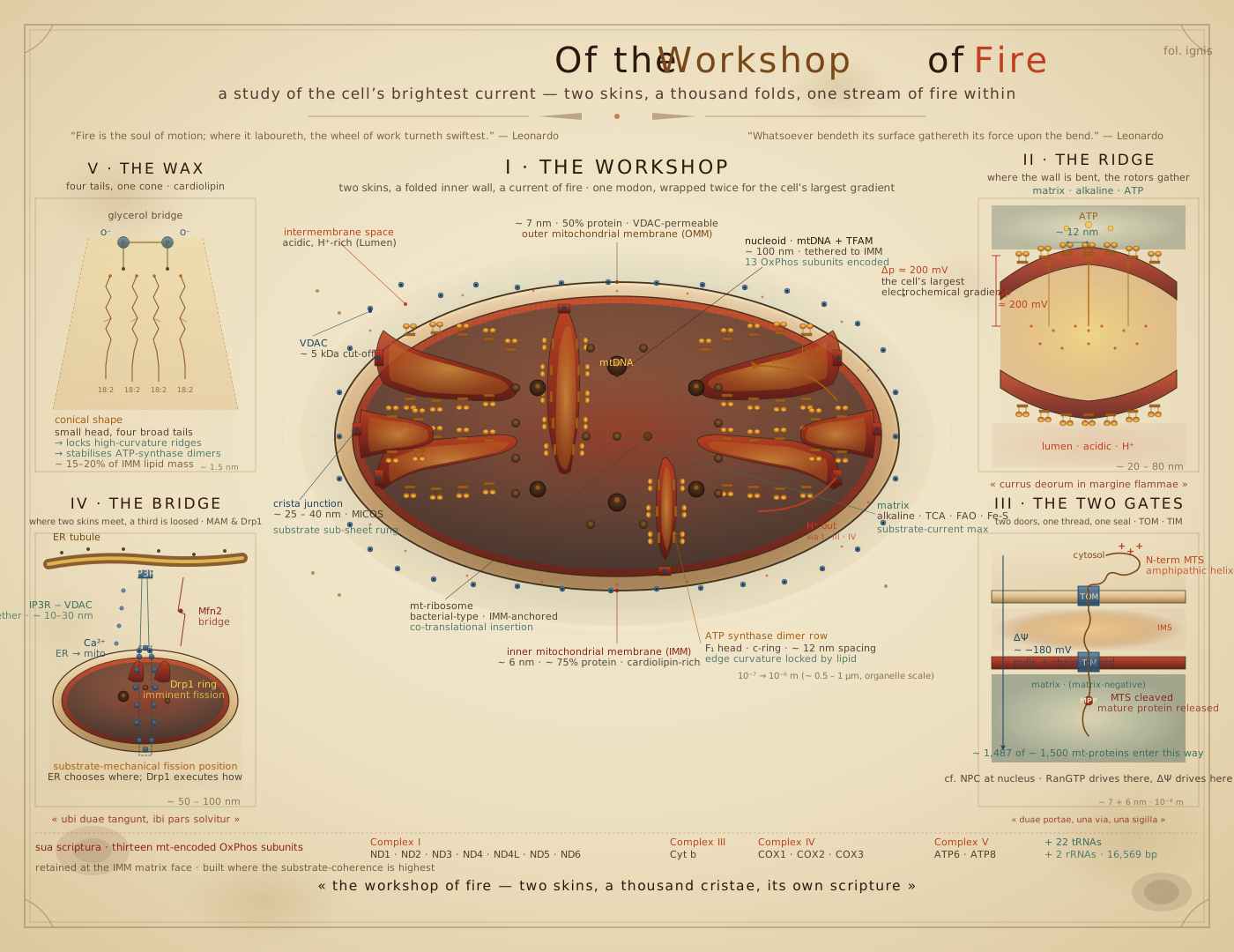
The mitochondrion is the cell’s other double-wrapped organelle, at \sim 0.5–1\;\mum in width and up to several micrometers in length, with a smooth outer mitochondrial membrane wrapping a deeply folded inner mitochondrial membrane that buries a matrix containing the cell’s only non-nuclear genome, the cell’s only non-cytosolic ribosomes, the entire TCA cycle, the fatty-acid β-oxidation machinery, and a substantial fraction of the cell’s iron-sulfur cluster biogenesis. It maintains a proton-motive force of \sim 200 mV across its inner membrane — the largest electrochemical gradient anywhere in the cell — and runs the F_0F_1 ATP synthase rotor against that gradient at \sim 100 Hz, generating the cell’s primary ATP supply. The modon-to-ATP chapter developed the rotor mechanism, the Q-cycle as a gated-bifurcation node, and the bacterial reaction center as the entry of substrate-current into this whole machine. This chapter takes the rest of the organelle — the double-wrap architecture, the cristae geometry, the proton circuit topology, the small genome that stays local to the inner membrane, the import machinery, the fission and fusion that redistributes the network, and the apoptotic boundary-inversion event that signals the modon’s death.
The mitochondrion is the cell’s most energy-flux-demanding internal modon, wrapped twice because its cargo — the proton-motive force across the inner membrane — is the cell’s largest substrate-current density anywhere, and running or maintaining that current requires the substrate’s deepest gradient-isolation anywhere inside the cell. Where the nucleus is double-wrapped because the genome demands the cell’s highest coherence-quality, the mitochondrion is double-wrapped because the proton circuit demands the cell’s highest current-density. Two organelles, two demands, the same architectural answer.
It is one modon wrapped twice with a folded inner surface for area amplification, regulated import jets at the boundary, a genome held at the substrate-current-density maximum, a fission/fusion network that redistributes substrate-current capacity, and a coherence-boundary inversion event that biology recognises as cell death.
The Double Wrap: Energy-Flux Demands a Two-Boundary Insulator
The mitochondrion’s two membranes are biochemically distinct in ways that are hard to overstate.
The outer mitochondrial membrane (OMM) is \sim 7 nm thick, \sim 50:50 protein-to-lipid by mass, and dominated by VDAC (voltage-dependent anion channel) porins that let molecules up to \sim 5 kDa pass freely. Functionally, the OMM is not a substantial permeability barrier to small metabolites; it is closer to a soft cytoplasmic skin that defines the organelle’s outer boundary, hosts the import machinery’s outer half (TOM complex, fission and fusion proteins, MAM-tethering chemistry), and lets the IMS chemistry equilibrate with the cytoplasm except at specifically gated sites.
The inner mitochondrial membrane (IMM) is \sim 6 nm thick, \sim 75:25 protein-to-lipid by mass — the most protein-rich membrane in the cell — and impermeable to essentially everything except across specific transporters. Functionally, the IMM is the real substrate-current boundary: it holds the proton-motive force, it carries the entire OxPhos chain, it runs the F_0F_1 rotor, and it tightly regulates every ion and metabolite passing across it. Its lipid composition is distinctive — cardiolipin, the only di-glycerophospholipid in animal membranes, with four acyl chains instead of two, sits at \sim 15–20% of IMM lipid mass and is essentially absent from every other membrane in the cell.
The framework reads the asymmetry between OMM and IMM as biology’s chemistry-side implementation of the substrate-current-density-isolation requirement at this scale. The OMM is the modon’s outer skin, comparable to the nuclear envelope’s outer membrane (continuous with the ER) — a sub-stantial but soft boundary that defines the organelle’s identity to the rest of the cell. The IMM is the modon’s true coherence-and-current-density boundary, holding the substrate-current gradient that the proton-motive force is the chemistry-side signature of. Two boundaries, two roles: the outer holds the organelle’s identity, the inner holds the substrate-current. As at the nucleus, the two wraps are a nesting count — the lock pole’s preferred-integer geometry, the same quantity-class as the Golgi cisternal stack and the microtubule’s N=13 — and explicitly not a step on the substrate ladder’s \sqrt2 length tower. The ladder’s \sqrt2 quantities here are the organelle’s lengths — the \sim 10–20 nm intermembrane space, the \sim 25–40 nm crista junction — not the membrane count.
Cardiolipin’s structural reading falls out of this same picture. The four-acyl-chain lipid has a conical molecular shape, with a small head group and four broad tails — exactly the geometry that supports high-curvature regions and locks the IMM’s tightly-folded cristae. Cardiolipin is also the lipid that physically stabilises the ATP synthase dimer ridges along cristae edges. The framework reads cardiolipin as the substrate-preferred curvature-locking lipid at the IMM rung, with chemistry-side properties (conical shape, four-tail packing, dimer-stabilising binding) that match the substrate’s preferred geometry at the cristae-edge scale. This is structurally parallel to cholesterol’s role at the plasma membrane (the substrate’s preferred stiffness modulator at the cell-wrap rung) and to reticulons at the ER (the substrate’s preferred curvature-locking proteins at the tubule rung). Same architecture, different chemistry-side implementation at each rung.
Cristae as Folded Substrate-Current Surface
The inner mitochondrial membrane is not smooth. It is folded into cristae — tubular, lamellar, or vesicular invaginations projecting into the matrix — that expand the IMM’s surface area by a factor of \sim 5–10\times over what a smooth wrap would offer. In high-energy-demand tissues (cardiac myocytes, brown adipocytes, skeletal muscle), the cristae are densely packed and dominate the matrix volume; in low-demand cells they are sparser.
Each crista connects back to the peripheral IMM (the “boundary IMM” lining the OMM) through a narrow crista junction — a \sim 25–40 nm-diameter pore stabilised by the MICOS complex (Mitochondrial contact site and cristae organising system). The crista junctions partition the IMS chemically: the crista lumen and the boundary-IMS are not fully equilibrated, and the local proton concentration inside a crista can exceed the IMS-proper concentration by a measurable amount, especially under high-flux conditions. The cristae are therefore not just surface-area amplifiers; they are substrate-current sub-compartments with their own local pH and electrical environment.
The framework reads cristae through three structural identifications.
Surface-area expansion as substrate-current capacity. The factor-of-\sim 5–10 surface expansion is biology’s chemistry-side implementation of the substrate-current-capacity demand. The proton circuit at the IMM runs at a finite current density per unit area; the cell’s total ATP demand sets the total proton flux; the IMM surface area required to support that flux at the substrate-preferred current density is therefore much larger than a smooth wrap of an \sim 1\;\mum organelle would provide. Cristae are the substrate’s offered geometry for expanding a wrap’s effective area without expanding the modon’s volume — the same architectural offer that gives the ER’s 10–30\times surface expansion over the plasma membrane (sheets and tubules) and the Golgi’s \sim 4–8-cisterna stacking (parallel sheets) at organelle scale. Three different chemistry-side implementations of the substrate’s folded-sheet offer; the mitochondrion’s chemistry is the most explicitly energetic.
ATP synthase dimer rows as edge stabilisers. Cryo-EM resolves ATP synthases at cristae edges as long rows of dimers running along the curvature ridge, spaced \sim 12 nm apart along the edge. The dimers preferentially localise to highest-curvature regions; they are not found on the flat top of cristae or on the peripheral IMM. Without the dimer rows, cristae lose their edge curvature and flatten; without cristae, the rotors lose their preferred binding sites. The two are mutually stabilising. The framework reads this as the substrate’s geometric self-consistency at the cristae rung: the cristae edge offers a substrate-preferred curvature, the dimer offers a substrate-preferred geometry that matches that curvature, and the chemistry-side machinery locks the match. The substrate offers the architecture; the chemistry takes the offer; the cristae form is mechanically and substrate-mechanically inseparable from the rotor placement.
Crista junctions as boundary-matching nodes. The \sim 25–40 nm junction diameter sits in the substrate’s sub-sub-sheet rung, the same rung the ER’s contact-site gaps, the Golgi’s inter-cisternal gaps, and (the framework’s prediction) the vesicle-coat-selected radii all sit at. Each crista junction is a substrate-coherent boundary-matching node between the crista lumen and the IMS-proper — the chemistry-side implementation (MICOS) is biology’s curvature-locking protein for the substrate’s preferred narrow-channel geometry at this scale. The framework predicts that the junction-diameter distribution across cell types should cluster at substrate-preferred values rather than vary continuously with MICOS expression level; cryo-electron tomography across tissues is the existing data series. In the ladder’s terms that clustering is a comb-test target — the successive lengths should be spaced by powers of \sqrt2 — and the cristae offer a candidate pair within one organelle: the \sim 12 nm ATP-synthase dimer spacing along the ridge and the \sim 25 nm crista junction stand close to one octave (\times 2 = \sqrt2^{\,2}) apart. Two numbers are thin; the firm claim is the clustering, with the \sqrt2 spacing the falsifiable part the cryo-ET distribution can decide.
The Proton Circuit as the Mitochondrion’s Canonical Loop
The proton-motive force across the IMM has two components: a chemical gradient (\DeltapH \sim 0.5–1 unit, alkaline matrix, acidic IMS) and an electrical gradient (\Delta\Psi \sim 150–180 mV, negative inside matrix). The two together give \Delta p \sim 200 mV — the largest electrochemical gradient anywhere in a healthy cell.
Conventional bioenergetics reads the gradient as the chemiosmotic coupling intermediate between substrate oxidation and ATP synthesis. The framework’s reading is that the proton circuit is the canonical feedback loop at the mitochondrial scale, expressed in its most explicitly energetic form anywhere in the cell.
The pattern lifts directly. Protons are extruded from the matrix to the IMS by Complexes I, III, and IV (the “disk” + “jet” arm of the loop) using substrate-oxidation energy as the driver. Protons return from the IMS to the matrix through F_0F_1 (the “counterflow” arm), with their return powering the rotor and the ATP synthesis it drives. The two arms are anti-parallel and tightly coupled — the flux balance is maintained on the millisecond timescale because the cell’s ATP demand is the consumer that closes the loop. The whole architecture is the canonical loop with protons as the substrate-current packets, the IMM as the boundary the loop rotates against, and the cristae geometry as the substrate-preferred shape that maximises the loop’s throughput per unit organelle volume. In the ladder’s energy economy this loop is the cell’s clearest case of spending the coin: the paired anti-phase breath is the lossless quantum the substrate mints, and the proton circuit is a structure pinned to a rung handing that coin back and forth at the highest flux in the cell — the same currency thermal dynamics spends as heat and lightning sheds as a gamma ray, here banked into ATP instead. The \Delta p \sim 200 mV is the current-density face of that coin — not how losslessly the breath is held but how much of it crosses the wrap per unit area.
The reading the vesicle-traffic chapter developed for the endomembrane loop in conventional fluid-flow form lifts directly to the mitochondrion’s proton circuit in conventional chemiosmotic form. Both are canonical loops at organelle scale; both have forward and return arms in mass-balance with each other; both are biology’s chemistry-side implementations of the same substrate architectural motif. The endomembrane loop runs membrane parcels; the mitochondrion runs proton packets. The substrate offers the architecture; the cell’s chemistry differs at each rung because the available chemistry differs.
The \sim 200 mV magnitude is then the framework’s signature for the substrate-current-density at this rung — the same way the plasma membrane’s \sim 70 mV and the nuclear envelope’s RanGTP gradient and the ER’s 5000\times calcium gradient and the endosomal pH gradient are each that wrap’s chemical-potential signature. Five wraps, five gradients, five substrate-current signatures at five rungs. The mitochondrial IMM carries the largest of them because the substrate-current density the proton circuit requires is the largest of them. The Nernst-equation chemistry gives the numerical value; the substrate’s offered gradient-rung places where the value sits.
Mitochondrial DNA at the Substrate-Coherence Maximum
The mitochondrion is the only organelle outside the nucleus that has its own genome — a small circular molecule of \sim 16{,}500 bp in humans, encoding 13 protein subunits (all OxPhos chain components: Complex I’s ND1-6 and ND4L, Complex III’s Cyt b, Complex IV’s COX1-3, and Complex V’s ATP6 and ATP8), 22 tRNAs, and 2 rRNAs. There are \sim 100–1{,}000 mtDNA copies per cell, organised into nucleoids of \sim 100 nm diameter (mtDNA wrapped with TFAM and a handful of replication-associated proteins). The nucleoids are tethered to the matrix face of the IMM, distributed along the inner-membrane surface.
The mitochondrial genome’s retention is a long-standing puzzle in cell biology. Of the \sim 1{,}500 proteins in the mitochondrial proteome, \sim 1{,}487 are nuclear-encoded and imported through TOM/TIM. Why does the cell retain 13? Three established hypotheses cluster on this:
- Hydrophobicity. The 13 mt-encoded proteins are the most hydrophobic in the OxPhos chain, and may be too hydrophobic to import through the aqueous TIM channel.
- CoRR (Co-location for Redox Regulation, Allen). The 13 are the OxPhos subunits whose synthesis must be redox-regulated locally at the IMM, in response to the local proton-circuit state, and nuclear encoding would lose this redox-coupling.
- Co-translational membrane insertion. The 13 are subunits that need co-translational insertion into the IMM, which requires local ribosomes that interact with the membrane directly.
The framework’s reading synthesises all three under one architectural principle. The 13 mt-encoded proteins are the substrate-current-density-most-critical components of the OxPhos chain, and biology has placed their genes at the substrate-current-density maximum (the IMM matrix face) so they can be assembled in the substrate-coherent environment their fold and function require. The substrate-coherence quality at the IMM matrix surface is the cell’s highest internal current-density rung; the OxPhos subunits are the cell’s most current-density-coupled proteins; the assembly machinery for those subunits (mitochondrial ribosomes, anchored at the IMM matrix face) sits at the same location; and the genes for those subunits sit in nucleoids tethered to the same surface, completing the architecture.
The pattern is identical to the nucleolus reading: biology places the assembly machinery at the substrate-coherence maximum for the cargo. The nucleolus is biology’s chemistry-side implementation of this principle at the ribosome rung (build the cell’s smallest stationary modon inside the cell’s most coherent compartment). The IMM-tethered mitochondrial nucleoids and ribosomes are biology’s chemistry-side implementation of the same principle at the OxPhos-subunit rung (build the cell’s highest-current-density proteins inside the cell’s highest-current-density compartment).
The endosymbiotic-origin reading — that the mitochondrion descends from an \alpha-proteobacterium engulfed \sim 1.5 billion years ago — gives the historical explanation for why the genome is there at all. The framework’s reading gives the functional explanation for why biology has not moved the remaining 13 genes to the nucleus over a billion years of evolution: those 13 require substrate-coherent assembly at the IMM, and any chemistry that moved them elsewhere would lose the substrate-coherence quality their fold and function depend on. The endosymbiotic origin set the initial condition; the substrate’s coherence-quality requirement holds the configuration in place against the otherwise universal evolutionary trend toward gene transfer to the nucleus.
The framework’s prediction here is that across organisms with mitochondrial genomes of varying size, the retained gene set should always include the OxPhos subunits with the highest substrate-current-density coupling — and species with smaller mtDNA than humans (down to the apicomplexan extreme of \sim 6 genes) should still retain the most current-density-critical subset, with conserved retention of the proteins biology cannot move without losing substrate-coherent assembly fidelity. The mt-genome literature across phyla provides the existing data; the framework predicts a specific gene-retention ranking distinct from the simple hydrophobicity ranking that the conventional models predict.
TOM/TIM as the Mitochondrion’s Regulated Import Jets
Most mitochondrial proteins (\sim 1{,}487 of 1{,}500) are nuclear-encoded, translated on cytosolic ribosomes, and imported across both membranes through coordinated TOM (translocase of outer membrane) and TIM (translocase of inner membrane) complexes. Cargo carrying an N-terminal mitochondrial targeting sequence (MTS) is recognised at the OMM by TOM20/TOM22, threaded through the TOM40 pore, handed off to TIM23 at the IMM, and pulled into the matrix by the import motor (PAM complex). The MTS is then cleaved by MPP, releasing the mature protein. Variants of this pathway handle membrane-protein import (TIM22 for carrier-family proteins), IMS-targeted proteins (Mia40-Erv1 disulfide relay), and OMM-targeted proteins (SAM complex).
The framework reads TOM/TIM as the mitochondrion’s regulated import jets, structurally analogous to the NPCs at the nucleus. Both are double-membrane spanning transport machines that pass cargo selectively across two coherence boundaries on the basis of a chemistry-readable signal sequence. Both maintain the wrap’s substrate-current isolation by selectively passing only cargo with the right signal. Both have phase-separation-like or hydrogel-like selectivity mechanisms in their channels (NPC’s FG-repeats; TOM/TIM’s hydrophobic-binding surfaces along the import path).
And as at the nucleus, import has a lock half and an anti-lock half. A single TOM receptor binding a presequence is a lock; but the space of targeting signals must stay distinguishable — an MTS must not read as an ER signal peptide, a peroxisomal targeting signal, or another organelle’s address — or the cell mis-delivers its proteome. That spread is the substrate ladder’s anti-lock pole reached by the labelling route, the same answer the genetic code and the vesicle SNARE/Rab addresses give: the machinery locks to commit an import, while the targeting code spreads so destinations cannot be confused. The framework predicts the MTS-plus-receptor stamp set is anti-clustered, with mis-import falling on the least-distinguishable signal pairs.
The architecture is the canonical loop’s regulated-jet motif expressed at two different organelle scales:
- NPCs at the nucleus. Cargo with NLS/NES signals; FG-repeat phase-separated channel; RanGTP gradient drives directionality; \sim 3{,}000–5{,}000 jets per modon.
- TOM/TIM at the mitochondrion. Cargo with MTS signals; hydrophobic-binding-surface selectivity; \Delta\Psi gradient drives directionality (the matrix-negative potential pulls positively-charged MTS sequences inward); \sim 100–1{,}000 jets per modon.
Both modons use their wrap-direction gradient (RanGTP, \Delta\Psi) as the directional motor for cargo translocation; both are biology’s chemistry-side implementations of the same substrate principle (regulated jets at a coherence boundary, with the wrap-gradient providing the substrate-current that drives transport). The framework’s reading is that any modon with a strong wrap-direction gradient will deploy regulated-jet transport machines on its boundary that use the gradient as the directional motor, and the cell’s two double-wrapped organelles are biology’s most explicit chemistry-side implementations of this principle. The matrix-negative \Delta\Psi that powers TIM23 import is the wrap-direction signature the framework reads at the IMM; the chemistry-side machinery merely couples to it.
Fission and Fusion as Modon-Network Redistribution
The mitochondrial network is dynamic. Individual mitochondria fuse into longer reticular structures and divide into smaller fragments on the seconds-to-minutes timescale, with the network’s overall morphology shifting between fused (long interconnected reticulum) and fragmented (many small punctate units) depending on cellular state. High energy demand and healthy redox state favour the fused state; stress, damage, and apoptotic signalling favour the fragmented state. The chemistry is well-characterised: Drp1 (dynamin-related protein 1) recruits to the OMM at constriction sites and drives fission; Mfn1/Mfn2 mediate OMM fusion; OPA1 mediates IMM fusion. The MAM contact sites with the ER mark the locations where fission preferentially occurs.
The framework reads fission/fusion as the mitochondrial modon-network redistributing its substrate-current capacity across the cell. The cell’s energy demand is spatially heterogeneous on the seconds-to-minutes timescale — local protein synthesis bursts, ion-channel activity at specific membrane patches, motor-protein clusters along microtubules all create local high-ATP-demand regions. A fully-fused mitochondrial reticulum can equilibrate ATP supply across the cell at the diffusion-and-substrate-current timescale; a fragmented network can concentrate substrate-current capacity at specific cellular positions. The cell’s chemistry-side machinery (Drp1, Mfn1/2, OPA1) implements the redistribution; the substrate’s requirement is that the network’s total substrate-current capacity must match the cell’s distributed demand.
This reading echoes the ER chapter’s topology-reorganisation argument — the ER reorganises its tubule/sheet ratio with cell state because the substrate landscape it is tracking changes. The mitochondrion does the same at its own scale: the network reorganises its fused/fragmented ratio because the substrate-current demand it must service changes. Two networks, two reorganisations, the same architectural principle expressed in two different chemistry-side configurations.
The MAM contact sites at fission positions are the architectural anchor for why fission happens there. The ER chapter developed MAM contacts as substrate-coherent boundary-matching events between the ER and mitochondrion. The framework reads MAM-driven fission as the boundary-matching event committing the mitochondrial modon to a split at the substrate-mechanically-favoured position — the ER tubule’s contact provides the substrate-coherence boundary that gates the fission commitment, and the Drp1 ring is biology’s chemistry-side execution of the split. The substrate decides where; the chemistry executes how.
Apoptotic Outer-Membrane Permeabilization as Coherence-Boundary Inversion
When a cell commits to apoptosis through the intrinsic (mitochondrial) pathway, the BCL-2 family proteins (Bax, Bak, with regulators BCL-2, BCL-XL, BAD, BID) drive OMM permeabilization (MOMP). Cytochrome c, normally held in the IMS at \sim 0.5 mM concentration, releases into the cytoplasm; the released cyt c assembles with Apaf-1 into the apoptosome; the apoptosome activates caspase-9, which activates the executioner caspases (-3, -7); and the apoptotic program proceeds.
The framework reads MOMP as the mitochondrion’s coherence-boundary inversion event, structurally parallel to the apoptotic PS exposure at the plasma membrane. At the plasma membrane, the wrap loses its substrate-flow direction when lipid asymmetry inverts (PS moves to outer leaflet), and the cell’s neighbours detect this as a decoherence signal that triggers phagocytic clearance. At the mitochondrion, the wrap loses its substrate-current isolation when MOMP opens the OMM, and the cytoplasm detects this as a decoherence signal (cyt c release) that triggers the caspase cascade.
Both events are biology’s chemistry-side implementations of the substrate-mechanical fact that a modon whose wrap has lost coherence is no longer the modon it was. The plasma membrane’s PS inversion makes the cell a candidate for phagocytic disposal; the mitochondrion’s MOMP makes the cell a candidate for caspase-driven dismantling. The chemistry differs; the substrate-mechanical principle is the same. Death is the decoherence signal of a modon at its scale.
The framework’s prediction is that MOMP wavefront geometry should track the mitochondrial network’s coherence structure, not the local BCL-2-family protein density alone — MOMP should propagate along the fused reticulum at the substrate-coherence-mediated rate, not at the local-chemistry-diffusion rate. Live-cell imaging of MOMP propagation through mitochondrial networks during apoptosis provides the test; the framework predicts coherence-front geometry that conventional reaction-diffusion models do not.
Predictions and What Would Falsify
Four predictions extend the architectural reading beyond the structural anchors.
Crista junction diameters cluster on the substrate ladder. Across cell types and tissues, the \sim 25–40 nm crista-junction-diameter distribution should cluster at substrate-preferred values rather than vary continuously with MICOS expression or metabolic state. Cryo-electron tomography across tissues is the existing data; the framework predicts clustering on the same \sqrt2 comb (fold mod \ln\sqrt2 \approx 0.347) the ER’s contact-site gaps, the Golgi’s inter-cisternal gaps, and the vesicle-coat radii fall on — the sharpened form of this chapter’s older standing-wave framing.
mtDNA gene retention tracks substrate-current-density coupling. Across organisms with mitochondrial genomes of varying size, the retained gene set should rank-order by substrate-current-density coupling — the proteins biology cannot move out of mtDNA encoding are the proteins whose substrate-coherent assembly at the IMM matrix face cannot be reproduced by nuclear-encoded import. Comparative mt-genome data across phyla provides the test; the framework predicts a specific retention ordering distinct from simple hydrophobicity ranking.
MOMP propagation tracks coherence-front geometry, not local chemistry diffusion. Live-cell apoptosis imaging with cyt c-release reporters should show MOMP propagating along fused mitochondrial reticula at substrate-coherence-mediated rates faster than local BCL-2-family-protein diffusion would predict. The MOMP-imaging literature provides the existing data; the framework’s prediction is a coherence-front correlation analogous to the PS-exposure prediction at the plasma membrane.
MAM-driven fission events show coherence-mediated specificity. Fission rates at MAM contact sites should depend on the substrate-coherence quality of the contact (gap width, tether-protein composition, local ER-mitochondrial substrate-coupling) at strengths that conventional Drp1-recruitment chemistry alone does not predict. The MAM-and-fission literature provides the test; the framework predicts a coherence-quality contribution to fission specificity distinct from the chemistry-side recruitment kinetics.
The picture is falsified if (a) crista junction diameters are smoothly distributed across cell types without preferred-node clustering, (b) mtDNA gene retention is fully predicted by hydrophobicity ranking alone, (c) MOMP propagation is fully explained by local reaction-diffusion chemistry, or (d) MAM-driven fission depends only on Drp1-recruitment kinetics without a coherence-quality contribution. It is supported, even partially, if any of the four ordering predictions hold against existing data.
Putting the Section in Context
The mitochondrion is the cell’s energy-flux-demanding double-wrapped modon. The outer membrane is the modon’s soft outer skin, hosting the import machinery’s outer half and the fission-fusion chemistry; the inner membrane is the modon’s true substrate-current boundary, folded into cristae to amplify surface area and locked into shape by cardiolipin and ATP-synthase dimer rows. The proton circuit is the canonical loop at the mitochondrial scale, with protons as the substrate-current packets, the IMM as the loop’s boundary, the cristae as substrate-current-density amplifiers, and \Delta p \sim 200 mV as the cell’s largest wrap-direction gradient. The matrix holds the cell’s only non-nuclear genome and ribosomes, both tethered to the IMM matrix face so the OxPhos subunits whose function requires substrate-coherent assembly can be built where the substrate coherence is highest. TOM/TIM are the modon’s regulated import jets, structurally analogous to NPCs at the nucleus but driven by \Delta\Psi instead of RanGTP. Fission and fusion redistribute the network’s substrate-current capacity across the cell to track distributed demand. Apoptotic MOMP is the modon’s coherence-boundary inversion event, structurally parallel to PS exposure at the plasma membrane.
The cellular walk has now developed two double-wrapped organelles with structurally parallel readings. The nucleus is double-wrapped because its cargo (the genome) demands the cell’s highest coherence-quality; the mitochondrion is double-wrapped because its cargo (the proton circuit) demands the cell’s highest current-density. Two organelles, two demands at opposite ends of the substrate’s offered properties, the same architectural answer. The nucleus places its highest-coherence cargo behind two boundary inversions; the mitochondrion places its highest-current-density cargo behind two boundary inversions. Both deploy regulated jets at the boundary (NPCs, TOM/TIM); both use a wrap-direction gradient as the jets’ directional motor (RanGTP, \Delta\Psi); both run an inner cortex or cortex-equivalent (lamins inside the INM, cardiolipin-locked cristae inside the IMM) to hold the inner wrap’s geometry; both build assembly machinery for substrate-demanding cargo at the substrate-property maximum (nucleolus for ribosomes, IMM-tethered nucleoids and ribosomes for OxPhos subunits); both signal their death through a coherence-boundary inversion event (NEBD or progeria-defect-driven decoherence at the nucleus; MOMP at the mitochondrion).
This is the architecture of nested coherence-isolation expressed in two different chemistry-side configurations, each one optimised for its cargo’s particular substrate demand. The cell’s two most complex organelles are biology’s two most explicit chemistry-side implementations of the same substrate principle, taken in opposite directions: one toward the substrate-mechanical extreme of coherence-quality, the other toward the substrate-mechanical extreme of current-density. Read through the substrate ladder, those two extremes are the two faces of one coin — the paired, lossless breath the substrate mints and a structure on a rung spends. Coherence-quality and current-density are how losslessly a modon holds that coin versus how much of it it passes per unit area; the nucleus is the cell’s vault and the mitochondrion its mint, the two poles of a single energy economy. And the self-similar polar-transport motif the nucleus chapter tracked across six scales is the same ladder thesis — one pattern tiled up a geometric tower — read here, like the organelle nesting itself, across the ladder’s coarse family rather than its clean \sqrt2 rungs (honest accounting).
The next chapter — cilia and flagella — closes the cellular walk with the cell’s only outward-extending polar jets. Where every other organelle the walk has covered sits inside the cell’s plasma membrane wrap, the cilium and flagellum extend the substrate’s offered architecture outward from the wrap. The microtubule-highways chapter developed the microtubule wall as the cell’s clearest closed-cylinder modon; the cilia chapter takes the axoneme’s [9+2] geometry as a microtubule-derived cilium-scale modon and the primary cilium as the cell’s substrate sensor at the cell-surface scale. The cellular walk closes where the cell meets its surroundings.