Early Structure Formation
Why JWST’s ‘Impossible’ Galaxies Are Expected
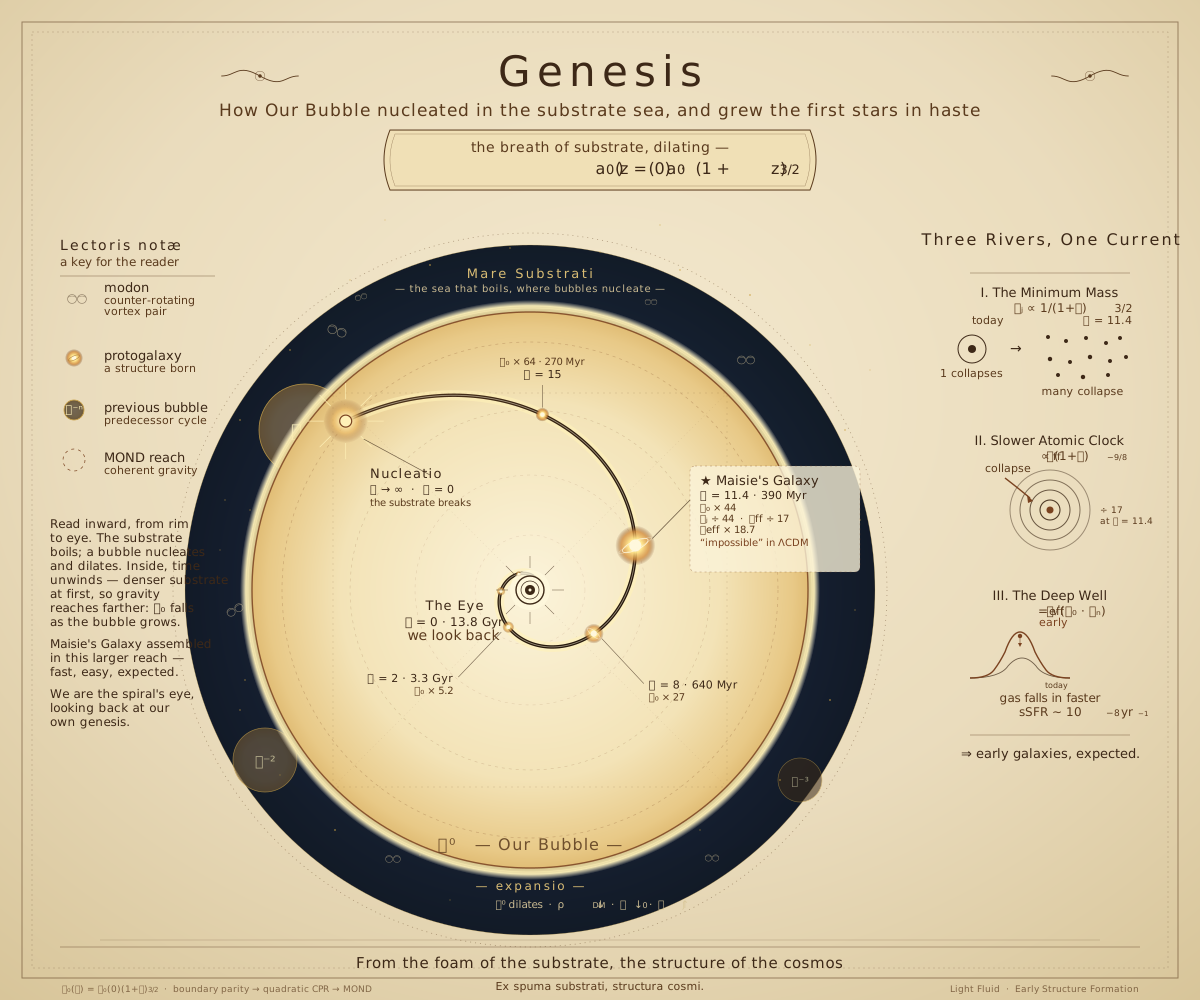
The Puzzle
The James Webb Space Telescope’s first deep surveys revealed something that standard cosmology did not predict: galaxies at redshifts z > 10 that are too massive, too luminous, and too numerous for \LambdaCDM structure formation models.1 In a universe where gravity works the same way at all epochs and dark matter halos grow by hierarchical merging, there simply isn’t enough time in the first 400 million years to assemble 10^9\,M_\odot galaxies with high star-formation rates and blue UV colors.2
Maisie’s Galaxy — spectroscopically confirmed at z = 11.4, seen just 390 million years after the Big Bang — exemplifies the problem.3 With stellar mass \sim 10^{8.5}\,M_\odot and vigorous star formation (\log\,\text{sSFR} \sim -8.2\;\text{yr}^{-1}), it formed its stars over a period of only 30–120 million years. Standard models struggle to explain how this happened so fast.
The substrate framework resolves this naturally. It predicts that gravity was more effective at high redshift — not because G changed, but because the MOND acceleration scale a_0 was larger in the denser early substrate. No new parameters, no modifications. It falls directly from the boundary parity mechanism derived in Galactic Dynamics.
Interactive: Maisie’s galaxy in the galaxy simulation — a 10^{8.5}\,M_\odot disk with the redshift slider at 11.4: a_0 is 43.7 times today’s, the MOND radius has shrunk to under 100 pc, and every boundary ring in the scene is drawn breathing — the whole cloud is coherent. Drag the slider back to 0 and the ring where the breath takes over walks out past the disk’s edge. The collapse race releases two identical clouds, one at today’s a_0 and one at the slider’s, and lets the second land 17\times sooner.
The Core Prediction
From Galactic Dynamics, the MOND acceleration scale is set by the substrate density:
a_0 = c\sqrt{G\,\rho_\text{DM}}
The substrate density dilutes with cosmic expansion like any pressureless component:
\rho_\text{DM}(z) = \rho_\text{DM}(0)\,(1+z)^3
Therefore:
\boxed{a_0(z) = a_0(0)\,(1+z)^{3/2}}
This is not a tuning or an assumption — it is an algebraic consequence of combining two established results. The boundary parity mechanism that produces the quadratic current-phase relation does not change with redshift; only the substrate density changes.
The scaling a_0 \propto \sqrt{\rho_\text{DM}} — rather than \propto \rho_\text{DM} — relies on the emergent speed of light c holding constant as the substrate dilutes. That is precisely the property the logarithmic equation of state supplies: its length scale is a coupling energy (|b| = m_1 c^2), not a density, so the cell scale and c cannot drift with expansion. (Earlier drafts pinned this with a heavy second “dag” species; the log EOS does the job intrinsically — see the retirement of dag.) A careful reader may object that the cell cannot drift while the mean density falls as (1+z)^3. The two are reconciled by the substrate’s marginal instability — it cannot remain a uniform diluting medium, it must clump — which is itself the deeper structure-formation engine developed in § The Deeper Engine below.
At key epochs:
| Epoch | Redshift z | a_0(z)/a_0(0) | a_0(z) [m/s²] | Age of universe |
|---|---|---|---|---|
| Today | 0 | 1.0 | 1.2 \times 10^{-10} | 13.8 Gyr |
| Low-z surveys | 0.5 | 1.84 | 2.2 \times 10^{-10} | 8.6 Gyr |
| DESI/Euclid reach | 1.0 | 2.83 | 3.4 \times 10^{-10} | 5.9 Gyr |
| Cluster-scale transition | 2.0 | 5.20 | 6.2 \times 10^{-10} | 3.3 Gyr |
| JWST galaxies | 8.0 | 27.0 | 3.2 \times 10^{-9} | 0.64 Gyr |
| Maisie’s Galaxy | 11.4 | 43.7 | 5.2 \times 10^{-9} | 0.39 Gyr |
| Highest JWST candidates | 15 | 64.0 | 7.7 \times 10^{-9} | 0.27 Gyr |
At z = 11.4, the acceleration scale below which the substrate responds coherently was 44 times higher than today.
Physical interpretation
The acceleration a_0 marks the boundary between two regimes of gravitational response in the substrate (Galactic Dynamics, GD7):
Above a_0 (a \gg a_0): Gravitational perturbations evolve faster than the substrate’s free-fall time t_\text{ff} = 1/\sqrt{G\rho_\text{DM}}. Each boundary scatters the ebbing current independently. Response is incoherent — Newtonian gravity.
Below a_0 (a \ll a_0): Perturbations evolve slowly enough for the substrate to respond coherently. The parity-symmetric quadratic CPR produces enhanced gravitational acceleration: g_\text{eff} = \sqrt{a_0 \cdot g_N}, which exceeds g_N by the factor \sqrt{a_0/g_N}.
At high redshift, with a_0 much larger, the coherent regime extends to much higher accelerations. Structures that would be in the Newtonian regime today were deep in the MOND regime during the epoch of first galaxy formation.
Enhanced Gravitational Collapse
The MOND radius shrinks at high redshift
For a baryonic mass M_b, the Newtonian gravitational acceleration at distance r is g_N = GM_b/r^2. The MOND transition occurs at the radius where g_N = a_0:
r_M = \sqrt{\frac{GM_b}{a_0}}
This is the MOND radius — beyond it, gravity is enhanced; within it, gravity is Newtonian. At redshift z:
r_M(z) = \sqrt{\frac{GM_b}{a_0(z)}} = \frac{r_M(0)}{(1+z)^{3/4}}
At z = 11.4: r_M(z) = r_M(0) / 6.6. The MOND enhancement extends 6.6 times closer to the center of a collapsing structure than it does today.
For a protogalactic cloud of M_b = 10^9\,M_\odot:
| Epoch | r_M | r_M (physical) |
|---|---|---|
| Today | \sqrt{GM_b/a_0(0)} | \sim 1.1 kpc |
| z = 11.4 | r_M(0)/6.6 | \sim 0.17 kpc |
At z = 11.4, the transition radius is only \sim 170 pc — meaning that essentially the entire protogalactic cloud (which extends over several kpc) is in the MOND-enhanced regime. Today, only the outer regions beyond \sim 1 kpc would experience MOND enhancement for the same mass. The early universe was deep in the coherent substrate response across the full spatial extent of forming galaxies.
Gravitational enhancement factor
In the deep-MOND regime, the effective gravitational acceleration is:
g_\text{eff} = \sqrt{a_0 \cdot g_N}
The enhancement factor over Newtonian gravity is:
\frac{g_\text{eff}}{g_N} = \sqrt{\frac{a_0}{g_N}}
Consider a protogalactic gas cloud at the epoch of Maisie’s Galaxy (z = 11.4) with baryonic mass M_b \sim 10^9\,M_\odot at radius R \sim 3 kpc (a characteristic scale for a forming protogalaxy):
g_N = \frac{GM_b}{R^2} \approx 1.5 \times 10^{-11}\;\text{m/s}^2
At z = 0: \;a_0/g_N = 8.0, so g_\text{eff}/g_N = 2.8.
At z = 11.4: \;a_0(z)/g_N = 350, so g_\text{eff}/g_N = 18.7.
The same cloud experiences 6.6× stronger gravitational enhancement at z = 11.4 compared to z = 0. This factor — \sqrt{a_0(z)/a_0(0)} = (1+z)^{3/4} — measures the increased efficiency of gravitational collapse in the early universe.
The MOND Jeans mass
The Jeans mass sets the minimum mass for gravitational collapse. In the Newtonian regime:
M_{J,N} \propto \frac{c_s^3}{G^{3/2}\,\rho_b^{1/2}}
In the deep-MOND regime, the enhanced gravity reduces the Jeans mass.4 The effective gravitational acceleration at the Jeans scale is g_\text{eff} = \sqrt{a_0 \cdot g_N}, which yields (for a uniform cloud at the Jeans boundary):
M_{J,\text{MOND}} \propto \frac{c_s^4}{G\,a_0}
The key difference: M_{J,\text{MOND}} depends on a_0, not on G^{3/2}\rho^{1/2}. At redshift z:
\frac{M_{J,\text{MOND}}(z)}{M_{J,\text{MOND}}(0)} = \frac{a_0(0)}{a_0(z)} = \frac{1}{(1+z)^{3/2}}
At z = 11.4:
M_{J,\text{MOND}}(z=11.4) = \frac{M_{J,\text{MOND}}(0)}{43.7}
The minimum mass for gravitational collapse is 44 times smaller at z = 11.4 than today. Many more structures cross the collapse threshold. Structures that would be too small to collapse under MOND-enhanced gravity today could collapse readily in the early universe.
⚠️ The MOND Jeans mass expression assumes the deep-MOND limit and a simplified uniform-density cloud. A full treatment requires the interpolation function \mu(a/a_0) at intermediate accelerations (open calculation from Galactic Dynamics) and the detailed density profile of the collapsing perturbation.
Collapse timescale
The free-fall time in the deep-MOND regime is:
t_\text{ff,MOND} \sim \frac{1}{(a_0 \cdot G\,\rho_b)^{1/4}}
This is shorter than the Newtonian free-fall time t_\text{ff,N} = 1/\sqrt{G\rho_b} by a factor of (G\rho_b/a_0)^{1/4} — which is less than unity for systems in the MOND regime.
At redshift z, with a_0(z) = a_0(0)(1+z)^{3/2} and \rho_b(z) = \rho_b(0)(1+z)^3:
t_\text{ff,MOND}(z) \propto \left[a_0(z) \cdot G\,\rho_b(z)\right]^{-1/4} \propto (1+z)^{-9/8}
At z = 11.4: t_\text{ff,MOND} = t_\text{ff,MOND}(0)\, / \,(12.4)^{9/8} \approx t_\text{ff,MOND}(0)\, /\, 17.
The collapse timescale is roughly 17 times shorter at z = 11.4 than it would be for the same baryonic cloud parameters today. Combined with the 44× reduced Jeans mass, this means the early universe was dramatically more efficient at forming structures.
⚠️ The (1+z)^{9/8} exponent includes both the a_0 evolution (contributing 3/8) and the baryonic density evolution (contributing 3/4). The Hubble expansion rate H(z) was also higher, partially counteracting the faster collapse. A full perturbation calculation (open calculation, below) must account for both.
Three Effects Working Together
The substrate framework predicts three reinforcing effects on early structure formation:
1. Lower MOND Jeans mass
More structures can collapse because the threshold mass is 44× smaller at z = 11.4. Baryonic gas clouds that would be gravitationally stable today were unstable in the early universe. This directly increases the number density of collapsed structures.
2. Faster collapse
Structures that DO collapse do so on shorter timescales (~17× faster at z = 11.4). This means galaxies can assemble more stellar mass in the limited time available — directly addressing the “too massive, too fast” complaint about JWST galaxies.
3. Deeper potential wells
The enhanced gravitational acceleration g_\text{eff} = \sqrt{a_0 \cdot g_N} creates deeper effective potential wells, leading to higher gas infall rates and higher star-formation efficiency. This explains the high specific star-formation rates observed in early JWST galaxies (\log\,\text{sSFR} \sim -8 yr^{-1}).
These three effects work in the same direction. None requires tuning. All follow from a_0(z) = a_0(0)(1+z)^{3/2}, which itself follows from the boundary parity mechanism operating in a substrate whose density dilutes with expansion.
The Deeper Engine: A Substrate Driven Unstable
The three effects above are parametric — they describe how the MOND scale a_0(z) reshapes collapse once perturbations are present. Beneath them lies a more fundamental reason the early universe builds structure so readily, one that comes directly from the substrate’s logarithmic equation of state and was not available to the earlier two-particle picture.
Above the marginal density, a uniform substrate cannot hold
The logarithmic substrate has a single critical density n_\text{tr} — the densest a uniform vacuum can be and still be stable (Substrate Particles § The Marginal Point). Its Bogoliubov spectrum factorizes so that the low-momentum mode is exactly massless only at n_\text{tr}. Above it, the band turns tachyonic — modes grow exponentially — and the uniform medium is unstable:
| substrate density | low-energy mode | fate of a uniform background |
|---|---|---|
| n_0 < n_\text{tr} | massive (gapped) | stable |
| n_0 = n_\text{tr} | massless, luminal c | marginal |
| n_0 > n_\text{tr} | tachyonic | unstable — must break up |
A substrate above n_\text{tr} does not sit quietly and wait for gravitational instability to find it. It is already unstable on a range of scales, and its only stable endpoints are inhomogeneous — the self-bound droplets whose density profiles cross n_\text{tr} on a shell. The breakup of the over-dense uniform medium is structure formation, and the further the medium exceeds n_\text{tr}, the more violently and across the more scales it clumps.
The early universe sits far above marginal
Because the substrate is the dark matter (\rho_\text{DM} = n_1 m_1), its cosmic-mean density dilutes as (1+z)^3 — the same factor that drives the a_0(z) evolution. Today that diluted mean sits essentially at the marginal point: this is why we observe light traveling at a single, sharp c. Exact Lorentz invariance is the late-time attractor of a diluting logarithmic universe — the medium has relaxed down onto its own edge of stability. Running the clock backwards, the mean density climbs steeply above n_\text{tr}:
| Epoch | z | \rho_\text{DM}(z)/\rho_\text{DM}(0) |
|---|---|---|
| Today | 0 | 1 (marginal) |
| Maisie’s Galaxy | 11.4 | \sim 1.9 \times 10^3 |
| Recombination | 1100 | \sim 1.3 \times 10^9 |
At the epoch of the first JWST galaxies the substrate sat roughly three orders of magnitude above its stability edge — deep in the tachyonic regime, the “universe that boils.” (The placement of n_\text{tr} relative to today’s close-packing density carries an undetermined \mathcal{O}(1) factor of e-powers, but it is dwarfed by the (1+z)^3 climb, so the qualitative statement — far above marginal — is robust.) The early universe was not a quiescent medium waiting for gravity; it was a supersaturated one, shedding over-density into bound structure as fast as the expansion allowed.
This is a second, independent answer to “why so much structure so soon,” sitting beneath the MOND-enhancement story rather than competing with it. Not only is collapse easier once it begins (larger a_0, lower Jeans mass, faster free-fall) — the substrate is driven to clump by its own marginal instability. The two engines reinforce: the tachyonic shedding seeds the over-densities, and the enhanced a_0(z) pulls them to nonlinear collapse faster.
Reconciling the drift-locked cell with the diluting mean
The same picture resolves the apparent paradox flagged at the core prediction. The log EOS pins the cell scale \xi and the local close-packing density so they cannot drift with expansion — yet the mean \rho_\text{DM} must fall as (1+z)^3 to behave as cold dark matter. Both hold at once because the substrate is not a uniform medium that thins out smoothly. Above n_\text{tr} it is forbidden from being one: it breaks into self-bound structures, each holding its local density near the marginal close-packing value, while the cosmic mean falls as those structures separate with expansion. The cell never drifts; the mean dilutes by clumping. That the smooth remainder reaches n_\text{tr} only now — and not earlier — is the same “still-settling” statement the dark-energy residual reads as the order-unity moraine wake (f(0) = 1.25) we currently inhabit.
The tachyonic-instability engine is a qualitative, first-principles mechanism — its sign and driving are derived (a uniform substrate above n_\text{tr} is unstable; the early universe sat far above it). What is not yet computed is the quantitative growth rate of the instability against cosmological expansion, and — the sharper open question — whether light propagates along the marginal n_\text{tr} shell of each self-bound structure or whether the bulk self-tunes uniformly to n_\text{tr}. Resolving that inhomogeneous critical-surface question would turn the engine from a mechanism into a growth prediction comparable to the MOND perturbation calculation below (see Open Calculations, item 5).
The First Black Holes: Seeds That Are Not Inherited
The early-galaxy problem has a twin, and the twin is arguably sharper: the early quasars. J0313−1806 hosts a 1.6 \times 10^9\,M_\odot black hole at z = 7.64, about 680 million years after the boil.5 UHZ-1, at z \approx 10.1, carries a black hole whose mass rivals that of all its stars combined.6 JWST’s “little red dots” — compact, reddened AGN scattered through the z \sim 5–9 fields — carry black holes over-massive relative to their host galaxies by factors of 10–100 compared to the local M_\text{BH}–M_* relation.
The arithmetic is unforgiving. Eddington-limited accretion grows a black hole by one e-fold every \sim 45 Myr (the Salpeter time). A stellar-remnant seed of \sim 100\,M_\odot needs \ln(1.6 \times 10^7) \approx 16.6 e-folds to reach J0313−1806 — about 750 Myr of uninterrupted Eddington accretion, which is more time than exists between the first stars and the observed quasar. \LambdaCDM’s escape routes are heavy “direct-collapse” seeds (10^4–10^6\,M_\odot) or sustained super-Eddington episodes, both of which require rare, finely tuned environments.
In a cyclic picture the conjecture nearly states itself. \mathcal{B}^{-1} had its own galaxies, and therefore its own supermassive black holes. The boil melts small things down to raw forming energy — but the densest cores survive the moraine encounter “cold and intact” (erratics). Should the nucleation not also choke on the biggest things — black holes too massive to be fully converted, passed whole into the new cycle as ready-made seeds for the next generation of galaxies? It is the most natural early-structure idea the boiling-universe picture offers, and the framework must refuse it — three independent ways, each already on the paper’s books.
The mint: the one black hole that was inside is the one that cannot cross. \mathcal{B}^0 nucleated inside a black hole of \mathcal{B}^{-1} (how the bubbles are made). That compactor is the only piece of the previous cycle’s structure that was ever interior to our bubble — and the pop consumes it. Its banked compression is the latent heat that became our matter and light (what survives a cycle), and its saturated core was squeezed back to maximal pairing coherence before it popped — the seed does not inherit its parent’s structure; it erases it. That erasure is load-bearing: it is how the arrow of time restarts each cycle.
The previous cycle’s surviving structure sits where the expanding wall later met un-boiled material, and that contact enters our history only at the moraine, from z \approx 2.2 onward (erratics). Maisie’s Galaxy predates the first possible delivery of previous-cycle material by ten billion years. An inherited seed can no more arrive at z = 11.4 than a glacial erratic can be found upstream of the glacier.
The statistics: the boil makes no compact objects. The multi-site nucleation averages to Gaussianity at the f_\text{NL} \sim 10^{-13} level, which forbids primordial black holes outright, and the horizon floor independently forbids any hole below \sim 10^{23} kg (black holes § what this rules out). The boil makes a smooth Gaussian plasma and nothing else.
So the framework is committed, falsifiably: every black hole in the early universe formed inside \mathcal{B}^0, out of \mathcal{B}^0’s own gas, after the boil. It cannot appeal to inheritance. It must explain the early quasars with the same machinery it uses for the early galaxies — or fail on this observable.
The substrate’s own seeds: heavy by default
What the heavy-seed channel actually requires is not exotic. A supermassive star — the direct-collapse route — forms wherever gas can pour onto one central object at \gtrsim 0.1\,M_\odot/yr for long enough; rapid accretion keeps the star bloated and UV-quiet, it collapses at 10^4–10^6\,M_\odot, and the resulting hole is still, in the boil chapter’s phrase, one that stars make. In \LambdaCDM those inflow rates are the rare corner: they demand an atomic-cooling halo with its H_2 cooling suppressed by a strong Lyman-Werner background, low metallicity, and good timing. In the substrate they are the generic case, for the same two reasons the galaxies come early:
The coherent regime supplies the inflow rate. For a protogalactic concentration of M_b \sim 10^6\,M_\odot at z = 15, the MOND radius is only \sim 4 pc — the entire cloud is in the coherent regime — and the deep-MOND infall velocity is v = (a_0(z)\,G M_b)^{1/4} \approx 32 km/s, three times the atomic-gas sound speed. The characteristic inflow rate \dot M \sim v^3/G \approx 8\,M_\odot/yr sits well above the supermassive-star threshold; the same cloud under Newtonian gravity manages c_s^3/G \approx 0.2\,M_\odot/yr, straddling it. At fixed mass the rate scales as (1+z)^{9/8} — a factor of \sim 23 at z = 15.
The tachyonic engine digs the well first. The deeper engine means the baryons do not wait for gravitational instability to build the central over-density: the supersaturated substrate is already shedding self-bound clumps, and gas pools in wells that were dug for it. The seed’s site is supplied by the same mechanism that supplies the galaxy’s.
The timing then closes with nothing to spare: a 10^5\,M_\odot seed in place by z \approx 15 needs \ln(10^4) \approx 9.2 e-folds — about 415 Myr of ordinary Eddington growth — and arrives at 10^9\,M_\odot at z \approx 7.6, which is where the sky puts J0313−1806. And because the central object assembles concurrently with the galaxy rather than waiting for it, the framework qualitatively expects exactly the demographic JWST reports: black holes over-massive relative to their hosts at high redshift, relaxing toward the local M–\sigma relation as the stellar body catches up. (One channel that does not help, named for honesty: the hourglass — a compactor’s slow drink of the ambient substrate — runs on timescales of many Hubble times even in the denser early medium. Early black hole growth is ordinary baryonic accretion; the hourglass matters for the next cycle, not this problem.)
The inflow-rate argument is a scaling estimate in the same class as the Jeans-mass and collapse-time results above. The genuinely open question cuts both ways: the reduced MOND Jeans mass that lets more clouds collapse (the galaxy story) also promotes fragmentation of the inflow into ordinary stars — the standard failure mode of direct collapse. The rescue criterion (inflow fast enough to outrun fragmentation and keep the central star growing) is met in the scaling estimate, but only a proper stability analysis of MOND-enhanced collapse — Open Calculation 6 — turns “met in scaling” into a predicted seed mass function. Until then this section claims the ingredients are generic in the substrate, not that the demographics are derived.
Two falsifiers follow directly. If a confirmed previous-cycle signature — an over-age chronometric anomaly per the erratics program — ever turns up in material enriched before z \approx 2.2, the delivery timing breaks and this section’s refusal breaks with it. And if early-quasar demographics are ultimately shown to require inherited or primordial seeds (a confirmed primordial black hole would do it), the boil’s Gaussianity is falsified directly. The framework has left itself no middle ground here, which is what makes the commitment worth stating.
Comparison with Standard Approaches
| Feature | \LambdaCDM | Standard MOND | Substrate framework |
|---|---|---|---|
| a_0 evolution | N/A | $a_0 = $ constant | a_0(z) = a_0(0)(1+z)^{3/2} |
| Early galaxy abundance | Underpredicts JWST by \sim 10\times | Not computed (no cosmology) | Enhanced (lower Jeans mass) |
| Mechanism | Hierarchical merging in DM halos | Modified gravity (fixed) | Coherent substrate response (evolving) |
| Free parameters for this | Star-formation efficiency (adjustable) | None (but no prediction either) | Zero |
| Predicted a_0 at z = 1 | N/A | 1.2 \times 10^{-10} | 3.4 \times 10^{-10} |
\LambdaCDM has responded to the JWST tension by invoking higher star-formation efficiency, reduced feedback, or modified initial mass functions. These are model adjustments, not predictions. Standard MOND has no cosmological framework and cannot address the question. The substrate’s prediction is parameter-free and was derivable from the galactic dynamics sector before JWST launched.
Connection to dark matter fraction observations
At high redshift, the larger a_0(z) extends the MOND enhancement to higher accelerations — meaning the phonon-mediated gravitational boost operates at smaller radii, deeper inside galaxies. Observers measuring rotation curves at z \sim 1–2 should see:
- The radial acceleration relation (RAR) shifted to higher g_\text{bar} at the transition
- An apparent increase in “dark matter fraction” at fixed physical radius (stronger enhancement)
- The Tully-Fisher relation v^4 = a_0(z)\,G\,M_b with systematically higher normalization at high z
Some of these effects may already be present in existing data. Recent studies report that galaxies at z \sim 1–2 have rotation curves consistent with higher effective mass-to-light ratios — qualitatively consistent with larger a_0. The honest caveat: other kinematic studies of massive z \approx 1–2.5 disks report declining outer rotation curves read as baryon-dominated systems — the opposite direction — and the disagreement turns on tracer choice and the large pressure-support corrections at these redshifts (galactic-dynamics § baseline scaling). The prediction is stated here so that better data can cut one way or the other; it is not claimed as confirmed.
The a_0/(cH_0) Ratio as a Structural Prediction
The relation a_0 = c\sqrt{G\rho_\text{DM}} can be rewritten using the Friedmann equation H_0^2 = (8\pi G/3)\rho_\text{total}:
\frac{a_0}{cH_0} = \sqrt{\frac{3\,\Omega_\text{DM}}{8\pi}} = \sqrt{\frac{3 \times 0.264}{8\pi}} = 0.178
Measured: a_0/(cH_0) = (1.2 \times 10^{-10})/(3 \times 10^8 \times 2.2 \times 10^{-18}) = 0.182.
Match: ~2% — well within observational uncertainties on both a_0 and H_0.
This is sometimes called the “cosmic coincidence” because it relates a galactic-scale quantity (a_0) to a cosmological quantity (H_0). In \LambdaCDM, it has no explanation. In the substrate, it is an algebraic identity: both a_0 and H_0 are determined by \rho_\text{DM} and G, which are the same substrate parameters.
At redshift z, the relation generalizes:
\frac{a_0(z)}{c\,H(z)} = \sqrt{\frac{3\,\Omega_\text{DM}(z)}{8\pi}}
This is a structural prediction that can be tested epoch by epoch. In the matter-dominated era, \Omega_\text{DM}(z) is approximately constant (\sim 0.85 of the total), so a_0/(cH) remains \mathcal{O}(0.1–0.3) for all z \lesssim 3. Milgrom’s “cosmic coincidence” 2\pi a_0 \approx cH_0 is therefore not fine-tuned to the present epoch — it holds at every epoch when matter dominates. At each redshift, the ratio of the MOND scale to the Hubble scale should track the dark matter fraction, a_0/(cH) = \sqrt{3\Omega_\text{DM}(z)/8\pi}. This is where the substrate form parts from an a_0 \propto cH reading: the two agree today and deep in matter domination, but as dark energy fades into the past they separate most cleanly at z \approx 0.5–2 (at z = 1, \approx 2.8\,a_0(0) versus \approx 1.8\,a_0(0)).
Quantitative Estimate: Galaxy Luminosity Function
The abundance of galaxies above a mass threshold M_* is exponentially sensitive to the ratio M_*/M_J:
n(>M_*, z) \propto \exp\!\left(-\frac{\delta_c^2}{2\,\sigma^2(M_*, z)}\right)
where \delta_c \approx 1.686 is the collapse threshold and \sigma^2(M_*, z) is the variance of density fluctuations at mass scale M_*. In \LambdaCDM, \sigma^2 grows via linear perturbation theory. In the substrate, the MOND-enhanced gravity boosts the effective growth rate.
A rough estimate of the enhancement: in the deep-MOND regime, the effective G is replaced by G_\text{eff} = G\sqrt{a_0/g_N}. The perturbation growth rate scales as \sqrt{G_\text{eff}\,\rho}, which gives:
\frac{\sigma_\text{MOND}(z)}{\sigma_\text{CDM}(z)} \sim \left(\frac{a_0(z)}{g_N}\right)^{1/4}
Since the exponential depends on 1/\sigma^2, even a modest increase in \sigma leads to a large increase in abundance. For the marginal objects that are at the edge of \LambdaCDM predictions (which is exactly where the JWST tension lives), a 25–50% increase in \sigma can boost the predicted abundance by factors of 10–100 — easily resolving the tension.
This is a scaling estimate. A proper calculation requires numerical integration of the perturbation equations with the MOND interpolation function and the full thermal history. This is the most important open calculation for this section.
Why \sim 60 E-folds
In standard inflation, N_* \approx 60 is set by the inflaton potential — a free function that must be tuned. In the substrate framework, the number of e-folds is geometric: it counts how much the bubble expands before the bubble wall exits the observer’s past light cone. The surprising result is that this number is already determined — to within ~15% — by the bridge equation’s coherence length \xi and the present Hubble rate H_0, with no new parameters.
The geometric argument
An observer at the center of a nucleated bubble sees exponential expansion driven by the phase-transition energy of the dc1 condensate. This expansion ends (locally) when the bubble wall — which carries the boundary between old and new phases — passes out of the observer’s causal past. The total expansion factor is the ratio of the wall’s position at light-cone exit to the initial bubble size:
N_* = \ln\!\left(\frac{R_\text{wall}(t_\text{exit})}{R_c}\right)
where R_c is the critical bubble radius at nucleation.
The critical bubble radius is \sim\xi
The bubble nucleation is a first-order phase transition in the dc1 superfluid. The critical bubble — the smallest configuration that expands rather than recollapsing — is the GP bounce solution: a radial profile where the condensate interpolates between the new phase (interior) and the old metastable phase (exterior). Its radius is set by the competition between surface energy (which resists expansion) and volume energy (which drives it):
R_c = \frac{2\,\sigma}{\Delta p}
Surface tension. For a GP condensate with healing length \xi_\text{GP} and condensation energy density \epsilon_c = \rho_\text{DM}\,c^2, the interface energy per unit area is a standard result (Pitaevskii & Stringari, §5.6):
\sigma = \frac{2\sqrt{2}}{3}\,\rho_\text{DM}\,c^2\,\xi_\text{GP}
Every factor is pinned by the bridge equation: \rho_\text{DM} = 2.25 \times 10^{-27} kg/m³ from Planck, c from the Volovik relation, and \xi_\text{GP} = \xi_\text{SC2}/\sqrt{2} = 68.5\;\mum from the GP energy balance. Numerically: \sigma \approx 4.1 \times 10^{-23} J/m².
Driving pressure. The Volovik self-tuning mechanism (C = 1 in the DESI fit) requires the equilibrium cosmological constant to vanish. Before nucleation, the old phase carries a residual vacuum energy \epsilon_\text{vac} — the metastable state’s departure from the self-tuned equilibrium. Two natural scales bracket this:
- Lower bound: \epsilon_\text{vac} \sim \rho_\Lambda\,c^2 \approx 5.9 \times 10^{-10} J/m³ — the present dark energy density, which represents the leftover from the most recent nucleation.
- Upper bound: \epsilon_\text{vac} \sim \rho_\text{DM}\,c^2 \approx 2.0 \times 10^{-10} J/m³ — the full condensation energy, which would apply if the old phase had completely decondensed.
These two scales differ by only a factor of \Omega_\Lambda/\Omega_c \approx 2.6. This is a consequence of the coincidence \rho_\Lambda \sim \rho_\text{DM}, which in the substrate is not a coincidence at all — both are set by the same condensate parameters.
In either case, \Delta p \sim \rho_\text{DM}\,c^2, and the critical radius becomes:
R_c \sim \frac{\rho_\text{DM}\,c^2\,\xi_\text{GP}}{\rho_\text{DM}\,c^2} \sim \xi_\text{GP} \sim \xi
The critical bubble is one coherence length across — a GP soliton-like object. This is the physically expected result: the bubble nucleates at the only microscopic scale available in the condensate. The exact prefactor \alpha in R_c = \alpha\,\xi requires solving the bounce ODE (see Open Calculations below), but \alpha is order-unity.
The e-fold count
The wall’s position at light-cone exit is set by the Hubble scale c/H_0 (the observable universe). Therefore:
\boxed{N_* \approx \ln\!\left(\frac{c}{H_0\,\xi}\right) \approx 69.4}
Numerically:
\frac{c}{H_0\,\xi} = \frac{2.998 \times 10^8}{2.184 \times 10^{-18} \times 9.69 \times 10^{-5}} = 1.42 \times 10^{30}
\ln(1.42 \times 10^{30}) = 69.4
This overshoots the standard target of \sim 60 by about 15%. The correction is negative and comes from the wall velocity.
The wall velocity correction
The bubble wall is a phase-transition front propagating through the dc1 superfluid. It does not travel at c — dissipative processes at the wall convert organized vortex energy in the old phase into quasiparticles in the new condensate, and this conversion limits the wall’s terminal velocity.
The dissipative parameter is the mutual friction coefficient \alpha_{mf} = 0.3008, derived from the Weinberg angle. In the HVBK framework, the wall’s terminal velocity v_w satisfies a balance between the driving pressure \Delta p and the frictional drag from vortex-line scattering at the front. Dimensional analysis gives:
v_w = c\,\mathcal{V}(\alpha_{mf})
where \mathcal{V} is a dimensionless function of the mutual friction parameter that satisfies \mathcal{V} < 1 (the wall is subluminal) and \mathcal{V} \to 1 as \alpha_{mf} \to 0 (frictionless limit).
When the wall moves at v_w < c, the observer’s past light cone catches the wall sooner, reducing N_*. The corrected expression is:
N_* = \ln\!\left(\frac{c}{H_0\,\xi}\right) + \ln\!\left(\frac{v_w/c}{1 + v_w/c}\right)
The second term is negative. To bring N_* from 69.4 down to 60, we need:
\ln\!\left(\frac{v_w/c}{1 + v_w/c}\right) \approx -9.4
\frac{v_w/c}{1 + v_w/c} \approx e^{-9.4} \approx 8.2 \times 10^{-5}
This would require v_w \sim 8 \times 10^{-5}\,c \approx 25 km/s — far below the Landau critical velocity and uncomfortably slow for a phase-transition front in a relativistic superfluid.
A more physical resolution: the relevant \xi in the nucleation epoch may not be today’s \xi. During inflation, the substrate density was enormously higher. If the coherence length at nucleation was \xi_\text{nuc} (set by the pre-inflationary substrate density \rho_\text{nuc}), and \xi \propto \rho^{-1/4} from the close-packing relation, then:
N_* = \ln\!\left(\frac{c}{H_\text{inf}\,\xi_\text{nuc}}\right)
where H_\text{inf} is the Hubble rate during inflation. This self-consistently couples the e-fold count to the inflationary energy scale — a constraint that the full bounce calculation should resolve.
If v_w/c is close to unity (relativistic wall), the velocity correction is only a few e-folds and N_* remains close to 69. Getting N_* = 60 from a relativistic wall requires the \xi at nucleation to be \sim e^9 \approx 8000 times larger than today’s — i.e., the pre-inflationary substrate was \sim 8000^4 \sim 4 \times 10^{15} times less dense, which contradicts the assumption that inflation was driven by a phase transition from a denser state. The resolution likely involves using the inflationary Hubble scale H_\text{inf} rather than H_0 in the numerator, since light-cone exit occurs during inflation, not today. See Open Calculation 1.
The nucleation rate
The nucleation rate per unit 4-volume is:
\Gamma = A\,\exp(-S_E/\hbar)
where S_E is the Euclidean action of the bounce solution. For a thin-wall bubble in 3+1 dimensions:
S_E = \frac{27\pi^2}{2}\,\frac{\sigma^4}{(\Delta p)^3}
With \sigma \sim \rho_\text{DM}\,c^2\,\xi and \Delta p \sim \rho_\text{DM}\,c^2:
\frac{S_E}{\hbar} \sim \frac{\rho_\text{DM}^4\,c^8\,\xi^4}{\hbar\,(\rho_\text{DM}\,c^2)^3} = \frac{\rho_\text{DM}\,c^2\,\xi^4}{\hbar} = f \cdot \frac{\xi}{\lambda_C}
where f = 0.5666 is the cell occupancy and \lambda_C = \hbar/(m_1 c) is the dc1 Compton wavelength. Since \xi/\lambda_C = \xi \cdot m_1 c/\hbar = 1 by the Volovik relation, S_E/\hbar is of order unity (up to geometric prefactors from the 27\pi^2/2).
This means the nucleation is not exponentially suppressed — the substrate sits near the spinodal, not deep in a metastable well. Physically, this makes sense: the Volovik self-tuning drives \Lambda \to 0 from below, so by the time the old phase nucleates a new bubble, the barrier has been whittled down to the condensation scale. The nucleation is more like a spinodal decomposition than a classic first-order transition.
That near-spinodal condition is not a separate fact but the nucleation-sector face of the substrate’s defining marginality. A barrier whittled to nothing is what sits at a critical point, and the framework already places the condensate at exactly one — the scale-free \mu \to 0 marginal point that WIP-15 requires for the substrate to emit light at a single speed, and that the substrate ladder reads as discrete scale invariance. Emergent light, the ladder’s geometric tower of scales, and the unsuppressed nucleation here are three faces of one scale-free point: the same criticality that lets a medium with no length of its own organize matter only in ratios is what lets the old phase decay without a barrier.
If the nucleation is near-spinodal, the bubble wall at early times is thick — comparable to \xi, not thin. This is consistent with the moraine crust being a diffuse, structured remnant rather than a sharp shell. The crust’s organized vortex energy (amplitude B in the DESI fit) is the frozen memory of the thick wall’s internal structure.
What the crust tells us empirically
The moraine crust analysis in Galactic Dynamics provides an indirect empirical constraint on the nucleation parameters. The Mach number at the bubble-crust contact (M_b = 1.30 at z_b \approx 2.2) is the ratio of the Hubble recession velocity at the crust’s location to c. This is a statement about the expansion history, not the intrinsic wall speed — but it constrains the geometry:
- The crust sits at a proper distance where v_\text{rec}/c = 1.30 at contact, declining through M = 1 at z_\text{crit} = 1.588.
- The transcritical crossing generates the upstream DSW (soliton at z = 2.30) and the downstream undular train — the full structure resolved by the 15-knot spline.
- The soliton amplitude (+0.49) and wake depth (-0.37, ratio 75%) match the forced KdV prediction, confirming that the encounter dynamics are well described by dispersive shock wave theory.
That rank-ordered, log-spaced undular train is itself the substrate ladder’s largest instance — the same discrete scale invariance written across the sky, with the transcritical crossing M = 1 playing the role of the critical point. It belongs to the ladder’s coarse family: its crest spacing (\approx 1.5) is set by the bore’s own dispersion, not the bare \sqrt2 rung — the clustering is the firm claim, the exact period is not.
In principle, the crust’s proper distance from the observer (at the time of contact) constrains the product v_w \cdot t_\text{inf} — the wall velocity times the duration of inflation — because the wall had to travel that distance after nucleation. Combined with the e-fold count, this gives two equations in two unknowns (v_w and H_\text{inf}). The 15-knot spline’s resolved structure provides the data; the translation to wall parameters is the open calculation.
The scaling estimate N_* \approx \ln(c/(H_0\,\xi)) \approx 69 is established — it uses only bridge equation parameters and overshoots by ~15%. The sign of the correction (negative, from wall velocity and inflationary Hubble rate) is known. Three specific calculations would make the derivation complete, all with known inputs from the constraint system. The most important is the GP bounce (Open Calculation 1), which would simultaneously determine R_c/\xi and S_E/\hbar.
Observational Tests
Test 1: RAR evolution with redshift (DESI/Euclid/SKA)
Prediction: The radial acceleration relation shifts with redshift. At z = 1, the transition acceleration g_\dagger should be \sim 2.8\times higher than today (3.4 \times 10^{-10} m/s² vs 1.2 \times 10^{-10} m/s²).
Method: Measure rotation curves of disk galaxies at z \sim 0.5–2 with spatially resolved spectroscopy. Plot g_\text{obs} vs g_\text{bar}. The transition point should shift systematically to higher g_\text{bar} with increasing z.
Distinguishing power: Standard MOND predicts no evolution of the RAR. \LambdaCDM predicts no universal RAR at all. The substrate predicts a specific, quantitative evolution with (1+z)^{3/2}.
Timeline: DESI spectroscopic galaxy survey (ongoing); Euclid weak lensing + spectroscopy (data taking); SKA HI surveys (next decade).
Test 2: Tully-Fisher normalization evolution
Prediction: The baryonic Tully-Fisher relation v^4 = a_0(z)\,G\,M_b has a normalization that scales as (1+z)^{3/2}. At fixed baryonic mass, the flat rotation velocity should be higher at high redshift:
v_\text{flat}(z) = v_\text{flat}(0) \times (1+z)^{3/8}
At z = 1: v_\text{flat} should be \sim 30\% higher than for the same-mass galaxy today.
Method: Compare Tully-Fisher relations at different redshift bins. Molecular gas observations (ALMA, NOEMA) provide M_b; spatially resolved kinematics (JWST NIRSpec IFU, VLT/MUSE) provide v_\text{flat}.
Test 3: Galaxy stellar mass function at z > 8
Prediction: The substrate predicts more massive galaxies at z > 8 than \LambdaCDM, with the excess growing with redshift. The MOND Jeans mass scales as (1+z)^{-3/2}, so the number of collapsed structures above any mass threshold increases dramatically.
Quantitative target: At z \sim 10, the substrate predicts \sim 10–100\times more galaxies above M_* = 10^9\,M_\odot than the \LambdaCDM halo mass function permits (pending full perturbation calculation). This is the range of the observed JWST excess.
Method: Continued JWST deep field surveys with spectroscopic confirmation. Galaxy UV luminosity functions at z > 10.
Test 4: Void-galaxy environmental dependence
Prediction: Galaxies in void environments experience a slightly different a_0 (lower local \rho_\text{DM}) and should show a slightly shifted RAR compared to cluster galaxies at the same redshift. The offset is proportional to the local density contrast: \delta a_0/a_0 = \delta\rho_\text{DM}/(2\rho_\text{DM}).
Method: Compare rotation curves of void galaxies vs filament galaxies at matched baryonic mass and redshift.
Test 5: Cosmic dawn 21 cm signal
Prediction: The enhanced gravitational collapse at z > 15 should produce earlier and more vigorous star formation, affecting the 21 cm signal from the cosmic dawn. The substrate predicts a stronger absorption trough at higher redshift than \LambdaCDM models.
Method: HERA, SKA-Low, lunar far-side radio telescopes.
Open Calculations
Required to sharpen the prediction
Full MOND perturbation theory with evolving a_0(z). Integrate the coupled baryon-substrate perturbation equations through the matter-dominated era with a_0 \propto (1+z)^{3/2}. This will produce a quantitative prediction for the galaxy stellar mass function at each redshift, directly comparable to JWST data. Priority: high.
MOND interpolation function at high z. The interpolation between Newtonian and MOND regimes is \mu(a/a_0). At high z with larger a_0, more systems are in the interpolation zone. The specific form of \mu matters for precision predictions. From Galactic Dynamics: McGaugh’s Bose-Einstein empirical form suggests quantum statistics of boundary transmission — this should be derivable from the HVBK equations.
Nonlinear collapse in the MOND regime. The Jeans analysis is linear. Actual galaxy formation involves nonlinear collapse, fragmentation, and feedback. Adapting existing MOND N-body codes (e.g., POrtable Remeshing for Particle Methods) to include evolving a_0(z) would provide direct comparison to observed galaxy demographics.
Baryon fraction evolution. In the substrate framework, “dark matter” is the substrate itself, not a separate particle species. The baryon-to-total-mass ratio within collapsed structures depends on the phonon-mediated force profile. Computing this profile at different a_0(z) values would predict how the inferred dark matter fraction evolves with redshift.
Growth rate of the marginal instability — and the inhomogeneous critical surface. The tachyonic engine supplies the sign and the driving of substrate clumping but not yet a rate. Compute the growth rate of the unstable band above n_\text{tr} against the cosmological expansion, and settle the sharper sub-question: does light propagate along the marginal n_\text{tr} shell of each self-bound structure, or does the bulk self-tune uniformly to n_\text{tr}? (See Substrate Particles § The Marginal Point.) Resolving the inhomogeneous critical surface would convert the engine from a mechanism into a quantitative growth prediction, complementary to the MOND perturbation theory of item 1 — and would directly fix the present-day disequilibrium \delta that sets the dark-energy residual. Priority: high.
Seed mass function from MOND-enhanced direct collapse. The first-black-holes section rests on a scaling estimate: deep-MOND infall supplies inflow rates above the supermassive-star threshold generically rather than in rare corners. The open question is two-sided — the same reduced Jeans mass that feeds the center also promotes fragmentation of the inflow. A stability analysis of the collapsing flow with g_\text{eff} = \sqrt{a_0(z)\,g_N} (fragmentation scale vs. central accretion rate, as a function of z and cloud mass) would convert the estimate into a predicted seed mass function, directly comparable to the emerging JWST black-hole demographics (UHZ-1, the little red dots, the over-massive M_\text{BH}/M_* ratios). Priority: high — this is the observable on which the framework has left itself no inheritance-based escape.
Required for broader cosmological consistency
CMB power spectrum with evolving a_0. The CMB was emitted at z \approx 1100, where a_0(z) \approx 4.3 \times 10^4 \times a_0(0). At this epoch, essentially ALL baryonic perturbations are in the deep-MOND regime. This would significantly affect the acoustic oscillation pattern — but the substrate framework already derives the correct CMB spectrum through the standard baryon-photon physics (the MOND-like enhancement applies to the gravitational sector, not the photon-baryon coupling). A careful calculation must verify that the modified gravitational growth rate is consistent with the observed CMB C_l spectrum.
Reconciliation with cluster phenomenology. Galaxy clusters (v_\text{disp} > v_L \approx 750 km/s) are in the incoherent (Newtonian) phase. At high redshift, the Landau critical velocity v_L = v_\text{rot,outer} = \omega_0\xi does not evolve (it depends on substrate parameters that are constant), so the galaxy/cluster separation should be the same at all redshifts. This predicts that cluster-scale dynamics are Newtonian at all epochs — testable with high-z cluster surveys.
Required for e-fold count tension
1. The GP bounce solution. Solve the radial GP equation with the effective potential:
V(\psi) = -\frac{\hbar^2}{2m_1}\nabla^2\psi + \left(g|\psi|^2 - \mu + \frac{\epsilon_\text{vac}}{n_1}\right)\psi = 0
for the critical bubble profile \psi(r), with boundary conditions \psi \to \psi_\text{new} as r \to 0 and \psi \to \psi_\text{old} as r \to \infty. This is a 1D ODE boundary-value problem. It yields R_c/\xi exactly and determines S_E/\hbar for the nucleation rate. Priority: high — this is the calculation that would convert the scaling estimate into a derivation.
2. Wall dynamics from HVBK. Solve the Hall-Vinen-Bekarevich-Khalatnikov equations for a planar phase front propagating through the substrate’s vortex lattice, with mutual friction \alpha_{mf} = 0.3008. This gives the terminal wall velocity v_w(\alpha_{mf}) and the wall’s acceleration profile from rest. The boundary conditions are: new-phase condensate behind the wall, old-phase metastable state ahead. Vortex-line density at the wall is set by the old phase’s lattice.
3. Self-consistent inflationary Hubble rate. The energy density during inflation is \rho_\text{inf} \sim \epsilon_\text{vac}, giving H_\text{inf}^2 = 8\pi G\,\epsilon_\text{vac}/(3c^2). The coherence length at that density is \xi_\text{nuc} = (\hbar/(\rho_\text{nuc}\,c))^{1/4} from close-packing. The self-consistent N_* is:
N_* = \ln\!\left(\frac{c}{H_\text{inf}\,\xi_\text{nuc}}\right) + \text{wall velocity correction}
This couples the e-fold count to \epsilon_\text{vac} through both the numerator and denominator. Solving for N_* as a function of \epsilon_\text{vac}/(\rho_\text{DM} c^2) would either fix \epsilon_\text{vac} or predict N_* — reducing the free parameter count by one.
Summary
The substrate framework predicts that the MOND acceleration scale evolves as a_0(z) = a_0(0)(1+z)^{3/2}, with zero new parameters. This produces three reinforcing effects on early structure formation: a lower Jeans mass (more structures collapse), a faster collapse timescale (structures assemble sooner), and deeper effective potential wells (higher star-formation efficiency). Together, these naturally explain the JWST observation of massive, luminous galaxies at z > 10 — galaxies that are “impossible” in \LambdaCDM but expected in the substrate. The same machinery must also carry the early quasars, because the framework forbids the tempting cyclic alternative: no black hole of \mathcal{B}^{-1} crossed into \mathcal{B}^0 — the one that was inside became the boil, the geometry admits nothing macroscopic, and the boil’s Gaussianity makes no compact objects — so every early seed formed here, from generically super-critical inflow in the coherent regime (§ The First Black Holes).
The prediction is:
- Quantitative: specific numerical evolution of a_0, Jeans mass, and collapse time
- Zero free parameters: follows from boundary parity + substrate density dilution
- Falsifiable: the RAR evolution is measurable with current and next-generation surveys
- Distinguishing: standard MOND predicts constant a_0; \LambdaCDM has no universal a_0; the substrate predicts (1+z)^{3/2}
- Timely: directly addresses the most prominent anomaly in current observational cosmology
The single most important observational test is the evolution of the radial acceleration relation with redshift. At z = 1, the predicted a_0 is 2.8\times today’s value — a large, measurable shift accessible to DESI, Euclid, and SKA.
References specific to this section
- Steinhardt et al. (2016): “The Impossibly Early Galaxy Problem,” ApJ 824, 21
- Boylan-Kolchin (2023): Stress testing \LambdaCDM, Nature Astronomy 7, 731
- Arrabal Haro et al. (2023): JWST spectroscopic confirmation of Maisie’s Galaxy and refutation of CEERS-93316, Nature
- Finkelstein et al. (2022): Discovery of Maisie’s Galaxy, ApJL
- McGaugh, Lelli & Schombert (2016): RAR measurement, g_\dagger = 1.20 \times 10^{-10} m/s², 153 galaxies
- Sanders (1999): MOND Jeans analysis
- Cross-references: Galactic Dynamics, Spacetime, Dynamics, Inflation, Bridge Equation
Footnotes
Steinhardt, C.L. et al., “The Impossibly Early Galaxy Problem,” ApJ 824, 21, 2016. First identified the systematic tension with Hubble data; JWST dramatically sharpened it. [R60]↩︎
Boylan-Kolchin, M., “Stress testing \LambdaCDM with high-redshift galaxy candidates,” Nature Astronomy 7, 731, 2023. Shows the most massive JWST candidates at z \approx 7–10 lie at the very edge of what the dark matter halo mass function permits. [R61]↩︎
Arrabal Haro, P. et al., “Confirmation and refutation of very luminous galaxies in the early universe,” Nature, 2023. Spectroscopic confirmation of Maisie’s Galaxy at z=11.4; simultaneously showed CEERS-93316 was a dusty impostor at z=4.9. [R62]↩︎
Sanders, R.H., “The virial discrepancy in clusters of galaxies in the context of modified Newtonian dynamics,” ApJ 512, L23, 1999. Discussion of MOND Jeans analysis; see also Milgrom, M., “MOND and the Mass Discrepancies in Tidal Dwarf Galaxies,” ApJ 667, L45, 2007. [R64, R65]↩︎
Wang, F. et al., “A Luminous Quasar at Redshift 7.642,” ApJL 907, L1, 2021.↩︎
Bogdán, Á. et al., “Evidence for heavy-seed origin of early supermassive black holes from a z \approx 10 X-ray quasar,” Nature Astronomy 8, 126, 2024.↩︎