The Electron
The Electron Is Not a Point
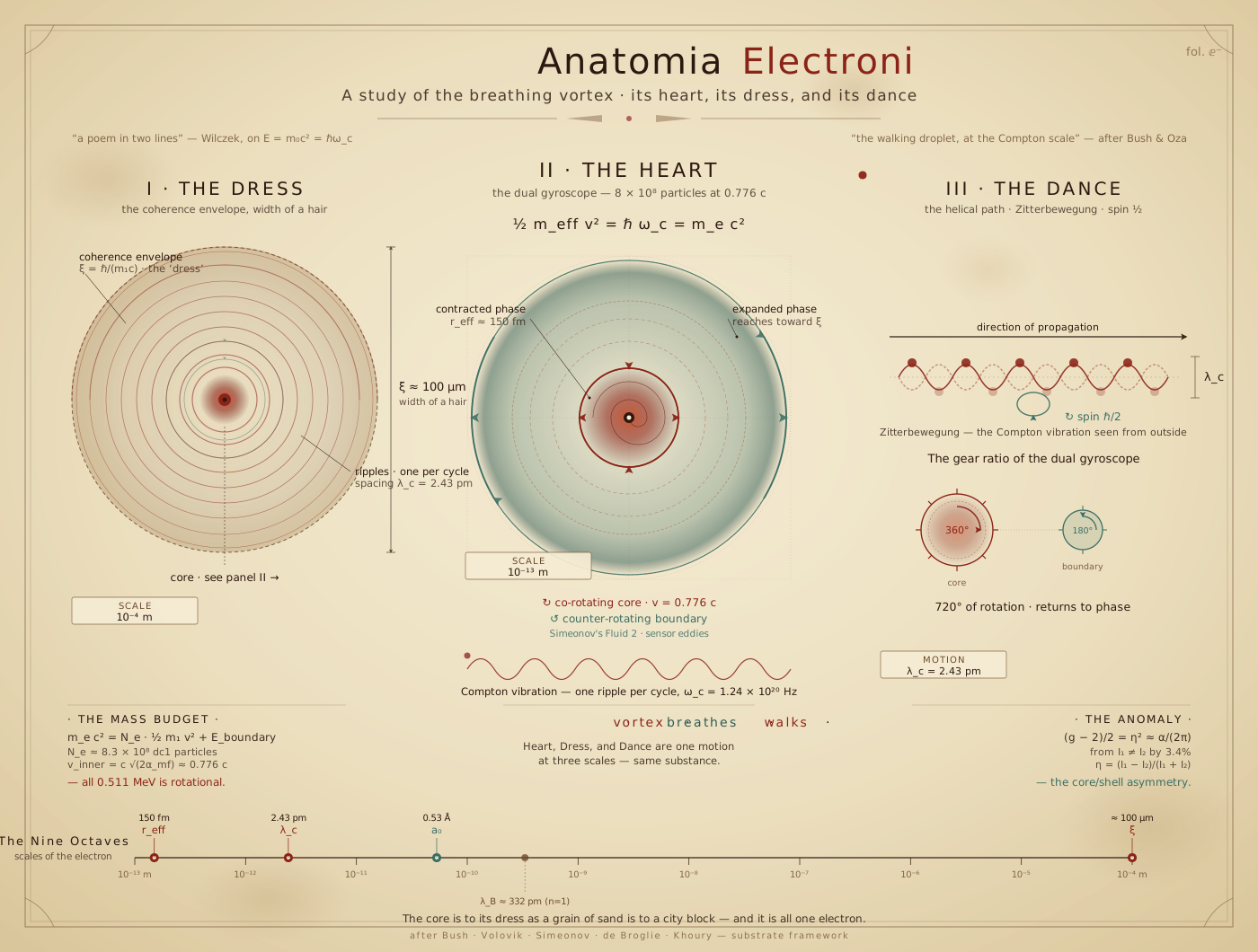
In standard QM, the electron is treated as a point particle with no internal structure, down to at least 10^{-18} meters. But it has mass (0.511 MeV/c^2), spin (½), magnetic moment, and charge — quite a lot of properties for a dimensionless dot. In the substrate picture, the electron is a high-intensity vortex storm of dc1 that entrains substrate material around it, creating a self-sustaining structure. Its mass is the total rotational energy of that structure divided by c^2.
The electron’s rest energy is the energy budget of this orbital system (Constraint C4):
m_e c^2 = N_e \cdot \tfrac{1}{2} m_1 v_\text{rot,inner}^2 + E_{\text{boundary},e}
The first term is the kinetic energy of N_e dc1 particles entrained in the orbital complex, spinning at the inner-scale velocity v_\text{rot,inner} = c\sqrt{2\alpha_{mf}} \approx 0.776c. The second is the energy stored in the counter-rotating boundary layer that separates the electron from the surrounding substrate. In the two-scale model, these N_e \approx 8.3 \times 10^8 dc1 particles condense into a single effective quantum of mass m_\text{eff} = m_e/\alpha_{mf} \approx 1.70 MeV/c^2, orbiting at v_\text{rot,inner} with radius r_\text{eff} \approx 150 fm and angular momentum \hbar.
The effective-quantum form is strikingly clean:
\boxed{\tfrac{1}{2}\,m_\text{eff}\,v_\text{rot,inner}^2 = \tfrac{1}{2}\left(\frac{m_e}{\alpha_{mf}}\right)\left(2\alpha_{mf}\,c^2\right) = m_e c^2}
The entire electron rest energy equals the kinetic energy of one effective quantum at peak contraction. This identity is algebraically forced by the definitions m_\text{eff} = m_e/\alpha_{mf} and v_\text{rot,inner}^2 = 2\alpha_{mf}\,c^2, both Subsystem A results — it is not a separate physical prediction. The non-relativistic \tfrac{1}{2}mv^2 form serves as an energy bookkeeping device for the BEC quasiparticle; it should not be interpreted as implying a Lorentz factor \gamma = 2. (At v = 0.776c the actual Lorentz factor is \gamma \approx 1.58; the BEC dispersion relation E^2 = \mu^2 + c^2p^2 does not map onto standard relativistic kinetic energy.) The factor of two is instead the breathing/pairing two — the radial Compton breath runs at twice the orbital rate, the temporal face of the lattice’s \xi^2 = 2\,\xi_\text{GP}^2 pairing (see Open Problems § WIP-12). The two C4 terms are not independent degrees of freedom — they are the extrema of the Compton oscillation described below.
The key insight from Bush’s work is that a vibrating particle coupled to a wave medium does something remarkable: it self-propels, creates a pilot wave that guides it, and exhibits quantized behavior — all from classical fluid dynamics. The electron in the dc1 substrate does exactly this, but at the Compton scale rather than the millimeter scale of walking droplets.
The Compton Vibration
De Broglie started with two equations that every physicist knows:
Einstein: E = m_0 c^2 (rest energy of a particle with mass m_0)
Planck: E = \hbar\omega (energy of a quantum oscillation at frequency \omega)
Set them equal and you get what Wilczek called “a poem in two lines”:
m_0 c^2 = \hbar\omega_c
This defines the Compton frequency: \omega_c = m_0 c^2/\hbar = 7.76 \times 10^{20} rad/s for the electron. That’s 1.24 \times 10^{20} Hz — a vibration completing once every 8.1 \times 10^{-21} seconds, about 10^5 times higher than visible light frequencies.
De Broglie’s radical claim was that this isn’t just algebra — the particle actually vibrates at this frequency, and that vibration creates a real wave in the medium it moves through. He spent the rest of his career being told this was naive. Bush’s walking droplets suggest he was right all along.
In the substrate picture, this vibration is literal: the electron’s vortex core oscillates, periodically exchanging energy between its internal rotational kinetic energy and the surrounding substrate. Each oscillation cycle pushes a ripple into the dc1 medium — exactly as a bouncing droplet pushes a wave into the silicon oil bath in Bush’s experiments. The electron is a tiny engine, vibrating at \omega_c and pumping energy into the substrate with every cycle.

The figure shows the mechanism unfolding in three stages, laid out side by side: isotropic ripples at rest, Doppler asymmetry in motion, then full pilot-wave guidance at orbital speed.
Stage 1: The Heartbeat (Stationary Electron)
Start with the first panel: the electron sits still in the substrate, but it is not quiet. Its vortex core is oscillating at \omega_c = 1.24 \times 10^{20} Hz, alternating between two states:
Expanded phase: The effective quantum’s orbit loosens to \sim\bar{\lambda}_C = 386 fm — energy flows out of internal rotation into radial motion and the boundary ripple, compressing the dc1 medium and launching a pressure ripple that propagates outward at c. Over many cycles these ripples accumulate into the standing pilot-wave dress that fills the coherence volume (\xi \approx 110\;\mum, nine orders of magnitude larger than the core) — but the per-cycle breath itself is bounded at the reduced Compton wavelength (see below). It is the slow accumulation, not a single breath, that reaches \xi.
Contracted phase: The effective quantum tightens to r_\text{eff} \approx 150 fm, pulling energy back from the substrate into intense rotational motion at 0.776c. The compressed substrate springs outward, launching a ripple that propagates at c.
Each cycle — expand, contract, expand, contract — pumps one ripple into the medium. The ripple propagates outward at speed c. This is the physical content of E = m_0 c^2 = \hbar\omega_c: the electron’s rest mass is the time-averaged energy of an oscillation at the Compton frequency. Half the time the energy is concentrated in rotation (contracted, radius \sim 150 fm, maximum internal spin); half the time it is in radial motion and boundary ripple (expanded, radius \sim\bar{\lambda}_C = 386 fm). The mass is the average.

A causal limit fixes how far this breath actually reaches. In one Compton period the fastest signal travels c\,T_c = \lambda_c = 2.43 pm, so the per-cycle breath cannot exceed the reduced Compton wavelength \bar{\lambda}_C = c/\omega_c \approx 386 fm — the Zitterbewegung amplitude. The electron’s heartbeat therefore oscillates by a factor \sim2.5 around r_\text{eff} = 150 fm, not by the nine orders of magnitude out to \xi.
What does reach \xi is the standing pilot-wave dress, not a single breath. Each cycle’s ripple travels outward at c; the dress fills the coherence envelope over \sim\xi/c and is thereafter quasi-static on the heartbeat timescale (it evolves \sim2.5\times10^8 times more slowly — at the dc1 lattice clock \omega_1 = m_1 c^2/\hbar, since \xi = \hbar/(m_1 c) is the dc1 Compton wavelength). The Bohr radius (a_0 = 0.53 Å) lies between the two scales; the pilot-wave field still extends to \xi, where the substrate imposes the modon boundary, providing the long-range coherence that Bush’s path memory requires. (The two-mode picture — and why the earlier “breathes to \xi every cycle” reading is causally impossible — is in Open Problems § WIP-12.)
In the C4 energy budget, N_e \cdot \tfrac{1}{2} m_1 v_\text{rot,inner}^2 is the contracted-phase peak and E_{\text{boundary},e} is the expanded-phase peak. The Compton vibration shuttles energy between the two reservoirs at \omega_c.
The ripples are one Compton wavelength apart:
\lambda_c = h/(m_0 c) = 2.43 \text{ pm}
This is about 1/20th of a Bohr radius — the natural “pixel size” of the electron’s interaction with the substrate.
Stage 2: The Doppler Pilot Wave (Moving Electron)
When the electron moves through the substrate, the ripples it emits are no longer symmetric. Ahead, each new ripple is emitted slightly closer to the previous one — the electron has moved forward between pulses, compressing the spacing. Behind, each ripple is further back, stretching the spacing. This is the Doppler effect.
The compressed wavefronts ahead overlap and interfere constructively. The stretched wavefronts behind interfere destructively. The net result: a strong, directional wave envelope builds up in front of the moving electron. This envelope is the pilot wave.
The wavelength of this envelope — the spacing of the constructive-interference peaks — is the de Broglie wavelength:
\lambda_B = h/p = h/(m_0 v)
For a stationary electron, \lambda_B is infinite (the ripples are isotropic, no envelope forms). As speed increases, \lambda_B shrinks. At the hydrogen ground state orbital speed (v = c/137):
\lambda_B = h/(m_e \times c/137) = 137 \times \lambda_c = 332 \text{ pm}
This is 137 Compton wavelengths — the constructive interference of 137 consecutive ripple wavefronts creates one de Broglie wavelength of the pilot wave envelope. The fine structure constant \alpha is the ratio of the Compton wavelength to the de Broglie wavelength: 137 ripple wavefronts fit in one pilot wave cycle. (This is a spatial ripple count; the number of Compton periods per orbital period is 1/\alpha^2 \approx 18{,}770.)
Stage 3: Self-Propulsion and Resonance
Here is where the walking droplet analogy becomes precise. The pilot wave envelope has a gradient — strongest just ahead of the electron and weaker behind. In the substrate, this gradient means the dc1 medium is denser (more compressed) ahead and thinner behind. The electron’s orbital system, embedded in this medium, gets pushed forward by the density gradient — toward the denser region.
This is self-propulsion. The electron creates a wave → the wave builds up ahead → the wave gradient pushes the electron forward → the electron creates more wave ahead. It’s a positive feedback loop, and Dagan and Bush showed mathematically that this feedback stabilizes at exactly the speed where the de Broglie relation p = \hbar k holds. The electron converges to its “natural walking speed” for the given momentum.
The harmony of phases — de Broglie’s phrase for the most important synchrony condition — is this: the electron’s internal vibration at \omega_c must stay in phase with the pilot wave oscillation at the location of the electron. If the electron’s vibration pushes on the substrate at the exact moment the pilot wave is pulling substrate toward the electron, the two reinforce. If they’re out of phase, they fight, and the walking state is unstable.
Dagan and Bush’s HQFT paper shows that this synchrony naturally emerges. The particle automatically locks its vibration phase to its pilot wave — it’s an attractor of the coupled dynamics, not something that needs to be imposed. The substrate framework says the same thing: the dc1 medium couples the electron’s internal oscillation to the external wave field so strongly that phase-locking is the only stable state. And the HQFT paper is directly relevant: Dagan and Bush model the particle as a localized periodic disturbance in the Klein-Gordon field at twice the Compton frequency, and show that the resulting pilot wave self-propels the particle at a speed consistent with p = \hbar k. The substrate framework says this isn’t just a mathematical model — the dc1 medium is the Klein-Gordon field, and the electron’s orbital system oscillation is the source term.
The Raceway and the Quantum Potential
When the pilot wave wraps around a closed orbit and meets itself constructively, a stable standing wave forms — but what does that standing wave do to the substrate? It creates the raceway: a self-reinforcing co-rotating flow channel. The substrate in this channel is entrained by the electron’s orbital motion, flowing in the same direction as the electron. The electron rides this co-rotating flow like a surfer on a wave it created — exactly as Bush’s walking droplet rides the crest of its own wave field, propelled by the gradient in the wave amplitude.

At the edges of the co-rotating raceway, the substrate flow must transition from “moving with the electron” to “stationary background.” This velocity gradient creates counter-rotating eddies — exactly as you’d expect from fluid dynamics at a shear boundary.
These eddies are small, fast, and they respond to the curvature of the electron’s density profile. Where the density \rho has sharp features (at nodes, at the classical turning point), the eddies are intense and generate strong forces. Where \rho is smooth, the eddies are gentle and the dynamics are nearly classical.
This is Simeonov’s Fluid 2 — the “sensor fluid.” The counter-rotating eddies diffuse in response to density gradients of the co-rotating flow with diffusion constant D = \hbar/(2m). Their reaction force on the co-rotating layer is the quantum potential:
Q = -\frac{\hbar^2}{2m}\frac{\nabla^2\sqrt{\rho}}{\sqrt{\rho}}
In the hydrogen atom, Q does several crucial jobs simultaneously. Near the nucleus, where \rho peaks (s-orbital center), Q is positive — it pushes outward, preventing the electron from collapsing onto the proton. At nodes (where \rho = 0, as in p and d orbitals), the quantum force -\nabla Q points away from the node on both sides, maintaining the zero. At the classical turning point, Q creates the effective barrier that confines the electron to its orbital region.
Only circumferences 2\pi r = n\lambda_B produce stable standing waves and stable raceways. This is why the hydrogen spectrum is quantized — not from quantum axioms, but from a vibrating particle in a responsive medium with path memory. (The detailed quantization mechanism and the numerical verification at n = 1 and n = 2 are developed in The Hydrogen Atom as a Layered Orbital System.)
The Dual-Spin Gyroscope
The electron is not just a breathing oscillator — it is a two-body gyroscope. The co-rotating core (Body 1, moment of inertia I_1) and the counter-rotating boundary shell (Body 2, moment of inertia I_2) are coupled by HVBK mutual friction. An external magnetic field couples to core and boundary with opposite signs, producing a net coupling of 2L_\text{spin} — this is why g = 2 for the electron, a fact that standard QM takes as a consequence of the Dirac equation but the substrate derives from boundary mechanics.
The core and boundary moments of inertia are not exactly equal. Their asymmetry \eta = (I_1 - I_2)/(I_1 + I_2) \approx 0.034 — a 3.4% difference — produces the anomalous magnetic moment:
(g-2)/2 = \eta^2 = \alpha/(2\pi) \approx 0.00116
This is derived from the Weinberg angle with zero new parameters (see Spin-Statistics and Fine Structure Constant), giving a tree-level prediction within 1.6% of the measured value.
A remarkable cross-check from the constraint system: the dual-spin internal precession frequency \omega_\text{internal} = 2K_r/I_\text{eff} equals \omega_c — the Compton frequency. The electron’s “heartbeat” (the Compton breathing that generates the pilot wave) and its “spin precession” (the internal relative rotation of core and boundary) are the same physics. One oscillation, two descriptions.
The Zitterbewegung Connection
In 1930, Schrödinger discovered that the Dirac equation predicts the electron should undergo rapid trembling motion — Zitterbewegung — at the Compton frequency, with amplitude on the order of the Compton wavelength. For decades this was considered a mathematical artifact with no physical meaning.
In the substrate picture, Zitterbewegung is the Compton vibration viewed from outside. The electron’s orbital system is expanding and contracting at \omega_c, and the center of mass of the system traces out a tiny helical or jittering path as a result. This jitter is real in the substrate — it’s the physical motion that generates the pilot wave.
Bush’s 3D pilot-wave paper makes this explicit: when the dynamics are fully resolved, the particle follows a helical path. If the helix diameter (the Compton wavelength) is too small to resolve — as it always is in non-relativistic experiments — you see only the smooth center-of-mass motion along the helix axis, but the particle appears to have intrinsic angular momentum. This is how spin-½ emerges from the helical Zitterbewegung: the unresolved helix carries angular momentum \hbar/2 aligned with the direction of motion.
The 720° rotation property — the hallmark of spin-½ — follows from the boundary’s half-periodicity: the counter-rotating shell completes half a rotation for each full rotation of the core. After 360° of external rotation, the core-boundary relative phase has shifted by 180°; it takes 720° to restore the full state. This is not mysterious — it is the gear ratio of a dual-spin gyroscope with a 2:1 reactive coupling (see Spin-Statistics).
The Energy Budget of One Vibration Cycle
In each Compton cycle (period T_c = 2\pi/\omega_c = 8.1 \times 10^{-21} s), the electron exchanges energy \Delta E with the substrate:
\Delta E \sim \hbar\omega_c = m_0 c^2 = 0.511 \text{ MeV}
That seems enormous — the electron is exchanging its entire rest mass energy with the substrate every cycle. But this isn’t “spending” energy. It’s an oscillation, like a pendulum swinging between kinetic and potential energy. The time-averaged energy exchange is zero. What matters is the ripple generated by each cycle, which carries a tiny fraction of the total energy outward as the pilot wave.
The power radiated into the pilot wave is:
P_\text{pilot} \sim \hbar\omega_c \times (v/c)^2
For v = c/137 (hydrogen ground state), this is about 0.511 MeV \times (1/137)^2 \approx 27 eV per Compton cycle. But the pilot wave is not lost — it stays in the substrate as a standing wave pattern that guides the electron back to itself. The energy circulates: electron → substrate → pilot wave → back to electron. The system is self-sustaining, with no net radiation loss in a stable orbit. Energy only leaves the system when the orbit changes — and that is the photon emission mechanism described in The Photon as Modon.
What This Means for the Substrate
This is where the Bush/Oza program, de Broglie’s original vision, and the dc1 substrate all converge. Bush’s work identifies three critical features for quantum-like behavior, and all three are physical mechanisms in the dc1 medium.
The electron’s Compton-frequency vibration provides the self-generated pilot wave. The synchrony between the internal oscillation and the orbital period provides the resonance — de Broglie’s “harmony of phases.” The persistence of the wave pattern in the substrate provides the path memory. None of these are abstract mathematical constructs. They are fluid dynamics in a specific medium.
In standard QM, the wavefunction \psi is a probability amplitude with no agreed-upon physical meaning. In the substrate framework, \psi = \sqrt{\rho}\,\exp(iS/\hbar) decomposes into two measurable quantities — \rho is the co-rotating substrate density, and S is the phase of the pilot wave flow. The quantum potential Q emerges from the interaction between the co-rotating flow and the counter-rotating eddies at its boundaries. Nothing is mysterious. Nothing requires interpretation. It’s fluid dynamics.
The next chapter examines what happens when the electron’s standing wave pattern organizes the substrate into a layered flywheel — the full architecture of the hydrogen atom, from the proton core through the Coulomb region to the confinement boundary and beyond.