Chloroplast Anatomy
Three wraps for substrate-current input, the mitochondrion’s mirror across the cell’s energy axis
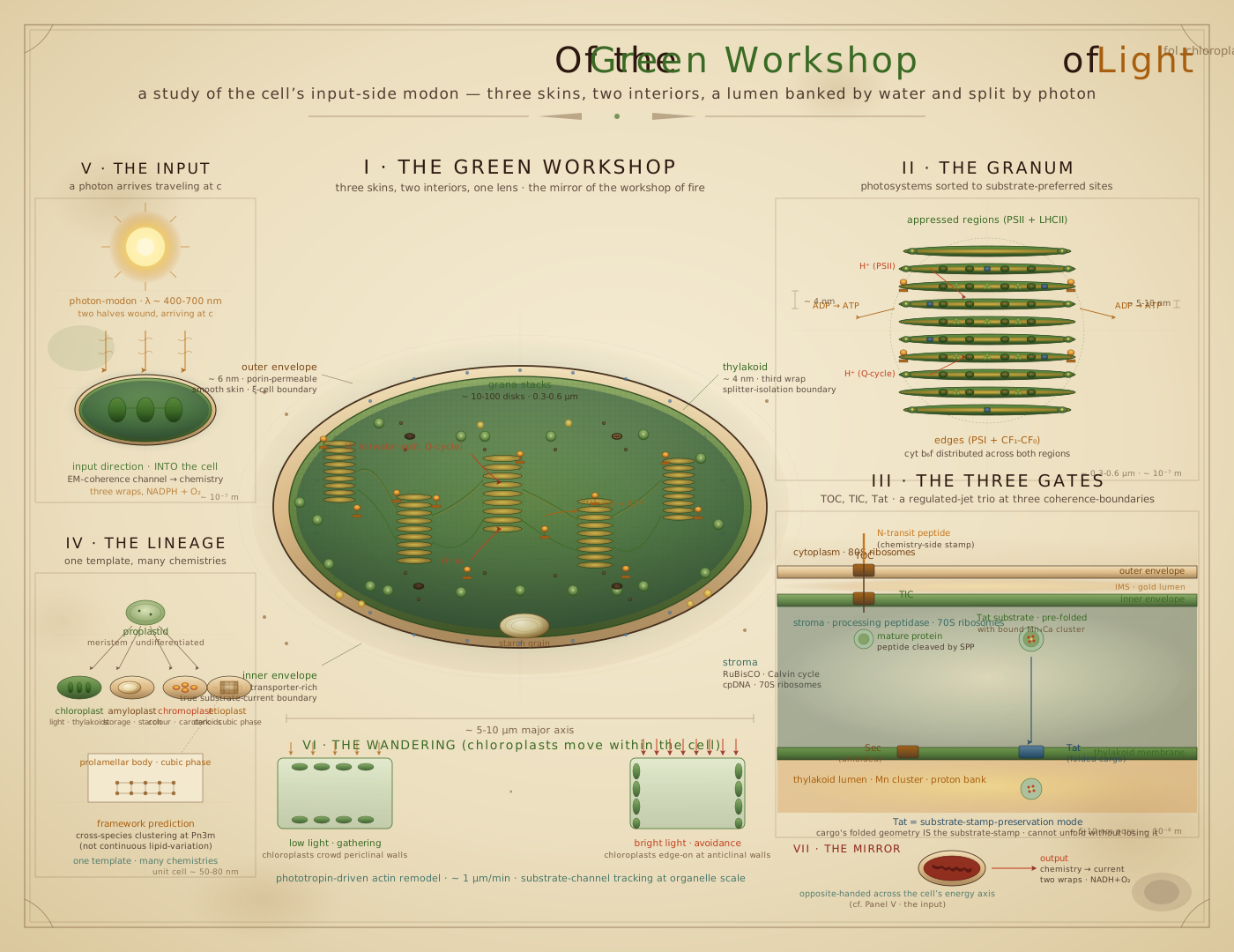
A chloroplast is a lens-shaped organelle, \sim 5–10\;\mum long and \sim 2–4\;\mum thick, that sits in the cytoplasm of plant and algal cells at \sim 10–100 copies per mature mesophyll cell. It is wrapped by three distinct membranes — an outer envelope (smooth, porin-permeable, \sim 6 nm thick), an inner envelope (transporter-rich, \sim 7 nm thick, the true selectivity boundary), and the thylakoid membrane, an entirely separate compartment in the form of flattened sacs that stack into grana (\sim 10–100 disks per granum, \sim 0.3–0.6\;\mum diameter) connected by stromal thylakoid lamellae threading between the grana. Inside the inner envelope lies the stroma, the chloroplast’s matrix-analog, where RuBisCO, the Calvin–Benson cycle, the chloroplast genome (\sim 80–120 kb of circular cpDNA in \sim 10–100 nucleoid copies per organelle), and the organelle’s own 70S ribosomes operate. Inside the thylakoid membrane lies the lumen, a separate aqueous compartment of \sim 5–10 nm thickness across the lumen where the proton gradient is banked. Three wraps, two interior compartments, one organelle.
The chloroplast is a cell’s substrate current input mechanism, to capture and store energy. It’s the mirror of the mitochondrion, taking substrate innergy in via an electromagnetic-coherence channel — photon-modons arriving at c — through three wraps, two interior compartments, and a separately-isolated photosynthetic apparatus. It uses the same canonical loop with one additional coherence-isolation wrap to handle the steeper isolation demand the input direction places on the organelle.
This chapter shows the wrap architecture, the surface-amplification rung, the polar stroma-vs-lumen wrap-direction signature, the regulated-jet trio at the envelopes and the thylakoid, the cpDNA retention pattern, and chloroplast movement as organelle-scale substrate-channel tracking.
The chloroplast uses the same splitter physics developed in modon-to-atp.qmd.
Three Wraps for the Input Direction
The mitochondrion has two membranes (OMM, IMM) and one internal-folding system (cristae, which are folds of the IMM, not a topologically separate compartment). The chloroplast has three membranes (outer envelope, inner envelope, thylakoid) with the thylakoid as a topologically separate compartment — its lumen is not continuous with the stroma, the way the IMS is continuous with the perforations of the IMM at crista junctions. The thylakoid is a genuine third wrap, established as a separate coherence-isolated volume during plastid development and maintained as a separate volume throughout the chloroplast’s life.
The framework reads this extra wrap as a structural signature of the substrate-current-input direction. The photon-modon arrives at the chloroplast from outside the cell at c, carrying its two counter-rotating halves coupled together. To split it, bank one half (the proton gradient), and walk the other half down the cofactor chain to NADPH without back-coupling either half into the surrounding cytoplasm, the substrate-current must be confined within a coherence-boundary that isolates the splitter geometry from both the cytoplasm and from the rest of the chloroplast’s chemistry. Two wraps would leave the splitter exposed to the stroma’s RuBisCO, soluble enzymes, and stochastic cytoplasmic traffic; three wraps — one for the cytoplasm boundary (outer envelope), one for the substrate-current boundary (inner envelope), one for the splitter-isolation boundary (thylakoid) — give the photon’s two halves their own coherence-protected compartment to be separated in.
The mitochondrion does not need this. Its substrate-current input is chemical (the reducing equivalents extracted from food by glycolysis and the TCA cycle), it arrives at the IMM from the matrix side already inside the organelle, and the matrix can host both the TCA cycle and the IMM-embedded splitter (Complex III’s Q-cycle) without coherence-cross-talk because the TCA cycle’s chemistry runs at a slower timescale than the proton circuit. The chloroplast’s substrate-current input is electromagnetic, it arrives from outside the cell at c, and the Calvin–Benson cycle in the stroma runs on a timescale comparable to RuBisCO’s catalytic cycle (\sim 3 s per RuBisCO turnover) — fast enough that coherence-cross-talk between splitter and carbon-fixation chemistry would be a real problem without an extra wrap separating them. The framework reads the third wrap as the substrate-mechanical signature of the input-direction architecture.
Grana, Stromal Thylakoids, and Substrate-Current Surface Amplification
Thylakoid disks stack into grana with \sim 10–100 disks per stack, granum diameters of \sim 0.3–0.6\;\mum, and tight inter-disk gaps of \sim 3–5 nm — the appressed-membrane region where the cytoplasmic faces of adjacent disks come into close substrate-mechanical contact. The intra-thylakoid lumen between the two leaflets of a single disk is similarly \sim 5–10 nm. Across grana, stromal thylakoid lamellae extend out into the stroma and connect grana to one another in a three-dimensional network, with \sim 3-fold junctions at the connection points reminiscent of the ER’s three-way junctions at a smaller membrane scale.
The framework reads thylakoid stacking as the substrate-current surface-amplification at the chloroplast rung, the chloroplast’s analog to cristae folding at the mitochondrion and disc stacking at rod outer segments. Total thylakoid surface area is amplified \sim 50–100\times over the inner envelope alone — substantially steeper than the mitochondrion’s cristae amplification (\sim 5–10\times) and approaching the rod outer segment’s disc-stack amplification (\sim 10^3\times). The framework’s reading is that surface-amplification factor tracks substrate-current load: the rod’s EM-photon-counting demand is steeper than the chloroplast’s photosynthetic-input demand (single-photon sensitivity vs. bulk photon flux), which is in turn steeper than the mitochondrion’s chemical-input demand (food turnover at organism-feeding cadence). In the ladder’s terms the grana stack is a lock-pole lattice — a periodic lamellar stack nesting on the substrate’s \sqrt2 rungs to amplify the surface that catches the photon — the chloroplast’s copy of the rod disc stack, and one of the chloroplast’s two poles.
The intra-thylakoid lumen width (\sim 5–10 nm) and the inter-disk appressed-region width (\sim 3–5 nm) fall in the same sub-organelle band of the substrate’s spacing comb as crista junctions (\sim 25 nm), ER contact gaps (\sim 10–30 nm), vesicle-coat radii (\sim 30–50 nm), rod-disc spacings (\sim 25–32 nm), myelin lamellar period (\sim 12 nm), and synaptic clefts (\sim 20–25 nm) — the substrate’s preferred discrete spacings at the sub-organelle scale, with the thylakoid sitting at the tighter end. These run \sim 3–50 nm, roughly four octaves, so the framework’s claim is not that they share one rung but that they fall on adjacent teeth of the substrate ladder’s \sqrt{2} comb rather than spreading continuously; it predicts cross-phylum clustering of thylakoid spacings on those teeth rather than continuous variation with lipid composition.
The functional segregation across the thylakoid network is structurally suggestive. PSII is concentrated in the appressed-membrane regions of granum stacks; PSI and ATP synthase are concentrated in the stromal thylakoid lamellae and the granum edges (the margin regions); cytochrome b_6 f distributes across both regions. This lateral heterogeneity is biology’s chemistry-side implementation of a substrate-coherent spatial separation of the splitter (PSII at the substrate-coherent stacking position), the second splitter (cytochrome b_6 f, the Q-cycle equivalent — see modon-to-atp.qmd), and the rotor (CF_1-CF_0 at the edge where stromal-side ADP and P_i are abundant). The framework reads the segregation as substrate-mechanical: the splitter and the rotor sit at different substrate-coherent rungs of the thylakoid network, the way the cell sits PSII and CF_1-CF_0 at different substrate-coherent positions of the membrane.
Polar Architecture: Stroma vs. Lumen
The proton gradient sits in the thylakoid lumen. RuBisCO, the Calvin–Benson cycle, the chloroplast genome, and the carbon-fixation machinery sit in the stroma. The stroma-vs-lumen polarity is the chloroplast’s wrap-direction signature, structurally parallel to the matrix-vs-IMS polarity at the mitochondrion, the nucleoplasm-vs-perinuclear polarity at the nucleus, the lumen-vs-cytosol polarity at the ER, and the cis-medial-trans polarity at the Golgi. The chloroplast is therefore an eighth polar substrate-reader (after the seven the cellular walk catalogued — DNA’s polar channel, ER junctions, Golgi cis-trans, endosomal pH ladder, nucleolar FC-DFC-GC, mitochondrial proton gradient, and ciliary axial gradient).
The handedness is opposite to the mitochondrion’s. At the mitochondrion, the matrix is the “inner” coherence-rich compartment and the proton gradient is banked in the IMS (between the IMM and OMM); protons flow out of the matrix across the IMM into the IMS, then back across the IMM through ATP synthase. At the chloroplast, the stroma is the “inner” coherence-rich compartment and the proton gradient is banked in the thylakoid lumen (entirely interior to all three wraps); protons flow into the lumen across the thylakoid membrane (driven by PSII’s water-splitting and the b_6 f Q-cycle), then back out across the thylakoid into the stroma through ATP synthase. The wrap-direction inversion is the substrate-mechanical signature of the input vs. output direction: substrate-current arrives from outside and is converted to a chemical gradient that flows back toward the chemistry-coherent interior (chloroplast); substrate-current is extracted from chemistry in the interior and converted to a chemical gradient that flows back toward the substrate-coherent interior (mitochondrion). Same architecture, opposite handedness across the energy axis.
Photosystems and the Z-Scheme — Two Splitters in Series
Photosystem II and Photosystem I sit on the thylakoid membrane and are connected by the cytochrome b_6 f complex through the mobile electron carrier plastoquinone (PQ) on the membrane and plastocyanin (PC) in the lumen. The Z-scheme — PSII excites an electron to high reduction potential, the electron descends through PQ to b_6 f where the Q-cycle bifurcates it into proton-pumping and onward-electron flow, PSI re-excites the now-reduced PC-delivered electron to high reduction potential a second time, the electron descends to ferredoxin and then NADP^+ — is the chloroplast’s substrate-current-input arm of the canonical loop with two splitter events rather than one.
The reason for two splitters is energetic. The framework reads it through the splitter mechanics modon-to-atp.qmd worked out. Water splitting at PSII operates at \sim +1.1 V (the reduction potential of the O_2/H_2 O couple, the most oxidising substrate readily available to biological chemistry); NADP^+ reduction at PSI’s terminal acceptor operates at \sim -0.32 V (NADP^+/NADPH couple). The total energetic span is \sim 1.4 V — larger than the energy a single visible photon (\sim 1.8 V at \sim 700 nm) could span if quantum efficiency were unity, but tight enough at the PSII end (P680^* \to P680^+, \sim 0.8 V drop) and at the PSI end (P700^* \to P700^+, \sim 1.0 V drop) that one photon per splitter fits if the architecture stages them in series. The framework reads two-photosystems-in-series as the substrate’s preferred staging when one photon-modon’s splitter-arc cannot cover the full energetic gap: stack two substrate-coherent splitters with a mobile-carrier bridge between them, and the substrate’s modon-handling capacity at fixed photon energy is extended to span the larger gap. Mitochondrial respiratory chains run one splitter (Complex III) because their input is chemical (NADH, \sim -0.32 V) and their output is electrochemical (\sim +0.8 V for the O_2/H_2 O couple at the terminal Complex IV), an energetic gap of \sim 1.1 V — still substantial, but one Q-cycle splitter at b c_1 extracts the useful PMF from it. The chloroplast’s Z-scheme is the input-direction architecture’s analog: two splitters because the EM-input span is larger and a single splitter cannot extract enough useful PMF from a single photon to cover both ends.
The chapter does not redo the splitter quantum-yield analysis, the bacterial-RC anchor, or the Q-cycle bifurcation accounting modon-to-atp.qmd developed. The reading the framework adds here is structural: two splitters in series is the input-direction’s architectural signature, the chloroplast’s chemistry-side implementation of the substrate’s preferred multi-stage modon-splitting at energy gaps larger than one photon can span.
TOC, TIC, and Tat — A Trio of Regulated Jets
Protein import into the chloroplast crosses three membranes and requires three import machineries acting in sequence. Most chloroplast proteins are nuclear-encoded, synthesised on cytoplasmic 80S ribosomes with N-terminal transit peptides, and imported through TOC (translocon at the outer chloroplast envelope) and TIC (translocon at the inner chloroplast envelope) into the stroma, where stromal processing peptidase cleaves the transit peptide. Proteins destined for the thylakoid carry a second targeting sequence revealed after stromal cleavage, and cross the thylakoid membrane through one of four pathways — most importantly the Sec pathway (for unfolded proteins, analogous to bacterial Sec) and the Tat pathway (twin-arginine translocation, for fully-folded proteins, including those with bound cofactors).
The framework reads the TOC/TIC pair as regulated jets at the chloroplast envelope coherence-boundary, structurally parallel to TOM/TIM at the mitochondrion, NPCs at the nucleus, and the transition zone at the cilium. The cargo’s transit peptide is the chemistry-side stamp; the TOC/TIC machinery is the chemistry-side selectivity gate; the inner-envelope membrane potential and the stromal ATP/GTP pool drive the directionality. All three properties match the regulated-jet template the cellular walk established.
The Tat pathway is architecturally distinctive. It transports pre-folded protein cargo across a coherence-boundary, including multi-subunit complexes with bound cofactors (the Rieske Fe-S protein of b_6 f, the OEC Mn cluster precursor at PSII). Sec, NPC, TOM/TIM, and the transition zone all require their cargo to unfold (or to never have folded) for transit; Tat does not. The framework reads Tat as the substrate’s preferred boundary-matching transport mode when the cargo’s folded state carries the substrate-coherent stamp — when the substrate-coherent geometry of the cofactor + protein complex is itself what must be preserved across the wrap, unfolding would erase exactly the substrate-stamp that justifies importing the complex in the first place. Tat’s chemistry-side machinery (the TatA/TatB/TatC complex, twin-arginine recognition, proton-gradient-driven translocation) is biology’s chemistry-side implementation of this substrate principle. The framework predicts that Tat substrates should cluster on the substrate-coherence-cost metric: substrates whose folded geometry carries a substrate-stamp the unfolded form would lose are Tat substrates; substrates whose substrate-coupling is sequence-encoded rather than geometry-encoded are Sec substrates. This is a sharper sorting rule than the conventional “folded vs. unfolded” reading and is independently testable.
cpDNA Retention — Substrate-Coherence-Critical Placement
The chloroplast retains \sim 80–120 protein-coding genes (depending on species; \sim 130 in Marchantia, \sim 80 in some parasitic plants, \sim 100 in Arabidopsis) — substantially more than the mitochondrion’s \sim 13. Why this number, and what specifically is retained?
The framework reads the chloroplast’s retention pattern through the same substrate principle mitochondrial-anatomy.qmd developed for mtDNA: retained genes encode proteins placed at the substrate-coherence maximum of the organelle’s substrate-current architecture, where co-translational insertion at the wrap they serve is substrate-mechanically preferable to import after cytoplasmic synthesis. The retained set is dominated by photosystem core subunits (PsbA = D1, PsbB = CP47, PsbC = CP43, PsbD = D2 at PSII; PsaA, PsaB at PSI), b_6 f subunits (PetA = cytochrome f, PetB = cytochrome b_6), ATP synthase subunits (AtpA/B/E/F/H/I), the large subunit of RuBisCO (RbcL), and components of the chloroplast translation machinery (ribosomal proteins, tRNAs, rRNAs).
The single cleanest case is PsbA / D1. D1 sits at the substrate-coherence maximum of PSII — it holds the OEC’s Mn_4CaO_5 cluster, the P680 chlorophyll-pair, the pheophytin acceptor, the Q_A/Q_B plastoquinone-binding sites, and the redox-active tyrosine Y_Z — and is the most-translated chloroplast-encoded protein, turned over every \sim 30 minutes under bright light. The reason it must be encoded in the chloroplast is the same reason the mitochondrion encodes COX1, COX3, ATP6, ATP8, ND1-6 and CytB: D1’s substrate-coherent geometry (the chirality of its cofactor cage, the precise placement of redox-active residues against the substrate’s preferred bond-stamp geometry) is what makes PSII a near-unity-quantum-yield splitter, and co-translational insertion at the thylakoid membrane (where the substrate-coherent geometry can lock into place against the membrane’s substrate-coherent stamp) is the only way to assemble the splitter at the substrate-coherence-quality the organelle requires.
The framework’s prediction parallels the mtDNA-retention prediction: across photosynthetic phyla (cyanobacteria \to glaucophytes \to red algae \to green algae \to land plants \to secondary endosymbionts) the retained-gene set should track a substrate-current-density ranking, with the genes most central to substrate-coherence-quality (D1, P700-binding subunits of PSI, b_6 f cytochrome subunits, RuBisCO L) retained universally and the genes serving less substrate-coherence-critical functions retained variably according to each lineage’s chemistry-side trade-offs. The chloroplast’s larger retained set (vs. mitochondrion’s \sim 13) reflects the larger photosynthetic apparatus — more substrate-coherence-critical positions to staff — not a difference in the underlying substrate principle.
Chloroplast Movement as Organelle-Scale Phototropism
Chloroplasts physically move within the cell in response to light intensity and direction. Under low light, chloroplasts cluster at the periclinal walls of mesophyll cells (the cell faces parallel to the leaf surface, where light arrives) — the gathering response. Under high light, chloroplasts spread along the anticlinal walls (perpendicular to the leaf surface, edge-on to the light) — the avoidance response. The movement is driven by an actin-cortex remodelling response to phototropin blue-light receptors (PHOT1, PHOT2) and is fast enough (\sim 1\;\mum/min) to track diurnal and weather-driven light changes.
The framework reads chloroplast positioning as substrate-channel tracking at organelle scale — the chloroplast modon adjusting its position within the cell modon to optimise its substrate-current input from the substrate’s electromagnetic-coherence channel. This is structurally parallel to (and developmentally continuous with) the organism-scale phototropic response the tropisms-and-substrate-response.qmd chapter will develop — the same substrate-channel-tracking principle expressed at two different rungs of the cell-leaf-plant stack. Read through the ladder’s two poles, the two light responses are the two poles: the gathering response spreads the chloroplasts to collect light uniformly without shadowing one another (the anti-lock pole), while the avoidance response clumps them edge-on to self-shade and shed the excess (the lock pole) — a slide between poles by light state that the next section reads in full.
The brain walk’s multi-scale substrate-coherent stack lifts to plants here, with the chloroplast as the smallest-scale rung. Five nested scales of substrate-coherent organisation in a photosynthetic plant: chloroplast positioning within the cell (\mum scale, this chapter); cell-modon fusion via plasmodesmata across the leaf symplast (10–100\;\mum scale, plant-cell-and-plasmodesmata.qmd next chapter); RuBisCO commit and Calvin loop within the stroma (turnover scale, calvin-cycle-as-loop.qmd); phloem-xylem polar substrate-reader at organism scale (10^{-1}–10^1 m, phloem-xylem-polar-transport.qmd); mycorrhizal-network substrate-coherence at forest scale (10^1–10^4 m, mycorrhizal-network.qmd). Each rung is a chemistry-side implementation of the same substrate-channel-tracking principle the chloroplast does at the inside of its first wrap.
The Chloroplast at Both Poles
Two structures this chapter has already described stand at opposite poles of the substrate ladder, and the chapter drew the first of them a few sections ago without naming the pole. The thylakoid disc stack is a periodic lamellar lattice — the lock pole, a structure that nests on the substrate’s \sqrt2 rungs to amplify the surface that catches the photon, the same periodic disc stack the chapter already matched to the rod outer segment. The chloroplast array across the mesophyll is the opposite move: a planar tiling of photon collectors that must cover the leaf face uniformly while no two shadow one another — the anti-lock pole, the geometry that refuses to lock, because a regular lattice of absorbers would self-shadow in coherent bands the way a regular sampling lattice aliases.
This makes the chloroplast the plant kingdom’s copy of an architecture the paper has already read in the eye. The retina builds both poles at once — a photoreceptor disc stack that locks to resonate with the photon, beside a cone mosaic that refuses the lattice to avoid aliasing — and it is the clearest single-organ case of the sign-rule in the paper. The chloroplast is its twin in a lineage that shares no chemistry and no history with animal vision: the same disc-stack-locks-while-the-array-refuses design, built to collect photons for carbon chemistry rather than to detect them for sight. The leaf is to the chloroplast what the retina is to the photoreceptor — a plane tiled with photon-handling units that must sample it without coherent overlap — and the framework’s cone-mosaic reading transfers directly: the anti-lock pole laid down in a plane is disordered hyperuniform blue noise, as uniform as a crystal on long wavelengths yet carrying no Bragg comb.
The chloroplast adds a mode the eye does not have. The retina occupies both poles by structure — it holds the lattice and its refusal simultaneously in space. The chloroplast occupies them that way and slides between them by state, the way the cortex slides in time: under low light the gathering response spreads the chloroplasts to the illuminated periclinal wall to maximise uniform capture (the anti-lock spread), and under high light the avoidance response clumps them edge-on along the anticlinal walls to self-shade and shed the excess (the lock-pole clump, deliberate self-shadowing as photoprotection). Self-shadowing is to a light-collecting array what aliasing is to a light-sampling one — the coherent-overlap failure the anti-lock pole exists to scatter — and the chloroplast’s two light responses are the two poles of the one ladder, named before the measurement by what each is for: collect uniformly \to spread \to blue noise; protect by overlapping \to clump \to lock.
The honest accounting is the cone mosaic’s. That chloroplasts accumulate toward weak light and avoid excess, and distribute fairly evenly when gathering, is textbook (Kasahara et al. 2002; Wada 2013); what the framework adds is the reading — that the gathering distribution is specifically the anti-lock pole’s hyperuniform packing rather than either a lattice or a random scatter, that it is the same pole the retinal cone mosaic reaches in a kingdom sharing none of its chemistry, and that the gathering/avoidance switch is a both-poles slide by state. As with the retina this is an application of the sign-rule in the framework’s own biology, not a chemistry-free witness of the gap; its payoff is a sharp, untested prediction, set out below.
Plastid Types and the Etioplast’s Cubic Phase
Chloroplasts are one of several plastid types — interconvertible organelles with shared envelope architecture but specialised internal contents. Amyloplasts (in storage tissues like potato tubers) carry large starch grains; chromoplasts (in fruits and flowers) carry carotenoid bodies; etioplasts (in dark-grown seedlings) carry a paracrystalline prolamellar body with cubic-phase membrane geometry; proplastids (in meristems) are the undifferentiated precursor. All derive from proplastids and most can interconvert in response to developmental and environmental cues.
The framework reads the plastid family as one organelle architecture under different chemistry-side specialisations, parallel to the way mitochondria and peroxisomes share lineage-level architectural elements but specialise to different substrate-current roles. The proplastid is the substrate-coherent template; chloroplast, amyloplast, chromoplast, and etioplast are chemistry-side implementations of that template at different functional roles.
The etioplast’s prolamellar body is the most substrate-geometrically interesting plastid form. It is a bicontinuous cubic-phase membrane lattice with \sim 4-fold connectivity at each membrane node and a unit-cell parameter of \sim 50–80 nm. The known lipid-cubic-phase symmetries (Im3m, Pn3m, Ia3d) are three discrete substrate-mechanically-stable bicontinuous configurations; the prolamellar body’s cryo-EM-resolved geometry has been variously assigned to Pn3m or Im3m depending on hydration and species. The framework predicts the prolamellar body geometry should cluster at one substrate-preferred cubic-phase symmetry across species (most likely Pn3m, the most substrate-mechanically stable of the three at biological lipid composition), with apparent variation reflecting fixation artefacts rather than genuine cross-species variation.
Predictions and What Would Falsify
Five predictions extend the architectural reading beyond the structural anchors.
Thylakoid intra-lumen and inter-disk spacing clusters at substrate-preferred rungs across photosynthetic phyla. The \sim 5–10 nm thylakoid lumen and \sim 3–5 nm inter-disk gap should sit at substrate-preferred discrete values across cyanobacteria / glaucophytes / red algae / green algae / land plants, distinct from continuous variation with lipid composition. Cryo-electron tomography of intact thylakoid networks across photosynthetic lineages provides the test; the framework predicts cross-phylum preferred-rung clustering parallel to the crista-junction, ER-contact-gap, and synaptic-cleft clustering predictions established for those rungs.
cpDNA retention tracks a substrate-current-density ranking parallel to mtDNA retention. Across phyla, the chloroplast-encoded gene set should track a ranking by substrate-coherence-criticality — D1, P700-binding subunits, b_6 f cytochrome subunits, ATP synthase Fo subunits, and RbcL retained universally; less substrate-coherence-critical genes (peripheral subunits, accessory components) retained variably. Genome-comparison studies across plastid lineages provide the existing data; the framework predicts retention probability scales with substrate-coherence-criticality rather than with hydrophobicity or co-translational-insertion necessity alone.
Tat substrates sort on substrate-stamp-preservation rather than fold-state alone. Across the Tat-substrate database, the substrates that must use Tat (rather than that can use Tat) should be those whose folded geometry carries a substrate-coherent stamp — a bound cofactor’s substrate-coupling geometry, or a multi-subunit substrate-coherent assembly — that the Sec pathway’s unfolded-state transit would erase. Substrates that are Tat-compatible but not Tat-obligate should fall outside this set. Reconstituted import assays comparing Sec-vs-Tat transit for substrate-stamp-bearing vs. sequence-only cargo provide the test; the framework predicts the substrate-stamp-bearing set as the Tat-obligate set.
Etioplast prolamellar-body geometry clusters at one substrate-preferred cubic-phase symmetry across species. Across plant lineages with etioplasts, the prolamellar-body cubic-phase symmetry should cluster at Pn3m (or another single substrate-preferred symmetry) rather than vary continuously with lipid composition or species. Cryo-electron tomography and SAXS measurements across etioplast-bearing species (and across hydration states within species) provide the test; the framework predicts cross-species clustering at one symmetry distinct from a continuous-distribution expectation.
Chloroplast positioning is disordered hyperuniform under the gathering response and clumped under avoidance. Under low-light gathering, the planar arrangement of chloroplast centroids across the periclinal mesophyll face should be disordered hyperuniform — as uniform as a lattice on long wavelengths, with no Bragg comb — the anti-lock pole laid down in a plane and the absorptive twin of the retinal cone mosaic; under high-light avoidance the same array should clump (the lock pole, deliberate self-shading). Confocal or light-sheet imaging of chloroplast positions in the two light states, scored by the normalized number variance \sigma^2/\langle N\rangle (the
scripts/cone_mosaic.pyinstrument built for the cone mosaic predicts \sim 0.1 in the gathering state, an order of magnitude below the \sim 1 of a random gas, sliding toward clumped under avoidance), provides the test. The framework predicts the gathering distribution clusters as blue noise rather than as either a rigid lattice or a Poisson scatter, and that the gathering/avoidance switch is a light-driven slide between the two poles.
The picture is falsified if (a) thylakoid spacings vary continuously across phyla without preferred-rung clustering, (b) cpDNA retention is fully predicted by hydrophobicity / CoRR / co-translational-insertion models alone, (c) Tat substrate sorting is fully explained by fold-state and signal-peptide affinity without a substrate-stamp-preservation contribution, (d) etioplast prolamellar-body symmetries are uniformly distributed across the three known cubic phases, or (e) chloroplast positions are light-state-independent, with the gathering distribution neither hyperuniform nor sliding to a clumped avoidance state. It is supported, even partially, if any of the four ordering predictions hold against existing data.
Putting the Section in Context
The chloroplast is the cell’s chemistry-side implementation of the substrate-current-input direction, the mirror of the mitochondrion across the cell modon’s energy axis. Three wraps — outer envelope, inner envelope, thylakoid — handle the steeper coherence-isolation demand the input direction places on the organelle: the photon-modon arrives at c from outside the cell carrying its two halves coupled together, and must be split, banked, and converted inside a substrate-coherent envelope before any chemistry touches the cytoplasm. The thylakoid system’s grana stacks amplify substrate-current input surface area at \sim 50–100\times, and its stroma-vs-lumen polarity is the chloroplast’s wrap-direction signature — opposite-handed to the mitochondrion’s matrix-vs-IMS polarity, the substrate-mechanical signature of input vs. output across the energy axis. PSII and PSI in series implement the substrate’s preferred two-splitter staging when the input-direction energy gap is too large for one photon to span; the chapter hands the splitter quantum-yield mechanics back to modon-to-atp.qmd and reads the two-photosystems architecture structurally. TOC/TIC + Tat is the regulated-jet trio at the three wraps, with Tat as the substrate’s preferred boundary-matching transport mode when cargo’s folded state carries a substrate-coherent stamp. cpDNA retention places substrate-coherence-critical genes at the wrap they serve, parallel to mtDNA retention. Chloroplast movement is substrate-channel tracking at organelle scale, the first rung of the five-scale stack the rest of the Plants section builds — chloroplast-positioning, plasmodesmal cell-fusion, Calvin-cycle commit, phloem-xylem polar transport, mycorrhizal-network coherence. And the chloroplast occupies both poles of the ladder at once — its thylakoid disc stack the lock-pole lattice that catches the photon, its mesophyll array the anti-lock blue noise that collects without self-shadowing — the plant kingdom’s copy of the eye’s both-poles architecture, with a gathering/avoidance slide by light state the eye does not have.
This chapter opens the Plants in the Substrate section. The brain walk built organism-scale substrate-coherent integration on neurons and cilia-derived axons; plants run a parallel organism-scale architecture — no neurons, no action potentials, no brain modon, but the same substrate-channel-tracking principle expressed at every scale from chloroplast to forest. The substrate offers more than one solution to organism-scale coherence; biology has built both. The chloroplast is where the plant’s solution begins, at the inside of its first wrap, where the substrate’s electromagnetic channel meets the cell’s chemistry-coherent interior across three membranes and two compartments. The architecture is one architecture; the chemistry-side implementation is one of two biology has assembled at organism scale; the substrate is one substrate.