Memory and the Hippocampal Modon
The technical companion to the memory walk — place cells and grid cells as the substrate’s position readout, theta-phase precession as space recoded into time, CA3 as a pattern-completion attractor, sharp-wave-ripple replay as the night shift that files the day into cortex, and the dentate gyrus feeding CA3 as the ladder’s two poles soldered into one circuit in series
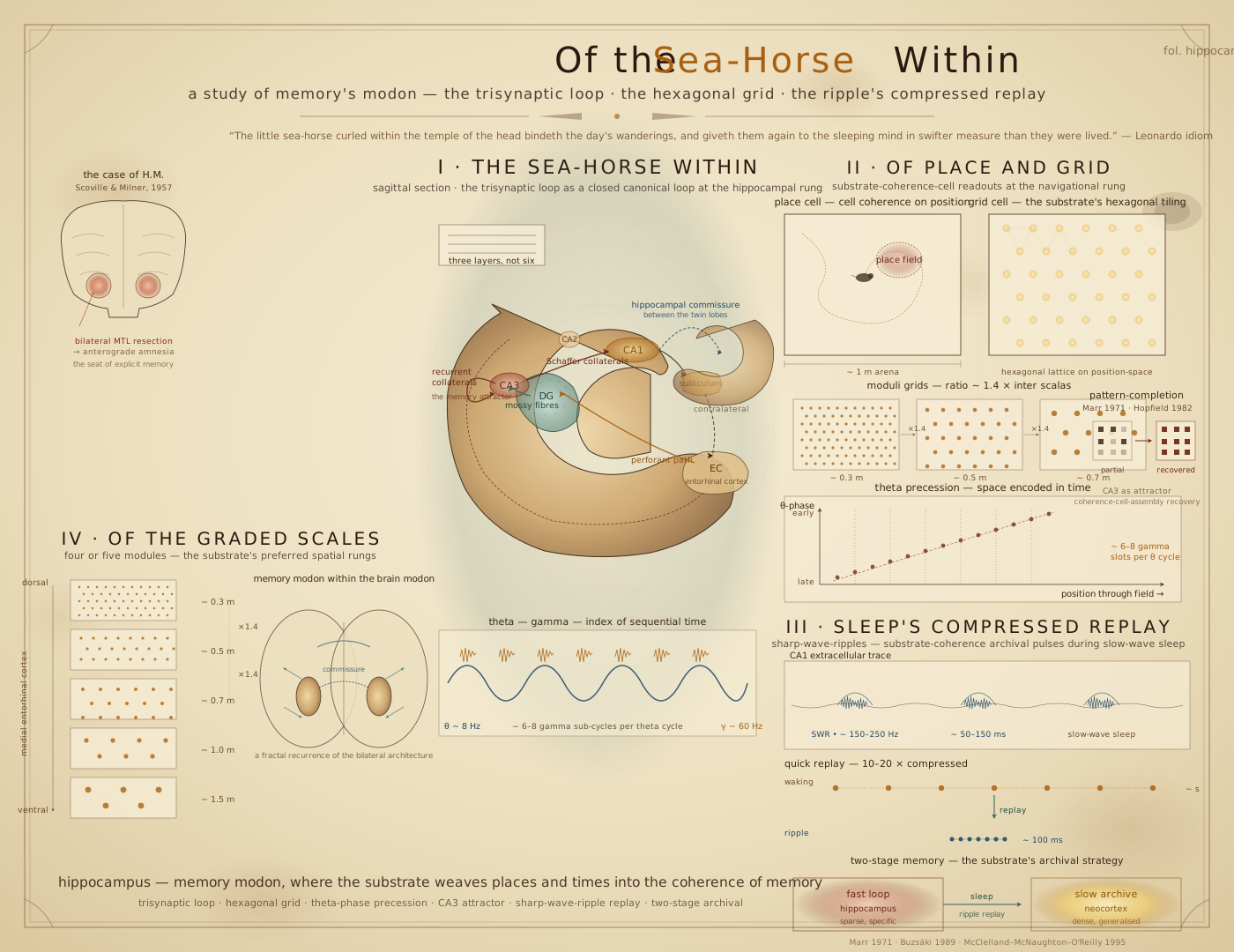
The previous chapter told the story of a memory in plain language — a moment caught as a coherent shape, filed overnight, and rung back years later by a smell. This chapter is its technical companion. It walks through the same machinery a second time, but slowly, region by region, naming the cells and the rhythms and the discoveries that earned them, and showing at each step how the framework reads them. If the memory walk was the tour, this is the engine room.
The hippocampus is the brain’s dedicated memory organ — a small, specialized sub-structure tucked under the cortex whose job is to catch the cortex’s fleeting coherent states, tag each one so it cannot be confused with its neighbours, bind it into a shape that can be recovered from a fragment, and replay it during sleep until the slow cortex has learned it for good. In the framework’s terms it is a sub-modon embedded in the larger brain modon — the resonator equations of the cortex describe the brain’s dynamics in the instant; the hippocampus is the structure that preserves those dynamics across time.
What this chapter adds to the standard neuroscience is a single interpretive move: it reads memory not as chemistry alone — synapses growing stronger or weaker — but as the substrate preserving a coherent shape, with the same two-poled signature that runs through the whole paper. The hippocampus turns out to be the single cleanest place in the brain to see that signature, because it does its two opposite jobs — keep memories apart and bind each one together — not by blending them but by wiring them as two anatomical stages in a row, where you can put an electrode on each one separately. We will build to that result through six passes: the seahorse as a sub-organ with its own architecture; place cells and grid cells as the substrate’s readout of where the body is; theta-phase precession turning space into a temporal sequence; CA3 as the attractor that completes a partial cue; sharp-wave-ripples as the night shift; and finally the dentate gyrus and CA3 as the two poles in series.
The Hippocampus as a Sub-Organ with Its Own Architecture
The first thing to know about the hippocampus is that it is built differently from the cortex around it. The cerebral cortex of the previous chapters is neocortex — six layers of cell bodies stacked in the famous columnar sheet. The hippocampus is allocortex — only three layers. This is not a small cosmetic difference; it is the reason the hippocampus can be a distinct organ doing a distinct job, and the framework reads the layer count as a real architectural fact rather than an accident of evolutionary bookkeeping.
The three-layer design is the older one. Comparative neuroanatomy across reptiles, birds, and mammals shows the simple allocortical plan preserved deep in the lineage, with the six-layer neocortex as the later mammalian elaboration built on top of it — the same boundary-and-resonance principle the cable-modon and cortical-rhythm chapters developed, worked out first in a plainer form. What is striking, in the framework’s reading, is that the layer counts cluster at small integers — three, then six — rather than drifting continuously, the way the rest of the paper’s structures cluster on preferred rungs rather than smearing across a continuum.
The hippocampus’s internal wiring is its signature, and it has a name that will recur through this whole chapter: the trisynaptic loop. Information flows around it in a closed circuit, the same closed-loop topology the paper finds at every scale — the thalamocortical loops of the cortex, the Calvin cycle of the chloroplast. The path is worth tracing once, because each station does a different job:
- The entorhinal cortex is the gateway — the cortex’s news arrives here first.
- Its output runs along the perforant path to the dentate gyrus, the separation stage.
- The dentate gyrus’s mossy fibres drive CA3, the attractor.
- CA3’s Schaffer collaterals feed CA1, the output stage.
- CA1 returns the result, via the subiculum, back to the entorhinal cortex — closing the loop.
The transit times around this loop fall on the brain’s familiar rhythmic rungs that the resonator-ODE chapter laid out — roughly 10 ms for the first synapse, 20–30 ms for a fast trip all the way around, stretching to 100–200 ms when the loop runs slowly under the theta rhythm. It is the same canonical loop the cortical microcircuit draws inside a single column, now drawn at the scale of an entire sub-organ. And — this is the punchline the chapter builds toward — the first two stations of the loop are not just relays. The dentate gyrus and CA3 are the substrate ladder’s two opposite poles, wired one after the other: a stage that pulls patterns apart feeding a stage that binds them together. Hold that thought; the both-poles pass returns to it once the attractor is in hand.
Finally, the hippocampus is paired — one on each side of the brain, joined across the midline by the hippocampal commissure, which the bilateral-coupling chapter named alongside the corpus callosum as one of the channels that couples the brain’s two halves. So the hippocampus is a bilateral pair nested inside the larger bilateral cortex — the same two-halves-held-in-tension architecture the paper finds at the whole-brain scale, recurring one level down. The resonator equations that describe two coupled hemispheres apply just as well to the two coupled seahorses, only with their own faster natural frequencies.
Grid Cells: The Substrate’s Preferred Hexagonal Tiling at Discrete Scale Modules
If place cells were a surprise, the 2005 discovery by Edvard and May-Britt Moser was a revelation. Recording one step upstream, in the entorhinal cortex, they found cells that fired not at one place but at many — and the many places formed a perfectly regular triangular lattice across the whole floor, like the cell had stamped graph paper over the world. These are grid cells, and a single grid cell fires whenever the animal crosses any vertex of its hexagonal grid, regardless of which vertex. The cell is not tuned to a location at all. It is tuned to the lattice itself — to a regular metric laid over space.
For the framework, the hexagon is the tell. The substrate’s preferred packing in two dimensions is the same one that packs coins on a table or bubbles in a foam: hexagonal, six neighbours to a site, the densest possible tiling of a plane. The paper has met this preference before — in the microtubule wall, in the recurring f/\pi structure traced back to the hydrogen flywheel. If the substrate is going to tile position the way it tiles everything else, the tiling should come out hexagonal. The grid cell shows it doing exactly that, out in the open, in the firing of a single neuron. The continuous-attractor circuitry in the entorhinal cortex is the machinery that physically maintains the grid; the framework’s reading is that the form of the grid — hexagonal — is fixed by the substrate’s preference regardless of which circuit implements it.
And then there is the part that makes grid cells the cleanest datum in the chapter. Grid cells come in modules: as you record along the entorhinal cortex, the grid spacing does not grow smoothly but jumps between a handful of discrete values — in the rat, roughly 0.3, 0.4, 0.6, and 1.0 m. Take the ratio between neighbouring modules and you get a number close to 1.4. Measured carefully it lands at about 1.42, against \sqrt{2} = 1.414 — agreement to better than half a percent, and it holds across animals. This is the half-octave rung of the substrate ladder read directly off a brain, with almost no interpretation in between. It is sub-octave where most of the paper’s rungs sit at ratios of two or three, matching the same half-octave spacing the conduction-velocity classes show at the level of single axons. The growing comparative literature — grid cells now recorded in mice, rats, bats, and humans — is the test bed: the framework predicts the module ratio clusters near this preferred value across species, rather than scaling with brain size or room size.
Place cells and grid cells together form a beautiful division of labour. The grid is the ruler — the substrate’s regular metric on space, a basis set laid over the floor. The place cell is the reading — which cell of which tile is lit right now. It is the same relationship the prediction-engine chapter found between a basis of cortical resonators and the readout that selects among them, lifted here to the manifold of physical space.
Theta-Phase Precession: Space Recoded into Time
There is a further subtlety in how a place cell fires, and it is one of the most elegant findings in systems neuroscience. The hippocampus runs a slow background rhythm — the theta rhythm, around 6–10 Hz in a moving rat — and a place cell does not fire just anywhere in its place field; it fires at a particular phase of each theta cycle. The remarkable part, found by O’Keefe and Recce in 1993, is that the phase shifts as the animal crosses the field. On entering the field the cell fires late in the theta cycle; as the animal moves through, the firing creeps to earlier and earlier phases; by the far edge it fires early. This is theta-phase precession, and it means the cell encodes where you are in the field not by how fast it fires but by when it fires within the rhythm.
The framework reads this as the substrate doing something deliberate: recoding a position in space into a position in time. The mechanism falls out of the brain’s nested rhythms. The slow theta cycle (~125 ms) is divided internally into a handful of faster gamma sub-cycles (~15–25 ms each), giving roughly six to eight discrete time-slots inside every theta period. The brain’s machinery — the medium-septum pacemaker on the slow side, fast inhibitory interneurons carving the gamma slots on the fast side — assigns spatially neighbouring positions to temporally neighbouring slots. So as the animal walks through a place field, its represented position marches forward through the slots, cycle after cycle.
The consequence is that a single sweep through a place field generates an ordered sequence of cell firings, compressed into the theta–gamma structure. A path through space becomes a little story told in the order of firing — and that is precisely what makes a memory replayable later. This is the cross-frequency coupling the resonator chapter laid out in general — a slow rhythm setting the window, a fast rhythm slotting events inside it — caught here doing a concrete and visible job. The hippocampus’s theta–gamma coupling is the clearest demonstration in the whole brain of the multi-rate integration the prediction-engine chapter described, because here you can see what the coupling is for: it sequences the brain’s representations into a preferred set of time-slots, turning a trajectory into something with an order that can be stored and run back.
CA3 as Substrate-Coherence Attractor: Pattern Completion at the Hippocampal Rung
Now the heart of the machine. CA3 has a wiring feature found nowhere else in the cortex at this density: its pyramidal cells are massively connected to each other, each one synapsing onto tens of thousands of its CA3 neighbours through recurrent collaterals. A network wired back onto itself this richly is the textbook substrate for an attractor — and that is exactly the role CA3 plays.
An attractor network does pattern completion. Store a pattern in the recurrent connections, then present the network with only a fragment of it — a few of the original cells — and the dynamics pull the rest of the pattern back into activity, the whole shape reassembling from the corner you supplied. This is the mathematics of the Hopfield network, John Hopfield’s 1982 formulation in which stored memories are stable fixed points and recall is the network sliding downhill into the nearest one. The biology was anticipated even earlier: David Marr’s 1971 theory of archicortex foresaw exactly this architecture, and Edmund Rolls’s modelling from 1989 onward worked it out specifically for CA3.
The framework’s reading puts a physical interpretation on the attractor’s fixed points: each one is a coherence-cell assembly — the particular coherent sub-state the brain was holding at the instant the memory formed. The Hebbian rule — cells that fire together wire together — runs across the dense CA3 web and carves a basin for that assembly. In the running language of this section, an encoded memory is a long vector frozen as an attractor basin: the chord the cortex was ringing, held as a shape the dynamics will restore. Recall is then the coherence-match operation run as completion — a fragmentary cue slides down the basin and rings the whole vector back.
This is no longer just theory. Susumu Tonegawa’s lab, beginning around 2012, learned to tag the specific cells active while a mouse formed a memory, then to switch that tagged population back on at will. Artificially reactivating the tagged cells reinstated the memory; silencing them during natural recall blocked it. These tagged populations are engram cells — the physical identity of one stored memory, made into something you can grab and toggle. The framework reads an engram as the coherence-cell assembly itself, exposed directly, and predicts a quantitative fingerprint: the sparsity of an engram — what fraction of the local network carries a given memory — should cluster at preferred values rather than varying smoothly.
But there is a danger built into any attractor, and it is the reason CA3 cannot be the whole story. An attractor that completes too eagerly is a catastrophe: hand it two similar memories and it will merge them into one indistinguishable basin, and you will confuse the people and places you care about. Pattern completion is the substrate ladder’s lock pole in its purest form — pure binding — and a lock pole running alone is exactly what the brain must guard against. Something upstream has to drive CA3’s inputs apart before CA3 is allowed to pull them together. That something is the dentate gyrus, and it is where the both-poles pass picks the thread back up.
The Hippocampus at Both Poles
Everything so far has leaned on the substrate ladder’s lock pole — grid modules sitting on the \sqrt{2} teeth, theta and gamma nested at clean ratios, CA3 completing a cue into a stored attractor. That is genuinely half the organ, and it is the dangerous half if it runs alone. The substrate ladder has two poles. Structures whose job is to bind climb onto the comb’s teeth, locking at low-order ratios. Structures whose job is to stay separable flee into the gaps between the teeth, refusing every clean ratio precisely so they cannot lock. An attractor network is the purest lock-pole device imaginable — and, as the CA3 pass warned, an attractor that locks too freely merges every similar experience into one blur. For CA3 to be useful, its inputs must arrive already pried apart.
The structure that pries them apart is the dentate gyrus, and its computation is the anti-lock pole made into a circuit. Instead of handing entorhinal activity straight to CA3, the perforant path delivers it first to the dentate granule-cell layer — a population that outnumbers its input several-fold (roughly a million granule cells fed by a few hundred thousand entorhinal cells in the rat) and that fires only sparsely, a percent or two of cells active at any moment. Expansion plus sparsification is pattern separation: two overlapping entorhinal inputs get recoded into two nearly orthogonal, decorrelated granule-cell patterns. By the time the powerful but few mossy-fibre “detonator” synapses reach CA3, the patterns have already been driven apart, and the attractor can complete one memory without colliding with its lookalike. Marr foresaw exactly this pairing in 1971 — a sparse separating stage feeding a recurrent completing stage — and the experiments have since made it concrete: the dentate gyrus decorrelates where CA3 generalizes (Treves & Rolls 1994; Leutgeb et al. 2007; Bakker et al. 2008). Separation precedes completion. The trisynaptic loop wires the ladder’s two opposite poles into one pipeline, in series — anti-lock first, to keep memories separable, then lock, to bind each one back into a whole. When the separating stage fails, the failure is the representational twin of the seizure a lock pole risks at the rhythmic level: similar memories merge, false recall rises — and it is no accident that the hippocampus, the brain’s densest attractor, is also its classic seizure focus.
This is the same anti-lock job that the retinal cone mosaic meets by scattering its colour sensors into blue-noise disorder, and that the genetic code meets by routing its unavoidable confusions onto synonyms. Like those, the dentate gyrus reaches the gap by labelling and decorrelation rather than by laying down a geometric pattern — so it is the framework’s own biology applying the ladder’s sign-rule, not an independent chemistry-free witness to the gap. What makes it the sharpest application in the paper is that the two poles are not blended in one tissue; they are built as two adjacent stages you can record from separately, the anti-lock stage anatomically feeding the lock stage.
The navigational system carries the very same split one level up, and seeing it there resolves an apparent puzzle in the grid-cell story. Grid cells are the cleanest lock-pole datum in the brain — a rigid hexagonal lattice, densest packing, modules a half-octave apart. But a rigid metric raises a question the lock pole cannot answer by itself: if the same grid tiles every room, how do two rooms stay distinct memories? The answer is that the separation is carried not by the grid but by the place code. Move an animal into a genuinely new environment and its place cells undergo global remapping — the active subset and their fields reorganize into a statistically independent, near-orthogonal map, so two contexts occupy maximally decorrelated codes and cannot be confused (Muller & Kubie 1987; Leutgeb et al. 2005; Colgin, Moser & Moser 2008). That is the anti-lock pole acting in representation space — the same maximal-separation move the cone mosaic makes in the image plane, now made across the space of environments. And the dissociation lands exactly where the framework would put it: when place cells globally remap, the grid cells do not remap. They merely realign — rotating and shifting as rigid modules while keeping their internal lattice intact (Fyhn et al. 2007). The metric stays locked on its teeth; the contents decorrelate into the gap. Grid and place are the ladder’s two poles wearing the same navigational coat — the rigid lock-pole ruler, and the anti-lock remapping that rides on it to keep the rooms apart.
So the hippocampus completes a set the paper has been assembling chapter by chapter. The cortex occupies both poles by state, sliding from octave-nesting to \varphi-spacing as it binds and rests; the prediction engine by operation, binding on the teeth and separating in the gap; the eye by subsystem, a lock-pole disc stack beside an anti-lock cone mosaic; the bilateral pair by architecture, two hemispheres held at the detuning that keeps them two; and the resonator ODE by the transition law between them. The hippocampus adds the most literal solution of all: both poles by circuit stage — not one structure sliding between poles in time, but two structures each permanently fixed at one pole and wired in series, the anti-lock separator feeding the lock-pole completer. It is the sign-rule built straight into anatomy, the two ends of the ladder soldered into a single loop.
Predictions and What Would Falsify
The reading above is not just a relabelling — it makes quantitative bets, and they are testable against datasets that already exist. Five of them. The first four test the lock-pole rung structure; the fifth tests its anti-lock complement.
Grid-module spacing ratios cluster at a preferred value across mammals. Comparative recordings across mice, rats, bats, primates, and humans should find the ratio between neighbouring grid modules clustering near \sim 1.4\times — the \sqrt{2} half-octave — rather than scaling with brain size, environment size, or hippocampal volume. The existing grid-cell datasets (Hafting, Fyhn, Killian & Buffalo, Jacobs, Doeller) are the test bed.
Theta-phase-precession slot counts cluster near six to eight. The number of discrete temporal slots packed into each theta cycle — the effective compression of the spatial sequence — should cluster at a preferred value rather than varying continuously with task or individual. The phase-precession datasets (O’Keefe, Recce, Skaggs, Buzsáki, Foster) are the test.
Sharp-wave-ripple replay-compression ratios cluster near ten to twenty. The replay speedup, set by the fixed ripple-to-theta rung ratio, should cluster at a preferred value across species and behavioural states rather than drifting with task complexity. The sleep-replay datasets (Wilson, McNaughton, Foster, Buzsáki, Eichenbaum) are the test.
Place-field sizes step in discrete scales along the hippocampus. Field-size measurements along the dorsoventral axis should cluster at a few preferred scales separated by the same \sim 1.4\times ratio the grid modules show, rather than varying smoothly with position. The dorsoventral-recording datasets (Jung, Wiener, Maurer, Royer, Komorowski) are the test.
The two stages carry opposite ladder-pole statistics, and global remapping is the anti-lock pole in representation space. The pole should follow the job, not the brain region, and three measurements split the same prediction. First, dentate-gyrus codes during high-separation encoding should test as more decorrelated and more hyperuniform — lower number-variance, no Bragg peak, by the very same
scripts/cone_mosaic.pyinstrument the retinal mosaic uses — than their CA3 completion counterparts. Second, and sharpest because it is already routinely measured: the place-map population-vector correlation between two distinct environments should cluster near zero — maximal decorrelation — rather than at intermediate values, and that decorrelation should be dentate-gyrus-dependent, so that impairing separation pulls the cross-environment correlation up off the floor. Third, when place cells globally remap, the grid modules should merely realign — rotating and translating as rigid bodies with their internal lattice preserved — rather than remapping with them. The remapping datasets (Muller & Kubie; Leutgeb; Colgin; Knierim), grid-realignment recordings (Fyhn et al. 2007; Hafting), and human separation-imaging (Bakker; Yassa & Stark) are the test.
The picture is falsified if grid-module ratios, phase-precession slot counts, replay-compression ratios, or place-field scales turn out to vary continuously with no preferred-rung clustering — or if the dentate gyrus and CA3 show the same correlation and regularity statistics with no separation-versus-completion split, with cross-environment place-map correlations sitting at intermediate values and grid modules remapping as fully as place cells rather than realigning rigidly. It is supported, even partially, if any of the five orderings holds against the existing data.
Putting the Section in Context
The hippocampus is the brain’s dedicated memory organ — a small, three-layer sub-structure with its own closed trisynaptic loop, nested as a bilateral pair inside the larger bilateral cortex. Its place cells read out where the body is, with field sizes that the framework predicts step in discrete scales. Its grid cells expose the substrate’s preferred hexagonal tiling of space directly, with module spacings stepping by \sqrt{2} — agreement to better than half a percent across animals, the single cleanest rung in the chapter. Theta-phase precession recodes a path through space into an ordered sequence in time, packed into the theta–gamma slots, which is what makes a captured moment replayable. CA3’s recurrent network is the attractor that completes a memory from a fragment, the Hopfield architecture Marr foresaw in 1971 and Tonegawa’s engram-cell optogenetics later made tangible. Sharp-wave-ripples replay the day’s sequences ten to twenty times over during sleep, teaching them outward to the slow cortex — the two-stage capture-then-consolidate design that lets the brain learn fast without overwriting what it knows.
And above all, the hippocampus is the paper’s most literal both-poles organ. The dentate gyrus separates before CA3 completes, wiring the substrate ladder’s anti-lock and lock poles into one pipeline, in series — decorrelation to keep memories distinct, attractor completion to bind each one whole — the same split the rigid grid metric (locked on the teeth) and place-cell remapping (decorrelated, in the gap) carry one level up in the navigational code. Where the cortex holds both poles by sliding its state, and the eye by holding two subsystems side by side, the hippocampus holds them by circuit stage — two structures each fixed permanently at one pole, soldered into a loop.
The prediction-engine chapter gave the cortex its instantaneous computation, the bilateral-coupling chapter its two-halved organisation, the resonator-ODE chapter its explicit equations, and the memory walk told in plain language how the substrate keeps a coherent experience across time. This chapter gave that memory its machinery — how the substrate captures, indexes, replays, and archives the brain’s coherent states through a specialized sub-organ. In the running terms of the section, that archival is the long vector frozen and rung back: encoding writes one vector into a CA3 attractor by separating it from its neighbours before binding it, and recall is the coherence-match run as completion from a fragment. The chapters ahead carry the brain modon outward — down the vagal corridor into the body, and across into the engineered transformer architectures that have, surprisingly, converged on the same separate-then-bind primitives the seahorse has been running all along.