The Vacuum’s Superfluid Lattice
When the photon is modeled as a vortex dipole in a superfluid substrate, the vacuum’s lattice size follows from the dark-matter density

This paper proposes that space is filled with a superfluid substrate rotating at \approx0.776c forming the self-binding condensate modeled by Zloshchastiev — and a photon is a modon, the self-propelled counter-rotating vortex dipole known from the ocean and atmosphere. E = mc^2 shows plainly as kinetic energy from the vortices. Two consequences follow with no free parameter. First, the smallest modon the substrate can carry is one lattice cell wide, which fixes the cell size from the measured dark-matter density alone: \xi=(\hbar/\rho_\mathrm{DM}c)^{1/4}\approx112\,\mum at unit occupancy. Second, the vortex geometry predicts a pure dimensionless number — the real cell occupancy f=4\pi/(K\sqrt2)=0.5666, with K=j_{11}^2+1 built from a Bessel zero — which corrects that length to \xi=\xi_\mathrm{CP}f^{1/4}\approx97\,\mum. With the condensate’s mutual friction, Simeonov’s two-fluid model supplies the Bohm quantum potential as the reaction force of a counter-rotating boundary layer; the charged-lepton Koide relation then follows to 9 ppm, the Higgs vacuum expectation value to 0.06\%, the fine-structure constant to 1.45\%, and c_\mathrm{GW}=c exactly — supplying a fluid mechanism underneath these Standard Model quantities. On cosmological scales gravity becomes an ebbing leak through counter-rotating boundaries, with the stream falling in between: Barceló–Liberati–Visser analog gravity applied to the substrate equations reproduces the Painlevé–Gullstrand (Schwarzschild) metric, Volovik’s self-tuning vacuum supplies a naturally tiny cosmological constant, and the MOND acceleration scale a_0=c\sqrt{G\rho_\mathrm{DM}} follows to \sim3\%, with reductions in both the S_8 and Hubble tensions.
Introduction
This paper continues an established thread — that empty space is a superfluid — by adding two adjustments:
- The Bohm quantum potential is the reaction force of a superfluid’s counter-rotating boundary layer (following Simeonov).
- The photon is a modon in that same fluid (Figure 1), following the vortex-dipole solutions of Larichev–Reznik: the self-propelled pair of counter-rotating vortices that oceanographers and atmospheric physicists already know from Gulf Stream rings and the Madden–Julian oscillation. A modon carries energy and momentum but transports no net mass, moves at the speed its medium allows, and is annihilated only by its mirror image — every property a photon must have.
This combines old and new physics into a satisfying result. In 1861 Maxwell built electromagnetism on a sea of molecular vortices, and Thomson’s vortex atom followed in 1867; neither could find a medium that supplies inertia and holds an electron’s orbit. Kleinert’s world crystal shows how defects in a Planck-scale elastic solid lattice can model gravity (Kleinert 1987), and Danielewski and Sapa derive a quaternion Schrödinger equation from Cauchy elasticity on that crystal (Danielewski and Sapa 2020).
A self-binding superfluid fills the gaps from these theories, and turns established superfluid physics into equations that span quantum mechanics and general relativity.
From just these — the boundary layer’s mutual friction and reaction force, plus the energy of the smallest modon the fluid can carry (through Planck’s constant) — a single length falls out: the lattice cell size \xi, the Compton wavelength of the vacuum’s particle/vortex. It is fixed by the measured dark-matter density with no free parameters,
\xi_\mathrm{CP}=\left(\frac{\hbar}{\rho_\mathrm{DM}\,c}\right)^{1/4}\approx112\;\mu\mathrm{m},
and the vortex geometry independently predicts a pure dimensionless number — the cell occupancy f=4\pi/(K\sqrt2)=0.5666 — which is the occupancy that length assumed to be 1. Using the close-packing geometry lowers the size to the accurate value, \xi=\xi_\mathrm{CP}f^{1/4}\approx97\;\mum.
That one length, with the vortex geometry, then finds:
| Quantity | Framework | Observed | Off by | Status |
|---|---|---|---|---|
| Higgs vacuum expectation value | 246.07 GeV | 246.22 GeV | 0.06\% | anchored to \nu |
| Koide lepton relation Q | 2/3 | 0.666660 | 9 ppm | derived |
| MOND scale c\sqrt{G\rho_\mathrm{DM}} | 1.16\times10^{-10} | 1.20\times10^{-10} | \sim3\% | anchored to \nu |
| Fine-structure constant \alpha | 1/135.1 | 1/137.04 | 1.45\% | tree-level; the correction is an open problem |
| Gravitational-wave speed c_\mathrm{GW} | c | c | <10^{-14} | derived |
That length is \xi, the lattice cell size: a \approx100\,\mum structure filling all space that transmits light losslessly, has no hard floor, and couples to chemistry seamlessly. Hiding in plain sight.
The framework uses five established results:
- Volovik, The Universe in a Helium Droplet (Volovik 2003) — superfluid ^3He reproduces fundamental properties of the vacuum at both atomic and galactic scales, including an emergent relativistic (Dirac) spectrum.
- Zloshchastiev and collaborators (Zloshchastiev 2020; Avdeenkov and Zloshchastiev 2011) — a self-binding condensate whose logarithmic equation of state (the superfluid-vacuum model) has a Lorentz-invariant ground state.
- Bush, Oza and collaborators (Bush and Oza 2020) — a droplet bouncing on a vibrating bath, a particle in self-generated resonance with a responsive substrate, experimentally reproduces quantized orbits, tunneling, and single-particle diffraction.
- Simeonov (Simeonov 2025) — the Madelung/Bohm quantum potential follows from the material derivative of the osmotic velocity in a two-fluid model.
- Khoury and Berezhiani (Khoury 2015; Berezhiani and Khoury 2015) — if dark matter is a superfluid, its phonons mediate a MOND-like force on galactic scales, with a sharp transition to ordinary cold-dark-matter behavior above a critical velocity.
To find the quantum potential, Simeonov’s two fluids fit perfectly as the two components of a superfluid: the co-rotating bulk is the condensate, and his counter-flowing second fluid is the counter-rotating component of the Hall–Vinen–Bekarevich–Khalatnikov (HVBK) mutual-friction force.
The photon as a modon (Figure 1) travelling at the speed of light requires a substrate with a proportional rotational velocity. The modon’s Bessel match function then finds the lattice size from the smallest modon the substrate can support.

The cosmological route cleanly shows the lattice cell size from the measured dark-matter density and the constants \hbar and c alone — \xi_\mathrm{CP}\approx112\,\mum (Equation 9), four measured inputs, no free parameter.
A clear geometry prediction, the cell occupancy f=4\pi/(K\sqrt2)=0.5666 (Equation 11) adjusts the cell size to the true value. Its three factors are three separate physical requirements on one medium — the 4\pi that lets the lattice gravitate, the 1/K that lets it carry photons, the 1/\sqrt2 that makes it a real condensate — and none of them is adjustable. Using this fraction instead of 1 gives \xi=\xi_\mathrm{CP}f^{1/4}\approx97\,\mum (Equation 12).
Particle physics finds the same size with dark matter density using the effective quantum’s reduced Compton length \bar\lambda_\mathrm{eff}=\hbar/(m_\mathrm{eff}c)=116\,fm, that uses \sin^2\theta_W and m_e, and the pure number of those rulers that fit in one cell — the condensation number \nu=m_\mathrm{eff}/m_1\approx8.4\times10^8 (Equation 13). Three measurements that share no physics land on that one number: cosmology through the geometric f, the measured Higgs vacuum expectation value, and the measured fast-solar-wind onset. The first two agree to 0.12\% (§2.2).
The lattice size is further confirmed through many fuzzy matches: the substrate and its lattice hide from observation through smooth energy transport and the lack of a hard floor. Still, enough measurements align — fenced in from cosmology, the electroweak scale, molecular geometry, and the far-IR sky — to give confidence in the \approx100\,\mum size, which supports numerous softer predictions (§5).
Understanding the results
This section provides context for the math of §1.
The lattice size, \xi \approx 100\;\mum, feels at first glance far too large for the structure that fills the vacuum. Picture \xi not as a rigid grid but as the perturbation envelope of a stiff superfluid spinning at \approx 0.776\,c (the substrate’s own inner rotation speed, c\sqrt{2\alpha_{mf}}, §1.1.1). It mimics a vacuum but is nothing like one. It is an energetic, closely packed, extremely coupled BEC condensate formed from balanced vortices breathing in anti-phase, tied together by topologically protected vortex lines. Its particles move too fast and sit too close to be resolved as individuals; instead they form lines connected to a vortex core, which disconnect and reconnect. As disconnected lines they bounce and rebound at the Compton wavelength. With an anti-phase partner they form counter-spinning nesting eddies, while retaining a quantized momentum that returns them to the connected state along a path that is very hard to break. That stiffness is what lets them bend quickly enough to transmit modons — radiation without energy loss. Counter-spinning boundary layers form around the electron’s orbit and keep it from collapsing. Those same stiff layers limit the leak we feel as gravity, and between them the stream falls.
And the stiff substrate provides the energy that supports photons as self-advecting modons. Neutrinos are bare vortices wrapped in a modon dressing and move the same way. Everything else pushes a bow wave, trails a balancing stern wave — at steady speed the two cancel and it coasts without substrate drag, vacuum-like inertia. Only near the signal speed, c, does the bow wave stiffen into ram pressure.
The substrate has two other speed limits. When an electron nears the inner one — the rotational speed of the substrate, \approx 0.776\,c — its boundary tears and spits out a gamma modon near 300 keV, seen as a lightning bolt, a solar flare, or a tokamak disruption.
When an organized current like the Sun’s polar wind hits the outer-rim limit near 750 km/s, v_L, it spills vortices carrying the excess energy. A galaxy’s slow swirl, well below 750 km/s, stays coherent — modified gravity, MOND’s extra grip. But two clusters slammed together above that speed create shear, and the substrate acts like an ordinary collisionless gas, streaming through itself — seen as dark matter.
The lattice cell size is large for a simple reason: through the Compton wavelength, lighter particles have longer wavelengths, and dc1 is very light. Its cell vortex’s lines start crowded at a core, disconnect, and oscillate outward at \sim0.776\,c — frictionlessly, so every collision is perfectly elastic — before reconnecting a wavelength later. A lighter, less dense core sends its ripples farther per cycle and overlaps more deeply with its anti-phase breathing partner, so the pair needs a larger envelope before a containing counter-spinning boundary can close around it.

That envelope is what the condensation number \nu=m_\mathrm{eff}/m_1\approx8.35\times10^8 measures — one number that shows up in two ways. As a mass count, \nu is the number of dc1 quanta that condense in concert to make one effective quantum — the 1.70 MeV vortex unit inside every particle. As a length count, the same number is the Compton lift \xi/\bar\lambda_\mathrm{eff} — how many effective-quantum reach-lengths (116 fm) fit across one lattice cell. The Compton length shows longer wavelengths for less mass. That sheer size is where the substrate’s energy hides, and it has a measured mirror. In ^3He, the substrate’s closest analog, a single Cooper pair’s coherence envelope spans \sim10^6 atoms — in a strongly overlapping BCS condensate. The ^3He count shares the mechanism — a light constituent has a long Compton reach, so the coherent envelope dwarfs the constituent spacing — but not the quantity: a condensate of far lighter cores, coupled even more strongly, stretches the envelope further with \approx8.35\times10^8 (developed in §2.2).
All of these disconnecting and reconnecting vortex lines make the substrate an energetic seamless glue, underlying it all and imposing a large blurry window for observations. It hides further still by nesting inside stable, balanced layers, concealing a subtle scale-invariant organization formed by the substrate energy.
Next I’ll provide an overview of the substrate’s interpretation of the Standard Model for more context, followed by the backbone equations. The shape of the lattice then covers how boundary layers are influenced through chemistry, and the paper closes with the substrate predictions, the open problems, and the conclusion.
The substrate overview
The framework posits a new particle, nicknamed dc1, of mass m_1\approx2\;\mathrm{meV}/c^2. It condenses into an extremely coupled BCS condensate and forms the quantized vortices that carry the substrate’s internal weather; because its self-interaction is logarithmic it also self-binds into a lattice of cell size \xi.
These identifications follow:
- The vacuum is the dc1 condensate, organized into a lattice of cell vortices — about one self-bound dc1 wavefunction per cell, each breathing anti-phase with its counter-rotating partner. Its rest-frame density is the cosmological dark-matter density, n_1 m_1 = \rho_\mathrm{DM}.
- Mass is leaking rotational kinetic energy — the fraction of a vortex’s spin that escapes its outermost counter-rotating boundary, the rest staying trapped and unweighable (§1.1.1).
- A fermion (electron, quark) is a persistent particle vortex of dc1, a topologically protected excitation, with an odd number of counter-rotating boundary layers separating its co-rotating interior from the surrounding substrate. The boundary count is what makes it a fermion.
- A boson (photon, W, Z) is a balanced, counter-rotating pair — a modon for the photon — with even boundary parity and zero net forward momentum, hence massless or massive only through its internal binding.
- A proton is a Borromean ring, three locked vortices — two up quarks and one down. Colors come from topological interlocking phases, and flavors from braids of the knot.
- Spin statistics — counter-rotating boundary-layer angular momentum, with a two-layer, double-cover topology, gives the 720° return.

From there, the bridge equation helps build the backbone of the hydrodynamic model of the lattice, which then yields a number of predictions — close fits to several observations, and added clarity for many others.
The argument runs in four steps:
- Shows the quantum potential as the reaction force of the counter-rotating boundary layer.
- Uses the photon’s minimum energy as a modon to fix the bridge equation.
- Extends that picture to gravity, as a slow leak of substrate through the same boundary.
- Works out the lattice’s vertical geometry and shows the clear patterns of underlying organization the substrate reveals.
A closing section gathers the framework’s predictions and its open problems.
1 Counter-rotating layers and the quantum potential
Start with the substrate at rest and ask what happens around an organized disturbance — a vortex, or an orbiting structure. A co-rotating region of dc1 flow has, at its edge, a shear zone; in a low-dissipation superfluid the lowest energy path to absorb that shear is a thin counter-rotating boundary layer of eddies (Figure 2). This decomposition — a co-rotating bulk and a counter-rotating boundary — is the two-fluid structure of HVBK superfluid hydrodynamics, and it is the structure Simeonov’s model needs.

Let fluid 1 (co-rotating, the “particle”) have density \rho_1 and velocity \mathbf v_1, and let fluid 2 (counter-rotating boundary) respond to gradients in fluid 1 with an osmotic velocity
\mathbf v_2 = -D\,\nabla \ln\rho_1, \qquad D = \frac{\hbar}{2m}, \tag{1}
where D is the diffusion constant of the counter-rotating layer. Simeonov (Simeonov 2025) shows that the reaction force of fluid 2 back on fluid 1 is, with R=\sqrt{\rho_1},
\mathbf F_\mathrm{reaction} = -\nabla Q, \qquad Q = -\frac{\hbar^2}{2m}\,\frac{\nabla^2 R}{R}, \tag{2}
which is the Bohm quantum potential.1 It is the back-pressure of that same skin on the curvature of the co-rotating density — applied to the hydrogen orbital (Figure 3). The three behaviors follow: near a density maximum \nabla^2 R<0 so Q>0 — a repulsive “quantum pressure” that keeps the electron from spiralling in; near a node Q dips sharply negative and its gradient pushes flow away from the node, maintaining it; in a uniform region \nabla^2R=0 and Q=0, no boundaries, no quantum effects. This is the substrate content of Bush’s hydrodynamic analogy: the electron is a real structure resonating with a real responsive substrate, and the “pilot wave” is the dc1 flow that the counter-rotating layer organizes around it.

1.1 Where \hbar comes from
In Equation 1 the diffusion constant D=\hbar/(2m) used Planck’s constant. Here we meet it again, this time in an equation built from vortex mechanics. The HVBK mutual-friction force is built with a dimensionless coupling \alpha_{mf} — the fraction of each boundary interaction that dissipates energy rather than deflecting the flow. For a superfluid with quantized circulation \kappa_q = h/m_\mathrm{eff}, the effective diffusivity of vortex-mediated transport is D_{sf} = \kappa_q/(4\pi\,\alpha_{mf}).2 Setting this equal to the quantum diffusion constant D=\hbar/(2m) of Equation 1 — where m is the mass of the particle the orbital builds (the electron, for hydrogen) — and substituting \kappa_q = 2\pi\hbar/m_\mathrm{eff} gives the central mass relation
\boxed{\;m_\mathrm{eff}\,\alpha_{mf} = m\;} \tag{3}
and, equivalently, \hbar = 2mD. Planck’s constant comes from the action of the counter-rotating boundary layer. It is the discrete minimum vortex circulation, the circulation quantum of the substrate, m_\mathrm{eff}\kappa_q, where m_\mathrm{eff} is the mass of one effective quantum of dc1 circulation and \alpha_{mf} is the mutual-friction coupling for the relevant scale. With the electroweak value \alpha_{mf} = \tan^2\theta_W = \sin^2\theta_W/(1-\sin^2\theta_W) = 0.30083 and m=m_e, the electron mass, the effective quantum is m_\mathrm{eff} = m_e/\alpha_{mf} = 1.70\;\mathrm{MeV}/c^2, heavier than the electron by 1/\alpha_{mf}\approx3.3. Applying the same relation in the nuclear sector, with this one shared quantum, shows the proton coupling \alpha_{mf}^{(N)} = m_p/m_\mathrm{eff}\approx552: the proton is \sim552 effective quanta of the same substrate unit, the electron a 0.3008 fraction of one.4
1.1.1 E=mc^2 - vortex energy fully expressed
A particle “at rest” is a parcel of substrate spinning in place — ordinary rotational kinetic energy. Only part of that is visible, because the inner energy is trapped behind the counter-rotating boundary layer that forms in the region right around the particle. The inside part hides; only the leak shows up in observations. The leaking fraction is \alpha_{mf}: about 30\% of the effective quantum’s spin energy dissipates outward. The other \approx70\% stays reactive and invisible to weighing — but not invisible to a hard enough probe, where it shows up as the scattering phase and the magnetic moment (§5.6).
But together, the flywheel energy of the spin and the leak combined have a speed, the speed of the medium, c, and the rim is locked to a fixed fraction of it, v_\mathrm{rot}^2 = 2\alpha_{mf}c^2 (v_\mathrm{rot}=0.776\,c, the substrate’s own inner rotation speed). So
\underbrace{\tfrac12\,m_\mathrm{eff}\,v_\mathrm{rot}^2}_{\text{flywheel energy stored}} \;=\; \tfrac12\,m_\mathrm{eff}\,(2\alpha_{mf}c^2) \;=\; \underbrace{(\alpha_{mf}\,m_\mathrm{eff})}_{\text{the part that leaks}}c^2 \;=\; m_e c^2 . \tag{4}
The \tfrac12 and the 2 cancel; \alpha_{mf} converts the effective quantum into the observed electron mass; what is left is E=mc^2. The c^2 is the flywheel’s rim speed, pinned to c because c is the fastest the substrate carries anything. And mass is not converted into energy: mass is that energy, seen through the finite aperture of a counter-rotating boundary. A nuclear reactor does not convert mass to energy, it tears open the stiff barrier that fixes the aperture, exposing the vast rotational energy that is already there.
The factor \alpha_{mf}=\tan^2\theta_W comes from the Weinberg angle, measured in particle accelerators, and the same coupling runs both sectors. The electron’s narrow 0.3008 lets out under a third of one quantum’s spin, which is why it is light. The proton’s \alpha_{mf}^{(N)}\approx552 is a wide aperture, which is why \sim99\% of its mass is boundary energy — and why a bound nucleus weighs less than its parts, since two merged boundaries present a smaller leaking surface than two separate ones. One measured coupling, read at two scales, and the mass of ordinary matter becomes a statement about how much of the substrate’s spin each boundary lets escape.
The shared effective quantum m_\mathrm{eff} is fixed by Equation 3 from m_e and \alpha_{mf}. It will matter in Step 2, because the same circulation quantum \kappa_q = 2\pi\hbar/m_\mathrm{eff} sets the speed of light and the modon’s action.
2 The photon as a modon, and the bridge equation
2.1 The modon and the emergent speed of light
A modon is a steadily propagating dipole of two counter-rotating vortex cores that advect each other forward: each core sits in the velocity field of the other, and their mutual induction drives the pair through the substrate without the substrate doing net work (Larichev and Reznik 1976; Saffman 1992). Its energy is entirely internal, its net mass transport is zero, and it is destroyed only by meeting an opposing balanced energy. These are exactly the properties a photon must have: massless, self-propelled, energy E=h\nu, and broken up by its antiparticle.
Those same counter-rotating layers from the previous section show why the photon is a modon and how the atom emits one (Figure 4). A bound orbital is built from the standing wave’s counter-spinning shells. When the electron drops from n\to n', the released energy \Delta E=E_n-E_{n'} has to go somewhere: it thins the seam between two shells, that sheared layer rolls up into a counter-rotating pair, and the pair pinches off as a free modon carrying \Delta E=h\nu. The photon is born massless and moving at c based on the orbital’s own rotation speed — each direction rotating at 0.776\,c.

In the strong-coupling BEC regime the dc1 quasiparticle spectrum is Dirac-like,
E^2 = \mu^2 + c^2 p^2, \qquad c = \frac{\hbar}{m_1\,\xi} \tag{5}
with a single isotropic speed set by the dc1 mass and the coherence length \xi (Volovik 2003).5 Every low-energy excitation — phonon, modon, and the tensor metric perturbation of Step 3 — inherits this one speed, so the framework predicts c_\mathrm{GW}=c exactly; gravity should travel at the speed of light. And this matches the result from the gravitational wave measured by LIGO, GW170817: |c_\mathrm{GW}/c-1| < 6\times10^{-15}. The speed of light is the maximum group velocity of organized disturbances in a superfluid of 2\;\mathrm{meV} particles with a hundred-micron coherence length.
The first-order equation underneath this observation can be written directly on the two-fluid velocity field of §1, using the quaternion packaging Danielewski and Sapa built for their elastic crystal (Danielewski and Sapa 2020).6 Hamilton’s quaternion gradient \partial=i\,\partial_x+j\,\partial_y+k\,\partial_z applied to a velocity field splits it into the cell’s two degrees of freedom,
\partial\,\mathbf v = -\nabla\!\cdot\mathbf v + \nabla\times\mathbf v \qquad(\text{breath},\ \text{circulation}), \qquad \partial\partial=-\nabla^2 , \tag{6}
so \partial is the square root of the Laplacian. With s=c\,\delta\rho/\rho_0 and q=s+\mathbf v, the linearized continuity and Euler equations of the bulk are one first-order equation, \partial_t\bar q/c=\partial q-\nabla\times\mathbf v, whose only term not closing on the bulk is the vorticity — the counter-rotating boundary layer’s contribution. In the vortex fluid mode, the two fluids can be seen as counter-chiral components, each carrying its signal at c and exchanging energy at the Compton rate mc^2/\hbar (the anti-phase breath of §1.1.1), this is the Weyl-pair form of the Dirac equation, and squaring it returns Equation 5 with \mu=mc^2. The chirality comes from the sense of rotation; the velocity operator’s \pm c is the rim speed; the mass term is the reactive mutual-friction exchange between the co- and counter-rotating fluids. The identity Equation 6 and the acoustic first-order form are exact; the identification of the mass term with the B' exchange, and its coefficient, is an open problem (§7).
The symbol \xi is the coherence length of the dc1 condensate - the perturbation envelope of the photon/modon that comes from Volovik’s superfluid helium, using the speed of light as the medium speed. This same equation is also the Compton wavelength formula using the dc1 particle’s mass. And with the close-packing nature of this densate, the length is also the lattice cell size.
The modon has a precise solution from Larichev–Reznik (Larichev and Reznik 1976) that matches the interior and exterior boundary energies, observed from long-lived eddy pairs in the ocean and atmosphere. Inside a critical radius the flow circulates and oscillates; outside it dies away exponentially into the surrounding substrate; and the two must join smoothly at the edge of the cell, r=\xi. Picture a self-contained swirl with a sharp skin — trapped circulation within, a fading halo without.
The interior pattern is a Bessel function, \psi\sim J_1(pr), for the same reason a circular drumhead vibrates in Bessel-function modes: it is the natural shape of a wave confined to a disk. Requiring the lowest mode — the swirl completing exactly one lobe across the cell, with nothing left over — pins the interior wavenumber to the first zero of J_1, the pure number j_{11}=3.8317 (the same constant that sets the fundamental dipole tone of a clamped circular drum). The exterior halo, \psi\sim K_1(qr), decays over exactly one coherence length, q\xi=1. Matching the two smoothly at the skin combines them through p^2+q^2; in units of the cell size (multiplying by \xi^2) this becomes the dimensionless structure constant7
K = (p\xi)^2 + (q\xi)^2 = j_{11}^2 + 1 = 15.68 . \tag{7}
K is a pure geometric number, like \pi — the square of a Bessel zero plus one, carrying no units and taking the same value in every unit system. The term j_{11}^2 is the lowest mode where the interior wavelength matches the cell’s wavelength. The term +1=(q\xi)^2 is the exterior tail over exactly one coherence length (q\xi=1), and both are fixed by the single scale \xi=\hbar/(m_1c), so the “+1” is a consequence of the cell size, not a free shift. Setting the resulting modon speed equal to c recovers the Volovik relation c=\hbar/(m_1\xi): modon matching is not a new assumption but the statement of why a counter-rotating dipole in the substrate travels at exactly the speed of light.
Two existence conditions follow. First, the matching has no solution below scale \xi: the smallest modon is exactly one lattice cell wide. Second, that smallest modon has wavelength \lambda=\xi; since a modon carries energy E=hc/\lambda, this fixes a minimum energy
E_\mathrm{min} = \frac{hc}{\xi} = 2\pi\,m_1 c^2 \approx 12.8\;\mathrm{meV}, \tag{8}
the minimum energy of a single localized modon — one whose whole dipole fits in one cell — at \lambda\sim100\,\mum, \nu\sim3 THz. This is a floor on one elementary modon, not a cutoff on the spectrum: lower-frequency light propagates as a coherent superposition of many cells, the collective limit of the same modon field (§5.2).8
How, then, does ordinary light live above this floor? Visible light (\sim2 eV) sits far above threshold, \lambda\ll\xi: it keeps the full \xi-scale envelope but concentrates its energy in a compact sub-cell dipole core — a boat in a harbor, a small hull trailing a basin-wide wake. At the floor the hull grows to fill the harbor, and core and envelope coincide at \xi. Below it (\lambda>\xi) the dipole can no longer localize inside one cell, and the excitation spreads into a delocalized, many-cell collective mode — the way radio, microwave, and the CMB propagate, each photon a single quantum of collective winding spread over many cells, just as a long-wavelength phonon is one quantum of collective motion far below any single atom’s vibration. So 12.8 meV (\sim3 THz) is a crossover in modon structure, not an edge in the spectrum: nothing goes dark there, only the shape of the packet changes.
2.2 The bridge equation
The next step is to find the lattice size \xi. From cosmology, the dark-matter density gives a larger size that the cell occupancy adjusts down. From particle physics, the same size arrives as a count — the condensation number \nu — and several independent observations land on it.
Route 1 — from cosmology. Three relations that describe the nature of the dc1 superfluid: the Volovik speed Equation 5, the composition n_1 m_1 = \rho_\mathrm{DM}, and close-packing n_1\xi^3 \approx 1 (one condensate wavefunction per cell, the Bose-condensation degeneracy condition n\lambda_{dB}^3\sim1).9 Eliminating n_1 and m_1 leaves a single equation,
\xi_\mathrm{CP} = \left(\frac{\hbar}{\rho_\mathrm{DM}\,c}\right)^{1/4} \approx 111.8\;\mu\mathrm{m}, \tag{9}
with inputs \hbar, c, and the dark-matter density \rho_\mathrm{DM}=2.254\times10^{-27}\;\mathrm{kg/m}^3 from Planck 2018 (Planck Collaboration et al. 2020).10 (Equivalently n_1\xi^3=1 and Equation 5 reduce, with no numbers, to \rho_\mathrm{DM}\xi^3=m_1 — close-packing is the same statement as emergent light.)
Route 2 — the electroweak side from the condensation number. From particle physics, using the modon-matching condition, a gravitational self-consistency condition called SC2, and the Gross–Pitaevskii core balance shared with Route 1, the same condensation number fits that lattice cell size as the other observations.
SC2 is the requirement that the lattice not merely carry disturbances but gravitate — that a lump of substrate energy bend the emergent (acoustic) metric exactly as Newton says a mass should, \nabla^2\Phi = 4\pi G\rho (Step 3). The 4\pi comes from the surface area of a unit sphere, the Gauss solid angle over which flux from a point spreads in three dimensions. For the substrate’s vortices to source gravity with that coefficient, one circulation quantum must satisfy
\kappa_q\,\Omega_v = 4\pi c^2, \qquad \Omega_v = \frac{2m_\mathrm{eff}c^2}{\hbar}, \tag{10}
where \kappa_q=2\pi\hbar/m_\mathrm{eff} is the quantum’s circulation — its swirl, in m²/s — and \Omega_v is its Compton zitterbewegung clock, its internal rate in 1/s. The striking part is that their product is 4\pi c^2 identically: m_\mathrm{eff} cancels. So SC2 adds no adjustable dynamics — it is the statement that the same quantum which carries circulation also sources gravity, and the two roles can only lock together through the geometric 4\pi. Both sides have units m²/s², so SC2 is dimensionally clean and unit-invariant, and it is what hands the cell occupancy its leading 4\pi (Equation 11, §2.3).11 Written out in the lattice’s own variables it reads \Omega_v\,\xi/c = 2\nu — a pure number set equal to a pure number.
The third ingredient is the Gross–Pitaevskii core balance. At a vortex core the condensate’s kinetic energy \hbar^2/(2m_1\xi^2) balances its interaction energy m_1c^2; equating the two fixes the healing length \xi_\mathrm{GP}=\hbar/(\sqrt2\,m_1c)=\xi/\sqrt2 (Fetter 2009). The \sqrt2 comes from the 2 in the kinetic operator \hbar^2/2m — an elementary fact of non-relativistic quantum mechanics.
The three assemble into a fraction. SC2 contributes its Gauss’s-law 4\pi; modon matching contributes 1/K with K=j_{11}^2+1; the core balance contributes 1/\sqrt2. Their product is the cell occupancy, the number of dc1 wavefunctions the substrate actually puts in one cell:
\boxed{\;f = \frac{4\pi}{K\sqrt2} = 0.5666\;} \tag{11}
4\pi is a solid angle, K is a Bessel zero squared plus one, \sqrt2 is the 2 in \hbar^2/2m. This is the bridge equation, and the physical reading of its four factors — including the \eta=1 that says no three-dimensional correction is needed.
Route 1’s close-packing “\approx1” finds the f\!=\!1 idealization: one wavefunction exactly filling each cell. But a real cell is not merely a census volume. Binding energy pulls the cores into overlap, and the modon envelope must close inside the same width. The geometry shows the real occupancy as f, and since \rho_\mathrm{DM}\,c\,\xi^4/\hbar=f makes \xi\propto f^{1/4}, the true lattice cell width
\xi = \xi_\mathrm{CP}\,f^{1/4} = 111.8\;\mu\mathrm{m}\times0.8676 = 97.0\;\mu\mathrm{m}. \tag{12}
Its inputs are \rho_\mathrm{DM}, \hbar, c, and the Bessel zero j_{11} — no free parameter.
The cell occupancy 0.5666 is three conditions held at once: heal a vortex core (1/\sqrt2, Gross–Pitaevskii), close the modon envelope (1/K, Bessel match), and present the correct flux to gravity (4\pi, Gauss).
The other thing the electroweak side supplies is the effective quantum, m_\mathrm{eff}=m_e/\alpha_{mf}=1.699 MeV/c^2 (Equation 3), whose reduced Compton length \bar\lambda_\mathrm{eff}=\hbar/(m_\mathrm{eff}c)=116.2 fm is the ruler the cell is measured in. The one number left over is the count of rulers — the condensation number,
\boxed{\;\nu \equiv \frac{m_\mathrm{eff}}{m_1} = \frac{\xi}{\bar\lambda_\mathrm{eff}} = \frac{\omega_\mathrm{eff}}{\omega_1} \approx 8.35\times10^8\;} \tag{13}
— a ratio of two masses, of two lengths, or of two frequencies, a dimensionless value.12 Equivalently, as a length set by a length,
\xi = \nu\,\bar\lambda_\mathrm{eff}, \tag{14}
which is [\text{m}]=[\text{m}] and unit-invariant. So Route 2 helps explain the nine-decade gap between the electroweak scale and the lattice cell with this number, using measurements that support it. The cell is large because \nu is large: a very light core sends its ripples far per cycle, and the pair needs a wide envelope before a counter-spinning boundary can close around it.
The value \nu is one pure number that shows up in two ways. Inside a particle, \nu is a mass count: 8.35\times10^8 dc1 quanta acting in concert as one effective quantum — a collective occupation number, like the macroscopic occupation of a laser mode. In the resting vacuum, the same number is a length ratio — the Compton lift \xi/\bar\lambda_\mathrm{eff} of Equation 14 — showing the ratio of energy inside that forms a surrounding envelope.
And \nu not only supports the cell size, it also finds the Higgs VEV. The chirality-ordered ground state has amplitude v=\sqrt{8\pi\,m_\mathrm{eff}^2c^4\,\nu} — the relativistic Bose amplitude law, with the same gravitational 8\pi=2\times4\pi the substrate uses to gravitate (§5.2) — so the measured v=246.22 GeV inverts to \nu=v^2/(8\pi m_\mathrm{eff}^2c^4).
A third measurement supports this value from the heliosphere: the Landau critical velocity v_L=c\,(4\pi/\nu)^{1/3}, from the fast solar wind (§3.3). Both clean reads from the pure energy you’d expect to find in the substrate.
Written as a close-packing statement rather than a count, the same content is the cell occupancy with the “\approx1”:
f \equiv \frac{\rho_\mathrm{DM}\,c\,\xi^4}{\hbar} = \left(\frac{\xi}{\xi_\mathrm{CP}}\right)^4 , \tag{15}
the number of dc1 wavefunctions in one cell.13 Cosmology supplies the left side from the size; the geometry of Equation 11 supplies the right.
f is a degeneracy parameter of condensate physics, the fractional count of wavefunctions per cell.
2.2.1 The agreement
The cosmology side and the electroweak side share no parameter beyond \hbar and c — one uses cosmological data (\rho_\mathrm{DM}), the other electroweak physics (\sin^2\theta_W, m_e, and the measured Higgs VEV v). They meet on \nu, and three measurements that share no physics fix it:
| Leg | Relation | Measured input | \nu |
|---|---|---|---|
| Cosmology \times geometry | \nu=\xi_\mathrm{CP}f^{1/4}/\bar\lambda_\mathrm{eff}, f=4\pi/(K\sqrt2) | \rho_\mathrm{DM} (Planck 2018) | 8.348\times10^8 |
| Electroweak | \nu=v^2/(8\pi\,m_\mathrm{eff}^2c^4) | v=246.22 GeV (collider) | 8.358\times10^8 |
| Heliospheric | \nu=4\pi\,(c/v_L)^3 | v_L=751.5 km/s (Ulysses) | 7.98\times10^8 |
Cosmological density, collider electroweak physics, and heliospheric flow converge on one \nu\approx8.2\times10^8 to \sim5\%, and the two tightest legs agree to \mathbf{0.12\%}. The two sides use the effective quantum with opposite powers — \nu\propto m_\mathrm{eff} on the length side (through 1/\bar\lambda_\mathrm{eff}), \nu\propto m_\mathrm{eff}^{-2} on the VEV side — so m_\mathrm{eff} cannot cancel out of the comparison. Their agreement is a constraint tying \rho_\mathrm{DM}, v, and \sin^2\theta_W together.
Four supporting data points combine into one match:
- as the pure number, \nu=8.348 vs 8.358\times10^8 — 0.12\%;
- as a length, \xi=97.0 vs 97.1\,\mum — the electroweak cell \nu\,\bar\lambda_\mathrm{eff} against the cosmological \xi_\mathrm{CP}f^{1/4};
- as the cell occupancy, the geometric 0.5666 against 0.5694 — 0.5\%, comfortably inside Planck’s \sim1\% on \rho_\mathrm{DM}
- and read forwards rather than backwards, as the Higgs VEV: v=\sqrt{8\pi\,m_\mathrm{eff}^2c^4\nu}=246.07 GeV against the measured 246.22 — 0.06\% (§5.2).

2.3 Four factors, one substrate
The cell occupancy decomposes as f = 4\pi\cdot(1/K)\cdot(1/\sqrt2)\cdot\eta, each factor a separate physical requirement on one substrate:
| Factor | Requirement | Origin | Standing |
|---|---|---|---|
| 4\pi | stiff enough to produce gravity | Gauss’s-law solid angle in SC2 (Step 3) | physical argument (not derived) |
| 1/K | structured enough to carry photons | Bessel modon matching, Equation 7; equivalently \lambda_2 of the disk | theorem for K |
| 1/\sqrt2 | a genuine quantum condensate | GP healing length \xi_\mathrm{GP}=\xi/\sqrt2 (Fetter 2009) | textbook identity |
| \eta=1 | parallel vortex filaments | parallel-cylinder reduction (Bezdek and Kuperberg 1990); triangular selection (Sandier and Serfaty 2012) | theorem, given the premise |
The first two come from Step 2 — the 4\pi as the Gauss’s-law normalization of SC2 (Equation 10),14 the 1/K as the Larichev–Reznik modon match (Equation 7).
The 1/\sqrt2 has two readings that meet on the same number. Kinematically it is the \sqrt2 of the Gross–Pitaevskii healing length \xi_\mathrm{GP}=\hbar/(\sqrt2\,m_1 c) (Fetter 2009) — the bare factor of two in the kinetic operator \hbar^2/2m. This healing length is the gausson’s self-binding width: the cell is set by the log coupling energy \beta^{-1}=m_1c^2, which is why it is a single length and not a rotating volume. Structurally, \xi^2 = 2\,\xi_\mathrm{GP}^2 says the close-packed lattice of vortex cores is exactly twice as dense as the lattice of fermions: there are two cores per fermion, a vortex and its anti-phase Cooper partner. The same factor of two appears in BCS pairing, in the type-I/II superconductor threshold \kappa=1/\sqrt2, and (Step 4) as the rung of the substrate’s scale ladder. That a quantum-mechanical convention and a pairing count return the same number is further confirmation of the lattice’s structure. It is also the one factor of f that comes from an energy balance rather than from geometry, and it is exactly what the cosmology route lacks: Route 1, built on the Volovik dispersion c=\hbar/(m_1\xi) alone, has no core-energy condition and so returns the f\!=\!1 cell. The \sqrt2 is the seam where a cosmological packing count meets a condensate energy condition, supporting the drop from 112 to 97 for the cell size.
The \eta=1 factor — no three-dimensional stacking correction — comes from the theorem Bezdek and Kuperberg proved where the maximum packing density of congruent infinite parallel circular cylinders in \mathbb{R}^3 is exactly \pi/\sqrt{12} — identical to the optimal density of circles in the plane (Bezdek and Kuperberg 1990). For parallel cylinders the three-dimensional packing problem therefore collapses without residue onto its two-dimensional cross-section: no stacking gain, no stacking penalty.
Classical vortex dynamics shows that the filaments are straight, parallel, and triangular in cross-section. Among 2D arrays only the triangular lattice is stable (Tkachenko 1966 (Tkachenko 1966)); parallel filaments are the self-induction equilibrium and are stable in 3D (Jiménez 1975 (Jiménez 1975)); helicity conservation forbids 3D networks (\mathbf u\perp\boldsymbol\omega\Rightarrow J=0, Moffatt 1969 (Moffatt 1969)); and Onsager clustering drives like-signed vortices together. Rotating-BEC experiments show exactly such triangular (Abrikosov) lattices — large, highly regular arrays that remain ordered over many rotation periods (Abo-Shaeer et al. 2001).
Sandier and Serfaty proved that the triangular lattice is the unique minimizer of the Coulombian renormalized energy among lattices, deriving that energy as the \Gamma-limit of Ginzburg–Landau in the Abrikosov regime (Sandier and Serfaty 2012), and their proof rests on the classical number-theoretic result that in two dimensions the Epstein zeta function at fixed density is uniquely minimized by the triangular lattice (Rankin 1953; Ennola 1964). The same theorem is what puts the Abrikosov parameter \beta_A=1.1596 on a rigorous footing where the energy functional uses it.
Choosing the gravitational 4\pi over the lattice-elastic 8\pi (Baym’s Tkachenko-wave coefficient (Baym 2003)) is a physical claim, not a convention, and the cell occupancy is where it shows: the elastic normalization would give f=8\pi/(K\sqrt2)=1.133 — more than one dc1 wavefunction per cell, which close-packing forbids outright. The gravitational 4\pi is the only one of the two that lands f inside its allowed range at all.15
3 Gravity as a leak, and the acoustic metric
3.1 The waterfall and the Schwarzschild metric
The substrate leaks through stiff counter-rotating boundary layers — an ebbing flow that only rarely breaks through a boundary’s rapids, but once through falls freely as a gravitational waterfall until it reaches the next boundary. Together the stream exerts a force: gravity. The rare boundary crossing is felt as weight, while the free-falling waterfall between boundaries is the velocity field that shapes the metric, giving the illusion of curved spacetime.
Unruh, Visser, and Volovik showed that sound in a flowing fluid obeys an effective Lorentzian (acoustic) metric (Unruh 1981; Barceló et al. 2005; Volovik 2003).16 For a steady radial inflow v_\mathrm{ebb}(r) the acoustic line element is
ds^2 = -\!\left(c^2 - v_\mathrm{ebb}^2\right)dt^2 - 2\,v_\mathrm{ebb}\,dr\,dt + dr^2 + r^2 d\Omega^2 . \tag{16}
A dc1 particle falling from rest at infinity reaches radius r with v_\mathrm{ebb}(r) = \sqrt{2GM/r} from the substrate’s Euler + continuity equations (the convective acceleration v\,dv/dr = -GM/r^2 is the free-fall law, with zero pressure gradient, as the equivalence principle requires). Substituting into Equation 16 gives
ds^2 = -\!\left(1 - \frac{2GM}{rc^2}\right)c^2 dt^2 - 2\sqrt{\tfrac{2GM}{r}}\,dr\,dt + dr^2 + r^2 d\Omega^2 , \tag{17}
which is the Painlevé–Gullstrand form of the Schwarzschild metric — the “river model” of a black hole (Hamilton and Lisle 2008). Here the river is the substrate waterfall.17

These classical tests follow: the full nonlinear redshift \nu(r)/\nu_0 = \sqrt{1-2GM/rc^2}, light deflection \Delta\theta = 4GM/(bc^2), the Shapiro delay, and perihelion precession 6\pi GM/(ac^2(1-e^2)).18 The effect on atomic clocks, both gravitational and kinematic, is one mechanism — a clock’s signal runs at c relative to the substrate, not to the clock, so a clock the river falls through, or one moving through still substrate, must run its signal along a diagonal and ticks slower by \sqrt{1-|\mathbf v_\mathrm{rel}|^2/c^2}, with \mathbf v_\mathrm{rel} its velocity relative to the local river.
At the dynamical level the linearized substrate equations reproduce the linearized Einstein equations, with the GR factor of 4 (the difference between 4\pi G and 16\pi G) supplied automatically because pressure gravitates: the stiff equation of state P=\rho c^2 gives an effective source \rho_\mathrm{eff}=\rho+3P/c^2 = 4\rho, and the substrate’s pressure is the rotational kinetic energy of its vortices, so this is mechanical rather than postulated.19 The full nonlinear completion proceeds order by order with coefficients fixed by the fluid equations; a formal all-orders proof is an open problem (§7).
Although the substrate is stiff locally, with both pressure and energy in its equation of state, that energy also balances locally. It affects how mass and radiation move through the substrate, but beyond that the anti-phase action cancels. Photons move masslessly, and massive objects form self-canceling disturbances. From observations at a distance it appears like a pressureless, temperatureless vacuum in space. These two properties give the accurate redshift predictions with a locally energetic substrate.20
3.2 The small cosmological constant
On cosmological scales the same fluid gives the Friedmann equations. From Volovik’s self-tuning (Volovik 2003) the equilibrium superfluid vacuum obeys the Gibbs–Duhem identity \varepsilon + P = 0, and in full equilibrium \varepsilon and P each relax to zero — the vacuum is gravitationally inert, contributing nothing to the acceleration equation, with no fine-tuning. The observed cosmological constant is then a small residual disequilibrium, the vacuum prevented from fully relaxing by the ongoing expansion. The dark-energy scale is the substrate scale, \rho_\Lambda^{1/4}\approx m_1 c^2\approx2\;\mathrm{meV}, which dissolves the “why is \rho_\Lambda\sim\rho_\mathrm{DM} today” coincidence into a single number. The confounding mismatch with 10^{120} becomes an order-unity disequilibrium times the same weak-gravity hierarchy (m_1/M_\mathrm{Pl})^2 that makes G small — reframing the cosmological-constant problem and Newton’s G as one problem rather than two.21 (The value of \Lambda remains an inherited initial condition.)

3.3 MOND from the superfluid
Because the substrate is dark matter, the anomalous observations around galaxies are explained by a collective response of the substrate, not by the gravity of an unseen halo. Following Khoury and Berezhiani (Khoury 2015; Berezhiani and Khoury 2015), the substrate behaves as a coherent superfluid below the Landau critical velocity and as a collisionless gas above it. That critical velocity, v_L\sim10^{-3}c\approx750 km/s, falls between galactic and cluster velocity scales, which is why rotation curves go MOND-like while clusters stay CDM-like.22 That MOND behavior is a property of the substrate: the counter-rotating boundary is parity-even — it holds +\omega_0 and -\omega_0 equally, the anti-phase breath of §4.1 — so its response has no linear term and is quadratic at leading order, which coarse-grained is exactly the Bekenstein–Milgrom deep-MOND field equation, the Newtonian limit appearing only once the Hubble flow’s DC bias breaks that parity. This reaches Khoury and Berezhiani’s superfluid dark matter from boundary symmetry rather than from a chosen P(X)\propto X^{3/2}.
This cosmological number falls out of the bridge equation directly: with \rho_\mathrm{DM} fixed by Equation 11, the MOND acceleration scale is
a_0 = c\sqrt{G\rho_\mathrm{DM}} = 1.16\times10^{-10}\;\mathrm{m/s^2}, \tag{18}
matching the measured g_\dagger = (1.20\pm0.02_\mathrm{stat}\pm0.24_\mathrm{sys})\times10^{-10}\;\mathrm{m/s^2} (McGaugh et al. 2016) to \sim3\% — with no free parameter.23 The same v_L\approx750 km/s is the terminal speed of the Sun’s fast polar wind — the polar jet of the Sun’s own loop (§4.3) saturating at that Landau velocity, a cross-scale match to better than 1\% (Ulysses mean 751.5 km/s) — one velocity seen at two scales. It follows from v_L=c\,(4\pi/\nu)^{1/3}=740 km/s (1.5\% low) using the same \nu that sizes the lattice cell and, through v=\sqrt{8\pi\,m_\mathrm{eff}^2c^4\nu}, the Higgs VEV, another coarse match for \nu.

Through the lens of the substrate framework, the universe makes more sense as Our Big Bubble — a nucleation event in a substrate that boils. To ease the tension between expansion and clumpiness, the framework models the dark-energy density fluctuations as the wake of Our Big Bubble striking the remnant “moraine” of a previous expansion, covered further in the predictions (§5).
4 The shape of the lattice
The bridge equation fixes one length, the in-plane cell width \xi. The lattice has a second, vertical geometry, and it is this structure that gives the substrate its richest organizing behavior.
4.1 Sheets, layers, and the anti-phase breath
The lattice’s cell vortices organize into coherent sheets — triangular arrays of aligned co-rotating vortices, spinning the same way, woven by counter-rotating intermediate vortices in the sheet’s plane, and stacked with a counter-rotating intermediate layer between each pair of like-handed sheets. Some vortex lines run perpendicular to the sheets. The vertical period comes from the Glaberson–Johnson–Ostermeier instability wavelength of the vortex lines (Glaberson et al. 1974):
d_\mathrm{GJO} = \xi\sqrt{\frac{\ln(\xi/\xi_\mathrm{GP})}{4\pi}} \approx 0.166\,\xi \approx 16\;\mu\mathrm{m}, \tag{19}
with \xi_\mathrm{GP}=\xi/\sqrt2.24 Because the stack alternates handedness, like-handed sheets repeat at \approx16\,\mum but a counter-rotating boundary falls every half-period, at \approx8\,\mum — the spacing for the boundary-locked structure. So those two values, 8 and 16\,\mum, form the substrate’s octave.
The counter-rotating intermediate layer holds the anti-phase partner to the previous one. Together they bind like a Cooper pair in a superconductor — expansion and contraction in opposite phase, tied by a counter-spinning vortex in the middle. This anti-phase breathing trades energy across the shared seam without loss, and cancels outside the cell. The vacuum hums everywhere at \omega_1 = m_1c^2/\hbar\approx3\times10^{12}\;\mathrm{rad/s}, but the hum is silent at every scale we can directly observe.

The cancellation is never quite perfect, and where the residual goes is why the lattice is so hard to find. Each cell is an anti-phase pair wrapped in one \xi-wide envelope; the envelopes tile on the triangular array, and the sliver the breath can’t cancel — the surviving quadrupole — is bottled in the gaps between them. Those gaps are not scattered voids but a single connected honeycomb of hollows, the lattice dual to the triangular array, one hollow between each trio of cells. The residual threads that honeycomb and self-screens to \sim1\% within one cell (the e^{-4.44} falloff of a source whose dipole has been arranged away), so a probe standing even one \xi away sees nothing. In Fourier language this is S(\mathbf q\to0)\to0: killing the dipole removes the long-range, small-\mathbf q weight and leaves only the quadrupole at the cell scale, the ring at q\approx2\pi/\xi. It is why a medium at the dark-matter density presents as a perfectly fluid soft boundary — the substrate hides in the seams of its own fabric.

4.2 The ladder: a √2 lock and a φ anti-lock
At boundaries on every scale, two patches of the lattice meet across a seam — two of the chirality-coherent sheets of §4.1, or a structure’s ordered interior meeting the resting substrate outside it. Each side is held by its own chemistry. In ordinary fluid mechanics the seam between two flows is a featureless shear layer that smears together by diffusion, with no length or shape to organize it. But the substrate’s seam is a counter-rotating boundary layer between stacked lattice sheets, with a definite spacing — a layered attraction/repulsion that chemistry uses to shape boundaries. How those sheets line up defines a ratio — something the next layer can either match or avoid. The ratio is mediated and adjusted by chemistry.
When the boundary layers of two sheets meet, they choose lock or anti-lock as the surrounding chemistry dictates. The next layers above and below can follow, and tile like a crystal to lock or anti-lock in cascades in whatever pattern the chemistry chooses. The lattice is otherwise scale-free, emitting light at one speed, no other break. It only has this mediated ratio that repeats: a boundary at one scale seeds a like boundary at the ratio times that scale, and that one seeds the next, up and down. The pattern propagates the way a crystal grows — start from a single rung and it tiles outward in both directions, start from a handful and they tile together. What is copied from rung to rung is not a length but a ratio. At the limit it could even create discrete scale invariance, the mechanism behind the Efimov effect’s universal 22.7 tower (Braaten and Hammer 2006) and Sornette’s log-periodic precursors to rupture.25 The result looks fractal, but it is one repeating energy pattern at a fixed ratio, influencing chemistry to build the next ratio out of it.
So when a structure locks on a rung, it can sit in register on a tooth, an integer ratio or the bare rung. This is how parts bind, nest and hand energy back and forth. Examples include the cochlea’s octave layout, the entorhinal grid modules’ measured \sim1.4 spacing, vesicle-coat and microtubule nesting.
On the other hand, when it anti-locks, it sits as far from every tooth as a ratio can, refusing to resonate. This is how parts stay independent and avoid overlapping: when chemistry chooses the gap, they repel through the dissonance.
The teeth (\sqrt2, the octave) allow binding and the gap (\varphi) keeps the boundary separate. These come from the substrate’s pairing factor: \xi^2 = 2\,\xi_\mathrm{GP}^2.
Chemistry chooses the moves and how they roll up across the boundary. Do the locks tile evenly or are they interleaved with anti-locks at intervals? The pure anti-lock pattern spirals up the scale ladder.
The substrate’s tower is formed from half-octaves of \sqrt2; the octave takes two rungs — the 8\to16\,\mum vertical span between sheets. The gap is the one number that refuses every tooth at once, the most-irrational \varphi=1.618 — the ladder’s shadow. 26 The same gap takes a different arithmetic in each space it lives in: \varphi on a circle (phyllotaxis’s golden angle), disordered hyperuniform “blue noise” on a plane (the retinal cone mosaic), and mutually-prime periods in time (the 13- and 17-year periodical cicada) — one principle, maximal incommensurability, three geometries.

The boundary can thus organize, not merely diffuse. When two lattices meet, their energy and chemistry set up a lock/anti-lock potential at every scale, with a variety of subtle effects.
It helps flows persist far past what viscosity should allow — a coherent ocean current, a vortex cell, a cell’s membrane network sit on rungs and are held there, trading energy along the lossless seam instead of dissipating it. The ladder is a hidden potential surface lying under structure at every scale.
The same boundary dynamics also set angles. When the tiling wraps a plane or a center, the lock/anti-lock choice becomes an angle. The cleanest lock is three-fold, 120^\circ — the lowest-frustration closed cycle, the angle of the hexagonal sheet and of the cell’s three-way membrane junctions. The cleanest anti-lock is the golden angle, 137.5^\circ = 360^\circ/\varphi^2, whose rational near-misses (1/3\to120^\circ, 3/8\to135^\circ, …) are the Fibonacci spiral arms a growing front slips through on its way to never locking at all. One ladder, two ends: the angle that nests and the angle that refuses.

Locked boundaries are stiff and only crossed by a punch-through. It’s more expensive to cross the locked boundary, so flow will be direct, not at an angle — like subducting slabs that punch through the mantle’s 660-km discontinuity or stall against it, or flux lines threading a type-II superconductor one quantum at a time.
The substrate energy appears to activate living dynamical systems like the endoplasmic reticulum: one membrane network that grows and re-knits itself like a crystal in real time, its three-way junctions sitting at 120^\circ, its tubule lengths clustering on the ladder’s rungs rather than spreading smoothly, its junctions migrating continuously to find the substrate-energy minimum. It is the ladder made dynamical — lock-pole geometry running a live search for its rungs across the inside of a cell.
4.3 The same loop at every scale
With mass as leaking rotational energy, a vortex, a vortex knot, an orbiting pair, a whole complex of orbiting structures — anything carrying more rotational energy than its counter-rotating layers can cancel — has a net spin it cannot hide, and that uncancelled remainder is felt as mass: a fermion with odd-parity is unbalanced, a persistent vortex with one rotational layer too many. Wrapping boundary layers must contain that energy, and the way they do forms a common feedback topology.
Unbalanced systems at all scales show the same pattern: a co-rotating equatorial disk, two opposing polar jets along the spin axis, and an enclosing counter-rotating boundary layer. The disk shape has the lowest energy — least moment of inertia per unit boundary. At the same time, the lowest energy exit for the excess momentum is straight up or down the axis — the jet. The cheapest return is a counter-rotating sheath wrapping the disk’s rim, conveying flow back inward while matching the substrate’s own boundary. Disk, jets, counterflow, and a thin remainder radiated outward as waves. It is boundary-minimization made dynamical: the reason a closed torus is the cheapest envelope for a standing loop becomes, for a system that must shed, this disk-jet-counterflow loop.

The excess energy in the substrate balances two ways at once. The jets offload angular momentum up the axis; the disk weaves it outward into the lattice’s repeating fabric, where it is stored, twisted, and fed back. Any disturbance to a lattice sheet pushes energy into the axis or pulls it away from it — modulating the jets. The jets’ pull controls the rotational speed of the vortex. A leaking spinning mass creates a feedback loop, not a simple leak: in through the disk, out through the jets, traded along the lossless counter-rotating seam, a fraction radiated — two coupled loops in one lattice containment field.
The loop has no viscosity and no measurable decay; it cycles the energy along topologically protected vortex lines. This three-part machine recurs across all scales: the substrate vortex cell at \xi\approx100\,\mum, an accretion disk with its relativistic jets, the geodynamo with its auroral funnels for jets, a galactic disk, the sheets of the cosmic web — and, turned inward, the nested loops that run a living cell.
Because the substrate prefers locally oriented planar order, its vortices lying in chirality-coherent sheets (§4.1), the disk plane is the substrate’s plane: orbital lobes, planetary rings, the ecliptic, accretion and galactic disks, and cosmic-web filaments are one geometry expressed in whatever local material is doing the rotating.
Frame-dragging observations are explained as the loop’s azimuthal component: a rotating mass entrains the azimuthal part of the gravitational inflow (§3.1) through the same mutual friction that couples the components of rotating superfluid helium, reproducing the Lense–Thirring rate exactly for a slow rotator — Gravity Probe B measured Earth’s at the predicted \sim37 mas/yr.27
Now let’s move to the massless topology, where the spinning energy is not leaking but balanced and self-sustaining.
4.4 The modon topology
When there is a balanced pair in the substrate — or a larger group organized as nested balanced loops, like a cell with its mitochondria — it behaves in many ways like the modon. The energy balances and effectively hides it from observation. In motion, the substrate energy appears massless like the photon, its momenta offsetting. At rest, the pair becomes counter-spinning layers of coherent energy circulation, obeying the same Bessel boundary-matching as the modon but held in place.
These are the coherence layers, the standing fabric the leaking loops weave into. The benzene ring forms a toroidal vortex to share electrons — a modon in the substrate. Aromatic stacks of vortices are composite modons of coherent energy.

Coherence scales by nesting topological modon layers. Each passes its boundary to the next by boundary matching, and the number and smoothness of those matches set the structure’s coherence — its stability and longevity.
Each modon holds a coherent, stable pattern — the modon’s coin. A photon is the simplest modon — a single frequency stored as persistent energy. But the topology also allows a structured or composite modon — an aromatic stack, or a nested cell — to hold and transmit a long vector of information, using the layered lock/anti-lock pattern along a stack of lattice sheets. This offers a new lens on cellular dynamics: organized by substrate energy, not by diffusion alone.
Notice that a eukaryotic cell typically fits into one lattice cell, and appears to be driven by a many-layered nested topological modon including the plasma membrane, cortex, nuclear double-wrap, mitochondrial double-membrane. Mitosis uses the substrate energy to divide the cell when it grows past the lattice cell size.

A speculative exploration that explores these ideas in more depth is available at https://lightfluid.org.
5 What the framework predicts
The predictions are tiered but line up on a single backbone.
5.1 The backbone
The framework has one number that holds it all together — the lattice cell size \xi, equivalently the condensation number \nu=m_\mathrm{eff}/m_1 — fixed once and then held from three independent directions. Here is a high-level map of the status of the core predictions:
| Status | Covers | Basis |
|---|---|---|
| Derived — zero parameters | cell occupancy f=4\pi/(K\sqrt2); Koide Q=\tfrac23 and why three generations; c_\mathrm{GW}=c; the classical GR tests and Hawking T_H; special-relativistic kinematics; the localized-modon floor 2\pi m_1c^2 | substrate geometry and constants alone |
| Over-determined, not derived — the one number \nu (hence \xi) | the lattice size; the Higgs VEV (0.06\%); the MOND scale a_0; v_L | cosmology \times the geometric f, the measured Higgs VEV, and the fast solar wind all land on \nu; the first two agree to 0.12\% |
| Open factor | the muon/tau phase \delta=2/9 rad; the baryon-asymmetry exponent 9; the pitch law \tan\alpha_\mathrm{pitch}=f | a motivated conjecture with a sharp falsifier, flagged at each use |
At a high level: the dark-matter density, the photon as a modon, and the Compton wavelength give the naive lattice size \xi_\mathrm{CP}\approx112\,\mum at unit occupancy. The zero-parameter geometric cell occupancy f=4\pi/(K\sqrt2)=0.5666 then corrects that occupancy and carries it to the substrate’s real cell, \xi=\xi_\mathrm{CP}f^{1/4}\approx97\,\mum.
Expressed as a pure number, that cell is the condensation number \nu\approx8.35\times10^8, and \nu is where the framework is checked: the measured Higgs VEV reaches the same number without using \rho_\mathrm{DM}, and the fast solar wind reaches it a third time (§2.2). \nu then fixes the lattice size, v_L, and the MOND scale. It is over-determined but still not derived — no bottom-up calculation yet produces 8.35\times10^8 from first principles, and that is the framework’s single sharpest open number.
The rest of the predictions add three parameters (\delta, B, z_s). The universe-decay constant \delta enters no current prediction, and the crust parameters B, z_s describe the previous bubble’s remnant.
The Tier 1a predictions use the backbone with the Weinberg angle \sin^2\theta_W=0.2312 measured in particle accelerators, Planck’s constant \hbar, the speed of light c, the gravitational constant G, the dark matter density \rho_\mathrm{DM}, one geometric backbone (f=4\pi/(K\sqrt2)), and one dynamical thread (\alpha_{mf} = \tan^2\theta_W = \sin^2\theta_W/(1-\sin^2\theta_W) = 0.3008, the mutual-friction coupling of §1.1).
5.2 Tier 1a — backbone predictions
| Quantity | Expression | Predicted | Observed | Discrepancy |
|---|---|---|---|---|
| Condensation number \nu | \xi_\mathrm{CP}f^{1/4}/\bar\lambda_\mathrm{eff} | 8.348\times10^8 | - | - |
| Higgs VEV v | \sqrt{8\pi\,m_\mathrm{eff}^2 c^4\nu}28 | 246.07 GeV | 246.22 GeV | -0.06\% |
| Fine-structure \alpha | \sin^2\!\delta_0\sin^2\theta_W/\pi29 | 1/135.1 | 1/137.04 | +1.45\% |
| Koide lepton relation Q | \tfrac13+(\sqrt2)^2/630 | 2/3 | 0.666660 | 9 ppm |
| MOND scale a_0 | c\sqrt{G\rho_\mathrm{DM}} | 1.16\times10^{-10} | (1.20\pm0.02)\times10^{-10} | \sim3\% |
| Landau critical velocity v_L | c\,(4\pi/\nu)^{1/3} | \approx740 km/s | Ulysses fast wind 751.5 km/s | 1.5\% |
| Cosmic coincidence | \sqrt{3\Omega_\mathrm{DM}/8\pi} | 0.178 | 0.179 | 0.7\% |
| Transient dark energy | Volovik self-tuning | C=1 | DESI DR2 C\approx1.0 | confirmed |
| Min localized-modon energy | hc/\xi = 2\pi m_1c^231 | 12.8 meV | — | crossover at \lambda=\xi |
The MOND scale a_0 only gives the scale. The coefficient is still open.
The Koide lepton relation shows the three generations as the three branches of one three-fold junction (the \mathbb{Z}_3 behind color and the \pm\tfrac23 quark charges), and the lattice’s pairing-\sqrt2 fixes the deviation amplitude, so Q=\tfrac13+(\sqrt2)^2/6=\tfrac23 identically — 9 ppm from the measured 0.666660, and an answer to why three generations.
5.3 Tier 1b — predictions with an open factor
| Quantity | Expression | Predicted | Observed | Discrepancy | Open Factor |
|---|---|---|---|---|---|
| Muon/electron ratio m_\mu/m_e | three-phase clock, \delta=2/9 rad32 | 206.77 | 206.768 | +0.001\% | 2/9 |
| B-DNA bp/turn | 2\pi r f/h33 | 10.47 | 10.5\pm0.1 | 0.3\% | \tan\alpha_\text{pitch}=f |
| Microtubule wall | 3/(2f)34 | 2.648 | 2.594 | 2.0\% | \tan\alpha_\text{pitch}=f |
Both m_\mu/m_e and m_\tau/m_e use the same \delta=2/9 rad matched from the data, explained by a pairing-two over three-fold-squared but not a formal derivation.
Both the B-DNA and microtubule rows use \tan\alpha_\text{pitch}=f that is explained by the chiral/boundary projection. DNA splits its motion into \sin\alpha across substrate sheets and \cos\alpha within them. The microtubule uses the same \tan\alpha_\text{pitch} as the ratio of the axial rise per cycle over perimeter per cycle for the microtubule.
5.4 The hidden lattice
One reason a hundred-micron superfluid filling space can be so stealthy is the way it transmits radiation. Photons move through the free substrate with the least energy path — Lorentz invariance — a property that emerges because every vortex, every excitation of the substrate shares the same cone c=\hbar/m_1\xi and the same timing.
The photon stays coherent, meaning the lattice must have a structure factor that prevents spatial scattering: S(\mathbf q) is the overlap of its density with the probe wave. The function might predict diffuse or even sharp scattering, but the photon keeps its shape, revealing a property of the lattice. The texture must be a domain glass of randomly oriented triangular Abrikosov crystallites, the same assumption made with the bridge equation’s \eta=1. It’s a disordered hyperuniform solid: S(\mathbf q\to0)\to0. There’s no comb, no dispersion. Instead the model predicts a single diffuse ring at the cell scale |\mathbf q|\simeq2\pi/\xi, a powder ring with an edge that coincides with the modon-localization crossover E_\mathrm{min}=2\pi m_1c^2. This is essentially the lattice size reached a third way.
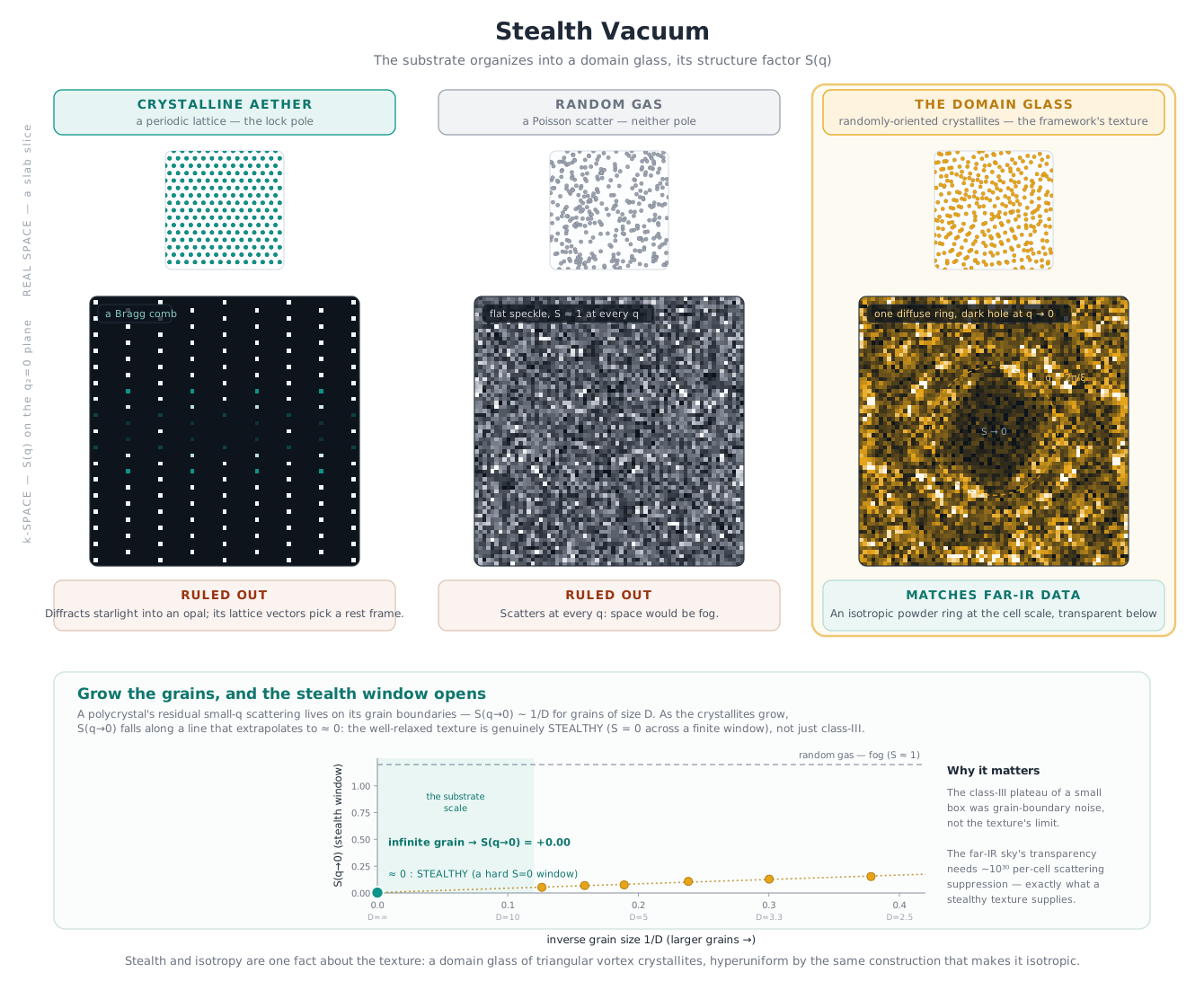
And the data shows that the far-IR sky is transparent until \lambda>2\xi\approx200\,\mum, then begins a faint scattering edge that rises to the ring at \lambda=\xi (\sim3 THz), matching the domain-glass texture, another observation that points to the scale of the lattice.
The same stealth answers an obvious question about gravity. A \sim100\,\mum superfluid lattice filling space sits squarely inside the sub-mm window that Eöt-Wash torsion balances have swept for deviations from Newtonian gravity (roughly 40\,\mum to 11 mm) — yet they see none. The cell scale does not present itself to laboratory masses as an extra gravitational structure: its cross-coupling to ordinary matter is f_\mathrm{cross}\sim10^{-15}, some ten-plus orders of magnitude below torsion-balance sensitivity, so there is no oscillatory sub-mm force to find. The same universal weakness banks the equivalence-principle tests — one gravitational channel, common to all matter, produces no composition-dependent force — consistent with MICROSCOPE’s \eta\lesssim10^{-15}. The one macroscopic scale above the cell — the coherence ceiling \ell_L\approx3.9 cm — is a smoothness null for the same reason, not a signal.
5.5 Two cosmic tensions find a fit
The Hubble and S_8 tensions are both reduced here by the model of the previous cycle’s moraine crust. Fit to the combined DESI DR2 BAO and Jia et al. H_0(z) measurements, the substrate’s one-parameter physical shockwave-envelope density profile reaches a \chi^2\approx42.2, against \LambdaCDM’s \approx821, and suppresses structure growth to S_8=0.816 compared to Planck 2018’s 0.832. Refining the shockwave envelope with the Hubble-tension-reducing freeform 14-knot spline gives S_8=0.807; and factoring in remnant debris in the moraine crust with a Poisson distribution lowers it another |\Delta S_8|\lesssim0.005–0.01, onto the edge of the lensing measurements of 0.76–0.79. Once dark-energy density is allowed to fluctuate, either tension can be reduced by various moraine-crust models; the one that I found that reduces both is the predicted chirping undular bore with a transcritical point at z=1.588, hitting remnants of the last cycle, an essential event in a substrate that nucleates on a periodic cycle.

5.6 Tier 2 — physics re-derived
This section has accurately measured physics with a substrate spin. This helps show the substrate model’s consistency and in some cases sharpen the observation, like the W/Z mass ratio to 0.5\%, and frame-dragging, (g-2)/2=\alpha/2\pi.
- The Bohm quantum potential (§1);
- The hydrogen Rydberg spectrum from pilot-wave standing-wave matching35
- Entanglement and Bell’s E(\theta)=-\cos\theta, CHSH 2\sqrt2 — from a twist wave on the vortex channel joining the split pair36
- The Born rule for a spin projection, \cos^2(\theta/2) — the single-quantum Malus law — from the reactive gear-reduction of the counter-rotating boundary layer as the analyzer axis tilts37
- The Aharonov–Bohm phase e\Phi/\hbar — real and topological, because the vector potential is the substrate’s co-rotating flow the charge swims in, not a bookkeeping device, so a charge circling shielded flux picks up its enclosed circulation even where the field vanishes38
- The Sagnac phase \Delta\varphi=\tfrac{2m}{\hbar}\vec\Omega\cdot\vec A — a rotation imprints the enclosed substrate circulation and the matter-wave fringe count is the number of circulation quanta h/m threading the loop, the frame-dragging term read for a laboratory apparatus rather than a gravitating mass39
- The Casimir force -\pi^2\hbar c/240\,d^4 comes from a boundary-shaped modon pressure, a rearrangement of the vacuum’s field, not its energy, with no zero-point sea, per Schwinger/Jaffe, exact where measured (10 nm–μm)
- Vacuum magnetic birefringence \Delta n\propto B^2 shows that field-aligned dc1 flow is the optic axis and the modon’s splitting is the phase delay with the field’s own flow as the lattice rows. Reproduces the Euler–Heisenberg form and scale (B/B_c)^2; magnetar RX J1856 (Mignani 2016), PVLAS bound.
- The electron g=2 and the anomalous moment40
- (g-2)/2=\alpha/2\pi; quark charges +\tfrac23,-\tfrac13 from junction solid angle and \sim99\% of the proton mass from boundary-layer energy (matching lattice QCD)41
- The quantum Hall effects — fractional charge e/3 as a Laughlin vortex’s winding fraction (the same charge-as-winding ontology as the quark \tfrac13, here measured directly by shot noise), integer quantization \sigma_{xy}=\nu e^2/h from topological protection of quantized circulation (exact to <10^{-9}, the resistance standard), and the odd/even-denominator rule as the boundary-parity fermion/boson split — even denominators the paired breath at \nu=\tfrac5242
- The W/Z mass ratio M_W/M_Z=\cos\theta_W — the standard gauge relation, but as the equatorial spin velocity \beta_\mathrm{eq} of the counter-rotating boundary shell: \cos\theta_W=0.877 against the measured 80.4/91.2=0.882 (0.5\%)43
- The CKM-small / PMNS-large mixing asymmetry — quark mixing is small and lepton mixing is large because a mixing matrix is the relative rotation of two \mathbb{Z}_3 generation clocks: up- and down-type quarks are color-loaded to the same side of the generation lock (co-aligned \to small CKM), while charged leptons and neutrinos straddle it (anti-aligned \to large PMNS); the atmospheric angle sits at the pairing-\sqrt2 tilt, \theta_{23}\approx45° (\cos45°=1/\sqrt2), and a large CP-violating Dirac phase is generic in both sectors as the imaginary part of the complex clock \omega=e^{2\pi i/3} — the sign of the asymmetry and near-maximal \theta_{23} reproduced, the individual angles and the CP value still owed44
- The Schwarzschild metric and classical GR tests (§3.1)
- Frame-dragging (Lense–Thirring) at the Gravity Probe B rate — the entrained azimuthal component of the same gravitational leak-inflow, v_\phi=2GJ\sin\theta/(c^2r^2) (§4.3): geodetic 6604 vs GP-B 6601.8\pm18.3, frame-drag \approx41 vs 37.2\pm7.2 mas/yr
- Gravitational waves travel at the speed of light: c_\mathrm{GW}=c
- Rest energy E=mc^2 (§1.1.1) — the flywheel energy of the internal vortex, \tfrac12m_\mathrm{eff}v_\mathrm{rot}^2 with the rim locked at v_\mathrm{rot}^2=2\alpha_{mf}c^2, with an aperture \alpha_{mf} that decides how much leaks out and is weighable; the \tfrac12 and the 2 cancel and m_ec^2 is what remains, with c derived (Equation 5) and \alpha_{mf}=\tan^2\theta_W fixed, so nothing is left free to choose
- Special relativity — time dilation \gamma, length contraction, and E=\gamma mc^2 — from a moving light-clock: the electron’s internal Compton breath runs on c-bounded substrate signals, so a moving clock slows by the transverse-light-clock factor \gamma=1/\sqrt{1-v^2/c^2} and the de Broglie wave is that same clock seen sideways, unifying the Michelson–Morley null with the pilot wave (exact, zero-parameter)45
- The baryonic Tully–Fisher law M_b\propto v^446
- Kleiber’s metabolic law B\propto M^{3/4} from the same boundary-leakage theorem read on a branching vascular network47
- The inflationary spectral index n_s\approx0.968 from a sound-speed phase transition48
- The cosmological constant (§3.2)
- The nuclear binding curve showing iron as the peak.49
- Mass defect ⟷ EMC effect. Mass is a boundary leak, not a bulk count, so binding merges two counter-rotating boundaries into one internal seam — dropping the leaked ledger (the mass defect) and reshaping the reactive ledger (in-medium quark structure, quenched moments/g_A). The sign and universality of the defect are structural, following from a total of -E_\text{bind}/c^2 (which both frameworks match), with EMC strength \propto binding per nucleon.
- Superconductivity’s Cooper pair as the substrate’s anti-phase breath made macroscopic — two same-chirality electrons \pi out of phase in their Compton breathing, one contracted while the other expands, bound by the shared counter-rotating vortex between them (the BCS singlet ↑↓ read as opposite phase, not spin), the charged twin of superfluid ^3He and the lab realization of the very +\omega/-\omega sheet pair the substrate is built from (§4.1)50
- The Hawking temperature T_H=\hbar c^3/8\pi GM, exact — the sonic horizon of the same Painlevé–Gullstrand inflow (§3.1), with 8\pi=2\times4\pi_\mathrm{SC2} the gravitational normalization shared with the Higgs VEV51
- The black-hole entropy area law S_\mathrm{BH}=A/4\ell_\mathrm{Pl}^2 — entropy as boundary-crossing leak counted on the one-way horizon seam, hence area not volume52
- Neutron stars show the substrate’s vortex unpinning and mutual friction in the context of a neutron superfluid, using the HVBK/\alpha_{mf} boundary coupling match the standard glitch model with recovery set by mutual friction. A canonical 1.4\,M_\odot, 12-km star has a surface that sits at r/r_s\approx3, so the substrate inflow there is v_\text{ebb}=c\sqrt{r_s/R}\approx0.6\,c — the framework’s counter-rotating boundary skin at more than half the signal speed and still closing the seam that keeps matter matter. The dipole is the geodynamo, the canonical loop scaled a billionfold. The pulsar/magnetar split shows a consistent birth and evolution pattern where the rotational budget is partitioned between a coherent-jet channel (the beamed spin-down) and a stored-field channel (released in bursts and giant flares). The glitches are mutual friction (\alpha_{mf}) in that superfluid. The Crab and Vela wind nebulae are the canonical disk–jet–counterflow loop photographed and the pulsar\tomagnetar sequence is a B/B_c ladder of natural birefringence laboratories climbing from \sim0.3\,B_c to \sim45\,B_c. The story holds together even without new numbers.
- The baryon asymmetry \eta_B\approx\varepsilon_\mathrm{chirality}^9=5.8\times10^{-10} † — all three Sakharov conditions native to the boil, the chiral-vacuum bias frozen across nine junction interfaces; the ninth-power exponent is read off the data as a bet, not derived, so it carries the same open-factor dagger as the Tier-1 rows above53
- The sonoluminescence flash width stays wavelength-independent into the far-UV / soft X-ray as the substrate predicts. It comes from the bubble’s boundary collapse, from a max R_\text{max}\approx 40–50\;\mum, one half of the lattice cell size, to R_\text{min}\approx 0.5\;\mum at supersonic speeds. The same process that emits a spectral line when an atom’s boundary collapses here causes a stream of photon/modons spread evenly across the spectrum, without an orbital boundary to form the sharp line. Noble gases allow the substrate’s pure energy to be released as modons. Other atoms absorb energy that disrupts the flash effect explaining this poorly understood phenomenon.
- The vacuum itself is a time-crystal formed from the anti-phase \omega_1 breathing. It is hidden in time, the way the lattice is hidden in space, beating a half-cycle out of step, summing to zero above one cell. Lab time crystals surface the vacuum’s breath through chemistry.
5.7 Tier 3 — the wider net
Tier 3 includes predictions that suggest the broader pattern. From the idea that the substrate nests hidden, perpetual energy in layers exact numbers are mediated by chemistry, well studied, so what happens if you look for these perpetual energy patterns, looking for the broader pattern.
- Grid cells step by \sim1.4\approx\sqrt2 — the bare ladder rung — across species.
- Phyllotaxis sets each leaf at the golden angle 137.5^\circ (\varphi on a circle), realized by the same flux-lattice physics the substrate is built from (Levitov 1991), magnet-free.
- The retinal cone mosaic tiles as disordered hyperuniform blue noise — the planar face of choosing anti-lock in the substrate ladder. This avoids image aliasing.
- The same sealed d^{10} boundary smoothness that makes copper, silver and gold the best normal conductors forbids them from superconducting, while rough-shelled niobium, vanadium and tantalum pair readily — T_c anti-correlates with inner-boundary smoothness across the transition metals.54
- The outer rim onset speed v_L=\omega_0\xi \approx750 km/s surfaces as a boundary gating the galactic MOND→CDM transition and near the peak of the Sun’s fast polar wind (Ulysses mean 751.5 km/s).
- The inner-rim \gamma shoulder shows that an electron driven to the substrate’s own rotation speed (0.776\,c) tears its boundary and sheds a \sim300 keV gamma modon; the electron–electron bremsstrahlung shoulder at T_e\approx300 keV — a 200–500 keV excess over combined bremsstrahlung, with a fatter angular distribution — in terrestrial \gamma-ray flashes (TGF/ALOFT), solar flares (RHESSI/STIX/NuSTAR), and tokamak hard-X-ray disruptions.
- Cell sorting is boundary-energy minimization one rung up: an embryonic tissue behaves as an immiscible liquid whose measured surface tension is the same counter-rotating-layer energy \tfrac12\rho_\text{cr}(\Delta v)^2 read at the cell cortex, with cadherins setting the velocity match — and the sorting topology is a dressing-cancelled tension ratio the data already bear out (transitive hierarchies, an E-cadherin phase reversal, a vanishing adhesion-bond term), the same knob whose pathological failure is metastasis.55
- Twelve-tone equal temperament fills the octave with twelve steps of 2^{1/12}, so the tritone lands at 2^{6/12}=\sqrt2 exactly — the substrate’s bare half-octave hinge — while the octave (2{:}1) and the fifth (3{:}2) sit on the comb’s cleanest teeth. Music theory has always heard the difference: the consonances are locks, and the tritone on the hinge is the diabolus in musica — the same \sqrt2 that half-registers two lattice sheets, now something anyone can hear.
- Cortical rhythms play both ends of the ladder in time: when it binds, the cortex nests its bands at octaves (integer theta–gamma phase-locking); at rest it spreads them to a non-locking irrational near the half-octave so they coexist without interference — either the substrate’s \sqrt2 or the most-irrational \varphi\approx1.618 the resting-EEG literature reports (Pletzer et al. 2010), a live {\sim}14\% test that either way is one gap read on the time axis.
- The solar system writes lock and anti-lock across the sky at once: the Galilean moons hold a 1{:}2{:}4 Laplace chain — an octave stacked twice, the cleanest tooth there is — and Neptune and Pluto ride a protected 3{:}2, bodies locking onto the comb; while the Kirkwood gaps in the asteroid belt are swept clean at the integer resonances, the survivors fleeing the tooth. One ladder, two ends, in orbits.
- Earth’s mantle runs the disk–jet–counterflow loop one rung up from a black hole: whole-mantle convection organizes into a degree-2 pattern with two roughly antipodal superplume feet — the African “Tuzo” and Pacific “Jason” LLSVPs, each {\sim}10{,}000 km across — as the counter-rotating dipole cores, wrapped by the {\sim}200 km D'' layer at the core–mantle boundary as the enclosing sheath. The same feedback topology that shapes an accreting spinner, at planetary scale.
- The Earth’s crust shows both substrate poles in rock. A major fault locks along some stretches — its rough walls nested in register, storing elastic strain for centuries, then spending it all at once as an earthquake — and creeps along others, the walls refusing to catch, sliding a few millimetres a year and never building toward rupture; the San Andreas and the Hayward do both at once, along their length and down their depth. The same lock/anti-lock split reads a cookie’s clean snap (a brittle lattice failing along its cheapest pre-existing seam — exactly how a fault nucleates), the six-fold basalt column (locked, in register), and a road-cut’s two joint sets meeting at right angles in junctions that refuse to merge (anti-lock). Other domains show both poles too, but by state or by orbit; the crust is where they share a single fault, outcrop, and hand specimen — the ladder (§4.2) made not just visible but touchable.
- Sonoluminescence is the lightning \gamma-shoulder’s twin at a wildly different scale: the line-free picosecond flash from a collapsing bubble is a boundary driven to reverse past the substrate’s own rotation speed 0.776\,c, tearing and shedding a modon — except here the boundary is macroscopic, the collapsing gas–liquid interface itself rather than an electron’s coherence dress.
- Helium-3, the one atom cold enough to mirror the substrate, carries the pairing-two in the open: it must first assemble an anti-phase paired boson before it can lock to the vacuum’s breath, so it goes superfluid only {\sim}1000\times colder than He-4 ({\sim}1 mK versus {\sim}2 K) and stamps the factor of two directly into its circulation quantum h/2m_3 — the same pairing-two the framework meets everywhere it probes the lattice.
5.7.1 Molecular recognition — one stamp metric, many reads
At the cellular scale, the substrate’s energy gets wrapped into nested layers of chemistry. But these nested layers make it hard for direct measurements to differentiate the substrate’s energy from what we already model through chemistry.
At the cellular scale, the numbers you’d expect to match do seem to match.
An aromatic ring shows clearly as a toroidal vortex — the closed surface that earns benzene its {\sim}36 kcal/mol of aromatic stabilization, a closed-loop flow with no ribbon end to terminate.56 Each nucleobase is then a stack of one or two such tori, and a codon, a base pair, or a binding pocket is a three-dimensional stamp: the superposition of those per-base vortex profiles on the substrate’s flow geometry. One set of per-base profiles, one overall scale, no per-observable tuning, feeds an L^2 overlap metric that reads out across three independent classes of molecular recognition. No single row below is a paper-central number — but as a group they put numeric weight under the cellular-dynamics chapters: the same metric that places every cognate anticodon first also tracks drug-binding affinity across four orders of magnitude and beats additive hydrogen-bond counting on base-pair stability.
| Observable | Substrate reading | Result |
|---|---|---|
| Benzene aromatic stabilization | closed-torus π flow, no edge to terminate | {\sim}36 kcal/mol — matches |
| G:C / A:T pair stability | per-lobe vortex overlap, non-additive57 | ratio 1.69 (measured 1.8–2.0; additive H-bonds give 1.5) |
| Codon–anticodon cognate recognition | 64\times64 stamp-overlap matrix58 | cognate ranks #1 for 64 of 64 |
| Synonymous vs non-synonymous spread | same metric, no retuning | stamp-distance ratio 1.75 |
| nAChR agonist affinity | aromatic-pocket stamp distance59 | Spearman \rho=+0.905 vs measured K_i |
| 5mC reader split | major-groove stamp-edit, WC face intact60 | groove readers respond, WC-edge readers blind (retrodiction, holds) |
| Olfactory OR repertoire | anti-lock pole in stamp space | hyperuniform, not Poisson ({\sim}400 pockets, untested) |
Each row supports the overall point — that substrate energy influences and organizes cellular dynamics, offering a hidden information channel mediated by chemistry.
See more at https://lightfluid.org/predictions.html.
6 Reproducing the numbers
Most numerical predictions are demonstrated by three python scripts:
python3 scripts/substrate_atomic.py     # particle-physics backbone + lattice
python3 scripts/substrate_gravity.py    # gravity sector
python3 scripts/substrate_galactic.py   # DESI / Hubble cosmology
7 Open problems
The 4\pi in SC2 and in the bridge equation’s geometric value and the following results rely on the substrate’s emergent Lorentz invariance being exact, supported by observation but not derived. The induced (Einstein–Hilbert) action gives the equation the 4\pi automatically once that is shown. It is also supported by Michelson–Morley and GW170817.
The nonlinear completion of the Einstein equations requires a formal proof.
For dark matter, the quantitative step from the Hubble flow’s DC parity-bias to the coefficient of a_0=c\sqrt{G\rho_\mathrm{DM}} (§3.3) — equivalently, a phonon-mediated force profile reproducing the full radial-acceleration relation at galactic scales — is still open.
Finding the nuclear surface scale profile a_S. Only the iron-peak has been predicted so far.
Derive the nuclear coupling \alpha_{mf}^{(N)}\approx552 (§1.1) independently — from nuclear-scale vortex packing, the way \tan^2\theta_W fixes the electronic \alpha_{mf}^{(e)}=0.3008. At present \alpha_{mf}^{(N)} is back-solved from the measured proton mass through the shared quantum m_\mathrm{eff}, so the proton-to-electron mass ratio is a re-parametrization rather than a prediction; an independent count \sim552 would turn m_p/m_e\approx1836 into a genuine output.
Derive the condensation number \nu=m_\mathrm{eff}/m_1=8.35\times10^8 (Equation 13). It is now over-determined — cosmology \times the geometric cell occupancy, the measured Higgs VEV, and the fast solar wind all land on it, the first two to 0.12\% — but no bottom-up calculation produces it from first principles. It is the framework’s single sharpest open number: the lattice size, the Higgs VEV, v_L, and the MOND scale all ride on it.
Derive the Dirac mass term from mutual friction. The quaternion first-order equation of §2.1 (Equation 6) is exact for the bulk; the step that turns it into the Dirac equation identifies the coupling between the co- and counter-rotating fluids with a conservative exchange at the Compton rate mc^2/\hbar. That rate is fixed here by §1.1.1, not computed. Showing that the reactive (B') HVBK coefficient acting at the inner rim yields exactly \hbar\omega=\alpha_{mf}m_\mathrm{eff}c^2=mc^2 would make the Dirac equation, and not only its spectrum, an output of the two-fluid model.
Show the substrate ladder’s properties support scale invariant properties.
Formal proof of the lattice spacing from the logarithmic equation of state’s maximum packing result.
Conclusion
I am not an expert in any of the domains this paper covers but have been avidly reading science papers for a long time. You may see something I missed, but to me, this feels like a worthy direction to pursue, and I welcome any help to improve it.
Volovik found key properties of the universe in a supercooled droplet of He-3, the one atom that stays fluid cold enough to tune into the anti-phase breathing of the substrate, and so essentially a mirror of the substrate itself. Bush, Zloshchastiev, Khoury, and many others supplied more pieces of the puzzle.
Treating Madelung/Bohm and Simeonov’s fluid as a superfluid, the quantum potential becomes the reaction force of the boundary layer. The photon makes perfect sense as a modon — wrapping up these counter-spinning layers and using the substrate’s energy to launch itself. Once Planck’s constant, light’s minimum packet size, is used as the modon’s minimum size, the lattice size is fixed and these predictions follow. The behavior of superfluids unifies science behind one physics — without strange assumptions.
The stealthy superfluid turns quantum uncertainty into a measurement artifact. Entanglement is explained by the split pair’s topologically protected vortex lines, which still join them across long distances. When you measure one end, a twist wave runs back down that cleared, laminar channel faster than the speed of light, reproducing the Bell correlations (§5.6). The unique properties of the superfluid — its stiff local behavior, cold distant appearance, and its phase transitions — explain gravitational lensing and time dilation as a signal speed pinned to a flowing medium, not strange physics.
To me, Our Big Bubble and Our Fluid Universe make more sense. When reading Bush’s paper, I had the realization that the photon is a modon, saw the anti-phase pairing. It did not take long to find the math, but it took time to accept the large size of the lattice, and to see how the energy flows create a common topology — the orbital plane, the polar jets, the modon topology that holds the energy. Given the sheet spacing, that leads to the ladder influencing boundary effects, and to chemistry creating long vectors by organizing against the lock/anti-lock pattern, storing them as coherent substrate layers and transmitting them as complex modons. With hidden organization, information, and energy, the substrate drives cellular dynamics — replacing the hard-to-accept notion that cells run on chaos alone. The Earth evolved by nesting and folding substrate layers to trap substrate energy into persistent modons, and life evolved by folding and trapping more.
The substrate framework offers a new lens to help uncover the nature of the superfluid that underlies everything, and its hidden lattice.
Find a deeper investigation at https://lightfluid.org.
Acknowledgements
This paper was made possible by the work of many scientists.
In particular, Volovik, Bush, Oza, Simeonov, Zloshchastiev, Khoury, Larichev and Reznik provided the foundational math and inspiration.
I’m also grateful to my amazing employer Posit PBC, supporters of open source software for data science. This is an unaffiliated side project, and naturally open source.
References
Footnotes
Simeonov’s derivation (Simeonov 2025) takes a single fluid of density \rho obeying the diffusion law \mathbf J=-D\nabla\rho; its velocity is the osmotic velocity \mathbf u=\mathbf J/\rho=-D\nabla\ln\rho. Form its material (convective) derivative — the osmotic acceleration \mathrm d\mathbf u/\mathrm dt=\partial_t\mathbf u+(\mathbf u\cdot\nabla)\mathbf u — and substitute the continuity equation \partial_t\rho=-\nabla\!\cdot\mathbf J=D\nabla^2\rho for the time part. The time and convective pieces collapse into a single gradient, \mathrm d\mathbf u/\mathrm dt=\nabla\!\left(-2D^2\,\nabla^2\!\sqrt{\rho}/\sqrt{\rho}\right), whose bracket is the Bohm quantum potential per unit mass, Q/m, the instant one sets D=\hbar/2m (then 2D^2=\hbar^2/2m^2 and Q=-\frac{\hbar^2}{2m}\,\nabla^2\!\sqrt{\rho}/\sqrt{\rho}). So Q is the inertia of the osmotic flow, and the convective term (\mathbf u\cdot\nabla)\mathbf u is what produces it. To turn this identity into a force on a physical density, Simeonov uses two fluids: fluid 2 mutually diffuses down fluid 1’s gradient, \mathbf J_2=-D\nabla\rho_1, and is re-equalised to it on a fast timescale, so its osmotic acceleration is the expression above with \rho\to\rho_1; by Newton’s third law its reaction on fluid 1 is exactly \mathbf F_\mathrm{reaction}=-\nabla Q (Equation 2). Fed into fluid 1’s Euler equation beside an ordinary potential U, this returns the full Madelung system — hence, through \Psi=\sqrt{\rho_1}\,e^{iS/\hbar}, the Schrödinger equation; a relativistic diffusion law J^\mu=D\,\partial^\mu\rho runs the identical steps to Klein–Gordon. For Step 1 the framework reads fluid 1 as the co-rotating dc1 bulk and fluid 2 as a counter-rotating HVBK boundary layer, so that his diffusion constant becomes the circulation-set diffusivity D_{sf}=\kappa_q/(4\pi\alpha_{mf}) of §1.1 and Simeonov’s fast density-equalising “jumps” become the boundary layer continuously re-tracking the bulk gradient. The quantum potential and \hbar=2mD are then a single statement read at two levels: Simeonov’s kinematics, and the substrate’s hydrodynamics.↩︎
Here \kappa_q/4\pi is the standard local-induction self-velocity coefficient of a quantized vortex filament (Saffman 1992; Donnelly 1991), \kappa_q = h/m_\mathrm{eff} the Onsager–Feynman circulation quantum, and \alpha_{mf} the HVBK mutual-friction coupling (Hall and Vinen 1956; Bekarevich and Khalatnikov 1961). The expression is a dimensional identification of the friction-limited transport scale — its content is the scaling D_{sf}\propto\kappa_q/\alpha_{mf} with the 4\pi local-induction prefactor — not a quoted closed-form coefficient. (The distinct thermal vortex-diffusion coefficient has the Einstein form D\propto\alpha_{mf}\,k_BT (Mehdi et al. 2023); what enters here is the athermal, circulation-set transport scale.)↩︎
The value \alpha_{mf}=0.3008 comes from the Weinberg angle using a friction ratio equation. The HVBK mutual-friction force has two pieces: a reactive part (deflection that turns the flow’s chirality without transferring energy) and a dissipative part (drag that carries energy across the boundary). Identifying the reactive channel with the SU(2)_L weak coupling g and the dissipative channel with the U(1)_Y hypercharge coupling g' makes the friction ratio the coupling ratio, \alpha_{mf}=\frac{g'^2}{g^2}=\tan^2\theta_W,\qquad\text{equivalently}\qquad \sin^2\theta_W=\frac{\alpha_{mf}}{1+\alpha_{mf}}, so the measured \sin^2\theta_W=0.2312 fixes \alpha_{mf}=0.2312/0.7688=0.3008. This sits squarely in the range real two-fluid superfluids show in their active regime (He-II passes \alpha\approx0.3 near T/T_\lambda\approx0.6): \approx30\% of each boundary interaction dissipates, \approx70\% deflects. The same parameter also represents a vortex-scattering phase, \alpha_{mf}=\tfrac12\sin2\delta_0 with \delta_0=18.48^\circ (the weak-scattering branch, selected by \alpha\ll1) — the geometric input behind the fine-structure-constant and magnetic-moment predictions of §5. Currently \alpha_{mf} comes from a measured input. It might be possible to compute it from the equilibrium spin rate of the counter-rotating boundary.↩︎
m_\mathrm{eff} is taken to be a property of the substrate, not of the particle it builds — one quantum of dc1 circulation, the same in the electronic and nuclear sectors. Quoting m_e = 0.511\;\mathrm{MeV}/c^2, Equation 3 fixes it once and for all: m_\mathrm{eff} = m_e/\alpha_{mf} = 0.511/0.3008 = 1.70\;\mathrm{MeV}/c^2. Applying Equation 3 in the nuclear sector with this same quantum then defines the proton coupling \alpha_{mf}^{(N)} = m_p/m_\mathrm{eff} = 1836\times0.3008 \approx 552: the proton is \sim552 effective quanta (552\times1.70\;\mathrm{MeV} \approx 938\;\mathrm{MeV} = m_p c^2), while the electron is a 0.3008 fraction of a single quantum. This is a re-parametrization of m_p, not a prediction of it: \alpha_{mf}^{(N)} is back-solved from the measured proton mass, so the identity \alpha_{mf}^{(N)}/\alpha_{mf}^{(e)} = m_p/m_e is algebraic. It would become a genuine prediction only if \alpha_{mf}^{(N)} — equivalently the count \sim552 — could be fixed independently from nuclear-scale vortex packing, the way \tan^2\theta_W fixes the electronic coupling. That derivation is left open (§7).↩︎
The observation about the spectrum comes from Volovik, The Universe in a Helium Droplet (2003), §7.4.3–7.4.4. The Bogoliubov quasiparticle energy of a pair-correlated fermionic vacuum is E^2 = M^2(\mathbf p) + c^2 p^2 with c=\Delta_0/p_F (his eqn 7.49); in the strong-coupling deep-BEC limit mc^2\gg|\mu| this deforms continuously into the relativistic Dirac form E^2=\mu^2+c^2p^2 (eqn 7.51), with the chemical potential \mu playing the role of the rest mass. The framework’s one added identification is that the dc1 coherence length is the dc1 Compton wavelength, \xi=\hbar/(m_1 c) — equivalently \Delta_0\simeq\mu=m_1c^2 and p_F\simeq\hbar/\xi, so c=\Delta_0/p_F=\hbar/(m_1\xi). This same \xi=\hbar/(m_1c) is the close-packing input of Route 1 (Equation 9). Strong coupling is also what makes the cone isotropic: the spectrum depends on |\mathbf p| alone, so c_\parallel=c_\perp — unlike weak-coupling ^3He-A, whose point-node spectrum is strongly anisotropic (c_\perp/c_\parallel\sim10^{-5}; Volovik §7.4.6). A single isotropic cone shared by every sector is the origin of c_\mathrm{GW}=c.↩︎
Danielewski and Sapa (Danielewski and Sapa 2020) write the state of a Cauchy elastic solid as one quaternion \sigma=\sigma_0+\hat\phi (compression plus twist) and use the Cauchy–Riemann operator D\sigma=\operatorname{grad}\sigma_0+\operatorname{rot}\hat\phi, with DD=-\Delta, to carry the local momentum, \hat p=-\hbar D\tilde\sigma (their eq. 44); minimizing the resulting energy functional gives a quaternion Schrödinger equation. Their medium is an elastic solid of Planck masses at the Planck length and their wavefunction a rescaled deformation; only the algebra is borrowed here. For a superfluid the natural object is the velocity, not the displacement, and the identity Equation 6 is just the quaternion product \partial\mathbf v read against continuity (\partial_t\ln\rho=-\nabla\!\cdot\mathbf v). Two facts make \mathbb H the right algebra rather than a convenience: the norm |q|^2=s^2+|\mathbf v|^2 is, times \rho_0/2, the acoustic energy density (kinetic plus compressional) for the stiff equation of state P=\rho c^2; and by Hurwitz’s theorem \mathbb R,\mathbb C,\mathbb H, \mathbb O are the only real algebras with a multiplicative norm, so a one-scalar, three-vector field has one choice. The Madelung wavefunction fits the same reading: -(i\hbar/m)\nabla\ln\Psi=\mathbf v_1+i\,\mathbf v_2, the bulk velocity plus i times the osmotic velocity of Equation 1, and Schrödinger’s equation is then the complex Burgers equation \partial_t\mathbf w+(\mathbf w\cdot\nabla)\mathbf w=(i\hbar/2m)\nabla^2\mathbf w-\nabla U/m for \mathbf w=\mathbf v_1+i\mathbf v_2. The full development is in the companion chapter Two Fluids § A First-Order Equation.↩︎
The modon is the Larichev–Reznik two-dimensional Rossby soliton (Larichev and Reznik 1976); its explicit interior/exterior construction and matching are eqns (1.25)–(1.26) of Reznik’s review (Reznik 2010). With the dipole streamfunction \psi=\sin\theta\,J_1(pr) inside and \psi=\sin\theta\,K_1(qr) outside, continuity of \psi and of the normal and tangential velocity at the separatrix r=\xi gives the transcendental matching \dfrac{J_2(p\xi)}{p\,J_1(p\xi)}=-\dfrac{K_2(q\xi)}{q\,K_1(q\xi)} (Reznik eqn 1.26, here in our convention: interior wavenumber p, exterior decay q). The lowest mode lays the first J_1 lobe exactly across one cell, p\xi=j_{11}=3.8317 (the first zero of J_1), with the exterior decaying over one coherence length, q\xi=1. These two — the interior lobe spanning exactly one cell and the exterior tail decaying over exactly one cell. So it is the sharp-lobe limit of that matching rather than a finite solution of it). The L–R speed denominator is then p^2+q^2=(j_{11}^2+1)/\xi^2\equiv K/\xi^2, which defines K=j_{11}^2+1=15.68. Setting the resulting modon speed equal to c collapses back to the Volovik relation c=\hbar/(m_1\xi). It shows why a counter-rotating dipole riding the dc1 circulation gradient \kappa_1=2\pi\hbar/m_1 propagates at exactly c. The pair’s vanishing net mass transport — the hydrodynamic content of “massless” — is Reznik’s Property 8, \int\psi\,dx\,dy=0 (eqn 1.18).↩︎
Two steps. (i) Existence condition 1 fixes the threshold wavelength at one cell, \lambda_\mathrm{min}=\xi (the perturbation envelope has no smooth J_1–K_1 match below \xi). A modon carries photon energy E=h\nu=hc/\lambda, so the one-cell modon has E_\mathrm{min}=hc/\xi. (ii) Substituting \hbar/\xi=m_1c (the Volovik relation, Equation 5) gives the clean identity E_\mathrm{min}=hc/\xi=2\pi(\hbar/\xi)c=2\pi\,m_1c^2: exactly 2\pi times the dc1 rest energy m_1c^2 — the 2\pi is one full circulation loop of the cell (the dc1 circulation quantum being \kappa_1=2\pi\hbar/m_1), m_1c^2 the rest energy of the single dc1 wavefunction per cell. Numerically m_1=m_\mathrm{eff}/\nu=2.03 meV gives E_\mathrm{min}=12.8 meV at \lambda=\xi=97\,\mum, i.e. a crossover frequency c/\xi\approx3.1 THz.↩︎
The elimination proceeds with three steps. Volovik’s speed (Equation 5) gives m_1=\hbar/(c\xi); the composition n_1m_1=\rho_\mathrm{DM} then gives n_1=\rho_\mathrm{DM}\,c\,\xi/\hbar; and close-packing n_1\xi^3=1 gives \rho_\mathrm{DM}\,c\,\xi^4/\hbar=1, i.e. \xi=(\hbar/\rho_\mathrm{DM}c)^{1/4}. The only physical content beyond \hbar,c,\rho_\mathrm{DM} is the quantum-degeneracy condition n\lambda_{dB}^3\sim1 that defines Bose condensation — one coherent wavefunction per de Broglie volume — read here at the lattice cell, \lambda_{dB}\to\xi. Numerically \hbar/(\rho_\mathrm{DM}c) = 1.055\times10^{-34}/(2.254\times10^{-27}\cdot2.998\times10^8) = 1.561\times10^{-16}\,\mathrm{m}^4, whose fourth root is 111.8\,\mum. The “\approx1” is exact only for one wavefunction per cell; the true occupancy is the cell occupancy f (Equation 15), so Route 1 is the f\!=\!1 idealization and the real cell is smaller by f^{1/4}.↩︎
Planck reports the dimensionless cold-dark-matter density \Omega_c h^2 = 0.1200 \pm 0.0012 (Planck Collaboration et al. 2020); the mass density follows from the critical density, \rho_\mathrm{DM} = \Omega_c h^2 \cdot \rho_\mathrm{crit}/h^2 = 0.1200 \times 1.878\times10^{-26}\;\mathrm{kg/m}^3 = 2.254\times10^{-27}\;\mathrm{kg/m}^3, with \rho_\mathrm{crit}/h^2 = 3H_0^2/(8\pi G h^2) = 1.878\times10^{-26}\;\mathrm{kg/m}^3. The \pm1\% uncertainty on \Omega_c h^2 carries directly to \rho_\mathrm{DM}.↩︎
The circulation \kappa_q=2\pi\hbar/m_\mathrm{eff} is the ordinary quantum of circulation for a quantum of mass m_\mathrm{eff} (§1.1); the Compton frequency \Omega_v=2m_\mathrm{eff}c^2/\hbar is twice its rest energy over \hbar, the zitterbewegung rate. Explicitly \kappa_q\Omega_v=(2\pi\hbar/m_\mathrm{eff})(2m_\mathrm{eff}c^2/\hbar)=4\pi c^2, with m_\mathrm{eff} cancelling — which is why SC2 is a normalization identity, not a dynamical equation: it fixes which 4\pi the lattice must present in order to gravitate. The field-theory reason that coefficient is precisely the induced-Newton 4\pi — one-loop induced gravity (Seeley–DeWitt) and Jacobson’s horizon thermodynamics both landing the same number — is spelled out in §2.3.↩︎
The two legs evaluated on the paper’s stated constants: \bar\lambda_\mathrm{eff}=\hbar/(m_\mathrm{eff}c)=116.2 fm with m_\mathrm{eff}=m_e/\alpha_{mf}=1.699 MeV/c^2; the cosmology-plus-geometry cell \xi=\xi_\mathrm{CP}f^{1/4}=111.8\times0.8676=97.0\,\mum gives \nu=97.0\,\mu\mathrm{m}/116.2\,\mathrm{fm}=8.348\times10^8, while \nu=v^2/(8\pi m_\mathrm{eff}^2c^4)=246220^2/(8\pi\cdot1.699^2)=8.358\times10^8. Equivalently m_1=m_\mathrm{eff}/\nu=2.03 meV. The gap between the two is 0.12\% at the Planck central density; The heliospheric leg, \nu=4\pi(c/v_L)^3=7.98\times10^8, sits 4.4\% low — from the other way, the same \nu predicts v_L=c(4\pi/\nu)^{1/3}=740 km/s against Ulysses’ 751.5 (1.5\%).↩︎
Equation 15 is the same statement as Route 1 with the “\approx1” made honest: n_1\xi^3=f rather than n_1\xi^3\approx1. Evaluated on the electroweak leg’s cell, \xi=\nu\,\bar\lambda_\mathrm{eff}=97.1\,\mum with \nu from the measured VEV, it returns f=0.5694 against the geometric 0.5666 — a 0.5\% match using the Planck density \rho_\mathrm{DM}=2.254\times10^{-27}\,\mathrm{kg/m}^3. Evaluated on the cosmology-plus-geometry cell it returns 0.5666 identically, because that cell was built from f; the content of the comparison is therefore entirely in the electroweak leg, which is why the pure-number form (the \nu table above) is the statement to quote.↩︎
That 4\pi is the Gauss’s law solid-angle factor. It is the 3D geometry — the surface area of a unit sphere through which gravitational flux escapes. The Seeley–DeWitt expansion fixes the form (an Einstein–Hilbert term \int\sqrt{-g}\,R) and the value of the induced G; the 4\pi relates G_{\mu\nu}=8\pi G\,T_{\mu\nu} to \nabla^2\Phi=4\pi G\rho. It requires that the substrate’s emergent Lorentz invariance is exact, the same assumption that gives c_\mathrm{GW}=c. The full derivation is open (§7, Step A). Two independent constructions land the same 4\pi — one-loop induced gravity (Seeley–DeWitt), and Jacobson’s horizon thermodynamics, where the 4\pi is automatic for any induced G through the entropy–area law. And the same 4\pi reappears, doubled, as the Higgs VEV’s prefactor 8\pi=2\times4\pi (the extra 2 the radiation-equation-of-state weight of the massless chirality Goldstones), so the bridge equation’s 4\pi and the electroweak VEV — found to 0.06\% from the same Weinberg angle (§5) — are not two results but one condition seen twice.↩︎
Baym’s 8\pi is the coefficient of the Tkachenko shear wave, c_T^2=\kappa_q\Omega/(8\pi) (Baym 2003) — an elastic vibration of the vortex lattice, a different excitation from the gravitational mode SC2 governs.↩︎
The acoustic metric is Unruh’s (Unruh 1981): linearizing the Euler + continuity equations of a barotropic fluid about a background flow \mathbf v shows that sound — here the modon — obeys a Lorentzian metric whose null cones are tilted and dragged by the flow; Barceló–Liberati–Visser made it general and rigorous (Barceló et al. 2005) and Volovik identified it with superfluid quasiparticles (Volovik 2003). We have dropped the overall conformal factor \rho/c_s that multiplies the bracket in the general expression: it rescales ds^2 but leaves the null cones — hence every light path and the entire causal structure — unchanged, and it divides out exactly when the metric is read in the rain-frame form Equation 17. The substrate identifications are c_s\to c (the modon speed Equation 5) and \mathbf v\to v_\mathrm{ebb}(r)\,\hat r (the radial dc1 inflow). This is the kinematic half — the metric given the flow; the dynamical half, that the substrate’s own equations produce exactly this flow, is carried by Equation 17 below.↩︎
Two independent statements agree. Kinematics: substituting the free-fall profile v_\mathrm{ebb}=\sqrt{2GM/r} into Equation 16 returns exactly the Painlevé–Gullstrand “rain” form of the Schwarzschild line element — the 1921–22 coordinates of Painlevé and Gullstrand, related to the textbook Schwarzschild coordinates by a redefinition of t alone (no curvature invariant is changed), read physically as Hamilton & Lisle’s river model (Hamilton and Lisle 2008). Dynamics: that profile is not an assumed force law but the steady state of the substrate’s own equations. For v_\mathrm{ebb}=\sqrt{2GM/r} the convective acceleration is v_\mathrm{ebb}\,dv_\mathrm{ebb}/dr=-GM/r^2 with dP/dr=0 — free fall with no pressure gradient, exactly as the equivalence principle requires of a comoving frame. The two halves close a fixed point: the flow that sets the metric (kinematics, Equation 16) is the flow the substrate dynamics produce, so the identification is self-consistent rather than circular.↩︎
Each is a geodesic of Equation 17. Redshift is the g_{00} of a static clock, \nu/\nu_0=\sqrt{1-2GM/rc^2}. The deflection \Delta\theta=4GM/(bc^2) carries the GR factor of two over the Newtonian-corpuscular 2GM/(bc^2) because the modon is both refracted by the gravitationally-graded signal speed c(r)=c\,(1-2GM/rc^2) and dragged by the inflow v_\mathrm{ebb} — two equal contributions, where the corpuscular estimate counts only the first. The Shapiro delay \Delta t=(2GM/c^3)\ln(4r_1r_2/b^2) is the same reduced signal speed integrated along the path; the perihelion precession 6\pi GM/(ac^2(1-e^2)) is the non-closure of bound geodesics. The combined moving-clock shift, \nu/\nu_0=\sqrt{1-2GM/rc^2-v^2/c^2}\simeq1-GM/rc^2-v^2/2c^2, is the Painlevé–Gullstrand proper time of a clock moving across the river: the radial inflow and the tangential motion add as one vector, |\mathbf v_\mathrm{rel}|^2=v_\mathrm{ebb}^2+v^2, and one \gamma follows — the GPS correction, +45.7-7.2=+38.5\;\mus/day. The boundary layer’s cost of holding coherence against the flow is a separate line of the energy ledger, \gamma mc^2=mc^2/\gamma+\gamma mv^2 (the beat plus the bow wave); it does not draw down the tick.↩︎
The linearized substrate equations give \Box\,\bar h_{00}=-(16\pi G/c^2)\,\rho_\mathrm{matter} — the 00 component of the linearized Einstein equations — where the naïve fluid-Poisson route would give only 4\pi G. The factor of four is that pressure gravitates: the standard general-relativistic source is the Tolman combination \rho_\mathrm{eff}=\rho+3P/c^2, and the substrate’s stiff equation of state P=\rho c^2 (sound speed c_s=c) makes \rho_\mathrm{eff}=\rho+3\rho=4\rho, so 4\rho\times4\pi G=16\pi G. The substrate’s pressure is the rotational kinetic energy of its vortices. The weight is equation-of-state specific and applies to the substrate’s own self-gravitation; matter embedded in it sources gravity through its own \rho_\mathrm{eff} — radiation 2\rho (P=\rho c^2/3), dust \rho (P\simeq0) — the standard kinematics/dynamics split of analog gravity (Barceló et al. 2005). The 4\pi here is the same Gauss’s-law solid angle that normalizes SC2 (Equation 10) and heads the cell occupancy (Equation 11).↩︎
The substrate’s stiff fluid nature, w=1, does not wreck BBN and the CMB because Gibbs–Duhem pins its background value \bar P\to0 at the marginal point (§3.2) while only the slope \delta P/\delta\rho=c^2 stays stiff — the logarithmic equation of state decouples the two. So the substrate gravitates to Friedmann as w\approx0, c_{s,\mathrm{bg}}\approx0 cold dark matter with clustering driven by a tachyonic instability above the marginal density rather than a horizon-scale Jeans pressure, and the internal 0.776\,c vortex circulation counting as rest-mass energy, not bulk kinetic pressure.↩︎
In a superfluid at T=0 in full equilibrium the Gibbs–Duhem relation forces \varepsilon+P=0, and the vacuum self-tunes both \varepsilon and P to exactly zero — any added vacuum energy shifts the density, hence the chemical potential, driving a flow that relaxes it away; this is Volovik’s reason the bare 10^{120} does not gravitate (Volovik 2003). The observed \Lambda is the small residual the expansion leaves un-relaxed, and its apparent size depends entirely on the reference density. Against the substrate’s own density \rho_\mathrm{DM} the disequilibrium is order unity, \delta T/T_c=\sqrt{\rho_\Lambda/\rho_\mathrm{DM}}\approx1.6 — there is no tuning of the substrate’s state. The notorious 10^{-61.5} appears only against the gravitational Planck density \rho_\mathrm{Pl}=c^5/\hbar G^2: \delta T/T_c=\sqrt{\rho_\Lambda/\rho_\mathrm{Pl}}=3.4\times10^{-62}, and the two readings differ by exactly \sqrt{\rho_\mathrm{DM}/\rho_\mathrm{Pl}}=(m_1/M_\mathrm{Pl})^2 — the same hierarchy (M_\mathrm{Pl}^2=\hbar c/G) that makes G weak, so small \Lambda and weak gravity have the same origin. Independently, the close-packing relation \rho_\mathrm{DM}c^2=(m_1c^2)^4/(\hbar c)^3 fixes the dark-energy scale with no new input, \rho_\Lambda^{1/4}=2.24\;\mathrm{meV}\approx m_1c^2, so \rho_\Lambda\sim\rho_\mathrm{DM} is the same substrate scale.↩︎
The Landau critical velocity is the substrate’s outer-scale lattice rotation v_L=\omega_0\xi\approx0.0025\,c\approx750\;\mathrm{km/s} — the threshold above which flow through a boundary excites vortices and dissipates. It gates the phase by velocity, not by position: dwarf galaxies (30–80 km/s) and the Milky Way (\lesssim200 km/s) sit below it and stay coherently superfluid (deep MOND), while galaxy clusters (800–1500 km/s) sit above and revert to collisionless CDM — the same substance in two regimes, which is why MOND phenomenology appears in galaxies but not clusters, with no spatial boundary invoked. It is the substrate-ladder sign rule read gravitationally: a system’s speed relative to v_L fixes its phase before it is measured.↩︎
The boundary’s parity-even current–phase relation has no linear term, J\propto|\nabla\Phi|\,\nabla\Phi, and coarse-grained over the N=r/\xi boundaries between source and test point gives the Bekenstein–Milgrom field equation \nabla\!\cdot(|\nabla\Phi|\,\nabla\Phi)\propto4\pi G\rho_b; the Newtonian linear term is induced only once the Hubble flow’s DC bias breaks the parity. So the scale of a_0 comes out where every factor is a substrate parameter — c=\hbar/(m_1\xi) (Equation 5), G from the boundary ebbing current, \rho_\mathrm{DM}=n_1m_1. Equivalently a_0=c/t_\mathrm{ff} with t_\mathrm{ff}=1/\sqrt{G\rho_\mathrm{DM}} the substrate’s gravitational free-fall time, and the long-standing “cosmic coincidence” a_0\approx cH_0/6 becomes the exact a_0/cH_0=\sqrt{3\Omega_\mathrm{DM}/8\pi}=0.178 (against a measured 0.179) once the Friedmann relation is applied — the 1/6 is Gauss’s 8\pi, geometry’s 3, and \Omega_\mathrm{DM}, nothing tuned.↩︎
The vertical period is derived from the wavelength of the Glaberson–Johnson–Ostermeier instability (Glaberson et al. 1974) of the vortex lines that thread the stack. Axial flow along a rotating vortex array destabilises its Kelvin (vortex-wave) modes once it exceeds the slowest wave speed; the GJO dispersion \omega=2\Omega+\nu_s k^2 has its phase-velocity minimum at k_c=\sqrt{2\Omega/\nu_s}, so the unstable mode selects a single wavelength d=1/k_c=\sqrt{\nu_s/(2\Omega_\mathrm{sheet})}. Two standard classical-fluid inputs close it with no new coefficient: Feynman’s relation at one vortex per cell, \Omega_\mathrm{sheet}=\kappa_q/(2\xi^2) (Donnelly 1991), and Saffman’s vortex-line tension \nu_s=(\kappa_q/4\pi)\ln(\xi/\xi_\mathrm{GP}) (Saffman 1992). The circulation quantum \kappa_q cancels, leaving the pure geometric ratio of Equation 19. The short-distance cut-off is the close-packing length \xi_\mathrm{GP}=\xi/\sqrt2 — cores touching, the same pairing-two as the ladder below and the bridge equation’s 1/\sqrt2 — so \ln(\xi/\xi_\mathrm{GP}) =\tfrac12\ln2 and d_\mathrm{GJO}=\xi\sqrt{\ln2/(8\pi)}=0.166\,\xi. On the cell size, \xi=97.0\,\mum (Equation 12), that is d_\mathrm{GJO}\approx16\,\mum; the naive f\!=\!1 length \xi_\mathrm{CP}=112\,\mum would give \approx19\,\mum, so the sheet spacing inherits the same f^{1/4} that separates the two.↩︎
Discrete scale invariance is what a scale-free system shows once it is handed a short-distance cutoff: the continuous rescaling symmetry breaks to a discrete subgroup, and a geometric tower of states spaced by a fixed ratio appears. The textbook instance is the Efimov effect — three particles at the unitary limit feel the unique scale-free 1/r^2 potential and would carry a continuum of bound states; a three-body cutoff discretises it into a tower with the universal ratio \lambda_0=e^{\pi/s_0}\approx22.7, set by a renormalisation-group limit cycle (Braaten and Hammer 2006). Sornette finds the same log-periodic signature in classical rupture and earthquakes (Sornette 1998). The substrate is built to sit at such a point — the gapless, isotropic \mu\to0 end of its Bogoliubov spectrum, the same condition under which it emits light at one speed — cut off below by the core \xi_\mathrm{GP}. The full derivation behind the tower effect is still open. The substrate’s ratio is found from the pairing geometry rather than computed from a limit cycle as Efimov’s 22.7 is. If we assume the tower exists: the fundamental rung \xi_\mathrm{GP}\to\xi sits on the marginal dispersion’s E\sim1/r^2 branch, so rescaling length by \sqrt2 rescales energy by 2 — the pairing/breathing octave — and the log-period is \ln\sqrt2=\tfrac12\ln2, the same \tfrac12\ln2 the packing factor carries. What is owed is that the marginal point is a genuine limit cycle at all (the anti-phase pairing driving the effective coupling past the “fall-to-the-center” threshold) — the same marginal-point Bogoliubov problem that gates Step A (§7).↩︎
The “most irrational” status of \varphi=(1+\sqrt5)/2 is precise: its continued-fraction expansion is all 1s, so its rational convergents approach it more slowly than for any other number — it is the value hardest to approximate by a ratio, hence the orientation a structure adopts to avoid every rung at once. Levitov derived exactly this for a lattice of magnetic flux tubes with a competing length scale: the energetically stable configuration locks onto the golden mean (Levitov 1991) — the same anti-resonance selection the framework reads into phyllotaxis’s golden angle and the resting cortex’s band spacing. The gap appears as \varphi only on a circle (angles mod 2\pi); the identical avoid-overlap principle takes a different arithmetic in a different space — disordered-hyperuniform “blue noise” for points on a plane (the retinal cone mosaic), and mutually-prime periods for cycles in time, which is why 13- and 17-year cicadas minimise predator co-emergence (Goles et al. 2001). One principle (maximal incommensurability), three geometries set by what the variable lives in.↩︎
A mass with angular momentum J makes a gyroscope at radius r precess at the Lense–Thirring rate \omega_\mathrm{fd}=2GJ/(c^2r^3). In the substrate this is the azimuthal part of the gravitational inflow (Step 3) entrained by the rotating boundary layer, through the same mutual friction that couples the normal and superfluid components of rotating helium (Hall and Vinen 1956). The mechanism is microscopic, not a numerical correction, so for slow rotators it reproduces GR exactly — Gravity Probe B measured Earth’s frame-dragging at the predicted \sim37 mas/yr. The framework departs from GR only where the substrate’s own critical (Landau) velocity bites: the azimuthal entrainment cannot exceed v_L\approx750 km/s, so the inferred frame-dragging frequency should plateau rather than diverge as J/M approaches the maximal-spin regime — testable in the inner accretion flow of high-spin AGN via iron-line spectroscopy.↩︎
Physically the Higgs VEV (v) is the baseline strength of the Higgs field that permeates all space. It’s the amplitude of the aligned ground state, v=\sqrt{8\pi}\,m_\mathrm{eff}c^2\sqrt{\nu}, built from the effective quantum m_\mathrm{eff}=m_e/\alpha_{mf}=1.699 MeV and the condensation number \nu=m_\mathrm{eff}/m_1=8.348\times10^8 — the count of dc1 quanta (m_1=2.03 meV) in one effective quantum (the same \nu as Equation 13). The \sqrt\nu is the relativistic Bose-field amplitude law: a complex field’s amplitude-squared counts quanta linearly (|\phi|^2=n/2\omega, so v^2=n_\chi/\omega_\chi is the in-quadrature sum of \nu chirality fluctuations), the same reason every condensate order parameter scales as \sqrt{\text{density}}. The prefactor is not a new constant but gravitational: 8\pi=2\times4\pi_\mathrm{SC2} — the Gauss 4\pi behind \nabla^2\Phi=4\pi G\rho (the Einstein–Hilbert normalization, with emergent Lorentz invariance) times the radiation-equation-of-state weight \rho_\mathrm{eff}=\rho+3P/c^2=2\rho of the massless chirality Goldstones. The chain m_\mathrm{eff}\!\leftarrow\!\sin^2\theta_W and \nu=m_\mathrm{eff}/m_1 never references v, and every step is dimensionally clean and unit-invariant. The \nu it uses is the one built from cosmology and the geometric cell occupancy, \nu=\xi_\mathrm{CP}f^{1/4}/\bar\lambda_\mathrm{eff}=8.348\times10^8 (Equation 13), not from the electroweak side. So the inputs are: measured \rho_\mathrm{DM}, measured \sin^2\theta_W, measured m_e, one Bessel zero, out comes 246.07 GeV against a measured 246.22.↩︎
\delta_0=18.48^\circ is the s-wave scattering phase of a dc1 quasiparticle off the quantized vortex boundary — the same boundary that supplies \hbar (§1.1) — fixed by the Weinberg angle through \alpha_{mf}=\tfrac12\sin2\delta_0, with the weak-scattering branch selected by the requirement \alpha\ll1. The same phase sets the SU(2) coupling (g^2=4\sin^2\delta_0) and the anomalous moment (g-2)/2, so \alpha, the magnetic moment, and \sin^2\theta_W share one geometric parameter. The residual +1.45\% is a tree-level number awaiting the modon self-energy (vacuum polarization), UV-finite because the healing length is a natural cutoff.↩︎
Koide’s 1981 relation folds the three charged-lepton masses into Q=(m_e+m_\mu+m_\tau)/(\sqrt{m_e}+\sqrt{m_\mu}+\sqrt{m_\tau})^2, measured 0.666660. A generation is read as which of the three branches of one three-fold (Y-junction) vortex node a knot threads — the same \mathbb{Z}_3 that gives color and the \pm\tfrac23 quark charges (§5.6) — so the three \sqrt{m_k} sit at a common mean times (1+A\cos\theta_k) with \theta_k=\delta+\tfrac{2\pi}{3}k. Three unit vectors 120^\circ apart give \sum\cos\theta_k=0 and \sum\cos^2\theta_k=\tfrac32, so the phase cancels and Q=\tfrac13+A^2/6 for any \delta. The lattice’s pairing-\sqrt2 — the same factor in \xi^2=2\xi_\mathrm{GP}^2 (§2.3) — quantizes the deviation amplitude at A=\sqrt2, giving Q=\tfrac13+(\sqrt2)^2/6=\tfrac23 exactly, 9 ppm from data with no free parameter. Equivalently the triad tilts 45^\circ (\cos45^\circ=1/\sqrt2) from the democratic axis (1,1,1) — the exact midpoint between mass degeneracy (Q=\tfrac13) and full hierarchy (Q=1) — and of N equal phases only N=3 lands the balanced Q_N=2/N on \tfrac23, which is also why three generations.↩︎
Derived at Equation 8: the modon matching condition (Equation 7) has no interior/exterior solution below one cell, so the smallest localized modon is exactly \xi wide and carries a floor energy E_\mathrm{min}=hc/\xi; the Volovik relation \hbar/\xi=m_1c (Equation 5) collapses this to the parameter-free 2\pi m_1c^2, with the 2\pi one full cell circulation (\kappa_1=2\pi\hbar/m_1) and m_1c^2 the rest energy of the single dc1 quantum per cell (m_1=2.03 meV \Rightarrow12.8 meV, \nu_\mathrm{floor}=c/\xi\approx3.1 THz, \lambda=\xi\approx97\,\mum). The floor is grounded by m_1 as the frequency of a crossover, not a spectral edge. The speed of light stays at c while the quantization flips from an ordinary modon above to a delocalized collective winding spread over \lambda\gg\xi below, a photon stretched across many cells.↩︎
Fixing A=\sqrt2 (hence Q=2/3) and the electron scale m_e=\alpha_{mf}m_\mathrm{eff} leaves exactly one undetermined number: the phase \delta where the rigid triad sits on its circle. Each lepton’s \sqrt{m} is then 1+\sqrt2\cos\theta_k, so all charged-lepton ratios ride on that single angle. The data pick \delta=0.222222\,rad =2/9 rad to six figures (pairing-two over three-fold-squared), and that one rational lands two independent ratios at once: m_\mu/m_e=206.77 (observed 206.768, +0.001\%) and m_\tau/m_e=3477.5 (observed 3477.23, +0.007\%). In the tripled phase the identity is clean, 3\delta=\tfrac23=Q, so \delta=Q/3=\tfrac19+A^2/18=\tfrac29. What is derived (zero parameters) is Q=2/3, “why three,” and the massless edge \delta_\mathrm{edge}=\pi/12 forced by A=\sqrt2; what remains a bet is that the residual phase is exactly 2/9 rad — read off the data, not yet derived from a boundary calculation. A sharpened m_\tau pulling the best-fit phase off 2/9 would break the bet while leaving Q=2/3 intact.↩︎
The cell occupancy locks the pitch angle of the counter-rotating duplex to itself, \tan\alpha_\text{pitch}=f — the strand splits its motion into \sin\alpha across substrate sheets and \cos\alpha within them, and equilibrium sits where that ratio matches the substrate’s own chiral/boundary ratio f. With the chemistry-fixed backbone radius r\approx10.0 Å and base rise h=3.4 Å, the turns-per-pitch ratio is N=2\pi r f/h=10.47 bp/turn with no fitted parameter, versus the canonical 10.5\pm0.1 measured in solution. Equivalently the pitch angle itself: f=0.5666 against the observed \tan\alpha_\text{pitch}=35.7/(2\pi r)=0.5681, a 0.26\% match. The numerical agreement is parameter-free; what remains conjectural is the functional form \tan\alpha_\text{pitch}=f (motivated by the chiral/boundary projection but not yet derived from the substrate Lagrangian) and deriving r itself from substrate constants.↩︎
The closed-cylinder counterpart of the DNA pitch, using the same tangent definition — axial rise per cycle over perimeter per cycle. The 13-protofilament wall’s 3-start lateral helix advances three monomer rises h_\text{mon} axially per full azimuthal turn 2\pi R, so \tan\alpha_\text{3start}=3h_\text{mon}/(2\pi R). The substrate locks this to f/\pi — one Gauss factor of \pi absorbed by the cylinder’s closed topology, the perimeter-to-diameter ratio between the open helix and the closed wall — giving R/h_\text{mon}=3/(2f)=2.648. Observed: R/h_\text{mon}=10.6/4.087=2.594 from cryo-EM, a 2.0\% match well inside the scatter on the wall radius R across structures. The same open derivation as the DNA case applies, though the substrate-Lagrangian backing (the cylindrical reduction 4\pi\to4 of the bridge equation’s Gauss factor) is sharper here.↩︎
The electron’s internal structure oscillates at the Compton frequency \omega_c=m_ec^2/\hbar, pumping pressure ripples of wavelength \lambda_c=h/(m_ec) into the substrate; the electron’s motion Doppler-compresses them into a pilot-wave envelope of de Broglie wavelength \lambda_B=h/(m_ev). Levels are quantized by requiring the envelope to close on itself constructively around the orbit, 2\pi r=n\lambda_B — the same standing-wave matching that fixes the Larichev–Reznik modon. With Coulomb force balance this gives r_n=n^2a_0 and E_n=-13.6/n^2 eV; the ground state locks with no free parameter, since at v=\alpha c the de Broglie wavelength 137\,\lambda_c equals the Bohr circumference 2\pi a_0.↩︎
The split pair stays joined by a half-quantum vortex channel in the substrate’s SU(2)\to U(1) order parameter — a topologically protected line, like those seen in superfluid ^3He-A, whose half-integer (\pi) winding encodes the singlet constraint J_A+J_B=0 and cannot be undone by any local fluctuation. As the two particles separate they sweep the bulk’s counter-rotating layers aside, so the channel interior is a laminar corridor, not the obstacle course that holds modons to c. A torsional twist wave bound to that corridor’s core is sub-emergent structure and runs at v_\mathrm{ch}\gg c — bounded below at 5\times10^6\,c by aligned Bell tests, and plausibly at the mass-hierarchy scale m_e/m_1\approx2.5\times10^8 (an ordinary Kelvin bending wave on the line is capped below c). Measuring A along \hat{\mathbf a} snaps its axis and launches that twist wave carrying the rotation to B; the geometric identity R_A(-\hat{\mathbf s}_0)=-\hat{\mathbf a} erases the hidden axis \hat{\mathbf s}_0 from B’s outcome, leaving E(\theta\mid\hat{\mathbf s}_0)=\sin^2(\theta/2)-\cos^2(\theta/2)=-\cos\theta for every \hat{\mathbf s}_0, not just on average — the local-hidden-variable \tfrac13 dilution is gone — and CHSH then reaches the Tsirelson bound |S|=4/\sqrt2=2\sqrt2. Because A’s outcome is random, B’s marginal averages to 50/50: nonlocal but non-signaling, the locality violation sealed inside the sub-emergent channel while everything observable stays at c. The finite v_\mathrm{ch} is the falsifiable edge — Bell correlations should relax from -\cos\theta toward the classical -\tfrac13\cos\theta for pairs whose two measurements are simultaneous in the substrate frame to within L/v_\mathrm{ch} — a reach L_\mathrm{max}=v_\mathrm{ch}\,\Delta t for an experiment aligned to \Delta t — so an aligned test on a 50–100 km baseline probes the mass-hierarchy scale directly. Full derivation at lightfluid.org.↩︎
A spin measurement reads the projection of the electron’s counter-rotating boundary-layer angular momentum onto the analyzer axis. As the axis tilts by \theta the reactive coupling between boundary layer and detector falls like a gear mesh taken off-axis, and the transmitted weight follows \cos^2(\theta/2) — the single-quantum Malus law that is the Born rule for spin. The half-angle is the same two-layer, double-cover topology that gives the 720° return; carried on the vortex channel joining a split pair, the identical twist-wave geometry returns Bell’s E(\theta)=-\cos\theta and CHSH 2\sqrt2, so measurement statistics and non-locality are one construction seen head-on and at a distance.↩︎
In the substrate the electromagnetic vector potential \mathbf A is the co-rotating flow-velocity field itself — a physically real circulation, not a gauge convenience. A charge carried around a region threaded by magnetic flux \Phi accumulates a phase e\Phi/\hbar from the enclosed circulation even where the local field \mathbf B vanishes (outside an ideal solenoid), exactly as a walker circling a vortex picks up its quantized circulation regardless of the empty core. The shift is therefore expected to be real, topological, and parameter-free, matching the measured Aharonov–Bohm effect; what the substrate reading removes is the “action at a distance” puzzle, since the potential is simply the local flow the charge swims in.↩︎
A rotating apparatus imprints the enclosed substrate circulation 2\vec\Omega\cdot\vec A on any wave that traverses the loop, and the matter-wave fringe count is the number of circulation quanta h/m threading the enclosed area, so the accumulated phase is \Delta\varphi=\tfrac{2m}{\hbar}\vec\Omega\cdot\vec A. This is the frame-dragging g_{t\phi} term (§4.3) read for a laboratory apparatus rather than for a gravitating mass — the same entrained azimuthal flow — so light interferometers, atom gyroscopes, and ring lasers are all reading one substrate circulation. A consistency check on the shared gravitational/quantum flow, not a new number.↩︎
The electron is a dual-spin gyroscope: a co-rotating core and a counter-rotating boundary shell of nearly equal moment of inertia, whose net angular momentum L_\mathrm{core}-L_\mathrm{boundary}=\hbar/2 is the residual. An external field couples to both with opposite sign, so the net coupling is proportional to 2L_\mathrm{spin} — hence g=2 at leading order. A small inertial asymmetry \eta=(I_1-I_2)/(I_1+I_2) shifts this to g_e=2/(1-\eta^2)\approx2(1+\eta^2), supplying the anomalous moment.↩︎
The fractional charges follow from the solid-angle geometry of the co-rotating flow at the three-fold Y-junction: the up- and down-quark orbital orientations couple to the confinement boundary with monopole strengths +\tfrac23 and -\tfrac13, a count reproduced independently by ribbon-twist counting in the preon-braid picture. The Schwinger term is the g=2 asymmetry made quantitative: the electron’s own electromagnetic self-energy perturbs the core/boundary mass split at order \alpha, with a 1/2\pi shell-averaging factor (l=1 Fourier component over the spherical shell), so \eta^2=\alpha/2\pi and (g-2)/2=\alpha/2\pi.↩︎
A Laughlin quasiparticle in the fractional quantum Hall effect is a vortex in the two-dimensional electron fluid, and its charge is its winding fraction — so the measured e/3 (shot noise, 1997) is charge as a vortex winding number, the same ontology the framework uses for the quark’s +\tfrac23,-\tfrac13 from the three-fold junction solid angle ([^t2-quark]): the fraction \tfrac13 appears twice for one reason, once minted at a vortex junction and once measured in a 2D electron gas. The integer plateaus \sigma_{xy}=\nu e^2/h are the topological protection of quantized circulation — why the von Klitzing resistance standard holds to <10^{-9}. The odd/even split in the fractional sequence is the framework’s boundary-parity fermion/boson rule (§4.4) read on flux attachment: odd denominators are the Jain composite-fermion sequence, while the even-denominator \nu=\tfrac52 state is the paired breath (Moore–Read / Read–Green p-wave BCS) — the same anti-phase pairing that binds a Cooper pair ([^t2-cooper]), here in the quantum Hall fluid. A shared ontology (charge = winding, parity = pairing), not an identical microscopic mechanism.↩︎
The equation M_W/M_Z=\cos\theta_W follows from the gauge structure shared by the Standard Model and the substrate, so recovering it is a consistency check, not a new number — but the substrate has a meaning behind \cos\theta_W. Writing the Weinberg angle as \sin^2\theta_W=1-\beta_\mathrm{eq}^2=1/\gamma_\mathrm{eq}^2 identifies \cos\theta_W=\beta_\mathrm{eq} as the equatorial spin velocity of the fermion’s counter-rotating boundary shell (§1.1) — an oblate spheroid of polar-to-equatorial axis ratio R_\mathrm{polar}/R_\mathrm{eq}=0.548 and eccentricity 0.837, the deformation expected of a shell spinning near the Compton frequency, with g (stronger) coupling to the tighter polar curvature and g' (weaker) to the gentler equatorial curvature. This \beta_\mathrm{eq}=0.877\,c is distinct from — and larger than — the inner rotation speed \approx0.776\,c the substrate itself turns at (the c\sqrt{2\alpha_{mf}} inner-scale orbital velocity): the boundary shell spins faster than the effective quantum it confines, as a confining structure should. Numerically \cos\theta_W=\sqrt{1-0.2312}=0.877 against the measured M_W/M_Z=80.4/91.2=0.882, a 0.5\% match; the small residual is the on-shell/pole-mass radiative correction (\sin^2\theta_W=0.2312 is the on-shell value while M_W/M_Z uses pole masses).↩︎
A mixing matrix is the relative rotation between two families’ \mathbb{Z}_3 generation clocks — the same three-fold junction whose branches are the three generations (§5.2, [^eq-koide]). In the quark sector the up-type and down-type towers are both color-loaded onto the same side of the generation lock, so their clocks are nearly co-aligned and the residual rotation — the CKM matrix — is small. In the lepton sector the charged leptons and neutrinos sit on opposite sides and straddle the lock, so their clocks are anti-aligned and the residual rotation — the PMNS matrix — is large. The sign of that asymmetry (small CKM, large PMNS) is the parameter-free content. Two further features follow: the atmospheric angle sits at the lattice’s pairing-\sqrt2 tilt, \theta_{23}\approx45° with \cos45°=1/\sqrt2 — the same \sqrt2 that fixes the Koide amplitude (§5.2) — reproduced within the measured 43–49°; and because each clock is the complex cube-root-of-unity \omega=e^{2\pi i/3}, a large CP-violating Dirac phase (the imaginary part of the clock) is generic in both sectors, so the framework expects a near-maximal \delta_\mathrm{PMNS}. What remains owed is the individual mixing angles and the numerical CP value, which need the full neutrino-oscillation calculation (§7).↩︎
The electron carries a real internal oscillation at the Compton frequency \omega_c=m_ec^2/\hbar ([^t2-hydrogen]) — a substrate breath, not a bookkeeping clock — and every signal that keeps it ticking is bounded by the one substrate signal speed c. A clock built on c-bounded signals and carried at speed v is the textbook transverse light-clock: it slows by \gamma=1/\sqrt{1-v^2/c^2}, lengths along the motion contract by 1/\gamma, and the energy of the moving breath is E=\gamma mc^2. The de Broglie wave is that same internal oscillation viewed from the lab frame — the Compton breath beat sideways — so relativistic kinematics and the pilot wave are one structure. This makes special relativity a consequence of an internal clock in a medium with a single signal speed, and unifies the Michelson–Morley null (no preferred frame is detectable because every clock and rod is built from the same c-bounded substrate) with the pilot-wave electron. Exact and zero-parameter; the lone substrate assumption — that the internal clock is physically real — is itself a live prediction (electron-channeling / Gouanère-type searches for the Compton oscillation). The real rest frame survives reciprocity: observers who synchronize their clocks with light signals set the forward clock behind by vD/c^2, and with those dials each crew reads the other’s clocks slow by the same \gamma (Bell 1987). The moving particle’s energy splits as \gamma mc^2=mc^2/\gamma+\gamma mv^2: the slowed beat plus the bow wave the pusher paid for, not a budget the tick draws down.↩︎
The counter-rotating boundary has even parity (equal +\omega_0 and -\omega_0 content), which forces a quadratic current–phase response, J\propto|\delta\phi|\,\delta\phi. In the continuum gravitational limit this is the deep-MOND field equation \nabla\!\cdot[|\nabla\Phi|\,\nabla\Phi]\propto4\pi G\rho_b, whose spherically symmetric solution gives flat rotation curves with v^4=a_0GM_b — the baryonic Tully–Fisher law. The acceleration scale a_0=c\sqrt{G\rho_\mathrm{DM}} is fixed by substrate parameters, not fitted to the relation.↩︎
Minimizing a coherent pulse’s reflection at each vascular junction derives the area-preserving branching rule that West, Brown & Enquist had to assume, and carrying it through the tree returns Kleiber’s 3/4 — one instance of the same boundary-leakage theorem that also fixes the lattice’s geometric ladder.↩︎
Inflation here is driven by latent-heat release during a first-order superfluid transition: compression nucleates more superfluid, suppressing the sound speed (c_s^2=\varepsilon_sc^2, \varepsilon_s\ll1) and acting as negative pressure. The tilt then follows the generic slow-roll/k-inflation form n_s\approx1-2/N_*-s, but the framework makes the e-fold count natural — N_*\approx\ln(c/H_0\xi)\approx60 from the coherence length and Hubble scale, no potential tuning — giving n_s\approx1-2/60-1/120\approx0.968, within 1\sigma of 0.965\pm0.004.↩︎
Binding is a “residual seam”: when nucleon confinement boundaries overlap, their tails fuse into a shared counter-rotating seam, a saturating contact interaction (~8 MeV/nucleon) that is the strong force rather than an exchanged particle. The curve’s shape is the competition of volume (seam saturation), surface (missing edge contacts), and Coulomb (co-rotating boundary repulsion) terms; setting \mathrm d(B/A)/\mathrm dA=0 gives a peak at A_\mathrm{peak}\approx2a_S/a_C, i.e. the iron/nickel region — the largest nucleus where surface-seam binding still outpaces accumulated Coulomb repulsion.↩︎
All electrons share one circulation handedness, so what pairs two electrons is opposite Compton phase: when phonon-mediated distortion brings two electrons into proximity \pi out of phase in their breathing, one is contracted to its inner scale while the other is expanded, and the inside/outside flow gradient between them self-organizes into a shared counter-rotating vortex — structurally the same seam that binds nucleons (§4.1), at a millionth the energy and a billion times the size. The BCS coherence length is not the electron size but the spatial envelope of that anti-phase give-and-take; the two phase-flips make the pair even-parity, hence a boson that condenses. The pair flows around a defect because its net disturbance averages to zero (topological protection), and the macroscopic SQUID-measurable phase is the condensate’s collective breathing clock — the same limit the ladder’s lock pole reaches when a whole ensemble locks breath-for-breath into one clock (§4.2). Two textbook results follow in the same language: the isotope effect T_c\propto M^{-1/2} is the phonon channel-distortion rate \omega_D\propto M^{-1/2}, and the Meissner effect with both London equations is the reactive (B\to0) limit of the same HVBK mutual friction that fixes \alpha_{mf} (§1.1) — the superconductor as the dissipationless corner of the framework’s two-fluid dynamics. The neutral twin, with the charge stripped off, is superfluid helium tuning in to the vacuum’s breath.↩︎
A mass draws a steady inward substrate current with the free-fall profile v_\mathrm{ebb}(r)=\sqrt{2GM/r} of §3.1; fed into the acoustic metric (Equation 16) it is exactly the Painlevé–Gullstrand Schwarzschild line element, so the horizon is the physical surface where the inflow reaches the signal speed, v_\mathrm{ebb}=c\Rightarrow r_s=2GM/c^2. Because the metric is exact, Unruh’s 1981 result follows exactly rather than by analogy: the surface gravity is \kappa=\tfrac12|\mathrm dv_\mathrm{ebb}^2/\mathrm dr|_{r_s}=c^4/4GM, and k_BT_H=\hbar\kappa/2\pi c=\hbar c^3/8\pi GM (for a solar mass, \sim6\times10^{-8} K). The radiated quanta are modons shed by the failing horizon boundary skin — the same pinch-off as atomic emission (Figure 4), driven by a flow gradient instead of an orbital drop. The prefactor 8\pi=2\times4\pi_\mathrm{SC2} is the framework’s gravitational normalization once more: the Gauss 4\pi of \nabla^2\Phi=4\pi G\rho times the radiation-EOS weight 2, the same 8\pi as the Higgs VEV (§5) and the Friedmann H^2=\tfrac{8\pi G}{3}\rho. A re-derivation of a known result, exact because the metric is.↩︎
In this framework entropy is lost pairing coherence counted in boundary crossings: the dissipative fraction \alpha_{mf} of each coherent “breath” handed across a counter-rotating seam disperses incoherently among the lattice cells and cannot be re-gathered. A horizon is the ultimate one-way boundary — everything crossing it takes the dissipative channel to completion (nothing can be re-collected from outside, 1-\alpha_{mf}\to0), so the irreversibly lost information is registered on the seam it had to cross, the horizon area, not the interior volume. That is the substrate reason the law is area, not volume. The coefficient S_\mathrm{BH}=A/4\ell_\mathrm{Pl}^2 (\ell_\mathrm{Pl}^2=\hbar G/c^3) is the same 1/4 the de Sitter horizon carries — the cosmological and black-hole horizons being one kind of surface seen from its two sides, so the two are locked, and it ties to the \Lambda accounting of §3.2. What the framework adds is the reason there is an area law; the value 1/4 is shared, not yet counted independently from substrate cells (the same open calculation as \Lambda’s value).↩︎
The three Sakharov conditions are native. (i) Baryon-number violation: knots are minted wholesale only at the boil — the first-order transition where normal substrate orders into the superfluid — and are topologically locked (unbreakable three-quark knots, hence also proton stability) ever after. (ii) C/CP violation: an antiparticle is a knot with every rotation reversed, and the vacuum condensed into a single chirality (the same fact that makes the weak force left-handed), so swapping co- for counter-rotating changes the knot’s relation to the handed background — CP is broken by a definite amount, \varepsilon_\mathrm{chirality}=\sqrt{\pi\ln2}/K=0.0942, fixed by the same modon factor K=j_{11}^2+1 that sets the cell occupancy (Equation 11), the \sqrt{\pi\ln2} the entropy of the one fillable Majorana zero mode per paired vortex. (iii) Departure from equilibrium: the boil proceeds by bubble nucleation, and a wall sweeping outward is equilibrium-breaking by definition. A baryon is a bound three-quark knot, each quark a three-armed Y-junction, so freezing a net handedness is a choice repeated across 3\times3=9 chirality-bearing interfaces, one factor of \varepsilon_\mathrm{chirality} each: \eta_B\approx\varepsilon_\mathrm{chirality}^9=(0.0942)^9=5.8\times10^{-10} versus the observed (6.1\pm0.04)\times10^{-10} (5\%, zero tunable parameters). The mechanism is solid; the number is a bet — that the per-interface bias is exactly one factor and the count exactly 9 is a motivated conjecture, not a stress-tensor calculation, and the exponent is sharply diagnostic (n=8 would overshoot tenfold), which makes it falsifiable rather than fitted.↩︎
Pairing needs a rough channel — the passing electron must distort the lattice enough (strong electron–phonon coupling) to funnel a partner into range. Copper’s spontaneous 3d^{10}4s^1 reorganization seals its d-shell into a perfectly smooth counter-rotating surface, which is exactly why it is the best normal conductor (the lone s-electron rides a clean channel with nothing to scatter off) — but that same smoothness means the electron barely disturbs the lattice, so the pairing energy is immeasurably small and copper never superconducts. Niobium ([Kr]4d^45s^1, T_c=9.3 K) carries four half-filled d-lobes, a rough boundary that couples strongly and pairs robustly; vanadium and tantalum follow. The forward prediction is quantitative: plot T_c against the number of unfilled d-orbital lobes across the transition metals and the framework requires a positive correlation, with a single smooth-shell elemental superconductor as the clean falsifier. One boundary property, read two opposite ways — the same \sqrt2-paired triangular vortex array that a Type-II superconductor makes visible as its Abrikosov flux lattice (§4.1) is the substrate’s own geometry seen in the lab.↩︎
Dissociated embryonic cells of two types re-sort, every time, into one population wrapped completely inside the other — Steinberg’s differential adhesion read as a liquid minimizing interfacial energy. Foty and Steinberg measured that interfacial energy directly as a genuine tissue surface tension (tens of dyn/cm, parallel-plate compression) that scales with cadherin expression, and the framework reads it as the same counter-rotating-layer energy \tfrac12\rho_\text{cr}(\Delta v)^2 that stores the electron’s mass and confines a quark, now evaluated at the cell cortex: cadherins set how nearly two apposed cortices move together (the velocity match \Delta v), the boundary energy of the residual contrast is the tension, and a tissue lays out by minimizing the sum. The absolute tension in dyn/cm is deep — dressed by every chemical layer between substrate and cortex, and not computed here — but the sorting outcome runs on tension ratios in which that dressing cancels, so it is the clean, middle-band part (the biological twin of the quark mass ratio, not the string tension). Three datasets already bear the ratio tier out: Foty’s five chick tissues form a single transitive hierarchy (ten consistent engulfments — exactly what one scalar per tissue forces); depleting E-cadherin from zebrafish ectoderm drops its tension below its neighbour’s and reverses which engulfs which (a within-type ratio 0.33/0.77\approx0.43=(\Delta v)^2); and Maître’s progenitor doublets order by the dimensionless cortical-tension ratio \gamma_{cc}/\gamma_{cm} while the adhesion-bond term measures \omega\approx0 — the sorting energy is the cortical shear, not the bond count. The same knob turned the wrong way — E-cadherin lost in the epithelial–mesenchymal transition — is a cell climbing off the matched floor and un-sorting out of its tissue, i.e. metastasis.↩︎
Kekulé bond bookkeeping predicts a benzene heat of hydrogenation near 86 kcal/mol — three times cyclohexene’s single double bond ({\sim}28.6) — yet the measured value is 49 kcal/mol, so the ring is {\sim}36 kcal/mol more stable than localized bonds allow. The framework reads a 4n+2 π system as a single closed toroidal raceway, the lowest-energy enclosure of a closed-loop co-rotating flow; unlike an open conjugated chain it has no ribbon ends, so it pays none of the boundary-termination energy a finite π ribbon owes at each end, and the 36 kcal/mol is exactly that saved cost. This toroidal-vortex reading of the aromatic ring is the per-base building block for every stamp in the table.↩︎
Each nucleobase is one (pyrimidine) or two (purine) toroidal vortices, and a base pair binds by lobe-to-lobe overlap of the two faces across the Watson–Crick bridge. Counting hydrogen bonds additively gives a G:C/A:T stability ratio of 3/2=1.5; the substrate overlap is non-additive — the three G:C lobes share merged boundary sheets, so the bound configuration exceeds the sum of its bonds — and returns 1.69, inside the measured 1.8–2.0 range and closer to it than the additive count. One overall scale, no per-pair tuning.↩︎
Stacking three per-base profiles along the helical axis (rise h\approx3.4 Å, twist \Delta\theta\approx34.3°) gives each codon a three-dimensional stamp; an L^2 metric on stamp space builds the 64\times64 codon–anticodon binding matrix. Reordered onto the cognate (Watson–Crick complementary) diagonal, every one of the 64 diagonal cells is the most attractive partner for its codon — cognate rank #1 for 64 of 64 — with a mean attraction gap of +42.5 (arb. units) between the cognate diagonal (-9.9) and the off-diagonal field (+32.5): structural discrimination, not a thermal margin. The same metric separates synonymous from non-synonymous codon pairs by a stamp-distance ratio of 1.75 and reproduces the wobble tolerance (G:U retains 73\% of canonical binding), all from the one set of per-base inputs with no per-observable tuning.↩︎
The nicotinic acetylcholine receptor agonist site is a textbook aromatic cage of five Trp/Tyr residues; reading each ligand and the cage as overlapping vortex stamps gives a cosine distance d_\mathrm{cos} whose ranking is predicted to track measured affinity once gross steric and charge effects are controlled. Across eight ligands spanning four orders of magnitude in K_i, the Spearman correlation is \rho=+0.905, reproduced identically at all five interfaces of the homopentamer, with one tunable parameter — a ring-competition weight \beta=0.80 penalizing two ligand rings that claim one cage residue (the destructive, co-rotating analog of the constructive opposite-phase cation-π lock). This is the binding-pocket counterpart of the codon “64 of 64”: the same opposites-attract overlap read transversely across a pocket instead of axially along a base stack.↩︎
5-methylcytosine adds a feature to DNA’s major-groove channel while leaving the Watson–Crick edge that fixes the genetic letter intact — a groove stamp-edit, not a C→T nudge (the 5mC stamp sits \sim0.14–0.51 of d(\mathrm{C,T}) off C, and farther from T than C is). The geometric prediction is then sharp: a reader that contacts the major groove has a direct handle on the edit and must react, while a reader specified only by the Watson–Crick edge is blind to it. It holds — the dedicated methyl readers (MeCP2, MBD1/2) grip the 5-methyl in the major groove through a conserved arginine, and Yin et al.’s methyl-SELEX of 542 human transcription factors sorts them into methyl-plus (the extended homeodomain family, making direct hydrophobic contact to the methyl) and methyl-minus (CTCF, position-specifically inhibited where an aspartate reads the unmodified cytosine). Sensitivity is set by groove geometry, sign by the local contact — exactly a stamp-edit into the channel, response without a letter change.↩︎
Citation
@misc{vroom2026,
  author = {Vroom, Jeff},
  title = {The {Vacuum’s} {Superfluid} {Lattice}},
  date = {2026-08-12},
  url = {https://doi.org/10.5281/zenodo.21897490},
  doi = {10.5281/zenodo.21897490},
  langid = {en},
  abstract = {This paper proposes that space is filled with a superfluid
    substrate rotating at \$\textbackslash approx0.776\$c forming the
    self-binding condensate modeled by Zloshchastiev — and a photon is a
    *modon*, the self-propelled counter-rotating vortex dipole known
    from the ocean and atmosphere. \$E = mc\^{}2\$ shows plainly as
    kinetic energy from the vortices. Two consequences follow with no
    free parameter. First, the smallest modon the substrate can carry is
    one lattice cell wide, which fixes the cell size from the measured
    dark-matter density alone: \$\textbackslash xi=(\textbackslash
    hbar/\textbackslash rho\_\textbackslash
    mathrm\{DM\}c)\^{}\{1/4\}\textbackslash
    approx112\textbackslash,\textbackslash mu\$m at unit occupancy.
    Second, the vortex geometry predicts a pure dimensionless number —
    the real cell occupancy \$f=4\textbackslash pi/(K\textbackslash
    sqrt2)=0.5666\$, with \$K=j\_\{11\}\^{}2+1\$ built from a Bessel
    zero — which corrects that length to \$\textbackslash
    xi=\textbackslash xi\_\textbackslash
    mathrm\{CP\}f\^{}\{1/4\}\textbackslash
    approx97\textbackslash,\textbackslash mu\$m. With the condensate’s
    mutual friction, Simeonov’s two-fluid model supplies the Bohm
    quantum potential as the reaction force of a counter-rotating
    boundary layer; the charged-lepton Koide relation then follows to
    \$9\$ ppm, the Higgs vacuum expectation value to
    \$0.06\textbackslash\%\$, the fine-structure constant to
    \$1.45\textbackslash\%\$, and \$c\_\textbackslash mathrm\{GW\}=c\$
    exactly — supplying a fluid mechanism underneath these Standard
    Model quantities. On cosmological scales gravity becomes an ebbing
    leak through counter-rotating boundaries, with the stream falling in
    between: Barceló–Liberati–Visser analog gravity applied to the
    substrate equations reproduces the Painlevé–Gullstrand
    (Schwarzschild) metric, Volovik’s self-tuning vacuum supplies a
    naturally tiny cosmological constant, and the MOND acceleration
    scale \$a\_0=c\textbackslash sqrt\{G\textbackslash
    rho\_\textbackslash mathrm\{DM\}\}\$ follows to \$\textbackslash
    sim3\textbackslash\%\$, with reductions in both the \$S\_8\$ and
    Hubble tensions.}
}