Lithium and Salts
The other half of the dial — three vacancies and nothing to give; why the smallest ion is the slowest, why sodium loses twice, why a salt is the bond that never merged, why a battery is one boundary torn on the outside and rewrapped on the inside, why the ion your cells keep inside is the first one down the column that carries nothing, and why the universe’s most fragile nucleus is the one we cannot account for
The other half of the dial
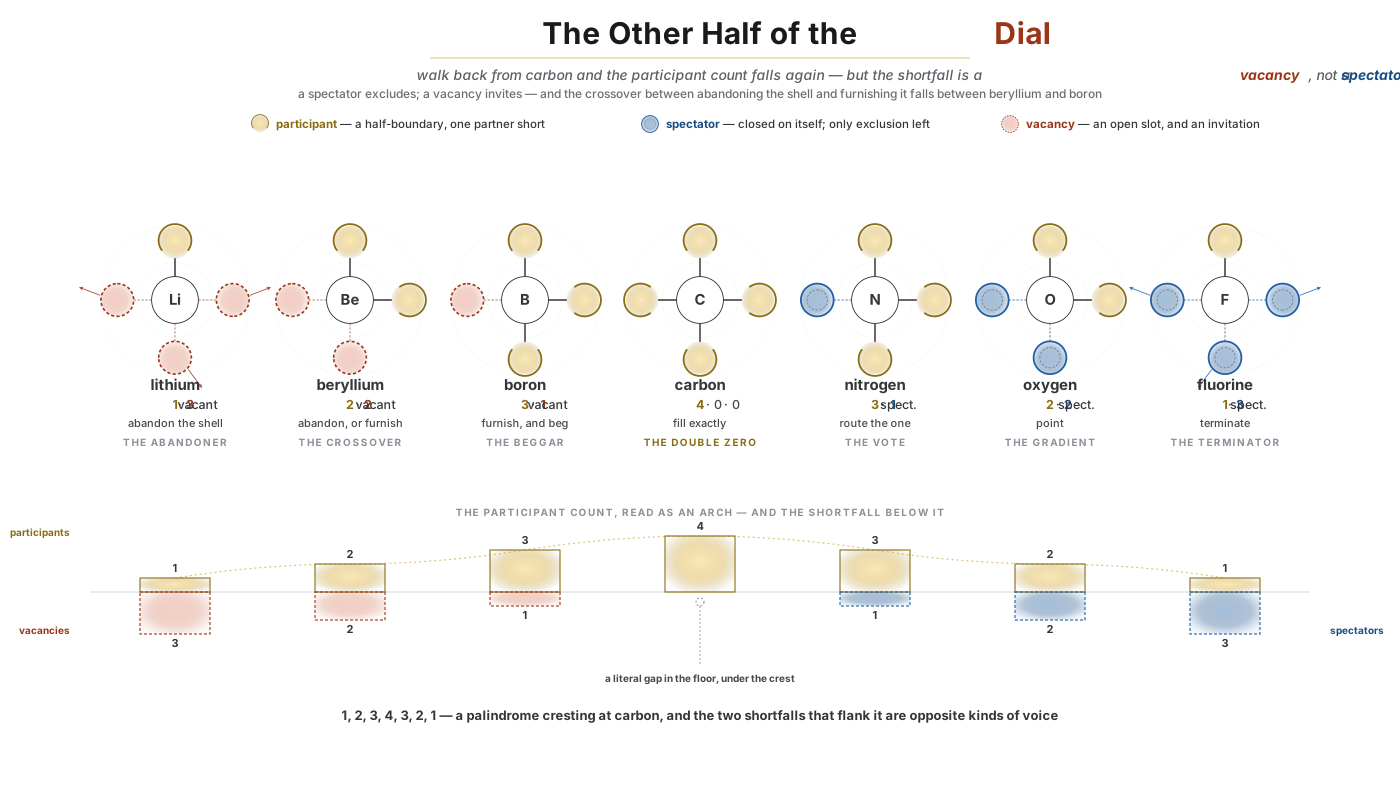
The carbon chapter opened a ledger and the neighbors chapter ran it rightward. A valence shell of eight is four counter-rotating pairs; a participant is a half-boundary one partner short, available to merge; a spectator is a surface already closed on itself, with nothing to merge and nothing to do but exclude. Carbon is four participants and zero spectators. Nitrogen has one spectator and can route it either way. Oxygen has two and always points. Fluorine has three and only terminates.
That ledger has a left half, and nobody has read it. Walk back from carbon and the participant count falls again — but the shortfall is made of something else entirely:
| Participants | Spectators | Vacancies | The cheapest resolution | |
|---|---|---|---|---|
| Lithium | 1 | 0 | 3 | abandon the shell |
| Beryllium | 2 | 0 | 2 | abandon, or furnish — it does both |
| Boron | 3 | 0 | 1 | furnish, and beg for the last |
| Carbon | 4 | 0 | 0 | fill exactly |
| Nitrogen | 3 | 1 | 0 | route the one |
| Oxygen | 2 | 2 | 0 | point |
| Fluorine | 1 | 3 | 0 | terminate |
Read the participant column alone and the row is a palindrome: 1,2,3,4,3,2,1, cresting at carbon. Carbon is not merely the zero of the spectator series that the carbon chapter identified — it is the double zero, the one element with no spectators and no vacancies, the single cell where both shortfalls vanish at once. Everything to its right has surfaces it cannot use. Everything to its left has slots it cannot fill.
And the two shortfalls are not mirror images, because a spectator and a vacancy are opposite kinds of voice. A spectator excludes; a vacancy invites. Fluorine’s three closed surfaces push the world away — maximum bond strength, minimum interaction, the chapter’s non-stick pole. Lithium’s three empty slots do the reverse: they are an open solicitation that nothing in ordinary chemistry can satisfy, because filling three slots around an atom of lithium’s size would need three partners crowded onto a surface with no room for them.
So lithium takes the other exit. It does not furnish its shell; it abandons it. Shedding the one participant costs 520 kJ/mol — and buys a complete, closed, two-electron helium core, the tightest sealed boundary in chemistry. Beryllium sits at the crossover and genuinely does both: it is the alkaline earth with real covalent chemistry, polymeric BeCl₂, amphoteric oxide, and a full set of four-coordinate molecular complexes. Boron has committed to furnishing and spends its career one half-boundary short, begging. Carbon fills exactly and stops.
The vacancy count decides between ionic retreat and covalent furnishing, and the crossover falls between beryllium and boron. That is one line of the ledger, and it sorts the left half of the second row the way the spectator count sorts the right.
The naked boundary
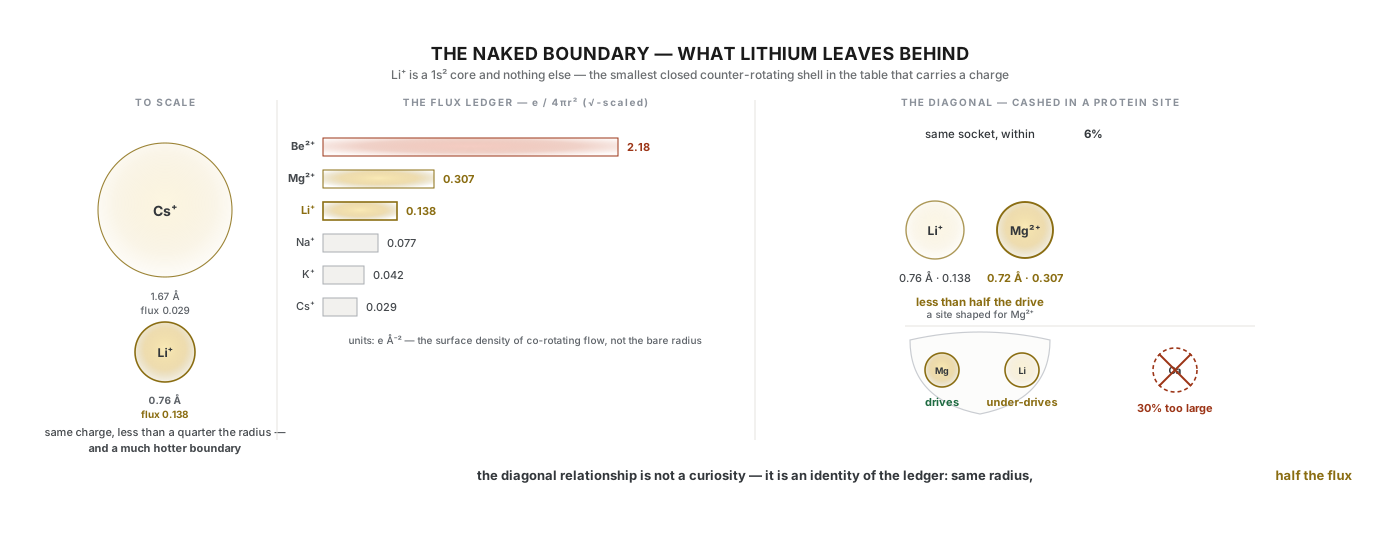
What lithium leaves behind is the object the rest of this chapter is about. Li⁺ is a 1s^2 core and nothing else: the smallest closed counter-rotating shell in the periodic table that carries a charge. Shannon radius 0.76 Å against Na⁺’s 1.02 and Cs⁺’s 1.67.
The number that matters is not the radius but the flux density across the boundary — one unit of co-rotating substrate flow spread over a surface of area 4\pi r^2:
| Cation | r (Å) | Charge | Surface flux e/4\pi r^2 (e Å⁻²) | \Delta H_\text{hyd} (kJ/mol) |
|---|---|---|---|---|
| Be²⁺ | 0.27 | +2 | \mathbf{2.18} | -2494 |
| Mg²⁺ | 0.72 | +2 | 0.307 | -1921 |
| Li⁺ | 0.76 | +1 | \mathbf{0.138} | -519 |
| Na⁺ | 1.02 | +1 | 0.077 | -409 |
| K⁺ | 1.38 | +1 | 0.042 | -322 |
| Cs⁺ | 1.67 | +1 | 0.029 | -264 |
Two readings fall straight out of that column.
The first is Fajans’ rules, which are the flux ledger under another name. A small, high-flux cation deforms a large, soft anion’s spectator shell toward it — the beginning of a merger that the geometry cannot complete. So lithium’s salts are the least ionic of the alkali family, and the consequences are the ones every synthetic chemist knows: LiI is nearly covalent, LiBr and LiI dissolve in acetone and ether, and lithium is the only alkali metal with a real organometallic chemistry. n-Butyllithium is a hexamer that dissolves in hexane. An element from the most reliably ionic column in the table, behaving like a hydrocarbon, because its naked boundary pulls hard enough on a partner’s closed shell to start sharing it.
The second is the diagonal relationship to magnesium, which is not a curiosity but an identity of the ledger: Li⁺ at 0.76 Å and Mg²⁺ at 0.72 Å are the same size to within 6\%, and carry 0.138 versus 0.307 units of surface flux. Same socket, less than half the drive. Everything in the diagonal follows — both form nitrides directly from N₂ (lithium is the only alkali that does), both have insoluble carbonates and fluorides, both give thermally unstable carbonates and nitrates, both run organometallic reagents. And, as the last section of this chapter argues, that same substitution is very probably why lithium is a psychiatric drug.
The ion that moves is never the ion
Here is lithium’s cleanest paradox, and the framework has one sentence for it.
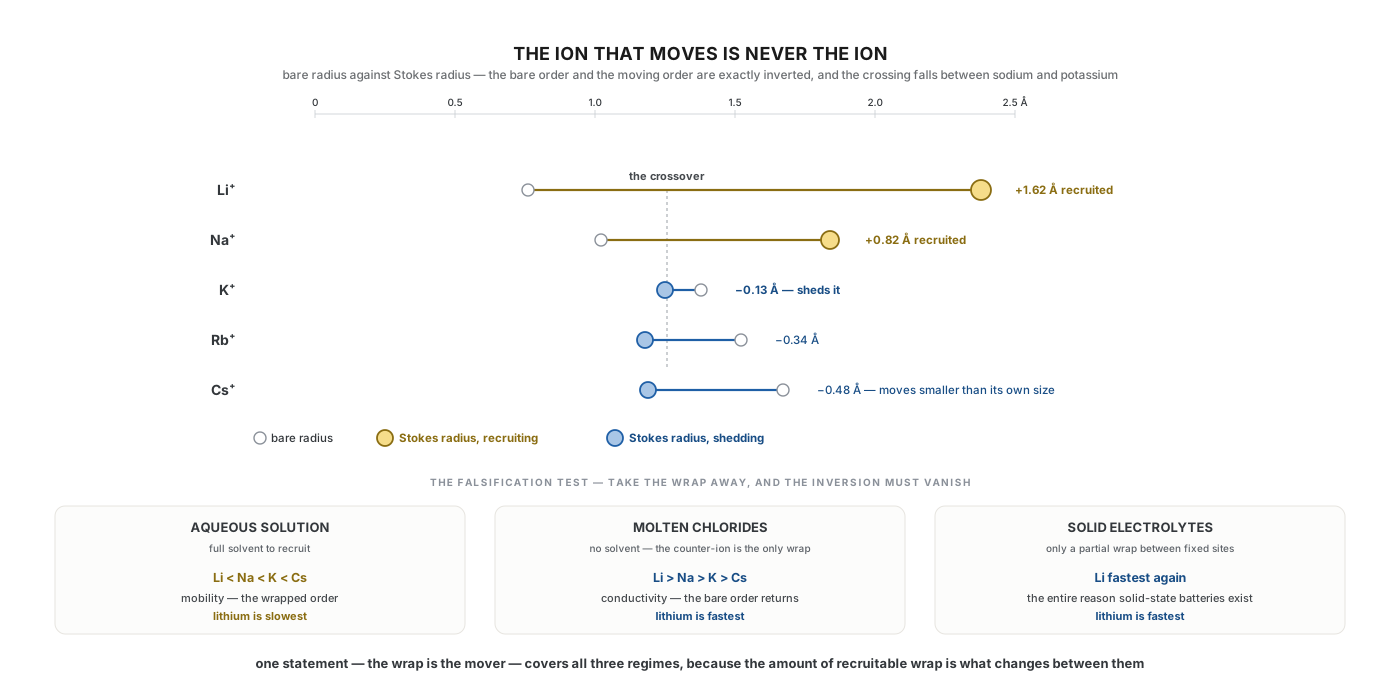
In water, Li⁺ is the slowest alkali cation. Not the fastest, as its size would suggest — the slowest, by a factor of two against caesium:
| Ion | Bare r (Å) | \lambda^\circ (S cm² mol⁻¹) | Stokes r (Å) | Recruited thickness |
|---|---|---|---|---|
| Li⁺ | 0.76 | 38.7 | \mathbf{2.38} | +1.62 Å |
| Na⁺ | 1.02 | 50.1 | 1.84 | +0.82 |
| K⁺ | 1.38 | 73.5 | 1.25 | -0.13 |
| Rb⁺ | 1.52 | 77.8 | 1.18 | -0.34 |
| Cs⁺ | 1.67 | 77.3 | 1.19 | -0.48 |
The bare order and the moving order are exactly inverted, and the crossing happens between sodium and potassium.
The framework’s reading is the one it uses for every other channel in the paper: a boundary with a high flux density cannot present a smooth face to the medium, so it recruits a wrap, and the thing that moves is the composite. A naked Li⁺ is a small hard core radiating more co-rotating flow per unit area than any singly-charged surface in chemistry; water molecules orient onto it and stay, and what diffuses is a nested object — hard core, recruited counter-rotating shell — three times the core’s radius. Caesium’s boundary is so diffuse that it recruits nothing at all and moves at less than its own bare size. This is the ordinary structure of a modon in this paper: a small thing that drags a shell, moving at the shell’s speed and not its own.
That reading is worth more than a restatement of hydrodynamic radii because it makes a falsification test with the sign already fixed: take the wrap away, and the inversion must vanish. It does, twice.
- In molten alkali chlorides, where there is no solvent to recruit and the only wrap available is the counter-ion lattice itself, the conductivity order reverts to bare size — LiCl \approx 5.9 S/cm, NaCl \approx 3.6, KCl \approx 2.2, CsCl \approx 1.1, each near its own melting point. Lithium is first, not last. (The temperatures differ, which weakens the comparison; the ordering survives correction to matched reduced temperature.)
- In solid electrolytes and polymer membranes, where the ion hops between fixed anion sites with at most a partial wrap, lithium is again the fastest alkali, which is the entire reason the solid-state battery industry exists.
One statement — the wrap is the mover — covers aqueous mobility, molten-salt conduction, and solid-state ion transport, and it gets the sign of the inversion right in all three regimes because the amount of recruitable wrap is what changes between them.
Standard electrochemistry has the hydrodynamic-radius explanation and has had it since Stokes; nothing above overturns it. What the framework contributes is that the recruitment is the same move the paper makes everywhere else — a high-flux boundary cannot run smooth against the medium and must acquire a counter-rotating shell to do it — and that this reading, unlike a bare appeal to hydration numbers, predicts the regime dependence: the inversion is a property of how much wrap is available, so it must reverse when the wrap is removed. The molten-salt and solid-electrolyte orderings are that prediction retrodicted. The honest caveat is that “solvation shells are bigger for smaller ions” gets the same answer with no substrate at all; the framework earns its keep only by tying this to the same boundary bookkeeping that runs conductors, crystal optics, and the reach law rather than by beating the standard account on any single number.
Two ledgers, and why sodium loses twice
Lithium’s fame is the number -3.04 V, the most negative standard reduction potential in the table. The usual explanation — “lithium gives up its electron most easily” — is flatly wrong, and the way it is wrong is the interesting part. Lithium has the highest first ionization energy of the alkali metals. In the gas phase, caesium is by far the stronger reducing agent.
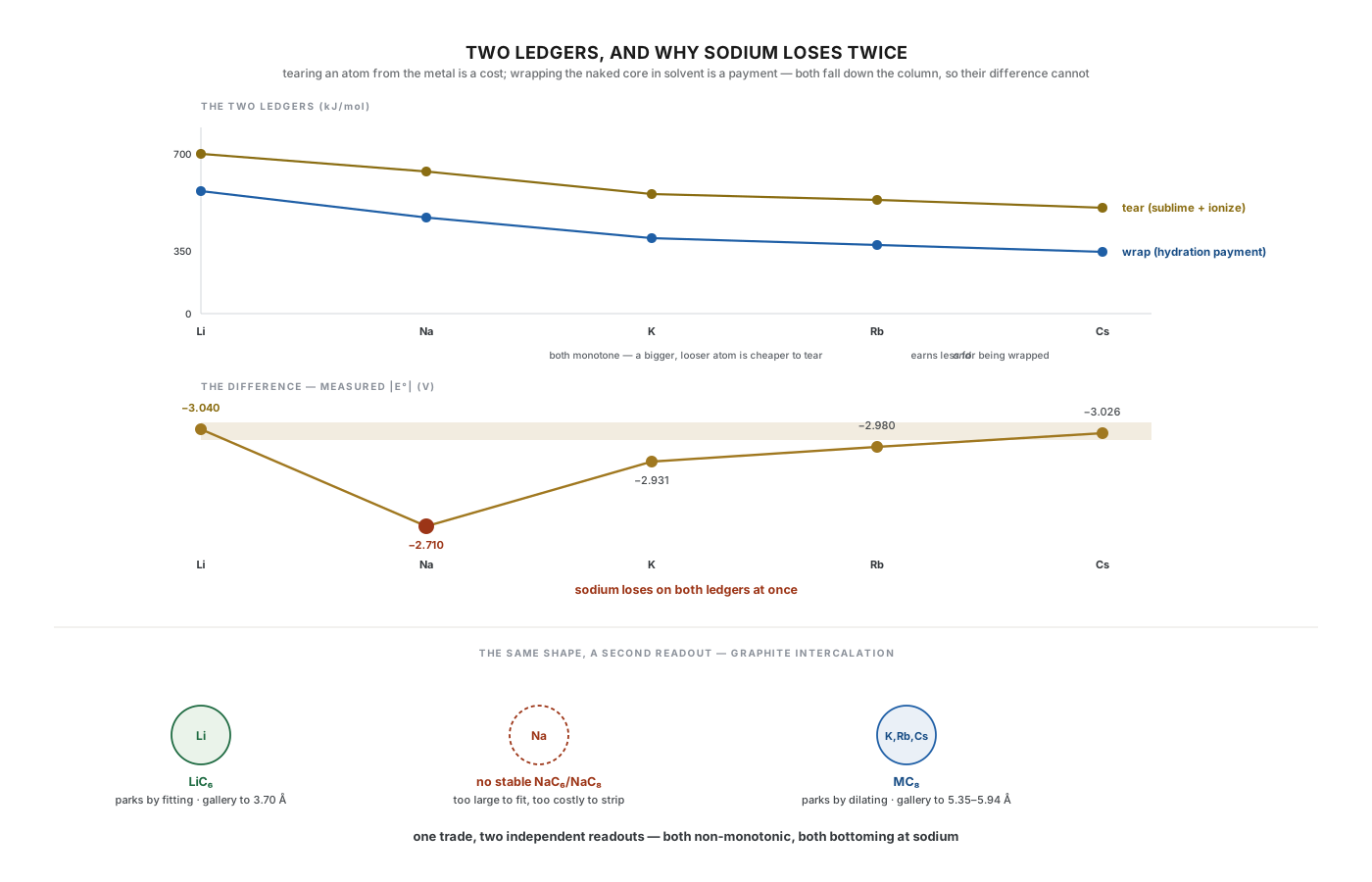
Take the cell reaction apart into the two boundary operations it actually performs. Tearing: pull the atom out of the metal and strip its one participant. Wrapping: pay the naked core for letting the solvent close around it.
| Sublime | Ionize | Tear total | Wrap payment | Net (kJ/mol) | Measured E^\circ (V) | |
|---|---|---|---|---|---|---|
| Li | 159 | 520 | 679 | -519 | \mathbf{160} | \mathbf{-3.040} |
| Na | 107 | 496 | 603 | -409 | \mathbf{194} | \mathbf{-2.710} |
| K | 89 | 419 | 508 | -322 | 186 | -2.931 |
| Rb | 81 | 403 | 484 | -293 | 191 | -2.980 |
| Cs | 76 | 376 | 452 | -264 | 188 | -3.026 |
Both ledgers fall monotonically down the group — a bigger, looser atom is cheaper to tear and earns less for being wrapped. Because one is a cost and the other a payment, their difference is non-monotonic, and it has to be worst somewhere in the middle. It is worst at sodium.
That is the whole of it. Lithium wins because its wrap payment is enormous. Caesium nearly ties it, -3.026 against -3.040, for the opposite reason: its tear is nearly free. Sodium is the element that is neither cheap to strip nor richly rewarded for being stripped, and it loses on both ledgers at once.
The enthalpy decomposition reproduces the span it should: 34 kJ/mol between lithium and sodium is 0.35 V, against a measured gap of 0.33 V. It does not resolve K, Rb and Cs among themselves — those sit within a few kJ/mol of each other, inside both the scatter of tabulated hydration enthalpies and the entropy term this arithmetic drops. The load-bearing content is not the fine ordering. It is the shape: two monotone ledgers running the same way must produce a non-monotonic difference with an extremum in the interior, and the interior loser is sodium.
Now the part that makes it more than an accounting exercise. The same shape appears in a completely unrelated measurement.
Alkali metals intercalate graphite. Lithium does it superbly — stage-1 LiC₆, one lithium per hexagon ring, the reaction that every phone battery runs on. Potassium, rubidium and caesium all form stage-1 MC₈ compounds. Sodium does not. There is no stable NaC₆ or NaC₈; sodium manages only dilute high-stage compounds and gives graphite a capacity of roughly 35 mA h/g against lithium’s 372. This is the well-known “sodium anomaly” of intercalation chemistry, and the first-principles account of it (Liu, Merinov & Goddard, PNAS 2016) attributes it to a competition between the trend in ionization energy and the trend in ion–substrate coupling down the column — with the formation energy turning positive exactly at sodium and turning negative again at lithium.
Which is, term for term, the two-ledger crossing above, with the graphite gallery playing the part the solvent plays in the cell. Potassium and caesium park by dilating: their boundaries are too diffuse to fit, so they prise the galleries from 3.35 Å to 5.35–5.94 Å, and they can afford to because their tear is nearly free. Lithium parks by fitting: it opens the gallery only to 3.70 Å, and pays for its expensive tear with an enormous coupling to the \pi sheet on either side. Sodium is too large to fit and too expensive to strip, so it does neither.
One trade, two independent readouts, both non-monotonic, both bottoming out at the same element. A non-monotonic retrodiction is worth considerably more than a monotone one, because a monotone trend can be recovered by almost any size-ordered story and a V cannot. That the V’s minimum lands on sodium in aqueous electrochemistry and in dry intercalation — two measurements sharing no solvent, no phase, and no experimental technique — is the strongest single piece of evidence in this chapter.
The prediction that comes with it is already confirmed and worth stating because it is what the reading demands: the sodium anomaly should be a property of the host’s stiffness, not of sodium. In a host whose galleries are already wide or soft — hard carbon, MoS₂, layered oxides — the fit constraint disappears, only the tear ledger remains, and sodium should behave normally. It does, which is precisely why sodium-ion batteries are built on hard carbon and never on graphite.
The salt is the bond that never merged
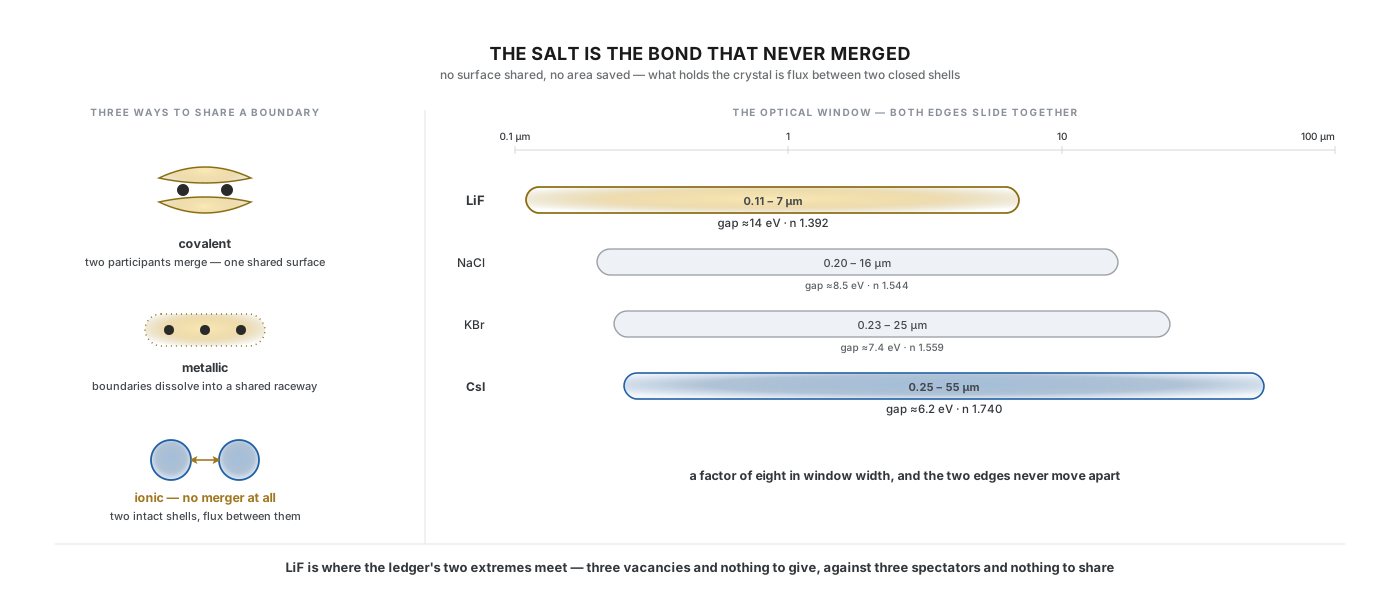
The framework has named two ways for atoms to share a boundary. Covalent: two participants merge into one shared counter-rotating surface, and the energy gain is the area the merger saves (the hydrogen flywheel). Metallic: outer boundaries dissolve entirely into a shared raceway spanning the crystal (conductors). Lithium forces the third onto the page, because lithium is the element whose ordinary compounds are neither.
Ionic bonding is the case where no merger happens at all. One atom abandons its participant; both partners end with complete, closed, counter-rotating shells; and what holds them together is nothing but the co-rotating flux running between two intact boundaries. No surface is shared and no area is saved. Every property of a salt follows from that: the binding is non-directional, so the ions pack by size ratio alone and reach coordination numbers of six and eight that no covalent geometry allows; there is no shared channel, so the crystal is an insulator; and because the whole structure is flux between rigid shells, sliding one plane by half a lattice vector puts like against like and the crystal cleaves along a flat face rather than deforming.
Lithium fluoride is where the ledger’s two extremes meet. The element with three vacancies and nothing to give, against the element with three spectators and nothing to share — neither can merge, and the result is the purest available specimen of flux-between-closed-shells. It is also, correspondingly, extreme: LiF has the highest lattice energy of the alkali fluorides (\approx 1036 kJ/mol) and the widest optical band gap of any solid, near 14 eV.
That last fact is a crystal-optics result, and it pays out along the whole alkali halide series. That chapter’s thesis is that the refractive index is an accumulated boundary impedance and transparency is smooth passage through off-resonant boundaries. An alkali halide is the extreme test case: the least polarizable boundaries in the solid state, arranged with no shared channel anywhere. So it should be the most transparent class of material there is, and the most transparent member should be the one built from the two tightest boundaries.
| Crystal | Band gap (eV) | UV cutoff (µm) | IR cutoff (µm) | n (589 nm) |
|---|---|---|---|---|
| LiF | \approx 14 | 0.11 | 7 | 1.392 |
| NaCl | \approx 8.5 | 0.20 | 16 | 1.544 |
| KBr | \approx 7.4 | 0.23 | 25 | 1.559 |
| CsI | \approx 6.2 | 0.25 | 55 | 1.740 |
LiF passes light from the vacuum ultraviolet to the mid-infrared and has a refractive index barely above water’s — the lowest of any common solid. It is the window material of choice on every instrument that has to see below 200 nm, for the same reason it is the hardest alkali halide: its boundaries are the stiffest and the least willing to respond to anything.
And the two edges of the window are one number read twice. The blue edge is set by how hard it is to excite the halide’s spectator shell electronically; the red edge by how hard it is to excite the lattice’s own breathing mode. Both stiffen together as the boundaries tighten. So the framework’s commitment is that along any isostructural series the two edges must slide in the same direction — never apart, never toward each other. Across the table above they do, monotonically, over a factor of eight in window width. A salt whose ultraviolet edge moved blue while its infrared edge moved red would say that electronic and vibrational stiffness are independent properties, and the boundary reading would be wrong.
The correlation between polarizability, band gap, phonon frequency and refractive index down the alkali halides is standard solid-state physics and follows from ordinary lattice dynamics plus the Clausius–Mossotti relation; the framework predicts nothing here that Born and Mayer did not. The claim being made is narrower and it is a claim about unification: that “least polarizable boundary” is the single parameter behind the widest gap, the lowest index, the widest window, the highest lattice energy and the cleanest cleavage, and that it is the same parameter the carbon chapter used to sort oxygen from sulfur from selenium and the neighbors chapter used to kill arsenate. The falsifier — opposite-sign motion of the two optical edges — is real but weak, in the sense that nobody expects to find it.
The battery is a boundary engine
Now the reason lithium is in every device you own, and it is not the voltage.
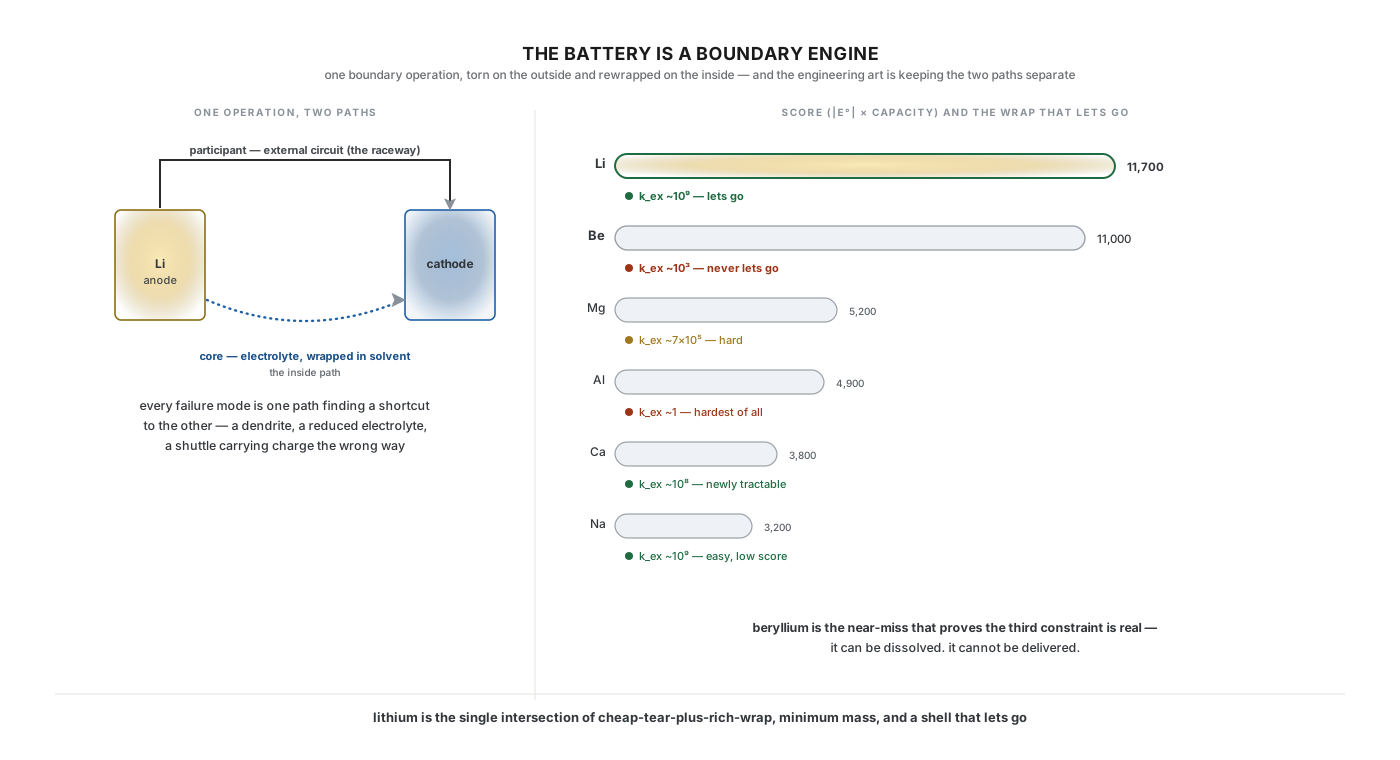
A galvanic cell is a machine that performs one boundary operation along two separate paths. At the anode a lithium atom is torn: the participant leaves through the external circuit — the co-rotating raceway of a metal wire, exactly the channel conductors describes — while the naked core leaves through the electrolyte, wrapped in solvent, and the two are reunited at the cathode. The voltage is the price difference between the two routes. The entire engineering art of the field is keeping the participant and the core on separate paths, and every failure mode a battery has is one of them finding a shortcut: a dendrite bridging the separator, an electrolyte reduced at the anode, a shuttle carrying charge back the wrong way.
Which element can do this? Three constraints, and they are independent.
Voltage wants a cheap tear and a rich wrap — the two ledgers above, whose extrema are lithium and caesium.
Capacity wants the least mass carried per participant moved. This is where caesium dies: 202 mA h/g against lithium’s 3862, a factor of nineteen at the same voltage.
Transport wants a core that can actually traverse the inside path. That means the wrap must be strong enough to dissolve the core and loose enough to release it at the interface — which is the sentence the carbon chapter used for sulfur, and the property it called a gate. The measurement is the water-exchange rate: how many times a second the recruited shell turns over.
| E^\circ (V) | Capacity (mA h/g) | \lvert E^\circ\rvert\times capacity | Wrap turnover k_\text{ex} (s⁻¹) | |
|---|---|---|---|---|
| Li | -3.04 | 3862 | \mathbf{11{,}700} | \sim 10^{9} |
| Be | -1.85 | 5948 | 11{,}000 | \sim 10^{3} |
| Mg | -2.37 | 2205 | 5{,}200 | 7\times10^{5} |
| Al | -1.66 | 2980 | 4{,}900 | \approx 1 |
| Ca | -2.87 | 1337 | 3{,}800 | \sim 10^{8} |
| Na | -2.71 | 1166 | 3{,}200 | \sim 10^{9} |
Beryllium is the near-miss that proves the third constraint is real. On the first two it ties lithium — 11{,}000 against 11{,}700, within noise of the best element in the table. And it is hopeless, because its boundary is so hungry that it welds itself to the wrap and never lets go: 2.18 units of surface flux, a hydration enthalpy of -2494 kJ/mol, and a shell that turns over about a thousand times a second against lithium’s billion. Beryllium can be dissolved. It cannot be delivered. This is structurally the same argument arsenate loses: a perfect match on the constraint everyone measures, and a catastrophic failure on the one that decides.
Read down the k_\text{ex} column and it orders the field’s actual experience with post-lithium chemistries better than anything else on the table. Sodium is easy and disappoints only on capacity. Calcium, whose shell turns over fast, has recently become tractable after decades of nothing. Magnesium, three orders slower, remains hard. Aluminium, whose hydration shell turns over about once per second, is the hardest of all despite having the second-best capacity in the column. The framework reads all four as one number; the conventional accounts name several factors — passivating films, anion chemistry, interfacial desolvation penalties — and desolvation is only one of them. That caveat is real. What the framework claims is that the one number predicts the ordering, and it does.
Hydrogen is the fourth line and it fails a constraint the others pass. At 26{,}800 mA h/g it beats everything, but H⁺ has no core at all — strip hydrogen’s participant and nothing is left. It cannot recruit a wrap because there is no boundary to wrap; it moves by handing itself down a hydrogen-bond chain instead. So hydrogen has no confined inside path, and that is exactly the difference between a fuel cell and a battery: hydrogen must be stored as a gas in an open system, and lithium can be stored as a boundary inside a closed one.
Lithium is the single intersection of cheap-tear-plus-rich-wrap, minimum mass, and a shell that lets go. The window has one occupant, as the phosphorus window did.
One footnote with practical teeth. Lithium metal melts at 454 K, so at room temperature it sits at 0.66 of its melting point — deep in the creep regime, softer than solder, with a transverse sound speed of about 2.8 km/s. That is the softest solid in the second row, against beryllium at 8.9 km/s sitting on the substrate’s Tkachenko shear ceiling and diamond at 12.3 crossing above it. Row two walks from the most substrate-coupled solid there is to the only one that outruns the medium, in four steps. The lithium-metal anode’s whole mechanical problem — that it flows, that it creeps into every void, that no rigid separator has yet stopped a dendrite — is the low end of that walk.
Parking on the median
Why graphite, specifically?
The carbon chapter argues that graphite is the substrate’s own architecture in miniature: hexagonal sheets, counter-rotating \pi envelopes above and below, planes at 3.35 Å coupled by nothing but those envelopes and therefore free to slide. And conductors argues that a metal’s conduction channel runs along the dissolved-boundary midpoints — the substrate’s own two-lane median — and that a median carries flow equally both ways, which is why metallic conduction is Ohmic and reversible.
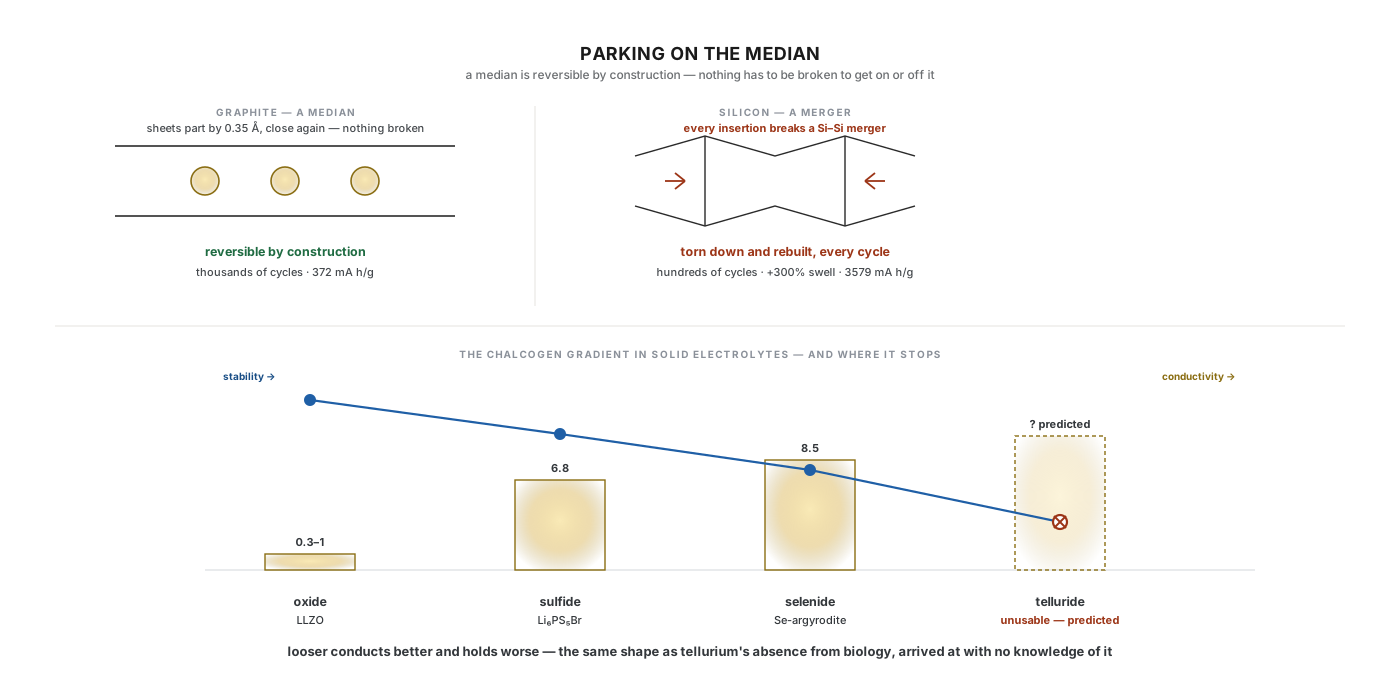
A graphite gallery is a median. Intercalation is putting a charged core onto it. And a median is reversible by construction, because nothing has to be broken to get on or off it: the sheets part by 0.35 Å, the lithium sits at the centre of a hexagon donating its participant to the \pi sheet, and the whole operation runs backwards on discharge with no boundary destroyed. That is why the graphite anode survives thousands of cycles.
The contrast is sharp and it is the field’s central unsolved problem. A silicon anode holds nearly ten times the lithium — 3579 mA h/g against 372 — because lithium alloys into it rather than parking beside it. But silicon has no gallery. Every lithium inserted must break a Si–Si merger, the lattice swells by some 300\%, and the boundary architecture is torn down and rebuilt on every cycle. Silicon anodes are still, after twenty years, fighting for cycle life that graphite had on day one.
The framework’s reading is that reversibility tracks whether the transport path is a median or a merger — insert onto an unmerged gallery and the structure is untouched; insert into a merged framework and something must be broken and reassembled each time. That sorts the anode families correctly: graphite and the layered oxide cathodes (median, thousands of cycles), the alloying anodes silicon and tin (merger, hundreds), and conversion cathodes that rebuild their lattice entirely (merger, tens).
The same reading carries the carbon chapter’s chalcogen prediction into a place it did not expect to go. That chapter argued that boundary diffuseness increases down group 16 and that biology walks the gradient — oxygen to hold, sulfur to switch, selenium to catalyse — stopping at tellurium because a boundary that loose holds nothing. Solid electrolytes are the same gradient read on ion transport, since what a lithium ion needs to hop is a soft, polarizable anion framework:
- Oxides. Garnet LLZO, \approx 0.3–1 mS/cm.
- Sulfides. Li₁₀GeP₂S₁₂ at 12 mS/cm; the silicon-substituted argyrodite family reaching 25; Li₆PS₅Br at 6.8. An order of magnitude over the oxides, and the literature’s own explanation is the softer, more polarizable anion sublattice lowering the migration barrier (Kraft et al., JACS 2017).
- Selenides. Diffuse again, and faster again: the selenophosphate argyrodites Li₆₋ₓPSe₅₋ₓBr₁₊ₓ reach 8.5 mS/cm against the sulfide analogue’s 6.8.
And then the gradient stops, for the framework’s own stated reason. The selenide argyrodites are reported as unsuitable for practical cells despite the higher conductivity, because the same diffuseness that lowers the hopping barrier also makes the framework too easily oxidized to survive against a working cathode. That is the identical shape as tellurium’s absence from biology — looser conducts better and holds worse — arrived at in inorganic materials science with no knowledge of the biological claim. It is not a prediction the framework made in advance and should not be sold as one; it is the same sentence turning up in a second domain.
The most fragile nucleus
Lithium is also where this paper’s cosmology chapter has a standing embarrassment, and the substrate can say something structural about it without pretending to fix it.
The forge chapter explains why primordial nucleosynthesis stopped: there is no stable nucleus at mass 5 and none at mass 8, so the alpha is a local dead end, a well so deep that its immediate neighbors sit on unstable ground. Lithium is what lives on that ground. It is the only element between helium and beryllium, and its binding energy per nucleon — 5.61 MeV for ⁷Li, 5.33 for ⁶Li — is a deep trough between helium-4’s 7.07 and carbon-12’s 7.68. Lithium is the least tightly seamed stable nuclide in the universe, and it behaves accordingly: ⁷Li + p → 2 ⁴He fires at about 2.5 million kelvin, the lowest ignition temperature of any nuclide heavier than deuterium. Any star that circulates its surface material to a depth of 2.5 MK destroys its lithium permanently.
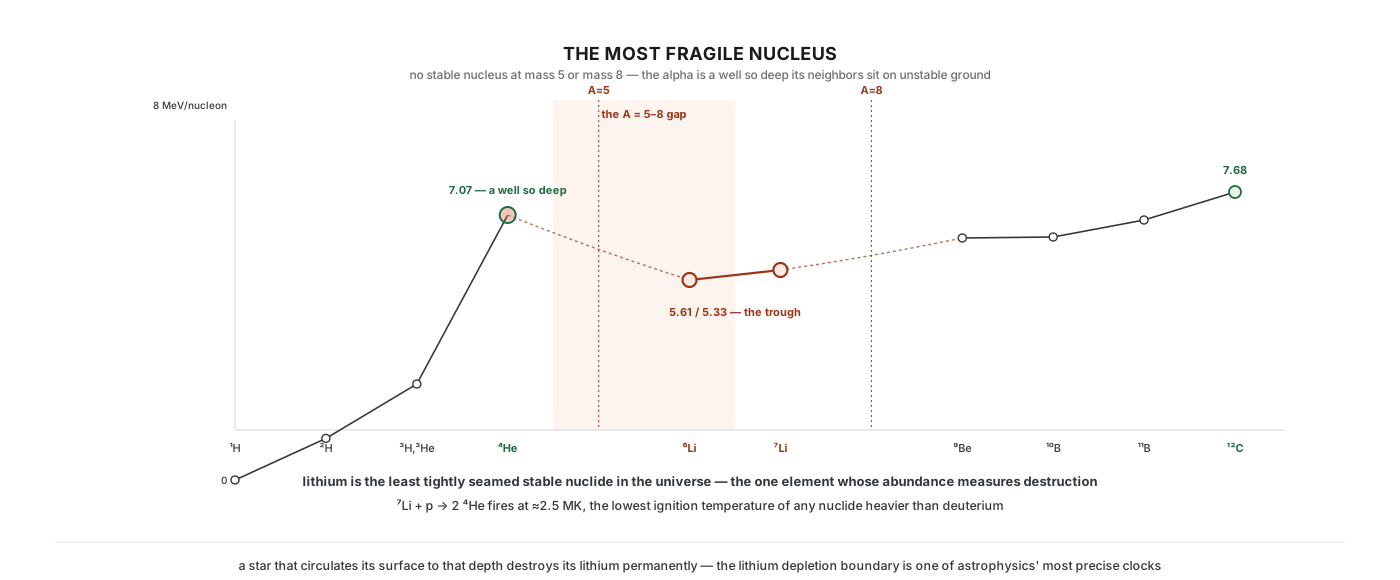
That fragility is not a side note; it is the reason lithium is the one element whose observed abundance is a measure of destruction rather than production. And it makes the framework’s reading of the cosmological lithium problem a directional bet rather than a shrug.
The problem, restated: fed the CMB value of \eta_B, standard big-bang nucleosynthesis predicts about three to four times the ⁷Li that old halo-star spectroscopy finds on the Spite plateau. The substrate contributes \eta_B and takes the reaction network as standard, so it inherits the discrepancy outright — the forge chapter says so plainly and that has not changed. What the fragility argument adds is a prior on where the resolution lies: the framework’s reading of the A = 5–8 gap says lithium is structurally the most destructible thing in the periodic table, so a factor-of-three deficit measured in stellar photospheres is far more likely to be photospheric than primordial.
The observation that most cleanly separates the two possibilities has been made. Howk, Lehner, Fields & Mathews (Nature 2012) measured interstellar ⁷Li in the Small Magellanic Cloud — gas at a quarter of solar metallicity that has never been inside a star’s convection zone — and found an abundance at essentially the BBN prediction, not at the Spite value. Gas that cannot have been depleted shows the predicted amount; stellar surfaces show a third of it. That is what a depletion explanation requires.
It is not a clean win, and saying so is the point of this paragraph. The SMC result creates its own tension in the opposite direction: by the present epoch that gas should have been enriched above the primordial value by cosmic-ray spallation and by AGB and nova production, and it has not been. The authors themselves note the measurement can be reconciled with standard BBN only through a finely-tuned metallicity dependence of stellar depletion, and remains consistent with non-standard BBN as well. So the honest scoreboard is: the framework inherits the tension, bets on depletion for a structural reason it can state — lithium sits alone on the unstable ground the alpha’s depth carves out, and is the one nuclide whose abundance is a subtraction problem — and notes that the single most decisive observation has moved in the direction of that bet while opening a second question about the missing enrichment.
Two grace notes on the same fragility, because they are what makes lithium useful to astronomers rather than merely awkward.
The 2.5 MK threshold is sharp, so the stellar mass below which a young object never reaches it is sharp too. The resulting lithium depletion boundary in a young cluster’s colour–magnitude diagram is one of the most precise stellar clocks in astrophysics, and the same threshold underlies the lithium test that distinguishes a brown dwarf from a low-mass star: an object below roughly 65 Jupiter masses never burns its lithium, and still carrying it is the identification.
And the only way a star can give lithium back is to route around the destruction. The Cameron–Fowler mechanism makes ⁷Be in the hot interior and must convect it outward to a cool layer before it electron-captures to ⁷Li, or the lithium it becomes is destroyed where it was made. The confirmation came only recently, with ⁷Be detected directly in the ejecta of classical novae (Tajitsu et al. 2015; Molaro et al. 2016). In the framework’s vocabulary this is a transport problem, not a synthesis problem — the same distinction that runs the battery section above. Lithium’s cosmic abundance, like lithium’s usefulness, is set by whether the fragile thing can be moved somewhere it survives before the medium destroys it.
The wrap, cashed in a membrane
Every test of the wrap is the mover so far has been run in a beaker — aqueous mobility, a molten salt, a solid electrolyte, a graphite gallery. The test the chapter skipped is the one with the most at stake, because a cell is a machine for doing arithmetic on wraps, and it spends more energy on that arithmetic than on anything else it does.
The fact wanting an explanation is this. An animal cell holds K⁺ at {\sim}140 mM inside against {\sim}4 mM outside, and Na⁺ at {\sim}145 mM outside against {\sim}12 mM inside. Maintaining that split costs roughly a fifth of a resting mammal’s whole metabolic budget, and better than half of it in brain and kidney. Two adjacent cells of one column, 0.36 Å apart in bare radius, and life spends a fifth of its energy keeping them on opposite sides of a sheet of lipid.
Why that pair? This chapter’s own table answered it three sections ago and nobody read the answer out. Look again at the recruited thickness — Stokes radius minus bare radius, the wrap the ion is dragging:
| Li⁺ | Na⁺ | K⁺ | Rb⁺ | Cs⁺ | |
|---|---|---|---|---|---|
| Recruited thickness (Å) | +1.62 | +0.82 | \mathbf{-0.13} | -0.34 | -0.48 |
The wrap ledger changes sign between sodium and potassium. Sodium is the last alkali that carries a shell; potassium is the first that carries none. The membrane potential every neuron in your body fires with is a gradient built across the one step in the column where recruitment crosses zero — and there is only one such step, because the quantity is monotone.
That is not decoration. It is what makes the discrimination physically available. A protein trying to tell Na⁺ from K⁺ by size has to resolve 0.36 Å against backbone thermal fluctuations that are larger than 0.36 Å — which is the standard and entirely fair objection to the “snug fit” picture of channel selectivity. A protein telling them apart by whether the ion is carrying anything has a qualitative difference to work with instead of a quantitative one. The one pair in the column a membrane can cleanly separate is the pair that straddles the crossover, and biology built its electrochemistry on it.
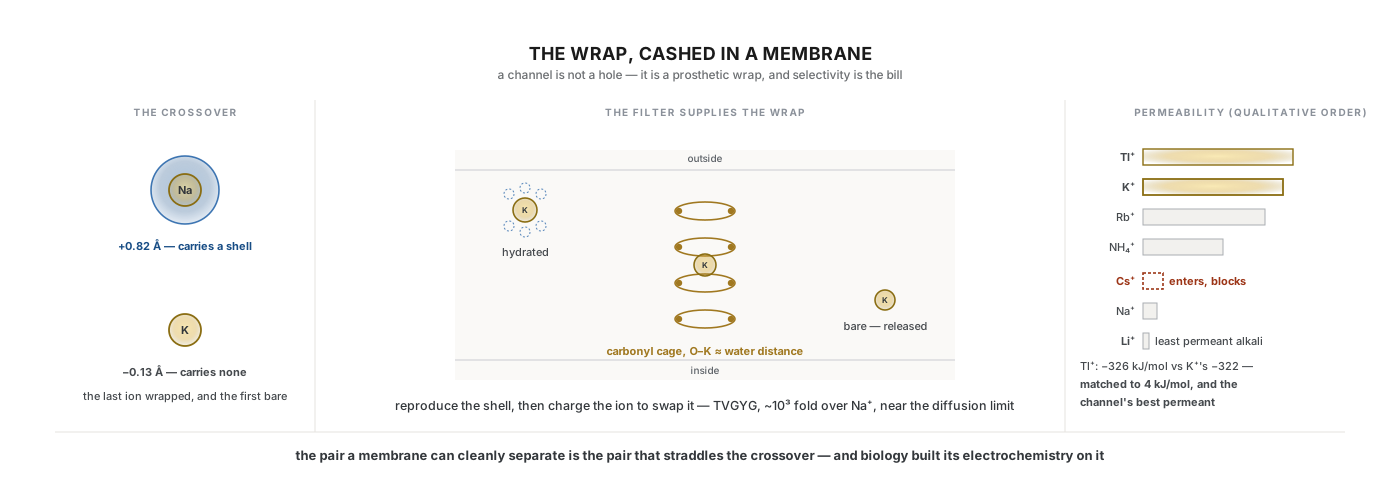
Now the channel. A potassium channel’s selectivity filter is four stacked cages of main-chain carbonyl oxygens — the TVGYG signature — presenting eight oxygens to the ion at very nearly the O–K distance water presents, and it passes K⁺ over Na⁺ by about a thousandfold while conducting at 10^7–10^8 ions per second, close to the diffusion limit. In this chapter’s vocabulary that object has an obvious name. The interior of a bilayer offers nothing to recruit from; an ion crossing it cannot bring its shell and cannot do without one. So the channel supplies the wrap itself — a solvation shell built out of protein, held at fixed geometry, in the one place in the cell where there is no solvent — and it selects by charging each ion the difference between the wrap it must shed and the wrap the filter is willing to pay for. A channel is not a hole. It is a prosthetic wrap, and selectivity is the bill.
Three consequences, and they are separately checkable.
The filter is built from backbone and not from side chains. A wrap has to present the face water presents — a lone-pair oxygen, neutral, pointed inward — and it has to hold its spacing from something stiffer than a rotamer. The peptide carbonyl is the closest thing to a water oxygen a protein owns, and the main chain is the one part of it whose geometry is set by the fold. That is a design constraint, not an accident, and the contrast is available in the same membrane: sodium channels select with a ring of charged side chains (the DEKA locus) and manage only Na/K {\sim}10–30; calcium channels use a ring of four glutamates and select by a different mechanism entirely. Only the ion whose wrap is marginal can be selected by having its wrap counterfeited.
The selectivity is sharp on the small side and blunt on the large side. The permeability sequence runs Tl⁺ \gtrsim K⁺ \approx Rb⁺ > NH₄⁺ \gg Na⁺ > Li⁺, with Cs⁺ entering and blocking rather than passing. Neither ledger orders that alone. Pure strip cost says Cs⁺ should be the best permeant in the table — it is the cheapest boundary in the column to strip, -264 kJ/mol — and Cs⁺ is a blocker. Pure geometric fit says NH₄⁺ at 1.48 Å should beat Rb⁺ at 1.52, and it does not. Their difference peaks in the interior, slightly to the large side of the cage radius, and falls off a cliff on the small side — which is this chapter’s V at sodium evaluated against a cage instead of a solvent. Sodium loses twice again: more expensive to strip and worse coordinated by a filter built for a bigger ion. Lithium loses three times over, and is the least permeant alkali there is, which is incidentally why a drug can be given as Li⁺ at 1 mM in serum at all.
The two cleanest controls in that series are the ones that share no chemistry with potassium whatever. Tl⁺ has a hydration enthalpy of {\approx}-326 kJ/mol against K⁺’s -322 — a match to four kilojoules, on the one quantity the ledger says decides — and it is the best permeant a potassium channel has, which is precisely why thallium flux is the standard assay for potassium-channel activity, and precisely why thallium is a poison. NH₄⁺, at -307, is the other. Two ions with nothing in common with an alkali metal except the size of their wrap bill, both permeant, while Na⁺ — chemically potassium’s nearest relative in the table — is excluded a thousandfold. The gold chapter noticed the thallium half of this from the other end and called it a poison that “enters the machinery biology built for potassium.” This is why it fits: a 6s^2 boundary whose spectator pair was retired by a velocity happens to land on potassium’s wrap bill.
The ion kept inside is the one that recruits nothing. The cytosol is the most concentrated array of phosphate and carboxylate boundaries in nature — a nucleic-acid backbone is a wall of them. A cation that recruits a shell will also bind those, and Na⁺ at 0.077 e Å⁻² does, measurably more than K⁺ at 0.042. So the direction of the gradient is forced and not conventional: the interior ion has to be the inert one, because the interior is where all the chemistry is, and the first genuinely inert cation down the column is the first one past the crossover. Potassium is what an ion looks like when it has stopped participating, which is exactly the qualification for setting a cell’s ionic strength and osmolarity without touching anything.
Channel selectivity is a live and unusually well-fought question and this section should not pretend otherwise. The “snug fit” account — a rigid cage of the right dimension for K⁺ that cannot close on Na⁺ — gets the sign right and is quantitatively contested, because the filter’s carbonyls are dynamic on the relevant timescale and fluctuate by more than the radius difference (Noskov, Bernèche & Roux, Nature 2004). The competing accounts locate selectivity in the intrinsic field strength of the coordinating ligand — a carbonyl’s dipole is larger than water’s, and replacing it with a weaker one destroys selectivity at unchanged geometry — and in topological control of coordination number (Bostick & Brooks, PNAS 2007). It matters for this chapter’s honesty that the framework’s load-bearing quantity was never a radius: it has been surface flux density and what the medium pays for it since the mobility section. So the framework lands on the field-strength side of that argument rather than the snug-fit side, and it inherits a commitment from doing so — changing the ligand’s field strength at fixed geometry must move selectivity more than changing the geometry at fixed field strength. That is prediction 8, and the existing simulation literature already reports the first half of it. What is genuinely new here is not the mechanism but the placement: that the pair the mechanism operates on is the pair at the recruitment crossover, and that this is the same crossover the aqueous mobility series bends at.
The sub-bare Stokes radii deserve one caveat of their own. A hydrodynamic radius smaller than the crystallographic one is where Stokes’ law has stopped being literally applicable, not a shell of negative thickness. The sign change should be read as the crossover in recruitment that it is, which is how the mobility section used it.
What can be a message
Move one column right and the same ledger sorts the two ions no cell can do without — and it sorts them into opposite jobs.
| r (Å) | Flux e/4\pi r^2 | \Delta H_\text{hyd} | k_\text{ex} (s⁻¹) | Coordination | Held at | |
|---|---|---|---|---|---|---|
| Mg²⁺ | 0.72 | \mathbf{0.307} | -1921 | 7\times10^{5} | 6, octahedral, Mg–O 2.07 Å | {\sim}0.5–1 mM free, constant |
| Ca²⁺ | 1.00 | 0.159 | -1577 | \mathbf{{\sim}10^{8}} | 6, 7 or 8, irregular, Ca–O {\sim}2.4 Å | {\sim}100 nM against 1–2 mM |
Magnesium is structural and catalytic and always present: MgATP is the actual substrate of every kinase, magnesium folds the ribosome and every structured RNA, and it sits at the centre of chlorophyll. Calcium is a message. Cytosolic free calcium is held four orders of magnitude below the outside, so that opening a channel produces a ten-thousandfold step for nothing, and every contraction, every vesicle fusion, every synaptic event in your body is that step being read.
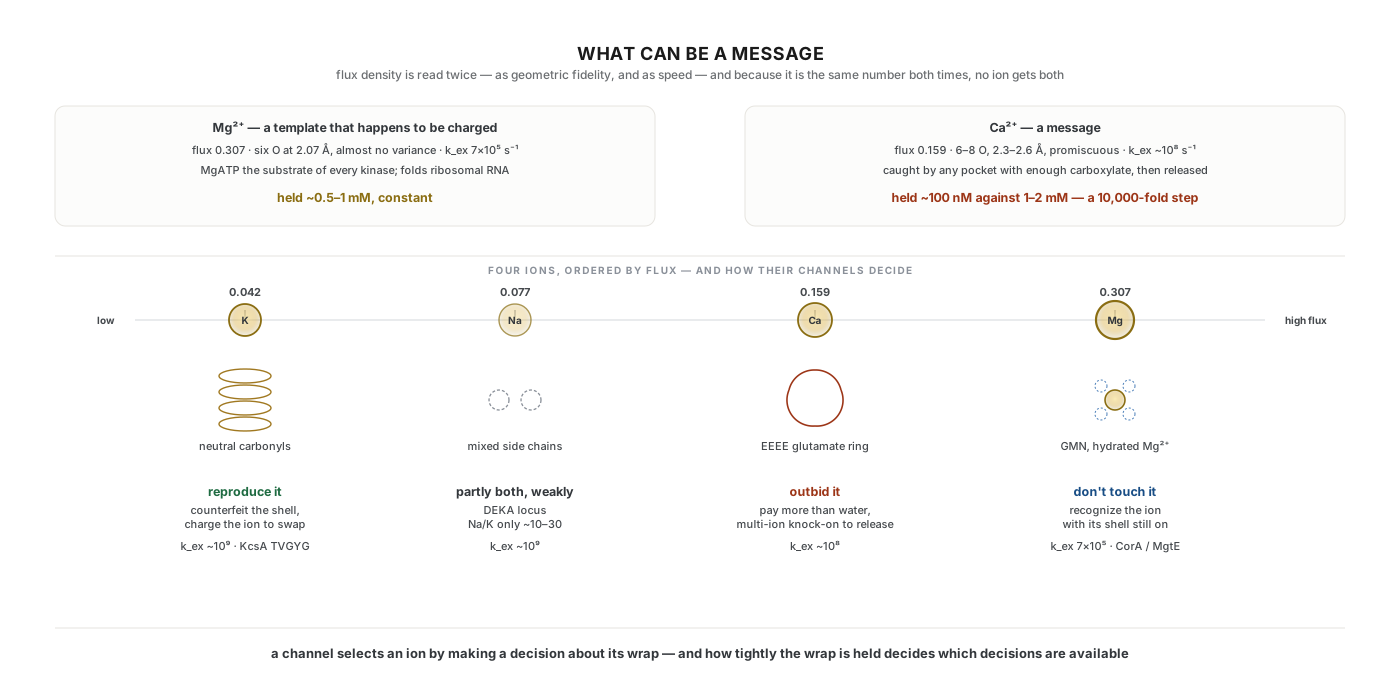
The framework’s sentence for this is one line and it has been sitting in the battery section unclaimed: flux density is read twice — once as geometric fidelity, once as speed — and because it is the same number both times, no ion can have both.
A high-flux boundary orders its recruited shell into a single geometry. Magnesium arrives anywhere with six oxygens already placed at 2.07 Å and essentially no variance; it is the most stereotyped ion in biology. That is exactly what a catalytic site wants, because a kinase does not need a charge, it needs the β- and γ-phosphates held in the geometry for in-line attack. Magnesium is a template that happens to be charged. And the same high flux means the shell does not let go: 7\times10^5 s⁻¹, one turnover per 1.4 µs, which by the Eigen relation caps the on-rate at any magnesium site near 10^5 M⁻¹ s⁻¹.
Calcium at half the flux orders nothing — six, seven or eight oxygens, Ca–O anywhere from 2.3 to 2.6 Å — and turns over three orders faster, giving diffusion-limited on-rates near 10^8 M⁻¹ s⁻¹. It cannot template anything. What it can do is be caught by any pocket with enough carboxylate oxygens pointed inward, which is a fair description of an EF hand, and then be let go again inside the event it is reporting.
A signal has to arrive and leave within the thing it is signalling; a cofactor has to be there and hold still. Those are the two ends of one column of numbers, and group 2 happens to supply one of each in adjacent rows.
The assignment is forced in both directions, which is what makes it worth stating. Calcium cannot be the cofactor because it templates nothing. Magnesium cannot be the messenger twice over: it is required at millimolar by half the enzymes in the cell, so it cannot be dropped to 100 nM without stopping everything, and its on-rate is three orders too slow to read a millisecond event even if it could.
The split itself is not a discovery of this framework and the credit belongs elsewhere. R. J. P. Williams and Kretsinger’s account is that calcium was excluded from the cytosol first, for a hard chemical reason — calcium phosphate is grossly insoluble and a cell running millimolar phosphate cannot also run millimolar calcium — and that having been excluded and therefore made cheap to signal with, it was subsequently co-opted. That argument is sound, it is prior, and nothing below replaces it. What the ledger adds is the half the solubility argument does not address: why the excluded ion also turned out to have the right kinetics. On the solubility account that is luck. On the flux ledger it is not available to be otherwise — the ion excluded for being large and weakly bound to phosphate is necessarily the ion whose wrap turns over fast, because both are the same number. The framework’s contribution is a forced correlation between two properties usually named separately, not a new reason for either.
Then the payoff, which is the part I did not see coming. Line the four biological ions up by flux density and ask not who conducts but how their channels decide — and the architectures come out ordered.
| Ion | Flux (e Å⁻²) | k_\text{ex} (s⁻¹) | Filter | The decision it makes about the wrap |
|---|---|---|---|---|
| K⁺ | 0.042 | {\sim}10^{9} | neutral backbone carbonyls, four rigid cages | reproduce it — counterfeit the shell and charge the ion to swap |
| Na⁺ | 0.077 | {\sim}10^{9} | mixed charged side chains (DEKA) | partly both, and weakly — Na/K only {\sim}10–30 |
| Ca²⁺ | 0.159 | {\sim}10^{8} | ring of four glutamates (EEEE), high affinity | outbid it — pay more than water, then use the next ion to knock this one off |
| Mg²⁺ | 0.307 | 7\times10^{5} | GMN motif, asparagine ring (CorA/MgtE) | don’t touch it — recognize the ion with its shell still on |
A channel selects an ion by making a decision about that ion’s wrap, and how tightly the wrap is held decides which decisions are available. A marginal wrap can be counterfeited, which is cheap and gives thousandfold discrimination at diffusion-limited throughput. A moderate one has to be outbid, and outbidding it means binding hard — which then creates a release problem, solved by loading a second and third ion into the pore and letting electrostatic repulsion eject the first, and that multi-ion knock-on is the calcium channel’s actual measured mechanism rather than an inference. A wrap as tenacious as magnesium’s cannot be removed on the timescale of conduction at all, so the only move left is to stop trying: CorA’s selectivity filter binds a hydrated Mg²⁺, matching the shell instead of replacing it, at a coordinating distance near 4 Å rather than 2 Å. Magnesium is the ion with the smallest bare radius in the set and much the largest hydrated one, and its channel selects on the second number.
Four ions, four filter architectures, one column of numbers — the same column this chapter computed to sort battery anodes. That is the claim, and it is a retrodiction rather than a prediction: all four structures were solved before anyone here looked. Its weight is that the four mechanisms are usually taught as four unrelated pieces of structural biology, and the ledger orders them monotonically without adjustment.
The near-misses land where the same table says they must, and three of them are already in this paper. Beryllium at 2.18 units of flux and k_\text{ex}\sim10^3 is the same near-miss in a cell that it is in a battery: it goes wherever magnesium goes, on a radius that fits, and never leaves — which is why Be²⁺ is a potent inhibitor of magnesium-dependent enzymes. It can be delivered and not recovered, the exact inverse of the battery failure, and for the identical reason. Aluminium at k_\text{ex}\approx1 cannot be handed at all, which is the abstention breadcrumb’s argument for why the third most abundant element in the crust has no biological role whatever. Lead takes the calcium socket and points, which is the gold chapter’s closing line. And lithium, one column left and one row up, fits the magnesium socket and under-drives it — which is the next section.
One number more, because it is the shape of the whole argument. The two largest single line items in a resting animal’s energy budget are the sodium–potassium gradient ({\sim}20\% of basal metabolism, over half in brain) and the calcium gradient (SERCA accounts for 40–50\% of resting metabolic rate in mouse skeletal muscle). The two most expensive things a body does while doing nothing are defending a crossover in one column and a split in the next, and both are the same ledger — how much shell a boundary drags, and how readily it lets go.
The socket that fits and under-drives
Lithium’s last strangeness is that it is the only element that is a psychiatric drug as a bare ion. Lithium carbonate has treated bipolar disorder since Cade in 1949, at serum concentrations of 0.6–1.2 mM, and after seventy-five years the mechanism is still contested.
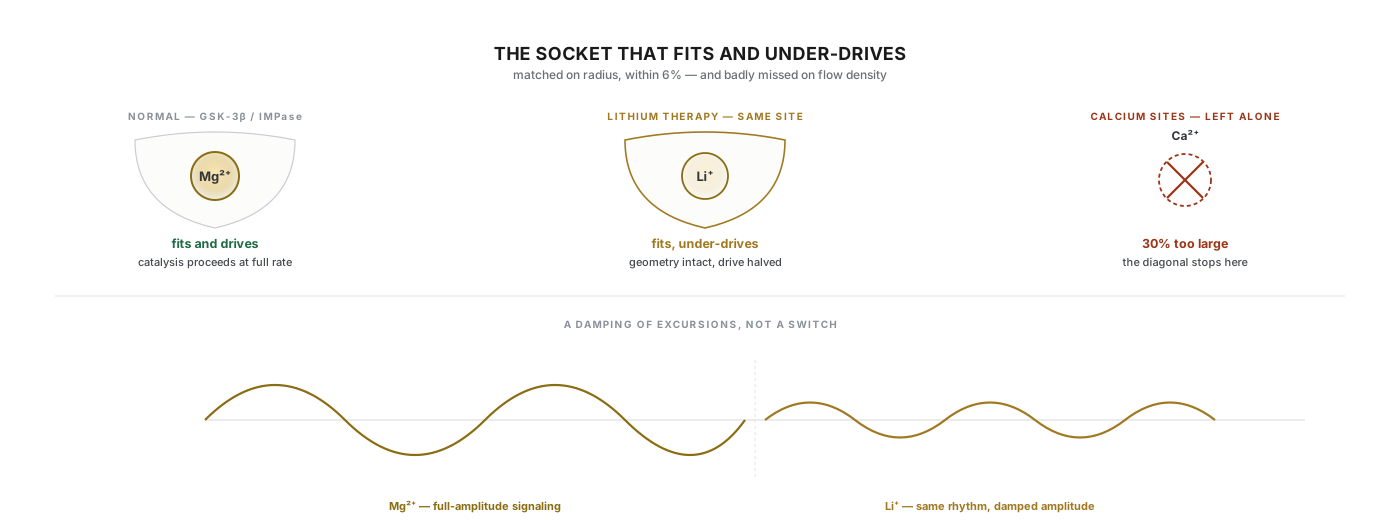
What is not contested is the shape of the mechanism. Lithium’s two best-supported molecular targets — glycogen synthase kinase-3β and inositol monophosphatase — are both inhibited competitively with magnesium, at lithium concentrations in the therapeutic range. Which is the diagonal relationship, cashed in a protein: Li⁺ and Mg²⁺ are the same size to 6\%, so a site shaped for magnesium accepts lithium geometrically. And Li⁺ delivers less than half the surface flux.
The framework’s reading is that a metal-binding site is a boundary matched on two independent quantities — a radius, and a flow density — and lithium is the one ion in the table that matches a magnesium site on the first and badly misses on the second. It fits the socket and under-drives it. That is not inhibition by blockade and not by allostery; it is a partial occupancy that leaves the site’s geometry intact and its drive halved, which is a good description of a drug whose effect is a damping of excursions rather than a switch. It also predicts where lithium should be inert: calcium sites, at 1.00 Å, are 30\% too large, and lithium leaves them alone.
Then there is the question this framework cannot avoid, and should approach carefully.
Lithium has two stable isotopes with different nuclear spins — ⁶Li at I=1 with a nearly spherical charge distribution, ⁷Li at I = 3/2 with a quadrupole moment fifty times larger. Chemically they are as close to identical as two isotopes get. Yet a 1986 experiment reported that rats fed ⁶Li and ⁷Li showed opposite changes in maternal behaviour and alertness, and the result sat unreplicated and largely ignored for thirty years until Fisher (2015) proposed a specific mechanism: nuclear spins on ³¹P in calcium-phosphate (Posner) clusters as long-lived quantum degrees of freedom in neural tissue, with the lithium isotopes acting on them differently because their nuclear spins differ. Work since has reported isotope-dependent differences in mitochondrial calcium cycling, in the in-vitro formation of calcium-phosphate clusters, and — in a 2025 preprint — in rat hippocampal synaptic transmission on multi-electrode arrays.
Very little, and it must be said before the next paragraph rather than after. The 1986 behavioural result has never been independently replicated in its original form. The Posner-molecule proposal is a specific and contested hypothesis, not an established mechanism. The 2025 electrophysiology result is a preprint. Ordinary mass-dependent kinetic isotope effects are a live alternative explanation and are not excluded, and a 17\% mass difference between ⁶Li and ⁷Li is large as isotope effects go. Nothing in this framework depends on any of it, and if all of it evaporates the rest of this chapter is unaffected.
With that stated: the experiment is nonetheless the cleanest available probe of a question this paper has already declared load-bearing and open. Channel with memory argues that the substrate’s general organizing principle in matter is a coherent channel whose boundary holds state for a finite ring-down time, and tabulates that time from 25 fs in copper to a conjectured semi-permanence in the codon stamp. The lifetime of the stamp holds the biological end of that ladder open as the framework’s central unknown. And the neighbors chapter has just finished arguing that phosphorus is the only element in the table that could be biology’s backbone and coin.
A lithium isotope substitution changes only the nuclear winding and holds the boundary ledger — radius, charge, flux density, wrap turnover, every quantity this chapter has used — essentially fixed. There are very few interventions in biology with that property. So whatever the answer turns out to be, the framework’s interest is specific and stateable: if a robust, chemistry-controlled isotope difference survives replication, it is direct evidence that something in neural tissue is holding a nuclear-scale state long enough to matter, which is the quantity lifetime-of-the-stamp has no number for. And if it does not survive, the framework loses a hoped-for probe and nothing else.
Predictions
The V at sodium, in a third readout. Two monotone ledgers — tear cost and wrap payment, both falling down the alkali column — must produce a non-monotonic difference with its worst value in the interior. Retrodicted twice, in aqueous electrode potential (E^\circ least negative at Na) and in graphite intercalation (formation energy positive only at Na). The prediction is that any alkali property built on the same trade shows the same interior minimum at sodium, and that it vanishes wherever the fit half of the trade is relaxed — hard carbon, MoS₂, wide-gallery hosts. Falsified by an alkali property that is a genuine strip-versus-wrap difference and comes out monotone down the group, or by a graphite-like stiff-gallery host in which sodium intercalates as readily as potassium.
The wrap is the mover, so removing it must invert the inversion. Aqueous mobility runs Li⁺ < Na⁺ < K⁺ < Cs⁺, opposite to bare size; molten-salt and solid-electrolyte transport run the other way. The framework’s commitment is that the crossover is continuous in the amount of recruitable wrap: mixed solvents of decreasing donor number, and increasingly concentrated “water-in-salt” electrolytes where free solvent is scarce, should show the alkali mobility ordering rotate smoothly from the aqueous order to the bare-size order rather than switching at a phase boundary. Falsified by a solvent series in which the ordering flips discontinuously, or in which lithium remains slowest in a medium with no free coordinating solvent.
Both optical edges must slide together. Along any isostructural ionic series, the ultraviolet cutoff (electronic boundary stiffness) and the infrared cutoff (lattice boundary stiffness) are one parameter read twice and must move in the same direction. Retrodicted across LiF → NaCl → KBr → CsI over a factor of eight in window width. Falsified by an isostructural series whose two edges move in opposite senses.
The chalcogen gradient in solid electrolytes, and where it must stop. Carrying the carbon chapter’s group-16 prediction into ion transport: at matched structure and matched lithium content, conductivity should order oxide < sulfide < selenide, and the electrochemical stability window should order in the opposite direction, so that the fastest member is the least usable. Retrodicted by LLZO / Li₆PS₅Br / Li₆₋ₓPSe₅₋ₓBr₁₊ₓ. The forward prediction is telluride: a structurally matched telluride argyrodite should have the lowest migration barrier of the family and be unusable — likely electronically conducting rather than merely unstable. Falsified by a selenide or telluride framework that is both faster and more stable than its sulfide analogue.
Reversibility tracks median versus merger. A host into which lithium inserts without breaking a covalent merger (graphite galleries, layered oxide interlayers) should show cycle life orders of magnitude above a host in which insertion requires tearing mergers and rebuilding them (alloying anodes, conversion cathodes), independent of capacity, voltage, and volume change taken separately. The sharp form: among alloying anodes, capacity retention should correlate with the fraction of host–host mergers broken per lithium inserted better than with volumetric expansion, which is the metric the field currently uses. Falsified by a high-merger-count host matching graphite’s cycle life, or by expansion predicting retention better than merger count across a matched series.
Wrap turnover predicts multivalent battery difficulty. The ordering of how tractable a metal-anode chemistry proves should track k_\text{ex}, the shell’s turnover rate, more closely than it tracks voltage, capacity, or ionic radius: Li ≈ Na (10^9) easy, Ca (10^8) tractable, Mg (10^6) hard, Al (10^0) hardest, Be (10^3) hopeless despite the second-best energy density in the table. Retrodicted against the field’s actual experience including the recent turn in calcium’s fortunes. Falsified by a slow-exchange cation (k_\text{ex} < 10^4 s⁻¹) supporting a practical, reversible, room-temperature metal anode.
Lithium’s targets are magnesium sites, never calcium sites. The ion fits a 0.72 Å socket and under-drives it; it does not fit a 1.00 Å one. Across the proteome, therapeutically relevant lithium targets should be Mg²⁺-dependent enzymes with Li⁺ acting competitively at the metal site, and should be enriched for sites where magnesium’s role is structural or positional rather than strongly electrophilic — because halved flux is tolerable in the former and fatal in the latter. Falsified by a well-characterized lithium target that is a Ca²⁺ site, or by lithium inhibiting a magnesium site non-competitively at therapeutic concentration.
A selectivity filter is a wrap, so permeability follows the strip ledger and not the radius. Across the permeant ions of a potassium channel, log permeability should track hydration enthalpy relative to K⁺’s better than it tracks radius mismatch relative to the filter’s, and the series must peak on the large side of the cage radius — because strip cost falls monotonically down the column while the cage’s payment peaks at its own dimension, and the difference of a monotone and a peaked ledger is displaced. Retrodicted by the two ions matched to K⁺ on hydration enthalpy and on nothing else: Tl⁺ (-326 against K⁺’s -322), the channel’s best permeant, and NH₄⁺ (-307). The mechanistic commitment that comes with reading the filter as a wrap rather than a hole: ligand field strength must matter more than cage geometry, so substituting a coordinating carbonyl for a weaker-dipole ligand at unchanged backbone geometry must degrade selectivity more than a comparable geometric perturbation at unchanged field strength. Falsified by a permeability series that orders on cage-radius mismatch across ions matched in hydration enthalpy, by a potassium channel that excludes Rb⁺ as sharply as it excludes Na⁺, or by a geometric perturbation outweighing a field-strength one.
Filter architecture is set by wrap tenacity, not by charge or by size. How a channel decides must order with its permeant ion’s surface flux: counterfeit the shell with neutral, geometry-matched ligands where the wrap is marginal (K⁺, 0.042); outbid it with a charged high-affinity site, and therefore require multi-ion knock-on to release, where it is moderate (Ca²⁺, 0.159); recognize the hydrated ion without stripping it where the wrap cannot be removed on the conduction timescale (Mg²⁺, 0.307, k_\text{ex} = 7\times10^5 s⁻¹). Retrodicted across KcsA, Ca$_$1’s EEEE locus and CorA/MgtE’s GMN motif. The forward form is that any newly solved selective channel should fall on the same ladder from its permeant ion’s flux density alone. Falsified by a magnesium-selective channel that dehydrates its ion inside the filter, by a potassium channel selecting through a charged high-affinity site, or by a calcium channel achieving its selectivity without a multi-ion mechanism.
Fidelity and speed are one number, so no main-group ion gets both. Surface flux sets how rigidly a boundary orders its recruited shell and how slowly it releases it, so across s- and p-block ions the variance in coordination geometry observed in structural databases must be monotone in 1/\text{flux} and anticorrelated with k_\text{ex}: Be²⁺ and Mg²⁺ rigid and slow, Ca²⁺ and the alkalis promiscuous and fast, with no occupants of the rigid-and-fast or floppy-and-slow quadrants. The d-block must depart from that line by the amount fold locking predicts and not by radius — Zn²⁺ and Mg²⁺ are matched in charge and within 0.02 Å, and Zn²⁺ exchanges some fifty times faster and coordinates 4, 5 or 6 at will. Falsified by a main-group ion with high flux and promiscuous coordination geometry, or with low flux and a rigid one.
Conclusion
Carbon is where the substrate is visible because chemistry abstains — four participants, no spectators, no vacancies, nothing of its own to say, so what fills the silence is the medium’s geometry. Lithium is visible for the opposite reason. Chemistry does not abstain; it collapses. One participant, three vacancies it can never fill, and a resolution that consists of giving up the shell entirely. What is left is a single object — the smallest closed charged boundary in the periodic table — and every fact about lithium is that one object seen from a different side.
Seen from the solvent, it is the boundary that must recruit a wrap, and therefore the smallest ion that moves the slowest — at the far end of a ledger whose sign change, four cells along between sodium and potassium, is what every cell in your body spends a fifth of its energy defending, and which is why lithium is the one alkali a nerve will not conduct. Seen from the ledger, it is the most expensive atom in its column to tear and the most richly paid to be wrapped, which puts it at one end of a V whose interior loser is sodium — in aqueous electrochemistry and in dry intercalation alike. Seen from a salt, it is the element that never merges at all, and lithium fluoride is what a bond made of nothing but flux between two closed shells looks like as a material: the widest optical window and the lowest refractive index in the solid state. Seen from a battery, it is the only element sitting at the voltage maximum, the mass minimum, and a wrap turnover fast enough to let go — a window with one occupant, the same shape the phosphorus argument had. Seen from a nucleus, it is the least tightly seamed stable thing in the universe, alone on the unstable ground the alpha’s depth carves out, and therefore the one element whose abundance measures destruction. And seen from a protein, it is a socket-fitting impostor delivering half the drive.
If carbon is the substrate’s sheet, lithium is its coin — and not only in the metaphor this paper has been using for the lossless exchange. Civilization stores and moves its energy in lithium for a reason the framework can now state in one line: a battery is one boundary torn on the outside and rewrapped on the inside, and lithium is the element for which the tear is worth the most, the mass is worth the least, and the wrap knows when to let go.
With lithium the second row is closed at both ends, and the ledger has been asked every question a shell of eight can answer. The iron chapter drops a row and asks it of a shell that is not eight — five lobes instead of four slots, buried behind the interface where no partner can reach them, so that the same arithmetic produces the same palindrome one step longer and a completely different resolution. Row two’s shells settle. The d-shell cannot, and what it keeps instead of settling is a register.
The thing I did not expect, going in, is how much of this is transport rather than chemistry. Why the smallest ion is slowest — transport. Why sodium fails at graphite — transport. Why beryllium loses a battery it should win — transport. Why the fastest solid electrolyte is the least usable — transport. Why a nerve fires on potassium and a message is carried by calcium — transport, in a membrane, decided by the same column of numbers. And why there is any lithium in the universe at all: because ⁷Be, made in a stellar interior hot enough to destroy the lithium it will become, sometimes gets carried out to a cool layer before it decays. Carbon’s chapter was a chapter about building. This one turned out to be about moving a fragile thing somewhere it survives — which is, read plainly, what the substrate does with every coin it mints.