Neutron Stars
The densest matter short of a horizon — where the substrate’s canonical loop is photographed as a torus-and-jet, the magnetic dipole is the geodynamo scaled a billionfold, glitches are mutual friction in a confirmed superfluid, and the pulsar/magnetar split is one rotational budget partitioned between the loop’s coherent-jet and stored-field channels
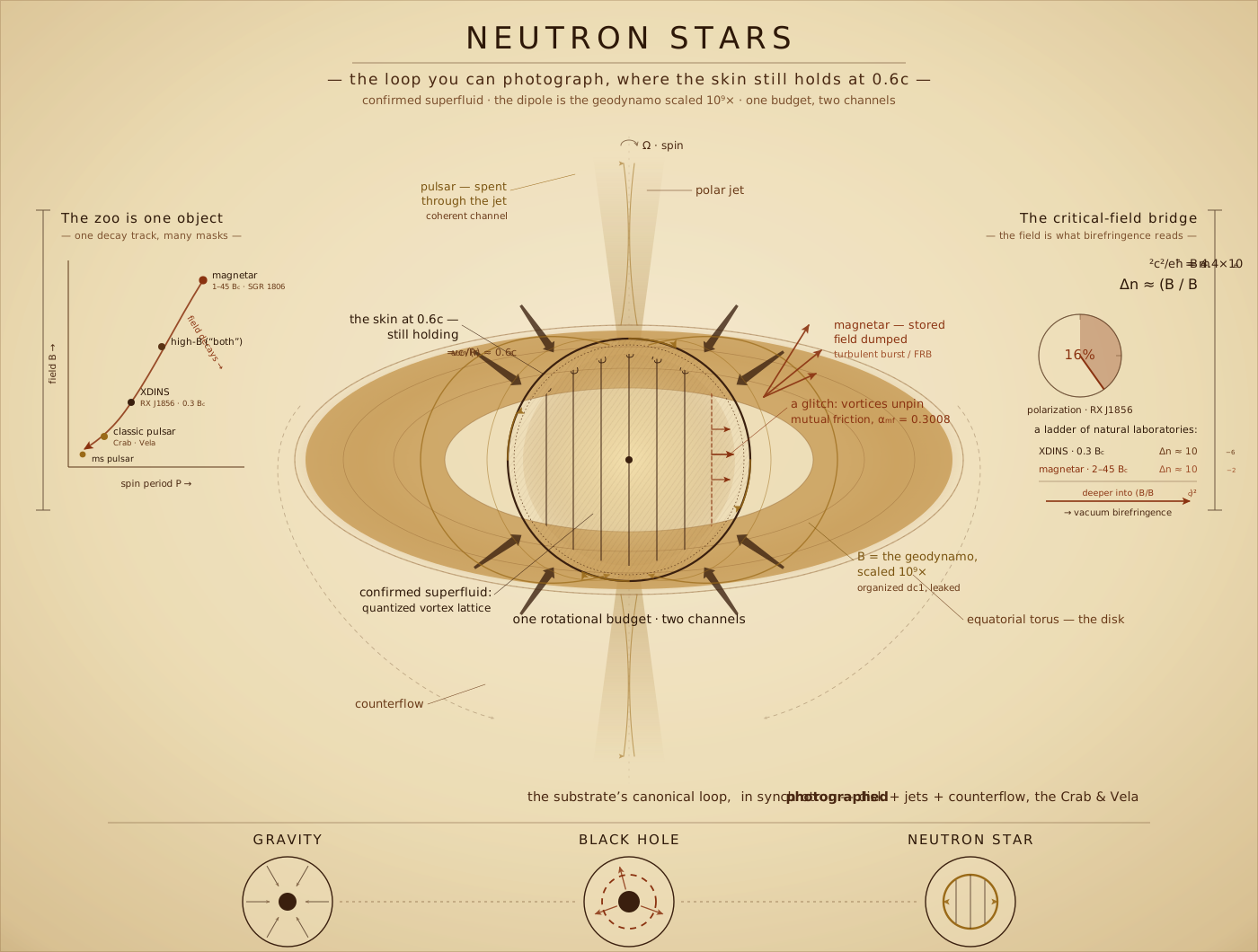
The densest thing that is still matter
The black-holes chapter followed the ebbing current all the way to the surface where it reaches c and read off everything a sonic horizon does. One of its sharpest observations was structural: everything stable in this universe is held together by counter-rotating boundary layers, and a boundary skin can only close a velocity jump if it can keep pace with the bulk flow it wraps. At the horizon the inflow exceeds c, no skin can track it, and matter cannot stay matter.
A neutron star is the object that sits one step back from that edge — the densest thing that is still matter, where the boundary skin holds at the highest load it can bear. Take a canonical 1.4\,M_\odot star of radius \sim 12 km. Its surface is at r/r_s \approx 3, so the substrate inflow there is v_\text{ebb}(R) = \sqrt{\tfrac{2GM}{R}} = c\sqrt{r_s/R} \approx 0.6\,c, already more than half the signal speed — and the counter-rotating skin still tracks it, still closes the seam, still keeps the matter matter. A neutron star is the boundary mechanism of the framework tested at 0.6\,c and passing. Everything else about these objects follows from one further fact that makes them, of all the framework’s astrophysical exhibits, the least analogical: their interior is a literally confirmed superfluid. Where the framework has elsewhere had to argue that the substrate is a low-dissipation superfluid — from helium, from Volovik’s route — here the medium doing the rotating is a neutron superfluid threaded by quantized vortices, and the machinery the framework runs everywhere else is the machinery astrophysicists already use to model it. This chapter reads the neutron-star zoo as the single clearest instance of scale-invariant feedback topology in the sky.
The zoo is one object
The textbook split into pulsars, magnetars, and objects that are “both” is a useful first cut, but the field has been converging on something the framework will recognize immediately: a grand unification of the neutron-star zoo, one object type spread across a plane whose axes are essentially magnetic field strength and age.1 The populations, ordered by field:
| Class | Surface dipole B | B/B_c | Energy source | Examples |
|---|---|---|---|---|
| Millisecond (recycled) pulsars | 10^8–10^9 G | 10^{-5} | rotation | — |
| Classic radio pulsars | 10^{11}–10^{13} G | 10^{-2}–0.3 | rotation | Crab, Vela |
| XDINS (“Magnificent Seven”) | \sim 10^{13} G | \sim 0.3 | residual heat | RX J1856.5-3754 |
| High-B pulsars (“both”) | 10^{13}–10^{14} G | 0.3–2 | rotation, w/ magnetar bursts | PSR J1846-0258 |
| Radio magnetars (“both”) | 10^{14}–10^{15} G | 2–20 | field decay, w/ radio pulses | XTE J1810-197 |
| Magnetars (SGRs/AXPs) | 10^{14}–2\times10^{15} G | 2–45 | field decay | SGR 1806-20 |
Here B_c = m_e^2 c^2/e\hbar = 4.4\times10^{9}\,\mathrm T = 4.4\times10^{13}\,G is the Schwinger critical field. The physically clean distinction is not the field but which reservoir is being spent:
- A pulsar shines on its rotational kinetic energy, bled off by magnetic-dipole braking. The field is the brake; the spin is the tank.
- A magnetar shines on the decay of the field itself. Its X-ray luminosity exceeds its spin-down luminosity — it radiates more than its slowing rotation can supply — so the organized field must be the tank.
- The “both” objects are the transition cases whose very existence collapses the taxonomy: rotation-powered stars with magnetar-strength fields that occasionally throw a magnetar burst (high-B pulsars), and magnetars that also emit coherent radio pulses (radio magnetars).
The favored evolutionary reading is a single decay track: magnetars are young, burn their enormous fields down fast (huge X-/\gamma-ray output, giant flares, and — the 2020 headline — even a fast radio burst, from SGR 1935+21542), then cool into high-B pulsars and finally classic radio pulsars as the field relaxes.
That places RX J1856.5-3754 — the source whose \sim 16\% optical polarization is the framework’s headline vacuum-birefringence signal — precisely. It is not a magnetar. It is the prototype XDINS, one of the nearby, radio-quiet, thermally emitting “Magnificent Seven,” with B\sim 10^{13} G, sitting between pulsars and magnetars, and population synthesis reads the M7 as aged, cooled magnetars kept warm by field decay — one or two rungs down the same track.3 The irony worth holding onto is that it is a clean birefringence target because it is a quiet, mid-field thermal emitter: an active magnetar, bursting and variable, is far harder to do precision polarimetry on. The pulsar\tomagnetar axis is exactly the axis of how strong the field is, and the field is exactly what the birefringence reads.
The dipole is the geodynamo, scaled a billionfold
The magnetism chapter reads a magnetic field literally: \mathbf B is the velocity field of organized co-rotating dc1 flow, leaked through boundary layers, the streamlines that iron filings trace made of real substrate current. The feedback-topology chapter reads the Earth’s geodynamo as that same organized flow expressed in iron and electrolyte: a co-rotating equatorial disk, polar columnar flow along the spin axis, counter-rotating boundary layers at the core boundaries, and “the magnetic field is the substrate’s bookkeeping of this flow.”
A neutron star is the same loop with the field crank turned up. Earth’s surface field is \sim 0.5 G; a magnetar’s is \sim 10^{15} G — the geodynamo mechanism run at fifteen extra orders of magnitude, which is exactly the “one topology across 25 orders of magnitude” claim feedback-topology makes for organized rotational energy in an elastic medium. The dipole is not a property the star has; it is the substrate’s ledger of the organized circulation the star is. This is why the field and the spin are not independent knobs but two readings of one rotational budget — the point the next section turns into the taxonomy’s resolution.
Pulsar and magnetar are one budget, split two ways
This is where the framework does more than re-picture standard results — it offers a genuine clarification of why the zoo has the shape it does.
The canonical loop of feedback-topology partitions injected rotational energy into a coherent jet channel (angular momentum ejected along the spin axis) and a stored organized-flow channel (the reservoir the loop maintains), with a residual radiated as waves. Read the pulsar/magnetar dichotomy as the two ways that one budget can be spent:
- A pulsar keeps its energy in the spin and exports it through the jet channel — the beamed dipole radiation and the pulsar wind. Coherent, organized, long-lived; the lighthouse beam is the loop’s polar jet made of electromagnetic outflow.
- A magnetar has converted and stored its budget as organized field — the loop’s reservoir wound to enormous amplitude — and releases it not as a steady beam but in turbulent boundary-failure events: bursts, giant flares, the occasional FRB.
The framework already carries the vocabulary for that contrast. Feedback-topology states that “the same parity rule that distinguishes aromatic from antiaromatic rings distinguishes coherent jets from turbulent dispersion.” A pulsar beam is the coherent jet; a magnetar giant flare is the boundary skin failing and the stored organized flow dumping turbulently — the same “boundary systems weaken” language the black-hole and boil chapters use, here at a definite object rather than a horizon. And the evolutionary track — magnetar \to high-B \to classic pulsar — is simply the reservoir draining back toward isotropy: field decay as the organized dc1 leak relaxing, the whole-star analog of a magnet dropping below its Curie point. The “three types” are one object at three settings of a single dial: how much of the birth rotational budget got locked into the stored-field channel, and how far it has since drained.
The loop, photographed
The strongest single piece of evidence is not an argument but an image. Feedback-topology’s canonical configuration is disk + jets + counterflow. When Chandra resolved the pulsar wind nebulae around the Crab and Vela pulsars, it found exactly that: a bright equatorial torus of synchrotron emission encircling the star, with two polar jets punched out along the spin axis.4 The torus is the disk; the jets are the jets; the return of shocked wind material along the nebular boundary is the counterflow. This is the substrate’s canonical loop photographed in synchrotron light at the \simkm-source, \simpc-nebula scale — the same topology feedback-topology tracks from the 100\,\mum vortex lattice up through AGN. If the chapter wants a compact-object exhibit that is a picture rather than an inference, the Crab torus-and-jet is it.
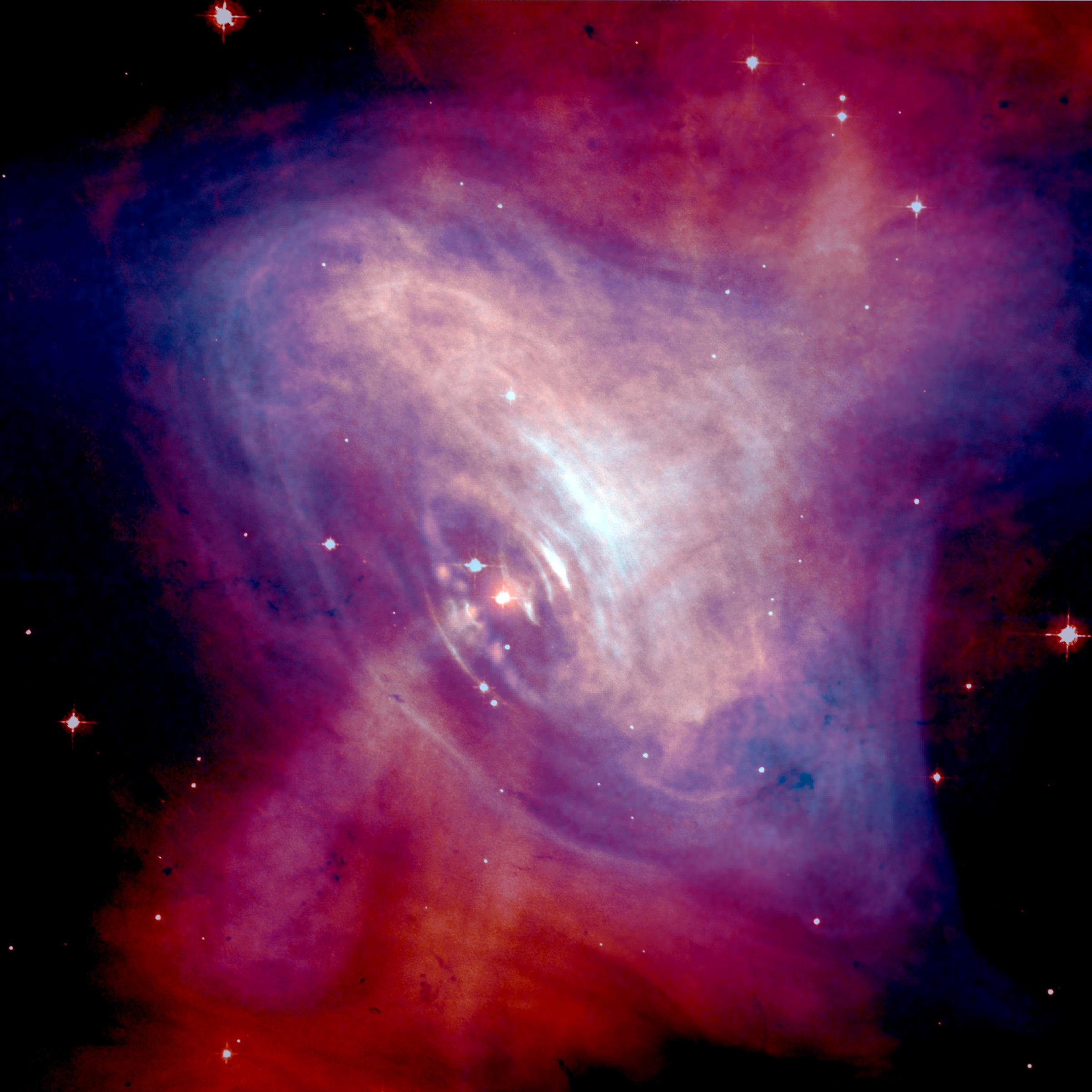
A composite image of the Crab Nebula showing the X-ray (blue), and optical (red) images superimposed. The size of the X-ray image is smaller because the higher energy X-ray emitting electrons radiate away their energy more quickly than the lower energy optically emitting electrons as they move (from science.nasa.gov).
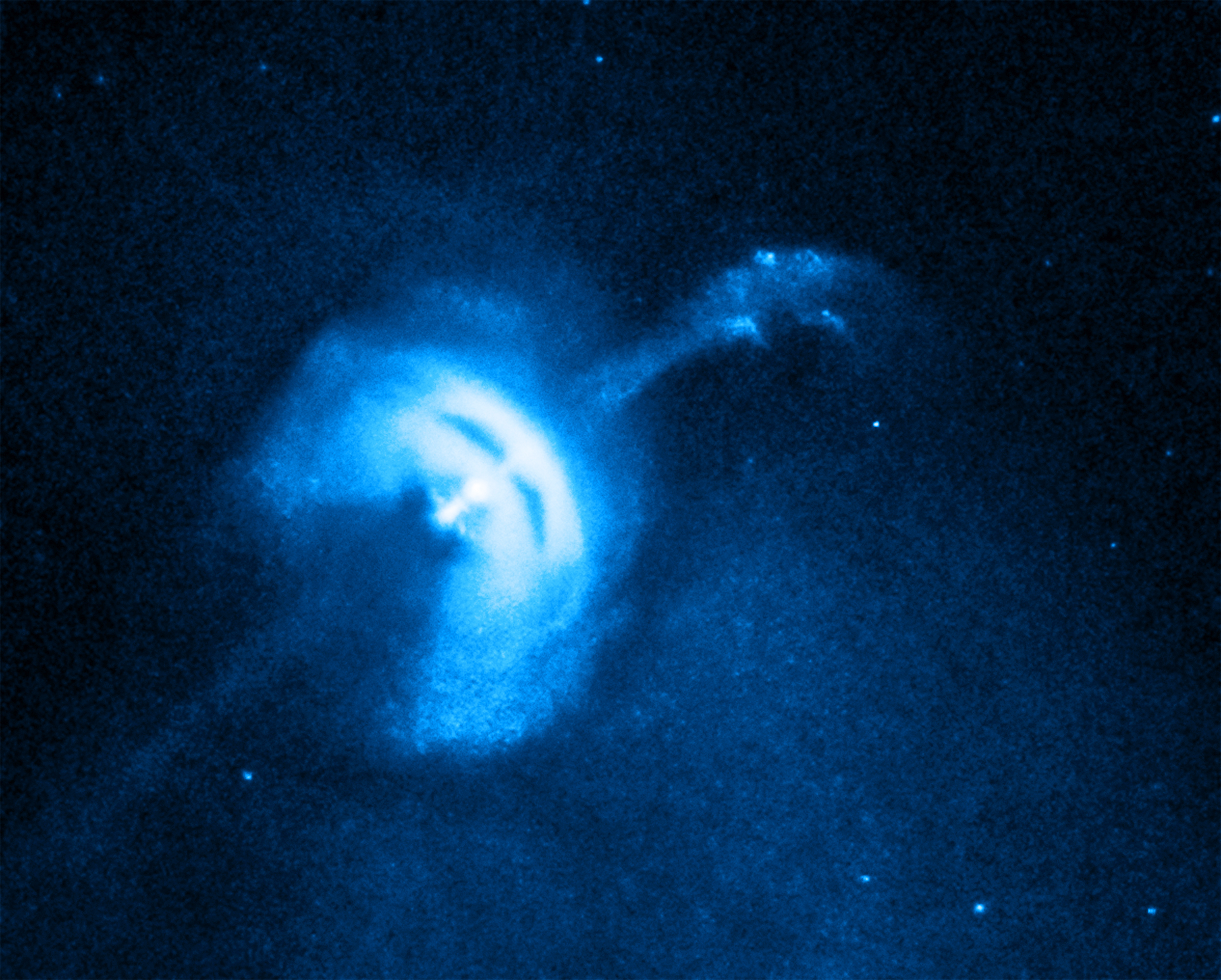
Vela Pulsar with rotating disk and pulsar jet, Chandra X-ray Observators, NASA/CXC/Univ of Toronto/M.Durant et al
(click to open the short video)
Glitches are mutual friction in a confirmed superfluid
The second grip is tighter still, because here the framework’s central coupling is not an analogy but the standard model of a measured phenomenon.
A neutron star’s interior is a neutron superfluid whose angular momentum is carried by an array of quantized vortices parallel to the spin axis, exactly the topologically protected circulation the framework builds everything from. As the star’s crust spins down under magnetic braking, the superfluid vortices — pinned to the crustal lattice — lag behind, storing a rotational lag. When enough lag accumulates, a population of vortices unpins and avalanches outward, dumping angular momentum onto the crust in a sudden spin-up: a glitch, seen in Vela and hundreds of other pulsars. The recovery afterward, over days to months, is set by mutual friction between the superfluid and the normal component — the transfer of angular momentum across the vortex boundary layers.5
This is the framework’s own machinery, running in real matter. The mutual friction that mediates glitch recovery is the same HVBK term — -\rho_s\rho_n\,\boldsymbol\Omega\times\mathbf v_\text{rel}/\rho — that feedback-topology invokes for frame-dragging and that the framework traces, through the Weinberg angle, to the single dissipative coupling \alpha_{mf} = \sin^2\theta_W/(1-\sin^2\theta_W) = 0.3008. Elsewhere the framework has to defend the claim that the substrate is a superfluid with a mutual-friction coupling of this form. In a neutron star the superfluid, the vortices, and the mutual friction are the established physics of glitches, and the framework’s contribution is to recognize them as one instance of the universal boundary coupling it uses for the fine structure constant and the cell occupancy.
The critical field is the birefringence bridge
The two threads — the neutron-star zoo and vacuum birefringence — meet at B_c, and meeting there sharpens the birefringence chapter’s own claim.
That chapter reads the Schwinger field mechanically: B\sim B_c is where “the organized flow speed a field B imposes on the substrate reaches the substrate’s own internal circulation speed.” Place the zoo against that scale (the B/B_c column above): ordinary pulsars sit at B\sim 0.1–0.3\,B_c, RX J1856 at \sim 0.3\,B_c, and magnetar surface fields at 1–45\,B_c — the one place in the universe where organized substrate flow persistently exceeds the substrate’s internal circulation scale. That is precisely why QED goes nonlinear there (photon splitting, order-unity polarization), and precisely why the birefringence chapter names a magnetar as its cleanest hope for the terahertz \mathcal S(\nu) departure. The pulsar\tomagnetar axis is the depth-into-(B/B_c)^2 axis; a birefringence measurement is a field measurement; the zoo is a ladder of natural laboratories climbing from \Delta n\sim 10^{-6} at RX J1856 toward \Delta n\sim 10^{-2} at the strongest magnetars.
The numbers make the point concrete. With \Delta n\approx 4\times10^{-24}(B/1\,\mathrm T)^2, a magnetar surface field of 10^{14}–10^{15} G (i.e. 2–45\,B_c) gives \Delta n\sim 10^{-4}–10^{-2}, while RX J1856 at \sim 0.3\,B_c sits near \Delta n\sim 10^{-6}. The strongest magnetars are the only natural laboratories above the critical field, deepest into the nonlinear regime — which is exactly why they are the birefringence chapter’s cleanest target for the terahertz departure.
Predictions
Pulsar-wind-nebula topology is universal. Every isolated, energetic pulsar with a spatially resolved nebula should show the canonical loop — an equatorial torus plus polar jets aligned with the spin axis — with jet prominence tracking spin-down power. A well-resolved young PWN exhibiting a persistent monopolar outflow, or jets orthogonal to a clearly defined torus plane, would falsify the identification of the PWN with the substrate’s disk-jet-counterflow loop.
Birefringence scales as (B/B_c)^2 across the zoo, with one coefficient. The vacuum birefringence / polarization signature of magnetized neutron stars should follow the single optical-regime law \Delta n\propto (B/B_c)^2 from XDINS (\sim 0.3\,B_c, RX J1856) up through magnetars (few \times B_c), with the same Cotton–Mouton coefficient the birefringence chapter owes. The forward departure \mathcal S(\nu)<1 is to be sought in the far-infrared polarimetry of the highest-field sources, compared against their own optical/X-ray birefringence.
Glitch mutual friction carries the universal boundary efficiency. To the extent that post-glitch angular-momentum transfer is set by a boundary-layer-limited mutual-friction coupling, the framework expects that component to carry the universal dissipative efficiency \alpha_{mf}=0.3008, rather than an unrelated value — a cross-scale bet in the spirit of the fast-solar-wind v_L match. This is a soft prediction: observed mutual-friction strengths span orders of magnitude between crust and core regions and pinning regimes, so the claim is specifically about the drag-limited boundary contribution, not the aggregate glitch-recovery timescale.
Magnetar release energetics are reservoir-capped. If giant flares and FRB-producing bursts are stored-organized-flow boundary failures, their per-event energy budget should be capped by the star’s stored magnetic (organized-flow) energy \sim B^2 R^3/6\mu_0, and the most violent events (and the FRB-active magnetars) should occupy the high-B, low-age corner of the P–\dot P plane — the corner with the fullest reservoir and the freshest, most unstable boundary.
Honest accounting
What the framework adds is a picture, not new numbers. Magneto-dipole braking, the field-decay evolutionary tracks, the superfluid glitch model, and the pulsar-wind torus-jet morphology are all quantitatively well-described by standard astrophysics. The framework’s contribution is consolidation: one superfluid-loop reading ties the dipole (the geodynamo scaled), the glitches (mutual friction), the wind nebula (the canonical loop imaged), the pulsar/magnetar split (one budget, two channels), and the birefringence (depth into B/B_c) into a single object — the same posture the paper takes for frame-dragging, where it “adds a microscopic mechanism, not a numerical correction.”
What is owed. The origin of the field — dynamo amplification at a millisecond birth spin (Duncan & Thompson) versus a fossil field inherited from a magnetic progenitor — is still open observationally, and reopened by the 2023 discovery of a Wolf–Rayet star with a magnetar-capable field.6 A substrate account of why a given birth produces a magnetar rather than an ordinary pulsar would have to earn its keep with something quantitative, and the framework cannot yet supply it. The \alpha_{mf} glitch bet (Prediction 3) is deliberately soft for the reason stated there. And the framework should resist the tempting move of positing a hard field ceiling at some multiple of B_c by analogy to its Landau-velocity ceilings: inferred internal fields run to 10^{16}–10^{17} G, well past B_c, so there is no clean cap to point at — B_c is the magneto-optic threshold, not a limit on B itself.
What is solid — and it is unusually solid — is the superfluid grip. Every other astrophysical exhibit in the framework asks the reader to grant that the medium is a low-dissipation superfluid with quantized vortices and a mutual-friction coupling. The neutron star does not ask: its interior is that medium, confirmed, and the standard model of its most distinctive behavior (glitches) is the framework’s own machinery under another name. Together with the photographed canonical loop of the Crab and Vela nebulae, that makes the neutron star the least analogical of the framework’s cosmological chapters — the place where the substrate’s picture and the established physics are, line for line, the same picture.
Putting the section in context
The gravity chapter built the leak, the black-hole chapter ran the leak to the surface where the boundary skin fails, and this chapter sits one step back from that edge, at the densest configuration where the skin still holds — and finds the substrate’s canonical loop not merely inferable but photographed, its superfluid not merely posited but confirmed. The neutron star is the compact-object rung of the same ladder that feedback-topology climbs from the vortex lattice to the galaxy: organized rotational energy in an elastic medium, resolving into disk, jets, counterflow, and a dipole that is the substrate’s bookkeeping of the whole.
It also hands the next chapter its opening. The glitch coupling and the field ceiling both press on the same scale — the Landau critical velocity v_L\approx 0.0025\,c that the framework uses to gate the CDM-to-MOND transition and to set the terminal speed of the Sun’s polar wind. The galactic-dynamics chapter that follows takes that scale out to the largest structures the loop organizes, where the same substrate that keeps a neutron star’s matter matter at 0.6\,c flattens the rotation curve of an entire galaxy.
Footnotes
The organizing diagram is the P–\dot P plane (spin period vs. spin-down rate), which yields both the dipole field B\propto\sqrt{P\dot P} and the characteristic age \tau = P/2\dot P under magneto-dipole braking. For the unification picture and the transition (“both”) objects see Kaspi & Beloborodov, “Magnetars,” Ann. Rev. Astron. Astrophys. 55, 261, 2017 (arXiv:1703.00068); and the reviews arXiv:2405.02368 (2024) and arXiv:2502.17652 (2025).↩︎
The Galactic magnetar SGR 1935+2154 produced FRB 200428 in April 2020, the first fast radio burst localized to a known source and the observation that welded the FRB and magnetar populations together. CHIME/FRB Collaboration, Nature 587, 54, 2020; Bochenek et al., Nature 587, 59, 2020.↩︎
van Kerkwijk & Kaplan, “Isolated neutron stars,” Astrophys. Space Sci. 308, 191, 2007; Popov et al. population-synthesis work reading the M7 as descendants of a decaying-field population. The M7 spin periods (RX J1856: P=7.06 s) overlap the magnetar range while their fields are intermediate.↩︎
Weisskopf et al., “Discovery of Spatial and Spectral Structure in the X-Ray Emission from the Crab Nebula,” Astrophys. J. Lett. 536, L81, 2000; Helfand, Gotthelf & Halpern on the Vela torus-jet, Astrophys. J. 556, 380, 2001. The equatorial torus + collimated polar jet is now the canonical young-PWN morphology.↩︎
Anderson & Itoh, “Pulsar glitches and restlessness as a hard superfluidity phenomenon,” Nature 256, 25, 1975, for the vortex-unpinning model; Haskell & Melatos, “Models of pulsar glitches,” Int. J. Mod. Phys. D 24, 1530008, 2015, for the modern mutual-friction treatment.↩︎
Shenar et al., “A massive helium star with a sufficiently strong magnetic field to form a magnetar,” Science 381, 761, 2023.↩︎