The Modon Index
Every place the substrate framework reads the dipole-vortex pattern, sorted into mobile dipoles and stationary nested topologies
What this page is
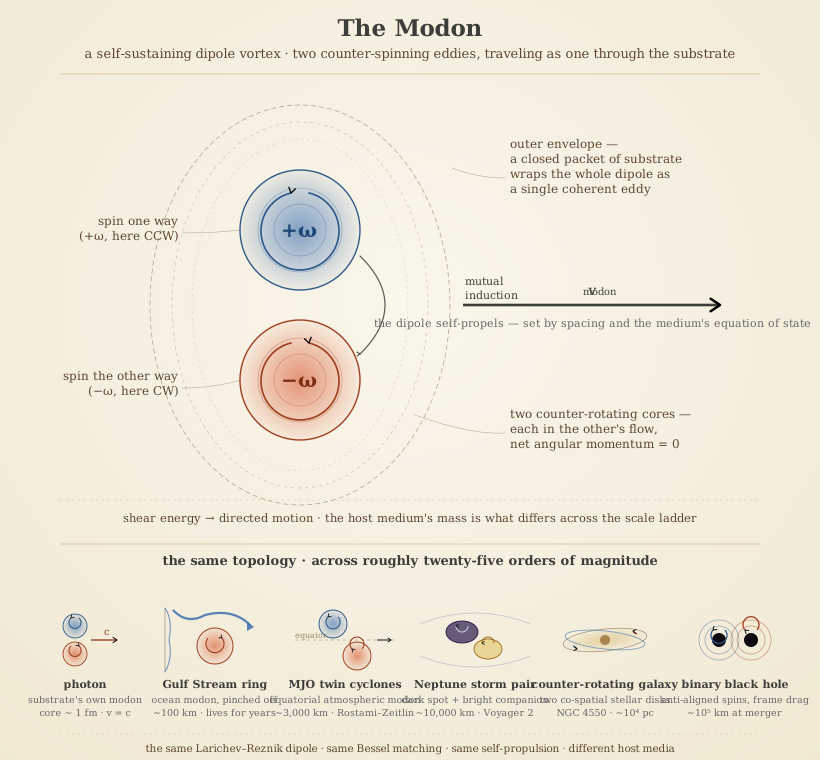
A modon is a dipole vortex — two oppositely spinning cores held in each other’s velocity field. The framework reads this geometry as the substrate’s preferred way of organising rotational energy in an elastic medium, and the same topology shows up across roughly twenty-five orders of magnitude in size. This page is a catalog of every place in the paper where that claim is made, so a reader can see the pattern without having to walk the whole sidebar.
Two flavors, distinguished by whether the dipole translates through the medium or stays put:
- Mobile modons — the canonical Larichev–Reznik dipole. Two cores translate together; each advects the other forward through the surrounding medium at a speed set by the dipole spacing and the medium’s equation of state. The photon is the substrate’s mobile modon; Gulf Stream rings, the MJO, and Neptune’s dark-spot pairs are macroscopic realisations of the same solution in different host media.
- Stationary modon topologies — coherent counter-rotating layers held in place rather than propagating. The dipole structure is topological — two (or more) oppositely spinning sheets nested around a common axis — but the whole assembly is locked rather than translating. The Cooper pair is the cleanest microscopic case; the cell, the brain hemispheres, and Earth’s two antipodal superplumes are the same pattern at much larger scales.
The two flavors share the same Larichev–Reznik mathematics — same Bessel matching, same counter-rotating-pair logic, same boundary-sharpening behaviour — and the substrate framework’s central claim is that wherever you see one, you are seeing one face of a single mechanism. The photon-as-modon, feedback topology, and cells-as-nested-modons chapters are the structural anchors a reader should hold while walking this index.
Columns in the tables below:
| Column | What it carries |
|---|---|
| Modon | The named structure, with a link to the chapter where the framework develops it |
| Scale | Characteristic size (radius, separation, or wavelength as appropriate) |
| Layers | Number of counter-rotating wrap layers, when the chapter specifies them |
| Notes / Predictions | What the substrate reading adds — a framework-specific prediction, a sharpness claim, or a brief structural comment |
Empty cells mean the chapter does not yet pin that number — they are flags for future tightening, not gaps in the catalog.
Part I — Mobile Modons
The Larichev–Reznik dipole translating through its host medium. The defining feature is self-propulsion: each core sits inside the other’s velocity field, the pair advects forward as a single object, and the medium’s elastic response holds the dipole together against the dispersion that would otherwise pull it apart.
Microscopic
| Modon | Scale | Layers | Notes / Predictions |
|---|---|---|---|
| Photon | \sim \xi \approx 100\;\mum perturbation envelope; dipole core \sim 1 fm | 2 (counter-rotating dc1 cores) | The substrate’s own mobile modon. Massless because the two cores carry exactly equal and opposite angular momentum; propagates at c because c is the medium’s equation of state. |
| W^\pm gauge modon | electroweak | 2 + chirality coat | Chirality-flipping mobile modon that picks up an inertial “coat” of Goldstone-mode dressing in the chirally ordered substrate; coat-drag is the framework reading of the \sim 80 GeV mass. |
| Z^0 gauge modon | electroweak | 2 + chirality + hypercharge coat | Same mechanism as W but coupled to both \text{SU}(2) chirality and \text{U}(1) hypercharge — drags a bigger coat, hence the higher mass. |
Atmospheric and oceanic
| Modon | Scale | Layers | Notes / Predictions |
|---|---|---|---|
| Gulf Stream warm-core ring | 100–300 km diameter, \sim 1{,}000 m deep | 2 | Pathway A modon (meander pinch-off). Multi-year lifetime well above the viscous floor R_\text{cross} \approx 580 m for Gulf Stream parameters. |
| Gulf Stream cold-core ring | same | 2 | Same mechanism, opposite sign. The Gulf Stream sheds both populations from the same cold-wall shear. |
| Loop Current ring | \sim 200 km | 2 | Pathway A in the Gulf of Mexico. |
| Agulhas ring | \sim 200–300 km | 2 | Pathway A around southern Africa, carries Indian Ocean water around the cape over years. |
| Mediterranean meddy | \sim 100 km, \sim 1{,}000 m depth | 2 | Pathway C (buoyancy-driven adjustment). Year-scale persistence; the oceanic confirmation of Rostami–Zeitlin geostrophic adjustment in real seawater. |
| MJO equatorial modon | core \sim L_d \approx 3{,}000 km; envelope 5{,}000–10{,}000 km | 2 (twin cyclones) | An exact L–R modon solution of moist-convective shallow water on the equatorial \beta-plane (Rostami–Zeitlin 2019). The framework’s clearest macroscopic case for “the photon is a modon” — same Bessel J_1/K_1 matching, scaled up by \sim 10^{13}. |
| Hurricane eyewall-replacement ring | \sim 50–100 km | 2 | Atmospheric analog of Gulf Stream ring-shedding — except the hurricane is too compact for the ring to escape, so it contracts inward and replaces the inner core. Framework predicts outer-eyewall radii cluster at substrate-organised scales rather than varying smoothly. |
| Multi-vortex tornado suction vortex | \sim 5–15 m | 1 (paired around funnel) | Sits right at the atmospheric substrate-locking floor R_\text{cross}^\text{air} \approx 13 m. Suction vortices prefer triangular packing — substrate’s Tkachenko lattice asserted at atmospheric scale. |
| Ball lightning | \sim 10–50 cm | 1 (toroidal) | Marginal: sits near the substrate-locking floor for thunderstorm-plasma parameters. Framework predicts the BL size distribution shows a substrate-floor cutoff with longer-lived events systematically larger. |
| Firestorm rotor | \sim 100 m – km | 2 | Briefly mentioned across element chapters as one of the three formation pathways for modons in air. |
Astrophysical and cosmological
These all come from Modons in Space, which sets the criterion: a binary pair becomes a modon only when each core carries a literal substrate-velocity field that the other sits inside (frame-dragging, accretion disk, or shared envelope). Pure Kepler binaries are not modons.
| Modon | Scale | Layers | Notes / Predictions |
|---|---|---|---|
| Binary black hole (anti-aligned spins) | \sim 10^2–10^5 km separation at merger | 2 (Kerr frame-drag fields) | Cleanest case in the universe: anti-aligned spins produce opposite-sign vorticity cores, gravitational-wave emission supplies the convergence, the ringdown is the modon-formation event. Framework predicts enhanced late-inspiral coherence in anti-aligned vs aligned systems. |
| Counter-rotating galactic disks (NGC 4550) | \sim 10^4 pc | 2 (two co-spatial stellar disks) | A literal modon at galactic scale: each disk sits inside the other’s circulation. Framework predicts these galaxies sit on the baryonic Tully–Fisher relation with smaller residuals than ordinary disk galaxies of comparable mass. |
| Binary AGN — OJ 287 | binary separation \sim 10^{15} m | 2 (Kerr drag + disk circulation) | A substrate modon under construction. The \sim 12-year orbit + \sim 10^5-year inspiral is the convergence timescale; the disk-punch flares are episodic convergence events. |
| RS CVn coupled stellar magnetospheres | \sim 10^{12} m | 2 (entrainment fields) | Coronal bridge between the two stars should host a sharp counter-rotating boundary — Gulf-Stream-cold-wall analog at stellar scale. |
| Contact-binary common envelope (same-spin variant) | \sim 10^{12} m | 3 (two co-rotating cores + counter-rotating midshell) | The same-spin modon variant: two co-rotating cores wrapped in a shared envelope whose middle layer counter-rotates, providing the third element the topology needs. Speculative. |
| Earth–Moon tidal bulge pair | \sim 10^7 m (planetary circumference scale) | 2 (sub-lunar + antipodal bulge) | The largest-amplitude long-lived mobile modon Earth supports — a single dipole locked at the Moon’s apparent angular velocity, sustained for \sim 4.5 Gyr. Framework predicts a small (\sim 10^{-4}) phase-lag residual not captured by standard dissipation models. |
| Neptune dark-spot + bright companion pair | \sim 10^4 km separation | 2 (anticyclone + cyclonic partner) | Literally a Larichev–Reznik dipole in a planetary atmosphere — the cleanest planetary-atmosphere realisation of the topology outside the MJO. Voyager 2 saw the first one; Hubble has confirmed subsequent paired structures. |
Part II — Stationary Modon Topologies
Coherent oppositely spinning layers held in place rather than propagating. The dipole structure is topological — two (or more) opposite-sign sheets nested around a common axis — and the assembly persists as a standing configuration. The cells-nested-modons chapter develops this language at the cellular scale; the same logic applies up and down the size axis.
A useful way to read this half of the index: each row is a place where the substrate has organised itself into nested counter-rotating layers, and the number and quality of those layers controls how coherent the structure is. Health, stability, longevity, and information-carrying capacity all track the layer count and the smoothness of the boundary matching between layers.
Microscopic
| Modon topology | Scale | Layers | Notes / Predictions |
|---|---|---|---|
| Electron’s counter-spinning layers | r_\text{eff} \approx 150 fm inner, \xi \approx 100\;\mum envelope | 2 (the two layers that give the 720° spin behaviour) | The electron is a stationary two-layer modon topology. The 720° rotation needed to return to the original state is the substrate signature of the two-layer structure. |
| Cooper pair vortex | \xi_\text{BCS} \sim 38–100 nm | 1 shared counter-rotating vortex between two electrons of the same chirality breathing anti-phase | “The photon-modon is the signal; the Cooper-pair vortex is the bond.” A bound stationary topology, not a translating dipole — though the pair drifts through the lattice at v_\text{drift}, the vortex structure itself is the standing object. Framework predicts \Delta_\text{BCS} \sim m_1 c^2 \approx 2 meV (the dc1 rest energy) as the natural pairing scale. |
| Aromatic ring (benzene) | \sim 1.4 Å | 2 (above + below the plane) | A toroidal vortex with two counter-spinning layers — the substrate template for everything that follows in chemistry. 36 kcal/mol topological stabilisation comes from the closed-torus geometry (no termination energy). |
Atmospheric and planetary
| Modon topology | Scale | Layers | Notes / Predictions |
|---|---|---|---|
| Hurricane (eye + eyewall) | eye \sim 30 km, eyewall \sim 5 km thick | 2 (co-rotating eye core + counter-rotating eyewall) + outflow shield | Stationary at storm scale even as the storm itself translates. Framework predicts eyewall sharpness floor at substrate-organised width and minimum hurricane radius \sim 1 km from R_\text{cross}^\text{air}. |
| Polar vortex | \sim 1{,}000 km wide, 25 km altitude | 2 (vortex + counter-rotating boundary) | A counter-rotating boundary sealing polar air from mid-latitudes, atmospheric analog of the tachocline. Sudden stratospheric warmings are bistable substrate-mediated reorganisations between locked configurations. |
| Hadley/Ferrel/Polar three-cell circulation | \sim 10^7 m | 3 counter-rotating meridional cells per hemisphere | The atmosphere’s planetary-scale assertion of the substrate’s preferred three-layer geometry. Framework predicts the number of meridional cells scales with substrate-stiffness/thermal-forcing ratio across planets — Mars (1 cell), Earth (3), Jupiter (dozens) sit on a single curve. |
| Tachocline (solar) | \sim 2.8 \times 10^7 m thickness, at 0.7\,R_\odot | 2 (radiative interior + convective envelope, counter-rotating boundary between) | Stellar analog of the polar vortex. Sharpness forced by substrate elasticity at the dissipation scale. |
Geology and deep Earth
| Modon topology | Scale | Layers | Notes / Predictions |
|---|---|---|---|
| Jason & Tuzo (LLSVPs) | each \sim 10{,}000 km wide, \sim 1{,}000 km tall; \sim 180° apart | 2 antipodal superplume feet + D″ counter-rotating boundary at CMB | Earth’s slowest stationary modon topology. The degree-2 antipodal LLSVPs are the substrate’s standing-wave preference asserted at planetary scale — opposite spinning massive modon feet, stable across Wilson cycles for \geq 300 Myr (likely much longer). Framework predicts the antipodal pattern is preserved across supercontinent cycles back into the Proterozoic. |
| D″ layer | \sim 200 km thick at CMB | 1 counter-rotating sheath | The closing boundary of the mantle’s slowest canonical loop, sandwiched between the LLSVPs and the core. The same family as the heliopause, the Gulf Stream cold wall, and the tachocline. |
| 660 km discontinuity | planetary | 1 substrate sheet boundary | Read as a substrate boundary in the same family as stratigraphic boundaries, oceanic fronts, and biological membrane stacks. Slab penetration vs stagnation should correlate with slab incidence angle relative to the local substrate sheet — testable against existing tomography. |
| Earth’s core counter-rotating shear | core-mantle boundary, \sim 3{,}500 km radius | 2 (outer core flow + mantle-side counter-flow) | Layer in the Gaia stack between geodynamo and mantle. |
Living systems — by scale
The living modons proliferate fast. Rather than listing every cell type, organ, and tissue, the rows below give one row per scale rung, with representative cases and links into the chapters that develop each in full.
| Scale rung | Characteristic size | Layers | Representative modon topologies | Anchored in |
|---|---|---|---|---|
| Aromatic stack | \sim 3.4 Å base-pair stacking | 2 (above + below the toroidal plane) per ring | Codons, base pairs, DNA double helix, RNA stacks, aromatic pockets in enzymes, microtubule wall lattice | aromatic rings, DNA living lattice, codon stamp metric |
| Macromolecular | \sim 10–25 nm | 2 wrap + multiple internal channels | Ribosome (with three counter-flowing channels — mRNA, tRNA, peptide); microtubule (closed cylindrical modon at R/h_\text{mon} = 3/(2f), 2\% precision) | cells-nested-modons, ribosome fluid flow, microtubule highways |
| Organelle | \sim 1–5\;\mum | 2 (double-membrane wrap) + internal counter-flow | Mitochondrion (outer + inner membrane, cristae rotors); nucleus (nuclear envelope double-wrap, pore-jets, nucleolus sub-modon); chloroplast (double envelope, thylakoid stacks) | mitochondrial anatomy, nucleus envelope, chloroplast anatomy |
| Cell | \sim 10–100\;\mum (\sim \xi) | 1 plasma-membrane wrap + nested organelle modons inside | The whole cell as one substrate coherence cell wrapped by its plasma membrane, with the six nested modons (cell, cytoskeleton–cortex pair, nucleus, mitochondrion, endomembrane loop, ribosome) sharing boundaries up and down the stack | cells-nested-modons, plasma membrane, plant cell + plasmodesmata |
| Organ-scale modon | \sim 10–100 mm | varies; 2 hemispheres + commissural coupling for brain | Two cerebral hemispheres as coupled near-mirror substrate modons with the \sim 2 \times 10^8-axon corpus callosum as the inter-modon coupling channel; hippocampus as a memory sub-modon embedded in the brain modon | bilateral coupling, hippocampal modon, cortical maps and rhythms |
| Brain-as-substrate-coherence-scaffold | \sim 10^{16} microtubule cylinders across \sim 10^{11} neurons | each MT is a closed cylindrical modon at \sim 25 nm | The \sim 10^{16}-cylinder array as the brain modon’s organ-scale substrate-coherence-quality scaffold — Penrose–Hameroff reread without quantum-gravitational OR, with substrate-coherent geometry doing the work | microtubule coherence revisited |
| Organism | \sim 0.1–2 m | 1 body coherence layer + exterior counter-mirror | The body’s substrate coherence layer surrounded by an exterior mirror-layer in the substrate. The peripheral axon lifts the cellular cilium-as-antenna idiom to body scale; proprioceptive + interoceptive signal is the trained read of this layer | touch and proprioception, vagal highway |
| Inter-organism / ecosystem | \sim 10^1–10^4 m | hyphal corridor + boundary-matched arbuscules/Hartig nets | Mycorrhizal hyphae as the substrate’s smallest inter-organism conduit (\sim 2–10\;\mum); common mycelial networks as inter-modon coupling parallel to synapses; the forest as a substrate-coherent coherence cell at 10^1–10^4 m | mycorrhizal network |
The bridge from microscopic to ecosystem is the framework’s strongest claim about life: the same dipole-vortex topology that organises a photon also organises a codon, a ribosome, a cell, a brain hemisphere, a body, and a forest. Each rung passes its boundary smoothly to the next, and the boundary-matching argument is what makes the whole stack run as one machine rather than a soup of independent compartments.
This index records where the rungs fall. Why they are spaced the way they are — discrete and roughly evenly spaced in the logarithm rather than continuous — is taken up in The Substrate Ladder, which reads the recurring scale-ratios as the discrete-scale-invariance tower of a critical superfluid, with the \sqrt{2} pairing factor as the fundamental half-octave; and its companion ladder index catalogs every structure the framework places on that ladder, sorted into the locking and anti-locking poles the way this page sorts the modon into mobile and stationary.