Silicon in the Substrate
The merger that does not finish — why one column walks from insulator to metal with the same four electrons; the band gap as the residue of an incomplete delocalization; why the metal/non-metal boundary is a diagonal rather than a line; why pressure walks an element down its own column and electrons walk it back across its row; and why the arithmetic that makes silicate the crust is the arithmetic that made silicon the chip
The other road to the same exit
The iron chapter closed one question with unusual force. A d-shell has five lobes pointing five ways from behind a surface no partner can reach through; there is no arrangement of neighbours in three-dimensional space that presents five partners to five buried lobes; so the shell is offered more mergers than it can complete, and it takes the only remaining exit. It dissolves. All forty d-block elements are metals, without a single exception, and the ledger’s account is that they had no choice.
Now ask the complementary question, which nobody has asked. What happens to a shell that can pair off — exactly, with nothing left over?
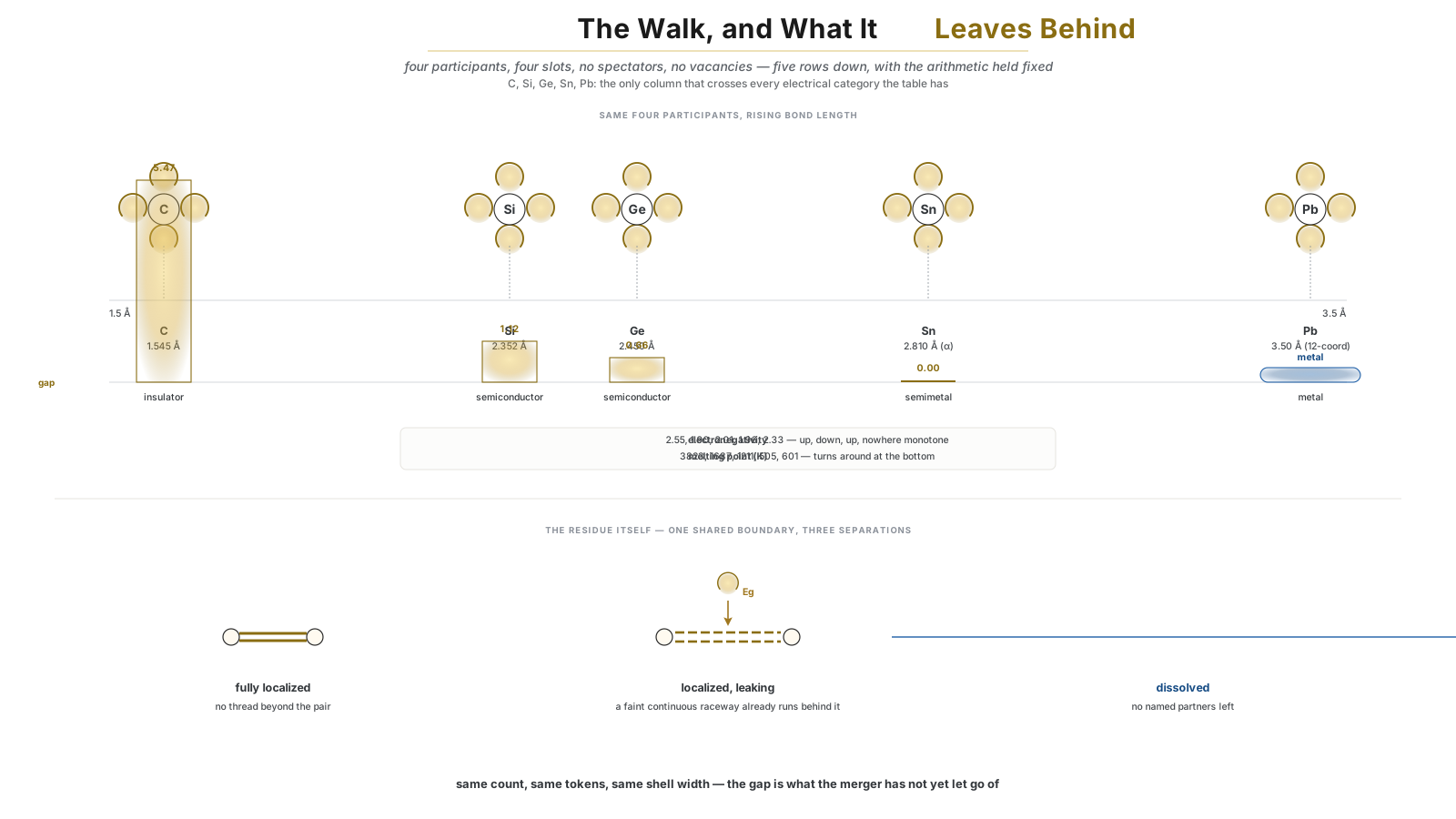
Group 14 is that shell. Four participants, four slots, no spectators, no vacancies: the carbon chapter’s double zero, repeated five times down a column. And the tetrahedral lattice is the geometry that satisfies it perfectly. Every atom has four neighbours, every neighbour takes one participant, every participant finds a partner, and the crystal closes with nothing unmerged anywhere. Diamond is the ledger’s ideal case — the one crystal in which the merger arithmetic comes out exactly even.
Diamond is an insulator with a 5.47 eV gap. Lead, four rows down, with the identical arithmetic, is a metal.
Same count, same tokens, same shell width, opposite exit. Whatever decides between merging and dissolving, it is not the arithmetic. The iron chapter’s answer was that a d-shell cannot pair off at all. Group 14’s answer has to be something else, because group 14 pairs off completely — and still ends up a metal if you walk far enough down the column. This chapter is about the second road to the metallic exit, and about the region of the table where a material is caught halfway along it.
That region is where every piece of electronics ever made was built.
The walk
Hold the arithmetic fixed and walk down the column. Every element below has four valence electrons; all but lead adopt the same diamond-cubic lattice; nothing about the token count changes at any step.
| Bond length (Å) | Coordination | Cohesive energy (eV/atom) | Band gap (eV) | d\rho/dT | Verdict | |
|---|---|---|---|---|---|---|
| C (diamond) | 1.545 | 4 | 7.37 | \mathbf{5.47} | — | insulator |
| Si | 2.352 | 4 | 4.63 | \mathbf{1.12} | negative | semiconductor |
| Ge | 2.450 | 4 | 3.85 | \mathbf{0.66} | negative | semiconductor |
| Sn (grey, \alpha) | 2.810 | 4 | 3.14 | \mathbf{0.00} | — | semimetal |
| Pb | 3.50 | 12 | 2.03 | metal | positive | metal |
Five steps, and the column crosses every category the periodic table has for electrical behaviour. It is the only column that does this.
Two things in that table are worth separating carefully, because the standard telling runs them together.
The first is what does not change: the participant count, the spectator count, the vacancy count, the hybridization, and — for four of the five — the crystal structure. Nothing in the ledger’s vocabulary moves.
The second is what does. Bond length rises monotonically. Cohesive energy — the depth of each merger — falls monotonically with it. And the gap falls monotonically with both, to zero. Those three columns are locked together, and they are the only quantities in the neighbourhood that are. Pauling electronegativity down group 14 runs 2.55, 1.90, 2.01, 1.96, 2.33 — up, down, up, and not monotone anywhere. Melting point runs 3823, 1687, 1211, 505, 601 K and turns around at the bottom. The two quantities that track the gap are the two the ledger names: how far apart the boundaries sit, and how much each merger is worth.
And the last row of the table records the structural break. Lead does not merely have the longest bond; it has abandoned the merger geometry altogether. Four directed partners at 109.5° become twelve undifferentiated neighbours in a close-packed array. Coordination number four is the merger number — it is what “every participant is committed to a named partner” looks like as a crystal — and lead has left it.
The gap is the residue
Here is the chapter’s central claim, and it is one sentence of vocabulary the framework already owns.
Conductors says what a metal is: the outermost counter-rotating boundaries of adjacent atoms are squeezed into the same space, cannot both exist, and partially dissolve, leaving continuous co-rotating raceways that span the whole crystal. Carbon says what a covalent solid is: each pair of participants merges into one shared counter-rotating surface, and that surface belongs to those two atoms and no others. The two descriptions are not opposites. They are the same operation at two degrees of completion. In both cases boundaries are being shared; the question is whether the sharing stays local to a pair or runs on into the next pair and the next.
So:
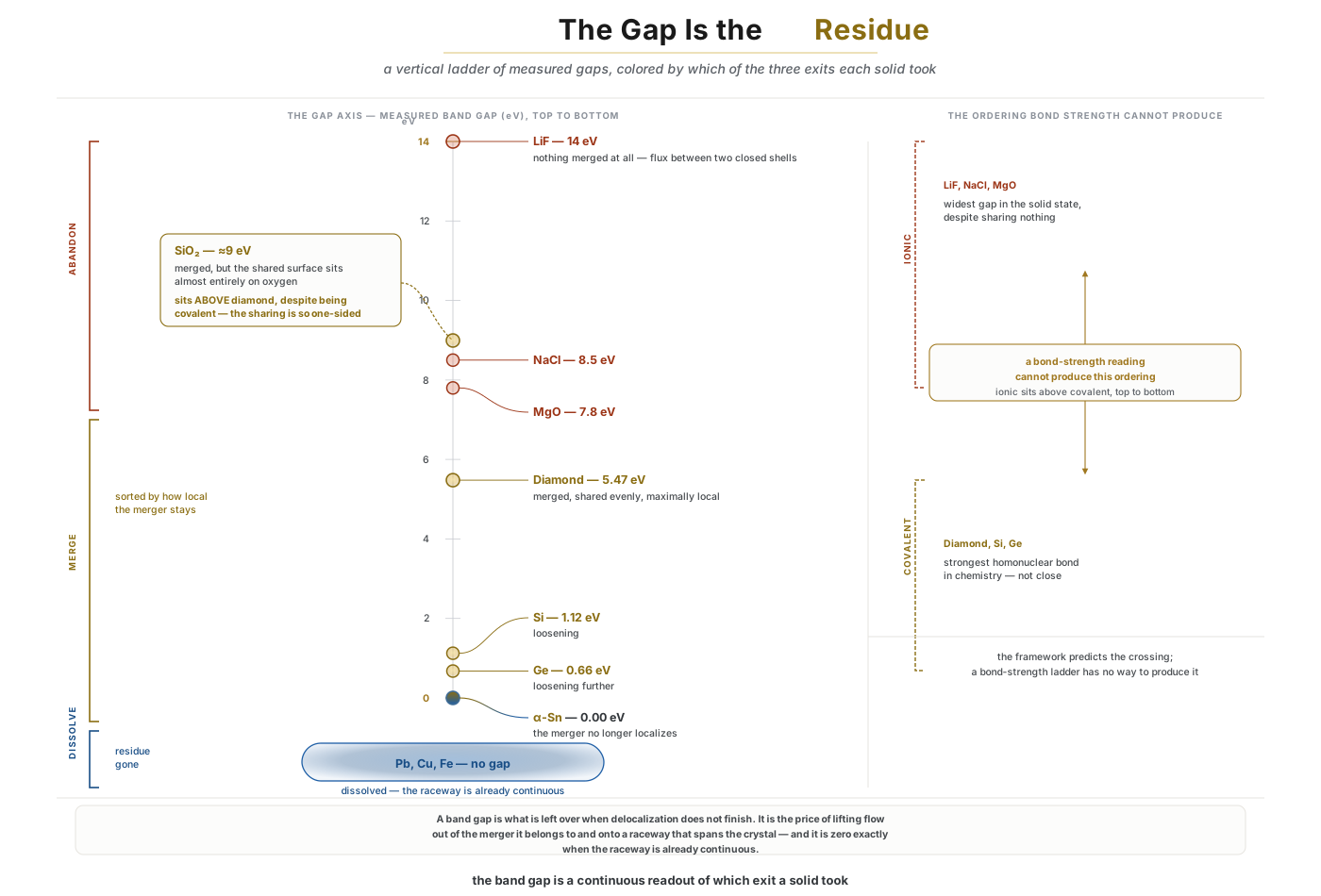
A band gap is what is left over when delocalization does not finish. It is the price of lifting flow out of the merger it belongs to and onto a raceway that spans the crystal — and it is zero exactly when the raceway is already continuous.
An insulator is a crystal in which every boundary is committed to a specific merger, so there is no raceway to lift onto and the price is enormous. A metal is a crystal in which the commitment has been dissolved, so there is no price at all. A semiconductor is neither: the raceway exists, but the boundaries have not let go of it. The gap is the residue of the commitment.
That reading is worth something only if it sorts materials the naive version does not, and there is one immediate test that it passes and a bond-strength story fails. If the gap merely measured how strong the bond is, the widest gaps in nature would belong to the strongest bonds — and diamond, with the strongest homonuclear bond in chemistry, would top the list. It does not, and it is not close:
| Solid | What the boundaries did | Gap (eV) |
|---|---|---|
| LiF | nothing merged at all — flux between two closed shells | \approx 14 |
| NaCl | ” | \approx 8.5 |
| SiO₂ | merged, but the shared surface sits almost entirely on oxygen | \approx 9 |
| MgO | ” | 7.8 |
| Diamond | merged, shared evenly, maximally local | 5.47 |
| Si | merged, shared evenly, loosening | 1.12 |
| Ge | ” | 0.66 |
| \alpha-Sn | the merger no longer localizes | 0.00 |
| Pb, Cu, Fe | dissolved | — |
The widest gap in the solid state is lithium fluoride, which the lithium chapter already identified as the bond that never merged: the element with three vacancies against the element with three spectators, neither able to share anything, held together by nothing but flux between two intact closed shells. On a bond-strength ladder that is an oddity. On the residue reading it is the top of the ladder by construction — the maximum possible residue is the case where nothing was ever put on the raceway, because there is no raceway. Crystal optics reaches the same crystal by a different route and calls it the widest optical window in the solid state, and the two statements are one statement.
Read the table downward and it is the ledger’s three exits in order. Abandon, at the top. Merge, in the middle, sorted by how local the merger stays. Dissolve, at the bottom, where the residue is gone. The band gap is a continuous readout of which exit a solid took, and group 14 is the column that walks the bottom half of it with the arithmetic held constant.
Band theory computes gaps, and computes them well: the Kohn–Sham gap is systematically too small and the GW correction fixes it, and the whole apparatus is quantitative in a way this framework is nowhere near. Nothing here improves any number. The nearest standard statement of the same physics — that increasing orbital overlap widens bands until they touch and the gap closes, the Wilson/Mott picture of the metal–insulator transition — is a century old and gets the entire column right without a substrate.
What the framework contributes is that the gap, the coordination number, the ionic/covalent/metallic trichotomy, and the metalloid staircase are one accounting rather than four descriptions: how much of an atom’s boundary is still committed to a named partner. The load-bearing consequence is the ordering in the table above, where the ionic crystals sit above the covalent ones — which follows immediately from “residue of incomplete delocalization” and does not follow from “gap measures bond strength.” The framework cannot compute a single gap and says so.
Two knobs, and both of them are the ledger’s
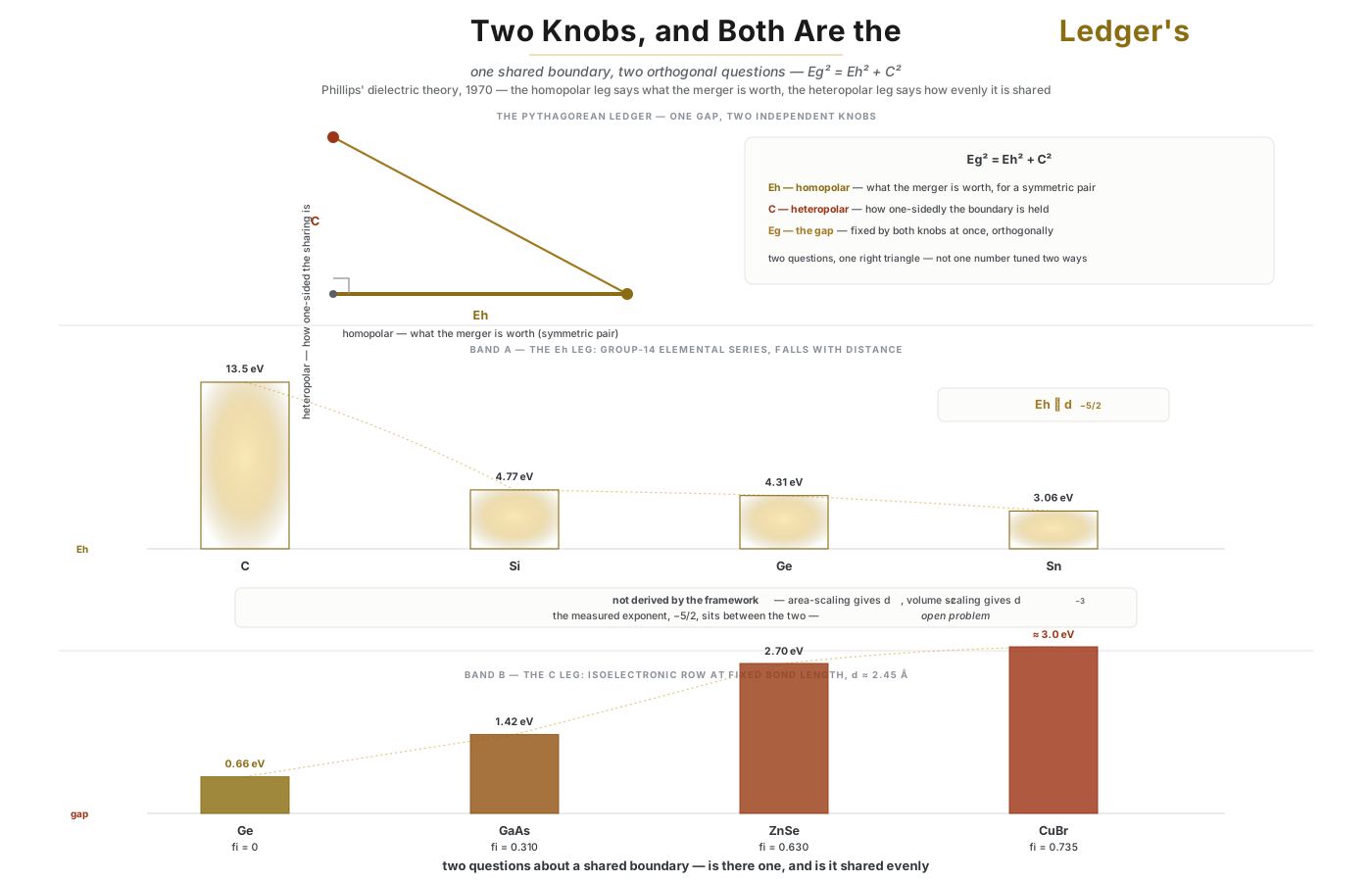
The residue reading says a gap should have exactly two determinants, because there are exactly two questions to ask about a shared boundary: is there one, and is it shared evenly. A boundary that is barely shared has little to lift. A boundary that is shared but sits almost entirely on one partner has been half-abandoned, and the flow is stuck on that partner rather than free to run.
Semiconductor physics has had precisely that decomposition since 1970, in Phillips’ dielectric theory of the covalent bond:
E_g^2 = E_h^2 + C^2
where E_h is the homopolar gap — what the merger is worth, for a symmetric pair — and C is the heteropolar term, the antisymmetric part, what it costs that the merger is one-sided. Two orthogonal contributions to one number, and they are the ledger’s two questions written as a right triangle.
Both legs are measurable independently, and each has its own clean series.
The E_h leg falls with distance, as a power law. Across the group-14 elements, Phillips’ homopolar gaps run 13.5 eV for carbon, 4.77 for silicon, 4.31 for germanium and 3.06 for tin, and they are fitted across the whole tetrahedral family by
E_h \;\propto\; d^{-5/2}
to within a couple of percent over a factor of four in E_h. The framework does not derive that exponent and should say so plainly: a naive area-scaling argument for a shared surface would give d^{-2} and a volume one d^{-3}, and the measured value sits between them. What the framework does claim is the sign and the identification — that the quantity falling as the boundaries move apart is the amount of merger there is to lift out of, and that it is the same failure of lateral consolidation that leaves silicon with no benzene and no planar oxyanion, read on the head-on merger instead of the sideways one.
The C leg rises with asymmetry, at fixed distance. This is the better test, because it holds everything the first leg varies completely still. Walk across the isoelectronic row at germanium’s bond length — same lattice, same structure, same eight valence electrons per formula unit, same 2.45 Å — and change only how unevenly the eight are shared:
| d (Å) | Phillips f_i | Gap (eV) | |
|---|---|---|---|
| Ge | 2.450 | 0 | 0.66 |
| GaAs | 2.448 | 0.310 | 1.42 |
| ZnSe | 2.454 | 0.630 | 2.70 |
| CuBr | 2.463 | 0.735 | \approx 3.0 |
The gap rises by a factor of nearly five with the bond length pinned to within half a percent. Nothing about the amount of merger changed; only how one-sidedly it is held. The same shared surface, tipped further onto one partner each step, is progressively less available to run on — which is what a gap measures.
So the two legs of Phillips’ triangle are the framework’s two exits seen as continuous coordinates: walk down the E_h leg and you approach the metal, walk up the C leg and you approach the salt. The ledger’s discrete trichotomy — merge, abandon, dissolve — is the corners of a plane whose interior is populated.
The two boundaries between the exits
Which raises the question the section has never asked. The intro chapter names three exits and treats them as categories. If they are corners of a plane, where exactly are the edges?
Both have been measured, independently, by people with no interest in this framework.
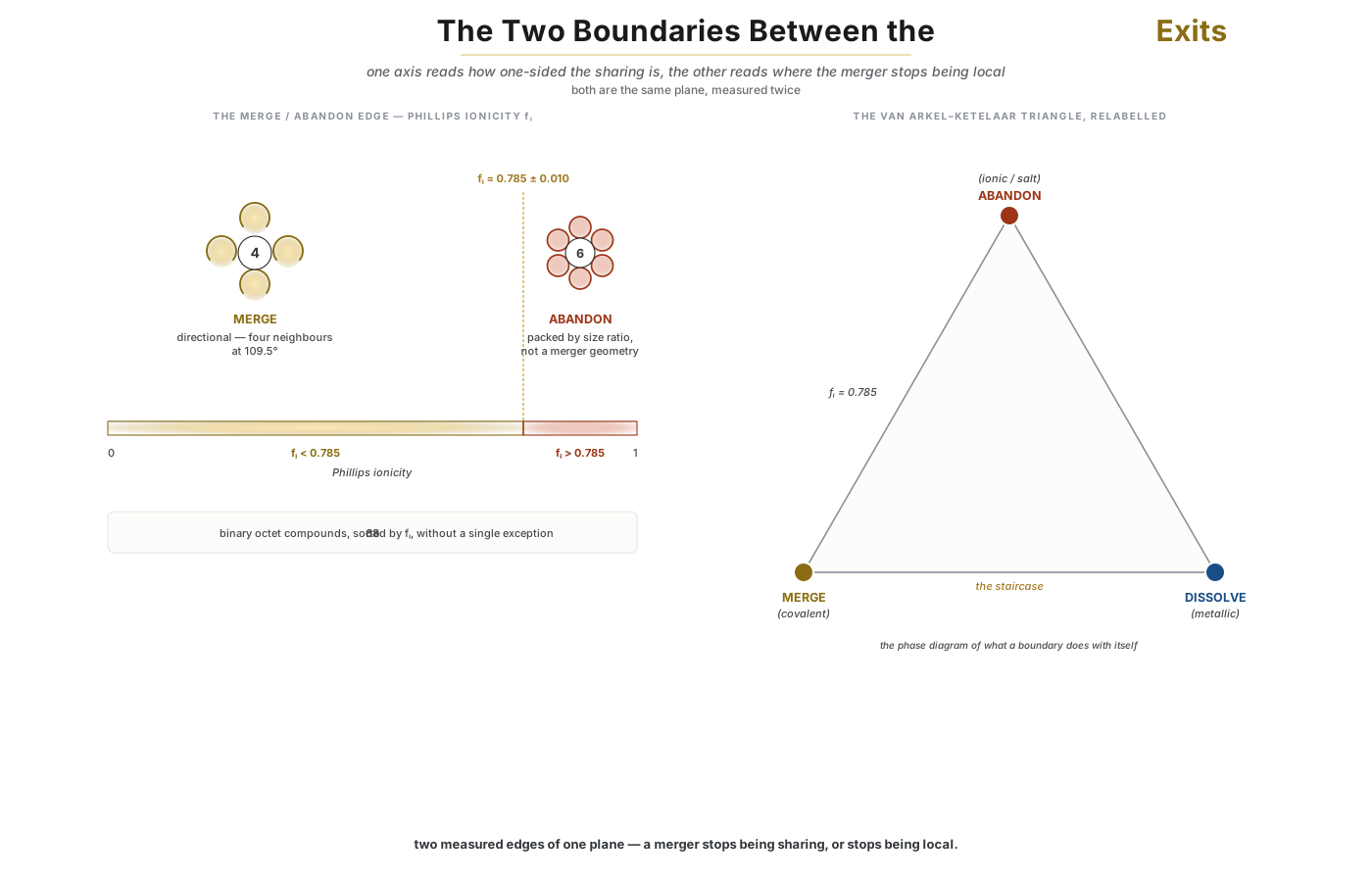
The merge/abandon edge is sharp and it is at f_i = 0.785. Phillips’ ionicity f_i = C^2/(E_h^2 + C^2) is the fraction of the gap contributed by the asymmetric term — how one-sided the sharing is. Sort the binary octet compounds by it, and there is a critical value, f_i = 0.785 \pm 0.010, that separates four-coordinate structures (zincblende and wurtzite) from six-coordinate ones (rocksalt), across sixty-eight compounds, without a single exception. Below it, tetrahedral. Above it, rocksalt.
That is not a gradual crossover; it is a threshold in a continuous parameter that sorts a large set perfectly. And the ledger reads it in one line: four-coordinate is the merger geometry and six-coordinate is not. A merger is directional — it happens between two specific partners along a specific line, so four of them arrange themselves at 109.5° and the coordination is fixed by the count of participants. Flux between two intact closed shells is not directional, so the ions pack by size ratio alone and reach six and eight, exactly as the lithium chapter argued a salt must. Phillips’ threshold is the point at which the sharing becomes so one-sided that it stops functioning as sharing, and the crystal stops using a merger geometry to hold itself together. The exit changes, and the coordination number is the receipt.
The merge/dissolve edge is the metalloid staircase, and its receipt is the same quantity read the other way. Lead is coordination twelve. White tin is coordination six. Silicon under pressure goes four, then six, then eight, then twelve. Leaving the covalent corner in either direction raises the coordination number, because in both directions what is being given up is the commitment of each participant to a named partner — and only a named partner imposes a direction.
So the ledger’s three exits have two measured edges, and both are drawn in the same currency. That whole picture already exists in inorganic chemistry as a standard construction nobody reads this way: the van Arkel–Ketelaar triangle, which plots average electronegativity against electronegativity difference and finds metals in one corner, covalent solids in another, and salts at the apex, with the metalloids strung along the metal–covalent edge. It has been in textbooks since 1956. On the ledger it is not a mnemonic. It is the phase diagram of what a boundary does with itself, and the metalloid staircase is one of its two edges projected back onto the periodic table.
Why the staircase is a diagonal
Now the shape itself, because it is a genuinely different move from anything in the section so far.
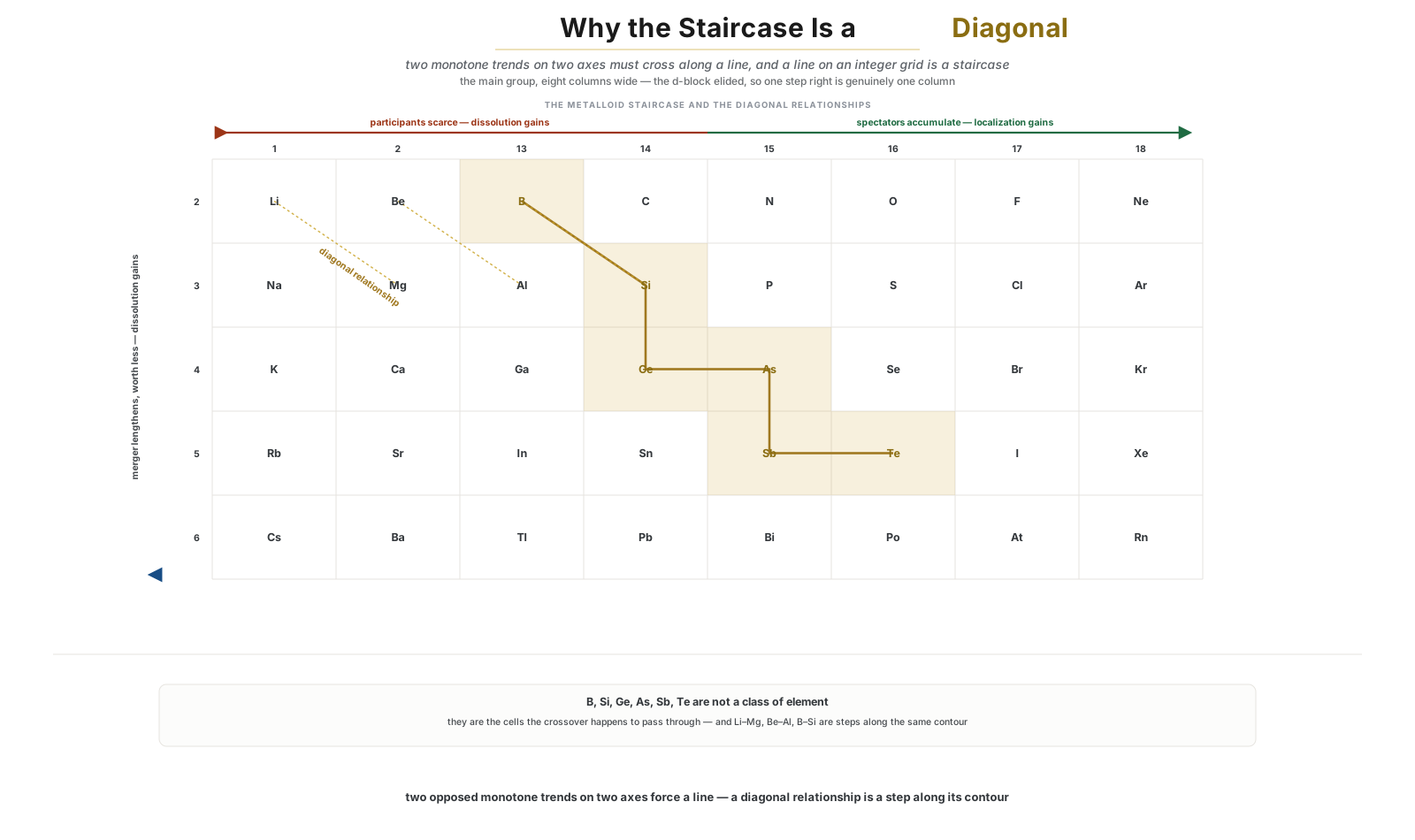
Pattern five is the section’s most evidentially valuable structure: two requirements varying monotonically in opposite senses along one axis force an extremum in the interior, and a bend is much harder to get by accident than a trend. The V at sodium and the volcano in groups 8–10 are both that shape.
The staircase is its two-dimensional relative, and the conclusion is different in kind. Take two monotone trends running along different axes of the table:
- Down a column, the merger lengthens and each shared surface is worth less — the E_h leg falling as d^{-5/2}. Dissolution gains.
- Leftward across a row, participants become scarce and vacancies accumulate; there are fewer named partners to commit to and more slots that nothing can fill. Dissolution gains again. Rightward, spectators accumulate, the surface becomes exclusive, and the merger localizes. Localization gains.
Two monotone axes, opposed, in a plane. Their crossover is not a point; it is a line. And because the periodic table is a grid of integers rather than a continuum, a line of slope roughly one is drawn as a staircase — one step right for every step down. Boron, silicon, germanium, arsenic, antimony, tellurium: the metalloids are not a category of element with a shared property. They are the cells the crossover happens to pass through.
The reading pays a dividend that costs nothing extra, which is always the sign that a unification is doing work. Introductory chemistry teaches the diagonal relationships — lithium with magnesium, beryllium with aluminium, boron with silicon — as a curiosity: an element resembles its lower-right neighbour more than its own column-mate. The lithium chapter already read one of them as an identity of the ledger, since Li⁺ and Mg²⁺ carry nearly the same radius. The staircase says why the rule exists in general: one step down and one step right moves both trends by one unit in opposite senses, so the balance is unchanged. A diagonal relationship is a step along a contour, and the metalloid staircase is the particular contour where the balance sits at zero. Two facts taught in different chapters, and they are the same line.
The metal/non-metal diagonal is standard, the qualitative explanation given for it in textbooks (metallic character increases down a group and decreases across a period) is the same two trends named above, and no number here is new. The framework is not claiming to have discovered the staircase or to predict where it falls; it cannot compute the crossover for a single element.
What it claims is a shape argument and one identification. The shape argument is that a crossover between two monotone trends on two axes must be a line, in the same way pattern five’s crossover on one axis must be a bend — and that a line rendered on an integer grid is a staircase. The identification is that the diagonal relationships and the metalloid staircase are the same locus, which is a checkable statement and not, as far as I can find, one anybody makes. The operational test is the sign of d\rho/dT: it is the definition of the crossover the ledger is describing, since a metal’s raceway already exists and heat only disrupts it while a semiconductor’s must first be paid for and heat pays. Falsified if the d\rho/dT sign flip and the diagonal-relationship pairs trace visibly different lines.
Tin does it twice
The best single piece of evidence that the crossover is a real physical balance rather than a bookkeeping convenience is that one element sits on it and cannot decide.
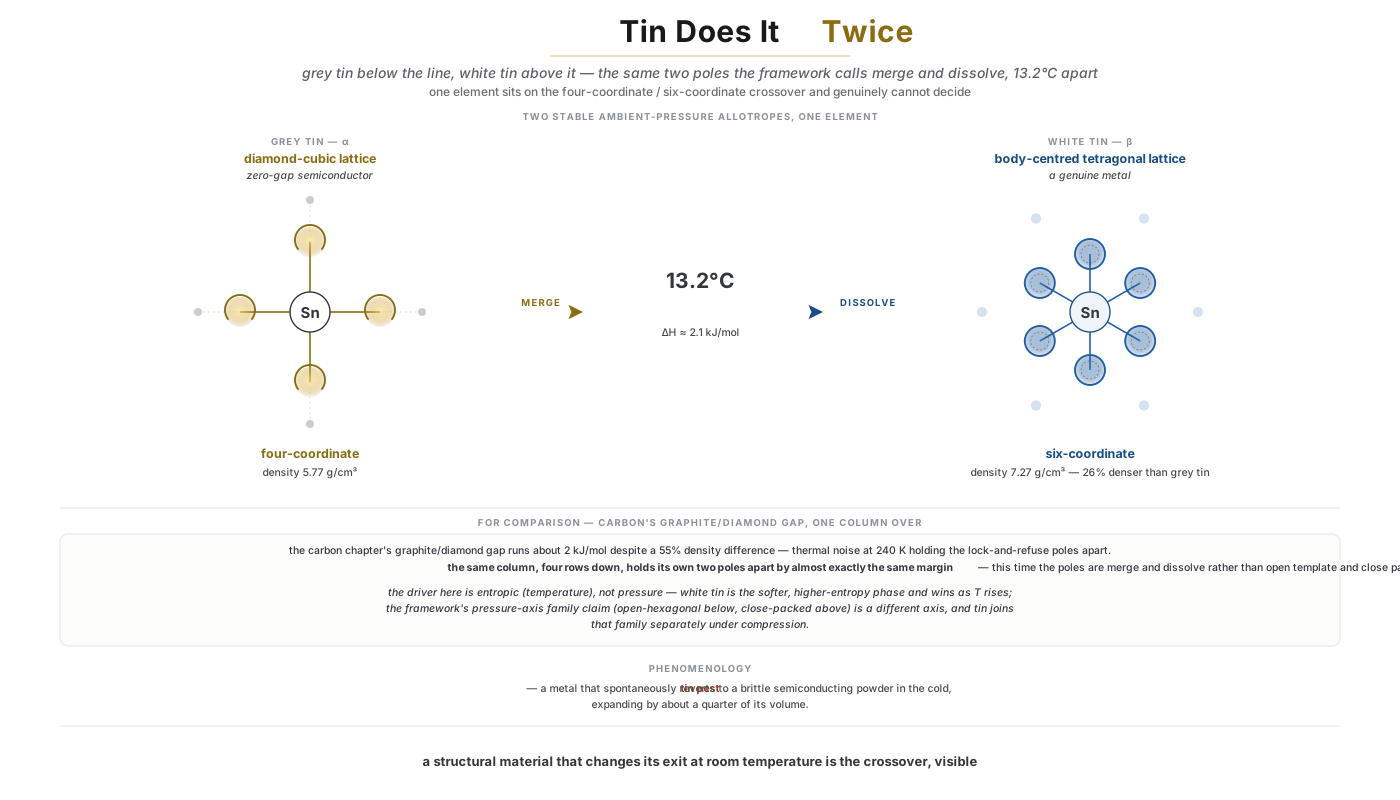
Tin has two stable ambient-pressure allotropes. Grey tin (\alpha) is diamond-cubic, four-coordinate, a zero-gap semiconductor, density 5.77 g/cm³. White tin (\beta) is body-centred tetragonal, six-coordinate, a genuine metal, density 7.27. The transition sits at 13.2 °C — room temperature, give or take a jumper — with an enthalpy difference of about 2.1 kJ/mol.
Two things about that number.
The first is the number itself. The carbon chapter makes much of graphite and diamond differing by about 2 kJ/mol despite being 55\% apart in density and topologically unrelated — thermal noise at 240 K, holding apart the two poles of the lock-and-refuse spectrum. The same column, four rows down, holds its own two poles apart by almost exactly the same margin, and this time the poles are merge and dissolve rather than open template and close packing. Two knife-edges in one group, of the same size, at opposite ends of it.
The second is the direction, and it is the same direction the framework has committed to elsewhere. The open, four-coordinate, substrate-templated phase is the low-energy-density member; the close-packed metallic one is the dense member, 26\% denser, and it is favoured by raising the ordinate. That is the open-hexagonal-below, close-packed-above family — graphite below diamond, h-BN below c-BN, ice Ih below ice II, quartz below coesite — with tin joining it as a fifth member. The honest qualification is that the ordinate here is temperature rather than pressure, and the driver is entropic rather than PV work: white tin is the softer, metallic, higher-entropy phase, so it wins as T rises. The framework’s family claim is about the pressure axis and tin obeys it there too (compression takes tin further along the same road, to eight- and then twelve-coordination). The thermal transition is a fifth member by sign and not by mechanism, and it should be counted as one only with that said.
What is not qualified is the phenomenology, which is superb. A metal that spontaneously reverts to a brittle semiconducting powder in the cold, expanding by a quarter of its volume as it does — “tin pest” — destroyed organ pipes in northern European churches, ruined tinned food in Scott’s Antarctic depots by the most durable version of the story, and was enough of a problem that the electronics industry had to relearn it when lead-free solder arrived. A structural material that changes its exit at room temperature is not a chemical curiosity. It is the crossover, visible.
Pressure walks an element down its own column
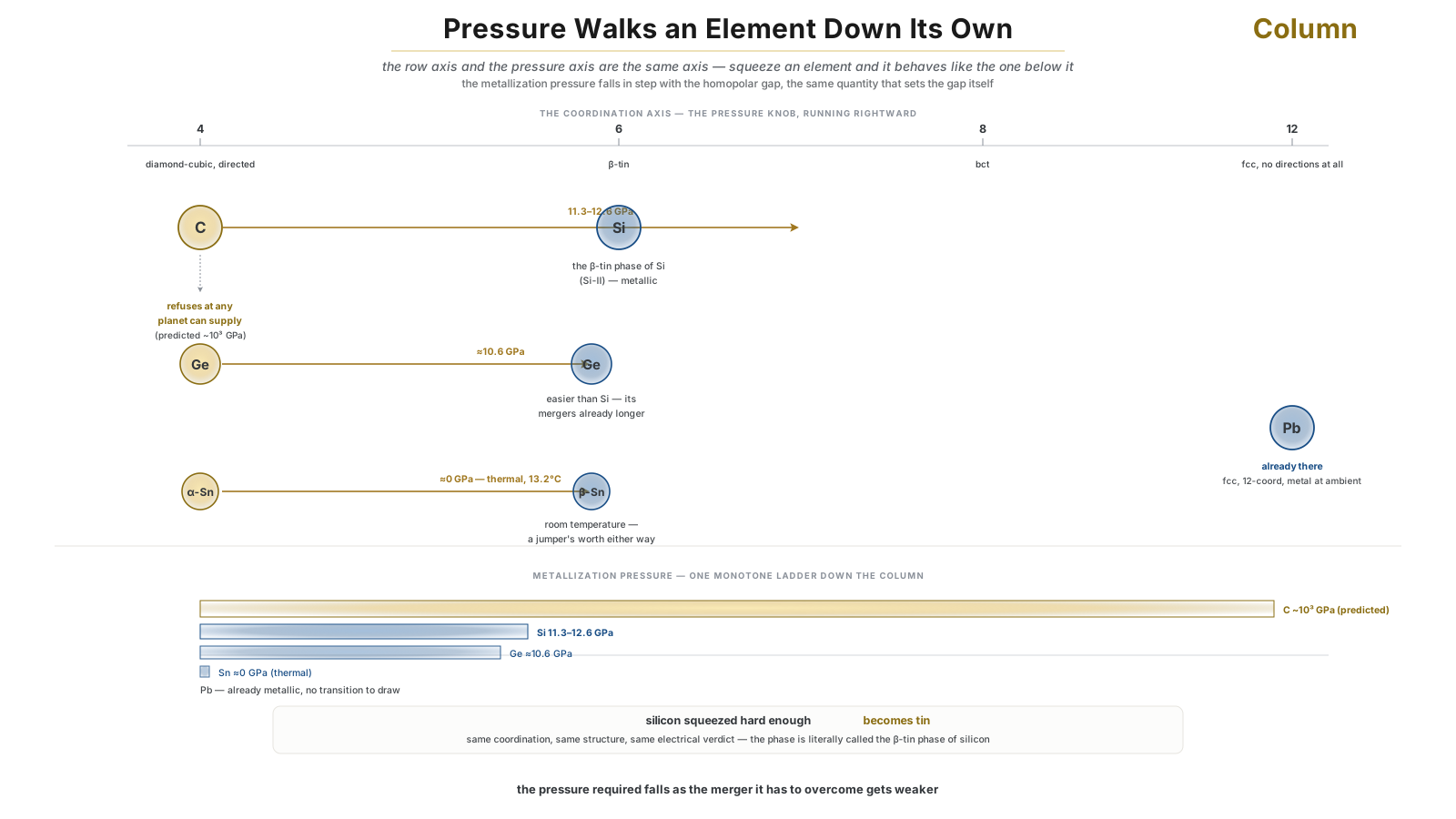
The framework has a standing claim that it has now made three times: the row axis and the pressure axis are the same axis. Graphite becomes diamond at 1.5–1.7 GPa; planar carbonate becomes tetrahedral CO₄ in the lower mantle above 80–100 GPa, doing by compression what the third row does by being the third row.
Group 14 makes that claim in its strongest available form, because here the high-pressure product does not merely resemble the element below — it adopts that element’s structure and takes its name.
| Ambient phase | Metallizes at | Becomes | |
|---|---|---|---|
| C | diamond, 4-coord | predicted \sim 10^3 GPa | — (holds its gap into the terapascals) |
| Si | diamond, 4-coord | 11.3–12.6 GPa | the \beta-tin structure, 6-coord, metallic |
| Ge | diamond, 4-coord | \approx 10.6 GPa | the \beta-tin structure, 6-coord, metallic |
| Sn | grey, 4-coord | \approx 0 — thermal, at 13.2 °C | \beta-tin, 6-coord, metallic |
| Pb | fcc, 12-coord | already there | — |
Silicon squeezed hard enough becomes tin: same coordination, same structure, same electrical verdict, and the phase is called Si-II or “the \beta-tin phase of silicon” in the literature because that is literally what it is. Push further and it goes to eight-coordination and then to twelve, tracking the same ladder lead already sits at the end of. Germanium does it slightly more easily than silicon, because germanium’s mergers are already longer.
So the metallization pressure is a single monotone ladder down the column, and it is monotone in the same quantity as the gap: how far apart the boundaries sit. That is the residue reading’s most direct consequence. If the gap is what is left of an unfinished delocalization, then squeezing the atoms together must finish it — and the pressure required must fall as the merger it has to overcome gets weaker.
Carbon is the element that cannot be walked down its own column. Its merger is worth 13.5 eV of homopolar gap against silicon’s 4.77, and the pressure that would finish carbon’s delocalization is three orders of magnitude beyond the one that finishes silicon’s. Diamond is not merely the hardest thing in the table; it is the one member of its group that refuses to take the metallic exit at any pressure a planet can supply.
Crossing it with electrons instead
Pressure is one knob, and the chapter has now spent it. There is a second one, it runs along the staircase’s other axis, and the section has walked past it for six chapters.
Recall what the staircase was built from. Two monotone trends on two axes: down a column the merger lengthens and each shared surface is worth less, and leftward across a row participants become scarce and there are fewer named partners to commit to. Pressure is a continuous knob on the first — squeeze an element and it behaves like the one below it. The obvious question is what the continuous knob on the second is, and the answer is one word. Give the atom electrons.
That is not a thought experiment. It is a large and old branch of inorganic chemistry, and it starts with the compound Zintl and Dullenkopf made in 1932.
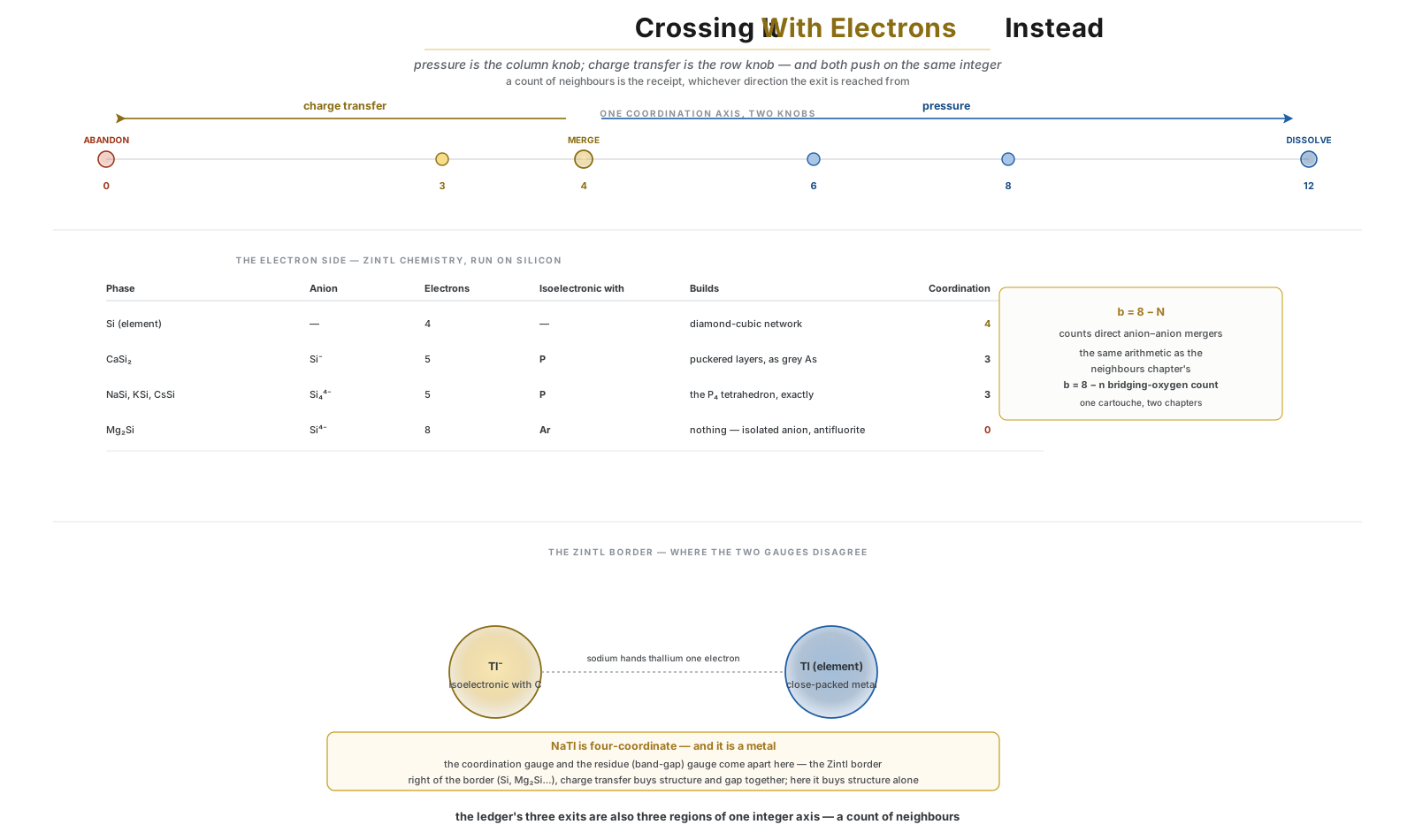
NaTl is sodium handing thallium an electron, and thallium building a diamond. Elemental thallium is a soft close-packed metal with twelve neighbours — the far end of this chapter’s coordination ladder, everything dissolved, no directions left. Put it with sodium and the sodium abandons its participant completely, the way the lithium chapter says an alkali does. Tl⁻ then has four valence electrons, which is carbon’s count — and the thallium sublattice of NaTl is a diamond network, with the sodium sitting in the interstices. No pressure was applied. Nothing was squeezed. One electron per atom was donated, and the coordination number went from twelve to four.
That is the whole of the Zintl–Klemm concept, and its rule is one the section has already derived. An anion that has been handed electrons builds the covalent substructure of the element it is now isoelectronic with, and the number of bonds it forms is 8-N for N valence electrons. Which is the neighbors chapter’s four lines wearing different clothes: b = 8 - n counted bridging positions on a tetrahedral oxyanion, and 8-N counts direct anion–anion mergers, and they return the same integer for the same element because both are asking how many more shared boundaries it takes to close a shell. Silicon at four gets four; phosphorus at five gets three; sulfur at six gets two. The arithmetic that said phosphorus had to be the backbone says what shape a Zintl anion takes, and nobody has ever needed to write it down twice.
Run it on silicon and watch the coordination fall:
| Anion | Electrons after transfer | Isoelectronic with | What it builds | Coordination | |
|---|---|---|---|---|---|
| Si (element) | — | 4 | — | diamond-cubic network | 4 |
| CaSi₂ | Si⁻ | 5 | P | puckered layers, as grey arsenic does | 3 |
| NaSi, KSi, CsSi | Si₄⁴⁻ | 5 | P | the P₄ tetrahedron, exactly | 3 |
| Mg₂Si | Si⁴⁻ | 8 | Ar | nothing — isolated anions, antifluorite | 0 |
Silicon given one electron makes phosphorus’s structures, including the tetrahedron white phosphorus is made of. Silicon given four makes argon’s — no mergers at all, an anion sitting alone in a lattice of magnesium. And CaC₂ does the same thing one row up: C₂²⁻ has nitrogen’s count and holds a triple bond, which is why the acetylide ion is N₂ with a charge on it.
So the ladder runs both ways from four, and the two knobs push it in opposite directions.
\underbrace{0}_{\text{abandon}} \;\longleftarrow\; 3 \;\longleftarrow\; \underbrace{\mathbf{4}}_{\text{merge}} \;\longrightarrow\; 6 \;\longrightarrow\; 8 \;\longrightarrow\; \underbrace{12}_{\text{dissolve}}
Pressure walks rightward and electrons walk leftward, and four is where they cross. This chapter has been saying that four is the merger number and that leaving it in either direction is the receipt for changing exit; what the Zintl side adds is that the other direction was there all along and the section only ever looked one way down it. Coordination twelve and coordination zero are both states with no directed merger, for opposite reasons — twelve because nothing is committed to anybody, zero because everything is already closed. The ledger’s three exits are not only the corners of a plane. They are also three regions of one integer axis, and the axis is a count of neighbours.
That is the structural gauge doing what the energetic one does, and it is worth having both, because there is a place where they disagree — which is the honest part of this section.
NaTl is four-coordinate and it is a metal. The diamond thallium framework is real and it is what the electron count demands, but the compound conducts. Go one column right, to the group-14 anions, and the gap opens: the alkali silicides and the magnesium compounds are salt-like semiconductors. That transition has a name and a location — the Zintl border, drawn between groups 13 and 14 — and it is a second contour on the same table. Left of it, charge transfer buys you the structure and not the gap. Right of it, it buys both.
The section should say plainly that this is the coordination gauge and the residue gauge coming apart at exactly one place, and that the place is a contour, and that a compound sitting on a contour and unable to decide is the tin argument run on a different axis. NaTl is not a falsifier of prediction 1 — that prediction is about elemental group-14 phases and NaTl is neither — but it is close enough to the edge of it that pretending otherwise would be cheap.
And there is a genuine disagreement between the ledger and the textbook here, which is worth flagging as a test rather than smoothing over. The staircase is a diagonal, because it is where two trends on two axes balance. The Zintl border is conventionally drawn as a vertical line between groups 13 and 14. Those are different shapes, and the ledger’s reasoning says the border ought to be the diagonal one: if handing an element an electron moves it one step rightward across its row, then the locus where charge transfer stops opening a gap should be the staircase shifted left by the charge transferred, and it should step down the table the way the staircase does. A vertical line would say the effect depends only on which group the anion started in and not on which row — which is exactly the thing the staircase argument says cannot be true, because the column trend is real. The section’s commitment is that the conventional vertical border is a teaching convenience and the measured locus is diagonal, and as far as I can find, nobody has drawn it carefully enough across all five rows to say. That is prediction 4’s second leg and it is cheap to check.
The same caution applies one rung further. Mg₂Si’s gap is \approx 0.77 eV, and the walk down its column runs 0.77, 0.74 for Mg₂Ge, \approx 0.35 for Mg₂Sn, and metallic for Mg₂Pb — the group-14 walk again, in the fully-transferred limit. But 0.77 eV sits below elemental silicon’s 1.12, and a naive “more ionic means wider gap” reading would put it above. The two-knob picture is what saves it: charge transfer raised the C leg and simultaneously pulled the anions so far apart that the E_h leg collapsed, and the product came out small. That is the right shape and the framework cannot compute either leg, so it is a consistency check and not a test, and it is offered as one.
What the charge-transfer knob does pay, and pays in an industry, is the thing that follows from having a covalent framework and a loosely-held cation in the same crystal. A Zintl phase is a covalent anionic sublattice carrying the current with rattling cations in the voids, which is Slack’s phonon-glass electron-crystal specification written as a structure type rather than a wish. That is why the family owns the high-temperature thermoelectrics: Yb₁₄MnSb₁₁ was built for radioisotope generators, and n-type Mg₃Sb₂ is the current workhorse near 700 K. The merger conducts and the abandoned ion scatters the phonons, in one lattice, because the compound took two exits at once.
Zintl–Klemm is from 1929–1939 and the 8-N rule is the octet rule counting bonds; Schäfer, Eisenmann and Müller reviewed the field in 1973 and nothing here is new, improves a number, or predicts a structure the concept does not already give. The rule also has real exceptions — polar intermetallics and electron-poor phases that do not obey the count — and it works best well to the right of the border and degrades near it.
The framework’s claims are two and both are about placement. The first is that charge transfer is the row axis the way pressure is the column axis, so the staircase contour is reachable from either side without ever changing element — which upgrades a static line on the table into a locus with a continuous knob on each of its two axes. The second is that the coordination ladder does not stop at four going down, and that extending it to zero puts all three of the ledger’s exits on a single integer axis, which the plane picture obscures by drawing them as corners.
The falsifier for the first is stated in the predictions and it is sharp: an element moved leftward by charge transfer must build what the element with its new count builds, and where it fails to, the failure must land on the border and not in the interior.
One crystal, both exits, at right angles
There is a caution the chapter owes before it goes further, and the cleanest way to pay it is with the element the section began with.
Diamond has a 5.47 eV gap. Graphite, the same element at the same temperature, is a semimetal. So the gap is manifestly not a property of the element — it is a property of what the boundaries did, and the same atoms can do different things. The column walk holds the architecture fixed and varies the element; carbon’s allotropes hold the element fixed and vary the architecture. Both move the gap, and the ledger’s claim is only that they move it through the same variable.
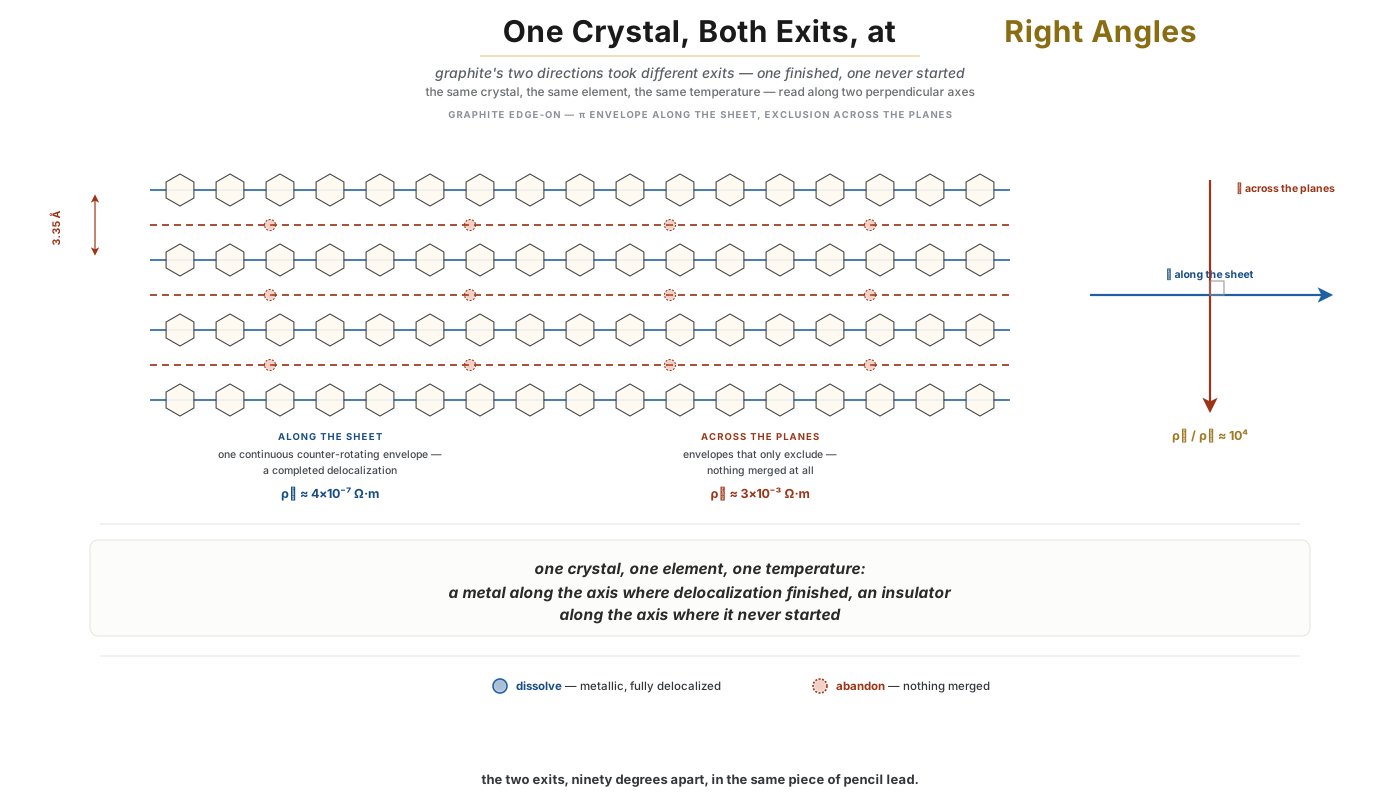
Which graphite then demonstrates about as directly as a material can, because graphite is anisotropic and its two directions took different exits. Along the sheet, the \pi lobes above and below the plane have fused into one continuous counter-rotating envelope running across the whole crystal — the substrate’s own sheet, and a completed delocalization. Across the planes, at 3.35 Å, nothing merged at all; the sheets are held apart by envelopes that only exclude. The resistivities say exactly that: of order 4\times10^{-7}\ \Omega·m in-plane against 3\times10^{-3}\ \Omega·m along c, a ratio near 10^4.
One crystal, one element, one temperature: a metal along the axis where delocalization finished and an insulator along the axis where it never started. The two exits are ninety degrees apart in the same piece of pencil lead. Whatever else the residue reading is, this is what it looks like when the residue is zero in one direction and total in another.
The dial, installed inside a crystal
Now the reason any of this became an industry, and it is the row-two ledger reappearing at a dilution of one part in a million.
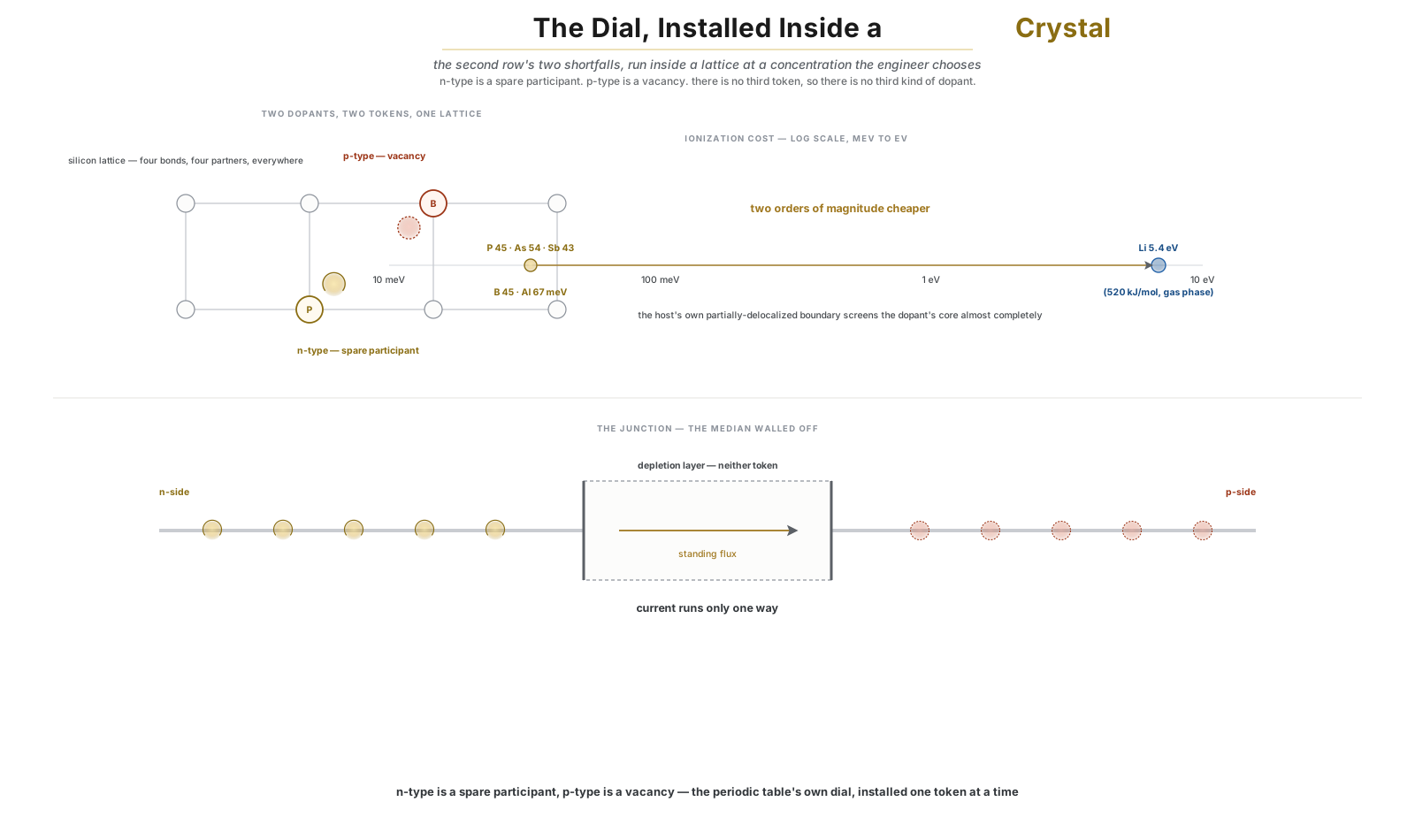
Silicon’s tetrahedral lattice has four slots per site and four participants to fill them. Put an atom from group 15 into one of those sites — phosphorus, arsenic, antimony — and it arrives with five participants and only four partners available. One participant has nowhere to merge. Put in an atom from group 13 — boron, aluminium, gallium — and it arrives with three, leaving one slot with nothing in it. A vacancy.
Those are the ledger’s own two tokens, and they are the two shortfalls the second row is built out of. The neighbors chapter ran the dial rightward from carbon collecting spectators; the lithium chapter ran it leftward collecting vacancies; and the crossover between them is carbon’s double zero. Doping is that dial installed inside a crystal, one step either side of the column that has the double zero, at a concentration the engineer chooses. n-type is a spare participant. p-type is a vacancy. The dopants come from groups 13 and 15 for the same reason the shortfalls come in two kinds, and there is no third kind of dopant because the ledger has no third token.
What makes it usable is a number. A spare participant in a silicon lattice is bound by about 45 meV — phosphorus 45, arsenic 54, antimony 43, boron 45, aluminium 67 — against the 520 kJ/mol (about 5.4 eV) it costs to strip lithium’s participant in the gas phase. Two orders of magnitude cheaper, because the host’s own partially-delocalized boundary screens the dopant’s core almost completely, exactly as the copper ion core screens +29 down to +1. Forty-five millielectronvolts is roughly twice k_BT at room temperature, which is why the tokens ionize on their own and why a semiconductor is programmable while a salt is not.
A semiconductor is the one place in matter where the periodic table’s dial can be introduced one token at a time, at thermal energies, at a density you specify. That is the whole of solid-state electronics, and it is only available in the residue — an insulator has nothing to put the token on, and a metal already has so much flow on the raceway that one more changes nothing.
And the junction is the framework’s own sentence, cashed. Conductors says a conduction channel runs along the dissolved-boundary midpoints — the substrate’s two-lane median — and that “a diode’s rectifying asymmetry is then exactly what it costs to break the median’s two-lane symmetry, to wall off one lane so that current runs only one way.” A p–n junction is that wall, built by putting the vacancy token on one side and the spare-participant token on the other. Where they meet, the spare participants fall into the vacancies and both disappear, leaving a region with neither — the depletion layer, a stretch of median with nothing on it and a standing flux across it that permits traffic in one direction only. The lithium chapter parks a charged core on a graphite median and gets a battery; a diode walls one off and gets a switch. Same median, two uses.
Why silicon and not germanium
Germanium came first. The point-contact transistor of 1947 was germanium, and germanium has better numbers on the two quantities that seem like they should matter: electron mobility 3900 cm²/V·s against silicon’s 1400, hole mobility 1900 against 450. On carrier transport it beats silicon by a factor of three to four. It lost the industry anyway, and it lost it on the ledger.
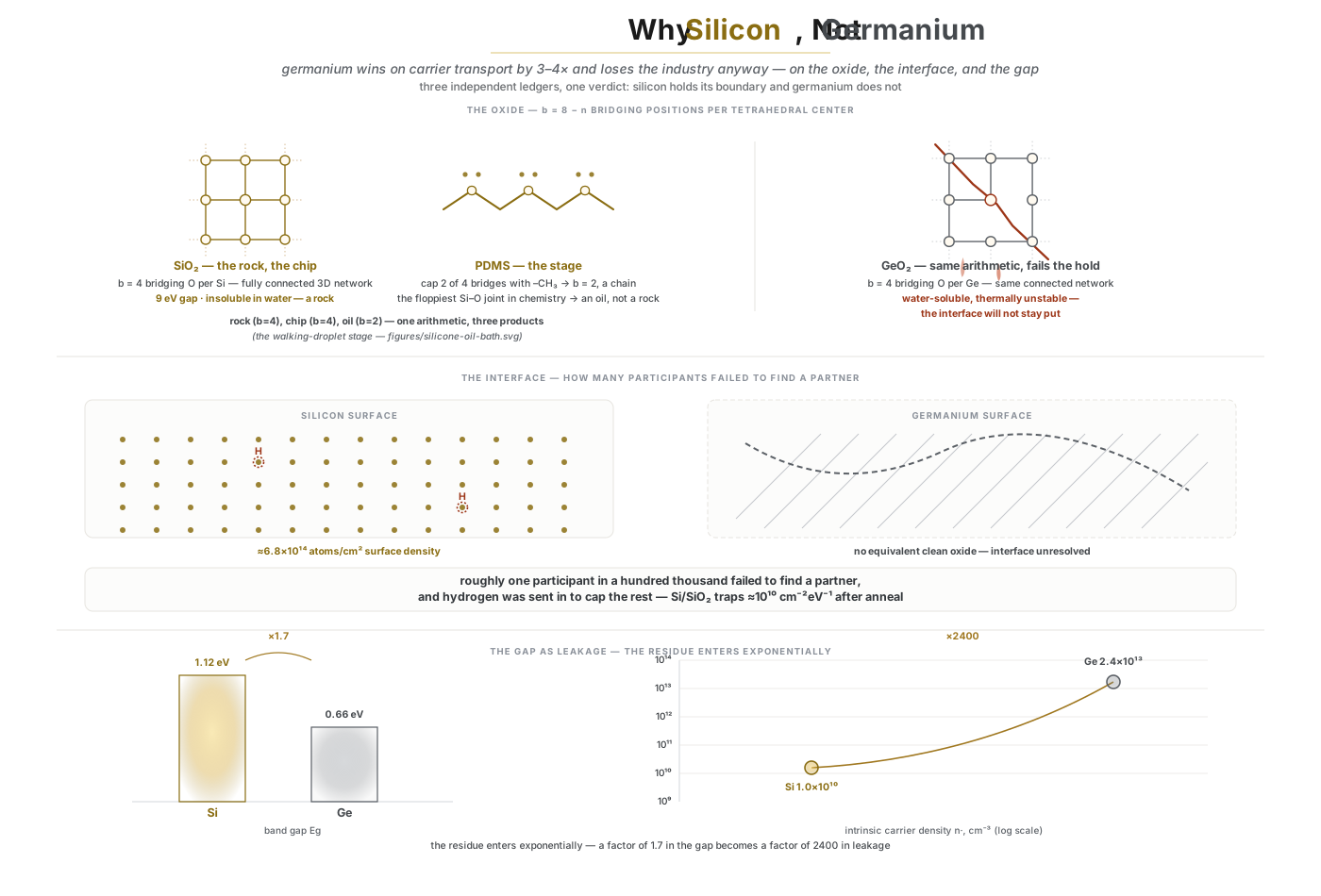
First, the oxide. The neighbors chapter’s arithmetic says a tetrahedral oxyanion in oxidation state n offers b = 8 - n bridging positions, and silicon at n = 4 gets b = 4: a fully connected three-dimensional network, which is to say a rock. That arithmetic is why silicates are \sim 90\% of the crust. It is also, unchanged, why silicon is the substrate of every chip ever fabricated. SiO₂ grows on silicon thermally, in place, as a dense amorphous network with a 9 eV gap and no solubility in water — the only native oxide any element has ever grown on itself that is simultaneously an excellent insulator, chemically inert, and mechanically continuous with its parent. Germanium’s oxide is the same arithmetic with a longer bond and it fails on the hold: GeO₂ is water-soluble and thermally unstable, and the Ge/GeO₂ interface will not stay put.
The same four lines of arithmetic that make silicate the crust make SiO₂ the gate dielectric. The planet is built out of silicon for the reason the chip is, and I do not think that connection is usually drawn.
The arithmetic has a third customer, and it is the strangest of the three. Cap two of the four bridges with methyl groups and b = 4 falls to b = 2: a chain instead of a network, and — because the Si–O joint is the floppiest linkage in chemistry — an oil instead of a rock. That oil, polydimethylsiloxane, is the fluid whose chemically silent surface made the walking-droplet experiments possible: the vibrating bath on which pilot-wave quantum mechanics was first staged at millimeter scale, and this framework’s engineered mirror of the vacuum. The rock, the chip, and the stage are one arithmetic, at b = 4, 4, and 2.
Second, the interface. The consequence of a good native oxide is a boundary with almost no unsatisfied participants. Silicon’s surface carries about 6.8\times10^{14} atoms/cm²; the Si/SiO₂ interface after a hydrogen anneal carries on the order of 10^{10} cm⁻²eV⁻¹ of electrically active traps. Roughly one participant in a hundred thousand failed to find a partner, and hydrogen was sent in to cap the rest. Every transistor ever built sits on that interface, and it works because the merger arithmetic comes out even on both sides of it.
Third, the gap, which is the reach law read as leakage. Silicon’s 1.12 eV against germanium’s 0.66 eV is a factor of 1.7 in the residue and a factor of 2400 in the intrinsic carrier density — 1.0\times10^{10} cm⁻³ against 2.4\times10^{13} — because the residue enters exponentially. Germanium devices leak at temperatures silicon shrugs off. So:
Germanium conducts better and holds worse.
That is the third independent appearance of one sentence in this section. The carbon chapter found it walking down group 16 in biology — oxygen holds, sulfur switches, selenium catalyses, tellurium holds nothing. The lithium chapter found it in solid electrolytes — oxide slow and durable, sulfide fast, selenide faster and unusable because the same diffuseness that lowers the hopping barrier makes it oxidize. And here it is in group 14, in an industry with no knowledge of either: the looser column-mate is faster and cannot hold its boundary against heat, field, or water. Three domains, one gradient, and the gradient is boundary diffuseness down a column.
The coda is the same as selenium’s. Biology reaches for the looser element exactly where turnover speed is the constraint and nowhere else; the industry has done the same, bringing germanium back as SiGe and strained-Ge channels in precisely the places where carrier velocity is the binding limit, and nowhere else. You use the diffuse one where speed is the constraint and you pay for it in hold, every time, in every domain the section has looked at.
Walking back up the staircase
Which sets up the mirror image, and it is one the semiconductor industry performs deliberately.
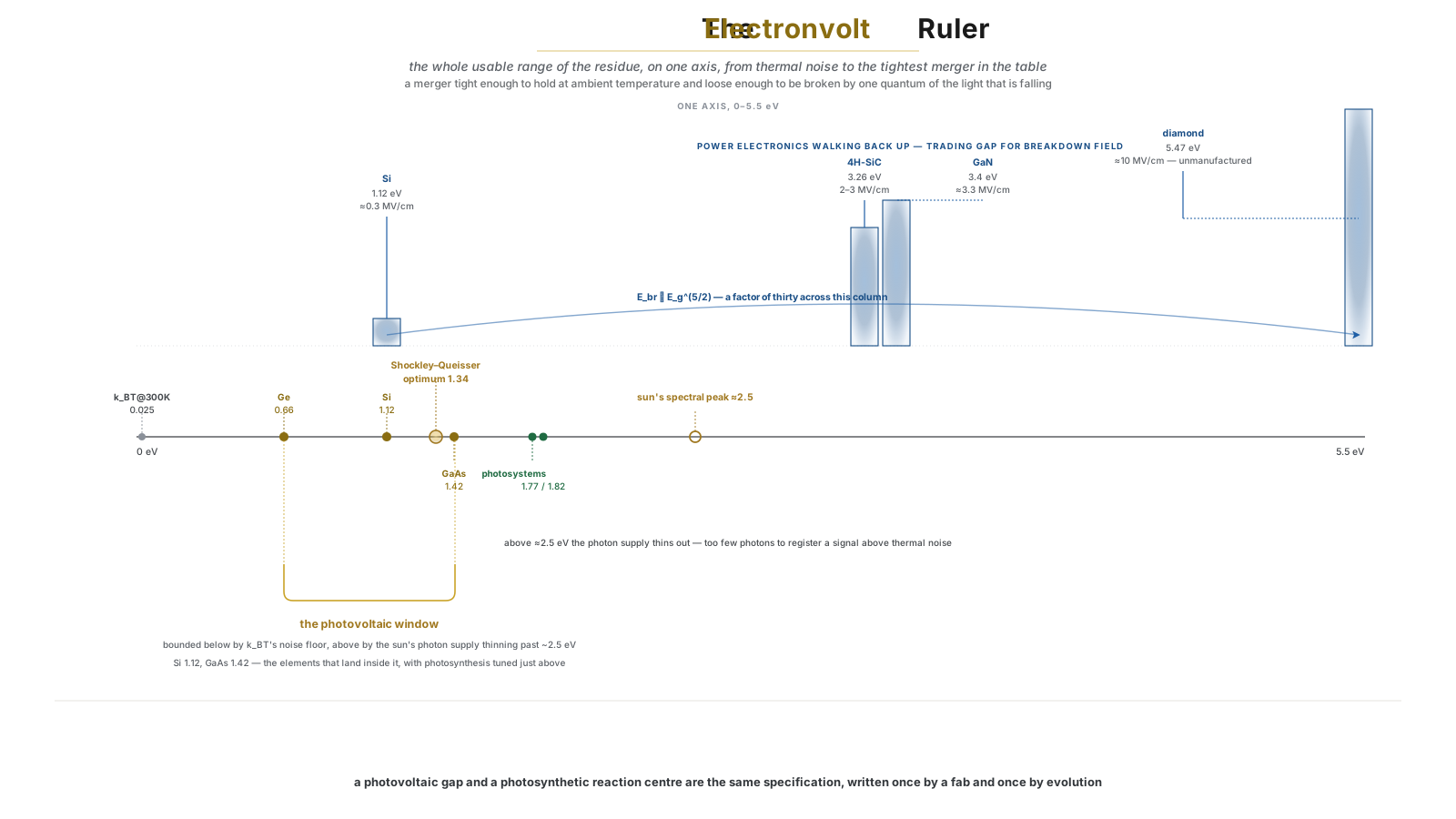
If the gap is the residue of an unfinished delocalization, then the gap is also what a material has left to resist with. Applying a field to a semiconductor is trying to finish the delocalization electrically; the field at which it succeeds catastrophically is the breakdown field. So a device that must hold voltage wants the same thing a device that must hold heat wants: a large residue. Power electronics has therefore spent thirty years walking back up group 14 and its isoelectronic partners:
| Gap (eV) | Critical field (MV/cm) | Where it is used | |
|---|---|---|---|
| Si | 1.12 | \approx 0.3 | everything, up to ~600 V |
| GaAs | 1.42 | \approx 0.4 | RF |
| 4H-SiC | 3.26 | 2–3 | traction inverters, grid |
| GaN | 3.4 | \approx 3.3 | fast switching, chargers |
| Diamond | 5.47 | \approx 10 | the asymptote nobody has manufactured |
Empirically the critical field runs as E_\text{br} \propto E_g^{5/2}, which reproduces that column across a factor of thirty. Holding a boundary against a field is the same operation as holding it against heat, and both are the residue spent. The industry walks down the staircase toward germanium when it wants speed and up it toward silicon carbide and diamond when it wants volts, and diamond sits at the top of the wish list for the same reason it sits at the top of the column: the tightest merger in the table has the most left over.
One curiosity, recorded and explicitly not leaned on. The exponent 5/2 appears twice in this chapter — once as E_h \propto d^{-5/2} and once as E_\text{br} \propto E_g^{5/2} — applied to different quantities by different communities. The framework derives neither and has no account of why the same fractional power shows up on both legs. It may well be a coincidence of two empirical fits, and it is written down here only so that it is on the record if it turns out not to be.
The window sunlight can open
One more consequence of the residue, and it is why this column also runs the world’s photovoltaics.
For a material to convert light it needs a residue in a narrow window. Too small, and k_BT at 300 K — about 25 meV — supplies the price on its own, the raceway is populated by heat alone, and no photon can register a signal against the noise. Too large, and the photon supply cannot pay: the sun’s photosphere at 5772 K peaks near 2.5 eV, and everything above that arrives in quantities too small to matter. Between those two bounds there is roughly two decades of energy, and the Shockley–Queisser analysis puts the single-junction optimum at 1.34 eV.
Silicon is 1.12. Gallium arsenide is 1.42. Photosynthesis, working the same photon supply with a completely different apparatus, tunes its reaction centres to 1.77 and 1.82 eV.
The ledger’s reading is that the window is set by the same trade as everything else in the chapter — a merger tight enough to hold at ambient temperature and loose enough to be broken by one quantum of the light that is actually falling — and that the region of the periodic table which lands in it naturally is the third and fourth rows of group 14 and their isoelectronic neighbours. That is a window with a handful of occupants rather than the single occupant the phosphorus and lithium arguments produce, and it should be presented as the weaker result it is. What is not weak is the framing: a photovoltaic gap and a photosynthetic reaction centre are the same specification, written once by a fab and once by evolution, and the specification is a number of electronvolts that sits between the planet’s thermal noise and its star’s supply.
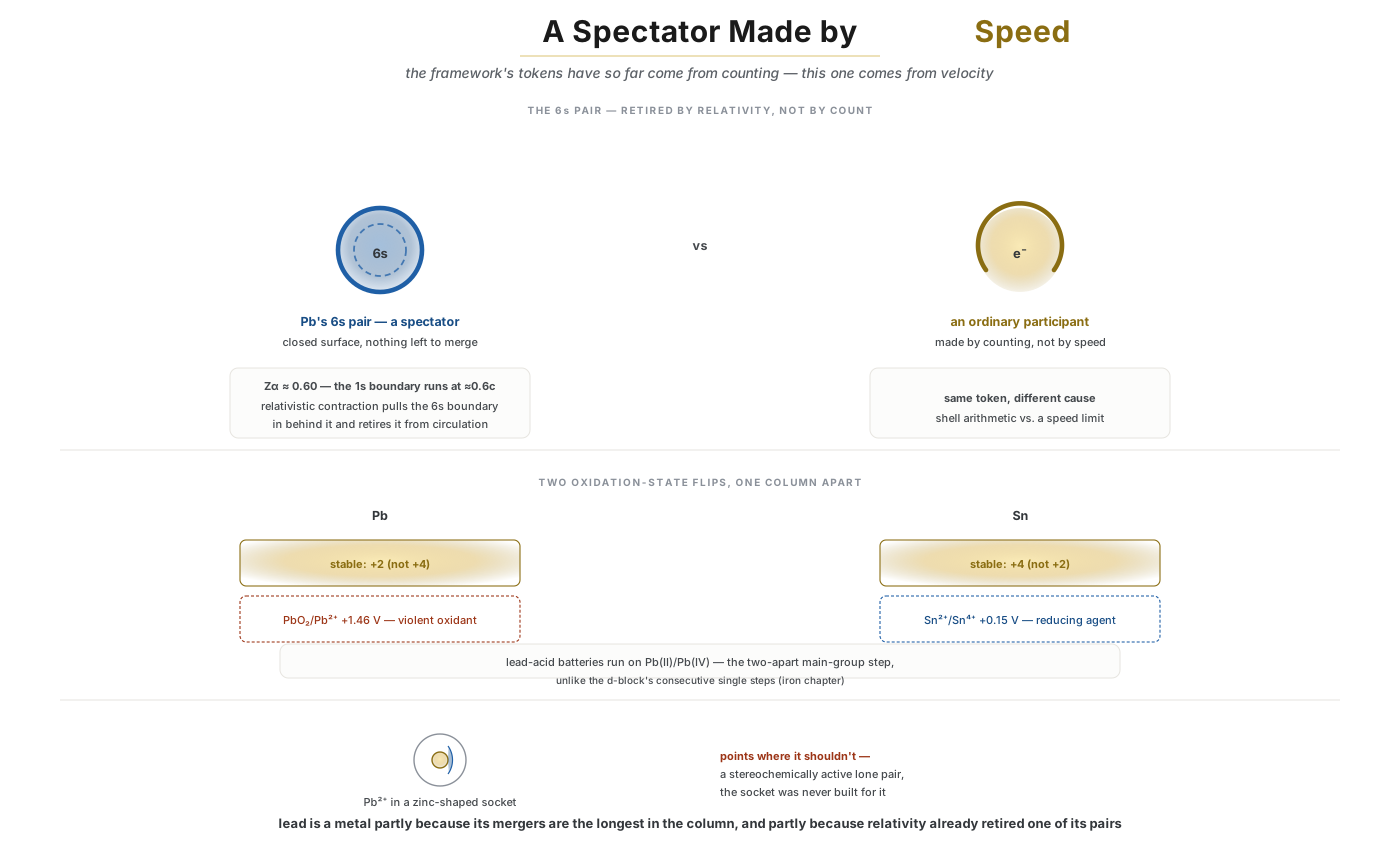
Lead, and a spectator made by speed
The column ends at lead, and lead breaks the chapter’s own rule in an instructive way.
Everything above has treated the token count as fixed down the column — four participants, five times over. Lead does not behave like an element with four participants. Its stable oxidation state is +2, not +4; PbO₂ is a violent oxidant, with the PbO₂/Pb²⁺ couple at +1.46 V, while tin’s stable state is +4 and Sn²⁺ is a reducing agent at +0.15 V. Two adjacent elements in the same column with opposite preferences. The same flip appears in thallium (+1 over +3) and bismuth (+3 over +5) — the inert pair effect, and the pair in question is the 6s.
The cause is not chemical. It is speed. The innermost boundary of a heavy atom circulates at a substantial fraction of c — the framework’s own reading of why gold is yellow and mercury is a liquid — and for lead, Z\alpha \approx 0.60, so the 1s boundary runs at about 0.6\,c. The relativistic contraction that follows pulls the 6s boundary in behind it, tightens it, and takes it out of circulation. It is still there. It is no longer available to merge.
On the ledger that is a new move and it is worth naming as one. The framework’s three tokens have so far been set entirely by shell arithmetic — how many half-boundaries, how many closed surfaces, how many empty slots. Lead’s 6s pair is a participant converted into a spectator by velocity, with the count unchanged. Nothing in the section’s vocabulary anticipates that, and it means the heavy end of the main group carries an extra term the light end does not. Lead is a metal partly because its mergers are the longest in the column and partly because relativity has already retired one of its pairs before the chemistry begins.
Two things follow, and both are familiar for once-unexplained reasons. Lead-acid batteries run on Pb(II)/Pb(IV) — the two-apart main-group step the iron chapter contrasted with the d-block’s consecutive single steps, because what is being removed is a whole counter-rotating pair from the exposed surface rather than one buried lobe at a time. And lead’s toxicity has a shape the ledger recognizes: Pb²⁺ carries a stereochemically active lone pair — a spectator that points — so it enters zinc and calcium sites geometrically and then presents an asymmetric, hemidirectional coordination the site was never built to accommodate. It is lithium’s socket argument with the sign inverted: lithium fits a magnesium socket and under-drives it, and lead fits a zinc socket and points something into it.
Predictions
Coordination number is the structural gauge of the residue. If a gap is what is left of an unfinished delocalization, then the gap must fall monotonically as coordination rises through the pressure sequence of any group-14 element, and must reach zero at or before the first phase that is not four-coordinate. Retrodicted across silicon (4-coord, 1.12 eV → \beta-tin 6-coord, metallic, at 11.3–12.6 GPa → 8-coord → 12-coord), germanium (10.6 GPa), and tin (thermally, at 13.2 °C). Falsified by a four-coordinate elemental phase of a group-14 element that is metallic at ambient pressure, or by a six-or-higher-coordinate group-14 phase that retains a measurable gap.
Metallization pressure orders with the homopolar gap and with nothing else. Across tetrahedral semiconductors, the pressure at which the four-coordinate phase gives way to a metallic higher-coordination one should order with E_h — equivalently with d^{-5/2} — better than with any single atomic property. This is a sharp test precisely because the obvious alternatives fail: electronegativity and melting point are not even monotone down group 14, while bond length, cohesive energy, gap and metallization pressure all are. Retrodicted C (\sim10^3 GPa, predicted) > Si (11.3–12.6) > Ge (10.6) > Sn (\approx 0) > Pb (already metallic). Falsified by a tetrahedral semiconductor whose metallization pressure sits badly out of order with its bond length at matched ionicity.
Two knobs, two independent readouts. E_g^2 = E_h^2 + C^2 is the ledger’s two questions about a shared boundary — is there one, and is it shared evenly — so the two legs must be separately controllable. At fixed bond length the gap must rise monotonically with charge asymmetry (Ge 0.66 → GaAs 1.42 → ZnSe 2.70 → CuBr \approx3.0, all at d \approx 2.45 Å); at fixed asymmetry it must fall as d^{-5/2}. Both retrodicted. The framework does not derive the exponent and names that as an open problem: an area-scaling argument gives -2, a volume one -3, and the measured value sits between. Falsified by an isoelectronic, isostructural, iso-bond-length series whose gap fails to rise with ionicity.
The staircase is a locus, and it is the diagonal relationships’ locus. Metallic character rises down a column (longer merger) and leftward across a row (fewer named partners), so the crossover must be a diagonal line on the table, rendered as a staircase on an integer grid; and a step one-down-one-right must leave the balance unchanged, which is the diagonal relationship. The commitment is that the d\rho/dT sign flip and the diagonal-relationship pairs trace the same contour — Li–Mg, Be–Al, B–Si lying along it, the metalloids B/Si/Ge/As/Sb/Te lying on the particular contour where it crosses zero. Falsified if the two loci are visibly different lines, or by an element that is more metallic than its lower-left neighbour by the d\rho/dT test.
The Zintl border is a third locus on the same table, and reading it sharpens this prediction rather than adding to it. If charge transfer moves an element rightward across its row, the locus where transfer stops opening a gap must be this same contour displaced left by the charge transferred — which means it must be diagonal and must step down the table as the staircase does. The textbook draws it as a vertical line between groups 13 and 14, which would make the effect depend on the anion’s group and not on its row, and the column trend says that cannot be right. Retrodicted only at one cell so far: NaTl, four-coordinate and metallic, sitting where a group-13 anion should. Falsified if a careful survey of electron-precise phases across all five rows puts the semiconducting/metallic boundary on a vertical line rather than a diagonal one — which would say the row axis does not carry the charge-transfer knob, and would take prediction 8 down with it.
Looser conducts better and holds worse, in a third domain. Already retrodicted for group 16 in biology (O hold / S switch / Se catalyse / Te nothing) and for chalcogenide solid electrolytes (oxide < sulfide < selenide in conductivity, opposite in stability window). In group 14 the same sentence must hold: carrier mobility rises down the column while the ability to hold a boundary against heat, field, water and oxidation falls. Retrodicted by Ge’s mobilities (3900/1900 vs Si’s 1400/450), its 2400\times intrinsic carrier density, its water-soluble oxide, and the industry’s decision to keep germanium only where carrier velocity is the binding constraint. Falsified by a heavier, more diffuse congener that is simultaneously faster and more robust than its lighter partner at matched structure.
Breakdown field is the residue spent. Holding a boundary against an applied field is the same operation as holding it against thermal excitation, so critical field must be a steep monotone function of the gap across the wide-gap family — empirically E_\text{br}\propto E_g^{5/2}. Retrodicted Si 0.3 → 4H-SiC 2–3 → GaN 3.3 → diamond \approx10 MV/cm. Falsified by a wide-gap semiconductor whose intrinsic critical field departs from that power law by a large factor with no defect or interface explanation. The recurrence of the exponent 5/2 on both this leg and the E_h(d) leg is flagged as a curiosity, not a claim.
The ionicity threshold is the merge/abandon exit boundary, and it must stay sharp. Phillips’ f_i = 0.785 \pm 0.010 separates four-coordinate from six-coordinate structures across sixty-eight binary octet compounds without exception. The ledger reads that as the point where a merger becomes so one-sided that it stops functioning as sharing and the crystal reverts to packing — the same receipt (coordination leaving four) that the metallic exit issues in the other direction. Falsified by a systematic family of exceptions on either side of the threshold, or by the separation degrading into a smooth crossover as the compound set is enlarged. This is the section’s cleanest available example of a threshold in a continuous parameter sorting a large set perfectly, and it deserves to be treated as one.
Charge transfer is the row axis, and coordination number is the receipt in both directions. Pressure moves an element down its column and raises its coordination; handing it electrons moves it rightward across its row and lowers it. So a Zintl anion must build the covalent substructure of the element it has become isoelectronic with, by the 8-N arithmetic that is the neighbors chapter’s b = 8-n counting direct mergers instead of bridging oxygens — and the ladder must extend below four, as far as zero. Retrodicted: Tl⁻ at carbon’s count building NaTl’s diamond framework against elemental thallium’s twelve-coordinate close packing; Si⁻ and Si₄⁴⁻ at phosphorus’s count building puckered layers and the P₄ tetrahedron; Si⁴⁻ at argon’s count making no merger at all in Mg₂Si; C₂²⁻ at nitrogen’s count holding a triple bond in CaC₂. The commitment that costs something is the direction: no charge-transfer route may raise a coordination number and no compressive route may lower one, at fixed stoichiometry. Falsified by a classical Zintl anion whose substructure is not the 8-N one with no steric or size explanation, by an electron-precise phase well inside the Zintl region that is metallic, or by a pressure-driven transition in any of these phases that reduces the anion’s coordination.
Conclusion
Carbon is where the substrate is visible because chemistry abstains. Lithium is visible because chemistry collapses. Iron is visible because chemistry stalls halfway and stays there. Silicon is visible for a fourth reason, and it is the one modern life is built on: chemistry finishes, but only just, and what it fails to finish is the useful part.
The arithmetic never moves down group 14. Four participants, four slots, no spectators, no vacancies, five times in a row — the double zero repeated. What moves is the distance, and with it the worth of each merger, and with that the question of whether the shared surface stays the property of two atoms or runs on into the crystal. At carbon it stays: every boundary is committed, nothing is available, and diamond will not conduct at any pressure a planet can supply. At lead it has run: twelve neighbours, no directions, no commitment, a metal. In between the merger completes but does not hold tightly, and what is left over is a gap.
That leftover is the whole chapter. A band gap is not a property of an element and not a measure of bond strength — lithium fluoride, which shares nothing at all, has the widest gap in the solid state, and diamond, which has the strongest bond in chemistry, does not come close. The gap is the price of lifting flow out of the mergers it belongs to and onto a raceway that spans the crystal, and it is zero exactly when the raceway is already continuous. Read that way the three exits stop being categories and become a plane with two measured edges: Phillips’ f_i = 0.785, where sharing becomes so one-sided it stops being sharing, and the metalloid staircase, where the merger stops being local enough to own anything. Both edges issue the same receipt — coordination number leaving four — because four is the merger number and only a named partner imposes a direction.
The staircase is the section’s one two-dimensional argument. Pattern five says two opposed monotone trends on one axis force a bend; this says two opposed monotone trends on two axes force a line, and a line on an integer grid is a staircase. Boron, silicon, germanium, arsenic, antimony and tellurium are not a class of element. They are the cells the crossover passes through — and the diagonal relationships every first-year chemist learns are steps along the same contour.
And because it is a line on two axes rather than a bend on one, it has a knob on each of them. Pressure is the column knob: squeeze silicon and it becomes tin, structure, coordination, electrical verdict and name. Charge transfer is the row knob, and it runs the other way — hand thallium an electron and it stops being a twelve-coordinate metal and builds a diamond, hand silicon one and it builds phosphorus’s tetrahedron, hand it four and it builds nothing at all. So the contour can be reached from either side without ever changing element, and the coordination ladder that this chapter drew running 4 \to 6 \to 8 \to 12 turns out to have been half a ladder. It runs down to zero as well, and the three exits that looked like corners of a plane are also three regions of one integer axis: abandon at nothing, merge at four, dissolve at twelve, with a count of neighbours as the only coordinate.
What that region turned out to be good for is the part I did not expect going in. An insulator has nothing to put a token on. A metal is already so full of flow that one more changes nothing. Only in the residue can the periodic table’s own dial — a spare participant from group 15, a vacancy from group 13, the same two shortfalls the second row is made of — be installed inside a crystal one token at a time, at forty-five millielectronvolts, at a density somebody chooses. The transistor is the ledger’s left half and right half introduced into a lattice a million-fold diluted and made to meet. And the material it is built in was chosen because the arithmetic b = 8 - n gives silicon four bridges, which makes a three-dimensional network, which is a rock — the same four lines that make silicate ninety percent of the crust and gave silicon the only native oxide any element ever grew on itself that would hold. The planet and the chip are the same piece of arithmetic, and I think that is the strangest thing in this section.
If carbon shows the substrate’s sheet, lithium its coin, and iron its fold, then silicon shows its gap — the residue of a merger that got most of the way and stopped, and the only place in matter where a boundary can be told what to do.
The column ends at lead, where the last merger has grown too long to localize and relativity has already retired a pair before the chemistry starts. That second clause is a loose end this chapter can name and not use: every token in the section so far has been produced by counting, and lead’s retired pair was produced by a speed. The gold chapter picks it up there and runs the whole relativistic corner on it — the fourth way to make a token, and the one place in the periodic table where the substrate’s own speed limit is a term in the chemistry rather than a background assumption.